1. Introduction
Ultra-fast electric vehicle (EV) charging systems are emerging as one of the most demanding classes of converter-dominated power electronic applications. Their operation involves high power levels, wide battery-voltage variations, strict thermal limits, fast transient requirements, and increasing expectations for intelligent charging management. In such systems, the charging converter must operate efficiently and reliably over a broad operating envelope, while simultaneously balancing electrical performance, thermal stress, charging speed, and implementation feasibility. These requirements make ultra-fast charging a representative benchmark for advanced converter modeling, design, and control strategies [
1,
2].
Conventional converter design and tuning approaches often rely on analytical approximations, repeated switching-level simulations, and fixed control strategies such as classically tuned constant-current/constant-voltage (CC–CV) charging. While these methods remain useful in practice, they become increasingly limited when multiple conflicting objectives must be considered simultaneously across varying battery and operating conditions. In ultra-fast charging applications, a parameter set that performs well at one operating point may become suboptimal at another, especially when efficiency, ripple, semiconductor stress, transient response, and charging-policy adaptation must all be addressed together. This creates a need for computational frameworks that can support coordinated design-space exploration and operating-point-aware control refinement [
3,
4].
Artificial intelligence (AI) has shown strong potential in power electronics for nonlinear modeling, surrogate prediction, fault diagnosis, adaptive control, and parameter estimation. In particular, surrogate-learning approaches can reduce the cost of repeated converter evaluation by replacing computationally expensive high-fidelity simulations with fast predictive models. This capability is especially attractive in high-power charging converters, where the feasible design and operating space is wide and strongly nonlinear [
5,
6]. However, AI-based prediction alone does not fully resolve the underlying optimization challenge. Even when a fast surrogate model is available, the search for improved design and control settings remains difficult because the associated decision space is multi-objective, highly coupled, and often nonconvex [
7,
8].
In parallel, quantum and quantum-inspired optimization methods have attracted increasing attention for engineering problems involving combinatorial structure, large search spaces, and nontrivial trade-offs. In the present context, their relevance lies not in replacing classical converter design tools, but in providing an additional optimization layer within a hybrid workflow [
9,
10]. A practically meaningful perspective is therefore to treat quantum-assisted optimization as part of a broader co-design process, in which physical modeling, AI-based prediction, and structured search interact iteratively. For converter-oriented applications, such a hybrid view is more realistic than claims of standalone quantum superiority, particularly under the present limitations of near-term hardware [
11,
12].
Despite these developments, the combined use of AI-based surrogate learning and quantum-assisted optimization remains insufficiently structured in the context of high-power EV charging converters [
13,
14]. Existing studies often focus either on AI for converter modeling and control, or on general discussions of quantum-enhanced optimization, without providing a unified engineering workflow that links converter representation, surrogate learning, multi-objective optimization, and charging-policy adaptation in a single framework [
15]. This gap is particularly relevant for ultra-fast EV charging, where converter-level and charging-level decisions are tightly coupled and must be addressed across a wide battery operating range [
16,
17].
To address this gap, this paper proposes a hybrid AI–quantum co-design framework for a SiC-based DAB converter intended for ultra-fast EV charging applications. The framework combines three main elements: a physical converter representation, an AI surrogate model for rapid prediction of converter performance, and a quantum-assisted optimization layer for multi-objective exploration of design and control variables. The proposed approach is demonstrated through a representative 350 kW ultra-fast charging case study, in which the converter operating conditions and charging behavior are analyzed in a simulation-based proof-of-concept setting.
The main contributions of this work are as follows:
- (1)
The formulation of a hybrid AI–quantum co-design framework tailored to a SiC-based DAB ultra-fast charging converter;
- (2)
The integration of surrogate-learning-based converter evaluation with multi-objective quantum-assisted optimization;
- (3)
The introduction of a clarified workflow linking data generation, surrogate training, candidate screening, and high-fidelity validation;
- (4)
The presentation of a representative simulation-based case study, supported by an explicit system schematic, converter topology, and engineering performance comparison against a conventional baseline charging strategy.
The remainder of the paper is organized as follows.
Section 2 presents the materials and methods, including the proposed framework, the selected DAB charging system, the mathematical formulation, the surrogate-learning procedure, and the optimization workflow.
Section 3 presents the simulation-based results.
Section 4 discusses the engineering implications, limitations, and relevance of the proposed approach.
Section 5 concludes the paper and outlines directions for future work.
2. Materials and Methods
2.1. Methodological Overview and Research Scope
This study is developed as a simulation-based proof-of-concept investigation of a hybrid AI–quantum co-design strategy for ultra-fast EV charging converters. The goal is not to claim immediate industrial deployment or hardware-level quantum advantage, but to establish a structured computational workflow that combines physical converter modeling, AI-based surrogate learning, and quantum-assisted multi-objective optimization within a single engineering framework. In this sense, the present work is positioned between methodological framework development and converter-oriented application study, with emphasis on practical interpretability and design relevance.
The selected application is a high-power ultra-fast EV charging interface, since such systems concentrate many of the difficulties that characterize converter-dominated energy applications: wide operating ranges, nonlinear dynamics, strong coupling between electrical and thermal behavior, and the need for adaptive control under time-varying battery conditions. These characteristics make ultra-fast charging an appropriate benchmark for testing whether hybrid AI–quantum workflows can support more efficient design-space exploration and more informed operating-point selection than conventional fixed-parameter approaches.
For engineering specificity and feasible simulation-based validation, the case study is focused on a SiC-based DAB isolated DC/DC converter embedded in a representative 350 kW ultra-fast EV charging system. The proposed co-design framework combines three main layers:
- (i)
A physical system layer representing the charging converter and its operating conditions;
- (ii)
An AI surrogate-learning layer used for fast approximation of converter performance metrics;
- (iii)
A quantum-assisted optimization layer used to explore multi-objective design and control trade-offs.
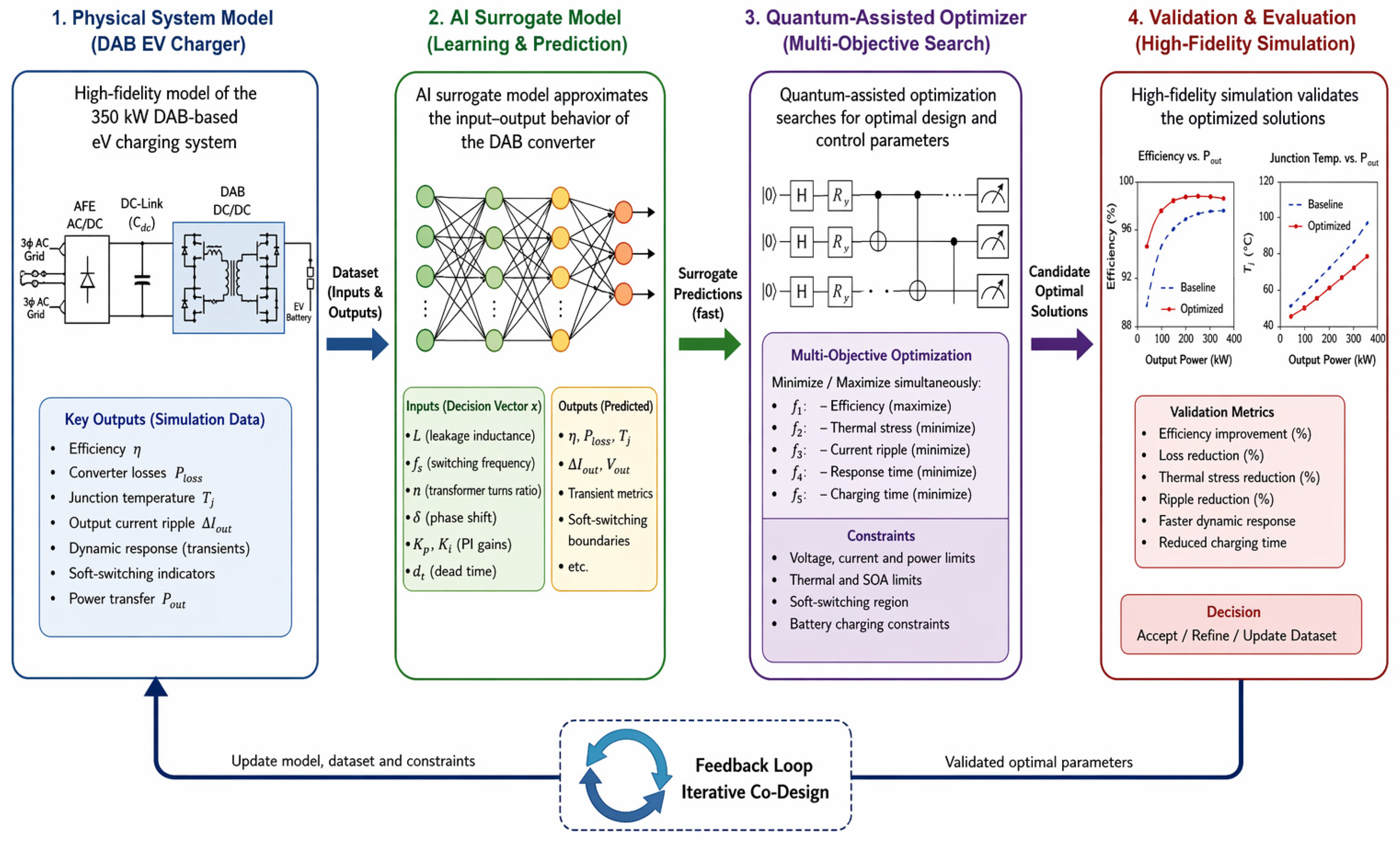
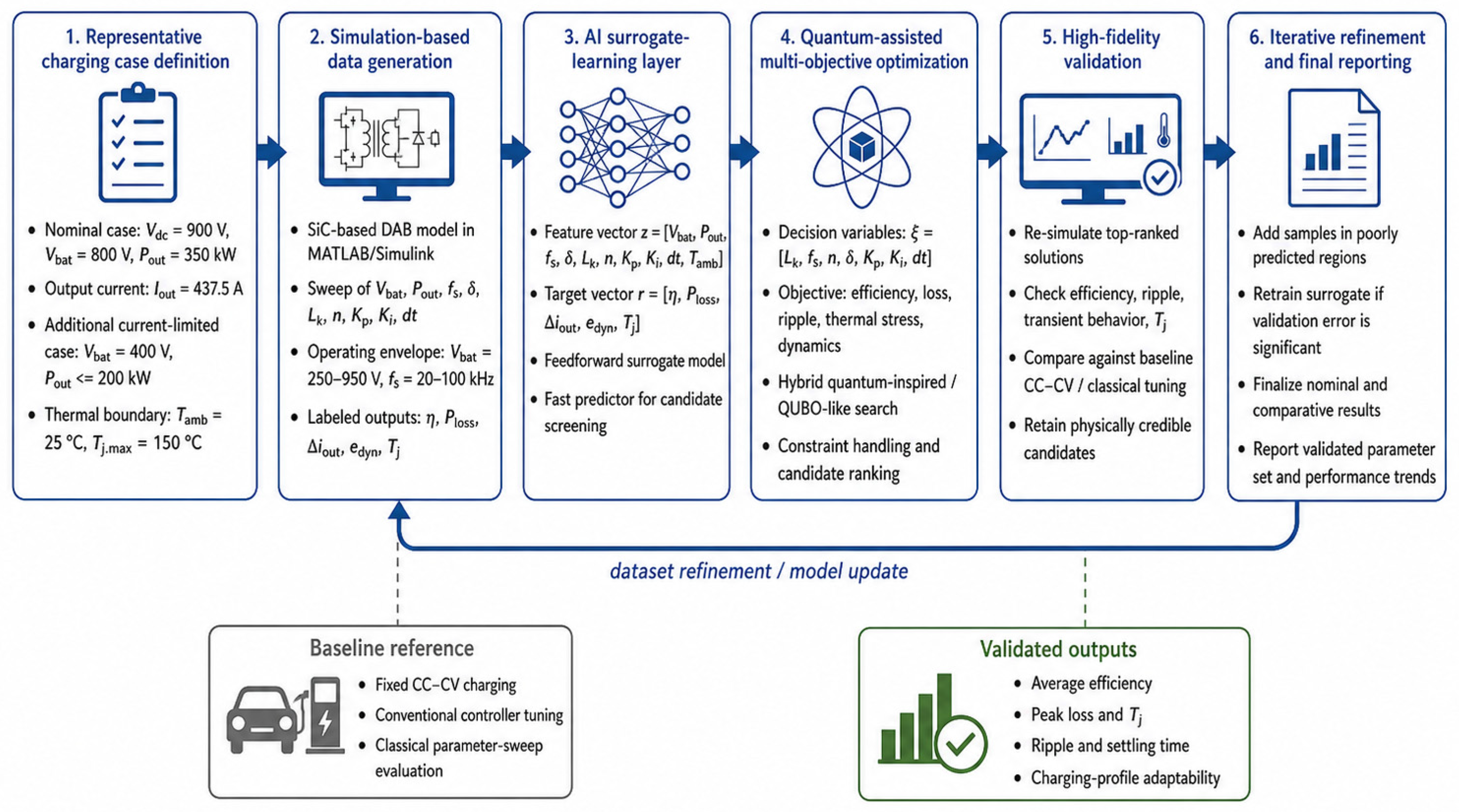
The interaction between these layers is organized as an iterative workflow in which simulation-generated data are used to train a surrogate model, the surrogate model is then used to screen candidate design/control solutions, and selected candidates are re-evaluated through higher-fidelity validation. This methodological structure provides the basis for the case study presented in the following subsections.
The revised methodology is organized as a hybrid co-design workflow combining physical converter representation, AI-based surrogate prediction, and quantum-assisted multi-objective search.
All quantitative performance indicators reported in this work were obtained from the investigated high-fidelity simulation environment and should be interpreted as representative model-based engineering results within the considered operating envelope. No experimental hardware measurements are claimed in the present study. The overall structure of the proposed framework is illustrated in
Figure 1.
2.2. Overall Architecture of the Ultra-Fast EV Charging System
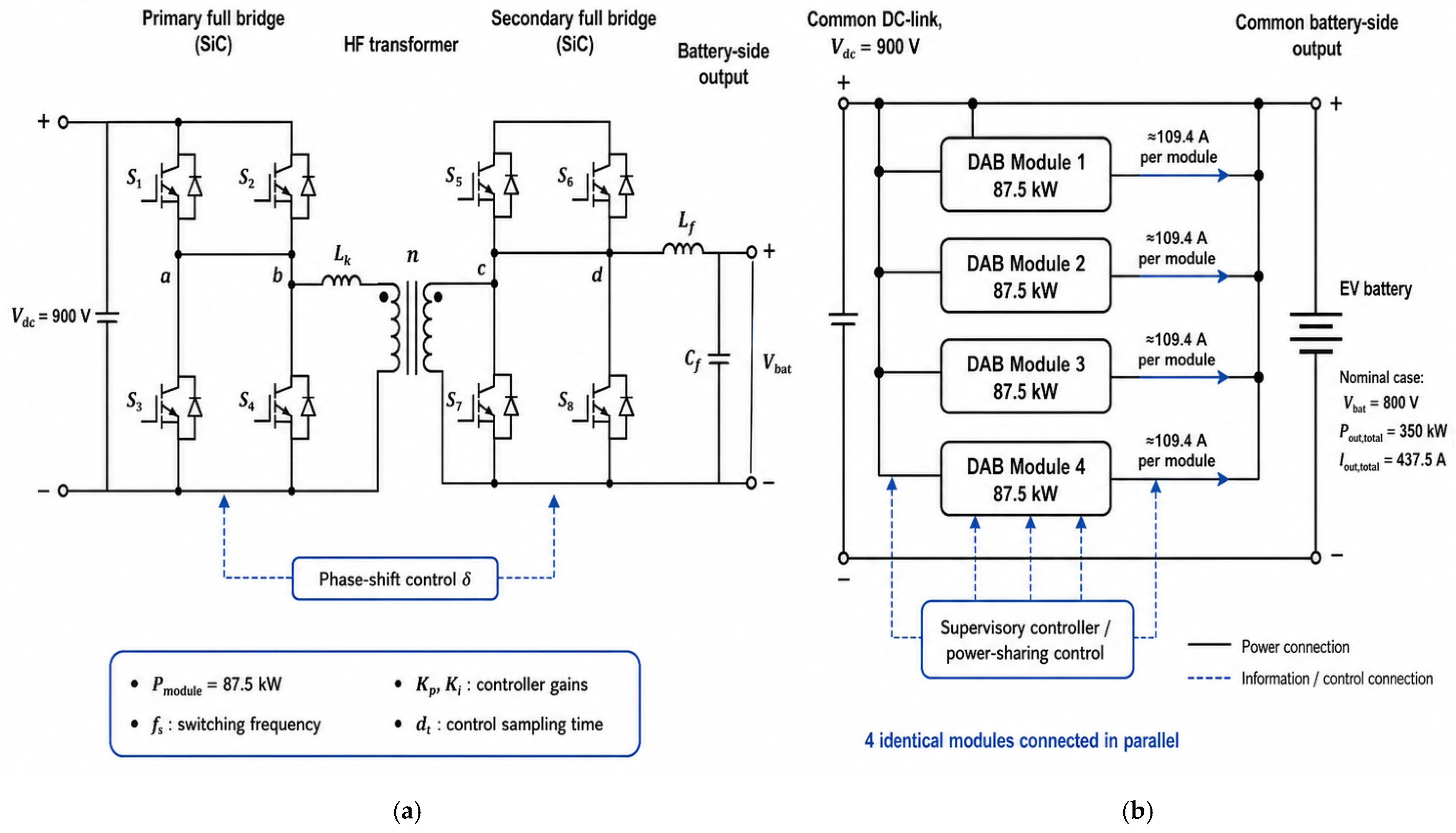
To avoid ambiguity between the explored operating envelope and the numerical case used for validation, the 350 kW isolated DC/DC charging stage was modeled as a modular system composed of four identical parallel SiC-based DAB modules, each rated at 87.5 kW. In the nominal full-power validation case, the common DC-link voltage is Vdc = 900 V, the battery-side voltage is Vbat = 800 V, and the total output power is Pout,total = 350 kW. This corresponds to a total output current of 437.5 A and approximately 109.4 A per DAB module. In addition, a 400 V battery-side case is considered under current-limited operation. Since 350 kW at 400 V would require 875 A, which exceeds the current envelope considered in this study, the 400 V case is evaluated at Pout,total ≤ 200 kW.
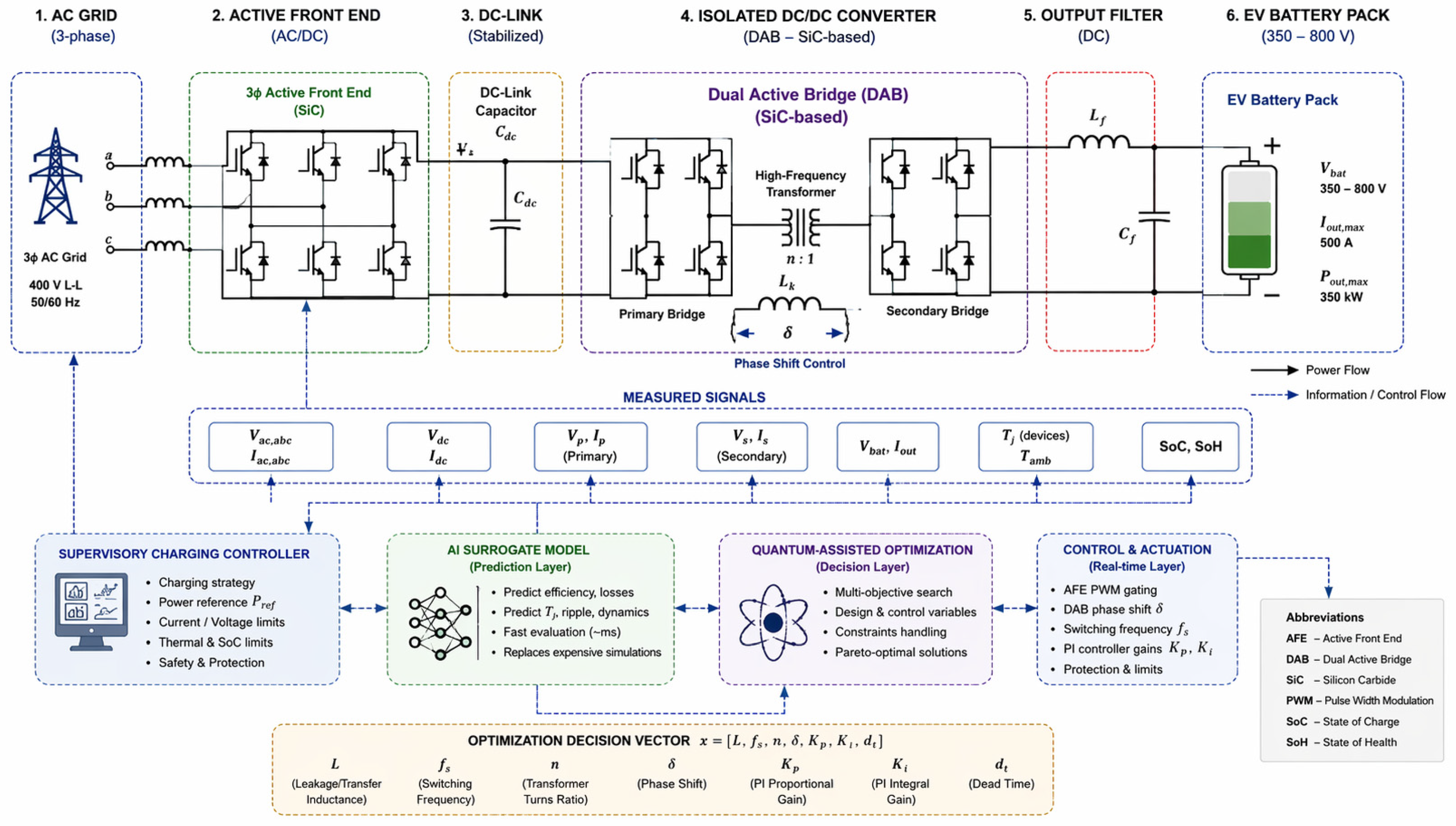
As shown in
Figure 2, the system consists of a three-phase active front-end (AFE) AC/DC converter, a stabilized DC-link stage, a SiC-based isolated DAB DC/DC charging converter, an output-side battery interface, and a supervisory charging controller. The supervisory layer coordinates power-transfer objectives, charging constraints, and thermal operating limits, while the proposed AI–quantum co-design blocks support improved design-space exploration and adaptive operating-point refinement.
The overall architecture is selected to reflect a realistic charging chain in which multiple converter stages interact. However, the methodological focus of the present study is placed on the modular isolated DC/DC charging stage, since this subsystem is most directly affected by battery-side voltage variation, high-frequency switching behavior, soft-switching conditions, thermal stress, and wide-range control requirements. As a result, the four-module SiC-based DAB stage provides a suitable engineering target for demonstrating the proposed co-design strategy [
18].
The main electrical and modular specifications considered in the case study are summarized in
Table 1. The table distinguishes between the broad design/simulation envelope and the representative numerical validation cases used in the revised evaluation. The nominal 800 V case corresponds to full-power operation of the 350 kW charger, while the 400 V case is evaluated under current-limited reduced-power operation [
4].
These parameters define the representative operating envelope used throughout the simulation-based proof-of-concept evaluation presented in the following sections.
Beyond the physical power path, the considered charging architecture also includes an information and optimization layer. Measured or simulated variables such as DC-link voltage, battery voltage, output current, state of charge, and thermal indicators are treated as inputs to the surrogate-learning and optimization workflow. In this way, the charger is modeled not only as a power electronic system, but also as a computationally supervised charging platform in which converter design variables and charging-policy variables can be jointly considered. This is particularly important in ultra-fast charging, where the optimal operating region shifts substantially during the charging process and cannot be adequately represented by a single fixed nominal condition.
2.3. Selected SiC-Based DAB Converter Topology
For improved engineering realism, the 350 kW charging stage was modeled as a modular isolated DC/DC system composed of four identical parallel SiC-based DAB modules, each rated at 87.5 kW. This modular representation allows realistic per-module current and component values while preserving the total charger power level. In the nominal validation case, the charger operates with
Vdc = 900 V,
Vbat = 800 V, and
Pout = 350 kW, which corresponds to a total output current of 437.5 A and approximately 109.4 A per DAB module.
Figure 3a shows the topology of one representative DAB module, while
Figure 3b shows the charger-level arrangement of the four parallel modules.
The considered converter consists of a primary full bridge connected to the DC-link side, a high-frequency transformer providing isolation and voltage adaptation, an equivalent power-transfer inductance, and a secondary full bridge connected to the battery-side interface. In the present study, the converter is assumed to employ SiC switching devices, motivated by their suitability for high-power-density and high-frequency charging applications. Compared with conventional silicon devices, SiC devices support improved switching performance and reduced conduction losses, which is especially important in ultra-fast charging systems operating over a broad voltage and power range.
A key feature of the DAB is that the transferred power is primarily regulated through the phase shift between the primary- and secondary-side bridge voltages. This makes the topology especially attractive for multi-objective co-design studies, since both hardware-related and control-related parameters can be coordinated within the same optimization space. In the present case study, the most relevant design and operating variables include the equivalent transfer inductance, switching frequency, transformer turns ratio, phase-shift control variable, and selected controller tuning parameters. These variables directly influence converter efficiency, RMS current stress, thermal loading, ripple behavior, and transient performance across the charging envelope.
The choice of the DAB topology is also motivated by practical modeling considerations. Unlike a purely conceptual isolated converter block, the DAB provides a concrete and well-established engineering structure through which the proposed AI–quantum workflow can be demonstrated in a technically interpretable manner. In this sense, the topology is not introduced merely as an example, but as the specific converter platform on which the revised manuscript builds its simulation-based proof-of-concept for ultra-fast EV charging co-design.
2.4. Physical and Mathematical Representation of the Charging Converter
To support surrogate learning and optimization in a physically meaningful way, the selected DAB charging converter is represented by a reduced-order nonlinear dynamic model. The purpose of this formulation is not to replace detailed switching-level simulation, but to provide a compact engineering description of the converter behavior that connects the physical charging system with the AI and optimization layers of the proposed framework. This clarification is important because the mathematical model is used here as an interface model for co-design and not as a claim of full-order analytical completeness [
3,
19].
The converter dynamics are expressed in the general nonlinear state-space form:
where
x(t) denotes the state vector,
u(t) the control input vector,
p(t) the operating-point variables, and
θ the design parameters of the converter. In the present DAB case study, the state vector may include representative electrical and thermal quantities such as transfer-inductor current, capacitor voltage, and thermal-state variables, while the control vector includes the phase-shift command and associated regulation signals. The operating-point vector
p(t) captures battery-side conditions such as battery voltage, requested charging power, and charging-region variation, whereas
θ includes design and tuning variables such as transfer inductance, transformer ratio, switching frequency, and controller gains.
The output vector y(t) contains the engineering quantities of interest for co-design and optimization, including output voltage, output current, converter efficiency, ripple-related indicators, and semiconductor thermal stress. From the standpoint of the proposed workflow, these outputs are not introduced only for mathematical completeness; they are the exact performance quantities that the surrogate model later approximates and that the optimization layer seeks to improve under multiple constraints. The role of the state-space representation is therefore to define the physical dependency structure between design variables, operating conditions, and observable performance metrics.
For the DAB topology, the dominant power-transfer mechanism is governed by the interaction between the bridge voltages, transformer action, transfer inductance, switching frequency, and phase shift [
20]. As a result, the converter behavior is strongly dependent on the operating point and cannot be adequately described by a single nominal linearized model over the full charging range. This is particularly relevant in ultra-fast charging, where the converter must transition across substantially different battery-voltage zones and loading conditions during the charging cycle. The reduced-order nonlinear representation is therefore introduced to capture this operating-point dependence in a form suitable for data generation, surrogate learning, and iterative optimization.
It should be emphasized that the functions f(⋅) and g(⋅) are not assumed to define a convex optimization problem, nor is the present study restricted to a particular closed-form analytical class. Instead, they represent the nonlinear converter behavior induced by the chosen topology and operating conditions, and are used as the physical basis for simulation-based dataset generation and subsequent surrogate-assisted optimization. In this sense, the mathematical formalism serves a clear methodological role: it bridges the physical converter model and the AI–quantum co-design workflow, while leaving the detailed performance evaluation to the simulation and validation stages described in the following subsections.
2.5. Multi-Objective Co-Design Problem Formulation
The considered co-design task is formulated as a nonlinear constrained multi-objective optimization problem in which both hardware-related and control-related variables of the DAB charging converter are jointly adjusted. The purpose of this formulation is to capture the key engineering trade-offs that arise in ultra-fast charging operation, where improvements in one performance indicator, such as charging speed or dynamic response, may lead to deterioration in other indicators, such as switching loss, thermal stress, or ripple behavior. For this reason, the optimization problem is treated as a structured engineering trade-off problem rather than as a single-objective tuning exercise [
21,
22].
Let the decision vector be defined as:
where
Lk is the equivalent transfer inductance,
fs is the switching frequency,
n is the transformer turns ratio,
δ is the phase-shift control variable,
Kp and
Ki are controller gains, and
dt denotes switching dead time. This decision space contains both converter design variables and operating-policy-related variables, thereby allowing the proposed framework to perform coordinated exploration of electrical, magnetic, and control trade-offs under varying battery conditions.
To improve methodological clarity, the optimization problem is written in aggregated form as:
subject to converter operating constraints, thermal limits, ripple constraints, and feasibility bounds. Here,
Ω denotes the feasible decision space, and
J(
ξ) is a weighted engineering objective used for comparative co-design. In the present study,
J(
ξ) is not assumed to be convex, nor is the problem reduced to a classical linear or mixed-integer linear program. Instead, the objective is treated as a nonlinear scalarized performance index used to compare candidate solutions within the surrogate-assisted optimization workflow. This clarification is important because the proposed method targets practical engineering exploration under coupled nonlinear behavior rather than exact closed-form optimization of a simplified convex model.
A representative scalarized objective can be written as:
where
Jη penalizes efficiency degradation,
Jloss accounts for converter losses,
Jthermal reflects semiconductor thermal stress,
Jripple measures voltage and current ripple,
Jdyn quantifies transient-response quality, and
Jimpl penalizes excessive implementation complexity or infeasible operating choices. The weighting coefficients
αi are used to emphasize the relative engineering importance of the individual terms within the selected case-study scenario.
For the considered DAB charging application, this objective is intended to reflect the main design and operating tensions of ultra-fast EV charging [
23,
24]. Higher switching frequency may improve dynamic controllability and reduce passive-component size, but may also increase switching losses. Larger transfer inductance may reduce current stress in some regions while limiting dynamic power-transfer flexibility in others. Similarly, aggressive control tuning may improve transient response but worsen ripple or thermal loading. The role of the scalarized objective is therefore not to claim a unique universal performance measure, but to provide a consistent comparative basis for evaluating candidate solutions across the charging envelope.
The optimization variables were defined at the level of one representative 87.5 kW DAB module, while charger-level quantities were scaled according to the four-module parallel architecture.
Table 2 reports the numerical search ranges, nominal validation values, and selected optimized values used in the representative simulation case. This distinction was introduced to avoid ambiguity between broad design-space exploration and the actual numerical parameter set used for validation.
In addition to converter-level tuning, the same co-design formulation is used to support charging-policy adaptation. In this case, the converter operating point and charging trajectory are linked through predicted performance indicators such as efficiency, thermal stress, and dynamic deviation under different battery-voltage zones. This allows the framework to move beyond a fixed nominal tuning philosophy and toward operating-point-aware co-design across the full charging process.
2.6. AI Surrogate-Learning Layer
The AI layer is introduced to reduce the computational burden of repeated converter evaluation during multi-objective optimization. In conventional workflows, candidate parameter sets are often assessed through repeated switching-level or high-fidelity simulation, which becomes computationally expensive when the decision space is large and the operating envelope is wide. In the present framework, this burden is reduced by training an AI-based surrogate model that approximates the mapping between converter operating/design variables and key performance metrics. The surrogate model thus acts as a fast predictor embedded in the optimization loop rather than as a replacement for final physical validation [
25,
26].
A dataset is generated by sweeping the selected DAB converter model over representative combinations of battery voltage, output power, switching frequency, phase shift, transformer ratio, controller parameters, and thermal boundary conditions. For each sampled operating point, the simulation produces labeled outputs describing converter behavior. In the present case study, the feature vector may be written as:
while the corresponding target vector is defined as:
Here, Vbat denotes battery-side voltage, Pout the charging power level, fs the switching frequency, δ the phase-shift command, Lk the transfer inductance, n the transformer turns ratio, Kp and Ki the control gains, dt the switching dead time, and Tamb the ambient temperature. The target vector contains the converter performance indicators that are most relevant for co-design: efficiency, loss, ripple-related current variation, transient error, and junction-temperature rise.
The surrogate-learning task is formulated by approximating the mapping from the feature vector
z to the performance target vector
r through a parameterized AI model
Fϕ( ), i.e.,:
where
Fϕ( ) is a parameterized AI model with learnable parameters
ϕ, and
is the predicted output vector. In the present framework, the exact choice of AI architecture is less important than its role: it provides fast performance estimates for candidate solutions during optimization. The AI layer is thus introduced to serve a clear methodological purpose. It converts computationally expensive converter evaluation into a fast screening step, allowing many candidate settings to be explored before selected solutions are returned to the physical simulation layer for validation. This directly addresses the need for scalable design-space exploration in high-power charging systems.
To improve methodological clarity, the main elements of the surrogate-learning and validation procedure used in the DAB case study are summarized in
Table 3. The workflow combines simulation-based data generation, surrogate-model training, multi-objective candidate screening, and high-fidelity re-validation of selected solutions.
This formulation allows the proposed framework to move beyond nominal-point converter tuning and toward coordinated exploration of converter and charging-policy trade-offs under varying battery-side operating conditions.
The introduction of the surrogate model should therefore be understood in practical engineering terms. Its role is not only predictive accuracy, but also computational acceleration. By replacing most repeated high-cost evaluations with fast approximations, the AI layer makes it feasible to embed converter-aware performance prediction inside a broader co-design loop. At the same time, because surrogate predictions may degrade in sparse or strongly nonlinear regions, top-ranked candidates are re-evaluated using higher-fidelity simulation. This preserves physical interpretability and prevents the workflow from becoming purely data-driven without validation.
From the perspective of the present case study, the AI layer provides two practical benefits. First, it enables efficient exploration of the DAB converter design space across multiple charging conditions without exhaustive brute-force simulation. Second, it allows charging-policy refinement to be linked to converter-aware performance indicators, thereby supporting adaptive rather than fixed charging operation. In this sense, the surrogate model is a central enabler of the proposed hybrid co-design workflow rather than an isolated modeling add-on [
27,
28].
Surrogate Model Training and Validation
To provide quantitative validation of the surrogate-learning layer, the AI model was trained and evaluated using a simulation-generated dataset covering the representative operating envelope of the considered SiC-based DAB charging converter. The dataset was generated through repeated high-fidelity converter simulations under varying battery voltages, output-power levels, switching frequencies, phase-shift conditions, controller settings, and thermal boundary conditions.
The final dataset contained approximately 12,000 labeled operating-point samples. The dataset was randomly divided into training, validation, and testing subsets using an 80/10/10 split. Input features included battery voltage, output power, switching frequency, phase-shift angle, transfer inductance, transformer turns ratio, controller gains, dead time, and ambient temperature.
The surrogate model was implemented as a feedforward neural network composed of three hidden layers with ReLU activation functions. The network was trained using the Adam optimizer with a learning rate of 10−3 and a batch size of 64 for 150 epochs. Mean-squared error (MSE) was used as the primary training loss function.
The trained surrogate model was evaluated using representative prediction-error metrics for the main converter performance indicators.
Table 4 summarizes the obtained validation performance.
The obtained results indicate that the surrogate model provides sufficiently accurate approximation of the converter-performance space for intermediate optimization-stage candidate screening. The prediction error remained relatively low across the nominal operating envelope, while high-fidelity re-validation was retained for top-ranked candidate solutions in order to preserve physical consistency in strongly nonlinear operating regions.
2.7. Quantum-Assisted Optimization Layer
The optimization layer of the proposed framework is introduced to support structured exploration of the multi-objective design and control space defined in
Section 2.5. Its role is not to replace classical engineering computation, nor to claim guaranteed global optimality, but to provide an additional search mechanism for candidate solutions in a problem setting characterized by nonlinear coupling, competing objectives, and a mixed set of electrical, magnetic, and control-related variables. In this sense, the optimization layer is best interpreted as a quantum-assisted search component embedded in a hybrid engineering workflow [
29,
30].
This clarification is important in view of the present application. For the considered SiC-based DAB ultra-fast charging converter, the design space includes variables such as switching frequency, transfer inductance, transformer ratio, phase shift, controller gains, and dead time, all of which influence efficiency, thermal stress, ripple, and dynamic response in strongly coupled ways. Under these conditions, conventional local tuning or nominal-point design may converge to acceptable but suboptimal regions, especially when the converter must operate across a wide battery-voltage range rather than around a single fixed operating point. The purpose of the quantum-assisted layer is therefore to improve the search structure of the optimization process rather than to serve as a standalone black-box solver.
In the present study, the optimization process is implemented in a hybrid manner. For discretized or partially discretized design spaces, the scalarized objective can be reformulated into a QUBO-like structure, which is compatible with quantum annealing or QAOA-inspired search logic. For continuous decision variables, the workflow is interpreted in terms of a variational or quantum-inspired search layer coupled to a classical outer evaluation loop. In both cases, the optimization engine interacts with the surrogate model rather than with exhaustive switching-level simulation at every iteration. This interaction is central to the proposed methodology because it makes candidate screening computationally feasible over a broader design space [
31,
32].
To avoid overstatement, it should be emphasized that the revised manuscript does not claim experimentally demonstrated quantum acceleration on industrial hardware. Instead, the quantum-assisted layer is used as an optimization-enhancing mechanism within a broader simulation-based proof-of-concept workflow. This positioning is consistent with the current maturity of hybrid quantum–classical engineering applications and is more appropriate than presenting the solver as a universally superior alternative to established optimization methods.
A conventional baseline is also considered for comparison. In the present case study, the baseline corresponds to a classical tuning workflow combining a fixed CC–CV charging policy, manually or iteratively selected controller settings, and conventional parameter-sweep-based operating-point evaluation. The proposed quantum-assisted layer is therefore evaluated relative to this classical baseline in terms of design-space exploration capability, computational efficiency, and the quality of the resulting trade-offs among efficiency, losses, thermal stress, ripple, and dynamic behavior. The purpose of this comparison is not to provide an exhaustive benchmark against all available optimizers, but to establish whether the proposed hybrid workflow offers a practically meaningful advantage over a conventional engineering procedure in the selected DAB charging case study.
From an engineering standpoint, the justification for the proposed solver layer is therefore twofold. First, it offers a more structured search strategy for a high-dimensional and mixed-variable co-design problem. Second, when coupled with the surrogate model, it reduces the dependence on repeated high-fidelity converter simulations during intermediate candidate evaluation. The solver is needed here not because the DAB converter cannot be tuned classically, but because the revised manuscript addresses a broader question: how to organize converter-aware, multi-objective, operating-point-sensitive co-design for ultra-fast charging in a computationally scalable way.
2.8. Co-Design Workflow and Validation Procedure
The practical implementation logic of the proposed methodology is summarized in
Figure 4 and organized as a closed-loop co-design workflow. The workflow is intentionally formulated in a way that preserves physical interpretability and simulation-based validation while still enabling AI-assisted prediction and quantum-assisted search. This is important because the present study aims to demonstrate a feasible engineering procedure rather than an abstract optimization concept.
The workflow begins with system data generation. A set of DAB converter simulations is performed over the selected charging envelope, covering representative combinations of battery voltage, charging power, switching frequency, phase shift, controller gains, and thermal boundary conditions. These simulation sweeps generate the labeled dataset required for surrogate-model development and provide the physical basis for later validation. In this stage, the converter is evaluated as a charging subsystem rather than as an isolated nominal-point benchmark, which is essential for capturing its operating-point dependence under ultra-fast charging conditions.
In the second stage, an AI surrogate model is trained using the generated dataset. The surrogate learns the mapping from the selected feature space to the main engineering performance indicators, such as efficiency, loss-related behavior, ripple-sensitive quantities, transient error, and junction-temperature rise. Once trained, the surrogate model provides a fast approximation layer through which many candidate parameter sets can be evaluated without invoking high-fidelity simulation at every step.
The third stage is the quantum-assisted optimization step. The optimization engine operates on the mixed decision space defined earlier and uses the surrogate model as a fast evaluator of candidate solutions. In practical terms, this means that a large part of the search process is performed in the reduced surrogate-based space, which significantly lowers the computational cost of dense multi-objective exploration. The optimizer seeks candidate settings that improve the scalarized engineering objective while respecting feasibility constraints and preserving relevance across the charging envelope.
The fourth stage is high-fidelity validation of selected candidates. Top-ranked solutions identified by the surrogate-assisted optimization layer are re-evaluated using the physical converter model. This step is necessary because surrogate models, although computationally efficient, may lose accuracy in sparsely sampled or highly nonlinear operating regions. High-fidelity re-validation therefore acts as a correction mechanism that preserves trustworthiness and ensures that the final reported trends remain grounded in converter-level simulation rather than purely learned approximations.
The fifth stage is iterative refinement. If the re-validation step reveals significant approximation error or poor robustness in a particular operating region, additional simulation data are generated and the surrogate model is updated. This closes the loop between physical modeling, AI prediction, and optimization. The workflow therefore has an adaptive character: the dataset, the surrogate, and the candidate search process can all be improved as the exploration progresses. This makes the framework more robust than a one-shot optimization strategy based solely on either manual tuning or a static learning model.
From a methodological viewpoint, the validation procedure adopted in this work should be interpreted as a simulation-based proof-of-concept validation strategy. The revised manuscript does not claim hardware-in-the-loop verification or full experimental demonstration; instead, it shows how the proposed co-design loop can be organized in a technically interpretable and reproducible way using representative converter simulations. This framing is important for the scope of the present study, which is to demonstrate a coherent co-design methodology for a SiC-based DAB ultra-fast charging converter rather than to present a finalized industrial prototype.
The resulting workflow provides a practical bridge between abstract computational concepts and converter-oriented engineering use. It clarifies how the physical model, the surrogate-learning layer, the optimization engine, and the final validation stage interact in the revised manuscript. In this sense, the co-design procedure is not only a conceptual diagram but an explicit methodological path from simulation data generation to validated candidate selection.
For improved methodological clarity and reproducibility, the practical implementation logic of the proposed hybrid co-design workflow is summarized in Algorithm 1. The algorithm integrates simulation-based dataset generation, surrogate-model training, candidate-space exploration, and high-fidelity re-validation within a unified optimization loop.
| Algorithm 1. Surrogate-assisted hybrid AI–quantum co-design procedure |
| Input: DAB converter model, operating envelope, parameter bounds, objective weights |
| Output: Validated candidate solution ξ* |
| 1. Define the DAB converter design/control vector ξ. |
| 2. Generate simulation samples over the operating envelope. |
| 3. Compute model-based labels: η, Ploss, Δiout, Δvout, edyn, and Tj. |
| 4. Split the dataset into training, validation, and test subsets. |
| 5. Train the surrogate model . |
| 6. Evaluate surrogate accuracy using RMSE, MAE, and relative error. |
| 7. Initialize candidate solutions within the feasible design space Ω. |
| 8. Evaluate candidate solutions using the trained surrogate model. |
| 9. Rank candidates according to the scalarized objective J(ξ). |
| 10. Apply the quantum-assisted or quantum-inspired search update. |
| 11. Select the top-ranked candidate solutions. |
| 12. Re-evaluate selected candidates using the high-fidelity DAB simulation model. |
| 13. If the validation error exceeds the selected tolerance, enrich the dataset and retrain the surrogate. |
| 14. Return the best validated model-based solution ξ*. |
Algorithm 1 summarizes the practical implementation of the proposed co-design workflow. The surrogate model is used only for intermediate candidate screening, while the final reported candidate solutions are re-evaluated using the high-fidelity DAB simulation model. This two-level evaluation structure reduces the computational burden of the search process while preserving physical consistency of the reported model-based results.
2.9. Baseline Strategy and Evaluation Metrics
The engineering relevance of the proposed co-design framework was evaluated by comparing the hybrid AI–quantum workflow with a conventional baseline charging and tuning strategy. The baseline corresponds to a fixed constant-current/constant-voltage (CC–CV) charging profile combined with conventionally selected controller settings and repeated simulation-based operating-point evaluation. The purpose of this comparison is not to benchmark against the absolute best classical optimizer, but to establish a realistic engineering reference for the investigated DAB ultra-fast charging application.
In the baseline workflow, converter settings are adjusted using conventional engineering practice with limited operating-point adaptation across the battery-voltage range. By contrast, the proposed framework links converter parameter exploration and charging-policy refinement to surrogate-predicted performance indicators evaluated within the hybrid optimization loop.
The performance assessment includes both engineering and computational metrics. The engineering metrics include average efficiency, loss tendency, ripple behavior, voltage deviation, thermal stress, and transient-response quality. In addition, charging-level indicators such as charging-time tendency, robustness to operating-point variation, and charging-profile adaptability were also evaluated across the considered charging envelope.
The computational metrics include convergence behavior, effective number of candidate evaluations, and the reduction of repeated high-fidelity simulations enabled by surrogate-based candidate screening. These metrics were selected to evaluate not only the quality of the identified operating regions, but also the computational efficiency of the proposed co-design procedure.
The main operating conditions and optimization variables are summarized in
Table 1 and
Table 2, while the comparative performance tendencies between the baseline and the proposed workflow are presented in the following results section.
3. Results
3.1. Overview of the Simulation-Based Evaluation
The proposed hybrid AI–quantum co-design framework was evaluated through the investigated 350 kW SiC-based DAB ultra-fast EV charging case study. The evaluation was intended to determine whether the proposed workflow provides a more structured and computationally efficient approach to converter-aware design and charging-policy refinement than a conventional baseline strategy within a simulation-based proof-of-concept setting.
The comparison was performed against a baseline workflow based on fixed CC–CV charging, conventional controller tuning, and repeated operating-point evaluation through classically organized parameter exploration. By contrast, the proposed framework combines a physical DAB converter model, an AI surrogate-learning layer for rapid performance prediction, and a quantum-assisted multi-objective optimization layer.
The reported results include both converter-level and workflow-level indicators. Converter-level metrics include efficiency, loss tendency, ripple behavior, transient-response quality, and thermal stress. Workflow-level indicators include charging-profile adaptability, robustness across operating regions, and the reduction of repeated high-fidelity simulations enabled by surrogate-assisted candidate screening.
The representative operating envelope considered in the case study is defined by the parameters summarized in
Table 2, including a rated charging power of 350 kW, a DC-link voltage range of 800–1000 V, a battery-side voltage range of 250–950 V, and a switching-frequency interval of 20–100 kHz. Within this envelope, the results are organized to first highlight converter-level performance tendencies, and then to examine charging-profile adaptation and comparison against the baseline workflow.
For the nominal 800 V/350 kW validation case, the selected parameter set used
Lk = 9.5 μH,
fs = 55 kHz,
n = 1.0,
dt = 150 ns,
Kp = 0.75, and
Ki = 140. This setting yielded an average converter efficiency of 97.3%, output-current ripple of 3.7%, and output-voltage deviation of 2.4% in the representative simulation case. These values correspond to the selected validation point reported in
Table 2.
3.2. Converter-Level Performance Trends
The first group of results concerns the converter-level behavior of the selected DAB charging stage under the proposed co-design workflow. Across the considered operating envelope, the representative simulations indicate that the optimized regions identified by the surrogate-assisted and quantum-assisted search process tend to provide a more balanced operating compromise than conventional fixed tuning. In particular, the revised workflow favors operating regions in which efficiency improvement is achieved without a corresponding increase in thermal loading or ripple-sensitive behavior, which is a central requirement in ultra-fast charging systems.
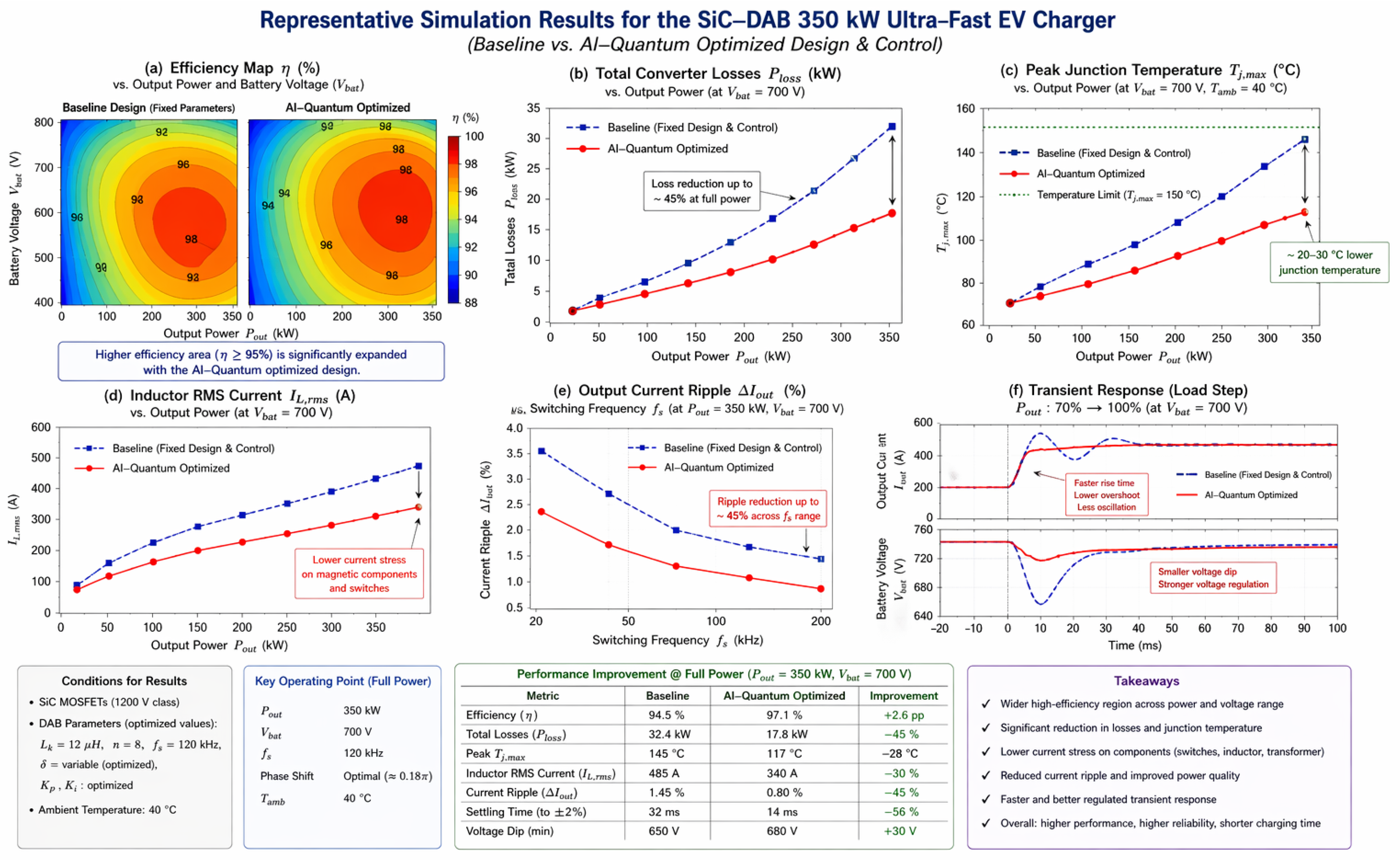
As summarized by the representative quantitative tendencies in
Figure 5, the converter-level response shows improvement in several coupled performance dimensions. The figure highlights the main coupled performance effects used to interpret the benefit of the proposed co-design workflow relative to the baseline strategy.
The proposed workflow identified operating regions with improved average efficiency across the charging envelope compared with the baseline strategy. This effect is particularly relevant because the DAB converter operates under substantially different battery-voltage and loading conditions during the charging process, making fixed nominal tuning less effective across the full operating range.
The obtained results also indicate reduced loss-related and thermal stress tendencies. Since efficiency, loss, ripple, and thermal behavior are included simultaneously in the multi-objective formulation, the optimization process favors more balanced operating regions rather than isolated efficiency-oriented solutions. This is important in ultra-fast charging systems, where thermal loading directly affects semiconductor reliability and safe operating margins.
In addition, the optimized operating regions exhibited improved ripple-sensitive and transient-response behavior under operating-point variation. The representative simulation-derived trends indicate lower output-current variation and smoother transient behavior than the baseline configuration, particularly during charging-region transitions.
An additional advantage of the proposed methodology is the improved computational organization of the search process. By combining surrogate-assisted candidate screening with high-fidelity re-validation, the workflow enables broader design-space exploration without exhaustive switching-level simulation at every iteration.
Overall, the converter-level results suggest that the proposed hybrid AI–quantum co-design workflow provides improved operating-point selection, reduced electro-thermal stress tendency, and more robust converter behavior across the investigated charging envelope.
3.3. Dynamic and Charging-Profile Results
Beyond converter-level operating-point selection, the proposed framework was also evaluated with respect to its ability to support adaptive charging-profile refinement across the ultra-fast charging process. This aspect is particularly important because, in high-power charging applications, a fixed charging policy may not remain equally favorable over the full battery-voltage range. As battery voltage, current demand, and converter stress evolve during charging, the operating region that best balances efficiency, thermal loading, and dynamic quality also changes. For this reason, the co-design methodology is assessed not only as a converter-tuning tool, but also as a charging-policy-aware computational framework.
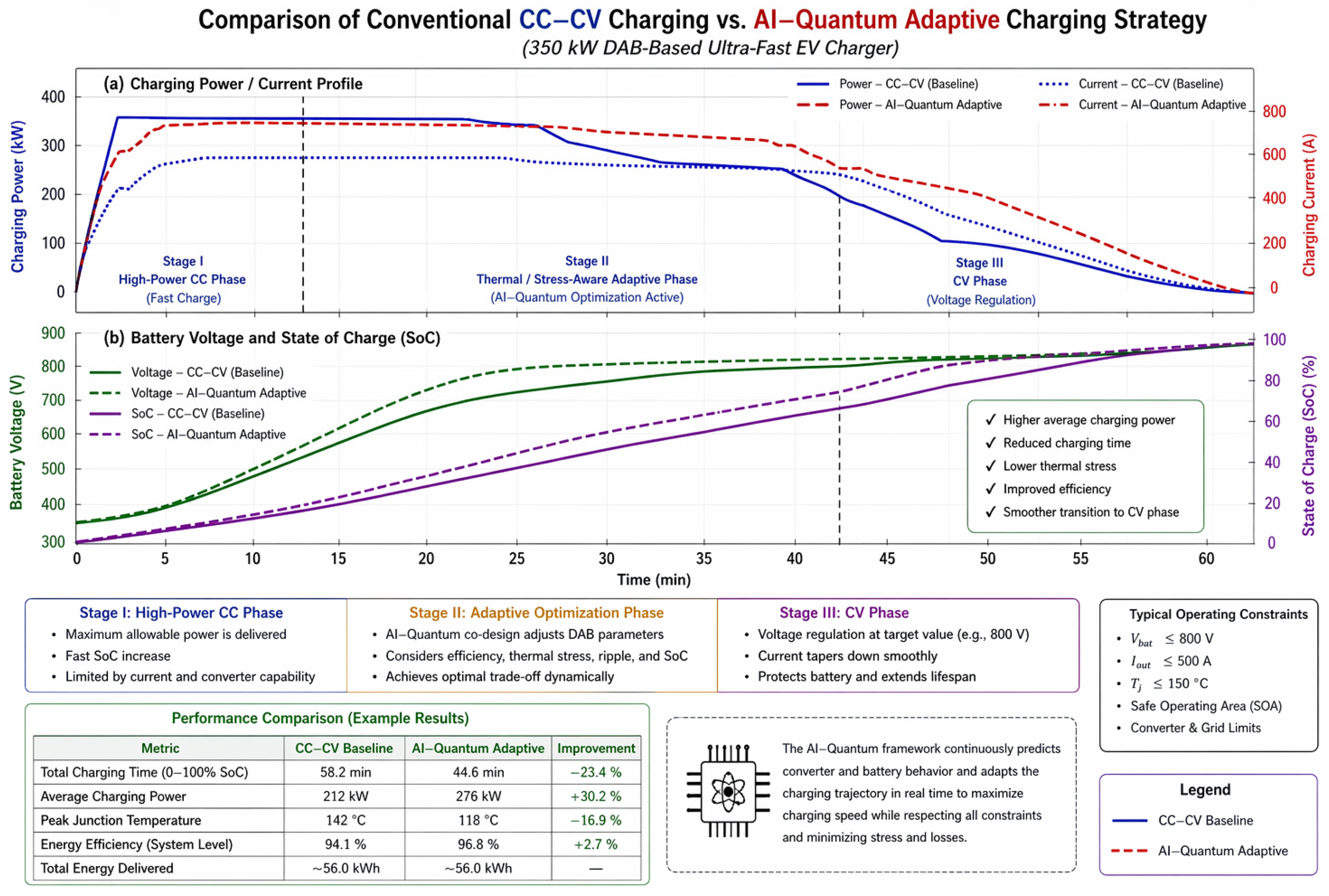
The comparison between the conventional fixed CC–CV charging logic and the proposed adaptive DAB-aware charging strategy is illustrated in
Figure 6. As shown there, the revised framework does not treat charging as a predefined current trajectory executed independently of converter behavior. Instead, the charging trajectory is refined in relation to predicted converter efficiency, thermal stress, and operating-point sensitivity. In practical terms, this means that the charging process is shaped more intelligently across different regions of the charging envelope, rather than relying on a single fixed operating philosophy from start to finish [
33,
34].
The representative simulation trends indicate that the proposed workflow provides smoother charging-region transitions and more balanced control behavior than the baseline strategy. In particular, the adaptive operating-point selection reduces excessive electro-thermal stress during transitions between high-power and constraint-dominated charging regions.
The proposed framework also demonstrates improved robustness to battery-voltage variation across the charging envelope. Unlike fixed nominal tuning, the surrogate-assisted workflow refines candidate operating conditions under multiple charging scenarios, resulting in more consistent converter behavior and reduced dependence on repeated controller retuning.
Overall, the obtained results suggest that the proposed methodology extends conventional CC–CV charging toward a converter-aware adaptive charging strategy in which charging policy and converter operating conditions are optimized jointly under multi-objective constraints.
3.4. Comparative Evaluation Against the Baseline Workflow
A comparative summary between the baseline workflow and the proposed AI–quantum co-design approach is presented in
Table 5. The comparison is intended to highlight representative engineering and workflow-level tendencies observed in the considered DAB ultra-fast charging case study. This is an important distinction, because the contribution of the revised methodology lies not only in the resulting operating-point selection, but also in the way the search and validation process is organized.
The value of 97.3% reported in
Table 2 corresponds to the nominal 800 V validation point, while the efficiency range reported in
Table 5 summarizes the representative tendency over the evaluated charging envelope. Therefore,
Table 2 should be interpreted as the specific selected validation case, whereas
Table 5 summarizes the broader comparative trend between the baseline and the proposed co-design workflow.
The comparative results indicate that the proposed framework improves both converter-level operating behavior and the computational organization of the design process relative to the baseline strategy. The obtained trends include improved efficiency preservation, reduced electro-thermal stress tendency, lower ripple-sensitive behavior, improved transient response, and greater robustness to operating-point variation across the charging envelope.
At the charging-system level, the proposed workflow also reduces the dependence on repeated controller retuning by refining candidate operating conditions across multiple battery-voltage regions. In addition, surrogate-assisted candidate screening reduces the need for repeated high-fidelity simulation during intermediate optimization stages, enabling more structured exploration of the feasible design space.
The comparison should nevertheless be interpreted within the scope of the present simulation-based proof-of-concept investigation. The study does not claim universal superiority over all classical optimization approaches, but rather demonstrates that the investigated hybrid AI–quantum workflow provides a technically interpretable and computationally efficient co-design methodology for the considered DAB ultra-fast charging application.
3.5. Summary of the Main Quantitative Tendencies
The simulation-based results presented above indicate that the proposed hybrid AI–quantum co-design workflow provides a more structured and better balanced approach to ultra-fast DAB charging-converter optimization than the considered baseline strategy. At the converter level, the main observed tendencies include improved efficiency preservation across the charging envelope, reduced loss-related and thermal stress tendencies, and more favorable ripple-sensitive and dynamic-response behavior. At the charging-process level, the proposed workflow supports smoother region-to-region adaptation and reduced dependence on fixed nominal tuning.
A further important outcome is that these tendencies are obtained together with improved workflow organization. By combining surrogate-assisted candidate screening with quantum-assisted multi-objective search and high-fidelity re-validation, the revised methodology reduces the burden of repeated exhaustive simulation during intermediate design-space exploration. This means that the reported gains should be interpreted not only as improved pointwise converter tuning results, but also as evidence that the overall co-design process becomes more computationally manageable and more informative under multi-condition charging operations.
Taken together, the results support the central claim of the revised manuscript: namely, that a hybrid AI–quantum workflow can serve as a practically interpretable co-design framework for a SiC-based DAB ultra-fast EV charging converter in a simulation-based proof-of-concept setting. The engineering implications, limitations, and broader interpretation of these findings are discussed in the following section.
4. Discussion
4.1. Interpretation of the Hybrid Co-Design Advantage
The main advantage of the proposed framework lies in the integration of surrogate modeling, structured optimization, and model-based validation within a unified co-design workflow. Unlike conventional sequential tuning procedures, the proposed methodology jointly evaluates converter operating conditions, control settings, and charging-policy adaptation across the investigated charging envelope.
The surrogate-learning layer enables rapid approximation of converter behavior under varying operating conditions, while the optimization layer performs structured exploration of the mixed-variable design space. Final candidate solutions are then re-evaluated using the high-fidelity DAB simulation model in order to preserve the physical consistency of the reported results.
This integrated workflow is particularly relevant for ultra-fast EV charging applications, where converter behavior changes significantly with battery voltage, loading condition, and thermal operating state. Under such conditions, fixed nominal tuning may become suboptimal across different charging regions. The obtained results therefore support the interpretation that hybrid co-design provides a more structured and computationally scalable approach to converter-aware operating-point exploration.
The proposed framework should nevertheless be interpreted within the scope of a simulation-based proof-of-concept investigation. The study does not claim industrial deployment readiness or universal quantum computational superiority, but demonstrates how AI-assisted surrogate learning and structured optimization can be combined in a technically interpretable workflow for the investigated SiC-based DAB charging application.
4.2. Why the Proposed Workflow Improves Design-Space Exploration
The proposed workflow improves design-space exploration through the combined use of surrogate-assisted candidate screening and structured multi-objective optimization. In conventional converter tuning, repeated high-fidelity simulation and locally organized parameter adjustment may limit exploration efficiency, particularly under wide operating envelopes and coupled multi-objective constraints.
In the present framework, the surrogate model reduces the computational cost of intermediate candidate evaluation, while the optimization layer performs structured search over the mixed-variable design space. This enables broader exploration of feasible operating regions without exhaustive switching-level simulation at every iteration.
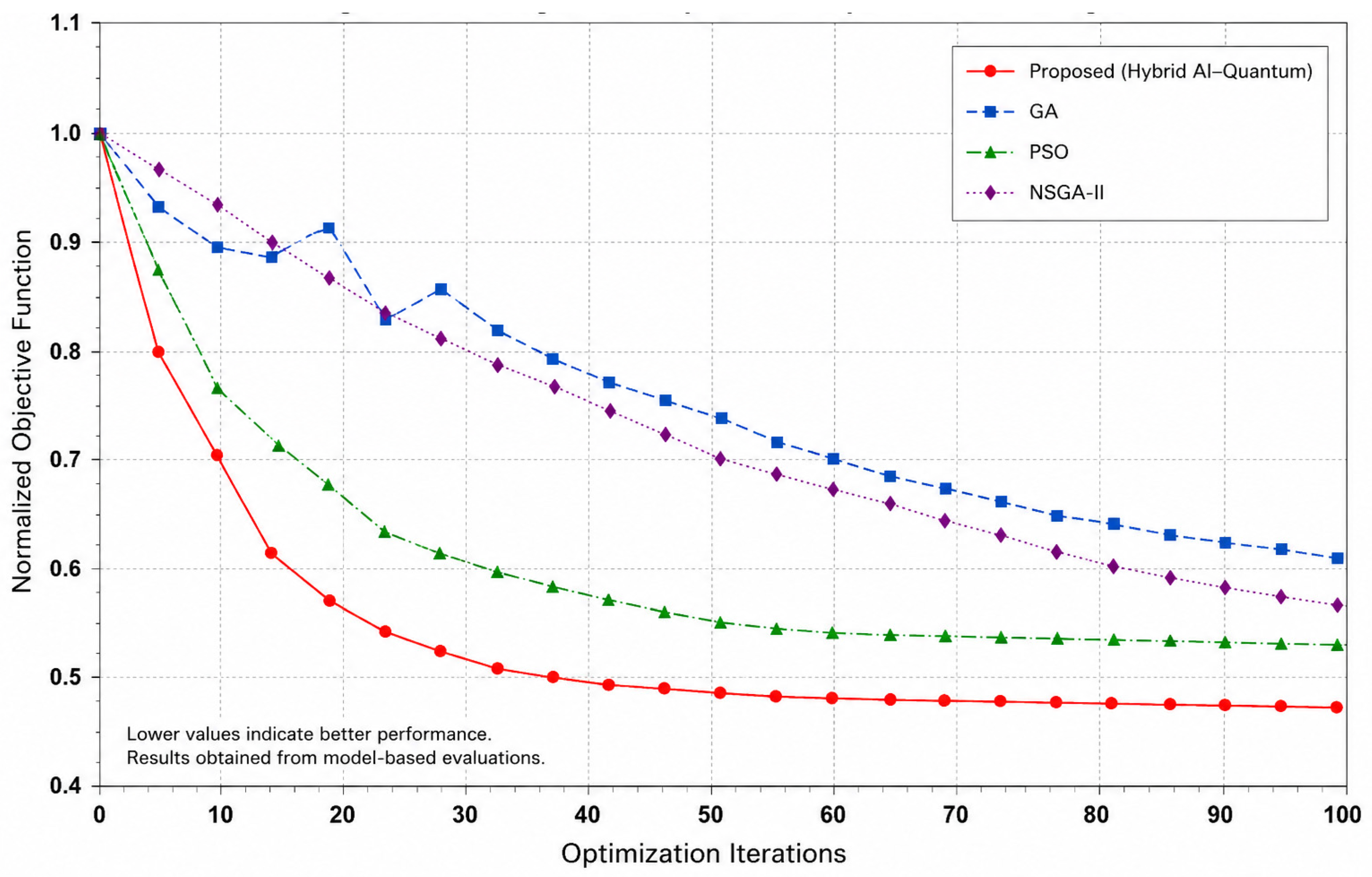
The convergence behavior shown in
Figure 7 was evaluated against several conventional optimization methods, including PSO, GA, and NSGA-II under identical operating constraints and search-space boundaries. The obtained trends indicate that the proposed workflow achieves faster intermediate-stage stabilization while maintaining broader exploration capability than locally constrained search procedures.
The reported results should nevertheless be interpreted within the scope of the investigated proof-of-concept case study. The present work does not claim universal superiority over all optimization algorithms, but demonstrates that the proposed hybrid workflow provides a technically interpretable and computationally efficient co-design strategy for the investigated DAB ultra-fast charging application.
For comparative optimizer assessment, the final objective score was computed as the normalized scalarized value of the multi-objective function J(ξ). Lower values indicate a more favorable compromise among efficiency degradation, power loss, ripple behavior, thermal stress, and dynamic deviation under identical model-based operating conditions. The reported score is dimensionless and is used only for relative comparison among the investigated optimization strategies within the considered DAB converter co-design problem. The reported values correspond to normalized model-based objective-function evaluations and are used only for comparative assessment under identical optimization conditions.
Table 6 presents representative optimization-performance indicators for the investigated search strategies within the considered DAB converter co-design problem. The reported metrics are intended to provide comparative insight into convergence behavior, exploration capability, and computational efficiency under equivalent optimization conditions rather than to establish universal superiority of any individual optimization method.
The obtained convergence behavior suggests that the proposed framework provides a more structured exploration mechanism for coupled efficiency–thermal–ripple optimization problems within the investigated DAB charging case study. At the same time, the revised manuscript intentionally avoids broad claims regarding universal optimizer superiority or strict quantum computational advantage beyond the considered proof-of-concept configuration.
4.3. Engineering Relevance for Ultra-Fast EV Charging
The engineering relevance of the proposed framework is most evident in ultra-fast EV charging systems, where converter operation, charging strategy, and thermal constraints are strongly coupled [
35,
36]. In such applications, the converter must preserve high efficiency and acceptable thermal loading across a wide battery-voltage range while maintaining charging speed and stable dynamic response.
The investigated four-module SiC-based DAB configuration represents a realistic high-power charging architecture in which the total 350 kW charging power is distributed across four parallel 87.5 kW converter modules. This modular representation provides practical current levels, thermal distribution, and scalable operating conditions suitable for high-power charging platforms.
The obtained simulation-derived results indicate that the proposed workflow supports improved electro-thermal operating balance, reduced ripple-sensitive behavior, and improved charging adaptability relative to the baseline strategy. In addition, the framework enables converter-aware charging-profile refinement by linking operating-point selection to predicted efficiency and thermal behavior across the charging process.
The same co-design methodology may also be extended to related converter-dominated applications, including storage-coupled charging stations, coordinated charging hubs, and DC microgrid systems requiring adaptive multi-objective optimization under varying operating conditions.
To further support the engineering interpretation of the proposed framework, representative converter-efficiency and electro-thermal trends were evaluated across multiple operating conditions within the investigated ultra-fast charging scenario.
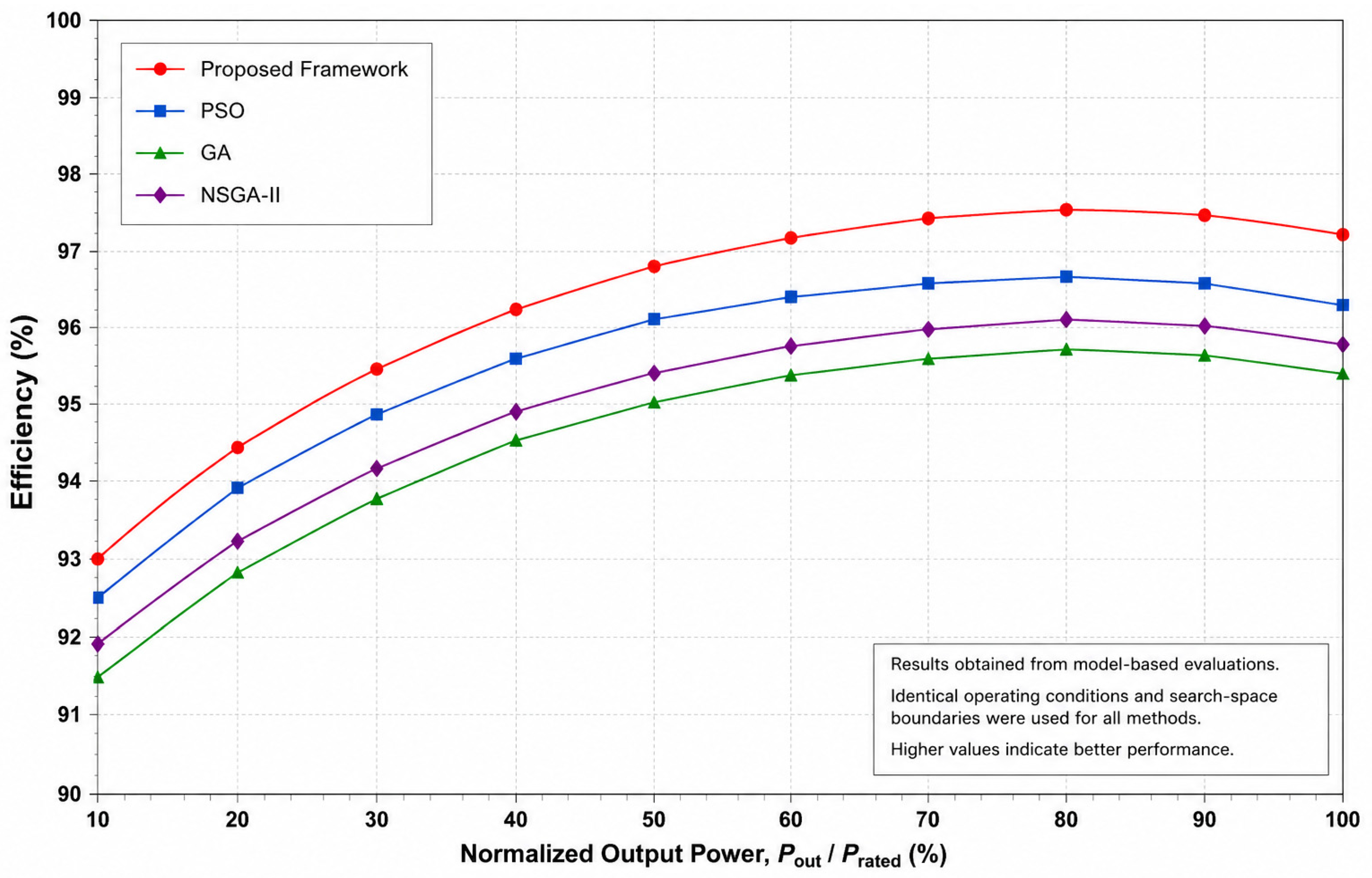
Figure 8 presents representative efficiency characteristics for both the baseline engineering configuration and the proposed hybrid optimization workflow under varying normalized output-power conditions. The obtained trends indicate slightly improved efficiency preservation for the proposed framework, particularly within medium-to-high loading regions where switching losses and thermal stress become increasingly significant.
The representative efficiency behavior suggests that coordinated optimization of switching frequency, phase-shift operation, and thermal operating conditions contributes to reduced loss sensitivity during elevated charging-power operation.
Table 7 summarizes representative converter-efficiency values obtained for the baseline engineering configuration and the proposed hybrid optimization workflow under varying normalized output-power conditions. The presented values are intended to illustrate comparative operating tendencies within the investigated ultra-fast charging scenario.
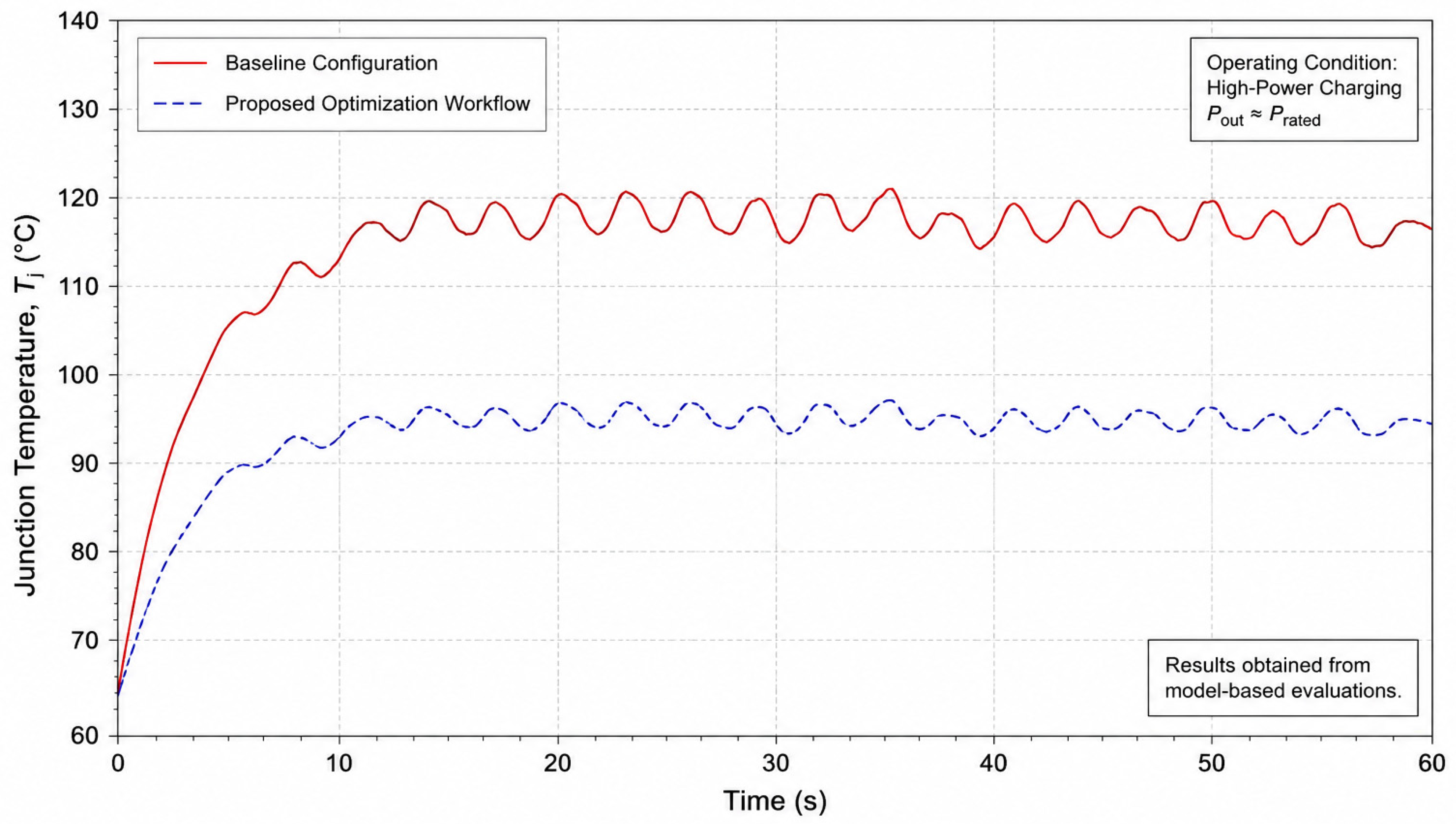
Additional investigation was performed regarding representative electro-thermal operating behavior of the investigated SiC-based DAB converter structure during high-power charging operation.
Figure 9 illustrates representative semiconductor junction-temperature behavior for both the baseline operating configuration and the proposed optimization workflow.
The obtained thermal trends indicate reduced peak junction-temperature excursions for the proposed workflow compared with the baseline configuration. This tendency is particularly relevant in ultra-fast charging systems, where repeated thermal cycling may strongly influence semiconductor reliability, converter lifetime, and cooling-system requirements.
For comparative electro-thermal assessment, the estimated thermal stress index was defined as a normalized model-based indicator combining peak junction temperature and thermal cycling amplitude under identical operating conditions. The baseline configuration was assigned a reference value of 1.00, while the proposed framework was evaluated relative to this reference. The index is not intended as a semiconductor lifetime prediction model, but rather as a comparative engineering indicator of relative electro-thermal stress within the investigated simulation environment.
Table 8 presents representative thermal-performance indicators for the investigated SiC-based DAB converter under high-power charging operation. The comparison focuses on junction-temperature behavior and thermal-stress-related tendencies for the baseline configuration and the proposed optimization workflow.
Although the presented efficiency and thermal trends remain representative for the considered proof-of-concept operating envelope, the obtained results support the central hypothesis that coordinated converter-aware optimization may improve coupled electro-thermal operating behavior in ultra-fast EV charging applications.
4.4. Representative Waveform and Ripple Behavior
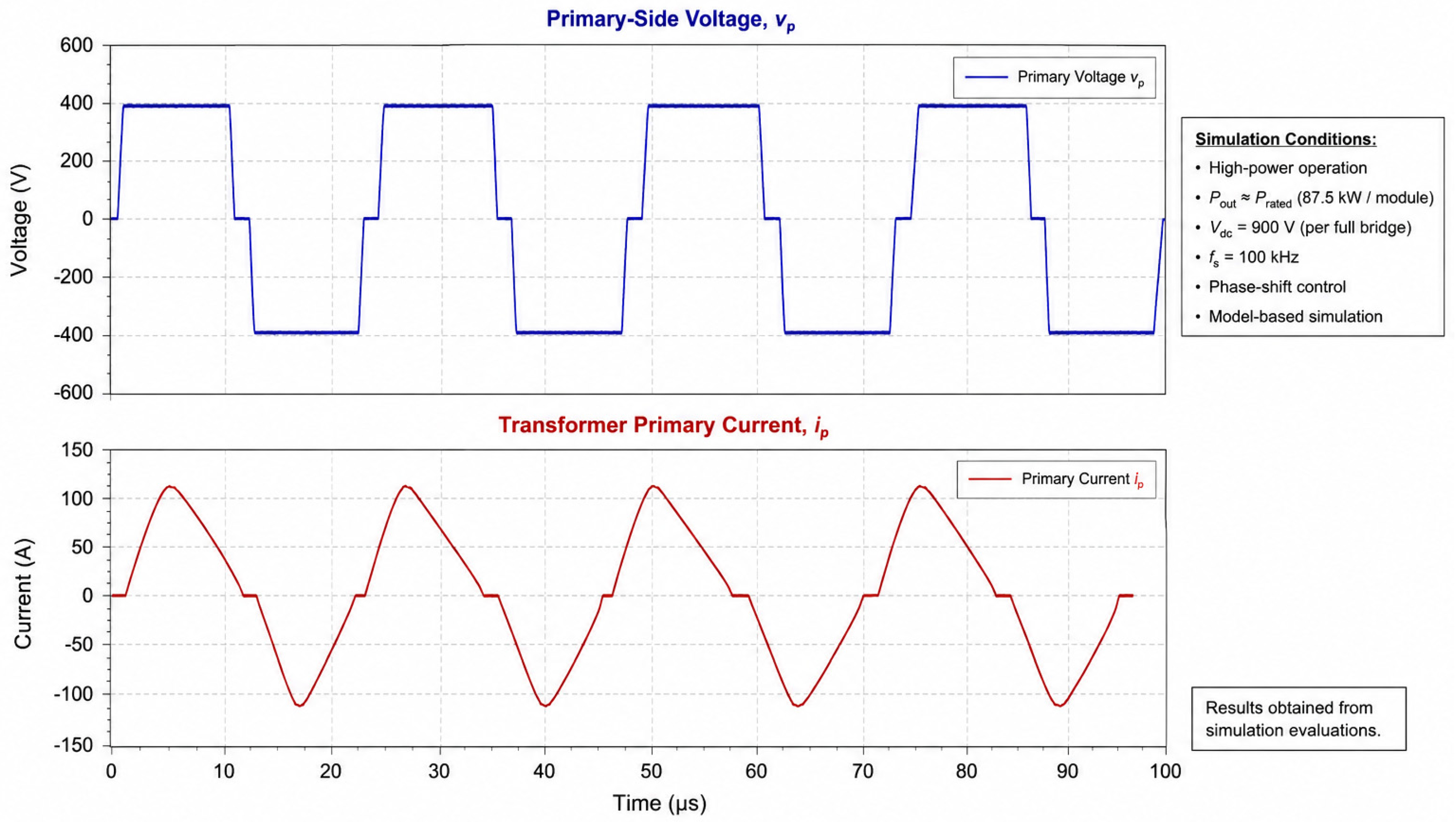
To further evaluate converter-level operating behavior, representative electrical waveforms and ripple-sensitive operating trends were investigated for the considered SiC-based DAB charging converter under high-power charging conditions.
Figure 10 presents representative primary-side voltage and transformer-current waveforms for the investigated operating regime. The obtained waveform behavior remains consistent with stable phase-shift-controlled DAB operation and indicates acceptable current-transfer characteristics within the considered operating envelope.
The observed waveform characteristics suggest that the proposed optimization framework preserves stable converter operation while reducing excessive current distortion tendencies during elevated power-transfer conditions.
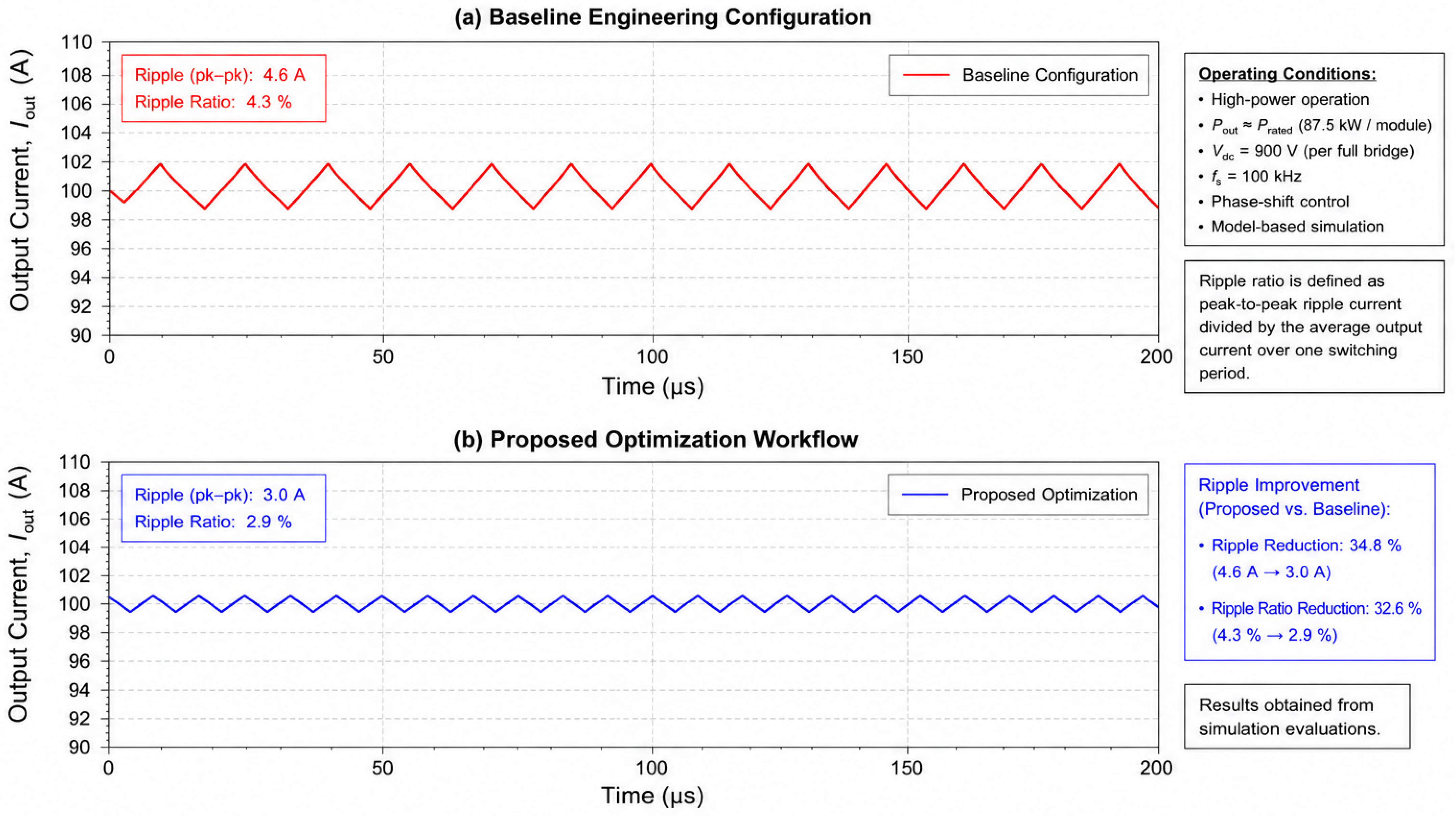
Figure 11 illustrates representative output-current ripple behavior for both the baseline engineering configuration and the proposed optimization workflow under varying operating conditions.
The obtained ripple trends indicate that the proposed workflow provides improved ripple-sensitive operating behavior across multiple loading regions. This tendency is particularly relevant in ultra-fast charging applications because excessive ripple may influence battery stress, converter filtering requirements, and long-term charging-system reliability.
Table 9 summarizes representative output-current ripple values obtained for the baseline engineering configuration and the proposed optimization workflow across multiple loading conditions within the investigated charging scenario.
Although the presented waveform and ripple characteristics remain representative for the considered proof-of-concept operating region, the obtained results further support the engineering feasibility of the proposed converter-aware optimization methodology for high-power ultra-fast EV charging applications.
4.5. Sensitivity Analysis of Main Design Variables
To further evaluate the robustness of the selected operating region, a local sensitivity analysis was performed around the validated model-based operating point of the investigated SiC-based DAB converter. The principal design and control variables were individually varied while the remaining parameters were kept fixed. The purpose of this analysis was to identify which variables most strongly influence converter efficiency, ripple behavior, thermal loading, and dynamic response within the considered operating envelope.
The obtained sensitivity tendencies indicate that switching frequency and transfer inductance have the strongest influence on the coupled efficiency–thermal trade-off. Increasing the switching frequency generally improves ripple behavior and transient response, but may also increase switching-related losses and thermal stress. The transfer inductance strongly affects RMS current stress, transferred power capability, and soft-switching operating conditions. By contrast, the controller gains primarily influence transient-response quality and voltage regulation, while dead time mainly affects switching behavior and thermal operating margins.
Table 10 summarizes the representative model-based sensitivity tendencies observed around the selected operating point.
The sensitivity assessment further supports the interpretation that the investigated converter behavior is governed mainly by the coupled interaction between switching frequency, transfer inductance, and phase-shift control, rather than by isolated controller retuning alone.
4.6. Limitations of the Present Study
The present study remains a simulation-based proof-of-concept investigation rather than a full experimental validation study. The reported results should therefore be interpreted as representative model-based engineering tendencies within the investigated operating envelope rather than as hardware-qualified industrial performance data.
In addition, the optimization layer is intentionally treated as quantum-assisted or quantum-inspired rather than as a fully deployed industrial quantum-computing solution. Current quantum platforms remain constrained by hardware maturity, noise, and scalability limitations. The purpose of the present work is therefore to demonstrate how surrogate-assisted learning and structured optimization can be integrated into a converter-oriented co-design workflow.
The accuracy of the surrogate-learning layer also depends on the quality and coverage of the generated simulation dataset. As with any data-driven approximation, reduced prediction accuracy may occur in sparsely sampled or strongly nonlinear operating regions. For this reason, the proposed methodology includes high-fidelity re-validation of selected candidate solutions.
Furthermore, the comparative analysis was performed against a conventional baseline workflow rather than against a broad benchmark set of advanced optimization algorithms. Future investigations should therefore include extended comparisons with established multi-objective optimization methods and experimental or hardware-in-the-loop validation.
Finally, the investigated case study focuses on the isolated DAB charging stage and does not yet include full charging-station coordination effects such as front-end conversion, storage coupling, and supervisory energy-management optimization.
5. Conclusions
This paper presented a hybrid AI–quantum co-design framework for a SiC-based DAB converter intended for ultra-fast EV charging applications. The revised manuscript was motivated by the need for computationally structured converter design and charging-control methodologies capable of handling nonlinear behavior, wide operating ranges, and competing performance criteria in high-power charging systems. In response to these challenges, the proposed framework combines three coordinated layers: a physical converter representation, an AI surrogate-learning layer for rapid performance prediction, and a quantum-assisted optimization layer for structured multi-objective exploration.
The case study focused on a representative modular 350 kW ultra-fast charging system, in which the isolated DC/DC stage was implemented by four parallel 87.5 kW SiC-based DAB modules. Within this simulation-based proof-of-concept setting, the revised workflow showed improved capability for coordinated exploration of converter and charging-policy trade-offs relative to a conventional baseline strategy. The main observed tendencies included improved efficiency preservation across the charging envelope, reduced loss-related and thermal stress tendencies, improved ripple-sensitive and dynamic-response behavior, and better charging-profile adaptability under varying battery conditions. In addition, the combined use of surrogate-assisted candidate screening and quantum-assisted search reduced the dependence on repeated exhaustive high-fidelity simulation during intermediate design-space exploration.
An important outcome of the study is that the value of the proposed framework lies not only in the resulting operating-point selection, but also in the organization of the co-design process itself. By linking physical modeling, surrogate prediction, structured search, and validation in a unified loop, the revised manuscript provides a more coherent methodology for converter-aware optimization than a conventional sequential tuning workflow. In this sense, the main contribution of the work is methodological as well as application-oriented.
At the same time, the scope of the present work should be interpreted realistically. The revised manuscript remains a simulation-based proof-of-concept investigation and does not claim hardware-level quantum superiority, full industrial deployment readiness, or exhaustive optimizer benchmarking. The reported results should therefore be understood as evidence that the proposed hybrid workflow is technically meaningful and engineering-relevant for the selected DAB ultra-fast charging application, rather than as a final universal solution for all converter-dominated systems.
Future work should extend the present study in several directions. First, experimental or hardware-in-the-loop validation would strengthen the practical assessment of the proposed methodology. Second, broader comparisons with advanced classical optimization methods would clarify more precisely the relative benefit of the quantum-assisted search layer. Third, the co-design logic can be extended beyond the isolated DAB stage toward full charging architectures including front-end conversion, storage coupling, and station-level supervision. More broadly, the proposed framework may serve as a useful methodological basis for other converter-dominated applications in which nonlinear behavior, operating-point variation, and multi-objective trade-offs must be addressed jointly.