1. Introduction
The interaction between lasers and atoms is of great importance for atomic sensing devices in quantum precision measurement fields, which usually occurs in alkali atomic vapor cells. The atomic vapor cells containing the simple substrate of alkali metals and buffer gases are the essential components for many laser-atomic-based miniature atomic sensors. Taking the coherent population trapping (CPT) atomic clock as an example, a laser beam is modulated to a specific frequency and resonates with the energy levels of alkali metal atoms in the vapor cell, which causes a change in the quantum state. By detecting the change in the quantum state, precise control of the atomic clock frequency can be achieved.
Traditional atomic vapor cells are mostly fabricated using glass-blowing technology. In recent years, the micro-electro-mechanical system (MEMS) atomic vapor cells based on micro-fabrication and wafer bonding techniques have drawn more attentions because of their ease of miniaturization and compatibility to integrate circuit (IC) process, which can meet the requirements of the increasingly developing chip-scale atomic sensing devices [
1], including atomic magnetometers [
2], atomic gyroscopes [
3], atomic clocks [
4], etc.
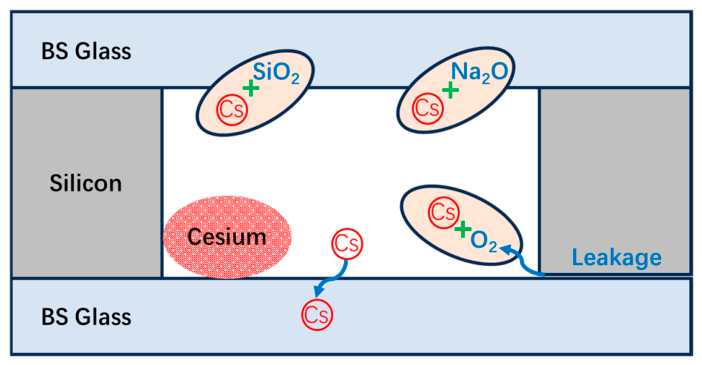
A typical MEMS vapor cell, as shown in
Figure 1, is an anodically bonded airtight sandwich structure composed of two borosilicate (BS) glass plates and a silicon through hole. Inside the cell, only alkali metals (usually cesium and rubidium) and inert buffer gases with the required composition proportion and pressure are filled. For many sensor device applications, a basic requirement of alkali atomic vapor cells is that they must maintain saturated vapor of alkali metal needed for operation for a time at least equivalent to its expected lifetime.
The reduction in the alkali metal inside is the main influencing factor for the lifetime of a MEMS vapor cell, and it can be attributed to the low hermeticity or the glass envelopes of the cell. The reasons are also illustrated in
Figure 1. For an imperfect vapor cell bonding process, which can result from inappropriate anodic bonding parameters, alkali metal contamination, or an unwanted intermediate layer between the two bonding surfaces, there will be outside air leakage from the bonding interfaces. The oxygen and water vapor in the leaked air can easily oxidize the active alkali metal inside and lead to a reduction. Owing to the mm
3 scale small volume of the vapor cell, even a slight leakage can cause an obvious reduction in the alkali metal [
5].
In addition, the active cesium atom can react with the sodium oxide and silicon dioxide inside the borosilicate glass envelope of the vapor cells, or diffuse directly into the interior of the glass [
6]. Owing to the high operation temperature of the vapor cell, which is usually about 80 °C for a cesium vapor cell applied in atomic clocks, the chemical reaction and diffusion process are accelerated significantly.
The low hermeticity of micro-fabricated vapor cells is a major problem that must be solved [
7], which strongly demands a well-designed anodic bonding process and highly flat and clean bonding surfaces of both the silicon and the glass. To reduce the chemical interaction and diffusion consumption of alkali metal, since the borosilicate glass envelope is necessary for the MEMS vapor cell because of its high laser transparency and similar thermal expansion coefficient to silicon, one effective method is to deposit a passivation layer on the inner surface of the glass wall of the vapor cell [
8].
S. Woetzel et al. coated an aluminum oxide (Al
2O
3) film with a thickness of 20 nm inside the vapor cell as the passivation layer by using atomic layer deposition (ALD), and they believed that such a thin Al
2O
3 layer had little influence on the transmittance of laser beam as well as the vapor cell performance, but can reduce the interaction between alkali metals and cell glass envelopes by about a factor of 100 [
9]. S. Karlen et al. also verified the effectiveness of the Al
2O
3 passivation layer, but with a molecular vapor deposition (MVD) method. According to their assessment method, a lifetime of more than 10 years was expected for those vapor cells [
10].
However, in those preparation processes, the passivation layers are deposited not only on the inner wall surfaces of the cells, but also on both bonding surfaces of the glass and the silicon. The material and the thickness of the passivation intermediate layer, in fact, have significant impacts on the anodic bonding process of glass and silicon. Inappropriate passivation materials, for example, the TiO
2, or over-thick layers (>20 nm both on glass and silicon surface), can lead to low hermeticity or even bonding failure of the vapor cells [
9,
11], which impede the further performance improvement of atomic vapor cells.
C. Carle et al. employed Al
2O
3 passivation layers to prevent gas permeation of micromachined vapor cells. To reduce the influence of the passivation intermediate layer on anodic bonding, they proposed to deposit Al
2O
3 only on the glass surface, so that a thicker inner wall coating can be used when compared to those processes from S. Woetzel et al. and S. Karlen et al. [
12,
13]. Nevertheless, in this case, there are still passivation materials present at the bonding interface, which weaken the bonding effects, and the passivation layer has not completely covered the inner wall of the vapor cell.
A novel fabrication process is proposed to achieve high hermeticity in alkali vapor cells with inner passivation layers. The fabrication process mainly consists of the preparation of patterned passivation layers and a well-designed anodic bonding procedure. Without considering the transmittance of the laser to the glass envelope, the proposed process has almost no limitations of passivation material and layer thickness, and is expected to realize long lifetime MEMS alkali metal vapor cells for atomic sensor applications with common IC technologies.
2. Materials and Methods
The detailed fabrication process of the hermetic alkali metal vapor cells with passivation layers is described in Ref. [
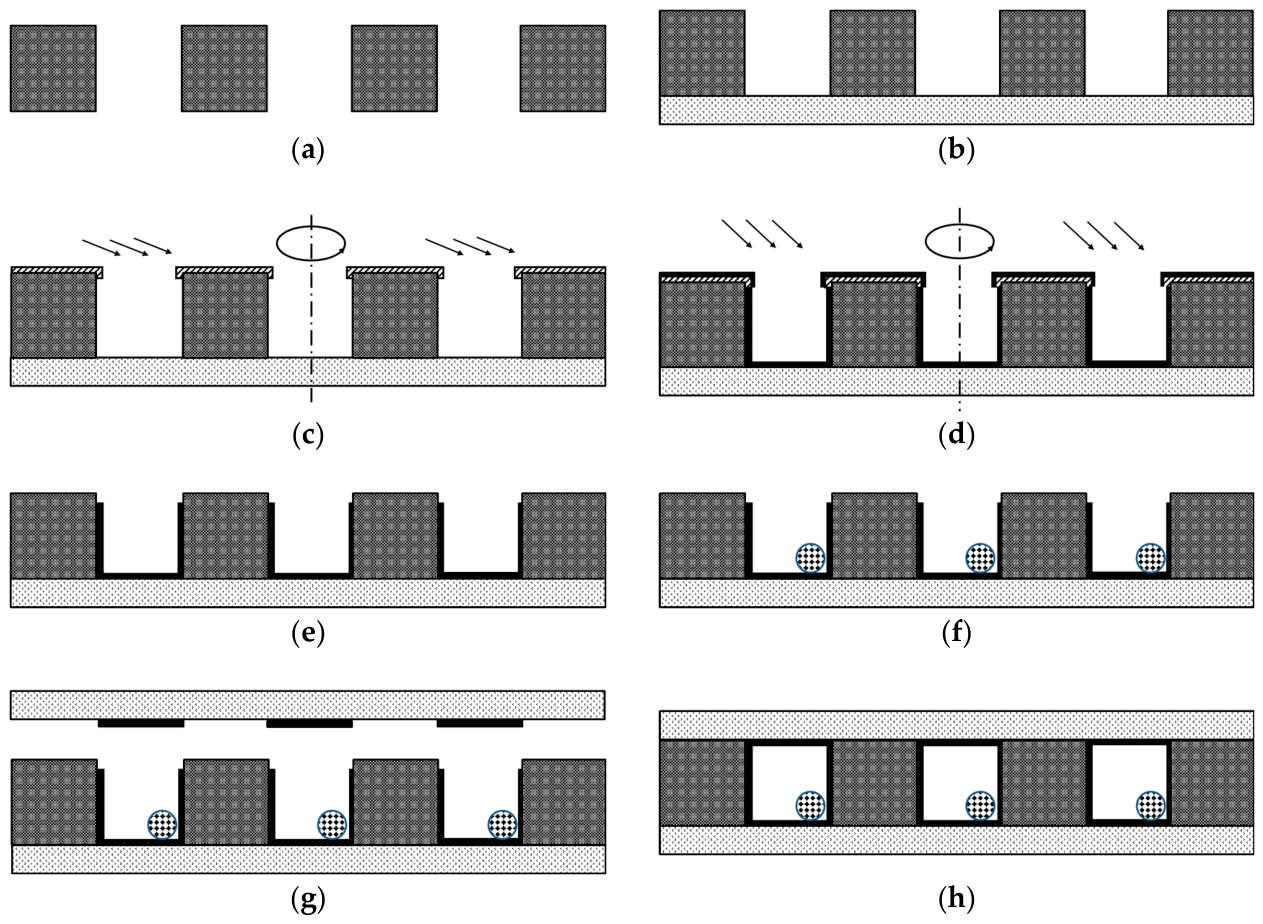
14], and a schematic fabrication process of cesium atomic vapor cells aiming for a specific chip-scale CPT atomic clock application is illustrated in
Figure 2. The detailed process is as follows:
- (a)
A 4-inch polished silicon wafer with a thickness of 1 mm is structured to form 2 mm × 2 mm through-hole arrays by double-sided exposure and consequent wet chemical etching.
- (b)
A Borofloat® 33 borosilicate glass wafer is anodically bonded at the bottom side of the structured silicon wafer to form cavity arrays.
- (c)
A 100 nm aluminum sacrificial layer is deposited by electron beam evaporation (EBD) with a grazing angle of about 15 degrees while rotating the substrate on an axis perpendicular to the surface. Because of the very small deposition angle, the aluminum layer only exists on the top surface of the silicon wafer and the upper portion of the inner side walls of the cavities.
- (d)
Maintaining the substrate rotating, a 30 nm Al2O3 passivation layer is then deposited also by electron beam evaporation, but with a deposition angle of about 45 degrees. Such an incident angle ensures the Al2O3 layer covers all the aluminum sacrificial layer as well as the whole inner walls of the cavities.
- (e)
A lift-off process is executed by wet chemical etching with aluminum etchant, which only attacks the sacrificial material. With the dissolution of the aluminum layer, the Al2O3 passivation layer on the aluminum is subsequently released, while those on the inner walls of the cavities are retained.
- (f)
A few microliters of cesium droplets are filled into the cavities by micro-pipetting. Such a cesium content is sufficient to ensure saturation in those small vapor cells.
- (g)
Another electron beam evaporation and lift-off process is carried out to prepare Al2O3 pad arrays on a second glass wafer. The positions of those pad arrays strictly correspond to the silicon cavity arrays, but the dimensions of the pads are several microns smaller than that of the opening of the cavities, which assures that the Al2O3 pads are confined within the cavity area in the consequent alignment bonding process.
- (h)
Finally, the cesium-filled cavities are hermetically sealed by anodic bonding with the second glass wafer to complete the process.
The final hermetical anodic bonding of the vapor cells, in fact, is a well-designed two-procedure process, and it is completed in a SUSS SB6 Bonder. In the whole bonding process, the pressure applied to the wafers is maintained at 500 mbar. The first procedure is to confine the cesium droplet and the buffer gases inside the vapor cell as quickly as possible. It is executed in a nitrogen/argon-dominated environment with appropriate composition proportion and pressure required for the atomic vapor cells. The first bonding procedure is completed in several minutes. In this procedure, a lower bonding temperature of 300 °C is used to prevent the excessive evaporation of cesium, and a lower voltage of 800 V is adopted to minimize gas discharge risk between the bonding electrodes.
The second bonding procedure is to further enhance the anodic bonding strength and to realize the high hermeticity of the cell. It is executed in a high vacuum condition (3 × 10
−3 Pa) so as to avoid gas discharge under higher bonding voltages. In this procedure, the increased temperature of 400 °C is used, and the voltage is increased from 800 V to 1200 V in steps of 100 V. Each step only ends when the bonding current drops below 10% of the maximum current for 2–3 min. The second bonding procedure is a rather time-consuming process; it usually lasts for several tens of minutes. This step bonding method is beneficial for forming more stable Si-O chemical bonds at the interfaces [
15,
16], because in each step of the process, it allows more bonding time for sufficient chemical reaction between O and Si.
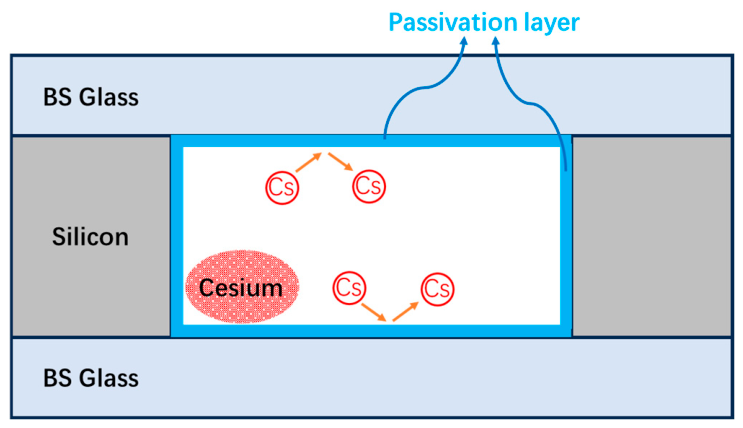
The schematic diagram of the MEMS cesium atomic vapor cell with a passivation layer is shown in
Figure 3. For the most current literature research, the Al
2O
3 intermediate layer between the interface of the glass and the silicon weakens the electrostatic bonding field and prevents the formation of the Si-O chemical bond, therefore decreasing the anodic bonding quality. Since there is no Al
2O
3 layer between the interface of the glass and the silicon in the proposed fabrication process, higher bonding strength and better hermeticity are expected when compared to the current studies. In addition, the Al
2O
3 passivation layer completely covers the inner surface of the cell, effectively isolating the cesium and the glass envelope. Both the high hermeticity bonding and the fully covered passivation layer ensure a constant cesium content in the vapor cell.
3. Results
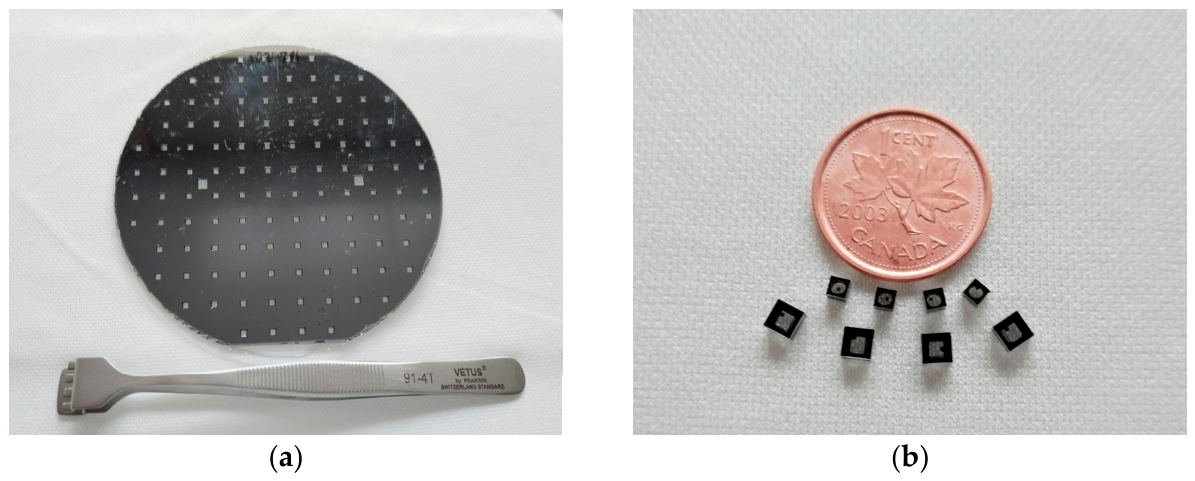
The image of a 4-inch wafer-scale fabricated cesium atomic vapor cell array is shown in
Figure 4a. The whole wafer contains two types of atomic vapor cells with different cavity dimensions, one is of 2 mm × 2 mm × 1 mm, and the other is of Φ1.5 mm × 1 mm.
Figure 4b shows some diced vapor cells with the two dimensions. Through the glass envelopes, light yellow cesium droplets can be seen clearly.
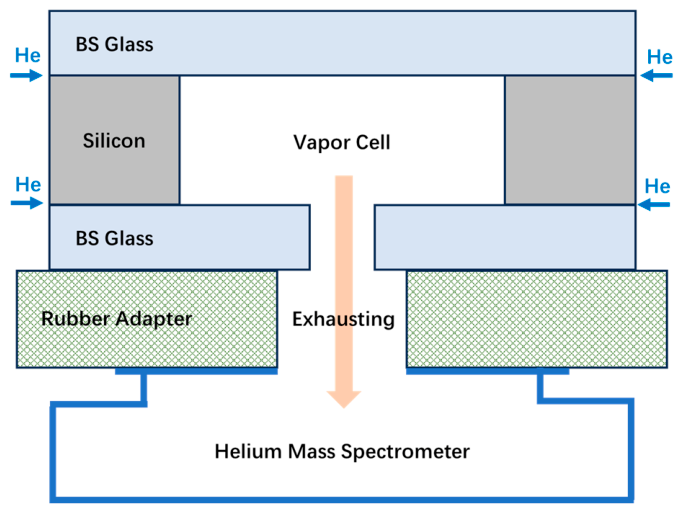
The hermeticity of the vapor cells is inspected by a laboratory leakage detection method. Usually, for each wafer, 2–3 vapor cells are randomly chosen for the detection. The detection setup of an atomic vapor cell is illustrated in
Figure 5. A small hole is drilled in one glass side of the cell, then the alkali metal inside is rinsed out, and the cell is cleaned and dried completely. And then the vapor cell is connected to a Phoenixl 300 helium mass spectrometer leak detector through the drilled hole and a specially designed rubber adapter, and the cell is exhausted by the pump of the spectrometer. Finally, a helium gun is used to spray the bonding interfaces of the cell, and the leakage rate is measured by the spectrometer.
When there is no response from the detector in the whole helium spraying process for more than 10 min, it is deduced that the leakage rate of the fabricated alkali metal vapor cell is lower than the minimum detectable value of 1.0 × 10⁻¹³ Pa·m3/s of the helium mass spectrometer.
This leakage detection idea originates from a developed leak detection technology of ceramic–metal sealed parts for vacuum devices; the volume range of the parts is usually from several mm3 to several dm3, covering the range of the vapor cells. For vapor cell detection, the thin exhaust channel decreases the effective pumping speed of the detector, which may affect measurement sensitivity. Low pumping speed is indeed a common challenge for leakage detection; however, the small volume of the vapor cell can naturally alleviate this problem to a certain extent, and a rather long helium spraying process is adopted to deal with it. Another issue in the detection is the different states of the vapor cells; the detected vapor cell is evacuated, while the one in operation is usually filled with buffer gas from several kPa to several decades kPa. But in fact, the evacuated vapor cells are more inclined to show obvious leakage because they have greater differences in internal and external pressure.
The hermeticity of the vapor cells is also detected by the standard methods described in Ref. [
15] and Ref. [
17], and the same leakage rates are obtained. These results verify the effectiveness of the laboratory detection method and the correctness of the leakage results of the vapor cells. The extremely low leakage rate is the same as that of the vapor cells without any passivation layers in our previous research [
18].
The effect of the 30 nm Al2O3 passivation layer on alkali metal reduction in the vapor cell is examined by a high-temperature accelerated experiment. In this process, the cesium vapor cells with/without passivation layers are put into a bake oven with a constant temperature of 115 °C, which is much higher than the operation temperature (about 80 °C) of the cesium vapor cells in atomic clocks. The experiment lasts for more than 2 years (17,520 h), and the vapor cells are observed periodically by using an optical microscope. It is found that the areas of the cesium droplets in the uncoated vapor cells decrease by a factor of about 20% in the whole process, while the droplets in the vapor cells with passivation layers remain almost unchanged.
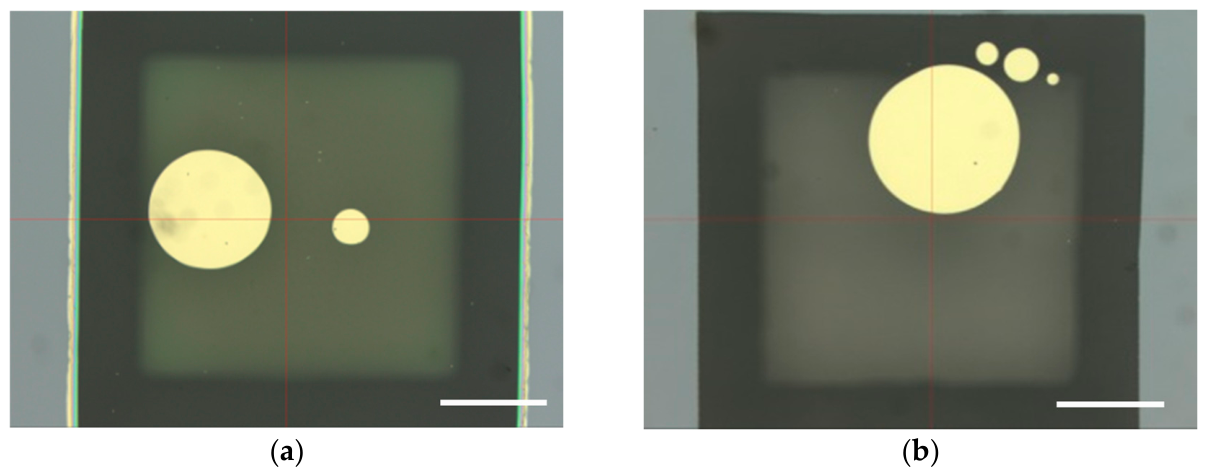
After the 2-year 115 °C baking, the passivation-coated vapor cells then undergo another high-temperature inspection process for potential application in atomic clocks. The experiment is executed on a 300 °C hotplate, and the baking process lasts for 48 h. The microscope photos of a typical cesium vapor cell before and after the baking are shown in
Figure 6.
It is a wonder that the baked cell has an even larger cesium droplet area. This phenomenon at least proves that there is no obvious decrease in cesium during the high-temperature baking process. As for the seeming enlargement of the droplet, it can be attributed to the recondensation of all the dispersed cesium small droplets on top of the glass with the help of the thermal gradient resulting from the bottom high-temperature hotplate and the room temperature environment.
After the two-step high-temperature treatment, the CPT resonance performances of the vapor cells are tested, and they are trially used in actual devices. The works are carried out to verify that the vapor cells still can meet the requirements of actual applications after the harsh aging process, thus reflecting the good performance of the vapor cells, including durability, hermeticity, absence of oxidation, etc.
A laser beam with a wavelength of and a diameter of 1.5 mm is circularly polarized and attenuated in the CPT test. With the modulation of sweeping current, a large proportion of the laser power is transferred from the carrier band to the sidebands. By locking the laser beam frequency on the absorption spectrum, the first sideband is roughly matched with the transition to create the resonance. The result shows that the CPT widths are all within 2 kHz, which are comparable with the reported values (Ref. [
17]), and are proven to be of good quality for the application in chip-scale atomic sensor devices.
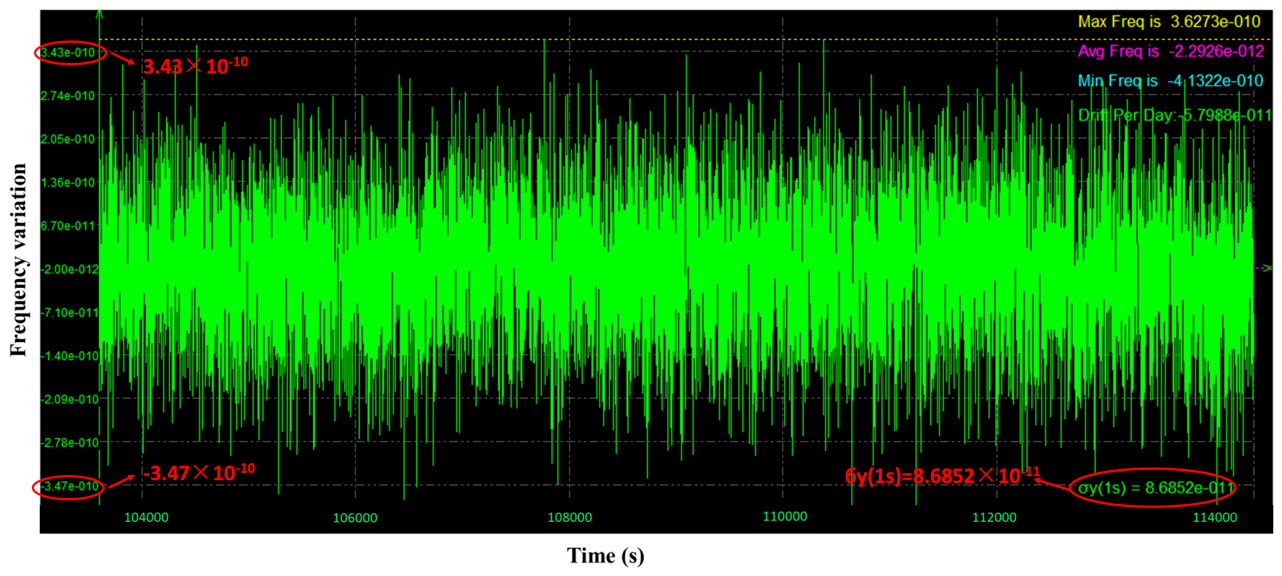
The high-temperature inspected cesium vapor cells are finally assembled in atomic clocks for trial use. The frequency variation in one miniaturized atomic clock in the time period from 104,000 s to 114,000 s is shown in
Figure 7. According to the data in
Figure 7, the short-term stability (Allan Variance) of the atomic clock is calculated, and the results are compared with those of the commonly used commercial SA.45s chip-scale atomic clocks in
Table 1.
The comparison results indicate that the atomic clock prototype employing the fabricated cesium vapor cells demonstrates a rather small frequency variation. The short-term stabilities of 8.68 × 10
−11 @ 1 s, 4.13 × 10
−11 @ 10 s, 1.30 × 10
−11 @ 100 s, and 6.83 × 10
−12 @ 1000 s are realized, respectively. The values are all better than the corresponding nominal indicators of the SA.45s atomic clocks [
19]. Without considering the difference in device design and assembling technique, the fabricated vapor cells are proven to be applicable to practical atomic clock devices and are expected to have a longer lifetime.
4. Discussion
The proposed fabrication process of the cesium vapor cells with passivation layers has been verified by the CPT test results of the vapor cells and the atomic clock prototypes employing the vapor cells. Although the fabrication process is focused on the millimeter-scale vapor cells for chip-scale atomic clock applications, it can be scaled to vapor cells with larger lateral sizes (up to centimeter level) easily for more atomic sensing application fields. In those situations, only the incidence angles of sacrificial layer deposition and passivation layer deposition need to be adjusted in the process according to the aspect ratio of the new vapor cell structures. The alkali metal in the research is focused on cesium. However, many other alkali metals, including rubidium, can be chosen in the proposed fabrication process without any difficulty. A rubidium vapor cell is also a popular alkali metal cell in quantum sensing and metrology applications. Furthermore, the described process is more flexible and can be optimized without considering the fabrication costs.
Deep reactive ion etching (DRIE) is a more suitable method for preparing silicon through-hole arrays, especially for those with a special shape, for example, the circular holes, or those with small lateral dimensions but in thick (mm-scale or even thicker) silicon wafers, which are usually difficult for wet chemical etching. Due to the characteristics of highly anisotropic etching, the DRIE technique can realize steep sidewalls with a smooth surface and regular shape of the vapor cell cavities. With the DRIE process, the black border in
Figure 6 caused by isotropic chemical wet etching can be eliminated, so that the effective area for laser transmittance is enlarged.
Electron beam deposition with a small grazing angle has been proven to produce a pin-free Al
2O
3 layer with controllable thickness and smooth surface, both in the literature [
20] and in our research. Although the deposition method produces a non-uniform layer at the bottom corner of the vapor cell and the passivation layer is an incomplete conformal layer, it does not influence the vapor cell much because the corner position is far apart from the laser transmission path. Other vacuum deposition methods, including vacuum thermal evaporation, MVD and ALD, can also be directly used in step (d) of the proposed process. With different deposition methods, other materials with high Gibbs energy can also be investigated to achieve better passivation performance. ALD method is obviously an ideal conformal film technology for passivation, and it can achieve a nanoscale denser film than most other methods; while the limitation of ALD is that it requires specialized equipment and the deposition materials are limited by precursor sources.
Besides the direct micro-pipetting [
21], some other alkali metal filling methods can also be used in the proposed process, including the wax package method [
22], chemical reaction method [
23], ultraviolet (UV) decomposition method [
24] and electrochemical decomposition [
25]. Compared to direct micro-pipetting, each method has strengths and weaknesses.
The wax package method is to put a paraffin-wrapped alkali metal into a vapor cell and release it after the bonding; it is easy to carry out with the fabricated package, and the paraffin can be used as an inner coating to reduce the collision of alkali metal atoms with the cell wall. This method was initially adopted in our research but eventually abandoned, due to the complex fabrication process of the wax package [
26] and the poor high-temperature withstanding of the wax.
The chemical reaction method activates the chemical reaction only after completing the bonding. It avoids the reaction of alkali metals with the outside air, thereby easing the bonding process. However, this method may introduce reaction residues and affect the light transmission rate. A vapor cell with a double-cavity structure can solve the low light transmission problem, but it increases the power consumption and is not conducive to device miniaturization.
UV decomposition method utilizes UV irradiation to decompose alkali metal azide sealed inside the vapor cell; it can maintain the chemical purity of the obtained alkali metal atoms and N2 for a long time. The drawback of the method is that the photolysis of alkali metal azide is rather a time-consuming process with careful operation, and a double-cavity structure is also required to achieve better control of the photolysis process.
Electrochemical decomposition is used to replace alkali metals in specially prepared glass with sodium ions through electrochemical methods. It is suitable for wafer-scale preparation of vapor cells, but it has not been applied in recent years because of the uncontrollable electrochemical current and the unreliable results.
Comparatively, although the microfluidic manipulation of alkali metal requires a strict non-oxygen environment and has technical challenges, and the corresponding bonding process needs to be well-designed, the direct filling method can avoid the introduction of impurities and is prone to achieve small planar dimensions of the vapor cell in a simple way, which is the main reason for its use in the proposed process.
5. Conclusions
Alkali metal MEMS vapor cells with Al2O3 passivation layers are fabricated by a novel process, which is expected to realize long lifetime stable operation for more than 10 years. The proposed fabrication process is flexible for passivation materials, deposition methods, and thicker layers, and can achieve high hermeticity compared to current processes. The fabricated cesium vapor cells have rather low leakage rates of less than 1 × 10⁻¹³ Pa·m3/s. With the help of low leakage and passivation layers, the vapor cells can effectively prevent the reduction in cesium content in long-time high-temperature experiments, including 115 °C for more than 2 years and 300 °C for 48 h. The high-temperature treated vapor cells have good CPT resonance with FWHM of less than 2 kHz, and the miniaturized atomic clocks employing those cesium vapor cells can realize rather good short-term stabilities of 8.68 × 10⁻¹¹ @ 1 s and 6.83 × 10⁻¹² @ 1000 s, which all indicate the MEMS atomic vapor cells’ long lifetime application potentials in chip-scale atomic sensor devices, including atomic clocks.
6. Patents
There are three patents resulting from the work reported in this manuscript [
27].
Li, X., Du, T., Chen, H., Feng, J. A miniature atomic vapor cell with an internal passivation layer and its preparation methods (in Chinese). Chinese Patent 2025, ZL 202211579959.6.
Li, X., Du, T., Chen, H., Liu, Z., Xiao, S. Mold for making alkali metal wax packet, method for preparing the same, and method for using same. United States Patent 2024, US 11947321 B2.
Li, X., Du, T., Chen, H., Liu, Z., Xiao, S. Mold for making alkali metal wax packet, method for preparing the same, and method for using same. Chinese Patent 2021, ZL 201911195820.X.
Author Contributions
Conceptualization, X.L. and H.C.; validation, T.D. and Z.Z.; investigation, X.L.; data curation, T.D.; writing—original draft preparation, X.L.; writing—review and editing, X.L. and J.F.; supervision, J.F.; project administration, H.C.; funding acquisition, P.P. All authors have read and agreed to the published version of the manuscript.
Funding
This research was funded by the National Key Laboratory of Science and Technology on Vacuum Electronics, Beijing Vacuum Electronics Research Institute, China, grant number K2410262.
Data Availability Statement
The original contributions presented in this study are included in the article. Further inquiries can be directed to the corresponding author.
Acknowledgments
The authors show grateful thanks to Jingbiao Chen from Peking University for the CPT resonance detection, and also show grateful thanks to Qiang Wei from Chengdu Spaceon Electronics Co., Ltd., for the CPT resonance detection and the atomic clock verification.
Conflicts of Interest
All authors were employed by Beijing Vacuum Electronics Research Institute. The authors declare that the research was conducted in the absence of any commercial or financial relationships that could be construed as a potential conflict of interest.
Abbreviations
The following abbreviations are used in this manuscript:
| MEMS | Micro-Electro-Mechanical System |
| BS | Borosilicate |
| IC | Integrate Circuit |
| Al2O3 | Aluminum Oxide |
| ALD | Atomic Layer Deposition |
| MVD | Molecular Vapor Deposition |
| EBD | Electron Beam Evaporation |
| DRIE | Deep reactive Ion Etching |
| CPT | Coherent Population Trapping |
| UV | Ultraviolet |
References
- Maurice, V.; Carlé, C.; Keshavarzi, S.; Chutani, R.; Queste, S.; Gauthier-Manuel, L.; Cote, J.M.; Vicarini, R.; Hafiz, M.A.; Boudot, R. Wafer-level vapor cells filled with laser-actuated hermetic seals for integrated atomic devices. Microsyst. Nanoeng. 2022, 8, 129. [Google Scholar] [CrossRef] [Scilit] [PubMed]
- Oelsner, G.; Ijsselsteijn, R.; Scholtes, T.; Krüger, A.; Stolz, R. Integrated optically pumped magnetometer for measurements within earth’s magnetic field. Phys. Rev. Appl. 2022, 17, 024034. [Google Scholar] [CrossRef] [Scilit]
- Kitching, J. Chip-scale atomic devices. Appl. Phys. Rev. 2018, 5, 031302. [Google Scholar] [CrossRef] [Scilit]
- Nishino, H.; Furuya, Y.; Ono, T. Micro-fabricated vapor cells with sealed Rb atoms by distillation at wafer level and two-step bonding for miniature atomic clocks. Opt. Express 2021, 29, 44316–44321. [Google Scholar] [CrossRef] [Scilit]
- Abdullah, S.; Affolderbach, C.; Gruet, F.; Mileti, G. Aging studies on micro-fabricated alkali buffer-gas cells for miniature atomic clocks. Appl. Phys. Lett. 2015, 106, 163505. [Google Scholar] [CrossRef] [Scilit]
- Quan, S.; Kvam, P.H. Multi-cause degradation path model: A case study on rubidium lamp degradation. Qual. Reliab. Eng. Int. 2011, 27, 781–793. [Google Scholar] [CrossRef] [Scilit]
- Zhang, Y.; Li, Y.; Hu, X.; Zhang, L.; Liu, Z.; Zhang, K.; Mou, S.; Zhang, S.; Yan, S. Micro-fabrication process of vapor cells for chip-scale atomic clocks. Chin. Opt. Lett. 2019, 17, 040202. [Google Scholar] [CrossRef] [Scilit]
- Noor, R.M.; Asadian, M.H.; Shkel, A.M. Design considerations for micro-glassblown atomic vapor cells. J. Microelectromech. Syst. 2019, 29, 25–35. [Google Scholar] [CrossRef] [Scilit]
- Woetzel, S.; Talkenberg, F.; Scholtes, T.; Ijsselsteijn, R.; Schultze, V.; Meyer, H.G. Lifetime improvement of micro-fabricated alkali vapor cells by atomic layer deposited wall coatings. Surf. Coat. Technol. 2013, 221, 158–162. [Google Scholar] [CrossRef] [Scilit]
- Karlen, S.; Gobet, J.; Overstolz, T.; Haesler, J.; Lecomte, S. Lifetime assessment of RbN3-filled MEMS atomic vapor cells with Al2O3 coating. Opt. Express 2017, 25, 2187–2194. [Google Scholar] [CrossRef] [Scilit] [PubMed]
- Ramm, P.; Lu, J.J.Q.; Taklo, M.M.V. Handbook of Wafer Bonding; Wiley-VCH Verlag GmbH & Co. KGaA: Weinheim, Germany, 2012; pp. 63–80. [Google Scholar]
- Carlé, C.; Keshavarzi, S.; Mursa, A.; Karvinen, P.; Chutani, R.; Bargiel, S.; Queste, S.; Vicarini, R.; Abbé, P.; Abdel Hafiz, M.; et al. Reduction of helium permeation in microfabricated cells using aluminosilicate glass substrates and Al2O3 coatings. J. Appl. Phys. 2023, 133, 214501. [Google Scholar] [CrossRef] [Scilit]
- Carlé, C.; Mursa, A.; Karvinen, P.; Keshavarzi, S.; Abdel Hafiz, M.; Maurice, V.; Boudot, R.; Passilly, N. On the reduction of gas permeation through the glass windows of micromachined vapor cells using Al2O3 coatings. J. Appl. Phys. 2024, 136, 085102. [Google Scholar] [CrossRef] [Scilit]
- Li, X.; Du, T.; Chen, H.; Feng, J. A Miniature Atomic Vapor Cell with an Internal Passivation Layer and Its Preparation Methods. Chinese Patent ZL 202211579959.6, 29 August 2025. (In Chinese) [Google Scholar]
- Zhang, L.; Zhang, W.; Zhang, S.; Yan, S. Micro-fabrication and hermeticity measurement of alkali-atom vapor cells based on anodic bonding. Chin. Opt. Lett. 2019, 17, 100201. [Google Scholar] [CrossRef] [Scilit]
- Zhu, J. Research on Wafer Level Preparation and Microwave Electric Field Testing Technology of MEMS Atomic Vapor Cell. Master’s Thesis, North University of China, Taiyuan, China, 2023. (In Chinese) [Google Scholar]
- Su, J.; Deng, K.; Guo, D.; Wang, Z.; Chen, J.; Zhang, G.; Chen, X. Stable 85Rb micro vapour cells: Fabrication based on anodic bonding and application in chip-scale atomic clocks. Chin. Phys. B 2010, 19, 110701. [Google Scholar] [CrossRef] [Scilit]
- Du, T.; Li, X.; Han, P.; Chen, H.; Cai, J.; Feng, J. Research on low temperature anodic bonding technology for high hermeticity micro alkali metal micro chamber. Transducer Microsyst. Technol. 2020, 39, 14–17. (In Chinese) [Google Scholar]
- Microchip. SA.45s CSAC and RoHS CSAC Options 001 and 003 Chip-Scale Atomic Clock. Available online: https://ww1.microchip.com/downloads/en/DeviceDoc/00002985.pdf (accessed on 21 May 2021).
- Zhu, W. Vacuum Micro-Electronics; John Woley & Sons: New York, NY, USA, 2001; pp. 108–141. [Google Scholar]
- Liew, L.A.; Knappe, S.; Moreland, J.; Robinson, H.; Hollberg, L.; Kitching, J. Microfabricated alkali atom vapor cells. Appl. Phys. Lett. 2004, 84, 2694–2696. [Google Scholar] [CrossRef] [Scilit]
- Chen, S.; Ruan, Y.; Ma, B. A new packaging method of alkali metal simple substrate and related key techniques. Key Eng. Mater. 2013, 562, 1361–1366. [Google Scholar] [CrossRef] [Scilit]
- Knappe, S.; Shah, V.; Schwindt, P.D.D.; Hollberg, L.; Kitching, J. A microfabricated atomic clock. Appl. Phys. Lett. 2004, 85, 1460–1462. [Google Scholar] [CrossRef] [Scilit]
- Ban, K.; Terao, A.; Mizutani, N.; Kobayashi, T.; Tabata, O. Characterization of alkali-metal vapor cells fabricated with an alkali-metal source tablet. J. Vac. Sci. Technol. A 2016, 34, 061601. [Google Scholar] [CrossRef] [Scilit]
- Gong, F.; Jau, Y.Y.; Jensen, K.; Happer, W. Electrolytic fabrication of atomic clock cells. Rev. Sci. Instrum. 2006, 77, 076101. [Google Scholar] [CrossRef] [Scilit]
- Li, X.; Du, T.; Chen, H.; Liu, Z.; Xiao, S. Mold for Making Alkali Metal Wax Packet, Method for Preparing the Same, and Method for Using Same. U.S. Patent 11947321 B2, 2 April 2024. [Google Scholar]
- Li, X.; Du, T.; Chen, H.; Liu, Z.; Xiao, S. Mold for Making Alkali Metal Wax Packet, Method for Preparing the Same, and Method for Using Same. Chinese Patent ZL 201911195820.X, 7 September 2021. [Google Scholar]
| Disclaimer/Publisher’s Note: The statements, opinions and data contained in all publications are solely those of the individual author(s) and contributor(s) and not of MDPI and/or the editor(s). MDPI and/or the editor(s) disclaim responsibility for any injury to people or property resulting from any ideas, methods, instructions or products referred to in the content. |