1. Introduction
Keratoconus (KC) is a typically non-inflammatory disorder characterised by an asymmetrical condition affecting the cornea, which usually becomes apparent during puberty, impacting roughly 0.05% of individuals within a given population annually [
1]. The nomenclature KC, derived from the Greek for ‘horn-shaped cornea,’ was introduced in 1869 by Swiss ophthalmologist Johann Horner [
2]. It is a progressive corneal disorder characterized by thinning and conical protrusion of the cornea and has been the subject of medical inquiry and innovation for over three centuries [
3].
1.1. Historical Development of KC Treatments
This disease was described by Sir Stewart Duke-Elder and well documented in 1748, when Burchard David Mauchart, an ophthalmologist and professor at the University of Tübingen, Germany, described a case in his dissertation [
4]. Mauchart coined the term
staphyloma diaphanum, meaning bulging of the cornea.
Subsequent advancements in the nineteenth century significantly deepened the understanding of KC. In 1854, British physician John Nottingham [
5] provided a more detailed clinical description, distinguishing KC from other corneal ectasias. Nottingham’s work outlined the characteristic symptoms such as diplopia, blurred vision, and the challenges in spectacle correction, thereby laying the groundwork for clinical diagnosis.
The invention of the ophthalmoscope by Hermann von Helmholtz in 1851 [
2] revolutionized ophthalmic examination. Utilising this instrument, British surgeon William Bowman pioneered a method to visualize the conical shape of the keratoconic cornea, a technique that remains fundamental in clinical practice today. Bowman also explored early therapeutic interventions, including mechanically altering the pupil to improve visual acuity, demonstrating an early understanding of the functional impact of KC [
2].
The late nineteenth and early twentieth centuries witnessed transformative innovations in KC management with the advent of contact lenses. Horner’s thesis named the condition of KC but also proposed chemical cauterization using silver nitrate as a means to reshape the cornea, an approach further endorsed by German ophthalmologist Albrecht von Graefe [
2]. Adolf Gaston Eugen Fic’s invention of the first successful glass contact lens in 1887, followed by Eugène Kalt’s development of hard glass scleral lenses designed to compress and regularize the corneal shape, marked significant progress. The introduction of plastic contact lenses by William Feinbloom in 1936 further enhanced patient comfort and compliance, solidifying contact lenses as a cornerstone of KC management.
Surgical interventions evolved alongside these developments. Eduard Zirm performed the first successful human corneal transplant in 1905, and Ramón Castroviejo Briones later refined this technique specifically for KC in 1936, achieving substantial improvements in visual outcomes. The integration of operating microscopes and advanced surgical instruments facilitated more precise and successful corneal transplants [
6].
Attempts at refractive surgery for KC, such as corneal incisions pioneered by Tsutomu Sato and later expanded by Svyatoslav Fyodorov, were ultimately abandoned due to the risk of exacerbating corneal thinning. However, newer surgical techniques, including mini asymmetric radial keratotomy and Deep Anterior Lamellar Keratoplasty (DALK), have emerged, offering improved structural integrity and reduced rejection risk by preserving the patient’s own endothelial layer [
7].
1.2. The Biophysical Bases of KC Treatments
The dawn of the twenty-first century introduced corneal cross-linking (CXL), a groundbreaking treatment developed in Germany in 2000. This technique employs riboflavin and ultraviolet A light to strengthen corneal collagen bonds, thereby stabilizing the corneal shape and halting disease progression. Additionally, the use of intrastromal corneal ring segments (ICRS), such as Intacs and Ferrara rings [
8], has provided a minimally invasive surgical option to flatten and reshape the cornea, with FDA approval for KC treatment granted in 2004.
In summary, the journey of KC from its initial identification to the sophisticated diagnostic and therapeutic modalities available today reflects a remarkable trajectory of medical innovation. Continuous advancements in understanding the disease’s pathophysiology have driven the evolution of increasingly effective management strategies, significantly improving quality of life for individuals affected by this challenging condition. Indeed, KC is a condition with an unclear origin that primarily involves the central cornea, marked by thinning and bulging [
9]. The thinning of the cornea occurs due to the depletion of structural elements. Increased flexibility has been noted as a significant factor in the development of KC [
10].
A substantial body of research supports the finding that keratoconic corneas exhibit significantly lower tangent modulus values than normal corneas [
11,
12]. This evidence led to a hypothesis regarding the biomechanical development of KC, grounded in established biomechanical models alongside clinical topographic and tomographic information [
13,
14]. This evidence [
15] suggested that KC starts with a localized decrease in biomechanical properties, leading to tissue thinning, as the softer region experiences more stress than the surrounding stiffer areas.
The cause may stem from a pathological condition or potentially a genetic susceptibility, with an external factor, such as eye rubbing in a specific area, serving as a catalyst. Over time, this focal decrease in tangent modulus results in greater deformation under intraocular pressure (IOP), leading to localized thinning, increased stress, and eventual corneal protrusion, culminating in diminished ocular vision clarity. The increase in corneal curvature corresponds to a reduction in focal stress as a compensatory response, which further contributes to an overall redistribution of stress. This creates a cyclical process of biomechanical failure driven by disparities in corneal properties, leading to ongoing thinning and bulging, both of which alter the overall stress distribution in the cornea. The symptoms comprise a gradual reduction in visual clarity, myopia, astigmatism, and light sensitivity [
16].
An important implication of this theory is that it might be feasible to diagnose ectasia based on the deterioration of mechanical properties before noticeable changes in thickness and curvature profiles occur. Diagnosing KC requires a slit lamp examination to examine the cornea’s protrusion and thinning, pachymetry for measuring corneal thickness, and, primarily, computerized corneal topography to evaluate the changed keratometry results [
17].
Surgical procedures and conditions affecting corneal tissue can significantly alter the structure of the cornea, which in turn may lead to changes in its biomechanical properties [
18]. This issue has been thoroughly examined in relation to corneal refractive surgery techniques, which modify the structure of corneal tissue and affect both corneal thickness (CCT) and the curvature of the cornea [
19]. These changes highlight that alterations in corneal biomechanics can result from both corneal refractive surgery and various corneal diseases [
20].
1.3. The Cross-Linking Approach
In this context, changes in biomechanical properties, caused by thermal stress, can be used as therapy for KC. Indeed, corneal collagen KC is a therapeutic intervention that induces covalent cross-links within the stromal corneal fibers by riboflavin photochemical activation with ultraviolet-A light to increase corneal biomechanical stability. This technique was first introduced around 25 years ago as a method to prevent KC from worsening.
Recently, a minimally invasive version of cornea KC has been recognized as an effective alternative for stopping the progression of the disease. This procedure aims to reinforce the corneal tissue. It works by utilizing riboflavin (vitamin B2) as a photosensitizer, along with ultraviolet-A light (UV-A), to slow or halt KC progression. The goal of this surgery is to form robust covalent bonds within the corneal stroma, thereby enhancing its stiffness and reducing the risk of KC advancement.
The Dresden protocol, which involves the use of ultraviolet radiation and a photo-sensitizing substance, most often riboflavin (vitamin B2) 0.1% in 20% dextran applied for 30 min, devised in the late 1990s at the University of Dresden, is where this method originated [
21]. In 2003, Wollensak et al. [
22] introduced an innovative minimally invasive technique as a revised version of the Dresden protocol, which showed promising clinical results. These results indicated a decrease in the progression of the condition following treatment, along with a decreased need for keratoplasty. Since then, various modified treatment protocols and techniques have been developed to further improve the clinical effectiveness, efficiency, and safety of cornea KC. These modifications include approaches such as transepithelial or epithelium-on KC, accelerated KC, pulsed KC, and other methods like transepithelial iontophoresis-assisted KC, diluted alcohol and iontophoresis-assisted corneal KC, slit-lamp KC, or combined cornea KC methods (for a comprehensive review of KC see the review of Papachristoforou et al. [
23]).
1.4. The Aim of This Brief Report
Recently, there has been an increasing interest in the analysis of evidence regarding the safety and long-term efficacy of CXL in patients affected by keratoconus [
24,
25], and the evaluation of the effectiveness is usually developed based on the evidence of
K parameters changes [
26,
27] for each patient. Key limitations and selection criteria for CXL can be summarised as:
Corneal thickness: A minimum corneal thickness of approximately 400 µm is generally required to safely perform CXL. However, specialized protocols, such as the use of hypo-osmolar riboflavin solutions, have been developed to enable treatment in thinner corneas, expanding eligibility in select cases.
Disease severity: CXL is primarily intended to halt the progression of keratoconus or ectatic corneal diseases rather than reverse existing structural damage or restore lost vision. Patients presenting with advanced disease characterized by severely thinned or scarred corneas are often unsuitable candidates for the procedure.
Progression thresholds: Candidates for CXL typically demonstrate documented disease progression, such as an increase in corneal curvature or refractive error over a period of approximately six months. This documented progression justifies the procedural risks and supports the indication for intervention.
Age considerations: The procedure is most effective in younger patients, particularly adolescents and individuals in their twenties, whose corneal ectasia is actively progressing. In patients over 35 years of age, natural age-related cross-linking often stabilizes the cornea, reducing the necessity for intervention. Nonetheless, progression can still occur in patients over 40, warranting consideration on a case-by-case basis.
Success rate: While CXL is generally effective, approximately 7–8% of treated patients may continue to experience disease progression post-treatment, necessitating additional therapeutic measures.
The objective of this brief report is to introduce a quantitative method that addresses two critical aspects of corneal cross-linking (CXL) evaluation: (i) progression thresholds and (ii) success rate. This is achieved through the development of the severity index , a percentage-based metric quantifying the variation in , which is the primary parameter utilized by ophthalmologists to assess the efficacy of CXL treatment.
Medicine follows the paradigm of Evidence-Based Medicine, which incorporates the latest research findings into everyday clinical practice. At the same time, biomedical scientific knowledge is expanding exponentially, accompanied by a surge in the number of scientific publications and biomedical journals. Although value-based care is gaining increasing emphasis, the measurement of surgical value remains unstandardised, hindering comparability, reproducibility, and applicability across specialities. Therefore, a quantitative approach to measuring ophthalmic surgery is necessary to develop a practical framework for standardized value assessment [
28]. The term effectiveness is used variably in the literature [
29]. In this study, it refers to how well a therapy or intervention achieves its intended outcomes [
30], although in management, effectiveness is often linked to economic efficiency. Our goal for the index measuring the output of CXL surgery is to consolidate all available information regarding changes in patients’ ability to perform daily activities and their health status into a single scalar index. This index quantifies the surgical outcome for each patient, recognizing that results may differ among individuals. However, an unsolved problem is to introduce a general index useful evaluate the effectiveness of the therapy to suggest to the ophthalmologist any subsequent therapy, repetition of CXL included.
This brief report aims to introduce a dimensionless index developed to quantify the efficacy of cross-linking surgery, presenting preliminary evidence derived from clinical activities. Notably, the analysis does not incorporate other ophthalmic characteristics of the patients. Moreover, due to the reduced number of patients it was not possible to compare our clinical results with other promising approaches [
31,
32]. Therefore, this study should be considered an initial exploratory investigation, establishing a foundation for future research endeavours intended to generate more comprehensive and robust clinical evidence. Thus, the aim of this work consists of proposing a simple and objective method to evaluate the effectiveness of the KC surgery, based on a new keratometric index, the severity index, for a quantitative evaluation of the therapeutic outcome, enabling a more objective assessment for prognostic and therapeutic purposes.
2. Materials and Methods
Cornea is the transparent, dome-shaped outermost layer of the eye that plays a vital role in focusing light onto the retina. Its anterior surface is convex and contributes approximately two-thirds of the eye’s total refractive power. In relation to cornea ophthalmic analysis, the term is used to refer to the sagittal plane that divides the cornea into right and left halves. In corneal topography, sagittal curvature maps represent the curvature measured perpendicular to the corneal surface along meridians radiating from the center.
The maximum anterior sagittal curvature of the cornea is a critical parameter used in ophthalmology and corneal topography to describe the steepest curvature of the anterior (front) surface of the cornea along the sagittal plane. The sagittal curvature at any point on the cornea is the radius of curvature of the corneal surface measured in the sagittal plane. It reflects how sharply the cornea bends at that point; is the steepest curvature value found on the anterior corneal surface within a specified area, often the central 3 to 6 mm zone. It corresponds to the smallest radius of curvature (since curvature is inversely proportional to radius) and indicates the area where the cornea is most curved or steepest. This measurement is essential for understanding the cornea’s shape, diagnosing corneal diseases, planning refractive surgeries, and evaluating surgical outcomes; indeed, directly influences the cornea’s refractive power. A higher curvature (steeper cornea) results in greater refractive power, which can affect visual acuity.
In the case of keratoconus, the cornea thins and bulges forward, increasing the maximum anterior sagittal curvature significantly. Monitoring this parameter helps in early diagnosis and progression tracking. Moreover, accurate knowledge of the maximum anterior sagittal curvature is crucial for planning refractive surgeries and corneal cross-linking procedures to ensure optimal outcomes and avoid complications. Thus, the maximum anterior sagittal curvature of the cornea is one of the most widely used parameters for detecting ectatic progression. It is commonly used as an indicator to evaluate the effectiveness of KC treatments. To determine the value, corneal topography is used. This is a non-invasive imaging technique used to map the curvature and shape of the anterior corneal surface. It creates a 3-D image of the cornea, assessing both the anterior and posterior surfaces. Its cursor is positioned on the anterior sagittal map to identify the highest value measured in diopters.
A study was conducted on a sample of patients with progressive KC who underwent corneal CXL surgery.
For the analysis, subjects were divided into four groups based on keratoconus severity, following the Amsler–Krumeich classification. To be included in the study, patients had to have progressive keratoconus with a worsening of > 1D over a year. Patients under 21 were treated without waiting for a worsening of 1D, as keratoconus at this age is very aggressive and highly progressive. Patients had to have a minimum corneal thickness of 400 microns, and BCVA had to have worsened by 1D over a year. Patients with stromal scarring or previous corneal lesions were excluded from corneal cross-linking treatment, as these conditions may interfere with the efficacy and safety of the procedure. Patients with other ocular pathologies such as active bacterial or viral infections, glaucoma, or retinal diseases were also excluded. Patients under 16 years of age and over 40 years of age were excluded.
The topographic analysis was conducted by evaluating various corneal indices, recorded at three time points: before surgery, one month after treatment, and six months after treatment. The topography instrument used was the Sirius topographer (CSO Italia). Among the parameters considered, represents the maximum curvature of the cornea, usually located at the apex of the cone. It is highly sensitive to local changes and is often used as the primary indicator of disease progression. However, as it is a point-in-time measurement, it may be more variable and less representative of the overall condition of the cornea. Corneal topography data were collected from 23 corneas belonging to patients at the Department of Ophthalmology at the Alessandria University Hospital. The topographic indices were obtained from the right corneas of both female and male patients, who were at various stages of the disease. The treatment was carried out using one of three methods: the standard Epi-Off procedure, Epi-On Iontophoresis, or Epi-On Ionto Plus.
Pretreatment and posttreatment data included uncorrected distance visual acuity (UDVA), corrected distance visual acuity (CDVA), subjective refraction, pachymetry, and anterior and posterior corneal curvature, using corneal topography.
To develop this comparison, the following keratometric index, or severity index,
was introduced:
where
is the maximum anterior sagittal curvature of the cornea at the time considered,
is its value before the KC surgery. Topographic images of each patient were used to extract values for the anterior curvature
before surgery, one month after surgery, and six months after surgery, as is usual in clinical activities.
The present study encompasses a limited cohort of 23 corneas subjected to heterogeneous treatment modalities, including Epi-Off, Epi-On iontophoresis, and Ionto Plus. Notably, no stratified analysis was conducted to account for these treatment variations. This brief report introduces a novel dimensionless index intended to quantify the efficacy of corneal cross-linking surgery. However, several limitations must be acknowledged. The severity index, constrained by the maximum anterior sagittal curvature parameter, should be interpreted in conjunction with additional ophthalmic measurements. Addressing this limitation will constitute a focus of future investigations. Moreover, subsequent research will aim to validate the severity index on a substantially larger sample size, thereby facilitating more rigorous and detailed statistical analyses. It is important to emphasize that the current study’s relatively small sample size precluded the application of comprehensive statistical methodologies. Furthermore, the analysis was restricted to the parameter, without incorporating other relevant ophthalmic characteristics of the patients. Consequently, this study should be considered a preliminary exploratory effort, establishing a foundation for future research endeavours designed to generate more robust clinical evidence.
3. Results
Post-surgery maximum anterior sagittal curvature, , should either remain stable or decrease.
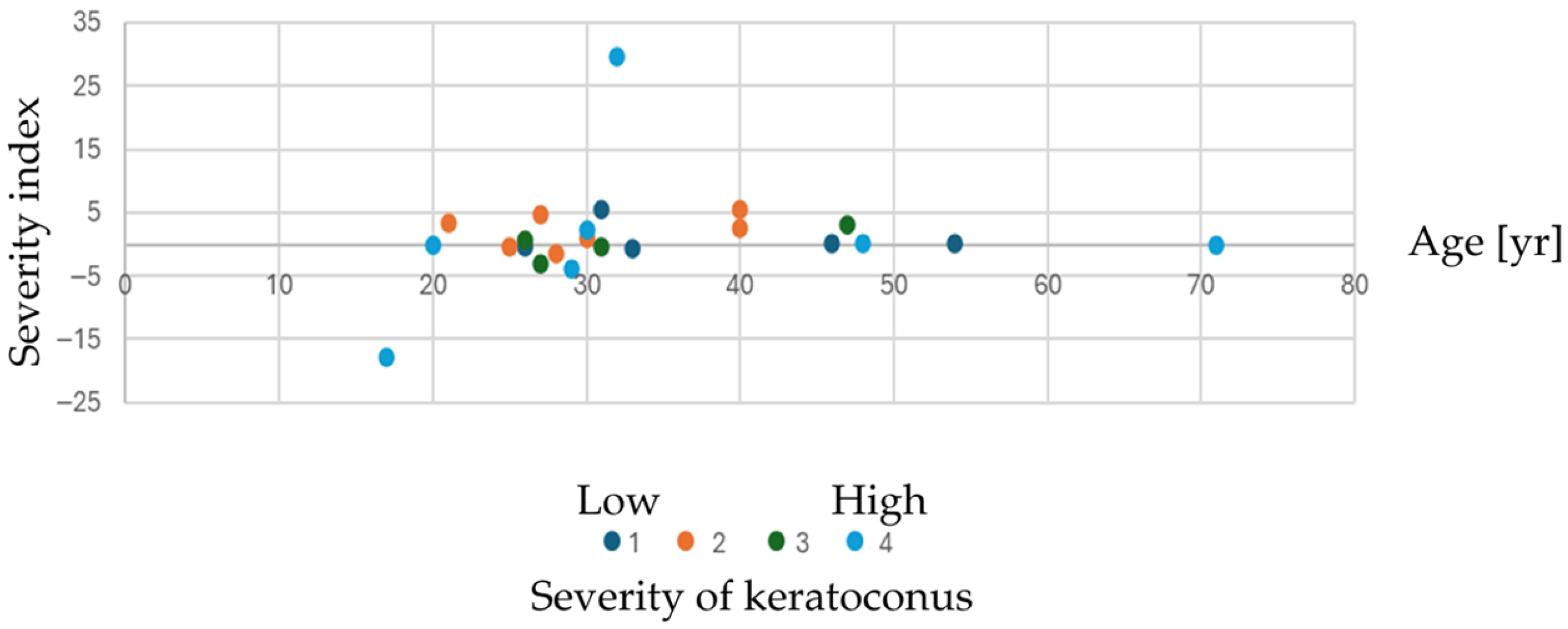
When reviewing the severity index graph at one month (
Figure 1), we expect the percentage values to be below zero, or at least close to the zero axis. The colours on the graph represent different stages. It’s important to note that not all corneas respond immediately after one month. In fact, it appears that the
value may initially increase before decreasing again, likely due to an inflammatory phase and subsequent stabilization.
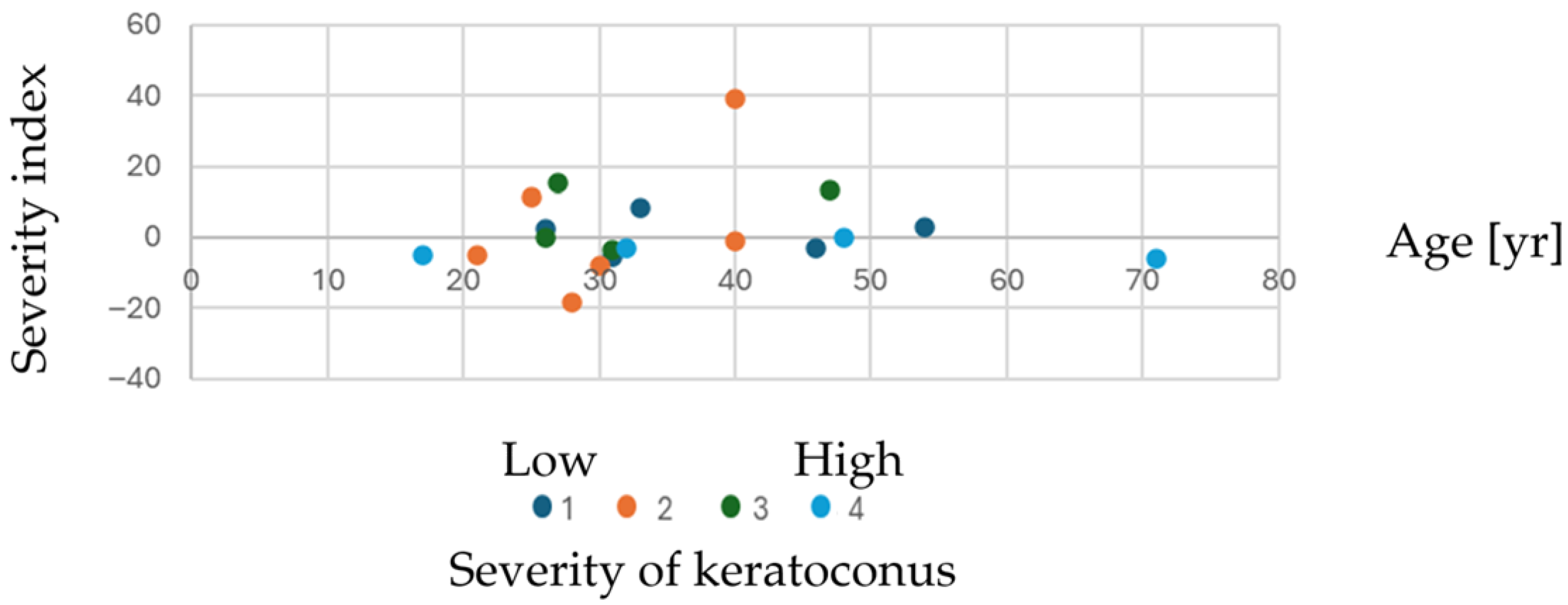
We can also highlight that the surgery obtains only a small stabilisation of the corneas for all the stages, pointing out that the eye systems require time to obtain a stable new state after the surgery, as it will be clear in
Figure 2.
By six months, nearly all measurements are expected to be around or below zero.
Figure 2 shows the severity index for the posterior corneal surface six months after CXL treatment. Examining the numerator, a noticeable difference is present, indicating that for the therapy to be deemed successful, the percentage must be negative or close to zero, as the measurement should exceed the baseline.
This points out that the intervention was successful, as evidenced by a relative reduction in the curvature of the posterior corneal surface after six months, indicated by an index lower than zero. If the index is equal to or close to zero, it suggests that the curvature has stabilized and has not progressed over time.
We can also highlight that the surgery obtains a full stabilisation of the corneas for stages 1, 2 and 4. This result is under consideration for medical interpretation in a new study during the next four years. This long time is related to the few cases of KC in Alessandria Hospital during a given year.
4. Discussion
In recent years, CXL has emerged as the leading surgical intervention for progressive keratoconus, significantly reducing the need for corneal transplantation in advanced cases. Particularly in early stages of the disease, CXL has proven effective in halting progression, thereby decreasing the incidence of severe corneal scarring that necessitates keratoplasty. Introduced approximately 25 years ago, CXL is a minimally invasive procedure designed to strengthen the corneal tissue. The treatment utilizes riboflavin (vitamin B2) as a photosensitiser combined with ultraviolet-A (UV-A) light to induce the formation of strong covalent bonds within the corneal stroma. This biochemical cross-linking increases corneal stiffness and resistance to deformation, effectively slowing or preventing the progression of keratoconus.
The foundational protocol for CXL, known as the Dresden protocol, was developed in the late 1990s at the University of Dresden and clinically introduced by Wollensak and colleagues in 2003 [
23]. This standard method involves removing the central 7 mm of the corneal epithelium to facilitate riboflavin penetration, followed by a 30-min application of riboflavin drops and simultaneous UV-A irradiation at a controlled intensity. The procedure delivers a total energy dose of 5.4 J cm
−2, which initiates a photochemical reaction that cross-links collagen fibers, thereby stabilizing the corneal structure.
Clinical studies have demonstrated the efficacy and safety of the Dresden protocol. Wollensak’s initial pilot study showed disease regression in 70% of treated eyes, with significant reductions in maximal keratometry and refractive error [
22]. Long-term follow-up studies have reinforced these findings, confirming sustained improvements in corneal curvature and visual acuity over periods extending up to ten years. For example, Raiskup et al. [
33] reported a decrease in keratometric values from 61.5 to 55.3 diopters (D) and an improvement in corrected distance visual acuity (CDVA) equivalent to approximately 1.4 lines on the Snellen chart after a decade. Other studies have observed keratoconus progression inhibition rates as high as 89%, with some reporting no progression at all over multi-year follow-ups.
To enhance clinical outcomes and patient safety, various modifications of the original Dresden protocol have been developed. These include:
Transepithelial (epi-on) CXL, which preserves the corneal epithelium to reduce discomfort and risk;
Accelerated CXL, which shortens treatment time by increasing UV-A intensity;
Pulsed CXL and iontophoresis-assisted techniques that improve riboflavin delivery.
Additionally, combined or CXL plus methods integrate cross-linking with other refractive procedures to optimize visual rehabilitation.
Safety considerations remain paramount, with treatment generally reserved for corneas at least 400 µm thick to protect the corneal endothelium from UV-A damage. The procedure’s minimally invasive nature and robust long-term data have established CXL as the gold standard for managing progressive keratoconus, offering patients a means to preserve vision and delay or avoid more invasive surgeries such as keratoplasty [
22].
Therefore, CXL has become a cornerstone in the treatment of KC and other corneal ectatic disorders, offering a minimally invasive approach to halt disease progression and improve corneal biomechanics. Clinical evidence supports the efficacy of concentional cross-linking (CCXL) in improving corneal parameters and visual outcomes. For instance, a study by Iqbal et al. [
34] demonstrated that 81.6% of treated eyes achieved postoperative spherical equivalent refraction better than the attempted target, with significant and stable reductions in maximal keratometry (
) and refractive error over a five-year follow-up. Importantly, only a small fraction (4%) showed disease progression, underscoring the procedure’s long-term effectiveness [
22].
Despite its success, CCXL is associated with postoperative complications primarily due to epithelial removal, such as infective keratitis and delayed wound healing [
22]. This has driven the development of alternative techniques aimed at preserving the epithelium, collectively termed transepithelial or epithelium-on CXL (TE-CXL or epi-on CXL). These methods seek to maintain the protective epithelial barrier, potentially reducing discomfort and accelerating recovery. However, the intact epithelium poses a challenge for riboflavin penetration, necessitating innovative delivery methods such as iontophoresis, chemical enhancers, or creation of epithelial flaps or pockets [
22]. While TE-CXL generally results in fewer complications, it tends to be less effective in halting keratoconus progression compared to CCXL.
Another significant advancement is accelerated CXL (ACXL), which shortens treatment time by increasing UV-A irradiance while maintaining the total energy dose. This approach reduces the procedure duration from the standard 30 min to as little as 3 to 10 min, enhancing patient comfort and clinical throughput. ACXL has shown promising results, particularly in mild to moderate keratoconus, although patient selection criteria remain critical to optimize outcomes. Pulsed CXL (PL-CXL) introduces intermittent UV-A irradiation to allow oxygen replenishment in the corneal stroma, theoretically enhancing cross-linking efficiency and reducing adverse effects. However, current evidence regarding its clinical superiority is inconclusive, and the longer treatment time compared to continuous ACXL may limit its practicality [
22].
Emerging combined approaches, such as CXL integrated with intracorneal ring segment implantation or topography-guided photorefractive keratectomy (PRK), offer synergistic benefits by simultaneously reshaping the cornea and strengthening its biomechanical properties. These dual modalities hold potential for managing advanced keratoconus but require additional validation before widespread adoption. Innovations in UV-A delivery, including slit-lamp-based systems, aim to increase accessibility by enabling CXL procedures outside specialized surgical suites, potentially reducing costs and expanding treatment availability to underserved populations [
22].
Iontophoresis-assisted CXL (I-CXL) utilizes a low electrical current to facilitate riboflavin penetration through the intact epithelium, aiming to combine the benefits of epi-on techniques with effective stromal saturation. Modifications such as diluted alcohol iontophoresis-assisted CXL (DAI-CXL) further enhance riboflavin delivery. While promising, the variability in clinical protocols and outcomes necessitates cautious interpretation and further research.
In this context this brief report has been developed to introduce a measure for evaluating the effectiveness of cross-linking surgery. Specifically, it aims to present the severity index as a quantitative tool to assess surgical outcomes in ophthalmic evaluations. Our result in developing the index to measure the output of CXL surgery is to integrate comprehensive data on patients’ functional abilities in daily life and overall health status into a unified scalar metric. This consolidated index serves as a quantitative representation of the surgical outcome for each individual patient, acknowledging the inherent variability in patient responses and results. The introduction of such a general index offers several significant advantages. Primarily, it provides a standardised and objective tool to evaluate the overall effectiveness of the therapy, facilitating consistent assessment across diverse patient populations. Moreover, this index can serve as a valuable decision-support tool for ophthalmologists by highlighting the degree of therapeutic success and identifying patients who may benefit from additional interventions, including the potential need for repeat treatment of KC. By enabling a more precise and personalised evaluation of surgical outcomes, the index supports optimised patient management and enhances the ability to tailor subsequent therapeutic strategies based on measurable clinical improvements.
Lastly, the proposed analytical relationship is characterized by its simplicity, which constitutes its principal advantage, as it enables ophthalmologists to effectively assess the efficacy of corneal cross-linking (CXL) treatment. Its straightforward nature facilitates ease of evaluation and quantification for both clinicians and patients. Furthermore, the quantitative index derived from this relation is amenable to integration within artificial intelligence systems, thereby supporting possible statistical analysis and objective evaluation of CXL surgical outcomes.
5. Conclusions
It is well known that the maximum anterior sagittal curvature (
) index has certain limitations. It does not take into account the contribution of the posterior corneal surface [
35].
Additionally, ectasia can progress significantly without any change in , or even with a reduction in that value. However, in this context, the quantity is considered the gold standard for detecting and documenting the progression of ectasia and is commonly used as an indicator of the effectiveness of KC treatments. Following treatment, the curvature, which indicates corneal ectasia, should stabilize over the following months.
In this study, a new parameter has been developed, expressed as a dimensionless numerical value represented as a percentage. Two indices related to the anterior surface of the cornea have been created: one that assesses success one month after treatment and another that visualizes success six months post-surgery.
This perspective study of existing topographic indices and topographic maps has led to the development of a new keratometric index, the severity index . This index allows the ophthalmologists to develop a quantitative and objective assessment of the effectiveness of the KC procedure over time, aiding physicians in determining whether to pursue further therapeutic measures. We propose this dimensionless severity index as a percentage of treatment success, making it easy and quick for ophthalmologists to interpret. This index must be considered together with other ophthalmic quantities due to the limitation of the maximum anterior sagittal curvature: this improvement will be the topic of future studies. Indeed, future developments will involve testing the severity index on a larger sample size to enable a more detailed statistical analysis.
Additionally, a program using artificial intelligence could be introduced to provide ophthalmologists with the proposed severity index value during corneal topographic measurements. This tool would allow for an effective and objective assessment of treatment success and assist physicians in promptly deciding on further therapeutic interventions in the event of adverse outcomes.
In summary, this brief report has introduced a dimensionless index designed to quantify the efficacy of cross-linking surgery. However, several limitations warrant consideration. Firstly, the study was conducted on a relatively small sample size, which precluded the application of a comprehensive statistical analysis. Additionally, the investigation focused exclusively on the parameter, without integrating other ophthalmic characteristics of the patients. Consequently, this study should be regarded as an initial exploratory effort, laying the groundwork for future research aimed at providing more robust clinical evidence.