Article

Sustained Swimming Training Enhances Growth and Swimming Performance in Juvenile Coho Salmon (Oncorhynchus kisutch) with Limited Effects on Osmoregulatory-Related Traits

College of Fisheries and Life Science, Dalian Ocean University, Dalian 116023, China
*
Authors to whom correspondence should be addressed.
These authors contributed equally to this work.
Fishes 2026, 11(6), 370; https://doi.org/10.3390/fishes11060370 (registering DOI)
Submission received: 29 May 2026 / Revised: 18 June 2026 / Accepted: 18 June 2026 / Published: 22 June 2026
(This article belongs to the Special Issue Physiological and Behavioral Studies in Aquaculture)

Abstract

To evaluate the effects of swimming training on growth, swimming performance, and osmoregulatory-related indices in juvenile coho salmon, freshwater-reared fish were subjected to current of 1 body length per second (BL·s−1) from December 2024 to April 2025. Fork length, body weight, condition factor, insulin-like growth factor-1 (IGF-1), and gill and intestinal Na+/K+-ATPase (NKA) protein abundance were measured monthly, and critical swimming speed (Ucrit) was evaluated after one month of training. Trained fish showed greater fork length in March and higher body weight in March and April than controls. The condition factor was higher in trained fish in February and March, but declined during spring smolt development. Swimming capacity was enhanced by training, as indicated by significantly higher Ucrit. Mean IGF-1 levels did not differ between groups, but IGF-1 correlated positively with body size only in trained fish. No significant training effect was detected for either gill or intestinal NKA protein abundance, although gill NKA increased significantly in April, likely reflecting seasonal smoltification. In addition, IGF-1 was significantly correlated with gill NKA in trained fish in March. Collectively, these results indicate that sustained swimming training improves growth and swimming performance and may enhance associations among measured physiological variables during smoltification in juvenile coho salmon.
Key Contribution: Sustained swimming training at 1 BL·s−1 significantly enhanced aerobic swimming performance and promoted late-stage growth in freshwater juvenile coho salmon. Although training did not change mean gill or intestinal NKA protein abundance, it strengthened IGF-1–growth associations and induced a significant IGF-1–gill NKA coupling during the smolt preparation window, suggesting improved associations among measured physiological variables rather than direct upregulation of NKA.

1. Introduction

Salmonids (Salmonidae) are important aquaculture species due to their favorable nutritional profile [1]. In China, salmonid farming is primarily conducted using either a freshwater–seawater relay production system or land-based recirculating aquaculture systems utilizing underground brine. Therefore, the capacity of salmonids to acclimate from freshwater to seawater—particularly post-transfer survival—is critical for production and industry development [2]. This highlights the practical importance of improving juvenile quality during freshwater rearing and promoting their preparedness for seawater entry. Among salmonids, coho salmon is particularly relevant to this issue because of its economic importance in freshwater–seawater relay aquaculture and its distinct smoltification process.
Coho salmon (Oncorhynchus kisutch) is a typical anadromous salmonid species. When anadromous salmon migrate from freshwater to seawater, they undergo a series of complex physiological changes known as the parr–smolt transformation (smoltification) [3]. Smoltification is a key stage for seawater adaptation, involving marked morphological, behavioral, and physiological changes (such as body silvering, body elongation, and increased scale size), which facilitate survival in seawater [4,5]. In addition, smoltification enhances osmoregulatory capacity, the process primarily reflected in functional remodeling of key osmoregulatory organs, such as gills and intestine [6,7].
Chloride cells (ionocytes) in the gills are found mainly in the filament epithelium and are rich in NKA, an enzyme that drives ion transport [8,9]. However, relying on gill NKA activity as the only indicator for determining seawater transfer timing is increasingly recognized as insufficient. In some aquaculture practices, this single parameter does not adequately account for post-transfer mortality or differences in seawater adaptation [10]. In addition to the gills, the intestine plays a key role in water and salt handling in seawater. Marine fish typically drink seawater to obtain water, making the intestine essential for water absorption and ion processing [7]. Studies also suggest that intestinal NKA can be regulated independently of the gills following seawater entry [11]. Moreover, recent work indicates that NKA regulation involves not only changes in enzyme activity but also remodeling of NKA protein abundance and isoform expression patterns [12,13]. Therefore, from an organ-coordination perspective, simultaneously examining ion-transport indicators in the gills and intestine, alongside NKA protein expression, may provide a more comprehensive molecular view of the stage-specific remodeling of the osmoregulatory system during smolt preparation and its response to swimming training.
On the other hand, salinity/seawater adaptation in salmonids is closely linked to growth. In species such as steelhead trout (Salmo gairdneri) and rainbow trout (Oncorhynchus mykiss), individuals with better growth performance under certain conditions often exhibit higher ion-transport-related indices and improved salinity acclimation [14,15,16], suggesting that the development of ion regulatory capacity may underpin sustained growth during smoltification.
Insulin-like growth factor 1 (IGF-1) is a key endocrine factor of the GH/IGF growth axis. It can be secreted by the liver and other tissues under GH stimulation to promote muscle and skeletal development and thereby drive increases in body length and weight [17,18]. Beyond growth regulation, IGF-1 may also participate in smoltification-related changes in NKA protein abundance and has been associated with indices such as gill NKA activity [19,20,21,22]. Notably, relationships between IGF-1 and growth rate or osmoregulatory indices are not constant and may show stage-specific patterns depending on environmental conditions, nutritional status, and smolt progression [23,24,25]. Therefore, in addition to comparing mean levels, examining changes in the relationship structure between endocrine signals and phenotypic/organ indices may help reveal how external conditions influence associations among measured physiological variables.
Improved swimming ability, stress tolerance, and other traits are all closely related to fitness [26,27]. Previous studies have shown that sustained exercise at an appropriate intensity can promote growth, muscle development, and multiple physiological functions, thereby enhancing fish performance in complex environments [28,29]. However, evidence remains limited regarding whether and how swimming training affects ion-transport indices related to smolt preparation in freshwater salmonids (e.g., gill and intestinal NKA) and their coordination with growth-axis signaling (IGF-1), and species and stage-dependent differences may exist [4]. Studies in Atlantic salmon suggest that sustained aerobic training may positively influence seawater-transfer-related physiological performance [10]. Moreover, a previous study on Atlantic salmon tested continuous aerobic exercise at different swimming speeds and reported that 1.0 BL·s−1 was the most suitable swimming speed for improving growth performance during the freshwater phase [30]. However, velocity suitability may differ among salmonid species. Previous habitat studies have shown that juvenile coho salmon are generally associated with low-velocity pool or slow-flow habitats. For example, juvenile coho salmon have been reported to prefer pools with average velocities below 20 cm·s−1, whereas steelhead more frequently use habitats with higher current velocities [31]. Therefore, 1.0 BL·s−1 was selected as a moderate and relatively conservative training velocity for juvenile coho salmon in the present study. Whether the beneficial effects reported in Atlantic salmon can be extended to juvenile coho salmon and detected at the level of freshwater ion-transport-related indices requires further verification.
Accordingly, this study established an Experiment group and a control group under freshwater conditions and conducted sustained swimming training in juvenile coho salmon for 4 months at a relative intensity of 1 BL·s−1. Body length, body weight, critical swimming speed (Ucrit), serum IGF-1, and NKA protein abundance in gill and intestinal tissues were measured to systematically evaluate training effects on growth and swimming performance, and to test whether training alters freshwater gill/intestinal NKA dynamics and the association structure between IGF-1 and growth traits as well as between IGF-1 and gill NKA levels. These results provide scientific support for optimizing juvenile rearing strategies in freshwater–seawater relay aquaculture of salmonids and offer new insights into interactions between swimming training and osmoregulation.

2. Materials and Methods

2.1. Experimental Fish and Rearing Conditions

Juvenile coho salmon were purchased from Beihuanghai Salmon Fishery Co., Ltd. (Dalian, China). The experiment was conducted in freshwater from December 2024 to April 2025. At the start of the experiment, the fish had an average fork length (FL) of 10.0 ± 1.02 cm, an average body weight (BW) of 11.0 ± 3.29 g, and an average condition factor (K) of 1.07 ± 0.050. Based on their initial body size, the fish were considered to be at an early smolt-preparation stage.
After acclimation, fish were randomly assigned to control and training groups (80 fish per group), with two replicate tanks per group to minimize potential tank effects. All tanks were maintained under standardized freshwater conditions with continuous filtration, aeration, and daily exchange of approximately one-third of the water volume. Water temperature was maintained at 13.1 ± 1.1 °C, and the dissolved oxygen concentration was 8.11 ± 0.36 mg/L.

2.2. Swimming Training System and Protocol

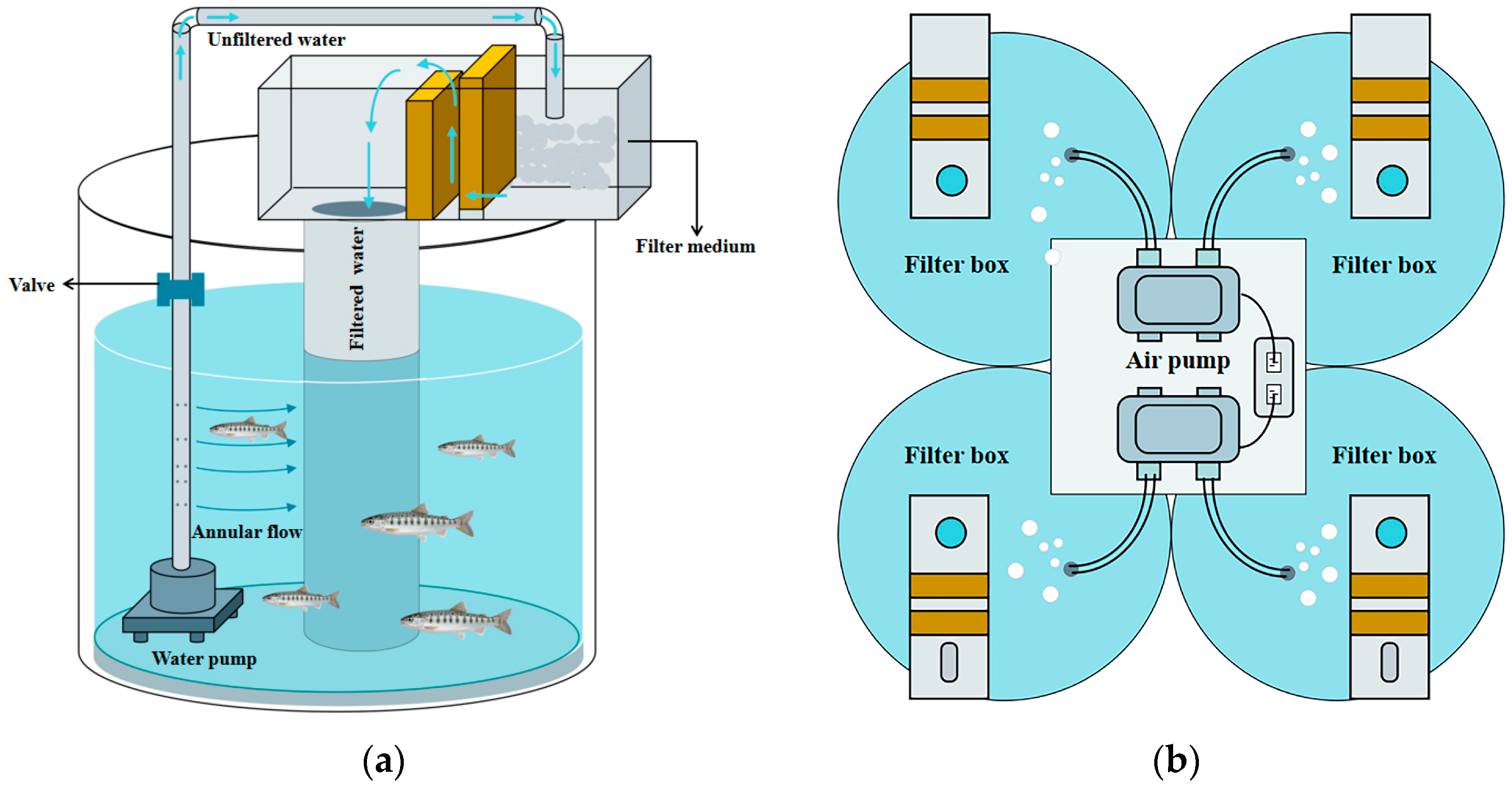
A self-constructed circular flume system was used for the swimming-training treatment (Figure 1). Each tank had a radius of 0.5 m, a height of 1.0 m, and an effective water volume of approximately 1.0 m3. A central cylindrical support structure was installed to hold the overhead filtration unit and also served as a baffle to reduce turbulence. Circular water flow was generated by directing the inlet tangentially to the tank wall and controlled by a pump and valve system to produce a persistent circular current in the main swimming area. Each tank was equipped with an overhead filtration unit containing mechanical and biological filter media, and continuous aeration was provided throughout the experiment.
The experiment used a control–training design. Fish in the control group were reared without a sustained directional current, whereas fish in the training group exposed to the circular current. This design relied on the positive rheotactic behavior of salmonids to induce sustained oriented swimming. Control and training tanks were maintained under the same water-exchange regime, aeration, feeding schedule, stocking-density adjustment, and routine husbandry management to reduce treatment-independent environmental variation. However, the hydraulic environments of the two treatments were not completely identical because only the training tanks generated a sustained directional current.
Each treatment contained 80 fish distributed into two replicate tanks, with 40 fish per tank. Based on the initial mean body weight of 11.0 g, the initial stocking density was approximately 0.44 kg·m−3 in each tank. As fish were removed during monthly sampling, the effective water volume was gradually adjusted to maintain comparable stocking density between treatments.
The training speed was set at 1.0 BL·s−1 recalibrated after each monthly sampling according to the updated mean fork length of the training group. The corresponding target velocities were 10.00, 12.05, 12.99, and 15.24 cm·s−1 from January to April, respectively. Flow velocity was measured using an LS300-A flow meter (Nanjing Ouka Instruments Co., Ltd., Nanjing, China) in two training tanks at four angular positions (90°, 180°, 270°, and 360°) and three water layers (upper, middle, resulting in 24 measurement points per month. Detailed point-by-point flow velocities are provided in Supplementary Table S1. Flow rate was adjusted through the tangential inlet valve when necessary.
Fish were fed twice daily with a commercial compound feed (Shandong Youyu Biotechnology Co., Ltd., Qingdao, China) containing ≥52.0% crude protein, ≥7.0% crude lipid, ≤5.0% crude fiber, ≤19.0% crude ash, ≥1.5% total phosphorus, ≥3.0% lysine, and ≤10.0% moisture. Fish were not fed ad libitum and the daily ration did not exceed 3% of total body weight. During feeding, water flow and aeration were suspended for approximately 30 min in both groups. Residual feed and feces were removed 1 h after feeding, but residual feed was not quantitatively weighed; therefore, precise feed intake and feed conversion ratio (FCR) could not be calculated. The experiment was conducted under a natural photoperiod.

2.3. Sampling

The experimental period lasted 4 months, with sampling conducted in January, February, March, and April. At each sampling point, eight fish were randomly sampled from each of the two replicate tanks in each treatment, resulting in 16 fish per treatment. Individual fish were used as biological observational units for the statistical analyses of growth and physiological variables. For specific assays, a small number of samples were excluded due to technical reasons, including insufficient sample volume or failure to meet assay quality-control criteria. Therefore, the actual sample size used in each analysis is reported in the corresponding figure legend. Remaining fish continued to be reared under their original treatment conditions after each sampling.
Fish were anesthetized with MS-222 (Fujian Jinjiang Wuli Economic Development Zone Aquatic Products Co., Ltd., Jinjiang, Fujian, China), and body length and weight were measured. Blood samples were collected and allowed to clot at 4 °C for 24 h, followed by centrifugation to obtain serum, which was stored at −80 °C for subsequent IGF-1 analysis.
Gill and mid-intestinal fragments were also collected, snap-frozen on dry ice, and stored at −80 °C for NKA protein measurement.

2.4. Determination of Condition Factor

To evaluate fish condition, Fulton’s condition factor (K) was calculated using the following formula:
K = 100 × BW/FL3
where BW is body weight (g) and FL is fork length (cm).

2.5. Serum IGF-1 Determination

Serum IGF-1 levels were determined by enzyme-linked immunosorbent assay (ELISA) using a commercial fish IGF-1 ELISA kit (Sangon Biotech Co., Ltd., Shanghai, China), strictly following the manufacturer’s instructions.
After the reaction, absorbance was measured at 450 nm using a Rayto RT-6100 microplate reader (Rayto Life and Analytical Sciences Co., Ltd., Shenzhen, China), and serum IGF-1 concentrations were calculated based on the standard curve.

2.6. Quantification of Na+-K+-ATPase Protein Abundance

NKA protein abundance in gill and intestinal tissues were quantified by ELISA using a fish NKA ELISA kit (Shanghai HEPENG Biotechnology Co., Ltd., Shanghai, China), based on the double-antibody one-step sandwich method. After completion of the reaction, optical density (OD) was measured at 450 nm, and NKA protein abundance was calculated from the standard curve according to the manufacturer’s instructions. In the present study, these measurements were interpreted as an index of NKA protein abundance in osmoregulatory tissues, rather than a direct measure of enzymatic activity.

2.7. Critical Swimming Speed Test

The Ucrit test was conducted after the first month of the four-month training period. 10 fish per group were randomly selected for critical swimming speed (Ucrit) tests, with 5 fish taken from each replicate tank, to minimize potential tank bias. Body length and body weight were recorded for all fish before test and each fish was then transferred to the circular flow swim tunnel system. Fish were allowed to acclimate to the test chamber at a low flow speed before the stepwise velocity test. Water temperature during testing was maintained close to the rearing temperature. Flow velocity was then increased by 1 BL·s−1 (approximately 11.37 cm/s, based on the average of test fish’s FL) at 10 min intervals until the fish reached fatigue. Fatigue was defined as the point at which the fish could no longer maintain its position against the current despite stimulation and remained impinged on the downstream screen or outlet area. The duration that each fish swam at the final, uncompleted velocity was recorded. Tested fish were not returned to the rearing tanks and were excluded from subsequent physiological sampling to avoid carry-over effects of exhaustive exercise. Fish subjected to the swimming performance test were not returned to the rearing tanks after testing.
Absolute and relative Ucrit were calculated using the following equations:
Ucrit = U1 + (T1/T2) × U2
Ucrit′ = Ucrit/L
where Ucrit is the absolute critical swimming speed, Ucrit′ is the relative critical swimming speed, U1 is the highest velocity maintained for the full interval, U2 is the velocity increment (1 BL·s−1), T1 is the time fish swam at the final uncompleted velocity, T2 is the time interval (10 min), and L is fork length.

2.8. Data Analysis

Data were organized in Microsoft Excel 2019 (Microsoft Corporation, Redmond, WA, USA), and statistical analyses were conducted using IBM SPSS Statistics (IBM Corp., Armonk, NY, USA, version 27.0). Normality and homogeneity of variance were evaluated using the Shapiro–Wilk and Levene’s tests, respectively. For variables that met the assumptions of normality and homogeneity of variance, two-way ANOVA was performed with treatment (control vs. training), sampling month (January–April) and their interaction as fixed factors. When significant interactions were detected (p < 0.05), simple-effects analyses with Bonferroni correction were conducted to compare treatment differences within each month and monthly differences within each treatment. When interactions were not significant, main effects were interpreted, followed by Bonferroni-adjusted post hoc comparisons among months where appropriate.
Variables that did not fully meet the assumptions for parametric analysis were compared between the control and training group within each sampling point using Mann–Whitney U test. Because Ucrit was measured at a single sampling time point and involved only two treatment groups, differences in Ucrit between the control and training groups were analyzed using an independent-samples t-test.
Spearman’s rank correlation analysis was performed at the individual level within each treatment. Correlations between serum IGF-1 levels and fork length, body weight, or gill NKA protein abundance were analyzed pooled individual data across sampling months. Correlation coefficients are reported as Spearman’s ρ and 95% confidence intervals for were estimated using bootstrap resampling. Raw p values were adjusted using the Benjamini–Hochberg false discovery rate (FDR) procedure. Correlations with FDR-adjusted p values < 0.05 were considered statistically significant.
Data are presented as mean ± standard deviation (SD), unless otherwise indicated. Statistical significance was accepted at p < 0.05. Figures were generated using Origin 2022.

3. Results

3.1. Effects of Swimming Training on Swimming Performance

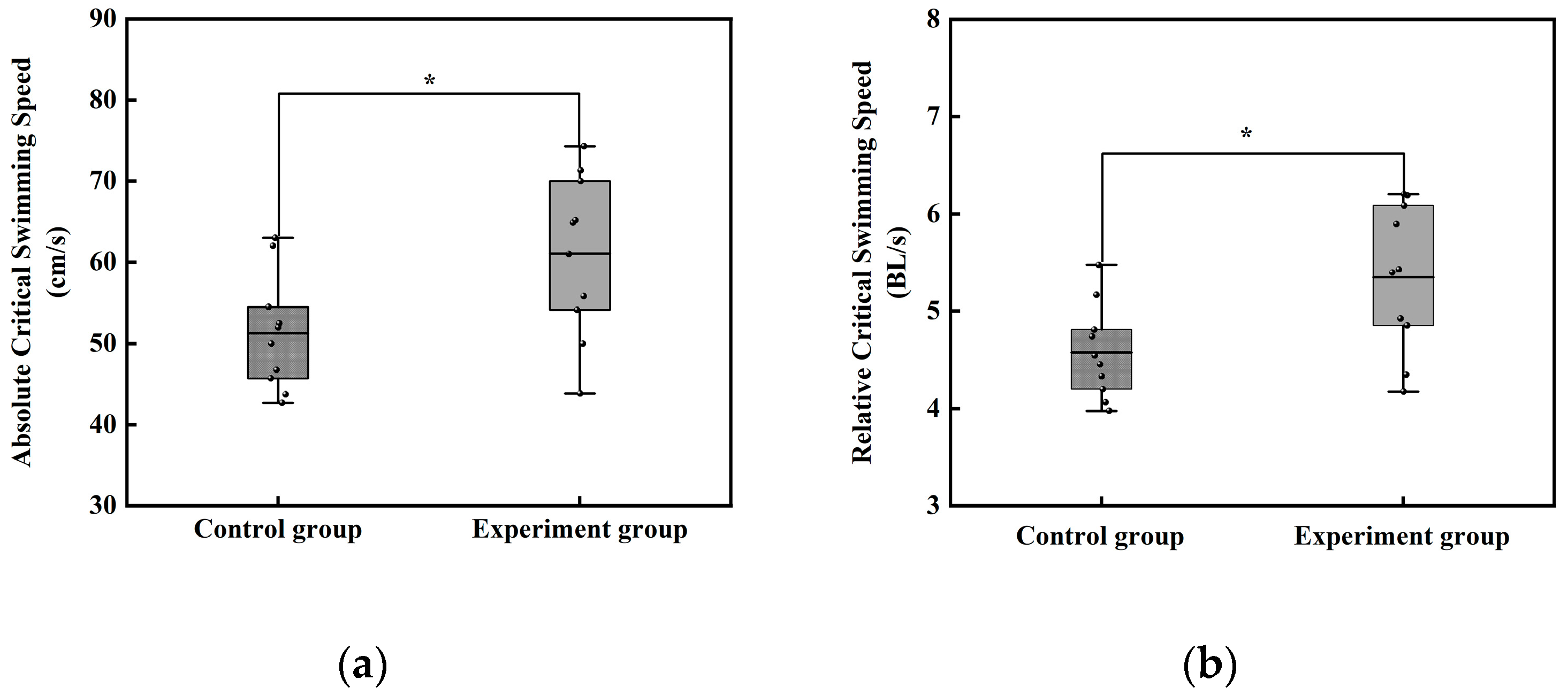
After the first month of the four-month training period, the absolute critical swimming speed (Ucrit) in the Experiment group was 61.06 ± 9.92 cm/s, which was significantly higher than that of the control group (51.29 ± 7.06 cm/s, p < 0.05; Figure 2a).
Similarly, relative Ucrit (expressed as body lengths per second, BL·s−1) was also significantly higher in the Experiment group compared with the control group (p < 0.05; Figure 2b), indicating that sustained swimming training significantly improved aerobic swimming capacity in juvenile coho salmon.

3.2. Effects of Swimming Training on Growth Performance

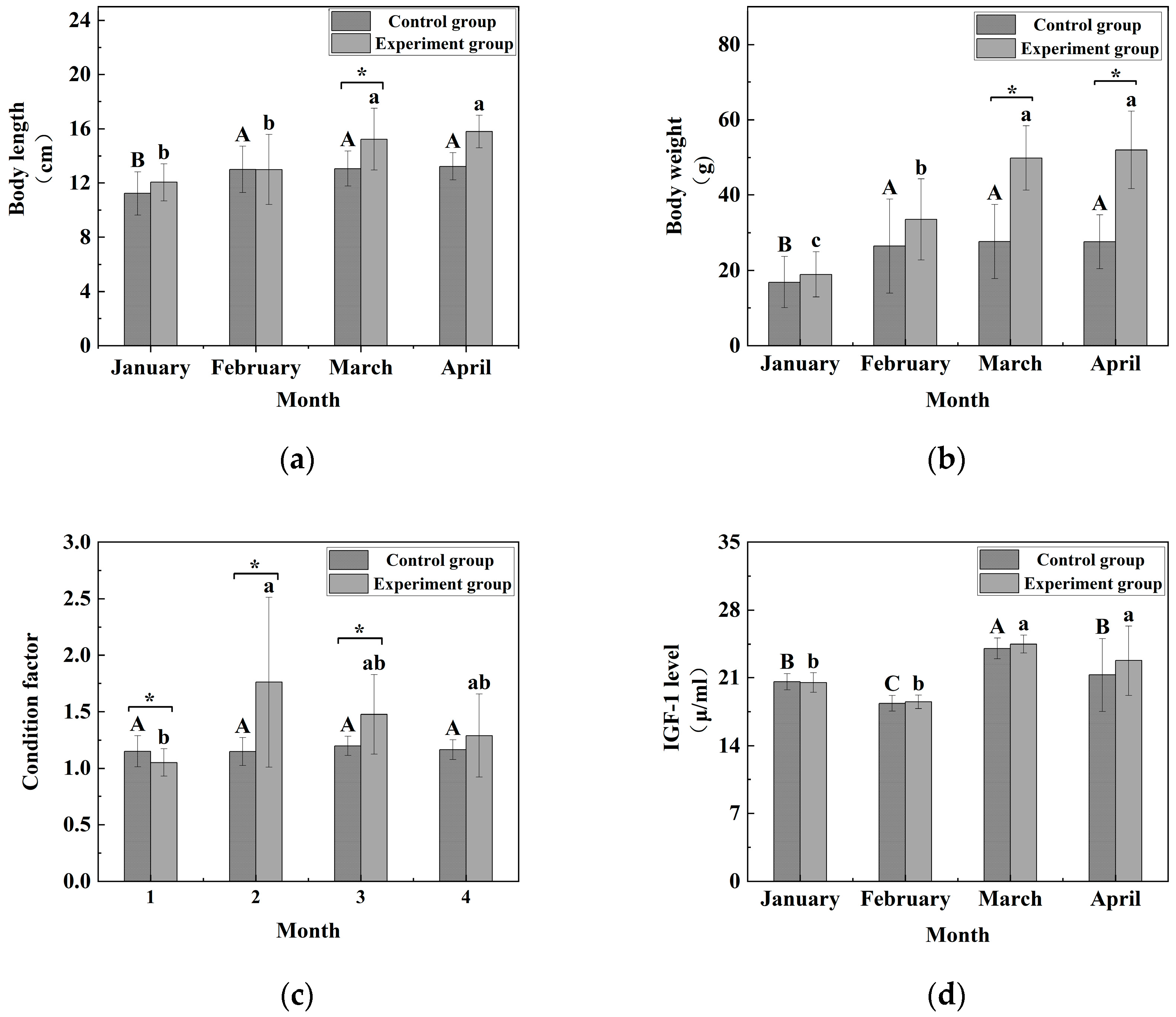
Swimming training promoted somatic growth performance in juvenile coho salmon during the late experimental period. For fork length (FL), two-way ANOVA revealed significant effects of training, sampling time, and their interaction (Table 1). Post hoc comparisons showed that FL was significantly higher in the Experiment group in March and April (p < 0.05; Figure 3a). Similar patterns were observed for body weight (BW) and condition factor (K). Because body weight (BW) and condition factor (K), data did not fully satisfy the assumptions for parametric in some sampling periods, non-parametric pairwise comparisons were used where appropriate. These analyses showed that BW in the Experiment group was significantly higher than that in the control group in March and April (p < 0.05; Figure 3b). For condition factor, significant between-group differences were detected in January, February, and March. The training group showed a lower condition factor than the control group in January, but higher values in February and March (p < 0.05; Figure 3c; Table 1).
Serum IGF-1 levels showed significant temporal variation but were not significantly affected by training treatment or by the interaction between training and sampling time (Table 1). IGF-1 levels increased during the later experimental period, with significantly higher values in March and April than in earlier months (Figure 3d).
Variables meeting the assumptions of normality and homogeneity of variance were analyzed using two-way ANOVA with treatment, sampling month, and their interaction as fixed factors. Variables that did not meet parametric assumptions were compared between groups within each sampling month using the Mann–Whitney U test. For non-parametric variables, only significant between-group outcomes are summarized. NKA protein abundance.

3.3. Effects of Swimming Training on Gill and Intestinal NKA Protein Abundance

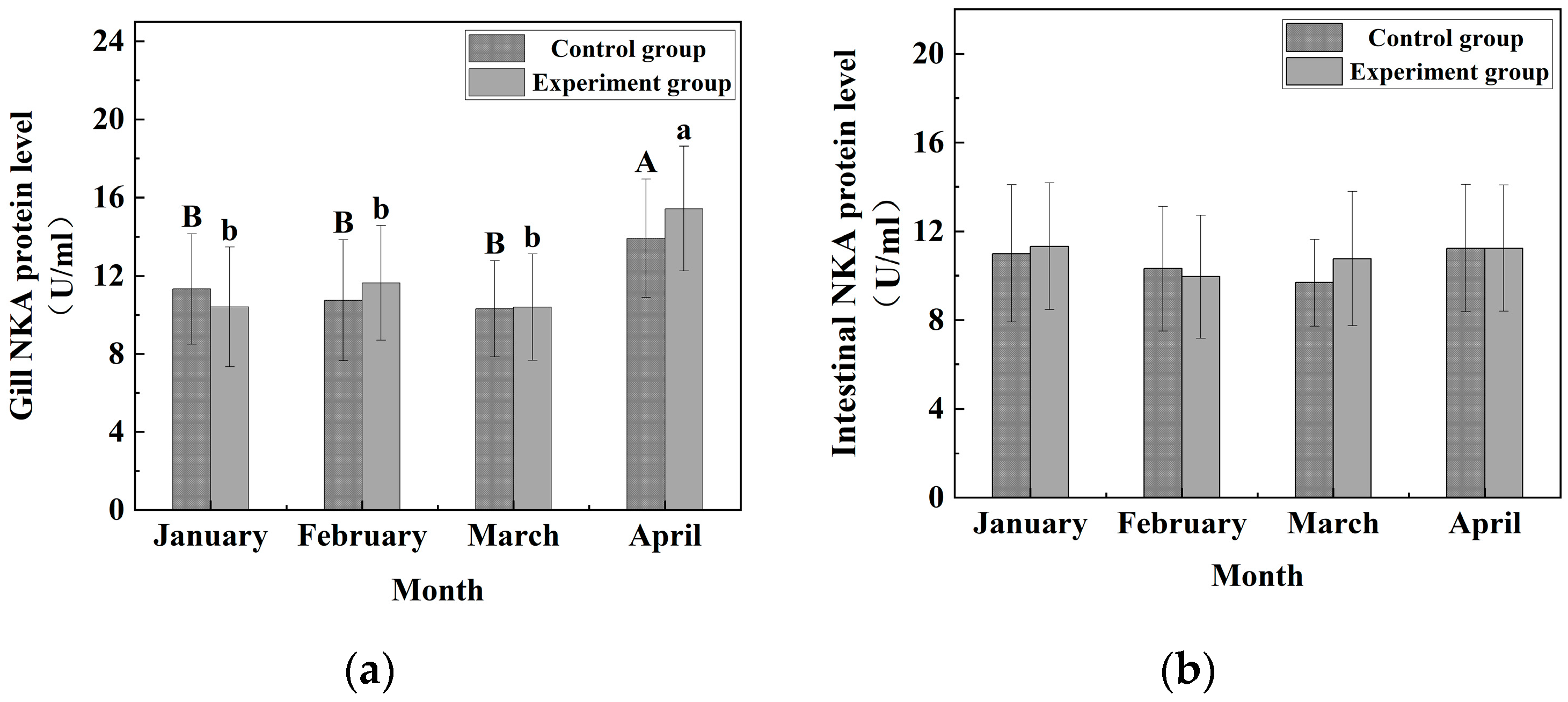
Gill NKA protein abundance was significantly affected by sampling time only, with all fish showing a marked increase in April, whereas no significant differences between groups were detected at any sampling point (Figure 4a). Intestinal NKA protein abundance was not significantly affected by training, sampling time, or their interaction, although slight fluctuations were observed during the experimental period (Figure 4b).

3.4. Correlation Analysis Among Growth Traits, IGF-1, and Gill NKA

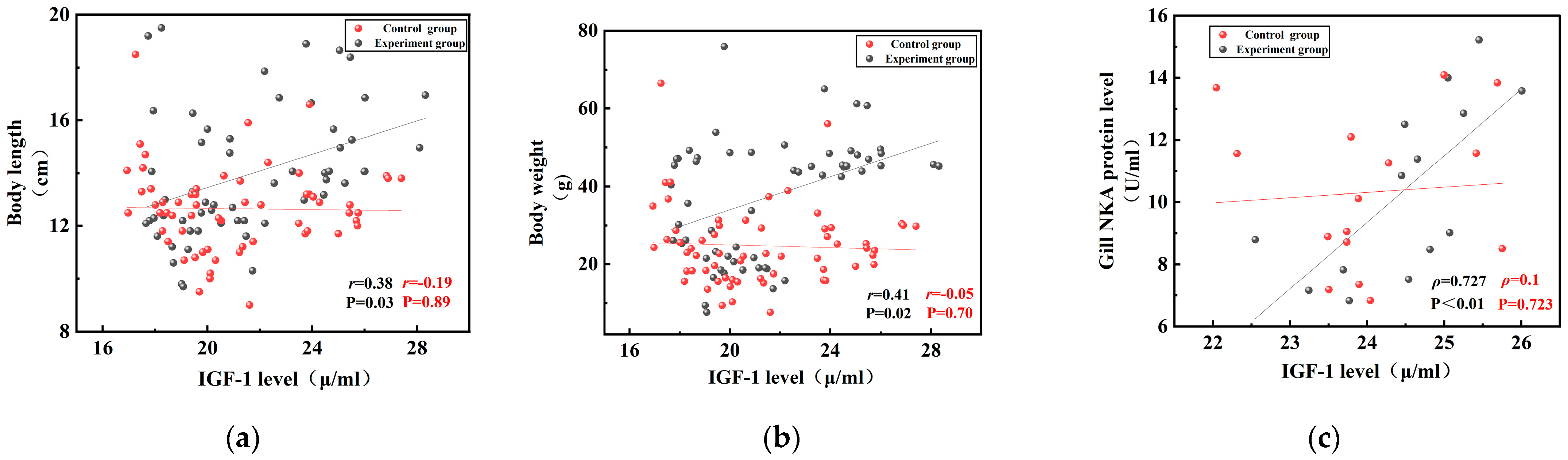
Although mean IGF-1 levels were not significantly affected by training, correlation analyses revealed altered coordination patterns under swimming training conditions. In the Experiment group: Serum IGF-1 levels were significantly positively correlated with fork length and body weight (Figure 5a,b). In March, IGF-1 levels were significantly correlated with gill NKA protein abundance. In contrast, these correlations were not observed in the control group (Figure 5c). The Spearman correlation coefficients, p values, 95% confidence intervals, and FDR-adjusted p values are provided in Table 2.

4. Discussion

Moderate swimming training has been shown to improve growth performance in fish [32,33,34,35]. Critical swimming speed (Ucrit) is a widely used indicator of prolonged aerobic exercise capacity in fish [36]. After one month of sustained swimming at 1 BL·s−1, both absolute and relative Ucrit were significantly higher in the Experiment groups than in the control group. Based on the Ucrit values measured after one month, the training velocity of 1.0 BL·s−1 corresponded to approximately 21.8% of Ucrit in the control group and 18.5% in the training group, indicating a relatively conservative sustained aerobic load. This result confirms that sustained swimming at 1 BL·s−1 was sufficient to induce measurable improvements in aerobic swimming capacity at an early stage of training, supporting the effectiveness of the training regime. This finding is consistent with previous studies in rainbow trout and striped bass under flow conditioning [37,38,39]. Improved aerobic swimming performance following chronic exercise is largely attributed to the structural plasticity of the fish musculature. Under moderate training intensity, increases in muscle fiber cross-sectional area and improvements in muscle development may provide a structural basis for the simultaneous enhancement of swimming performance and growth [40,41]. Together, these results suggest that moderate sustained swimming can rapidly improve swimming endurance in juvenile coho salmon and may contribute to subsequent growth advantages.
Regarding somatic growth, body length and body weight in the Experiment group became significantly higher than those in the control group from March onward and remained elevated in April under sustained swimming at 1 BL·s−1. This temporal patterns suggests that the growth-promoting effect of swimming training did not occur immediately, but emerged gradually after a period of physiological adaptation. Similar growth enhancements have been reported in other salmonids. For instance, masu salmon exhibited accelerated growth under higher flow velocities [42], and Atlantic salmon subjected to continuous or intermittent aerobic training also showed enhanced growth, although the effect became evident only after a certain training duration [34]. Notably, the temporal pattern of growth divergence in the present study coincided with the spring smolt preparation period. During smoltification, salmonids typically undergo marked physiological remodeling characterized by body elongation, decreased condition factor, and enhanced osmoregulatory capacity [4,43]. In the Experiment group, condition factor increased during the mid stage but did not remain elevated in the later stage. This pattern may reflect energy reallocation under the combined influence of swimming training and smolt-related physiological remodeling [15,31]. Overall, the observed growth differences were most likely associated with the swimming training regime, although seasonal developmental changes probably also contributed to the timing of divergence [16]. Under such physiological conditions, training-induced improvements in swimming capacity may be more readily translated into measurable growth advantages. Therefore, the present findings support the conclusion that sustained moderate swimming training promotes later-stage growth in juvenile coho salmon, with effects that appear to be temporally delayed and stage dependent.
To further investigate growth regulation under training conditions, serum IGF-1 levels were measured. IGF-1 exhibited significant temporal variation, with levels increasing from March onward; however, no significant difference in mean IGF-1 levels was detected between groups. This suggests that the seasonal increase was primarily driven by photoperiod and smoltification processes, consistent with previous reports in salmonids during spring smoltification [24,44]. These findings indicate that sustained swimming training did not elevate absolute IGF-1 levels. However, under training conditions, the relationship between IGF-1 and growth traits became significantly stronger. Previous studies have shown that the association between IGF-1 and growth in fish can be either concordant or discordant, and that changes in IGF-1 concentration alone do not fully explain growth variation [45]. In the present study, evaluating only mean IGF-1 levels would not capture the training-associated differences in associations among measured physiological variables. Instead, the strengthened correlations between IGF-1 and body length and body weight in the Experiment group provide insight into how swimming training modifies endocrine–growth coupling.
Condition factor declined in April, coinciding with the increase in gill NKA protein abundance. In salmonids, a reduction in condition factor during spring smoltification is generally associated with body elongation, mobilization of energy reserves, and whole-body remodeling, whereas elevated branchial NKA-related indices reflect remodeling of ion-transport tissues [46,47]. Therefore, the concurrent decline in condition factor and increase in gill NKA protein abundance observed here are more appropriately interpreted as coordinated manifestations of smolt-related physiological remodeling rather than a direct causal relationship. Because neither metabolic rate nor body composition was measured in the present study, the mechanistic link between energetic reallocation and NKA-related changes remains to be clarified.
Changes in branchial NKA are widely considered as an important component of changes in NKA protein abundance during smolt preparation [48]. In this study, however, NKA was quantified using ELISA therefore reflects NKA protein abundance rather than enzymatic activity. Accordingly, these data should be interpreted as an index of NKA protein abundance in osmoregulatory tissues, rather than as a direct measure of ion-transport function or functional osmoregulatory capacity. This distinction is important because NKA activity may vary independently of total NKA protein abundance due to factors such as post-translational regulation, isoform composition, and membrane localization [49,50,51]. No significant differences were detected between training and control groups at any sampling time point. However, both groups exhibited significant increases in gill NKA protein abundance in April. In contrast, mid-intestinal NKA protein abundance did not increase in parallel, indicating tissue-specific and time-dependent regulation. Wild juvenile coho salmon typically undergo smoltification in spring [52], a critical period for acquiring seawater tolerance. A hallmark of this stage is enhanced branchial ion-transport capacity, often reflected by increased NKA-related indices [53]. Seasonal factors such as rising temperature and extended photoperiod can stimulate NKA-related changes via endocrine regulation [15,53]. Therefore, the April increase in gill NKA protein abundance observed in the present study likely reflects seasonal smoltification processes rather than swimming training effects. Under the current freshwater conditions and training intensity, swimming training had limited influence on mean gill and intestinal NKA protein abundance.
Unlike the gill, mid-intestinal NKA protein abundance did not change significantly in April. Previous research suggests that intestinal osmoregulatory function becomes increasingly important after seawater entry, particularly during seawater ingestion and water absorption, and may respond later than gill tissue or differ among intestinal segments [11,12]. Thus, the asynchronous changes between gill and intestinal NKA protein abundance observed here may reflect organ-specific and stage-dependent remodeling of the ion-transport system during smolt preparation. Future studies incorporating segmental intestinal analysis and seawater challenge tests may clarify the temporal dynamics and functional significance of intestinal responses.
Importantly, in March, IGF-1 levels were significantly positively correlated with gill NKA protein abundance in the Experiment group, whereas no such relationship was observed in the control group. This finding is consistent with previous reports linking IGF-1 and gill NKA during smoltification [26]. Therefore, these results should be interpreted as training-associated altered correlation patterns between growth-related endocrine signaling and gill NKA protein abundance, rather than as evidence of a causal physiological coupling mechanism. Future studies should compare multiple swimming speeds, such as 0.5, 1.0, and 1.5 BL·s−1, under different water temperatures and starting body sizes to determine whether the effects of sustained swimming training on growth and NKA-related traits are dependent on exercise intensity, thermal conditions, and developmental stage.
To further clarify the functional significance of these findings, future studies may combine NKA protein abundance with direct assessments of ion-transport activity, such as NKA enzymatic activity, plasma osmolality and Na+/Cl measurements, and seawater challenge tests. Greater tank-level replication would also help strengthen treatment-level inference.

5. Conclusions

In summary, sustained swimming training at 1 BL·s−1 during freshwater rearing improved swimming capacity and was associated with growth performance in juvenile coho salmon. This was evidenced by elevated Ucrit after 1 month of training and greater body length and body weight during March–April. With respect of osmoregulatory-related indices, swimming training did not alter mean gill or intestinal NKA protein abundance. The increase of gill NKA protein abundance observed in April in both groups was more likely associated with seasonal smoltification-related processes than with the training itself. Nevertheless, swimming training strengthened the positive relationship between IGF-1 and body size and was associated with a significant correlation between IGF-1 and gill NKA protein abundance in March. These findings suggest that swimming training may enhance associations among measured physiological variables between growth-axis signaling and changes in NKA protein abundance rather than directly increasing NKA protein abundance during freshwater stage. This training strategy may therefore serve as a useful physical conditioning approaching during freshwater rearing, although its influence on seawater tolerance requires further validation through seawater challenge experiments and plasma osmolality and ion analyses.

Supplementary Materials

The following supporting information can be downloaded at: https://www.mdpi.com/article/10.3390/fishes11060370/s1, Table S1: Flow velocity measurements in the Experiment group.

Author Contributions

Conceptualization, W.C. and H.Y.; methodology, W.C., H.Y., S.S., L.D., H.C., J.B., B.X. and X.Q.; formal analysis, W.C., H.Y., S.S., L.D., H.C., J.B., B.X. and X.Q.; data curation, W.C., H.Y., S.S., L.D., H.C., J.B., B.X. and X.Q.; writing—original draft, W.C. and H.Y.; writing—review and editing, W.C., B.X. and X.Q.; project administration, W.C. and B.X.; funding acquisition, W.C. and B.X. All authors have read and agreed to the published version of the manuscript.

Funding

This research was funded by Liaoning Provincial Department of Science and Technology, (2025JH2/101300087), Fundamental Research Projects for Universities in Liaoning Province, grant number (JYTQN2023128).

Institutional Review Board Statement

The animal study was reviewed and approved by the Institutional Animal Care and Use Committee (IACUC) of Dalian Ocean University (Approval code: DLOU20260021; Approval date: 15 January 2026).

Data Availability Statement

The original contributions presented in this study are included in the article. Further inquiries can be directed to the corresponding authors.

Conflicts of Interest

The authors declare no conflict of interest.

References

  1. Carr, I.; Glencross, B.; Santigosa, E. The importance of essential fatty acids and their ratios in aquafeeds to enhance salmonid production, welfare and human health. Front. Anim. Sci. 2023, 4, 1147081. [Google Scholar] [CrossRef]
  2. Oliveira, V.H.S.; Dean, K.R.; Qviller, L.; Kirkeby, C.; Jensen, B.B. Factors associated with baseline mortality in Norwegian Atlantic salmon farming. Sci. Rep. 2021, 11, 14702. [Google Scholar] [CrossRef] [PubMed]
  3. Sandercock, F.K. Life history of coho salmon. In Pacific Salmon Life Histories; UBC Press: Vancouver, BC, Canada, 1991; pp. 397–445. [Google Scholar]
  4. Folmar, L.C.; Dickhoff, W.W. The parr-smolt transformation and seawater adaptation in salmonids: A review. Aquaculture 1980, 21, 1–37. [Google Scholar] [CrossRef]
  5. Langdon, J.S. Smoltification physiology in the culture of salmonids. In Recent Advances in Aquaculture; Wiley: Oxford, UK, 2019; pp. 79–118. [Google Scholar]
  6. McCormick, S.D. Preparatory physiological adaptations for marine life of salmonids: Osmoregulation, growth and metabolism. Am. Fish. Soc. Symp. 1987, 1, 211–229. [Google Scholar]
  7. Takei, Y. Digestive tract as an essential organ for water acquisition in marine teleosts. Zool. Lett. 2021, 7, 10. [Google Scholar] [CrossRef] [PubMed]
  8. Carmona, R.; García-Gallego, M.; Sanz, A.; Domezain, A.; Ostos-Garrido, M.V. Chloride cells in gill epithelia of Acipenser naccarii. J. Fish. Biol. 2004, 64, 553–566. [Google Scholar]
  9. Keys, A.; Willmer, E.N. Chloride secreting cells’ in the gills of fishes, with special reference to the common eel. J. Physiol. 1932, 76, 368–378. [Google Scholar] [CrossRef] [PubMed]
  10. Esbaugh, A.J.; Kristensen, T.; Takle, H.; Grosell, M. The effects of sustained aerobic swimming on osmoregulatory pathways in Atlantic salmon Salmo salar smolts. J. Fish. Biol. 2014, 85, 1355–1368. [Google Scholar] [CrossRef] [PubMed]
  11. Takvam, M.; Sundell, K.; Sundh, H.; Gharbi, N.; Kryvi, H.; Nilsen, T.O. New wine in old bottles: Modification of the Na+/K+-ATPase enzyme activity assay and its application in salmonid aquaculture. Rev. Aquac. 2024, 16, 1087–1098. [Google Scholar]
  12. Richards, J.G.; Semple, J.W.; Bystriansky, J.S.; Schulte, P.M. Na+/K+-ATPase alpha-isoform switching in gills of rainbow trout (Oncorhynchus mykiss) during salinity transfer. J. Exp. Biol. 2003, 206, 4475–4486. [Google Scholar] [PubMed]
  13. Pino Martinez, E.; Balseiro, P.; Pedrosa, C.; Haugen, T.S.; Fleming, M.S.; Handeland, S.O. The effect of photoperiod manipulation on Atlantic salmon growth, smoltification and sexual maturation: A case study of a commercial RAS. Aquac. Res. 2021, 52, 2593–2608. [Google Scholar] [CrossRef]
  14. McCormick, S.D. Smolt physiology and endocrinology. In Fish Physiology; Academic Press: San Diego, CA, USA, 2012; Volume 32, pp. 199–251. [Google Scholar]
  15. Johnsson, J.; Clarke, W.C. Development of seawater adaptation in juvenile steelhead trout (Salmo gairdneri) and domesticated rainbow trout (Salmo gairdneri)—Effects of size, temperature and photoperiod. Aquaculture 1988, 71, 247–263. [Google Scholar] [CrossRef]
  16. Xiong, Y.; Wang, X.; Dong, S.; Wang, F.; Yang, J.; Zhou, Y. Comparisons of salinity adaptation in terms of growth, body composition, and energy budget in juveniles of rainbow and steelhead trouts (Oncorhynchus mykiss). J. Ocean Univ. China 2019, 18, 509–518. [Google Scholar] [CrossRef]
  17. Fuentes, E.N.; Valdés, J.A.; Molina, A.; Björnsson, B.T. Regulation of skeletal muscle growth in fish by the growth hormone-insulin-like growth factor system. Gen. Comp. Endocrinol. 2013, 192, 136–148. [Google Scholar] [PubMed]
  18. Schiaffino, S.; Mammucari, C. Regulation of skeletal muscle growth by the IGF1-Akt/PKB pathway: Insights from genetic models. Skelet. Muscle 2011, 1, 4. [Google Scholar] [PubMed]
  19. Duan, C. The Insulin-Like Growth Factor System and Its Biological Actions in Fish. Am. Zool. 1997, 37, 491–503. [Google Scholar] [CrossRef]
  20. Reindl, K.M.; Sheridan, M.A. Peripheral regulation of the growth hormone-insulin-like growth factor system in fish and other vertebrates. Comp. Biochem. Physiol. Part A Mol. Integr. Physiol. 2012, 163, 231–245. [Google Scholar]
  21. McCormick, S.D. Effects of Growth Hormone and Insulin-like Growth Factor I on Salinity Tolerance and Gill Na+, K+-ATPase in Atlantic Salmon (Salmo salar): Interaction with Cortisol. Gen. Comp. Endocrinol. 1996, 101, 3–11. [Google Scholar] [PubMed]
  22. Madsen, S.S.; Bern, H.A. In-vitro effects of insulin-like growth factor-I on gill Na+, K+-ATPase in coho salmon, Oncorhynchus kisutch. J. Endocrinol. 1993, 138, 23–30. [Google Scholar] [PubMed]
  23. Beckman, B.R.; Larsen, D.A.; Moriyama, S.; Lee-Pawlak, B.; Dickhoff, W.W. Insulin-like growth factor-I and environmental modulation of growth during smoltification of spring chinook salmon (Oncorhynchus tshawystscha). Gen. Comp. Endocrinol. 1998, 109, 325–335. [Google Scholar] [PubMed]
  24. McCormick, S.D. Endocrine control of osmoregulation in teleost fish. Am. Zool. 2001, 41, 781–794. [Google Scholar] [CrossRef]
  25. Shimomura, T.; Nakajima, T.; Horikoshi, M.; Iijima, A.; Urabe, H.; Mizuno, S.; Hiramatsu, N.; Hara, A.; Shimizu, M. Relationships between gill Na+,K+-ATPase activity and endocrine and local insulin-like growth factor-I levels during smoltification of masu salmon (Oncorhynchus masou)—ScienceDirect. Gen. Comp. Endocrinol. 2012, 178, 427–435. [Google Scholar]
  26. Zhang, Z. Problems and solutions for hatchery release: A framework. Front. Mar. Sci. 2023, 10, 1252589. [Google Scholar] [CrossRef]
  27. Brown, C.; Day, R.L. The future of stock enhancements: Lessons for hatchery practice from conservation biology. Fish Fish. 2002, 3, 79–94. [Google Scholar] [CrossRef]
  28. Palstra, A.P.; Planas, J.V. Fish under exercise. Fish Physiol. Biochem. 2011, 37, 259–272. [Google Scholar] [CrossRef] [PubMed]
  29. Guo, H.; Zhai, J.; Tian, M.; Näslund, J.; Ru, J.; Ou, Y.; Qi, Y.; Hu, Q.; Liu, K.; Zhang, X. Effects of exercise training on the external morphology, growth performance, swimming ability, body composition and metabolism of juvenile black seabream Acanthopagrus schlegelii. Aquaculture 2024, 587, 740878. [Google Scholar] [CrossRef]
  30. Gomes, A.S.; Balseiro, P.; Iversen, M.D.; Zimmermann, F.; Shimizu, M.; Izutsu, A.; Albalat, A.; Pedrosa, C.; Broughton, R.; Calabrese, S.; et al. Performance of Atlantic salmon reared under three different regimes of continuous aerobic exercise during the freshwater phase. Aquaculture 2025, 609, 742797. [Google Scholar] [CrossRef]
  31. Bisson, P.A.; Sullivan, K.; Nielsen, J.L. Channel hydraulics, habitat use, and body form of juvenile coho salmon, steelhead, and cutthroat trout in streams. Trans. Am. Fish. Soc. 1988, 117, 262–273. [Google Scholar] [CrossRef]
  32. Boesgaard, L.; Nielsen, M.E.; Rosenkilde, P. Moderate exercise decreases plasma cortisol levels in atlantic salmon (Salmo salar). Comp. Biochem. Physiol. Part A Physiol. 1993, 106, 641–643. [Google Scholar] [CrossRef]
  33. Davison, W. The effects of exercise training on teleost fish, a review of recent literature. Comp. Biochem. Physiol. Part A Physiol. 1997, 117, 67–75. [Google Scholar] [CrossRef]
  34. Castro, V.; Grisdale-Helland, B.; Helland, S.J.; Kristensen, T.; Jørgensen, S.M.; Helgerud, J.; Claireaux, G.; Farrell, A.P.; Krasnov, A.; Takle, H. Aerobic training stimulates growth and promotes disease resistance in Atlantic salmon (Salmo salar). Comp. Biochem. Physiol. Part A Mol. Integr. Physiol. 2011, 160, 278–290.34. [Google Scholar] [CrossRef] [PubMed]
  35. Hou, Q.; Fu, S.; Huang, T.; Li, X.; Shi, X. Effects of aerobic exercise training on the growth, swimming performance, antipredation ability and immune parameters of juvenile rock carp (Procypris rabaudi). Animals 2022, 12, 257. [Google Scholar] [CrossRef] [PubMed]
  36. Brett, J.R. The respiratory metabolism and swimming performance of young sockeye salmon. J. Fish. Board Can. 1964, 21, 1183–1226. [Google Scholar] [CrossRef]
  37. Farrell, A.P.; Johansen, J.A.; Suarez, R.K. Effects of exercise-training on cardiac performance and muscle enzymes in rainbow trout, Oncorhynchus mykiss. Fish Physiol. Biochem. 1991, 9, 303–312. [Google Scholar] [CrossRef] [PubMed]
  38. Young, P.S.; Cech, J.J., Jr. Effects of different exercise conditioning velocities on the energy reserves and swimming stress responses in young-of-the-year striped bass (Morone saxatilis). Can. J. Fish. Aquat. Sci. 1994, 51, 1528–1534. [Google Scholar]
  39. Zhao, W.W.; Pang, X.; Peng, J.L.; Cao, Z.-D.; Fu, S.-J. The effects of hypoxia acclimation, exercise training and fasting on swimming performance in juvenile qingbo (Spinibarbus sinensis). Fish Physiol. Biochem. 2012, 38, 1367–1377. [Google Scholar] [CrossRef] [PubMed]
  40. Bugeon, J.; Lefevre, F.; Fauconneau, B. Fillet texture and muscle structure in brown trout (Salmo trutta) subjected to long-term exercise. Aquac. Res. 2003, 34, 1287–1295. [Google Scholar] [CrossRef]
  41. Ibarz, A.; Felip, O.; Fernández-Borràs, J.; Martín-Pérez, M.; Blasco, J.; Torrella, J.R. Sustained swimming improves muscle growth and cellularity in gilthead sea bream. J. Comp. Physiol. B 2011, 181, 209–217. [Google Scholar] [PubMed]
  42. Azuma, T.; Noda, S.; Yada, T.; Ototake, M.; Nagoya, H.; Moriyama, S.; Yamada, H.; Nakanishi, T.; Iwata, M. Profiles in growth, smoltification, immune function and swimming performance of 1-year-old masu salmon Oncorhynchus masou masou reared in water flow. Fish. Sci. 2002, 68, 1282–1294. [Google Scholar] [CrossRef]
  43. Hoar, W.S. Smolt transformation: Evolution, behavior, and physiology. J. Fish. Board Can. 1976, 33, 1233–1252. [Google Scholar] [CrossRef]
  44. Cui, W.; Takahashi, E.; Morro, B.; Balseiro, P.; Albalat, A.; Pedrosa, C.; Mackenzie, S.; Nilsen, T.O.; Sveier, H.; Ebbesson, L.O.; et al. Changes in circulating insulin-like growth factor-1 and its binding proteins in yearling rainbow trout during spring under natural and manipulated photoperiods and their relationships with gill Na+, K+-ATPase and body size. Comp. Biochem. Physiol. Part A Mol. Integr. Physiol. 2022, 268, 111205. [Google Scholar]
  45. Beckman, B.R. Perspectives on concordant and discordant relations between insulin-like growth factor 1 (IGF1) and growth in fishes. Gen. Comp. Endocrinol. 2011, 170, 233–252. [Google Scholar] [CrossRef] [PubMed]
  46. Sheridan, M.A. Alterations in lipid metabolism accompanying smoltification and seawater adaptation of salmonid fish. Aquaculture 1989, 82, 191–203. [Google Scholar] [CrossRef]
  47. Nilsen, T.O.; Ebbesson, L.O.E.; Madsen, S.S.; McCormick, S.D.; Andersson, E.; Bjornsson, B.T.; Prunet, P.; Stefansson, S.O. Differential expression of gill Na+, K+-ATPaseα-and β-subunits, Na+, K+, 2Cl-cotransporter and CFTR anion channel in juvenile anadromous and landlocked Atlantic salmon Salmo salar. J. Exp. Biol. 2007, 210, 2885–2896. [Google Scholar] [PubMed]
  48. Evans, D.H. The Multifunctional Fish Gill: Dominant Site of Gas Exchange, Osmoregulation, Acid-Base Regulation, and Excretion of Nitrogenous Waste. Physiol. Rev. 2005, 85, 97–177. [Google Scholar] [CrossRef] [PubMed]
  49. McCormick, S.D.; Regish, A.M.; Christensen, A.K. Distinct freshwater and seawater isoforms of Na+/K+-ATPase in gill chloride cells of Atlantic salmon. J. Exp. Biol. 2009, 212, 3994–4001. [Google Scholar] [CrossRef] [PubMed]
  50. Clausen, M.V.; Hilbers, F.; Poulsen, H. The structure and function of the Na, K-ATPase isoforms in health and disease. Front. Physiol. 2017, 8, 371. [Google Scholar] [PubMed]
  51. Hodeify, R.; Kreydiyyeh, S.; Zaid, L.M.J. Identified and potential internalization signals involved in trafficking and regulation of Na+/K+ ATPase activity. Mol. Cell. Biochem. 2024, 479, 1583–1598. [Google Scholar] [PubMed]
  52. Beckman, B.R.; Dickhoff, W.W.; Zaugg, W.S.; Sharpe, C.; Hirtzel, S.; Schrock, R.; Larsen, D.A.; Ewing, R.D.; Palmisano, A.; Schreck, C.B.; et al. Growth, smoltification, and smolt-to-adult return of spring Chinook Salmon from hatcheries on the Deschutes River, Oregon. Trans. Am. Fish. Soc. 1999, 128, 1125–1150. [Google Scholar]
  53. Handeland, S.O.; Berge, Å.; Björnsson, B.T.; Lie, Ø.; Stefansson, S. Seawater adaptation by out-of-season Atlantic salmon (Salmo salar L.) smolts at different temperatures. Aquaculture 2000, 181, 377–396. [Google Scholar] [CrossRef]
Figure 1. Schematic diagram of the circular-flow rearing system used for sustained swimming training. (a) Three-dimensional view of the system; (b) equipment top view showing the circular-flow configuration.
Fishes 11 00370 g001
Figure 2. Effects of swimming training on critical swimming speed in juvenile coho salmon. (a) Absolute Ucrit; (b) Relative Ucrit expressed as body lengths per second, BL·s−1. Data are presented as mean ± SD n = 10 per group. Differences were analyzed using independent-samples t-tests; asterisks indicate significant differences (p < 0.05).
Fishes 11 00370 g002
Figure 3. Effects of swimming training on growth traits and serum IGF-1 levels in juvenile coho salmon: (a) body length, (b) body weight, (c) condition factor (K); (d) serum IGF-1 levels. Data are presented as mean ± SD. For growth traits, n = 64 per group; for IGF-1, control n = 61, training n = 57. Fork length and IGF-1 were analyzed using two-way ANOVA; body weight and condition factor were analyzed using monthly Mann–Whitney U tests. Asterisks indicate significant between-group differences within the same month, p < 0.05. Different lowercase and uppercase letters indicate significant monthly differences within the training and control groups, respectively.
Fishes 11 00370 g003
Figure 4. Effects of swimming training on gill and intestinal NKA protein abundance in juvenile coho salmon: (a) gill NKA protein abundance, and (b) intestinal NKA protein abundance. Data are presented as mean ± SD n = 61 per group. Data were analyzed using two-way ANOVA followed by Bonferroni-adjusted post hoc comparisons where appropriate. Different lowercase and uppercase letters indicate significant monthly differences within the training and control groups, respectively (p < 0.05).
Fishes 11 00370 g004
Figure 5. Relationships between serum IGF-1 and growth traits or gill NKA abundance in juvenile coho salmon: (a) IGF-1 versus fork length, (b) IGF-1 versus body weight (Control group, n = 61; Experiment group, n = 57), and (c) IGF-1 versus gill NKA protein abundance in March (Control group, n = 15; Experiment group, n = 14). Correlations were analyzed using Spearman’s rank correlation. Lines indicate fitted trends for significant associations.
Fishes 11 00370 g005
Table 1. Summary of statistical outcomes for growth and physiological variables in juvenile coho salmon.
VariableStatistical MethodTraining Effect F (p)Time Effect F (p)Interaction F (p)Main Outcome
Fork lengthTwo-way ANOVA17.914 (<0.001)16.042 (<0.001)3.802 (0.012)Training > control
(in March and April)
Body weightMann–Whitney U test Training > control
(in March and April)
Condition factorMann–Whitney U test Training < control in January; training > control in
(February and March)
Serum IGF-1Two-way ANOVA0.013 (0.911)20.212 (<0.001)0.549 (0.650)Significant month effect only
Gill NKATwo-way ANOVA0.738 (0.392)11.779 (<0.001)1.140 (0.336)Significant month effect only
Intestinal NKATwo-way ANOVA0.165 (0.685)1.502 (0.218)0.704 (0.552)No significant effect
Table 2. Spearman correlations between serum IGF-1 and growth traits or gill NKA protein abundance in juvenile coho salmon.
GroupCorrelation TestednSpearman ρ95% CIRaw pFDR-Adjusted p
TrainingIGF-1 vs. body weight570.3190.088–0.5230.01570.0314
Control61−0.031−0.288–0.2320.81230.8123
TrainingIGF-1 vs. fork length570.4270.157–0.6520.00090.0056
Control61−0.060−0.316–0.2030.64410.8123
TrainingIGF-1 vs. gill NKA protein abundance, March140.7270.347–0.9000.00320.0096
Control150.100−0.498–0.6420.72270.8123
Spearman’s ρ, 95% confidence intervals, raw ρ values, and Benjamini–Hochberg FDR-adjusted p values are shown. Correlations with FDR-adjusted p < 0.05 were considered statistically significant.
Disclaimer/Publisher’s Note: The statements, opinions and data contained in all publications are solely those of the individual author(s) and contributor(s) and not of MDPI and/or the editor(s). MDPI and/or the editor(s) disclaim responsibility for any injury to people or property resulting from any ideas, methods, instructions or products referred to in the content.