
Article

Integrated Heart Rate Monitoring and Transcriptomic Analyses Reveal Distinct Responses to Hypo- and Hypersalinity Stress in Abalone

1
State Key Laboratory of Mariculture Breeding, Fisheries College, Jimei University, Xiamen 361021, China
2
Key Laboratory of Healthy Mariculture for the East China Sea, Ministry of Agriculture and Rural Affairs, Xiamen 361021, China
3
State Key Laboratory of Mariculture Breeding, College of Ocean and Earth Sciences, Xiamen University, Xiamen 361021, China
4
State Key Laboratory of Marine Environmental Science, College of the Environment & Ecology, Xiamen University, Xiamen 361021, China
*
Authors to whom correspondence should be addressed.
Fishes 2026, 11(6), 369; https://doi.org/10.3390/fishes11060369 (registering DOI)

Submission received: 19 May 2026 / Revised: 17 June 2026 / Accepted: 18 June 2026 / Published: 22 June 2026

Abstract

In the context of global climate change, intensified salinity fluctuations driven by altered precipitation, extreme rainfall events, and typhoons have emerged as a major threat to coastal mollusk aquaculture. In this study, integrated physiological and transcriptomic analyses were performed to investigate the responses of Pacific abalone (DD, Haliotis discus hannai) and its hybrid (DF, H. discus hannai ♀ × H. fulgens ♂) to hypo- and hypersalinity stress. Two salinity breakpoints (BPS1 for hyposalinity, BPS2 for hypersalinity) were identified using heart rate monitoring to indicate the osmotic tolerance thresholds of the abalone. The BPS1 and BPS2 values did not differ significantly between the DD and DF groups. However, a subsequent 30-day culture trial confirmed that exposure to the salinity level corresponding to BPS1 significantly reduced growth and survival of both DD and DF groups. To explore the molecular mechanisms underlying these two salinity breakpoints in abalone, the transcriptomes of hemocytes and gill tissues were profiled under both stress conditions. Both hypo- and hypersalinity stress induced pronounced transcriptomic responses in abalone, accompanied by upregulated differentially expressed genes (DEGs) significantly enriched in pathways like TNF and NF-κB signaling, including genes like piap, diap2, birc7-a, birc2, and birc3. However, abalone exhibited more intense responses to hypersalinity stress, as reflected by a greater number of annotated differentially expressed genes (DEGs) and more complex transcriptional regulation. Overall, this study integrates physiological assessment based on heart rate monitoring, aquaculture trials, and transcriptomic analysis to advance our mechanistic understanding of osmotic stress adaptation in abalone, while laying a scientific foundation for the sustainable development of abalone aquaculture under global climate change.
Key Contribution: 1. This study identified significant heart rate breakpoints (BPS1 and BPS2) during both salinity decline and elevation. Salinity below BPS1 or above BPS2 marks the threshold at which abalone is exposed to salinity stress. 2. A 30-day aquaculture trial demonstrated that salinity at BPS1 significantly reduced the growth and survival of both abalone strains, thereby establishing the direct practical relevance of heart rate-derived breakpoints for real-world aquaculture management. 3. Transcriptomic analyses showed that abalone displayed more intensive responses to hypersalinity stress than to hyposalinity stress, characterized by a higher number of DEGs and enhanced enrichment of pathways associated with immune and inflammatory responses.

1. Introduction

Salinity is critical to the development, reproduction, distribution, and survival of aquatic organisms [1]. Optimal salinity levels can facilitate growth and development, whereas extremely hypo- or hypersalinity stress can induce a range of stress responses, cause tissue damage, suppress growth substantially, and even lead to mortality [2,3]. However, natural salinity gradients in marine and inland waters have increasingly been disrupted by the interplay of hydrological processes (e.g., tides, rainfall, and freshwater inflow) and anthropogenic pressures (e.g., freshwater diversion) [4]. Against the backdrop of global warming, both observational and modeling data support the “fresh gets fresher, salty gets saltier” pattern [5]. The most pronounced hyposalinization has been observed in the low-salinity Pacific coastal waters off China and the eastern shelf waters of Australia [6]. Moreover, increased precipitation, prolonged rainy seasons, and frequent typhoons have markedly increased the frequency of extreme precipitation events. The resulting episodic and abrupt reductions in surface seawater salinity in estuarine and coastal regions pose a severe threat to shallow offshore mollusk aquaculture. For instance, severe rainfall events triggered by Hurricane Alex [7,8], Hurricane Irene and Tropical Storm Lee (August and September 2011) [9] caused sharp declines in estuarine surface salinity that resulted in mass mortality of local oyster populations. Since 2020, Fujian Province, a major aquaculture province in China, has also sustained substantial economic losses of multiple farmed mollusk stocks. These losses stem from sharp salinity reductions in coastal culture ponds driven by sustained heavy rainfall. Marine mollusks, especially benthic species with limited mobility, are osmoconformers and more susceptible to fluctuations in environmental salinity [10]. Therefore, undomesticated or non-genetically improved aquaculture mollusks lack the necessary long-term adaptability to withstand severe osmotic stress, rendering them highly vulnerable to mass mortality during intense and prolonged salinity fluctuations [11]. Furthermore, these sudden declines in surface salinity impose substantial pressure on the broader biodiversity, sustainability, and resilience of coastal marine ecosystems.
Historically, studies on the stress responses of marine mollusks have primarily focused on molecular, cellular or phenotypic characterizations [12,13,14,15]. In recent years, heart rate monitoring has become a widely adopted physiological parameter to investigate the impacts of various environmental factors (e.g., temperature, salinity, oil contamination) on cardiac performance [16,17,18,19]. Cardiac activity assessments have also been successfully utilized to evaluate thermal and hypoxic tolerances in abalones. This method possesses prominent advantages of non-lethal sampling and rapid detection, making it a practical tool for screening stress-resistant elite individuals for subsequent genetic breeding programs [20,21]. Previous research [20,21] has demonstrated that the inflection point of heart rate serves as a reliable biomarker for identifying mild stress in abalones. Nevertheless, the underlying molecular mechanisms activated under mild stress, as well as the long-term impacts of sustained mild stress on abalone growth and survival, have not been systematically characterized. Furthermore, while salinity fluctuations impose severe osmotic pressure under both hypo- and hypersaline conditions, the conserved and divergent response mechanisms driving adaptation to these two distinct stress regimes remain to be fully elucidated.
Abalone (genus: Haliotis) are among the most economically valuable marine mollusks worldwide. Global farmed abalone production reached 279,280 tons in 2024 [22], with China being the largest producer, contributing approximately 90% of the global total. In 2024, China’s abalone output exceeded 0.25 million tons [23], and Fujian Province accounted for the 80% of the total production. Consequently, farmed abalones along Fujian’s coastal waters are constantly threatened by abrupt, recurrent salinity reductions. Unlike bivalves, which can tightly close their shells and seal their inhalant and exhalant siphons upon exposure to acute salinity stress, thereby resisting short-term acute salinity fluctuations [24], abalone only possess a single shell. Furthermore, Fujian’s mariculture model confines abalone to aquaculture cages, preventing them from escaping acute stress through locomotion. Clarifying the physiological and molecular responses of abalones to sudden salinity declines therefore carries great significance for both abalone biological research and the sustainable development of abalone aquaculture.
This study employed two major cultured abalone species, Pacific abalone (Haliotis discus hannai) and its hybrid with green abalone (H. discus hannai ♀ × H. fulgens ♂), as experimental materials to investigate their responses to hypersalinity and hyposalinity stress. First, cardiac physiological responses to salinity gradient treatments were monitored to identify salinity thresholds corresponding to heart rate breakpoints, which were defined as mild stress conditions. Given the frequent occurrence of hyposalinity stress in practical aquaculture, a 30-day rearing experiment was conducted to evaluate the effects of mild hyposalinity stress on abalone growth and survival. Transcriptomic analysis was then performed to elucidate the similarities and differences in transcriptional regulation induced by mild hypersalinity and hyposalinity stresses. This study deepens our understanding of how abalones respond to salinity and environmental stress, offering a scientific reference for future aquaculture practices.

2. Materials and Methods

2.1. Animals

Eighteen-month-old Pacific abalone H. discus hannai (DD; Shell length: 51.04 ± 2.44 mm, mean ± standard deviation) and 16-month-old hybrid abalone H. discus hannai ♀ × H. fulgens ♂ (DF; Shell length: 44.93 ± 2.80 mm) were sourced from Fuda Abalone Farm (Jinjiang, Fujian Province, China) and used in this study. The abalone individuals were transported to the lab at Jimei University (Xiamen, Fujian Province, China) and maintained in a recirculating system with four tanks (70 cm × 35 cm × 45 cm) and sand-filtered seawater. Prior to the experiment, abalone were acclimated for more than seven days. During the acclimation period, seawater temperature (24 °C), dissolved oxygen (DO, fully bubbled, >95% of O2 saturation) and salinity (natural seawater, ~33 psu) were continuously maintained. Abalone were fed once daily with a red algae, Gracilaria lemaneiformis. Fifty percent of the seawater in each tank was replaced daily with fresh sand-filtered seawater. A maximum of 40 individuals were housed in each tank, which were shaded (except during sampling) to minimize external disturbances. Feeding was terminated 12 h prior to the start of the experiment, and all fecal debris was cleared from the tanks.

2.2. Salinity Adjustment and Heart Rate Recording

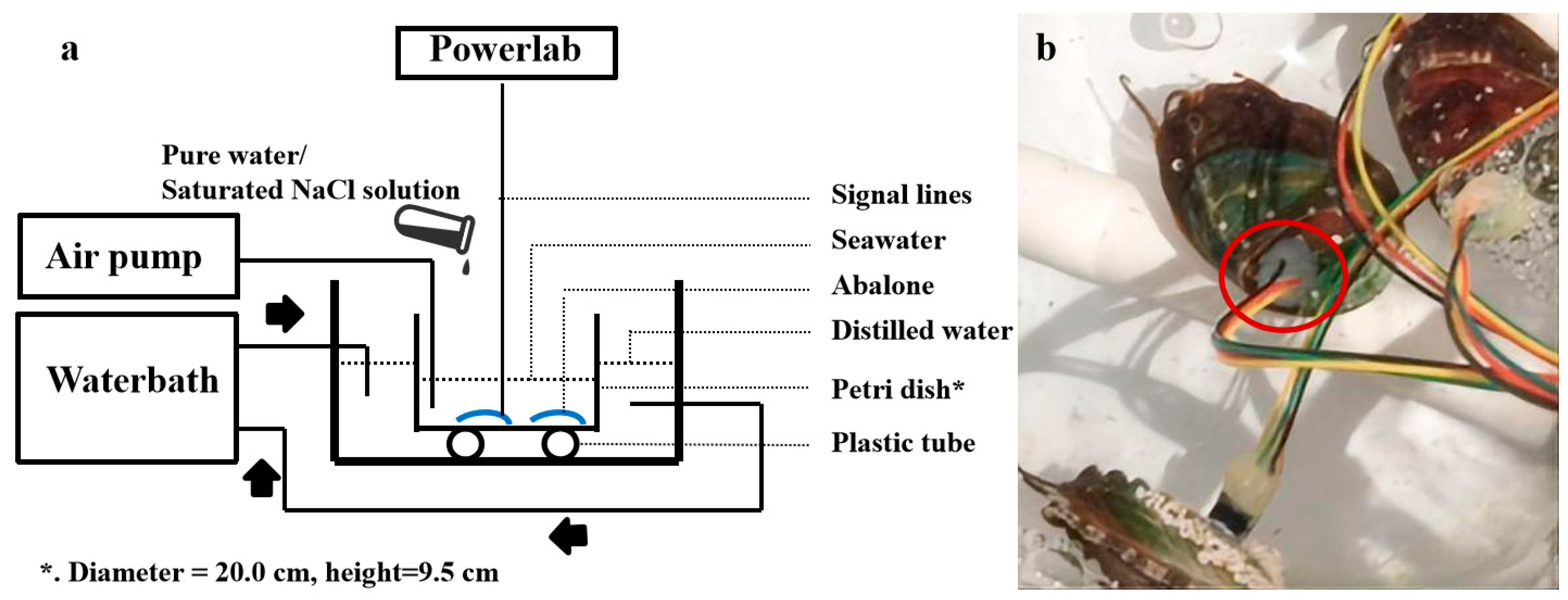
Steadily decreasing and increasing salinity conditions were used to determine the effects of salinity fluctuations on the heart rate. The fluctuant salinity levels were established by adding pure water or saturated sodium chloride solution; the salinity was adjusted to decrease or increase at a rate of 4–5 psu per hour. The salinity values were measured with a handheld water quality meter (AZ Waterproof IP67 Combo Water Quality Tester; AZ, Taiwan Province, China). Abalone individuals were placed in a Petri dish (diameter = 20.0 cm, height = 9.5 cm) and allowed to attach to the dish. The Petri dish was immersed in a water bath to maintain a temperature of 24 °C. The high DO levels were kept by bubbling a constant flow of air into the dishes (Figure 1a).
The electrocardiosignals of the abalones were measured by a non-invasive method [20]. An infrared sensor (IR-EX, Newshift, Leiria, Portugal) was fixed to the shell of each abalone above the heart (Figure 1b). Heartbeat signals were captured by the sensor, amplified and filtered with an infrared signal amplifier (AMP03, Newshift, Leiria, Portugal), and finally recorded using a Powerlab (8/35, ADInstruments, Sydney, Australia). Continuous cardiac waveforms were visualized and analyzed on a computer via LabChart 8.0 software (ADInstruments, Sydney, Australia). For each individual, heart rate variations during salinity decrease (salinity from 33 psu to 22 psu) were first recorded. The abalones were then returned to the recirculating system for a 10-day recovery period, after which they were subjected to salinity elevation testing (salinity from 33 psu to 48 psu). The breakpoints for salinity (BPS, the salinity at which heart rate decreases dramatically) were determined using regression analyses to fit the best-fit lines on both sides of the putative breakpoint. Heart rate variations were measured across a total of 16 DD and 16 DF individuals during both salinity decrease and elevation.

2.3. A 30-Day Aquaculture Trial Under Hyposalinity Stress

To elucidate the practical aquacultural significance of the salinity conditions corresponding to the heart rate breakpoints, a 30-day aquaculture trial under salinity stress was conducted. The two dominant cultured species, Pacific abalone (Haliotis discus hannai, DD) and hybrid (H. discus hannai ♀ × H. fulgens ♂, DF), were used. Since hyposalinity stress is the predominant stressor in actual practices of abalone aquaculture, the control group (natural seawater, ~33 psu) and four experimental groups with salinities of 31, 28, 25, and 22 psu were established. The control group was maintained in natural sand-filtered seawater, while the other salinity gradients were achieved by mixing sand-filtered seawater with pure water. At the start of the experiment, all abalones were reared in natural seawater, after which the salinity was reduced to the set levels at a rate of 1.5 psu per day by adding pure water. The culture tanks and rearing conditions employed were as described in Section 2.1. Each tank was stocked with 10 DD and 10 DF, and three biological replicates were set up for each group. Prior to the initiation of the experiment, each abalone was tagged for individual identification, and the initial shell length (SL0) was measured. Following the 30-day culture period, abalone survival in each tank was recorded, and the final shell length (SL30) of each individual was measured. The daily growth rate of each abalone was calculated as (SL30 − SL0)/30.

2.4. Transcriptome Analysis

To investigate the molecular responses of abalone to rapid salinity changes and explore the effects of heart rate breakpoints on its transcriptional regulation, a new batch of DD individuals was subjected to hyposalinity and hypersalinity stress and to transcriptomic analysis. Based on the results of heart rate breakpoint assessments in Section 2.2, 25 psu and 41 psu were selected as the hyposalinity and hypersalinity conditions. These abalone individuals were evenly divided into three groups: (1) hyposalinity group: abalone were treated under hyposalinity stress (25 psu); (2) hypersalinity group: abalone were treated under hypersalinity stress (41 psu); (3) control group: abalone were treated with natural seawater (~33 psu). Gill tissues and hemocytes of each individual were sampled following 3 h of stress exposure (equivalent to the duration of heart rate breakpoint assessments), immediately snap-frozen in liquid nitrogen and stored at −80 °C for subsequent RNA extraction. For each tissue, 9 samples were collected, including three biological replicates from the hyposalinity group, three from the hypersalinity group and three from the control group (sand-filtered seawater).
Total RNA was extracted from gill tissues and hemocytes using the TRIzol method (Invitrogen, Carlsbad, CA, USA). The quantity and integrity of RNA were determined using the Qubit® RNA Assay Kit with a Qubit® 2.0 Fluorometer (Thermo Fisher Scientific, Carlsbad, CA, USA) and the RNA Nano 6000 Assay Kit on Agilent 2100 Bioanalyzer system (Agilent Technologies, Santa Clara, CA, USA), respectively. Following RNA extraction, library preparation and sequencing were performed by Novogene (Beijing, China), using an Illumina HiSeq X10 platform (Illumina, San Diego, CA, USA), generating 150 bp paired-end reads. Since the genome of the Pacific abalone is approximately 1.5 Gb, the target sequencing data for the transcriptome is 6 Gb. Raw data were filtered to remove adapter sequences, N bases, and low-quality reads, yielding clean reads. The clean reads were then aligned to the reference genome of H. discus hannai using HISAT2 2.1.0 software [25] (Pertea et al., 2016). StringTie software was used to quantify gene expression abundance in each sample, with Fragments Per Kilobase of transcript per Million mapped fragments (FPKM) values representing gene expression levels. DESeq2 1.42.0 [26] was employed to identify differentially expressed genes (DEGs) through pairwise comparisons among the hyposalinity, hypersalinity, and control groups. Genes with p-adj ≤ 0.005 and |log2FoldChange| ≥ 1 were considered significantly differentially expressed. Furthermore, principal component analysis (PCA) was conducted within the FPKM values of all genes across samples. Kyoto Encyclopedia of Genes and Genomes (KEGG) pathway enrichment analysis for the DEGs was performed using the clusterProfiler 4.10.0 R package [27], with pathway significance determined by a modified Fisher’s exact test (p < 0.05).

2.5. Statistical Analysis

To compare the BPS1 and BPS2 values between two abalone species and the differences in survival and daily growth rate among different salinity conditions, one-way analyses of variance (ANOVAs) were conducted, followed by Tukey’s honestly significant difference (HSD) post hoc tests. Regression analyses were conducted in R v.3.6.1 to study the correlation between the BPS1 and BPS2 values.

3. Results

3.1. Salinity Stress and Heart Rate

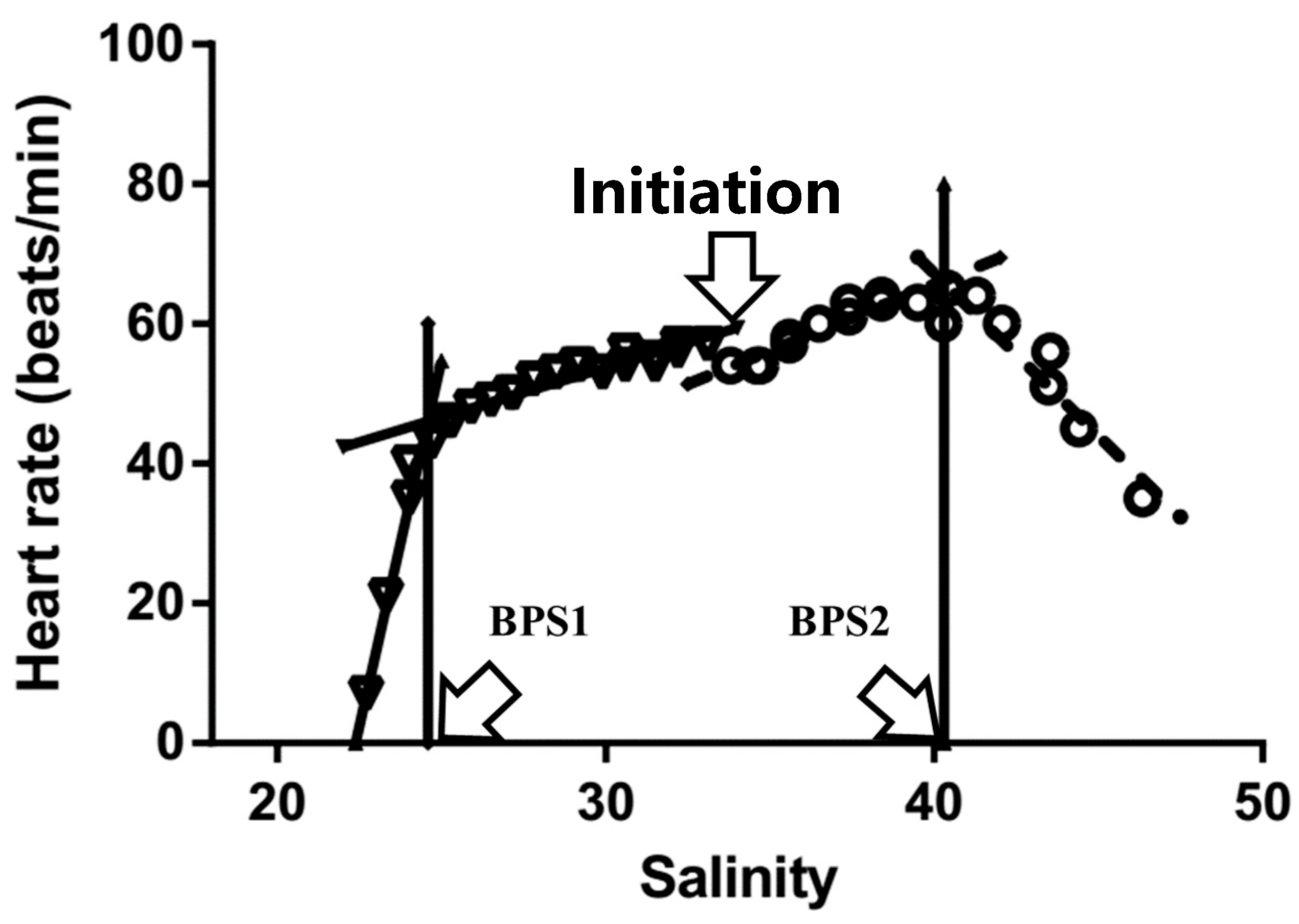
As illustrated in Figure 2, abalone heart rates exhibited a distinct M-shaped pattern in response to salinity fluctuations. During the salinity reduction phase, heart rates initially declined gradually before dropping sharply once a critical threshold was crossed. Conversely, during the salinity elevation phase, heart rates initially rose slowly but decreased abruptly after exceeding a second distinct threshold. Consequently, two critical breakpoints for salinity (BPS) were identified across both experimental phases: BPS1 represents the critical breakpoint triggered by decreasing salinity, while BPS2 denotes the threshold associated with increasing salinity.
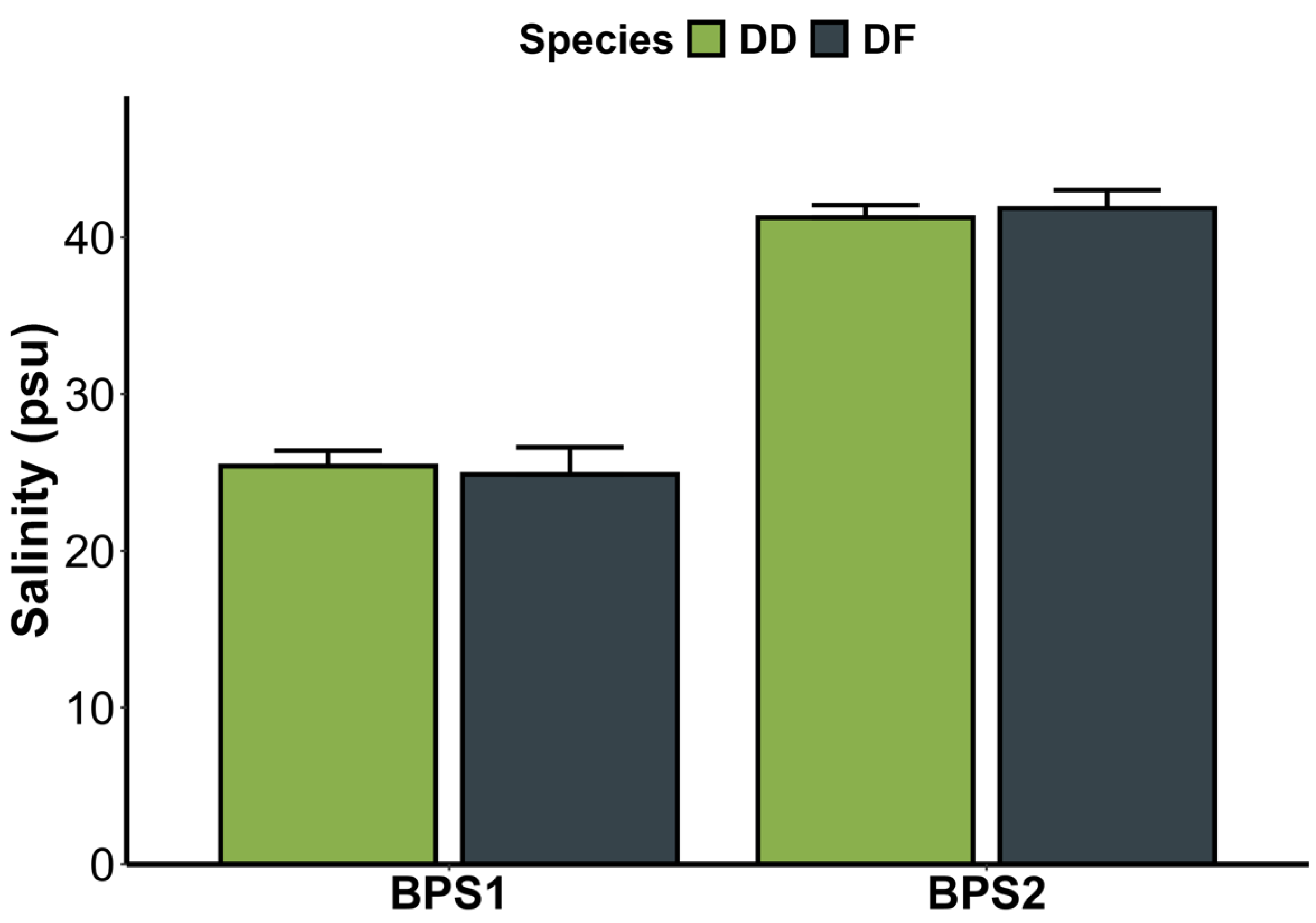
BPS1 and BPS2 values were determined for 16 DD individuals and 16 DF individuals. The BPS1 and BPS2 values of DD were 25.41 ± 0.98 and 41.26 ± 0.74, respectively (Figure 3), while the corresponding BPS1 and BPS2 values of DF were 24.87 ± 1.74 and 41.85 ± 1.17, respectively. No significant differences were detected in either BPS1 or BPS2 values between the two abalone species. Regression analysis further revealed a positive correlation between BPS1 and BPS2 (R2 = 0.26, p = 0.044).

3.2. Survival and Growth During 30-Day Constant Salinity Culture

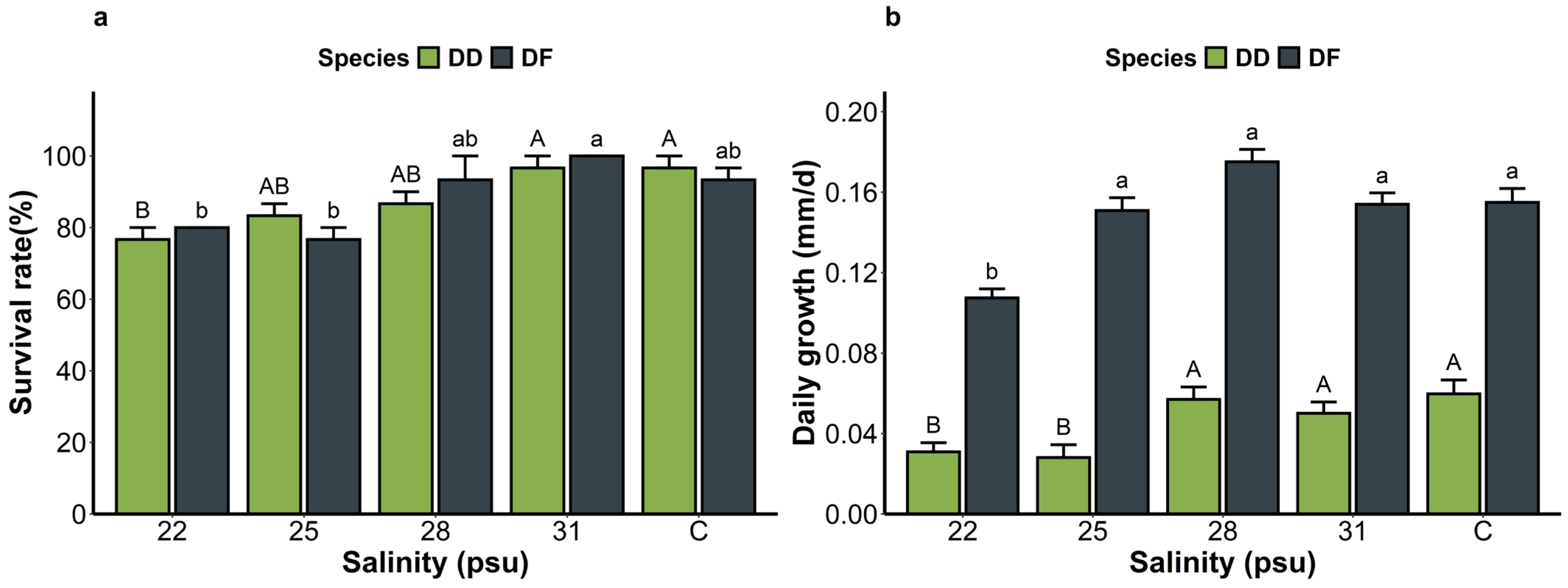
For both DD and DF, the survival rates exceeded 90% at a constant salinity of 31 psu (Figure 4a), consistent with the control group. Further salinity reductions to 25 and 22 psu significantly compromised survival rates, specifically affecting the DD group at 22 psu and the DF group at both 22 and 25 psu. Regarding growth, while the DF group maintained a distinct advantage across all salinity treatments, their optimal growth rate was achieved at 28 psu (Figure 4b). When salinity dropped below 25 psu, the growth rates of both abalone species were lower than those of the control group, with a more pronounced reduction observed in DD.

3.3. Transcriptomic Fluctuations Under Hypersalinity and Hyposalinity Stresses

Transcriptomic sequencing yielded approximately 42.95 million raw reads (corresponding to ~6 Gb of raw bases) per sample. Following quality control, a total of 748.70 million clean reads (37.88–43.50 million clean reads per sample for gill tissue and 39.37–46.57 million clean reads per sample for hemocytes) were generated, with the Q20 and Q30 values ranging from 96.56% to 97.97% and 91.14% to 94.28%, respectively. These results indicated that the sequencing data were highly reliable and suitable for subsequent bioinformatics analysis.
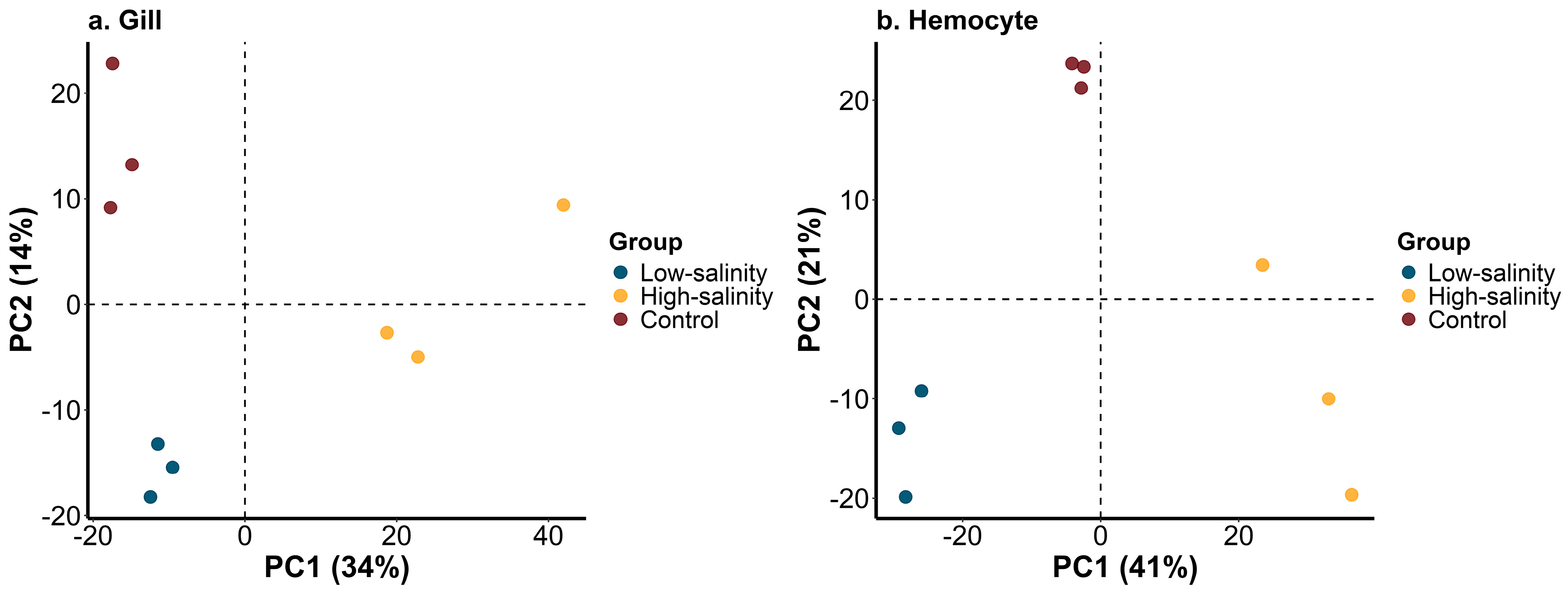
Based on FPKM values, PCA revealed a clear separation among the three groups (Figure 5) in both gill tissue and hemocyte transcriptomes, while biological replicates within each group clustered closely together. This result indicated that salinity stress at heart rate breakpoints significantly altered the global gene expression pattern of abalones.
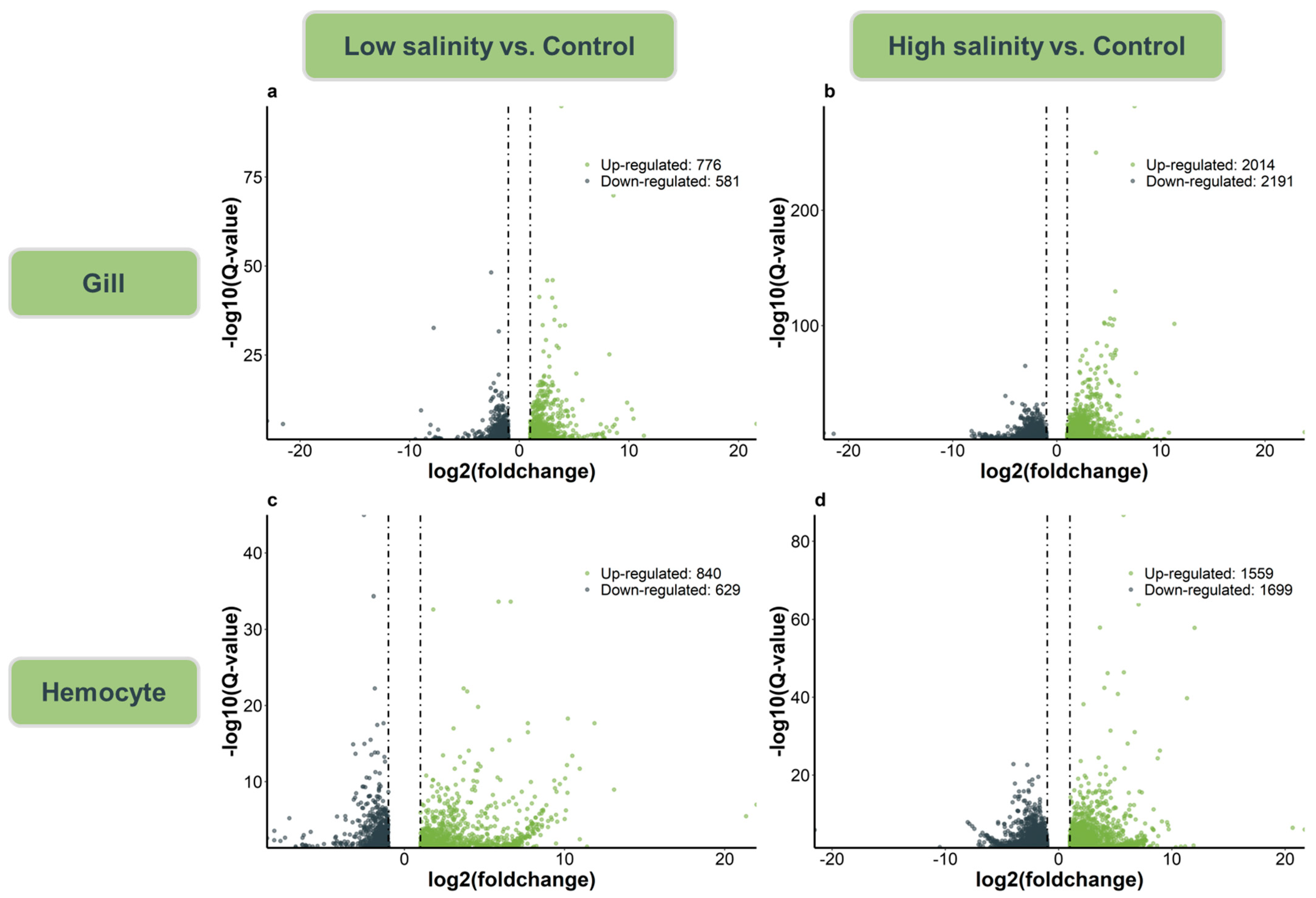
A total of 1357 DEGs were identified in gill tissues between the hyposalinity and control groups (Figure 6a). A total of 776 DEGs were up-regulated, and 581 DEGs were down-regulated by hyposalinity stress. Under hypersalinity stress, the gill tissue transcriptome underwent more extensive alterations (Figure 6b), with a total of 4205 DEGs (2014 up-regulated and 2191 down-regulated) identified compared with the control group. A total of 1469 DEGs (840 up-regulated and 629 down-regulated DEGs) were identified in hemocytes between the hyposalinity group and the control group (Figure 6c), while hypersalinity stress induced transcriptional reprogramming across 3258 genes, and 1559 DEGs were up-regulated and 1699 were down-regulated, respectively (Figure 6d).
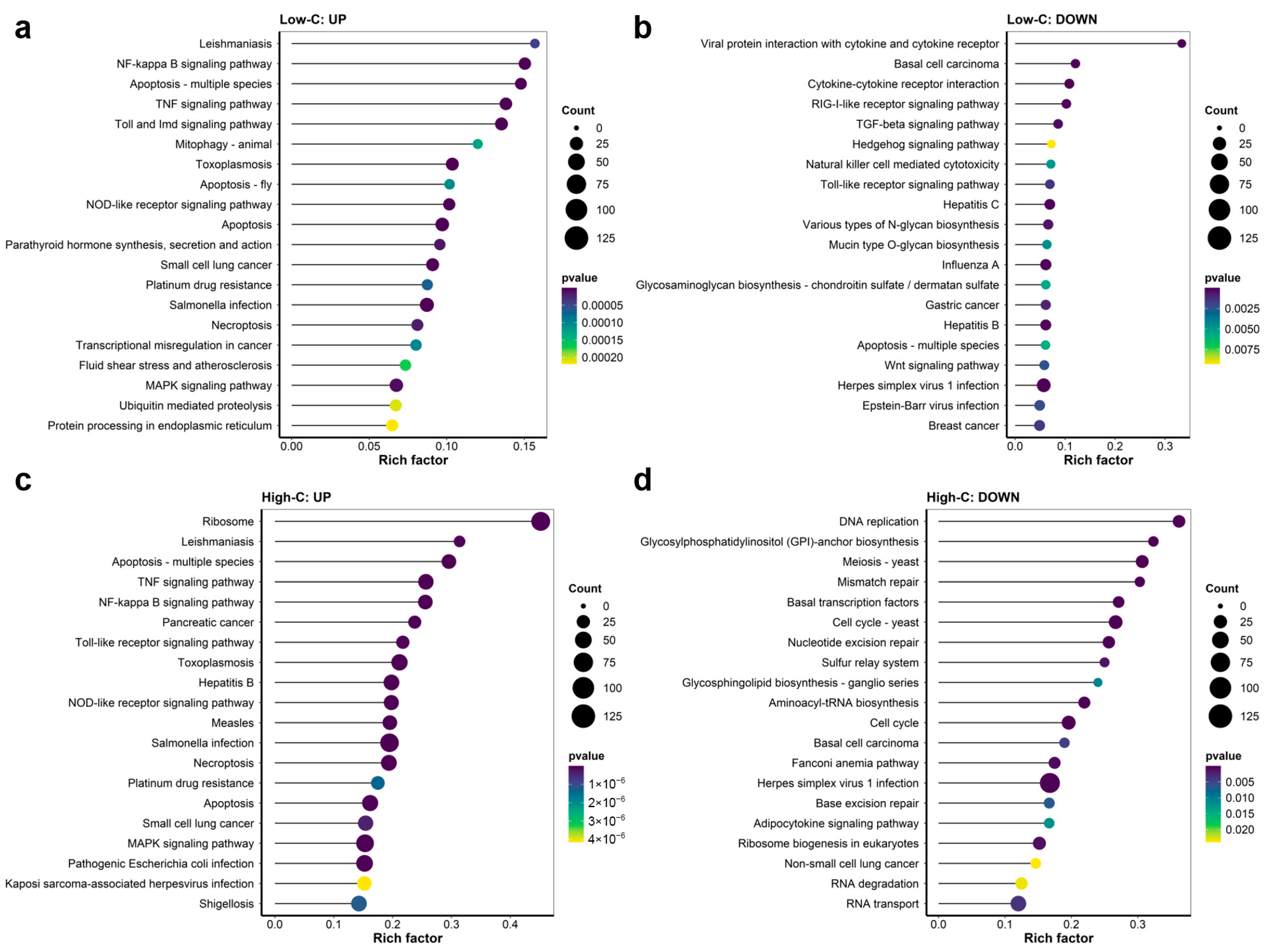
KEGG pathway enrichment analysis of upregulated DEGs in gill tissues revealed partial overlap between the hyposalinity and hypersalinity stress responses (Figure 7). Compared with the control group, upregulated DEGs from both salinity treatments were significantly enriched in pathways associated with immune defense, inflammatory response and pathogen recognition, including the NF-κB signaling pathway (such as piap, diap2, birc2, birc3, birc7-a, irak4, and gadd45g), TNF signaling pathway (such as piap, diap2, birc2, birc3, birc7-a, mmp12, mmp14, mmp16, and mmp19) and NOD-like receptor signaling pathway. Meanwhile, pathways governing cell survival and damage repair, such as the MAPK signaling pathway and apoptosis pathway, were also commonly enriched with upregulated DEGs under both hyposalinity and hypersalinity stress. However, pathways related to cell cycle regulation and DNA replication were uniquely enriched among downregulated DEGs in gill tissues under hypersalinity stress.
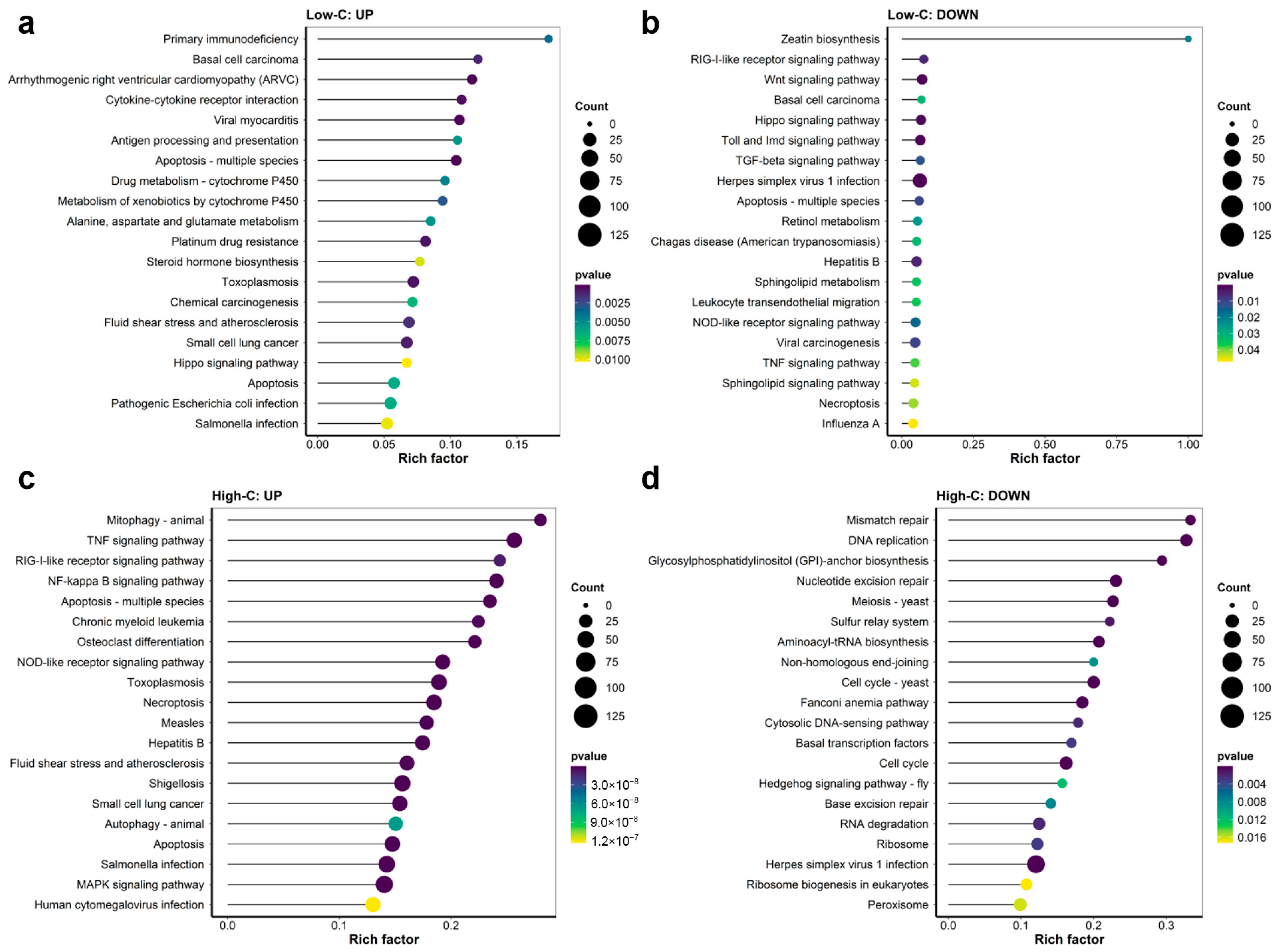
As shown in Figure 8, hemocytes exhibited a response profile similar to that of gill tissue under hypersalinity stress. The NF-κB signaling pathway, TNF signaling pathway and apoptosis pathway were significantly enriched among upregulated DEGs, while pathways involved in cell cycle regulation and DNA replication were markedly suppressed, consistent with the expression pattern observed in gill tissues.

4. Discussion

4.1. Aquaculture Performance and Survival Dynamics at Critical Salinity Thresholds

Heart rate is recognized as a reliable parameter for assessing the physiological status of mollusks in response to environmental stress [16,19,28]. In abalone, this metric has also been validated as an effective indicator for tolerance to heat and hypoxic stress [20,21]. It is well recognized that heart rate is positively correlated with oxygen consumption and metabolic rate in mollusks [29]. Under stressful conditions, aerobic metabolic efficiency declines rapidly when the heart rate fails to keep pace with routine metabolic demands [16,21]. When salinity decreased below BPS1 or increased beyond BPS2, the rapid decline in heart rate indicated that aerobic metabolism in abalone could no longer meet the organism’s stress-resistance demands, signifying that the abalone had entered a state of physiological stress.
Previous studies have shown that a marked decrease in heart rate occurs in response to hyposalinity, as reported in Cellana toreuma [30], Mytilus edulis [31], and Modiolus modiolus and Hiatella arctica [18]. A similar trend, characterized by an initial increase followed by a sharp drop with increasing salinity, has also been observed in Anodonta anatina, Dreissena polymorpha and Unio pictorum [32] and Mytilaster minimus [33]. In the present study, each abalone was exposed to both hypo- and hypersalinity treatments for cardiac measurement. Heart rate variations were found to be comparable with those documented in other molluscan species. A weak positive correlation was observed between individual BPS1 and BPS2 threshold values, such that individuals with relatively higher BPS1 values tended to have moderately higher BPS2 values. It is hypothesized that the salinity-regulating capacity of individual abalones is restricted, resulting in a relatively fixed salinity tolerance range. Given the frequent occurrence of hyposalinity stress in practical aquaculture, BPS1 thresholds can be used as screening markers to establish selective breeding programs for hyposalinity-tolerant abalone lines.
To better understand the practical aquaculture implications of BPS1, individuals of the DD and DF strains were selected, and a constant-salinity culture trial was conducted under control, 31, 28, 25 and 22 psu. Across all salinity regimes, the hybrid (DF) showed distinct growth advantages relative to Pacific abalone (DD), which is consistent with previous findings [34]. However, for each strain, decreasing trends in growth and survival performance were detected at 25 psu (corresponding to BPS1). Specifically, DF exhibited a significant decrease in survival rate, and DD showed a significant reduction in growth rate. These results indicated that hyposalinity at BPS1 compromised long-term aquaculture performance. Previous studies have demonstrated that physiological stressors, such as salinity fluctuations, can suppress the growth of soft tissues and shells in mollusks [35]. To survive in low-salinity environments, bivalves partition more energy to sustain osmotic homeostasis, thereby reducing energy allocated to growth [36,37]. This energy reallocation mechanism may also account for the reduced growth and survival observed in abalones under BPS1-related salinity stress, as the metabolic cost of coping with suboptimal salinity likely diverts energy away from growth and reproduction.

4.2. Transcriptional Fluctuations Showed Distinct Responses to Hyposalinity and Hypersalinity Stress

Although the applied salinity stress was mild (determined based on heart rate responses), which was mild, transcriptomic data revealed that both hyposalinity and hypersalinity stress induced molecular responses in the sample. In both gills and hemocytes, upregulated DEGs were significantly enriched in key signaling pathways, such as TNF, NF-κB signaling pathways, and the apoptosis pathway, suggesting that the salinity stress in this study might stimulate the immunological responses. Whether these pathways would be activated or inhibited needs to be confirmed by further molecular experiments. These mechanisms would help maintain immune homeostasis, thereby alleviating cellular damage caused by osmotic imbalance [14]. Similar responses were recorded in Anadara kagoshimensis [38], Mizuhopecten yessoensis [39], Corbicula mortoni [40], and Crassostrea hongkongensis [41]. In abalone, defense mechanisms may be induced by stressors such as nitrite and bifenthrin [42], Vibrio harveyi infection [43], and heat exposure [44].
Transcriptomic analysis demonstrated that hypersalinity stress elicited more extensive transcriptomic reprogramming compared with hyposalinity. Specifically, 4205 DEGs were identified in gills and 3258 DEGs in hemocytes, whereas the corresponding values under hyposalinity stress were 1357 and 1469, respectively. Although both salinity treatments were set at levels corresponding to the heart rate breakpoints, the biological effects imposed by the two salinity conditions were distinct. Transcriptomic discrepancies were further manifested by a higher number of enriched immune-related pathways (including NF-κB, TNF and NOD-like receptor signaling pathways) [45,46,47] in both gill tissues and hemocytes under hypersalinity stress. It is speculated that this phenomenon arises from more severe cellular damage, oxidative stress and disturbances to internal osmotic homeostasis induced by hypersalinity stress, which compels abalones to mobilize a broader immune defense network.
Compared with the control group, the DEGs in both the hypersalinity and hyposalinity stress groups were enriched in the apoptosis pathway. In marine invertebrates, environmental stressors, including hypoxia, thermal and hypo-osmotic stress, induce complex cellular responses that extend beyond antioxidant activation to encompass the regulation of apoptotic pathways [48,49,50,51]. Apoptosis, or programmed cell death, is primarily mediated through two evolutionarily conserved mechanisms: the intrinsic mitochondrial pathway and the extrinsic death receptor pathway [52]. The intrinsic apoptosis pathway is activated by stimuli such as DNA damage, growth arrest, or viral infection, leading to the release of cytochrome c from mitochondria and promoting apoptosis [52,53]. In contrast, the extrinsic apoptosis pathway is triggered by interactions between extracellular ligands and death receptors, thereby activating downstream caspases [54,55]. The results of the present study demonstrate that under different salinity conditions, genes involved in the extrinsic apoptotic pathway, including bcl2l1, piap, diap2, nfkb1, tuba3a, eif2ak3, and actb, were identified as DEGs annotated to the apoptosis pathway. Meanwhile, genes related to the intrinsic apoptosis pathway, such as cytochrome c and caspase-2, were also detected and annotated under hypersalinity stress. It is speculated that hypersalinity stress imposed more severe physiological stress on the specimens, and thus, two distinct apoptotic mechanisms were simultaneously observed.
Notably, genes involved in the cell cycle and DNA replication were significantly downregulated under hypersalinity stress. Previous studies have reported that cell cycle- and DNA replication-related genes were markedly downregulated in heat-sensitive strains under the same heat stress [56]. Under conditions of elevated stress, cells typically undergo delayed DNA replication and cell division to prioritize cytoprotective functions [7]. It is therefore speculated that hypersalinity stress also represents a more severe stressor for abalone.

5. Conclusions

This study integrated physiological monitoring, aquaculture trials, and transcriptomic analysis to elucidate abalone’s salinity responses. Two heart rate breakpoints (BPS1 and BPS2) were identified as indicators for hyposalinity and hypersalinity stresses, respectively. The aquaculture trial confirmed that salinity levels corresponding to BPS1 negatively affect long-term abalone growth and survival, thereby confirming the practical implications of heart rate breakpoints for aquaculture management. Transcriptomic analyses revealed that both hyposalinity and hypersalinity stress influenced the immune and apoptotic responses through the upregulation of genes like piap, diap2, birc7-a, birc2, and birc3, with hypersalinity stress exerting greater physiological pressure. Collectively, these findings advance our understanding of osmotic stress adaptation in abalones and provide actionable references for optimizing abalone culture practices to cope with the escalating salinity variability induced by global climate change.

Author Contributions

N.C.: Writing—review and editing, Writing—original draft, Resources, Methodology, Investigation, Funding acquisition, Formal analysis, Data curation, Conceptualization. R.H.: Formal analysis, Data curation. Y.C.: Validation, Conceptualization. W.Y.: Resources, Methodology. C.K.: Resources, Methodology, Writing—review and editing. Y.S.: Writing—review and editing, Validation, Visualization, Methodology, Investigation, Funding acquisition, Data curation. All authors have read and agreed to the published version of the manuscript.

Funding

This work was supported by grants from the Natural Science Foundation of Fujian Province (No. 2023J01764), the National Natural Science Foundation of China (No. 42306109), and Research start-up funds of Jimei University (ZQ2021023).

Institutional Review Board Statement

The animal study protocol was approved by the Animal Care and Use Committee of the Fisheries College of Jimei University (protocol code 2021-04 and date of approval: 22 January 2021).

Informed Consent Statement

Not applicable.

Data Availability Statement

Data will be made available on request.

Conflicts of Interest

The authors declare no conflicts of interest.

References

  1. Niu, D.; Wang, H.; Li, J. Research progress on adaptation mechanism of marine shellfish to salinity stress. J. Fish. China 2024, 48, 049104. [Google Scholar]
  2. Horodesky, A.; Westphal, G.G.C.; Cozer, N.; Rossi, V.G.; Ostrensky, A. Effects of salinity on the survival and histology of oysters Crassostrea gasar (Adanson, 1757). Biosci. J. 2019, 35, 586–597. [Google Scholar] [CrossRef]
  3. Taware, S.S.; Lagade, V.M.; Muley, D.V. Effect of salinity on digestive gland of estuarine clam Paphia laterisulca. J. Mar. Biol. Assoc. India 2017, 59, 44–48. [Google Scholar] [CrossRef]
  4. Röthig, T.; Trevathan-Tackett, S.M.; Voolstra, C.R.; Ross, C.; Chaffron, S.; Durack, P.J.; Warmuth, L.M.; Sweet, M. Human-induced salinity changes impact marine organisms and ecosystems. Glob. Change Biol. 2023, 29, 4731–4749. [Google Scholar] [CrossRef] [PubMed]
  5. Douville, H.; Cheng, L. Asymmetric sea surface salinity response to global warming: “fresh gets fresher but salty hesitates”. Geophys. Res. Lett. 2024, 51, e2023GL107944. [Google Scholar] [CrossRef]
  6. Balaguru, K.; Chang, P.; Saravanan, R.; Leung, L.R.; Xu, Z.; Li, M.; Hsieh, J.-S. Ocean barrier layers’ effect on tropical cyclone intensification. Proc. Natl. Acad. Sci. USA 2012, 109, 14343–14347. [Google Scholar] [CrossRef] [PubMed]
  7. Jonas, K.; Liu, J.; Chien, P.; Laub, M.T. Proteotoxic stress induces a cell-cycle arrest by stimulating Lon to degrade the replication initiator DnaA. Cell 2013, 154, 623–636. [Google Scholar] [CrossRef] [PubMed]
  8. Kowalski, J.L.; DeYoe, H.R.; Boza, G.H., Jr.; Hockaday, D.L.; Zimba, P.V. A comparison of salinity effects from hurricanes Dolly (2008) and Alex (2010) in a Texas lagoon system. J. Coast. Res. 2018, 34, 1429–1438. [Google Scholar] [CrossRef]
  9. Munroe, D.; Tabatabai, A.; Burt, I.; Bushek, D.; Powell, E.; Wilkin, J. Oyster mortality in Delaware Bay: Impacts and recovery from hurricane Irene and tropical storm Lee. Estuar. Coast. Shelf Sci. 2013, 135, 209–219. [Google Scholar] [CrossRef]
  10. Zeng, Y.; Zeng, X.; Yee, J.C.; Yang, H. Immune function and transcriptome of hemocytes in northern quahogs Mercenaria mercenaria in response to acute salinity challenges. Fish Shellfish Immunol. 2025, 166, 110609. [Google Scholar] [CrossRef] [PubMed]
  11. Fan, C.; Wen, Z.; Huo, Z.M.; Yang, F.; Yan, X.W. Influence of salinity stress on growth and survival of Manila clam Ruditapes philippinarum at various developmental stages. J. Dalian Ocean. Univ. 2016, 31, 497–504. (In Chinese) [Google Scholar]
  12. Wang, Y.; Hu, M.; Cheung, S.; Shin, P.; Lu, W.; Li, J. Immune parameter changes of hemocytes in green-lipped mussel Perna viridis exposure to hypoxia and hyposalinity. Aquaculture 2012, 356, 22–29. [Google Scholar] [CrossRef]
  13. Kuchel, R.; Raftos, D.; Nair, S. Immunosuppressive effects of environmental stressors on immunological function in Pinctada imbricata. Fish Shellfish Immunol. 2010, 29, 930–936. [Google Scholar] [CrossRef] [PubMed]
  14. Boamah, G.A.; Huang, Z.; Shen, Y.; Lu, Y.; Wang, Z.; Su, Y.; Xu, C.; Luo, X.; Ke, C.; You, W. Transcriptome analysis reveals fluid shear stress (FSS) and atherosclerosis pathway as a candidate molecular mechanism of short-term low salinity stress tolerance in abalone. BMC Genom. 2022, 23, 392. [Google Scholar] [CrossRef] [PubMed]
  15. Kladchenko, E.S.; Gostyukhina, O.L.; Lavrichenko, D.S.; Uppe, V.A.; Vodiasova, E.A.; Chelebieva, E.S. The impact of short-term hyposalinity stress on the Pacific oyster (Magallana gigas) infested with boring sponges (Pione vastifica). Comp. Biochem. Physiol. A-Mol. Integr. Physiol. 2025, 309, 111925. [Google Scholar] [CrossRef] [PubMed]
  16. Braby, C.; Somero, G. Following the heart: Temperature and salinity effects on heart rate in native and invasive species of blue mussels (genus Mytilus). J. Exp. Biol. 2006, 209, 2554–2566. [Google Scholar] [CrossRef] [PubMed]
  17. Bakhmet, I.N.; Fokina, N.N.; Nefedova, Z.A.; Nemova, N.N. Physiological-biochemical properties of blue mussel Mytilus edulis adaptation to oil contamination. Environ. Monit. Assess. 2009, 155, 581–591. [Google Scholar] [PubMed]
  18. Bakhmet, I.; Komendantov, A.; Smurov, A. Effect of salinity change on cardiac activity in Hiatella arctica and Modiolus modiolus, in the White Sea. Polar Biol. 2012, 35, 143–148. [Google Scholar]
  19. Xing, Q.; Zhang, L.; Li, Y.; Zhu, X.; Li, Y.; Guo, H.; Bao, Z.; Wang, S. Development of novel cardiac indices and assessment of factors affecting cardiac activity in a bivalve mollusc Chlamys farreri. Front. Physiol. 2019, 10, 293. [Google Scholar] [CrossRef] [PubMed]
  20. Chen, N.; Luo, X.; Gu, Y.; Han, G.; Dong, Y.; You, W.; Ke, C. Assessment of the thermal tolerance of abalone based on cardiac performance in Haliotis discus hannai, H. gigantea and their interspecific hybrid. Aquaculture 2016, 465, 258–264. [Google Scholar] [CrossRef]
  21. Chen, N.; Shen, Y.; Yu, F.; Luo, X.; You, W.; Ke, C. A new indicator of hypoxia tolerance in abalone, developed based on heart rate fluctuations. Aquaculture 2020, 519, 734903. [Google Scholar] [CrossRef]
  22. FAO. The State of World Fisheries and Aquaculture 2026; Food and Agriculture Organization of the United Nations: Rome, Italy, 2026. [Google Scholar]
  23. Fisheries Bureau of the Ministry of Agriculture and Rural Affairs. China Fishery Statistical Yearbook 2025; China Agriculture Press: Beijing, China, 2025. (In Chinese) [Google Scholar]
  24. Navarro, J.M. The effects of salinity on the physiological ecology of Choromytilus chorus (Molina, 1782) (Bivalvia: Mytilidae). J. Exp. Mar. Biol. Ecol. 1988, 122, 19–33. [Google Scholar] [CrossRef]
  25. Pertea, M.; Kim, D.; Pertea, G.M.; Leek, J.T.; Salzberg, S.L. Transcriptlevel expression analysis of RNA-seq experiments with HISAT, StringTie and Ballgown. Nat. Protoc. 2016, 11, 1650–1667. [Google Scholar] [CrossRef] [PubMed]
  26. Love, M.; Huber, W.; Anders, S. Moderated estimation of fold change and dispersion for RNA-seq data with DESeq2. Genome Biol. 2014, 15, 550. [Google Scholar] [CrossRef] [PubMed]
  27. Yu, G.; Wang, L.-G.; Han, Y.; He, Q.-Y. Clusterprofiler: An R package for comparing biological themes among gene clusters. Omics J. Integr. Biol. 2012, 16, 284–287. [Google Scholar] [CrossRef] [PubMed]
  28. Dong, Y.-W.; Han, G.-D.; Ganmanee, M.; Wang, J. Latitudinal variability of physiological response to heat stress of the intertidal limpet Cellana toreuma along the Asian coast. Mar. Ecol. Prog. Ser. 2015, 529, 107–119. [Google Scholar] [CrossRef]
  29. Chelazzi, G.; Williams, G.; Gray, D. Field and laboratory measurement of heart rate in a tropical limpet, Cellana grata. J. Mar. Biol. Assoc. UK 1999, 79, 749–751. [Google Scholar] [CrossRef]
  30. Chelazzi, G.; De Pirro, M.; Williams, G. Cardiac responses to abiotic factors in two tropical limpets, occurring at different levels of the shore. Mar. Biol. 2001, 139, 1079–1085. [Google Scholar] [CrossRef]
  31. Bakhmet, I.; Berger, V.; Khalaman, V. The effect of salinity change on the heart rate of Mytilus edulis specimens from different ecological zones. J. Exp. Mar. Biol. Ecol. 2005, 318, 121–126. [Google Scholar] [CrossRef]
  32. Sharvov, A.; Kholodkevich, S. Some features of using heart rate monitoring of freshwater bivalve molluscs with a fiberoptical method for ecotoxicological research. Principy Ekol. 2015, 4, 21–28. [Google Scholar]
  33. Sarà, G.; De Pirro, M. Heart beat rate adaptations to varying salinity of two intertidal Mediterranean bivalves: The invasive Brachidontes pharaonis and the native Mytilaster minimus. Ital. J. Zool. 2011, 78, 193–197. [Google Scholar] [CrossRef]
  34. You, W.; Guo, Q.; Fan, F.; Ren, P.; Luo, X.; Ke, C. Experimental hybridization and genetic identification of Pacific abalone Haliotis discus hannai and green abalone H. fulgens. Aquaculture 2015, 448, 243–249. [Google Scholar] [CrossRef]
  35. Hiebenthal, C.; Philipp, E.; Eisenhauer, A.; Wahl, M. Interactive effects of temperature and salinity on shell formation and general condition in Baltic Sea Mytilus edulis and Arctica islandica. Aquat. Biol. 2012, 14, 289–298. [Google Scholar] [CrossRef]
  36. Maar, M.; Saurel, C.; Landes, A.; Dolmer, P.; Petersen, J.K. Growth potential of blue mussels (M. edulis) exposed to different salinities evaluated by a Dynamic Energy Budget model. J. Mar. Syst. 2015, 148, 48–55. [Google Scholar] [CrossRef]
  37. Pourmozaffar, S.; Jahromi, S.T.; Rameshi, H.; Sadeghi, A.; Bagheri, T.; Behzadi, S.; Gozari, M.; Zahedi, M.R.; Lazarjani, S.A. The role of salinity in physiological responses of bivalves. Rev. Aquac. 2020, 12, 1548–1566. [Google Scholar]
  38. Zhang, M.; Li, L.; Liu, Y.; Gao, X. Effects of sudden drop in salinity on immune response mechanisms of Anadara kagoshimensis. Int. J. Mol. Sci. 2019, 20, 4365. [Google Scholar] [CrossRef] [PubMed]
  39. Xiao, H.; Jin, X.; Wang, Z.; Ye, Q.; Li, W.; Han, L.; Ding, J. Effects of Chronic Low-Salinity Stress on Growth, Survival, Antioxidant Capacity, and Gene Expression in Mizuhopecten yessoensis. Biology 2025, 14, 759. [Google Scholar] [CrossRef] [PubMed]
  40. Wang, Y.; Min, Y.; Yan, T.; Yang, J.; Liu, S.; Li, Q. Integrative genomic and functional analyses identify NFKBIA as a key regulator of salinity tolerance in Corbicula mortoni. Aquaculture 2026, 612, 743221. [Google Scholar] [CrossRef]
  41. Zhang, Y.; Liang, Q.; Yu, F.; Zhu, J.; Gui, J.; Lin, J.; Lu, Y.; Tao, H. Integration of transcriptome and metabolome reveals tolerance mechanism to high salinity stress in Crassostrea hongkongensis. Aquac. Rep. 2025, 42, 102759. [Google Scholar] [CrossRef]
  42. Chen, H.; Wu, G.; Jiao, C.; Chen, L.; Sun, C.; Zhang, X.; Wei, X.; Wu, X.; Yang, D.; Zhao, J. Interactive effects of nitrite and bifenthrin on bioaccumulation, oxidative stress and immune responses of Haliotis discus hannai. Aquat. Toxicol. 2025, 287, 107512. [Google Scholar] [CrossRef] [PubMed]
  43. Lee, Y.; Roh, H.; Kim, A.; Park, J.; Lee, J.-Y.; Kim, Y.-J.; Kang, Y.-R.; Kang, H.; Kim, S.; Kim, H.-S.; et al. Molecular mechanisms underlying the vulnerability of Pacific abalone (Haliotis discus hannai) to Vibrio harveyi infection at higher water temperature. Fish Shellfish Immunol. 2023, 138, 108844. [Google Scholar] [CrossRef] [PubMed]
  44. Wang, R.; Chen, H.; Fan, W.; Yue, P.; Zhang, H.; Chen, P.; Wu, Z.; Mai, K.; Zhang, W. The growth performance, anti-oxidative capacity, immunity and resistance to heat stress of abalone Haliotis discus hannai can be improved by a mixture of herbs. Aquac. Rep. 2024, 35, 101931. [Google Scholar] [CrossRef]
  45. Liu, T.; Zhang, L.; Joo, D.; Sun, S.C. NF-κB signaling in inflammation. Signal Transduct. Target. Ther. 2017, 2, e17023. [Google Scholar] [CrossRef] [PubMed]
  46. Heim, V.; Stafford, C.; Nachbur, U. NOD Signaling and Cell Death. Front. Cell Dev. Biol. 2019, 7, 208. [Google Scholar] [CrossRef] [PubMed]
  47. Dhar, A.; Jaiswal, R.K.; Zaki, H.; Jeyaseelan, S. Editorial: The role of nod-like receptor (NLR) family of proteins in inflammation. Front. Immunol. 2026, 17, 1793019. [Google Scholar] [CrossRef] [PubMed]
  48. Chu, P.; Luo, S.; Wang, H.; Zhang, K.; Wen, X.; Yin, S.; Wang, T. Interactive effects of temperature and salinity on the apoptosis, antioxidant enzymes, and MAPK signaling pathway of juvenile pufferfish (Takifugu fasciatus). Aquac. Rep. 2023, 29, 101483. [Google Scholar] [CrossRef]
  49. Shen, M.; Wang, Y.; Tang, Y.; Zhu, F.; Jiang, J.; Zhou, J.; Li, Q.; Meng, Q.; Zhang, Z. Effects of different salinity reduction intervals on osmoregulation, anti-oxidation and apoptosis of Eriocheir sinensis megalopa. Comp. Biochem. Physiol. A-Mol. Integr. Physiol. 2024, 291, 111593. [Google Scholar] [CrossRef] [PubMed]
  50. Yue, C.; Ran, Y.; Yang, C.; Ibrahim, S.; Song, X.; Lü, W.; Deng, Y.; Li, Q. The effects of salinity stress on Crassostrea hongkongensis gill morphology, cell proliferation, and apoptosis. Aquaculture 2024, 583, 740621. [Google Scholar] [CrossRef]
  51. Zhang, Z.; Zhang, Y.; Cao, Y.; Chen, S.; Zhu, Y.; Wang, Y.; Peng, Y.; Chen, A.; Wu, Y. Integrated physiological and transcriptomic analysis reveals osmoregulatory collapse, oxidative stress, and apoptosis drive hypo-salinity-induced mortality in Solen grandis. Int. J. Biol. Macromol. 2025, 310, 143495. [Google Scholar] [CrossRef] [PubMed]
  52. Lin, J.; Yu, Z.; Leng, Y.; Zhu, J.; Yu, F.; Lu, Y.; Chen, J.; He, W.; Zhang, Y.; Wen, Y. Cloning, characterization and functional analysis of caspase 8-like gene in apoptosis of Crassostrea hongkongensis response to hyper-salinity stress. Fishes 2024, 9, 172. [Google Scholar] [CrossRef]
  53. Green, D.; Llambi, F. Cell death signaling. Cold Spring Harb. Perspect. Biol. 2015, 7, a006080. [Google Scholar] [CrossRef] [PubMed]
  54. Krumschnabel, G.; Podrabsky, J. Fish as model systems for the study of vertebrate apoptosis. Apoptosis 2009, 14, 1–21. [Google Scholar] [PubMed]
  55. Li, C.; Qu, T.; Huang, B.; Ji, P.; Huang, W.; Que, H.; Li, L.; Zhang, G. Cloning and characterization of a novel caspase-8-like gene in Crassostrea gigas. Fish Shellfish Immunol. 2015, 46, 486–492. [Google Scholar] [CrossRef] [PubMed]
  56. Chen, N.; Huang, Z.; Lu, C.; Shen, Y.; Luo, X.; Ke, C.; You, W. Different transcriptomic responses to thermal stress in heat-tolerant and heat-sensitive Pacific abalones indicated by cardiac performance. Front. Physiol. 2019, 9, 1895. [Google Scholar] [CrossRef] [PubMed]
Figure 1. Schematic diagram of the assessment system for measuring the heart rate of abalone under different salinity conditions. (a). The assessment system. (b). The fixed position of the infrared sensor on the abalone shell (red circle).
Fishes 11 00369 g001
Figure 2. Heart rate changes in one abalone individual (as an example) across different salinity levels. BPS1: the breakpoint for hyposalinity stress. BPS2: the breakpoint for hypersalinity stress. Initiation point: Heart rate at the initial test salinity (natural seawater, ~33 psu). Triangles represent variations during salinity decrease and circles represent variations during salinity increase. The BPS1 and BPS2 of the illustrated sample were calculated to be 24.59 and 40.24, respectively.
Fishes 11 00369 g002
Figure 3. The BPS1 and BPS2 for Pacific abalone (DD, n = 16) and hybrid abalone (DF, n = 16) (mean ± standard deviation). DD: Haliotis discus hannai, DF: H. discus hannai ♀ × H. fulgens ♂.
Fishes 11 00369 g003
Figure 4. The results of DD and DF after 30-day constant salinity culture (mean ± standard error). (a) Survival rate of abalone under different hyposalinity stress. (b) Daily growth rate of abalone under hyposalinity stress. DD: Haliotis discus hannai, DF: H. discus hannai ♀ × H. fulgens ♂. The differences in DD at various salinities are represented by the capital letters. The differences in DF at various salinities are indicated by lowercase letters.
Fishes 11 00369 g004
Figure 5. Principal component analysis (PCA) for transcriptome of (a) gill tissues and (b) hemocytes.
Fishes 11 00369 g005
Figure 6. Volcano plots of differentially expressed genes (DEGs) in gill tissues and hemocytes. (a) DEGs in gill tissue: hyposalinity vs. control. (b) DEGs in gill tissue: hypersalinity vs. control. (c) DEGs in hemocyte tissue: hyposalinity vs. control. (d) DEGs in hemocyte tissue: hypersalinity vs. control. Genes with p-adj ≤ 0.005 (the criteria for the Y-axis) and |log2FoldChange| ≥ 1 (as presented by dashed lines) were considered significantly differentially expressed.
Fishes 11 00369 g006
Figure 7. Top 20 KEGG pathways enriched by DEGs in gill tissues. (a) Up-regulated pathways: hyposalinity stress vs. control group. (b) Down-regulated pathways: hyposalinity stress vs. control group. (c) Up-regulated pathways: hypersalinity stress vs. control group. (d) Down-regulated pathways: hypersalinity stress vs. control group.
Fishes 11 00369 g007
Figure 8. Top 20 KEGG pathways enriched by DEGs in hemocytes. (a) Up-regulated pathways: hyposalinity stress vs. control group. (b) Down-regulated pathways: hyposalinity stress vs. control group. (c) Up-regulated pathways: hypersalinity stress vs. control group. (d) Down-regulated pathways: hypersalinity stress vs. control group.
Fishes 11 00369 g008
Disclaimer/Publisher’s Note: The statements, opinions and data contained in all publications are solely those of the individual author(s) and contributor(s) and not of MDPI and/or the editor(s). MDPI and/or the editor(s) disclaim responsibility for any injury to people or property resulting from any ideas, methods, instructions or products referred to in the content.