
Article

Size Selectivity and Exploitation Pattern of Traps for Japanese Mantis Shrimp (Oratosquilla oratoria) in the Bohai Sea

1
Key Laboratory of Sustainable Development of Polar Fisheries, Ministry of Agriculture and Rural Affairs, Yellow Sea Fisheries Research Institute, Chinese Academy of Fishery Sciences, Qingdao 266071, China
2
Marine Development Service Center of Lanshan District, Rizhao 276808, China
3
DTU Aqua, Technical University of Denmark, 1019850 Hirtshals, Denmark
4
University of Tromsø, Breivika, N-9037 Tromsø, Norway
5
School of Environmental Science and Engineering, Hubei Polytechnic University, Huangshi 435003, China
*
Author to whom correspondence should be addressed.
Fishes 2026, 11(6), 343; https://doi.org/10.3390/fishes11060343 (registering DOI)
Submission received: 28 April 2026 / Revised: 1 June 2026 / Accepted: 4 June 2026 / Published: 8 June 2026
(This article belongs to the Section Fishery Facilities, Equipment, and Information Technology)

Abstract

The Japanese mantis shrimp (Oratosquilla oratoria) is a commercially important crustacean species distributed around the coastal waters of China, which is harvested with both active and passive fishing gears. Among these, traps are one of the primary passive gears used in the Bohai Sea, which is one of the most important fishing grounds for Japanese mantis shrimp in northern China. However, the use of traps with a small mesh size challenges the sustainability of this fishery. Therefore, this study quantified the size selectivity and harvesting pattern for traps with different mesh sizes for harvesting Japanese mantis shrimp in the Bohai Sea. Results showed that the 50% retention length increased from 6.39 cm to 12.44 cm as mesh sizes increased from 20 (T20) to 60 mm (T60). T20 retained 86.8% and 100% of individuals, respectively, below (np-) and above (np+) the minimum landing size. Increasing mesh sizes decreased both np- and np+. Compared with T20, T30 reduced undersized catch by 67.8% while decreasing legal-sized catch by 8.2%. Increasing mesh sizes beyond T40 provided no significant reduction in np- but caused further reduction in np+. Therefore, the T30 mesh trap was recommended to replace the currently applied T20 in the Bohai Sea.
Key Contribution: The size selectivity of traps targeting Japanese mantis shrimp (Oratosquilla oratoria) was systematically evaluated in the Bohai Sea. Based on the trade-off analysis of reducing undersized bycatch while maintaining legal-sized catch, the T30 mesh trap was recommended to replace the T20 in Bohai Sea commercial fisheries.

1. Introduction

The Japanese mantis shrimp (Oratosquilla oratoria) is a commercially important crustacean species distributed around the coastal waters of China, including the Bohai Sea, Yellow Sea, East China Sea, and South China Sea [1,2]. It is one of the dominant species in the marine crustacean fisheries of China’s coastal provinces [3]. In 2025, the total catch of Japanese mantis shrimp was around 228,567 t, which accounted for around 12.15% of crustacean catches and 2.38% of total marine catches in China [4]. However, the total catch of this species decreased by 33.6% in the last twenty years [4]. Key factors resulting in the decline include high fishing pressure, poor selectivity of fishing gears, and climate change-induced alterations in water temperature and ocean productivity [5,6,7]. Gears with poor selectivity could retain large amounts of undersized or juvenile individuals before they contribute to the spawning, which undermines the recruitment potential of the stock [2].
In northern China, the Bohai Sea is one of the most significant fishing grounds for Japanese mantis shrimp. Most of the catch in northern China is from this area, and it is the spawning, nursery, and foraging grounds for this species [8]. However, the stock in the Bohai Sea has been under intensive fishing pressure, and its resources were overexploited [2]. Fishery monitoring data demonstrated problems in population structures, including body size reduction, earlier sexual maturity, and a reduction in the ratio of large individuals in commercial catches [2]. To maintain the sustainable development of coast fisheries, the Ministry of Agriculture and Rural Affairs of China (MARA) implemented strict fishery management regulations, including seasonal fishing bans, minimum mesh sizes for approved gears, and minimum landing size for key species [9]. For commercial fisheries in the Bohai Sea, the minimum mesh size for traps is 25 mm, and the minimum landing size (MLS) for Japanese mantis shrimp (O. oratoria) is 11 cm in body length [9,10].
Traditional fishing gears used in Japanese mantis shrimp fisheries in China include bottom trawls, gillnets, stow nets, and traps. Among these, traps are one of the primary passive gears used in the Bohai Sea [9]. The traps are generally unbaited, and several traps are tied together as a gang that is simultaneously deployed along the bottom. Compared with active fishing gears such as bottom trawls, traps cause relatively less disturbance to the ecosystem and could allow the live release of some bycatch species [11,12]. Their operational convenience and relatively low cost also make them fit for the small-scale fisheries in the Bohai Sea. However, the size selectivity problems resulting from the use of small meshes can affect the fishing efficiency and sustainability of the fisheries [6,13]. Size selectivity of fishing gears refers to the ability of a gear to retain individuals of a particular size relative to their availability in the environment [14].
Trap size selectivity can be affected by gear designs, the morphological and behavioral traits of target species [15,16]. Considerable research has been conducted to improve the size selectivity of traps through modification of gear designs. According to Broadhurst et al. [17], optimizing mesh size and escape gap designs of crab traps reduced undersized catch while causing no obvious decrease in commercial catch. A suitable pot entrance design could reduce escapement in cod pots [18]. Changing the height of escape gaps in crab pots reduced catch efficiency for undersized catch, and the height was in linear correlation with the 50% retention size [19,20]. Another research by Cerbule et al. [21] found that the shape of the escape gap also affected the size selectivity of crab pots. As demonstrated by Winger and Walsh [22] and Anders et al. [23], mesh sizes could affect the size selection of snow crab in pot fisheries. Research by Virgili et al. [24] found that appropriate pot colors improve the catch efficiency of mantis shrimp (Squilla mantis). In addition, operational factors affected escape behavior and therefore affected the size selectivity of target species [25,26,27].
However, research on trap size selectivity for Japanese mantis shrimp is limited [6]. The size selectivity of the trap for Japanese mantis shrimp used in the Bohai Sea was unknown, and the capture pattern, including catch efficiency for respectively undersized and target-sized Japanese mantis shrimp, has not been systematically analyzed. The key research question of this study is: how does mesh size affect the size selectivity and catch efficiency of Japanese mantis shrimp traps in the Bohai Sea? It was hypothesized that increasing mesh size would improve the size selectivity of traps and reduce the capture of individuals under MLS. The objective of this research was to evaluate the size selectivity and capture pattern of traps on the fishing grounds of the Bohai Sea. Selectivity parameters (e.g., 50% retention length (L50); selection range (SR = L75–L25)) for each mesh size were estimated. The trade-off between reducing undersized catch and maintaining legal-sized catch was evaluated. Our results suggest that the traps of 30 mm mesh size provide the optimal balance between reducing undersized bycatch and maintaining catch efficiency. The results of this research were expected to provide species-specific selectivity data for the trap gears and to provide support for balancing resource exploitation and fishery sustainability in the Bohai Sea.

2. Materials and Methods

2.1. Sea Trials

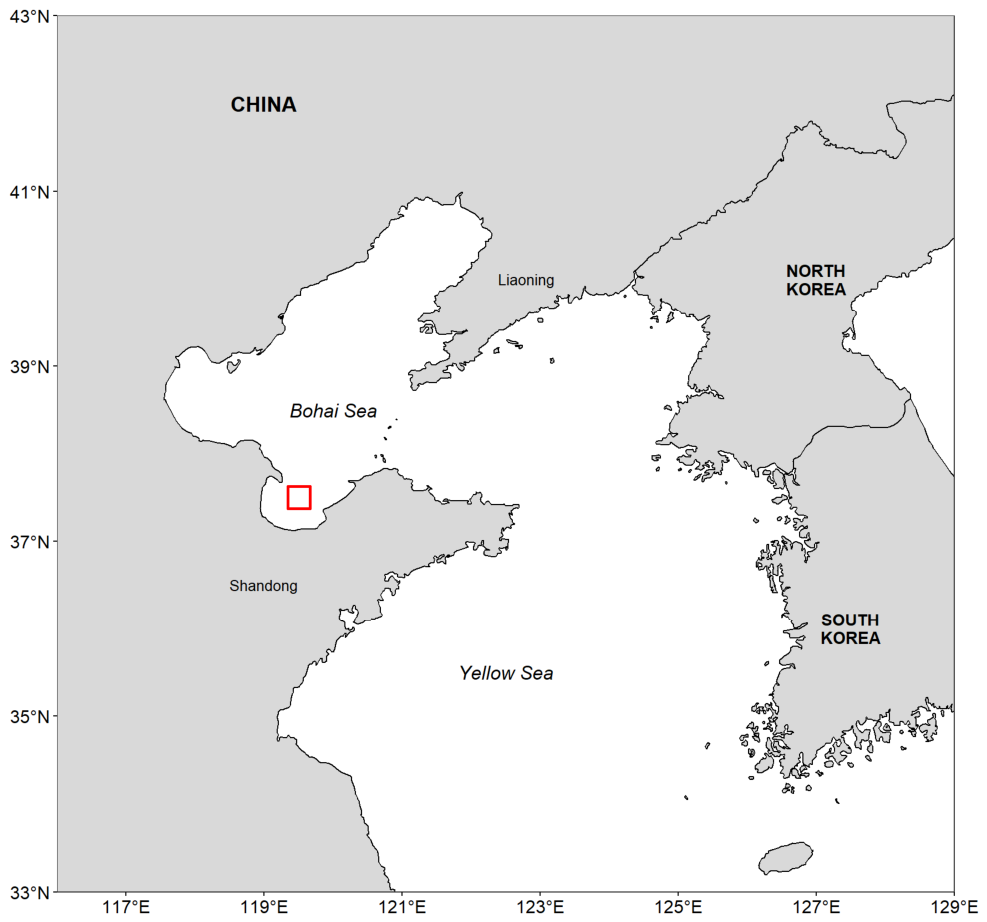
Sea trials were conducted on the commercial fishing grounds for Japanese mantis shrimp in the Bohai Sea from 10 to 30 April 2018 (Figure 1). A commercial fishing vessel, Luchangyuyang 60,077 (length 13.50 m; width 4.50 m; engine power 42 hp), was used during the sea trials. Following commercial fishing operations, traps were tied together as a gang and were deployed along the seafloor. All traps were unbaited. Deployment locations were decided by experienced fishers onboard. Water depth of fishing locations ranged from 10 to 15 m. The soak time for each tap was around 48 h. Catches from each trap and its cover net were sorted and recorded separately on the deck. Catches from each trap and its cover net were sorted (see the following paragraph for a detailed description) separately on the deck.
Catch species were identified by trained personnel onboard. Measurements of the body length and weight were performed in a shore-based laboratory immediately after sample collection. Body length was measured to the nearest 1 mm using a stainless-steel fish measuring board with a measurement range of 0–30 cm (Yingmai YM70300, Linyi Yingmai Tools Co., Ltd., Linyi, China). Body weight was measured to the nearest 0.1 g using an OHAUS Scout SE series electronic balance (OHAUS Instruments (Shanghai) Co., Ltd., Changzhou, China). For catches with large numbers of individuals, a random subsample of 50 individuals was measured, and the total number of individuals in each catch was recorded separately.

2.2. Gear Specifications

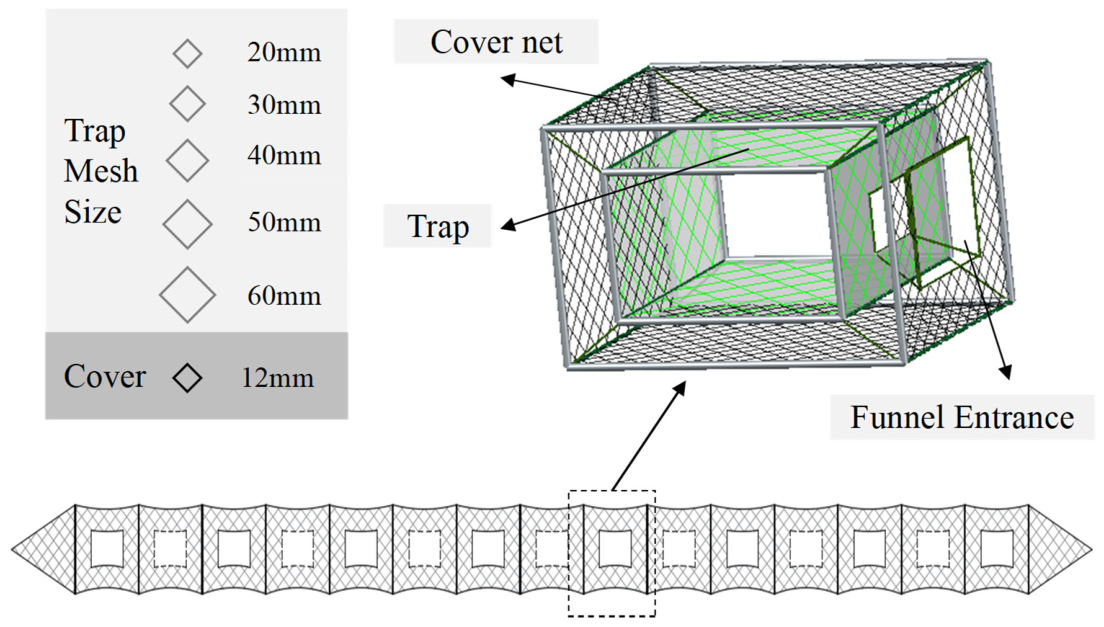
Traditional traps (810 × 40 × 25 cm) with a nominal mesh size of 20 mm (T20) were used as a control group. The trap consists of a rectangular main frame and two tapered codends at the rear (Figure 2). Each trap has 18 chambers supported by iron frames measuring 25 cm × 40 cm. Each chamber has a funnel entrance, and the horizontal distance between the two adjacent iron frames is 45 cm. The netting of the traps and the cover nets were made from polyethylene (PE) twine with a linear density specification of 43 tex × 1 × 3. Mesh measurements were performed using a certified mesh gauge (Model HAIEN, Shanghai Enwen Navigation Instrument Development Co., Ltd., Shanghai, China) according to a standard measurement method [28]. All measurements were conducted on dry netting with ten replicates. Nominal mesh sizes of experimental traps were 30, 40, 50, and 60 mm (termed as T30, T40, T50, and T60).
To analyze the size selectivity of the traps, the covered codend method was applied [14]. A cover net (810 × 60 × 45 cm) was used to collect individuals that escaped from each trap (Figure 2). The net has a similar shape to the traps. Nominal mesh size of the cover net is 12 mm. The net is supported by an iron frame (45 × 60 cm). Each cover net shares the same funnel entrances as the traps. Each trap is totally covered by its own cover, and the gap between the cover net and the trap is around 10 cm.
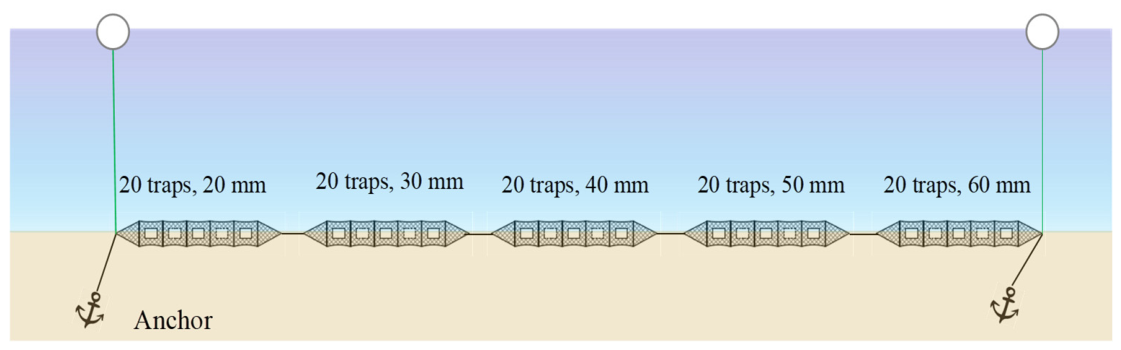
A trap group consists of 20 replicate traps (Figure 3). Five such groups with different mesh sizes compose a trap gang, and they are tied together end-to-end in series. The total length of a trap gang is therefore 81 m. One metal anchor (~6 kg) per 10 traps was used to secure the traps to the seafloor. Surface buoys were attached to the traps via a rope for retrieval.

2.3. Size Selectivity Analysis

The applied experimental design enabled analysis of the collected catch data as binomial data, where individuals either are retained by the cover or by the trap, and are used to estimate the size selection in the trap (i.e., length-dependent retention probability). The probability of finding a fish of length l in a trap in haul j is expressed by the function rj(l). The purpose of the analysis is to estimate the values of this function for all relevant sizes and species individually. Thus, the analysis is conducted separately for each species and trap, following the description below.
Between hauls with the same trap, the value of rj(l) is expected to vary [29]. In this study, we were interested in the length-dependent values of r(l) averaged over hauls with the same trap, since this would provide information about the average consequences for the size selection process when applying the trap in the fishery. Thus, it was assumed that the size-selective performance of the trap, for the hauls conducted, was representative of how the trap would perform in a commercial fishery [30,31].
Estimation of the average size selection over hauls rav(l) involves pooling data from the different hauls [32]. Since we tested different parametric models for rav(l), we write rav(l,v), where v is a vector consisting of the parameters of the model. The purpose of the analysis is to estimate the values of the parameter v that make experimental data (averaged over hauls) most likely to be observed, assuming that the model is able to describe the data sufficiently well. Therefore, Expression (1) was minimized with respect to parameters v, which is equivalent to maximizing the likelihood for the observed data in the form of the length-dependent number of fish retained in the trap (nRjl) versus those escaping to the cover (nEjl):
j = 1 m l n R j l q R j × l n r a v l , ν + n E j l q E j × l n 1.0 r a v l , ν +
where the outer summation is over the m hauls conducted and the inner over length classes l. qRj and qEj are the sampling factors for the fraction of the fish length measured in the trap and cover, respectively.
Four basic selectivity models were tested to describe rav(l,v) for each trap and species individually: Logit, Probit, Gompertz, and Richard (Equation (2)), which assume that all individual fish entering the trap are subjected to the same size selection process. More information about the four selection models can be found in Wileman et al. [33].
r a v l , v = L o g i t l , L 50 ,   S R = exp ( l L 50 ×   ln ( 9 ) S R ) 1 + exp ( l L 50 ×   ln ( 9 ) S R ) P r o b i t l , L 50 ,   S R   Φ 1.349 S R × ( l L 50 ) G o m p e r t z l , L 50 ,   S R e x p e x p 0.3665 + 1.573 S R × l L 50 R i c h a r d s l ,   L 50 ,   S R ,   δ = e x p f 0.5 δ +   f 0.75 δ f   0.25 δ S R × l L 50 1.0 + e x p   f 0.5 δ + f   0.75 δ f 0.25 δ S R × l L 50 1 δ ,   w h e r e   f x = l n ( x 1.0 x ) C L o g i t l , C ,   L 50 ,   S R = 1.0 C + C × L o g i t l , L 50 ,   S R D L o g i t l , C 1 , L 50 1 ,   S R 1 , L 50 2 ,   S R 2 = C 1 × L o g i t l , L 50 1 ,   S R 1 + 1.0 C 1 × L o g i t l , L 50 2 ,   S R 2 T L o g i t l , C 1 , L 50 1 ,   S R 1 , C 2 , L 50 2 ,   S R 2 , L 50 3 ,   S R 3 = C 1 × L o g i t l , L 50 1 ,   S R 1 + C 2 × L o g i t l , L 50 2 ,   S R 2 + 1.0 C 1 C 2 × L o g i t l , L 50 3 ,   S R 3 P o l y 4 v 0 ,   v 1 , v 2 , v 3   , v 4   = e x p v 0 + v 1 × l 100 + v 2 × l 2 100 2 + v 3   × l 3 100 3 + v 4   × l 4 100 4 1.0 + e x p v 0 + v 1 × l 100 + v 2 × l 2 100 2 + v 3   × l 3 100 3 + v 4   × l 4 100 4
The term Φ of the Probit model (Equation (2)) represents the cumulative distribution function of a standard normal distribution [33]. Additional models tested include the CLogit model Equation (2)), where C represents the assumed length-independent contact probability with the trap meshes that provide fish with a length-dependent chance of escape [34]. C is a value from 0.0 to 1.0, and if C = 1.0, all fish were able to have sufficient contact with the trap. For the double logistic model (DLogit), C1 represents the fraction of fish entering the trap that will be subjected to one logistic size selection process with parameters v1, while the remaining fraction (1.0−C1) will be subjected to an additional logistic size selection process with parameters v2 [35]. Compared with DLogit, the triple logistic model (TLogit) introduces an additional size selection process, totaling three different processes, C1, C2, and (1.0-C1-C2) probabilities of being the process that determines the trap size selection of the individual fish entering the trap [36]. Finally, a quartic polynomial model (Poly4) was considered to estimate the trap size selection [37]. For the Poly4 model, leaving out one or more of the parameters v0…v4 in Equation (2) provided 31 additional models that were also considered as potential models to describe rav(l,v).
The capacity of a model to describe the data was inspected following the procedure of inspecting goodness-of-fit as described by Wileman et al. [33]. Therefore, the p-value representing the likelihood of obtaining at least as big a discrepancy between the fitted model and the observed data by coincidence should not be below 0.05. In case of a poor statistical fit (p-value < 0.05), the residuals were inspected to determine whether the poor result was due to structural problems when modeling the experimental data using the different selection curves or if it was due to overdispersion in the data [33]. The most appropriate model for each species and trap was selected based on comparing Akaike information criterion (AIC) values, where the selected model had the lowest AIC.
Once the specific size selection model was identified for a particular species and trap, bootstrapping was applied to estimate the confidence limits for the average size selection. We applied the software tool SELNET [32] for the size selection analysis and utilized the double bootstrap method implemented in this tool to obtain the confidence limits for the size selection curve and the corresponding parameters. This bootstrapping approach is identical to the one described in Millar [30] and takes both within-haul and between-haul variation into consideration. The hauls for each trap were used to define a group of hauls. To account for between-haul variation, an outer bootstrap resample with replacement from the group of hauls was included in the procedure. Within each resampled haul, the data for each length class was bootstrapped in an inner bootstrap with replacement to account for within-haul variation. Each bootstrap resulted in a “pooled” set of data, which was then analyzed using the identified selection model. Thus, each bootstrap run resulted in an average selection curve. For each species analyzed, 1000 bootstrap repetitions were conducted to estimate the Efron percentile 95% confidence limits [32]. The 95% confidence limits correspond to a test at the α = 0.05 level.
To compare the difference in length-dependent selectivity of the traps, Δr(l) was estimated:
Δ r l = r T 1 l r T 2 l
rT1(L) and rT2(L) represent the size selection of trap 1 and trap 2. The 95% confidence intervals (CI) for rT1(L) were estimated based on the bootstrap population results by the method described in Herrmann et al. [38]. The inspection of the length class with a lack of overlap between 95% CI and 0.0 was conducted to determine whether there were any significant differences between traps.

2.4. Estimation of Usability Indicators

To evaluate how the tested traps would affect the specific fishery, three trap usability indicators, nP−, nP+, and nRatio, Equations (4)–(6) were calculated for species or species groups with an MRL. Contrary to the size selection properties, which provide information that is independent of the size structure of the population encountered by the gear, the indicators directly depend on the size structure of the population encountered during the sea trials, providing additional information for the evaluation of the catch performance of each trap.
n P = 100 × j l < M R L n C d j l j l < M R L n C d j l + n C v j l
n P + = 100 × j l > M R L n C d j l j l > M R L n C d j l + n C v j l
n R a t i o = j l < M R L n C d j l j l > M R L n C d j l
where the summation of j is over hauls with a specific trap, and l over length classes. nCdjl and nCvjl represent the number of individuals of length l in haul j that were found in the trap and in the cover, respectively. nP− and nP+ estimate the retention efficiency of the catch below and above MRL. nRatio represents the landings ratio between captured fish below and above the MRL of the fished population’s size structure.
These indicators evaluate the effects each trap has on the specific fishery. Ideally, for a target species, nP− and nRatio should be low (close to zero), while nP+ should be high (close to 100), i.e., all individuals over MRL that enter the trap are retained. The double bootstrapping method was used to estimate the Efron percentile 95% CI for the indicator values, considering the effect of between-haul variation and that of the uncertainty related to within-haul variation [32].

3. Results

A total of 10 hauls were conducted during sea trials, with 20 traps of each mesh size deployed per haul, resulting in a total of 100 traps deployed. The inner stretched mesh sizes for T20, T30, T40, T50, and T60 were 18.25 (SD = 0.37), 27.89 (SD = 0.41), 35.86 (SD = 0.73), 48.76 (SD = 0.41), and 55.89 mm (SD = 0.49), respectively. Measured mesh size for the cover net was 11.52 mm (SD = 0.26). The total catch weight across all hauls was 100.33 kg, with a mean catch weight per haul of 10.03 ± 1.24 kg. Japanese mantis shrimp was the dominant species in the catches and accounted for 30.4% (in weight) of the total catch. The number of catches for each mesh size was listed in Supplementary Table S1. Other bycatch species included 36 fish and shellfish species (Supplementary Table S2, Figure S1) with negligible catch numbers or of low commercial value.

3.1. Size Selectivity

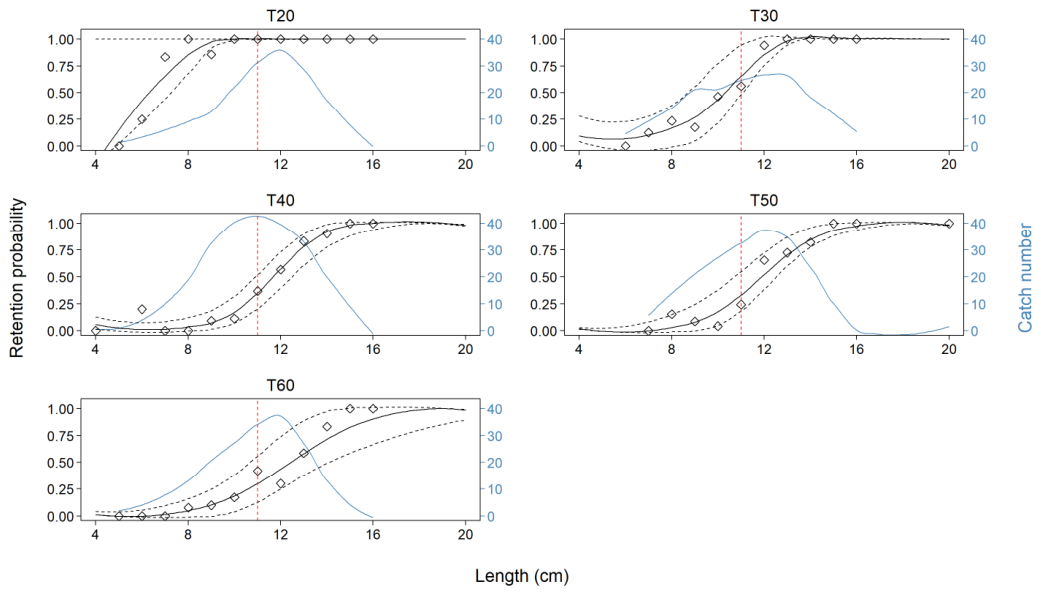
Model selection results based on AIC demonstrated that the best-fitting selectivity models varied with mesh sizes (Table 1). The Gompertz, Richard, CLogit, Logit, and Probit models were the best ones for T20, T30, T40, T50, and T60 traps, respectively. Size selectivity curves for each trap were presented in Figure 4. Catch of T20 ranged from 5 to 16 cm, and the length distribution was centered around 12 cm. For T20, the selectivity curve showed a sharp rise trend, and the retention rate reached around 100% at 10.0 cm. The CI bands for length below 7.0 cm were wide due to low catch numbers. The estimated retention ratio for length at MLS was 0.997, which was consistent with the observed value. According to the curves, the T20 trap retained almost all individuals above MLS with narrow CI bands (Figure 4). L50 was 6.39 cm (CI 0.10–7.05), and SR was 1.36 cm (CI 0.06–2.66; Table 2).
Catch size for T30 ranged from 6 to 16 cm and was dominated by a length of 12 cm (Figure 4). Selectivity curves of the T30 trap also suggested a relatively low retention ratio for small individuals (e.g., 0.175 at 8.0 cm), and showed a gradual increase with body length. For length at MLS, the estimated retention ratio was 0.617. The trap retained almost all individuals above 13 cm. The curves showed a close match to the observed retention data with relatively narrow CI bands. The estimated L50 was 10.50 cm (CI 8.98–11.14) and SR was 2.61 cm (CI 0.72–3.87; Table 2).
For the T40 trap, the catch length ranged from 4 to 16 cm with a mode at 11 cm (Figure 4). Selectivity curves for the T40 demonstrated low retention rates at small sizes (e.g., 0.045 at 8 cm), but the corresponding CI bands were relatively narrow. The retention ratio at MLS was 0.320 and reached 0.993 at 16 cm. L50 was 11.69 cm (CI 11.03–12.38), and SR was 1.99 cm (CI 1.25–3.49; Table 2).
The catch length of T50 ranged from 7 to 20 cm with a mode at 13 cm (Figure 4). The retention curve showed very low retention for small shrimps (e.g., 0.050 at 8 cm). At MLS, the estimated retention ratio was 0.314. For lengths above 18 cm, this trap retained almost all the catch (0.995). L50 for T50 was 11.90 cm (CI 10.81–12.43), and SR was 2.49 cm (CI 1.46–3.78; Table 2).
Size selectivity curves for the T60 were shown in Figure 4. The fitted curve predicted low retention for small length sizes, increasing gradually with length (e.g., 0.049 at 8.0 cm, and 0.181 at 10.0 cm). The estimated retention was 0.295 at MLS and reached 0.993 at 19 cm. The estimated L50 was 12.44 cm (CI 10.76–14.13) and the SR was 3.62 cm (CI 1.39–6.76; Table 2). The length distribution of T60 catch ranged from 5 to 16 cm with a mode at 12 cm.
Large-mesh traps showed relatively gradual retention curves. Retention at MLS decreased with mesh sizes (Figure 4). L50 increased consistently with mesh sizes from 6.39 cm for T20 to 12.44 cm for T60. SR became wider from 1.4 (T20) to 3.6 cm (T60) while no obvious change pattern was observed (Table 2).
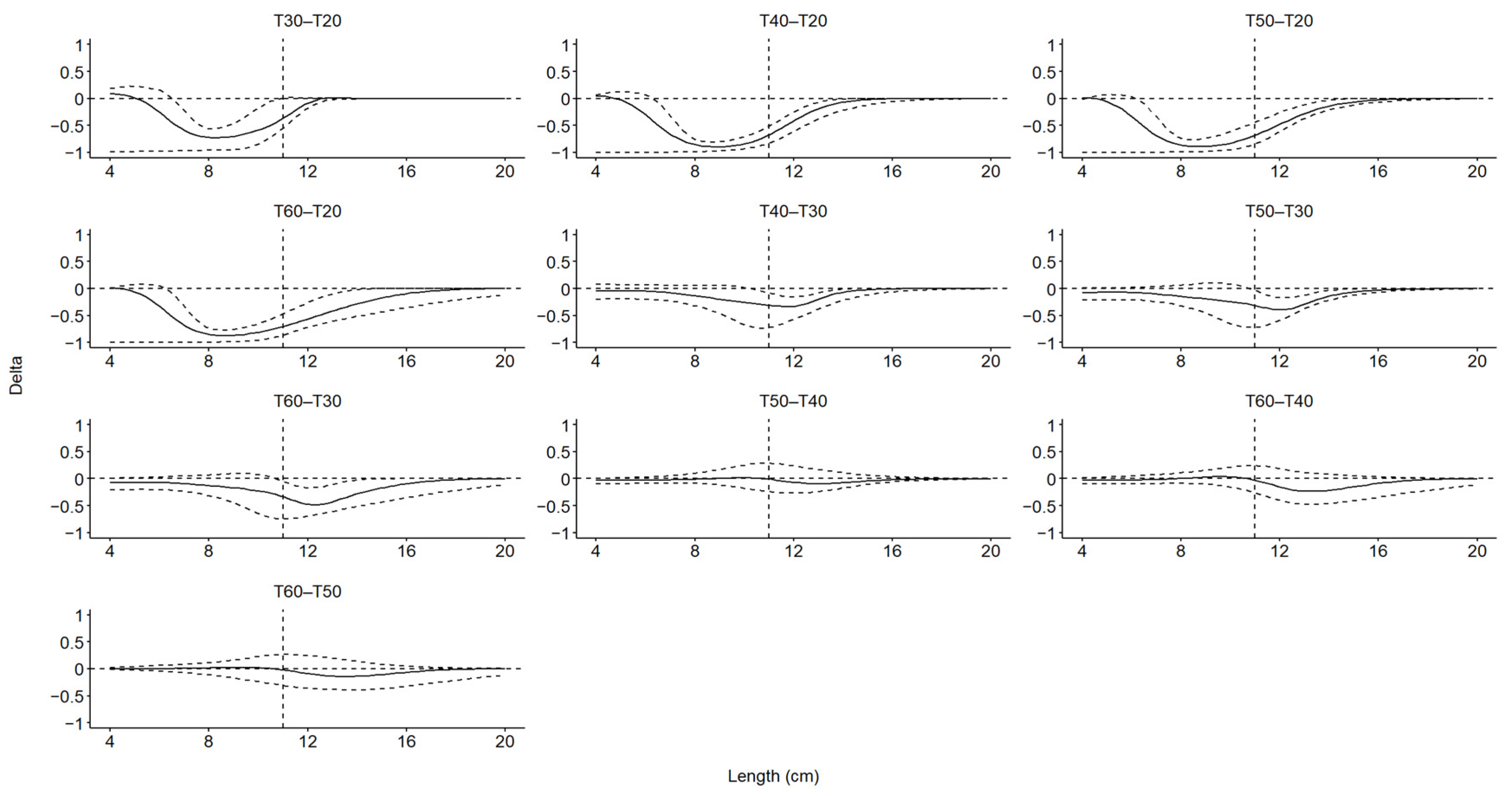
Pairwise comparisons of selectivity curves showed significant differences in retention probabilities across mesh sizes (Figure 5). All larger meshes retained significantly fewer individuals than T20 in the length range 7–17 cm. Compared with T30, larger meshes (T40–T60) retained significantly fewer individuals above MLS. No significant differences in retention probability were found among T40, T50, and T60 (Figure 5).

3.2. Exploitation Pattern

Values for the usability indicators were used to quantify the exploitation pattern of the tested traps, which varied with mesh size (Table 2). The proportion of undersized catch (np-) also decreased with increasing mesh sizes from 86.8% in T20 to 7.7–10.5% in all meshes larger than T40. This demonstrated the effectiveness of bycatch reduction with the increase in mesh size. However, the proportion of legal-sized catch (nP+) decreased with increasing mesh size from 100% (T20) to 46.4% (T60), which demonstrated that increasing mesh sizes reduced legal-sized catch retention.
The ratio of undersized to legal catches (nRatio) was highest for T20 (0.38; CI: 0.23–0.58) and was lowest for T50 (0.058; CI: 0.00–0.15). nRatio showed a decreasing trend when increasing mesh sizes from T20 to T50. However, nRatio for T60 (0.16; CI: 0.00–0.30) was higher than T50.

4. Discussion

This study provided the first systematic evaluation of size selectivity and exploitation pattern of traps targeting Japanese mantis shrimp under commercial fishing conditions. Our results demonstrated that size selectivity and usability of traps did not change linearly with mesh sizes. As the mesh size increased, L50 increased accordingly, while SR became wider (Table 2). However, increasing mesh sizes above T40 did not further reduce undersized bycatch (np-) but resulted in further reduction in legal-sized catch (np+, Table 2). This was probably because the T40 mesh allowed most undersized individuals to escape while retaining legal-sized ones. Therefore, using mesh sizes larger than T40 was not recommended, especially for fishers, unless the management goal was to reduce fishing pressure on the legal-sized population.
For the T20 trap, the fitted selectivity curve showed wide CI bands at smaller lengths (Figure 4). The wide CI was possibly due to the lack of small individuals encountered during fishing or the low proportion in the population fished. This created uncertainty when interpreting the results at these length classes. The observed retention increased rapidly with length in all traps. This consistency between modeled curves and observed retention trends supported the selectivity estimates of T20. However, to further reduce uncertainty around these estimates, additional deployments or sea trials are recommended.
Our results suggested that increasing trap mesh sizes by 10 mm from 20 to 60 mm resulted in an average L50 increase of ~1.5 cm, which demonstrated that mesh size is one of the key factors affecting size selectivity for this species. The positive relationship between mesh size and L50 was consistent with previous research on crustacean traps [39,40,41]. The narrow SR for T20 indicated a sharp rise in retention from 0 to 100%, which was consistent with the selectivity curve shape. However, SR for T60 was wide with wide CI bands (Table 2). This could increase estimation uncertainty in the ratio of legal-sized individuals retained by larger meshes. Increasing mesh sizes from T40 to T60 did not cause a significant difference in retention probability. This may result from variations in escape behavior and morphological differences among larger individuals. Future studies could investigate the reasons, e.g., incorporating behavior and biological traits (e.g., swimming performance and body morphology) into selectivity analysis.
The sea trials were conducted on the fishing grounds in the Bohai Sea. The population structure and behavior characteristics of Japanese mantis shrimp may vary spatially. Therefore, the selectivity parameters and exploration patterns estimated in this study should be considered with caution when applied to other regions. In addition, the covered-codend method [33] was used in sea trials in this study. The cover net may affect the entry and escape behavior of the target species. These effects may introduce biases to the estimated selectivity. Future studies could incorporate underwater video observations to investigate the potential effects of the cover net and the associated behavioral responses.
Traps were not baited and deployed in strings in this study, which followed the traditional fishing practice in the Bohai Sea. Without the bait, trap entry was probably driven by the natural behavior, such as shelter-seeking, territorial defense, and local movement [42,43,44]. It was expected that total catch would increase if baits were used since baits could attract target species to approach and contact with the traps [45]. Therefore, the findings in this study may not apply to baited traps.
The size selectivity of the traps is a mechanical property mainly determined by the mesh size relative to body girth and is independent of population structure. Therefore, the L50 and SR reported in this study remain consistent despite temporal shifts in population structure. However, the exploitation pattern can be affected by the selectivity and the encountered population structure. Our recommendation of the T30 trap is based on the population structure encountered during the sea trials in 2018. If the stock changes temporally or spatially, the resulting exploitation pattern would differ, even though the selectivity properties of the traps are consistent. Therefore, ongoing population monitoring is recommended to assess the continued applicability of the exploitation patterns, although such research extends beyond the scope of this study.
In this study, the usability indicator analysis quantified the trade-off between undersized bycatch reduction and legal-sized catch retention. The T20 traps retained 86.8% of undersized shrimp, although retention of legal-sized ones was 100% (Table 2). Such a high percentage of juvenile removal affected the sustainability of the fishery, especially when the bycatch was not released. Increasing mesh size to ≥40 mm reduced undersized retention to <10.5%, but the legal-sized retention decreased to <63.8% (Table 2). Based on this trade-off analysis, a T30 instead of a T20 was recommended for Japanese mantis shrimp trap fisheries in the Bohai Sea. This recommendation considered the balance between conserving fisheries resources and protecting the livelihoods of the small-scale fishers. T30 reduced undersized bycatch to 28.0% and retained 91.8% of legal-sized catch (Table 2).

5. Conclusions

The results of this study support our hypothesis that increasing mesh size increases the size selectivity of the traps. We found that T30 traps provide the optimal balance between reducing the capture of individuals smaller than the MLS and maintaining acceptable catch rates of marketable-sized individuals. We believed that the findings of this study would contribute to understanding trap selectivity for stomatopod and provide insights for managers and fishers to balance the sustainability and profitability of the Japanese mantis shrimp trap fisheries in the Bohai Sea.

Supplementary Materials

The following supporting information can be downloaded at: https://www.mdpi.com/article/10.3390/fishes11060343/s1, Figure S1: Species composition (by weight) of the total catch.; Table S1: Catch counts of Japanese mantis shrimp in the trap and cover net by trap type; Table S2: Fish and shellfish species caught during the study (“–” indicates that individual weight data were not recorded due to their small catch volumes and low economic value; together they account for 17.8% (in weight) of the total catch).

Author Contributions

Conceptualization, Q.X. and Z.C.; formal analysis, Q.X. and Z.C.; investigation, Q.X., W.H., Z.P., J.Z. and X.L.; writing—original draft preparation, Q.X. and Z.C.; writing—review and editing, B.H., Q.X., W.H., Z.P., J.Z. and X.L. All authors have read and agreed to the published version of the manuscript.

Funding

This work was funded by the National Key R&D Program of China, grant number 2024YFD2400702, and the Central Public-interest Scientific Institution Basal Research Fund, CAFS, grant number 2023TD02.

Institutional Review Board Statement

Not applicable.

Informed Consent Statement

Not applicable.

Data Availability Statement

The data are available from the corresponding author upon request.

Acknowledgments

We would like to thank many students and staff from the Yellow Sea Fisheries Research Institute for their valuable support and contributions. We also thank all the crew of the commercial fishing vessel Luchangyuyang 60077 for their assistance during sea trials.

Conflicts of Interest

The authors declare no conflicts of interest.

References

  1. Yang, M.; Li, X. Population genetic structure of the mantis shrimp Oratosquilla oratoria (Crustacea: Squillidae) in the Yellow Sea and East China Sea. J. Oceanol. Limnol. 2018, 36, 905–912. [Google Scholar] [CrossRef]
  2. Wu, Q.; Han, Q.; Jin, Y.; Yang, T.; Li, Z.; Shan, X.; Jin, X. Long-term and monthly changes in abundance, size composition and spatial distribution of the mantis shrimp Oratosquilla oratoria in the Bohai Sea. Acta Oceanol. Sin. 2022, 41, 80–86. [Google Scholar] [CrossRef]
  3. Lu, Z.; Xue, L.; Zhang, Y. Species composition and quantitative distribution of Stomatopod in the East China Sea. J. Nat. Resour. 2013, 28, 2105–2114. [Google Scholar]
  4. China Fishery Statistical Yearbook (CFSY). China Fishery Statistical Yearbook; Bureau of Fisheries and Fisheries Administration, Ministry of Agriculture and Rural Affairs of the People’s Republic of China: Beijing, China, 2025.
  5. Xu, Q.C.; Li, X.S.; Sun, S.; Fan, G.Z. Size selectivity of codend mesh of beam trawl in Laizhou Bay in autumn. Prog. Fish. Sci. 2020, 41, 78–86. (In Chinese) [Google Scholar]
  6. Ren, J.Q.; Huang, L.Y.; Xu, Q.C.; Li, Y.; Cheng, Z.; Feng, W. Analysis and comparison of catch performance of cage net with different mesh sizes in Laizhou Bay in spring. Fish. Mod. 2021, 48, 41–47. (In Chinese) [Google Scholar]
  7. Lin, Q.; Wang, J.; Yuan, W.; Fan, Z.H.; Jin, X.S. Effects of fishing and environmental change on the ecosystem of the Bohai Sea. J. Fish. Sci. China 2016, 23, 619–629. [Google Scholar]
  8. Cao, W.; Wang, Y.; Zheng, L.; Zhang, Z.; Liu, S.; Dong, X.; Xian, W. Exploitation pattern assessment of the Japanese mantis shrimp (Oratosquilla oratoria) resource in the coastal waters of the Shandong Peninsula. Mar. Pollut. Bull. 2023, 194, 115253. [Google Scholar] [CrossRef] [PubMed]
  9. Ministry of Agriculture of the People’s Republic of China. Announcement on the Implementation of the Minimum Mesh Size System for Permitted and Transitional Marine Fishing Gears. 2013. Available online: https://yyj.moa.gov.cn/tzgg/201404/t20140402_6300664.htm (accessed on 10 April 2026). (In Chinese)
  10. Ministry of Agriculture and Rural Affairs of the People’s Republic of China. Regulations on the Conservation of Biological Resources in the Bohai Sea. 2004. Available online: https://www.moj.gov.cn/pub/sfbgw/flfggz/flfggzbmgz/200404/t2004029_143643.html (accessed on 10 April 2026). (In Chinese)
  11. Broadhurst, M.K.; Butcher, P.A.; Cullis, B.R. Effects of mesh size and escape gaps on discarding in an Australian giant mud crab (Scylla serrata) trap fishery. PLoS ONE 2014, 9, e106414. [Google Scholar] [CrossRef]
  12. Kalogirou, S.; Pihl, L.; Maravelias, C.D.; Herrmann, B.; Smith, C.J.; Papadopoulou, N.; Notti, E.; Sala, A. Shrimp trap selectivity in a Mediterranean small-scale fishery. Fish. Res. 2019, 211, 131–140. [Google Scholar] [CrossRef]
  13. Breen, M.; Graham, N.; Pol, M.; He, P.; Reid, D.; Suuronen, P. Selective fishing and balanced harvesting. Fish. Res. 2016, 184, 2–8. [Google Scholar] [CrossRef]
  14. Millar, R.B.; Fryer, R.J. Estimating the size-selection curves of towed gears, traps, nets and hooks. Rev. Fish Biol. Fish. 1999, 9, 89–116. [Google Scholar] [CrossRef]
  15. Brown, C.G. Crab trap selectivity: Effects of escape vent size and soak time on the catch of Dungeness crabs (Cancer magister). Can. J. Fish. Aquat. Sci. 1982, 39, 112–118. [Google Scholar]
  16. Millar, R.B. Estimating the size-selectivity of fishing gear by conditioning on the total catch. J. Am. Stat. Assoc. 1992, 87, 962–968. [Google Scholar] [CrossRef]
  17. Broadhurst, M.K.; Tolhurst, D.J.; Hughes, B.; Raoult, V.; Smith, T.M.; Gaston, T.F. Optimising mesh size with escape gaps in a dual-species portunid-trap fishery. Aquac. Fish. 2020, 5, 308–316. [Google Scholar] [CrossRef]
  18. Berzosa, S.A.; Noack, T.; Santos, J.; Lichtenstein, U.; Milanelli, A.M.; Kindt-Larsen, L.; Ljungberg, P.; Dahlke, F.; Stepputtis, D. From semi-controlled environment to field trials: Testing pot entrance designs for Atlantic cod (Gadus morhua). Fish. Res. 2025, 288, 107470. [Google Scholar] [CrossRef]
  19. Zhang, J.; Pei, Z.; He, P.; Shi, J. Effect of escape vents on retention and size selectivity of crab pots for swimming crab Portunus trituberculatus in the East China Sea. Aquac. Fish. 2021, 6, 340–347. [Google Scholar] [CrossRef]
  20. Zhang, J.; Zhang, H.; He, P.; Fei, J.; Chu, W.; Shi, J. Selectivity of crab pots with escape vents and the optimal vent height for reducing the catch of sublegal swimming crab in the East China Sea pot fishery. Fish. Res. 2024, 274, 107002. [Google Scholar] [CrossRef]
  21. Cerbule, K.; Herrmann, B.; Brčić, J.; Grimaldo, E.; Bak-Jensen, Z. Selectivity in snow crab (Chionoecetes opilio) pot fishery: Effect of escape gap shape and size for conservation of fishery resources. J. Nat. Conserv. 2024, 79, 126616. [Google Scholar] [CrossRef]
  22. Winger, P.D.; Walsh, P.J. Selectivity, efficiency, and underwater observations of modified trap designs for the snow crab (Chionoecetes opilio) fishery in Newfoundland and Labrador. Fish. Res. 2011, 109, 107–113. [Google Scholar] [CrossRef]
  23. Anders, N.; Ingólfsson, Ó.A.; Jørgensen, T.; Løkkeborg, S.; Humborstad, O.B. Investigating the potential of escape openings and reduced mesh size to optimize snow crab (Chionoecetes opilio) pot catches in the Barents Sea. Fish. Res. 2023, 258, 106517. [Google Scholar] [CrossRef]
  24. Virgili, M.; Petetta, A.; Herrmann, B.; Cerbule, K.; Guicciardi, S.; Li Veli, D.; Barone, G.; Lucchetti, A. Efficient and sustainable: Innovative pot design for a Mediterranean small-scale fishery. Front. Mar. Sci. 2024, 11, 1408036. [Google Scholar] [CrossRef]
  25. Fogarty, M.J.; Addison, J.T. Modelling capture processes in individual traps: Entry, escapement and soak time. ICES J. Mar. Sci. 1997, 54, 193–205. [Google Scholar] [CrossRef]
  26. Hardee, D.C. The Effects of Bait Type, Trap-Soak Duration, and Trap Modification on Harvest of Red Swamp Crawfish. Master’s Thesis, Louisiana State University and Agricultural and Mechanical College, Baton Rouge, LA, USA, 2009. [Google Scholar]
  27. Olsen, L.; Herrmann, B.; Sistiaga, M.; Grimaldo, E. Effect of gear soak time on size selection in the snow crab pot fishery. Fish. Res. 2019, 214, 157–165. [Google Scholar] [CrossRef]
  28. General Administration of Quality Supervision, Inspection and Quarantine of the People’s Republic of China & Standardization Administration of China. Determination of Mesh Size of Fishing Nets (GB/T 6964-2010). 2010. Available online: https://openstd.samr.gov.cn/bzgk/std/newGbInfo?hcno=7BB234C1FA2B3F0FEC0A3538B32709E4 (accessed on 10 April 2026). (In Chinese)
  29. Fryer, R.J. A model of between-haul variation in selectivity. ICES J. Mar. Sci. 1991, 48, 281–290. [Google Scholar] [CrossRef]
  30. Millar, R.B. Incorporation of between-haul variation using bootstrapping and nonparametric estimation of selection curves. Fish. Bull. 1993, 91, 564–572. [Google Scholar]
  31. Sistiaga, M.; Herrmann, B.; Grimaldo, E.; Larsen, R.B. Assessment of dual selection in grid based selectivity systems. Fish. Res. 2010, 105, 187–199. [Google Scholar] [CrossRef]
  32. Herrmann, B.; Sistiaga, M.; Nielsen, K.N.; Larsen, R.B. Understanding the size selectivity of redfish (Sebastes spp.) in North Atlantic trawl codends. J. Northwest Atl. Fish. Sci. 2012, 44, 1–13. [Google Scholar] [CrossRef]
  33. Wileman, D.A.; Ferro, R.S.T.; Fonteyne, R.; Millar, R.B. Manual of Methods of Measuring the Selectivity of Towed Fishing Gears; International Council for the Exploration of the Sea: Copenhagen, Denmark, 1996; 126p, ICES Cooperative Research Report No. 215. [Google Scholar]
  34. Bayse, S.M.; Herrmann, B.; Lenoir, H.; Depestele, J.; Polet, H.; Vanderperren, E.; Verschueren, B. Could a T90 mesh codend improve selectivity in the Belgian beam trawl fishery? Fish. Res. 2016, 174, 201–209. [Google Scholar] [CrossRef]
  35. Lipovetsky, S. Double logistic curve in regression modeling. J. Appl. Stat. 2010, 37, 1785–1793. [Google Scholar] [CrossRef]
  36. Frandsen, R.P.; Madsen, N.; Krag, L.A. Selectivity and escapement behaviour of five commercial fishery species in standard square- and diamond-mesh codends. ICES J. Mar. Sci. 2010, 67, 1721–1731. [Google Scholar] [CrossRef]
  37. Krag, L.A.; Herrmann, B.; Karlsen, J.D.; Mieske, B. Species selectivity in different sized topless trawl designs: Does size matter? Fish. Res. 2015, 172, 243–249. [Google Scholar] [CrossRef]
  38. Herrmann, B.; Krag, L.A.; Krafft, B.A. Size selection of Antarctic krill (Euphausia superba) in a commercial codend and trawl body. Fish. Res. 2018, 207, 49–54. [Google Scholar] [CrossRef]
  39. Grati, F.; Polidori, P.; Scarcella, G.; Fabi, G. Estimation of basket trap selectivity for changeable nassa (Nassarius mutabilis) in the Adriatic Sea. Fish. Res. 2013, 141, 101–107. [Google Scholar] [CrossRef]
  40. Özdemir, S.; Gökçe, G.; Çekiç, M. Determination of size selectivity of traps for blue crab (Callinectes sapidus Rathbun, 1896) in the Mediterranean Sea. J. Agric. Sci. 2015, 21, 256–261. [Google Scholar] [CrossRef]
  41. Cilbiz, M.; Aydın, C.; Herrmann, B. New codend designs to improve the size selectivity of fyke net for narrow-clawed crayfish (Pontastacus leptodactylus). Aquat. Living Resour. 2022, 35, 14. [Google Scholar] [CrossRef]
  42. Matsuura, S.; Hamano, T. Ecological studies on the Japanese mantis shrimp, Oratosquilla oratoria (De Haan). I. Selection for artificial burrows by the Japanese mantis shrimp with some notes on natural burrows. Nippon Suisan Gakkaishi 1984, 50, 1963–1968. [Google Scholar] [CrossRef]
  43. Slack-Smith, R.J. Fishing with Traps and Pots; FAO Training Series No. 26; Food and Agriculture Organization of the United Nations: Rome, Italy, 1990; Available online: https://www.fao.org/4/x2590e/x2590e00.htm#TopOfPage (accessed on 10 April 2026).
  44. Bacheler, N.M. A review and synthesis of the benefits, drawbacks, and considerations of using traps to survey fish and decapods. ICES J. Mar. Sci. 2024, 81, 1–21. [Google Scholar] [CrossRef]
  45. Merilä, J. Baiting improves CPUE in nine-spined stickleback (Pungitius pungitius) minnow trap fishery. Ecol. Evol. 2015, 5, 3737–3742. [Google Scholar] [CrossRef] [PubMed]
Figure 1. Location of the study area (marked with a square) in the Bohai Sea, China.
Fishes 11 00343 g001
Figure 2. Schematic illustration of the traps and cover nets. Each trap measures 40 × 25 × 810 cm, and the cover net 60 × 45 × 810 cm. The gap between the trap and the cover net is 10 cm.
Fishes 11 00343 g002
Figure 3. Schematic illustration of the trap gangs. Each gang consists of twenty traps with the same mesh size. Five gangs are connected in series. Metal anchors (6 kg) were used to secure the traps (one anchor per ten traps). Two marker buoys are tied to the ends of the traps.
Fishes 11 00343 g003
Figure 4. Size selectivity curves of each trap. Diamond symbols represent the experimental data; the solid black curve is the fitted selectivity curve with dotted curves representing its 95% CIs; red vertical lines represent the MLS for mantis shrimp; blue curves represent the size distribution of the encountered population.
Fishes 11 00343 g004
Figure 5. Delta curves for each pair of traps. The solid black curve indicates the fitted Delta curve with stipple curves describing its 95% Cis. Vertical dotted lines represent the MLS for mantis shrimp.
Fishes 11 00343 g005
Table 1. Akaike’s information criterion (AIC) for each model for each trap. Selected model in bold.
TrapModel
LogitProbitGompertzRichardDLogitTLogitPoly4CLogit
T2032.3132.5131.7033.7633.5739.5638.0134.31
T30130.36129.55138.20124.79129.22135.22131.06128.03
T40219.86223.04235.28220.73222.63228.63222.80218.61
T50203.10204.49209.08204.90203.25205.99208.04203.7
T60194.29194.07195.13194.84200.29206.29199.20196.29
Table 2. Trap usability indicators with fit statistics. Numbers in () represent the 95% CI for the estimated data.
ParameterT20T30T40T50T60
ModelGompertzRichardsCLogitLogitProbit
L50 (cm)6.39 (0.10–7.05)10.50 (8.98–11.14)11.69 (11.03–12.38)11.90 (10.81–12.43)12.44 (10.76–14.13)
SR (cm)1.36 (0.06–2.66)2.61 (0.72–3.87)1.99 (1.25–3.49)2.49 (1.46–3.78)3.62 (1.39–6.76)
nP86.79 (78.57–100.00)28.00 (8.33–52.46)8.18 (0.00–21.43)7.69 (0.00–23.33)10.53 (0.00–21.74)
nP+100.00 (100.00–100.00)91.82 (85.29–100.00)63.77 (54.22–75.73)60.99 (52.89–79.03)46.36 (31.01–74.36)
nRatio0.38 (0.23–0.58)0.21 (0.05–0.43)0.10 (0.00–0.22)0.0581 (0.00–0.15)0.16 (0.00–0.30)
DOF10.008.009.009.0010.00
Deviance6.292.556.0810.557.24
p-value0.790.960.730.310.70
Disclaimer/Publisher’s Note: The statements, opinions and data contained in all publications are solely those of the individual author(s) and contributor(s) and not of MDPI and/or the editor(s). MDPI and/or the editor(s) disclaim responsibility for any injury to people or property resulting from any ideas, methods, instructions or products referred to in the content.