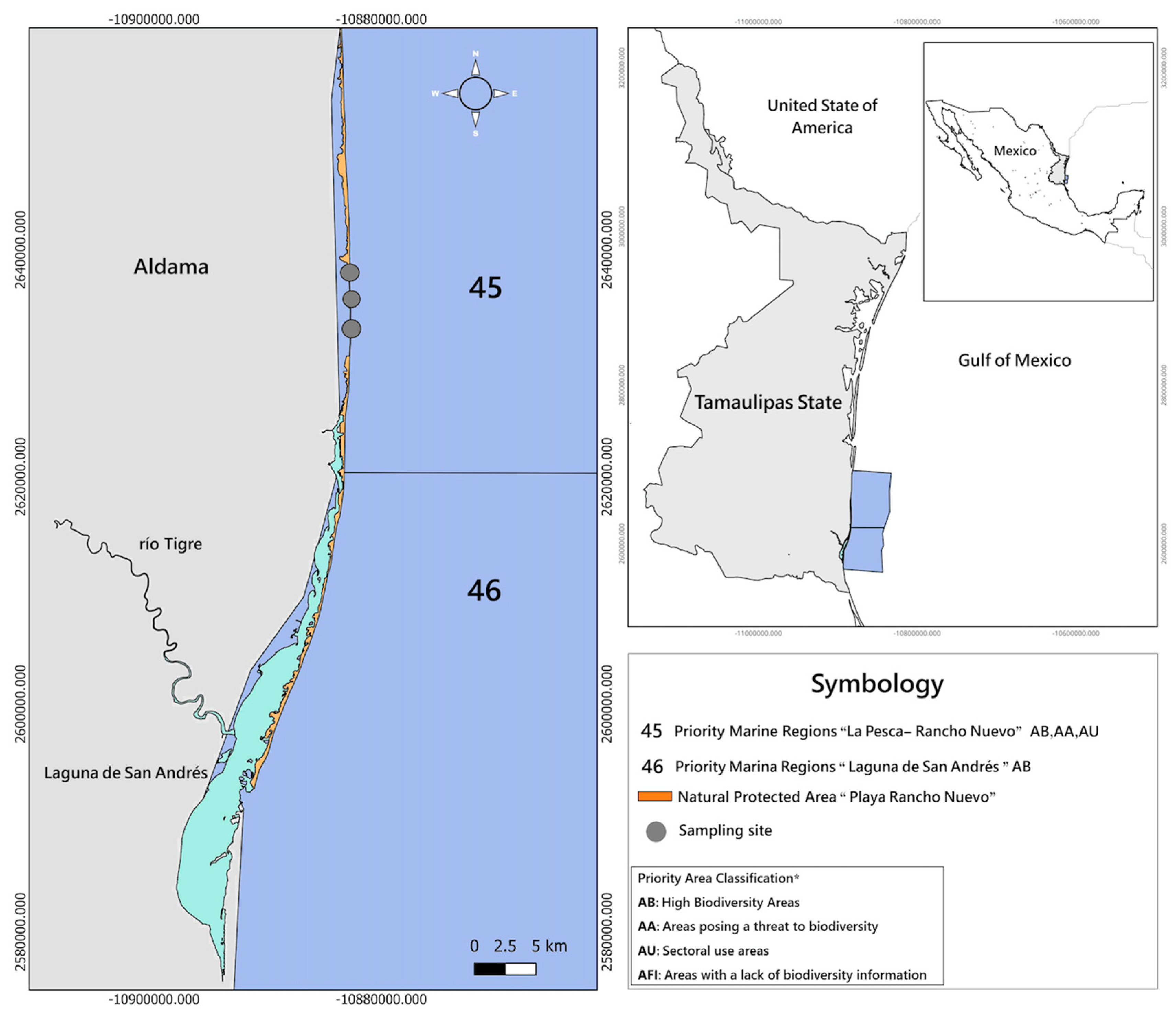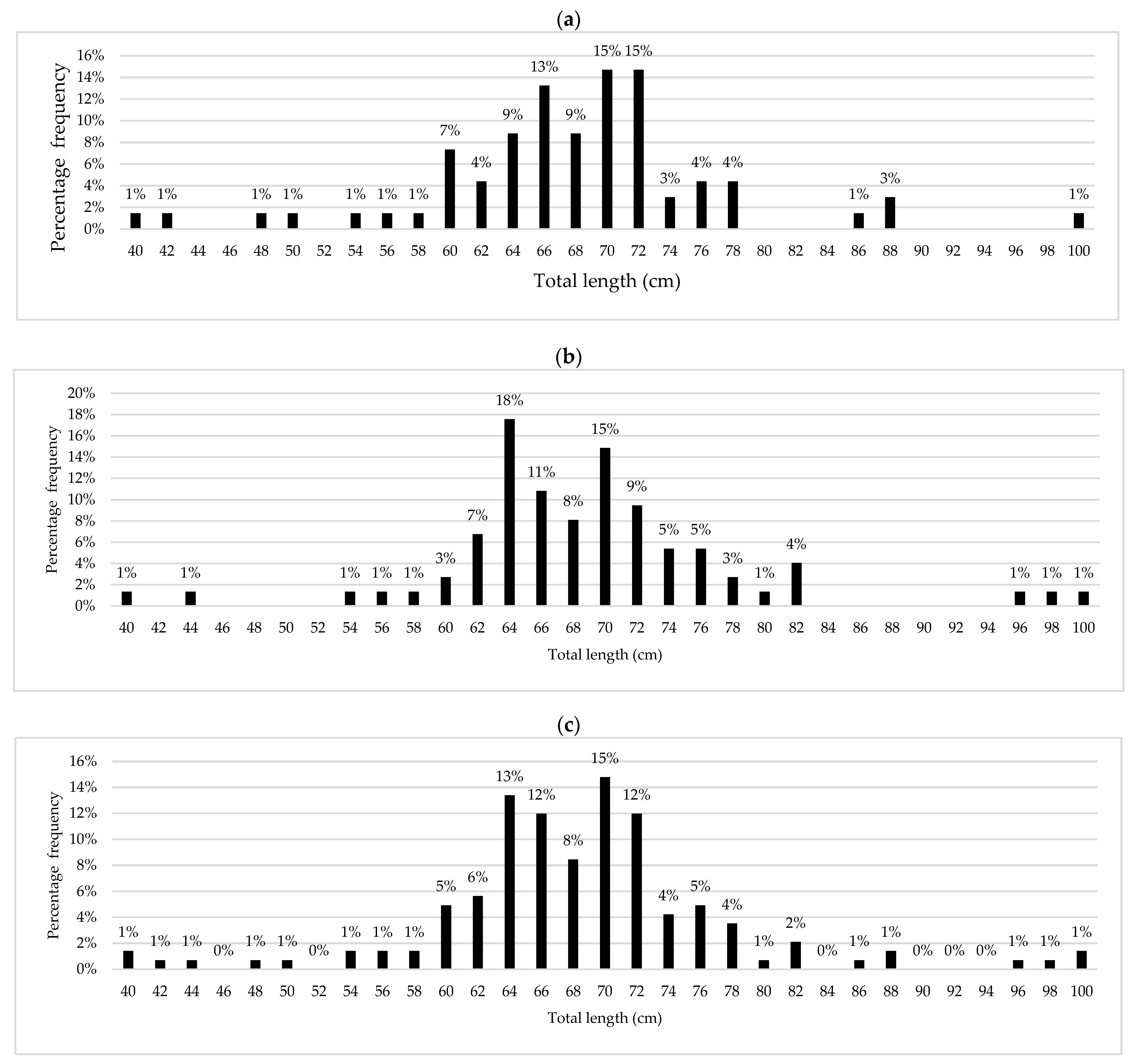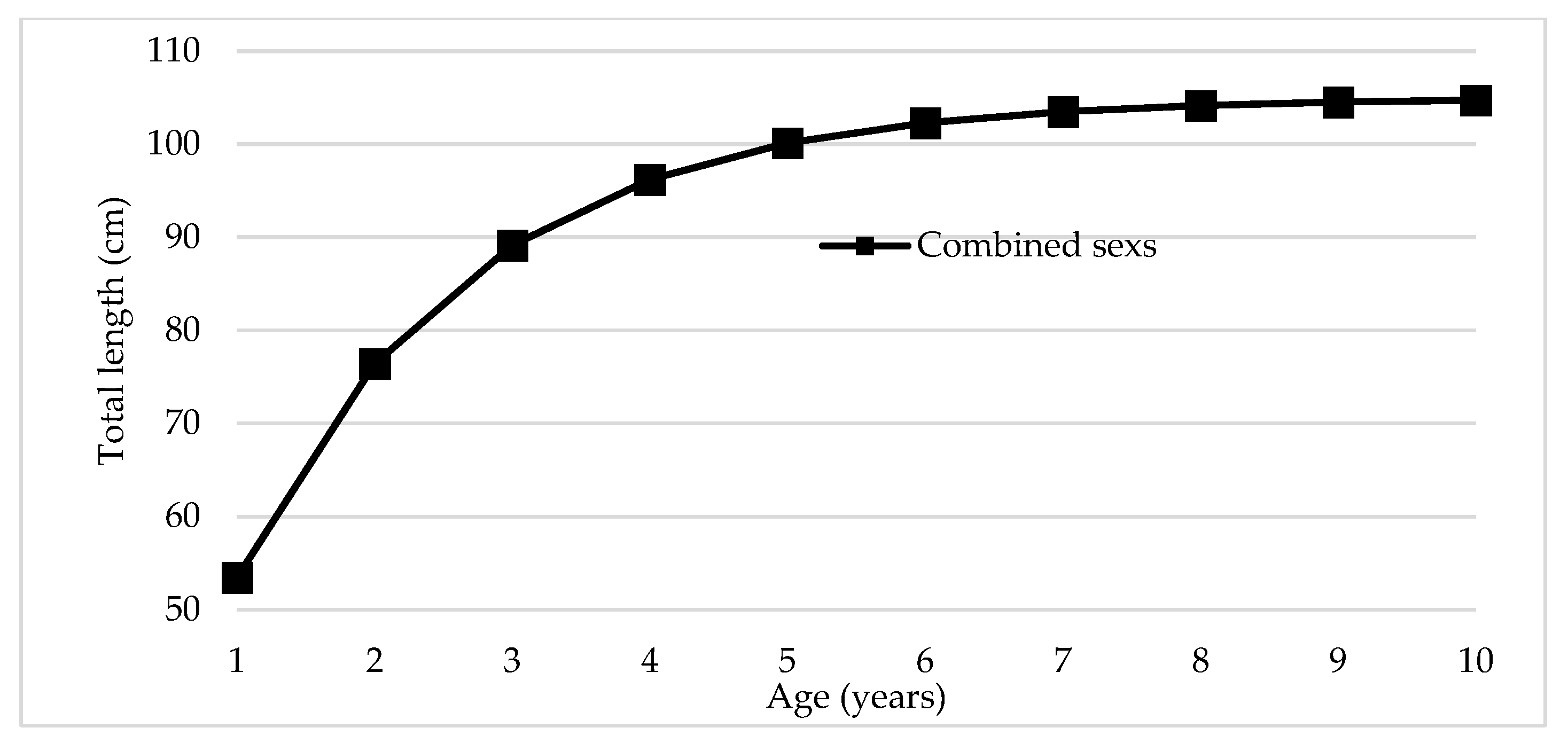

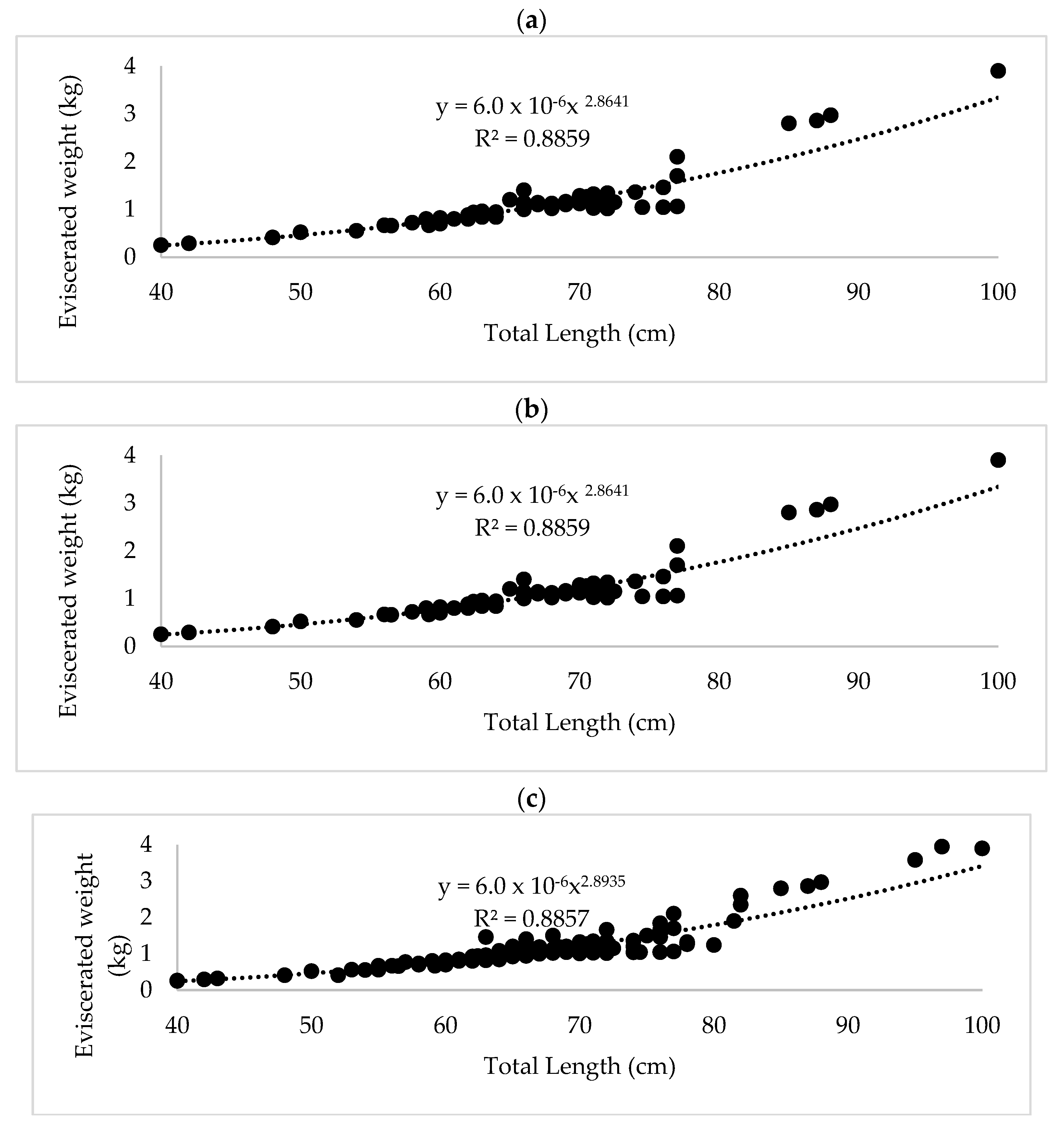
Overexploitation of the Atlantic Sharpnose Shark (Rhizoprionodon terraenovae) in Marine Priority Regions of Tamaulipas, Mexico: Implications for Wetland Conservation and Data-Limited Fisheries Management

 ,
,
Abstract
1. Introduction
2. Materials and Methods
2.1. Study Area
2.2. Biological Sampling
2.3. Data Analysis
2.3.1. Sex Ratio and Size Structure
2.3.2. Total Length-Eviscerated Weight Relationship
2.3.3. Growth Parameters
2.3.4. Total Mortality (Z)
2.3.5. Natural Mortality (M)
2.3.6. Fishing Mortality (F) and Exploitation Rate (E)
2.3.7. Uncertainty Analysis and Selection of Robust Estimates
2.3.8. Declaration on the Use of Artificial Intelligence
3. Results
3.1. Sample Composition and Population Structure
3.2. Length–Weight Relationship
3.3. Growth Parameters
3.4. Mortality
3.5. Exploitation Rate
4. Discussion
4.1. Von Bertalanffy Growth Model
4.2. Interpretation of Size Structure in Relation to Sexual Maturity
4.3. Overexploitation of R. terraenovae in Priority Marine Regions 45 and 46
4.4. Ecological Role of Sharks in the Coastal Ecosystem
4.5. Implications for Sea Turtle Conservation
4.6. Biological Consistency of Estimates
4.7. Implications for Management with an Ecosystem Approach in the Conservation Sector
- (a)
- (b)
- Temporary closure during the reproductive period of R. terraenovae (spring–summer), which coincides with the calving period in the Gulf of Mexico [16,86]. This measure aims to reduce fishing mortality of gravid females and neonates at a critical time in the life cycle of the species. While no specific breeding grounds have been identified in the study region, recent research in the southeastern Gulf of Mexico documents the use of coastal lagoons by neonates [16], underscoring the need for telemetry studies to identify priority conservation areas in Tamaulipas.
- (c)
- Fisheries zoning that establishes temporary or permanent exclusion areas for fishing gear with high bycatch of elasmobranchs, such as gillnets, in areas identified as breeding habitats [21,76]. Although specific breeding areas have not yet been identified in the region, recent research in the southeastern Gulf of Mexico documents the use of coastal lagoons by neonates [16], underscoring the need for telemetry studies to locate these priority areas in Tamaulipas.
- (d)
- Participatory monitoring with local fishermen to obtain catch time series and evaluate the effect of management measures, within the framework of the recommendations for Marine Priority Region 46, where it is suggested to evaluate the pressure on crab, shrimp and fish species [36]. Experience in other regions shows that participatory monitoring strengthens local governance and improves the acceptance of management measures [87,88].
- (e)
- Interdisciplinary research to evaluate the real impact of predation by R. terraenovae on turtle neonates, through analysis of stomach contents, telemetry studies and food web models. However, the main justification for the conservation of sharks lies in their functional role as medium-high trophic level predators in the coastal ecosystem [73,74], rather than in their occasional interaction with charismatic species.
- (f)
- Implementation of best fishing practices as established by the Sanctuary Management Program, including training of fishermen in bycatch turtle release techniques and the adoption of selective fishing gear, as well as the release of juvenile shark individuals caught below the minimum legal size [89].
- (g)
- Strengthening of surveillance in Rancho Nuevo for the protection of turtles, addressing the identified problem of “lack of surveillance in Rancho Nuevo for the protection of turtles (olive ridley)” [36]. This measure, although targeting turtles, indirectly contributes to the sustainability of the fishery by reducing illegal fishing.
- (h)
- (i)
- These measures should be implemented through a participatory process involving fishers, fisheries authorities (National Fisheries and Aquaculture Commission) and environmental authorities (National Commission of Natural Protected Areas, CONANP), within the framework of the management councils of natural protected areas and environmental policy instruments such as the Marine Ecological Management Program. Collaborative governance is essential for the success of management strategies in artisanal fisheries [91].
4.8. Lessons for the Assessment of Data-Limited Fisheries in Priority Areas for Conservation
4.9. Limitations of the Study and Future Prospects
5. Conclusions
Author Contributions
Funding
Institutional Review Board Statement
Informed Consent Statement
Data Availability Statement
Conflicts of Interest
References
- FAO. The State of World Fisheries and Aquaculture 2020; Food and Agriculture Organization of the United Nations: Rome, Italy, 2020. [Google Scholar]
- Avadí, A.; Acosta-Alba, I. Eco-Efficiency of the Fisheries Value Chains in the Gambia and Mali. Foods 2021, 10, 1620. [Google Scholar] [CrossRef] [Scilit]
- Haque, A.B.; Cavanagh, R.D.; Seddon, N. Evaluating artisanal fishing of globally threatened sharks and rays in the Bay of Bengal, Bangladesh. PLoS ONE 2021, 16, e0256146. [Google Scholar] [CrossRef] [Scilit] [PubMed]
- Mejía, C.V.; Rodríguez, G.; Tanner, M.K.; Ramírez-González, J.; Moity, N.; Andrade, S.; Paladines, M.J.B.; Cáceres, R.; Castrejón, M.; Pittman, J. Fishing during the “new normality”: Social and economic changes in Galapagos small-scale fisheries due to the COVID-19 pandemic. Marit. Stud. 2022, 21, 193–208. [Google Scholar] [CrossRef] [Scilit]
- Hilborn, R.; Ovando, D. Reflections on the success of traditional fisheries management. ICES J. Mar. Sci. 2014, 71, 1040–1046. [Google Scholar] [CrossRef] [Scilit]
- Santos, R.; Peixoto, U.I.; Medeiros-Leal, W.; Novoa-Pabon, A.; Pinho, M. Growth Parameters and Mortality Rates Estimated for Seven Data-Deficient Fishes from the Azores Based on Length-Frequency Data. Life 2022, 12, 778. [Google Scholar] [CrossRef] [Scilit]
- Tavares, R.; Carreon-Zapiain, M.T.; Perez-Jimenez, J.C. Vulnerability of elasmobranchs caught by artisanal fishery in the Southeastern Caribbean. Reg. Stud. Mar. Sci. 2024, 79, 103851. [Google Scholar] [CrossRef] [Scilit]
- Peñaherrera-Palma, C.R.; Chinacalle-Martínez, N.S.; Zamora, W.G.; Jaramillo-Vallejo, S.P.; López-Macías, J.P.; Safady-Mendoza, O.; Bravo-Ormaza, M.E. Reconstructing the spatial and temporal dynamics of Ecuador’s artisanal small-scale fisheries from fishers’ perspective. PLoS ONE 2025, 20, e0338495. [Google Scholar] [CrossRef] [Scilit] [PubMed]
- Prince, J.D.; Rufiati, I.; Septiani, W.D.; Kembaren, D.D.; Gough, C.L.A. A novel size-based method for assessing the spawning potential ratio of data-poor octopus fisheries. Front. Mar. Sci. 2025, 12, 1647742. [Google Scholar] [CrossRef] [Scilit]
- Klaoudatos, D.; Theocharis, A. Methodologies for Data-Poor Fisheries Assessment in the Mediterranean Basin: Status, Challenges, and Future Directions. Fishes 2025, 11, 22. [Google Scholar] [CrossRef] [Scilit]
- Canales, C.M.; Punt, A.E.; Mardones, M. Can a length-based pseudo-cohort analysis (LBPA) using multiple catch length-frequencies provide insight into population status in data-poor situations? Fish. Res. 2021, 234, 105810. [Google Scholar] [CrossRef] [Scilit]
- Prince, J.D.; Wilcox, C.; Hall, N. How to estimate life history ratios to simplify data-poor fisheries assessment. ICES J. Mar. Sci. 2023, 80, 2619–2629. [Google Scholar] [CrossRef] [Scilit]
- Sandin, S.A.; French, B.J.; Zgliczynski, B.J. Emerging insights on effects of sharks and other top predators on coral reefs. Emerg. Top. Life Sci. 2022, 6, 57–65. [Google Scholar] [CrossRef] [Scilit]
- Lubitz, N.; Abrantes, K.; Crook, K.; Currey-Randall, L.M.; Chin, A.; Sheaves, M.; Fitzpatrick, R.; Martins, A.B.; Bierwagen, S.; Miller, I.B.; et al. Trophic ecology shapes spatial ecology of two sympatric predators, the great hammerhead shark (Sphyrna mokarran) and bull shark (Carcharhinus leucas). Front. Mar. Sci. 2023, 10, 1274275. [Google Scholar] [CrossRef] [Scilit]
- Cortés, E. Life history patterns and correlations in sharks. Rev. Fish. Sci. 2000, 8, 299–344. [Google Scholar] [CrossRef] [Scilit]
- Márquez-Farias, J.F.; Castillo-Geniz, J.L. Fishery biology and demography of the Atlantic sharpnose shark, Rhizoprionodon terraenovae, in the southern Gulf of Mexico. Fish. Res. 1998, 39, 183–198. [Google Scholar] [CrossRef] [Scilit]
- Aguirre-García, B.; Medina-Quej, A.; López-García, A. Análisis de la pesquería artesanal del “cazón de ley” Rhizoprionodon terraenovae (Richardson, 1836) en Campeche, México. In Proceedings of the 60th Gulf and Caribbean Fisheries Institute, Punta Cana, Dominican Republic, 5–9 November 2007; Gulf and Caribbean Fisheries Institute: Miami, FL, USA, 2004; Volume 60, pp. 153–160. [Google Scholar]
- Worm, B.; Davis, B.; Kettemer, L.; Ward-Paige, C.A.; Chapman, D.; Heithaus, M.R.; Kessel, S.T.; Gruber, S.H. Global catches, exploitation rates, and rebuilding options for sharks. Mar. Policy 2013, 40, 194–204. [Google Scholar] [CrossRef] [Scilit]
- Walker, T.I. Management measures. In Management Techniques for Elasmobranch Fisheries; Musick, J.A., Bonfil, R., Eds.; FAO Fisheries Technical Paper No. 474; Food and Agriculture Organization of the United Nations: Rome, Italy, 2005; pp. 216–242. [Google Scholar]
- Dulvy, N.K.; Fowler, S.L.; Musick, J.A.; Cavanagh, R.D.; Kyne, P.M.; Harrison, L.R.; Carlson, J.K.; Davidson, L.N.; Fordham, S.V.; Francis, M.P.; et al. Extinction risk and conservation of the world’s sharks and rays. eLife 2014, 3, e00590. [Google Scholar] [CrossRef] [Scilit] [PubMed]
- Driggers, W.B.; Campbell, D.M.; Jones, C.M.; Hannon, K.M.; Hoffmayer, E.R.; Sulikowski, J.A. Spatial variability in the fecundity of Atlantic sharpnose sharks (Rhizoprionodon terraenovae) in the northern Gulf of Mexico. Fish. Bull. 2020, 118, 51–62. [Google Scholar] [CrossRef] [Scilit]
- Wakida-Kusunoki, A.T.; Anislado-Tolentino, V.; Del Moral-Flores, L.F. Unusual presence of atlantic sharpnose shark (Rhizoprionodon terraenovae) neonates in a coastal lagoon in southeast Gulf of Mexico. Novit. Caribaea 2025, 62–69. [Google Scholar] [CrossRef] [Scilit]
- DOF. Acuerdo Por el Que se Expide la Parte Marina del Programa de Ordenamiento Ecológico Marino y Regional del Golfo de México y Mar Caribe; Diario Oficial de la Federación: Mexico City, Mexico, 2012. [Google Scholar]
- CONANP. Ficha Informativa de los Humedales de Ramsar—Santuario Playa Rancho Nuevo; Comisión Nacional de Áreas Naturales Protegidas: Ciudad de México, México, 2004. [Google Scholar]
- IUCN. The IUCN Red List of Threatened Species, Version 2023-1; International Union for Conservation of Nature: Gland, Switzerland, 2023. [Google Scholar]
- CONANP. Programa de Manejo del Santuario Playa Rancho Nuevo; Comisión Nacional de Áreas Naturales Protegidas: Ciudad de México, México, 2014. [Google Scholar]
- Pilcher, N.J.; Antonopoulou, M.; Rodriguez-Zarate, C.J. Marine turtle nest predation. Endanger. Species Res. 2021, 45, 123–136. [Google Scholar]
- Bashir, Z.; Abdullah, M.M.; Ghaffar, M.A.; Rusli, M.U. Exclusive predation of sea turtle hatchlings by juvenile blacktip reef sharks Carcharhinus melanopterus at a turtle nesting site in Malaysia. J. Fish Biol. 2020, 97, 1876–1879. [Google Scholar] [CrossRef] [Scilit] [PubMed]
- Oñate-Casado, J.; Booth, D.T.; Vandercamere, K.; Sakhalkar, S.P.; Rusli, M.U. Offshore Dispersal and Predation of Sea Turtle Hatchlings I: A Study of Hawksbill Turtles at Chagar Hutang Turtle Sanctuary, Malaysia. Ichthyol. Herpetol. 2021, 109, 180–187. [Google Scholar] [CrossRef] [Scilit]
- Bada-Sánchez, E.; Pérez-Jiménez, J.C.; Méndez-Loaeza, I. Estado del stock pesquero del cazón tutzún Rhizoprionodon terraenovae (Richardson, 1836) en el Banco de Campeche. In Proceedings of the VII Simposio Nacional de Tiburones y Rayas, Puerto Vallarta, Jalisco, México, 18–22 April 2016; Anislado-Tolentino, V., Pérez-Jiménez, J.C., Cabrera-Sánchez, M.G., Eds.; Sociedad Mexicana de Peces Cartilaginosos, A.C.: México D.F., México, 2016; pp. 53–55. [Google Scholar]
- Loefer, J.K.; Sedberry, G.R. Life history of the Atlantic sharpnose shark (Rhizoprionodon terraenovae) (Richardson, 1836) off the southeastern United States. Fish. Bull. 2003, 101, 75–88. [Google Scholar]
- Nikolic, N.; Devloo-Delva, F.; Bailleul, D.; Noskova, E.; Rougeux, C.; Delord, C.; Borsa, P.; Liautard-Haag, C.; Hassan, M.; Marie, A.D.; et al. Stepping up to genome scan allows stock differentiation in the worldwide distributed blue shark Prionace glauca. Mol. Ecol. 2022, 32, 1000–1019. [Google Scholar] [CrossRef] [Scilit]
- Leone, A.; Arnaud-Haond, S.; Babbucci, M.; Bargelloni, L.; Coscia, I.; Damalas, D.; Delord, C.; Franch, R.; Garibaldi, F.; Macias, D.; et al. Population Genomics of the Blue Shark, Prionace glauca, Reveals Different Populations in the Mediterranean Sea and the Northeast Atlantic. Evol. Appl. 2024, 17, e70005. [Google Scholar] [CrossRef] [Scilit]
- Chhina, A.K.; Abhari, N.; Mooers, A.; Lewthwaite, J.M. Linking the spatial and genomic structure of adaptive potential for conservation management: A review. Genome 2024, 67, 403–423. [Google Scholar] [CrossRef] [Scilit]
- Massa, P.; Leitão, H.G.; Manousaki, T.; Cariani, A.; Svardal, H.; Tsaparis, D.; Cannas, R.; Zane, L.; De Pooter, T.; Spedicato, M.T.; et al. Genomic insights into the population structure and adaptive variation of Mullus barbatus in the Mediterranean Sea. BMC Evol. Biol. 2025, 25, 101. [Google Scholar] [CrossRef] [Scilit]
- Arriaga, L.; Vázquez, E.; González, J.; Jiménez, R.; Muñoz, E.; Aguilar, V. Regiones Marinas Prioritarias de México; Comisión Nacional para el Conocimiento y Uso de la Biodiversidad (CONABIO): México D.F., México, 1998. [Google Scholar]
- Caballero-Rico, F.C.; Roque-Hernández, R.V.; Cano, R.d.l.G.; Arvizu-Sánchez, E. Challenges for the Integrated Management of Priority Areas for Conservation in Tamaulipas, México. Sustainability 2022, 14, 494. [Google Scholar] [CrossRef] [Scilit]
- INAPESCA. Boletín Hidrometeorológico—Temperatura Superficial del Mar; Instituto Nacional de Pesca: Ciudad de México, México, 2013. [Google Scholar]
- SEMARNAT. Diagnóstico del Sector Pesquero en la Costa Sur de Tamaulipas; Secretaría de Medio Ambiente y Recursos Naturales, Delegación Tamaulipas: Ciudad Victoria, Mexico, 2014. [Google Scholar]
- Sparre, P.; Venema, S.C. Introducción a la Evaluación de Recursos Pesqueros Tropicales. Parte 1. Manual; FAO Documento Técnico de Pesca No. 306.1, Rev. 2; Food and Agriculture Organization of the United Nations: Rome, Italy, 1998. [Google Scholar]
- Hordyk, A.; Ono, K.; Valencia, S.; Loneragan, N.; Prince, J. A novel length-based empirical estimation method of spawning potential ratio (SPR), and tests of its performance, for small-scale, data-poor fisheries. World Conference on Stock Assessment Methods for Sustainable Fisheries. ICES J. Mar. Sci. 2015, 72, 217–231. [Google Scholar] [CrossRef] [Scilit]
- Zar, J.H. Biostatistical Analysis, 5th ed.; Prentice Hall: Upper Saddle River, NJ, USA, 2010. [Google Scholar]
- Ricker, W.E. Computation and Interpretation of Biological Statistics of Fish Populations. Bull. Fish. Res. Board Can. 1977, 41, 154–155. [Google Scholar] [CrossRef] [Scilit]
- Walpole, R.E.; Myers, R.H.; Myers, S.L.; Ye, K. Probability & Statistics for Engineers & Scientists, 9th ed.; Pearson: Boston, MA, USA, 2012. [Google Scholar]
- Chen, Y.; Jackson, D.A.; Harvey, H.H. A Comparison of von Bertalanffy and Polynomial Functions in Modelling Fish Growth Data. Can. J. Fish. Aquat. Sci. 1992, 49, 1228–1235. [Google Scholar] [CrossRef] [Scilit]
- von Bertalanffy, L. A quantitative theory of organic growth. Hum. Biol. 1938, 10, 181–213. [Google Scholar]
- Gayanilo, F.C.; Sparre, P.; Pauly, D. FAO-ICLARM Stock Assessment Tools II (FiSAT II). Revised Version, User’s Guide; FAO Computerized Information Series (Fisheries) No. 8; Food and Agriculture Organization of the United Nations: Rome, Italy, 2005. [Google Scholar]
- Pauly, D. Fish population dynamics in tropical waters: A manual for use with programmable calculators. In ICLARM Studies and Reviews; ICLARM: Manila, Philippines, 1984; Volume 8, pp. 1–325. [Google Scholar]
- Efron, B.; Tibshirani, R.J. An Introduction to the Bootstrap; Chapman & Hall: New York, NY, USA, 1993. [Google Scholar]
- Pauly, D.; Munro, J.L. Once more on the comparison of growth in fish and invertebrates. Fishbyte 1984, 2, 21. [Google Scholar]
- Pauly, D. Growth performance in fishes: Rigorous description of patterns as a basis for understanding causal mechanisms. Aquabyte 1991, 4, 3–6. [Google Scholar]
- Jones, R.; van Zalinge, N.P. Estimations of mortality rate and population size for shrimp in Kuwait waters. Kuwait Bull. Mar. Sci. 1981, 2, 273–288. [Google Scholar]
- Pauly, D. On the interrelationships between natural mortality, growth parameters, and mean environmental temperature in 175 fish stocks. ICES J. Mar. Sci. 1980, 39, 175–192. [Google Scholar] [CrossRef] [Scilit]
- Gulland, J.A. Manual de Métodos para la Evaluación de las Poblaciones de Peces; Acribia: Zaragoza, Spain, 1971. [Google Scholar]
- Liu, K.M.; Wu, C.B.; Joung, S.J.; Tsai, W.P.; Su, K.Y. Multi-model approach on growth estimation and association with life history trait for elasmobranchs. Front. Mar. Sci. 2021, 8, 591692. [Google Scholar] [CrossRef] [Scilit]
- Caña-Hernández, S.; Lara-Mendoza, R.E.; Mendoza-Carranza, M.; Pérez-Jiménez, J.C. Using a multimodel approach to determine the age and growth of an endangered small shark species in the southern Gulf of Mexico. Reg. Stud. Mar. Sci. 2023, 60, 102836. [Google Scholar] [CrossRef] [Scilit]
- Dureuil, M.; Aeberhard, W.H.; Dowd, M.; Pardo, S.A.; Whoriskey, F.G.; Worm, B. Reliable growth estimation from mark–recapture tagging data in elasmobranchs. Fish. Res. 2022, 256, 106488. [Google Scholar] [CrossRef] [Scilit]
- Talwar, B.S.; Bradley, D.; Berry, C.; Bond, M.E.; Bouyoucos, I.A.; Brooks, A.M.L.; Fields, C.Y.A.; Gallagher, A.J.; Guttridge, T.L.; Guttridge, A.E.; et al. Estimated life-history traits and movements of the Caribbean reef shark (Carcharhinus perezi) in The Bahamas based on tag-recapture data. Mar. Biol. 2022, 169, 55. [Google Scholar] [CrossRef] [Scilit]
- Oviedo-Pérez, J.L.; Zea-de-la-Cruz, H.; Aguirre-Villaseño, D.H.; Meiners-Mandujano, C.; Jiménez-Badillo, L.; González-Ocaranza, L. Talla de madurez sexual del tiburón Rhizoprionodon terraenovae en Veracruz, México. Cienc. Pesq. 2014, 22, 37–45. [Google Scholar]
- Musick, J.A. Criteria to Define Extinction Risk in Marine Fishes: The American Fisheries Society Initiative. Fisheries 1999, 24, 6–14. [Google Scholar] [CrossRef] [Scilit]
- Hashemi, S.A.; Doustdar, M.; Ghasemzadeh, J.; Gholampour, A. Length-based fishery status of skipjack tuna, Katsuwonus pelamis (Linnaeus, 1758) (Teleostei: Scombridae: Scombrinae) in the northern waters of the Oman Sea (Iran). Iran. J. Ichthyol. 2021, 8, 160–169. [Google Scholar]
- Mehanna, S.F.; Samy-Kamal, M. Population Dynamics Parameters and Exploitation Status of 55 Commercial Species in Egyptian Red Sea Fisheries: A Key to Sustainable Fisheries. Fishes 2024, 9, 255. [Google Scholar] [CrossRef] [Scilit]
- Rahman, O.; Laboni, T.A.; Khatun, M.S.; Rahman, A.; Islam, A.; Rahman, M.; Parvin, M.F.; Abedin, J.; Hossain, Y. Estimating the growth parameters, exploitation rate, biomass and maximum sustainable yield of long whisker catfish Mystus gulio (Hamilton, 1822) in the coastal waters from southwestern Bangladesh. Heliyon 2024, 10, e29788. [Google Scholar] [CrossRef] [Scilit] [PubMed]
- Aladawi, U.; Majeed, S.; Al-Anboori, I.; Amin, S.M.N. Assessment of Exploited Stock and Management Implications of Kingfish (Scomberomorus commerson) in the Omani Waters. Fishes 2025, 10, 589. [Google Scholar] [CrossRef] [Scilit]
- Das, D.; Priester, R.; Soares, J.; Macena, B.; Fontes, J.; Afonso, P. Nearshore essential habitat of threatened sharks around a temperate oceanic island. Mar. Ecol. Prog. Ser. 2025, 766, 73–90. [Google Scholar] [CrossRef] [Scilit]
- Hashemi, S.A.; Doustdar, M.; Al Kindi, A.; Dutta, S. Assessment of Population Dynamics and Fishery Exploitation of Narrow-Barred Spanish Mackerel (Scomberomorus commerson) in Iranian Waters. Oceans 2025, 6, 55. [Google Scholar] [CrossRef] [Scilit]
- la Cruz, H.Z.-D.; Tovar-Ávila, J.; Meiners-Mandujano, C.; Jiménez-Badillo, L.; Oviedo-Pérez, J.L. Determining potential management strategies for the elasmobranchs bycatch of the Mexican shrimp trawl fishery of the Gulf of Mexico through a vulnerability analysis. Reg. Stud. Mar. Sci. 2021, 42, 101626. [Google Scholar] [CrossRef] [Scilit]
- Mukherji, S.; Simpfendorfer, C.; Dowling, N.; Krueck, N.C. Assessing mechanisms of intrinsic vulnerability in sharks occupying different marine environments. Biodivers. Conserv. 2026, 35, 31. [Google Scholar] [CrossRef] [Scilit]
- Hoenig, J.M. Empirical use of longevity data to estimate mortality rates. Fish. Bull. 1983, 82, 898–903. [Google Scholar]
- Then, A.Y.; Hoenig, J.M.; Hall, N.G.; Hewitt, D.A. Evaluating the predictive performance of empirical estimators of natural mortality rate using information on over 200 fish species. ICES J. Mar. Sci. 2014, 72, 82–92. [Google Scholar] [CrossRef] [Scilit]
- Pauly, D. Some simple methods for the assessment of tropical fish stocks. In FAO Fisheries Technical Paper; FAO: Rome, Italy, 1980; Volume 234, p. 52. [Google Scholar]
- Suárez-Moo, P.d.J.; Rocha-Olivares, A.; Zapata-Pérez, O.; Quiroz-Moreno, A.; Sánchez-Teyer, L.F. High genetic connectivity in the Atlantic sharpnose shark, Rhizoprionodon terraenovae, from the southeast Gulf of Mexico inferred from AFLP fingerprinting. Fish. Res. 2013, 147, 338–343. [Google Scholar] [CrossRef] [Scilit]
- Su, H.; Zhou, L.; Xie, P. What can we learn from the loss of sharks? Trends Ecol. Evol. 2025, 40, 531–533. [Google Scholar] [CrossRef] [Scilit]
- Shipley, O.N.; Matich, P.; Hussey, N.E.; Brooks, A.M.L.; Chapman, D.; Frisk, M.G.; Guttridge, A.E.; Guttridge, T.L.; Howey, L.A.; Kattan, S.; et al. Energetic connectivity of diverse elasmobranch populations—Implications for ecological resilience. Proc. R. Soc. B Biol. Sci. 2023, 290, 20230262. [Google Scholar] [CrossRef] [Scilit]
- TinHan, T.C.; Wells, R.J.D. Spatial and Ontogenetic Patterns in the Trophic Ecology of Juvenile Bull Sharks (Carcharhinus leucas) From the Northwest Gulf of Mexico. Front. Mar. Sci. 2021, 8, 664316. [Google Scholar] [CrossRef] [Scilit]
- Matich, P.; Bigelow, C.L.; Chambers, B.; Dodds, J.J.; Hebert, J.A.; Lemieux, A.; Pittman, C.M.; Trapp, J.; Bianco, B.; Cadena, C.P.; et al. Delineation of blacktip shark (Carcharhinus limbatus) nursery habitats in the north-western Gulf of Mexico. J. Fish Biol. 2022, 101, 236–248. [Google Scholar] [CrossRef] [Scilit]
- Viana-Morayta, J.E.; Torres-Rojas, Y.E.; Camalich-Carpizo, J. Diet shifts of Rhizoprionodon terraenovae from the southern Gulf of Mexico: Possible scenario by temperature changes. Lat. Am. J. Aquat. Res. 2020, 48, 406–420. [Google Scholar] [CrossRef] [Scilit]
- SEDAR. SEDAR 13—Small Coastal Shark Complex, Atlantic Sharpnose, Blacknose, Bonnethead, and Finetooth Shark Stock Assessment Report; Southeast Data, Assessment, and Review: North Charleston, SC, USA, 2007. [Google Scholar]
- Prince, J.; Hordyk, A.; Valencia, S.R.; Loneragan, N.; Sainsbury, K. Revisiting the concept of Beverton–Holt life-history invariants with the aim of informing data-poor fisheries assessment. ICES J. Mar. Sci. 2014, 72, 194–203. [Google Scholar] [CrossRef] [Scilit]
- Cortés, E. Perspectives on the intrinsic rate of population increase of elasmobranchs and consequences for sustainable management. Mar. Freshw. Res. 2016, 67, 1843–1852. [Google Scholar]
- Branstetter, S. Age and Growth Validation of Newborn Sharks Held in Laboratory Aquaria, with Comments on the Life History of the Atlantic Sharpnose Shark, Rhizoprionodon terraenovae. Copeia 1987, 1987, 291–300. [Google Scholar] [CrossRef] [Scilit]
- Béné, C.; Arthur, R.; Norbury, H.; Allison, E.H.; Beveridge, M.; Bush, S.; Campling, L.; Leschen, W.; Little, D.; Squires, D.; et al. Contribution of Fisheries and Aquaculture to Food Security and Poverty Reduction: Assessing the Current Evidence. World Dev. 2016, 79, 177–196. [Google Scholar] [CrossRef] [Scilit]
- Perryman, H.A.; Hansen, C.; Howell, D.; Olsen, E. A Review of Applications Evaluating Fisheries Management Scenarios through Marine Ecosystem Models. Rev. Fish. Sci. Aquac. 2021, 29, 800–835. [Google Scholar] [CrossRef] [Scilit]
- Woods, P.J.; Macdonald, J.I.; Bárðarson, H.; Bonanomi, S.; Boonstra, W.J.; Cornell, G.; Cripps, G.; Danielsen, R.; Färber, L.; Ferreira, A.S.A.; et al. A review of adaptation options in fisheries management to support resilience and transition under socio-ecological change. ICES J. Mar. Sci. 2021, 79, 463–479. [Google Scholar] [CrossRef] [Scilit]
- Craig, J.K.; Link, J.S. It is past time to use ecosystem models tactically to support ecosystem-based fisheries management: Case studies using Ecopath with Ecosim in an operational management context. Fish Fish. 2023, 24, 381–406. [Google Scholar] [CrossRef] [Scilit]
- Parsons, G.R.; Hoffmayer, E.R. Seasonal changes in the distribution and availability of the Atlantic sharpnose shark Rhizoprionodon terraenovae in the north central Gulf of Mexico. Copeia 2005, 2005, 913–919. [Google Scholar] [CrossRef] [Scilit]
- Ayala, B.; Aranda-Fragoso, A.; Castillo, A.; Basurto, X.; Nenadovic, M. Presentación en la conferencia IASC 2025 sobre gobernanza de pesquerías artesanales en el Pacífico Central Mexicano. In Proceedings of the IASC 2025 XX Biennial Conference, Amherst, MA, USA, 16–20 June 2025. [Google Scholar]
- PANORAMA. Fortalecimiento de la Gestión Pesquera a Través de Redes Colectivas (México). 2024. Available online: https://panorama.solutions/es/solution/fortalecimiento-de-la-gestion-pesquera-traves-de-redes-colectivas (accessed on 24 February 2026).
- O’FArrell, H.B.; Babcock, E.A.; McCarthy, K.J. Bycatch mitigation for commonly caught shark species in the Gulf of Mexico reef bottom longline fishery. Mar. Coast. Fish. 2024, 16, 10310. [Google Scholar] [CrossRef] [Scilit]
- Shidqi, R.A.; Sari, D.R.; Alopen, J.; Bang, Y.M.; Arianto, I.; Kopong, P.N.S.; Td, V.G.; Smulders, E.; Booth, H. Designing and evaluating alternative livelihoods for shark conservation: A case study on thresher sharks in Alor Island, Indonesia. Oryx 2025, 59, 19–30. [Google Scholar] [CrossRef] [Scilit]
- Aranda-Fragoso, A.; Castillo, A.; Coronado, E. Pesca artesanal en la costa sur de Jalisco: Reflexiones sobre su investigación y manejo. Soc. Ambient. 2023, 1–31. [Google Scholar] [CrossRef] [Scilit]
- Hilborn, R.; Walters, C.J. Quantitative Fisheries Stock Assessment: Choice, Dynamics and Uncertainty; Chapman and Hall: New York, NY, USA, 1992. [Google Scholar]
- Punt, A.E.; Butterworth, D.S.; de Moor, C.L.; De Oliveira, J.A.A.; Haddon, M. Management strategy evaluation: Best practices. Fish Fish. 2014, 17, 303–334. [Google Scholar] [CrossRef] [Scilit]
- Beverton, R.J.H.; Holt, S.J. A review of the lifespans and mortality rates of fish in nature, and their relation to growth and other physiological characteristics. In Ciba Foundation Symposium—The Lifespan of Animals (Colloquia on Ageing); John Wiley & Sons, Ltd.: Chichester, UK, 1959; Volume 5, pp. 142–180. [Google Scholar]
- Carlson, J.K.; Baremore, I.E. Changes in biological parameters of Atlantic sharpnose shark Rhizoprionodon terraenovae in the Gulf of Mexico: Evidence for density-dependent growth and maturity? Mar. Freshw. Res. 2003, 54, 227–234. [Google Scholar] [CrossRef] [Scilit]
- Campana, S.E. Accuracy, precision and quality control in age determination, including a review of the use and abuse of age validation methods. J. Fish Biol. 2001, 59, 197–242. [Google Scholar] [CrossRef]




| Group | n | a (×10−3) | SE(a) | b | SE(b) | r2 | t (b vs. 3) | dL | p | Growth Type |
|---|---|---|---|---|---|---|---|---|---|---|
| Females | 260 | 6.2 | 0.2013 | 2.86 | 0.1105 | 0.9056 | 1.230 | 258 | 0.219 | Isometric |
| Males | 281 | 5.0 | 0.1974 | 2.92 | 0.1083 | 0.9054 | 0.716 | 279 | 0.474 | Isometric |
| Combined sexes | 541 | 5.6 | 0.1404 | 2.89 | 0.0770 | 0.9050 | 1.382 | 539 | 0.167 | Isometric |
| Group | Method | L∞ (cm) | 95% CI L∞ | k (Years−1) | 95% CI k | t0 (yr) | 95% CI t0 | Ø′ |
|---|---|---|---|---|---|---|---|---|
| Females | ELEFAN I | 97.9 | 94.2–101.6 | 0.38 | 0.28–0.48 | −0.313 | −0.440–−0.242 | 3.56 |
| Males | ELEFAN I | 100.8 | 94.8–106.8 | 0.45 | 0.40–0.50 | −0.261 | −0.302–−0.229 | 3.66 |
| Combined sexes | ELEFAN I | 105.0 | 100.0–110.0 | 0.59 | 0.53–0.65 | −0.195 | −0.221–−0.174 | 3.81 |
| Combined sexes | Shepherd | 105.0 | - | 0.78 | - | −0.152 | - | 3.93 |
| Parameter | Method/Combination | Value | 95% CI | r2 | CIL |
|---|---|---|---|---|---|
| Z1 | Curva captura (kELEFAN) | 2.72 | 1.86–3.59 | 0.95 | 1.73 |
| Z2 | Curva captura (kShepherd) | 3.60 | 2.46–4.74 | 0.95 | 2.28 |
| Z3 | Jones-van Zalinge (kELEFAN) | 4.13 | 3.60–4.65 | 0.98 | 1.05 |
| Z4 | Jones-van Zalinge (kShepherd) | 4.13 | 3.60–4.65 | 0.98 | 1.05 |
| M1 | Pauly (kELEFAN) | 0.46 | - | - | - |
| M2 | Pauly (kShepherd) | 0.47 | - | - | - |
| F5 | Z3 - M1 | 3.30 | 2.77–3.82 | - | 1.05 |
| F6 | Z3 - M2 | 3.13 | 2.61–3.65 | - | 1.05 |
| F7 | Z4 - M1 | 3.30 | 2.77–3.82 | - | 1.05 |
| F8 | Z4 - M2 | 3.13 | 2.61–3.65 | - | 1.05 |
| F | Z1 (r2 = 0.95) | Z2 (r2 = 0.95) | Z3 y Z4 (r2 = 0.98) | ||||||
|---|---|---|---|---|---|---|---|---|---|
| CI | CI | CI | |||||||
| LL | UL | LL | UL | LL | UL | ||||
| F1 | 0.70 | 0.55 | 0.77 | 0.53 | 0.42 | 0.58 | 0.46 | 0.29 | 0.59 |
| F2 | 0.63 | 0.46 | 0.72 | 0.48 | 0.35 | 0.55 | 0.42 | 0.24 | 0.56 |
| F3 | 1.02 | 0.88 | 1.09 | 0.77 | 0.66 | 0.83 | 0.67 | 0.45 | 0.84 |
| F4 | 0.96 | 0.79 | 1.04 | 0.72 | 0.60 | 0.79 | 0.63 | 0.41 | 0.81 |
| F5 | 1.21 | 1.49 | 1.06 | 0.92 | 1.13 | 0.81 | 0.8 | 0.77 | 0.82 |
| F6 | 1.15 | 1.4 | 1.02 | 0.87 | 1.06 | 0.77 | 0.76 | 0.72 | 0.79 |
| F7 | 1.21 | 1.49 | 1.06 | 0.92 | 1.13 | 0.81 | 0.8 | 0.77 | 0.82 |
| F8 | 1.15 | 1.4 | 1.02 | 0.87 | 1.06 | 0.77 | 0.76 | 0.72 | 0.79 |
| Combination | Z | F | E | 95% CI E | CIL |
|---|---|---|---|---|---|
| E(5,3) | Z3 (4.13) | F5 (3.30) | 0.80 | 0.77–0.82 | 0.05 |
| E(6,3) | Z3 (4.13) | F6 (3.13) | 0.76 | 0.72–0.79 | 0.07 |
| E(7,4) | Z4 (4.13) | F7 (3.30) | 0.80 | 0.77–0.82 | 0.05 |
| E(8,4) | Z4 (4.13) | F8 (3.13) | 0.76 | 0.72–0.79 | 0.07 |
| Mean | - | - | 0.78 | 0.745–0.805 | 0.06 |
| Author | Year | Region | L∞ (cm) | k (Years−1) | Z | M | F | E |
|---|---|---|---|---|---|---|---|---|
| This study | 2026 | RMP 45–46, Tamps. (Conservation Sector) | 105.0 | 0.59 | 4.13 | 0.46 | 3.22 | 0.78 |
| Bada-Sánchez et al. | 2016 | Campeche Bank | - | - | 0.70 | 0.50 | 0.19 | 0.14 |
| Worm et al. | 2013 | Southern Gulf of México | - | - | - | - | - | 0.37 |
| Zea de la Cruz | 2012 | Veracruz Central | 104.3 | 0.44 | 1.09 | 0.27–0.70 | 0.43 | 0.39 |
| Aguirre-García et al. | 2004 | Campeche | 114.9 | 0.18 | 1.67 | 0.39 | 1.28 | 0.77 |
Disclaimer/Publisher’s Note: The statements, opinions and data contained in all publications are solely those of the individual author(s) and contributor(s) and not of MDPI and/or the editor(s). MDPI and/or the editor(s) disclaim responsibility for any injury to people or property resulting from any ideas, methods, instructions or products referred to in the content. |
© 2026 by the authors. Licensee MDPI, Basel, Switzerland. This article is an open access article distributed under the terms and conditions of the Creative Commons Attribution (CC BY) license.
Share and Cite
Rodríguez-Castro, J.H.; Olmeda-de la Fuente, S.E.; Rodríguez-Olmeda, J.A.; Balderas-Mancilla, U.d.J.; Tovar-Ortíz, J.; Rangel-Lucio, J.A.; Vázquez-Ochoa, L.A. Overexploitation of the Atlantic Sharpnose Shark (Rhizoprionodon terraenovae) in Marine Priority Regions of Tamaulipas, Mexico: Implications for Wetland Conservation and Data-Limited Fisheries Management. Fishes 2026, 11, 268. https://doi.org/10.3390/fishes11050268
Rodríguez-Castro JH, Olmeda-de la Fuente SE, Rodríguez-Olmeda JA, Balderas-Mancilla UdJ, Tovar-Ortíz J, Rangel-Lucio JA, Vázquez-Ochoa LA. Overexploitation of the Atlantic Sharpnose Shark (Rhizoprionodon terraenovae) in Marine Priority Regions of Tamaulipas, Mexico: Implications for Wetland Conservation and Data-Limited Fisheries Management. Fishes. 2026; 11(5):268. https://doi.org/10.3390/fishes11050268
Chicago/Turabian StyleRodríguez-Castro, Jorge Homero, Sandra Edith Olmeda-de la Fuente, Jorge Alejandro Rodríguez-Olmeda, Ulises de Jesús Balderas-Mancilla, Juventino Tovar-Ortíz, Jose Antonio Rangel-Lucio, and Luis Antonio Vázquez-Ochoa. 2026. "Overexploitation of the Atlantic Sharpnose Shark (Rhizoprionodon terraenovae) in Marine Priority Regions of Tamaulipas, Mexico: Implications for Wetland Conservation and Data-Limited Fisheries Management" Fishes 11, no. 5: 268. https://doi.org/10.3390/fishes11050268
APA StyleRodríguez-Castro, J. H., Olmeda-de la Fuente, S. E., Rodríguez-Olmeda, J. A., Balderas-Mancilla, U. d. J., Tovar-Ortíz, J., Rangel-Lucio, J. A., & Vázquez-Ochoa, L. A. (2026). Overexploitation of the Atlantic Sharpnose Shark (Rhizoprionodon terraenovae) in Marine Priority Regions of Tamaulipas, Mexico: Implications for Wetland Conservation and Data-Limited Fisheries Management. Fishes, 11(5), 268. https://doi.org/10.3390/fishes11050268