
Article

Brown Trout (Salmo trutta) Abundance and Biomass in Mediterranean Rivers: Environmental, Genetic, and Management Drivers

1
Gesna Estudis Ambientals, S.L., E-25240 Linyola, Catalonia, Spain
2
IRTA, Marine and Continental Waters, Carretera Poble Nou Km 5.5, E-43540 La Ràpita, Catalonia, Spain
3
Research Group in Continental Aquatic Ecology (GRECO), Institute of Aquatic Ecology, University of Girona, E-17071 Girona, Catalonia, Spain
*
Authors to whom correspondence should be addressed.
Fishes 2026, 11(4), 217; https://doi.org/10.3390/fishes11040217

Submission received: 3 March 2026 / Revised: 30 March 2026 / Accepted: 31 March 2026 / Published: 2 April 2026
(This article belongs to the Special Issue Sustainable Fisheries Dynamics)

Abstract

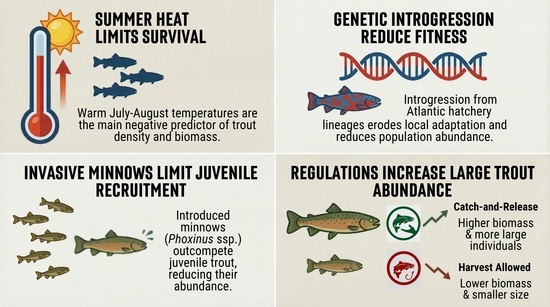
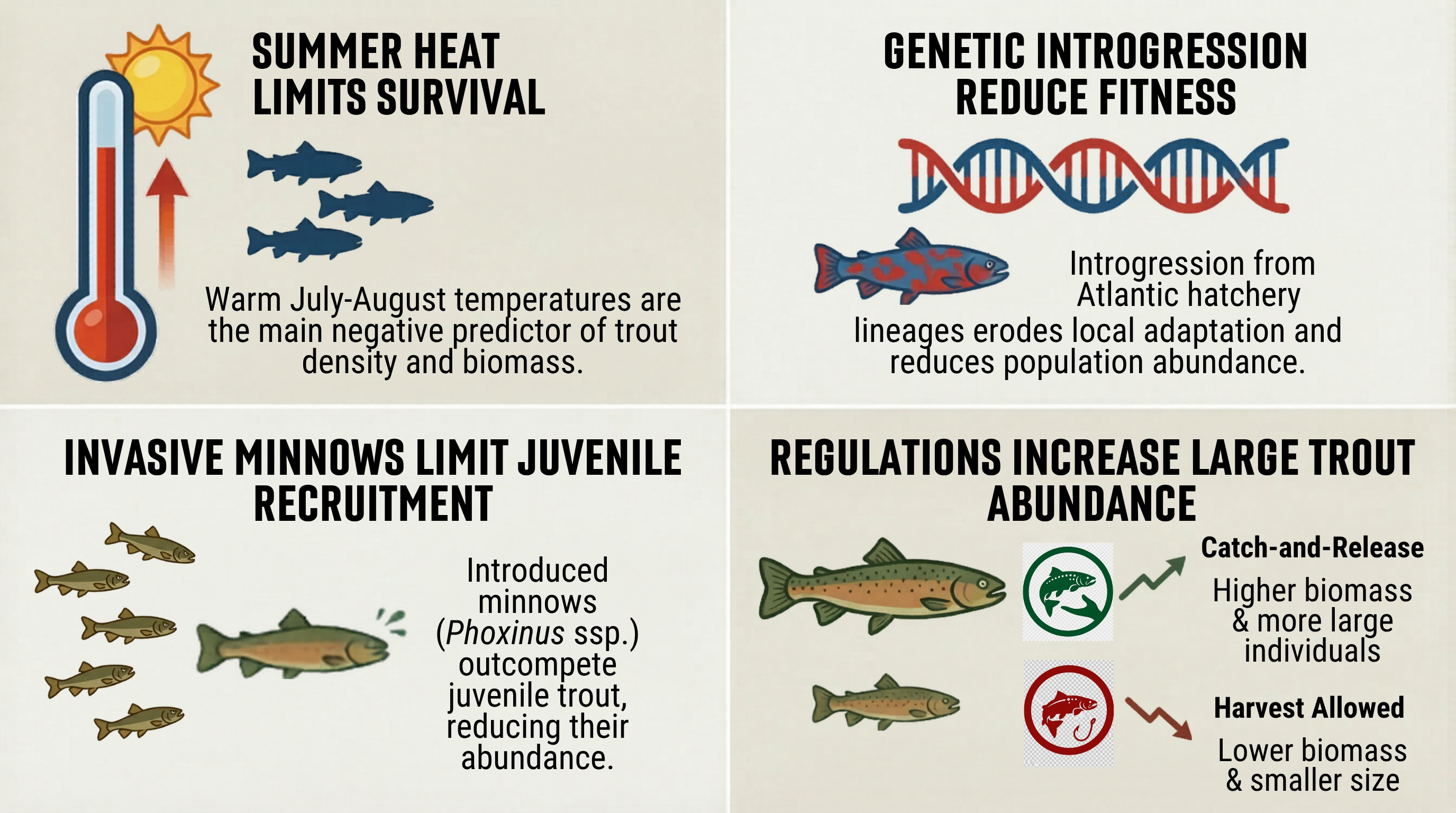
Brown trout (Salmo trutta) populations at the southern edge of the species’ distribution are increasingly exposed to interacting climatic, biotic, genetic, and anthropogenic pressures. This study provides an integrative assessment of the drivers of variation in brown trout density, biomass, and size structure across six Mediterranean river basins in Catalonia (NE Iberian Peninsula), based on long-term standardized electrofishing surveys (2016–2025; 88 sites). Generalized linear mixed models revealed that mean summer temperature, genetic introgression from hatchery-derived Atlantic lineages, and the density of introduced fish species were the most consistent negative predictors of total density, biomass, and juvenile abundance (<120 mm FL). Hydrological and nutrient variables showed comparatively weak or non-significant effects relative to thermal and biotic predictors. Fishing regulations significantly influenced the biomass and density of larger trout (>220 mm FL), with lower values in harvest-allowed sections, whereas total density was less responsive to regulation. These findings indicate that Mediterranean brown trout populations are primarily constrained by thermal conditions, genetic integrity, and biological invasions, with implications for conservation and fishery management under ongoing climate warming.
Key Contribution: This study provides one of the first integrative, multi-basin evaluations of environmental, biotic, genetic, and management drivers of brown trout population performance in Mediterranean river systems, demonstrating the predominant influence of summer thermal stress, genetic introgression, and introduced species on population density and biomass at the southern edge of the species’ range.

Graphical Abstract

1. Introduction

Brown trout (Salmo trutta complex) are among the most widely distributed freshwater fish species, occurring naturally across Europe, Western Asia and North Africa [1]. This broad native range, combined with extensive human-mediated introductions, has resulted in a nearly global distribution, making the species one of the most socioeconomically important freshwater fishes worldwide [2]. Across their range, the species exhibits considerable ecological plasticity, and populations located at the southern edge of their distribution experience environmental conditions that differ substantially from those prevailing in central and northern Europe. Southern populations are characterised by high levels of genetic differentiation and represent important reservoirs of intraspecific diversity, reflecting their long evolutionary history in glacial refugia [3]. In the Mediterranean region, native brown trout are predominantly represented by the Mediterranean (ME) and Adriatic (AD) lineages, which constitute a long-diverged branch of the Salmo trutta complex [4]. These populations are increasingly exposed to the combined effects of climatic stressors and human pressures, raising concerns about their long-term persistence. Identifying the principal drivers of population abundance and biomass has therefore become a priority for their effective conservation and management [5].
Hydrological variability is a primary environmental driver regulating trout population dynamics [6,7]. In Mediterranean rivers, flow regimes are characterised by pronounced intra- and inter-annual variability, generating potential critical bottlenecks for recruitment. High-discharge events and spates during the emergence period (winter and early spring) have been consistently associated with reduced densities of age-0+ trout, likely because of the displacement and mortality of vulnerable fry [6,8]. In contrast, summer conditions impose severe limitations, as drought markedly reduces habitat availability and longitudinal connectivity, thereby intensifying biotic interactions and physiological stress [9,10]. These hydrological pressures are closely associated with the thermal regime. Water temperature is one of the main factors determining the geographical range and physiological performance of brown trout [11,12]. In southern Europe, many populations already persist near the upper boundary of their thermal tolerance. Summer water temperatures frequently exceed critical thresholds for feeding and growth (approximately 19 °C), contributing significantly to observed population declines and habitat contractions throughout the region. Global climate change is likely to amplify these limitations, further increasing the extinction risk for brown trout at the southern edge of the species’ range [13,14].
Beyond physical factors, water chemistry also exerts a significant influence on the carrying capacity of trout streams. In particular, alkalinity and nutrient concentrations have been shown to be positively associated with brown trout biomass and production [15]. In the Iberian Peninsula, for example, streams draining limestone catchments typically exhibit greater nutrient availability and sustain substantially higher trout biomass and production compared with those flowing over siliceous substrates [16]. Conversely, excessive anthropogenic nutrient inputs can shift streams from naturally productive conditions towards eutrophication, degrading water quality through oxygen depletion that negatively affects salmonids [17].
Fishery management also influences brown trout populations. Recreational angling directly affects both abundance and age structure. Traditional harvest regimes are commonly associated with truncated size distributions and reduced spawning stock [18,19]. In response, catch-and-release (C&R) regulations have been increasingly adopted to maintain population densities and preserve larger size classes within populations [20]. Nevertheless, the effectiveness of C&R in Mediterranean fisheries remains debated. Recent modelling studies suggest that although C&R is generally sustainable, its benefits may be reduced under scenarios of increasing water temperature and declining summer flows, primarily due to elevated post-release mortality at higher water temperatures [21]. Fishery management has also contributed to genetic changes in brown trout populations. Extensive stocking programs using domestic Atlantic lineages have been implemented to support recreational fisheries and counteract declining wild stocks. These introductions have resulted in widespread genetic introgression in native Mediterranean populations [22,23,24]. Available evidence suggests that native Mediterranean genotypes are better adapted to the region’s hydrological and thermal conditions and tend to exhibit higher fitness than domestic Atlantic strains or hybrids, which may show reduced survival under these environmental constraints [5,25].
Biotic interactions with introduced species represent an additional source of pressure on brown trout populations. In Mediterranean river systems, the expansion of European minnows (Phoxinus spp.) has been identified as a substantial threat [26]. Minnows can exert strong competitive effects on brown trout through resource competition and habitat displacement. High densities of minnows in shallow littoral areas, which typically constitute preferred nursery habitats for juvenile trout, can markedly reduce the availability of benthic invertebrate prey [27]. This competition not only limits food resources but also forces juvenile trout into deeper areas to avoid competition, thereby increasing exposure to predation. Together, these processes may reduce juvenile survival and ultimately limit recruitment, highlighting the potential for introduced minnows to constrain the carrying capacity of brown trout populations in invaded reaches [28,29].
The interaction among abiotic, biotic, and anthropogenic factors is central to the effective conservation and management of brown trout populations at the southern edge of the species’ range. Based on the mechanisms described above, increasing summer temperature, genetic introgression from hatchery stocks, and the presence of introduced species are expected to negatively affect brown trout population metrics. However, hydrological variables and nutrient availability could have negative or positive effects depending on the context. Although some studies have examined these factors individually or in limited combinations, such as the effects of flow on recruitment [6], temperature on distribution [13], or angling on population structure [19], integrative analyses evaluating their relative importance simultaneously are scarce. Determining which factors most strongly influence population density and biomass is critical for prioritising restoration actions and adjusting management strategies under future climate scenarios. To address this gap, the present study analysed a comprehensive dataset from river basins in Catalonia (NE Spain), where Mediterranean brown trout represents both a conservation priority and an important resource for recreational fisheries. The analysis was based on long-term, standardised electrofishing surveys conducted across multiple catchments and jointly evaluated the effects of hydrological regime, thermal conditions, water chemistry, fishing regulations, and genetic introgression. The objective of this study was to clarify the relative effects of multiple interacting pressures influencing brown trout populations in Mediterranean river systems.

2. Materials and Methods

2.1. Study Area

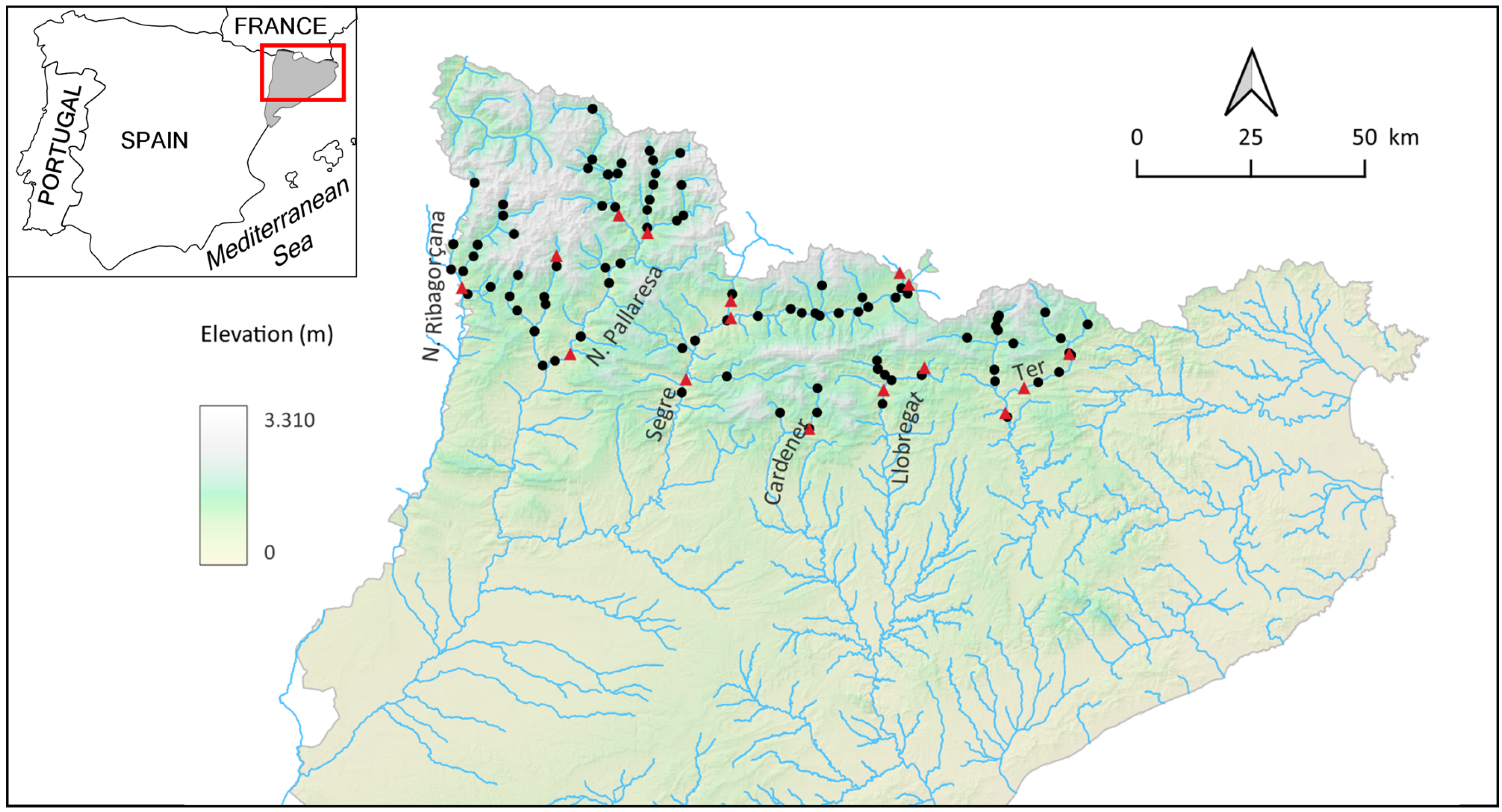
This study was conducted across the distribution range of brown trout in Catalonia, northeastern Iberian Peninsula, encompassing the main river basins draining the Eastern Pyrenees (Figure 1). These basins originate near or above 2000 m a.s.l. and flow predominantly in a southward direction. The region is characterized by strong altitudinal gradients, resulting in marked spatial variations in hydrology, temperature regimes, and habitat structure. The streams are characterized by a nival hydrological regime, with peak discharge during spring snowmelt and reduced flows in summer (Ebro Water Authority, http://www.chebro.es, accessed on 7 July 2025). Within these basins, brown trout mainly occupy headwater streams and middle river sections, where cool summer water temperatures and coarse substrates provide suitable conditions for feeding, growth, and spawning. Channel morphology is typically dominated by riffle–run–pool sequences, with substrates composed primarily of gravel, cobbles and boulders.
The study area is characterised by low anthropogenic disturbances, and land use is largely dominated by forest and other natural habitats, negligible urban presence, and limited agricultural activity. Anthropogenic influences are mainly related to fishery management practices and the presence of introduced species. Fishery management in the region has a long history of interventions. Non-native hatchery stocks of brown trout were intensively introduced throughout the region during the twentieth century. As a result, genetic assessments have revealed widespread introgression of hatchery-origin alleles in most populations, although the magnitude of hatchery influence varies substantially among catchments [24,30]. In addition, rivers in this region are characterised by a high prevalence of non-native fish species, particularly in middle and lower river sections [31]. Within the brown trout range in Catalonia, other native fish species include primarily Barbus meridionalis, Barbus haasi, Parachondrostoma miegii and Barbatula hispanica, all of which occur at low frequencies and abundances, whereas introduced species are dominated by several European minnow taxa, including Phoxinus dragarum and P. septimaniae [32,33].

2.2. Fish Sampling and Brown Trout Population Metrics

Fish sampling was conducted at 88 sites distributed across six major river basins in northeastern Iberia: the Ter, Llobregat, Cardener, Segre, Noguera Pallaresa, and Noguera Ribagorçana (Figure 1; Table S1). The sampling sites spanned a broad gradient of environmental conditions, including elevation, channel slope, water chemistry, flow regime and thermal characteristics, thereby providing a representative overview of brown trout habitats across the region. Each site was surveyed between two and ten times over a ten-year period (2016–2025), resulting in a total of 352 sampling events. Sampling was conducted during the low-flow season, from mid-July to late September, when the discharge was relatively stable and interannual comparisons of density and size structure were more robust.
Fish were sampled using two-pass depletion electrofishing [33] with a backpack electrofisher (ELT60II, Hans Grassl, Schönau am Königssee, Germany; pulsed DC, 1.3 kW, 300–500 V). Sampling reaches ranged from 72 to 150 m in length (mean ± SE = 93.3 ± 0.9 m) and from 2.9 to 14.2 m in width (mean ± SE = 7.3 ± 0.1 m). All captured fish were identified to species, measured for fork length (FL, mm), weighed (g), and held temporarily outside the sampling reach between passes before being released upon completion of the survey.
Population density (ind·ha−1) and biomass (kg·ha−1) were estimated using a maximum-likelihood depletion model for closed populations with constant effort [34] implemented in the Pop/Pro Modular Statistical Software version 1 [35]. Additional size-based metrics were calculated to characterize population structure, including the density of trout < 120 mm FL (ind·ha−1), representing early life classes (0+ and 1+) [36], and the density of trout > 220 mm FL (ind·ha−1), corresponding to the minimum legal capture size and used as an indicator of fishery quality.

2.3. Environmental, Genetic and Management-Related Variables

To identify the drivers of variation in brown trout population metrics, we compiled a suite of site-specific environmental, biological, genetic, and management variables from multiple sources. Variables were selected to characterise habitat structure, nutrient conditions, hydrological variability and extremes (drought and flood events), summer thermal stress, biotic pressure, genetic integrity and fishery regulations, representing key abiotic, biotic and anthropogenic processes expected to influence brown trout populations. Detailed definitions, units and calculation procedures for each predictor are provided in Table 1.
The broad-scale habitat structure was described using elevation and mean channel slope, derived from publicly available databases [37]. Background productivity and nutrient status were characterised using long-term mean alkalinity, electrical conductivity, and nitrate and phosphate concentrations. Water chemistry data (2016–2025) were obtained from the Catalan Water Agency [38] and the Ebro Water Authority [39].
Hydrological predictors were designed to capture average flow conditions and extreme events during the year preceding each sampling occasion, thereby capturing antecedent conditions influencing life-history processes that determine population status [40]. Daily discharge data (2015–2024) were obtained from the nearest streamflow gauge station using records provided by the Catalan Water Agency [38] and the Ebro Water Authority [41]. The standardized mean annual discharge was included as an indicator of overall hydrological wetness or dryness relative to long-term site conditions. Drought intensity was characterised using the number of low-flow days below the 10th percentile of the long-term discharge distribution and relative summer minimum discharge. Flood disturbance was described using the number of days that exceeded the 95th percentile of long-term discharge and relative winter maximum discharge. All discharge-based metrics are expressed in relative or standardized forms to ensure comparability among rivers differing in size and flow regime.
Summer thermal stress was characterised using mean summer temperature (July–August) and the number of extreme summer temperature days exceeding the 95th percentile of the long-term summer distribution, both calculated for the year preceding each sampling occasion. Because continuous water temperature records were not available for all sampling sites, air temperature data from the nearest meteorological stations were used as proxies. Meteorological records were obtained from official regional monitoring networks [42]. Seasonal and interannual variations in air and water temperatures are generally strongly correlated in lotic systems, supporting the use of air temperature as an indicator of relative thermal variability at the spatial scale considered [43].
Biotic interactions were represented by the density of introduced fish species (individuals·ha−1), estimated at each sampling occasion. These were primarily represented by European minnows (Phoxinus spp.), whereas other non-native species, such as Iberian gudgeon (Gobio lozanoi) and rainbow trout (Oncorhynchus mykiss), occurred at much lower frequencies.
Genetic integrity was quantified using the frequency of the LDH-C*90 allele, derived from systematic genetic surveys conducted in the study area between 2014 and 2019 [5]. Fishing regulation was incorporated as a categorical variable that distinguishes harvest-allowed from catch-and-release sections. Spatial information on fishing regulations was obtained from official GIS layers provided by the Government of Catalonia [44].

2.4. Data Analysis

All selected predictors (Table 1) were tested for significant univariate correlations and possible inclusion as covariates in all subsequent predictive models. The univariate correlations provide information on the association between predictors and allowed us to obtain a subset of uncorrelated variables (Pearson’s r < 0.70), thereby reducing model multicollinearity [45]. Furthermore, to reduce model collinearity, we applied a hierarchical predictor clustering based on the correlation matrix to this set of variables, selecting the best univariate predictor from each cluster of two or more collinear predictors (i.e., ecologically more meaningful), following [45,46]. Finally, elevation, channel slope, alkalinity, nitrate and phosphate concentration, relative summer minimum discharge, relative winter maximum discharge, mean summer temperature, density of introduced species, genetic introgression, and fishing regulation were used as predictors in subsequent models.
The effects of selected biotic (introduced species), abiotic (temperature, hydrology and nutrient concentrations), and anthropogenic (genetic introgression and fishing regulation) predictors on brown trout population metrics (i.e., total density (ind·ha−1), total biomass (kg·ha−1), density of individuals < 120 mm FL (ind·ha−1), and density of individuals > 220 mm FL (ind·ha−1)) were analysed with Generalized Linear Mixed Models (GLMMs). GLMMs provide a flexible framework to model non Gaussian response variables while simultaneously accounting for the nested hierarchy of the data (repeated observations within sites and years). GLMMs also allow for the integration of random intercepts and slopes to mitigate potential bias arising from spatial and temporal autocorrelation, thus ensuring more robust parameter estimates. Predictors were included as fixed effects, while site and year were included as intercept-only random effects, along with a nested random factor with site nested within year (using a spatial exponential correlation matrix) to account for spatial and temporal autocorrelation (e.g., different sampling stations could have had different baseline levels; sampling stations that are geographically close are more similar within each year). The models were fitted assuming a Tweedie error structure with a log link function. This distribution is particularly suited for continuous, non-negative and right-skewed data with potential zero values, such as density and biomass metrics, and it allows for the simultaneous modelling of zero and positive observations within a single framework.
An information-theory approach was implemented to find the best predictive models following the methodology described by Burnham and Anderson [47]. GLMMs were built including all possible combinations of independent variables, but excluding interactions due to the large number of variables included. Genetic introgression and the density of introduced species were log-transformed to reduce skewness, and continuous predictors were scaled prior to model fitting to facilitate model convergence and comparison of effect sizes. Only those models performing significantly better than the null model and with a variance inflation factor ≤ 5, to avoid multicollinearity effects in regression models [48], were considered as candidate models. The degree of support for each candidate model was assessed with the second-order Akaike Information Criterion (AICc), rescaled to obtain ΔAICc values (ΔAICc = AICci − minimum AICc). Finally, since models with ΔAICc > 4 have less support, they were omitted from further consideration. The relative plausibility of each candidate model was assessed by calculating Akaike’s weights (wi), which range from 0 to 1 and can be interpreted as the probability that a given model is the best model in the candidate set. Because there was not a clearly best model (i.e., wi ≥ 0.9), we averaged standardized regression coefficients (βi) by weighing selected model coefficients by model wi. The relative importance of each variable (i.e., the selection probability, SP) was also calculated by the sum of wi for all models in which a given variable occurs, which estimates the importance of an independent variable for differentiating the response variable [47]. In addition to SP, we also provide standardized estimates of βi and parameter bias, defined as the difference between model-averaged estimates and full model coefficients (see [5,49] for more details regarding model criteria selection). Model-averaged standardized coefficient estimates (β) and selection probability (SP) indicate the relative importance of each independent variable. Model selection was performed with R software version 4.5.2 [50]; MuMIn 1.48.11 was used for multi-model inference analysis; GLMMs were fitted with glmmTMB 1.1.14, car 3.1-3 was used for VIF analysis of each of the candidate models; and DHARMa 0.4.7 was used for residual diagnostics. visreg 2.8.0 and ggeffects 2.3.2 were used for visualization of regression models.

3. Results

3.1. Summary of Population Metrics

Brown trout density (ind·ha−1) and biomass (kg·ha−1) exhibited pronounced spatial and temporal variability across sampling sites and basins. Considering all sampling events (N = 352), mean total density was 1662 ind·ha−1 (range from <50 to >11,000 ind·ha−1), with the highest values predominantly recorded in the Pallaresa, Ribagorçana, and Ter basins, whereas lower densities were more frequent in several Segre and Llobregat reaches. Mean biomass was 66.3 kg·ha−1, typically ranging between 30 and 120 kg·ha−1, but exceeding 250 kg·ha−1 at high-density sites, particularly in the Pallaresa and Ter basins. The density of larger individuals (>220 mm FL) averaged 113 ind·ha−1 and was generally below 250 ind·ha−1, although maximum values surpassed 700 ind·ha−1 in some reaches. In contrast, juveniles (<120 mm FL) dominated population structure, with a mean density of 838 ind·ha−1, frequently exceeding 800 ind·ha−1 and reaching >5000 ind·ha−1 at high-recruitment sites (Figure S1). Non-native species were absent from most samples but occurred in approximately one quarter of sites, primarily within the Segre and Llobregat basins, where densities occasionally exceeded 20,000 ind·ha−1.

3.2. Effects of Environmental and Biotic Predictors on Population Metrics

Overall, generalized linear mixed models showed that brown trout population metrics were primarily associated with mean summer temperature, genetic introgression, density of introduced species, elevation and fishing regime, whereas hydrological and chemical variables showed weak or non-significant effects.
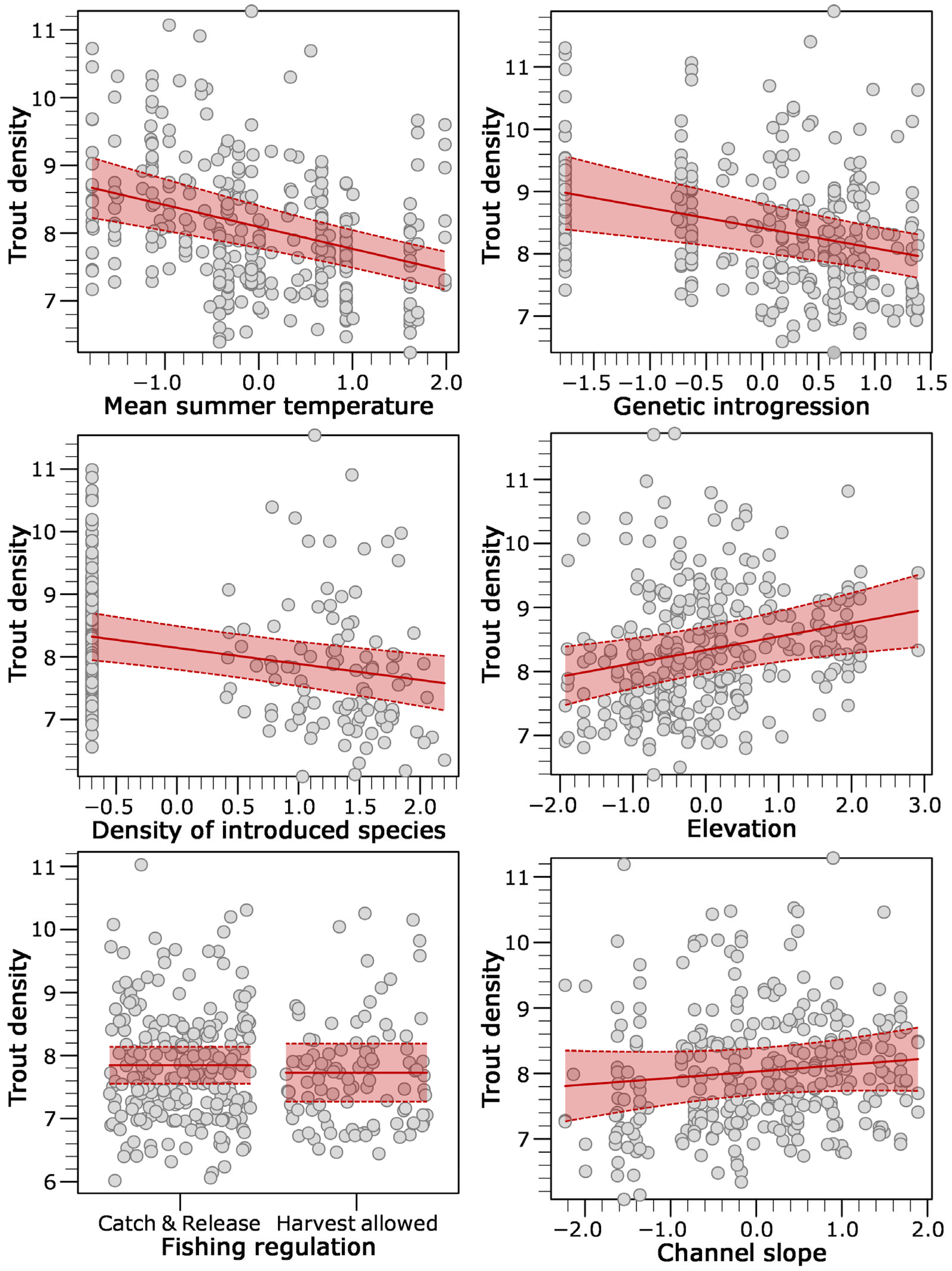
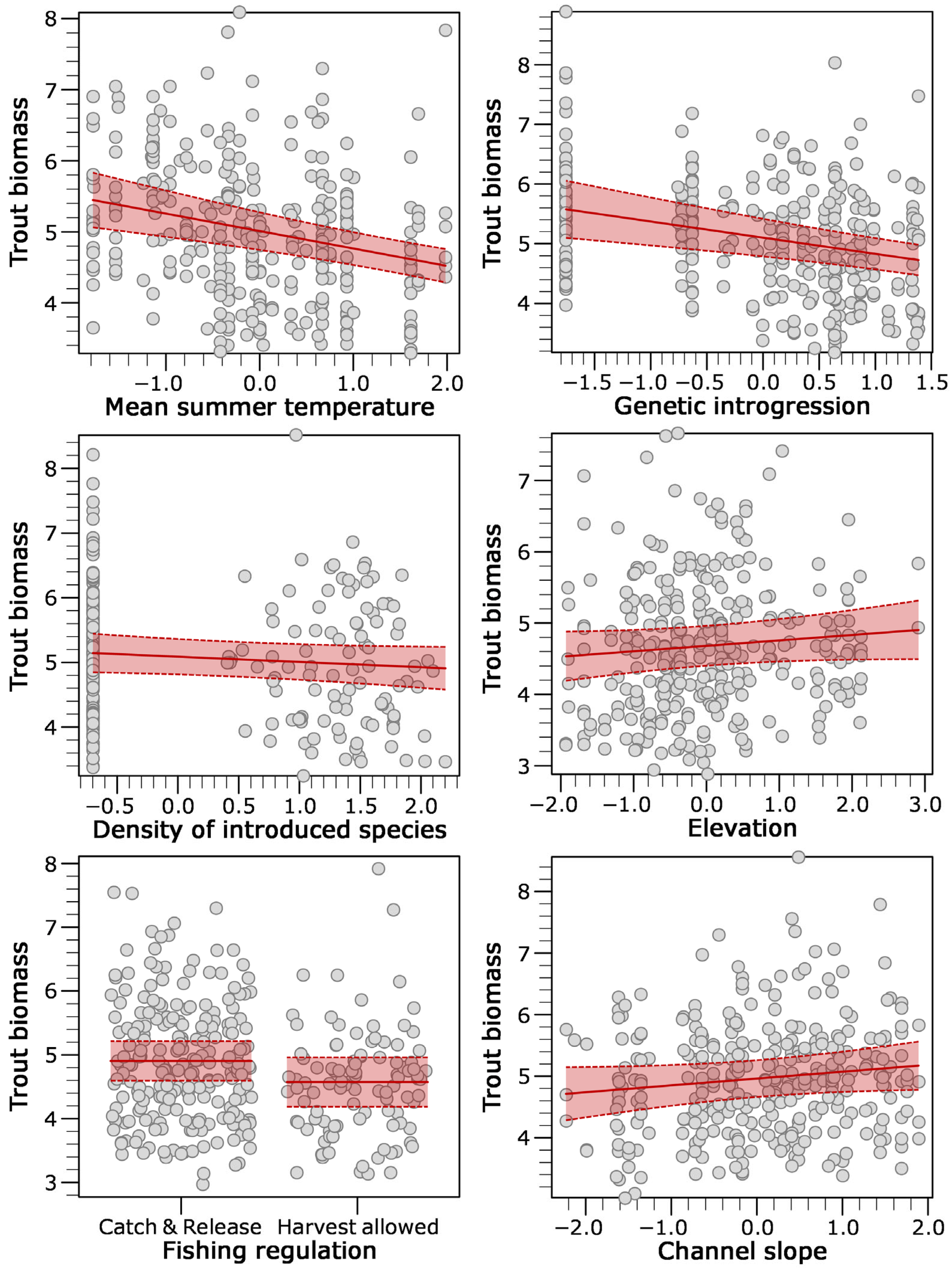
Particularly, an information-theoretic approach applied to a set of candidate GLMMs identified forty-five plausible models (ΔAICc ≤ 4) explaining variability in trout density (Table 2). The best explanatory variables were mean summer temperature, density of introduced species, genetic introgression, and elevation, as indicated by their standardized coefficient estimates (β) and selection probabilities (SP; Table 2). Channel slope, fishing regulation, and alkalinity had intermediate importance, while nutrient concentrations and hydrology showed the weakest relationship with brown trout density (Table 2). Conditional residual plots (Figure 2), which show the relationship between each predictor and the response while accounting for the other variables included in the model, revealed that mean summer temperature, density of introduced species, and genetic introgression were negatively associated with trout density, whereas elevation and channel slope were positively related, with higher densities observed at sites located at higher elevations and with steeper slopes. Furthermore, although fishing regulation had an intermediate effect, trout density was lower in reaches where harvest was allowed (Figure 2).
Trout biomass showed a similar pattern to trout density. Forty-four models were selected as candidates, in which mean summer temperature, genetic introgression, and fishing regulation were the most influential predictors for trout biomass, while channel slope, elevation, and density of introduced species showed intermediate importance (Table 2). Interestingly, fishing regulation was more important in explaining trout biomass than trout density, and conditional residuals of the main predictors showed the same response as for trout density (Figure 3).
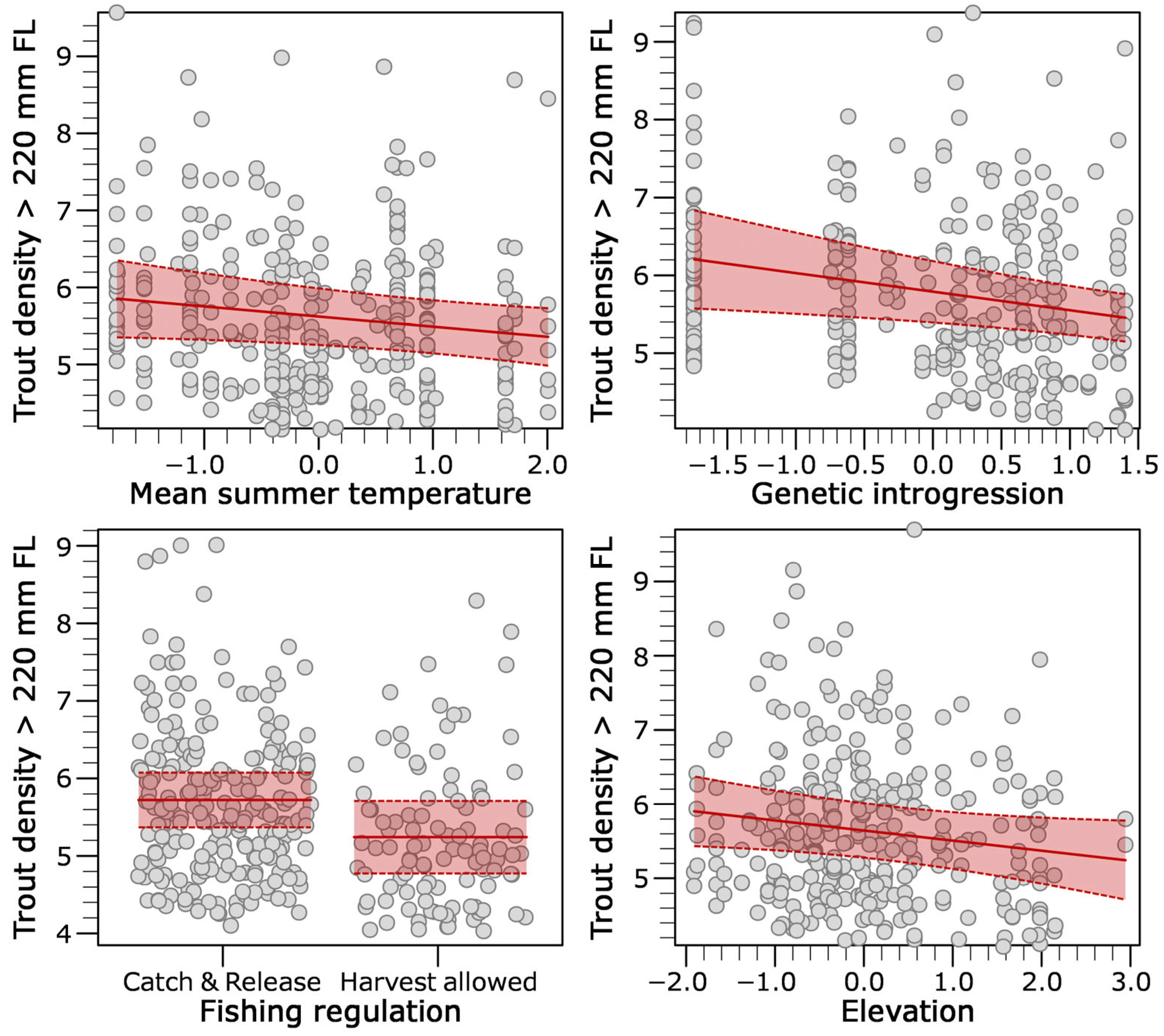
The density of larger fish (>220 mm FL) was primarily associated with fishing regulation, genetic introgression, mean summer temperature, elevation, and relative winter maximum discharge (Table 3). Conditional residuals showed that the density of larger individuals declined with elevation, genetic introgression, and mean summer temperature. Furthermore, the fishing regulation had a strong negative impact, with substantially lower densities under the harvest-allowed regime (Figure 4).
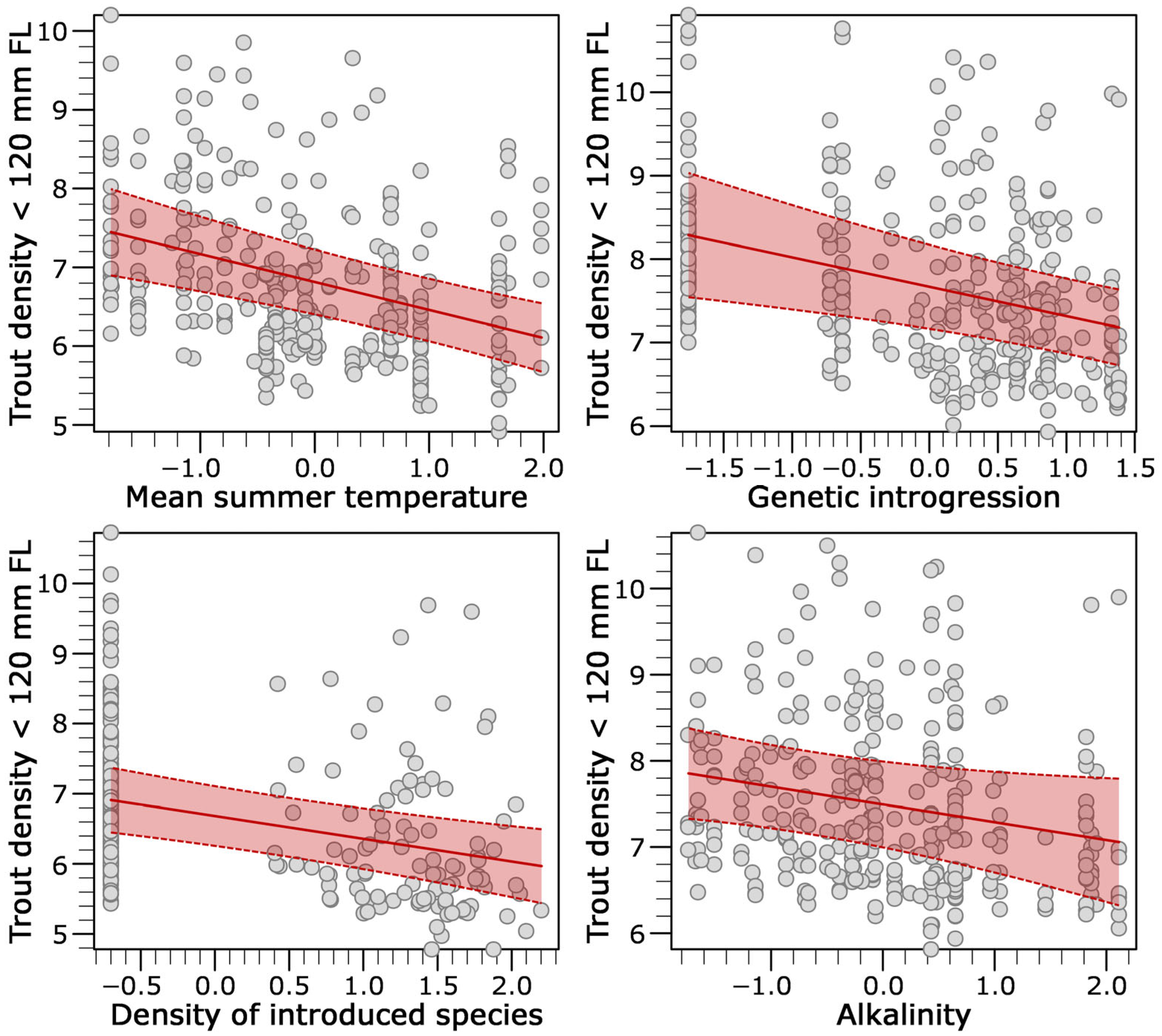
Finally, the density of individuals < 120 mm was mainly influenced by both environmental and biotic factors (Table 3). Mean summer temperature, density of introduced species, genetic introgression, and alkalinity were the most influential predictors, and conditional residuals showed that all of them were negatively associated with trout density (Figure 5). Fishing regulation, although showing weak importance, exhibited the same pattern as the other trout metrics.

4. Discussion

This study provides an integrative assessment of the relative influence of environmental, biotic, genetic, and management-related factors on brown trout population metrics in Mediterranean rivers in Catalonia.
Summer temperature, genetic introgression, and density of introduced species were the main negative predictors of trout population metrics. In contrast, topographic, hydrological and physicochemical variables showed weaker effects that varied depending on the population metric considered. Fishing regime primarily influenced biomass and the density of large individuals, consistent with size-selective harvest effects.

4.1. Brown Trout Biomass in a Global and Iberian Context

Mean brown trout biomass in the Mediterranean basins studied (66.3 kg·ha−1) is close to the global mean reported for brown trout streams (70.3 kg·ha−1) [51]. This suggests that, despite their location at the southern edge of the species’ distribution, these populations sustain biomass levels comparable to the worldwide average for the species. Indeed, several reaches, particularly in the Pallaresa, Ribagorçana, and Ter basins, exceeded 150 kg·ha−1, and maximum values approached 300 kg·ha−1, placing them above the global 90th percentile for salmonid streams (119 kg·ha−1) [51]. Therefore, when local environmental conditions are favourable, Mediterranean brown trout populations can achieve biomass levels comparable to those observed in the most productive temperate streams. At the Iberian scale, the biomass values reported here are comparable to those documented for Pyrenean headwaters and for Atlantic drainages in central and northern Spain [16,52].

4.2. Influence of Thermal and Hydrological Regimes

Summer thermal conditions were a consistent constraint on the brown trout populations in the river reaches studied. Mean July–August temperature was strongly negatively related to total density, total biomass, density > 220 mm, and density < 120 mm. As a cool-water-adapted species, brown trout is particularly sensitive to elevated temperatures, which increase metabolic demands and constrain feeding efficiency and growth [53,54]. Along natural thermal gradients in cooler northern river systems, brown trout biomass, abundance, growth, and production often increase with rising temperature up to an optimum [55]. However, Mediterranean populations already occupy near the upper margin of the thermal niche of the species. Thus, further warming is expected to reduce performance, shifting the primary limitation from physical habitat to thermal tolerance once critical thresholds are approached [56]. Spatial modelling and empirical studies of Mediterranean brown trout populations consistently project substantial biomass declines under future climate scenarios [55]. In Mediterranean river systems, rising summer temperatures are expected to severely constrain recruitment, potentially reducing it by more than 60%, and progressively contract thermally suitable habitats, rendering a large fraction of currently viable reaches unsuitable by the end of the century [13,14].
Hydrological variables exhibited weaker and less consistent effects once temperature was accounted for. This pattern suggests that, at the spatial and temporal scales considered, thermal conditions may play a more influential role than the hydrological metrics included in the models. In Mediterranean rivers, low summer flows and high temperatures frequently coincide, creating a synergistic effect that reduces habitat availability while simultaneously increasing warming rates [57,58]. The present findings, however, indicate that temperature explained more variation than the hydrological metrics included in the models under current climatic conditions. These patterns are consistent with a hierarchical model of population limitation for Mediterranean brown trout: physical habitat structure and density-dependence define potential abundance but increasing summer temperatures progressively reduce the effective carrying capacity. Beyond critical thermal thresholds, temperature becomes the dominant limiting factor. For southern margin populations with limited dispersal opportunities, continued warming is likely to result in sustained reductions in abundance and an increased risk of local extirpation [59].

4.3. Effects of Introduced Species

The density of introduced species showed a consistent negative relationship with brown trout biomass and density, and particularly with the abundance of younger size classes. Although the present analysis does not allow direct inference of the underlying mechanisms, several processes may be involved, including exploitative competition for resources, altered trophic pathways, and increased energetic costs associated with coexistence. In the salmonid reaches of Catalonia, European minnows (Phoxinus spp.) represent the most widespread non-native taxa [32,60]. Previous studies have documented strong competitive interactions between minnows and juvenile brown trout [27], which can impair recruitment success and, in some cases, contribute to local population collapses [28,61].
A particularly concerning pattern is the tendency for the density of introduced species to increase during warmer summers, raising the possibility of a synergistic interaction between climate warming and biological invasion [57]. The robustness of the density of introduced species effect in models that account for temperature supports the view that climate change and non-native pressures may act jointly to intensify threats to native brown trout in Mediterranean rivers [62].

4.4. Genetic Introgression as a Constraint on Population Performance

Genetic introgression from hatchery-reared Atlantic lineages was a strong negative predictor of total density, total biomass, density > 220 mm, and density < 120 mm in the studied reaches. Introgression can reduce individual fitness in native Mediterranean populations by eroding locally adapted gene pools [25]. For example, Mediterranean brown trout exhibit greater thermal plasticity and resilience to the pronounced thermal variability typical of the Mediterranean region, whereas Atlantic hatchery strains and introgressed populations often display reduced tolerance to these conditions [5,25]. Immunogenetic studies also indicate reduced fitness associated with introgression: in Mediterranean brown trout from central Italy, individuals carrying locally rare native immune variants showed significantly better body condition and resistance to parasites [63]. Moreover, introgressed populations frequently express a suite of traits associated with domestication that reduce their overall fitness in the wild, including maladaptive behaviours, diminished predator avoidance, and lower survival during early life stages [64,65]. These cumulative effects tend to depress recruitment and increase mortality in introgressed populations, ultimately resulting in lower standing stocks compared with genetically pure or minimally introgressed populations [24,66]. Genetic introgression was also associated with a lower density of larger individuals. Available evidence in brown trout does not consistently show differences in growth between hatchery-origin or hybrid individuals and wild fish [67,68]. Consequently, the negative association between genetic introgression and the density of larger individuals is more likely to reflect reduced overall fitness in introgressed populations, rather than differences in individual growth rates.

4.5. Effects of Fisheries Regulations

The fishing regime exerted a strong influence on the biomass and density of large-sized brown trout, while its effects on total density remained comparatively weak. This pattern is consistent with expectations from size-selective harvesting, in which exploitation primarily removes larger individuals and truncates size structure without necessarily causing immediate reductions in overall abundance [19,69]. The significant reduction in the density of larger individuals under harvest-allowed regimes highlights the vulnerability of large trout to exploitation, even in regulated fisheries [20].
These patterns suggest that catch-and-release regulations can be effective in maintaining larger size classes, though their effectiveness appears to be context-dependent. Under conditions of elevated summer temperatures and increasing environmental stress, the effectiveness of harvest restrictions may be limited, particularly if post-release mortality increases during warm conditions [21]. Consequently, management measures relying exclusively on fishing regulations may be insufficient to counteract the combined pressures of climate warming, biological invasions, and genetic introgression.

4.6. Influence of Topographic and Water Quality Variables

Topographic variables showed contrasting associations depending on the population metric considered. Elevation showed a positive relationship with total density and a weak positive trend with biomass, suggesting that higher-altitude reaches may provide environmental conditions that favour overall abundance. Headwater reaches at higher elevations are typically characterized by cooler summer temperatures and greater structural heterogeneity, both of which can enhance habitat suitability for salmonids [70]. However, elevation was negatively related to the density of larger individuals, indicating that high-altitude environments, despite supporting higher overall densities, may not necessarily hold larger trout. This pattern may reflect differences in growth rates, energetic limitations, or demographic structure along the altitudinal gradient. In headwater streams, lower productivity and reduced habitat capacity may limit the presence of larger individuals, while favouring smaller size classes [71].
Contrary to expectations, nutrient concentrations were not significant predictors in any of the fitted models, whereas alkalinity was negatively associated with the density of juveniles (<120 mm). These results contrast with studies from more temperate systems, where higher alkalinity is often linked to increased trout biomass through bottom-up effects on productivity [15,16]. The absence of this relationship suggests that nutrient availability is unlikely to be a primary driver of population regulation under Mediterranean conditions. Alternatively, the nutrient gradient across the studied sites may not have been sufficiently broad to exert a significant influence, particularly when compared to other dominant drivers such as temperature and biotic variables.

4.7. Management and Conservation Implications

Our results indicate that multiple interacting factors are currently constraining brown trout populations in the Mediterranean rivers of Catalonia, underscoring the need for integrated management actions to support both conservation and fishery objectives.
The negative impact of introgression on population performance emphasises the importance of conserving the genetic integrity of native trout. Widespread introgression from Atlantic hatchery lineages has been documented across Mediterranean river systems of the Iberian Peninsula [24,30,72], and recent assessments indicate that only a small fraction of populations in Catalonia remain genetically pure, while most exhibit varying degrees of introgression [5]. Therefore, preventing further introgression should be the primary conservation priority. This should be complemented, where feasible, by restoration actions aimed at reducing Atlantic and hybrid populations and reinforcing native Mediterranean populations through targeted translocations to recover local genetic integrity [73,74].
Catch-and-release regulations have contributed to sustain brown trout populations in Catalonia. However, their effectiveness may decline at elevated water temperatures, as post-release mortality increases when fish are handled under thermal stress [21]. Therefore, management strategies should incorporate thermal considerations into recreational fishing regulations. In river reaches particularly vulnerable to summer warming, or during heatwave events, temporal restrictions, seasonal closures, or temperature-triggered angling bans may reduce cumulative stress and enhance population resilience.
The consistent negative effects of introduced species on trout performance emphasises the need for proactive prevention and control. Avoiding further spread should be prioritized through strict regulations and early detection programmes, particularly in headwater refugia that remain free of non-native species. In suitable sites, targeted removal programs, such as repeated electrofishing or installation of selective barriers, could be implemented. However, such interventions require careful evaluation of feasibility, reinvasion risk, and potential non-target impacts. Even when complete eradication is unfeasible, sustained population control in critical trout habitats may still produce measurable benefits [75].
Finally, ongoing climate warming is likely to amplify existing pressures by intensifying summer thermal stress and indirectly favouring introduced species [61,62]. Therefore, conservation strategies for rear-edge brown trout populations should prioritise actions that mitigate thermal exposure, including the preservation of riparian shading, protection of groundwater inputs, and maintenance of longitudinal connectivity to cold-water refugia [76,77]. Long-term, standardised monitoring will be essential to evaluate the effectiveness of these measures and adapt management to continued climatic change.

5. Conclusions

This study provides an integrative assessment of the drivers influencing brown trout populations in Mediterranean rivers of Catalonia. Summer thermal conditions, genetic introgression from hatchery-derived Atlantic lineages, and the density of introduced fish species were identified as the primary constraints on trout density, biomass, and population structure across basins, whereas hydrological and physicochemical variables explained comparatively little variation in population metrics. Mean summer temperature was the most consistent negative predictor, highlighting the vulnerability of Mediterranean trout populations to increasing thermal stress. Genetic introgression and the presence of introduced fishes, particularly European minnows (Phoxinus spp.), were also associated with reduced trout abundance and recruitment. Fishery regulations mainly influenced population structure, with harvest-allowed sections supporting lower biomass and reduced densities of large individuals. Overall, these results indicate the importance of protecting thermal refugia, preserving native genetic diversity, and preventing the spread of non-native species.

Supplementary Materials

The following supporting information can be downloaded at https://www.mdpi.com/article/10.3390/fishes11040217/s1, Figure S1. Spatial variation in brown trout population metrics in six Mediterranean river basins (Llobregat, Cardener, Pallaresa, Ribagorçana, Segre, and Ter). Boxplots represent median (central line), interquartile range (box), and whiskers extending to 1.5 × IQR of (a) total density (ind·ha−1), (b) biomass (kg·ha−1), (c) density of quality-sized trout > 220 mm FL (ind·ha−1), and (d) density of juveniles < 120 mm FL (ind·ha−1). Table S1. Location, elevation, fishing regulation, and genetic introgression of brown trout sampling sites. Introgression_LDH (%) represents the proportion of Atlantic hatchery ancestry estimated from LDH-C*90 allele frequencies.

Author Contributions

Conceptualization, R.R.: and E.A.; methodology, R.R., C.A. and E.A.; formal analysis, E.A. and C.A.; data curation, E.A., R.R. and C.A.; writing—original draft preparation, R.R., E.A. and C.A.; writing—review and editing, R.R., E.A. and C.A. All authors have read and agreed to the published version of the manuscript.

Funding

The authors declare that this study received funding from the Departament d’Agricultura, Ramaderia, Pesca i Alimentació, Generalitat de Catalunya. The funder was not involved in the study design, collection, analysis, interpretation of data, the writing of this article or the decision to submit it for publication.

Institutional Review Board Statement

Ethical approval was not required for this study as it involved non-invasive sampling of fish (capture and immediate release) in their natural habitat, which does not constitute a procedure under the Spanish Royal Decree 53/2013 on the protection of animals used for scientific purposes. All fieldwork was conducted under the official scientific sampling permits SF/142 (2017), SF/026 (2018), SF/0083 (2019), SF/0028 (2020), SF/0020 (2021), SF/0005 (2022), SF/0038 (2023), AP-014-2024 (2024) and CC-2025-13 (2025) issued by the Generalitat de Catalunya. The study was carried out in accordance with the ethical guidelines of the University of Girona (UdG).

Data Availability Statement

The original data presented in the study are openly available in FigShare at https://doi.org/10.6084/m9.figshare.31483369.

Acknowledgments

We are grateful to Roger Guillem and Carme Pou for their valuable field assistance. Carles Alcaraz acknowledges support from the CERCA Program of the Generalitat de Catalunya.

Conflicts of Interest

R.R. was employed by the company Gesna Estudis Ambientals S.L. The remaining authors declare that the research was conducted in the absence of any commercial or financial relationships that could be construed as a potential conflict of interest.

References

  1. MacCrimmon, H.R.; Marshall, T.L.; Gots, B.L. World Distribution of Brown Trout, Salmo trutta: Further Observations. J. Fish. Res. Board Can. 1970, 27, 811–818. [Google Scholar] [CrossRef]
  2. Lobón Cerviá, J.; Sanz, N. (Eds.) Brown Trout: Biology, Ecology and Management; John Wiley & Sons, Inc.: Hoboken, NJ, USA, 2018; ISBN 978-1-119-26829-1. [Google Scholar]
  3. Sanz, N. Phylogeographic History of Brown Trout: A Review. In Brown Trout: Biology, Ecology and Management; John Wiley & Sons, Ltd.: Hoboken, NJ, USA, 2017; pp. 17–63. ISBN 978-1-119-26835-2. [Google Scholar]
  4. Bernatchez, L. The Evolutionary History of Brown Trout (Salmo trutta L.) Inferred from Phylogeographic, Nested Clade, and Mismatch Analyses of Mitochondrial DNA Variation. Evolution 2001, 55, 351–379. [Google Scholar] [CrossRef] [PubMed]
  5. Aparicio, E.; Rocaspana, R.; García-Berthou, E.; Alcaraz, C.; Vera, M.; Heras, S.; García-Marín, J.-L. Conservation Challenges Under Taxonomic Uncertainty: Introgression Patterns and Environmental Correlates in Mediterranean Brown Trout. Aquat. Conserv. Mar. Freshw. Ecosyst. 2025, 35, e70269. [Google Scholar] [CrossRef]
  6. Bergerot, B.; Cattanéo, F. Hydrological Drivers of Brown Trout Population Dynamics in France. Ecohydrology 2017, 10, e1765. [Google Scholar] [CrossRef]
  7. Cattanéo, F.; Lamouroux, N.; Breil, P.; Capra, H. The Influence of Hydrological and Biotic Processes on Brown Trout (Salmo trutta) Population Dynamics. Can. J. Fish. Aquat. Sci. 2002, 59, 12–22. [Google Scholar] [CrossRef]
  8. Nicola, G.G.; Almodóvar, A.; Elvira, B. Influence of Hydrologic Attributes on Brown Trout Recruitment in Low-Latitude Range Margins. Oecologia 2009, 160, 515–524. [Google Scholar] [CrossRef]
  9. Bruder, A.; Salis, R.K.; Jones, P.E.; Matthaei, C.D. Biotic Interactions Modify Multiple-Stressor Effects on Juvenile Brown Trout in an Experimental Stream Food Web. Glob. Change Biol. 2017, 23, 3882–3894. [Google Scholar] [CrossRef]
  10. Borgwardt, F.; Unfer, G.; Auer, S.; Waldner, K.; El-Matbouli, M.; Bechter, T. Direct and Indirect Climate Change Impacts on Brown Trout in Central Europe: How Thermal Regimes Reinforce Physiological Stress and Support the Emergence of Diseases. Front. Environ. Sci. 2020, 8, 59. [Google Scholar] [CrossRef]
  11. Santiago, J.M.; García de Jalón, D.; Alonso, C.; Solana, J.; Ribalaygua, J.; Pórtoles, J.; Monjo, R. Brown Trout Thermal Niche and Climate Change: Expected Changes in the Distribution of Cold-Water Fish in Central Spain. Ecohydrology 2016, 9, 514–528. [Google Scholar] [CrossRef]
  12. Santiago, J.M.; Muñoz-Mas, R.; Solana-Gutiérrez, J.; García de Jalón, D.; Alonso, C.; Martínez-Capel, F.; Pórtoles, J.; Monjo, R.; Ribalaygua, J. Waning Habitats Due to Climate Change: The Effects of Changes in Streamflow and Temperature at the Rear Edge of the Distribution of a Cold-Water Fish. Hydrol. Earth Syst. Sci. 2017, 21, 4073–4101. [Google Scholar] [CrossRef]
  13. Almodóvar, A.; Nicola, G.G.; Ayllón, D.; Elvira, B. Global Warming Threatens the Persistence of Mediterranean Brown Trout. Glob. Change Biol. 2012, 18, 1549–1560. [Google Scholar] [CrossRef]
  14. Estrela-Segrelles, C.; Gómez-Martínez, G.; Pérez-Martín, M.Á. Climate Change Risks on Mediterranean River Ecosystems and Adaptation Measures (Spain). Water Resour. Manag. 2023, 37, 2757–2770. [Google Scholar] [CrossRef]
  15. Kwak, T.J.; Waters, T.F. Trout Production Dynamics and Water Quality in Minnesota Streams. Trans. Am. Fish. Soc. 1997, 126, 35–48. [Google Scholar] [CrossRef]
  16. Almodóvar, A.; Nicola, G.G.; Elvira, B. Spatial Variation in Brown Trout Production: The Role of Environmental Factors. Trans. Am. Fish. Soc. 2006, 135, 1348–1360. [Google Scholar] [CrossRef]
  17. Rosenfeld, J.; Lee, R. Thresholds for Reduction in Fish Growth and Consumption Due to Hypoxia: Implications for Water Quality Guidelines to Protect Aquatic Life. Environ. Manag. 2022, 70, 431–447. [Google Scholar] [CrossRef]
  18. Braña, F.; Nicieza, A.G.; Toledo, M.M. Effects of Angling on Population Structure of Brown Trout, Salmo trutta L., in Mountain Streams of Northern Spain. Hydrobiologia 1992, 237, 61–66. [Google Scholar] [CrossRef]
  19. Almodóvar, A.; Nicola, G.G. Angling Impact on Conservation of Spanish Stream-Dwelling Brown Trout Salmo trutta. Fish. Manag. Ecol. 2004, 11, 173–182. [Google Scholar] [CrossRef]
  20. Carosi, A.; Ghetti, L.; Soresina, A.; Lorenzoni, M. Catch and Release Angling: Implications for the Management and Conservation of the Mediterranean Trout in Central Italy. Fish. Res. 2022, 250, 106285. [Google Scholar] [CrossRef]
  21. Ayllón, D.; Blasco Hernanz, S.; Nicola, G.G.; Elvira, B.; Almodóvar, A. Mediterranean Brown Trout Catch-and-Release Recreational Fisheries Might Not Be Sustainable under Concurrent Climate Warming and Hydrological Change. Hydrobiologia 2025, 852, 659–672. [Google Scholar] [CrossRef]
  22. Splendiani, A.; Ruggeri, P.; Giovannotti, M.; Pesaresi, S.; Occhipinti, G.; Fioravanti, T.; Lorenzoni, M.; Nisi Cerioni, P.; Caputo Barucchi, V. Alien Brown Trout Invasion of the Italian Peninsula: The Role of Geological, Climate and Anthropogenic Factors. Biol. Invasions 2016, 18, 2029–2044. [Google Scholar] [CrossRef]
  23. Berrebi, P.; Poteaux, C.; Fissier, M.; Cattaneo-Berrebi, G. Stocking Impact and Allozyme Diversity in Brown Trout from Mediterranean Southern France. J. Fish Biol. 2000, 56, 949–960. [Google Scholar] [CrossRef]
  24. Vera, M.; Aparicio, E.; Heras, S.; Abras, A.; Casanova, A.; Roldán, M.-I.; García-Marin, J.-L. Regional Environmental and Climatic Concerns on Preserving Native Gene Pools of a Least Concern Species: Brown Trout Lineages in Mediterranean Streams. Sci. Total Environ. 2023, 862, 160739. [Google Scholar] [CrossRef] [PubMed]
  25. Folio, D.M.; Gil, J.; Caudron, A.; Labonne, J. Genotype-by-Environment Interactions Drive the Maintenance of Genetic Variation in a Salmo trutta L. Hybrid Zone. Evol. Appl. 2021, 14, 2698–2711. [Google Scholar] [CrossRef] [PubMed]
  26. Esposito, A.; Denys, G.P.J.; Haÿ, V.; Godeaux, Q.; Foata, J.; Quilichini, Y. Multiple Introduction Pathways of Non-Native Phoxinus Minnows (Teleostei: Leuciscidae) in Corsica Revealed by Its Hidden Diversity and Their Parasites. Biol. Invasions 2024, 26, 2453–2474. [Google Scholar] [CrossRef]
  27. Museth, J.; Borgstrøm, R.; Brittain, J.E. Diet Overlap between Introduced European Minnow (Phoxinus phoxinus) and Young Brown Trout (Salmo trutta) in the Lake, Øvre Heimdalsvatn: A Result of Abundant Resources or Forced Niche Overlap? Hydrobiologia 2010, 642, 93–100. [Google Scholar] [CrossRef]
  28. Tiberti, R.; Buchaca, T.; Cruset Tonietti, E.; Iacobelli, L.; Maini, M.; Ribelli, F.; Pou Rovira, Q.; Ventura, M. Minnow Introductions in Mountain Lakes Result in Lower Salmonid Densities. Biol. Invasions 2022, 24, 2285–2289. [Google Scholar] [CrossRef]
  29. Museth, J.; Hesthagen, T.; Sandlund, O.T.; Thorstad, E.B.; Ugedal, O. The History of the Minnow Phoxinus phoxinus (L.) in Norway: From Harmless Species to Pest. J. Fish Biol. 2007, 71, 184–195. [Google Scholar] [CrossRef]
  30. Araguas, R.M.; Vera, M.; Aparicio, E.; Sanz, N.; Fernández-Cebrián, R.; Marchante, C.; García-Marín, J.L. Current Status of the Brown Trout (Salmo trutta) Populations within Eastern Pyrenees Genetic Refuges. Ecol. Freshw. Fish 2017, 26, 120–132. [Google Scholar] [CrossRef]
  31. Maceda-Veiga, A.; Monleon-Getino, A.; Caiola, N.; Casals, F.; De Sostoa, A. Changes in Fish Assemblages in Catchments in North-Eastern Spain: Biodiversity, Conservation Status and Introduced Species. Freshw. Biol. 2010, 55, 1734–1746. [Google Scholar] [CrossRef]
  32. Corral-Lou, A.; Perea, S.; Aparicio, E.; Doadrio, I. Phylogeography and Species Delineation of the Genus Phoxinus Rafinesque, 1820 (Actinopterygii: Leuciscidae) in the Iberian Peninsula. J. Zool. Syst. Evol. Res. 2019, 57, 926–941. [Google Scholar] [CrossRef]
  33. Zippin, C. An Evaluation of the Removal Method of Estimating Animal Populations. Biometrics 1956, 12, 163–189. [Google Scholar] [CrossRef]
  34. Seber, G.A.F. The Estimation of Animal Abundance and Related Parameters; Charles Griffin Publications: London, UK, 1982. [Google Scholar]
  35. Kwak, T.J. Modular Microcomputer Software to Estimate Fish Population Parameters, Production Rates and Associated Variance. Ecol. Freshw. Fish 1992, 1, 73–75. [Google Scholar] [CrossRef]
  36. Aparicio, E.; Rocaspana, R.; Palau-Ibars, A.; de Sostoa, A.; Alcaraz, C. Life History Traits of Mediterranean Brown Trout (Salmo trutta Complex) in Pyrenean Headwater Streams. Ichthyol. Res. 2022, 70, 101–109. [Google Scholar] [CrossRef]
  37. Domisch, S.; Amatulli, G.; Jetz, W. Near-Global Freshwater-Specific Environmental Variables for Biodiversity Analyses in 1 Km Resolution. Sci. Data 2015, 2, 150073. [Google Scholar] [CrossRef]
  38. Agència Catalana de l’Aigua. Consulta de Dades. Available online: http://aca.gencat.cat/ca/laigua/consulta-de-dades/ (accessed on 25 February 2026).
  39. Confederación Hidrográfica del Ebro. Redes de Control de Calidad (SAICA). Available online: https://saica.chebro.es/ (accessed on 25 February 2026).
  40. Fornaroli, R.; Muñoz-Mas, R.; Martínez-Capel, F. Fish Community Responses to Antecedent Hydrological Conditions Based on Long-Term Data in Mediterranean River Basins (Iberian peninsula). Sci. Total Environ. 2020, 728, 138052. [Google Scholar] [CrossRef]
  41. Confederación Hidrográfica del Ebro. SAIH. Available online: https://www.saihebro.com/ (accessed on 25 February 2026).
  42. Generalitat de Catalunya. Dades Meteorològiques XEMA. Available online: https://web.gencat.cat/ca/generalitat/dades-indicadors/dades-obertes (accessed on 25 February 2026).
  43. Johnson, M.F.; Albertson, L.K.; Algar, A.C.; Dugdale, S.J.; Edwards, P.; England, J.; Gibbins, C.; Kazama, S.; Komori, D.; MacColl, A.D.C.; et al. Rising Water Temperature in Rivers: Ecological Impacts and Future Resilience. WIREs Water 2024, 11, e1724. [Google Scholar] [CrossRef]
  44. Generalitat de Catalunya. Caça i Pesca Continental. Available online: http://agricultura.gencat.cat/ca/serveis/cartografia-sig/bases-cartografiques/cacera-pesca-continental/ (accessed on 25 February 2026).
  45. Dormann, C.F.; Elith, J.; Bacher, S.; Buchmann, C.; Carl, G.; Carré, G.; Marquéz, J.R.G.; Gruber, B.; Lafourcade, B.; Leitão, P.J.; et al. Collinearity: A Review of Methods to Deal with It and a Simulation Study Evaluating Their Performance. Ecography 2013, 36, 27–46. [Google Scholar] [CrossRef]
  46. Harrell, F.E. Regression Modeling Strategies: With Applications to Linear Models, Logistic Regression, and Survival Analysis; Springer: New York, NY, USA, 2015; ISBN 978-3-319-19425-7. [Google Scholar]
  47. Burnham, K.P.; Anderson, D.R. (Eds.) Model Selection and Multimodel Inference; Springer: New York, NY, USA, 2004; ISBN 978-0-387-95364-9. [Google Scholar]
  48. Maggini, R.; Lehmann, A.; Zimmermann, N.E.; Guisan, A. Improving Generalized Regression Analysis for the Spatial Prediction of Forest Communities. J. Biogeogr. 2006, 33, 1729–1749. [Google Scholar] [CrossRef]
  49. Aparicio, E.; Rocaspana, R.; de Sostoa, A.; Palau-Ibars, A.; Alcaraz, C. Movements and Dispersal of Brown Trout (Salmo trutta Linnaeus, 1758) in Mediterranean Streams: Influence of Habitat and Biotic Factors. PeerJ 2018, 6, e5730. [Google Scholar] [CrossRef]
  50. R Core Team. R: A Language and Environment for Statistical Computing; R Core Team: Vienna, Austria, 2025. [Google Scholar]
  51. Foote, K.J.; Grant, J.W.A.; Biron, P.M. Salmonid Biomass in Streams Around the World: A Quantitative Synthesis. Fish Fish. 2025, 26, 394–413. [Google Scholar] [CrossRef]
  52. Aparicio, E.; Rocaspana, R.; Alcaraz, C. Secondary Production and Biomass Dynamics of Mediterranean Brown Trout (Salmo trutta Complex) in Pyrenean Headwater Streams. Fishes 2025, 10, 476. [Google Scholar] [CrossRef]
  53. Hampuwo, B.; Duenser, A.; Lahnsteiner, F. Effects of Elevated Temperature on Gene Expression, Energy Metabolism, and Physiology in Brown Trout, Salmo trutta. Conserv. Physiol. 2025, 13, coaf025. [Google Scholar] [CrossRef]
  54. Archer, L.C.; Hutton, S.A.; Harman, L.; Russell Poole, W.; Gargan, P.; McGinnity, P.; Reed, T.E. Associations between Metabolic Traits and Growth Rate in Brown Trout (Salmo trutta) Depend on Thermal Regime. Proc. Biol. Sci. 2021, 288, 20211509. [Google Scholar] [CrossRef] [PubMed]
  55. Cianfrani, C.; Satizábal, H.F.; Randin, C. A Spatial Modelling Framework for Assessing Climate Change Impacts on Freshwater Ecosystems: Response of Brown Trout (Salmo trutta L.) Biomass to Warming Water Temperature. Ecol. Model. 2015, 313, 1–12. [Google Scholar] [CrossRef]
  56. Ayllón, D.; Nicola, G.G.; Elvira, B.; Parra, I.; Almodóvar, A. Thermal Carrying Capacity for a Thermally-Sensitive Species at the Warmest Edge of Its Range. PLoS ONE 2013, 8, e81354. [Google Scholar] [CrossRef]
  57. Carosi, A. Effects of Climate Change on Freshwater Biodiversity. Water 2022, 14, 3953. [Google Scholar] [CrossRef]
  58. Ayllón, D.; Railsback, S.F.; Vincenzi, S.; Groeneveld, J.; Almodóvar, A.; Grimm, V. InSTREAM-Gen: Modelling Eco-Evolutionary Dynamics of Trout Populations under Anthropogenic Environmental Change. Ecol. Model. 2016, 326, 36–53. [Google Scholar] [CrossRef]
  59. Ayllón, D.; Railsback, S.F.; Harvey, B.C.; García Quirós, I.; Nicola, G.G.; Elvira, B.; Almodóvar, A. Mechanistic Simulations Predict That Thermal and Hydrological Effects of Climate Change on Mediterranean Trout Cannot Be Offset by Adaptive Behaviour, Evolution, and Increased Food Production. Sci. Total Environ. 2019, 693, 133648. [Google Scholar] [CrossRef]
  60. Aparicio, E. Peixos Continentals de Catalunya. Ecologia, Conservació i Guia D’identificació; Lynx Edicions: Barcelona, Spain, 2016; ISBN 978-84-16728-01-5. [Google Scholar]
  61. Qvenild, T.; Hesthagen, T.; Museth, J. A Long-Term Study of the Impact of the Invasive Species Eurasian Minnow Phoxinus phoxinus on Brown Trout Salmo trutta Production in a High Mountain Lake, Southern Norway. Fauna Nor. 2024, 43, 1–11. [Google Scholar] [CrossRef]
  62. Carosi, A.; Lorenzoni, F.; Lorenzoni, M. Synergistic Effects of Climate Change and Alien Fish Invasions in Freshwater Ecosystems: A Review. Fishes 2023, 8, 486. [Google Scholar] [CrossRef]
  63. Talarico, L.; Marta, S.; Rossi, A.R.; Crescenzo, S.; Petrosino, G.; Martinoli, M.; Tancioni, L. Balancing Selection, Genetic Drift, and Human-Mediated Introgression Interplay to Shape MHC (Functional) Diversity in Mediterranean Brown Trout. Ecol. Evol. 2021, 11, 10026–10041. [Google Scholar] [CrossRef]
  64. Araki, H.; Berejikian, B.A.; Ford, M.J.; Blouin, M.S. Fitness of Hatchery-Reared Salmonids in the Wild. Evol. Appl. 2008, 1, 342–355. [Google Scholar] [CrossRef] [PubMed]
  65. Hansen, M.M. Estimating the Long-Term Effects of Stocking Domesticated Trout into Wild Brown Trout (Salmo trutta) Populations: An Approach Using Microsatellite DNA Analysis of Historical and Contemporary Samples. Mol. Ecol. 2002, 11, 1003–1015. [Google Scholar] [CrossRef] [PubMed]
  66. Mezzera, M.; Largiadèr, C.R. Comparative Analysis of Introgression at Three Marker Classes: A Case Study in a Stocked Population of Brown Trout. J. Fish Biol. 2001, 59, 289–305. [Google Scholar] [CrossRef]
  67. Dahl, J.; Pettersson, E.; Dannewitz, J.; Järvi, T.; Löf, A.-C. No Difference in Survival, Growth and Morphology between Offspring of Wild-Born, Hatchery and Hybrid Brown Trout (Salmo trutta). Ecol. Freshw. Fish 2006, 15, 388–397. [Google Scholar] [CrossRef]
  68. Bohlin, T.; Sundström, L.F.; Johnsson, J.I.; Höjesjö, J.; Pettersson, J. Density-Dependent Growth in Brown Trout: Effects of Introducing Wild and Hatchery Fish. J. Anim. Ecol. 2002, 71, 683–692. [Google Scholar] [CrossRef]
  69. Sánchez-Hernández, J.; Shaw, S.L.; Cobo, F.; Allen, M.S. Influence of a Minimum-Length Limit Regulation on Wild Brown Trout: An Example of Recruitment and Growth Overfishing. N. Am. J. Fish. Manag. 2016, 36, 1024–1035. [Google Scholar] [CrossRef]
  70. Fornaroli, R.; Cabrini, R.; Sartori, L.; Marazzi, F.; Canobbio, S.; Mezzanotte, V. Optimal Flow for Brown Trout: Habitat—Prey Optimization. Sci. Total Environ. 2016, 566–567, 1568–1578. [Google Scholar] [CrossRef]
  71. Parra, I.; Almodóvar, A.; Nicola, G.G.; Elvira, B. Latitudinal and Altitudinal Growth Patterns of Brown Trout Salmo trutta at Different Spatial Scales. J. Fish Biol. 2009, 74, 2355–2373. [Google Scholar] [CrossRef]
  72. Almodóvar, A.; Nicola, G.G.; Elvira, B.; García-Marín, J.L. Introgression Variability among Iberian Brown Trout Evolutionary Significant Units: The Influence of Local Management and Environmental Features. Freshw. Biol. 2006, 51, 1175–1187. [Google Scholar] [CrossRef]
  73. Carosi, A.; Bonomo, G.; Lorenzoni, M. Effectiveness of Alien Brown Trout Salmo trutta L. Removal Activities for the Native Trout Conservation in Mediterranean Streams. J. Appl. Ichthyol. 2020, 36, 461–471. [Google Scholar] [CrossRef]
  74. Caudron, A.; Champigneulle, A. Multiple Electrofishing as a Mitigate Tool for Removing Nonnative Atlantic Brown Trout (Salmo trutta L.) Threatening a Native Mediterranean Brown Trout Population. Eur. J. Wildl. Res. 2011, 57, 575–583. [Google Scholar] [CrossRef]
  75. Rytwinski, T.; Taylor, J.J.; Donaldson, L.A.; Britton, J.R.; Browne, D.R.; Gresswell, R.E.; Lintermans, M.; Prior, K.A.; Pellatt, M.G.; Vis, C.; et al. The Effectiveness of Non-Native Fish Removal Techniques in Freshwater Ecosystems: A Systematic Review. Environ. Rev. 2019, 27, 71–94. [Google Scholar] [CrossRef]
  76. Quilbé, R.; Ouellet, V.; Frechette, D.; Kurylyk, B.L.; Sullivan, C.J.; Halfyard, E.A.; Smith, K.A.; Wilbur, N.; Gillis, C.-A. Cold-Water Thermal Refuge Enhancement and Creation for Salmonids: Successes, Failures, and Lessons Learned. River Res. Appl. 2025, 41, 1673–1700. [Google Scholar] [CrossRef]
  77. Kelly, S.; Kelly, F.L. Shaded Streams with Permeable Watersheds Provide Naturally Resilient Fish Habitat Refugia during Heatwaves. Fish. Manag. Ecol. 2024, 31, e12704. [Google Scholar] [CrossRef]
Figure 1. Study area in Catalonia (northwestern Mediterranean Basin) showing the 88 sampling sites (black circles) across six major catchments, and the location of hydrological gauging stations (red triangles).
Fishes 11 00217 g001
Figure 2. Conditional residual plots showing the relationship between the most important predictors in the averaged GLMM and brown trout density. Points are the partial residuals, the red line indicates model predictions, and shaded bands are the confidence intervals based on standard error.
Fishes 11 00217 g002
Figure 3. Conditional residual plots showing the relationship between the most important predictors in the averaged GLMM and brown trout biomass. Points are the partial residuals, the red line indicates model predictions, and shaded bands are the confidence intervals based on standard error.
Fishes 11 00217 g003
Figure 4. Conditional residual plots showing the relationship between the most important predictors in the averaged GLMM and brown trout density > 220 mm FL. Points are the partial residuals, the red line indicates model predictions, and shaded bands are the confidence intervals based on standard error.
Fishes 11 00217 g004
Figure 5. Conditional residual plots showing the relationship between the most important predictors in the averaged GLMM and brown trout density < 120 FL. Points are the partial residuals, the red line indicates model predictions, and shaded bands are the confidence intervals based on standard error.
Fishes 11 00217 g005
Table 1. Environmental, biological, genetic and management predictors included in the analyses of brown trout population metrics.
VariableAcronymUnitDescription
ElevationELEVm a.s.l.Elevation of sampling site
Channel slopeSLOPEdegrees × 100Mean channel slope at sampling reach
AlkalinityALKmg CaCO3 L−1Long-term mean alkalinity
Electrical conductivityCONDμS cm−1Long-term mean electrical conductivity
Nitrate concentrationNO3mg L−1Long-term mean nitrate concentration
Phosphate concentrationPO4mg L−1Long-term mean phosphate concentration
Standardized mean annual dischargeQ_MEANdimensionlessMean annual discharge standardized relative to long-term station mean
Low-flow days (Q10)Q_LOW_DAYSdaysDays below 10th percentile of long-term discharge
Relative summer minimum dischargeQ_MIN_RATIOratioMinimum summer discharge divided by long-term mean discharge
High-flow days (Q95)Q_HIGH_DAYSdaysDays exceeding 95th percentile of long-term discharge
Relative winter maximum dischargeQ_MAX_RATIOratioMaximum discharge (January-March) divided by long-term mean discharge
Mean summer temperatureT_SUMMER°CMean July–August air temperature (proxy for water temperature)
Extreme summer temperature daysT_EXT_DAYSdaysDays exceeding 95th percentile of long-term summer temperature
Density of introduced speciesDENS_INTRODIndividuals·ha−1Density of non-native fish species
Genetic introgressionLDH_INTROGproportionFrequency of LDH-C*90 allele
Fishing regulationFISH_REGcategoricalHarvest-allowed vs. catch-and-release regime
Table 2. Model-averaged standardized coefficients (β), selection probability (SP), and parameter bias for predictors included in the Generalized Linear Mixed Models explaining brown trout density (ind·ha−1) and biomass (kg·ha−1). The number of candidate models (N) and the Pearson’s correlation coefficient (r) between observed and predicted values are also shown.
Model ParameterTrout Density
N = 45; r = 0.80
Trout Biomass
N = 44; r = 0.76
SPβ ± SEBias SPβ ± SEBias
Intercept1.007.09 ± 0.09−0.01 1.004.14 ± 0.07<0.01
Elevation0.990.21 ± 0.080.10 0.720.08 ± 0.06−0.20
Channel Slope0.660.10 ± 0.09−0.30 0.810.11 ± 0.07−0.02
Alkalinity0.45−0.05 ± 0.08−0.91 0.36−0.02 ± 0.05−1.20
Nitrate concentration0.26−0.01 ± 0.050.07 0.32−0.02 ± 0.05−2.37
Phosphate concentration0.26−0.01 ± 0.053.35 0.240.00 ± 0.04−27.91
Relative summer minimum discharge0.360.02 ± 0.03−1.48 0.410.02 ± 0.03−1.16
Relative winter maximum discharge0.290.01 ± 0.02−1.99 0.260.01 ± 0.02−1.89
Mean summer temperature1.00−0.32 ± 0.060.02 1.00−0.25 ± 0.050.04
Density of introduced species1.00−0.26 ± 0.070.04 0.71−0.08 ± 0.06−0.21
Genetic introgression1.00−0.33 ± 0.080.05 1.00−0.27 ± 0.060.05
Fishing regulation—harvest allowed0.49−0.10 ± 0.10−1.06 1.00−0.33 ± 0.110.04
Table 3. Model-averaged standardized coefficients (β), selection probability (SP), and parameter bias for predictors included in the Generalized Linear Mixed Models explaining density (ind·ha−1) of large (>220 mm FL) and juvenile brown trout (<120 mm FL). The number of candidate models (N) and the Pearson’s correlation coefficient (r) between observed and predicted values are also shown.
Model ParameterTrout > 220 mm Density
N = 36; r = 0.72
Trout < 120 mm Density
N = 56; r = 0.77
SPβ ± SEBias SPβ ± SEBias
Intercept1.004.69 ± 0.090.00 1.006.26 ± 0.11−0.01
Elevation0.86−0.14 ± 0.09−0.39 0.420.05 ± 0.06−0.81
Channel Slope0.320.03 ± 0.06−2.37 0.350.04 ± 0.08−1.53
Alkalinity0.49−0.06 ± 0.06−0.85 0.87−0.21 ± 0.120.08
Nitrate concentration0.240.01 ± 0.05−4.74 0.270.02 ± 0.07−7.29
Phosphate concentration0.220.00 ± 0.05−8.78 0.30−0.03 ± 0.09−3.37
Relative summer minimum discharge0.220.00 ± 0.02−10.35 0.250.00 ± 0.03−0.49
Relative winter maximum discharge0.810.07 ± 0.05−0.28 0.510.03 ± 0.03−0.97
Mean summer temperature0.84−0.13 ± 0.09−0.10 1.00−0.36 ± 0.080.01
Density of introduced species0.28−0.00 ± 0.03−5.56 1.00−0.33 ± 0.100.09
Genetic introgression0.97−0.24 ± 0.100.01 1.00−0.35 ± 0.110.04
Fishing regulation—harvest allowed1.00−0.48 ± 0.160.00 0.37−0.08 ± 0.15−2.02
Disclaimer/Publisher’s Note: The statements, opinions and data contained in all publications are solely those of the individual author(s) and contributor(s) and not of MDPI and/or the editor(s). MDPI and/or the editor(s) disclaim responsibility for any injury to people or property resulting from any ideas, methods, instructions or products referred to in the content.