Article

Anti-Mold and Water Retention Effects of Extracts of Pomegranate Peel on Pellet Feeds and Their Impact on Biochemical Indicators in Tissues and Organs of Cyprinus carpio var. Jian


1
Fishes Conservation and Utilization in the Upper Reaches of the Yangtze River Key Laboratory of Sichuan Province, Neijiang Normal University, Neijiang 641100, China
2
College of Fisheries, Neijiang Normal University, Neijiang 641100, China
3
College of Fisheries, Guangdong Ocean University, Zhanjiang 524088, China
*
Author to whom correspondence should be addressed.
Fishes 2026, 11(4), 216; https://doi.org/10.3390/fishes11040216
Submission received: 24 February 2026 / Revised: 31 March 2026 / Accepted: 31 March 2026 / Published: 2 April 2026
(This article belongs to the Special Issue Nutrition Requirements and Feed Development for Aquaculture Animals)

Abstract

This research was conducted to evaluate the impacts of pomegranate (Punica granatum L.) peel extract (PPE) on the mold growth and moisture content in pellet feeds, as well as the biochemical indicators in tissues and organs of fish. Firstly, six types of pellet feeds were formulated by adding 0% or 0.5% of pomegranate peel powder (PP), petroleum ether extract (PEE), ethyl acetate extract (EAE), ethanol extract (EE), or aqueous extract (AQE) of PP. Moisture content was determined by air-drying 10 g of wet pellet feed from each treatment at 60 °C for 48 h in uniform-sized Petri dishes. Mold growth was evaluated by homogenizing 15 g of 12-week stored pellet feed with 15 mL of purified water, incubating at 25 °C for 4 days, and recording mold growth. The results indicated that PP, PEE, EE, and AQE reduced the mold growth in pellet feeds (p < 0.05). PP, EAE, EE, and AQE increased the moisture content in pellet feeds. Among all additives, EE has the strongest effects on the mold growth and moisture content in feeds (p < 0.05). According to regression analysis of mold and moisture levels, the optimal EE supplementation levels in pellet feeds were evaluated to be 1.284% and 1.485%, respectively. Then, 420 carp (Cyprinus carpio var. Jian, mean initial weight 12.01 ± 0.53 g) were fed diets formulated with EE at graded inclusion levels (0, 0.3, 0.6, 0.9, 1.2, 1.5, and 1.8%) over a 15-day period. The findings indicated that dietary EE improved the digestive and absorptive function in carp (p < 0.05), and this improvement was closely correlated with the upregulated activities of digestive and absorptive enzymes and the strengthened antioxidant capability in carp’s digestive tissues. Regression analysis of feed intake rate indicated that the optimal EE level suitable for carp is 0.906%. Furthermore, dietary EE enhanced the respiratory capacity by improving functional metabolic enzyme activity and antioxidant defense in the respiration-related tissues and organs of fish (p < 0.05). In summary, supplement EE increases the moisture content, inhibits the mold growth in pellet feeds, and improves the respiratory, digestive, and absorptive functions in fish, providing a valuable insight for PEE use as a naturally functional raw material in fish feeds.
Key Contribution: This study aims to investigate the anti-mold and water retention functions of PPE in pellet feeds, as well as its effects on biochemical indicators in various fish tissues and organs, providing valuable insight into its application as a natural functional ingredient in fish feeds.

1. Introduction

Mold is widely distributed and diverse in nature [1]. Aspergillus, Penicillium, and Fusarium have been well-documented to induce feed spoilage and mustiness, thereby impairing feed quality [2]. Beyond compromising nutritional components of feeds [3], molds can also produce toxic metabolites (e.g., mycotoxins) [4], which may result in retarded growth, hepatic impairment, and even poisoning or mortality in farmed animals [5]. Consequently, the incorporation of mold inhibitors has emerged as a prevalent and essential strategy in feed production [6]. At present, common mold inhibitors are mainly organic acid compounds, including acetic acid, propionic acid, benzoic acid, and sorbic acid, as well as their salts [7]. Most of these agents are synthetic chemicals. Some may cause allergic reactions in humans (Homo sapiens) and low toxicity in animals [8]. They may also lead to environmental risks and promote the development of drug-resistant fungal strains [9]. Therefore, the development of natural mold inhibitors is of considerable importance in feed production.
Pomegranate (Punica granatum L.) peel is an easily a ccessible and low-cost agro-industrial byproduct accounting for about 50% of the whole fruit weight [10]. The pomegranate peel is rich in bioactive compounds, such as phenolic compounds, mainly tannins (ellagitannins such as gallagic acid, punicalin, and punicalagin), flavonoids (anthocyanins and catechins), and phenolic acids (hydroxycinnamic acids, hydroxybenzoic acids, gallotannins), which can exert antimicrobial activity, antioxidant activity, and antifungal activity [10]. Studies have demonstrated that pomegranate peel extract (PPE) exhibits a potent antifungal activity against Fusarium oxysporum [11], Aspergillus flavus, Aspergillus parasiticus, and Gibberella fujikuroi [12]. Accordingly, it is reasonable to propose that PPE supplementation could inhibit mold growth in feeds. However, limited data are available regarding how PPE affects mold in feeds. In China, the moisture content requirement for hard pellet feeds is generally below 12.5% [13]. However, the dry pressing granulation process results in a marked decrease in moisture content [14], which is significantly lower than the requirements of the national standard in pellet feeds. Improvements in pellet quality and electrical energy efficiency have been observed with moisture addition in feeds [15]. However, the addition of moisture may promote mold spore proliferation [15]. Studies have demonstrated the water holding capacity of pomegranate peel powder (PP) in sausages [16]. Thus, it is possible that PPE has anti-mold and water retention properties in pellet feeds. To date, no systematic or targeted investigations have been conducted to elucidate the specific effects of PPE on the moisture content of pellet feeds.
China, as the main production country of pomegranates, has a planting area of more than 120,000 ha, with a production exceeding 1.2 million t yearly. Pomegranate is generally processed into two primary components: pomegranate juice and pomegranate peel. Currently, the pomegranate juice industry has become a core and rapidly expanding sector in global food processing. This growth is driven by rising consumer demand for natural and nutrient-rich beverages [17]. Pomegranate peel is a major byproduct generated during juice production. It possesses high nutritional value and well-documented traditional medicinal uses [18]. However, it is mostly discarded as agricultural waste without further utilization. Earlier studies have indicated that dietary PPE addition improves the antioxidant potential and quality traits of broiler chick (Gallus gallus) breast meat [19] and positively influences hindgut fermentation and antioxidant condition in dogs (Canis lupus familiaris) [20]. Based on its nutritive and antioxidative potential, pomegranate byproducts have been used as a novel feed for beef cattle (Bos taurus) [21]. Dietary incorporation of PP enhanced hepatic antioxidant enzyme activity and key plasma immune parameters in common carp (Cyprinus carpio) [22]. Therefore, it is possible to use PPE as a naturally functional raw material in fish feeds. Nevertheless, the impact of PPE on the biochemical indicators that can reflect the respiratory, digestive, and absorptive functions in tissues and organs of fish has yet to be reported.
Consequently, this study aims to investigate the anti-mold and water retention functions of PPE in pellet feeds. We also evaluate its effects on biochemical indicators in fish tissues and organs. These results will provide valuable insight into the application of PPE as a natural functional ingredient in fish feeds.

2. Materials and Methods

2.1. Chemical Reagent

Analytical reagent (AR) grade main reagents for this study were carefully chosen from reputable sources. China’s Chengdu Kelong Chemical Reagent Factory provided ethanol, ethyl acetate, and petroleum ether. The study’s other substances all met the exacting standards of analytical reagent grade, guaranteeing the accuracy and dependability of our experimental findings.

2.2. Preparation of PPE and Composition Analysis

Pomegranate peels used in this investigation were obtained from the Chengdu Hehuachi Chinese Herbal Medicine Professional Market in Sichuan, China. After being dried to a moisture content of less than 8% (to ensure storage stability), the peels were ground into a fine powder using a traditional Chinese medicine mill (Model RHP-2000A, Ronghao, Hangzhou, China). The grinding procedure was adjusted to achieve a particle size of ≤0.4 mm, ensuring uniform particle distribution for subsequent experimental processes. A total of 500 g of these powdered peels was extracted using the procedure described by [23]. This required using 4500 mL of petroleum ether, ethyl acetate, ethanol, and water, sequentially. For 6 h, the process was run at 800 rpm using an agitator (Model OS40-S, Dalong, Beijing, China) for every solvent. To guarantee consistency, the extraction procedure for every solvent was painstakingly carried out three times. Petroleum ether extract (PEE), ethanol extract (EE), aqueous extract (AQE), and ethyl acetate extract (EAE) were prepared by subjecting the extracted solutions to rotary evaporation under reduced pressure using a rotary evaporator (Model RE-52CS, Jinye Instrument Co., Ltd., Shanghai, China) after the extraction procedure. Evaporation continued until a constant dry weight was achieved. The dried extracts were then preserved in sealed containers under light-proof conditions at −20 °C prior to subsequent experimental analyses.
The total polyphenol content of PP, EAE, AQE, EE, and PEE was assayed via the Folin–Ciocalteau phenol reagent method, as described by Liu et al. [10]. The total polyphenol content is expressed in gallic acid equivalents. For every sample, three duplicates were prepared.

2.3. Pellet Feeds

2.3.1. Preparation of Feeds

A stringent procedure was followed in the preparation of the basal and experimental feeds [24]. The basal feed had a crude lipid content of 5.47% and a crude protein content of 34.12%. PP, EAE, AQE, EE, and PEE were added to the basal diet in order to provide a concentration of 5.0 g kg−1. Then, EE was added to the basal diet in order to provide a concentration of 0.3, 0.6, 0.9, 1.2, 1.5, and 1.8%, to formulate 6 types of experimental feeds, respectively. In order to offset the PP and PPE contribution, less wheat flour was used. The feeds above were made into particles with a diameter of 1.5 mm. After feed pelleting, the resultant pellets were spread evenly on drying trays and oven-dried at a constant temperature of 50 °C until constant weight was achieved. Once completely dried, the pellets were cooled down to room temperature naturally, sealed in airtight plastic bags, and stored at −20 °C for subsequent feeding trials. Proximate analyses of the feeds were conducted following the Association of Official Analytical Chemists (AOAC) methods [25,26]. The nutrient profile of the diets is presented in Table 1.

2.3.2. Determination of Feed Moisture

Before drying, the experimenter took 10 g of wet pellet feeds from each treatment and placed them in equally sized sample dishes. The wet pellet feeds in the dishes were air-dried continuously at 60 °C for 48 h for the determination of moisture content. The moisture content of air-dried pellet feeds was determined using a halogen rapid moisture analyzer (MD-610A model, Xiamen Mide Electronic Technology Co., Ltd., Xiamen, China). The above measurements were repeated three times for each treatment.

2.3.3. Determination of Mold Growth

Firstly, according to the method described in Hernández et al. [27], 50 g of dried pellet feeds was taken from each treatment and placed in 100 mL beakers, sealed, and kept in a dark environment at 20–28 °C. After 12 weeks, the growth of mold in pellet feeds was detected using the plate method as described by Huang et al. [28] with slight modifications. Specifically, 15 mL of purified water was accurately measured and injected into a 100 mm glass culture plate. A total of 15 g of pellet feed was weighed and quickly poured into the culture plate. The feeds were mixed well with the water, spread flat, and slightly compacted in the culture plate. After cultivation at 25 °C for 4 days, the growth of mold was observed and recorded in pellet feeds. Each treatment contained three replicates as described above. The degree of mold growth in the feed samples was indicated by the number of “+” symbols on the culture plates. A rating of “+++++” denoted that mold covered the entire surface of the plate; “++++” meant mold accounted for the majority of the plate area; “+++” represented mold coverage of approximately 50% of the plate; “++” indicated that mold colonized a small fraction of the plate; “+” signified only scattered mold colonies on the plate; and “O” indicated the absence of any mold growth.

2.4. Animal Experiment

2.4.1. Ethics Statement

The study has obtained the official approval of the Institutional Animal Care and Use Committee of Neijiang Normal University (approval No. JM2023-17, approval date: 30 September 2023). All experimental procedures involving fish were strictly performed in accordance with the ethical guidelines for the humane treatment of laboratory animals formulated by the Institutional Ethics Committee of the Chinese Institute of Chemical Biology and the relevant animal welfare regulations of the approving committee, ensuring full compliance with animal research ethical standards.

2.4.2. Feeding Trial

We collected juvenile Jian carp (Cyprinus carpio var. Jian) from a fish breeding farm in Neijiang, China, for the current study. Strict screening was conducted to ensure that the fish had homogeneous body weight and were in a disease-free, healthy state before the formal experiment. The environmental conditions were simulated to approximate their natural habitat, with the temperature regulated at 21.5 ± 1.5 °C [23]. With daily changes of dechlorinated water and a natural light cycle, the water quality index, which is based on tap water, complies with the Standards for Drinking Water Quality (GB5749−2006 [29]). The parameters maintained were pH 7.8 ± 0.3 units, dissolved oxygen > 6 mg L−1, nitrite <0.05 mg L−1, and ammonium–nitrogen < 0.4 mg L−1. An Octadem W-II water quality analyzer (Wuxi, Jiangsu, China) was used to measure the water quality parameters once every 2 days. Water temperature was gauged with a mercury thermometer, and the juvenile fish were provided with the baseline diet prior to the formal trial. Following a 15-day acclimation period, seven experimental groups were established, with each group consisting of 60 Jian carp at an average body weight of 12.01 ± 0.53 g. These fish were randomly distributed into rearing tanks, with 3 replicate tanks allocated per group and 20 fish stocked in each tank. Of the seven treatment groups, the control group was fed the basal diet, whereas the remaining six groups received experimental diets supplemented with graded levels of EE (0.3%, 0.6%, 0.9%, 1.2%, 1.5%, and 1.8%). All experimental fish groups were provided with feed four times per day, and rigorous observation was made to ensure they were satiated with no overfeeding in a 15-day experimental period. Uneaten feed particles (feed residues) were counted, and their weight was calculated (weight of uneaten feed = number of uneaten particles × average weight of each particle), using the correction of feed intake (FI) and calculating the rate of feed intake (RFI) in fish. The FI, RFI, survival rate (SR), weight gain (WG), and specific growth rate (SGR) were among the important indicators that were made easier to calculate with the use of these metrics.
FI (g fish−1) = [feed offered (g) − feed residues (g)]/final number of fish;
RFI (% d−1) = 100 × FI/body weight (g fish−1)/duration of experiment (d);
WG (g fish−1) = final body weight (FBW, g fish−1) − initial body weight (IBW, g fish−1);
SGR (% d−1) = 100 × [ln (mean FBW) − ln (mean IBW)]/duration of experiment (d);
SR (%) = (final fish number/initial fish number) × 100.

2.4.3. Sampling

Standardized sample collection protocols, as established by our research group, were strictly followed in this study [30]. After fasting for 24 h, 10 additional fish were put on ice after being anaesthetized with a 50 mg L−1 benzocaine solution in water. Blood was drawn from fish in each experimental group through caudal puncture and placed into heparinized syringes. Within 60 min, the blood samples were centrifuged at 1000× g and 4 °C for a duration of 3 min. The red blood cells and plasma were separated from the blood. Plasma was collected to determine enzyme activities, including lactate dehydrogenase (LDH), glutamate–pyruvate transaminase (GPT), and glutamate–oxaloacetate transaminase (GOT). The red blood cells were kept at −80 °C for subsequent measurement of activities of Na+, K+-ATPase (NKA), GOT, GPT, catalase (CAT), and LDH, as well as the levels of methemoglobin (MetHb) and hydrogen peroxide (H2O2). Subsequently, the overall internal organs were extracted from the abdominal cavity. Intestines were immediately stripped from the hepatopancreas. Following collection, tissues were snap-frozen in liquid nitrogen and kept at −80 °C until analysis. Intestinal tissues were used to assess the activities of trypsin, chymotrypsin (CTS), pepsin, lipase, α-amylase (AMS), NKA, alkaline phosphatase (AKP), and γ-glutamyl transpeptidase (γ-GT). Hepatopancreas tissues were used to assess the activities of trypsin, CTS, lipase, AMS, and glutathione S-transferase (GST), as well as the levels of reduced H2O2 and reduced glutathione (GSH). Likewise, the gill tissues were rapidly dissected and preserved at −80 °C for the determination of NKA, anti-hydroxyl radical (AHR), and CAT activities, as well as glutathione peroxidase (GPx) activity and GSH content.

2.4.4. Biochemical Analysis

Tissue samples were homogenized thoroughly in a pre-cooled physiological saline solution at a ratio of 1:9 (sample weight: saline volume, w/v). Subsequently, the prepared homogenate was subjected to centrifugation at 3200× g and 4 °C for 20 min. The obtained supernatant was reserved for the determination of various enzyme activities, including γ-GT, CTS, GOT, and GPT, following the protocol described in our previous study [31]. In addition, the evaluations of activities of GST, AHR, and GPx were examined using the known techniques [32]. LDH and CAT activities, as well as the MetHb and H2O2 levels, were measured according to the method described by Li et al. [23]. The assays of AKP, lipase, and AMS activities were performed using the techniques established by Li et al. [33]. The activities of pepsin, NKA, and trypsin, as well as the level of GSH, were determined according to the method described by Jiang et al. [13]. Total soluble protein concentration was assayed using the classic Bradford method, as originally described by Bradford [34]. For hemoglobin (Hb) content measurement, the protocol reported by Darbkin [35] was strictly followed.

2.5. Statistical Analysis

All experimental data were reported as mean ± standard deviation (SD) for characterizing central tendency and data dispersion, and corresponding statistical analyses were carried out with SPSS software (version 26.0). Prior to statistical testing, the Shapiro–Wilk test was used to verify the normality of data distribution, and Levene’s test was applied to assess the homogeneity of variances for all variables. For variables that met the assumptions of normality and homoscedasticity, one-way analysis of variance (ANOVA) was conducted to examine significant differences among experimental groups. Significant differences identified by ANOVA (p < 0.05) were further analyzed through Duncan’s multiple range test to pinpoint specific intergroup variations. All statistical analyses adopted a significance level of p < 0.05 to determine statistical significance.

3. Results

3.1. How PPE Influences Mold Growth and Moisture in Pelleted Feeds

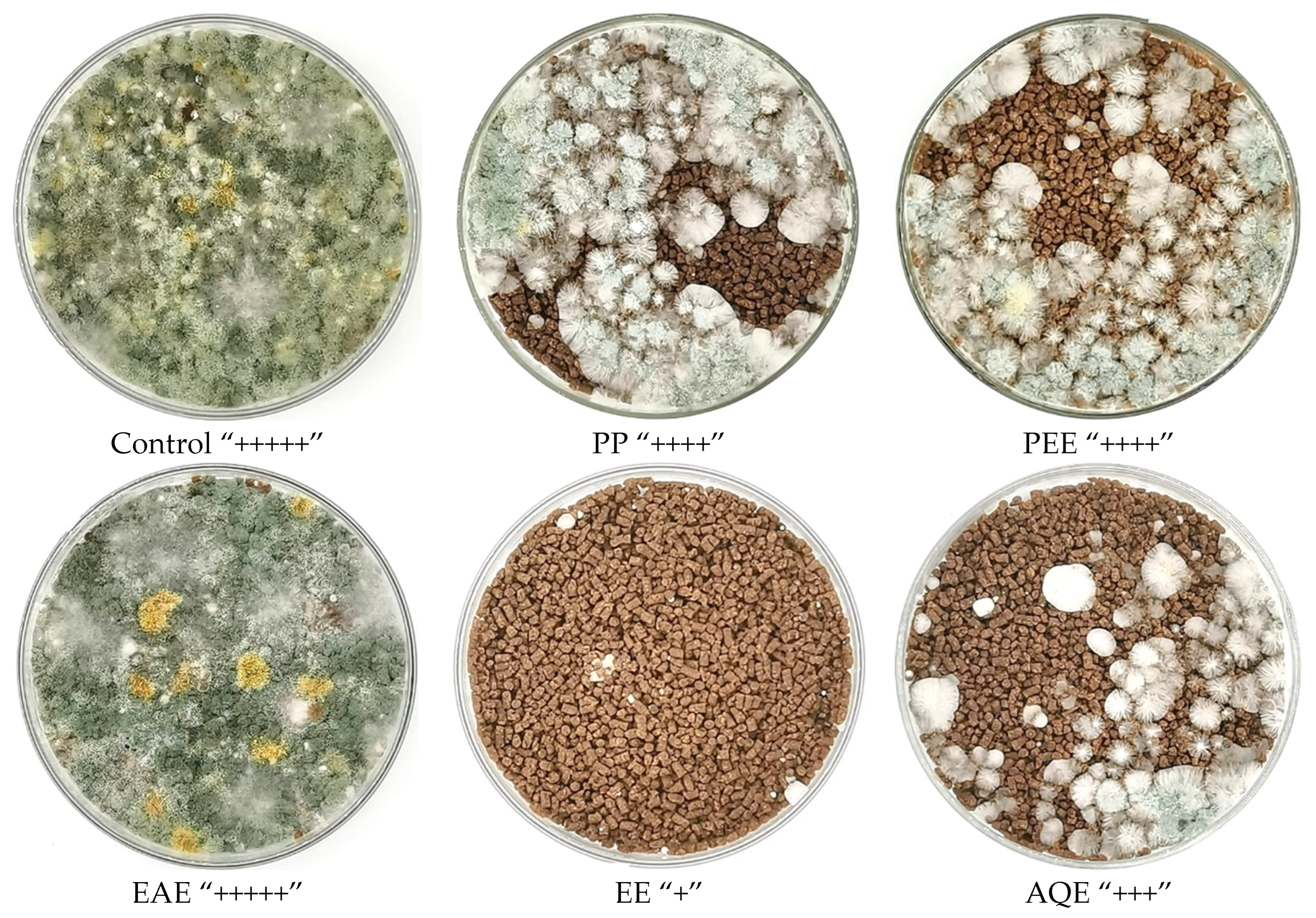
Data illustrated in Table 2 and Figure 1 show that, relative to the control group, the number of “+” in pellet feeds containing PP, PEE, EE, and AQE was significantly reduced (p < 0.05). The number of “+” in the EE group was the lowest in all treatment groups (p < 0.05). There was no significant difference in the number of “+” between PP, PEE, and AQE groups (p < 0.05). The count of “+” symbols across all experimental groups, ranked in descending order, was as follows: control = EAE > PEE > PP > AQE > EE. As indicated in Table 2, when contrasted with the control group, the level of moisture in pelleted feeds containing PP, PEE, and EE was significantly enhanced (p < 0.05). The EE group exhibited the highest moisture level among all treatment groups (p < 0.05). There was no significant difference in the levels of moisture in the control, EAE, and AQE groups (p < 0.05). Moisture content across all experimental groups, ranked from highest to lowest, was as follows: EE > PEE > PP > EAE > AQE > control (Table 2).
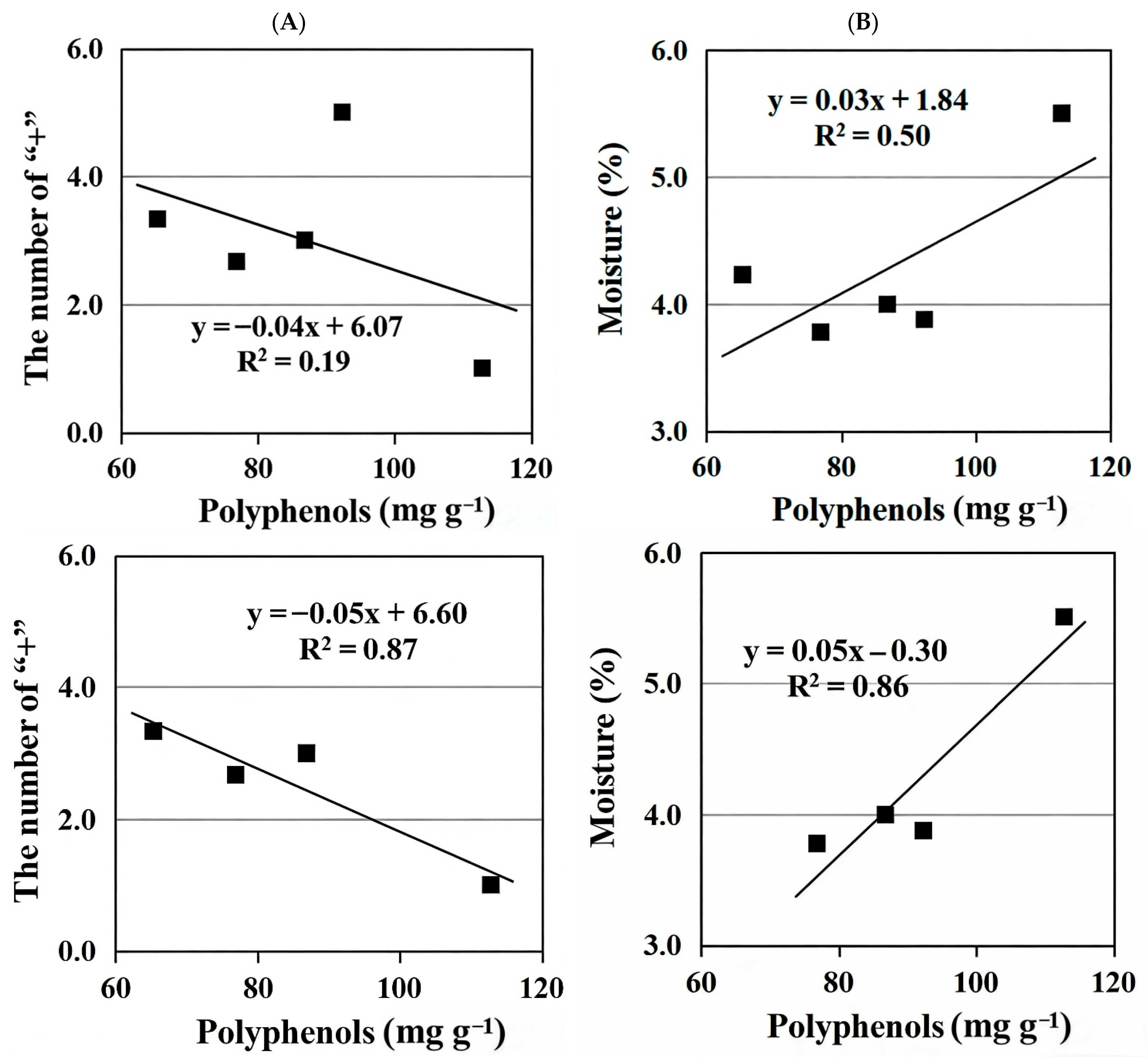
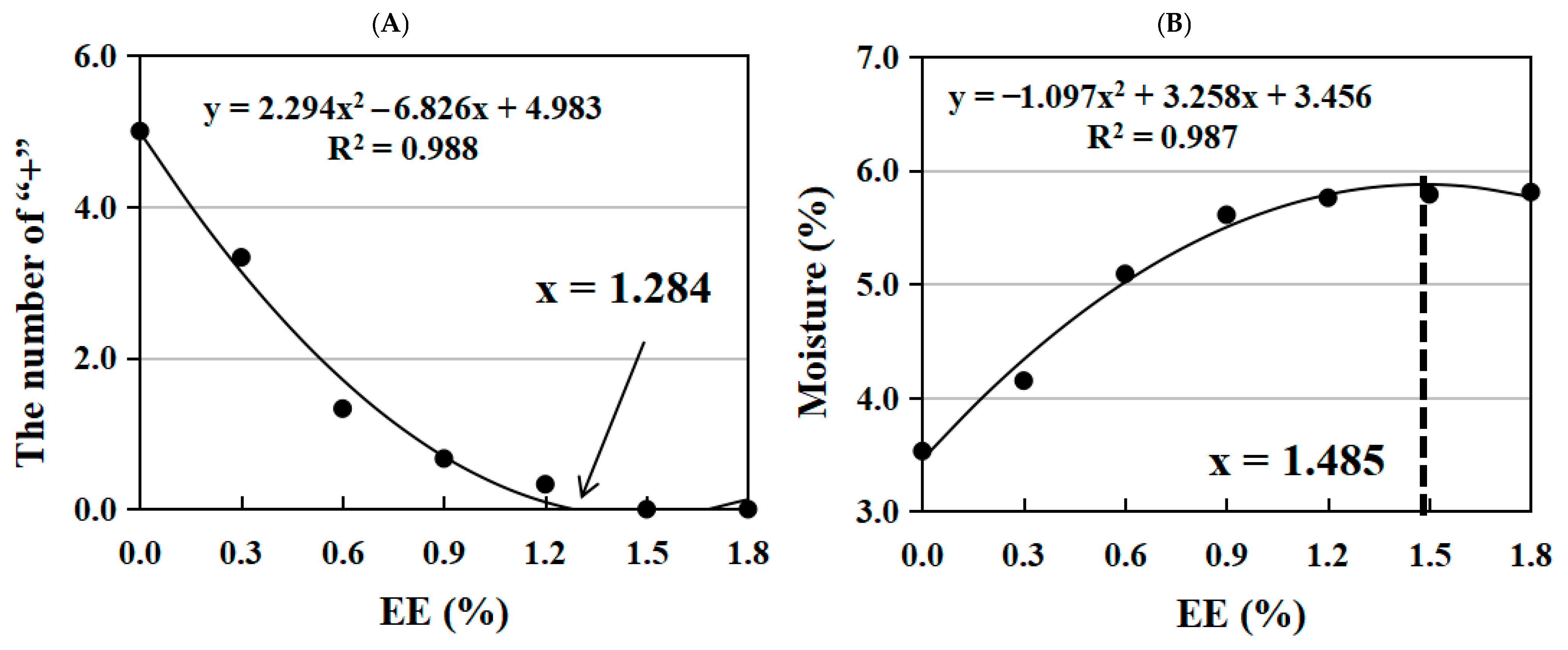
Figure 2 illustrates that, for pellet feeds with PP and different PPE additions, mold growth levels had a significant positive correlation with polyphenol content, and moisture content had a significant negative correlation with mold growth levels (p < 0.05). The effects of EE on mold growth and moisture levels in pelleted feeds are presented in Table 3. Compared with participants not receiving the treatment, the level of mold growth in pelleted feeds was significantly reduced with the increase in EE addition (p < 0.05, Table 3). The lowest value of mold growth was observed in the feeds containing 1.5% and 1.8% of EE (Table 3). However, curvilinear regression analysis indicated that the optimal addition level of EE for mold growth was 1.284% (Figure 3). In contrast to the control, EE addition significantly enhanced the moisture level in pelleted feeds containing 0.3% of EE (p < 0.05), which gradually increased with the increase in EE concentrations in the feeds (Table 3). Curvilinear regression analysis indicated that the optimal addition level of EE for moisture was 1.485% (Figure 3).

3.2. How Dietary EE Influences RFI in Jian Carp

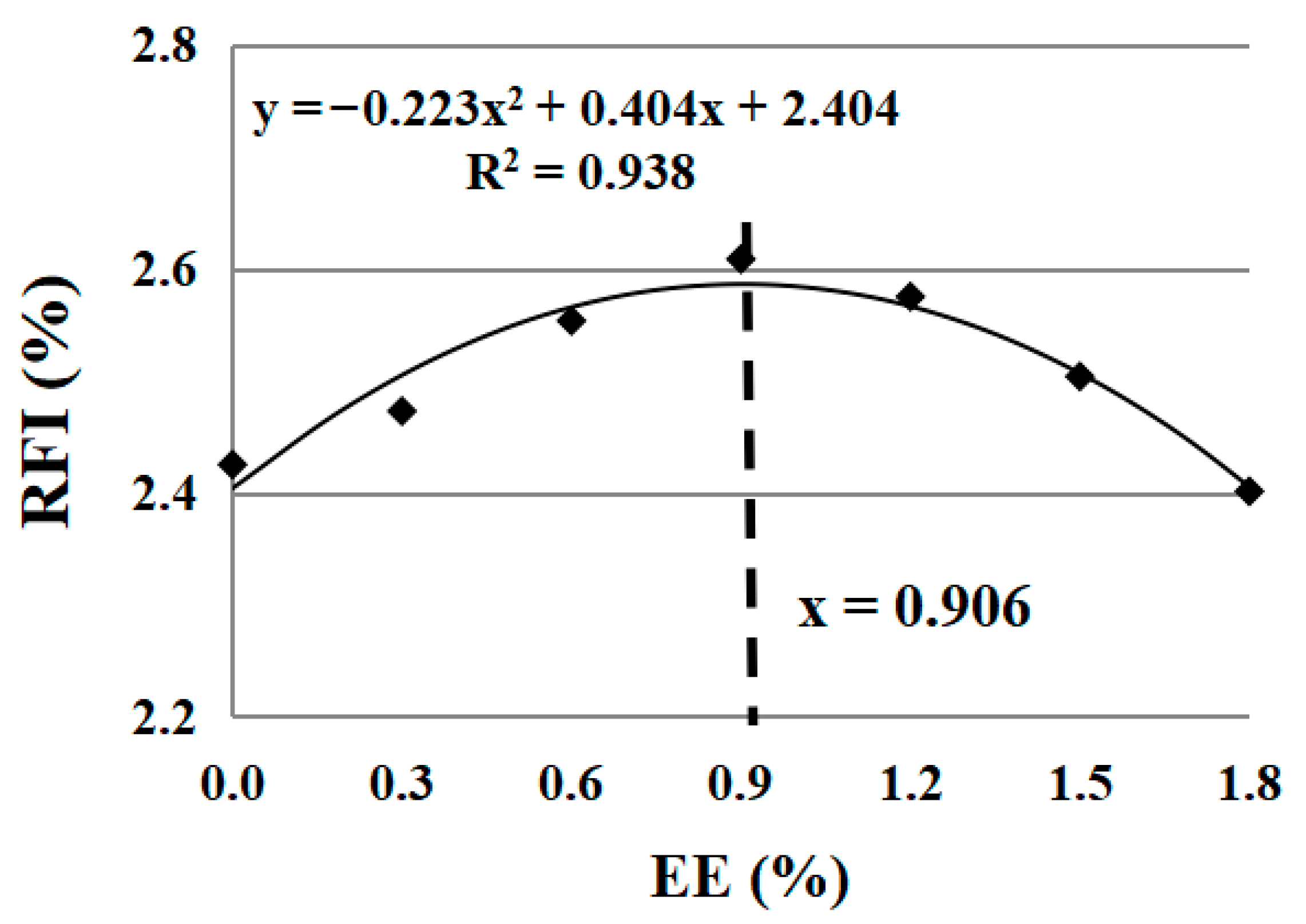
The effects of dietary supplementation with graded levels of EE on FI and RFI of Jian carp are presented in Table 4. Compared with participants not receiving the treatment, EE supplementation at 0.3% and 0.6% significantly enhanced FI and RFI, respectively (p < 0.05, Table 4). The highest values of FI and RFI were observed in carp fed the feed containing 0.9% of EE, whereas a decline was noted at 1.2% of EE supplementation (Table 4). Curvilinear regression analysis indicated that the optimal dietary levels of EE for RFI were determined to be 0.906% (Figure 4). Compared with the control, the 1.8% EE group exhibited significantly higher FBW, WG, and SGR (p < 0.05), while other EE groups showed no significant changes in these growth indices (p > 0.05, Table 4).

3.3. How Dietary EE Influences the Biochemical Parameters in the Plasma of Jian Carp

In comparison with the control group, GOT, GPT, and LDH activity exhibited a marked decrease in plasma of Jian carp fed 0.6%, 0.6%, and 0.9% of EE (p < 0.05) and reached the minimum value at 1.8%, 1.5%, and 1.5% of EE supplementation in feeds. GPT and LDH activity subsequently ascended as the supplemental level of EE increased (Table 5).

3.4. How Dietary EE Influences the Biochemical Index in the Intestines of Jian Carp

In comparison with the control, the activities of trypsin, pepsin, and AMS in the intestines of Jian carp were significantly increased at 1.5%, 0.9%, and 0.3% of EE addition, respectively (p < 0.05), which progressively increased with the increase in EE concentrations in feeds (Table 6). The activities of CTS, lipase, NKA, AKP, and γ-GT first increased and then decreased in the intestines of EE-treated carp. The biochemical indices above were significantly greater than those in the control group at 0.3%, 0.6%, 0.6%, 1.2%, and 0.9% of EE supplementation (p < 0.05), reaching peak values at 1.5%, 0.9%, 0.9%, 1.2%, and 1.5%, respectively, and subsequently declining with higher EE levels (Table 6).

3.5. How Dietary EE Influences the Biochemical Index in the Hepatopancreas of Jian Carp

Trypsin, CTS, lipase, AMS, and GST showed a trend of initial increase followed by a decline in hepatopancreas of carp treated with EE (Table 7). The biochemical indices above were higher than those in the control group at 0.3%, 0.3%, 0.9%, 0.3%, and 0.9% of EE supplementation (p < 0.05) and reached the maximum value at 1.2%, 0.6%, 1.2%, 0.6%, and 0.9% of EE addition, respectively, subsequently declining as the supplemental level of EE increased (Table 7). The level of GSH was increased and reached the maximum value at 0.6% of EE addition, but there was no significant difference compared to the control group (p < 0.05); then, it significantly decreased in the hepatopancreas of EE-treated carp (p < 0.05, Table 7). A progressive decline in H2O2 content was observed in the Jian carp hepatopancreas as dietary EE supplementation increased; notably, at an EE addition level of 0.6%, H2O2 content was significantly lower than that of the control group (p < 0.05, Table 7).

3.6. How Dietary EE Impacts Biochemical Parameters in the Erythrocytes of Jian Carp

The NKA, GOT, GPT, and LDH activities in red blood cells of EE-treated Jian carp exhibited biphasic responses, showing initial increases followed by decreases (Table 8). The activities of the above enzymes were higher than those in the control group at 0.6%, 0.6%, 0.3%, and 0.9% of EE supplementation (p < 0.05), reaching the highest values in 1.2%, 0.9%, 0.6%, and 1.5% of EE, respectively, and subsequently markedly declining when the supplemental level of EE increased (Table 8). The MetHb and H2O2 contents decreased first and then increased and were lower than those in the control group at 0.3% and 0.3% of EE supplementation (p < 0.05), reaching the lowest value at 1.2% and 1.5% of EE addition and subsequently ascending when the supplemental level of EE increased (Table 8). In contrast to the control, dietary EE supplementation at 0.6% significantly enhanced the CAT activity in red blood cells of Jian carp (p < 0.05), which demonstrated dose-dependent increases with rising dietary EE concentrations (Table 8).

3.7. How Dietary EE Influences Biochemical Parameters in the Gills of Jian Carp

The GSH level was gradually increased with the increase in EE supplementation and was higher than that in the control group at 1.2% of EE supplementation in the gills of Jian carp (p < 0.05, Table 9). The activities of NKA, AHR, CAT, and GPx increased first and then decreased in the gills of EE-treated Jian carp (Table 9). The activities of NKA, AHR, and CAT were significantly higher than those in the control group, peaking at EE supplementation levels of 0.3%, 0.3%, and 1.2%, respectively (p < 0.05), and then declining with further increases in EE concentration (Table 9). However, NKA activity was still significantly higher than that of the control group (p < 0.05). GPx activity was significantly greater than that in the control group at 0.3% of EE (p < 0.05), and it reached the highest value at 0.6% of EE and then decreased as the EE addition level increased (Table 9).

4. Discussion

4.1. The Anti-Mold and Water Retention Effects of PPE on Pellet Feeds

The low moisture content of pellet feed has caused unnecessary economic losses to production enterprises [14]. The results of this study indicated that supplementation with PP and PPE (PEE, EE, EAE, and AQE) all increased the moisture content in pellet feeds, with EE having the strongest effect. Curvilinear regression analysis based on moisture content showed that the appropriate additional amount of EE is 1.485% in pellet feeds. This result was consistent with the previous report that PP contributed to the moisture retention in sausages [16]. The effect of PP and PPE on the moisture content of pellet feeds may be related to the polyphenol content it contains. Previous reports have shown that polyphenols are one of the main bioactive components in pomegranate [17]. Our other research results showed that EE had the highest content of polyphenols among all PP and PPE (no data shown). Furthermore, this study demonstrated that the impacts of PP, EAE, EE, and AQE on the moisture content of pellet feeds are strongly correlated with their polyphenol contents. Therefore, the reason that PPE increases the moisture content of pellet feeds may be due to its rich polyphenols.
The increase in feed moisture content will facilitate the growth of mold [15]. This study indicated that PP, PEE, EE, and AQE reduced the growth of mold in pellet feeds, with EE having the strongest effect. Curvilinear regression analysis based on the mold growth shows that the appropriate additional amount of EE is 1.284% in pellet feeds. This result was in accordance with the reports that methanol, water, and ethanol extracts of PP showed antifungal activity [11,36]. The inhibitory effect of PP and PPE on the mold growth in pellet feeds may be closely related to their polyphenol level, also. A previous report has shown that pomegranate phenolic compounds exhibit a potent antifungal activity [37]. Plant polyphenols display a significant inhibitory effect on fungal growth in vitro [38]. Moreover, our research results showed that the effects of PP, PEE, EE, and AQE on the mold growth in pellet feeds are closely associated with their polyphenol content. However, there have been no reports on the effect of polyphenols on the moisture content of pellet feeds. It is worth noting that removing PEE and EAE increased the water retention and anti-mold activity of PP and PEE in relation to their polyphenol content, respectively. These results indicate that part of PPE has significant water retention and anti-mold effects on pellet feeds. PEE and EAE may contain substances that inhibit polyphenol activity. The detailed mechanism needs further research.

4.2. Dietary EE Improved the Digestive and Absorptive Function in Fish

Plasma GOT, GPT, and LDH activities serve as primary sensitive biomarkers for hepatocyte damage [39]. Hepatic tissue injury triggers the release of GOT, GPT, and LDH into circulation, elevating their plasma concentrations [40]. The current investigation showed that dietary EE supplementation significantly reduced plasma GOT, GPT, and LDH activities in carp. Consistent with the findings, dietary PP reduced the GOT and GPT activities in the serum of silver nanoparticles (AgNPs) and induced Nile tilapia (Oreochromis niloticus) [41]. The study indicated that weight gain was significantly improved in grass carp (Ctenopharyngodon idella) fed with aqueous and ethanolic extract of pomegranate peel for 70 days [42]. Feeding ethanolic extract of pomegranate peel for 60 days increased the growth parameters in roho labeo (Labeo rohita) [43]. These results confirm the non-toxic nature of EE in fish.
The growth performance shows a significant positive correlation with FI in fish [44]. The current experiment demonstrated that the EE-supplemented diet significantly enhanced RFI in Jian carp. Curvilinear regression analysis based on RFI indicated that the optimal supplementation level of EE was 0.906% of the diet. This result is in line with the report that supplementation of pomegranate peel improves FI in beef cattle [21]. One possible explanation for this alteration may be the improved digestive and absorptive capacity in fish. The efficiency of digestive and absorptive enzymes facilitates the breakdown of nutrients and directly helps improve appetite and nutrient utilization in fish [45]. Among them, pepsin, trypsin, and CTS play a vital role by catalyzing the hydrolysis of proteins and polypeptides into amino acids and small peptides [46]. Lipase mediates the hydrolysis of ester bonds in substrates including triglycerides, phospholipids, and cholesteryl esters [47]. AMS hydrolyzes starch into glucose and maltose [48]. Analysis of the results revealed that dietary EE increased the trypsin, CTS, lipase, and AMS activities in both hepatopancreas and intestines, as well as the pepsin activity in the intestines of carp. A similar trend was documented by [49] regarding lipase and AMS activities in ethanolic extracts of PP. These results confirm that dietary EE can improve the digestive function in fish.
Among the absorption enzymes, NKA mediates transmembrane transport of phosphate, amino acids, and glucose in animals [50]. AKP not only promotes the breakdown of phosphate compounds, resulting in the release of phosphate ions and alkaline products, but also facilitates nutrient absorption (including glucose, lipids, inorganic phosphate, and calcium) in the fish intestine [51,52]. γ-GT mediates gamma-glutamyl transfer to amino acid receptors (critical for cellular amino acid absorption) [53]. Our investigation revealed that dietary EE increased intestinal NKA, AKP, and γ-GT activities in carp. The collective data suggest that dietary EE can improve the absorptive function in fish. This result was consistent with a previous report showing that PP supplementation improved nutrient digestibility in broiler chicks [54]. Currently, the literature regarding EE’s effects on digestive and absorptive enzymes in fish hepatopancreas and intestines remains limited.
The hepatopancreas is not only the digestive organ but also the metabolic organ in fish [55]. Cells can continuously produce reactive oxygen species (ROS), including superoxide anions (O2·-), H2O2, and hydroxyl radicals (·OH), during metabolic processes [56]. ROS contribute significantly to the oxidative modification of cellular components, such as lipids and proteins, thereby inducing lipid peroxidation and impairing essential enzymatic functions in fish [57]. EE addition considerably reduced the H2O2 level in the hepatopancreas of carp. The present observation is consistent with prior research showing that ethanolic and hydroalcoholic extracts of PP exhibited significant inhibitory activity against H2O2 in vitro [43,58]. These results confirm that dietary EE inhibits the formation of ROS in the hepatopancreas of fish. The effects of EE on ROS are likely mediated through the antioxidant systems in fish. Fishes have evolved enzymatic antioxidants, like GST, and non-enzymatic antioxidants, like GSH. GST can mediate the conjugative reaction of lipid peroxide breakdown products, with glutathione acting as its substrate [10]. GSH can neutralize intracellular ROS in cells [59]. In this study, dietary EE significantly elevated the GST activity and GSH level in the hepatopancreas of carp. This outcome is in agreement with what has been reported previously, indicating that administration of PP at 2.0% of diet produced a significant increase in hepatic GST activity and GSH level in common carp [22]. This is confirmed by the present results that dietary EE can scavenge ROS by enhancing GST activity and GSH level in the hepatopancreas of fish.

4.3. Dietary EE Enhanced Respiratory Capacity in Fish

Gills are principally involved in respiratory gas exchange and the excretion of nitrogenous compounds, whereas red blood cells play a central role in the transport of O2 and CO2 [60]. In fish, NKA contributes significantly to the maintenance of gill membrane ion gradients [61] and the cytoplasmic ionic environment in red blood cells [62]. The present study indicated that dietary EE increased the activity of NKA in gills and red blood cells of carp. Adenosine triphosphate or energy is essential for effectively maintaining the cytoplasmic ionic milieu in mature red blood cells [63]. LDH acts as an essential role in the utilization of glucose to generate energy by anaerobic glycolysis in red blood cells of fish [62]. GOT and GPT play an important role in the utilization of amino acids as an energy source in the tricarboxylic acid cycle by deamination [60]. In this experiment, EE supplementation significantly elevated the activity levels of GOT, LDH, and GPT in the red blood cells of carp. There is a dearth of published research regarding the effects of EE on NKA, LDH, GOT, and GPT in the gills and red blood cells of fish species. Collectively, these results confirm that dietary EE augments the functional performance of gills and red blood cells in fish.
Oxygenated Hb can undergo spontaneous oxidation, resulting in the production of O2·- and MetHb that cannot bind O2 [64]. The gill is highly vulnerable to ROS damage owing to persistent environmental stress and the substantial number of red blood cells it contains in fish [65]. Collectively, this study showed the heightened activity of AHR in gills and the decreased levels of MetHb and H2O2 in red blood cells of carp. The polyphenolic compounds in pomegranate peel strongly scavenged O2·- and H2O2, inhibited the oxidation of Fe3+ in vitro [66], and markedly diminished ROS generation in human bladder cancer cells [58]. The findings demonstrate a decrease in ROS production and Hb oxidation in the respiration-associated tissues and organs of fish.
The enzymatic antioxidant system plays a critical role in sustaining the proper function of tissues and organs in aquatic animals [67]. Subsequently, H2O2 is detoxified by enzymes like CAT and GPx [68]. In the present study, EE addition elevated the activity of CAT in red blood cells and the activities of CAT and GPx, as well as the level of GSH in the gills of carp. The present observation aligns with previous reports showing that dietary methanolic extract of pomegranate peel improved the CAT and GPx activities as well as the GSH level in red blood cells of dogs [20]. Limited investigations have been conducted on the influence of EE on these parameters in fish red blood cells and gills. It is suggested by our study that dietary EE supplementation can reduce ROS formation and Hb oxidation through the elevation of enzymatic antioxidant activities and non-enzymatic antioxidant levels in fish respiration-related tissues and organs.

5. Conclusions

In summary, PPE has significant water retention and anti-mold effects on pellet feeds, especially EE, which has the strongest effect. According to regression analysis of mold and moisture levels, the optimal EE supplementation levels in pelleted feeds were found to be 1.284% and 1.485%, respectively. Moreover, this study revealed that the effects of PPE on mold growth and moisture level may be closely related to their polyphenol content. Dietary EE improves the digestive and absorptive function in fish. According to curvilinear regression analysis of RFI, the optimal EE addition level for fish was found to be 0.906%. This study reveals that the effects of EE on RFI are closely related to enhancing the activities of digestive and absorptive enzymes, as well as antioxidant capacity in the digestive organs of fish. Moreover, this research confirms that dietary EE supplementation enhances the respiratory capacity by improving functional metabolic enzyme activity and antioxidant defense in the respiration-related tissues and organs of fish. These findings highlight the potential of PPE as a naturally functional raw material in fish diets, offering guidance for its application in aquaculture.

Author Contributions

Designed the experiment, H.L. (Haijing Liu) and H.L. (Huatao Li); performed the feeding experiment, H.L. (Haijing Liu); conceptualization, H.L. (Haijing Liu) and H.L. (Huatao Li); methodology, M.W.; validation, J.H.; formal analysis, J.L.; resources, C.Z.; data curation, H.L. (Haijing Liu), M.W., J.H., J.L., C.Z. and H.Z.; writing—original draft preparation, H.L. (Haijing Liu) and H.L. (Huatao Li); writing—review and editing, J.X., Q.Y. and G.C. All authors have read and agreed to the published version of the manuscript.

Funding

This work was supported by the Sichuan Science and Technology Program [grant numbers 2018JY0214 and 2025ZNSFSC0206] and the Talent Program [grant number R2019015] of Neijiang Normal University.

Institutional Review Board Statement

The authors declare that all experimental procedures have strictly complied with the ethical policies specified on the journal’s author guidelines webpage. Additionally, the study has obtained the official approval of the Institutional Animal Care and Use Committee of Neijiang Normal University (approval code: JM2023-17, approval date: 30 September 2023). The authors further confirm that the research protocol fully conforms to the EU standards governing the protection of animals utilized for scientific research, as well as the relevant feed legislation requirements.

Data Availability Statement

The data of this study can be provided by the corresponding author upon request.

Conflicts of Interest

The authors declare no conflicts of interest.

Abbreviations

The following abbreviations are used in this manuscript:
Hbhemoglobin
GPxglutathione peroxidase
AHRanti-hydroxyl radical
GSTglutathione S-transferase
GSHreduced glutathione
GPTglutamate–pyruvate transaminase
GOTglutamate–oxaloacetate transaminase
LDHlactate dehydrogenase
H2O2hydrogen peroxide
CATcatalase
ARanalytical reagent
PEEpetroleum ether extract
EEethanol extract
AQEaqueous extract
EAEethyl acetate extract
PPpomegranate peel powder
PPEpomegranate peel extract
AOACAssociation of Official Analytical Chemists
FIfeed intake
RFIrate of feed intake
NKANa+, K+-ATPase
MetHbmethemoglobin
AMSα-amylase
CTStrypsin, chymotrypsin
γ-GTγ-glutamyl transpeptidase
AKPalkaline phosphatase
ROSreactive oxygen species
·OHhydroxyl radicals
O2·-superoxide anions
IBWinitial body weight
FBWfinal body weight
SRsurvival ratio
WGweight gain
SGRspecific growth rate

References

  1. Hardin, B.D.; Kelman, B.J.; Saxon, A. Adverse human health effects associated with molds in the indoor environment. J. Occup. Environ. Med. 2010, 45, 470–478. [Google Scholar]
  2. Bashorun, A.; Hassan, Z.U.; Al-Yafei, M.A.A.; Jaoua, S. Fungal contamination and mycotoxins in aquafeed and tissues of aquaculture fishes and their biological control. Aquaculture 2023, 576, 739892. [Google Scholar] [CrossRef]
  3. Nelson, C.E. Strategies of mold control in dairy feeds. J. Dairy Sci. 1993, 76, 898–902. [Google Scholar] [CrossRef] [PubMed]
  4. Temiraev, R.B.; Baeva, A.F.; Vityuk, L.A.; Yurina, N.A.; Yarmots, A.V.; Pshatsieva, Z.V. Effect of mold inhibitor and adsorbent on broilers digestive enzyme activities and meat productivity with reduced risk of aflatoxicosis. J. Pharm. Sci. Res. 2018, 10, 2900–2902. [Google Scholar]
  5. Greco, M.; Pardo, A.; Pose, G. Mycotoxigenic fungi and natural co-occurrence of mycotoxins in rainbow trout (Oncorhynchus mykiss) feeds. Toxins 2015, 7, 4595–4609. [Google Scholar] [CrossRef]
  6. Brake, J.; Hagler, W.M.; Jones, F.T. Effect of feeding diets containing corn treated with a commercial mold inhibitor (Myco Curb) on broiler-breeder performance. Poult. Sci. 1990, 69, 37–44. [Google Scholar] [CrossRef]
  7. Nahm, K.H. Use of mold inhibitor for feed storage and improved chick performance. Asian Australas. J. Anim. Sci. 1991, 4, 285–291. [Google Scholar] [CrossRef]
  8. Küçükkaya, S.; Arslan, B.; Soncu, E.D.; Ertürk, D.; Soyer, A. Effect of chitosan–essential oil, a surface mold inhibitor, on microbiological and physicochemical characteristics of semidried fermented sausages. J. Food Sci. 2020, 85, 1240–1247. [Google Scholar] [CrossRef]
  9. Tayel, A.A.; El-Madawy, K.M.; Moussa, S.H.; Assas, M.A. Application of Cystoseira myrica phycosynthesized selenium nanoparticles incorporated with nano-chitosan to control aflatoxigenic fungi in fish feed. J. Sci. Food Agric. 2024, 104, 7678–7687. [Google Scholar] [CrossRef]
  10. Liu, H.; Shi, X.; Huang, X.; Wang, M.; Li, J.; Zhang, S.; Xu, J.; Yang, Q.; Chen, G.; Li, H. Effects of pomegranate (Punica granatum) peel extract on hypoxia tolerance and biochemical markers in organs of Jian carp (Cyprinus carpio var. Jian). Aquac. Rep. 2025, 45, 103217. [Google Scholar] [CrossRef]
  11. Rongai, D.; Pulcini, P.; Di Lernia, G.; Nota, P.; Preka, P.; Milano, F. Punicalagin content and antifungal activity of different pomegranate (Punica granatum L.) genotypes. Horticulturae 2019, 5, 52. [Google Scholar] [CrossRef]
  12. Rosas-Burgos, E.C.; Burgos-Hernández, A.; Noguera-Artiaga, L.; Kačániová, M.; Hernández-García, F.; Cárdenas-López, J.L.; Carbonell-Barrachina, Á.A. Antimicrobial activity of pomegranate peel extracts as affected by cultivar. J. Sci. Food Agric. 2016, 97, 802–810. [Google Scholar] [CrossRef]
  13. Jiang, J.; Xu, S.; Feng, L.; Liu, Y.; Jiang, W.; Wu, P.; Wang, Y.; Zhao, Y.; Zhou, X. Lysine and methionine supplementation ameliorates high inclusion of soybean meal inducing intestinal oxidative injury and digestive and antioxidant capacity decrease of yellow catfish. Fish Physiol. Biochem. 2018, 44, 319–328. [Google Scholar] [CrossRef]
  14. Chew, K.K. Preconditioning: An Effective Approach to Maximizing Milling Efficiency, Feed Quality and Feed Mill Profitability. Livestock & Feed Business. 2017. Available online: https://www.efeedlink.com/cps/attachment/2017/june/2017062813595048442207.pdf (accessed on 28 June 2022).
  15. Hott, J.M.; Buchanan, N.P.; Cutlip, S.E.; Moritz, J.S. The effect of moisture addition with a mold inhibitor on pellet quality, feed manufacture, and broiler performance. J. Appl. Poult. Res. 2008, 17, 262–271. [Google Scholar] [CrossRef]
  16. Gharably, A.; Ashoush, I. Utilization impact of adding pomegranate rind powder and red beet powder as natural antioxidant on quality characteristics of beef sausage. World J. Dairy Food Sci. 2011, 6, 86–97. [Google Scholar]
  17. Akhtar, S.; Ismail, T.; Fraternale, D.; Sestili, P. Pomegranate peel and peel extracts: Chemistry and food features. Food Chem. 2015, 174, 417–425. [Google Scholar] [CrossRef] [PubMed]
  18. Cano-Lamadrid, M.; Martínez-Zamora, L.; Castillejo, N.; Artés-Hernández, F. From Pomegranate Byproducts Waste to Worth: A Review of Extraction Techniques and Potential Applications for Their Revalorization. Foods 2022, 11, 2596. [Google Scholar] [CrossRef] [PubMed]
  19. Saleh, H.; Golian, A.; Kermanshahi, H.; Mirakzehi, M.T. Effects of dietary α-tocopherol acetate, pomegranate peel, and pomegranate peel extract on phenolic content, fatty acid composition, and meat quality of broiler chickens. J. Appl. Anim. Res. 2016, 45, 629–636. [Google Scholar] [CrossRef]
  20. Jose, T.; Pattanaik, A.K.; Jadhav, S.E.; Dutta, N.; Sharma, S. Nutrient digestibility, hindgut metabolites and antioxidant status of dogs supplemented with pomegranate peel extract. J. Nutr. Sci. 2017, 6, e36. [Google Scholar] [CrossRef][Green Version]
  21. Shabtay, A.; Eitam, H.; Tadmor, Y.; Orlov, A.; Meir, A.; Weinberg, P.; Weinberg, Z.G.; Chen, Y.; Brosh, A.; Izhaki, I.; et al. Nutritive and antioxidative potential of fresh and stored pomegranate industrial byproduct as a novel beef cattle feed. J. Agric. Food Chem. 2008, 56, 10063–10070. [Google Scholar] [CrossRef]
  22. Yousefi, M.; Hoseini, S.M.; Kulikov, E.; Babichev, N.; Bolshakova, M.; Shopinskaya, M.; Rogov, R.; Zharov, A.N. Effects of dietary pomegranate peel supplementation on growth performance and biochemical responses of common carp, Cyprinus carpio, to chronic crowding stress. Aquac. Rep. 2023, 30, 101532. [Google Scholar] [CrossRef]
  23. Li, H.; Lu, L.; Wu, M.; Xiong, X.; Luo, L.; Ma, Y.; Liu, Y. The effects of dietary extract of mulberry leaf on growth performance, hypoxia-reoxygenation stress and biochemical parameters in various organs of fish. Aquac. Rep. 2020, 18, 100494. [Google Scholar] [CrossRef]
  24. Li, H.T.; Yang, D.D.; Li, Z.H.; He, M.Q.; Li, F.Y.; Jiang, J.; Tang, S.Y.; Peng, P.Y.; Du, W.H.; Ma, Y.T.; et al. Effects of Angelica sinensis extracts on lipid oxidation in fish feeds and growth performance of juvenile Jian carp (Cyprinus carpio var. Jian). Anim. Nutr. 2019, 5, 109–114. [Google Scholar] [CrossRef] [PubMed]
  25. Shiau, S.; Su, S. Juvenile tilapia (Oreochromis niloticus×Oreochromis aureus) requires dietary myo-inositol for maximal growth. Aquaculture 2005, 243, 273–277. [Google Scholar] [CrossRef]
  26. Zhou, X.Q.; Zhao, C.R.; Jiang, J.; Feng, L.; Liu, Y. Dietary lysine requirement of juvenile Jian carp (Cyprinus carpio var. Jian). Aquac. Nutr. 2008, 14, 381–386. [Google Scholar] [CrossRef]
  27. Hernández, A.; García, B.G.; Jordán, M.J.; Hernández, M.D. Natural antioxidants in extruded fish feed: Protection at different storage temperatures. Anim. Feed Sci. Technol. 2014, 195, 112–119. [Google Scholar] [CrossRef]
  28. Huang, X.L.; Wang, M.M.; Liu, H.J.; Yang, Q.H.; Zhang, H.L.; Chen, H.H.; Li, J.; Xu, J.; Chen, G.F.; Li, H.T. Protective effects of Angelica sinensis by-product on pellet feed and its effects on the growth and hypoxic stress in crucian carp. Chin. J. Anim. Nutr. 2025, 37, 1173–1187. [Google Scholar]
  29. GB5749−2006; Standards for Drinking Water Quality. National Standards of the People’s Republic of China: Beijing, China, 2022. Available online: https://openstd.samr.gov.cn/bzgk/gb/newGbInfo?hcno=99E9C17E3547A3C0CE2FD1FFD9F2F7BE (accessed on 28 June 2022).
  30. Xu, J.; Chen, G.; Wu, M.; Yang, Q.; Li, H. The extract of Astragalus membranaceus inhibits lipid oxidation in fish feed and enhances growth performance and antioxidant capacity in Jian carp (Cyprinus carpio var. Jian). Fishes 2023, 8, 594. [Google Scholar] [CrossRef]
  31. Hong, Y.; Jiang, W.D.; Kuang, S.Y.; Hu, K.; Tang, L.; Liu, Y.; Jiang, J.; Zhang, Y.A.; Zhou, X.Q.; Feng, L. Growth, digestive and absorptive capacity and antioxidant status in intestine and hepatopancreas of sub-adult grass carp Ctenopharyngodon idella fed graded levels of dietary threonine. J. Anim. Sci. Biotechnol. 2015, 6, 34. [Google Scholar] [CrossRef]
  32. Jiang, W.D.; Feng, L.; Liu, Y.; Jiang, J.; Zhou, X.Q. Myo-inositol prevents oxidative damage, inhibits oxygen radical generation and increases antioxidant enzyme activities of juvenile Jian carp (Cyprinus carpio var. Jian). Aquac. Res. 2009, 40, 1770–1776. [Google Scholar] [CrossRef]
  33. Li, H.; Tang, S.; Du, W.; Jiang, J.; Peng, P.; Yuan, P.; Liao, Y.; Long, J.; Zhou, S. The effects of ethoxyquin and Angelica sinensis extracts on lipid oxidation in fish feeds and growth, digestive and absorptive capacities and antioxidant status in juvenile red carp (Cyprinus carpio var. xingguonensis): A comparative study. Fish Physiol. Biochem. 2019, 45, 43–61. [Google Scholar] [CrossRef]
  34. Bradford, M.M. A rapid and sensitive method for the quantitation of microgram quantities of protein utilizing the principle of protein-dye binding. Anal. Biochem. 1976, 72, 248–254. [Google Scholar] [CrossRef] [PubMed]
  35. Darbkin, D.L. Spectrophotometric studies. XIV the crystallographic and optical properties of the hemoglobin of man in comparison with these of other species. J. Biol. Chem. 1946, 164, 703–772. [Google Scholar]
  36. Gosset-Erard, C.; Zhao, M.; Lordel-Madeleine, S.; Ennahar, S. Identification of punicalagin as the bioactive compound behind the antimicrobial activity of pomegranate (Punica granatum L.) peels. Food Chem. 2021, 352, 129396. [Google Scholar] [CrossRef]
  37. Brighenti, V.; Iseppi, R.; Pinzi, L.; Mincuzzi, A.; Ippolito, A.; Messi, P.; Sanzani, S.M.; Rastelli, G.; Pellati, F. Antifungal Activity and DNA Topoisomerase Inhibition of Hydrolysable Tannins from Punica granatum L. Int. J. Mol. Sci. 2021, 22, 4175. [Google Scholar] [CrossRef] [PubMed]
  38. Li, Z.-J.; Guo, X.; Dawuti, G.; Aibai, S. Antifungal activity of ellagic acid in vitro and in vivo. Phytother. Res. 2015, 29, 1019–1025. [Google Scholar] [CrossRef]
  39. Akrami, R.; Gharaei, A.; Mansour, M.R.; Galeshi, A. Effects of dietary onion (Allium cepa) powder on growth, innate immune response and hemato–biochemical parameters of beluga (Huso huso Linnaeus, 1754) juvenile. Fish Shellfish Immunol. 2015, 45, 828–834. [Google Scholar] [CrossRef]
  40. Kumar, O.; Sugendran, K.; Vijayaraghavan, R. Oxidative stress associated hepatic and renal toxicity induced by ricin in mice. Toxicon 2003, 41, 333–338. [Google Scholar] [CrossRef]
  41. Hamed, H.S.; Abdel-Tawwab, M. Dietary pomegranate (Punica granatum) peel mitigated the adverse effects of silver nanoparticles on the performance, haemato-biochemical, antioxidant, and immune responses of Nile tilapia fingerlings. Aquaculture 2021, 540, 736742. [Google Scholar] [CrossRef]
  42. Fazaa, H.A.; Sultan, F.A.M.; Sayed-Lafi, R.M. Growth performance, antioxidants, intestinal microbial composition and histological effect of grass carp (Ctenopharyngodon idella) through diets enriched to pomegranate peel (Punica granatum) extracts. J. Ilm. Perikan. Dan Kelaut. 2024, 16, 473–484. [Google Scholar] [CrossRef]
  43. Patra, O.; Shamna, N.; Sardar, P.; Jayant, M.; Sahu, N.P.; Deo, A.D.; Rani, A.M.B.; Giri, N.A.; Kishore, P.S.; Bhusare, S. Dietary Supplemented Pomegranate Peel Ethanolic Extract Improves Growth, IGF-1 Expression and Immune Responses in Labeo Rohita Fingerlings Reared in Varying Stocking Densities. Waste Biomass Valorization 2024, 15, 6847–6863. [Google Scholar] [CrossRef]
  44. Zhou, X.Q.; Zhao, C.R.; Lin, Y. Compare the effect of diet supplementation with uncoated or coated lysine on juvenile Jian Carp (Cyprinus carpio var. Jian). Aquac. Nutr. 2007, 13, 457–461. [Google Scholar] [CrossRef]
  45. Li, H.; Wu, M.; Jiang, J.; Sun, X.; Chen, L.; Feng, M.; Yuan, D.; Wen, Z.; Qin, C. The extracts of Angelica sinensis restore the digestive and absorptive capacity through improving antioxidant status in digestive organs of fish treated with trichlorfon. Aquac. Res. 2019, 50, 490–504. [Google Scholar] [CrossRef]
  46. Tengjaroenkul, B.; Smith, B.J.; Caceci, T.; Smith, S.A. Distribution of intestinal enzyme activities along the intestinal tract of cultured Nile tilapia, Oreochromis niloticus L. Aquaculture 2000, 182, 317–327. [Google Scholar] [CrossRef]
  47. Wong, H.; Schotz, M.C. The lipase gene family. J. Lipid Res. 2002, 43, 993–999. [Google Scholar] [CrossRef]
  48. Agrawal, V.; Sastry, K.; Kaushab, S. Digestive enzymes of three teleost fishes. Acta Physiol. Acad. Sci. Hung. 1975, 46, 93–98. [Google Scholar]
  49. Kupnik, K.; Primožič, M.; Vasić, K.; Knez, Ž.; Leitgeb, M. A Comprehensive Study of the Antibacterial Activity of Bioactive Juice and Extracts from Pomegranate (Punica granatum L.) Peels and Seeds. Plants 2021, 10, 1554. [Google Scholar] [CrossRef]
  50. Geering, K. Subunit assembly and functional maturation of Na,K-ATPase. J. Membr. Biol. 1990, 115, 109–121. [Google Scholar] [CrossRef]
  51. Al-Hussaini, A.H. Alkaline phosphatase in fish gut. Nature 1948, 161, 274–275. [Google Scholar] [CrossRef]
  52. Villanueva, J.; Vanacore, R.; Goicoechea, O.; Amthauer, R. Intestinal alkaline phosphatase of the fish Cyprinus carpio: Regional distribution and membrane association. J. Exp. Zool. Part A Ecol. Genet. Physiol. 1997, 279, 347–355. [Google Scholar]
  53. Koven, W.; Rojas-Garcia, C.R.; Finn, R.N.; Tandler, A.; Rønnestad, I. Stimulatory effect of ingested protein and/or free amino acids on the secretion of the gastro-endocrine hormone cholecystokinin and on tryptic activity, in early-feeding herring larvae, Clupea harengus. Mar. Biol. 2002, 140, 1241–1247. [Google Scholar]
  54. Akuru, E.A.; Mpendulo, C.T.; Oyeagu, C.E.; Nantapo, C.W.T. Pomegranate (Punica granatum L.) peel powder meal supplementation in broilers: Effect on growth performance, digestibility, carcase and organ weights, serum and some meat antioxidant enzyme biomarkers. Ital. J. Anim. Sci. 2021, 20, 119–131. [Google Scholar] [CrossRef]
  55. Liu, Y.; Feng, L.; Jiang, J.; Liu, Y.; Zhou, X.Q. Effects of dietary protein levels on the growth performance, digestive capacity and amino acid metabolism of juvenile Jian carp (Cyprinus carpio var. Jian). Aquac. Res. 2009, 40, 1073–1082. [Google Scholar] [CrossRef]
  56. Matés, J.M.; Sanchez-Jimenez, F.M. Role of reactive oxygen species in apoptosis: Implications for cancer therapy. Int. J. Biochem. Cell Biol. 2000, 32, 157–170. [Google Scholar] [CrossRef]
  57. Li, H.; Liu, H.; Wu, S.; Ai, C.; Yang, Q.; Jia, J.; Xu, X.; Wu, M.; Jiang, J. Effects of ferulic acid on respiratory metabolism, oxidative lesions, and apoptotic parameters in gills and red blood cells of carp (Cyprinus carpio var. Jian) response to copper. Antioxidants 2024, 13, 314. [Google Scholar] [CrossRef]
  58. Benchagra, L.; Berrougui, H.; Islam, M.O.; Ramchoun, M.; Boulbaroud, S.; Hajjaji, A.; Fulop, T.; Ferretti, G.; Khalil, A. Antioxidant Effect of Moroccan Pomegranate (Punica granatum L. Sefri Variety) Extracts Rich in Punicalagin against the Oxidative Stress Process. Foods 2021, 10, 2219. [Google Scholar] [CrossRef]
  59. Martínez-Álvarez, R.M.; Morales, A.E.; Sanz, A. Antioxidant Defenses in Fish: Biotic and Abiotic Factors. Rev. Fish Biol. Fish. 2005, 15, 75–88. [Google Scholar] [CrossRef]
  60. Li, H.-T.; Wu, M.; Wang, J.; Qin, C.-J.; Long, J.; Zhou, S.-S.; Yuan, P.; Jing, X.-Q. Protective role of Angelica sinensis extract on trichlorfon-induced oxidative damage and apoptosis in gills and erythrocytes of fish. Aquaculture 2020, 519, 734895. [Google Scholar] [CrossRef]
  61. Lingwood, D.; Harauz, G.; Ballantyne, J.S. Regulation of fish gill Na+-K+-ATPase by selective sulfatide-enriched raft partitioning during seawater adaptation. J. Biol. Chem. 2005, 280, 36545–36550. [Google Scholar] [CrossRef]
  62. Cimen, M.Y. Free radical metabolism in human erythrocytes. Clin. Chim. Acta 2008, 390, 1–11. [Google Scholar] [CrossRef]
  63. Phillips, M.C.L.; Moyes, C.D.; Tufts, B.L. The effects of cell ageing on metabolism in Rainbow trout (Oncorhynchus mykiss) red blood cells. J. Exp. Biol. 2000, 203, 1039–1045. [Google Scholar] [CrossRef]
  64. Johnson, R.M.; Goyette, G., Jr.; Ravindranath, Y.; Ho, Y.S. Hemoglobin autoxidation and regulation of endogenous H2O2 levels in erythrocytes. Free Radic. Biol. Med. 2005, 39, 1407–1417. [Google Scholar] [CrossRef]
  65. Sinha, A.K.; Zinta, G.; AbdElgawad, H.; Asard, H.; Blust, R.; De Boeck, G. High environmental ammonia elicits differential oxidative stress and antioxidant responses in five different organs of a model estuarine teleost (Dicentrarchus labrax). Comp. Biochem. Physiol. Part C Toxicol. Pharmacol. 2015, 174–175, 21–31. [Google Scholar] [CrossRef]
  66. Sun, Y.-Q.; Tao, X.; Men, X.-M.; Xu, Z.-W.; Wang, T. In vitro and in vivo antioxidant activities of three major polyphenolic compounds in pomegranate peel: Ellagic acid, punicalin, and punicalagin. J. Integr. Agric. 2017, 16, 1808–1818. [Google Scholar] [CrossRef]
  67. Winston, G.W.; Giulioz, R.T.D. Prooxidant and antioxidant mechanisms in aquatic organisms. Aquat. Toxicol. 1991, 19, 137–161. [Google Scholar] [CrossRef]
  68. Ni, M.; Liu, M.; Lou, J.; Mi, G.; Yuan, J.; Gu, Z. Stocking density alters growth performance, serum biochemistry, digestive enzymes, immune response, and muscle quality of largemouth bass (Micropterus salmoides) in in-pond raceway system. Fish Physiol. Biochem. 2021, 47, 1243–1255. [Google Scholar] [CrossRef]
Figure 1. Picture of mold growth in pellet feeds supplemented with pomegranate peel powder (PP), petroleum ether extract (PEE), ethyl acetate extract (EAE), ethanol extract (EE), and aqueous extract (AQE) after 12 weeks. Note: The degree of mold growth in the feed samples was indicated by the number of “+” symbols on the culture plates. A rating of “+++++” denoted that mold covered the entire surface of the plate; “++++” meant mold accounted for the majority of the plate area; “+++” represented mold coverage of approximately 50% of the plate; “+” signified only scattered mold colonies on the plate.
Fishes 11 00216 g001
Figure 2. The correlations of the levels of mold growth (A) and moisture (B) in pelleted feeds with polyphenol content in powder and extracts of pomegranate peel.
Fishes 11 00216 g002
Figure 3. Curvilinear regression analysis of mold growth (A) and moisture (B) levels in pelleted feeds containing graded levels of ethanol extract (EE) of pomegranate peel.
Fishes 11 00216 g003
Figure 4. Curvilinear regression analysis of the rate of feed intake (RFI) of Jian carp fed graded levels of ethanol extract (EE) of pomegranate peel for 15 days.
Fishes 11 00216 g004
Table 1. Composition and nutrient content of the basal diet.
Ingredients a%Proximate Analysis%
Fish meal14.00Dry matter93.08
Soybean meal15.00Crude protein34.12
Meat and bone meal5.00Crude lipid5.47
Corn gluten meal13.00Crude ash6.09
Rapeseed meal8.00
Wheat flour38.00
Fish oil1.60
Corn oil0.70
DL-methionine0.70
Lysine0.70
Threonine0.70
Ca(H2PO4)20.60
Vitamin mixture b1.00
Mineral mixture c1.00
Note: a Fish meal was produced from PESKUERA HAYDUK S. A. (Santiago de Surco, Peru) Soybean meal, meat and bone meal, corn gluten meal, DL-methionine, lysine, threonine, Ca(H2PO4)2, and rapeseed meal were purchased from Shijiazhuang Chenxi Yongsheng Trading Co., Ltd (Shijiazhuang, China). Wheat flour and corn oil was purchased from Sichuan Yonghui Supermarket Co., Ltd (Neijiang, China). Fish oil (feed grade) was purchased from Qingdao Meiweiyuan Biotechnology Co., Ltd (Qingdao, China). Vitamin mixture and mineral mixture were produced from DSM Vitamin (Shanghai, China) Co., Ltd. b Per kg of vitamin mix: cholecalciferol (500,000 IU g−1), 0.48 g; retinyl acetate (500,000 IU g−1), 0.80 g; menadione (23%), 0.43 g; DL-α-tocopherol acetate (50%), 20.00 g; riboflavine (80%), 0.63 g; thiamin nitrate (90%), 0.11 g; cyanocobalamin (1%), 0.10 g; pyridoxine HCl (81%), 0.92 g; D-calcium pantothenate (90%), 2.73 g; ascorhyl acetate (93%), 7.16 g; D-biotin (2%), 5.00 g; niacin (99%), 2.82 g; folic acid (96%), 0.52 g; and meso-inositol (99%), 52.33 g. c Per kg of mineral mix: CuSO4·5H2O (25% Cu), 1.20 g; FeSO4·7H2O (20% Fe), 69.70 g; MnSO4·H2O (32% Mn), 4.09 g; ZnSO4·7H2O (23% Zn), 21.64 g; KI (4% I), 2.90 g; CaCO3, 897.98 g; and Na2SeO3·5H2O (1% Se), 2.50 g.
Table 2. The levels of mold growth and moisture in pelleted feeds containing powder (PP), petroleum ether extract (PEE), ethyl acetate extract (EAE), ethanol extract (EE), and aqueous extract (AQE) of pomegranate peel.
ExtractsThe Number of “+”Moisture (%)
Control5.00 ± 0.00 a3.50 ± 0.00 c
PP3.00 ± 0.82 b4.00 ± 0.00 b
PEE3.33 ± 0.47 b4.23 ± 0.05 b
EAE5.00 ± 0.00 a3.88 ± 0.25 bc
EE1.00 ± 0.00 c5.50 ± 0.00 a
AQE2.67 ± 0.47 b3.78 ± 0.05 bc
Note: The growth level of mold in feeds is represented by the number of “+”. Values are mean ± SD of three replicates. Values with the different superscripts in the same column are significantly different (p < 0.05 by Duncan’s test).
Table 3. The levels of mold growth and moisture in pelleted feeds containing graded levels of ethanol extract (EE) of pomegranate peel.
EE (%)The Number of “+”Moisture (%)
0.05.00 ± 0.00 a3.53 ± 0.12 d
0.33.33 ± 0.47 b4.15 ± 0.23 c
0.61.33 ± 0.47 c5.09 ± 0.18 b
0.90.67 ± 0.47 cd5.61 ± 0.25 a
1.20.33 ± 0.47 d5.76 ± 0.15 a
1.50.00 ± 0.00 d5.79 ± 0.22 a
1.80.00 ± 0.00 d5.81 ± 0.16 a
Note: The level of mold growth in feeds is represented by the number of “+”. Values are mean ± SD of three replicates. Values with the different superscripts in the same column are significantly different (p < 0.05 by Duncan’s test).
Table 4. Initial body weight (IBW), final body weight (FBW), weight gain (WG), specific growth rate (SGR), feed intake (FI), rate of FI (RFI), and survival ratio (SR) in Jian carp fed graded levels of ethanol extract (EE) of pomegranate peel for 15 days.
EE (%)IBW (g Fish−1)FBW (g Fish−1)WG (g Fish−1)SGR (% d−1)FI (g Fish−1)RFI (%)SR (%)
0.011.97 ± 0.21 a14.18 ± 0.33 b2.22 ± 0.23 b1.13 ± 0.10 b4.76 ± 0.05 d2.43 ± 0.05 d100.00 ± 0.00 a
0.312.02 ± 0.18 a14.12 ± 0.06 b2.10 ± 0.13 b1.07 ± 0.08 b4.85 ± 0.03 c2.47 ± 0.01 cd100.00 ± 0.00 a
0.612.05 ± 0.13 a14.03 ± 0.10 b1.98 ± 0.13 b1.02 ± 0.07 b5.00 ± 0.02 b2.55 ± 0.03 ab100.00 ± 0.00 a
0.912.02 ± 0.26 a13.93 ± 0.35 b1.92 ± 0.15 b0.99 ± 0.07 b5.08 ± 0.01 a2.61 ± 0.06 a100.00 ± 0.00 a
1.212.05 ± 0.13 a14.10 ± 0.13 b2.05 ± 0.13 b1.05 ± 0.07 b5.05 ± 0.01 a2.58 ± 0.03 ab100.00 ± 0.00 a
1.512.05 ± 0.15 a14.27 ± 0.13 ab2.22 ± 0.15 b1.13 ± 0.08 b4.94 ± 0.03 b2.50 ± 0.02 bc100.00 ± 0.00 a
1.811.98 ± 0.19 a14.65 ± 0.31 a2.67 ± 0.20 a1.34 ± 0.09 a4.80 ± 0.05 cd2.40 ± 0.06 d100.00 ± 0.00 a
Note: Values are means ± SD of three replicates, with 20 fish in each replicate. Values in the same column with the different superscripts are significantly different (p < 0.05 by Duncan’s test).
Table 5. The activities of glutamate–oxaloacetate transaminase (GOT), glutamate–pyruvate transaminase (GPT), and lactate dehydrogenase (LDH) in the plasma of Jian carp fed graded levels of ethanol extract (EE) of pomegranate peel for 15 days.
EE (%)GOT (U g−1 Protein)GPT (U g−1 Protein)LDH (U g−1 Protein)
0.097.72 ± 19.29 a32.72 ± 2.33 a852.21 ± 63.27 a
0.3103.74 ± 14.90 a31.56 ± 1.72 a791.54 ± 66.95 ab
0.676.26 ± 8.12 b24.95 ± 4.53 bc791.91 ± 20.18 ab
0.978.52 ± 14.63 b25.80 ± 2.94 bc749.63 ± 72.51 bc
1.261.95 ± 7.20 bc24.88 ± 2.53 bc697.43 ± 10.70 cd
1.565.49 ± 11.66 bc24.06 ± 2.84 c642.28 ± 34.33 d
1.855.14 ± 4.76 c30.10 ± 2.14 ab644.49 ± 18.85 d
Note: Values are means ± SD of three replicates, with five fish in each replicate. Values in the same column with the different superscripts are significantly different (p < 0.05 by Duncan’s test).
Table 6. The activities of trypsin, chymotrypsin (CTS), pepsin, lipase, α-amylase (AMS), Na+, K+-ATPase (NKA), alkaline phosphatase (AKP), and γ-glutamyl transpeptidase (γ-GT) in the intestines of Jian carp fed graded levels of ethanol extract (EE) of pomegranate peel for 15 days.
EE (%)Trypsin (U mg Protein−1)CTS (U mg−1 Protein)Pepsin (U mg−1 Protein)Lipase (U g Protein−1)AMS (U mg Protein−1)NKA (U mg Protein−1)AKP (U g Protein−1)γ-GT (U g Protein−1)
0.0689.81 ± 112.26 c20.41 ± 1.75 c8.72 ± 0.85 d21.28 ± 4.22 c0.93 ± 0.08 c5.21 ± 0.96 c205.62 ± 3.63 c4.12 ± 0.33 b
0.3664.15 ± 87.53 c28.67 ± 2.52 b12.55 ± 1.38 d25.45 ± 6.21 bc1.06 ± 0.08 b6.11 ± 0.76 bc224.66 ± 9.05 bc4.2 ± 0.80 b
0.6789.82 ± 136.96 bc29.77 ± 4.89 b9.73 ± 1.33 d31.69 ± 3.06 ab1.11 ± 0.10 b6.5 ± 1.02 ab224.44 ± 10.56 bc4.04 ± 0.41 b
0.9810.41 ± 115.15 bc36.39 ± 5.12 ab18.2 ± 1.88 c36.92 ± 5.60 a1.26 ± 0.01 a7.68 ± 0.84 a221.31 ± 1.70 bc5.6 ± 0.64 a
1.2787.76 ± 150.88 bc35.46 ± 5.88 ab24.25 ± 3.05 b32.43 ± 3.68 ab1.37 ± 0.08 ab7.2 ± 1.57 ab254.37 ± 12.99 a5.5 ± 0.63 a
1.5961.57 ± 134.44 ab38.18 ± 5.74 a28.03 ± 3.62 ab31.67 ± 6.61 ab1.33 ± 0.10 ab5.97 ± 0.43 bc237.88 ± 16.09 ab6.35 ± 0.55 a
1.81114.99 ± 164.09 a34.82 ± 6.47 ab29.66 ± 4.55 a31.06 ± 2.74 ab1.47 ± 0.12 a5.89 ± 0.50 bc232.64 ± 15.62 b5.58 ± 0.56 a
Note: Values are means ± SD of three replicates, with five fish in each replicate. Values in the same column with the different superscripts are significantly different (p < 0.05 by Duncan’s test).
Table 7. The activities of trypsin, chymotrypsin (CTS), lipase, α-amylase (AMS), and glutathione S-transferase (GST), as well as the levels of reduced glutathione (GSH) and hydrogen peroxide (H2O2), in the hepatopancreas of Jian carp fed graded levels of ethanol extract (EE) of pomegranate peel for 15 days.
EE (%)Trypsin (U mg−1 Protein)CTS (U mg−1 Protein)Lipase (U mg−1 Protein)AMS (U mg Protein−1)H2O2 (mmol g−1 Protein)GSH (mg g−1 Protein)GST (U mg−1 Protein)
0.0489.27 ± 38.26 d17.09 ± 2.78 d29.54 ± 3.34 d0.58 ± 0.09 c21.67 ± 2.00 a9.27 ± 1.29 ab100.02 ± 17.81 bc
0.3665.17 ± 84.07 c29.54 ± 2.44 b30.59 ± 1.99 d0.95 ± 0.13 ab19.79 ± 1.60 ab9.32 ± 0.57 ab100.62 ± 10.82 bc
0.6983.69 ± 52.54 b44.06 ± 5.88 a37.74 ± 7.72 bc1.08 ± 0.15 a18.14 ± 1.61 b10.05 ± 0.51 a112.89 ± 11.67 ab
0.91366.51 ± 140.19 a27.59 ± 4.27 bc45.90 ± 5.41 bc0.97 ± 0.13 ab16.14 ± 0.54 c9.51 ± 0.87 ab120.25 ± 14.65 a
1.21369.19 ± 97.92 a21.85 ± 3.54 cd56.11 ± 10.81 a0.96 ± 0.13 ab14.86 ± 1.22 c8.46 ± 0.64 b94.69 ± 5.79 bc
1.5877.32 ± 126.73 b21.75 ± 4.39 cd54.34 ± 4.44 ab0.84 ± 0.08 b14.95 ± 1.12 c8.58 ± 0.89 b100.17 ± 13.75 bc
1.8830.74 ± 152.61 b16.30 ± 2.42 d49.47 ± 6.44 ab0.79 ± 0.12 b11.41 ± 0.27 d8.45 ± 0.30 b92.01 ± 3.30 c
Note: Values are means ± SD of three replicates, with five fish in each replicate. Values in the same column with the different superscripts are significantly different (p < 0.05 by Duncan’s test).
Table 8. The activities of Na+, K+-ATPase (NKA), glutamate–oxaloacetate transaminase (GOT), glutamate–pyruvate transaminase (GPT), lactate dehydrogenase (LDH), and catalase (CAT), as well as the levels of methemoglobin (MetHb) and hydrogen peroxide (H2O2), in red blood cells of Jian carp fed graded levels of ethanol extract (EE) of pomegranate peel for 15 days.
EE (%)NKA (U mg Protein−1)GOT (U g−1 Protein)GPT (U g−1 Protein)LDH (U g−1 Protein)MetHb (g L−1)H2O2 (mmol g−1 Protein)CAT (U mg−1 Protein)
0.00.51 ± 0.03 c11.88 ± 1.51 d8.9 ± 0.49 c87.69 ± 10.91 c3.23 ± 0.29 a56.34 ± 7.77 a4.73 ± 0.45 c
0.30.68 ± 0.08 c14.63 ± 1.64 d13.14 ± 1.28 b97.07 ± 5.75 bc3.01 ± 0.12 b46.58 ± 6.88 b4.85 ± 0.62 c
0.61.05 ± 0.12 b25.14 ± 2.98 b19.95 ± 2.85 a101.07 ± 4.46 bc2.76 ± 0.04 c45.36 ± 1.89 b5.62 ± 0.49 b
0.91.91 ± 0.17 a45.09 ± 4.69 a19.04 ± 2.09 a108.3 ± 6.72 ab2.82 ± 0.03 c45.57 ± 2.05 b6.62 ± 0.08 a
1.21.97 ± 0.25 a23.89 ± 0.77 bc18.94 ± 2.93 a111.86 ± 19.75 ab2.72 ± 0.05 c38.73 ± 0.82 c7.14 ± 0.13 a
1.51.94 ± 0.31 a24.25 ± 4.01 bc15.55 ± 1.95 b125.43 ± 10.94 a2.91 ± 0.04 bc38.68 ± 1.02 c6.99 ± 0.18 a
1.81.26 ± 0.17 b19.85 ± 2.85 c13.03 ± 2.29 b93.17 ± 15.88 bc3.07 ± 0.09 ab42.83 ± 1.95 bc7.18 ± 0.11 a
Note: Values are means ± SD of three replicates, with five fish in each replicate. Values in the same column with the different superscripts are significantly different (p < 0.05 by Duncan’s test).
Table 9. The activities of Na+, K+-ATPase (NKA), anti-hydroxyl radical (AHR), catalase (CAT), and glutathione peroxidase (GPx), as well as the content of reduced glutathione (GSH), in the gills of Jian carp fed graded levels of ethanol extract (EE) of pomegranate peel for 15 days.
EE (%)NKA (U mg Protein−1)AHR (U g−1 Protein)CAT (U mg−1 Protein)GPx (U mg−1 Protein)GSH (mg g−1 Protein)
0.04.3 ± 0.61 d35.49 ± 2.43 b5.39 ± 0.26 b92.27 ± 7.18 c6.74 ± 0.65 d
0.310.07 ± 0.45 a47.55 ± 7.87 a5.76 ± 0.78 b118.61 ± 6.95 ab8.14 ± 1.52 cd
0.69.23 ± 1.02 ab30.59 ± 2.61 b6.01 ± 0.48 ab136.93 ± 21.50 a10.37 ± 2.04 bcd
0.98.4 ± 0.87 b19.66 ± 2.32 c6 ± 0.84 ab119.79 ± 18.66 ab9.6 ± 1.84 bcd
1.28.04 ± 0.75 bc19.52 ± 2.78 c7.07 ± 0.74 a120.21 ± 11.56 ab12.6 ± 2.28 abc
1.58.06 ± 0.59 bc19.66 ± 4.15 c6.12 ± 0.17 ab101.07 ± 11.56 bc13.96 ± 2.81 ab
1.86.89 ± 0.71 c14.57 ± 1.12 c5.53 ± 0.51 b91.85 ± 13.86 c14.84 ± 2.90 a
Note: Values are means ± SD of three replicates, with five fish in each replicate. Values in the same column with the different superscripts are significantly different (p < 0.05 by Duncan’s test).
Disclaimer/Publisher’s Note: The statements, opinions and data contained in all publications are solely those of the individual author(s) and contributor(s) and not of MDPI and/or the editor(s). MDPI and/or the editor(s) disclaim responsibility for any injury to people or property resulting from any ideas, methods, instructions or products referred to in the content.