Article

Comparative Neurochemical and Metabolic Alterations Induced by Slaughter Procedures in European Sea Bass (Dicentrarchus labrax)


by
Aristeidis Tsopelakos
1,2,*,
Christina Dalla
3 and
Helen Miliou
1
1
Laboratory of Applied Hydrobiology, Department of Animal Production, Agricultural University of Athens, 11855 Athens, Greece
2
Directorate of Fishing Activity and Product Control, Directorate General of Fisheries, Ministry of Rural Development and Food, 17671 Athens, Greece
3
Second Department of Obstetrics & Gynecology, Aretaieio Hospital, Medical School, National and Kapodistrian University of Athens, 11528 Athens, Greece
*
Author to whom correspondence should be addressed.
Fishes 2026, 11(4), 218; https://doi.org/10.3390/fishes11040218
Submission received: 7 March 2026 / Revised: 29 March 2026 / Accepted: 2 April 2026 / Published: 4 April 2026

Abstract

Understanding how different pre-slaughter and slaughter procedures modulate physiological and neurochemical pathways in European sea bass (Dicentrarchus labrax) remains essential for welfare-oriented aquaculture. This study comparatively evaluated six procedures: clove oil and 2-phenoxyethanol anaesthesia, percussive stunning, asphyxiation in ice slurry or on solid ice, and clove oil anaesthesia followed by ice slurry, using plasma glucose and whole-brain monoaminergic indices as integrative physiological response indicators. Ninety-six fish were analysed. Ice-based asphyxiation and 2-phenoxyethanol exposure were associated with the highest plasma glucose concentrations, whereas clove oil and percussive stunning showed comparatively lower values. Dopaminergic and serotonergic turnover ratios (DOPAC/DA; 5-HIAA/5-HT) increased sharply under ice and 2-phenoxyethanol treatments, indicating increased monoaminergic activity under these procedures. Multivariate analyses (MANOVA, PCA) distinguished anaesthetic-based treatments from ice-based methods according to their combined neurochemical profiles. Although correlations between glucose and monoaminergic indices were modest, they were statistically significant and consistent with coordinated metabolic–neurochemical adjustments. Overall, DOPAC/DA and 5-HIAA/5-HT ratios emerged as sensitive and mechanistic biomarkers capable of differentiating slaughter procedures according to their relative physiological impact. These findings support the integration of metabolic and neurochemical indicators in welfare assessment and may contribute to evidence-based refinement of humane slaughter protocols in Mediterranean aquaculture systems.
Key Contribution: This study provides the first integrated metabolic–neurochemical comparison of six pre-slaughter and slaughter procedures in European sea bass. By combining plasma glucose and whole-brain monoaminergic turnover indices (DOPAC/DA and 5-HIAA/5-HT), it establishes a comparative physiological framework capable of differentiating slaughter procedures according to their relative neurochemical and metabolic impact. These findings expand the application of monoaminergic profiling in aquaculture research and support evidence-based refinement of welfare-oriented slaughter practices.

1. Introduction

In contemporary aquaculture, the refinement of pre-slaughter and slaughter procedures has become a central scientific and regulatory priority [1,2,3]. The final stages of production involve crowding, handling, and slaughter procedures that can elicit acute physiological and neurochemical stress pathways, potentially influencing both welfare and product quality [4,5]. Over the past decade, increasing attention has been directed toward identifying objective, biologically grounded indicators capable of distinguishing among slaughter techniques in terms of their physiological impact [1,2,3,6]. Despite the inclusion of welfare requirements [7] in European legislation (Council Regulation (EC) No 1099/2009 on the protection of animals at the time of killing) [8], slaughter protocols still differ widely across Mediterranean farms, and hypothermic approaches continue to be used extensively despite welfare concerns [4,9,10]. A recent multi-country assessment reported that hypothermic slaughter continues to be the dominant method for both sea bass and sea bream, highlighting a clear gap between regulatory expectations and on-farm implementation of humane-slaughter standards [11]. Such approaches have been questioned from a welfare perspective, because they may delay loss of consciousness and prolong exposure to aversive stimuli under certain operational conditions [4,6,7].
According to FAO FishStatJ (Aquaculture Production dataset, 1950–2023), Mediterranean aquaculture of European sea bass (Dicentrarchus labrax, Actinopterygii, Acanthuriformes, Moronidae) reached approximately 285,000 tonnes in 2023 [12]. Given its economic importance and wide distribution in aquaculture, this species has become a representative model for investigating welfare-related physiological processes in marine aquaculture. Previous studies have demonstrated that pre-slaughter handling can significantly disturb physiological homeostasis, impair fillet quality, and influence consumer perception [3,4]. Fish exposed to prolonged asphyxiation or inadequate stunning exhibit behavioural agitation, elevated glucose and lactate concentrations, and impaired muscle pH recovery after death [13,14]. These alterations form part of the integrated neuroendocrine cascade engaged during acute challenge conditions in teleosts, coordinating metabolic and behavioural adjustments necessary for short-term adaptation [15,16]. A recent multi-country survey further indicated that incomplete stunning and continued reliance on hypothermic slaughter remain common in Mediterranean farms, largely due to operational constraints and the limited availability of validated welfare indicators [11]. This evidence highlights the need for mechanistically informative physiological markers capable of differentiating slaughter procedures according to their relative biological impact.
Among commonly used secondary indicators in fish welfare research, plasma glucose is frequently employed as a sensitive marker of acute physiological disturbance, reflecting rapid metabolic mobilisation during challenging conditions [15,16,17,18]. Elevated glucose levels are commonly observed following confinement, handling, or exposure to low temperature and have been associated with pre-mortem physiological activation in farmed fish [13,19,20]. However, metabolic indicators alone do not fully describe the central neurobiological dimension of such responses. For this reason, increasing attention has focused on brain monoamines, primarily dopamine (DA), serotonin (5-HT), and noradrenaline (NA), which regulate arousal, coping, and behavioural modulation and can provide mechanistic insight into central response patterns during acute challenges [21,22,23,24].
The dopaminergic system plays a central role in regulating arousal, motivation, and adaptive behavioural responses during acute environmental challenges in teleosts [21,22,25]. In vertebrates, dopaminergic neurotransmission interacts with hypothalamic and pituitary circuits that coordinate neuroendocrine and metabolic adjustments to demanding conditions [15,16]. In teleosts, dopamine and its metabolite 3,4-dihydroxyphenylacetic acid (DOPAC) are responsive to environmental challenges, with the DOPAC/DA ratio widely used as an index of dopaminergic turnover and central activation [26,27,28]. High DOPAC/DA ratios are commonly interpreted as increased dopaminergic engagement under challenging conditions, whereas lower ratios are associated with more stable neurochemical states [26,27]. Similarly, the serotonergic pathway—represented by serotonin (5-HT) and its metabolite 5-hydroxyindoleacetic acid (5-HIAA)—plays a pivotal role in behavioural inhibition and coping strategies [23,29,30,31]. The 5-HIAA/5-HT ratio reflects serotonergic turnover and has been repeatedly shown to increase during acute exposure to aversive or demanding stimuli in teleost species [31,32]. Through interactions with hypothalamic neuropeptides such as CRF and AVT, these monoaminergic systems participate in the integrated central regulation of adaptive responses, providing mechanistic insight into neural response patterns during acute challenge [33].
The refinement of welfare assessment tools increasingly relies on the integration of these central and peripheral indicators. Combining metabolic parameters, such as plasma glucose, with brain monoaminergic measurements offers a multidimensional view of how fish perceive and process stressors [34]. Multivariate approaches, including MANOVA and principal component analysis (PCA), facilitate combined interpretation of metabolic and neurochemical markers and enable clear discrimination among handling procedures based on the magnitude of physiological and neurochemical responses [35,36]. Such integrative, multiparametric approaches are crucial for identifying reliable biomarkers that can differentiate handling methods and support operational welfare protocols at farm and processing-plant levels [34,37].
A variety of stunning and slaughter techniques have been evaluated for farmed sea bass and other marine species. Chemical anaesthesia with clove oil (eugenol) and 2-phenoxyethanol is among the most studied alternatives to ice-based slaughter. These agents have been experimentally compared with other stunning and slaughter methods in European sea bass, showing marked effects on muscle pH and colour [38]. Clove oil, a natural essential oil derived from Syzygium aromaticum, has demonstrated rapid anaesthetic onset and low physiological disturbance, while 2-phenoxyethanol is a synthetic compound commonly used for short-term sedation. Both induce reversible loss of reflexes at relatively low concentrations and can substantially reduce the physiological burden of handling [39,40]. However, regulatory constraints have limited their commercial use: eugenol currently lacks a maximum residue limit (MRL) for food-producing fish under EU legislation, while its structural isomer, isoeugenol, is approved under Commission Regulation (EU) No 363/2011 [41]. Nevertheless, new formulations such as nanoencapsulated clove oil have recently shown promising results in reducing stress and extending post-harvest freshness [42,43]. In parallel, electrical stunning is also gaining recognition as a welfare-oriented method for large-scale operations, capable of inducing rapid loss of consciousness when properly configured for species-specific parameters [44,45,46].
The six handling procedures selected in the present study were chosen to represent a physiologically meaningful gradient of pre-slaughter stress intensity while reflecting methods of practical, historical, or experimental relevance in Mediterranean aquaculture. Although not all procedures are routinely used for commercial slaughter, they collectively capture the range of conditions under which sea bass may experience acute stress prior to death.
Percussive stunning, when correctly applied, is widely regarded as a rapid and welfare-compatible slaughter technique, as it induces immediate loss of consciousness and limits prolonged pre-mortem agitation [6,45,46]. However, it is generally impractical for large-scale sea-cage operations due to the need for precise strike placement, operator expertise, and low throughput [7]. Its inclusion in this study was therefore not intended to suggest operational feasibility for high-volume harvests, but rather to provide a reference condition characterised by minimal handling duration and the absence of pharmacological agents that could potentially interact with central neurotransmitter systems.
Chemical anaesthetics such as clove oil and 2-phenoxyethanol are widely used in aquaculture for low-stress handling, transport, sedation during tagging and husbandry procedures [40,47,48]. However, they are not authorised for the slaughter of food fish in the European Union because eugenol lacks an established maximum residue limit under Regulation (EU) No 37/2010, and only isoeugenol is permitted under Regulation (EU) No 363/2011. Their application in the present experiment does not imply a recommendation for operational slaughter. Instead, they were used as controlled, experimentally reproducible low-stress treatments that reduce struggling and agitation, allowing their use as low-stress reference conditions in experimental settings. By minimising behavioural disturbance while avoiding physical trauma, these anaesthetic conditions serve as useful scientific tools for benchmarking neurochemical sensitivity.
In contrast, hypothermic methods such as immersion in ice slurry or placement on solid ice remain among the most commonly applied slaughter procedures in Mediterranean sea bass and sea bream aquaculture [4,9]. Despite their widespread use, both methods have been associated with delayed induction of unconsciousness, prolonged perception of noxious stimuli, and intense activation of endocrine and neurochemical stress pathways [7,13,14]. These procedures represent high-stress, real-world practices whose welfare implications are of significant relevance for industry and regulatory bodies.
By incorporating both low-stress reference treatments (percussive stunning, mild anaesthesia) and high-stress operational methods (ice slurry, solid ice), the present study establishes a wide comparative gradient that allows the mechanistic sensitivity of plasma glucose and monoaminergic biomarkers to be objectively evaluated. This integrative experimental design enables the identification of neurochemical signatures associated with lower- and higher-impact slaughter practices, providing insights that remain relevant, independently of current regulatory limitations on specific substances. Together, these considerations underscore the need for objective, mechanistically grounded indicators capable of distinguishing low- and high-stress slaughter conditions.
Beyond ethical considerations, the adoption of humane slaughter methods has tangible benefits for product quality and market competitiveness. Stress-induced acceleration of muscle glycolysis leads to rapid pH decline, poor texture, and reduced shelf life [5,49,50,51]. Conversely, welfare-compatible protocols can enhance quality consistency, reduce mortality, and strengthen consumer trust. Moreover, certification schemes and retailer requirements increasingly emphasise welfare standards as part of sustainable aquaculture certification [3,6]. Consequently, developing reliable physiological and neurochemical indicators of welfare is not only a scientific challenge but also a prerequisite for the ethical and economic sustainability of aquaculture.
The present study addresses this need by comparatively investigating the combined effects of six pre-slaughter and slaughter methods—clove oil and 2-phenoxyethanol anaesthesia, percussive blow, asphyxiation in ice slurry or on solid ice, and clove oil anaesthesia followed by immersion in ice slurry—on plasma glucose and whole-brain monoaminergic turnover in European sea bass. By integrating neurochemical, metabolic, and multivariate analyses, the study aims to characterise relative physiological and monoaminergic response profiles across commonly applied procedures and to discuss their welfare implications. The study does not aim to establish absolute stress-free baselines or to demonstrate definitive activation of the HPI axis. Instead, monoaminergic turnover and metabolic variables are interpreted as comparative indicators of procedure-specific physiological responses under standardised handling conditions.

2. Materials and Methods

2.1. Experimental Procedures

The experiment was conducted in indoor tanks at the facilities of the Laboratory of Applied Hydrobiology, Agricultural University of Athens (Greece). Fish from the stock tanks were transferred to 12 glass-rearing tanks (water capacity 215.5 L), where they were kept for 5 weeks (8 fish per tank, 2 replicate tanks per treatment). Photoperiod was maintained at 12 h light:12 h dark. During the experimental period, fish were fed commercial feed (Skretting, Stavanger, Norway) at a feeding level 1% of body weight, divided into two meals. Initial body weight (mean ± SD) was 4151.6 ± 87.1 g and final 515.7 ± 94.5 g. Mean total length was 35.4 ± 2.5 cm, and mean standard length was 31.6 ± 2.6 cm. No significant differences were observed among rearing tanks. Fish originated from the same batch and were of comparable developmental stage. Water quality parameters were monitored throughout the experimental period. Mean (±SD) values were as follows: temperature, 24.3 ± 0.5 °C; pH, 7.18 ± 0.25; dissolved oxygen, 6.20 ± 0.33 mg L−1; salinity, 36.5 ± 0.64‰; nitrite (NO2), 0.04 ± 0.023 mg L−1; ammonia (NH3), 0.44 ± 0.098 mg L−1; and unionised ammonia (UIA), 0.004 ± 0.0016 mg L−1. Values remained within acceptable ranges for marine aquaculture conditions.
Six handling procedures were tested: anaesthesia with clove oil, anaesthesia with 2-phenoxyethanol, percussive blow to the head, asphyxiation in ice slurry (mixture of ice and water) and on solid ice, and clove oil anaesthesia followed by immersion in ice slurry. In total, 96 fish were analysed (n = 16 per treatment; 8 fish × 2 replicate tanks). All individuals were included in plasma glucose and monoamine assays. The experimental design was structured as a comparative evaluation of operationally relevant slaughter procedures rather than as a baseline-versus-treatment model. All groups were subjected to standardised pre-slaughter handling to ensure consistency across procedures and to allow relative differences in physiological and neurochemical responses to be attributed to the slaughter method itself.
For the procedures involving anaesthetics, fish were netted from the rearing tank and placed in 20 L tanks pre-dosed with the anaesthetic solution (10 mL of a clove oil:ethanol mixture at a 1:9 ratio per 10 L of seawater or 10 mL of 2-phenoxyethanol per 10 L of seawater). The selected concentrations were based on preliminary trials and published values shown to induce rapid and reproducible deep anaesthesia (stage 5) in European sea bass and other marine teleosts. Typical effective ranges reported in the literature are 40–70 mg L−1 for clove oil [52,53] and 200–350 mg L−1 for 2-phenoxyethanol [19,40,54], which aligned with the induction times observed in our pilot tests. Pilot tests confirmed that these concentrations induced complete loss of reflex responses within 2 min (stage 5 of anaesthesia according to Keene et al. [55]) and allowed full behavioural recovery (stage 5 of recovery according to Keene et al. [55]). During induction, behavioural indicators were continuously monitored, including loss of equilibrium, cessation of opercular movements, reduced responsiveness to tactile stimulation, and absence of vestibular reflexes. Time to loss of reflexes (stage 5) and time to recovery were recorded following Keene et al. [55] to ensure consistent anaesthesia depth across replicates. For all anaesthetic treatments, tissue and blood sampling were initiated immediately upon confirmation of stage 5 anaesthesia to ensure a comparable physiological status at the time of sampling. The interval between immersion in the anaesthetic bath and completion of blood collection was recorded for each individual and incorporated as sampling time in the statistical analysis.
Although fish originated from two stock tanks, experimental treatments were not applied at the tank level. Each fish was removed individually from the holding tanks and subjected to its assigned handling procedure. Therefore, tanks did not constitute experimental units. The only tank-related effect was the order in which fish were removed, which was statistically accounted for by including sampling time as a covariate, following established recommendations for managing time-dependent handling effects in biological data [56]. Individual fish were therefore treated as independent experimental units for physiological and neurochemical analyses.
For the percussive blow procedure, fish were netted successively at two-minute intervals and immediately rendered unconscious by a percussive blow to the head. Blood and tissue sampling were initiated immediately following confirmation of unconsciousness to minimise post-stunning physiological progression.
For the asphyxiation procedures, fish were netted and transferred either to a holding tank containing ice slurry (a mixture of ice and seawater, 0 to −3 °C) or to a container filled with solid ice, where they remained for 10 and 20 min, respectively. These exposure times were considered sufficient to achieve complete loss of opercular and eye movements, indicating loss of reflex activity consistent with terminal unconsciousness [57]. For the ice slurry, temperature was monitored using a digital thermometer. The presence of dissolved salts in seawater allowed the ice slurry to reach sub-zero temperatures slightly below 0 °C without freezing the entire medium. Fish placed on solid ice were in direct contact with ice but not intentionally exposed to prolonged air handling beyond the short transfer period required for placement in the container. Blood sampling was performed immediately upon confirmation of loss of reflexes, during the terminal phase when residual cardiac activity permitted venipuncture of the caudal vessels prior to complete circulatory arrest.
For the final handling procedure, fish were first anaesthetised in a holding tank containing the dissolved clove oil solution at the same concentration used in the anaesthesia treatment. After reaching the surgical stage of anaesthesia (within 2 min), fish were transferred to ice-cold seawater to induce terminal loss of reflexes by asphyxiation for 10 min.
In all cases, once anaesthesia or terminal loss of reflexes had been confirmed, specimens were weighed, the viscera were removed, and the fish were laid in trays for tissue sampling.
Blood samples were collected in heparinized tubes, and the sampling time (i.e., the interval between fish removal from the tank and completion of blood collection) was recorded for each individual and subsequently incorporated as a covariate in statistical analyses to account for potential time-dependent physiological variation. Immediately after sampling, the tubes were centrifuged, and the separated plasma was stored at −20 °C until glucose analysis. Glucose levels in plasma were quantified using an enzymatic colorimetric assay and spectrophotometric detection at 510 nm in accordance with the manufacturer’s protocol (Biosis, Athens, Greece). Sampling time was included as a covariate in the statistical analysis to account for potential differences in handling duration among treatments.

2.2. Brain Neurotransmitter Analysis

The whole brain was collected immediately after euthanasia, frozen on dry ice, and stored at −80 °C until analysis. Monoamine concentrations were determined using high-performance liquid chromatography coupled with an electrochemical detector (HPLC/ECD), as described by Papadopoulou-Daifotis et al. [58] and Kokras et al. [59]. Brain sections were homogenised and deproteinized in 500 μL of 0.1 N perchloric acid solution (Applichem, Darmstadt, Germany) containing 7.9 mM Na2S2O5 and 1.3 mM Na2EDTA (Riedel-de Haën AG, Seelze, Germany), centrifuged at 15,000 r.p.m. for 45 min at 4 °C, and the supernatant was stored at −80 °C until analysis. The analysis was performed using an LKB2248 HPLC pump (Pharmacia, Uppsala, Sweden) coupled with a BAS LC4 B electrochemical detector (Bioanalytical Systems, West Lafayette, IN, USA). The working electrode was set at +0.8 mV. Reverse-phase ion-pair chromatography was used to assay noradrenaline (NA), dopamine (DA) and its metabolite 3,4-dihydroxyphenylacetate (DOPAC), as well as serotonin (5-HT) and its metabolite 5-hydroxyindoleacetic acid (5-HIAA). The mobile phase consisted of a 50 mM phosphate buffer (pH 3.0), containing sodium octylsulfate at a concentration of 300 mg/L as the ion pair agent and Na2EDTA at a concentration of 20 mg/L (Riedel-de Haën AG); acetonitrile (Merck, Darmstadt, Germany) was added at a 6–9% concentration. The reference standards were prepared in 0.2 N perchloric acid solution containing 7.9 mM Na2S2O5 and 1.3 mM Na2EDTA. The sensitivity of the assay was tested for each series of samples using external standards. The column used was an Aquasil C18, 150 mm × 2.1 mm, 5 μm particle size (Thermo Electron, Waltham, MA, USA). Samples were quantified by comparison of the area under the curve (AUC) against reference standards using a PC-compatible HPLC software package (Clarity, Data-Apex, Prague, Czech Republic). The 5-HT and DA turnover rates (5-HIAA/5-HT, DOPAC/DA) were calculated as indices of serotonergic and dopaminergic activity, respectively.

2.3. Statistical Analysis

Statistical analyses were conducted in RStudio (Version 2025.09.1+401; Posit Software, PBC) using R (R Core Team, 2025). Data were tested for normality (Shapiro–Wilk test) and homogeneity of variances (Levene’s test). Depending on assumption fulfilment, either parametric ANOVA with Tukey’s HSD post hoc tests or appropriate non-parametric alternatives (Kruskal–Wallis test with Bonferroni-adjusted Dunn’s pairwise comparisons) were applied.
Plasma glucose was analysed using ANCOVA, with sampling time included as a covariate to account for differences in handling duration among fish.
For monoaminergic variables, overall differences among treatments were evaluated using MANOVA. Sampling time was not included as a covariate in the MANOVA of monoaminergic variables, as neurotransmitter measurements were performed immediately upon confirmation of anaesthesia or terminal loss of reflexes. This standardised endpoint minimised variability related to handling duration at the time of neurochemical sampling. Principal component analysis (PCA) on standardised data was used to visualise treatment separation and identify variables contributing most to discrimination.
Correlation analyses between glucose and monoamines or metabolite ratios were performed using Pearson’s or Spearman’s coefficients, depending on normality. Correlations were tested one-tailed because positive associations between stress intensity and biomarker activation were expected. Statistical significance was set at p < 0.05. Data are presented as mean ± SD unless otherwise stated.

3. Results

Prior to statistical testing, data were examined for normality and homogeneity of variances. Since several variables did not meet these assumptions, appropriate alternative procedures were applied, as described in the Statistical Analysis Section.

3.1. Plasma Glucose

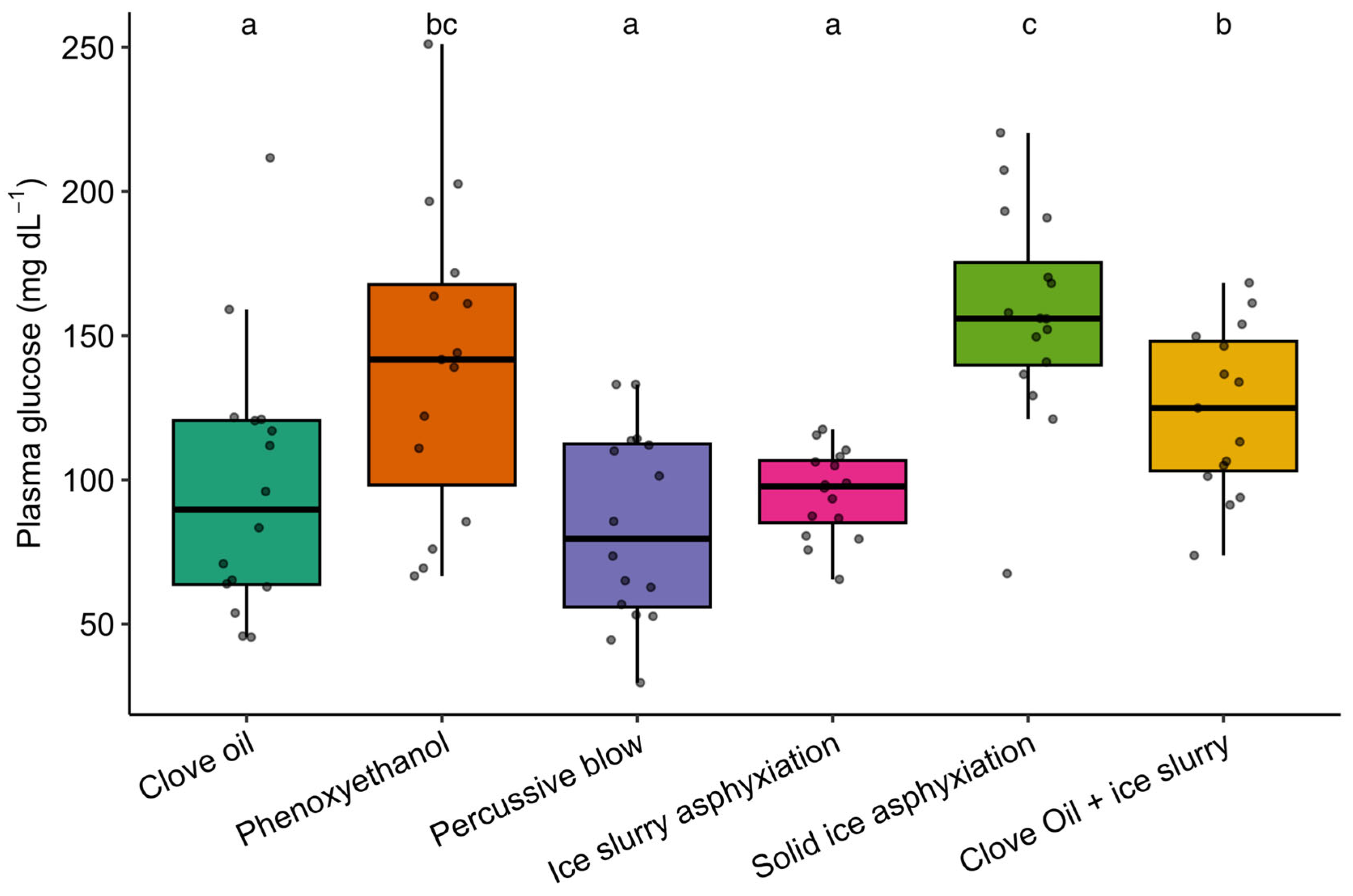
Plasma glucose concentrations were measured in 94 fish. Plasma glucose levels differed significantly among handling procedures (ANCOVA, F(5, 82) = 17.70, p < 0.001, partial η2 = 0.519). Sampling time also had a significant effect (p < 0.05) and was therefore included as a covariate in the analysis. Adjusted means (±SE) showed that glucose concentrations were highest in fish subjected to asphyxiation on solid ice and 2-phenoxyethanol anaesthesia, intermediate in those anaesthetised with clove oil, followed by immersion in ice slurry, and lowest in fish anaesthetised with clove oil, asphyxiated in ice slurry, or stunned by percussive blow (Table 1). Figure 1 illustrates the distribution of raw glucose values across the six handling procedures.

3.2. Brain Neurotransmitters

Analyses were conducted on 93 fish for most neurotransmitters and ratios, 92 for 5-HIAA, and 91 for 5-HT. Significant differences among handling procedures were detected for most monoamines and their metabolites (Table 2). Noradrenaline (NA) concentrations showed a decreasing trend from clove oil-anaesthetised fish to those exposed to ice and clove oil + ice slurry treatments, although differences were not statistically significant.
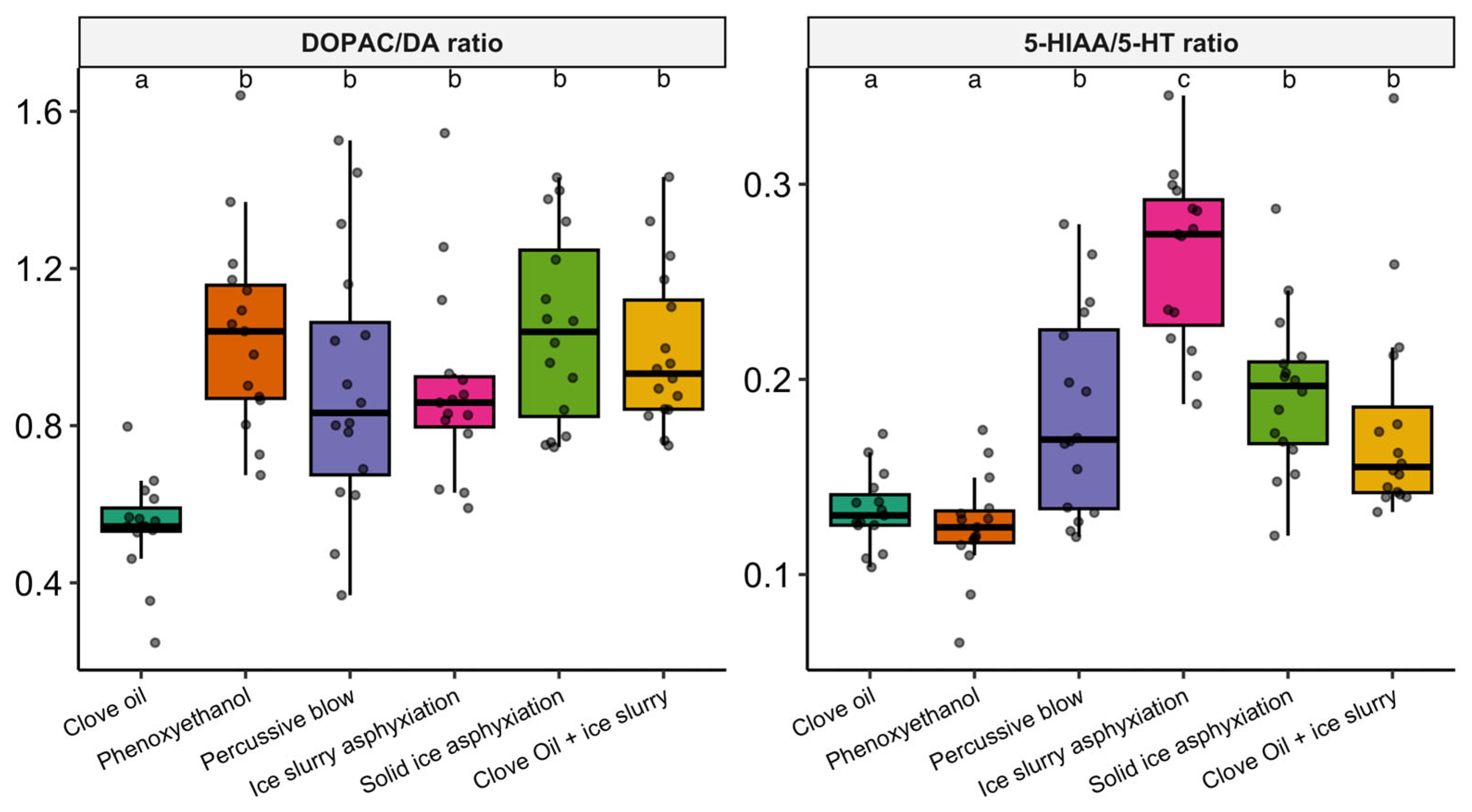
Within the dopaminergic system, DOPAC and dopamine (DA) displayed opposite patterns. DOPAC concentrations were significantly higher in 2-phenoxyethanol-treated fish and lower in those exposed to clove oil, whereas DA concentrations were significantly lower in fish subjected to percussive stunning and clove oil + ice slurry treatments compared to clove oil or 2-phenoxyethanol anaesthesia (p < 0.001, Kruskal–Wallis). The DOPAC/DA ratio followed a pattern similar to that of DOPAC, being significantly higher under 2-phenoxyethanol and ice exposure and indicating increased dopamine turnover under the corresponding handling conditions.
Serotonergic activity also differed significantly among treatments. 5-HIAA concentrations and the 5-HIAA/5-HT ratio were significantly elevated in fish exposed to asphyxiation in ice slurry and on solid ice, suggesting enhanced serotonin catabolism in these groups. Conversely, fish anaesthetised with clove oil or 2-phenoxyethanol exhibited the lowest 5-HIAA/5-HT ratios, indicating a more stable serotonergic state.
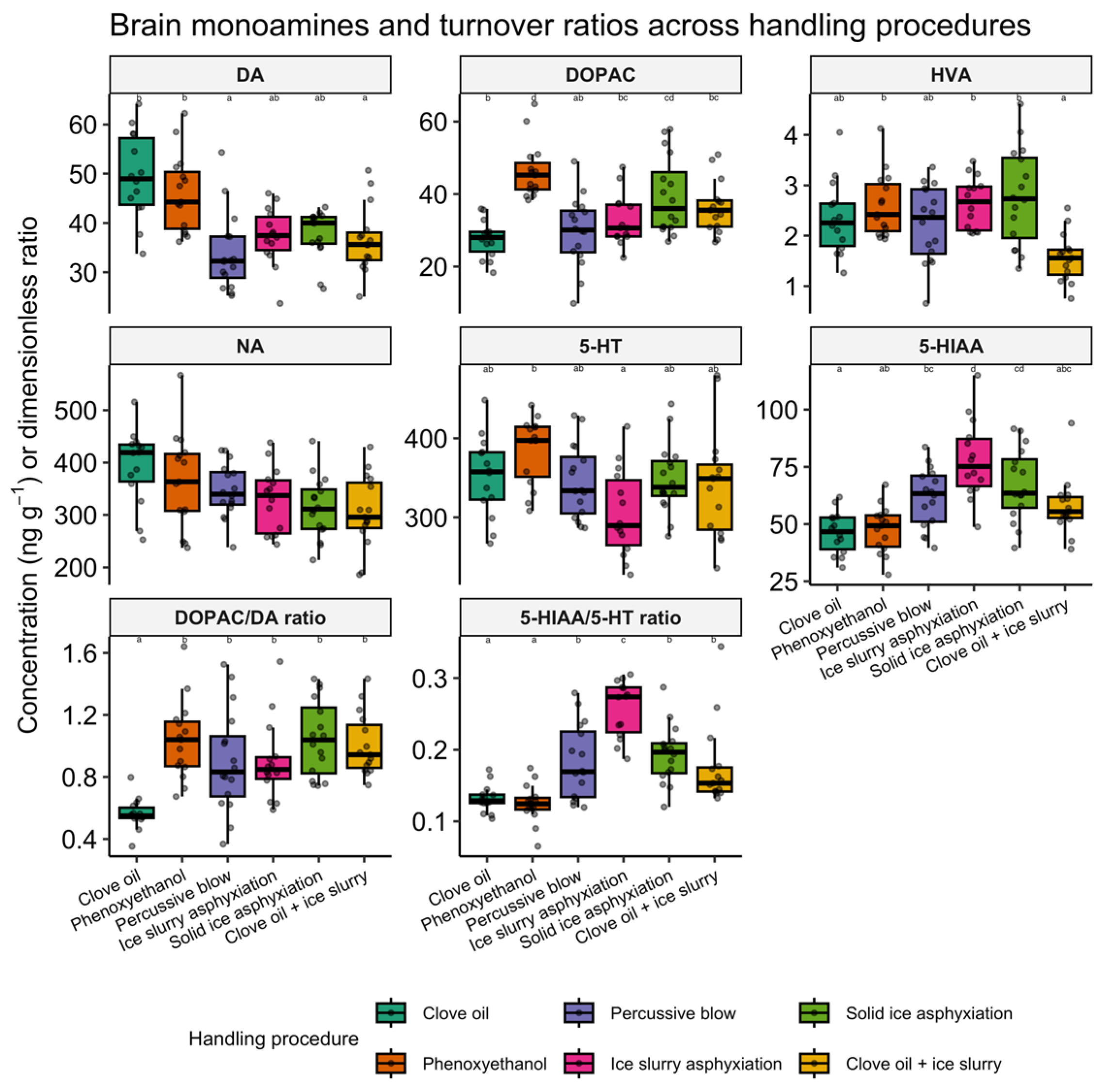
Homovanillic acid (HVA) concentrations closely paralleled those of DOPAC, being lowest in fish subjected to clove oil, followed by immersion in ice slurry and highest in ice-based and 2-phenoxyethanol treatments. Overall, dopaminergic turnover (DOPAC/DA) was significantly higher in all treatments compared with clove oil anaesthesia, whereas serotonergic turnover (5-HIAA/5-HT) was highest in the ice slurry treatment and remained lowest in the two anaesthetic-only treatments (clove oil and 2-phenoxyethanol). These differences reflect relative monoaminergic response patterns among treatments and are not interpreted as absolute baseline comparisons. To visualise the monoaminergic response patterns across treatments, Figure 2 presents boxplots of the two turnover ratios (DOPAC/DA and 5-HIAA/5-HT). A full set of boxplots for all quantified monoamines is provided in Appendix A (Figure A1) for completeness.

3.3. Multivariate Analysis of Variance and Principal Component Analysis

The multivariate analysis of variance (MANOVA) revealed a highly significant overall effect of handling procedure on the combined set of neurotransmitter variables (Wilks’ λ = 0.183, F(40, 338) = 6.82, p < 0.001; Pillai’s trace = 1.154, F(40, 405) = 5.72, p < 0.001). Post hoc univariate tests confirmed significant differences among treatments for most monoamines and their metabolites (Table 2).
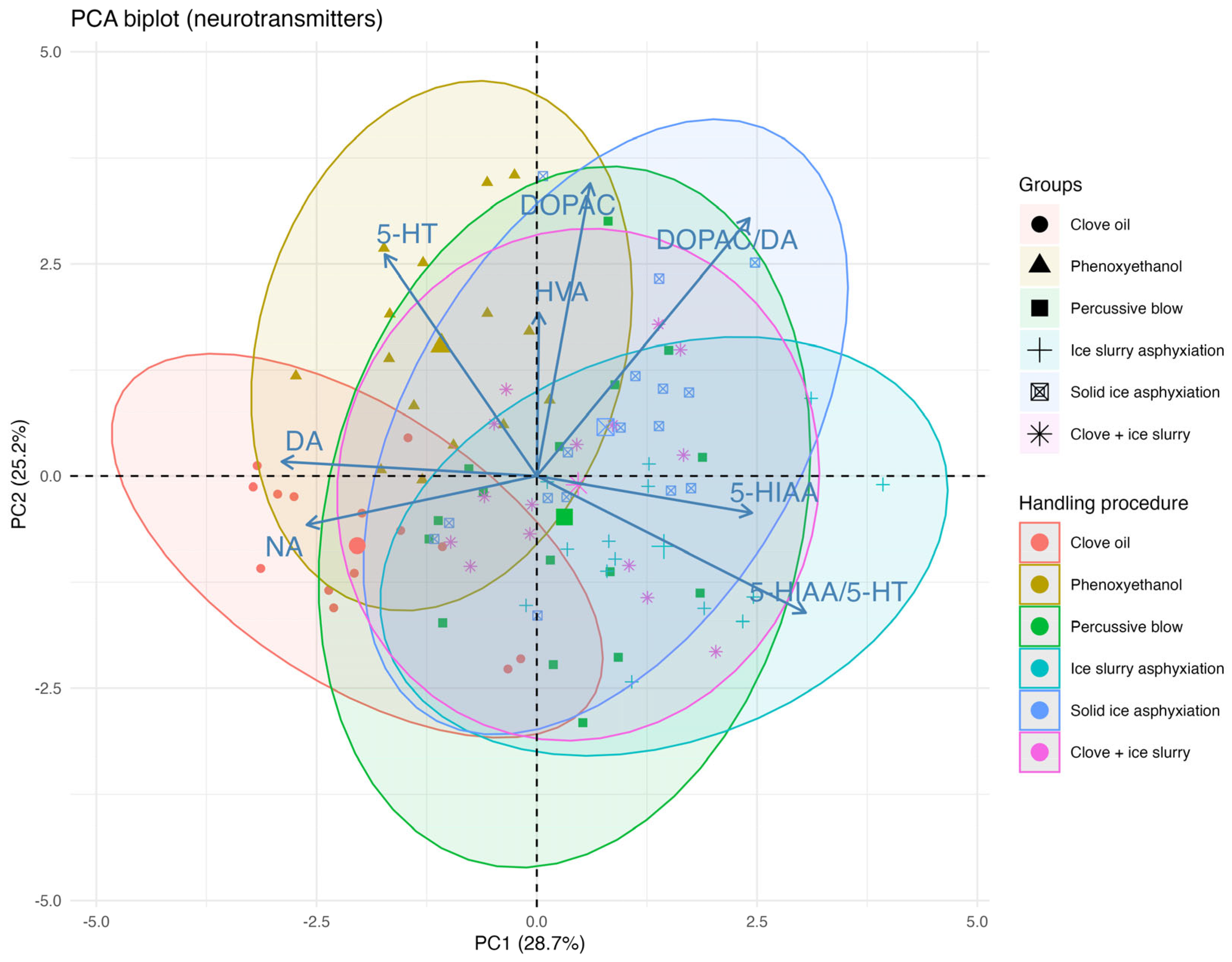
The principal component analysis (PCA) supported these findings by visualising distinct clustering of treatments (Figure 3). The first two principal components (PC1 and PC2) explained 28.7% and 25.2% of the total variance, respectively. Variables contributing most strongly to PC1 were DOPAC/DA, DOPAC, 5-HIAA/5-HT and 5-HIAA, while PC2 was mainly associated with DOPAC, HVA, and 5-HT.
Along the PC1 axis, clove oil and 2-phenoxyethanol treatments were positioned toward the left, characterised by higher DA and NA levels, whereas ice-based treatments and clove oil followed by immersion in ice slurry were positioned toward the right, associated with increased metabolite-to-parent ratios (DOPAC/DA, 5-HIAA/5-HT). This distribution reflects a shift from parent monoamines toward enhanced turnover ratios across specific handling procedures. The clustering pattern further indicates that the anaesthetic-only treatments (clove oil, 2-phenoxyethanol) exhibited similar monoaminergic profiles, distinct from those observed under ice-based or percussive procedures.
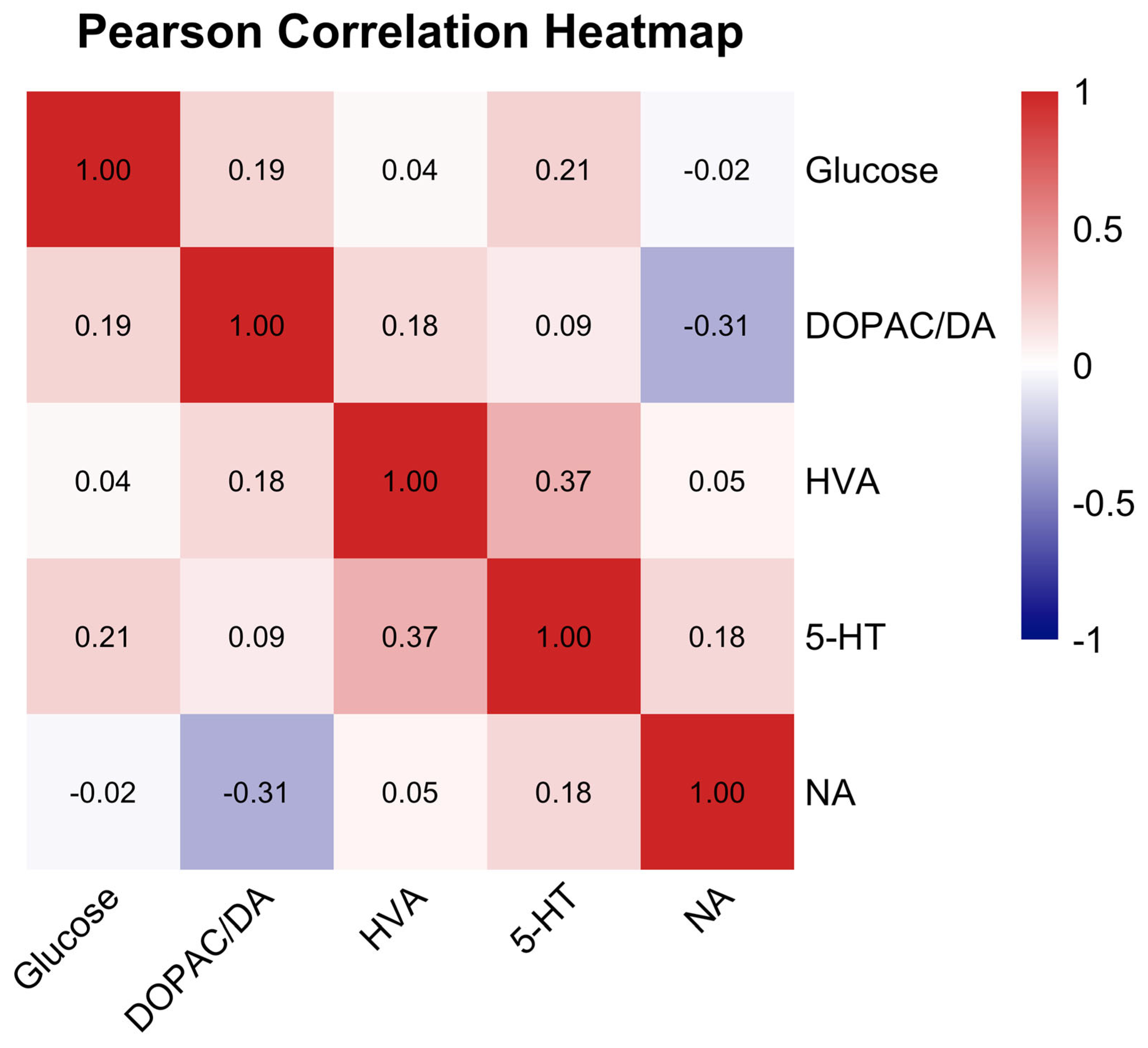
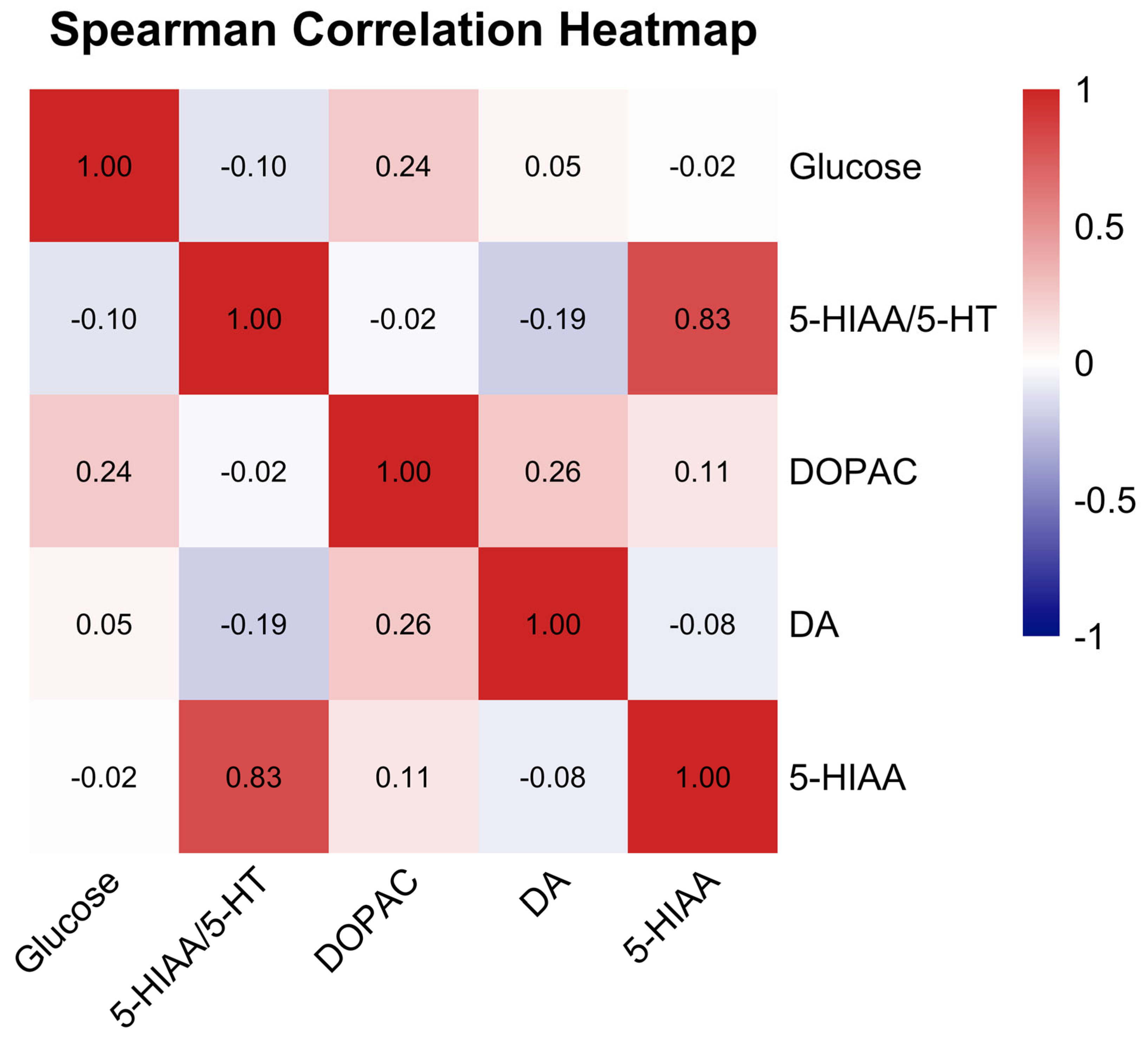
Pearson’s correlation analysis revealed weak but significant positive associations of glucose with both 5-HT (r = 0.21, p = 0.024) and DOPAC/DA (r = 0.192, p = 0.034), suggesting coordinated changes between glucose availability and serotonergic as well as dopaminergic metabolism. Moreover, a weak but significant correlation was also found between glucose and DOPAC (ρ = 0.196, p = 0.033, Spearman). In contrast, the correlation between glucose and 5-HIAA/5-HT was not significant (ρ = −0.104, p = 0.162). The full correlation matrix and heatmap illustrating interrelationships among all neurochemical variables are shown in Appendix A, Table A1 and Table A2, and Figure A2 and Figure A3.

4. Discussion

The present study demonstrates that both plasma glucose and brain monoaminergic responses of Dicentrarchus labrax are strongly influenced by the pre-slaughter and slaughter methods applied. The observed variation among treatments highlights procedure-specific metabolic and neurochemical response patterns. By integrating these parameters, the study provides a comparative physiological framework for evaluating commonly used slaughter practices in aquaculture and discussing their potential welfare implications.

4.1. Plasma Glucose and Metabolic Activation During Slaughter Procedures

Circulating glucose is a commonly used indicator of acute metabolic mobilisation in fish, as it increases rapidly in response to demanding environmental or handling conditions [15,16]. In the present study, glucose levels were significantly higher in fish subjected to asphyxiation on solid ice and 2-phenoxyethanol anaesthesia, whereas the lowest values were observed in clove oil and percussive blow treatments. These findings are consistent with previous reports on Dicentrarchus labrax [19,60] that evaluated asphyxiation procedures, as well as studies showing elevated plasma glucose following exposure to 2-phenoxyethanol [20]. In teleosts, such increases are generally interpreted as reflecting rapid metabolic mobilisation and short-term energetic adjustments during acute physiological challenge [17,18]. The inclusion of sampling time as a covariate further confirmed that handling duration contributes to physiological variability, emphasising the importance of rapid and standardised slaughter procedures [7]. From a welfare perspective, elevated glucose under ice-based and 2-phenoxyethanol treatments indicates greater short-term metabolic activation prior to loss of consciousness. Such pre-mortem physiological engagement may have implications for both welfare considerations and product quality, as accelerated post-mortem glycolysis has been associated with altered muscle pH dynamics [5,49]. Similar conclusions were reached in recent studies assessing seabass and seabream welfare under various slaughter conditions [4,13]. Plasma glucose should therefore be interpreted here as a comparative metabolic indicator rather than as a standalone marker of stress axis activation.

4.2. Dopaminergic Responses and Monoaminergic Turnover

Dopamine and its metabolite DOPAC are central components of monoaminergic regulation in teleosts, contributing to arousal, behavioural modulation, and neuroendocrine coordination during challenging conditions [21,22,61]. In the present study, 2-phenoxyethanol and ice-based treatments produced marked increases in DOPAC concentrations and in the DOPAC/DA ratio, accompanied by a decline in DA levels. This pattern reflects enhanced dopaminergic turnover, indicating increased monoaminergic activity under these procedures [22,62].
Conversely, clove oil anaesthesia maintained lower DOPAC/DA ratios, consistent with reduced dopaminergic metabolism and a more stable neurochemical profile at the time of sampling. Clove oil has been shown to induce mild sedation and attenuate physiological activation during handling [40,55], potentially contributing to the comparatively lower metabolite-to-parent ratios observed here. Recent meta-analytical evidence further supports the efficacy of eugenol and other monoterpenes as anaesthetics in finfish while highlighting interspecific variation and regulatory limitations that still constrain their use in commercial aquaculture [39].
Mechanistically, the increases in DOPAC/DA and 5-HIAA/5-HT observed under ice-induced asphyxia are consistent with accelerated monoamine turnover mediated by monoamine oxidase (MAO)-dependent metabolism. Such increases are typically associated with intensified neuronal activity and enhanced vesicular release under demanding environmental or handling conditions and have been repeatedly documented in teleost species [21,22]. They are therefore widely interpreted as indices of acute monoaminergic activation rather than direct measures of stress axis output. Recent neurophysiological findings in zebrafish further demonstrate the interaction between monoaminergic metabolism and hypothalamic CRF/AVT signalling pathways involved in adaptive neuroendocrine regulation [23].
Although prolonged hypothermia reduces metabolic rate in ectothermic organisms, abrupt exposure to near-freezing water constitutes an acute environmental challenge capable of eliciting immediate neuroendocrine activation before metabolic depression becomes established. Experimental evidence indicates that acute cold shock in teleosts can engage sympathetic and HPI axis pathways during the initial exposure phase, with transient increases in catecholaminergic signalling prior to longer-term metabolic adjustment [15,16,63].
The elevated monoaminergic turnover observed under ice-based procedures is likely driven by a combination of acute thermal shock and hypoxia. While abrupt exposure to near-freezing temperatures can trigger rapid catecholaminergic and neuroendocrine responses during the initial phase of exposure [15,16], concurrent asphyxiation induces hypoxic conditions that are known to influence monoamine metabolism, including monoamine oxidase (MAO) activity [62]. Hypoxia has been shown to alter neurotransmitter degradation and turnover rates, potentially contributing to the increased metabolite-to-parent ratios observed in the present study. Therefore, the observed neurochemical responses in ice-based treatments should be interpreted as the combined effect of thermal and hypoxic stressors, which cannot be fully disentangled within the present experimental design.
Monoaminergic turnover indices do not directly quantify hypothalamic–pituitary–interrenal (HPI) axis activation; however, substantial evidence indicates that these systems are functionally integrated with neuroendocrine stress pathways [24,31]. Dopaminergic and serotonergic signalling modulate hypothalamic neuropeptides such as corticotropin-releasing factor (CRF) and arginine vasotocin (AVT), thereby influencing downstream HPI axis activity [31]. Recent evidence further supports the role of monoaminergic turnover as a biologically grounded indicator of stress-related neuroendocrine state. In teleost fish, serotonergic activity and turnover have been shown to correlate with cortisol dynamics and acute stress exposure, supporting their relevance as integrative markers of central stress processing and allostatic load [64].
In this context, increased DOPAC/DA and 5-HIAA/5-HT ratios observed under specific handling procedures may reflect enhanced monoaminergic signalling within neural circuits associated with stress-related neural processing. However, these measures should be interpreted as indirect markers of central neurophysiological activation rather than direct evidence of HPI axis stimulation.

4.3. Serotonergic Activity and Coping Mechanisms

Serotonin pathways influence behavioural traits such as social interaction, inhibition, and coping style and are therefore highly responsive to environmental and handling challenges in teleosts [22,65,66,67,68]. In the present study, high 5-HIAA concentrations and 5-HIAA/5-HT ratios were observed in fish exposed to asphyxiation in ice slurry and solid ice, indicating enhanced serotonin turnover under these conditions. Such increases are commonly associated with intensified serotonergic metabolism and altered behavioural modulation in response to demanding stimuli [30,31,32]. In contrast, clove oil and 2-phenoxyethanol treatments were characterised by comparatively lower turnover ratios, consistent with the sedative properties of these anaesthetic agents and their capacity to reduce overt behavioural reactivity during handling. The serotonergic profile observed here aligns with previous descriptions of monoaminergic adjustments in teleosts exposed to confinement or handling challenges [29,69], underscoring the sensitivity of this pathway to procedure-specific physiological engagement [4].
Although monoaminergic profiling requires rapid post-mortem sampling and specialised analytical instrumentation [58,59], it provides insight into central neurochemical regulation that is rarely incorporated into slaughter-related assessments in aquaculture. As highlighted in recent neurobiological reviews [23,24], advanced neurochemical analyses in fish are more commonly applied in behavioural neuroscience than in production-oriented research. The present findings demonstrate that monoamine turnover analysis can effectively differentiate slaughter procedures based on their relative neurochemical impact, offering a biologically grounded complement to conventional metabolic indicators.

4.4. Integrative Multivariate Evaluation of Physiological and Neurochemical Profiles

The MANOVA and PCA results confirmed that the combined monoaminergic profile clearly discriminated between treatments, revealing two main clustering patterns corresponding to anaesthetic-based treatments and ice-based asphyxiation methods. The first two principal components explained more than 50% of total variance, with DOPAC/DA and 5-HIAA/5-HT contributing most strongly to group separation. These results highlight the capacity of multivariate approaches to capture treatment-specific response patterns [4,70]. Dopaminergic and serotonergic turnover ratios contributed prominently to treatment differentiation, supporting their utility as indicators of group separation.
Significant but weak positive correlations were found between plasma glucose and both DOPAC/DA and 5-HT, suggesting partially associated metabolic and monoaminergic adjustments under specific handling conditions. These pathways interact with hypothalamic neuropeptide systems involved in adaptive neuroendocrine regulation [23,33], providing a mechanistic basis for these associations. It should also be noted that monoaminergic responses operate on a rapid timescale (seconds to minutes), whereas changes in circulating glucose reflect downstream metabolic processes that may involve catecholaminergic and hormonal mediation over a longer timeframe [15,16,17,18]. This temporal mismatch limits the interpretation of direct coupling between these variables and suggests that the observed associations reflect parallel but not necessarily synchronous physiological processes. Although the observed correlations were modest, their consistency suggests that these indices may provide additional information to metabolic indicators when differentiating among slaughter procedures. Such a combined assessment could enhance the physiological resolution of routine stunning evaluations under commercial conditions.
When considered collectively, the metabolic and monoaminergic profiles allow grouping of procedures according to their relative biological impact. Clove oil and 2-phenoxyethanol treatments were characterised by comparatively lower glucose concentrations and reduced turnover ratios, whereas ice-based asphyxiation methods were associated with higher metabolite-to-parent ratios and elevated glucose values. Percussive stunning and clove oil, followed by immersion in ice slurry, produced intermediate patterns. These distinctions are consistent with welfare-oriented evaluations of ice-based slaughter in Mediterranean aquaculture species [7], while remaining grounded in the comparative physiological framework applied here.
Interpretation of these response amplitudes should also consider species-specific neurobiological characteristics. Salmonids are generally characterised by stronger neuroendocrine and monoaminergic reactivity during acute environmental challenges compared with Mediterranean species [32,67]. Rainbow trout, for instance, display rapid increases in 5-HT metabolism during novelty or social challenge, often exceeding the responses reported for sea bass [21,30]. Slaughter-related studies in trout similarly describe marked neurochemical shifts under comparable operational procedures [51]. Within this wider interspecific context, the amplitude of monoaminergic changes observed in D. labrax is consistent with the species’ known reactivity profile.
It should be emphasised that, in the absence of a pre-slaughter baseline group, these findings reflect relative differences among treatments rather than absolute levels of stress or neurophysiological activation.

4.5. Welfare and Practical Implications for Aquaculture Slaughter

The comparative analysis supports the view that pre-slaughter chemical anaesthesia is associated with reduced physiological activation compared with direct chilling or asphyxiation procedures [1,2,6,14]. Among the agents tested, clove oil was characterised by the lowest combined monoaminergic turnover and plasma glucose values, whereas 2-phenoxyethanol exhibited intermediate physiological activation relative to ice-based methods. Although eugenol-based anaesthetics such as clove oil are effective and well-tolerated, their commercial application in the European Union remains constrained by regulatory restrictions. Eugenol is not approved as a veterinary medicinal product for fish intended for human consumption, and no maximum residue limit (MRL) has been established under Commission Regulation (EU) No 37/2010 [71]. However, its isomer isoeugenol has been listed for finfish species under Regulation (EU) No 363/2011 [4,41]. Nevertheless, recent studies indicate that combining clove oil—particularly in nanoencapsulated formulations—with hypothermic stunning can further attenuate physiological stress and extend freshness in harvested fish [42,43].
The findings of this study have direct implications for aquaculture practice. The use of a mild sedative before slaughter may reduce excessive behavioural reactivity, facilitate handling, and contribute to more consistent product characteristics. Similar findings were previously reported by Simitzis et al. [38], who demonstrated improved flesh pH and appearance in European sea bass anaesthetized with clove oil prior to chilling in ice slurry. Such approaches are compatible with current EU welfare directives (Regulation 1099/2009) [8] and can be integrated into existing harvest protocols with minimal operational changes. In intensive production systems where fish are frequently handled, the application of mild anaesthetics before grading or transport could also mitigate cumulative stress, potentially enhancing growth performance, immune competence, and survival [47,48,72,73]. Beyond ethical considerations, welfare-friendly slaughter methods may contribute to improved consumer perception and certification of aquaculture products under eco-labels emphasising animal welfare [4]. The monoaminergic turnover indices identified here may complement conventional metabolic measures when evaluating slaughter procedures in applied aquaculture settings.
Industrial adoption may also consider electrical stunning systems, which have demonstrated satisfactory welfare outcomes and consistent flesh quality in sea bass, when appropriately configured for water conductivity and field strength [45,46,74]. Recent research demonstrates that electrical stunning can induce rapid loss of consciousness while preserving fillet quality, provided that voltage gradients and exposure durations are optimised to species-specific physiological characteristics [11,44]. The integration of such validated protocols into Mediterranean aquaculture could represent a significant step toward harmonised welfare standards.
From an industry perspective, procedures that minimise neurochemical and metabolic activation are associated with improved fillet pH stability, reduced gaping, and extended shelf life [5,13,49]. Neurochemical indices such as DOPAC/DA and 5-HIAA/5-HT provide mechanistic insight into central monoaminergic regulation and may assist in evaluating the physiological impact of operational adjustments, including improved handling, staff training, or chilling-system optimisation. Their integration into multivariate welfare frameworks aligns with recent recommendations for modern aquaculture systems [34,36,37]. Recent evaluations of electrical stunning in sea bass further highlight the need for validated physiological indicators to confirm effective loss of consciousness [11,44].

4.6. Limitations and Future Directions

A key limitation of the present study is the use of whole-brain homogenates rather than discrete brain regions, which may obscure spatially specific responses in areas directly involved in stress regulation, such as the hypothalamus or telencephalon. However, whole-brain approaches are widely used in welfare-related studies and have consistently detected treatment effects in teleosts when sample size is sufficient and processing procedures are standardised [26,27,28]. Future work combining whole-brain screening with targeted regional analyses would allow more precise mapping of neurochemical dynamics across slaughter procedures.
In addition, although individual fish were treated as experimental units, fish originated from a limited number of tanks. Therefore, potential tank-level effects cannot be entirely excluded and may have contributed to part of the observed variability. This limitation may have introduced a degree of non-independence among observations, potentially inflating the apparent treatment effects. However, the consistency of the observed patterns across multiple independent physiological and neurochemical variables suggests that the main conclusions are robust and not solely driven by tank-related bias [56].
Another limitation is the absence of a pre-slaughter baseline group. While absolute resting values can provide additional physiological context, the present experimental design focused on comparative evaluation among operational slaughter procedures. Cross-procedure comparisons represent a common approach in Mediterranean sea bass and sea bream welfare research [13,19,60]. Within this framework, the findings provide internally consistent differentiation of response patterns across treatments. Such designs are widely applied in studies evaluating slaughter and harvesting procedures in aquaculture species, where the objective is to rank the relative physiological impact of different methods rather than to establish absolute stress-free baselines [6,75,76,77].
Although cortisol and lactate were not quantified, monoaminergic turnover provides direct insight into central neurochemical regulation during acute handling challenges [23,24]. The absence of additional endocrine and metabolic markers, such as cortisol and lactate, limits the ability to fully characterise the magnitude and temporal dynamics of the stress response. Therefore, the present findings should be interpreted as reflecting relative physiological patterns rather than a complete assessment of the stress axis [15,16]. Plasma glucose, as discussed above, reflects acute physiological disturbance in fish, through the rapid mobilisation of energy reserves associated with catecholamine- and cortisol-mediated responses [17,18]. Nevertheless, future studies integrating hormonal measurements with neurochemical, metabolic, and transcriptomic indicators (e.g., crh, pomc, hsp70) would enable a more comprehensive characterisation of procedure-specific physiological responses.
An additional limitation concerns the difference in exposure duration between ice slurry (10 min) and solid ice (20 min) treatments. This discrepancy introduces a potential confounding factor, as the higher physiological responses observed in the solid ice group may reflect not only the characteristics of the physical medium but also the longer exposure duration. Consequently, the relative contribution of exposure time versus treatment type cannot be fully disentangled and should be considered when interpreting differences between these conditions.
Although monoamines are known to fluctuate rapidly during acute responses, sampling in the present study was consistently performed immediately upon confirmation of anaesthesia or terminal loss of reflexes. This standardised sampling endpoint reduces variability related to handling duration and limits the influence of sampling time on neurochemical measurements. Nevertheless, the absence of sampling time as a covariate in the multivariate analysis should be acknowledged as a potential source of residual variability. Despite this standardisation, rapid monoaminergic fluctuations may still introduce variability that cannot be fully controlled.
Finally, because the experimental work was conducted before the formal establishment of institutional ethics committees, the study underscores the importance of retrospective welfare evaluation and the evolution of ethical standards in aquaculture research. The selected procedures reflect commonly applied or historically relevant aquaculture practices, allowing their evaluation under controlled experimental conditions. In addition, all efforts were made to minimise animal suffering, including rapid handling, immediate confirmation of loss of reflexes prior to sampling, and standardisation of procedures to reduce exposure duration variability. These measures were implemented to ensure that fish were not subjected to unnecessary prolonged distress during the experimental procedures. Updating and validating these findings under current legislative and ethical frameworks, particularly those emphasising humane slaughter and validated indicators of unconsciousness, will further strengthen their applicability to modern aquaculture practice.

5. Conclusions

The combined assessment of plasma glucose and brain monoaminergic activity offers a comprehensive comparative evaluation of physiological and neurochemical responses to commonly applied slaughter procedures in European sea bass. The results indicate that clove oil anaesthesia and, to a lesser extent, 2-phenoxyethanol, were associated with comparatively lower metabolic and monoaminergic activation prior to loss of consciousness. In contrast, ice-based asphyxiation procedures were characterised by elevated turnover ratios and glucose levels. The monoaminergic indices identified in this study—particularly the DOPAC/DA and 5-HIAA/5-HT ratios—provide mechanistically informative markers of procedure-specific neurochemical modulation and may complement conventional metabolic indicators in welfare-oriented evaluations. Integrating such physiological profiling approaches into aquaculture practice could support evidence-based refinement of slaughter protocols tailored to Mediterranean production systems.

Author Contributions

Conceptualization, A.T. and H.M.; methodology, A.T., C.D., and H.M.; investigation, A.T. and C.D.; formal analysis, A.T. and C.D.; data curation, A.T.; writing—original draft preparation, A.T.; writing—review and editing, C.D. and H.M.; visualisation, A.T.; supervision, H.M.; project administration, H.M.; resources, H.M. All authors have read and agreed to the published version of the manuscript.

Funding

This research received no external funding.

Institutional Review Board Statement

The experimental trial was conducted in 2010 at the Laboratory of Applied Hydrobiology, Agricultural University of Athens, Greece, before the formal establishment of an Institutional Ethics Committee for animal experimentation at the University. All procedures complied with the national legislation then in force and with the European Directive 86/609/EEC, preceding Directive 2010/63/EU. All efforts were made to minimise suffering and ensure the humane treatment of fish during all experimental procedures. Preliminary results from this experiment were presented at Aquaculture Europe 2011 (Rhodes, Greece; oral presentation entitled “Effects of Pre-Slaughter and Slaughter Methods on Brain Monoaminergic Activities and Plasma Glucose Levels in Sea Bass, Dicentrarchus labrax”), but the present work includes a complete analysis and interpretation of the dataset, which has not been previously published in a peer-reviewed journal.

Informed Consent Statement

Not applicable.

Data Availability Statement

The data presented in this study are available on request from the corresponding author. The data are not publicly available due to institutional data retention policies.

Acknowledgments

The authors thank the staff of the Laboratory of Applied Hydrobiology (Agricultural University of Athens) for their technical assistance during the experimental trial and the undergraduate students who assisted in sampling and laboratory procedures. During the preparation of this manuscript, the authors used ChatGPT (GPT-5, OpenAI) as a language-editing tool to improve the clarity and style of the English text. The authors reviewed and edited all AI-generated content and take full responsibility for the final manuscript.

Conflicts of Interest

The authors declare no conflicts of interest.

Abbreviations

The following abbreviations are used in this manuscript:
5-HIAA5-hydroxyindoleacetic acid
5-HTSerotonin (5-hydroxytryptamine)
ANCOVAAnalysis of covariance
ANOVAAnalysis of variance
AUCArea under the curve
AVTArginine vasotocin
CRFCorticotropin-releasing factor
DADopamine
DOPAC3,4-dihydroxyphenylacetic acid
ECEuropean Commission
EFSAEuropean Food Safety Authority
EUEuropean Union
FAOFood and Agriculture Organization
HPAHypothalamic–pituitary–adrenal
HPIHypothalamic–pituitary–interrenal
HPLC/ECDHigh-performance liquid chromatography with electrochemical detection
HSDHonestly significant difference
HVAHomovanillic acid
MANOVAMultivariate analysis of variance
MRLMaximum residue limit
NANoradrenaline
PCAPrincipal component analysis
SDStandard deviation
SEStandard error

Appendix A

Figure A1. Βrain monoamine profiles across treatments. Boxplots of all quantified monoaminergic variables (DA, DOPAC, HVA, NA, 5-HT, 5-HIAA, DOPAC/DA, and 5-HIAA/5-HT) across the six handling procedures. Points represent individual fish. Different letters indicate significant differences among treatments (p < 0.05; see Table 2 for detailed pairwise comparisons).
Fishes 11 00218 g0a1
Table A1. Pearson’s correlation coefficients (one-tailed) among plasma glucose and neurochemical variables. p < 0.05 (*), p < 0.01 (**).
GlucoseDOPAC/DAHVA5-HTNA
Glucose10.192 *0.0370.210 *−0.023
DOPAC/DA0.192 *10.178 *0.094−0.311 **
HVA0.0370.178 *10.368 **0.054
5-HT0.210 *0.0940.368 **10.183 *
NA−0.023−0.311 **0.0540.183 *1
Table A2. Spearman’s rank correlation coefficients (one-tailed) among plasma glucose and neurochemical variables. p < 0.05 (*), p < 0.01 (**).
Glucose5-HIAA/5-HTDOPACDA5-HIAA
Glucose1−0.1040.196 *0.048−0.016
5-HIAA/5-HT−0.10410.012−0.194 *0.828 **
DOPAC0.196 *0.01210.253 **0.13
DA0.048−0.194 *0.253 **1−0.077
5-HIAA−0.0160.828 **0.13−0.0771
Figure A2. Pearson’s correlation heatmap among glucose concentration and monoaminergic neurochemical parameters in fish brain tissue. The colour scale represents correlation coefficients (r) ranging from −1 (blue) to +1 (red), with 0 corresponding to white. Positive correlations indicate direct associations, whereas negative correlations indicate inverse relationships. Glucose is presented first, followed by the corresponding neurotransmitters and metabolites (DOPAC/DA, HVA, 5-HT, and NA).
Fishes 11 00218 g0a2
Figure A3. Spearman’s correlation heatmap among glucose and serotonergic–dopaminergic neurochemical ratios and metabolites. The colour scale ranges from −1 to +1, with 0 shown in white. The glucose variable is placed first for consistency with the Pearson matrix. Non-parametric Spearman’s rank correlation was used to account for potential non-linearity or non-normality in the data. Variables included 5-HIAA/5-HT ratio, DOPAC, DA, and 5-HIAA.
Fishes 11 00218 g0a3

References

  1. Ashley, P.J. Fish welfare: Current issues in aquaculture. Appl. Anim. Behav. Sci. 2007, 104, 199–235. [Google Scholar] [CrossRef]
  2. Huntingford, F.A.; Adams, C.; Braithwaite, V.A.; Kadri, S.; Pottinger, T.G.; Sandøe, P.; Turnbull, J.F. Current issues in fish welfare. J. Fish Biol. 2006, 68, 332–372. [Google Scholar] [CrossRef]
  3. Mercogliano, R.; Avolio, A.; Castiello, F.; Ferrante, M.C. Development of Welfare Protocols at Slaughter in Farmed Fish. Animals 2024, 14, 2730. [Google Scholar] [CrossRef]
  4. de la Rosa, I.; Castro, P.L.; Gines, R. Twenty Years of Research in Seabass and Seabream Welfare during Slaughter. Animals 2021, 11, 2164. [Google Scholar] [CrossRef]
  5. Poli, B.M. Farmed fish welfare-suffering assessment and impact on product quality. Ital. J. Anim. Sci. 2009, 8, 139–160. [Google Scholar] [CrossRef]
  6. Lines, J.; Spence, J. Humane harvesting and slaughter of farmed fish. Rev. Sci. Tech. Off. Int. Epizoot. 2014, 33, 255–264. [Google Scholar] [CrossRef] [PubMed]
  7. EFSA. Scientific Opinion of the Panel on Animal Health and Welfare on a request from the European Commission on welfare aspect of the main systems of stunning and killing of farmed seabass and seabream. EFSA J. 2009, 1010, 1–52. [Google Scholar]
  8. EC. Council Regulation (EC) No 1099/2009 of 24 September 2009 on the Protection of Animals at the Time of Killing; European Council: Brussels, Belgium, 2009; Volume 1099. [Google Scholar]
  9. Clemente, G.A.; Tolini, C.; Boscarino, A.; Lorenzi, V.; Dal Lago, T.L.; Benedetti, D.; Bellucci, F.; Manfrin, A.; Trocino, A.; Rota Nodari, S. Farmed fish welfare during slaughter in Italy: Survey on stunning and killing methods and indicators of unconsciousness. Front. Vet. Sci. 2023, 10, 1253151. [Google Scholar] [CrossRef]
  10. Espmark, Å.M.O.; Grimsbø, E.; Patel, S.J.; Rimstad, E.; Seljetun, K.O.; Vindas, M.A.; Granquist, E.G.; Jørgensen, G.H.M.; Nordgreen, J.; Olesen, I.; et al. Assessment of Welfare Aspects of Stunning and Killing of Farmed Fish in Norway. Scientific Opinion of the Panel on Animal Health and Welfare of the Norwegian Scientific Committee for Food and Environment; VKM Report; VKM: Oslo, Norway, 2025. [Google Scholar]
  11. van Pelt, K.; Carpendale, M.; Ryba, R. Humane slaughter in Mediterranean sea bass and bream aquaculture: Farm characteristics, stakeholder views, and policy implications. Front. Aquac. 2024, 3, 1383280. [Google Scholar] [CrossRef]
  12. FAO. FishStatJ—Software for Fishery and Aquaculture Statistical Time Series: Aquaculture Production (Quantities and Values), 1950–2023 (Release Date: March 2025); FAO: Rome, Italy, 2025. [Google Scholar]
  13. Papaharisis, L.; Tsironi, T.; Dimitroglou, A.; Taoukis, P.; Pavlidis, M. Stress assessment, quality indicators and shelf life of three aquaculture important marine fish, in relation to harvest practices, water temperature and slaughter method. Aquac. Res. 2019, 50, 2608–2620. [Google Scholar] [CrossRef]
  14. Zampacavallo, G.; Parisi, G.; Mecatti, M.; Lupi, P.; Giorgi, G.; Poli, B.M. Evaluation of different methods of stunning/killing sea bass (Dicentrarchus labrax) by tissue stress/quality indicators. J. Food Sci. Technol. 2015, 52, 2585–2597. [Google Scholar] [CrossRef]
  15. Barton, B.A. Stress in Fishes: A Diversity of Responses with Particular Reference to Changes in Circulating Corticosteroids. Integr. Comp. Biol. 2002, 42, 517–525. [Google Scholar] [CrossRef]
  16. Wendelaar Bonga, S.E. The stress response in fish. Physiol. Rev. 1997, 77, 591–625. [Google Scholar] [CrossRef]
  17. Polakof, S.; Panserat, S.; Soengas, J.L.; Moon, T.W. Glucose metabolism in fish: A review. J. Comp. Physiol. B 2012, 182, 1015–1045. [Google Scholar] [CrossRef]
  18. Weber, R.A.; Pérez-Maceira, J.J.; Peleteiro, J.B.; García-Martín, L.; Aldegunde, M. Effects of acute exposure to 2-phenoxyethanol, clove oil, MS-222, and metomidate on primary and secondary stress responses in Senegalese sole (Solea senegalensis Kaup 1858). Aquaculture 2011, 321, 108–112. [Google Scholar] [CrossRef]
  19. Acerete, L.; Reig, L.; Alvarez, D.; Flos, R.; Tort, L. Comparison of two stunning/slaughtering methods on stress response and quality indicators of European sea bass (Dicentrarchus labrax). Aquaculture 2009, 287, 139–144. [Google Scholar] [CrossRef]
  20. Filiciotto, F.; Buscaino, G.; Buffa, G.; Bellante, A.; Maccarrone, V.; Mazzola, S. Anaesthetic qualities of eugenol and 2-phenoxyethanol and their effect on same haematological parameters in farmed European sea bass (Dicentrarchus labrax L.). J. Anim. Vet. Adv. 2012, 11, 494–502. [Google Scholar] [CrossRef]
  21. Hoglund, E.; Kolm, N.; Winberg, S. Stress-induced changes in brain serotonergic activity, plasma cortisol and aggressive behavior in Arctic charr (Salvelinus alpinus) is counteracted by L-DOPA. Physiol. Behav. 2001, 74, 381–389. [Google Scholar] [CrossRef]
  22. Winberg, S.; Nilsson, G.E. Roles of brain monoamine neurotransmitters in agonistic behaviour and stress reactions, with particular reference to fish. Comp. Biochem. Physiol. 1993, 106, 597–614. [Google Scholar] [CrossRef]
  23. Pietsch, C.; Konrad, J.; Wernicke von Siebenthal, E.; Pawlak, P. Multiple faces of stress in the zebrafish (Danio rerio) brain. Front. Physiol. 2024, 15, 1373234. [Google Scholar] [CrossRef] [PubMed]
  24. Yuan, M.; Fang, Q.; Lu, W.; Wang, X.; Hao, T.; Chong, C.-M.; Chen, S. Stress in Fish: Neuroendocrine and Neurotransmitter Responses. Fishes 2025, 10, 307. [Google Scholar] [CrossRef]
  25. Dalla, C.; Antoniou, K.; Kokras, N.; Drossopoulou, G.; Papathanasiou, G.; Bekris, S.; Daskas, S.; Papadopoulou-Daifoti, Z. Sex differences in the effects of two stress paradigms on dopaminergic neurotransmission. Physiol. Behav. 2008, 93, 595–605. [Google Scholar] [CrossRef]
  26. Lopez-Patino, M.A.; Skrzynska, A.K.; Naderi, F.; Mancera, J.M.; Miguez, J.M.; Martos-Sitcha, J.A. High Stocking Density and Food Deprivation Increase Brain Monoaminergic Activity in Gilthead Sea Bream (Sparus aurata). Animals 2021, 11, 1503. [Google Scholar] [CrossRef]
  27. Sen Sarma, O.; Frymus, N.; Axling, F.; Thornqvist, P.O.; Roman, E.; Winberg, S. Optimizing zebrafish rearing-Effects of fish density and environmental enrichment. Front. Behav. Neurosci. 2023, 17, 1204021. [Google Scholar] [CrossRef]
  28. Staven, F.R.; Gesto, M.; Iversen, M.H.; Andersen, P.; Patel, D.M.; Nordeide, J.T.; Kristensen, T. Cohabitation With Atlantic Salmon (Salmo salar) Affects Brain Neuromodulators But Not Welfare Indicators in Lumpfish (Cyclopterus lumpus). Front. Physiol. 2022, 13, 781519. [Google Scholar] [CrossRef]
  29. Winberg, S.; Thornqvist, P.O. Role of brain serotonin in modulating fish behavior. Curr. Zool. 2016, 62, 317–323. [Google Scholar] [CrossRef] [PubMed]
  30. Alfonso, S.; Sadoul, B.; Gesto, M.; Joassard, L.; Chatain, B.; Geffroy, B.; Begout, M.L. Coping styles in European sea bass: The link between boldness, stress response and neurogenesis. Physiol. Behav. 2019, 207, 76–85. [Google Scholar] [CrossRef] [PubMed]
  31. Backstrom, T.; Winberg, S. Serotonin Coordinates Responses to Social Stress-What We Can Learn from Fish. Front. Neurosci. 2017, 11, 595. [Google Scholar] [CrossRef]
  32. Winberg, S.; Lepage, O. Elevation of brain 5-HT activity, POMC expression, and plasma cortisol in socially subordinate rainbow trout. Am. J. Physiol. 1998, 274, R645–R654. [Google Scholar] [CrossRef] [PubMed]
  33. Backstrom, T.; Thornqvist, P.O.; Winberg, S. Social effects on AVT and CRF systems. Fish Physiol. Biochem. 2021, 47, 1699–1709. [Google Scholar] [CrossRef]
  34. Oliveira, J.; Oliva-Teles, A.; Couto, A. Tracking Biomarkers for the Health and Welfare of Aquaculture Fish. Fishes 2024, 9, 289. [Google Scholar] [CrossRef]
  35. Carbonara, P.; Zupa, W.; Bitetto, I.; Alfonso, S.; Dara, M.; Cammarata, M. Evaluation of the Effects of the Enriched-Organic Diets Composition on European Sea Bass Welfare through a Multi-Parametric Approach. J. Mar. Sci. Eng. 2020, 8, 934. [Google Scholar] [CrossRef]
  36. Dara, M.; Carbonara, P.; La Corte, C.; Parrinello, D.; Cammarata, M.; Parisi, M.G. Fish Welfare in Aquaculture: Physiological and Immunological Activities for Diets, Social and Spatial Stress on Mediterranean Aqua Cultured Species. Fishes 2023, 8, 414. [Google Scholar] [CrossRef]
  37. Toomey, L.; Alfonso, S.; Mente, E.; Bitetto, I.; Fiocchi, E.; Manfrin, A.; Vasilaki, P.; Zupa, W.; Bégout, M.L.; Spedicato, M.T.; et al. Toward the use of innovative environmentally sustainable feed in organic aquaculture: Impact on growth performance, health, and welfare of gilthead seabream (Sparus aurata). J. World Aquac. Soc. 2025, 56, e70021. [Google Scholar] [CrossRef]
  38. Simitzis, P.E.; Tsopelakos, A.; Charismiadou, M.A.; Batzina, A.; Deligeorgis, S.G.; Miliou, H. Comparison of the effects of six stunning/killing procedures on flesh quality of sea bass (Dicentrarchus labrax, Linnaeus 1758) and evaluation of clove oil anaesthesia followed by chilling on ice/water slurry for potential implementation in aquaculture. Aquac. Res. 2014, 45, 1759–1770. [Google Scholar] [CrossRef]
  39. Félix, L.; Vieira, R.; Monteiro, S.M.; Venâncio, C. A meta-analytic review of monoterpene for fish anaesthesia. Fish Fish. 2023, 24, 367–380. [Google Scholar] [CrossRef]
  40. Priborsky, J.; Velisek, J. A Review of Three Commonly Used Fish Anesthetics. Rev. Fish. Sci. Aquac. 2018, 26, 417–442. [Google Scholar] [CrossRef]
  41. EU. Commission Regulation (EU) No 363/2011 of 13 April 2011 Amending the Annex to Regulation (EU) No 37/2010 on Pharmacologically Active Substances and Their Classification Regarding Maximum Residue Limits in Foodstuffs of Animal Origin, as Regards the Substance Isoeugenol Text with EEA Relevance; European Council: Brussels, Belgium, 2011. [Google Scholar]
  42. Lopez-Canovas, A.E.; Cabas, I.; Chaves-Pozo, E.; Ros-Chumillas, M.; Navarro-Segura, L.; Lopez-Gomez, A.; Fernandes, J.M.O.; Galindo-Villegas, J.; Garcia-Ayala, A. Nanoencapsulated Clove Oil Applied as an Anesthetic at Slaughtering Decreases Stress, Extends the Freshness, and Lengthens Shelf Life of Cultured Fish. Foods 2020, 9, 1750. [Google Scholar] [CrossRef]
  43. López-Cánovas, A.E.; Cabas, I.; Ros-Chumillas, M.; Navarro-Segura, L.; López-Gómez, A.; García-Ayala, A. Nanoencapsulated clove essential oil applied in low dose decreases stress in farmed gilthead seabream (Sparus aurata L.) during slaughter by hypothermia in ice slurry. Aquaculture 2019, 504, 437–445. [Google Scholar] [CrossRef]
  44. Gräns, A.; Cabrera-Álvarez, M.J.; Oliveira, G.D.C.; Saraiva, J.L.; Arechavala-Lopez, P.; Bortoletti, M.; Schwerte, T.; Brijs, J. Stunning challenges: Operational indicators flag failures, but neurological validation is needed to confirm stunning effectiveness in seabass and seabream. Aquac. Rep. 2025, 45, 103189. [Google Scholar] [CrossRef]
  45. Knowles, T.G.; Brown, S.N.; Warriss, P.D.; Lines, J.; Tinarwo, A.; Bravo, A.; Carvalho, H.; Gonçalves, A. Effect of electrical stunning at slaughter on the carcass, flesh and eating quality of farmed sea bass (Dicentrarchus labrax). Aquac. Res. 2007, 38, 1732–1741. [Google Scholar] [CrossRef]
  46. Lambooij, B.; Gerritzen, M.A.; Reimert, H.; Burggraaf, D.; André, G.; Van De Vis, H. Evaluation of electrical stunning of sea bass (Dicentrarchus labrax) in seawater and killing by chilling: Welfare aspects, product quality and possibilities for implementation. Aquac. Res. 2008, 39, 50–58. [Google Scholar] [CrossRef]
  47. Bronstad, A. Good Anesthesia Practice for Fish and Other Aquatics. Biology 2022, 11, 1355. [Google Scholar] [CrossRef]
  48. Purbosari, N.; Warsiki, E.; Syamsu, K.; Santoso, J. Natural versus synthetic anesthetic for transport of live fish: A review. Aquac. Fish. 2019, 4, 129–133. [Google Scholar] [CrossRef]
  49. Matos, E.; Gonçalves, A.; Nunes, M.L.; Dinis, M.T.; Dias, J. Effect of harvesting stress and slaughter conditions on selected flesh quality criteria of gilthead seabream (Sparus aurata). Aquaculture 2010, 305, 66–72. [Google Scholar] [CrossRef]
  50. Angelakopoulos, R.; Tsipourlianos, A.; Fytsili, A.E.; Giannoulis, T.; Moutou, K.A. Impact of Harvest Method on Development of European Sea Bass Skin Microbiome during Chilled Storage. Aquac. J. 2024, 4, 270–282. [Google Scholar] [CrossRef]
  51. González-Garoz, R.; Cabezas, A.; González de Chávarri, E.; Fernández-Muela, M.; Martínez Villalba, A.; Villarroel, M.; de la Llave-Propín, Á.; de la Fuente, J.; Bermejo-Poza, R.; Díaz, M.T. Comparing stunning methods and seasonal effects on biochemical variables and product quality of rainbow trout. Aquac. Rep. 2025, 45, 103117. [Google Scholar] [CrossRef]
  52. Velisek, J.; Svobodova, Z.; Piackova, V.; Groch, L.; Nepejchalova, L. Effects of clove oil anaesthesia on common carp (Cyprinus carpio L.). Vet. Med. 2005, 50, 269–275. [Google Scholar] [CrossRef]
  53. Ross, L.G.; Ross, B. Anaesthetic and Sedative Techniques for Aquatic Animals, 3rd ed.; John Wiley & Sons: Hoboken, NJ, USA, 2008. [Google Scholar]
  54. Velíšek, J.; Svobodová, Z.; Piačková, V. Effects of 2-phenoxyethanol Anaesthesia on Haematological Profile on Common Carp (Cyprinus carpio) and Rainbow Trout (Oncorhynchus mykiss). Acta Vet. Brno 2007, 76, 487–492. [Google Scholar] [CrossRef]
  55. Keene, J.L.; Noakes, D.L.G.; Moccia, R.D.; Soto, C.G. The efficacy of clove oil as an anaesthetic for rainbow trout, Oncorhynchus mykiss (Walbaum). Aquac. Res. 1998, 29, 89–101. [Google Scholar] [CrossRef]
  56. Lazic, S.E. The problem of pseudoreplication in neuroscientific studies: Is it affecting your analysis? BMC Neurosci. 2010, 11, 5. [Google Scholar] [CrossRef]
  57. Cachat, J.; Stewart, A.; Grossman, L.; Gaikwad, S.; Kadri, F.; Chung, K.M.; Wu, N.; Wong, K.; Roy, S.; Suciu, C. Measuring behavioral and endocrine responses to novelty stress in adult zebrafish. Nat. Protoc. 2010, 5, 1786–1799. [Google Scholar] [CrossRef]
  58. Papadopoulou-Daifotis, Z.; Antoniou, K.; Vamvakides, A.; Kalliteraki, I.; Varonos, D. Neurochemical changes in dopamine and serotonin turnover rate in discrete regions of rat brain after the administration of glycinergic compounds. Acta Ther. 1995, 21, 5–18. [Google Scholar]
  59. Kokras, N.; Pastromas, N.; Papasava, D.; de Bournonville, C.; Cornil, C.A.; Dalla, C. Sex differences in behavioral and neurochemical effects of gonadectomy and aromatase inhibition in rats. Psychoneuroendocrinology 2018, 87, 93–107. [Google Scholar] [CrossRef] [PubMed]
  60. Zampacavallo, G.; Scappini, F.; Mecatti, M.; Iurzan, F.; Mosconi, G.; Poli, B.M. Study on methods to decrease the stress at slaughter in farmed sea bass (Dicentrarchus labrax). Ital. J. Anim. Sci. 2003, 2, 616–618. [Google Scholar]
  61. Winberg, S.; Nilsson, G.E.; Olsen, H.K. The effect of stress and starvation on brain serotonin utilization in arctic charr (Salvelinus alpinus). J. Exp. Biol. 1992, 165, 229–239. [Google Scholar] [CrossRef]
  62. Conde-Sieira, M.; Chivite, M.; Miguez, J.M.; Soengas, J.L. Stress Effects on the Mechanisms Regulating Appetite in Teleost Fish. Front. Endocrinol. 2018, 9, 631. [Google Scholar] [CrossRef]
  63. Donaldson, M.R.; Cooke, S.J.; Patterson, D.A.; Macdonald, J.S. Cold shock and fish. J. Fish Biol. 2008, 73, 1491–1530. [Google Scholar] [CrossRef]
  64. Sorensen, C.; Vas, J.; Folkedal, O.; Bui, S.; Remen, M.; Gunnes, M.; Calabrese, S.; Wedaa, L.O.M.; Green, E.A.L.; Overli, O.; et al. Regional brain serotonergic activity as an indicator of chronic stress and compromised welfare in fish. Front. Endocrinol. 2026, 17, 1736618. [Google Scholar] [CrossRef]
  65. Winberg, S.; Nilsson, A.; Hylland, P.; Söderstöm, V.; Nilsson, G.E. Serotonin as a regulator of hypothalamic-pituitary-interrenal activity in teleost fish. Neurosci. Lett. 1997, 230, 113–116. [Google Scholar] [CrossRef]
  66. Lepage, O.; Larson, E.T.; Mayer, I.; Winberg, S. Serotonin, but not melatonin, plays a role in shaping dominant–subordinate relationships and aggression in rainbow trout. Horm. Behav. 2005, 48, 233–242. [Google Scholar] [CrossRef]
  67. Øverli, Ø.; Korzan, W.J.; Larson, E.T.; Winberg, S.; Lepage, O.; Pottinger, T.G.; Renner, K.J.; Summers, C.H. Behavioral and neuroendocrine correlates of displaced aggression in trout. Horm. Behav. 2004, 45, 324–329. [Google Scholar] [CrossRef]
  68. Perez-Maceira, J.J.; Otero-Rodino, C.; Mancebo, M.J.; Soengas, J.L.; Aldegunde, M. Food intake inhibition in rainbow trout induced by activation of serotonin 5-HT2C receptors is associated with increases in POMC, CART and CRF mRNA abundance in hypothalamus. J. Comp. Physiol. B 2016, 186, 313–321. [Google Scholar] [CrossRef]
  69. Øverli, Ø.; Sørensen, C.; Nilsson, G.E. Behavioral indicators of stress-coping style in rainbow trout: Do males and females react differently to novelty? Physiol. Behav. 2006, 87, 506–512. [Google Scholar] [CrossRef]
  70. Turnbull, J.; Bell, A.; Adams, C.; Bron, J.; Huntingford, F. Stocking density and welfare of cage farmed Atlantic salmon: Application of a multivariate analysis. Aquaculture 2005, 243, 121–132. [Google Scholar] [CrossRef]
  71. EU. Commission Regulation (EU) No 37/2010 of 22 December 2009 on Pharmacologically Active Substances and Their Classification Regarding Maximum Residue Limits in Foodstuffs of Animal Origin; European Council: Brussels, Belgium, 2010. [Google Scholar]
  72. Ntzimani, A.; Angelakopoulos, R.; Semenoglou, I.; Dermesonlouoglou, E.; Tsironi, T.; Moutou, K.; Taoukis, P. Slurry ice as an alternative cooling medium for fish harvesting and transportation: Study of the effect on seabass flesh quality and shelf life. Aquac. Fish. 2023, 8, 385–392. [Google Scholar] [CrossRef]
  73. Calabrese, S.; Jonassen, T.M.; Steigum, E.; Asnes, H.O.; Imsland, A.K.D.; Saude, C.S.; Wergeland, T.; Hoglund, E. Does sedation with AQUI-S® mitigate transport stress and post transport mortality in ballan wrasse (Labrus bergyltae)? Front. Vet. Sci. 2024, 11, 1347062. [Google Scholar] [CrossRef]
  74. Lines, J.; Kestin, S. Electrical stunning of fish: The relationship between the electric field strength and water conductivity. Aquaculture 2004, 241, 219–234. [Google Scholar] [CrossRef]
  75. Bagni, M.; Civitareale, C.; Priori, A.; Ballerini, A.; Finoia, M.; Brambilla, G.; Marino, G. Pre-slaughter crowding stress and killing procedures affecting quality and welfare in sea bass (Dicentrarchus labrax) and sea bream (Sparus aurata). Aquaculture 2007, 263, 52–60. [Google Scholar] [CrossRef]
  76. Poli, B.M.; Parisi, G.; Scappini, F.; Zampacavallo, G. Fish welfare and quality as affected by pre-slaughter and slaughter management. Aquac. Int. 2005, 13, 29–49. [Google Scholar] [CrossRef]
  77. Robb, D.H.F.; Kestin, S.C. Methods Used to Kill Fish: Field Observations and Literature Reviewed. Anim. Welf. 2002, 11, 269–282. [Google Scholar] [CrossRef]
Figure 1. Plasma glucose across handling procedures. Boxplot of raw plasma glucose values (mg dL−1) in European sea bass subjected to six pre-slaughter handling and slaughter techniques: clove oil, 2-phenoxyethanol, percussive blow, ice slurry asphyxiation, solid ice asphyxiation, and clove + ice slurry. Jittered individual points represent biological replicates. Different letters indicate significant differences among treatments (p < 0.05). Statistical comparisons are reported in Table 1 (ANCOVA).
Fishes 11 00218 g001
Figure 2. Monoaminergic turnover ratios across handling procedures. Boxplots of the two monoaminergic turnover indices, DOPAC/DA and 5-HIAA/5-HT, across the six handling and slaughter procedures. These ratios reflect dopaminergic and serotonergic turnover patterns and illustrate differences between anaesthetic-based and asphyxia-based procedures. Individual points represent measurements from individual fish. Different letters indicate significant differences among treatments (p < 0.05). Corresponding statistics are shown in Table 2.
Fishes 11 00218 g002
Figure 3. Principal component analysis (PCA) biplot of brain neurotransmitters in Dicentrarchus labrax following different handling procedures. Arrows indicate variable loadings, and 95% confidence ellipses represent each treatment group. PC1 and PC2 explain 28.7% and 25.2% of the total variance, respectively.
Fishes 11 00218 g003
Table 1. Adjusted mean ± SE plasma glucose concentrations of Dicentrarchus labrax following different handling procedures.
Clove OilPhenoxyethanolPercussive Blow Ice SlurrySolid IceClove Oil/Ice Slurry
Glucose (mg dL−1)97.5 ± 6.9 a144.8 ± 7.2 bc97.5 ± 6.9 a95.3 ± 6.9 a156.3 ± 7.0 c123.5 ± 7.2 b
Values represent adjusted mean ± SE after controlling for sampling time as a covariate (ANCOVA). Different superscript letters indicate significant differences among treatments (Bonferroni, p < 0.05).
Table 2. Mean ± SD concentrations of brain monoamines and their metabolites in Dicentrarchus labrax following different handling procedures.
Clove OilPhenoxyethanolPercussive Blow Ice SlurrySolid IceClove Oil/Ice Slurryp
NA (ng g−1)375.96 ± 97.282365.13 ± 90.811346.45 ± 51.437333.04 ± 62.716313.54 ± 58.906310.14 ± 69.704NS
DA (ng g−1)48.36 ± 9.515 b46.00 ± 7.858 b33.82 ± 7.912 a37.82 ± 5.944 ab37.73 ± 4.910 ab36.77 ± 6.606 a***
DOPAC (ng g−1)26.27 ± 7.133 a45.03 ± 5.840 d29.69 ± 9.734 ab33.14 ± 6.883 abc38.23 ± 9.798 cd35.91 ± 7.208 bc***
HVA (ng g−1)2.22 ± 0.845 ab2.61 ± 0.630 b2.23 ± 0.763 ab2.68 ± 0.513 b2.78 ± 0.962 b1.55 ± 0.463 a***
5-HIAA (ng g−1)43.75 ± 13.313 a47.67 ± 10.299 ab61.60 ± 13.046 bc78.07 ± 17.331 d67.21 ± 15.704 cd56.56 ± 12.975 abc***
5-HT (ng g−1)351.63 ± 50.842 ab385.24 ± 42.079 b344.89 ± 46.413 ab310.28 ± 56.884 a348.71 ± 44.223 ab341.47 ± 69.877 ab***
DOPAC:DA0.54 ± 0.126 a1.04 ± 0.253 b0.90 ± 0.332 b0.90 ± 0.248 b1.05 ± 0.245 b0.99 ± 0.204 b***
5-HIAA:5-HT0.13 ± 0.019 a0.12 ± 0.027 a0.18 ± 0.052 b0.26 ± 0.045 c0.19 ± 0.041 b0.18 ± 0.056 b***
Values represent mean ± standard deviation (SD). Different superscript letters indicate significant differences among treatments (p < 0.05). Statistical tests applied: one-way ANOVA (Tukey’s HSD) for normally distributed data; Kruskal–Wallis test with Dunn–Bonferroni post hoc comparisons for non-parametric variables. NS: non-significant; *** p < 0.001.
Disclaimer/Publisher’s Note: The statements, opinions and data contained in all publications are solely those of the individual author(s) and contributor(s) and not of MDPI and/or the editor(s). MDPI and/or the editor(s) disclaim responsibility for any injury to people or property resulting from any ideas, methods, instructions or products referred to in the content.