
Article

First Mediterranean Records of Two African Crabs, the Mud Crab Panopeus africanus and the Pebble Crab Ilia spinosa (Crustacea, Decapoda, Brachyura)

1
Instituto de Investigación para la Gestión Integrada de las Zonas Costeras (IGIC), Universitat Politècnica de València, 46730 Grao de Gandía, Spain
2
Institut de Ciències del Mar (ICM-CSIC), 08003 Barcelona, Spain
3
Centro Oceanográfico de Cádiz (IEO-CSIC), Puerto Pesquero, Muelle de Levante, 11006 Cádiz, Spain
4
Instituto de Ciencias Marinas de Andalucía (ICMAN-CSIC), Puerto Real, 11519 Cádiz, Spain
*
Author to whom correspondence should be addressed.
Fishes 2026, 11(3), 168; https://doi.org/10.3390/fishes11030168
Submission received: 31 January 2026 / Revised: 9 March 2026 / Accepted: 12 March 2026 / Published: 14 March 2026
(This article belongs to the Special Issue Biology and Culture of Marine Invertebrates)

Abstract

Two African crab species are recorded for the first time for the Mediterranean Sea. On the one hand, eight individuals of the mud crab Panopeus africanus were found in the port of Gandía, València, Spain. On the other hand, one zoea larva of the pebble crab Ilia spinosa was identified in plankton samples collected in coastal waters adjacent to L’Albufera, València, Spain. These two Mediterranean findings represent the second records for these two African crab species outside their native Atlantic distributions. Identifications were confirmed using DNA barcoding. Comparisons with other African decapod species introduced into the Mediterranean are made to assess whether they may have followed similar transport patterns, which include two main pathways, natural larval expansion from nearby Atlantic populations or accidental transport mediated by ships’ ballast water or hull fouling.
Key Contribution: This study provides the first Mediterranean records of the African crabs Panopeus africanus and Ilia spinosa, confirmed through DNA barcoding. These findings, validated by molecular tools, provide new evidence for the “African Creep” phenomenon in Western Mediterranean and underscore the importance of DNA barcoding for the early detection of exotic marine species.

1. Introduction

The invasion of exotic species, also referred to as biological invasion, has been recognized as one of the main drivers of biodiversity loss [1,2], with significant ecological and economic impacts [3]. It is well known that exotic aquatic species are particularly difficult to eradicate once established, that is, to achieve the complete removal of the species from the invaded area, and they therefore pose the greatest concern [4]. In this context, the Mediterranean Sea is considered one of the most invaded ecosystems worldwide in terms of the number of alien species recorded [5,6,7]. The Mediterranean has two main entry points for exotic species: the Suez Canal, through which primarily species of Indo-Pacific origin arrive [8], and the Strait of Gibraltar, through which Atlantic species enter [9,10]. In both cases, they are also important maritime routes to the Mediterranean for a large number of ships, which act as vectors for species that can originate from anywhere in the world [11]. As a consequence, the Eastern Mediterranean is more strongly influenced by Indo-Pacific species, whereas the Western Mediterranean shows a higher presence of Atlantic species. Although Atlantic and Indo-Pacific species may tend to expand in opposite directions, ship-mediated introductions are initially concentrated near major ports, i.e., ports with high shipping traffic and international maritime connections, and may subsequently spread to other areas.
This process is well illustrated by decapod crustaceans. Large numbers of introduced species are Lessepsian migrants entering through the Suez Canal, for example, Athanas dimorphus Ortmann, 1894, Pilumnus longicornis Hilgendorf, 1879, Pilumnus savignyi Heller, 1861 [12], Portunus pelagicus (Linnaeus, 1758) [13], or the Red Sea pebble crab Ixa monodi Holthuis & Gottlieb, 1956 [14]. Some species have expanded their distributions to the Western Mediterranean, such as Trachysalambria palaestinensis (Steinitz, 1932) [15] and Portunus segnis (Forskål, 1775) [16]; the latter one has even been reported in the Gulf of Cádiz [17].
The introductions arriving from the Atlantic are mostly African species, and this is what has been called the African Creep [18]. These terms refer to the northward expansion of warm-water African marine species into the Mediterranean Sea and Atlantic Europe, driven by rising sea temperatures and climate change. Most of these species reach the Gulf of Cádiz, such as the squad lobster Iridonida speciosa (von Martens, 1878) [19]. However, some African species, curiously without yet being present in the Gulf of Cádiz, have entered the Mediterranean, for example, the hermit crab Pagurus mbizi (Forest, 1955) [10], the Nimble spray crab Percnon gibbesi (H. Milne-Edwards, 1853) [20], or the slipper lobster Scyllarus subarctus Crosnier, 1970 [21].
Despite the increasing attention given to non-indigenous species in the Mediterranean Sea, most studies have focused on Indo-Pacific taxa entering through the Suez Canal, while Atlantic African species reaching the Western Mediterranean remain comparatively poorly documented. Recording new occurrences is therefore important to improve our understanding of their arrival and potential establishment in the region.
In this study, we report the presence of two African decapod species, previously recorded in the Gulf of Cádiz [22,23], in the Gulf of València, Western Mediterranean. Concretely, eight specimens of the mud crab Panopeus africanus A. Milne-Edwards, 1867, and one zoea larva of Ilia spinosa Miers, 1881, an African leucosiid crab, were identified. These two records of African crabs are compared with the previous ones of other decapod species introduced in the Mediterranean to assess whether similar introduction pathways may be involved.

2. Materials and Methods

2.1. Study Area

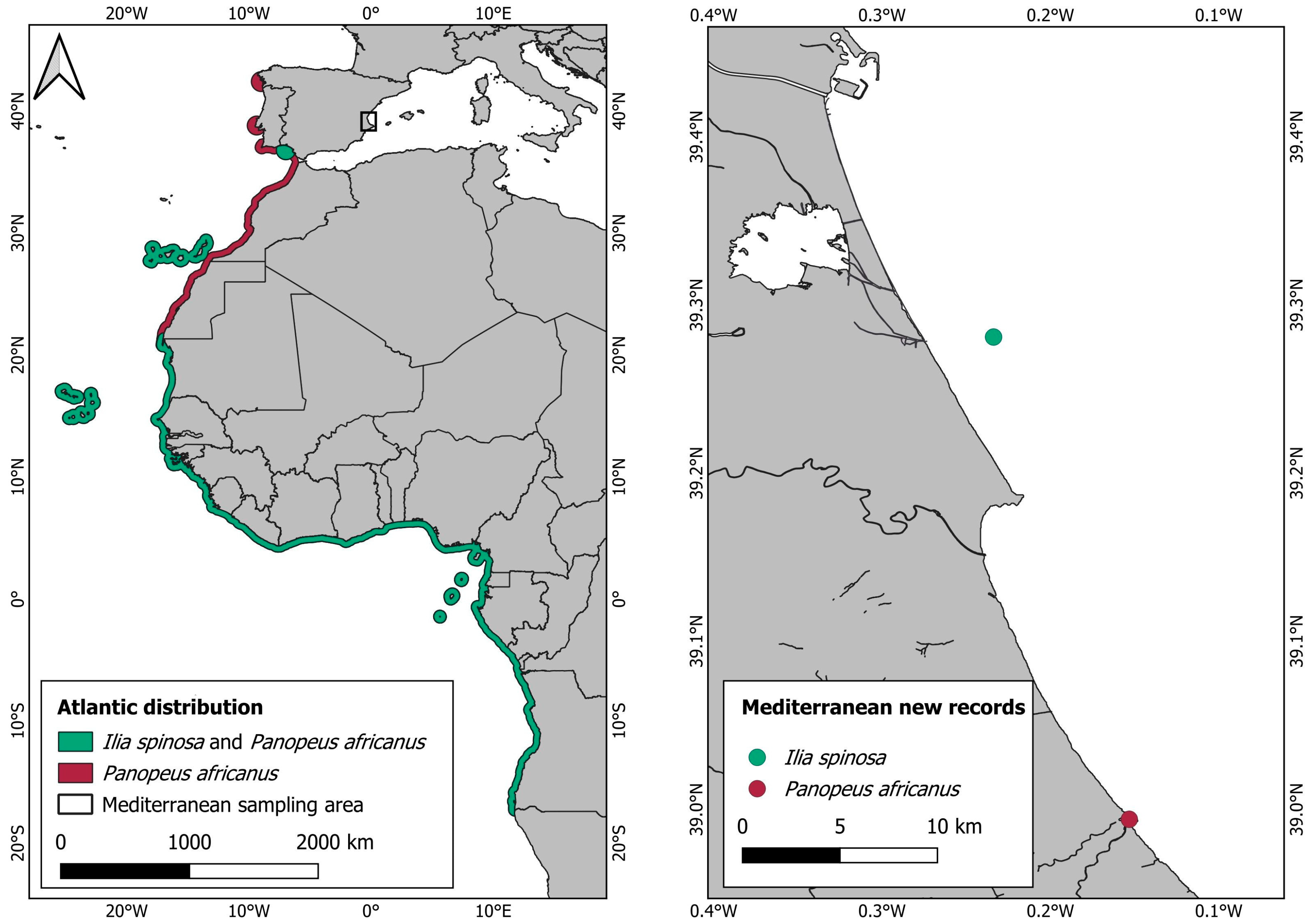
Both P. africanus and I. spinosa were incidentally detected in the Gulf of València (Western Mediterranean) during sampling efforts aimed at capturing specimens of the invasive blue crab Callinectes sapidus Rathbun, 1896. The Gulf of València extends from the southern edge of the Ebro shelf to the promontory of Cap La Nao, forming a Tertiary basin in the northwestern region of the Mediterranean Sea. The two species were recorded in geographically separate areas. The P. africanus specimen was obtained from the San Nicolás ravine in Gandía, which is a small creek that flows into the inner part of the port of Gandía (Figure 1). The average depth of this area is less than 1.5 m, and the salinity typically ranges between 22 and 30, depending on the amount of freshwater discharge and tidal regime. The I. spinosa early zoea specimen was obtained during plankton samplings conducted in the coastal waters adjacent to L’Albufera (Figure 1).

2.2. Sampling Methods

The P. africanus specimen was captured using a crab trap that was originally deployed to collect adults of C. sapidus. Sampling of C. sapidus was conducted using four cylindrical traps (dimensions (cm): 60 × 30 × 30) with a mesh aperture of 1.5 cm. Sampling was conducted weekly from 4 March to 10 July 2019. Traps were deployed at 8:00 pm and retrieved at 10:00 am the following day, using mussels as bait. It is noteworthy that there was rough weather the night prior to capture of the P. africanus specimen, resulting in a significant amount of plant materials and marine debris entangled in the traps, which is uncommon. Over the 18-week sampling period, no additional P. africanus specimens were found. The captured specimen was kept alive and fed with mussel pieces for over one year and was preserved in formalin after its death.
A single early zoeal stage of I. spinosa was accidentally captured during a study originally aimed to capture larval stages of C. sapidus [24]. Samples were collected using a manta net with a mouth opening of 0.28 m2 and 300 µm mesh size, which was trawled 200 m parallel to the coastline at a speed of 3 knots. Each transect filtered an estimated volume of 56 m3 from the water layer between 0.6 and 1 m deep. Trawling depths were adjusted using buoys and verified with a depth sensor attached to the net. All transects were conducted under calm weather conditions between 9:00 and 11:00 am. At the end of each transect, the manta net was rinsed externally with seawater using a low-pressure water pump to consolidate all collected material into the cod end. The cod end was subsequently detached and preserved in 80% ethanol. In the laboratory, all materials were extracted from the cod end by thorough rinsing and preserved in fresh 80% ethanol. Zooplankton samples were subsequently sorted and identified using an inverted microscope Leica DM IL LED (Leika Microsystems, Heerbrugg, Switzerland).

2.3. Morphological Identification

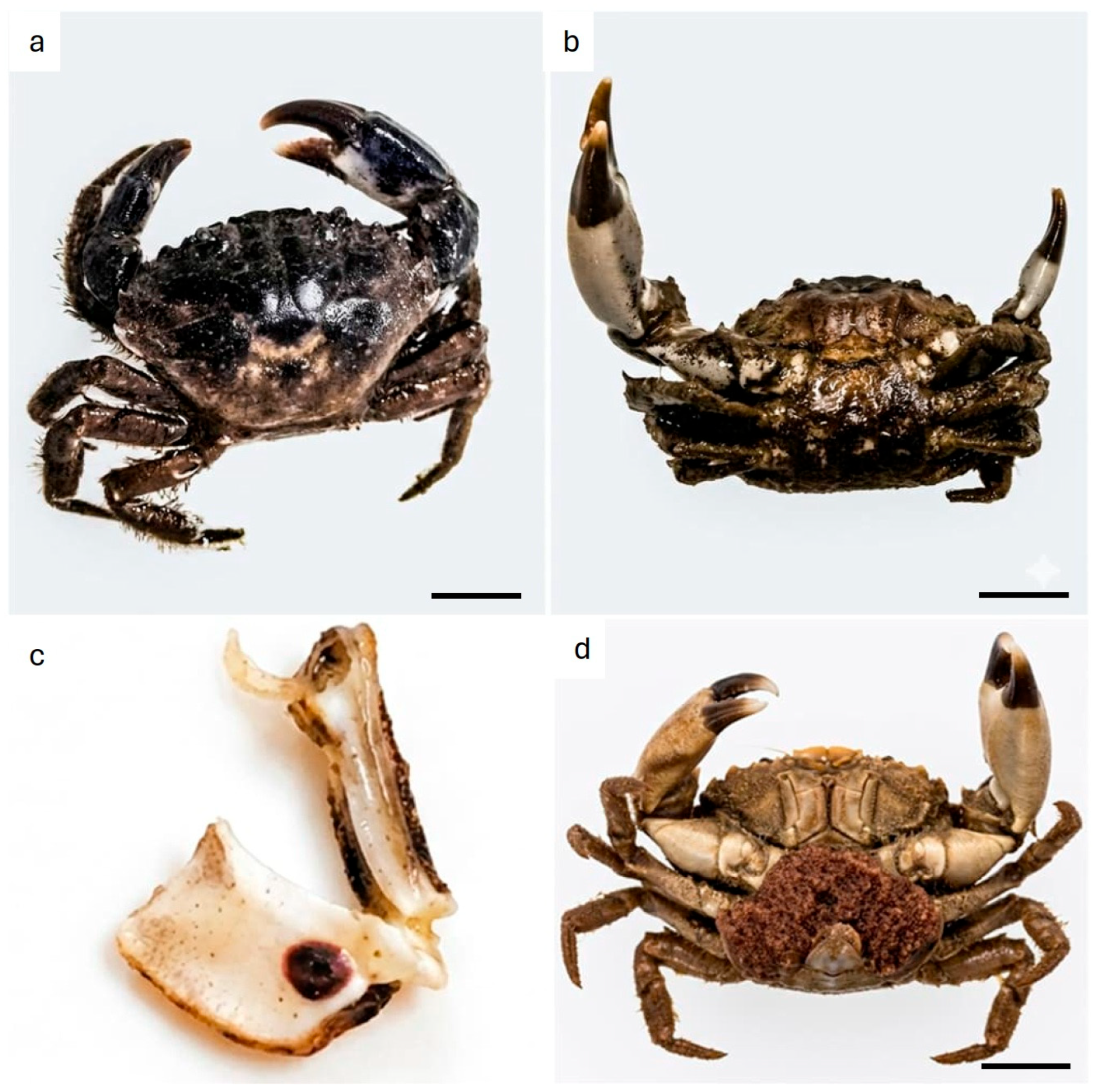
The P. africanus specimen (Figure 2) was identified following the keys to identification of Iberian Crustacean Decapods [25], taking into account a distinctive feature of this species, the presence of a red spot on the inner surface of the ischium of the third maxilliped. This red spot was observed in the specimen, although it should be noted that it is more frequent in males and not always present in all individuals of P. africanus, and it is a feature not exclusive to this species, since it has been recorded in other panopeids [26].
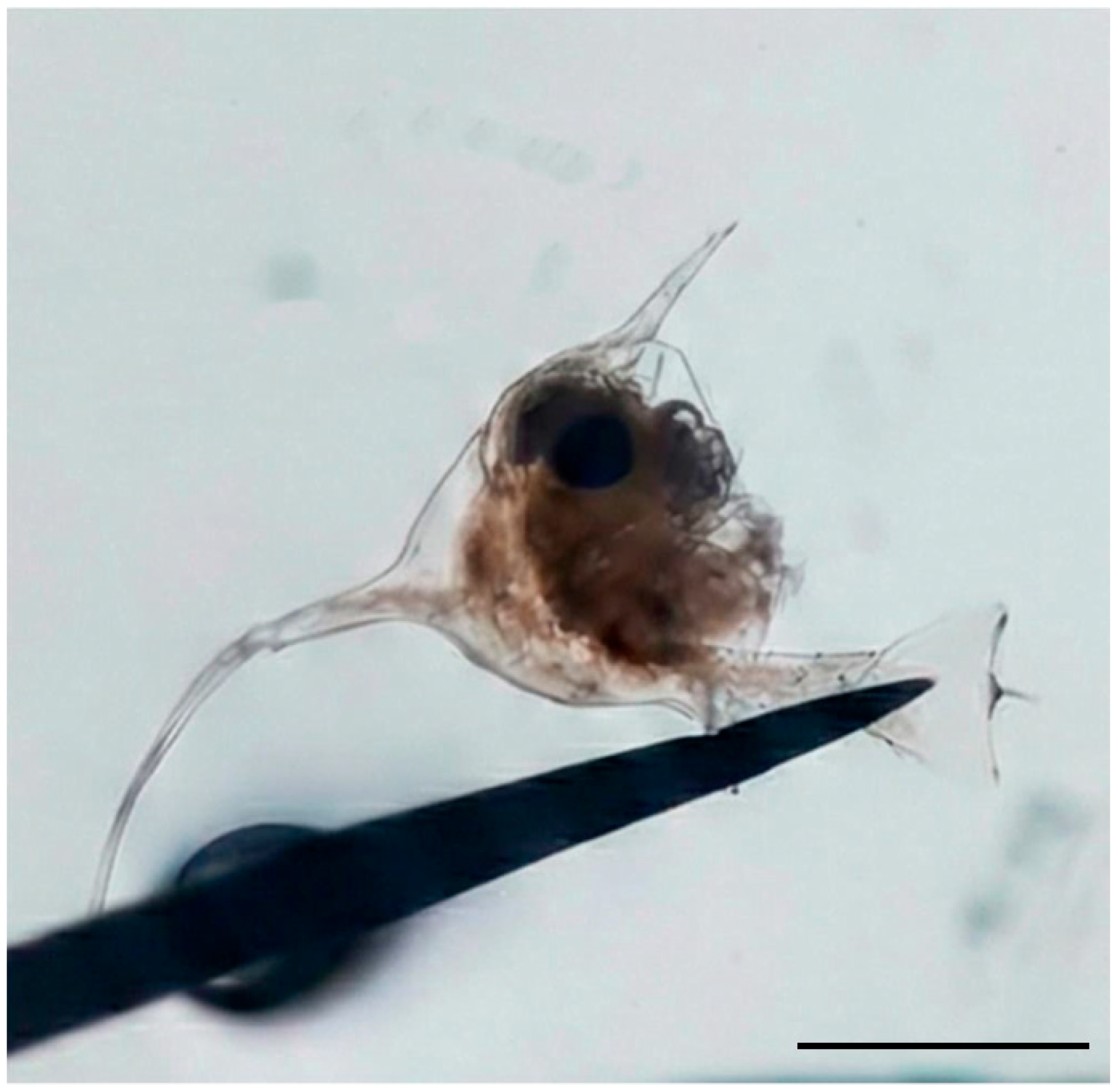
Regarding the larval stage of I. spinosa, the specimen could only be assigned to Leucosiidae zoea, since larvae of this family exhibit a unique type of telson that characterizes them (Figure 3). In Western Mediterranean waters, three leucosiid genera occur, and they are represented by seven species in the case of Ebalia Leach, 1817, and just one each in Ilia Leach, 1817, and Merocryptus A. Milne-Edwards, 1873 [27]. Since zoea larvae are not described for all these species, the most reliable method for identification was the use of DNA barcoding. The whole specimen was used in DNA extraction; therefore, after its molecular identification, it could not be described.

2.4. Molecular Identification

Total genomic DNA of the specimen of P. africanus was extracted from pereiopod muscle tissue following a modified Chelex 10% protocol [28]. A partial sequence of the mitochondrial COI gene was amplified. Cycling conditions of the polymerase chain reaction (PCR) were: 2 min at 95 °C, 35 cycles of 30 s at 95 °C, 30 s at 43 °C, 30 s at 72 °C, and finally 5 min at 72 °C. Primers COH6 (5′-TAD ACT TCD GGR TGD CCA AAR AAY CA-3′) and COL6b (5′-ACA AAT CAT AAA GAT ATY GG-3′) [29] allowed for the amplification of a 658 bp sequence. PCR products were purified, bidirectionally sequenced by Stab-Vida Laboratories, and edited using Chromas version 2.6.6. The final sequence was validated via BLAST searches on the NCBI website (https://blast.ncbi.nlm.nih.gov/Blast.cgi (accessed on 30 January 2026)) and deposited in the GenBank database under the accession number PX929708.
For I. spinosa, DNA isolation was conducted using the Puregene® kit (Gentra Systems, Minneapolis, MN, USA), using the whole zoea. The targeted region for sequencing was 16S, resulting in a 347 bp sequence. All processes of extraction, PCR and sequencing were carried out at the late Christoph Schubart’s laboratory; for this reason, currently, we cannot access more details of how these processes were carried out. The sequence was validated via BLAST search on the NCBI website and deposited in the GenBank database under the accession number PX934870.

3. Results

The early zoea specimen of Ilia spinosa was captured on 26 August 2021. Specifically, the specimen was captured in the Gulf of València, at 3000 m from the coast, at 1 m depth, and stored as sample T756-12.
For P. africanus, even though only one specimen was captured on 21 June 2019 during the sampling campaign for C. sapidus, seven other specimens were found in the Universitat Politècnica de València samples collection, although they were deposited and identified as Dyspanopeus sayi (Smith, 1869) (Table 1). Those specimens had been captured in 2015 closer to the sea, in an area about the middle of the port. In this area, both the salinity and depth are higher, but no other data about their capture is available. The distance between both sampling locations is about 500 m. The specimen collected in 2019, used as a DNA voucher, as well as the specimens collected in 2015 were deposited in the Marine Crustacean Collection of the Cádiz Oceanographic Center (CRUST_IEOCD) under the accession codes CRUST/4310 and CRUST/896, respectively [30].
The examined specimens of P. africanus showed carapace widths ranging from 40.4 to 56.3 mm (Table 1), including one ovigerous female. These values are consistent with the size range and weight reported for Atlantic populations of the species, where adult carapace width has been documented between approximately 7 and 52 mm and total weight between 0.14 and 47.75 g [22,25,26]. Only one of the males (CRUST/896-2) with 56.3 mm CW and 65 g Ww exceeds the maximum size and weight recorded.

Molecular Identification

The COI sequence PX929708 (658 bp) of P. africanus matches at 99.24 and 99.18% (divergence of four and three mutations) with the sequences KF682774 (524 bp) and KU163297 (613 bp) of P. africanus obtained by Thoma et al. [31] and Cuesta et al. [32] from the specimens ULLZ4273 from Gulf of Cádiz (Spain) and MHNUSC25043-2 from Galicia (Spain), respectively.
The 16S sequence PX934870 (340 bp) of the zoea of I. spinosa matches at 98.75% (diverging in four mutations) with the sequence PP118330 (490 bp) of I. spinosa obtained by Muñoz et al. [33] from the specimen IEOCD-GB19-2955 from Guinea Bissau.

4. Discussion

The Mediterranean Sea is one of the most important biodiversity hotspots worldwide due to its high level of endemism [34]; however, this status is increasingly threatened by the high number of exotic species present. This phenomenon has accelerated in the last 50 years, according to the increase in reporting rates, leading the Mediterranean to be considered one of the most invaded seas worldwide [35].
One of the taxonomic groups for which this process is well studied is that of decapod crustaceans. A significant number of species, 384 species according to Coll et al. [36] and likely more when accounting for newly described taxa and all the exotic species recorded over the last 15 years, have been recorded in Mediterranean waters. Species of Indo-Pacific origin have a greater presence in the eastern area due to its proximity to one of the main sources of exotic species into the Mediterranean, the Suez Canal [8]. According to Gönülal et al. [37], species of Indo-Pacific origin account for approximately two-thirds of the alien species recorded in the Mediterranean Sea.
In this study, we confirm for the first time in the Mediterranean Sea, specifically in the Gulf of València, the presence of the crab P. africanus and the first record of I. spinosa, which have an Atlantic African origin. This biogeographic origin is less frequent among exotic species present in the Mediterranean, but several precedents exist, including Percnon gibbesi, Pagurus mbizi, and Scyllarus subarctus [10,20,21]. However, these species have been found directly in more inland areas of the Mediterranean. Percnon gibbesi, was first recorded in Sicily, S. subarctus in the Gulf of Naples, and P. mbizi in the Alboran Sea, with the latter being the closest to the Atlantic basin [10,21,38]. None of these species had previously been reported in Iberian Atlantic waters, such as the Gulf of Cádiz. After becoming established, one of these species, P. gibbesi, subsequently expanded its range westward and is now present in the Alboran Sea. P. mbizi, however, has not been recorded outside the Alboran Sea, where its Mediterranean distribution appears to be restricted. Similarly, S. subarctus has been recorded again in recent years but in the same area [39].
The cases of P. africanus and I. spinosa are comparable to the case of Iridonida speciosa [19], an African species whose northward expansion appears to have reached Atlantic areas close to the Mediterranean, such as the Gulf of Cádiz, prior to its entry into the Mediterranean Sea. This pattern may support additional hypotheses regarding potential introductory pathways into the Mediterranean.
The success of an introduction, and whether an exotic species becomes invasive, depends mainly on two factors: first, what is known as propagule pressure [40], defined as the quantity (size) and frequency (number) of individuals of a species released into a new area, which would allow or prevent the establishment of a breeding population; and second, the species must find a habitat that is physically and biologically similar to its native environment, allowing it to survive and reproduce. Species with very narrow ecological requirements (e.g., strict temperature tolerance or specialized diets) are less likely to succeed than those with broader ecological flexibility. This latter factor also includes the absence of specialized predators or pathogens in the new habitat. For the introduced species, a high reproductive capacity, both in terms of offspring number and the duration of the reproductive period, further enhances the likelihood of successful establishment.
As the habitats of P. africanus and I. spinosa are different, the potential introductory pathways for each species are considered separately.
Panopeus africanus is an Atlantic epibenthic species inhabiting shallow intertidal and subtidal habitats (0.5 to 8 m) in estuaries and coastal lagoons, with a preference for muddy substrates [22,32], and is rarely found far from the intertidal zone, with an exception at 140 m depth [26]. Consequently, its distribution along its known range from Angola to Portugal is discontinuous [26]. The northernmost record is from Galicia (northwestern Iberian Peninsula), where only two specimens were reported in 2013, one male collected in a crustacean trap on muddy sand and another male found inside a fouling colony of the bryozoan Biflustra perambulata Louis & Menon, 2009, attached to the hull of a tuna vessel arriving from the Ivory Coast [32]. To date, there is no evidence of an established population of P. africanus in Galicia. In Portugal, the species is well established in the southern region, the Algarve [22], and the northernmost confirmed population located in the Mira estuary [41]. Additionally, a study on non-indigenous species inhabiting soft sediments of the Tagus and Sado estuaries [42] reported the presence of three exotic panopeid species, Dyspanopeus sayi, Dyspanopeus texanus (Stimpson, 1859), and Panopeus occidentalis de Saussure, 1857. These identifications were based solely on morphological characters, and unfortunately, there is no information available regarding the deposition of specimens in any collection for future studies, consultation, and to confirm their identities. Therefore, the possibility cannot be excluded that some of these species correspond to misidentified P. africanus, a species that currently forms a well-established population only approximately 100 km to the south, in the Mira estuary.
There is also in the Mediterranean a record of P. africanus that requires confirmation. Grimes et al. [43], in a checklist of Algerian marine decapods, reported a single individual of P. africanus collected at 83 m depth. In that study, the authors analyzed all species collected and highlighted all exotic species found (four Lessepsian species), as well as those of Mediterranean endemism sensu lato, also present in the south of the Iberian Peninsula. However, the presence of P. africanus was not emphasized in the text and was only mentioned in a table where the new reported species for Algerian waters were listed. Therefore, considering this, together with the depth at which the specimen was collected, we regard this record as doubtful, and it needs to be confirmed.
In the present study, we have reported not only the collection of a single P. africanus specimen in 2019 but seven individuals, including an ovigerous female, who had been collected in 2015 in Gandía (València), close to the place where the recent specimen was found. How did this species arrive in the Gulf of València? The main pathways suggested for the introduction of exotic species are the ships’ ballast water and hull biofouling [44]. Considering that one of the specimens of P. africanus found in Galicia was collected in the hull biofouling of a tuna vessel, this pathway could plausibly explain its introduction into the Gulf of València, which is characterized by both the presence of an important port in València, and the Port of Gandía, where all these individuals were collected in 2015 and 2019. Furthermore, the species is present in the nearby Gulf of Cádiz; therefore, the origin population could be either directly from Africa or from this closer Atlantic region.
Ilia spinosa inhabits mud or sandy mud bottoms between 6 and 132 m depth and distributes from Mauritania to Angola and the Canary Islands [26], although it has been recently recorded in the Gulf of Cádiz [23]. In the Gulf of València, only an early zoeal stage has been collected; therefore, the origin of this larva is uncertain. One possibility is that the larva was released by an ovigerous female present in the area, which would imply that the species is present in the Gulf of València but has been overlooked until now. Specimens of I. spinosa can be easily confused with the native, common congeneric species Ilia nucleus (Linnaeus, 1758), and only a detailed examination of the characters distinguishing the two species allows for correct identification. Perhaps, because until now only I. nucleus, a crab with a clearly distinctive morphology, was the only species present in the Mediterranean, it was not considered necessary to examine specimens in detail to identify them, and therefore, specimens of I. spinosa could have been misidentified as I. nucleus. In this case, future benthic sampling, specifically targeting the possible presence of I. spinosa, would be required to confirm whether a reproductive population is established in the Gulf of València. Alternatively, the larva could have been transported in ship ballast water; however, as only an early zoeal stage was collected, the source vessel could not have originated from very distant areas. There are, nonetheless, examples of larvae of exotic species collected in the plankton without subsequent detection of adult specimens in the same area, for instance, Palaemon macrodactylus Rathbun, 1902, in the Balearic Islands. This species was reported for the first time for the Mediterranean based on larvae collected in 2005 and 2010 in the Balearic Islands [45], yet no adult specimens were recorded there until a well-established population was observed in the Adriatic Sea in 2013 [46]. The Balearic larvae and the Adriatic population are likely unrelated, but larval transport via currents or ships’ ballast water between these two locations cannot be entirely ruled out.
Finally, it is important to highlight the crucial role that DNA barcoding techniques play in the early detection of exotic species, which is increasingly applied through environmental DNA (eDNA) sampling. In any case, it should be emphasized that the reliability of eDNA-based detection depends on the availability of high-quality reference databases containing sequences from accurately identified specimens.

5. Conclusions

The findings of this study document the first record of the African crab Ilia spinosa in the Mediterranean waters and confirms the presence of Panopeus africanus in the Western Mediterranean Sea. The identification of both species was supported by morphological and molecular evidence, including DNA barcoding for P. africanus and molecular identification of the larval specimen of I. spinosa. These findings contribute to the growing number of Atlantic African decapods recorded in the Mediterranean and provide additional support for the northward expansion of warm-affinity species associated with the “African Creep” phenomenon. Although the mechanisms responsible for their arrival remain uncertain, maritime transport and natural dispersal processes may both play a role. Continued monitoring and further records will be necessary to determine whether these occurrences represent isolated introductions or the early stages of a broader biogeographical shift in Mediterranean decapod fauna.
This study underscores the crucial role of DNA barcoding as a tool for the early detection of exotic species, particularly in their larval stages, where morphological identification is often insufficient.

Author Contributions

Conceptualization, A.G.-F., P.A. and J.A.C.; sampling, A.G.-F.; processing of samples A.G.-F.; molecular analysis J.A.C.; processing of photos and figures A.G.-F.; specimen curation, I.M.; writing—original draft preparation, J.A.C.; writing—review and editing, A.G.-F., P.A., I.M. and J.A.C. All authors have read and agreed to the published version of the manuscript.

Funding

This research received no external funding.

Institutional Review Board Statement

Not applicable.

Data Availability Statement

Specimens studied in the present study are deposited in the Marine Crustacean Collection of the Cádiz Oceanographic Center (CRUST_IEOCD), except the Ilia spinosa larva that was destroyed when it was used in the DNA extraction. DNA sequences obtained in the present study are deposited in GenBank under the accession numbers PX929708 and PX934870.

Acknowledgments

We thank our dear friend and colleague, the late Christoph Schubart, for his initial contribution to the molecular identification of the Ilia spinosa larva. We also thank Miguel Rodilla for his tireless sampling efforts, Carlos Sánchez for his work at the ICMAN-CSIC laboratory, and three anonymous reviewers for their suggestions and constructive criticism that improved the manuscript. During the preparation of this manuscript the authors used QGIS 3.40.11 free software for Figure 1, and Figure 2 and Figure 3 were digitally enhanced using Google Gemini Pro and GIMP free software for increased contrast and clarity. The authors have reviewed and edited the output and take full responsibility for the content of this publication.

Conflicts of Interest

The authors declare no conflicts of interest.

References

  1. Dueñas, M.-A.; Hemming, D.J.; Roberts, A.; Diaz-Soltero, H. The threat of invasive species to IUCN-listed critically endangered species: A systematic review. Glob. Ecol. Conserv. 2021, 26, e01476. [Google Scholar] [CrossRef] [Scilit]
  2. Niederman, T.E.; Aronson, J.N.; Gainsbury, A.M.; Nunes, L.A.; Dreiss, L.M. US imperiled species and the five drivers of biodiversity loss. BioScience 2025, 75, 524–533. [Google Scholar] [CrossRef] [Scilit]
  3. Haubrock, P.J.; Everts, T.; Abreo, N.A.S.; Bojko, J.; Deklerck, V.; Dickey, J.W.E.; Franco, A.C.S.; García-Berthou, E.; Katsanevakis, S.; Kirichenko, N.I.; et al. The impacts of biological invasions. Biol. Rev. 2025. Epub ahead of printing. [Google Scholar] [CrossRef] [Scilit]
  4. Havel, J.E.; Kovalenko, K.E.; Thomaz, S.M.; Amalfitano, S.; Kats, L.B. Aquatic invasive species: Challenges for the future. Hydrobiologia 2015, 750, 147–170. [Google Scholar] [CrossRef] [Scilit] [PubMed]
  5. Costello, M.J.; Dekeyzer, D.; Galil, B.S.; Hutchings, P.; Katsanevakis, S.; Pagad, S.; Robinson, T.B.; Turon, X.; Vandepitte, L.; Vanhoorne, B.; et al. Introducing the World Register of Introduced Marine Species (WRiMS). Manag. Biol. Invasions 2021, 12, 792–811. [Google Scholar] [CrossRef] [Scilit]
  6. Galil, B.S. Taking stock: Inventory of alien species in the Mediterranean Sea. Biol. Invasions 2009, 11, 359–372. [Google Scholar] [CrossRef] [Scilit]
  7. Zenetos, A.; Albano, P.G.; Garcia, E.L.; Stern, N.; Tsiamis, K.; Galanidi, M. Established non-indigenous species increased by 40% in 11 years in the Mediterranean Sea. Mediterr. Mar. Sci. 2022, 23, 196–212. [Google Scholar] [CrossRef] [Scilit]
  8. Galil, B.S.; Boero, F.; Fraschetti, S.; Piraino, S.; Campbell, M.L.; Hewitt, C.L.; Carlton, J.T.; Cook, E.J.; Jelmert, A.; Macpherson, E. The enlargement of the Suez Canal and introduction of non-indigenous species to the Mediterranean Sea. Limnol. Oceanogr. Bull. 2015, 24, 41–43. [Google Scholar] [CrossRef] [Scilit]
  9. Ribera-Siguan, M.A. Pathways of biological invasions of marine plants. In Invasive Species: Vectors and Management Strategies; Ruiz, G.M., Carlton, J.T., Eds.; Island Press: Washington, DC, USA, 2003; pp. 183–226. [Google Scholar] [CrossRef] [Scilit]
  10. García Raso, J.E.; Salmerón, F.; Baro, J.; Marina, P.; Abelló, P. The tropical African hermit crab Pagurus mbizi (Crustacea, Decapoda, Paguridae) in the Western Mediterranean Sea: A new alien species or filling gaps in the knowledge of the distribution? Mediterr. Mar. Sci. 2014, 15, 172–178. [Google Scholar] [CrossRef] [Scilit]
  11. Katsanevakis, S.; Zenetos, A.; Belchior, C.; Cardoso, A.C. Invading European Seas: Assessing pathways of introduction of marine aliens. Ocean Coast. Manag. 2013, 76, 64–74. [Google Scholar] [CrossRef] [Scilit]
  12. Galil, B.S.; Zirler, R.; Feldstein-Farkash, T.; Bronstein, O. A call to ARMS: New records of invasive alien decapods in the Mediterranean Sea. Manag. Biol. Invasions 2024, 15, 581–600. [Google Scholar] [CrossRef] [Scilit]
  13. Corsini-Foka, M.; Kondilatos, G.; Economidis, P.S. Occurrence of the Lessepsian species Portunus pelagicus (Crustacea) and Apogon pharaonis (Pisces) in the marine area of Rhodes Island. Mediterr. Mar. Sci. 2004, 5, 83–90. [Google Scholar] [CrossRef] [Scilit]
  14. Ceyhan, T.; Akyol, O. A new record of the Red Sea pebble crab, Ixa monodi Holthuis and Gottlieb, 1956 (Crustacea: Decapoda) from the Aegean Coast of Turkey. Aquat. Invasions 2008, 3, 239–241. [Google Scholar] [CrossRef] [Scilit]
  15. Shaiek, M.; El Zrelli, R.; Crocetta, F.; Mansour, L.; Rabaoui, L. On the occurrence of three exotic decapods, Callinectes sapidus (Portunidae), Portunus segnis (Portunidae), and Trachysalambria palaestinensis (Penaeidae), in Northern Tunisia, with updates on the distribution of the two invasive Portunids in the Mediterranean Sea. BioInvasions Rec. 2021, 10, 158–169. [Google Scholar] [CrossRef] [Scilit]
  16. Galil, B.S. The alien crustaceans in the Mediterranean Sea: An historical review. In In the Wrong Place—Alien Marine Crustaceans: Distribution, Biology and Impacts; Galil, B.S., Clark, P.F., Carlton, J.T., Eds.; Springer: Dordrecht, The Netherlands, 2011; Volume 6, pp. 377–401. [Google Scholar] [CrossRef] [Scilit]
  17. Carvalho-Souza, G.F.; Cuesta, J.A.; Arana, D.; Lobato, C.; González-Ortegón, E. Westward range expansion of the blue swimmer crab Portunus segnis (Forskål, 1775) (Crustacea, Decapoda, Portunidae) into Atlantic European waters. BioInvasions Rec. 2023, 12, 1033–1044. [Google Scholar] [CrossRef] [Scilit]
  18. Canning-Clode, J.; Carlton, J.T. Refining and expanding global climate change scenarios in the sea: Poleward creep complexities, range termini, and setbacks and surges. Divers. Distrib. 2017, 23, 463–473. [Google Scholar] [CrossRef] [Scilit]
  19. Farré, M.; Lombarte, A.; Tuset, V.M.; Salmerón, F.; Vivas, M.; Abelló, P. Tropicalization induced by non-native species in the Western Mediterranean Sea: Effects on decapod crustacean taxocoenoses. Estuar. Coast. Shelf Sci. 2025, 313, 109114. [Google Scholar] [CrossRef] [Scilit]
  20. Iveša, N.; Brajković, A.; Piria, M.; Buršić, M. The northernmost record of Percnon gibbesi (H. Milne Edwards, 1853) in the Mediterranean Sea. BioInvasions Rec. 2024, 13, 767–776. [Google Scholar] [CrossRef] [Scilit]
  21. Tanduo, V.; Osca, D.; Crocetta, F. A bycatch surprise: Scyllarus subarctus Crosnier, 1970 (Decapoda: Achelata: Scyllaridae) in the Mediterranean Sea. J. Crustac. Biol. 2021, 41, ruab010. [Google Scholar] [CrossRef] [Scilit]
  22. Monteiro, J.N.; Ovelheiro, A.; Pinto, M.; Teodósio, M.A.; Leitão, F. Reproductive traits of the African mud crab (Panopeus africanus) on the South Portuguese Coast. Reg. Stud. Mar. Sci. 2024, 69, 103339. [Google Scholar] [CrossRef] [Scilit]
  23. Muñoz, I.; Coján, M.; Silva, L.; García-Raso, J.E.; Cuesta, J.A. First record of the African crab Ilia spinosa Miers, 1881 (Crustacea: Decapoda: Leucosiidae) in European continental waters. Thalassas, 2026; submitted.
  24. Gil-Fernández, A.; Rodilla, M.; Prado, P.; Falco, S. Early life stages of the invasive Atlantic blue crab Callinectes sapidus in the Western Mediterranean Sea. Estuar. Coast. Shelf Sci. 2024, 296, 108593. [Google Scholar] [CrossRef] [Scilit]
  25. Zariquiey Álvarez, R. Crustáceos Decápodos Ibéricos. Investig. Pesq. 1968, 32, 1–510. [Google Scholar] [CrossRef] [Scilit]
  26. Manning, R.B.; Holthuis, L.B. West African brachyuran crabs (Crustacea: Decapoda). Smithson. Contrib. Zool. 1981, 306, 1–379. [Google Scholar] [CrossRef] [Scilit]
  27. Marco-Herrero, E.; Abelló, P.; Drake, P.; García-Raso, J.E.; González Gordillo, J.I.; Guerao, G.; Palero, F.; Cuesta, J.A. Annotated checklist of brachyuran crabs (Crustacea, Decapoda) of the Iberian Peninsula (SW Europe). Sci. Mar. 2015, 79, 243–256. [Google Scholar] [CrossRef] [Scilit]
  28. Estoup, A.; Largiader, C.R.; Perrot, E.; Chourrout, D. Rapid one-tube DNA extraction for reliable PCR detection of fish polymorphic markers and transgenes. Mol. Mar. Biol. Biotechnol. 1996, 5, 295–298. [Google Scholar]
  29. Schubart, C.D.; Huber, M.G.J. Genetic comparisons of German populations of the stone crayfish, Austropotamobius torrentium (Crustacea: Astacidae). Bull. Fr. Pêche Piscic. 2006, 380–381, 1019–1028. [Google Scholar] [CrossRef] [Scilit]
  30. Muñoz, I.; Serrano, M. Colección de Crustáceos Marinos (CRUST-IEOCD); Version 1.33; Occurrence Dataset; Instituto Español de Oceanografía, Centro Oceanográfico de Cádiz (CSIC): Cádiz, España, 2025; Available online: https://www.gbif.org/dataset/317fd0a9-1bcf-4e94-bc3c-a685c4693c10 (accessed on 30 January 2026). [CrossRef] [Scilit]
  31. Thoma, B.P.; Guinot, D.; Felder, D.L. Evolutionary relationships among American mud crabs (Crustacea: Decapoda: Brachyura: Xanthoidea) inferred from nuclear and mitochondrial markers, with comments on adult morphology. Zool. J. Linn. Soc. 2014, 170, 86–109. [Google Scholar] [CrossRef] [Scilit]
  32. Cuesta, J.A.; Almón, B.; Pérez-Dieste, J.; Trigo, J.E.; Bañón, R. Role of ships’ hull fouling and tropicalization process on European carcinofauna: New records in Galician waters (NW Spain). Biol. Invasions 2016, 18, 619–630. [Google Scholar] [CrossRef] [Scilit]
  33. Muñoz, I.; García-Raso, J.E.; Abelló, P.; Cuesta, J.A. Marine crabs of Guinea-Bissau, with emphasis on the deep fauna, supported by an integrative taxonomy. Diversity 2024, 16, 93. [Google Scholar] [CrossRef] [Scilit]
  34. Cantasano, N. Loss and gain of marine biodiversity in Mediterranean Seawaters. Nat. Resour. Conserv. Res. 2024, 7, 5420. [Google Scholar] [CrossRef] [Scilit]
  35. Edelist, D.; Rilov, G.; Golani, D.; Carlton, J.T.; Spanier, E. Restructuring the Sea: Profound shifts in the world’s most invaded marine ecosystem. Divers. Distrib. 2013, 19, 69–77. [Google Scholar] [CrossRef] [Scilit]
  36. Coll, M.; Piroddi, C.; Steenbeek, J.; Kaschner, K.; Ben Rais Lasram, F.; Aguzzi, J.; Ballesteros, E.; Bianchi, C.N.; Corbera, J.; Dailianis, T. The biodiversity of the Mediterranean Sea: Estimates, patterns, and threats. PLoS ONE 2010, 5, e11842. [Google Scholar] [CrossRef] [Scilit] [PubMed]
  37. Gönülal, O.; Lubinevsky, H.; Galil, B.S. The first Indo-West Pacific rock shrimp (Crustacea, Decapoda, Sicyoniidae) in the Mediterranean Sea. Mar. Biodivers. Rec. 2016, 5, 39–42. [Google Scholar] [CrossRef] [Scilit]
  38. Relini, M.; Orsi, L.; Puccio, V.; Azzurro, E. The Exotic crab Percnon gibbesi (H. Milne Edwards, 1853) (Decapoda, Grapsidae) in the Central Mediterranean. Sci. Mar. 2000, 64, 337–340. [Google Scholar] [CrossRef] [Scilit]
  39. Langeneck, J.; Bakiu, R.; Chalari, N.; Chatzigeorgiou, G.; Crocetta, F.; Doğdu, S.A.; Durmishaj, S.; García-Charton, J.A.; Gülşahin, A.; Hoffman, R.; et al. New records of introduced species in the Mediterranean Sea (November 2023). Mediterr. Mar. Sci. 2023, 24, 610–632. [Google Scholar] [CrossRef] [Scilit]
  40. Jeschke, J.M.; Starzer, J. Propagule Pressure Hypothesis. In Invasion Biology: Hypotheses and Evidence; Jeschke, J.M., Heger, T., Eds.; CABI: Wallingford, UK, 2018; pp. 147–153. [Google Scholar] [CrossRef] [Scilit]
  41. Rodriguez, A.; Paula, J. Larval and postlarval development of the mud crab Panopeus africanus A. Milne Edwards (Decapoda: Xanthidae) reared in the laboratory. J. Crustac. Biol. 1993, 13, 296–308. [Google Scholar] [CrossRef] [Scilit]
  42. Cabral, S.; Carvalho, F.; Gaspar, M.; Ramajal, J.; Sá, E.; Santos, C.; Silva, G.; Sousa, A.; Costa, J.L.; Chainho, P. Non-indigenous species in soft-sediments: Are some estuaries more invaded than others? Ecol. Indic. 2020, 110, 105640. [Google Scholar] [CrossRef] [Scilit]
  43. Grimes, S.; Bakalem, A.; Dauvin, J.-C. Annotated Checklist of Marine Algerian Crustacean Decapods. Mediterr. Mar. Sci. 2016, 17, 384–395. [Google Scholar] [CrossRef] [Scilit]
  44. Minchin, D.; Gollasch, S.; Cohen, A.N.; Hewitt, C.L.; Olenin, S. Characterizing vectors of marine invasion. In Biological Invasions in Marine Ecosystems; Rilov, G., Crooks, J.A., Eds.; Ecological Studies; Springer: Berlin/Heidelberg, Germany, 2009; Volume 204, pp. 109–116. [Google Scholar]
  45. Torres, A.P.; Santos, A.D.; Cuesta, J.A.; Massutí, E.; Alemany, F.; Reglero, P. First record of Palaemon macrodactylus Rathbun, 1902 (Decapoda, Palaemonidae) in the Western Mediterranean. Mediterr. Mar. Sci. 2012, 13, 278–282. [Google Scholar] [CrossRef] [Scilit]
  46. Cuesta, J.A.; Bettoso, N.; Comisso, G.; Froglia, C.; Mazza, G.; Rinaldi, A.; Rodríguez-Romero, A.; Scovacricchi, T. Record of an established population of Palaemon macrodactylus Rathbun, 1902 (Decapoda, Palaemonidae) in the Mediterranean Sea: Confirming a prediction. Mediterr. Mar. Sci. 2014, 15, 569–573. [Google Scholar] [CrossRef] [Scilit]
Figure 1. Maps of the Atlantic distribution and Mediterranean new records of Panopeus africanus and Ilia spinosa. In the Atlantic distribution, Pa_1 indicates a possible locality of P. africanus in the Tagus estuary (Portugal), Pa_2 is a record of this species in Galicia (Spain), and Is_1 indicates a recent record of I. spinosa in the Gulf of Cádiz.
Fishes 11 00168 g001
Figure 2. Panopeus africanus collected at San Nicolás ravine in Gandía (Gulf of València, Spain): male (CRUST/4310): (a) dorsal view, (b) ventral view, and (c) detail of the red spot on the inner surface of the ischium of the third maxilliped; ovigerous female (CRUST/896-1): (d) ventral view. Scale bars = 1 cm.
Fishes 11 00168 g002
Figure 3. Ilia spinosa (T756-12) early zoeal stage collected in plankton sampling in the Gulf of València (Spain). The needle points out the telson, typical of leucosiid zoeal stages. Scale bar = 1 mm.
Fishes 11 00168 g003
Table 1. Data of the Panopeus africanus specimens studied in the present study and deposited in the Marine Crustacean Collection of the Cádiz Oceanographic Center (CRUST_IEOCD), including the date of collection, carapace width in mm (CW), carapace length in mm (CL), carapace width/length ratio (CW/CL), wet weight in g (Ww), and sex (M, male; F, female).
IDDate of CollectionCWCLCW/CLWwSex (M/F)
CRUST/896-12015 146.731.71.4738F (ovigerous)
CRUST/896-22015 156.338.81.4565M
CRUST/896-32015 147.432.71.4536M
CRUST/896-42015 152.835.11.5050M
CRUST/896-52015 145.530.41.5031M
CRUST/896-62015 150.434.91.4432M
CRUST/896-72015 147.131.91.4833F
CRUST/431021 June 201940.426.61.5220M
1 Only the year was included in the label of these samples.
Disclaimer/Publisher’s Note: The statements, opinions and data contained in all publications are solely those of the individual author(s) and contributor(s) and not of MDPI and/or the editor(s). MDPI and/or the editor(s) disclaim responsibility for any injury to people or property resulting from any ideas, methods, instructions or products referred to in the content.