Article

Hypoxic Preconditioning Enhances the Hypoxia Tolerance of the Pearl Oyster Pinctada fucata martensii and Is Associated with Changes in the Intestinal Microbiota

1
Fisheries College, Guangdong Ocean University, Zhanjiang 524088, China
2
Pearl Breeding and Processing Engineering Technology Research Centre of Guangdong Province, Zhanjiang 524088, China
3
Guangdong Provincial Key Laboratory of Aquatic Animal Disease Control and Healthy Culture, Zhanjiang 524088, China
4
Guangdong Science and Innovation Center for Pearl Culture, Zhanjiang 524088, China
*
Author to whom correspondence should be addressed.
Fishes 2026, 11(3), 163; https://doi.org/10.3390/fishes11030163
Submission received: 29 January 2026 / Revised: 4 March 2026 / Accepted: 11 March 2026 / Published: 12 March 2026
(This article belongs to the Special Issue Biology and Culture of Marine Invertebrates)

Abstract

Hypoxia frequently triggers mass mortality events in pearl oysters during the summer months. Hypoxic preconditioning (HP), repeated exposure to sublethal low-oxygen conditions, has been proposed as a potential strategy to enhance stress resistance. Here, we investigated how HP affects hypoxia tolerance in the pearl oyster Pinctada fucata martensii, with emphasis on host apoptotic and immune regulation and the gut microbiota. Pearl oysters assigned to HP (experimental group, EG) and to a non-preconditioned control group (CG) were subjected to sustained hypoxic challenge (1.5 ± 0.1 mg/L DO for 15 days). HP significantly increased the expression of apoptosis- and immunity-related genes (MyD88, IκK, NF-κB) while suppressing JNK expression in gills after extended hypoxia (MyD88: EG 2.26 ± 0.65 vs. CG 0.96 ± 0.29, p < 0.05, ~2.3-fold increase; NF-κB: EG 1.50 ± 0.20 vs. CG 0.81 ± 0.31, p < 0.05, ~1.8-fold increase; IκK: EG 1.55 ± 0.38 vs. CG 0.65 ± 0.12, p < 0.05, ~4.0-fold increase; JNK: EG 0.49 ± 0.25 vs. CG 1.44 ± 0.51, p < 0.05, ~0.34-fold), consistent with a pre-activated yet controlled stress response. In parallel, HP markedly reshaped the intestinal microbial community under hypoxia, increasing alpha diversity (Ace, Chao, and Sobs indices) and enriching potentially beneficial bacterial phyla such as Planctomycetota, Nitrospirota, and Fusobacteriota, groups often linked to nutrient cycling and short-chain fatty acid production. Collectively, these results suggest that HP-enhanced hypoxia tolerance in P. f. martensii is associated with coordinated modulation of host apoptotic and immune signaling and concomitant shifts in gut microbiome diversity. These findings highlight the role of the host–microbiota axis in environmental acclimation and suggest that HP may be a practical tool for improving bivalve performance under hypoxic stress in aquaculture.
Key Contribution: This study offers insights into how HP improves hypoxia tolerance in P. f. martensii and suggests that host–microbiota interactions contribute synergistically to this effect. Specifically, HP modulates host apoptotic/immune signaling while reorganizing the gut microbiome, increasing overall diversity and enriching beneficial phyla such as Planctomycetota, Nitrospirota, and Fusobacteriota. Together, these results make HP a feasible, practice-oriented approach for strengthening health and resilience in cultured bivalves.

1. Introduction

Coastal ecosystems experience highly variable environmental conditions [1,2,3]. Among the most severe pressures on these systems is hypoxia, the decline of dissolved oxygen (DO) in seawater [4]. In general, hypoxia develops when oxygen demand (from respiration and microbial processes) exceeds the oxygen supply via diffusion, water mixing, and photosynthesis. Consequently, DO may drop below 2 mg/L, resulting in hypoxia [5]; with further declines in oxygen, severe anoxia can arise and impose additional stress on organisms. Furthermore, heatwaves are becoming increasingly frequent, exacerbating extreme hypoxic events [6]. Hypoxia can cause biodiversity loss and negatively affect the survival of organisms [4].
Hypoxic stress disrupts bivalve physiology by suppressing feeding and altering reactive oxygen species (ROS) dynamics, thereby slowing growth and compromising immunity. It can also induce autophagy and oxidative stress and disrupt protein metabolism and inflammatory gene expression, ultimately increasing the risk of mass mortality events [7,8]. Pinctada fucata martensii is a marine, pearl-producing bivalve and accounts for more than 90% of global seawater pearl production [9,10], making it a major contributor to the pearl industry [11]. This species is cultured using a variety of farming systems [12,13]. These production approaches expose pearl oysters to environmental stressors [14,15]. Moreover, pearl oysters readily accumulate biofoulants, which can markedly reduce water-exchange efficiency within culture systems [16] and thereby exacerbate hypoxic stress. Liusha Bay is China’s largest marine pearl-farming base [17], and hypoxic episodes in this area are becoming increasingly common [7]. Summer mass mortality events in pearl oysters are frequently reported [18]. Therefore, improving their hypoxia tolerance capacity is critically important.
Moderate stress exposure can shape stress responses, and predictable stressor regimes may enable fish to anticipate environmental challenges [19]. Stress resistance can be enhanced through multiple mechanisms, and “preconditioning,” the use of sublethal stress to prime cellular defense networks (e.g., hypoxic preconditioning and acid-adaptation responses), is considered a particularly promising strategy [20]. Hypoxic preconditioning refers to endogenous protective responses elicited by repeated brief, non-lethal hypoxic episodes; similarly, moderate hypoxic exposure can attenuate systemic stress responses to subsequent hypoxia and ultimately increase organismal tolerance [21]. Wu et al. [22] reported that hypoxia tolerance in Scapharca broughtonii is enhanced following hypoxic preconditioning. More recently, Yang et al. [23] showed that hypoxic preconditioning improves hypoxia tolerance in the pearl oyster P. f. martensii. The gut microbiome has been recognized as a vital external organ in animals [24] that shapes host development and physiology [25]. Hypoxic conditions can influence microbial metabolism, and abundant microbial functional pathways may confer a survival advantage [26]. Long-term periodic hypoxia reduces intestinal microbial richness and diversity in Hong Kong oysters [27]. Hypoxic exposure also induces marked shifts in the bacterial communities of both the hepatopancreas and gills in the ark shell Anadara kagoshimensis [28]. Nonetheless, whether the gut microbiota mediates the health benefits of hypoxic preconditioning remains a pivotal yet understudied question.
Here, we evaluated how hypoxic preconditioning affects the gut microbiota of P. f. martensii and how these changes relate to host adaptation. Clarifying the mechanisms through which the microbiome supports hypoxia tolerance may yield new insights for improving stress resilience and health management in cultured bivalves.

2. Materials and Methods

2.1. Hypoxic Preconditioning

Healthy pearl oysters (1.5 years old) were used in experiments. They were then acclimated for 14 days at 31 °C (7.0 mg/L DO), followed by 2.0 mg/L DO for 24 h and then normoxic seawater (DO > 7.0 mg/L) for 48 h. Hypoxia exposure was conducted following Chen et al. [7]. The DO concentration (2.0 mg/L) was maintained via aeration with nitrogen and air.

2.2. Hypoxia Challenge

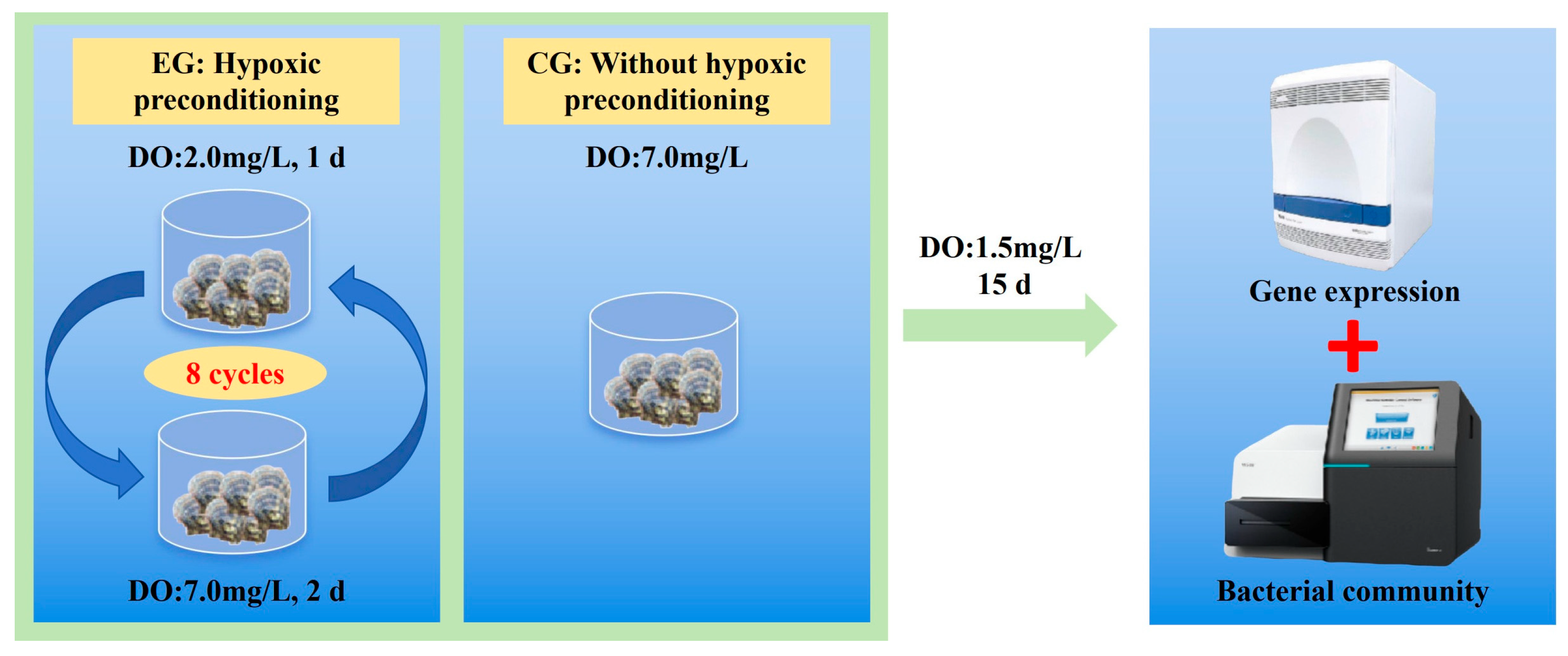
The experimental group (EG) underwent eight consecutive cycles of hypoxic preconditioning. A total of 300 hypoxia-preconditioned pearl oysters were then randomly assigned to three replicate tanks (100 oysters per tank). The control group (CG) did not undergo preconditioning; 300 non-preconditioned pearl oysters were likewise randomly allocated to three replicate tanks (100 per tank). Both groups were subsequently subjected to hypoxic stress (DO: 1.5 ± 0.1 mg/L) (Figure 1) [23]. The hypoxic challenge lasted 15 days, during which pearl oysters were fed algae. Seawater was replaced daily in each tank (three replicates per treatment). During the 15 days of hypoxic stress, preconditioned pearl oysters exhibited a 36.96% higher survival rate [23]. Gill tissues were collected from three pearl oysters per replicate tank at 0, 0.5, 1, and 15 days after the onset of hypoxia. Intestinal tissues were collected from eight pearl oysters per group at day 15. Intestinal and gill tissues were dissected, frozen, and stored at −80 °C.

2.3. Apoptosis- and Immunity-Related Genes

Total RNA was extracted from gill tissues (three individuals per replicate) using TRIzol reagent (Molecular Research Center (MRC), Cincinnati, OH, USA). First-strand cDNA was then synthesized. qRT-PCR primers were designed based on the published genomic dataset [29] and are listed in Table 1. Relative transcript abundance was calculated using the 2−ΔΔCT method [30], with β-actin used as the internal reference gene [31].

2.4. Gut Microbiota Detection

Total microbial genomic DNA was extracted separately from the intestinal microbiota of eight P. f. martensii in the EG and eight in the CG. DNA quality was assessed, and samples were stored at −80 °C until further processing. The V3–V4 hypervariable region of the bacterial 16S rRNA gene was amplified on a thermocycler using primers 341F (5′-CCTACGGGNGGCWGCAG-3′) and 785R (5′-GACTACHVGGGTATCTAATCC-3′) [32]. PCR reactions (20 µL) contained 2× Pro Taq (10 µL), 0.8 µL of each primer (5 µM), 10 ng template DNA, and ddH2O to volume. Cycling conditions were as follows: 95 °C for 3 min; 27 cycles of 95 °C for 30 s, 55 °C for 30 s, and 72 °C for 45 s; followed by 72 °C for 10 min and a hold at 10 °C. Amplicons were excised from a 2% agarose gel, purified using a PCR Clean-Up Kit (YuHua, Shanghai, China) according to the manufacturer’s instructions, and quantified with a Qubit 4.0 fluorometer (Thermo Fisher Scientific, Waltham, MA, USA). Purified products were pooled at equimolar concentrations and sequenced (paired-end) on an Illumina NextSeq 2000 platform (Illumina, San Diego, CA, USA) following standard protocols provided by Majorbio Bio-Pharm Technology Co., Ltd. (Shanghai, China). The raw data have been deposited in the GSA database (accession: PRJCA058929).
Raw paired-end reads were quality-filtered using fastp (version 0.19.6) and merged using FLASH (version 1.2.11) as follows: (1) Reads were filtered by trimming low-quality bases (Q < 20) from the 3′ end using a 50 bp sliding window; when the mean quality within a window dropped below 20, bases from the start of that window to the end of the read were truncated. Reads <50 bp after quality filtering and reads containing ambiguous bases (N) were discarded. (2) Paired-end reads were merged based on sequence overlap, with a minimum overlap of 10 bp. (3) A maximum mismatch ratio of 0.2 was allowed within the overlap region; sequences exceeding this threshold were removed. (4) Sequences were assigned to samples based on barcodes and primers at both ends, with orientation corrected accordingly. No barcode mismatches were permitted, and up to two primer mismatches were allowed.
To reduce the influence of sequencing depth on alpha and beta diversity estimates, each sample was rarefied to 20,000 sequences, yielding an average Good’s coverage of 99.00%. Denoising was performed in QIIME 2 (version 2020.2) at single-nucleotide resolution to generate amplicon sequence variants (ASVs). Downstream gut microbiota analyses were conducted on the Majorbio Cloud platform (https://cloud.majorbio.com, accessed on 10 March 2026). Alpha diversity indices were calculated using Mothur v1.30.1, and among-sample similarity was assessed by principal coordinate analysis (PCoA) using the Vegan v2.5-3 package.

2.5. Statistical Analysis

All apoptosis- and immunity-related gene data were analyzed using SPSS 26.0 software. Data normality and homoscedasticity were evaluated using the Shapiro–Wilk test and Levene’s test, respectively. Differences were assessed using Tukey’s post hoc test. Results are presented as mean ± standard deviation (SD), along with 95% confidence intervals.

3. Results

3.1. Expression of Apoptosis- and Immunity-Related Genes

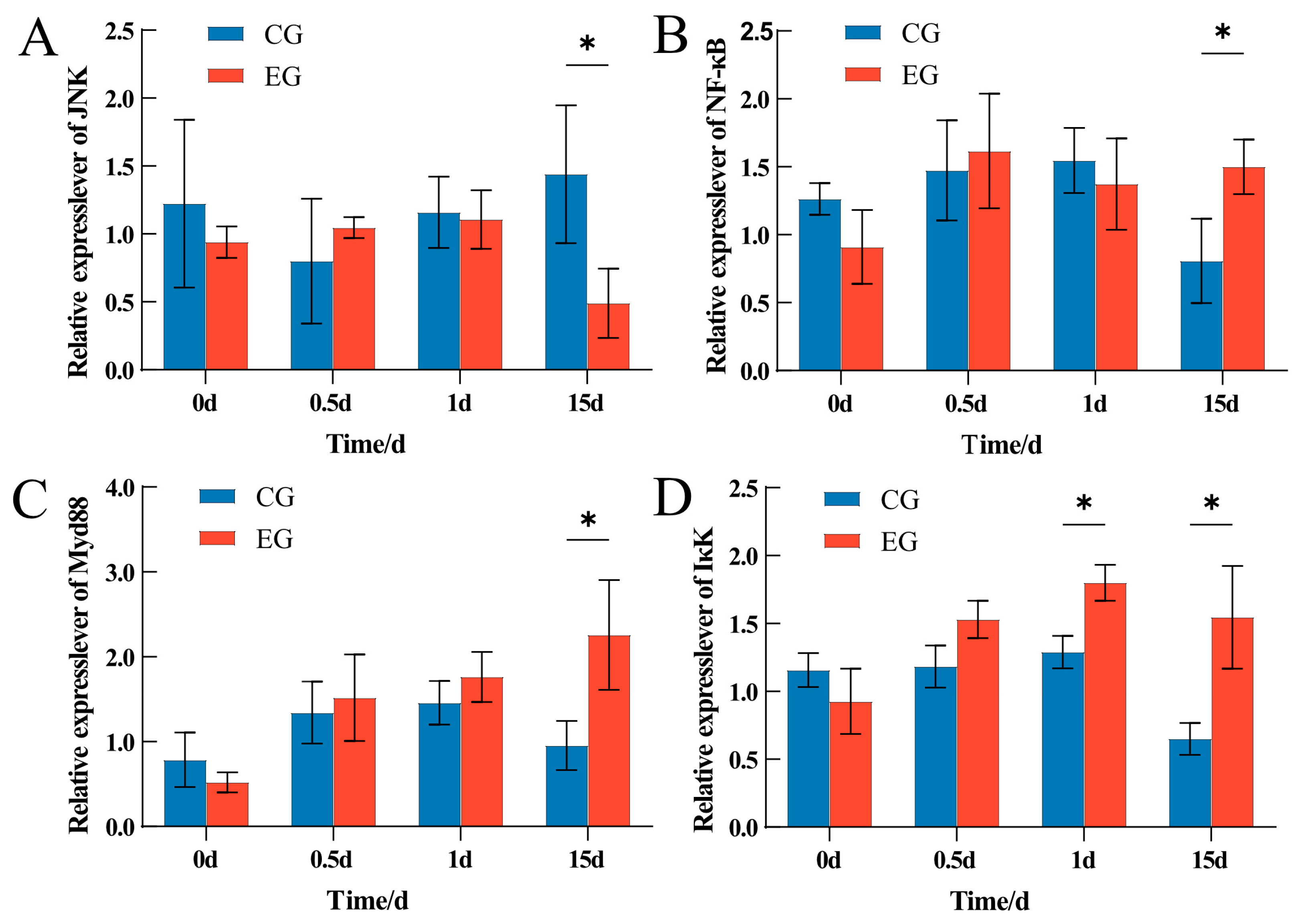
The expression of MyD88, IκK, NF-κB, and JNK (genes associated with apoptosis and immunity) was quantified. No significant differences were observed between the EG and CG for MyD88, NF-κB, or JNK at 0, 0.5, or 1 day of hypoxic stress (p > 0.05; Figure 2). By day 15, MyD88 and NF-κB expression was significantly higher in the EG than in the CG (MyD88: EG 2.26 ± 0.65 vs. CG 0.96 ± 0.29, p < 0.05, ~2.3-fold increase; NF-κB: EG 1.50 ± 0.20 vs. CG 0.81 ± 0.31, p < 0.05, ~1.8-fold increase), whereas JNK expression was significantly lower in the EG (EG 0.49 ± 0.25 vs. CG 1.44 ± 0.51, p < 0.05, ~0.34-fold; Figure 2). For IκK, no significant differences were detected at 0 or 0.5 days (p > 0.05; Figure 2); however, IκK expression was significantly elevated in the EG at 1 and 15 days (EG 1.55 ± 0.38 vs. CG 0.65 ± 0.12, p < 0.05, ~4.0-fold increase; Figure 2). Collectively, these expression patterns indicate that hypoxic preconditioning modulates immune and apoptotic signaling during prolonged hypoxia.

3.2. Gut Microbiota

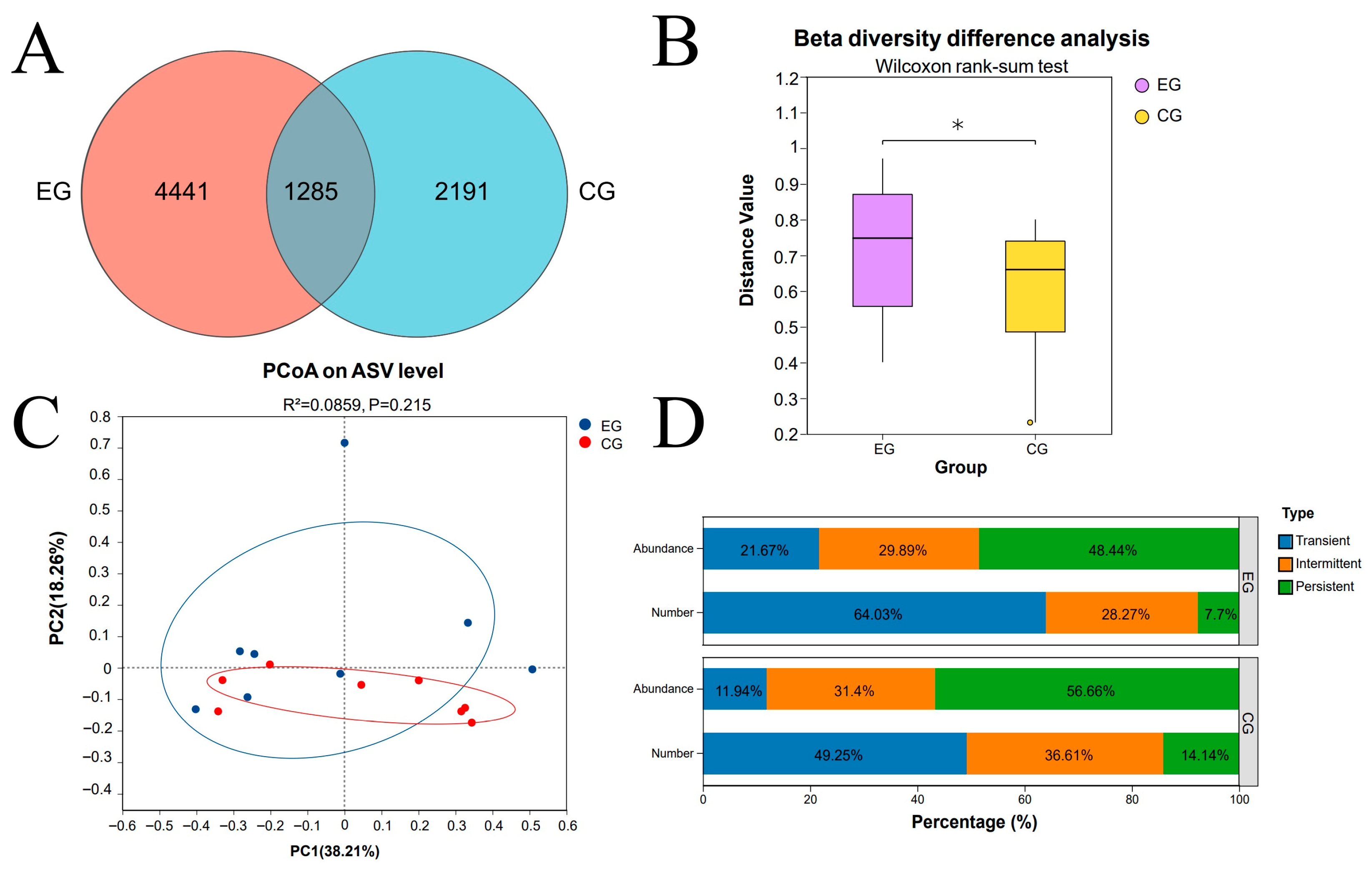
Following sequencing and quality filtering of 16 samples, 442,384 sequences were retained, and 7917 ASVs were identified (Figure 3A). The CG and EG comprised 3476 and 5726 ASVs, respectively, including 2191 and 4441 unique ASVs, with 1285 ASVs shared across all groups.

3.3. Bacterial Community Diversity

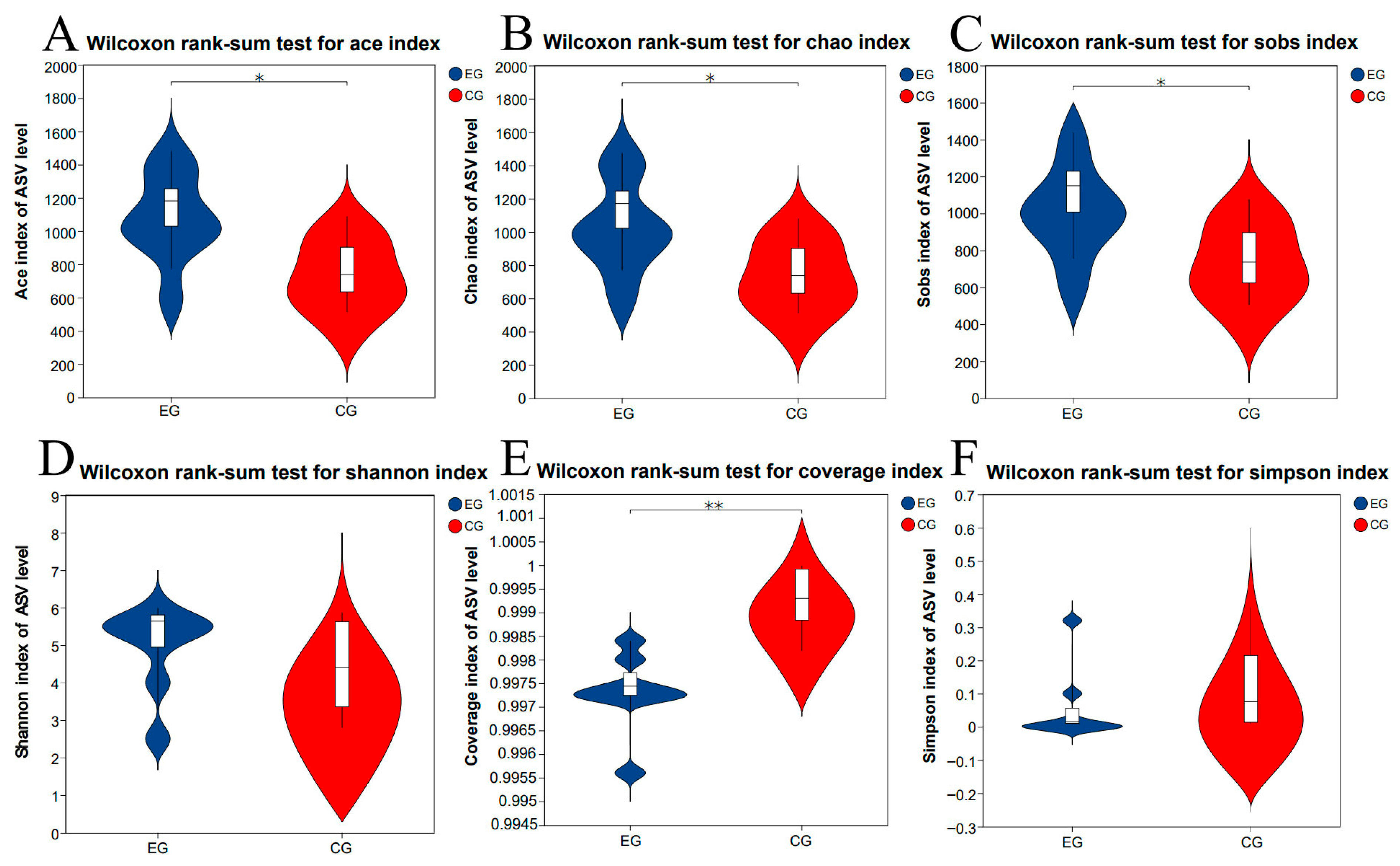
To evaluate changes in gut bacterial community diversity, samples were assessed using alpha diversity indices (Figure 4). After hypoxia challenge, the Ace, Chao, and Sobs indices were significantly higher in the EG than in the CG (p < 0.05). In contrast, coverage was significantly lower in the EG than in the CG after hypoxia challenge (p < 0.05). No significant differences in Simpson and Shannon indices were observed between the EG and CG (Wilcoxon rank-sum test, p > 0.05).
Beta diversity analysis was performed to quantify similarities and differences in microbial communities among samples. PCoA indicated that samples across treatments clustered closely, with partial overlap between the EG and CG. Nonetheless, hypoxic preconditioning was associated with shifts in gut microbiota composition after hypoxia challenge: PC1 and PC2 explained 38.21% and 18.26% of the variance, respectively (Figure 3C). Consistent with this, Figure 3B shows a significant difference in community distribution between EG and CG (p < 0.05).

3.4. Community Structure Analysis

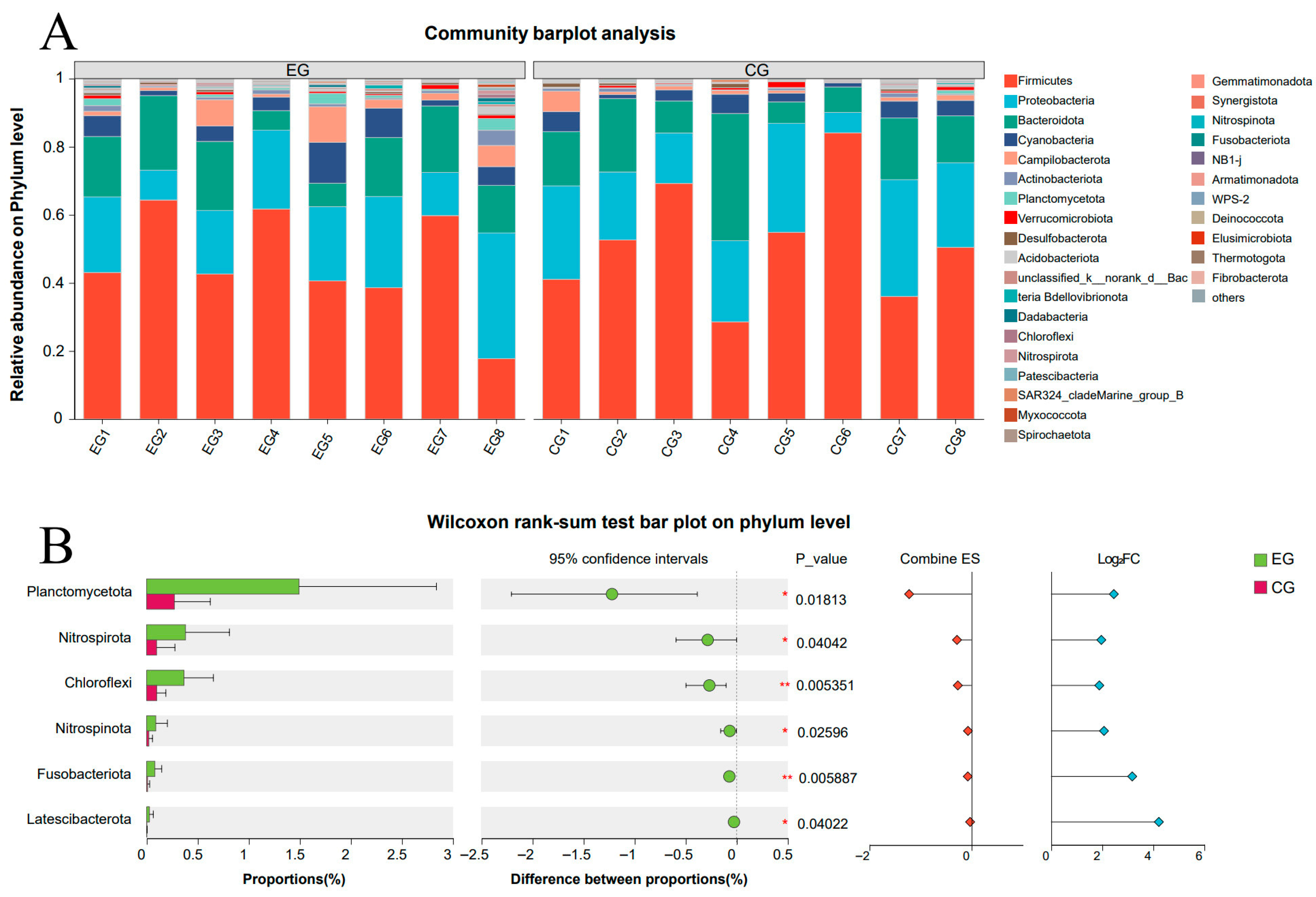
The 30 most prevalent gut bacterial phyla are summarized in Figure 5A. In both the EG and CG, the three dominant phyla were Firmicutes (48.10% and 56.05%), Proteobacteria (22.18% and 20.01%), and Bacteroidota (16.03% and 17.83%). Relative to CG, Planctomycetota, Acidobacteriota, Nitrospirota, Chloroflexi, Fusobacteriota, and Latescibacterota showed significantly higher relative abundance in EG (p < 0.05, Figure 5B).
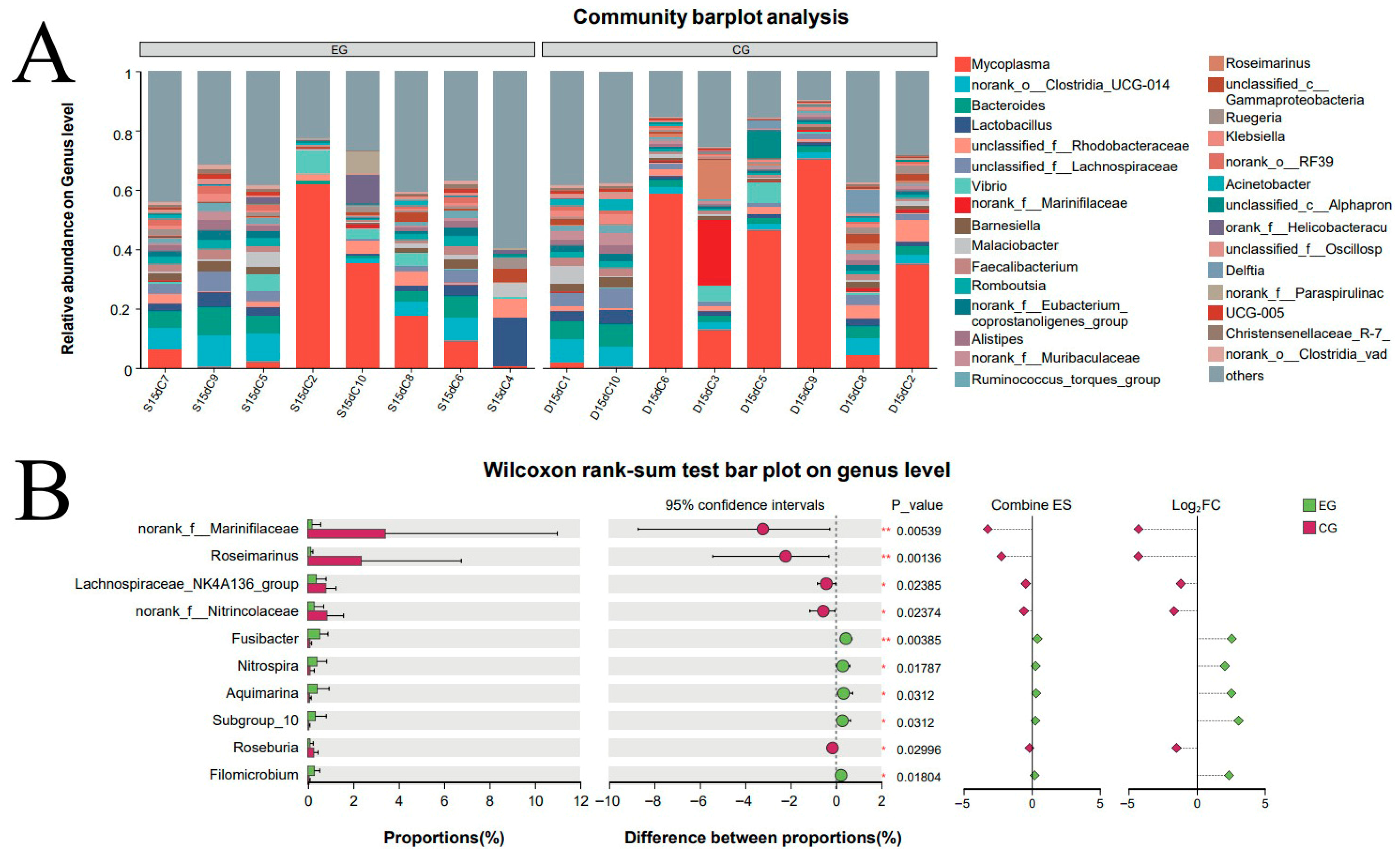
The top 30 gut bacterial genera are summarized in a stacked bar plot (Figure 6A). In the CG, the three most abundant genera were Mycoplasma (28.84%), Clostridia_UCG-014 (4.06%), and Bacteroides (3.76%). In the EG, Mycoplasma (16.83%), Clostridia_UCG-014 (5.12%), and Bacteroides (4.27%) were the top three genera. In addition, genus-level comparisons showed that gut microbiota composition differed between the EG and CG (Figure 6B). Marinifilaceae, Roseimarinus, Lachnospiraceae, and Nitrincolaceae were less abundant in the EG than in the CG (p < 0.05). In contrast, Fusibacter, Nitrospira, Aquimarina, Subgroup_10, Roseburia, and Filomicrobium were more abundant in the EG than in the CG (p < 0.05).

4. Discussion

Coastal bivalves, including the commercially important P. f. martensii, are increasingly exposed to hypoxic stress driven by climate change and anthropogenic eutrophication, a growing challenge for shellfish aquaculture worldwide [18,33]. Our previous work showed that hypoxic preconditioning, a regimen of intermittent sublethal low-oxygen exposure, significantly enhances hypoxia tolerance in P. f. martensii during sustained hypoxia [23]. The present study further indicates that this increased resilience is accompanied by marked modulation of apoptosis-related gene expression and substantial reorganization of the intestinal microbial community. Together, these findings provide new insights into the physiological and molecular basis of environmental acclimation in marine bivalves and support hypoxic preconditioning as a practical strategy for sustainable aquaculture.
The upregulation of core apoptosis-related genes (MyD88, IκK, NF-κB) in preconditioned pearl oysters after 15 days of hypoxia points to a primed and engaged cellular stress response. Although apoptosis is commonly associated with severe hypoxic injury, the coordinated induction of these genes in the preconditioned group more likely reflects a regulated adaptive program rather than uncontrolled cell death. The NF-κB signaling pathway regulates various processes in cells, tissues, organs, and organisms [31]. IκK is a central component of the NF-κB signaling cascade and can release NF-κB from its inhibitor IκB, thereby activating downstream signaling events [34]. Accordingly, NF-κB and IκK act in concert during immune activation, and their expression levels can reflect the status of host immune responses. NF-κB and IκK are functional in pearl oysters [35]. MyD88-2 acts via NF-κB to mediate the innate immune response of pearl oysters [36]. In parallel, JNK is a key mediator of stress signaling, with established roles in regulating cell fate decisions and oxidative stress responses [37]. In this study, NF-κB, IκK, and MyD88 expression levels were higher in the EG than in the CG after 15 d of hypoxic stress, suggesting that hypoxic preconditioning effectively activated immune responses in pearl oysters. The reduced JNK expression in the EG relative to the CG further suggests that hypoxia-induced ROS production may drive JNK activation, consistent with elevated JNK expression reported in clams [38]. These patterns are in line with findings from other aquatic species, where preconditioning promotes a “prepared” cellular state that enables a faster and potentially less injurious response to subsequent severe stress [39]. Together, these findings indicate that hypoxic preconditioning in P. f. martensii induces sustained modulation of the apoptosis–immune axis, which may help mitigate the harmful effects of prolonged hypoxia.
Notably, the EG exhibited slightly lower coverage than the CG, which may reflect differences in sequencing depth and/or intestinal microbial biomass. Nonetheless, rarefaction analysis indicated that sequencing depth was sufficient to capture the core microbiota, as evidenced by the plateauing of the rarefaction curves. The hypoxia-preconditioned group exhibited significantly higher richness indices (Ace, Chao, Sobs) of the intestinal microbiota following hypoxia challenge than the non-preconditioned CG. Increased microbial diversity is widely regarded as an indicator of stress tolerance [31,40], suggesting that hypoxic preconditioning promotes greater taxonomic richness and abundance of gut microbes. This implies that moderate and sublethal stress may prime adaptive capacity by dynamically reshaping microbial symbionts, thereby contributing to the maintenance of host homeostasis. Rather than driving microbial depletion, hypoxic preconditioning, acting as a mild “training” stimulus, may have selected for and enriched taxa with higher functional resilience or hypoxia tolerance, thereby establishing a more diverse and stable intestinal micro-ecosystem. A richer community can increase metabolic redundancy and support functional stability, improving resistance to external disturbance, including hypoxic stress. The observation that evenness remained stable while richness increased suggests that hypoxic preconditioning may create additional niches that allow low-abundance taxa to expand without destabilizing the dominant community members. Beta diversity analyses showed that hypoxic preconditioning significantly altered gut microbiota composition (p < 0.05). However, the partial overlap in the PCoA ordination indicates a moderate effect size, suggesting that although HP shifts community structure, it does not fully separate the two groups. This compositional reorganization likely reflects adaptive host-microbe feedback [41]. During preconditioning, host physiological and biochemical changes (e.g., immune modulation, metabolic reprogramming) may alter intestinal conditions (e.g., mucus secretion, ROS levels), creating ecological niches that favor the establishment and expansion of specific functional microorganisms.
Notably, the reshaped microbiota in preconditioned oysters exhibited significant enrichment of phyla such as Planctomycetota and Nitrospirota, which are frequently linked to complex nitrogen and sulfur cycling [42]. While the presence of these groups in the gut could potentially expand host-associated metabolic versatility under oxygen-limited conditions, their actual functional contributions in this context require experimental confirmation. The pronounced increase in Fusobacteriota (including the genus Fusibacter) is especially noteworthy, given that some members are anaerobic fermenters capable of generating short-chain fatty acids (SCFAs). SCFAs such as butyrate serve as key energy substrates for intestinal epithelial cells and exert anti-inflammatory effects [43], suggesting a potential link between the observed microbial shifts and the maintenance of barrier integrity and/or energy metabolism under hypoxic stress. However, this hypothesis should be tested in future work using metabolomic profiling and/or functional metagenomic analyses. This targeted microbiota remodeling, enriching beneficial symbionts while suppressing potentially detrimental members, parallels the concept of a health-promoting microbiome induced by environmental priming [44]. We propose that this optimized microbial community functions as an “external organ,” supporting nutrient acquisition, helping maintain redox balance, and modulating host immune activity, thereby collectively buffering the host against hypoxic insult. Future studies integrating metatranscriptomics and/or metabolomics are needed to directly link these taxonomic shifts to specific functional outcomes.
Host molecular responses and the gut microbiota likely interact synergistically. Preconditioning-associated upregulation of immune and stress-response pathways (e.g., NF-κB) may reshape the intestinal microenvironment in ways that favor colonization by beneficial, hypoxia-tolerant bacteria. In turn, metabolites produced by the remodeled microbiota (e.g., SCFAs) could further modulate host inflammatory signaling and energy homeostasis, potentially creating a positive feedback loop that enhances systemic tolerance [45]. Although this coordinated host–microbiota acclimation provides an appealing framework for how pearl oysters may persist in highly variable coastal habitats, direct evidence of such a feedback loop, such as through microbiota transplantation experiments or metabolomic profiling, is needed to establish causality.
The recurrent summer mass mortality events reported for pearl oysters in Liusha Bay [18] highlight the need for effective mitigation measures. Our results suggest that hypoxic preconditioning is an effective approach for “hardening” cultured bivalves against a major climate-linked stressor. By administering controlled, non-lethal hypoxic pulses during nursery stages, aquaculture operations could potentially produce oysters with increased resilience, thereby reducing economic losses and improving long-term sustainability. However, translating these laboratory findings into aquaculture practice will require careful consideration of several factors. First, the economic feasibility of HP will depend on the energy and infrastructure costs of maintaining controlled hypoxic conditions in large-scale nursery systems. Second, the timing, frequency, and intensity of HP pulses must be optimized and standardized across life stages and culture systems. Third, potential trade-offs, such as impacts on growth or reproduction under normoxic conditions, should be evaluated. Pilot-scale field trials comparing HP-treated and untreated cohorts under commercial conditions would be a logical next step to assess protective efficacy as well as any unintended consequences. If validated, HP could be incorporated into existing hatchery protocols as a low-cost, chemical-free intervention, providing a sustainable tool for climate adaptation in shellfish aquaculture.

5. Conclusions

This study provides evidence suggesting that hypoxic preconditioning improves the hypoxia tolerance of P. f. martensii through a dual mechanism: priming host cellular stress responses while promoting a resilient gut microbiome. These findings deepen our understanding of bivalve physiology and show that the gut microbiome is a critical component underlying environmental adaptation. Future work should prioritize (1) metatranscriptomic or metabolomic profiling to resolve the functional outputs of the remodeled microbiota; (2) testing whether preconditioning confers cross-protection to additional stressors (e.g., heat, acidification) under multi-stressor scenarios; and (3) establishing optimized preconditioning protocols (duration, frequency, intensity) suitable for large-scale aquaculture. Ultimately, leveraging this form of adaptive plasticity may offer a powerful route to protecting marine resources under accelerating environmental change.

Author Contributions

Conceptualization, C.Y. (Chuangye Yang); methodology, Q.S., J.H., C.F., W.H., and X.Z.; software, Q.S. and J.H.; validation, C.Y. (Chenyang Yue); formal analysis, Q.S., J.H., C.F., W.H., L.L., and X.Z.; investigation, Q.S., J.H., C.F., W.H., and X.Z.; resources, C.Y. (Chenyang Yue); data curation, Q.S., J.H., C.F., W.H., and X.Z.; writing—original draft preparation, Q.S., J.H., C.F., W.H., and X.Z.; writing—review and editing, C.Y. (Chuangye Yang); visualization, C.Y. (Chuangye Yang); supervision, C.Y. (Chuangye Yang) and Y.D.; project administration, C.Y. (Chuangye Yang); funding acquisition, C.Y. All authors have read and agreed to the published version of the manuscript.

Funding

This research was funded by Research on industrial innovation technology for Guangdong modern marine ranching (Grant no. 2024-MRI-001-03), Shellfish & Algae Industry Innovation Team of Guangdong Modern Agricultural Technology System (Grant no. 2025CXTD23), Students Innovation and Entrepreneurship Training Program of Guangdong Ocean University (Grant no. S202510566027), Guangdong Ocean University Pilot Program (Grant no. yhjh2025bk002), Undergraduate Innovation Team of Guangdong Ocean University (Grant no. CXTD2025001), the earmarked fund for CARS-49, and the program for scientific research start-up funds of Guangdong Ocean University (Grant no. 060302022304).

Institutional Review Board Statement

The pearl oyster P. f. martensii is a lower invertebrate, and therefore, the study was not subject to ethical approval.

Informed Consent Statement

This study does not involve human research.

Data Availability Statement

The original contributions presented in this study are included in the article. Further inquiries can be directed to the corresponding author.

Acknowledgments

We are very grateful to Marine Pearl Science and Technology Backyard in Leizhou of Guangdong for collecting samples.

Conflicts of Interest

The authors declare that the research was conducted in the absence of any commercial or financial relationships that could be construed as a potential conflict of interest.

References

  1. Masanja, F.; Jiang, X.; He, G.; Xu, Y.; Zang, X.; He, Y.; Zhao, L. Bivalves under Extreme Weather Events: A Comparative Study of Five Economically Important Species in the South China Sea during Marine Heatwaves. Mar. Environ. Res. 2024, 202, 106716. [Google Scholar] [CrossRef]
  2. Liu, C.H.; Shang, Y.Y.; Gul, S.; Hu, M.H.; Wang, Y.J. Energetic Adaptations of Bivalves Under Environmental Stress: A Comprehensive Review on Bioenergetics and Aquaculture Sustainability. Rev. Aquac. 2025, 17, e70052. [Google Scholar] [CrossRef]
  3. Yuan, B.; Tu, J.C.; Li, Z.J. Impacts of climate change on mariculture in coastal China: Spatial reconfiguration and structural adaptation. Aquaculture 2025, 609, 742874. [Google Scholar] [CrossRef]
  4. Vaquer-Sunyer, R.; Duarte, C.M. Thresholds of Hypoxia for Marine Biodiversity. Proc. Natl. Acad. Sci. USA 2008, 105, 15452–15457. [Google Scholar] [CrossRef] [PubMed]
  5. Rabalais, N.N.; Díaz, R.J.; Levin, L.A.; Turner, R.E.; Gilbert, D.; Zhang, J. Dynamics and Distribution of Natural and Human-Caused Hypoxia. Biogeosciences 2010, 7, 585–619. [Google Scholar] [CrossRef]
  6. Li, C.; Huang, J.; Liu, X.; Ding, L.; He, Y.; Xie, Y. The Ocean Losing Its Breath under the Heatwaves. Nat. Commun. 2024, 15, 6840. [Google Scholar] [CrossRef]
  7. Chen, J.; Qiu, J.; Yang, C.; Liao, Y.; He, M.; Mkuye, R.; Li, J.; Deng, Y.; Du, X. Integrated Transcriptomic and Metabolomic Analysis Sheds New Light on Adaptation of Pinctada fucata martensii to Short-Term Hypoxic Stress. Mar. Pollut. Bull. 2023, 187, 114534. [Google Scholar] [CrossRef]
  8. Liu, Y.; Ren, J.S.; Wang, X.M.; Chen, J.; Wu, W.G.; Zhang, J.H. The impact of marine heatwaves and hypoxia on behavior and physiology of Manila clam Ruditapes philippinarum. Mar. Pollut. Bull. 2025, 219, 118327. [Google Scholar] [CrossRef] [PubMed]
  9. Zhao, M.M.; Thaimuangphol, W.; Hong, Y.J.; Yan, Z.Q.; Chen, Z.F.; Jin, M.X.; Zheng, A.N.; Wang, B.; Wang, Z.L. Identification of Growth-Related SNPs and Genes in the Genome of the Pearl Oyster (Pinctada fucata) Using GWAS. Fishes 2023, 8, 296. [Google Scholar] [CrossRef]
  10. Mariom, S.; Take, Y.; Igarashi, K.; Yoshitake, S.; Asakawa, K.; Maeyama, K.; Nagai, S.; Watabe, S.; Kinoshita, S. Gene expression profiles at different stages for formation of pearl sac and pearl in the pearl oyster Pinctada fucata. BMC Genom. 2019, 20, 240. [Google Scholar] [CrossRef]
  11. Wang, P.; Guo, Y.; Li, S.P.; Zheng, Y.S.; Li, T.; Zhao, S.; Yu, D.H.; Bai, L.R. Comparative proteomics reveal the humoral immune rejection of pearl oyster Pinctada fucata to xenograft from Pinctada maxima. Aquaculture 2022, 582, 740515. [Google Scholar] [CrossRef]
  12. Chen, Q.; Yu, W.; Hao, R.; Yang, J.; Yang, C.; Deng, Y.; Liao, Y. Molecular Characterization and SNPs Association with Growth-related Traits of Myosin Heavy Chains from the Pearl Oyster Pinctada fucata martensii. Aquac. Res. 2022, 53, 2874–2885. [Google Scholar] [CrossRef]
  13. Yang, C.; Wang, Q.; Hao, R.; Liao, Y.; Du, X.; Deng, Y. Effects of Replacing Microalgae with an Artificial Diet on Pearl Production Traits and Mineralization-Related Gene Expression in Pearl Oyster Pinctada fucata martensii. Aquac. Res. 2017, 48, 5331–5337. [Google Scholar] [CrossRef]
  14. Zhang, H.; Jia, H.X.; Xiong, P.P.; Yao, G.Y.; He, M.X. Transcriptome and enzyme activity analyses of tolerance mechanisms in pearl oyster (Pinctada fucata) under high-temperature stress. Aquaculture 2022, 550, 737888. [Google Scholar] [CrossRef]
  15. Hashimoto, N.; Matsuyama, T.; Iwahashi, Y.; Nagai, K. Effects of water temperature and infection history on the severity of summer atrophy in juvenile Akoya pearl oyster Pinctada fucata martensii. Fish. Sci. 2025, 91, 301–310. [Google Scholar] [CrossRef]
  16. Li, J.; Yang, C.; Wang, Q.; Du, X.; Deng, Y. Growth and Survival of Host Pearl Oyster Pinctada fucata martensii (Dunker, 1880) Treated by Different Biofouling-Clean Methods in China. Estuar. Coast. Shelf Sci. 2018, 207, 104–108. [Google Scholar] [CrossRef]
  17. Wang, T.; Yang, C.; Wang, C.; Liao, Y.; Mkuye, R.; Deng, Y. Bacterial Community Profiling Associated with Pearl Culture Facilities of Liusha Bay, the Largest Marine Pearl Culture Base on the Western Guangdong Coast, South China. Mar. Environ. Res. 2023, 189, 106063. [Google Scholar] [CrossRef]
  18. Chen, J.; Huang, J.; Peng, J.; Yang, C.; Liao, Y.; Li, J.; Deng, Y.; Du, X. Effects of Hypoxic Stress on the Digestion, Energy Metabolism, Oxidative Stress Regulation, and Immune Function of the Pearl Oyster (Pinctada fucata martensii). Aquac. Rep. 2022, 25, 101246. [Google Scholar] [CrossRef]
  19. Spiliopoulos, O.; Brown, C.; Hilder, P.; Tilbrook, A.; Descovich, K. The Path to Resilience: Improving Welfare in Aquaculture through Physical Exercise and Stressor Predictability Training. Rev. Aquac. 2025, 17, e70051. [Google Scholar] [CrossRef]
  20. Kurt, A.G.; Bekah, D. Hypoxia tolerance and preconditioning are not additive in the trout (Oncorhynchus mykiss) heart. J. Exp. Biol. 2004, 207, 2497–2505. [Google Scholar] [CrossRef]
  21. Zhang, S.J.; Fu, W.; Xie, Y.B.; Xie, W.; Liu, Y. Advances in DNA methylation regulating BDNF and TrkB receptor under hypoxic preconditioning. Chin. J. Pathophysiol. 2021, 37, 951–955. [Google Scholar]
  22. Wu, L.N.; Wu, B.; Liu, Z.H.; Yu, T.; Sun, X.J.; Zhou, L.Q.; Zheng, Y.X.; Wang, Z.Y. Effects of hypoxic preconditioning on the physiological and biochemical characteristics of Scapharca broughtonii under hypoxia stress. Prog. Fish. Sci. 2023, 44, 98–106. [Google Scholar] [CrossRef]
  23. Yang, C.; Huang, J.; Luo, J.; Wu, Q.; Hao, R.; Liao, Y.; Wang, Q.; Deng, Y. Molecular Mechanisms of Hypoxic Preconditioning in the Pearl Oyster Pinctada fucata martensii Revealed by DNA Methylation Profiling and Transcriptome Sequencing. Aquaculture 2026, 613, 743428. [Google Scholar] [CrossRef]
  24. Chen, L.M.; Tu, Z.H.; Zhong, Z.; Wei, S.S.; Hu, M.H.; Wang, Y.J. Differential effects of polyvinyl chloride microplastics and kaolin particles on gut immunity of mussels at environmental concentrations. J. Hazard. Mater. 2025, 484, 136711. [Google Scholar] [CrossRef]
  25. Montúfar-Romero, M.; Valenzuela-Miranda, D.; Valenzuela-Muñoz, V.; Morales-Rivera, M.F.; Gallardo-Escárate, C. Microbiota Dysbiosis in Mytilus Chilensis Is Induced by Hypoxia, Leading to Molecular and Functional Consequences. Microorganisms 2025, 13, 825. [Google Scholar] [CrossRef] [PubMed]
  26. Fan, S.; Li, H.; Zhao, R. Effects of Normoxic and Hypoxic Conditions on the Immune Response and Gut Microbiota of Bostrichthys sinensis. Aquaculture 2020, 525, 735336. [Google Scholar] [CrossRef]
  27. Xie, Z.; Li, Y.; Xiong, K.; Tu, Z.; Waiho, K.; Yang, C.; Deng, Y.; Li, S.; Fang, J.K.H.; Hu, M.; et al. Combined Effect of Salinity and Hypoxia on Digestive Enzymes and Intestinal Microbiota in the Oyster Crassostrea hongkongensis. Environ. Pollut. 2023, 331, 121921. [Google Scholar] [CrossRef] [PubMed]
  28. Mizutani, Y.; Orita, R.; Kimura, K.; Funabara, D. Hypoxia-Induced Changes in the Gill and Hepatopancreatic Bacterial Communities of the Ark Shell Anadara kagoshimensis. Mar. Biotechnol. 2025, 27, 53. [Google Scholar] [CrossRef] [PubMed]
  29. Zheng, Z.; Hao, R.; Yang, C.; Jiao, Y.; Wang, Q.; Huang, R.; Liao, Y.; Jian, J.; Ming, Y.; Yin, L.; et al. Genome-wide Association Study Analysis to Resolve the Key Regulatory Mechanism of Biomineralization in Pinctada fucata martensii. Mol. Ecol. Resour. 2023, 23, 680–693. [Google Scholar] [CrossRef]
  30. Livak, K.J.; Schmittgen, T.D. Analysis of Relative Gene Expression Data Using Real-Time Quantitative PCR and the 2−ΔΔCT Method. Methods 2001, 25, 402–408. [Google Scholar] [CrossRef]
  31. Gu, Z.; Shi, S.; Cao, Y.; Yang, C.; Wang, Q.; Jiao, Y. Use of Mycophenolate Mofetil as Immunosuppressant during Pearl Production in Pearl Oyster Pinctada fucata martensii. Aquac. Res. 2021, 52, 4043–4049. [Google Scholar] [CrossRef]
  32. Huang, L.; Lin, Y.; Liu, L.; Su, Q.; Liu, J.; Yang, C.; Yao, J.; Gao, Z.; Deng, Y. Combined Microplastics and Cadmium Exposure Induces Persistent Gut Microbiota Dysbiosis in Pearl Oyster Pinctada fucata martensii. Fishes 2026, 11, 51. [Google Scholar] [CrossRef]
  33. Diaz, R.J.; Rosenberg, R. Spreading Dead Zones and Consequences for Marine Ecosystems. Science 2008, 321, 926–929. [Google Scholar] [CrossRef]
  34. Nie, H.; Wang, H.; Jiang, K.; Yan, X. Transcriptome Analysis Reveals Differential Immune Related Genes Expression in Ruditapes philippinarum under Hypoxia Stress: Potential HIF and NF-κB Crosstalk in Immune Responses in Clam. BMC Genom. 2020, 21, 318. [Google Scholar] [CrossRef]
  35. Wang, Q.; Liu, Y.; Zheng, Z.; Deng, Y.; Jiao, Y.; Du, X. Adaptive Response of Pearl Oyster Pinctada fucata martensii to Low Water Temperature Stress. Fish Shellfish Immunol. 2018, 78, 310–315. [Google Scholar] [CrossRef]
  36. Jiao, Y.; Gu, Z.; Luo, S.; Deng, Y. Evolutionary and Functional Analysis of MyD88 Genes in Pearl Oyster Pinctada fucata martensii. Fish Shellfish Immunol. 2020, 99, 322–330. [Google Scholar] [CrossRef]
  37. Zhu, Y.-T.; Zhang, X.; Wang, S.-C.; Li, W.-W.; Wang, Q. Antimicrobial Functions of EsLecH, a C-Type Lectin, via JNK Pathway in the Chinese Mitten Crab, Eriocheir Sinensis. Dev. Comp. Immunol. 2016, 61, 225–235. [Google Scholar] [CrossRef]
  38. Wang, Q.J.; Xiao, G.J.; Teng, S.S. Expression characteristics of the JNK gene in Tegillarca granosa infected by Vibrio harveyi and its regulation on activating protein-1. J. Fish. Sci. China 2023, 30, 60–74. [Google Scholar]
  39. Guo, H.; Whitehouse, L.; Danzmann, R.; Dixon, B. Effects of Juvenile Thermal Preconditioning on the Heat-Shock, Immune, and Stress Responses of Rainbow Trout upon a Secondary Thermal Challenge. Comp. Biochem. Physiol. A Mol. Integr. Physiol. 2023, 280, 111413. [Google Scholar] [CrossRef] [PubMed]
  40. Wanna, W.; Aucharean, C.; Jaeram, N. Analysis of Gut Microbiota Associated with WSSV Resistance in Litopenaeus vannamei. Mar. Biotechnol. 2025, 27, 10. [Google Scholar] [CrossRef] [PubMed]
  41. Pan, Y.T.; Yang, Z.Y.; Zhao, W.X.; Fang, J.K.H.; Shi, J.H.; Li, D.J.; Hu, M.H.; Wang, Y.J. Combined effects of polyamide microplastics and the pathogenic bacterium Vibrio parahaemolyticus on the immune parameters of Mytilus coruscus. Mar. Pollut. Bull. 2025, 218, 118204. [Google Scholar] [CrossRef]
  42. Hüpeden, J.; Wemheuer, B.; Indenbirken, D.; Schulz, C.; Spieck, E. Taxonomic and Functional Profiling of Nitrifying Biofilms in Freshwater, Brackish and Marine RAS Biofilters. Aquac. Eng. 2020, 90, 102094. [Google Scholar] [CrossRef]
  43. Tran, N.T.; Li, Z.; Wang, S.; Zheng, H.; Aweya, J.J.; Wen, X.; Li, S. Progress and Perspectives of Short-chain Fatty Acids in Aquaculture. Rev. Aquac. 2020, 12, 283–298. [Google Scholar] [CrossRef]
  44. Dantan, L.; Carcassonne, P.; Degrémont, L.; Morga, B.; Travers, M.-A.; Petton, B.; Mege, M.; Maurouard, E.; Allienne, J.-F.; Courtay, G.; et al. Microbial Education Plays a Crucial Role in Harnessing the Beneficial Properties of Microbiota for Infectious Disease Protection in Crassostrea Gigas. Sci. Rep. 2024, 14, 26914. [Google Scholar] [CrossRef] [PubMed]
  45. Fontinha, F.; Martins, N.; Campos, G.; Peres, H.; Oliva-Teles, A. The Effects of Short-Chain Fatty Acids in Gut Immune and Oxidative Responses of European Sea Bass (Dicentrarchus labrax): An Ex Vivo Approach. Animals 2024, 14, 1360. [Google Scholar] [CrossRef] [PubMed]
Figure 1. Schematic of the study design [23].
Fishes 11 00163 g001
Figure 2. Expression levels of apoptosis- and immunity-related genes in different groups. “*” denotes significant differences (p < 0.05), N = 3.
Fishes 11 00163 g002
Figure 3. Gut bacterial changes across groups. (A) Venn diagram at the ASV level. (B) Significance testing among groups; “*” denotes significant differences (p < 0.05). (C) Principal coordinates analysis (PCoA). (D) Stacked bar plot showing the abundance of microbial taxa across groups.
Fishes 11 00163 g003
Figure 4. Effect of different groups on gut bacterial community diversity in pearl oysters. “*” (p < 0.05) and “**” (p < 0.01) denote significant differences.
Fishes 11 00163 g004
Figure 5. Intestinal bacterial phyla of pearl oysters. (A) Comparison of bacterial phylum relative abundance among groups; taxa with low relative abundance are pooled as “Others.” (B) Significance testing; “*” and “**” denote significant differences (*: p < 0.05; **: p < 0.01).
Fishes 11 00163 g005
Figure 6. Intestinal bacterial genera of pearl oysters. (A) Comparison of bacterial genus relative abundance among groups; taxa with low relative abundance are pooled as “Others.” (B) Significance testing; “*” and “**” denote significant differences (*: p < 0.05; **: p < 0.01).
Fishes 11 00163 g006
Table 1. Primers for amplifying apoptosis- and immunity-related genes.
GeneForward (5′ → 3′)Reverse (5′ → 3′)PCR Efficiency (%)
β-actinCGGTACCACCATGTTCTCAGGACCGGATTCATCGTATTCC-
JNKTGTCAATCGTAACCAAGCCCATCCGATGGGTTTGAGGGT93.6
NF-κBAGAAGAGACAGGCCAAAGAGCAAGAGAGAACAGGCGTGAGAAGC97.8
MyD88AACATCAGGATAGCCCAACAGAGGTGCCGTTCTCTAACACATCAGTCC92.7
IκKTATTAAAGGCTCAGGCAGAGGTATTTGGAGTTGCTGATTACGGATT96.8
Disclaimer/Publisher’s Note: The statements, opinions and data contained in all publications are solely those of the individual author(s) and contributor(s) and not of MDPI and/or the editor(s). MDPI and/or the editor(s) disclaim responsibility for any injury to people or property resulting from any ideas, methods, instructions or products referred to in the content.