
Article

Trace Metals in Twaite Shad (Alosa fallax): Patterns Across Two Northern European Populations

1
State Scientific Research Institute Nature Research Centre, Akademijos St. 2, LT-08412 Vilnius, Lithuania
2
Institute of Geosciences, Faculty of Chemistry and Geosciences, Vilnius University, M. K. Čiurlionio St. 21/27, LT-3101 Vilnius, Lithuania
3
Institute for Marine Ecosystem and Fishery Science, University of Hamburg, Grosse Elbstrasse 133, 22767 Hamburg, Germany
4
Deakin Marine Research and Innovation Centre, School of Life and Environmental Sciences, Deakin University, Warrnambool, VIC 3280, Australia
*
Author to whom correspondence should be addressed.
Fishes 2026, 11(2), 85; https://doi.org/10.3390/fishes11020085
Submission received: 9 December 2025 / Revised: 19 January 2026 / Accepted: 22 January 2026 / Published: 1 February 2026
(This article belongs to the Special Issue Toxicology of Anthropogenic Pollutants on Fish)

Abstract

Heavy metal contamination poses concerns for managing Twaite shad (Alosa fallax) populations, yet data remain sparse. Intermittent capture as bycatch, with negligible prospects for post-release survival and IUCN Red listing, provides a compelling case for investigation. Concentrations of six trace metals (As, Cd, Cr, Cu, Pb and Zn) in the dorsal muscle tissue of A. fallax from the Curonian Lagoon (Lithuania) and the Elbe Estuary (Germany) were analyzed to evaluate size-related patterns and compliance with international safety standards. Overall, metal levels were uniformly low, with Cd and Pb below EU limits. Cu exhibited a weak negative correlation with fish weight (ρ = −0.35; p < 0.05), while Zn tended to increase in larger individuals, reflecting its essential physiological role. Comparing both adult populations, Cr and Zn, which provide nutritional benefits, were higher in the Curonian Lagoon, whereas toxic As and Pb were higher in the Elbe Estuary. All concentrations complied with EU and FAO thresholds, indicating acceptable risk for human consumption. The findings provide baseline information for A. fallax as a potential bioindicator. Constraints on the number of A. fallax sampled, given its IUCN status, exclusion of Hg and lack of environmental parameters, limit conclusions, but would be mostly remediable by future research.
Key Contribution: This study provides the first comparative assessment of trace metal bioaccumulation in Alosa fallax from two Northern European populations, demonstrating uniformly low contamination levels and full compliance with international food safety standards. It establishes baseline data for a near-threatened fish species and highlights its potential as a bioindicator for regional pollution monitoring.

1. Introduction

In fish, heavy metals accumulate primarily through the gills, gastrointestinal tract and skin. After absorption, they are distributed via the bloodstream to target tissues such as muscle and liver, where the metals bind to carrier and storage proteins [1,2]. The extent of bioaccumulation is determined by both environmental exposure (e.g., discharge of wastewater, etc.) and intrinsic biological factors (e.g., species-specific metabolism, body size, age) [3]. Excessive heavy metal contamination in organisms therefore affects nutritional pathways in aquatic ecosystems and poses a potential risk to humans as consumers. This is particularly apparent in semi-enclosed seas such as the Baltic Sea, where anthropogenic pollution inputs and limited water exchange can enhance the risk of heavy metal accumulation [4].
Twaite shad (Alosa fallax) [5] is an anadromous fish species distributed from Iceland to Morocco, with substantial historical presence in the Baltic Sea and inland waters of Lithuania [6]. However, environmental pollution and habitat modification over the past 60–70 years, including water impoundment and reclamation activities, caused a severe decline in the local population [7], which led to the species being listed as endangered in the Lithuanian Red List in 1992 [8].
In Germany, this species is also listed on the Red List and is currently classified as highly endangered due to a steep decline in the German North Sea during 2002–2021 [9,10]. In the Elbe Estuary and other river systems in Germany, factors such as habitat loss and water pollution are considered the main reasons for the decline in local populations [11]. Due to its sensitivity, the species is considered a bioindicator of water quality [12] because A. fallax are primarily sensitive to industrial and wastewater pollution, responding rapidly to relatively low levels of environmental contamination [6], notwithstanding impacts from fishing pressure and spawning ground degradation [10,13,14,15]. This arises because poor water quality, e.g., low DO and high turbidity, can impede adult access to spawning grounds, which rely on clean freshwater and in the case of heavy metals, can be toxic to embryos and larvae [16]. A recent study comparing fish abundance and environmental parameters in the Elbe Estuary showed a sharp decline in all key fish species, especially A. fallax, with a population decline of 98.8% since 2009–2010 [17]. Spawning occurs in the freshwater Curonian Lagoon (SE Baltic), where abundance increased rapidly and has remained steady from 1994 onwards [7]. The IUCN now lists the species as ‘near threatened’ in line with a general improvement in its abundance throughout much of Europe [18].
Knowledge about the role of the contaminant burden in A. fallax, needed to address concerns about ecological and consumer impacts, has, to date, been very limited. Metal accumulation may be influenced by ontogenesis, including factors like age and size. Many metals (except mercury) exhibit inverse or variable relationships with size/age, reflecting significant contingency on species, physiology and exposure history [19]. Indeed, whereas older benthivores can show higher concentrations of heavy metals in their tissues accumulated over longer exposure periods, larger pelagic fish species often exhibit lower concentrations from dilution as they continue to grow, with only low or negligible further absorption [20,21,22,23,24].
This study addresses the deficiency in knowledge by analyzing the bioaccumulation of six heavy metals, Arsenic (As), Cadmium (Cd), Chromium (Cr), Copper (Cu), Lead (Pb) and Zinc (Zn), in the dorsal white muscle of A. fallax from the Curonian Lagoon (Lithuania) and the Elbe Estuary (Germany). We specifically tested the hypothesis that heavy metal concentrations correlate with fish body size (length and weight). The main rationale for pursuing this hypothesis is that ingestion, absorption, deposition, excretion and detoxification processes depend on metabolism, which varies with body size and species [20,21,23]. Of course, accumulation of a specific heavy metal contaminant in fish depends upon exposure levels, mediated by life history, habitat and feeding patterns [16,17,19,21]. Previous research has revealed positive and negative correlations between fish size and trace and toxic metal concentrations in their tissues [16,17,20,21].
In addition, comparisons were made between the two A. fallax populations (Curonian Lagoon vs. Elbe Estuary) in the context of previous studies of heavy metal contamination of their respective environments. Finally, the study evaluates whether the concentrations detected exceed the maximum allowable limits set by the EC [25], FAO [26] and related food safety standards.
Although previous research has examined heavy metal accumulation in Baltic fish, most studies have focused on a limited set of elements and species [27]. To our knowledge, this is the first study specifically addressing metal accumulation in A. fallax from the Baltic and tidal Elbe regions. By integrating biometric correlations, inter-population comparisons and food safety thresholds, this work provides new insights into contaminant dynamics in recovering and declining populations of an anadromous species and contributes to regional monitoring and conservation efforts.

2. Materials and Methods

2.1. Sampling Locations

Sampling was conducted at locations in Lithuania and Germany to differentiate between heavy metal uptake related to Twaite shad biology and accumulation under differing environmental conditions. The locations were as follows:
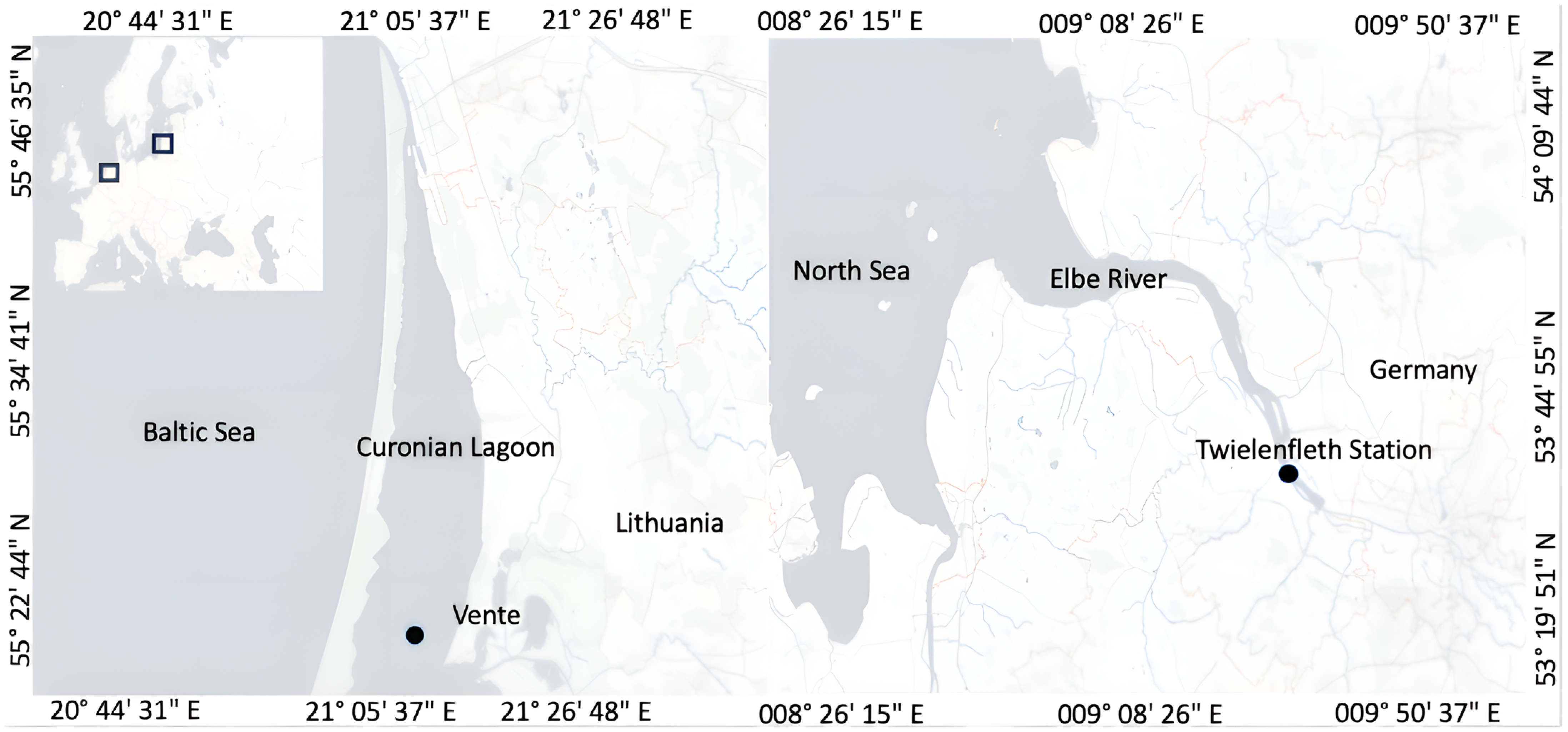
  • The Curonian Lagoon (Figure 1), one of Europe’s largest coastal lagoons extending from Lithuania in the north to Russia’s Kaliningrad Oblast in the south. It is connected to the Baltic Sea by the Klaipėda Strait, 70 km north of the Nemunas River Delta. Samples were collected from 55°21′24″ N 21°10′51″ E; and
  • The Elbe Estuary in Germany (Figure 1) is among Europe’s largest estuaries connected to the North Sea. Samples were collected from 53°36′33″ N 9°33′55″ E.

2.2. Sample Collection

Alosa fallax samples of the Baltic Sea population were captured from spawning grounds in the Curonian Lagoon during June 2022 using research fishing nets deployed from a small research boat. All live fish collected from the Curonian Lagoon were euthanized in conformance with the European Council Directive 2010/63/EU on the protection of animals used for scientific purposes, and in compliance with the Law on Welfare and Protection of Animals of the Republic of Lithuania, Order No B1-866 of the Director of State Food and Veterinary Service of the Republic of Lithuania for the keeping, care and use of animals for scientific and educational purposes. An experienced operator accurately delivered a percussive blow to the head of each fish with a wooden cudgel, followed immediately by partial decapitation using a boning knife to sever dorsally through the spinal column at the posterior margin of the cranial cavity.
The North Sea population was sampled in the spawning grounds of the Elbe Estuary during April 2022 from the by-catch of a licensed fisher targeting smelt from the Lower Saxony (Niedersachsen) area. In this instance, a commercial stow net (opening 135 m2, mesh size of 10 mm at the cod end) was set from a boat, restricting the sample to legal-sized fish. Alosa fallax is caught inadvertently in relatively small numbers in this gear despite shots being restricted to short durations in the spawning season. Incidental fishing mortality from capture is high among A. fallax, with fish usually dead after the nets are hauled. Permission to use the 20 dead A. fallax for research purposes was granted by the relevant fisheries authority in Lower Saxony, and the specimens were collected immediately upon landing and taken directly to the laboratory in a polystyrene foam (EPS) box with ample dry ice.
In Vente, biological measurements (Total Length-TL, Length-L, Weight-W and Weight/Gonads-W) were made immediately upon collection, then the fish were subsequently frozen and stored at −20° degrees in a freezer cabinet (Forcar G-GN1200BT, Rimini, Italy) prior to their transportation in a portable compressor-based freezer (Ezetil EZC 45, IPV GmbH, Hungen, Germany) to the Fish Ecology Laboratory of the Lithuanian Nature Research Centre in Vilnius, where all samples were stored in a chest freezer (Whirlpool AFG 6402, Cassinetta di Biandronno, Italy) until processing.

2.3. Laboratory Preparation and Analysis

Good Laboratory Practice (GLP) was applied throughout the study (SafetyCulture, A Guide to Good Laboratory Practice (GLP). Available online: https://safetyculture.com/topics/good-laboratory-practice-glp/, accessed on 20 July 2024) [28], and procedural blanks were analyzed to ensure accuracy. A total of 41 individuals from the Curonian Lagoon and 20 from the Elbe Estuary were analyzed. Muscle tissue was selected as the analytical matrix because it is the most frequently used tissue in comparative trace metal studies of fish, i.e., for fish nutrition and when the objectives include safety for human consumption, allowing direct comparison across species, regions and monitoring programs [29,30,31,32]. Liver is preferable when the primary objective is environmental biomonitoring of toxic pollutants [30,33]. In the laboratory, approximately 3–4 g of dorsal white muscle tissue was carefully excised using a ceramic knife and weighed to the nearest 0.1 g with a precision balance (KERN EG 4200-2NM, Balingen, Germany). The samples were then prepared following a protocol adapted from Sen et al. [34]. Specifically, 3–4 g (wet weight) of each sample was digested in 10 mL of ultra-pure nitric acid at 95 °C until the solution became clear (approximately 90 min). Analytical or higher-grade reagents from Sigma Aldrich (Steinheim, Germany) and Carl Roth (Karlsruhe, Germany) were used in the analysis. After the addition of 3 mL of H2O2, the solution was held at 100 °C for a further 120 min. The digest was then concentrated to a volume of 2 mL, cooled and filtered through a Whatman filter into a volumetric flask and finally diluted to a final volume of 100 mL. The EPA method 200.7/200.5 was used.
The prepared fish samples were analyzed for Pb, Cu, Cr, Cd, As and Zn using a Perkin Elmer Optima 7000 DV (Waltham, MA, USA) inductively coupled argon plasma spectrometer (ICP-OES). For the trace elements, the LODs (ppb) were as follows: Cd (0.07), As (3.6), Cr (0.3), Cu (0.3), Pb (1.5), Zn (0.2). Quality control measures performed during the analysis included the cleaning of all glassware with 30% nitric acid, followed by thorough rinsing with ultrapure deionized water, appropriate preparation of working standards and analysis of blanks and internal standard. The NIST standard reference material 2702 was used for quality control. For each sample, three replicates were run. The analytical procedure precision, expressed as a standard deviation, was less than 10%. Accuracy was within 15% of the certified value for Cr and within 10% for the other elements. Precision, expressed as RSD, was always less than 7% for the measured elements. All concentrations were calculated on a wet weight basis.

2.4. Data Processing and Statistical Analysis

Sample results were corrected and expressed in µg/kg wet weight (WW) and subsequently converted to mg/kg for final analysis.
Prior to statistical analysis, the dataset was examined for extreme values. Outliers were defined as observations exceeding 1.5 times the interquartile range (IQR); however, no data points were excluded, as all values were considered biologically plausible and representative of natural environmental variability. Values below the LOD were replaced with half the relevant LOD as a constant.
Linear and generalized linear models were initially explored to assess relationships between biometric variables (fish length, weight, condition, age, sex) and metal concentrations. However, model diagnostics indicated substantial violations of linearity and homoscedasticity assumptions that could not be resolved through transformation or alternative link functions. Given the small sample sizes and presence of non-linear relationships, Spearman rank correlations were therefore used as the primary analytical approach. Thus, we only report Spearman correlation analysis as an indication of direction of association, although we could not adjust for covariates.
Given the skewed distribution of the data, normality was assessed using the Shapiro–Wilk test. As the data did not conform to a normal distribution, even after transformation, Spearman’s rank correlation analysis was performed to assess the relationship between morphological measurements and metal concentrations. Statistical analyses were completed using R 4.3.2 (CRAN, hosted at the Institute for Statistics and Mathematics of WU (Wirtschaftsuniversität Wien), Vienna, Austria. Available online: https://cran.r-project.org/, accessed on 20 July 2024) and Past4 (version 4.15, hosted by LO4D, Seattle, WA, USA. Available online: https://past.en.lo4d.com/windows, accessed on 20 July 2024).
For analysis of the effect of size on tissue heavy metal content, the Curonian Lagoon samples were assigned to one of two size categories based on their total length (TL): “small” individuals ranged from 16.0 to 22.5 cm, and “large” individuals ranged from 30.5 to 48.0 cm. The division into two size groups is an indicator of the developmental stage widely used in fish bioaccumulation studies [23,35]. These size categories essentially correspond to juvenile (“small”) and adult (“large”) individuals, which also differ in their habitat use and feeding behavior.
Comparison between the Baltic and North Sea populations was undertaken by selecting the largest 20 A. fallax from the Curonian Lagoon samples (38–48 cm), which approximated the constrained size distribution of the commercial bycatch samples (40–44 cm) from the Elbe Estuary. As length at maturity is 30–40 cm (Fishbase Alosa fallax (Lacepède, 1803) Twaite shad, Available online: https://www.fishbase.org.au/summary/SpeciesSummary.php?ID=5355&AT=twaite+shad, accessed on 23 January 2026), this effectively excluded data for juveniles from the Curonian Lagoon, which could otherwise confound the analysis. During an exploratory data analysis, the Bartlett test for homogeneity of variances and the Shapiro–Wilk normality test both identified violations of assumptions necessary for parametric multivariate analysis such as MANOVA. Accordingly, the data were analyzed using the nonparametric ANOSIM in R 4.3.2 (CRAN, hosted at the Institute for Statistics and Mathematics of WU (Wirtschaftsuniversität Wien), Vienna, Austria. Available online: https://cran.r-project.org/, accessed on 20 July 2024).

3. Results

3.1. Curonian Lagoon

Concentrations (mg/kg WW), range and mean values ± SD of each heavy metal (As, Cd, Cr, Cu and Pb) in muscle tissues of A. fallax sampled from the Curonian Lagoon during this study exhibited high variability. Ranges (min-max) in values were one and in some instances two orders of magnitude (Table 1).
Spearman correlation analyses between biometric variables (Total Length, TL and Total Weight, TW) and heavy metal concentrations (As, Cd, Cr, Cu, Pb, Zn) showed a significant but weak negative correlation between TW and Cu concentration (ρ = −0.35; p < 0.05). No significant correlations were found between biometric variables and the concentrations of other metals (Table 2).
The highest concentrations (mg/kg) of As (0.04), Cd (0.008), Cr (0.9), Cu (0.65) and Pb (0.04) were measured in the smallest individuals, whereas As, Cd and Pb levels were below instrumental detection limits in most muscle samples from larger specimens. In contrast, the highest levels of Zn (6.06) were found in the largest fish (Table 1).
None of the results exceeded the MRL (Maximum Residual Limit) EC/FAO limits for human consumption, i.e., EC (Cd 0.05 mg/kg, Pb 0.30 mg/kg) and FAO (As 0.10 mg/kg, Cr 0.15 mg/kg, Cu 30 mg/kg, Zn 40 mg/kg).

3.2. Elbe Estuary

The concentrations of trace metals in A. fallax from the Elbe Estuary were uniformly low (Table 3). Mean values (mg/kg WW) were As (0.03 ± 0.02), Cd (0.001 ± 0.001), Cr (0.02 ± 0.01), Cu (0.25 ± 0.09), Pb (0.02 ± 0.01) and Zn (0.93 ± 0.33). Cd was below the detection limit in all samples, whereas As, Cr, Cu, Pb and Zn were consistently detectable. The highest concentrations were recorded for Zn (up to 1.7 mg/kg) and Cu (up to 0.4 mg/kg). None of the observed concentrations exceeded the maximum permissible levels for human consumption established by the EC (Cd 0.05 mg/kg, Pb 0.30 mg/kg) and FAO (As 0.10 mg/kg, Cr 0.15 mg/kg, Cu 30 mg/kg, Zn 40 mg/kg), indicating no food safety concern for human consumption.

3.3. Comparison Between Lithuanian and German Samples

Differences in concentrations of heavy metals in A. fallax tissues between the Curonian Lagoon and the Elbe Estuary were significant (Table 4).

4. Discussion

The main objectives of this study were to analyze the accumulation of heavy metals in the white muscle tissue of A. fallax from the Baltic Sea, Lithuania, compare these results with those of commercial-sized A. fallax caught as bycatch in the Elbe Estuary, Germany, and to investigate the relationship between metal concentrations and fish size. Recent reports indicate that parts of the Baltic Sea are highly polluted [36] (Baltic Waters, available online: https://balticwaters.org/en/is-the-baltic-sea-the-worlds-most-polluted-sea/, accessed on 23 August 2025; Race For The Baltic, available online: https://www.raceforthebaltic.com/, accessed on 29 December 2025). Therefore, monitoring heavy metal concentrations in fish tissue is necessary to exclude any unacceptable risk to consumers of recreational and commercial catches and to document any possible exceedance of prescribed safe limits for human consumption. As a pollution-sensitive species [6] recovering from an ‘endangered’ population status classification in Baltic but not the German North Sea [8,9,10] and now listed as ‘near threatened’ by the IUCN [18] (noting that national Red List classifications do not necessarily concur with IUCN global and European classifications), there is also an ecological imperative for improving the knowledge base about accumulation of toxic substances in A. fallax that potentially jeopardize its survival.
We hypothesized that larger fish would exhibit higher concentrations of heavy metals due to their greater tissue mass and longer exposure arising from their advanced age. In our dataset, most metals showed no significant relationship with fish length or weight, confirming that size plays a limited role in A. fallax from the Curonian Lagoon. The only exception was copper (Cu), which exhibited a weak but significant negative correlation with total weight (p < 0.05). This pattern may reflect specific metabolic regulation of Cu, including more efficient excretion or redistribution in larger individuals [23,37].
In the Curonian Lagoon, we found that Zn concentrations in muscle tissue tended to be slightly higher in larger A. fallax individuals, with the highest value observed in the largest size class (6.06 mg/kg). This suggests that Zn accumulation may be linked to somatic growth, reflecting its essential biological role. As Zn is a vital trace element in fish, it contributes to growth, immune function and enzymatic activity [38,39]. Unlike non-essential metals, Zn is tightly regulated through homeostatic mechanisms in teleosts [40], which ensures availability for physiological functions without reaching toxic levels. Although the concentrations measured in this study remain well within safe ranges for humans, Zn levels in larger individuals may influence trophic transfer to higher predators, highlighting its ecological relevance. The observed pattern, where Zn increases with body size while most other metals decline or remain stable, aligns with findings in other clupeids [38,41].
While juveniles often occupy lagoonal or coastal habitats where they are potentially more exposed to anthropogenic inputs, adults migrate to more stable, potentially less polluted open waters. This habitat differentiation has been observed in A. fallax through various studies [6,42], highlighting the importance of estuarine and freshwater nursery areas for juveniles and offshore coastal habitats for adults [43].
Despite potentially lower environmental concentrations in habitats inhabited by adults, physiological factors such as increased metabolic demands during somatic growth and strict homeostatic control likely contribute to higher Zn accumulation in larger individuals [34,44]. Ontogenetic physiological regulation may buffer environmental differences across life stages, resulting in greater Zn retention in adult muscle tissue [19].
Although fish size generally showed limited correlation with metal accumulation in this study, Cu exhibited a significant but weak negative correlation with total length and total weight in A. fallax. This pattern suggests that smaller individuals tend to have higher muscle Cu concentrations. Cu metabolism in fish involves complex physiological regulation, primarily through sequestration in tissues and limited elimination pathways. Studies of Cyprinus carpio have demonstrated that while some metal elimination occurs via gills and liver, elimination from muscle tissue is negligible, meaning Cu tends to accumulate and be retained once deposited in muscle [2]. Zn, in contrast, is more effectively regulated and maintained at homeostatic levels in tissues, which may explain the differing accumulation patterns between Cu and Zn [2,45].
Other factors, such as diet, metabolic rate and environmental conditions, can further influence metal accumulation dynamics. These factors were not directly measured in this study, and their potential impact on the observed correlations should be considered in future research. Habitat use may also contribute to these differences, as nursery areas occupied by juveniles are more exposed to agricultural runoff and urban discharges, whereas adults inhabit open water areas with lower contamination levels [46,47]. An exception being offshore spoil-grounds, where dredged channel and port sediments are dumped [36,48,49]. Higher Cu bioavailability localized to estuarine or freshwater nursery areas might help explain the weak negative trend with size that we observed.
Furthermore, differences in excretion and detoxification pathways may explain why non-essential metals (e.g., Cd, Pb) tend to decline with fish size, while essential elements like Zn can increase or remain stable [38,50]. Similar size-dependent trends have been reported in other clupeid species, such as Clupea harengus from the Baltic Sea, supporting the idea that both ontogeny and ecology interact with physiology in shaping metal accumulation [26].
Body size is a recognized factor influencing metal bioaccumulation, as it affects metabolic rates and the balance between uptake and elimination [31,39].
Previous studies have revealed relationships, both positive and negative, between metal levels in fish muscle tissue and fish size. For example, Tekin-Özan and Aktan [51] found both positive and negative relationships between body size and heavy metal levels in tissues and organs of Cyprinus carpio from Lake Işıklı. Merciai et al. [17] observed a negative and statistically significant correlation between fish size and heavy metal content in Spain’s Llobregat River. Similarly, Canli and Atli [16] suggested that negative correlations between metal concentration and size could be explained by differences in metabolic activity between juveniles and adults.
Although our study suggests some size-dependent trends in metal accumulation, several limitations must be considered when interpreting these results. In particular, the sample size was relatively small, which may affect the robustness of the statistical findings. A larger sample size would improve the representativeness of observed correlations and reduce the influence of outliers or sampling bias. Body size was used as a practical and biologically relevant proxy for developmental stage and, accordingly, age. Nevertheless, age likely plays a critical role in metal bioaccumulation since older fish may accumulate metals over prolonged exposure intervals. Future studies should consider incorporating validated age data to better understand the role of ontogeny in heavy metal bioaccumulation.
The populations of A. fallax from the Curonian Lagoon and the Elbe Estuary show some notable similarities in metal accumulation, particularly in the generally low levels of contamination found in muscle tissue of both populations. However, the environmental conditions differed, and differences in heavy metal tissue concentrations between the large, presumably mature fish from the two populations differed significantly. Importantly, higher levels of the essential trace elements Cr and Zn in the Curonian Lagoon will be playing vital biomolecular roles as nutrients in metabolic processes, such as the production of structural proteins that promote growth and development [52] and immune system functionality [53]. In contrast, higher levels of the non-essential, highly toxic As and Pb in the Elbe Estuary will have negative effects on A. fallax ontogenetic development and population ecology, including stunting growth, producing morphological abnormalities, impairing reproduction and reducing survival [54].
The Curonian Lagoon is impacted by agricultural runoff, industrial activities and historical pollution, mainly from the Nemunas River catchment (~98,000 km2) and regional industries, which contribute to elevated nutrient and metal loads, although recent improvements in wastewater treatment have helped mitigate pollution [55]. Seasonal events linked to algal blooms also adversely affect Lagoon water quality but do not appear to have elevated metal concentrations in fish muscle above safety limits. In contrast, the Elbe River drainage basin encompasses a vast area covering approximately 148,000 km2, making it the fourth largest basin in Central Europe. Approximately two-thirds of this basin lies within Germany, with the rest mostly in the Czech Republic. This river drains extensive regions with a longstanding history of pollution from various sources, including discharge from heavily industrialized areas, intensive agriculture and runoff from densely populated urban areas [56]. Long-term river water quality management initiatives since German reunification in the 1990s have led to significant improvements, including reductions in nutrients, organic carbon and metals, which lowered contamination risks in connected aquatic biota [56,57]. Current water and sediment monitoring confirm that heavy metal concentrations in biota remain below EU safety thresholds for fish products [58].
Considering previous studies of the heavy metal content of sediment from both locations provides insights into our multivariate comparison, on the premise that whilst water contamination can be transient, sediment levels will show physicochemical cumulative effects, more akin to potential bioaccumulation. Although much can change over a decade, Wetzel et al. [59] showed that concentrations of heavy metals in the sediments of the Elbe Estuary were significantly higher upstream in the estuary, markedly so for As, Cu, Hg and Zn. Downstream in the Elbe Estuary, there was a significant decrease in contaminant concentrations toward the sea, with the highest toxicity in the inner estuary. Highest average sediment concentrations of Zn, 392 ppm (90–691 ppm), followed by Cr, 83 ppm (34–108 ppm) and Pb, 81 ppm (16–128 ppm), while relatively low values were measured for Cd, 2 ppm (0.1–4 ppm) and Hg, 1 ppm (0.1–3.0 ppm). In other studies of the Elbe, Reese et al. [60] and Von den Au [61] demonstrated similar gradients.
Indeed, Zn was also the highest among the heavy metals investigated in Lithuania, where a 2018 study [48] showed a marked decrease between the maximum sediment concentrations in spoil grounds in the Baltic Sea offshore from Klaipeda (Max: Zn 157.1, Cr 75.4, Pb 46.3 ppm) and those in the Curonian Lagoon (max: Zn 11.2, Cr 25.8, Pb 6.7 ppm). It is important to point out the role of sediment type, with finer sediments generally having higher concentrations [48]. An extensive 2016 study of the Curonian Lagoon [62], with 34 fine sand sites (max: Zn 33.0, Cr 18.0, Pb 18.9 ppm) and seven sites with mud substrate (max: Zn 105.0, Cr 40.0, Pb 44.7 ppm) highlighted the importance of habitat characteristics in determining exposure. This study also tested for Hg in the Curonian Lagoon, with a range of <0.01–0.03 ppm in sand and 0.03–0.21 ppm in mud, so although Hg was not tested in A. fallax tissues in our study, the environmental data from previous studies in both locations imply that exposure risk is low. Mean concentrations of all the heavy metals combined were 3.7–7.4 times higher in the mud sediments than in sand, which is more prevalent in the Lagoon. Most of the fine mud sediments were distributed on the western side of the Lagoon from just north of Pervalka southwards to Nida and then fanning out to the Kaliningrad border at approximately Lat. 55.3° N. The silty sediments of the Klaipeda Strait also had higher loads of heavy metals [36,48], although intensive dredging can reduce contamination levels [36]. In contrast, an integral pollution index (Nemerov’s) for heavy metals showed some of the lowest values in coarser sediments along the east coast of the Lagoon adjacent to the sampling site at Vente on the Nemunas Delta [62].
Although the high levels of Zn and, to a lesser extent, Cr are consistent with our results for the Curonian Lagoon, the higher levels in A. fallax tissues from the Elbe Estuary are inconsistent with As and Pb being the highest tissue contaminants. The relatively lower levels in sediments from where the A. fallax samples were taken, compared with the most contaminated regions in both ecosystems, are at least consistent with the reduced exposure evident from the acceptably low tissue concentrations. Apart from physical alterations upstream, which have reduced flows, higher contamination upstream might explain why A. fallax is forming spawning aggregations in the lower reaches of the Elbe Estuary and in the Curonian Lagoon around the Nemunas Delta region, thereby avoiding excessive bioaccumulation of heavy metals.
The metal concentrations measured in A. fallax muscle tissue from both regions were generally below the EU maximum permissible limits and FAO guidelines for safe human consumption [25,26]. This suggests that current environmental metal burdens do not pose significant risks to the health or ontogeny of A. fallax populations in these areas [63]. However, localized pollution events and seasonal fluctuations in water quality highlight the importance of continued monitoring to promptly detect any changes that might threaten these populations. Heavy metal accumulation in the white muscle of A. fallax varies geographically, reflecting differences in environmental exposure, migratory behavior and physiology. For example, higher concentrations of Cd (0.11–0.26 mg/kg) and Pb (1.02–1.46 mg/kg) have been reported in Mediterranean populations [64], while A. fallax nilotica from the Black Sea showed Cd levels of 0.071 mg/kg [65]. In the Gironde estuary (Atlantic), muscle concentrations reached Cd 0.18 mg/kg, Cu 2.1 mg/kg and Zn 19 mg/kg (dry weight) [66]. In comparison, the concentrations that we observed in this study for the Curonian Lagoon and Elbe Estuary populations were consistently lower, particularly for Cd and Pb, both of which remained well below EU food safety limits. This suggests that A. fallax from the eastern regions of the Baltic and North Seas currently experience lower contamination pressures than conspecifics in southern or Atlantic habitats of the species distribution range.
In terms of health and safety, our findings suggest that the consumption of A. fallax from both the Curonian Lagoon and the Elbe Estuary is not a cause for concern, as the heavy metal concentrations in the muscle tissue of the fish are well below the limits recommended by the EC and the FAO. This is crucial for public health, as it indicates that fish from these regions are safe for human consumption with respect to exposure to the metals we tested. However, the accumulation of metals can vary depending on environmental factors [67], and ongoing monitoring is recommended to detect any potential changes in metal levels over time. It is also important to note that we did not test for mercury (Hg) due to a lack of appropriate instrumentation, but we recommend Hg be included in future studies.
Our data collectively are consistent with effective ongoing pollution management in both the Curonian Lagoon and Elbe Estuary, indicating that policy and industrial changes can significantly reduce contamination of aquatic ecosystems over time [36,58,61,63]. Maintaining such vigilance is essential for safeguarding the health of A. fallax and sustaining their ecological and socio-economic roles.

5. Conclusions

Our study demonstrates that A. fallax had only low levels of heavy metals in its muscle tissue, with all concentrations below international food safety limits. Although considered highly polluted, downstream gradients of reducing concentrations of heavy metals in sediments exist from upstream in the Elbe and Nemunas Rivers towards the sampling locations. These low sediment levels reflect that A. fallax exposure is counter-intuitively lower than anticipated at the outset of the study. Comparison of the two study locations revealed clear differences, with the Curonian Lagoon samples having higher dorsal muscle concentrations of the trace metals Cr and Zn, whereas samples from the Elbe Estuary had higher concentrations of the toxic metals As and Pb. While Cu and Zn showed size-related patterns in the Curonian Lagoon, overall body size had limited influence on metal bioaccumulation. Low tissue levels may reflect an adaptive response in A. fallax seeking less contaminated freshwater in which to spawn. These findings establish valuable baseline data underscoring the potential of A. fallax as a future bioindicator for monitoring. Although it has contributed to closing a knowledge gap, this study nevertheless had substantial experimental limitations. Our investigation was constrained by the number of A. fallax that could be sampled and analyzed and did not incorporate seasonal effects or changing environmental conditions. Caution is warranted when interpreting our conclusions. Future research should endeavor to account for the effects of environmental parameters at different stages of ontogenetic development to remediate these limitations.

Author Contributions

Conceptualization, E.N.; methodology, K.J., E.N., E.J. and Ž.P.; software, E.N.; validation, E.N.; formal analysis, E.N.; investigation, E.N., K.J., H.G., E.H. and Ž.P.; resources, L.L., K.J. and E.H.; data curation, E.J.; writing—original draft preparation, E.N.; writing—review and editing, H.G., E.J., Ž.P., E.H., K.J. and L.L.; visualization, E.N.; supervision, L.L.; project administration, L.L.; funding acquisition, L.L., K.J. and E.H. All authors have read and agreed to the published version of the manuscript.

Funding

This research was supported by PhD studies under Ecology and Environmental Sciences at the State Scientific Research Institute Nature Research Centre in collaboration with Vilnius University (contract number of PhD studies AZ1550591 and the Ministry of Environment of the Republic of Lithuania, grant number VPS–2021–121–AARP). The samples from the Elbe Estuary were financed within the Research Training Group 2530 project funded by the German Research Foundation (DFG) (project number: 407270017).

Institutional Review Board Statement

All sampling and surveys were conducted in accordance with the Lithuanian and German laws. Permits for fish sampling were issued by the Environmental Protection Agency under the Ministry of Environment of the Republic of Lithuania. Twaite shad from the Elbe Estuary were caught by commercial fishermen, who applied the standards of the German Animal Welfare Act (§4 TierSchG) for killing the Fish. Our research did not involve live animals.

Informed Consent Statement

Not applicable.

Data Availability Statement

The raw data supporting the conclusions of this article will be made available by the authors on request.

Acknowledgments

We would like to express our sincere gratitude to the members of our Laboratory of Fish Ecology team for their invaluable support and dedication during the fieldwork for this research in Lithuania and to colleagues involved during the fieldwork at the Elbe Estuary. Their expertise, hard work and collaboration were integral to the success of our study. Special thanks goes to our boat captain R. Rimkus, for specific contributions in helping with boats and fish sampling in the Curonian Lagoon. We would also like to warmly thank the fishermen Claus Zeeck and Dirk Stumpe for their fishing expertise and support during the Elbe River cruises. We appreciate their commitment and professionalism, which made this research possible.

Conflicts of Interest

The authors declare no conflicts of interest. The funders had no role in the design of this study; in the collection, analyses or interpretation of data; in the writing of the manuscript; or in the decision to publish the results.

Abbreviations

The following abbreviations are used in this manuscript:
ECEuropean Commission
EUEuropean Union
FAOFood and Agriculture Organization of the United Nations
GLPGood Laboratory Practice
ICP-OESInductively Coupled (argon) Plasma-Optical Emission Spectroscopy
NISTNational Institute of Standards and Technology
RDSRelative Standard Deviation
SESouth-East
WWWet Weight

References

  1. Dokmecia, A.H.; Sabudakb, T.; Dalmiçb, V. Bioaccumulation of Essential and Toxic Metals in Four Different Species of Bottom Fish in the Marmara Sea, Tekirdag, Turkey: Risk Assessment to Human Health. Desalination Water Treat. 2019, 148, 213–221. [Google Scholar] [CrossRef] [Scilit]
  2. Cicik, B. The Effects of Copper-Zinc Interaction on the Accumulation of Metals in Liver, Gill and Muscle Tissues of Common Carp (Cyprinus carpio L.). Ekoloji 2003, 12, 32–46. [Google Scholar]
  3. Łuczyńska, J.; Paszczyk, B.; Łuczyński, M.J. Fish as a Bioindicator of Heavy Metals Pollution in Aquatic Ecosystem of Pluszne Lake, Poland, and Risk Assessment for Consumer’s Health. Ecotoxicol. Environ. Saf. 2018, 153, 60–67. [Google Scholar] [CrossRef] [Scilit]
  4. Shahabi-Ghahfarokhi, S.; Josefsson, S.; Apler, A.; Kalbitz, K.; Åström, M.; Ketzer, M. Baltic Sea Sediments Record Anthropogenic Loads of Cd, Pb, and Zn. Environ. Sci. Pollut. Res. 2021, 28, 6162–6175. [Google Scholar] [CrossRef] [Scilit]
  5. La Cépède, M.; Buffon, G.L.L. Histoire Naturelle Des Poissons; Plassan: Paris, France, 1798. [Google Scholar]
  6. Aprahamian, M.W.; Baglinière, J.L.; Sabatié, M.R.; Alexandrino, R.; Thiel, R.; Aprahamian, C.D. Biology, Status, and Conservation of the Anadromous Atlantic Twaite Shad Alosa fallax fallax. In Biodiversity, Status, and Conservation of the World’s Shads; American Fisheries Symposium; American Fisheries Society: Bethesda, MD, USA, 2003; Volume 35, p. 370. [Google Scholar]
  7. Repecka, R. The Recovery of Twaite Shad (Alosa fallax) Population in Lithuania. In Proceedings of the 2012 IEEE/OES Baltic International Symposium (BALTIC), Klaipeda, Lithuania, 8–10 May 2012; pp. 1–6. [Google Scholar]
  8. Balevičius, K.; Drobelis, E.; Lapelė, M.; Paltanavičius, S. Lithuanian Red List in 1992; Ministry of the Environment of the Republic of Lithuania: Vilnius, Lithuania, 1992.
  9. Rote Liste und Gesamtartenliste der Fische und Neunaugen (Elasmobranchii, Actinopterygii & Petromyzontida) der Marinen Gewässer Deutschlands. Available online: https://www.rote-liste-zentrum.de/de/Artensuchmaschine.html?q=Finte (accessed on 26 December 2025).
  10. Thiel, R.; Winkler, H.; Sarrazin, V.; Böttcher, U.; Dänhardt, A.; Dorow, M.; Dureuil, M.; George, M.; Kuhs, V.; Oesterwind, D.; et al. Red List and Complete Species List of Fish and Lampreys (Elasmobranchii, Actinopterygii & Petromyzontida) of the Marine Waters of Germany; Rote-Liste-Zentrum: Bonn, Germany, 2025; p. 119. [Google Scholar]
  11. Magath, V.; Thiel, R. Stock Recovery, Spawning Period and Spawning Area Expansion of the Twaite Shad Alosa fallax in the Elbe Estuary, Southern North Sea. Endang. Species Res. 2013, 20, 109–119. [Google Scholar] [CrossRef] [Scilit]
  12. Magath, V. Estuarine Life of the Diadromous Twaite Shad: Population Status, Migration Behavior and Exposure to Predation in the Elbe; University of Hamburg: Hamburg, Germany, 2013. [Google Scholar]
  13. Caswell, P.A.; Aprahamian, M.W. Use of River Habitat Survey to Determine the Spawning Habitat Characteristics of Twaite Shad (Alosa Fallax Fallax). Bull. Fr. Pêche Piscic. 2001, 362–363, 919–929. [Google Scholar] [CrossRef] [Scilit]
  14. Maes, J.; Stevens, M.; Breine, J. Poor Water Quality Constrains the Distribution and Movements of Twaite Shad Alosa fallax fallax (Lacépède, 1803) in the Watershed of River Scheldt. Hydrobiologia 2008, 602, 129–143. [Google Scholar] [CrossRef] [Scilit]
  15. Inácio, M.; Schernewski, G.; Nazemtseva, Y.; Baltranaitė, E.; Friedland, R.; Benz, J. Ecosystem Services Provision Today and in the Past: A Comparative Study in Two Baltic Lagoons. Ecol. Res. 2018, 33, 1255–1274. [Google Scholar] [CrossRef] [Scilit]
  16. Bancel, S.; Cachot, J.; Blaya, M.; Bouyssonnie, W.; Coynel, A.; Mazzella, N.; Millan-Navarro, D.; Pierre, M.; Geffard, O.; Rochard, É. Water Quality of Spawning Grounds Constrains the Population Dynamics of an Emblematic Diadromous Species (Alosa alosa). Environ. Biol. Fish 2025, 108, 821–834. [Google Scholar] [CrossRef] [Scilit]
  17. Theilen, J.; Sarrazin, V.; Hauten, E.; Koll, R.; Möllmann, C.; Fabrizius, A.; Thiel, R. Environmental Factors Shaping Fish Fauna Structure in a Temperate Mesotidal Estuary: Periodic Insights from the Elbe Estuary across Four Decades. Estuar. Coast. Shelf Sci. 2025, 318, 109208. [Google Scholar] [CrossRef] [Scilit]
  18. IUCN Alosa fallax; Ford, M. The IUCN Red List of Threatened Species 2024: E.T904A221185486 2023; IUCN: Cambridge, UK, 2024. [Google Scholar]
  19. Jezierska, B.; Witeska, M. The Metal Uptake and Accumulation in Fish Living in Polluted Waters. In Soil and Water Pollution Monitoring, Protection and Remediation; Twardowska, I., Allen, H.E., Häggblom, M.M., Stefaniak, S., Eds.; NATO Science Series; Springer: Dordrecht, The Netherlands, 2006; Volume 69, pp. 107–114. ISBN 978-1-4020-4726-8. [Google Scholar]
  20. Balzani, P.; Kouba, A.; Tricarico, E.; Kourantidou, M.; Haubrock, P.J. Metal Accumulation in Relation to Size and Body Condition in an All-Alien Species Community. Environ. Sci. Pollut. Res. 2022, 29, 25848–25857. [Google Scholar] [CrossRef] [Scilit]
  21. Yi, Y.J.; Zhang, S.H. The Relationships between Fish Heavy Metal Concentrations and Fish Size in the Upper and Middle Reach of Yangtze River. Procedia Environ. Sci. 2012, 13, 1699–1707. [Google Scholar] [CrossRef] [Scilit]
  22. Oroian, I.; Bulete, B.I.; Matei, E.; Odagiu, A.C.M.; Burduhos, P.; Oroian, C.; Ștefan, O.D.; Bordea, D. Assessment of Heavy Metal Contamination, Bioaccumulation, and Nutritional Quality in Fish from the Babina–Cernovca Romanian Sector of the Danube River. Foods 2025, 14, 3419. [Google Scholar] [CrossRef] [Scilit]
  23. Merciai, R.; Guasch, H.; Kumar, A.; Sabater, S.; García-Berthou, E. Trace Metal Concentration and Fish Size: Variation among Fish Species in a Mediterranean River. Ecotoxicol. Environ. Saf. 2014, 107, 154–161. [Google Scholar] [CrossRef] [Scilit] [PubMed]
  24. Verstijnen, Y.J.M.; Lucassen, E.C.H.E.T.; Wagenvoort, A.J.; Ketelaars, H.A.M.; Van Der Velde, G.; Smolders, A.J.P. Trophic Transfer of Cd, Cu, Pb, Zn, P and Se in Dutch Storage Water Reservoirs. Arch. Environ. Contam. Toxicol. 2024, 86, 217–233. [Google Scholar] [CrossRef] [Scilit]
  25. European Commission. EU Commission Regulation (EU) 2023/915 of 25 April 2023 on Maximum Levels for Certain Contaminants in Food and Repealing Regulation (EC) No 1881/2006. Off. J. Eur. Union 2023, 66, 1–177. [Google Scholar]
  26. FAO/WHO Food and Agriculture Organisation. General Standard for Contaminants and Toxins in Food and Feed; CXS 193-1995; Codex Alimentarius Commission: Rome, Italy, 1995. [Google Scholar]
  27. Zaki, M.S.; Youssef, R.A.; Atta, N.S. Heavy Metals in the Environmental and Its Effects on Fish. Der Pharm. Lett. 2017, 9, 130–134. [Google Scholar]
  28. Coja, T.; Charistou, A.; Anagnos, S.; Anagnostopoulos, C.; Arapaki, N.; Bauer, R.; Bournele, D.; Galazka, S.; Gatos, P.; Hofstädter, D.; et al. Refining the Methodology for Verifying GLP Studies Submitted within an Application for Regulated Products. EFS3 2024, 21, 1–52. [Google Scholar] [CrossRef] [Scilit]
  29. Páez-Osuna, F.; Espinoza, A.C.; Figueroa, E.T.; Saucedo Barrón, C.J.; Bergés-Tiznado, M.E. Tilapia as a Model Fish for Biomonitoring of Metal Pollution in Dams Associated with Mining Watersheds: Contrasting Diagnosis from Different Tissues and Health Risk Assessment. Environ. Geochem. Health 2024, 46, 447. [Google Scholar] [CrossRef] [Scilit]
  30. Hearst, S.; Selby, T.; Kazery, J.; Everman, S.; Feng, M.; Sisson, L.; Nwaiwu, C.; Cevallos, A.; Lock, J.; Sinclair, M. Fish as Environmental Sentinels for Metal Contaminants of Human Health Concern in the Lower Mississippi River Basin. J. Trace Elem. Med. Biol. 2025, 87, 127593. [Google Scholar] [CrossRef] [Scilit]
  31. Al-Yousuf, M.H.; El-Shahawi, M.S.; Al-Ghais, S.M. Trace Metals in Liver, Skin and Muscle of Lethrinus Lentjan Fish Species in Relation to Body Length and Sex. Sci. Total Environ. 2000, 256, 87–94. [Google Scholar] [CrossRef] [Scilit] [PubMed]
  32. Saputri, M.; Yusnaini, Y.; Sara, L.; Widowati, I.; Guyot, T.; Fichet, D.; Radenac, G. Multi-Year Monitoring of the Toxicological Risk of Heavy Metals Related to Fish Consumption by the Population of the Kendari Region (Southeast Sulawesi, Indonesia). Toxics 2023, 11, 592. [Google Scholar] [CrossRef] [Scilit] [PubMed]
  33. Albuquerque, F.E.A.; Herrero-Latorre, C.; Miranda, M.; Barrêto Júnior, R.A.; Oliveira, F.L.C.; Sucupira, M.C.A.; Ortolani, E.L.; Minervino, A.H.H.; López-Alonso, M. Fish Tissues for Biomonitoring Toxic and Essential Trace Elements in the Lower Amazon. Environ. Pollut. 2021, 283, 117024. [Google Scholar] [CrossRef] [Scilit]
  34. Sen, I.; Shandil, A.; Shrivastava, V.S. Study for Determination of Heavy Metals in Fish Species of the River Yamuna (Delhi) by Inductively Coupled Plasma-Optical Emission Spectroscopy (ICP-OES). Adv. Appl. Sci. Res. 2011, 2, 161–166. [Google Scholar]
  35. Canli, M.; Atli, G. The Relationships between Heavy Metal (Cd, Cr, Cu, Fe, Pb, Zn) Levels and the Size of Six Mediterranean Fish Species. Environ. Pollut. 2003, 121, 129–136. [Google Scholar] [CrossRef] [Scilit]
  36. Jokšas, K.; Stakėnienė, R.; Karlonienė, D.; Raudonytė-Svirbutavičienė, E. Long-Term Spatial and Temporal Dynamics of Heavy Metals and PAHs in Sediments from Klaipėda Port and an Offshore Dredged Material Disposal Site 2025. SSRN 2025. [Google Scholar] [CrossRef] [Scilit]
  37. Sonesten, L. Fish Mercury Levels in Lakes—Adjusting for Hg and Fish-Size Covariation. Environ. Pollut. 2003, 125, 255–265. [Google Scholar] [CrossRef] [Scilit]
  38. Ma, S.; Wang, W.-X. Physiological Trade-off of Marine Fish under Zn Deficient and Excess Conditions. Sci. Total Environ. 2023, 901, 166187. [Google Scholar] [CrossRef] [Scilit]
  39. Xia, Y.; Tsim, K.W.K.; Wang, W.-X. How Fish Cells Responded to Zinc Challenges: Insights from Bioimaging. Sci. Total Environ. 2023, 875, 162538. [Google Scholar] [CrossRef] [Scilit] [PubMed]
  40. Wu, K.; Luo, Z.; Hogstrand, C.; Chen, G.-H.; Wei, C.-C.; Li, D.-D. Zn Stimulates the Phospholipids Biosynthesis via the Pathways of Oxidative and Endoplasmic Reticulum Stress in the Intestine of Freshwater Teleost Yellow Catfish. Environ. Sci. Technol. 2018, 52, 9206–9214. [Google Scholar] [CrossRef] [Scilit]
  41. Sarker, I.; Moore, L.R.; Tetu, S.G. Investigating Zinc Toxicity Responses in Marine Prochlorococcus and Synechococcus: Read the Story behind the Paper on the Microbe Post Here. Microbiology 2021, 167, 001064. [Google Scholar] [CrossRef] [Scilit]
  42. Aprahamian, M.W. The Biology of the Twaite Shad, Alosa fallax fallax (Lacépède), in the Severn Estuary. J. Fish Biol. 1988, 33, 141–152. [Google Scholar] [CrossRef] [Scilit]
  43. Brown, E.J.; Vasconcelos, R.P.; Wennhage, H.; Bergström, U.; Støttrup, J.G.; Van De Wolfshaar, K.; Millisenda, G.; Colloca, F.; Le Pape, O. Conflicts in the Coastal Zone: Human Impacts on Commercially Important Fish Species Utilizing Coastal Habitat. ICES J. Mar. Sci. 2018, 75, 1203–1213. [Google Scholar] [CrossRef] [Scilit]
  44. Kalay, M.; Canli, M. Elimination of Essential (Cu, Zn) and Non-Essential (Cd, Pb) Metals from Tissues of a Freshwater Fish Tilapia Zilli. Turk. J. Zool. 2000, 24, 429–436. [Google Scholar]
  45. Amann, T.; Weiss, A.; Hartmann, J. Carbon Dynamics in the Freshwater Part of the Elbe Estuary, Germany: Implications of Improving Water Quality. Estuar. Coast. Shelf Sci. 2012, 107, 112–121. [Google Scholar] [CrossRef] [Scilit]
  46. Polak-Juszczak, L. Temporal Trends in the Bioaccumulation of Trace Metals in Herring, Sprat, and Cod from the Southern Baltic Sea in the 1994–2003 Period. Chemosphere 2009, 76, 1334–1339. [Google Scholar] [CrossRef] [Scilit]
  47. Barak, N.A.-E.; Mason, C.F. Mercury, Cadmium and Lead in Eels and Roach: The Effects of Size, Season and Locality on Metal Concentrations in Flesh and Liver. Sci. Total Environ. 1990, 92, 249–256. [Google Scholar] [CrossRef] [Scilit]
  48. Remeikaitė-Nikienė, N.; Garnaga-Budrė, G.; Lujanienė, G.; Jokšas, K.; Stankevičius, A.; Malejevas, V.; Barisevičiūtė, R. Distribution of Metals and Extent of Contamination in Sediments from the South-Eastern Baltic Sea (Lithuanian Zone). Oceanologia 2018, 60, 193–206. [Google Scholar] [CrossRef] [Scilit]
  49. Kondrat, V.; Šakurova, I.; Baltranaitė, E.; Kelpšaitė-Rimkienė, L. Natural and Anthropogenic Factors Shaping the Shoreline of Klaipėda, Lithuania. J. Mar. Sci. Eng. 2021, 9, 1456. [Google Scholar] [CrossRef] [Scilit]
  50. Kerner, M. Effects of Deepening the Elbe Estuary on Sediment Regime and Water Quality. Estuar. Coast. Shelf Sci. 2007, 75, 492–500. [Google Scholar] [CrossRef] [Scilit]
  51. Tekin-Özan, S. Relationship of Heavy Metals in Water, Sediment and Tissues with Total Length, Weight and Seasons of Cyprinus carpio L., 1758 From Işikli Lake (Turkey). Pak. J. Zool. 2012, 44, 1405–1416. [Google Scholar]
  52. Lall, S.P.; Kaushik, S.J. Nutrition and Metabolism of Minerals in Fish. Animals 2021, 11, 2711. [Google Scholar] [CrossRef] [Scilit] [PubMed]
  53. Khawar, M.; Masood, Z.; Ul Hasan, H.; Khan, W.; De Los Ríos-Escalante, P.R.; Aldamigh, M.A.; Al-Sowayan, N.S.; Razzaq, W.; Khan, T.; Said, M.B. Trace Metals and Nutrient Analysis of Marine Fish Species from the Gwadar Coast. Sci. Rep. 2024, 14, 6548. [Google Scholar] [CrossRef] [Scilit]
  54. Taslima, K.; Al-Emran, M.; Rahman, M.S.; Hasan, J.; Ferdous, Z.; Rohani, M.F.; Shahjahan, M. Impacts of Heavy Metals on Early Development, Growth and Reproduction of Fish—A Review. Toxicol. Rep. 2022, 9, 858–868. [Google Scholar] [CrossRef] [Scilit] [PubMed]
  55. Granit, J.; Lindström, A.; Dmitrevsky, V.; Guterstam, B.; Hellström, M.; Kindler, J.; Kramen, L.; Okruszko, T.; Paukstys, B.; Smorodinskaya, N.; et al. Managing and Developing the Water Resources Assets in Kaliningrad Oblast, Russia in Support of Economic Growth and Environmental Sustainability, with Lithuanian, Polish and Swedish Examples; SIWI publications; Stockholm International Water Institute (SIWI): Stockholm, Sweden, 2011; p. 36. [Google Scholar]
  56. Wang, Z.; Hua, P.; Li, R.; Bai, Y.; Fan, G.; Wang, P.; Hu, B.X.; Zhang, J.; Krebs, P. Concentration Decline in Response to Source Shift of Trace Metals in Elbe River, Germany: A Long-Term Trend Analysis during 1998–2016. Environ. Pollut. 2019, 250, 511–519. [Google Scholar] [CrossRef] [Scilit]
  57. Tian, M.; Hartmann, J.; Romero-Mujalli, G.; Amann, T.; Ran, L.; Park, J.-H. Long-Term Reduction in CO2 Emissions from the Elbe River Due to Water Quality Improvement 2023. Biogeosci. Discuss. 2023, 1–18. [Google Scholar] [CrossRef] [Scilit]
  58. Jarosz-Krzemińska, E.; Mikołajczyk, N.; Adamiec, E. Content of Toxic Metals and As in Marine and Freshwater Fish Species Available for Sale in EU Supermarkets and Health Risk Associated with Its Consumption. J. Sci. Food Agric. 2021, 101, 2818–2827. [Google Scholar] [CrossRef] [Scilit]
  59. Wetzel, M.A.; Wahrendorf, D.-S.; Von Der Ohe, P.C. Sediment Pollution in the Elbe Estuary and Its Potential Toxicity at Different Trophic Levels. Sci. Total Environ. 2013, 449, 199–207. [Google Scholar] [CrossRef] [Scilit]
  60. Reese, A.; Zimmermann, T.; Pröfrock, D.; Irrgeher, J. Extreme Spatial Variation of Sr, Nd and Pb Isotopic Signatures and 48 Element Mass Fractions in Surface Sediment of the Elbe River Estuary-Suitable Tracers for Processes in Dynamic Environments? Sci. Total Environ. 2019, 668, 512–523. [Google Scholar] [CrossRef] [Scilit]
  61. Von Der Au, M.; Zimmermann, T.; Kleeberg, U.; Von Tümpling, W.; Pröfrock, D. Characteristic Regional Differences in Trace Element Pattern of 2014 German North Sea Surface Wadden Sediments—A Judge and Assessment. Mar. Pollut. Bull. 2022, 184, 114208. [Google Scholar] [CrossRef] [Scilit]
  62. Jokšas, K.; Galkus, A.; Stakėnienė, R. Heavy Metal Contamination of the Curonian Lagoon Bottom Sediments (Lithuanian Waters Area). Baltica 2016, 29, 107–120. [Google Scholar] [CrossRef] [Scilit]
  63. HELCOM. HELCOM Red List of Baltic Sea Species in Danger of Becoming Extinct; Baltic Sea Environment Proceedings; Baltic Marine Environment Protection Commission: Helsinki, Finland, 2013; p. 106. [Google Scholar]
  64. Laika, H.E.K.; Rasheed, R.A.; Galiya, M.Y.; Almagid, Z. Accumulation of Cadmium and Lead in the Muscles of Sardinella Maderensis and Alosa fallax Caught from the Syrian Marine Waters. Tishreen Univ. J. Res. Sci. Stud. 2023, 45, 83–95. [Google Scholar]
  65. Ergönül, M.B.; Altindag, A. Heavy Metal Concentrations in the Muscle Tissues of Seven Commercial Fish Species from Sinop Coasts of the Black Sea. Rocz. Ochr. Srodowiska 2014, 16, 34–51. [Google Scholar]
  66. Durrieu, G.; Maury-Brachet, R.; Girardin, M.; Rochard, E.; Boudou, A. Contamination by Heavy Metals (Cd, Zn, Cu, and Hg) of Eight Fish Species in the Gironde Estuary (France). Estuaries 2005, 28, 581–591. [Google Scholar] [CrossRef] [Scilit]
  67. Heath, A.G. Water Pollution and Fish Physiology, 2nd ed.; CRC Press: Boca Raton, FL, USA, 2018; ISBN 978-0-203-71889-6. [Google Scholar]
Figure 1. Twaite shad (Alosa fallax) sampling sites in Lithuania (the Curonian Lagoon), and Germany (the Elbe Estuary). Black open squares in inset panel depict the site locations, relative to each other, in Northern Europe, and black solid circles in the left and right panels illustrate the locations within each country.
Fishes 11 00085 g001
Table 1. Summary statistics for heavy metal concentrations (mg/kg WW) in the muscle tissue of Alosa fallax from the Curonian Lagoon. The Food safety limit = EC or FAO requirement for a specific element.
ParameterAsCdCrCuPbZn
Mean0.0070.0010.090.240.012.41
SD0.0060.0010.210.150.011.49
N samples414141414141
N detectable12518172117
Precision (SE/Mean)0.270.360.200.150.180.09
Max0.040.0080.90.650.046.06
Min0.0050.0010.010.010.010.7
Food safety limit0.10.050.15300.340
Table 2. Spearman’s rank correlation matrix showing the relationships between the concentrations of six heavy metals (As, Cd, Cr, Cu, Pb, Zn) and fish size (weight and length) in Alosa fallax from the Curonian Lagoon (* statistically significant, p < 0.05).
TL (cm)TW (g)AsCdCrCuPbZn
TL (cm)1
TW (g)0.971
As−0.0020.0211
Cd−0.26−0.200.401
Cr−0.27−0.30−0.072−0.0341
Cu−0.30−0.35 *−0.30−0.230.351
Pb−0.0010.0560.190.58−0.032−0.221
Zn0.180.16−0.49−0.320.220.28−0.0291
Table 3. Heavy metal concentrations (mg/kg WW) in the muscle tissue of Alosa fallax from the Elbe Estuary, Germany. The food safety limit = EC or FAO requirement for a specific element.
ParameterAsCdCrCuPbZn
Mean0.030.0010.020.250.020.93
SD0.020.0010.010.090.010.33
N samples202020202020
N detectable20020202020
Precision (SE/Mean)0.100.200.100.080.100.08
Max0.080.0010.070.40.051.7
Min0.010.0010.010.10.010.6
Food safety limit0.100.050.15300.3040
Table 4. Multivariate comparison (ANOSIM) of heavy metal concentrations (mg/kg WW) in the muscle tissue of Alosa fallax between the North Sea (Elbe Estuary, Germany) and the Baltic Sea (Curonian Lagoon, Lithuania).
Test/ComparisonGlobal Rp-ValuePermutations
Between locations0.27670.003999
Between locations and HMs0.32550.001999
Disclaimer/Publisher’s Note: The statements, opinions and data contained in all publications are solely those of the individual author(s) and contributor(s) and not of MDPI and/or the editor(s). MDPI and/or the editor(s) disclaim responsibility for any injury to people or property resulting from any ideas, methods, instructions or products referred to in the content.