
You are currently viewing a new version of our website. To view the old version click .
Fishes
  • Protocol
  • Open Access

10 December 2025

Development of Primary Cell Cultures from Haplochromine Cichlid Bone-Derived Tissues
,
,
and
1
School of Biodiversity, One Health and Veterinary Medicine, University of Glasgow, Glasgow G12 8QQ, UK
2
School of Molecular Biosciences, University of Glasgow, Glasgow G12 8QQ, UK
*
Authors to whom correspondence should be addressed.
This article belongs to the Special Issue Skeletal Development of Fishes: Using New Technologies to Study Bone Biology

Abstract

Bone is a dynamic tissue with ecological and evolutionary importance, as it can grow and remodel itself in response to mechanical stimuli. In mammals, osteocytes are widely recognised as the central regulators of bone formation and mechanotransduction. However, many advanced teleosts lack these cells yet still exhibit evidence of bone formation and remodelling. This challenges the prevailing view that osteocytes are indispensable for these processes. Notably, these anosteocytic teleosts exhibit clear responses to mechanical loading, suggesting alternative mechanisms at play. African cichlids, known for their remarkable ecological diversification, which occurs in craniofacial bone morphology. However, these differences are based on very few genetic changes, while including interspecific variation in bone remodeling capacities. Thus, cichlid, being anosteocytic, and variable in remodeling abilities based on very few genetic changes, represents an ideal model system for understanding the mechanisms underlying remodeling. This protocol outlines the development of primary cell cultures from cichlid jaw bones that can be applied across species, establishing a foundation for future research aimed at elucidating the cellular and molecular mechanisms underlying bone formation and remodelling in anosteocytic systems.
Key Contribution:
This protocol outlines the development of primary cell cultures from African cichlid bones, which could be promising, as this group of teleost species is highly evolutionarily relevant and has been known to exhibit bone remodelling responses when subjected to mechanical stress. Examining bone cells from these species could provide a cornerstone for revealing how bone remodeling capacity varies, establishing a foundation for future research aimed at elucidating the cellular and molecular mechanisms underlying bone formation and remodelling in anosteocytic systems.

1. Introduction

Bone is a metabolically active tissue that is key to many examples of adaptive evolution due to its ability to change into many different forms [1,2]. In relation to this, several studies have revealed that exposure of bone cells to mechanical stress can increase their metabolic activities [3,4], affecting bone formation, remodelling, and repair [5,6]. In order to respond to mechanical stress, osteocytes are usually considered master cells that play a critical sensory role in bone physiology. They are known to orchestrate adaptation and work with the effector cells (bone-resorbing and bone-forming cells) to regulate bone size, mass, and shape in response to mechanical stimuli [7,8]. In adult mammalian bones, the osteocytes are most abundant and constitute 95% of total bone cells [7,9]. However, osteocytes are not present in all vertebrates, being absent in most advanced fishes, which are well known for their skeletal responses to mechanical stress [10,11]. This suggests additional mechanisms can be present in bone to initiate mechanical stress responses.
Indeed, researchers have made striking observations from teleost bone physiology which challenge the indispensable role of osteocytes in strain detection, bone formation, and mineral homeostasis. Advanced teleosts form a major group of bony fish and account for about half of all vertebrate species [12,13,14,15] thus, it is the case that responses to mechanical stress in bone are actually more likely not to involve osteocytes. Such fish demonstrate mechanoadaptation, where mechanical loads from rapid swimming [16] or feeding [17] are known to stimulate both bone resorption and deposition. It has been observed that even without osteocytes, bone-surface osteoblasts can detect mechanical loading and induce a mechanical response [16].
The morphological responses of fish to varying mechanical loads have been well characterised. For example, the rostral bone of billfishes (marlin, swordfish) exhibits intense remodelling [18,19]. Also, during prey capture and processing, fish experience mechanical stress on their craniofacial bones, which induces adaptive remodelling, often referred to as phenotypic plasticity [20,21]. Fish anosteocytic bones have shown evidence of bone remodelling in response to mechanical loading across several species [22,23,24,25], as well as within closely related species. Indeed, microevolutionary processes have changed the capacity of bone remodelling, suggesting that osteocyte-independent mechanisms are evolutionarily label between closely related species. This provides a way for deeper insights into bone biology to be gained [26]. Thus, while achieving the ability to remodel does not require the presence of osteocytes anosteocytic bone varies from osteocytic bone in terms of mineral regulation. For example, the absence of osteocytes prevents mineral homeostasis, which is compensated for by the phosphorus and calcium available in ambient waters and dietary sources [27,28]. This suggests that the fundamental role of osteocytes is in mineral homeostasis (via osteocytic osteolysis) rather than in detecting mechanical loading and bone reshaping. Thus, these processes are potentially varying on a microevolutionary scale and thus may facilitate the evolution of adaptive bone-based phenotypes.
Thus, fish anosteocytic bone is a great model to advance our understanding of bone biology by allowing us to isolate the impact of additional remodeling mechanisms and how they can vary among close relatives [14,19]. However, to understand the structure and function of anosteocytic bone, more studies on teleosts should be conducted, as they are the largest group representing anoesteocytic bone cells. The calcified structures of teleosts have been studied to gain insights into physiological, cellular, and evolutionary vertebrate groups [29]. In line with this idea, this paper aims to develop a comprehensive protocol for establishing bone cells derived from mechanically active fish species, including varying abilities to remodel bone, that would help to address knowledge gaps.
Resources from the Cellosaurus database (https://www.cellosaurus.org/) have revealed that the majority of the fish cell lines are represented by marine species (52%) compared to freshwater species [30]. African cichlids (Perciformes: Teleostei) from Lake Malawi (~1.5 Myrs) are an interesting freshwater species known to have high evolutionary relevance, diversifying into several hundred ecologically specialised species in less than a million years [31,32]. These cichlids are closely related, with very low levels of genetic variation between species, but variation in their capacity for bone remodeling [23,26,33,34,35,36]. They exhibit considerable variation in their craniofacial morphology with evolutionary divergence enabling swift transitions between biting and suction modes of feeding [37,38]. This adaptability offers extensive evolutionary advantages by creating significant biomechanical variations in feeding, leading to crucial shifts in trophic ecology with contributions from bone remodeling. They display a primary axis of craniofacial differences that aligns with the two primary foraging mechanisms (biting and suction feeding).
Species on one end of this ecomorphological continuum are limnetic feeders that graze upon mobile prey in the water column via suction feeding. These are characterised by a shallow craniofacial profile and a relatively long mandible. Species on the other end are benthic feeders that scrape prey from the rocks by biting and are characterised by a steep craniofacial profile and a short mandible [33]. For example, Labeotropheous fuelleborni, a biter, feeds by scraping algae off rocks and has a short, wide, U-shaped lower jaw. This is conducive to a greater bite force/mechanical loading but has resulted in a low degree of phenotypic plasticity relative to other species [33]. On the other hand, Maylandia zebra, has a greater degree of plasticity and can adopt a suction or biting mode of feeding, suctioning occurs from the water column and requires faster speed [35,39]. Thus, examining bone cells from these species could provide a cornerstone for revealing how bone remodeling capacity varies.

2. Materials and Methods

All animals used in this study were kept and used under ethical approval from the University of Glasgow research ethics committee, and in accordance with the School of Biodiversity, One Health and Veterinary Medicine (Ethical Approval number 5974).

2.1. 6-Well Plate Preparation for Primary Cell Culture

Due to the difficulty in establishing primary cell cultures from these fish, 6-well plates (Corning, New York, NY, USA, catalogue number: 3516) were treated with oxygen plasma (for 30 s).
The plates were UV-sterilised for 10–15 min (remove the lid).
To improve cell adhesion further the plate was coated with PLL solution (Poly-L-lysine, 0.01%, Sigma-Aldrich, Waltham, MA, USA, catalogue number: P4707).
2 mL of PLL solution (Poly-L-lysine) was poured into each well and maintained for 1 h with gentle shaking to ensure that the coating was even on the culture surface.
The solution was then discarded and rinsed twice thoroughly with sterile PBS (Dulbecco’s Phosphate Buffered Saline 1×, Gibco; Waltham, MA, USA, pH 7.0–7.3, catalogue number: 14190-094).

2.2. Establishing Primary Cell Culture from Bone Tissue

2.2.1. Collection of Bone Material

Jaw bone samples, including the mandible, maxillae, and premaxillae, were collected from adult fish (8–10 months old) using sterile instruments. While collecting, care must be taken to ensure that the tissue is free of mucus and surface contaminants. In order to minimise age-related differences, individuals of similar size and developmental stage were used. Both males and females were included, but sex was not analysed as an independent variable. This protocol was run with 10 independent individuals for each species.
Juvenile cichlids (Labeotropheus fuelleborni and Maylandia zebra) were reared at 28 °C in 40-gallon tanks. Fish were fed thrice a day with crushed algae flakes (Aquadip) for up to 2 months, followed by floating algae pellets (Hikari Cichlid Excel mini, Hertford, UK).
Adult (8–10 months) disease-free individuals were selected and euthanised with benzocaine (10 g benzocaine powder, Sigma Life Science, diluted in 950 mL ethanol and 50 mL water) diluted 1:50 in fish water.
70% ethanol was sprayed all over the fish body (including the mouth and buccal cavity) to remove surface contaminants like bacteria and fungi.
Calcified tissues (lower and upper jaws) were collected using sterile instruments (scalpels, scissors, and forceps), cleaned, and then transferred to 1.5 mL Eppendorf tubes containing 1 mL filter-sterilised DPBS supplemented with 5% antibiotic–antimycotic solution containing 6.74 U/mL of Penicillin–Streptomycin (Sigma-Aldrich, catalogue number: P0781) and 0.2 µg/mL of Amphotericin (Gibco, catalogue number: 15290026).
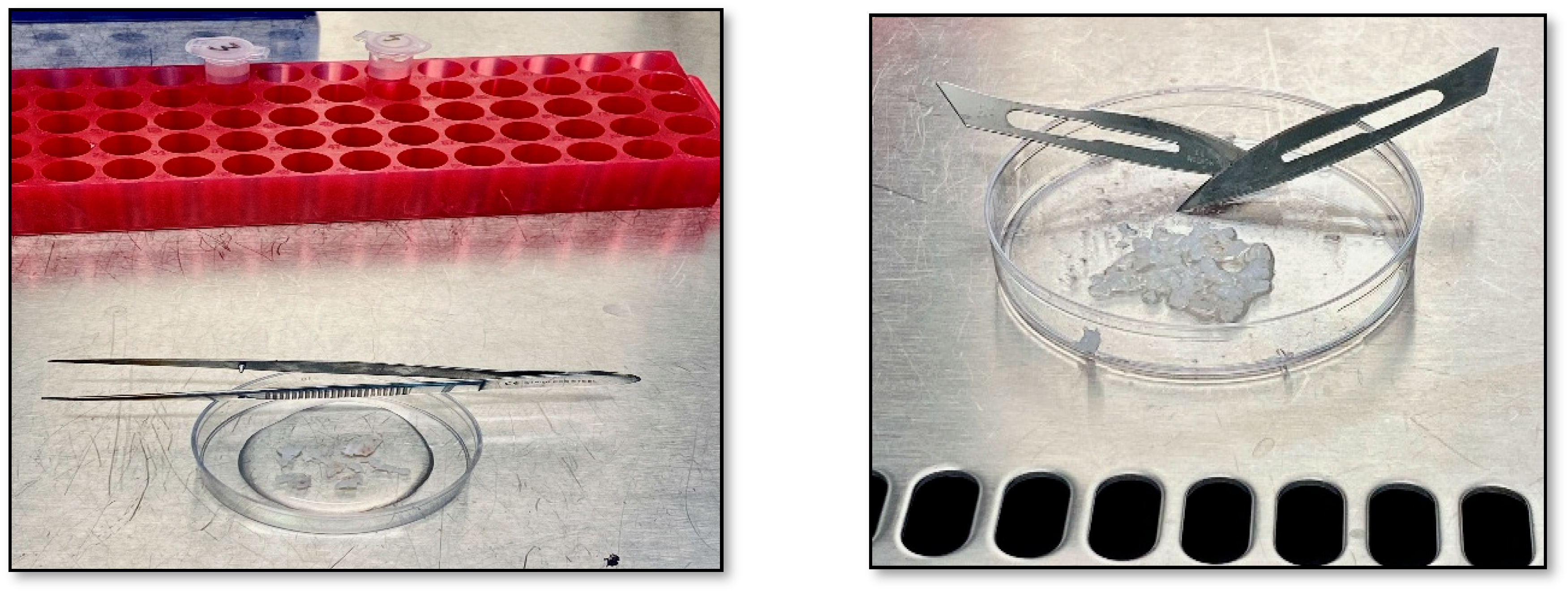
Collected bone tissues were washed 3 × 5 min with PBS supplemented with antibiotic antimycotic solution and then minced into small fragments using sterile scalpel blades (Swann-Morton No. 23 carbon steel, catalogue number: 0110) (Figure 1).
Figure 1. Bone tissues minced into small fragments using sterilised instruments.

2.2.2. Initiation of Bone Cell Cultures

Following the detailed steps above, the minced tissue was collagenase-treated to digest the collagen fibres in the bone. Then, the tissue was transferred to a culture plate, and cell culture media containing foetal bovine serum and antibiotic–antimycotic solution were added. The cells were allowed to attach to the substratum with routine media exchange. After a few weeks, when the cells were confluent, healthy, and contamination-free, they were subcultured using trypsin-EDTA to detach them from the plastic surface and re-seed them for expansion or setting up experiments.
The fragments were treated with collagenase type II (Gibco, 1000–1200 IU/mL, catalogue number: 17101015) for 2 h at 28 °C with gentle agitation. This step is crucial, as it facilitates the efficient digestion of the collagen matrix, enabling cells to detach easily from the explants. To determine the optimal digestion time, we performed preliminary trials using different incubation periods (2, 6, 12, and 24 h). The results showed no noticeable difference in the number of cells released among these time points. Therefore, a 2-h digestion period was selected for the final protocol, as it provides efficient cell release while minimising potential prolonged enzyme exposure that could compromise cell integrity.
The digestion solution was discarded, and the fragments were washed twice with sterile PBS.
These fragments were moved to the PLL-coated six-well plates.
2 mL of DMEM culture medium (Dulbecco’s modified Eagle’s medium, Gibco, catalogue number: 21969-035) supplemented with 20% FBS (Foetal bovine serum, Gibco, catalogue number: A3382001) and 1% antibiotic–antimycotic solution was poured into the wells, and the fragments were transferred into them.
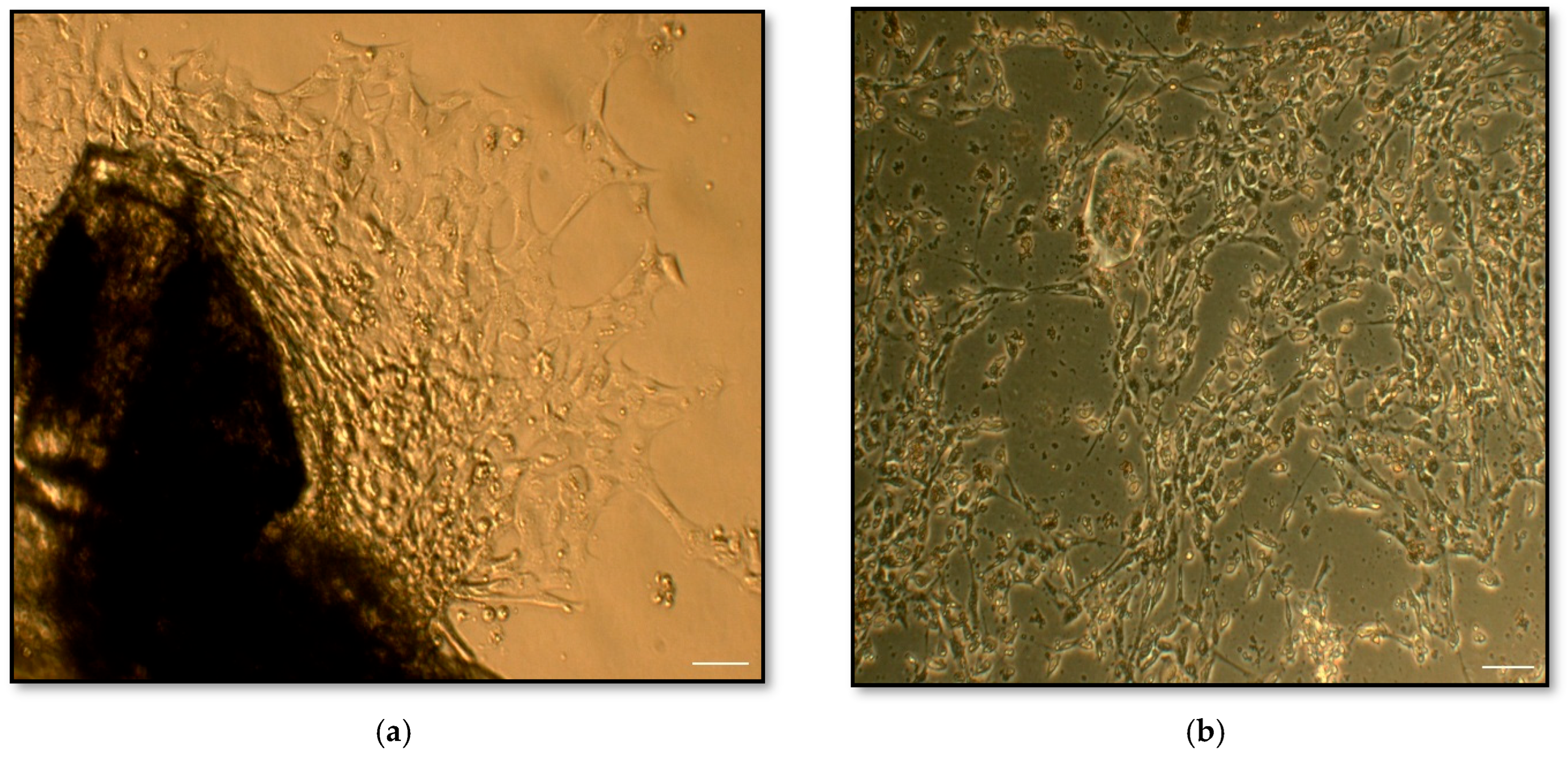
The explants were incubated at 28 °C (CO2 incubator for DMEM) to allow the cells to leave the bone fragments and attach to the substratum for 2–4 weeks (Figure 2a). A high fragment density is maintained to help the cells radiate from the explants.
Figure 2. (a) Once the bone fragments were transferred to the culture plates, they were incubated at 28 °C. After 14–28 days, cells radiate from the bone fragments. (b) Once the cells became 70% confluent, they were passaged and transferred to culture flasks (10× mag).
50% exchange of culture media was performed twice weekly to maintain sufficient nutrients and essential growth-promoting factors.
The cells were observed with brightfield microscopy using a Leica microscope (Figure 2b). When the cells were confluent, they were subcultured using trypsin-EDTA to detach them from the plastic surface and re-seed them for expansion, freezing for stocks or setting up experiments.

2.3. Osteogenic Differentiation Induction

Testing of bone mineralisation in bone cells can be performed using chemical induction (osteogenic) media. The osteogenic media is prepared by supplementing DMEM with 10 nM dexamethasone (Sigma-Aldrich, catalogue number: D2915), 10 mM β-glycerophosphate disodium salt hydrate (Sigma-Aldrich, catalogue number: G9422), and 200µM L-ascorbic acid-2-phosphate sesquimagnesium salt hydrate (Sigma-Aldrich, catalogue number: A8960), which together induce the expression of bone-specific markers and facilitate the deposition of calcium phosphate minerals in the extracellular matrix. The cells were cultured in osteogenic media for 2–3 weeks, and the media was exchanged 50% twice a week.

2.4. Fixation and Cytoskeletal Staining

The culture media was removed, and the cells were washed twice with PBS. Cells were then fixed with 10% buffered formaldehyde (10 mL formaldehyde in 90 mL PBS, then 2 g sucrose was added and dissolved well) at 37 °C for 30 min. Following fixation, the formaldehyde was removed, and the cells were rinsed with PBS.
Cells were permeabilised using PERM buffer with enough volume of BSA to cover the cells completely (e.g., 0.5 mL/well in a 24-well plate) (Invitrogen, ThermoFisher Scientific, San Diego, CA, USA, catalogue number: 00-8333-56) and kept at 4 °C for 4 min.
Blocking was performed using enough volume of BSA to cover the cells completely (e.g., 0.5 mL/well in a 24-well plate) and incubated at 37 °C for 5 min.
Cells were then incubated with enough volume of phalloidin (Invitrogen, ThermoFisher Scientific, USA, catalogue number: A12381) to form a thin layer over the cells (e.g., 100 µL/well in a 24-well plate) to visualise actin filaments (F-actin) (1:1000 dilution) for 60 min. After staining, cells were washed thrice with wash buffer (PBS  +  0.5% (v/v) Tween© 20 (Sigma-Aldrich, catalogue number: P1379).
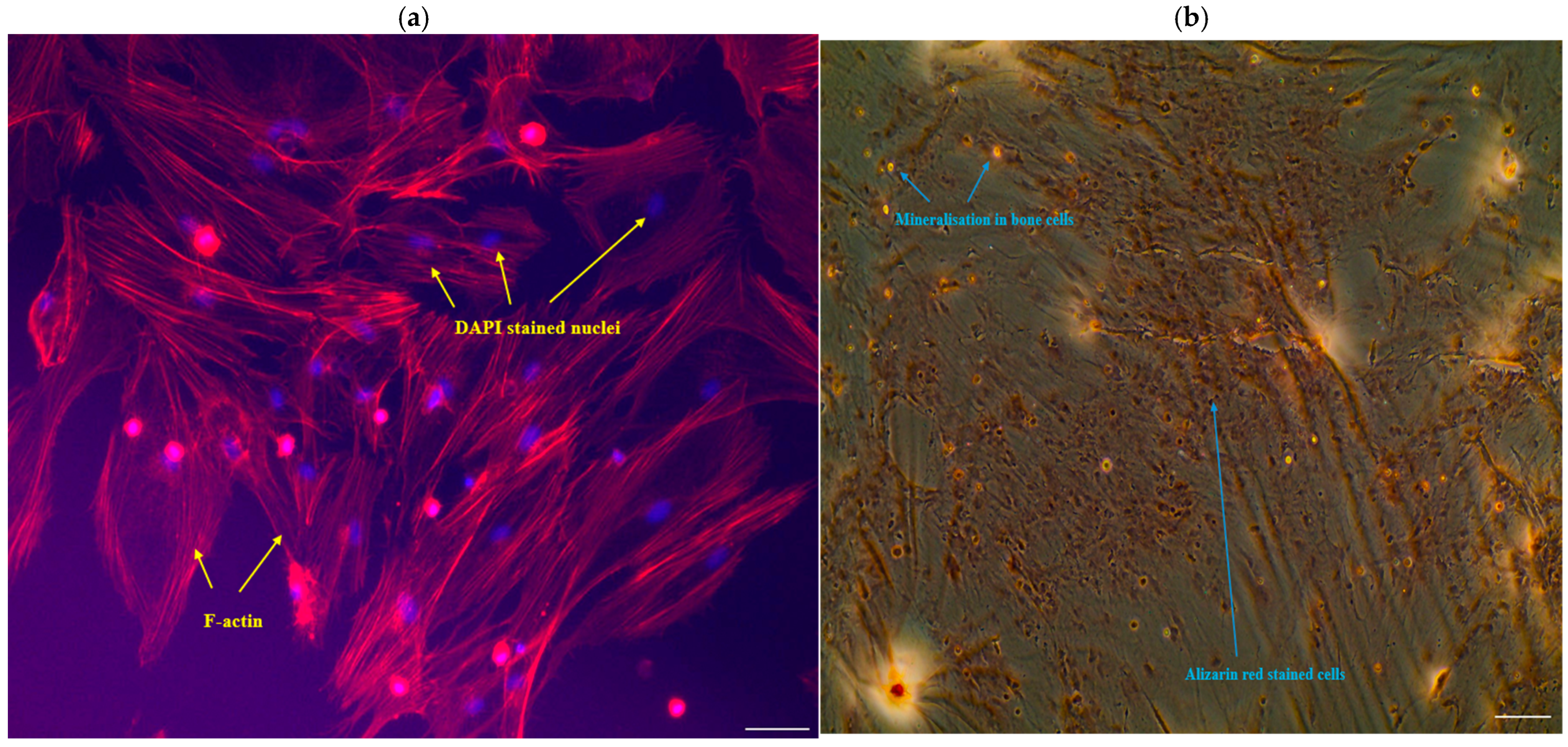
Next, 10 µL of DAPI (Invitrogen, ThermoFisher Scientific, San Diego, CA, USA, catalogue number: 62248) was added for nuclear counterstaining, and cells were imaged using a fluorescence microscope (Figure 3a).

2.5. Histological Staining for Mineralisation Detection

Alizarin Red S staining was performed to assess calcium deposition and confirm bone matrix mineralisation. Cells were incubated with 40 mM Alizarin Red S solution adjusted to pH 4.1–4.3 (2 g of Alizarin Red S was diluted in 100 mL of deionised water) (Sigma-Aldrich, catalogue number: A5533) at room temperature for 20–30 min, followed by 4–5 washes with tap water to remove excess dye. Calcium deposits appear as red staining under the microscope (Figure 3b).
Figure 3. (a) Fluorescent microscopy (EVOS M7000, ThermoFisher). Cells stained with Actin and DAPI. The actin staining targets the filamentous actin, which is shown in red. This highlights the cell shape and morphology. DAPI stains the nuclei of the cells, which are shown in bright blue (Scale bar = 50 µm). (b) Alizarin red S stain was used to detect calcium deposits and test for mineralisation (10× mag).

2.6. Long-Term Storage and Reconstitution

The cells were cryopreserved in liquid nitrogen for long-term storage. This was done to maintain their viability and preserve the original cell phenotype. They can then be thawed and cultured as required.
Once the cells reached confluency, they were subcultured using trypsin-EDTA (Sigma-Aldrich, catalogue number: T4049).
After 2–3 passages, the cells were trypsinised and centrifuged (4 min at 1400× g). The supernatant was discarded, and the cell pellet was dissolved in the cryogenic media (containing 10% DMSO (ThermoFisher Scientific, catalogue number: D-4120-PB08, 60% FBS and 30% DMEM).
Next, the cell suspension was aliquoted into 1 mL cryogenic tubes, transferred into Mr. Frosty (slow-freezing method) and stored at −80 °C overnight. Later, these tubes were immersed in liquid nitrogen for indefinite storage.
To thaw the cells, the cryogenic tubes were removed from the liquid nitrogen and rapidly thawed at 37 °C in a water bath (quick thawing). Once the cryogenic media containing the cells had turned into liquid, the tubes were disinfected with 70% ethanol, and the cells were transferred into a Falcon tube containing pre-warmed media to wash away the DMSO. After centrifugation at 330× g to pellet the cells, they were resuspended in fresh DMEM and seeded in a 6-well plate at a cell density of 2000/cm2 for further studies.

3. Conclusions

The present study was designed primarily to establish and validate a reliable protocol for isolating and maintaining bone cells from evolutionary relevant cichlid species. Here, we would like to point out that minor potential changes in shape and function with extended passaging may occur, as in most primary cultures, these factors do not affect the main conclusion that viable, reproducible bone cell cultures from cichlid species can be obtained using this methodology. Future studies will include further assessment of cell-type composition and functional assays to refine and validate cell purity and stability to check if that would cause possible limitations to this work. The next steps could be to build upon this foundation to conduct comparative analyses of cellular behaviour and mechanosensitivity between species with different feeding adaptations and remodeling capacities (e.g., Labeotropheus fuelleborni and Maylandia zebra) to gain deeper insights into these mechanisms.
We caution those using this protocol that the primary aim of this study was to demonstrate mineralization within the cultures and to indicate the presence of bone-associated cells, rather than definitively identify osteoblasts. While assays such as Alizarin Red S staining indicate calcium deposition and mineralization, they do not completely confirm the presence of osteoblast cells. Studies that require explicit verification of osteoblast cell identification may have to consider performing additional characterization assays. In mammalian systems, osteoblast identification relies on immunohistochemistry of markers such as expression of Runx2, Osterix and alkaline phosphatase activity. Unfortunately, in this case, there are no validated antibodies with proven specificity available, nor did our cultures yield high enough quantities of RNA for quantitative PCR. However, our work does confirm the presence of mineralized tissue derived from bone.
Further research on bone structure, function and physiology is required to enhance our comprehension of bone biology. This should not only pertain to clinical research but must also be complemented by an extension to ecological and evolutionary studies. The traditional understanding of the critical role of osteocytes in orchestrating bone formation and remodelling is being re-evaluated [15,25,40]. This is because of the way the anoesteocytic teleosts exhibit bone remodelling in the absence of the osteocytes, challenging the notion that osteocytes have an indispensable role in this. While the experiments in this study were not designed to directly test the evolutionary loss or compensation of osteocyte function, our findings contribute to this discussion by providing a cell culture model from a species possessing anosteocytic bone. The maintenance of bone formation and remodeling in cichlids supports the hypothesis that other cell types may play a part in some of the mechanosensory or regulatory roles attributed to osteocytes. This could serve as a valuable tool for future studies investigating how bone cells in anosteocytic species compensate functionally for the absence of osteocytes and specifically how these processes can vary between closely related species.
To better our understanding of remodeling in anosteocytic bones, more studies on teleosts should be conducted, as they are the largest group representing anoesteocytic bone cells and contain many examples of microevolutionary divergence [11]. Investigating the bone structures of African cichlids at a cellular level could be promising, as this group of teleost species has high evolutionary relevance and has been known to exhibit bone remodelling responses when subject to mechanical stress [26]. We would like to highlight that the primary aim of this study was to develop and validate a protocol for isolating and maintaining anosteocytic bone cells from evolutionarily significant cichlid species, thereby establishing a foundation for future investigations into how these cells respond to mechanical stimuli. Emerging approaches such as nanovibrational stimulation (“nanokicking”) have demonstrated the ability to impose controlled nanoscale mechanical stresses on bone cells to study their behaviour and differentiation [41,42].

Author Contributions

Conceptualization: D.N., K.J.P., M.J.D. and P.M.T.; Methodology, D.N., K.J.P., M.J.D. and P.M.T.; Writing—original draft preparation, D.N.; Writing—review and editing, K.J.P., M.J.D. and P.M.T.; Resources, K.J.P. and M.J.D.; Supervision, K.J.P. and M.J.D.; Funding acquisition, D.N., K.J.P. and M.J.D. All authors have read and agreed to the published version of the manuscript.

Funding

This work was supported by the Natural Environment Research Council IAPETUS2 Doctoral Training Partnership (grant number NE/S007431/1).

Institutional Review Board Statement

This work was approved by the University of Glasgow research ethics committee (Approval Code: 5974; Approval Date: 25 April 2022).

Data Availability Statement

The original contributions presented in this study are included in the article. Further inquiries can be directed to the corresponding author(s).

Acknowledgments

We thank the animal care staff at the University of Glasgow for fish care and feeding.

Conflicts of Interest

The authors declare no conflicts of interest.

References

  1. Robling, A.G.; Castillo, A.B.; Turner, C.H. Biomechanical and molecular regulation of bone remodeling. Annu. Rev. Biomed. Eng. 2006, 8, 455–498. [Google Scholar] [CrossRef]
  2. Parsons, K.J.; Albertson, R.C. Roles for Bmp4 and CaM1 in shaping the jaw: Evo-devo and beyond. Annu. Rev. Genet. 2009, 43, 369–388. [Google Scholar] [CrossRef]
  3. Dodds, R.A.; Ali, N.; Pead, M.J.; Lanyon, L.E. Early Loading-Related Changes in the Activity of Glucose 6-Phosphate Dehydrogenase and Alkaline Phosphatase in Osteocytes and Periosteal Osteoblasts in Rat Fibulae In Vivo. J. Bone Miner. Res. 1993, 8, 261–267. [Google Scholar] [CrossRef] [PubMed]
  4. Pead, M.J.; Skerry, T.M.; Lanyon, L.E. Direct Transformation from Quiescence to Bone Formation in the Adult Periosteum Following a Single Brief Period of Bone Loading. J. Bone Miner. Res. 1988, 3, 647–656. [Google Scholar] [CrossRef]
  5. Herrel, A.; Podos, J.; Vanhooydonck, B.; Andrew, P. Force–velocity trade-off in Darwin’s finch jaw function: A biomechanical basis for ecological speciation? Funct. Ecol. 2009, 23, 119–125. [Google Scholar] [CrossRef]
  6. Riddle, R.C.; Donahue, H.J. From Streaming Potentials to Shear Stress: 25 Years of Bone Cell Mechanotransduction. J. Orthop. Res. 2009, 27, 143–149. [Google Scholar] [CrossRef] [PubMed]
  7. Bonewald, L.F. The amazing osteocyte. J. Bone Miner. Res. 2011, 26, 229–238. [Google Scholar] [CrossRef] [PubMed]
  8. Xiong, J.; Onal, M.; Jilka, R.L.; Weinstein, R.S.; Manolagas, S.C.; O’brien, C.A. Matrix-embedded cells control osteoclast formation. Nat. Med. 2011, 17, 1235–1241. [Google Scholar] [CrossRef] [PubMed]
  9. Hellmich, C.; Ulm, F.J. Micromechanical model for ultrastructural stiffness of mineralized tissues. J. Eng. Mech. 2002, 128, 898–908. [Google Scholar] [CrossRef]
  10. Robinson, B.W.; Parsons, K.J. Changing times, spaces, and faces: Tests and implications of adaptive morphological plasticity in the fishes of northern postglacial lakes. Can. J. Fish. Aquat. Sci. 2002, 59, 1819–1833. [Google Scholar] [CrossRef]
  11. Skúlason, S.; Parsons, K.J.; Svanbäck, R.; Räsänen, K.; Ferguson, M.M.; Adams, C.E.; Snorrason, S.S. A way forward with eco evo devo: An extended theory of resource polymorphism with postglacial fishes as model systems. Biol. Rev. 2019, 94, 1786–1808. [Google Scholar] [CrossRef]
  12. Moss, M.L. The biology of acellular teleost bone. Ann. N. Y. Acad. Sci. 1963, 109, 337–350. [Google Scholar] [CrossRef]
  13. Ekanayake, S.; Hall, B.K. The development of acellularity of the vertebral bone of the Japanese medaka, Oryzias latipes (Teleostei; Cyprinidontidae). J. Morphol. 1987, 193, 253–261. [Google Scholar] [CrossRef]
  14. Witten, P.E.; Huysseune, A. A comparative view on mechanisms and functions of skeletal remodelling in teleost fish, with special emphasis on osteoclasts and their function. Biol. Rev. 2009, 84, 315–346. [Google Scholar] [CrossRef] [PubMed]
  15. Shahar, R.; Dean, M.N. The enigmas of bone without osteocytes. BoneKEy Rep. 2013, 2, 343. [Google Scholar] [CrossRef] [PubMed]
  16. Ofer, L.; Dean, M.N.; Zaslansky, P.; Kult, S.; Shwartz, Y.; Zaretsky, J.; Griess-Fishheimer, S.; Monsonego-Ornan, E.; Zelzer, E.; Shahar, R. A novel nonosteocytic regulatory mechanism of bone modeling. PLoS Biol. 2019, 17, e3000140. [Google Scholar] [CrossRef] [PubMed]
  17. Gunter, H.M.; Fan, S.; Xiong, F.; Franchini, P.; Fruciano, C.; Meyer, A. Shaping development through mechanical strain: The transcriptional basis of diet-induced phenotypic plasticity in a cichlid fish. Mol. Ecol. 2013, 22, 4516–4531. [Google Scholar] [CrossRef]
  18. Atkins, A.; Dean, M.N.; Habegger, M.L.; Motta, P.J.; Ofer, L.; Repp, F.; Shipov, A.; Weiner, S.; Currey, J.D.; Shahar, R. Remodeling in bone without osteocytes: Billfish challenge bone structure–function paradigms. Proc. Natl. Acad. Sci. USA 2014, 111, 16047–16052. [Google Scholar] [CrossRef]
  19. Currey, J.D.; Dean, M.N.; Shahar, R. Revisiting the Links between Bone Remodelling and Osteocytes: Insights from across Phyla. Biol. Rev. 2017, 92, 1702–1719. [Google Scholar] [CrossRef]
  20. Albertson, R.C.; Yelick, P.C. Fgf8 haploinsufficiency results in distinct craniofacial defects in adult zebrafish. Dev. Biol. 2007, 306, 505–515. [Google Scholar] [CrossRef]
  21. Parsons, K.J.; McWhinnie, K.; Pilakouta, N.; Walker, L. Does phenotypic plasticity initiate developmental bias? Evol. Dev. 2020, 22, 56–70. [Google Scholar] [CrossRef]
  22. Wimberger, P.H. Plasticity of jaw and skull morphology in the neotropical cichlids Geophagus brasiliensis and G. steindachneri. Evolution 1991, 45, 1545–1563. [Google Scholar] [CrossRef]
  23. Bouton, N.; Witte, F.; Van Alphen, J.J. Experimental evidence for adaptive phenotypic plasticity in a rock-dwelling cichlid fish from Lake Victoria. Biol. J. Linn. Soc. 2002, 77, 185–192. [Google Scholar] [CrossRef]
  24. Huysseune, A.; Sire, J.Y.; Meunier, F.J. Comparative study of lower pharyngeal jaw structure in two phenotypes of Astatoreochromis alluaudi (Teleostei: Cichlidae). J. Morphol. 1994, 221, 25–43. [Google Scholar] [CrossRef]
  25. Atkins, A.; Milgram, J.; Weiner, S.; Shahar, R. The response of anosteocytic bone to controlled loading. J. Exp. Biol. 2015, 218, 3559–3569. [Google Scholar] [CrossRef] [PubMed]
  26. Gilbert, M.C.; Tetrault, E.; Packard, M.; Navon, D.; Albertson, R.C. Ciliary rootlet coiled-coil2 (crocc2) is associated with evolutionary divergence and plasticity of cichlid jaw shape. Mol. Biol. Evol. 2021, 38, 3078–3092. [Google Scholar] [CrossRef]
  27. Cohen, L.; Dean, M.; Shipov, A.; Atkins, A.; Monsonego-Ornan, E.; Shahar, R. Comparison of structural, architectural and mechanical aspects of cellular and acellular bone in two teleost fish. J. Exp. Biol. 2012, 215, 1983–1993. [Google Scholar] [CrossRef] [PubMed]
  28. Doherty, A.H.; Ghalambor, C.K.; Donahue, S.W. Evolutionary physiology of bone: Bone metabolism in changing environments. Physiology 2015, 30, 17–29. [Google Scholar] [CrossRef]
  29. Dornburg, A.; Wcisel, D.J.; Zapfe, K.; Ferraro, E.; Roupe-Abrams, L.; Thompson, A.W.; Braasch, I.; Ota, T.; Yoder, J.A. Holosteans contextualize the role of the teleost genome duplication in promoting the rise of evolutionary novelties in the ray-finned fish innate immune system. Immunogenetics 2021, 73, 479–497. [Google Scholar] [CrossRef]
  30. Laizé, V.; Rosa, J.T.; Tarasco, M.; Cancela, M.L. Status, challenges, and perspectives of fish cell culture—Focus on cell lines capable of in vitro mineralization. In Cellular and Molecular Approaches in Fish Biology; Academic Press: Cambridge, MA, USA, 2022; pp. 381–404. [Google Scholar]
  31. Brawand, D.; Wagner, C.E.; Li, Y.I.; Malinsky, M.; Keller, I.; Fan, S.; Simakov, O.; Ng, A.Y.; Lim, Z.W.; Bezault, E.; et al. The genomic substrate for adaptive radiation in African cichlid fish. Nature 2014, 513, 375–381. [Google Scholar] [CrossRef]
  32. Schneider, R.F.; Meyer, A. How plasticity, genetic assimilation and cryptic genetic variation may contribute to adaptive radiations. Mol. Ecol. 2017, 26, 330–350. [Google Scholar] [CrossRef]
  33. Parsons, K.J.; Taylor, A.T.; Powder, K.E.; Albertson, R.C. Wnt signalling underlies the evolution of new phenotypes and craniofacial variability in Lake Malawi cichlids. Nat. Commun. 2014, 5, 3629. [Google Scholar] [CrossRef] [PubMed]
  34. Parsons, K.J.; Concannon, M.; Navon, D.; Wang, J.; Ea, I.; Groveas, K.; Campbell, C.; Albertson, R.C. Foraging environment determines the genetic architecture and evolutionary potential of trophic morphology in cichlid fishes. Mol. Ecol. 2016, 25, 6012–6023. [Google Scholar] [CrossRef]
  35. Navon, D.; Male, I.; Tetrault, E.R.; Aaronson, B.; Karlstrom, R.O.; Craig Albertson, R. Hedgehog signaling is necessary and sufficient to mediate craniofacial plasticity in teleosts. Proc. Natl. Acad. Sci. USA 2020, 117, 19321–19327. [Google Scholar] [CrossRef] [PubMed]
  36. McWhinnie, K.; Gibson, J.; Gislason, M.; Tanner, E.; Windmill, J.; Albertson, R.; Parsons, K. Assessing the levels of functional adaptation: Finite element analysis reveals species, hybrid, and sexual variation in the biomechanics of African cichlid mandibles. Evol. Biol. 2022, 49, 205–220. [Google Scholar] [CrossRef]
  37. Kocher, T.D. Adaptive evolution and explosive speciation: The cichlid fish model. Nat. Rev. Genet. 2004, 5, 288–298. [Google Scholar] [CrossRef]
  38. Cooper, W.J.; Parsons, K.; Mcintyre, A.; Kern, B.; Mcgee-moore, A.; Craig, R. Bentho-Pelagic Divergence of Cichlid Feeding Architecture Was Prodigious and Consistent during Multiple Adaptive Radiations within African Rift-Lakes. PLoS ONE 2010, 5, e9551. [Google Scholar] [CrossRef]
  39. Albertson, R.C.; Kocher, T.D. Genetic and developmental basis of cichlid trophic diversity. Heredity 2006, 97, 211–221. [Google Scholar] [CrossRef]
  40. Davesne, D.; Meunier, F.J.; Schmitt, A.D.; Friedman, M.; Otero, O.; Benson, R.B. The phylogenetic origin and evolution of acellular bone in teleost fishes: Insights into osteocyte function in bone metabolism. Biol. Rev. 2019, 94, 1338–1363. [Google Scholar] [CrossRef] [PubMed]
  41. Tsimbouri, P.M.; Childs, P.G.; Pemberton, G.D.; Yang, J.; Jayawarna, V.; Orapiriyakul, W.; Burgess, K.; Gonzalez-Garcia, C.; Blackburn, G.; Thomas, D.; et al. Stimulation of 3D osteogenesis by mesenchymal stem cells using a nanovibrational bioreactor. Nat. Biomed. Eng. 2017, 1, 758–770. [Google Scholar] [CrossRef]
  42. Robertson, S.N.; Campsie, P.; Childs, P.G.; Madsen, F.; Donnelly, H.; Henriquez, F.L.; Mackay, W.G.; Salmerón-Sánchez, M.; Tsimbouri, M.P.; Williams, C.; et al. Control of cell behaviour through nanovibrational stimulation: Nanokicking. Philos. Trans. R. Soc. A 2018, 376, 20170290. [Google Scholar] [CrossRef] [PubMed]
Disclaimer/Publisher’s Note: The statements, opinions and data contained in all publications are solely those of the individual author(s) and contributor(s) and not of MDPI and/or the editor(s). MDPI and/or the editor(s) disclaim responsibility for any injury to people or property resulting from any ideas, methods, instructions or products referred to in the content.

Article Metrics

Citations

Article Access Statistics

Multiple requests from the same IP address are counted as one view.