
Article

The Analysis of Transitional or Caudal Vertebrae Is Equally Suitable to Determine the Optimal Dietary Phosphorus Intake to Ensure Skeletal Health and Prevent Phosphorus Waste in Salmonid Aquaculture

by
Mursal Abdulkadir Hersi
1,
Thomas William Kenneth Fraser
2,
Saskia Kröckel
3,
Per Gunnar Fjelldal
2 and
Lucia Drábiková
2,4,*
1
Scottish Association for Marine Science (SAMS), Oban PA37 1QA, UK
2
Reproduction and Developmental Biology, Institute of Marine Research (IMR), Matre Research Station, 5984 Matredal, Norway
3
MOWI Feed AS, Pb 4102 Sandviken, 5835 Bergen, Norway
4
Evolutionary Developmental Biology, Biology Department, Ghent University, Ledeganckstraat 35, 9000 Ghent, Belgium
*
Author to whom correspondence should be addressed.
Fishes 2025, 10(12), 617; https://doi.org/10.3390/fishes10120617 (registering DOI)
Submission received: 2 October 2025 / Revised: 28 November 2025 / Accepted: 29 November 2025 / Published: 2 December 2025

Abstract

A prolonged dietary phosphorus (P) deficiency can result in reduced growth and vertebral deformities in farmed Atlantic salmon (Salmo salar). Severe deformities can impair swimming and lead to chronic stress associated with muscular fibrotic scarring. Conversely, excess dietary P contributes to farm effluents and environmental pollution. Vertebral centra ash content and mechanical strength both respond rapidly to suboptimal dietary P supply, but measuring all of salmon’s 59 vertebrae is time consuming. As such, this study assessed whether vertebrae from two commonly assessed regions (transitional and caudal) vary in their response to different dietary P levels. Atlantic salmon with an initial average weight of 1.8 kg (December 2022) were fed one of four experimental diets containing an increasing level of inorganic P (6.1–10.7 g/kg total P, 2.3–5.8 g/kg available P). Animals were distributed across 16 sea cages in a quadruplicated design. The regional differences in vertebral centra were assessed at two sampling points: in April 2023 following a slow growth period, and in July 2023 following a fast growth period. The growth of the caudal vertebrae in length surpassed the extension of the transitional vertebrae during the fast growth period. The bone mineralisation measured through vertebral centra ash and mechanical strength was however comparable between the regions, indicating that the rate of mineralisation was adjusted to the growth of the vertebrae. Only two parameters, yield point, which specifies the amount of energy that vertebra can absorb before it is permanently compressed, and toughness, a measure of stress per unit volume required to cause a fracture, showed regional differences. Considering transitional vertebrae, the estimated requirements were 4.1 g/kg available P in April and 4.4 g/kg in July, while the requirements based on caudal vertebrae were 3.7 g/kg in April and 4.6 g/kg in July. As such, both the transitional and caudal regions are equally suitable for a prompt recognition of suboptimal dietary P levels.
Key Contribution: A long-term exposure to dietary phosphorus (P) deficiency results in reduced mineral content and mechanical strength of vertebral centra. Soft vertebrae are prone to develop deformities, especially in animals exposed to acute handling stress under farming conditions. This study examined the effects of four dietary available P levels (2.3 to 5.9 g/kg) on vertebral morphometry, ash content, and mechanical strength of two distinct vertebral column regions (transitional and caudal) in sea-cage-reared Atlantic salmon post-smolts over a 7-month period. While the growth of transitional vertebrae was inferior to that of caudal vertebrae, the regions displayed comparable ash content and mechanical properties. Both regions are suitable candidates to safely detect suboptimal dietary P levels well ahead of other traditional methods such as animal growth, plasma phosphate or whole-body P.

1. Introduction

Atlantic salmon are one of the most farmed finfish species in the world with 2.9 million tonnes (Mt) produced in 2023 and with over 50% of the world’s production in Norway [1]. These fish are fed a commercial diet formulated to meet the animals’ needs. Phosphorus is one of the essential nutrients, as this mineral is important in many biological processes. However, phosphorus is also a primary driver of eutrophication which degrades aquatic environments [2,3]. With an average of 9.4 g of total P/kg in diets for farmed Atlantic salmon [4], commercial feeds currently oversupply this limited and expensive nutrient by up to 24% [5], due to concerns around the development of vertebral deformities. In addition, Atlantic salmon retain only around 18–29% of the P supplied in commercial feeds [4]. This oversupply and poor retention contribute to aquaculture’s release of P into the environment, which was estimated to be 16.3 kt, or 35% of all of Norway’s emissions, in 2021 [6].
To determine requirements for dietary P levels in Atlantic salmon, numerous endpoints have been assessed for their sensitivity. These include growth, blood plasma phosphate concentrations, the P content of either the whole body, the vertebrae, or the scales, gene expression associated with P metabolism, or macro- and microscopical assessments of bone mineralisation (radiography, whole-mount, and histology) [6,7,8,9,10,11,12,13]. These biomarkers reliably identify significant P deficiency, but a common limitation is their inability to detect suboptimal, but still biologically relevant, dietary P feeding [5]. For example, the dietary P requirement for animals’ growth is lower than the requirement for bone (vertebral column) mineralisation; thus, the onset of bone mineral deficiency precedes the decrease in growth [10,13,14,15,16]. As such, the latter is considered a more sensitive measure of dietary P deficiency in Atlantic salmon [5].
The vertebral column of Atlantic salmon is composed of 57–59 vertebrae which differ in their anatomy, size, and mineral content [8,17,18]. Therefore, the salmon’s vertebral column is divided into five distinct regions defined by their morphology and shaped by their functional requirements, namely the postcranial (V1–2), abdominal (V3–26), transitional (V27–36), caudal (V37–53), and ural regions (V54–59) (Figure 1) [18]. Post-cranial vertebrae lack ribs but carry epineurals (mineralised intermuscular tendon) and unfused neural spines dorsally [17,18,19]. Vertebrae of the abdominal region have epineurals, unfused neural spines dorsally, and paraphophyses that provide articulation for ribs ventrally [17,18,20]. Transitional vertebrae represent a gradual change of abdominal to caudal vertebrae. The neural spines progressively fuse, the epineurals are lost, ribs are reduced to vestigial ribs, and modified parapophyses develop into closed haemal arches. Vertebrae of the transitional region are therefore relatively heterogenous in their anatomy. Caudal vertebrae possess closed neural and haemal arches and spines. These vertebrae are also the largest in size [21]. Vertebra of the ural region carry neural and haemal arches and modified spines to support caudal fin rays [17,18].
To establish a method for mechanical property testing of bone in different species, [22] analysed V2–9 or V7–15 due to their intermediate strength and stiffness. With regards to nutrition, previous studies have used either transitional (V32–34) or caudal (V41–43) vertebrae to determine dietary P requirements in freshwater and seawater stages of Atlantic salmon [13,15,23,24]. These regions are important for the undulatory subcarangiform mode of swimming behaviour in salmonids [25], have superior vertebral ash and mechanical strength over the other regions of the vertebral column [21], and are regions with most common late-onset deformity development in the seawater stages of farmed Atlantic salmon [24].
However, studies analysing other factors influencing vertebral morphology have noted that not all regions may respond equally. According to [26], a faster growth of vertebrae 31–49 compared to vertebrae 9–30 in response to continuous light in early seawater stages of Atlantic salmon (post-smolts) was observed. As noted in [27], there were changes in relative vertebral length and increased vertebral mineral content (ash) in the transitional and caudal regions of Atlantic salmon post-smolts exposed to various current speeds that were not seen in other regions. It is therefore important to understand if different dietary phosphorus regimes lead to distinct responses in the transitional versus caudal vertebral column regions.
In the current study, Atlantic salmon were reared in sea cages and fed 1 of 4 dietary P levels (2.3 to 5.8 g/kg available P with a total phosphorus digestibility ranging between 37.4 and 55.7%, diet A–D) over a 7-month period. The analysed samples represent a subsample from a published study, and the diet E in [5] is coded as diet D here. The analysis included vertebral ash and mechanical strength of the vertebral centra from two vertebral column regions: the transitional and caudal. A comparative study analysing the effect of dietary P on the transitional and caudal regions together is missing. The aim of this study is to determine whether one region is more sensitive to the varying dietary P levels than the other and could therefore serve as a better indicator of suboptimal dietary P nutrition.

2. Materials and Methods

2.1. Study Location, Design, and Experimental Conditions

Samples analysed in this study originated from research conducted at the MOWI Feed Research Station (Aukan), Averøy, Norway (63° N, 7° E) between December 2022 and July 2023. Details of the study can be found in [5]. Briefly, seawater Atlantic salmon (MOWI strain) with an initial average weight of 1.8 kg were randomly distributed among 16 sea cages (5.2 × 5.2 × 6 m, 90 animals/sea cage). Atlantic salmon were fed one of four diets containing different levels of dietary P, having four cages assigned to the same diet treatment. Animals were reared on ambient water temperature and natural photoperiod. The sea temperature varied from 5 to 9 °C between December and April, and from 7 to 14 °C between April and July.
The use of experimental animals was performed in strict accordance with the Norwegian Animal Welfare Act 2010. A veterinarian approved by the Norwegian Food Safety Authority was present on the site during samplings. Salmon were reared under conditions comparable to standard commercial fish farming. The varying dietary P levels fed to the experimental fish could be considered within a regular natural fluctuation in food supply experienced by wild salmon [28,29].

2.2. Diets

Isocaloric and isonitrogenous diets were formulated to contain four different levels of total P (diets A–D) [5]. Diets A–D contained total P levels of 6.1, 8.0, 8.7, and 10.4 g/kg, respectively. Diets A–C were lower than, while diet D represented, the level of total P in commercial feed for Atlantic salmon. The different levels of total P were achieved by supplementation of inorganic phosphate in the form of mono-ammonium phosphate (MAP), while the content of wheat was reduced to enable MAP inclusion. Diet A contained a negligible amount of MAP, and the main sources of P were fish meal and plant-P [5]. As described in [5], the digestibility of total phosphorus was 37.4% (diet A), 46.6% (diet B), 47.2% (diet C), and 53.6% (diet D) between December and April, with a significant increase to 42.2% (diet A), 52.9% (diet B), 53.5% (diet C), and 55.7% (diet D) between April and July. Subsequently, the calculated available P (g/kg) was 2.3 (diet A), 3.7 (diet B), 4.1 (diet C), and 5.6 (diet D) from December to April, and 2.5 (diet A), 4.2 (diet B), 4.6 (diet C), and 5.8 (diet D) from April to July.

2.3. Sampling

All measurements were performed in fish anesthetised using MS-222 (0.003% Finquel Vet., VESO Aqua, Oslo, Norway) in accordance with the supplier’s instructions. Prior to any sampling, fish were euthanised using an overdose of MS-222 (0.02% Finquel Vet.). Thus, in accordance with Norwegian and European legislation related to animal research, formal approval of the experimental protocol by the Norwegian Animal Research Authority (NARA) was not required.

2.4. Radiography

All sampled animals were filleted on the left side, placed on a Canon CXDI-410C digital plate (43 × 43 cm) (Canon Inc., Tokyo, Japan) and radiographed with a GIERTH TR 90/20 portable X-ray unit (GIERTH X-Ray international GmbH, Riesa, Germany) by Aqua Kompetanse. X-ray images were taken at 90 cm between the X-ray source and the tablet. The X-ray unit was set to 44 kV, 3.5 mA, and 0.18 s exposure time during sampling in December and 50 kV, 4.0 mA, and 0.2 s exposure time during samplings in April and July. Images were digitised by CANON Advanced Edge Enhancement software. X-ray images were assessed for the presence of vertebral deformities according to [30] and vertebral centra of 12 animals/cage that showed <1 deformed vertebrae were used for compression test analyses of vertebral mechanical strength and ash content.

2.5. Vertebral Centra Measurements and Compression Tests

The compression tests were carried out at the Institute of Marine Research, Matre Research Station (Matre, Vaksdal Municipality, Norway) and described in detail in [5]. Briefly, the transitional and caudal vertebral regions were dissected and stored at −20 °C for subsequent analysis. Prior to the compression test analysis, vertebral column samples were thawed at room temperature. The analysis included 6 vertebrae/animal, 3 animals/cage, and 12 animals/diet group at each sampling point. There were 25 females analysed in April and 18 in July, and 23 males analysed in April and 30 in July. Three transitional vertebrae (32, 33, and 34) and three caudal vertebrae (42, 43, and 44) were dissected with the exception of 2 animals in diet B, 1 animal in diet C, and 3 animals in diet E in which the selection was shifted to 33, 34, and 35 for transitional vertebrae due to damage in vertebra 32 incurred during sampling. The neural and haemal arches, notochord, neural tube, and other soft body tissues were removed. Vertebral centra were kept in a 6‰ NaCl solution prior to the compression tests to mimic the regular osmolality of the extracellular body fluids of teleost fish [31]. The dimensions of the centrum were measured using vernier callipers; the anterior–posterior length, the lateral diameter (width), and the dorsal–ventral diameter (height) were recorded to the nearest 0.01 mm.
Each vertebral centrum was compressed along the cranial–caudal axis with a steadily advancing piston (0.01 mm/s) using a texture analyser (TA-HD plus Texture Analyser; Stable Micro Systems Ltd., Surrey, UK). The raw data were measured continuously and recorded every 0.1 s. The test ended at 35% vertebral centra compression. The stress–strain graphs were used to calculate mechanical properties corrected for the size of the vertebral centra according to [21,24,32]. Following mechanical testing, vertebrae were stored at −20 °C for subsequent ash content analysis.

2.6. Ash Content Analysis

For ash content determination, previously mechanically compressed vertebrae were thawed and pooled samples of three vertebrae per fish were analysed. The samples were defatted in a solution of acetone and methanol (1:1, v/v) for 20 h. The solution was renewed once. The defatted bones were then oven-dried (DRY-Line, VWR) at 105 °C for 24 h, placed in a desiccator, and subsequently weighed (dry weight). Samples were incinerated in a muffle furnace (Mod. Controller P320; Nabertherm GmbH, Lilienthal, Germany) (0.5 h at 115 °C, 4 h at 540 °C, and 6 h at 750 °C) [33]. The ashed vertebrae were then transferred to a desiccator to cool down before being weighed (ash weight). The ash content was calculated according to the following equation: ash (% of defatted dry weight) = (ash weight (g)/dry weight (g)) × 100.

2.7. Statistical Analysis

For all statistical analyses, R software version 4.3.2 (RStudio team, http://www.rstudio.com) was used with significance assigned at p < 0.05. A mean value of three vertebrae/fish was used in the analysis of all mechanical properties to maintain consistence with the analysis of vertebral ash values. The “lme” function from the “nlme” package [34] was used to run linear mixed effect (LME) models to assess the vertebral centra mechanical strength and ash content. The independent factors were dietary P level (4 levels: 6.1, 8.0, 8.7, and 10.4 g/kg), sampling point (2 levels: April vs. July), vertebral column region (2 levels: transitional vs. caudal), and all their 2- and 3-way interactions, with sea cage (16 levels) included as a random factor on the intercept. The final model was then based on backwards model building using the “dredge” function within the “MuMIn” package [35], with the model with the lowest Akaike information criterion adjusted for small sample sizes (AICc) considered that with the best fit when weighted against complexity [36]. The residuals of the final model were checked for normality (q-q plots) and non-linearity and unequal variance (standardised vs. predicted residual plots). The significance of the main effects of the model were assessed by the “Anova” function from the “car” package [37]. The differences in P requirement estimated between the regions were evaluated by broken-line models using the “segmented” package [38]. The values used in the broken-line analysis were the estimated marginal means calculated from the LME models described above using the “emmeans” function within the “emmeans” package [39]. The “ggplot2” package [40] was used for graphical presentation. Results are presented as means with 95% confidence intervals unless otherwise stated.

3. Results

3.1. Vertebral Centra Morphometrics

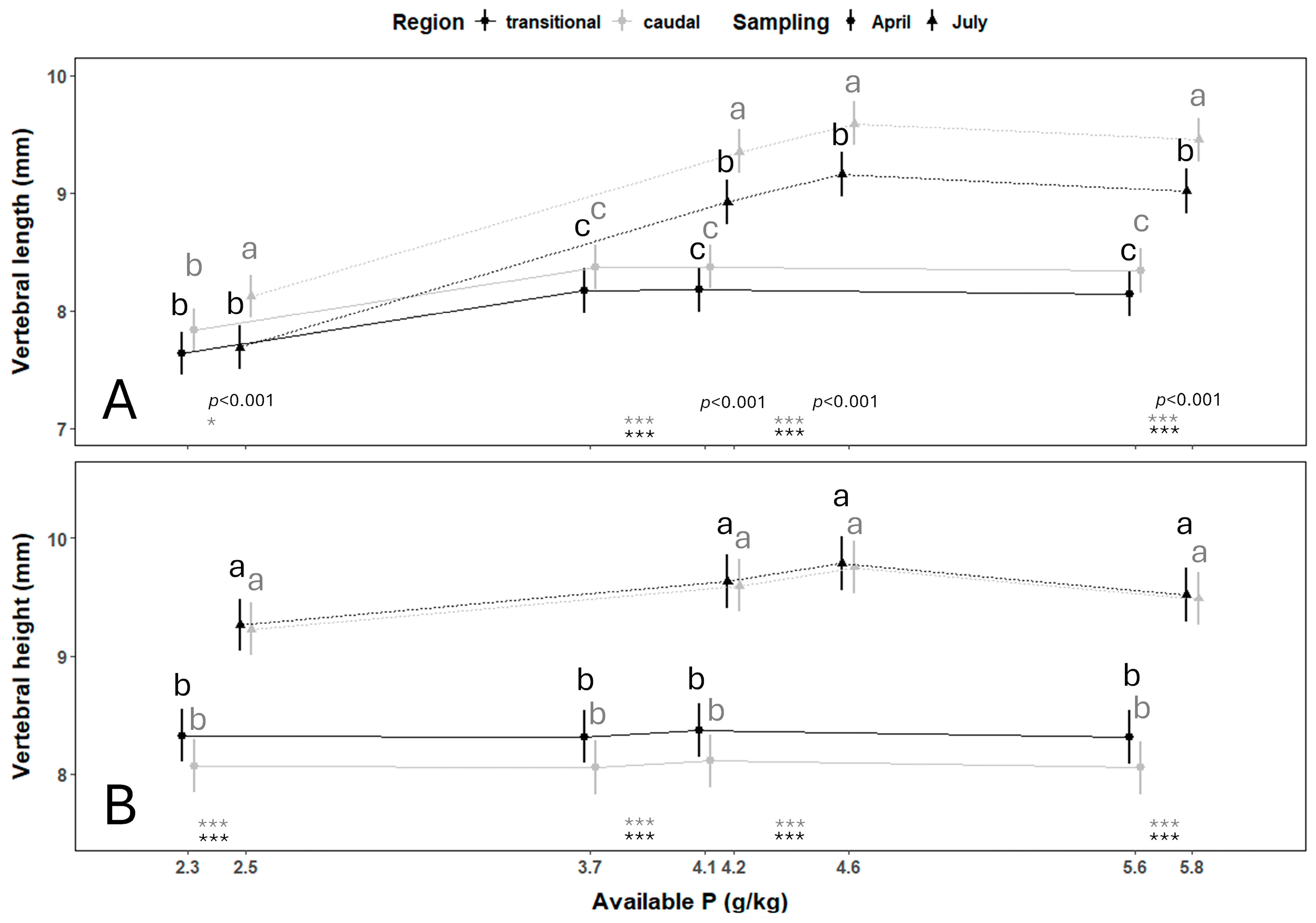
The statistical output of the final models on vertebral centra measurements are presented in Table S1. Irrespective of the dietary P levels, the animals’ vertebral centra length (Figure 2A) increased significantly more in the caudal compared to the transitional region between April and July. Vertebral centra of diet A fed animals were significantly shorter in length compared to vertebrae of diet B, C and E fed animals. Vertebral centra of female salmon were significantly shorter in length (8.44 [8.35–8.53] mm) compared to the male vertebral centra (8.59 [8.50–8.67] mm), with no interaction with any of the other factors in the model (Table S1). There was a significant increase in vertebral length across all diet groups and in both vertebral column regions except in transitional vertebrae of diet A-fed animals (Figure 2A). Vertebral centra height was significantly lower in animals fed diet A compared to diet C-fed animals in both regions in July. There was a significant uniform increase in height of the vertebrae throughout the study (Figure 2B).

3.2. Vertebral Centra Mechanical Properties

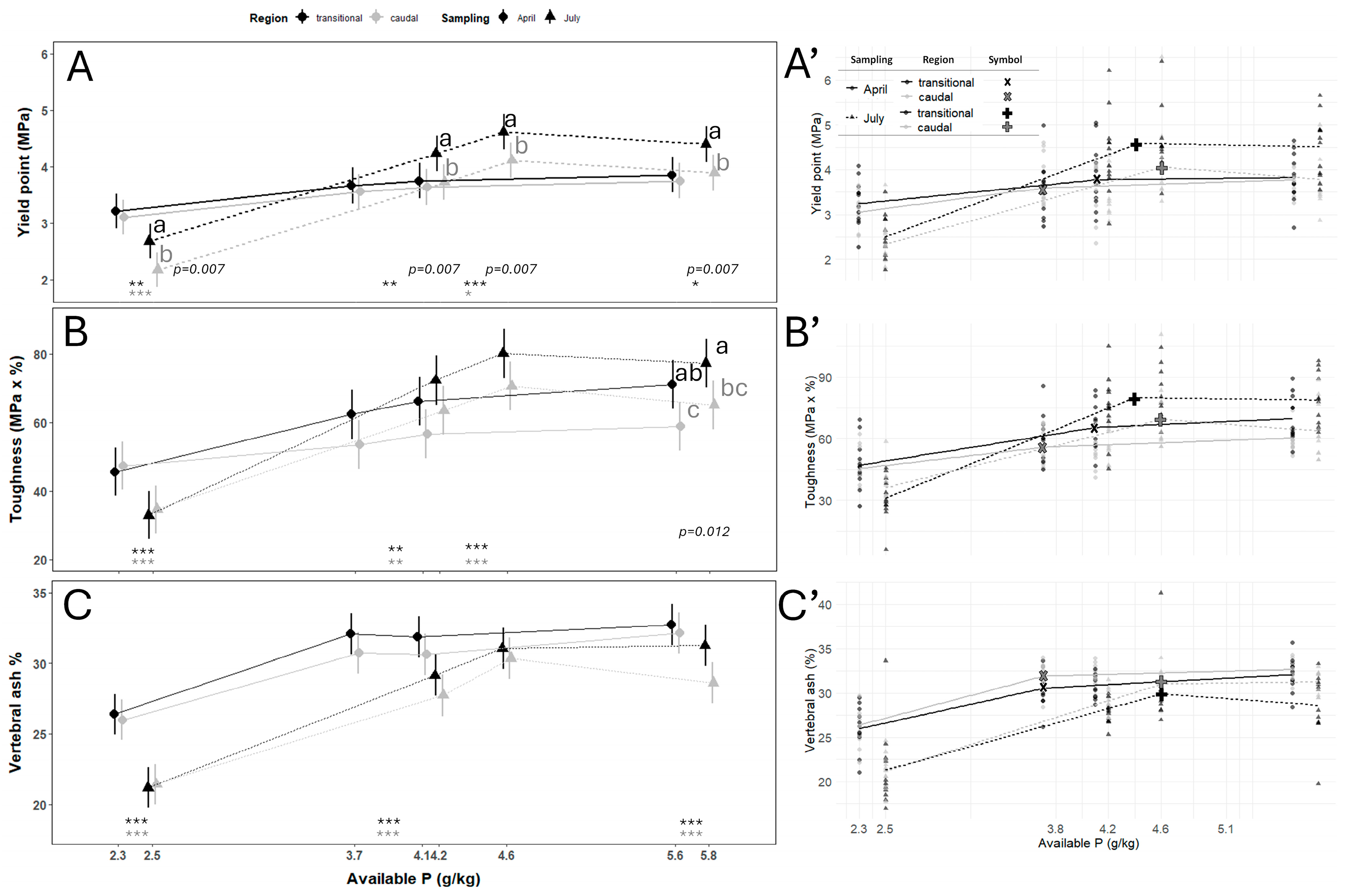
The statistical output of the final models on vertebral centra mechanical properties is presented in (Table S1). Yield point (ability of the vertebra to resist mechanical load before it is permanently deformed) showed significant time-dependent regional differences in all diet groups (Figure 3A). Transitional vertebrae of animals fed diet B-D showed a significantly increased yield point in July compared with April (Figure 3A). The yield point of caudal vertebrae was significantly increased in diet group C, though to a lesser extent compared to the transitional vertebrae (Figure 3A). The yield point of caudal vertebrae of animals fed diet A between April and July was reduced to a larger extent compared to the transitional vertebrae (Figure 3A). The yield point of vertebral centra of female salmon was significantly lower (3.52 [3.36–3.68] MPa) compared to the yield point of male vertebral centra (3.75 [3.60–3.89] MPa), with no interaction with any of the other factors in the model (Table S1). While in July diet A-fed animals had significantly reduced yield point compared to the other diet groups (p < 0.001), in April only diet D-fed animals showed significantly increased values compared to vertebrae from diet A animals (p = 0.03). The broken-line analysis subsequently estimated the requirements for available P to be 3.7 g/kg available P at the sampling in April according to the caudal vertebrae, and 4.4 g/kg and 4.6 g/kg available P at the sampling in July according to the transitional and caudal vertebral region, respectively (Figure 3A′, Table 1). The slope of the linear regression line for the yield point of transitional vertebrae was not significant, and the dietary P requirement estimate was therefore not considered (Table 1).
A significant regional effect on the dietary P groups was observed in the vertebral toughness (the ability of the vertebral centra to absorb energy). In vertebrae of fish fed diet D, a significantly reduced toughness was observed in the caudal region when compared to the transitional region at both sampling points (Figure 3B). Sex had no effect on toughness of the vertebral centra. In July, diet A-fed animals had a significantly reduced vertebral toughness compared to the other diet groups (p < 0.001), and in April only transitional vertebrae showed significantly reduced values in diet A diet animals compared to diet B-, D-fed animals (p < 0.05). Phosphorus requirement estimated by a broken-line analysis predicted 3.7 and 4.1 g/kg available P at the sampling in April and 4.4 and 4.6 g/kg available P in July based on the analysis of caudal and transitional vertebrae, respectively (Figure 3B′, Table 1).
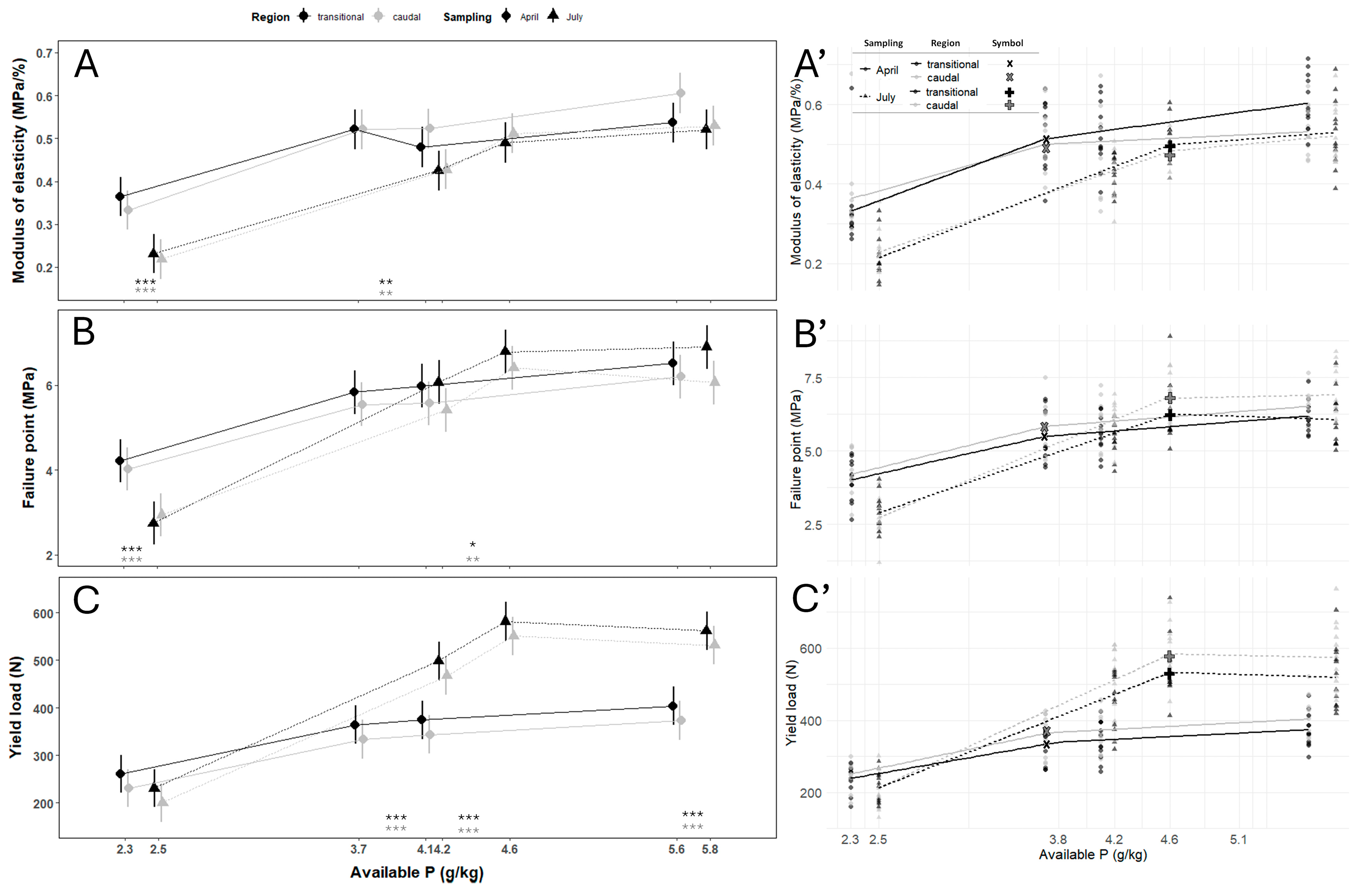
The remaining mechanical properties, including modulus of elasticity, a measure of vertebra rigidity, failure (fracture) point, and yield load, did not show significant differences between the vertebral column regions (Figure 4A–C). Modulus of elasticity, failure point, and yield load showed significantly reduced values in both transitional and caudal vertebrae of animals fed diet A compared with diet B-D-fed animals at both samplings. Diet B-fed animals showed significantly lower values for modulus of elasticity in caudal vertebrae compared with diet D-fed animals at sampling in July. Vertebrae of diet A-fed animals showed significant reductions in the modulus of elasticity and failure point throughout the study (Figure 4A,B). The same effect was observed for the modulus of elasticity in diet B-fed animals (Figure 4A). Vertebral centra failure point in diet C-fed animals was significantly higher in July compared to April (Figure 4B). Diet B-D-fed animals showed a vertebral centra yield load increase throughout the study (Figure 4C). Broken-line analysis for the transitional and caudal vertebral regions across mechanical properties uniformly estimated 3.7 g/kg available P as the requirement at the sampling point in April and 4.6 g/kg available P at the end of the trial in July (Figure 4A′–C′, Table 2).

3.3. Vertebral Centra Ash Content

The statistical output of the final models on ash content is presented in Table S1. Both regions showed a similar response in vertebral ash to different dietary P levels irrespective of the vertebral column region (Figure 3C), with vertebral centra from diet A-fed animals showing significantly reduced ash compared to the other groups. Sampling point had a statistically significant effect on vertebral ash content in both vertebral column regions in A-B and D diet groups (Figure 3C). Broken-line analysis of predicted values for vertebral ash in the transitional and caudal vertebral regions uniformly estimated 3.7 g/kg available P as the requirement at the end of the trial in April and 4.6 g/kg available P in July (Figure 3C′, Table 1).

4. Discussion

The current study shows that irrespective of the dietary P, vertebral centra of Atlantic salmon post-smolts grew faster in the caudal compared to the transitional vertebral region. The observed accelerated growth did not compromise vertebral ash content or vertebral centra mechanical strength of caudal vertebrae compared to transitional vertebrae at either sampling points. This indicates that the rate at which minerals are incorporated into the non-mineralised bone matrix of caudal vertebrae is faster compared to the transitional vertebrae in the post-smolt Atlantic salmon. Consequently, broken-line analysis demonstrated that both regions were equally suitable to detect early signs of suboptimal dietary P in the farmed Atlantic salmon post-smolts.
Still, this study observed regional differences in the yield point and toughness of vertebrae leading to a 5–10% difference in the dietary P requirement estimates. Based on the analysis of yield point and toughness of transitional vertebrae, the estimated requirements were 4.1 g/kg available P in April and 4.4 g/kg in July, while the requirements based on measurements of caudal vertebrae showed 3.7 g/kg in April and 4.6 g/kg in July. The relevance of these two mechanical parameters will be discussed in terms of vertebral centra deformity development, an indicator of compromised fish welfare.
Post-smolt Atlantic salmon are categorised as subcarangiform swimmers, whereby it is mostly the posterior half of their body that is involved in propulsion [25]. An increased swimming speed associated with an enhanced mechanical load on vertebral column was reported to increase the mineral content, size, and mechanical strength of transitional and anterior caudal vertebrae [27,41]. Exercise was reported to upregulate the expression of bone gla protein and alkaline phosphatase genes stimulating the bone formation and bone mineralisation [41]. Salmon of the current study were reared in a sheltered fjord with currents generated by regularly occurring high and low tides, and the swimming speed was therefore predicted to be relatively low. In contrast to previous studies, the length of anterior caudal vertebrae increased significantly more throughout this study compared with the transitional vertebrae. Meanwhile the mineral content and mechanical strength remained comparable between the analysed regions, indicating that the bone mineralisation was accelerated in the anterior caudal relative to transitional vertebrae. Since bone formation and bone mineralisation are induced by mechanical load [42], the current results imply that the caudal rather than transitional vertebrae are involved in the swimming of 1.8–4.5 kg Atlantic salmon post-smolts under slow current speed.
Bone is a composite material consisting of minerals, non-mineralised collagenous matrix, and water. The role of the mineralised part is to provide bone with stiffness while the non-mineralised collagenous matrix serves to absorb energy and delivers toughness [43]. As described by [44], the pre- and post-yield properties are indeed influenced by the total bone mineral content (ash) in reverse order and can therefore be termed pre-yield stiffness and post-yield toughness. This means that the total mineral content (ash) of vertebral centra dictates when vertebra reaches its yield point and the amount of collagenous matrix is responsible for post-yield behaviour prior to the vertebra reaching its fracture (failure) point. At the end of the slow growth period in April, vertebral centra of animals did not show a pronounced negative effect of dietary P deficiency on yield point and toughness. This could be explained by the continuously formed non-mineralised bone matrix partially compensating for the lack of minerals as previously observed in P-deficient salmon parr [13] and in zebrafish [45]. While the mineral content (ash) and modulus of elasticity, a parameter which shows how stiff the bone is [44], were not compromised by the increased growth in the caudal vs. transitional vertebrae, the caudal vertebrae showed reduced yield point compared to the transitional vertebrae across all diet groups.
The analysis of yield point is relevant in deformity studies since it determines the amount of energy that vertebra can absorb before they are permanently compressed [44]. The current study observed a time dependent yield point increase in the transitional but not the caudal vertebrae, which likely makes the caudal region more susceptible to vertebral compression. Indeed, a common location of newly developed vertebral compression in seawater Atlantic salmon is in the posterior transitional and the caudal regions [24], with vertebra 43 as the most frequently affected [33].
Vertebral compressions have also been observed to develop following a period of a prolonged dietary P deficiency [15,46,47]. The soft, non-mineralised vertebral body endplates bend inwards under the mechanical forces of muscles, and as a result vertebrae become shorter in cranial–caudal length and longer in dorsal–ventral height as observed in the current study and that of [48]. Both low-mineralisation and vertebral compression can be reversed with sufficient dietary P providing that the intervertebral joints are intact [23,24].
The yield point likely marks the amount of mechanical stress that the vertebra can absorb while maintaining the ability to recover its original shape, as opposed to the amount of stress necessary to cause a permanent vertebral centra compression. This is especially important when thinking about the whole vertebral column. A single severely compressed vertebral centra with bent bone trabeculae and ectopic-cartilage-filled “bone marrow” spaces, such as hyper-dense vertebrae, can be recovered under favourable conditions [24]. However, multiple vertebral centra deformities could potentially lead to compromised structural integrity of the vertebral column and an increased likelihood of collapsed intervertebral joints through buckling failure [49]. Deformities affecting the intervertebral joints are different to the deformities of the vertebral centra. Intervertebral joint deformities can be at best stabilised, otherwise they worsen over time but can never recover [50,51]. Progressive vertebral fusions comprising four and more vertebrae can result in the development of fibrotic (white) tissue within the surrounding musculature and severely impair the welfare of farmed teleost fish [12,50,51]. The inability of intervertebral joint recovery is likely because cartilage and notochord (found within the intervertebral joints) are phylogenetically related tissues. Both synthetise and deposit fibrils of type II collagen and both tissues can be repaired to some extent; however, they cannot regenerate [52,53,54].
Caudal relative to transitional vertebrae also showed reduced values for toughness in animals fed diet E. This observation is more puzzling and likely less relevant to farmed Atlantic salmon. While vertebral centra toughness is related to the collagenous part of the bone rather than the mineralised part, it is the measure of stress per unit volume required to cause a fracture. Bone fractures other than those of ribs are seldom reported in aquaculture studies [55]. In addition, bone is capable of fracture healing initiated by the proliferation of mesenchymal tissue and the formation of a fracture callus composed of bone and cartilage [56]. The callus is later mineralised, remodelled, and resorbed to allow the bone to restore its original shape [57]. These changes moreover mark the importance of studying bone micro-structure through histological and micro-CT examination for a more complete understanding of bone metabolism.
Despite the faster growth of caudal vs. transitional vertebrae, the vertebral ash (%) content was indifferent between the regions, indicating a faster mineral incorporation into the caudal vertebrae compared with the latter. The measured vertebral ash content (21–33%) agrees with values reported for regularly mineralised vertebrae in [24] (30–32%) and in [9] (25.8%) for low dietary P-fed salmon vertebrae but were relatively low compared to other studies (36–58%, [8,10,33]). These differences are due to the method used to de-fat the vertebrae as it has a significant influence on the total ash content [33]. Although salmon fed low dietary P showed an increased whole-body lipid accumulation [58], it is unknown if vertebrae are equally affected. Indeed, spaces between the bone trabeculae of vertebral centra are filled with fat and the content can be up to 9.2% in fatty teleost fish [59]. Further studies can determine if dietary P content affects the vertebral fat content and can compare different bone defatting methods to determine the effect on the final % ash.
Considering the yield point and toughness results for transitional and caudal vertebral regions, the estimated requirements for dietary phosphorus were met with 4.1 g/kg in December–April and 4.6 g/kg available P in April–July. While the requirement for April–July agrees with the previous findings [5], the value for April–July period is marginally higher than the earlier reported 3.7 g/kg. This difference stems from a single variable: the toughness of the transitional vertebrae, while the prevailing values for all the other variables here and in [5] estimated 3.7 g/kg available P.
Compared to the 5.6–5.8 g/kg available P used commercially [5], the current estimated requirements represent 21–27% reduction in available P content for grow-out farmed Atlantic salmon. The P handling (increased kidney P retention and reduced P loss) of salmon was likely enhanced at the new lower estimated P requirements compared with the higher dietary P levels. Studies show that reduced dietary P increases the intestinal and renal P uptake through upregulation of sodium phosphate (NaPi-IIb) co-transporters in both kidney and intestine [60,61]. In addition, fibroblasts growth factor 23, a hormone synthetised by osteoblasts and osteocytes, which inhibits the renal P reabsorption, is downregulated by low dietary P in Atlantic salmon [9,48,62]. Meanwhile the content of plasma calcitriol, the active metabolite of vitamin D3, shows an increase in salmon post-smolts fed a diet reduced in P [8,10], likely through an increase in parathyroid hormone-related protein [63]. This in turn increases the calcium and P intestinal absorption [63,64]. All in all, the combined findings of the current study and that by [5] provide strong evidence towards new reduced estimated dietary phosphorus in post-smolt Atlantic salmon with the potential of improved P use and reduced P waste.

5. Conclusions

To conclude, this study examined the effects of four dietary available P levels (2.3 to 5.9 g/kg) on vertebral morphometry, ash content, and mechanical strength of two distinct vertebral column regions in sea-cage-reared Atlantic salmon post-smolts over a 7-month period. While the growth of transitional vertebrae was inferior to that of caudal vertebrae, the regions displayed comparable ash content and mechanical properties. The caudal vertebrae were therefore more readily mineralised, implying that functionally they play a more important role in the swimming movement during the grow-out phase of farmed Atlantic salmon than transitional vertebrae. Both regions are suitable candidates to safely detect suboptimal dietary P levels well ahead of other traditional methods such as animal growth, plasma phosphate or whole-body P. Still, caudal vertebrae may represent a more practical choice due to their larger size enabling analysis of vertebral mechanical strength even in smaller animals. A standardised analysis of caudal vertebrae across different developmental stages and species would create a comparative dataset on vertebral mechanical strength.
Interestingly, vertebral centra yield point was the only parameter which was negatively affected by the increased growth of the caudal versus transitional vertebrae across the dietary P groups. Yield point is a relevant parameter in the studies concerning vertebral deformities since it estimates the amount of mechanical stress that can be exerted onto a vertebra prior to it becoming permanently compressed. It remains to be recommended to combine mechanical property and ash analysis with methods such as radiology and histology to determine the effects of P nutrition on both the vertebral centra and intervertebral joints. Further studies could determine whether vertebrae of the abdominal region, as the predominantly deformed region in the freshwater stages of Atlantic salmon [33], would be more suitable for analysis in salmon parr or if it is practically more feasible to use caudal vertebrae for their larger size.

Supplementary Materials

The following supporting information can be downloaded at: https://www.mdpi.com/article/10.3390/fishes10120617/s1, Figure S1: Vertebral centra mechanical strength (continued); Table S1: Statistical output.

Author Contributions

Conceptualization, L.D. and T.W.K.F.; methodology, L.D. and P.G.F.; software, P.G.F.; validation, L.D., T.W.K.F. and P.G.F.; formal analysis, M.A.H. and L.D.; investigation, M.A.H. and L.D.; resources, S.K. and P.G.F.; data curation, M.A.H., L.D. and T.W.K.F.; writing—original draft preparation, M.A.H. and L.D.; writing—review and editing, M.A.H., L.D., T.W.K.F., P.G.F. and S.K.; visualization, L.D.; supervision, L.D. and T.W.K.F.; project administration, P.G.F. and S.K.; funding acquisition, P.G.F. and S.K. All authors have read and agreed to the published version of the manuscript.

Funding

This work was supported by MOWI Feed AS, Norway and registered as the Institute of Marine Research’s project number 15996.

Institutional Review Board Statement

The current manuscript studied additional tissues of animals that come from a study published in Aquaculture: Drábiková, L., Kröckel, S., Witten, P.E., Riesen, G., Morris, P., Ostertag, A., Cohen-Solal, M., Fraser, T.W.K., Fjelldal, P.G., 2026. Phosphorus requirements in sea-cage-farmed Atlantic salmon with an emphasis on bone health and digestibility. Aquaculture 610, 742915. Therefore, no additional animals were used nor there were additional animals sampled for the purpose of the current study. The study was conducted at the MOWI Feed Research Station (Aukan), Averøy, Norway (63°3′37″ N, 7°35′23″ E) between December 2022 and July 2023. The use of experimental animals was performed in strict accordance with the Norwegian Animal Welfare Act 2010. A veterinarian approved by the Norwegian Food Safety Authority was present on the site at all times during samplings. Salmon were reared under conditions comparable to those of standard commercial fish farming. The varying dietary P levels fed to the experimental fish could be considered within a regular natural fluctuation in food supply experienced by wild salmon [28,29,65]. All measurements were performed in fish anesthetised using MS-222 (0.003% Finquel Vet., VESO Aqua, Oslo, Norway) in accordance with the supplier’s instructions. Prior to any sampling, fish were euthanised using an overdose of MS-222 (0.02% Finquel Vet.). Thus, in accordance with Norwegian and European legislation related to animal research, formal approval of the experimental protocol by the Norwegian Animal Research Authority (NARA) was not required.

Data Availability Statement

The original contributions presented in this study are included in the Supplementary Material. Further inquiries can be directed to the corresponding author.

Acknowledgments

The authors would like to acknowledge the team at Averøy Research Station: Jørn Age Stene, Matthew Watkins Baker, Sjur Storaas, Sindre Pettersen, Eirik Nordahl, Fredrik Røsand, Hans Henning Heyn, and Even Røisgaard for their dedication and hard work. The authors would also like to extend their acknowledgments to the reviewers that contributed with helpful comments and discussion. Segments of the master thesis of M.A.H. are included in this study. During the preparation of this work the authors have not used any tools to generate scientific writing used in this research paper. The authors take full responsibility for the content of the published article.

Conflicts of Interest

Author Saskia Kröckel has received research grants from Company MOWI Feed AS (Study design, Collection and Review). The remaining authors declare that the research was conducted in the absence of any commercial or financial relationships that could be construed as a potential conflict of interest.

References

  1. FAO. Salmon—Main Producers See Record-Breaking Exports. Available online: https://www.fao.org/in-action/globefish/news-events/news/news-detail/Salmon---Main-producers-see-record-breaking-exports/en (accessed on 13 January 2025).
  2. Mustapha, A.; El Bakali, M. Phosphorus Waste Production in Fish Farming: A Potential for Reuse in Integrated Aquaculture Agriculture. Int. J. Environ. Agric. Res. 2021, 7, 5–13. [Google Scholar]
  3. Luo, G. Review of Waste Phosphorus from Aquaculture: Source, Removal and Recovery. Rev. Aquac. 2023, 15, 1058–1082. [Google Scholar] [CrossRef]
  4. Aas, T.S.; Åsgård, T.; Ytrestøyl, T. Utilization of Feed Resources in the Production of Atlantic Salmon (Salmo salar) in Norway: An Update for 2020. Aquac. Rep. 2022, 26, 101316. [Google Scholar] [CrossRef]
  5. Drábiková, L.; Kröckel, S.; Witten, P.E.; Riesen, G.; Morris, P.; Ostertag, A.; Cohen-Solal, M.; Fraser, T.W.; Fjelldal, P.G. Phosphorus Requirements in Sea-Cage Farmed Atlantic salmon with an Emphasis on Bone Health and Digestibility. Aquaculture 2026, 610, 742915. [Google Scholar] [CrossRef]
  6. Pandit, A.V.; Dittrich, N.; Strand, A.V.; Lozach, L.; Hernandez, M.L.H.; Reitan, K.I.; Müller, D.B. Circular Economy for Aquatic Food Systems: Insights from a Multiscale Phosphorus Flow Analysis in Norway. Front. Sustain. Food Syst. 2023, 7, 1248984. [Google Scholar] [CrossRef]
  7. Baeverfjord, G.; Åsgård, T.; Shearer, K.D. Development and Detection of Phosphorus Deficiency in Atlantic salmon, Salmo salar L., Parr and Post-Smolts. Aquac. Nutr. 1998, 4, 1–11. [Google Scholar] [CrossRef]
  8. Fjelldal, P.G.; Hansen, T.; Breck, O.; Sandvik, R.; Waagbø, R.; Berg, A.; Ørnsrud, R. Supplementation of Dietary Minerals During the Early Seawater Phase Increases Vertebral Strength and Reduces the Prevalence of Vertebral Deformities in Fast-Growing Under-Yearling Atlantic salmon (Salmo salar L.) Smolt. Aquac. Nutr. 2009, 15, 366–378. [Google Scholar] [CrossRef]
  9. Fjelldal, P.G.; Hansen, T.J.; Lock, E.J.; Wargelius, A.; Fraser, T.W.K.; Sambraus, F.; El-Mowafi, A.; Albrektsen, S.; Waagbø, R.; Ørnsrud, R. Increased Dietary Phosphorus Prevents Vertebral Deformities in Triploid Atlantic salmon (Salmo salar L.). Aquac. Nutr. 2016, 22, 72–90. [Google Scholar] [CrossRef]
  10. Fjelldal, P.G.; Lock, E.J.; Hansen, T.; Waagbø, R.; Wargelius, A.; Gil Martens, L.; El-Mowafi, A.; Ørnsrud, R. Continuous Light Induces Bone Resorption and Affects Vertebral Morphology in Atlantic salmon (Salmo salar L.) Fed a Phosphorus Deficient Diet. Aquac. Nutr. 2012, 18, 610–619. [Google Scholar] [CrossRef]
  11. Witten, P.E.; Owen, M.A.G.; Fontanillas, R.; Soenens, M.; McGurk, C.; Obach, A. A Primary Phosphorus-Deficient Skeletal Phenotype in Juvenile Atlantic salmon Salmo salar: The Uncoupling of Bone Formation and Mineralization. J. Fish Biol. 2016, 88, 690–708. [Google Scholar] [CrossRef]
  12. Fraser, T.W.K.; Witten, P.E.; Albrektsen, S.; Breck, O.; Fontanillas, R.; Nankervis, L.; Thomsen, T.H.; Koppe, W.; Sambraus, F.; Fjelldal, G. Phosphorus Nutrition in Farmed Atlantic salmon (Salmo salar): Life Stage and Temperature Effects on Bone Pathologies. Aquaculture 2019, 511, 734246. [Google Scholar] [CrossRef]
  13. Drábiková, L.; Fjelldal, P.G.; De Clercq, A.; Yousaf, M.N.; Morken, T.; McGurk, C.; Witten, P.E. Vertebral Column Adaptations in Juvenile Atlantic salmon Salmo salar, L. as a Response to Dietary Phosphorus. Aquaculture 2021, 541, 736776. [Google Scholar] [CrossRef]
  14. Åsgård, T.; Shearer, K.D. Dietary Phosphorus Requirement of Juvenile Atlantic salmon, Salmo salar L. Aquac. Nutr. 1997, 3, 17–23. [Google Scholar] [CrossRef]
  15. Fjelldal, P.G.; Hansen, T.; Albrektsen, S. Inadequate Phosphorus Nutrition in Juvenile Atlantic Salmon Has a Negative Effect on Long-Term Bone Health. Aquaculture 2012, 334–337, 117–123. [Google Scholar] [CrossRef]
  16. Gil Martens, L.; Fjelldal, P.G.; Lock, E.J.; Wargelius, A.; Wergeland, H.; Witten, P.E.; Hansen, T.; Waagbø, R.; Ørnsrud, R. Dietary Phosphorus Does Not Reduce the Risk for Spinal Deformities in a Model of Adjuvant-Induced Inflammation in Atlantic salmon (Salmo salar) Postsmolts. Aquac. Nutr. 2012, 18, 12–20. [Google Scholar] [CrossRef]
  17. De Clercq, A.; Perrott, M.R.; Davie, P.S.; Preece, M.A.; Wybourne, B.; Ruff, N.; Huysseune, A.; Witten, P.E. Vertebral Column Regionalisation in Chinook salmon, Oncorhynchus tshawytscha. J. Anat. 2017, 231, 500–514. [Google Scholar] [CrossRef]
  18. Sankar, M.; Kryvi, H.; Fraser, T.W.K.; Philip, A.J.P.; Remø, S.; Hansen, T.J.; Witten, P.E.; Fjelldal, P.G. A New Method for Regionalization of the Vertebral Column in Salmonids Based on Radiographic Hallmarks. J. Fish Biol. 2024, 105, 1189–1199. [Google Scholar] [CrossRef]
  19. Schultze, H.-P.; Arratia, G. The Caudal Skeleton of Basal Teleosts, Its Conventions, and Some of Its Major Evolutionary Novelties in a Temporal Dimension. In Mesozoic Fishes 5—Global Diversity and Evolution; Arratia, G., Schultze, H.-P., Wilson, M.V.H., Eds.; Verlag Dr. Friedrich Pfeil: München, Germany, 2013; pp. 187–246. [Google Scholar]
  20. Owen, R. On the Archetype and Homologies of the Vertebrate Skeleton; Richard & John E. Taylor: London, UK, 1848. [Google Scholar]
  21. Fjelldal, P.G.; Grotmol, S.; Kryvi, H.; Gjerdet, N.R.; Taranger, G.L.; Hansen, T.; Porter, M.J.R.; Totland, G.K. Pinealectomy Induces Malformation of the Spine and Reduces the Mechanical Strength of the Vertebrae in Atlantic salmon, Salmo salar. J. Pineal Res. 2004, 36, 132–139. [Google Scholar] [CrossRef] [PubMed]
  22. Hamilton, S.J.; Mehrle, P.M.; Mayer, F.L.; Jones, J.R. Method to Evaluate Mechanical Properties of Bone in Fish. Trans. Am. Fish. Soc. 1981, 110, 708–717. [Google Scholar] [CrossRef]
  23. Witten, P.E.; Fjelldal, P.G.; Huysseune, A.; McGurk, C.; Obach, A.; Owen, M.A.G. Bone without Minerals and Its Secondary Mineralization in Atlantic salmon (Salmo salar): The Recovery from Phosphorus Deficiency. J. Exp. Biol. 2019, 222, jeb188763. [Google Scholar] [CrossRef]
  24. Drábiková, L.; De Clercq, A.; Yousaf, M.N.; Morken, T.; McGurk, C.; Witten, P.E. What Will Happen to My Smolt at Harvest? Individually Tagged Atlantic Salmon Help to Understand Possible Progression and Regression of Vertebral Deformities. Aquaculture 2022, 560, 738430. [Google Scholar] [CrossRef]
  25. Sfakiotakis, M.; Lane, D.M.; Davies, J.B.C. Review of Fish Swimming Modes for Aquatic Locomotion. IEEE J. Ocean. Eng. 1999, 24, 237–252. [Google Scholar] [CrossRef]
  26. Fjelldal, P.G.; Nordgarden, U.; Berg, A.; Grotmol, S.; Totland, G.K.; Wargelius, A.; Hansen, T. Vertebrae of the Trunk and Tail Display Different Growth Rates in Response to Photoperiod in Atlantic salmon, Salmo salar L., Post-Smolts. Aquaculture 2005, 250, 516–524. [Google Scholar] [CrossRef]
  27. Solstorm, F.; Solstorm, D.; Oppedal, F.; Fjelldal, P.G. The Vertebral Column and Exercise in Atlantic salmon—Regional Effects. Aquaculture 2016, 461, 9–16. [Google Scholar] [CrossRef]
  28. Hendry, A.P.; Beall, E. Energy Use in Spawning Atlantic Salmon. Ecol. Freshw. Fish 2004, 13, 185–196. [Google Scholar] [CrossRef]
  29. Thorstad, E.B.; Whoriskey, F.; Uglem, I.; Moore, A.; Rikardsen, A.H.; Finstad, B. A Critical Life Stage of the Atlantic salmon Salmo salar: Behaviour and Survival During the Smolt and Initial Post-Smolts Migration. J. Fish Biol. 2012, 81, 500–542. [Google Scholar] [CrossRef] [PubMed]
  30. Witten, P.E.; Gil-Martens, L.; Huysseune, A.; Takle, H.; Hjelde, K. Towards a Classification and an Understanding of Developmental Relationships of Vertebral Body Malformations in Atlantic salmon (Salmo salar L.). Aquaculture 2009, 295, 6–14. [Google Scholar] [CrossRef]
  31. Kültz, D. Physiological Mechanisms Used by Fish to Cope with Salinity Stress. J. Exp. Biol. 2015, 218, 1907–1914. [Google Scholar] [CrossRef]
  32. Porter, M.E.; Long, J.H. Vertebrae in Compression: Mechanical Behavior of Arches and Centra in the Gray Smooth-Hound Shark (Mustelus californicus). J. Morphol. 2010, 271, 366–375. [Google Scholar] [CrossRef]
  33. Grini, A.; Hansen, T.; Berg, A.; Wargelius, A.; Fjelldal, P.G. The Effect of Water Temperature on Vertebral Deformities and Vaccine-Induced Abdominal Lesions in Atlantic salmon, Salmo salar L. J. Fish Dis. 2011, 34, 531–546. [Google Scholar] [CrossRef]
  34. Pinheiro, J.; Bates, D.; DebRoy, S.; Sarkar, D.; R Core Team. Nlme: Linear and Nonlinear Mixed Effects Models. Available online: https://CRAN.R-project.org/package=nlme (accessed on 20 September 2025).
  35. Bartoń, K. MuMIn: Multi-Model Inference, R Package Version 1.46.0. Available online: https://CRAN.R-project.org/package=MuMIn (accessed on 20 September 2025).
  36. Hurvich, C.M.; Tsai, C.L. Bias of the Corrected AIC Criterion for Underfitted Regression and Time Series Models. Biometrika 1991, 78, 499–509. [Google Scholar] [CrossRef]
  37. Fox, J.; Weisberg, S. Nonlinear Regression, Nonlinear Least Squares, and Nonlinear Mixed Models in R. In An R Companion to Applied Regression, 3rd ed.; SAGE Publications: Thousand Oaks, CA, USA, 2019; p. 200. [Google Scholar]
  38. Muggeo, V.M. segmented: An R Package to Fit Regression Models with Broken-Line Relationships. R News 2008, 8, 20–25. Available online: https://cran.r-project.org/doc/Rnews/ (accessed on 20 September 2025).
  39. Lenth, R. Emmeans: Estimated Marginal Means, Aka Least-Squares Means, R Package Version 1.10.5-0900003. Available online: https://rvlenth.github.io/emmeans/ (accessed on 20 September 2025).
  40. Wickham, H. ggplot2: Elegant Graphics for Data Analysis, 2nd ed.; Springer: Cham, Switzerland, 2016; p. XVI, 260. [Google Scholar] [CrossRef]
  41. Totland, G.K.; Fjelldal, P.G.; Kryvi, H.; Løkka, G.; Wargelius, A.; Sagstad, A.; Hansen, T.; Grotmol, S. Sustained Swimming Increases the Mineral Content and Osteocyte Density of Salmon Vertebral Bone. J. Anat. 2011, 219, 490–501. [Google Scholar] [CrossRef] [PubMed]
  42. Witten, P.E.; Hall, B.K. Teleost Skeletal Plasticity: Modulation, Adaptation, and Remodelling. Copeia 2015, 103, 727–739. [Google Scholar] [CrossRef]
  43. Viguet-Carrin, S.; Garnero, P.; Delmas, P.D. The Role of Collagen in Bone Strength. Osteoporos. Int. 2006, 17, 319–336. [Google Scholar] [CrossRef]
  44. Currey, J.D. Role of Collagen and Other Organics in the Mechanical Properties of Bone. Osteoporos. Int. 2003, 14, 29–36. [Google Scholar] [CrossRef]
  45. Cotti, S.; Huysseune, A.; Koppe, W.; Rücklin, M.; Marone, F.; Wölfel, E.; Fiedler, I.; Busse, B.; Forlino, A.; Witten, P. More bone with less minerals? The effects of dietary phosphorus on the post-cranial skeleton in zebrafish. Int. J. Mol. Sci. 2020, 21, 5429. [Google Scholar] [CrossRef]
  46. Sullivan, M.; Reid, S.W.J.; Ternent, H.; Manchester, N.J.; Roberts, R.J.; Stone, D.A.J.; Hardy, R.W. The Aetiology of Spinal Deformity in Atlantic salmon, Salmo salar L.: Influence of Different Commercial Diets on the Incidence and Severity of the Preclinical Condition in Salmon Parr under Two Contrasting Husbandry Regimes. J. Fish Dis. 2007, 30, 759–767. [Google Scholar] [CrossRef] [PubMed]
  47. Smedley, M.A.; Migaud, H.; McStay, E.L.; Clarkson, M.; Bozzolla, P.; Campbell, P.; Taylor, J.F. Impact of Dietary Phosphorus in Diploid and Triploid Atlantic salmon (Salmo salar L.) with Reference to Early Skeletal Development in Freshwater. Aquaculture 2018, 490, 329–343. [Google Scholar] [CrossRef]
  48. Fjelldal, P.G.; Nordgarden, U.; Hansen, T. The Mineral Content Affects Vertebral Morphology in Underyearling Smolt of Atlantic salmon (Salmo salar L.). Aquaculture 2007, 270, 231–239. [Google Scholar] [CrossRef]
  49. Laerm, J. The Development, Function, and Design of Amphicoelous Vertebrae in Teleost Fishes. Zool. J. Linn. Soc. 1976, 58, 237–254. [Google Scholar] [CrossRef]
  50. Witten, P.E.; Gil-Martens, L.; Hall, B.K.; Huysseune, A.; Obach, A. Compressed Vertebrae in Atlantic Salmon Salmo salar: Evidence for Metaplastic Chondrogenesis as a Skeletogenic Response Late in Ontogeny. Dis. Aquat. Org. 2005, 64, 237–246. [Google Scholar] [CrossRef]
  51. Witten, P.E.; Obach, A.; Huysseune, A.; Bæverfjord, G. Vertebrae Fusion in Atlantic Salmon (Salmo salar): Development, Aggravation and Pathways of Containment. Aquaculture 2006, 258, 164–172. [Google Scholar] [CrossRef]
  52. Ashhurst, D.E. The Cartilaginous Skeleton of an Elasmobranch Fish Does Not Heal. Matrix Biol. 2004, 23, 15–22. [Google Scholar] [CrossRef]
  53. Lopez-Baez, J.C.; Simpson, D.J.; LLeras Forero, L.; Zeng, Z.; Brunsdon, H.; Salzano, A.; Brombin, A.; Wyatt, C.; Rybski, W.; Huitema, L.F.; et al. Wilms Tumor 1b Defines a Wound-Specific Sheath Cell Subpopulation Associated with Notochord Repair. eLife 2018, 7, e30657. [Google Scholar] [CrossRef]
  54. Witten, P.E.; Hall, B.K. The Notochord: Development, Evolution and Contributions to the Vertebral Column, 1st ed.; CRC Press: Boca Raton, FL, USA, 2022; 266p. [Google Scholar] [CrossRef]
  55. Jiménez-Guerrero, R.; Baeverfjord, G.; Evensen, Ø.; Hamre, K.; Larsson, T.; Dessen, J.E.; Gannestad, K.H.; Mørkøre, T. Rib Abnormalities and Their Association with Focal Dark Spots in Atlantic salmon Fillets. Aquaculture 2022, 561, 738697. [Google Scholar] [CrossRef]
  56. Carter, D.R.; Van der Meulen, M.C.H.; Beaupré, G.S. Mechanical Factors in Bone Growth and Development. Bone 1996, 18, S5–S10. [Google Scholar] [CrossRef]
  57. Urist, M.R.; Johnson, R.W. Calcification and Ossification: IV. The Healing of Fractures in Man under Clinical Conditions. J. Bone Joint Surg. 1943, 25, 375–426. [Google Scholar]
  58. Albrektsen, S.; Hope, B.; Aksnes, A. Phosphorous (P) deficiency due to low P availability in fishmeal produced from blue whiting (Micromesistius poutassou) in feed for under-yearling Atlantic salmon (Salmo salar) smol. Aquaculture 2009, 296, 318–328. [Google Scholar] [CrossRef]
  59. Phleger, C.F.; Wambeke, S.R. Bone lipids and fatty acids of Peru Fish. Comp. Biochem. Physiol. B 1994, 109, 145–152. [Google Scholar] [CrossRef]
  60. Sugiura, S.H.; McDaniel, N.K.; Ferraris, R.P. In Vivo Fractional Pi Absorption and NaPi-II mRNA Expression in Rainbow Trout Are Upregulated by Diteray P Restriction. Am. J. Physiol. Regul. Integr. Comp. Physiol. 2003, 285, R770–R781. [Google Scholar] [CrossRef]
  61. Sugiura, S.H. Digestion and Absorption of Dietary Phosphorus in Fish. Fishes 2024, 9, 324. [Google Scholar] [CrossRef]
  62. Drábiková, L.; Fjelldal, P.G.; Yousaf, M.N.; Morken, T.; De Clercq, A.; McGurk, C.; Witten, P.E. Elevated Water CO2 Can Prevent Dietary-Induced Osteomalacia in Post-smolt Atlantic salmon (Salmo salar, L.). Biomolecules 2023, 13, 663. [Google Scholar] [CrossRef]
  63. Taketani, Y.; Segawa, H.; Chikamori, M.; Morita, K.; Tanaka, K.; Kido, S.; Yamamoto, H.; Iemori, Y.; Tatsumi, S.; Tsugawa, N.; et al. Regulation of Type II Renal Na+-Dependent Inorganic Phosphate Transporters by 1,25-Dihydroxyvitamin D3. Identification of a Vitamin D-Responsive Element in the Human NaPi-3 gene. J. Biol. Chem. 1998, 273, 14575–14581. [Google Scholar] [CrossRef]
  64. Sundell, K.; Norman, A.W.; Björnsson, B.T. 1,25(OH)2 Vitamin D3 Increases Ionized Plasma Calcium Concentrations in the Immature Atlantic cod Gadus morhua. Gen. Comp. Endocrinol. 1993, 91, 344–351. [Google Scholar] [CrossRef]
  65. Kadri, S.; Metcalfe, N.B.; Huntingford, F.A.; Thorpe, J.E. What controls the onset of anorexia in maturing adult female Atlantic salmon? Funct. Ecol. 1995, 9, 790–797. [Google Scholar] [CrossRef]
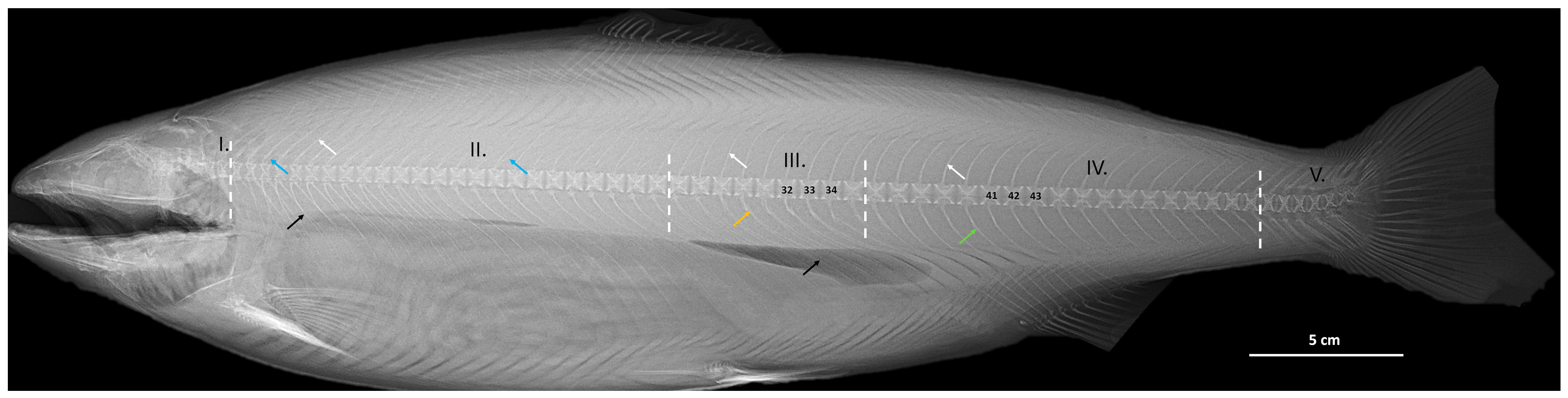
Figure 1. X-ray image of Atlantic salmon with a normally mineralised vertebral column. Vertebral column regions: post-cranial (I.), abdominal (II.), transitional (III.), caudal (IV.), and ural (V.) are indicated. Neural spines (white arrows), epineural (blue arrows), ribs (black arrows), modified parapophysis (yellow arrow), haemal spine (green arrow) are highlighted. Vertebrae 32–34 from the transitional and vertebrae 41–43 from the caudal regions were measured and analysed for vertebral centra mechanical strength and total ash content.
Fishes 10 00617 g001
Figure 2. Vertebral centra measurements. (A,B) Predicted values for length (anterior–posterior diameter) and height (dorsal–ventral diameter) of vertebral centra from transitional and caudal regions (black—transitional region, grey—caudal region) of animals fed diets A–D containing a mean available P on a dry matter basis of 2.3 g/kg (A), 3.7 g/kg (B), 4.1 g/kg (C), and 5.6 g/kg (D) from December to April and 2.5 g/kg (A), 4.2 g/kg (B), 4.6 g/kg (C), and 5.7 g/kg (D) from April to July (circle—April, triangle—July). Different lowercase letters and associated p values in graph (A) indicate significant differences between vertebral column regions within the same dietary P group at sampling in July while there were no regional differences in April. Graph (B) shows absence of regional differences in vertebral centra height at both sampling points. Asterisks in graphs (A,B) indicate a significant increase between April and July in vertebral length and height in both vertebral column regions and in all dietary P groups (significant codes: <0.001 ***, 0.01 *).
Fishes 10 00617 g002
Figure 3. Vertebral centra yield point, toughness, and ash content. Compression tests and total vertebral mineral content (ash) analysis of vertebral centra from transitional and caudal regions of animals fed diets A–C and D containing a mean available P on a dry matter basis of 2.3 g/kg (A), 3.7 g/kg (B), 4.1 g/kg (C), and 5.6 g/kg (D) from December to April and 2.5 g/kg (A), 4.2 g/kg (B), 4.6 g/kg (C), and 5.7 g/kg (D) from April to July. (AC) Graphs show the predicted values for yield point, toughness, vertebral ash and (A′C′) demonstrate the broken-line analysis with estimated dietary requirements for available P based on predicted values for yield point, toughness, and vertebral ash (highlighted by different symbols). Different lowercase letters and associated p values in (A,B) indicate significant differences between vertebral column regions at sampling in July (A) and at both samplings (B) (black—transitional region, grey—caudal region) within the same dietary P group. Asterisks indicate significant differences between sampling points (circle—April, triangle—July) within the same dietary P group (significant codes: <0.001 ***, 0.001 **, 0.01 *).
Fishes 10 00617 g003
Figure 4. Vertebral centra modulus of elasticity, failure point, and yield load. Compression tests analysis of vertebral centra from transitional and caudal regions of animals fed diets A–D containing a mean available P on a dry matter basis of 2.3 g/kg (A), 3.7 g/kg (B), 4.1 g/kg (C), and 5.6 g/kg (D) from December to April and 2.5 g/kg (A), 4.2 g/kg (B), 4.6 g/kg (C), and 5.7 g/kg (D) from April to July. (AC) Graphs show the predicted values for modulus of elasticity, failure point, and yield load, and (A′C′) demonstrate the broken-line analysis with estimated dietary requirements for available P based on the predicted values (highlighted by different symbols). Asterisks indicate significant differences between sampling points (circle—April, triangle—July), within the same vertebral region (black—transitional region, grey—caudal region) and within the same dietary P group (significant codes: <0.001 ***, 0.001 **, 0.01 *).
Fishes 10 00617 g004
Table 1. Estimated dietary phosphorus (P) requirements and their associated 95% confidence intervals based on breakpoints of the broken-line regression model analysis of yield point, toughness, and ash of transitional and caudal vertebrae in animals fed diets A–D and sampled in April and July. The significances of the broken-line regression models are specified (p).
SamplingVertebral Column RegionEstimated Dietary P Requirements (g/kg)95% Confidence Intervalsp-Value
Yield point
AprilTransitional4.1(1.91–6.28)0.1
Caudal3.7(2.02–5.38)0.013
JulyTransitional4.4(3.83–5.02)<0.001
Caudal4.6(4.03–5.17)<0.001
Toughness
AprilTransitional4.1(2.63–5.57)0.003
Caudal3.7(1.91–5.49)0.01
JulyTransitional4.4(3.93–4.86)<0.001
Caudal4.6(4.06–5.14)<0.001
Vertebral ash
AprilTransitional3.7(3.27–4.13)<0.001
Caudal3.7(2.93–4.47)
JulyTransitional4.6(4.30–4.92)
Caudal4.6(3.97–5.23)
Table 2. Estimated dietary phosphorus (P) requirements and their associated 95% confidence intervals based on breakpoints of the broken-line regression model analysis of modulus of elasticity, failure point, and yield load of transitional and caudal vertebrae in animals fed diets A–D and sampled in April and July. The significances of the broken-line regression models are specified (p).
SamplingVertebral Column RegionEstimated Dietary P Requirements (g/kg)95% Confidence Intervalsp-Value
Modulus of elasticity
AprilTransitional3.7(2.63–4.77)<0.001
Caudal3.7(2.71–4.69)
JulyTransitional4.6(4.01–5.19)
Caudal4.6(4.06–5.14)
Failure point
AprilTransitional3.7(2.83–4.58)<0.001
Caudal3.7(2.76–4.63)
JulyTransitional4.6(4.18–4.95)
Caudal4.6(4.16–5.04)
Yield load
AprilTransitional3.7(2.89–4.54)<0.001
Caudal3.8(2.88–4.68)
JulyTransitional4.6(4.19–5.01)
Caudal4.6(4.17–5.03)
Disclaimer/Publisher’s Note: The statements, opinions and data contained in all publications are solely those of the individual author(s) and contributor(s) and not of MDPI and/or the editor(s). MDPI and/or the editor(s) disclaim responsibility for any injury to people or property resulting from any ideas, methods, instructions or products referred to in the content.