
Article

Biomarker Responses and Trophic Dynamics of Metal(loid)s in Prussian Carp and Great Cormorant: Mercury Biomagnifies; Arsenic and Selenium Biodilute


1
Department of Biology, Josip Juraj Strossmayer University of Osijek, Cara Hadrijana 8/A, 31000 Osijek, Croatia
2
Independent Researcher, St. 4A# 3S-81, Jamundí 764007, Colombia
3
Department of Biology, Faculty of Science, University of Zagreb, Rooseveltov Trg 6, 10000 Zagreb, Croatia
4
Teaching Institute of Public Health Osijek-Baranja County, Drinska 8, 31000 Osijek, Croatia
*
Author to whom correspondence should be addressed.
Fishes 2025, 10(12), 635; https://doi.org/10.3390/fishes10120635 (registering DOI)
Submission received: 31 October 2025 / Revised: 3 December 2025 / Accepted: 8 December 2025 / Published: 10 December 2025
(This article belongs to the Special Issue The Impact of Contamination on Fishes)

Abstract

Trace metals and metalloids pose persistent threats to freshwater ecosystems, yet their trophic transfer and sublethal effects across food webs remain poorly understood. We investigated bioaccumulation patterns and biomarker responses in a predator–prey system comprising Prussian carp (Carassius gibelio) and Great Cormorant (Phalacrocorax carbo) nestlings from the Danube floodplain wetland Kopački rit Nature Park (Croatia) during 2023–2024. Concentrations of arsenic (As), selenium (Se), cadmium (Cd), mercury (Hg) and lead (Pb) were determined in Prussian carp liver and in Great Cormorant whole blood. The activities of acetylcholinesterase (AChE), carboxylesterase (CES), glutathione S-transferase (GST) and the levels of reactive oxygen species (ROS) and reduced glutathione (GSH) were measured in brain, muscle and gill tissues of Prussian carp, as well as in plasma and S9 blood fractions of Great Cormorants. In addition, tissue-specific metal concentration ratios (TSMCR) were calculated to assess the relative magnitude of recent dietary exposure in the predator compared to the prey. Biomarker activity showed strong tissue- and fraction-specific variation, with temporal differences. Exposure–response modelling revealed significant associations between As, Cd, and Hg and specific biomarkers, particularly in gill and plasma. Cross-species comparisons indicated elevated TSMCR as a proxy for recent trophic exposure only for Hg in 2023, whereas As and Se exhibited lower TSMCR. These findings demonstrate that metal exposure in floodplain systems induces physiological responses and Hg poses the greatest prey-to-predator exposure risk, highlighting the value of integrating pollutant measurements with mechanistic biomarker endpoints to evaluate ecosystem-level impacts.
Key Contribution: We show that mercury indicates elevated tissue-specific metal concentration ratios (TSMCR) as a proxy for recent trophic exposure from Prussian carp to Great Cormorant (whereas arsenic and selenium show low TSMCR), and we map matrix-specific physiological responses that shift by tissue/fraction and year. By linking pollutant burdens to enzymatic (acetylcholinesterase, carboxylesterase, glutathione S-transferase activities) and oxidative-stress (reactive oxygen species, reduced glutathione concentrations) endpoints, the study provides an integrated, early-warning framework for tracking trophic metal risks in floodplain wetlands.

1. Introduction

Aquatic ecosystems are among the most threatened habitats globally, facing mounting pressures from anthropogenic pollution that disrupt ecological processes and endanger wildlife health [1,2]. Among these pollutants, metalloids and heavy metals such as arsenic (As), selenium (Se), cadmium (Cd), mercury (Hg), and lead (Pb) are of particular concern due to their persistence and capacity to induce a range of sublethal effects in aquatic organisms [3,4,5]. Unlike many organic pollutants, metals cannot be degraded, allowing them to persist and cycle within ecosystems for decades after their release [6,7]. Through processes of trophic transfer, metal(loid)s may accumulate at higher concentrations in top predators than in their prey, potentially altering physiology, behaviour, and fitness [8,9,10,11]. While elements like Hg and Cd are well known for their strong bioaccumulation and biomagnification potential [8], others, such as As and Se, often exhibit biodilution or more complex trophic transfer dynamics [8,12]. Lead, though persistent, shows variable accumulation patterns depending on environmental and biological factors [8,13,14].
Sentinel species that integrate environmental exposures provide a powerful means of assessing spatio-temporal ecosystem pollution [15,16]. Fish are widely used as bioindicators of aquatic health because they readily accumulate metals from water and diet, often showing tissue-specific accumulation patterns that reflect both exposure pathways and metabolic handling [15,16,17,18]. Similarly, piscivorous birds can serve as integrative sentinels of pollutant transfer at higher trophic levels [10,19,20]. As long-lived predators that feed on fish, they provide critical information about the biological consequences of chronic exposure [8]. The Great Cormorant, Phalacrocorax carbo Linnaeus, 1758, is well suited for monitoring metal(loid) transfer in freshwater ecosystems [21,22]. Among its main prey, the invasive Prussian carp, Carassius gibelio (Bloch, 1783), occupies floodplain wetlands and large rivers across Central and Eastern Europe, where it serves as an important food source for Great Cormorants [23]. Its benthic foraging and accumulation of pollutants make it a valuable model for tracing pollutant exposure at lower trophic levels [24,25]. The predator–prey link between Prussian carp and Great Cormorant enables assessment of bioaccumulation and trophic transfer in natural systems [23,24,25,26]. Kopački rit Nature Park, a dynamic Danube floodplain in Croatia, provides an ideal setting, with seasonal inundations that sustain rich biodiversity yet also transport legacy pollutants from upstream sources [24,25,27,28].
Understanding the interactions of metalloids and metals requires more than measuring their concentrations; it involves evaluating their effects on physiological processes as well. Biomarkers, measurable biochemical, cellular, or physiological responses to exposure, offer sensitive tools to detect early sublethal effects of pollutants before they manifest at the organism or population level [29,30]. Among them, enzymatic biomarkers such as the activities of acetylcholinesterase (AChE), carboxylesterase (CES), and glutathione S-transferase (GST) are widely used indicators of neurotoxicity and detoxification capacity, while non-enzymatic markers such as the levels of reactive oxygen species (ROS) and reduced glutathione (GSH) reflect oxidative stress dynamics [3,31]. Linking these biomarker responses to measured metal(loid) levels can assist in identifying potential exposure–response relationships that may reveal subtle physiological disruptions in both prey and predators.
To interpret the biomarker responses in an ecologically meaningful way, it is essential to consider the specific tissues in which they are measured and the physiological information those tissues provide. In fish, different tissues provide complementary windows into pollutant exposure and physiological stress [32]. The brain, gills and muscle were selected because they represent three biologically distinct and ecologically relevant tissues: the brain reflects neurotoxic effects [33,34] the gills represent the primary interface for gas exchange, osmoregulation, acid-base regulation, and excretion of nitrogenous waste [35] and the muscle provides insights into systemic accumulation [36]. In birds, blood provides an integrative and ethically accessible window into exposure and physiological status [37]. Blood reflects recent dietary uptake and the circulating fraction of metal(loid)s bound to plasma proteins and erythrocytes, making it a sensitive indicator of short-term systemic exposure [31,37].
The aim of the present research was to determine the degree of trophic transfer of selected metalloids and metals between Prussian carp and Great Cormorant nestlings, as well as the associated biomarker responses. We hypothesised that:
(I)
biomarkers of enzymatic activity and oxidative stress would display tissue- and fraction-specific changes in response to exposure to metal(loid)s.
(II)
Hg would exhibit elevated tissue-specific metal concentration ratios as a proxy for recent trophic exposure (i.e., higher concentrations in Great Cormorant nestlings compared to Prussian carp);
(III)
As and Se would exhibit decreased tissue-specific metal concentration ratios as a proxy for recent trophic exposure (i.e., lower levels in Great Cormorant nestlings relative to the Prussian carp).
To address these hypotheses, we combined pollutant analysis with biomarker assessment to investigate biological effects and trophic transfer of metalloids and metals in a predator–prey system from the Kopački rit Nature Park. We quantified As, Se, Cd, Hg, and Pb levels in Prussian carp liver and Great Cormorant nestling blood collected concurrently in 2023 and 2024 to reflect the same seasonal exposure window for both predator and prey. Concurrently, we measured enzymatic biomarkers (AChE, CES, and GST) and non-enzymatic biomarkers (ROS and GSH) in the brain, gill, and muscle tissues of Prussian carp, as well as in plasma and S9 blood fractions of Great Cormorants. Linear mixed-effects models were used to test for tissue-, fraction-, and year-specific differences in biomarker activity and to describe within-species exposure–response interactions. Tissue-specific metal concentration ratios were further estimated to evaluate trophic transfer between Prussian carp and Great Cormorant.
By integrating pollutant levels with physiological biomarkers across trophic levels, this study provides new insight into how metal(loid) exposure propagates through a wetland food web and how it affects organisms at different trophic positions. Our findings contribute to a deeper understanding of metal(loid) dynamics in floodplain ecosystems and highlight the importance of linking exposure data with biological effects to assess ecological risk.

2. Materials and Methods

2.1. Study Area

The Kopački Rit Nature Park, a 23,000 ha large area, located in north-eastern Croatia at the confluence of the Danube and Drava rivers (Figure 1), represents one of the largest and most ecologically complex floodplain systems in the Danube Basin. The park’s high habitat heterogeneity, combined with its strong legal protection (Nature Park, Special Zoological Reserve, Ramsar and Biosphere Reserve designations) [38], makes Kopački Rit an exemplary natural laboratory for examining ecological processes, pollutant pathways, and trophic interactions in floodplain ecosystems. Hydrological dynamics are primarily driven by the Danube and Drava rivers, whose seasonal flooding determines the extent of water exchange, sediment deposition, and nutrient input across the floodplain [27,28]. However, the same hydrological processes that sustain biodiversity also transport legacy pollutants from industrial, agricultural, and urban sources upstream, making the floodplain a potential hotspot for metal(loid) accumulation [24,25].

2.2. Study Species

The area supports a highly diverse ichthyofauna, comprising 41 recorded freshwater fish species, characteristic of large lowland river systems. Among these, the invasive Prussian carp is one of the most abundant species, constituting 17.5% of the total fish abundance recorded across all species [39]. Its benthic foraging habits and capacity to accumulate pollutants in metabolically active tissues make it an informative model species for tracing exposure at the base of piscivorous food webs [24,25]. The Great Cormorant, a colonial piscivore waterbird with predictable breeding sites and a diet dominated by fish, is especially suited for monitoring metal(loid) transfer and effects in freshwater ecosystems [21,22]. They are highly opportunistic feeders, and prey availability is the main factor shaping their diet composition [40,41,42]. The Kopački rit Nature Park hosts the largest Great Cormorants colony in Croatia [43,44] with 760 breeding pairs in 2022 (T. Mikuška, pers. comm.). The trophic relationship between Prussian carp and Great Cormorant provides a valuable framework for examining how metal(loid)s move and amplify through the food web. By analysing pollutant levels in both prey and predator, it becomes possible to assess the extent of bioaccumulation within the fish and assess TSMCR as a proxy for recent trophic exposure across trophic levels under natural ecological conditions [23,24,25,26].

2.3. Sampling Procedure

A total of 20 Prussian carps were collected in June 2023 and 2024 (10 individuals per year) using standard ichthyological methods, including electrofishing and gill nets, to ensure representative coverage of the local fish community. Electrofishing followed the EN 14011:2003 [45] standard for water quality and was conducted from a boat using a Hans Grassl 7.5 kW electrofisher with a rounded stainless-steel anode (50 cm diameter, 10 mm mesh). Gill nets of different mesh sizes were used in accordance with EN 14757:2005 [46] and permits issued by the Ministry of Agriculture, Fisheries Administration (UP/I-324-01/23-01/33, 525-12/733-23-4 for 2023; UP/I-324-01/24-01/321, 525-12/733-23-2 for 2024).
Prussian carps were euthanised by a blow to the head and kept on ice and in the dark until dissection. Brain, gill, liver, and muscle tissues were carefully collected; liver samples were stored at −80 °C for metalloid and heavy metal analysis. Due to the limited liver mass available per individual, the liver was prioritised for metalloid and heavy metal analysis; consequently, biomarker assays were conducted exclusively in brain, gill and muscle tissues. Following dissection, brain, gill and muscle samples were weighed and homogenised on ice in cold sodium phosphate buffer (0.10 M, pH 7.20, 1:5 w:v) using an Ultra-Turrax T10 homogeniser (IKA, Königswinter, Germany). The homogenates were centrifuged for 10 min at 9000× g and 4 °C to obtain the post-mitochondrial (S9) supernatant, which was transferred to sterile tubes and stored at −80 °C until biomarker assays. Brain, gill and muscle tissues were selected because they represent physiologically distinct targets relevant to metal(loid) toxicity. The brain is sensitive to cholinergic disruption, making it suitable for AChE and CES activity; the gills act as the primary site of waterborne metal uptake and oxidative stress, justifying the measurement of ROS, GST and GSH; and muscle tissue reflects systemic exposure and longer-term accumulation [32,33,34,35,36,37]. All biomarkers were measured in all three tissues to ensure comparability across organs, with minor protocol adjustments where required. The sample size follows standard practice in field-based ecotoxicology, where ethical considerations and conservation requirements limit lethal sampling [47,48,49].
Blood samples from Great Cormorant nestlings were collected during the April 2023 and 2024 breeding seasons under licence from the Ministry of Economy and Sustainable Development (UP/I-352-04/23-08/35; No. 517-10-1-2-23-4). Ten and 12 nestlings were sampled in 2023 and 2024, respectively. Nestlings were selected based on similar body size and developmental characteristics, estimated to be approximately 4–6 weeks old, to minimise variation in age-related physiology and exposure duration. The sex of nestlings was not determined, as previous studies have demonstrated that sex does not significantly influence the activity of the biomarker response assessed in this study [50,51]. Nestlings were carefully removed from nests, placed into cloth bags, and processed to minimise handling stress following Bjedov et al. [52]. Approximately 2 mL of blood per nestling was collected into lithium-heparin tubes and kept at 4 °C until centrifugation (6–8 h). Plasma was separated by centrifugation (3000× g, 10 min, 4 °C) and stored at −80 °C for chemical analysis. Pellets were resuspended in sodium phosphate buffer (0.10 M, pH 7.20) and sonicated to obtain the S9 fraction. Both plasma and S9 samples were stored at −80 °C until biomarker assays. For Great Cormorant nestlings, whole blood and plasma were selected for the analysis of metal(loid) concentrations and biomarker response, respectively, as they provide an ethically accessible and biologically relevant tissue for assessing recent dietary exposure [37]. Blood reflects the circulating fraction of pollutants bound to proteins and erythrocytes, and is therefore sensitive to short-term variations in dietary intake [37]. Its use is well established in avian ecotoxicology, particularly in studies on nestlings, because it avoids lethal sampling while offering a robust indicator of systemic exposure [50,53]. All metal(loid) analyses were conducted on whole blood to ensure comparability with established monitoring protocols [54,55,56,57].

2.4. Chemicals

For the analyses of metalloids and heavy metals, the following chemicals were used: nitric acid (HNO3, CAS 7697-37-2; Mr 63.01 g mol−1), hydrochloric acid (HCl, CAS 7647-01-0; Mr 36.46 g mol−1), ammonium hydroxide (NH4OH, CAS 1336-21-6; Mr 35.05 g mol−1), ethylenediaminetetraacetic acid, acid form (H4EDTA, CAS 60-00-4; Mr 292.24 g mol−1), sodium chloride (NaCl, CAS 7647-14-5; Mr 58.44 g mol−1), calcium chloride (CaCl2, CAS 10043-52-4; Mr 110.98 g mol−1), and ultrapure water (Milli-Q grade). Calibration standards for As, Se, Cd and Pb (0–100 µg L−1) and for Hg (0–2 µg L−1) were prepared from certified single-element or multi-element stock solutions: arsenic (As, CAS 7440-38-2, Mr 74.92 g mol−1), selenium (Se, CAS 7782-49-2, Mr 78.96 g mol−1), cadmium (Cd, CAS 7440-43-9, Mr 112.41 g mol−1), lead (Pb, CAS 7439-92-1, Mr 207.2 g mol−1) and mercury (Hg, CAS 7439-97-6, Mr 200.59 g mol−1). Germanium (72Ge, CAS 7440-56-4), indium (115In, CAS 7440-74-6) and bismuth (209Bi, CAS 7440-69-9) were used as internal standards. For quality control, Multi Analyte Custom Grade Solution reference material (Inorganic Ventures; Lot No. T2-MEB721398) was analysed in parallel with samples. For the biomarker assays, the following analytical grade chemicals were used: 5,5′-dithiobis-(2-nitrobenzoic acid) (DTNB) ([-SC6H3(NO2)CO2H]2, CAS 69-78-3, 396.35 g mol−1), (2-Mercaptoethyl) trimethylammonium iodide acetate (acetylthiocholine iodide) (CH3COSCH2CH2N(CH3)3I, CAS 1866-15-5, 289.18 g mol−1), acetonitrile (C2H3N, CAS 75-05-8, 41.05 g mol−1), p-nitrophenyl acetate (C8H7NO4, CAS 830-03-5, 181.15 g mol−1), 1-chloro-2,4-dinitrobenzene (CDNB) (C6H3ClN2O4, CAS 97-00-7, 202.55 g mol−1), dimethyl sulphoxide (DMSO) (C2H6OS, CAS 67-68-5, 78.13 g mol−1), CellTracker™ Green CMFDA Dye (C25H17ClO7, CAS 136832-63-8, 464.86 g mol−1) (ThermoFisher Scientific, Waltham, MA, USA), CM-H2DCFDA (C27H19Cl3O8, CAS 1219794-09-8, 577.80 g mol−1) (ThermoFisher Scientific), disodium hydrogen phosphate (NaH2PO4, CAS 7558-79-4, 141.96 g mol−1), sodium dihydrogen phosphate dihydrate (NaH2PO4 × 2H2O, CAS 13472-35-0, 156.01 g mol−1). For the determination of the protein levels, the Pierce™ BCA Protein Assay Kit was used (ThermoFisher Scientific, Waltham, MA, USA)

2.5. Metalloid and Heavy Metal Analyses

In Prussian carp liver and Great Cormorant whole blood, concentrations of metalloids arsenic (As) and selenium (Se), and heavy metals cadmium (Cd), mercury (Hg), and lead (Pb) were determined. The same analytical protocol was applied to both matrices. Prior to analysis, chemical equipment was thoroughly rinsed and soaked overnight in 10% HNO3, followed by washing and rinsing with Milli-Q water. Liver samples were homogenised prior to analysis, while whole blood samples were processed directly. Both liver homogenates and blood samples were then diluted in the same manner: 250 µL of each sample was transferred into a PE tube, and diluted with a mixture of 2% NH4OH (w:v), 0.25% H4EDTA (w:v), 7.50 g L−1 NaCl, and 0.50 g L−1 CaCl2 to a final volume of 12.50 mL. All samples were subsequently transferred to the measuring vessel and analysed in three technical replicates. The dilution factor was 1:50. The linearity range of standard solution for As, Se, Cd and Pb was 0–100 μg L−1 (0, 0.10, 1, 10, 50, 100 g L−1, standard curve R2 > 0.9999) and for Hg was 0–2 μg L−1 (0, 0.02, 0.50, 1, 1.50, 2 μg L−1, standard curve R2 = 0.9980). Limit of detection (LOD) is determined as 3 * SD of the reagent blank control, and for As, Se, Cd, Pb is <0.03 μg L−1, for Hg is <0.007 μg L−1. Limit of quantification (LOQ) is determined as 10 * SD of the standard solution, and for As, Se, Cd, Pb is <0.10 μg L−1, and for Hg is <0.02 μg L−1. Analytical recoveries were determined from the certified standard reference materials (Multi Analyte Custom Grade Solution; Inorganic Ventures; Lot No. T2-MEB721398) analysed in parallel with the samples. The range of recovery rates (in view of the levels in the reference material) ranged between 103% for Hg, 95% for Cd, 101% for Se, 90% for As. For the quantification of As, Se, Cd, Hg, and Pb levels, Germanium (72Ge), Indium (115In), and Bismuth (209Bi) were used as internal standards, respectively.

2.6. Enzymatic Biomarker Assays

Measurements of all biomarker responses were analysed by Tecan Spark 10 M microplate reader (Tecan Trading AG, Männedorf, Switzerland). Each sample (Prussian carp brain, gills, and muscle; Great Cormorant plasma and S9), as well as blanks, was measured in triplicate. Calculation of enzyme activity was based on the obtained changes in the measured absorbance and expressed as specific enzyme activity.
The AChE activity was measured according to a protocol established by Ellman et al. [58]. For Prussian carp brain, muscle, and gill homogenates, the reaction mixture contained 10 µL sample, 200 µL sodium phosphate buffer (0.10 M, pH 7.20), 10 µL DTNB (1.60 mM in sodium phosphate buffer), and 10 µL acetylthiocholine iodide (156 mM in distilled water). Kinetics were recorded at 412 nm for 3 min. For Great Cormorant samples, 5 µL plasma (diluted 5×) or 25 µL S9 fraction (diluted 10×) was used with the same reagent composition, and absorbance was measured at 412 nm for 5 min. Blanks contained sodium phosphate buffer, DTNB, and substrate only. Enzyme activity was calculated using a molar extinction coefficient (ε = 13.6 × 10³ M−1 cm−1).
The CES activity was measured according to a protocol established by Hosokawa and Satoh [59]. For Prussian carp brain, muscle, and gill homogenates, the reaction mixture contained 10 µL sample and 190 µL p-nitrophenyl acetate (1.00 mM, dissolved in acetonitrile and diluted with distilled water). For Great Cormorant samples, 10 µL plasma or 20 µL S9 fraction (diluted 10× with sodium phosphate buffer, 0.10 M, pH 7.20) was used with the same reagent composition. Kinetics were recorded at 405 nm for 4 min. Blanks contained only p-nitrophenyl acetate, and enzyme activity was calculated using ε = 16.40 × 10³ M−1 cm−1.
The GST activity was measured according to a protocol established by Habig and Jakoby [60]. For Prussian carp brain and gill homogenates, the reaction mixture contained 15 µL sample, 160 µL CDNB (1 mM, dissolved in 96% ethanol and diluted with sodium phosphate buffer, 0.10 M, pH 7.20), and 40 µL GSH (25 mM, prepared in distilled water). For muscle homogenates, a 10 µL sample was used with the same reagent composition. For Great Cormorant samples, 5 µL plasma or 20 µL S9 fraction (diluted 10× with sodium phosphate buffer, 0.10 M, pH 7.20) was used with the same reagents. Kinetics were recorded at 340 nm for 3 min (Prussian carp) and 2 min (Great Cormorant). Blanks contained only CDNB and GSH, and enzyme activity was calculated using ε = 9.60 × 10³ M−1 cm−1.

2.7. Non-Enzymatic Biomarker Assays

The GSH and ROS detection using fluorescent dyes was performed following the protocol previously established for avian blood [52], with modifications for Prussian carp brain, muscle, and gills. All measurements were performed using Tecan Spark 10 M microplate reader (Tecan Trading AG, Männedorf, Switzerland) set on excitation wavelength of 485 nm, emission wavelength of 530 nm, and gain = 50. Each sample (Prussian carp brain, gills, and muscle; Great Cormorant plasma and S9), as well as blanks, was measured in triplicate.
The ROS levels were determined using the CM-H2DCFDA dye. For Prussian carp brain and gill homogenates, the reaction mixture contained 2.50 µL sample, 90 µL sodium phosphate buffer (0.10 M, pH 7.20), and 10 µL CM-H2DCFDA (7.87 µM, prepared in DMSO). For muscle homogenates, 5 µL sample was used with the same buffer and dye composition. For Great Cormorant samples, 10 µL plasma or 10 µL S9 fraction was combined with 90 µL sodium phosphate buffer (0.10 M, pH 7.20) and 10 µL (plasma) or 5 µL (S9) CM-H2DCFDA (7.87 µM, prepared in DMSO). Blanks contained only buffer and dye in the corresponding volumes. Fluorescence was measured every 5 min over a total of 15 min.
GSH levels were determined using CellTracker™ Green CMFDA. For Prussian carp brain, muscle, and gill homogenates, the reaction mixture contained 2 µL sample, 90 µL sodium phosphate buffer (0.10 M, pH 7.20), and 10 µL CellTracker™ Green CMFDA (9.78 µM, prepared in DMSO). For Great Cormorant plasma and S9 fractions, a 2 µL sample was mixed with 90 µL sodium phosphate buffer (0.10 M, pH 7.20) and 5 µL CellTracker™ Green CMFDA (9.78 µM, prepared in DMSO). Blanks contained only buffer and dye in the corresponding volumes. Fluorescence was measured every 5 min over a total of 15 min.
Total protein concentration was determined using the Pierce™ BCA Protein Assay Kit, with bovine serum albumin (BSA) as the standard. Measurements followed the manufacturer’s instructions and were performed in triplicate using a Tecan Spark 10 M microplate reader (Tecan Trading AG, Männedorf, Switzerland). For Prussian carp brain, gill, and muscle homogenates, the reaction mixture contained 2.50 µL sample, 22.50 µL sodium phosphate buffer (0.10 M, pH 7.20), and 200 µL working solution. For Great Cormorant samples, 2.50 µL plasma (diluted 5×) or S9 fraction (diluted 10×) was used with the same reagent composition. Blanks contained only buffer and working solution. Plates were shaken for 30 s, incubated for 2 h at room temperature, and absorbance was read at 562 nm.

2.8. Data Analysis

2.8.1. Modelling Biomarker Responses Across Tissues, Fractions, and Years

To test whether biomarker responses differed among Prussian carp tissues (brain, muscle, gills), Great Cormorant blood fractions (plasma, S9), and sampling years (2023, 2024), we fitted linear mixed-effects models for each biomarker (AChE, CES, GST, ROS, GSH). Fixed effects included Year, Tissue, and their interaction (Year × Tissue), while a random intercept was included for Individual (Prussian carp) or Nest (Great Cormorant) to account for non-independence. This structure allowed us to test for differences in biomarker response while accounting for repeated measures and hierarchical data.
Residual diagnostics indicated heteroscedasticity for AChE, CES, GST, and ROS, which was modelled using a variance structure (nlme::varIdent) specific to Year × Tissue combinations. The GSH showed no variance heterogeneity and was modelled under homoscedastic residuals. Models were estimated by restricted maximum likelihood (REML) using nlme::lme, and the heteroscedastic structure was selected a priori based on diagnostic plots and confirmed by ΔAIC and likelihood-ratio tests against a homoscedastic model.
Global tests for fixed effects were performed using Type II Wald χ2 tests (car::Anova), and pairwise comparisons among tissue-year groups were conducted with Tukey-adjusted contrasts using emmeans. To visualise biomarker data (tissue/fraction according to year) as a raincloud plot, values were log-transformed using base::log1p to stabilise variance and reduce right-skew. Distributions were constructed in ggplot2 and ggdist, combining mirrored half-violins with centred boxplots showing the median and interquartile range (IQR).

2.8.2. Modelling Within-Species Exposure–Response Interactions

To evaluate whether exposure–response relationships differed by sampling year and tissue/fraction, we modelled associations between metal(loid)s (As, Se, Cd, Hg, Pb) and biomarkers (AChE, CES, GST, ROS, GSH) in Prussian carp and Great Cormorant. Measurements reported as “<0.10” (for As, Se, Cd and Pb) or “<0.20” (for Hg) µg L−1 were treated as left-censored and imputed using Regression on Order Statistics implemented in NADA2. Specifically, the percentage of left-censored observations in the data set was for Prussian carp in 2023: Se 9.1%, Cd 63.6%, Hg 27.3%; in 2024: Cd 33.3%, Hg 33.3%; and for Great Cormorant in 2024: As 16.7%, Cd 100%, Hg 16.7%, Pb 16.7%. Regression on Order Statistics models was fitted separately by species and matrix (Prussian carp liver, Great Cormorant whole blood) to respect distributional differences, and all summaries are presented on the original measurement scale.
For each biomarker-metal(loid) pair, linear mixed-effects models were fitted using nlme::lme, with a random intercept for Individual (Prussian carp) or Nest (Great Cormorant) to account for non-independence. Fixed effects included Metal, Year, Tissue, and their interactions (Metal × Year and Metal × Tissue), with inference focused on these interaction terms, while main effects were retained for adjustment only. This approach allowed us to test whether exposure–response trends (i.e., slopes) varied across tissues/fractions or between years.
Global tests for interaction effects were conducted via marginal (Type II) ANOVA on the fitted models. To interpret significant or near-significant interactions, subgroup-specific trends of biomarker response as a function of metal(loid) level were estimated using emmeans::emtrends, stratified by Year × Tissue, and reported with 95% confidence intervals (CIs). Due to Cd levels for Great Cormorant in 2024 being consistently < 0.10 µg L−1, Cd-biomarker models were fitted for 2023 only.

2.8.3. Tissue-Specific Metal Concentration Ratio (TSMCR) Estimation

To assess the degree of metal(loid) transfer from prey to predator, we quantified median-based tissue-specific metal concentration ratio (TSMCR) for each metal(loid) (As, Se, Cd, Hg, Pb) and sampling year (2023, 2024). The TSMCR was calculated as the ratio of the median level in Great Cormorant whole blood to the median level in Prussian carp liver. This formulation reflects trophic transfer from prey tissue where metal(loid)s accumulate over time (liver) to the predator’s circulating blood, thereby providing an integrative measure of bioaccumulation that is robust to outliers and appropriate for small sample sizes. The TSMCR represents the median concentration of each metal(loid) in predator whole blood relative to the median concentration in prey liver. Blood and liver differ fundamentally in toxicokinetic behaviour; therefore, blood reflects recent dietary uptake and systemic circulation, while liver reflects mid- to long-term storage. Following this, the ratio does not correspond to a biomagnification or trophic transfer factor, which requires tissue-to-tissue comparability. Hence, TSMCR should be interpreted as an exposure ratio indicative of recent trophic intake relative to prey tissue.
To quantify uncertainty around TSMCR estimates, we used a nonparametric bootstrap approach with 10,000 resamples per metal(loid)-year combination. In each bootstrap iteration, Prussian carp and Great Cormorant values were resampled with replacement at their observed sample sizes, median levels were recalculated for each group, and TSMCR was recomputed. The 2.50th and 97.50th percentiles of the resulting bootstrap distribution were taken as the 95% CI. A two-sided bootstrap p-value was calculated as twice the smaller tail probability of the bootstrap log-TSMCR distribution relative to zero, corresponding to a null hypothesis of TSMCR = 1 (no bioaccumulation).

3. Results

3.1. Biomarker Responses Across Tissues, Fractions, and Years

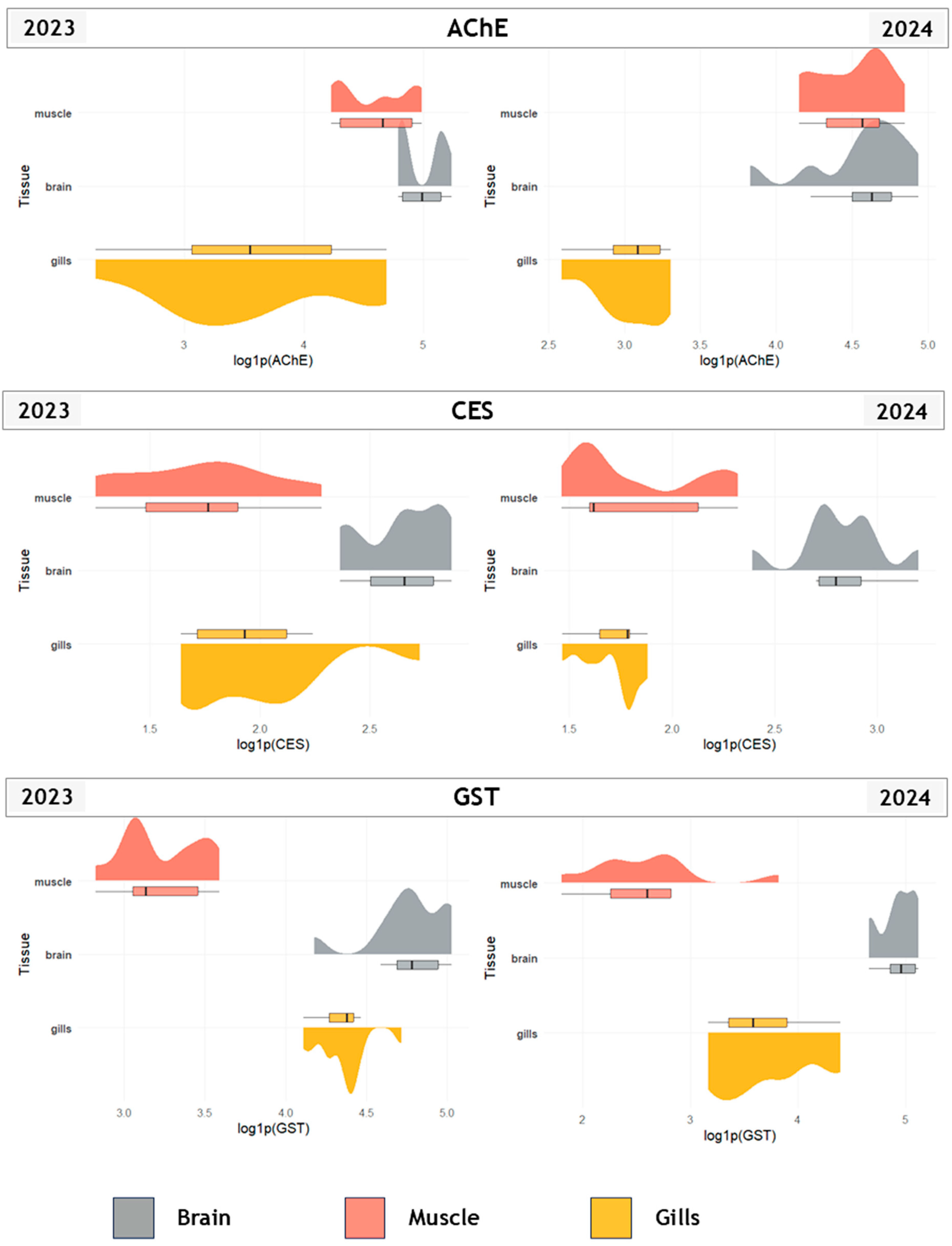
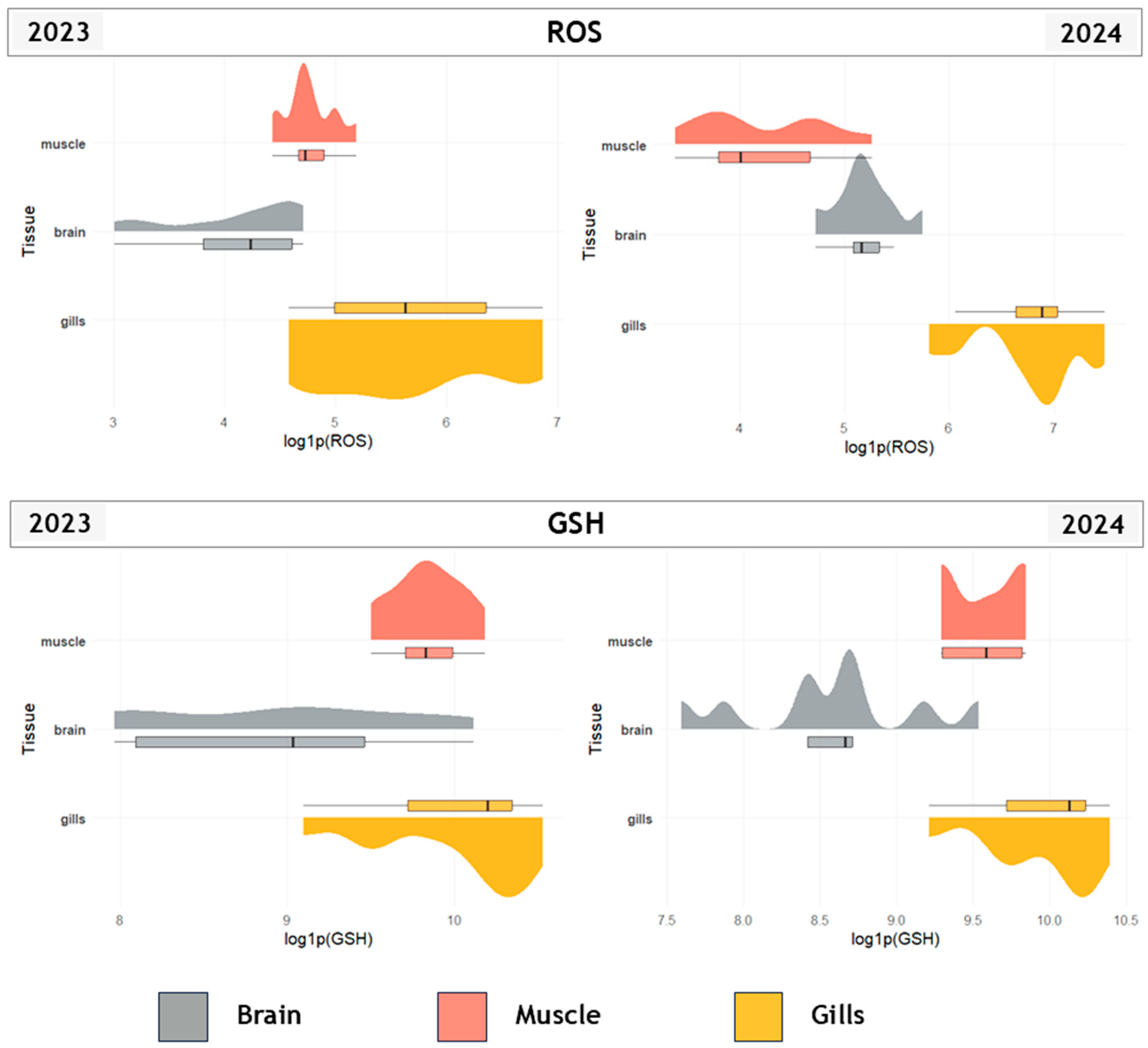
Descriptive statistics for Prussian carp enzymatic biomarker response are provided in Table S1, and model outputs in Table S3. Raincloud plots (Figure 2 and Figure 3) illustrate biomarker distributions across tissues (brain, muscle, gills) and years. The AChE activity showed strong tissue dependence (Figure 2): in 2023, brain > muscle (p = 0.0024) > gills (p = 0.0010), with brain also exceeding gills (p < 0.0001). In 2024, brain AChE activity remained higher than gills (p < 0.0001), while brain and muscle did not differ (p = 0.814). Year effects were selective, with lower AChE activity in 2024 in the brain (p = 0.0003) and gills (p = 0.019), but not in muscle (p = 0.346). The CES activity followed a consistent pattern, with higher activity in the brain than in gills and muscle in both years (all p < 0.0001), while gills and muscle did not differ (p = 0.22 in 2023; p = 0.599 in 2024). The CES activity was lower in gills in 2024 (p = 0.037), with no change in brain (p = 0.064) or muscle (p = 0.533). The GST activity showed the clearest gradient, with brain > gills > muscle in both years (all p ≤ 0.003). Year effects indicated decreases in 2024 GST activity in gills (p = 0.0001) and muscle (p = 0.027), while the brain showed no change (p = 0.083).
Descriptive statistics for Prussian carp non-enzymatic biomarker response are provided in Table S1, and model outputs in Table S3. The ROS levels varied by tissue and year (Figure 3). In 2023, gills > muscle (p = 0.018) > brain (p = 0.002), with ROS levels in gills also exceeding the brain (p = 0.004). In 2024, gills again showed the highest ROS levels (vs. brain and muscle: both p < 0.0001), while brain exceeded muscle (p = 0.0004). Year effects showed higher ROS in 2024 in the brain (p < 0.0001) and gills (p = 0.0019), but lower levels in muscle (p = 0.048). The GSH levels differed by tissue but not by year (Figure 3). Gills consistently exceeded brain GSH levels (both years: p < 0.0001), with muscle > brain in 2023 (p = 0.010) and a similar but non-significant trend in 2024 (p = 0.062). The GSH levels in gills and muscle did not differ (2023: p = 0.131; 2024: p = 0.105), and no tissue showed significant year-to-year changes (all p ≥ 0.22).
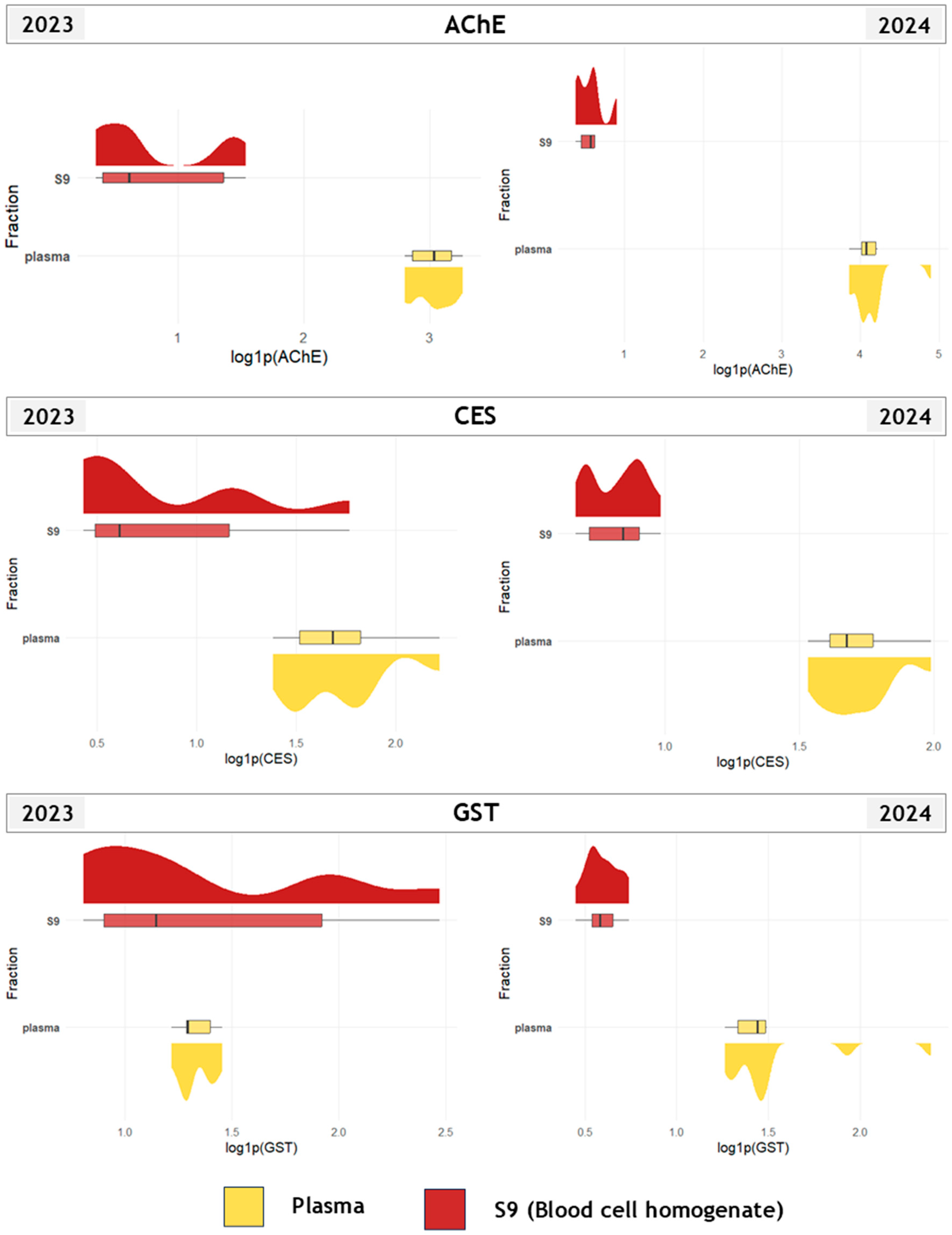
Descriptive statistics for Great Cormorant enzymatic biomarkers are provided in Table S2, with model outputs in Table S4. Raincloud plots (Figure 4 and Figure 5) show biomarker distributions across blood fractions (plasma, S9) and years. Enzymatic activity differed consistently between fractions, with plasma > S9 (Figure 4). The AChE activity was significantly higher in plasma in both years (2023 and 2024: p < 0.0001), and showed a year effect only in plasma (lower in 2023; p = 0.0002), with no change in S9 (p = 0.214). The CES activity followed the same fraction pattern (2023: p = 0.0004; 2024: p < 0.0001) but remained temporally stable (plasma: p = 0.911; S9: p = 0.575). The GST activity showed a year-dependent fraction effect: no fraction difference in 2023 (p = 0.399), but higher plasma activity in 2024 (p < 0.0001). Across years, plasma GST activity did not change (p = 0.127), while S9 increased in 2024 (p = 0.028), indicating stronger temporal variation in S9.
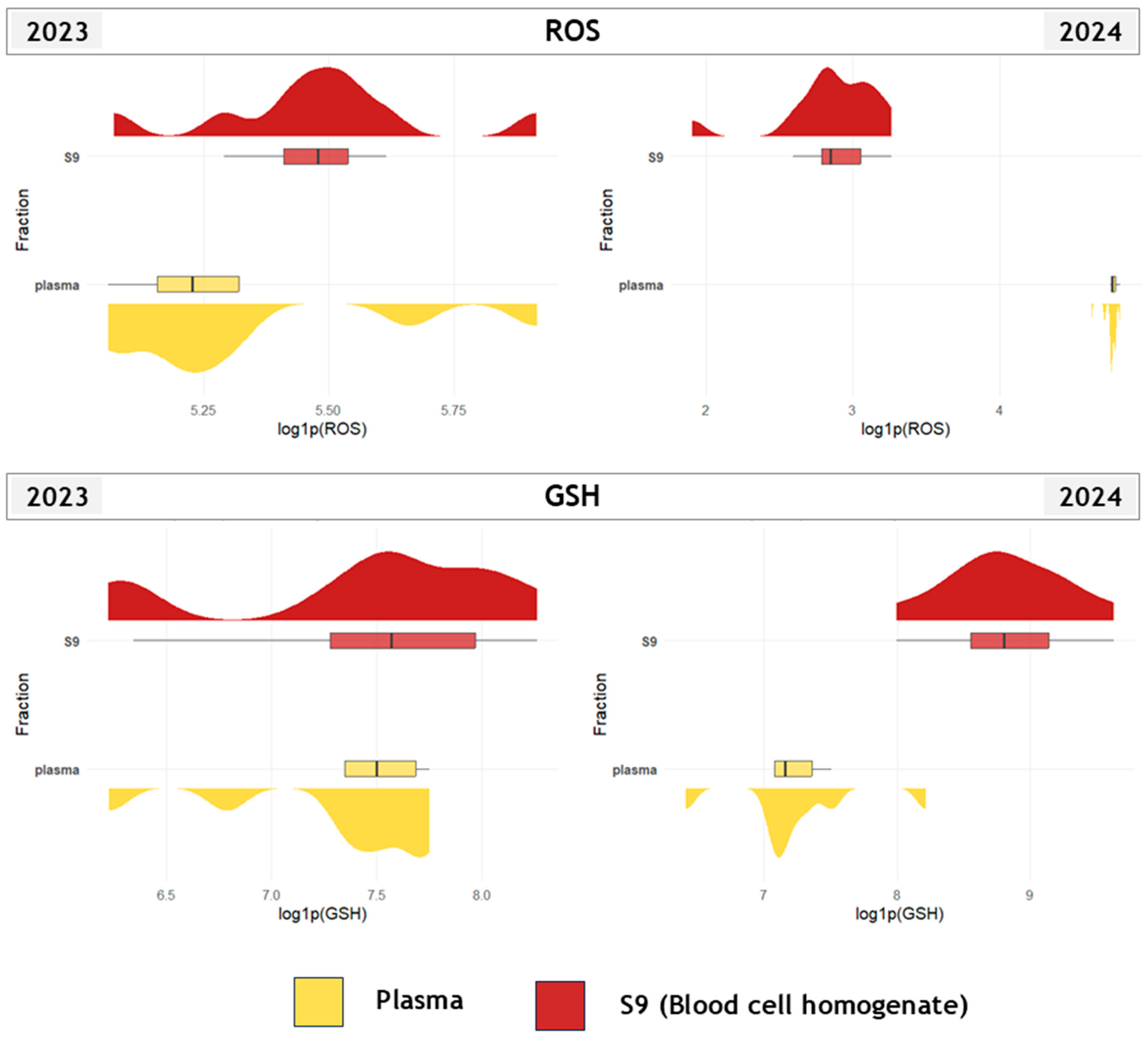
Descriptive statistics for Great Cormorant non-enzymatic biomarker responses are provided in Table S2, with model outputs in Table S4. ROS levels differed by both fraction and year (Figure 5), with no fraction difference in 2023 (p = 0.306), but higher plasma levels than S9 in 2024 (p < 0.0001). Across years, ROS levels declined in both plasma (p = 0.0033) and S9 (p < 0.0001), with a stronger decrease in S9. The GSH levels also displayed fraction-dependent variation (Figure 5). No fraction difference was observed in 2023 (p = 0.741), but in 2024, S9 exceeded plasma (p < 0.0001). Plasma GSH levels remained stable across years (p = 0.947), whereas S9 increased significantly from 2023 to 2024 (p = 0.0004).

3.2. Within-Species Exposure–Response Interactions

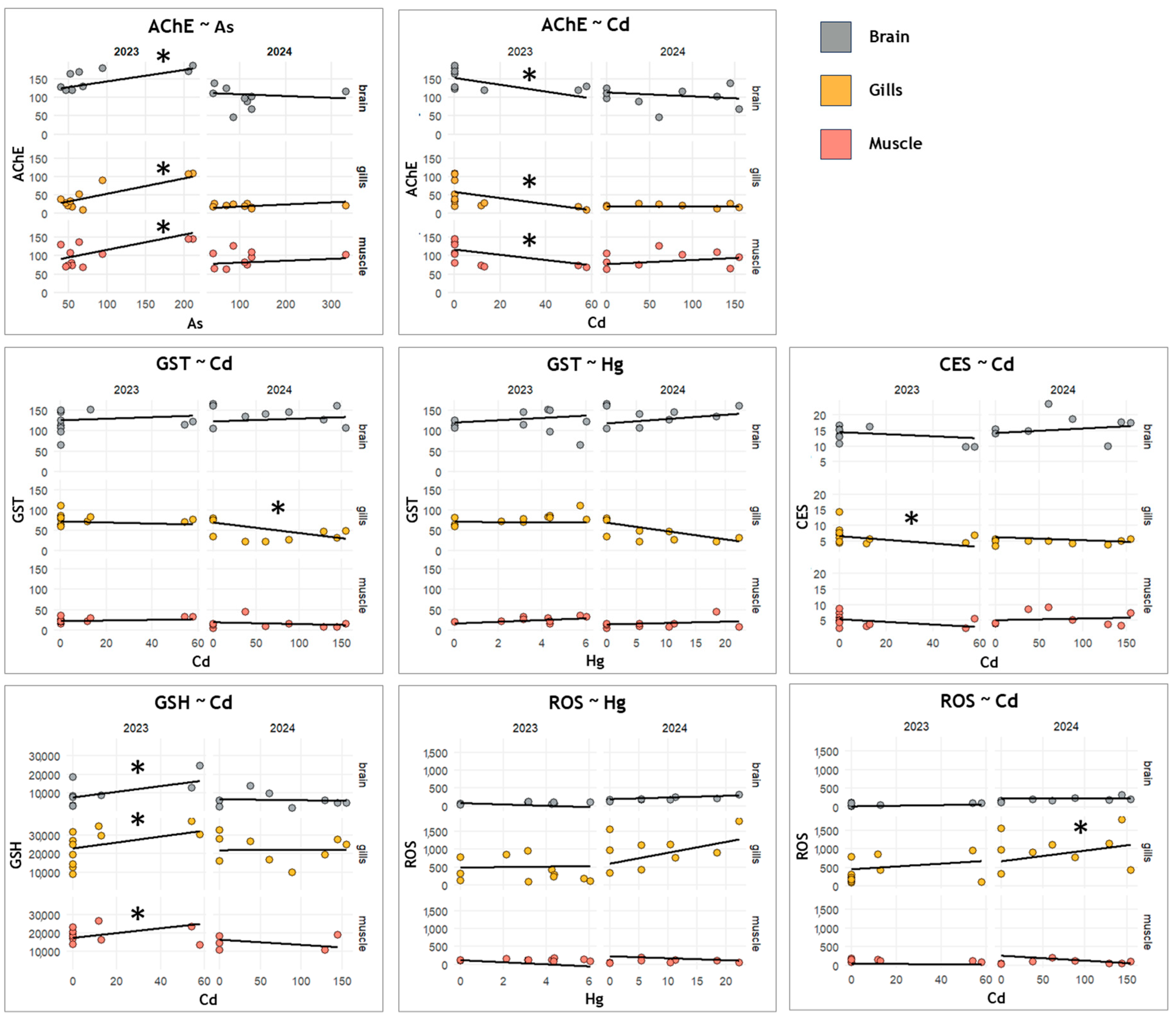
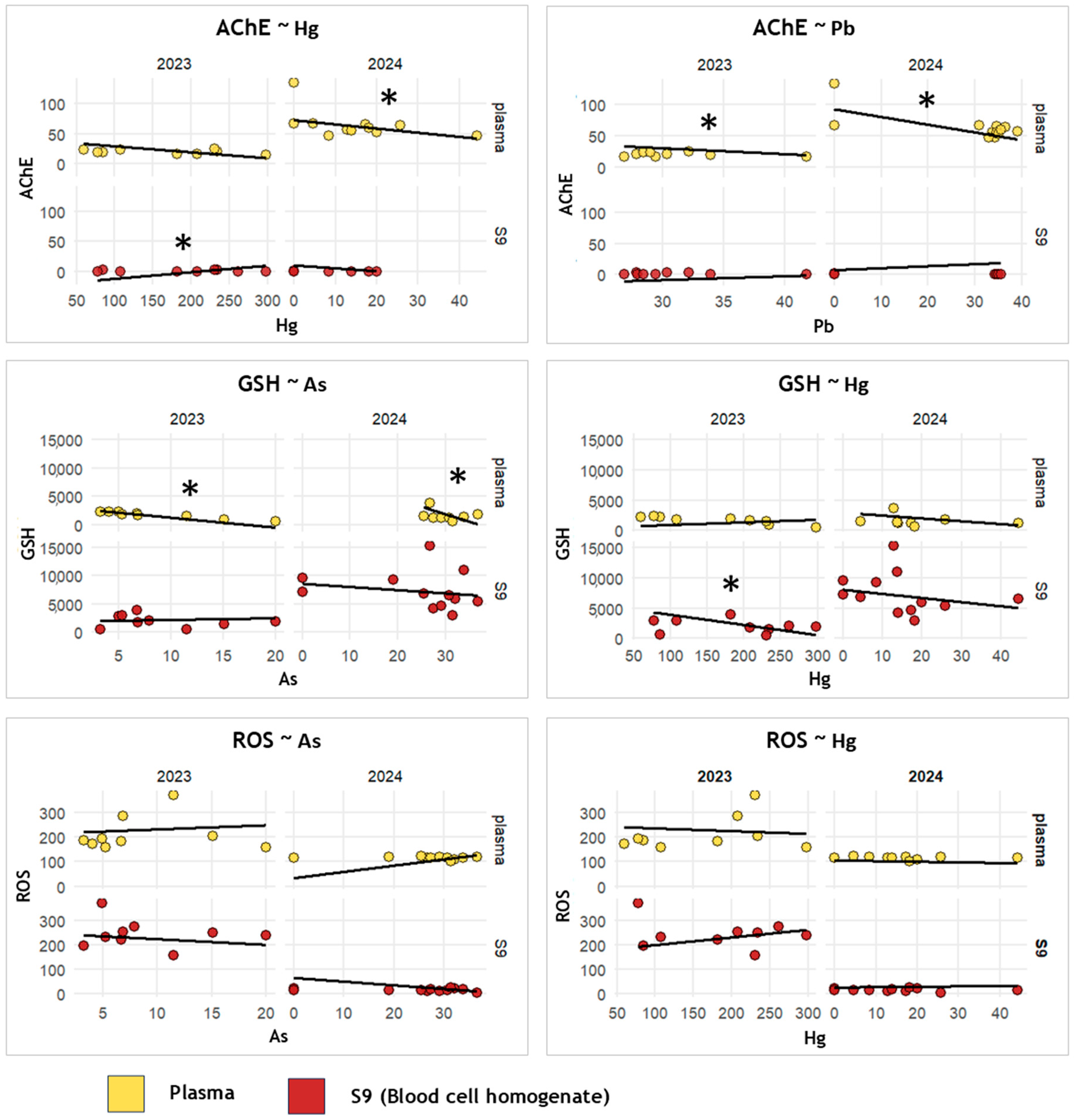
All Prussian carp model outputs are presented in Supplementary Table S5 and significant interactions are shown in Figure 6. The AChE activity showed a clear year-dependent association with As, with increasing As levels corresponding to elevated AChE activity in brain (p = 0.001), gills (p < 0.0001) and muscle (p < 0.0001) in 2023, whereas no trends were observed in 2024 (all p ≥ 0.47). The As × Year interaction was significant (p = 0.0001), while As × Tissue was not (p = 0.51). No significant associations were detected for Se with any biomarker. Cadmium responses were also strongly year-dependent. In 2023, higher Cd levels were associated with reduced AChE activity in brain (p = 0.0002), gills (p = 0.0008) and muscle (p = 0.0033), and reduced CES activity in gills (p = 0.019), while GSH levels increased in brain (p = 0.010), gills (p = 0.0067) and muscle (p = 0.028). These relationships were absent in 2024 (all p ≥ 0.37 for AChE activity; p ≥ 0.45 for GSH levels), resulting in significant Cd × Year interactions (AChE activity: p = 0.0007; GSH levels: p = 0.0068). In 2024 only, Cd levels were associated with reduced GST activity (p = 0.012) and increased ROS levels (p = 0.028) specifically in gills, confirmed by significant Cd × Tissue interactions (GST activity: p = 0.041; ROS levels: p = 0.038). Mercury effects were tissue-specific rather than year-specific, with reduced GST activity (p = 0.013) and elevated ROS levels (p = 0.0043) in gills (Hg × Tissue interactions: GST activity: p = 0.014; ROS levels: p = 0.032). No Hg effects were detected for activities of AChE and CES or levels of GSH. Lead showed no meaningful exposure–response relationships with any biomarker.
All Great Cormorant model outputs are provided in Supplementary Table S6 and significant interactions are shown in Figure 7. Arsenic and Se showed no consistent exposure–response across fractions (plasma, S9) or years (2023, 2024), with no significant effects on the activities of AChE, CES or GST (all p ≥ 0.207). A fraction-specific pattern emerged for non-enzymatic biomarkers: Although the As × Fraction interaction for ROS was significant (p = 0.032), neither plasma nor S9 showed a clearly significant individual trend (plasma 2024: p = 0.059; S9: p ≥ 0.19), while GSH levels declined with As levels in plasma for both 2023 (p = 0.039) and 2024 (p = 0.0005), but showed no response in S9 (p ≥ 0.326). Cd levels in 2024 were < LOD, so modelling was limited to 2023, with no significant effects detected in either fraction for any biomarker (all p ≥ 0.16). Mercury effects were fraction-specific rather than year-specific. Plasma AChE activity decreased with rising Hg levels in 2024 (p = 0.049), whereas S9 AChE activity increased in 2023 (p = 0.043), supported by a significant Metal × Fraction interaction (p = 0.0003). Although the Metal × Fraction interaction was significant (p = 0.018), no significant trend in GST activity with Hg level was observed in S9 (p = 0.099). For ROS, the Metal × Fraction interaction was significant (p = 0.015), although the Hg-related decline observed in plasma in 2023 was not statistically significant (p = 0.096). GSH levels decreased with Hg levels in S9 (2023: p = 0.029; 2024: p = 0.074; interaction: p = 0.014). Lead effects were also fraction-dependent (Metal × Fraction: p = 0.0025), with plasma AChE decreasing in 2024 (p = 0.0008), but no effects were detected for CES and GST activities as well as ROS or GSH levels (all p ≥ 0.311).

3.3. Trophic Transfer and Bioaccumulation Dynamics

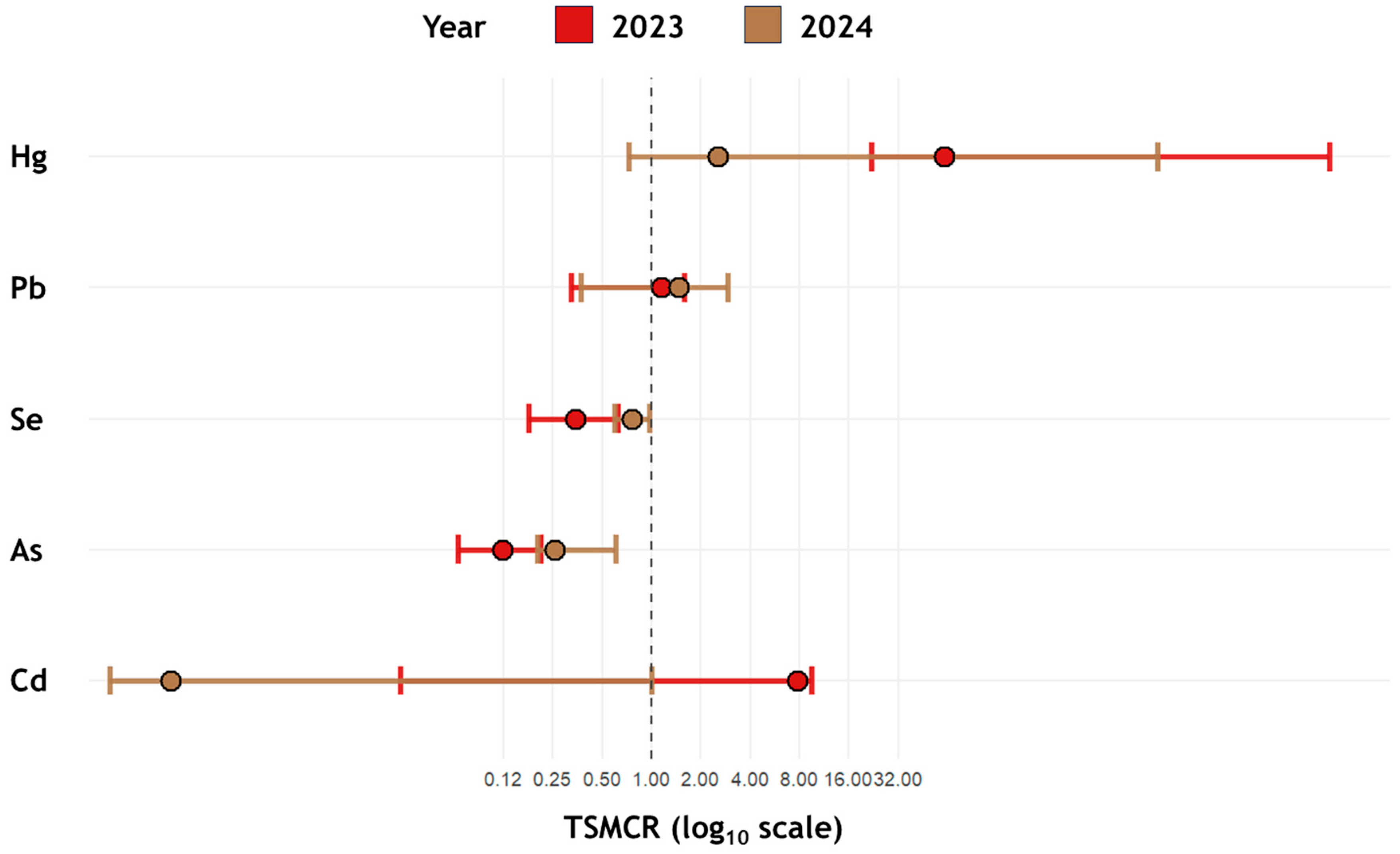
Cross-species comparisons revealed strong element- and year-specific trophic transfer patterns (Figure 8 and Table S7). Mercury was the only element to show elevated TSMCR, and only in 2023, when Great Cormorant blood contained markedly higher levels than Prussian carp liver (TSMCR = 61.4, 95% CI: 22.1–1.38 × 10⁴; p < 0.001). In 2024, Hg transfer was weaker and not significant (TSMCR = 2.52, 95% CI: 0.72–1.22 × 10³; p = 0.160). Arsenic and Se consistently showed lower TSMCR, with TSMCR < 1 in both 2023 (As: 0.12, 95% CI: 0.07–0.21, p < 0.001; Se: 0.34, 95% CI: 0.18–0.63, p = 0.0002) and 2024 (As: 0.26, 95% CI: 0.20–0.60, p < 0.001; Se: 0.76, 95% CI: 0.59–0.97, p = 0.027). Cadmium and Pb remained statistically non-significant, with wide CIs overlapping 1 in both years (Cd 2023: TSMCR = 7.71, 95% CI: 0.03–9.48, p = 0.342; Pb 2024: TSMCR = 1.46, 95% CI: 0.37–2.91, p = 0.302).

4. Discussion

4.1. Species-, Tissue- and Fraction-Specific Biomarker Response

Distinct tissue- and fraction-specific patterns in biomarker activity were observed in both Prussian carp and Great Cormorant, consistent with functional differences among tissues related to their primary physiological roles. The higher AChE, CES and GST activities in the Prussian carp brain relative to muscle and gills reflect fundamental differences in tissue physiology. The brain, with its high oxygen consumption, lipid-rich membranes, and intense synaptic activity, is particularly vulnerable to neurotoxic and oxidative damage [61]. Sustained AChE activity is crucial for rapidly terminating synaptic signalling by hydrolysing acetylcholine [62], while CES activity contributes to detoxification of xenobiotics that cross the blood–brain barrier [63]. Physiologically, GST activity is generally expected to be higher in gills than in internal tissues such as the brain and muscle, reflecting their role as a primary interface with the aquatic environment [64,65,66]. However, the lower GST activity observed in gills relative to brain and muscle may indicate inhibition of the enzyme’s catalytic mechanism rather than a biologically reduced detoxification role [67]. Gills function as a physiological interface between internal and external environments. Their large surface area, thin epithelial layers, and rich vascularisation facilitate efficient gas exchange but also make them a major site of metal(loid) entry [35,68]. Dissolved metals readily adsorb to branchial epithelia and enter systemic circulation via ion transporters or paracellular diffusion [69]. This exposure could explain the markedly elevated ROS and GSH levels as well as lower GST activity in gills compared to brain and muscle. ROS are generated not only by metal-induced Fenton and Haber–Weiss reactions but also as by-products of mitochondrial electron transport [70], which may become dysregulated when metal(loid)s displace essential cofactors such as iron (Fe), zinc (Zn), or copper (Cu) from enzymes [69]. Elevated GSH levels in gills may represent a response to neutralise ROS and maintain redox balance, highlighting the gills’ defensive role against oxidative stress. Muscle tissue is less in direct contact with the external environment. Its detoxification systems are comparatively limited, relying more on systemic circulation to deliver antioxidants and less on intrinsic enzyme activity. Consequently, biomarker activity in muscle is consistently lower, reflecting its secondary role in xenobiotic metabolism [71]. Temporal changes, e.g., reduced AChE activity and elevated ROS in the brain and gills in 2024, point to physiological plasticity and changing exposure. Lower AChE activity may arise from cumulative inhibition by metals or other pollutants, while increased ROS levels could reflect intensified redox cycling due to shifts in metal speciation or load. Hydrological variability in the Danube, altering sediment resuspension and pollutant availability, may explain these interannual differences [72].
In Great Cormorant nestlings, plasma and S9 show distinct, fraction-specific patterns. Higher AChE and CES activities in plasma indicate rapid turnover of cholinesterase activity to maintain neurotransmission and detoxify ester-containing xenobiotics circulating in the bloodstream [52]. Changes in GST activity over time may mirror shifts in intracellular redox demands [52]. The increase in S9 GSH levels from 2023 to 2024 suggests upregulated synthesis via the γ-glutamyl cycle in erythrocytes, possibly as a pre-emptive adaptation to elevated pro-oxidant exposure [73]. Meanwhile, the observed decline in ROS levels across both fractions points to either lower oxidative challenge or enhanced efficiency of antioxidant defences, potentially linked to dietary changes or improved nutritional antioxidant status.

4.2. Metal(loid) Exposure–Response Patterns

The significant exposure–response relationships were identified in the Prussian carp. The positive interaction between As levels and AChE activity across tissues in 2023 likely reflects activation of cholinergic signalling pathways. Inorganic As, e.g., arsenite (As3+), is known to generate ROS, which act as second messengers that can upregulate cholinesterase gene expression or enzyme activity [74,75]. This may represent a compensatory mechanism to maintain neurotransmission under oxidative stress. The absence of this interaction in 2024 could indicate reduced As exposure or adaptive down-regulation following chronic exposure. Cadmium inhibitory effect on AChE and CES activities is consistent with its strong thiophilicity and molecular mimicry, whereby Cd2+ binds avidly to cysteine residues in enzyme active sites, disrupting catalytic conformation and blocking substrate access [76]. Additionally, Cd can displace essential cofactors like Zn or calcium (Ca) from metalloenzymes [77], further reducing activity. The parallel induction of GSH levels may reflect the activation of the nuclear factor erythroid 2-related factor 2 (Nrf2) pathway, which upregulates antioxidant and detoxification in response to oxidative stress [78]. GSH not only neutralises ROS but also forms Cd-GSH complexes that are sequestered in lysosomes or excreted via bile [79]. In gills, where metal(loid) uptake occurs primarily through Ca and sodium (Na) channels, Cd can accumulate to higher levels, overwhelming antioxidant defences. Lower GST activity in gills compared to brain and muscle may indicate direct inhibition by Cd or depletion of GSH required for conjugation reactions, exacerbating oxidative damage [80]. Furthermore, in contaminated or physiologically stressed fish, gill GST activity is often lower than that of brain and muscle, likely reflecting enzyme inhibition or depletion of conjugation substrates under oxidative pressure [81,82,83]. The lower GST activity observed here may therefore reflect pollutant-, i.e., metal-induced enzymatic inhibition rather than inherently lower basal levels.
Mercury effects also stem from its chemical reactivity with thiol groups. Both inorganic Hg2+ and methylmercury (MeHg) form covalent bonds with sulfhydryl groups on proteins and enzymes, impairing their function and disrupting cellular redox homeostasis [84]. Methylmercury, in particular, can cross cell membranes efficiently due to its lipophilicity and accumulates in mitochondria, where it perturbs electron transport and enhances superoxide generation [85]. Thus, higher ROS levels and lower GST activity in gills compared to brain and muscle may point to mitochondrial oxidative stress and impaired detoxification capacity.
In Great Cormorant nestlings, although exposure–response trends were less pronounced than in Prussian carp, they still reveal mechanistic insights. The inverse relationship between plasma AChE and both Hg and Pb levels indicates cholinesterase inhibition. Lead (II) competes with Ca2+ in synaptic vesicles, altering neurotransmitter release and contributing to synaptic dysfunction [86,87], while high affinity of Hg for sulfhydryl groups leads to irreversible binding and enzyme inactivation [88]. Reduced GSH levels in the S9 fraction may result from the loss of cellular antioxidants caused by direct binding with Hg or by other stress factors that trigger oxidative stress. While Hg exposure could be partly responsible, other sources of stress might also explain the lower GSH levels. Fraction-specific oxidative responses to As, reflected by a significant As × Fraction interaction in ROS and by significant As-related declines in plasma GSH levels, may indicate redox imbalance even without strong enzymatic alterations, consistent with the weak oxidative responses reported in As-exposed Great Tit nestlings [89]. These differences between plasma and S9 responses underline the complementary nature: plasma biomarkers reflect acute systemic effects, while cellular fractions integrate cumulative oxidative challenges [52].

4.3. Trophic Transfer and Bioaccumulation Dynamics

In the present research, all sampled Great Cormorants were nestlings, and as such, blood was the only viable and ethically acceptable matrix for metal(loid) quantification. Consequently, our TSMCR calculations are based on comparisons between metal(loid) concentrations in Prussian carp liver and Great Cormorant whole blood. While we acknowledge that blood reflects recent rather than cumulative exposure, this approach is consistent with non-lethal biomonitoring practices commonly used in avian ecotoxicology [90,91]. Therefore, the TSMCRs presented here should be interpreted as indicative of recent exposure under field conditions, with appropriate caution regarding long-term accumulation dynamics. Cross-species comparisons revealed contrasts in exposure. Mercury was the only element that showed elevated TSMCR from Prussian carp to Great Cormorant, and this occurred exclusively in 2023. This pattern likely reflects the trophic persistence of Hg, primarily through its methylated forms, which are microbially produced under anoxic sediment conditions and efficiently assimilated by aquatic organisms [92]. Although only total Hg was measured in this study, methyl-Hg generally represents the dominant fraction in aquatic biota and is known to form covalent bonds with cysteine residues in proteins [88]. Once incorporated into tissues, MeHg has a long biological half-life and limited excretion pathways, accumulating preferentially in protein-rich tissues such as muscle in fish [17] and blood in birds [93]. The restriction of the elevated TSMCR pattern in 2023 suggests that high recent exposure is modulated by environmental context: hydrological conditions influence sediment resuspension and microbial methylation rates, while prey community structure determines exposure pathways. Periods of high flood intensity can redistribute polluted sediments and increase methylation hotspots, potentially explaining the stronger Hg transfer observed that year. The sampling site, located in Kopački rit Nature Park, is characterised by pronounced flood dynamics, i.e., seasonal flooding, which strongly influence sediment-water interactions and hence, the pollutant (in)fluxes.
In contrast, As and Se consistently exhibited biodilution, remaining lower in Great Cormorants than in Prussian carp, reflecting their more dynamic biogeochemical cycling and the efficiency of excretory and regulatory mechanisms. Inorganic As is enzymatically methylated to methylarsonic acid (MMA) and dimethylarsinic acid (DMA) and efficiently eliminated [94], although methylation capacity and excretion routes vary by bird species. Birds possess highly active methyltransferases that accelerate As detoxification [95], leading to low tissue retention despite dietary exposure. In fish, As speciation often differs, e.g., high arsenobetaine, and methylation to MMA/DMA is not uniformly rapid [96,97]. Selenium follows a similarly regulated pathway: although essential as a cofactor for antioxidant selenoproteins such as glutathione peroxidases [98], however, Se can form inert complexes with Hg [99], thus reducing Hg levels and limiting its own accumulation. These detoxification routes could explain why As and Se levels decrease with increasing trophic level, a phenomenon well-documented as trophic biodilution.
Cadmium and Pb exhibited intermediate or inconsistent transfer patterns, with TSMCRs near or overlapping unity, suggesting that physiological sequestration limits their trophic amplification. Cadmium strongly induces metallothionein (MT) synthesis, proteins that bind Cd2+ ions with high affinity, sequestering them [100]; thus reducing their bioavailability for transfer. This mechanism is highly effective in both fish and birds [101,102] and possibly contributes to the weak or inconsistent Cd trophic transfer observed in the present study. Since metals differ in their blood-liver fractioning, the interpretation of high TSMCR values varies. For Hg, strong binding to blood proteins can produce high circulatory concentrations even when prey liver concentrations are modest, resulting in a high blood-to-liver ratio [103,104]. For Cd, hepatic sequestration by metallothioneins may suppress blood concentrations relative to the liver, producing low TSMCR values [103,104]. Lead, meanwhile, has a high affinity for phosphate groups and tends to accumulate in skeletal tissue by substituting for Ca in hydroxyapatite [105]. That being said, Pb is less likely to be accumulated into soft tissues like blood, thereby limiting trophic transfer to Great Cormorant nestlings even when prey-exposure occurs.

5. Conclusions

The present study provides an integrated assessment of metal(loid) exposure, biomarker responses, and trophic transfer in a natural predator–prey system linking Prussian carp and Great Cormorant in the Kopački rit Nature Park. By combining pollutant levels with enzymatic and oxidative stress biomarkers, we demonstrate that physiological responses to metal(loid) exposure are strongly tissue-, fraction-, and year-specific, reflecting the interplay between metabolic function, exposure pathways, and environmental variability. Distinct toxicodynamic mechanisms emerged for individual elements: As modulated AChE activity through oxidative signalling, Cd inhibited esterases and triggered GSH-mediated defences, and Hg disrupted redox balance and detoxification capacity, particularly in gill tissue. Across trophic levels, Hg was the only element to show elevated TSMCR, and only in 2023, highlighting its exceptional persistence and ecological risk, while As and Se showed low TSMCR for both years, Cd and Pb showed constrained transfer due to physiological regulation. Our findings show that combining biomarker responses with measured metal(loid) levels can provide useful insight into early physiological effects and the short-term exposure dynamics of pollutants in a predator–prey system. Although responses were not uniform across years, tissues or biomarkers, the approach helped identify exposure–response patterns that may otherwise remain undetected in field conditions. Such integrative analyses are increasingly important for understanding pollutant behaviour in complex floodplain food webs and for refining biomonitoring strategies in freshwater ecosystems. Future work would benefit from broader temporal coverage, additional tissues, and complementary tools such as stable isotope analysis to strengthen trophic linkages. Expanding physiological endpoints to include reproductive or behavioural measures could further clarify the ecological significance of the sublethal effects observed here.

Supplementary Materials

The following supporting information can be downloaded at: https://www.mdpi.com/article/10.3390/fishes10120635/s1, Table S1. Descriptive statistics of biomarker response in Prussian carp, C. gibelio, brain, gill, and muscle tissues sampled in 2023 and 2024 from Kopački rit Nature Park. Shown are the number of samples (n), minimum, 25th percentile, median, 75th percentile, maximum, range, mean, standard deviation (SD), standard error (SE), and coefficient of variation (CV) for acetylcholinesterase (AChE), carboxylesterase (CES), glutathione S-transferase (GST), reactive oxygen species (ROS), and reduced glutathione (GSH). Values are expressed as specific activity (nmol min−1 mgPROT−1) for AChE, CES and GST; or relative fluorescence units (RFU) for ROS and GSH; Table S2. Descriptive statistics of biomarker response in nestling Great Cormorant, P. carbo plasma and S9 sampled in 2023 and 2024 from Kopački rit Nature Park. Shown are the number of samples (n), minimum, 25th percentile, median, 75th percentile, maximum, range, mean, standard deviation (SD), standard error (SE), and coefficient of variation (CV) for acetylcholinesterase (AChE), carboxylesterase (CES), glutathione S-transferase (GST), reactive oxygen species (ROS), and reduced glutathione (GSH). Values are expressed as specific activity (nmol min−1 mgPROT−1) for AChE, CES and GST; or relative fluorescence units (RFU) for ROS and GSH; Table S3. Results of global Type II Wald χ2 tests from linear mixed-effects models (LMMs) assessing the effects of Year, Tissue, and their interaction (Year × Tissue) on biomarker responses in Prussian carp, C. gibelio. Individual fish (LabID) was included as a random intercept to account for repeated measures. Heteroscedastic residuals (varIdent structure) were fitted for AChE, CES, GST, and ROS, while GSH was modelled under homoscedastic residual variance. Significant χ2 values (p < 0.05) indicate biomarkers exhibiting tissue-specific and/or interannual variation in activity or concentration; Table S4. Results of global Type II Wald χ2 tests from linear mixed-effects models (LMMs) evaluating the effects of Year, Tissue, and their interaction (Year × Tissue) on biomarker responses in Great Cormorant, P. carbo nestlings. Nest was included as a random intercept to account for non-independence among siblings. Heteroscedastic residuals (varIdent structure) were fitted for AChE, CES, GST, and ROS, while GSH was modelled under homoscedasticity. Significant χ2 values (p < 0.05) indicate biomarkers showing variation across tissues and/or sampling years; Table S5. Results of Type II ANOVA tests for interaction terms (Metal × Year; Metal × Tissue) from linear mixed-effects models (LMMs) assessing within-species exposure–response relationships in Prussian carp, C. gibelio. Models were fitted separately for each biomarker-metal(loid) pair (As, Se, Cd, Hg, Pb), with Individual included as a random intercept to account for repeated measures. F-statistics are reported as F(df1, df2). Significant interaction effects (p < 0.05) indicate that exposure–response slopes differed between sampling years or among tissues, revealing temporal or tissue-specific variability in biomarker sensitivity to metal(loid) exposure; Table S6. Results of Type II ANOVA tests for interaction terms (Metal × Year; Metal × Fraction) from linear mixed-effects models (LMMs) assessing within-species exposure–response relationships in Great Cormorant, P. carbo nestlings. Models were fitted for each biomarker-metal(loid) pair (As, Se, Cd, Hg, Pb), with Nest included as a random intercept to account for non-independence among siblings. F-statistics are reported as F(df1, df2). Cadmium models were fitted for 2023 only, as 2024 concentrations were consistently below the limit of detection (<LOD). Significant interaction terms (p < 0.05) indicate that exposure–response slopes varied between years or blood fractions (plasma, S9); Table S7. Tissue-specific metal concentration ratio (TSMCR) comparing Great Cormorant nestlings, P. carbo whole blood, with Prussian carp, C. gibelio liver by metal(loid) and year. TSMCR is median (P. carbo)/median (C. gibelio); values > 1 indicate amplification in Great Cormorant nestlings, values < 1 indicate biodilution. For each metal(loid)–year, we report sample sizes (n), medians (µg kg−1), TSMCR with bootstrap 95% CIs (10,000 resamples per metal(loid) × year), and two-sided p-values for log(TSMCR) = 0. CIs excluding 1 denote a clear cross-species difference for that year.

Author Contributions

Conceptualisation, D.B.; methodology, D.B., Ž.L., S.E., Z.M., S.A., L.S.K.; software, D.B.; validation, D.B., J.B.-A. and M.V.; formal analysis, D.B. and J.B.-A.; investigation, D.B., Ž.L., S.E., A.M., S.A., J.B.-A., N.T., Z.M., R.N., L.S.K. and T.M.; resources, A.M., Z.M. and M.V.; data curation, D.B.; writing—original draft preparation, D.B., A.M., S.A., L.S.K.; writing—review and editing, All; visualisation, D.B., A.M.; supervision, D.B. and M.V.; funding acquisition, D.B., A.M. and M.V. All authors have read and agreed to the published version of the manuscript.

Funding

This research was supported by the institutional research project “Pollutants as stressors in aquatic and terrestrial ecosystems (ZASTEK)”, financed by the European Union through the NextGenerationEU programme under the mechanism for recovery and resilience (funding source 581-UNIOS-98).

Institutional Review Board Statement

All animal procedures were conducted in accordance with national and institutional regulations on animal welfare and approved by the relevant authorities. Sampling of Prussian carp was authorised by the Ministry of Agriculture, Fisheries Administration (Licence 2023: UP/I-324-01/23-01/33, Ed. No. 525-12/733-23-4; Licence 2024: UP/I-324-01/24-01/321, Ed. No. 525-12/733-23-2). Sampling of Great Cormorant nestlings was conducted under a two-year licence issued by the Ministry of Economy and Sustainable Development (UP/I-352-04/23-08/35; Ed. No. 517-10-1-2-23-4).

Informed Consent Statement

Not applicable.

Data Availability Statement

The data supporting the findings of this study are available from the corresponding author upon reasonable request.

Conflicts of Interest

The authors declare no conflicts of interest.

References

  1. Dudgeon, D.; Arthington, A.H.; Gessner, M.O.; Kawabata, Z.; Knowler, D.J.; Lévêque, C.; Naiman, R.J.; Prieur-Richard, A.; Soto, D.; Stiassny, M.L.J.; et al. Freshwater Biodiversity: Importance, Threats, Status and Conservation Challenges. Biol. Rev. 2006, 81, 163–182. [Google Scholar] [CrossRef] [PubMed]
  2. Gangloff, M.M.; Edgar, G.J.; Wilson, B. Imperilled Species in Aquatic Ecosystems: Emerging Threats, Management and Future Prognoses. Aquat. Conserv. 2016, 26, 858–871. [Google Scholar] [CrossRef]
  3. Bjedov, D.; Turić, N.; Mikuška, A.; Vignjević, G.; Kovačić, L.S.; Pavičić, A.M.; Toth Jakeljić, L.; Velki, M. The Diving Beetle, Cybister lateralimarginalis (De Geer, 1774), as a Bioindicator for Subcellular Changes Affected by Heavy Metal(loid) Pollution in Freshwater Ecosystems. Aquat. Toxicol. 2025, 279, 107258. [Google Scholar] [CrossRef]
  4. Ogidi, O.I.; Akpan, U.M. Aquatic Biodiversity Loss: Impacts of Pollution and Anthropogenic Activities and Strategies for Conservation; Springer: Singapore, 2022; pp. 421–448. [Google Scholar]
  5. Sharma, M.; Kant, R.; Sharma, A.K.; Sharma, A.K. Exploring the Impact of Heavy Metals Toxicity in the Aquatic Ecosystem. Int. J. Energy Water Resour. 2025, 9, 267–280. [Google Scholar] [CrossRef]
  6. Ali, H.; Khan, E.; Ilahi, I. Environmental Chemistry and Ecotoxicology of Hazardous Heavy Metals: Environmental Persistence, Toxicity, and Bioaccumulation. J. Chem. 2019, 2019, 6730305. [Google Scholar] [CrossRef]
  7. Edo, G.I.; Samuel, P.O.; Oloni, G.O.; Ezekiel, G.O.; Ikpekoro, V.O.; Obasohan, P.; Ongulu, J.; Otunuya, C.F.; Opiti, A.R.; Ajakaye, R.S.; et al. Environmental Persistence, Bioaccumulation, and Ecotoxicology of Heavy Metals. Chem. Ecol. 2024, 40, 322–349. [Google Scholar] [CrossRef]
  8. Ali, H.; Khan, E. Trophic Transfer, Bioaccumulation, and Biomagnification of Non-Essential Hazardous Heavy Metals and Metalloids in Food Chains/Webs—Concepts and Implications for Wildlife and Human Health. Hum. Ecol. Risk Assess. Int. J. 2018, 25, 1353–1376. [Google Scholar] [CrossRef]
  9. Jahan, U.; Kafeel, U.; Naikoo, M.I.; Kaifiyan, M.; Hasan, M.; Khan, F.A. Trophic Transfer, Bioaccumulation, and Detoxification of Lead and Zinc via Sewage Sludge Applied Soil-Barley-Aphid-Ladybird Food Chain. Water Air Soil. Pollut. 2023, 234, 508. [Google Scholar] [CrossRef]
  10. Oros, A. Bioaccumulation and Trophic Transfer of Heavy Metals in Marine Fish: Ecological and Ecosystem-Level Impacts. J. Xenobiot. 2025, 15, 59. [Google Scholar] [CrossRef]
  11. Saidon, N.B.; Szabó, R.; Budai, P.; Lehel, J. Trophic Transfer and Biomagnification Potential of Environmental Contaminants (Heavy Metals) in Aquatic Ecosystems. Environ. Pollut. 2024, 340, 122815. [Google Scholar] [CrossRef]
  12. Pantoja-Echevarría, L.M.; Marmolejo-Rodríguez, A.J.; Galván-Magaña, F.; Elorriaga-Verplancken, F.R.; Tripp-Valdéz, A.; Tamburin, E.; Lara, A.; Jonathan, M.P.; Sujitha, S.B.; Delgado-Huertas, A.; et al. Trophic Structure and Biomagnification of Cadmium, Mercury and Selenium in Brown Smooth Hound Shark (Mustelus henlei) within a Trophic Web. Food Webs 2023, 34, e00263. [Google Scholar] [CrossRef]
  13. Amiard, J.C.; Amiard-Triquet, C.; Berthet, B.; Metayer, C. Comparative Study of the Patterns of Bioaccumulation of Essential (Cu, Zn) and Non-Essential (Cd, Pb) Trace Metals in Various Estuarine and Coastal Organisms. J. Exp. Mar. Biol. Ecol. 1987, 106, 73–89. [Google Scholar] [CrossRef]
  14. Collin, M.S.; Venkatraman, S.K.; Vijayakumar, N.; Kanimozhi, V.; Arbaaz, S.M.; Stacey, R.G.S.; Anusha, J.; Choudhary, R.; Lvov, V.; Tovar, G.I.; et al. Bioaccumulation of Lead (Pb) and Its Effects on Human: A Review. J. Hazard. Mater. Adv. 2022, 7, 100094. [Google Scholar] [CrossRef]
  15. Łuczyńska, J.; Paszczyk, B.; Łuczyński, M.J. Fish as a Bioindicator of Heavy Metals Pollution in Aquatic Ecosystem of Pluszne Lake, Poland, and Risk Assessment for Consumer’s Health. Ecotoxicol. Environ. Saf. 2018, 153, 60–67. [Google Scholar] [CrossRef]
  16. Corsi, I.; Mariottini, M.; Sensini, C.; Lancini, L.; Focardi, S. Fish as Bioindicators of Brackish Ecosystem Health: Integrating Biomarker Responses and Target Pollutant Concentrations. Oceanol. Acta 2003, 26, 129–138. [Google Scholar] [CrossRef]
  17. Hernández-Domínguez, C.; Bjedov, D.; Buelvas-Soto, J.; Córdoba-Tovar, L.; Bernal-Alviz, J.; Marrugo-Negrete, J. Factors Affecting Arsenic and Mercury Accumulation in Fish from the Colombian Caribbean: A Multifactorial Approach Using Machine Learning. Environ. Res. 2025, 268, 120761. [Google Scholar] [CrossRef] [PubMed]
  18. Bernal-Alviz, J.; Córdoba-Tovar, L.; Pastrana-Durango, D.; Molina-Polo, C.; Buelvas-Soto, J.; Cruz-Esquivel, Á.; Marrugo-Negrete, J.; Díez, S. Influence of Environmental and Biological Factors on Mercury Accumulation in Fish from the Atrato River Basin, Colombia. Environ. Pollut. 2025, 366, 125345. [Google Scholar] [CrossRef]
  19. Bjedov, D.; Mikuška, A.; Velki, M.; Lončarić, Z.; Mikuška, T. The First Analysis of Heavy Metals in the Grey Heron Ardea cinerea Feathers from the Croatian Colonies. Larus Godišnjak Zavoda Za Ornitol. Hrvat. Akad. Znan. I Umjet. 2020, 55, 7–25. [Google Scholar] [CrossRef]
  20. Bjedov, D.; Mikuska, A.; Begović, L.; Bollinger, E.; Bustnes, J.O.; Deme, T.; Mikuška, T.; Morocz, A.; Schulz, R.; Søndergaard, J.; et al. Effects of White-Tailed Eagle (Haliaeetus albicilla) Nestling Diet on Mercury Exposure Dynamics in Kopački Rit Nature Park, Croatia. Environ. Pollut. 2023, 336, 122377. [Google Scholar] [CrossRef]
  21. Lehel, J.; Grúz, A.; Bartha, A.; Menyhárt, L.; Szabó, R.; Tibor, K.; Budai, P. Potentially Toxic Elements in Different Tissues of Great Cormorant (Phalacrocorax carbo) at a Wetland Area. Environ. Sci. Pollut. Res. Int. 2023, 30, 120540–120551. [Google Scholar] [CrossRef]
  22. Vainio, R.K.; Eulaers, I.; Laaksonen, T.; Vasko, V.; Jormalainen, V. White-Tailed Eagle (Haliaeetus albicilla) and Great Cormorant (Phalacrocorax carbo) Nestlings as Spatial Sentinels of Baltic Acidic Sulphate Soil Associated Metal Contamination. Sci. Total Environ. 2020, 718, 137424. [Google Scholar] [CrossRef]
  23. Opačak, A.; Florijančić, T.; Horvat, D.; Ozimec, S.; Bodakoš, D. Diet Spectrum of Great Cormorants (Phalacrocorax carbo sinensis L.) at the Donji Miholjac Carp Fishponds in Eastern Croatia. Eur. J. Wildl. Res. 2004, 50, 173–178. [Google Scholar] [CrossRef]
  24. Skoric, S.; Visnjić-Jeftic, Z.; Jaric, I.; Djikanovic, V.; Mickovic, B.; Nikcevic, M.; Lenhardt, M. Accumulation of 20 Elements in Great Cormorant (Phalacrocorax carbo) and Its Main Prey, Common Carp (Cyprinus carpio) and Prussian Carp (Carassius gibelio). Ecotoxicol. Environ. Saf. 2012, 80, 244–251. [Google Scholar] [CrossRef]
  25. Milošković, A.; Stojković Piperac, M.; Kojadinović, N.; Radenković, M.; Đuretanović, S.; Čerba, D.; Milošević, Đ.; Simić, V. Potentially Toxic Elements in Invasive Fish Species Prussian Carp (Carassius gibelio) from Different Freshwater Ecosystems and Human Exposure Assessment. Environ. Sci. Pollut. Res. Int. 2022, 29, 29152–29164. [Google Scholar] [CrossRef]
  26. Opačak, A.; Jelkić, D. Seasonal Changes in the Condition Factor and Gonado-Somatic Index of Carassius gibelio from the Kopački Rit Nature Park, Croatia. Poljoprivreda 2023, 29, 43–48. [Google Scholar] [CrossRef]
  27. Peršić, V.; Čerba, D.; Bogut, I.; Horvatić, J. Trophic State and Water Quality in the Danube Floodplain Lake (Kopački Rit Nature Park, Croatia) in Relation to Hydrological Connectivity. In Eutrophication: Causes, Consequences and Control; Springer: Dordrecht, The Netherlands, 2010; pp. 109–129. [Google Scholar]
  28. Stojković Piperac, M.; Milošević, D.; Čerba, D.; Simić, V. Fish Communities Over the Danube Wetlands in Serbia and Croatia. In Small Water Bodies of the Western Balkans; Springer: Cham, Switzerland, 2022; pp. 337–349. [Google Scholar]
  29. Watson, W.P.; Mutti, A. Role of Biomarkers in Monitoring Exposures to Chemicals: Present Position, Future Prospects. Biomarkers 2004, 9, 211–242. [Google Scholar] [CrossRef]
  30. Gil, F.; Pla, A. Biomarkers as Biological Indicators of Xenobiotic Exposure. J. Appl. Toxicol. 2001, 21, 245–255. [Google Scholar] [CrossRef]
  31. Bjedov, D.; Velki, M.; Toth, L.; Filipović Marijić, V.; Mikuška, T.; Jurinović, L.; Ečimović, S.; Turić, N.; Lončarić, Z.; Šariri, S.; et al. Heavy Metal(loid) Effect on Multi-Biomarker Responses in Apex Predator: Novel Assays in the Monitoring of White Stork Nestlings. Environ. Pollut. 2023, 324, 121398. [Google Scholar] [CrossRef]
  32. Xu, Z.; Cao, J.; Qin, X.; Qiu, W.; Mei, J.; Xie, J. Toxic Effects on Bioaccumulation, Hematological Parameters, Oxidative Stress, Immune Responses and Tissue Structure in Fish Exposed to Ammonia Nitrogen: A Review. Animals 2021, 11, 3304. [Google Scholar] [CrossRef]
  33. Li, P.; Li, Z.-H. Neurotoxicity and Physiological Stress in Brain of Zebrafish Chronically Exposed to Tributyltin. J. Toxicol. Environ. Health A 2021, 84, 20–30. [Google Scholar] [CrossRef]
  34. Sukharenko, E.V.; Samoylova, I.V.; Nedzvetsky, V.S. Molecular Mechanisms of Aluminium Ions Neurotoxicity in Brain Cells of Fish from Various Pelagic Areas. Regul. Mech. Biosyst. 2017, 8, 461–466. [Google Scholar] [CrossRef]
  35. Evans, D.H.; Piermarini, P.M.; Choe, K.P. The Multifunctional Fish Gill: Dominant Site of Gas Exchange, Osmoregulation, Acid-Base Regulation, and Excretion of Nitrogenous Waste. Physiol. Rev. 2005, 85, 97–177. [Google Scholar] [CrossRef]
  36. Wagner, A.; Boman, J. Biomonitoring of Trace Elements in Muscle and Liver Tissue of Freshwater Fish. Spectrochim. Acta Part B At. Spectrosc. 2003, 58, 2215–2226. [Google Scholar] [CrossRef]
  37. Espín, S.; Andevski, J.; Duke, G.; Eulaers, I.; Gómez-Ramírez, P.; Hallgrimsson, G.T.; Helander, B.; Herzke, D.; Jaspers, V.L.B.; Krone, O.; et al. A Schematic Sampling Protocol for Contaminant Monitoring in Raptors. Ambio 2021, 50, 95–100. [Google Scholar] [CrossRef]
  38. Javna ustanova “Park prirode Kopački rit”. Plan Upravljanja Parkom Prirode Kopački Rit i Pridruženim Zaštićenim Područjem Te Područjima Ekološke Mreže; Javna ustanova “Park prirode Kopački rit”: Kopačevo, Croatia, 2023.
  39. Horvatić, S.; Zanella, D.; Mustafić, P.; Marčić, Z.; Ćaleta, M.; Buj, I.; Karlović, R.; Ivić, L.; Onorato, L.; Tvrdinić, G.; et al. The Fish Fauna of Nature Park Kopački Rit. In Proceedings of the 11th Symposium with International Participation Kopački Rit: Past, Present, Future 2022, Osijek, Croatia, 29–30 September 2022; Ozimec, S., Bogut, I., Bašić, I., Rožac, V., Stević, F., Popović, Ž., Eds.; Public Institution Nature Park Kopački rit: Kopačevo, Croatia, 2022. [Google Scholar]
  40. Emmrich, M.; Düttmann, H. Seasonal Shifts in Diet Composition of Great Cormorants Phalacrocorax carbo sinensis Foraging at a Shallow Eutrophic Inland Lake. Ardea 2011, 99, 207–216. [Google Scholar] [CrossRef]
  41. Čech, M.; Vejřík, L. Winter Diet of Great Cormorant (Phalacrocorax carbo) on the River Vltava: Estimate of Size and Species Composition and Potential for Fish Stock Losses. Folia Zool. 2011, 60, 129–142. [Google Scholar] [CrossRef]
  42. van Eerden, M.; van Rijn, S.; Volponi, S.; Paquet, J.-Y.; Carss, D. Cormorants and the European Environment: Exploring Cormorant Status and Distribution on a Continental Scale; INTERCAFE COST Action 635 Final Report I; NERC/Centre for Ecology & Hydrology: Gwynedd, UK, 2012. [Google Scholar]
  43. Mikuska, T.; Tomik, A.; Ledinšćak, J. Projekt NATURAVITA—Monitoring Staništa, Flore i Faune—Ponovljeni Postupak—Grupa 5: Monitoring Ptica; Fakultet agrobiotehničkih znanosti Osijek: Osijek, Croatia, 2023. [Google Scholar]
  44. Mikuska, T.; Rožac, V.; Šetina, N.; Hima, V. Status of the Breeding Population of Great Cormorants in Croatia in 2012; Aarhus: Aarhus Universitetsforlag; DCE–Danish Centre for Environment and Energy: Roskilde, Denmark, 2013; ISBN 978-87-7156-018-3. [Google Scholar]
  45. EN 14011:2003; Water Quality—Sampling of Fish with Electricity. European Committee for Standardization (CEN): Brussels, Belgium, 2003.
  46. EN 14757:2005; Water quality—Sampling of Fish with Multi-mesh Gillnets. European Committee for Standardization (CEN): Brussels, Belgium, 2005.
  47. Dragun, Z.; Krasnići, N.; Ivanković, D.; Filipović Marijić, V.; Mijošek, T.; Redžović, Z.; Erk, M. Comparison of Intracellular Trace Element Distributions in the Liver and Gills of the Invasive Freshwater Fish Species, Prussian Carp (Carassius gibelio Bloch, 1782). Sci. Total Environ. 2020, 730, 138923. [Google Scholar] [CrossRef]
  48. Filipović Marijić, V.; Krasnići, N.; Valić, D.; Kapetanović, D.; Vardić Smrzlić, I.; Jordanova, M.; Rebok, K.; Ramani, S.; Kostov, V.; Nastova, R.; et al. Pollution Impact on Metal and Biomarker Responses in Intestinal Cytosol of Freshwater Fish. Environ. Sci. Pollut. Res. 2023, 30, 63510–63521. [Google Scholar] [CrossRef]
  49. Mijošek, T.; Filipović Marijić, V.; Dragun, Z.; Ivanković, D.; Krasnići, N.; Redžović, Z.; Erk, M. Intestine of Invasive Fish Prussian Carp as a Target Organ in Metal Exposure Assessment of the Wastewater Impacted Freshwater Ecosystem. Ecol. Indic. 2021, 122, 107247. [Google Scholar] [CrossRef]
  50. Bjedov, D.; Velki, M.; Lackmann, C.; Begović, L.; Mikuška, T.; Jurinović, L.; Mikuška, A. Blood Biomarkers in White Stork (Ciconia ciconia) Nestlings Show Different Responses in Several Areas of Croatia. J. Exp. Zool. A Ecol. Integr. Physiol. 2022, 337, 547–558. [Google Scholar] [CrossRef]
  51. Bjedov, D.; Velki, M.; Kovačić, L.S.; Begović, L.; Lešić, I.; Jurinović, L.; Mikuska, T.; Sudarić Bogojević, M.; Ečimović, S.; Mikuška, A. White Stork (Ciconia ciconia) Nestlings Affected by Agricultural Practices? Assessment of Integrated Biomarker Responses. Agriculture 2023, 13, 1045. [Google Scholar] [CrossRef]
  52. Bjedov, D.; Mikuška, A.; Lackmann, C.; Begović, L.; Mikuška, T.; Velki, M. Application of Non-Destructive Methods: Biomarker Assays in Blood of White Stork (Ciconia ciconia) Nestlings. Animals 2021, 11, 2341. [Google Scholar] [CrossRef]
  53. Mikuška, A.; Alić, S.; Levak, I.; Bernal-Alviz, J.; Velki, M.; Nekić, R.; Ečimović, S.; Bjedov, D. Bayesian Structure Learning Reveals Disconnected Correlation Patterns Between Morphometric Traits and Blood Biomarkers in White Stork Nestlings. Birds 2025, 6, 51. [Google Scholar] [CrossRef]
  54. Jerzak, L.; Sparks, T.H.; Kasprzak, M.; Bochenski, M.; Kaminski, P.; Wiśniewska, E.; Mroczkowski, S.; Tryjanowski, P. Blood Chemistry in White Stork Ciconia ciconia Chicks Varies by Sex and Age. Comp. Biochem. Physiol. B Biochem. Mol. Biol. 2010, 156, 144–147. [Google Scholar] [CrossRef]
  55. Berglund, Å.M.M. Evaluating Blood and Excrement as Bioindicators for Metal Accumulation in Birds. Environ. Pollut. 2018, 233, 1198–1206. [Google Scholar] [CrossRef]
  56. Henry, P.-Y.; Le Bayon, N.; Masbou, J.; Delcourt, N.; Chastel, O. Mercury and Other Heavy Metals in Blood and Feathers as Indicators of Tissue Burdens in Songbirds. Ecotoxicology 2015, 24, 1391–1400. [Google Scholar]
  57. Coeurdassier, M.; Fritsch, C.; Faivre, B.; Crini, N.; Scheifler, R. Partitioning of Cd and Pb in the Blood of European Blackbirds (Turdus merula) from a Smelter Contaminated Site and Use for Biomonitoring. Chemosphere 2012, 87, 1368–1373. [Google Scholar] [CrossRef]
  58. Ellman, G.L.; Courtney, K.D.; Andres, V.; Featherstone, R.M. A New and Rapid Colorimetric Determination of Acetylcholinesterase Activity. Biochem. Pharmacol. 1961, 7, 88–95. [Google Scholar] [CrossRef]
  59. Hosokawa, M.; Satoh, T. Measurement of Carboxylesterase (CES) Activities. Curr. Protoc. Toxicol. 2001, 10, 14. [Google Scholar] [CrossRef]
  60. Habig, W.H.; Jakoby, W.B. Assays for Differentiation of Glutathione S-Transferases. Methods Enzymol. 1981, 77, 398–405. [Google Scholar] [CrossRef]
  61. Ahrends, R.; Ellis, S.R.; Verhelst, S.H.L.; Kreutz, M.R. Synaptoneurolipidomics: Lipidomics in the Study of Synaptic Function. Trends Biochem. Sci. 2025, 50, 156–170. [Google Scholar] [CrossRef]
  62. Zimmerman, G.; Soreq, H. Termination and beyond: Acetylcholinesterase as a Modulator of Synaptic Transmission. Cell Tissue Res. 2006, 326, 655–669. [Google Scholar] [CrossRef]
  63. Gupta, R.C. Brain Regional Heterogeneity and Toxicological Mechanisms of Organophosphates and Carbamates. Toxicol. Mech. Methods 2004, 14, 103–143. [Google Scholar] [CrossRef]
  64. Franco, M.E.; Schönenberger, R.; Hollender, J.; Schirmer, K. Organ-Specific Biotransformation in Salmonids: Insight into Intrinsic Enzyme Activity and Biotransformation of Three Micropollutants. Sci. Total Environ. 2024, 925, 171769. [Google Scholar] [CrossRef]
  65. Martin, B.P.M.; Franco, M.E.; Schirmer, K. Comparative Characterization of Organ-Specific Phase I and II Biotransformation Enzyme Kinetics in Salmonid S9 Sub-Cellular Fractions and Cell Lines. Cell Biol. Toxicol. 2025, 41, 37. [Google Scholar] [CrossRef]
  66. Tierbach, A.; Groh, K.J.; Schönenberger, R.; Schirmer, K.; Suter, M.J.-F. Glutathione S-Transferase Protein Expression in Different Life Stages of Zebrafish (Danio rerio). Toxicol. Sci. 2018, 162, 702–712. [Google Scholar] [CrossRef]
  67. Hellou, J.; Ross, N.W.; Moon, T.W. Glutathione, Glutathione S-Transferase, and Glutathione Conjugates, Complementary Markers of Oxidative Stress in Aquatic Biota. Environ. Sci. Pollut. Res. Int. 2012, 19, 2007–2023. [Google Scholar] [CrossRef]
  68. Evans, D.H. The Fish Gill: Site of Action and Model for Toxic Effects of Environmental Pollutants. Environ. Health Perspect. 1987, 71, 47–58. [Google Scholar] [CrossRef]
  69. Kwong, R.W.M. Trace Metals in the Teleost Fish Gill: Biological Roles, Uptake Regulation, and Detoxification Mechanisms. J. Comp. Physiol. B 2024, 194, 749–763. [Google Scholar] [CrossRef]
  70. Kehrer, J.P. The Haber–Weiss Reaction and Mechanisms of Toxicity. Toxicology 2000, 149, 43–50. [Google Scholar] [CrossRef]
  71. Sullivan, K.M.; Somero, G.N. Enzyme Activities of Fish Skeletal Muscle and Brain as Influenced by Depth of Occurrence and Habits of Feeding and Locomotion. Mar. Biol. 1980, 60, 91–99. [Google Scholar] [CrossRef]
  72. Oskoruš, D.; Kapelj, S.; Zavrtnik, S.; Leskovar, K. Suspended Sediment Metal and Metalloid Composition in the Danube River Basin, Croatia. Water 2022, 14, 3552. [Google Scholar] [CrossRef]
  73. el-Mekawi, S.; Yagil, R.; Meyerstein, N. Effect of Oxidative Stress on Avian Erythrocytes. J. Basic. Clin. Physiol. Pharmacol. 1993, 4, 199–211. [Google Scholar] [CrossRef]
  74. Chandravanshi, L.P.; Gupta, R.; Shukla, R.K. Arsenic-Induced Neurotoxicity by Dysfunctioning Cholinergic and Dopaminergic System in Brain of Developing Rats. Biol. Trace Elem. Res. 2019, 189, 118–133. [Google Scholar] [CrossRef]
  75. Medda, N.; Patra, R.; Ghosh, T.K.; Maiti, S. Neurotoxic Mechanism of Arsenic: Synergistic Effect of Mitochondrial Instability, Oxidative Stress, and Hormonal-Neurotransmitter Impairment. Biol. Trace Elem. Res. 2020, 198, 8–15. [Google Scholar] [CrossRef]
  76. de Lima, D.; Roque, G.M.; de Almeida, E.A. In Vitro and in Vivo Inhibition of Acetylcholinesterase and Carboxylesterase by Metals in Zebrafish (Danio rerio). Mar. Environ. Res. 2013, 91, 45–51. [Google Scholar] [CrossRef]
  77. Moulis, J.-M. Cellular Mechanisms of Cadmium Toxicity Related to the Homeostasis of Essential Metals. BioMetals 2010, 23, 877–896. [Google Scholar] [CrossRef]
  78. Kwon, D.H.; Cha, H.-J.; Lee, H.; Hong, S.-H.; Park, C.; Park, S.-H.; Kim, G.-Y.; Kim, S.; Kim, H.-S.; Hwang, H.-J.; et al. Protective Effect of Glutathione against Oxidative Stress-Induced Cytotoxicity in RAW 264.7 Macrophages through Activating the Nuclear Factor Erythroid 2-Related Factor-2/Heme Oxygenase-1 Pathway. Antioxidants 2019, 8, 82. [Google Scholar] [CrossRef]
  79. Ballatori, N.; Clarkson, T.W. Biliary Secretion of Glutathione and of Glutathione-Metal Complexes. Toxicol. Sci. 1985, 5, 816–831. [Google Scholar] [CrossRef]
  80. Srikanth, K.; Pereira, E.; Duarte, A.C.; Ahmad, I. Glutathione and Its Dependent Enzymes’ Modulatory Responses to Toxic Metals and Metalloids in Fish—A Review. Environ. Sci. Pollut. Res. 2013, 20, 2133–2149. [Google Scholar] [CrossRef]
  81. dos Santos Carvalho, C.; Bernusso, V.A.; de Araújo, H.S.S.; Espíndola, E.L.G.; Fernandes, M.N. Biomarker Responses as Indication of Contaminant Effects in Oreochromis niloticus. Chemosphere 2012, 89, 60–69. [Google Scholar] [CrossRef] [PubMed]
  82. Kim, J.H.; Kang, J.C. Oxidative Stress, Neurotoxicity, and Non-Specific Immune Responses in Juvenile Red Sea Bream, Pagrus major, Exposed to Different Waterborne Selenium Concentrations. Chemosphere 2015, 135, 46–52. [Google Scholar] [CrossRef]
  83. Siddique, Q.; Abdullah, S.; Naz, H.; Abbas, K.; Shafique, L. Changes in Glutathione S-Transferase Activity and Total Protein Contents of Labeo rohita. Punjab Univ. J. Zool. 2020, 35, 25–29. [Google Scholar] [CrossRef]
  84. Rupa, S.A.; Patwary, M.A.M.; Matin, M.M.; Ghann, W.E.; Uddin, J.; Kazi, M. Interaction of Mercury Species with Proteins: Towards Possible Mechanism of Mercurial Toxicology. Toxicol. Res. 2023, 12, 355–368. [Google Scholar] [CrossRef]
  85. Miura, K.; Imura, N.; Clarkson, T.W. Mechanism of Methylmercury Cytotoxicity. CRC Crit. Rev. Toxicol. 1987, 18, 161–188. [Google Scholar] [CrossRef]
  86. Florea, A.-M.; Taban, J.; Varghese, E.; Alost, B.T.; Moreno, S.; Büsselberg, D. Lead (Pb2+) Neurotoxicity: Ion-Mimicry with Calcium (Ca2+) Impairs Synaptic Transmission. A Review with Animated Illustrations of the Pre- and Post-Synaptic Effects of Lead. J. Local. Glob. Health Sci. 2013, 2013, 4. [Google Scholar] [CrossRef]
  87. Suszkiw, J.; Toth, G.; Murawsky, M.; Cooper, G.P. Effects of Pb2+ and Cd2+ on Acetylcholine Release and Ca2+ Movements in Synaptosomes and Subcellular Fractions from Rat Brain and Torpedo Electric Organ. Brain Res. 1984, 323, 31–46. [Google Scholar] [CrossRef]
  88. Burstein, Y.; Sperling, R. The Chemical Identification of S-Hg-S Bonds in Mercury Protein Derivatives. Biochim. et Biophys. Acta (BBA)—Protein Struct. 1970, 221, 410–441. [Google Scholar] [CrossRef]
  89. Sánchez-Virosta, P.; Espín, S.; Ruiz, S.; Panda, B.; Ilmonen, P.; Schultz, S.L.; Karouna-Renier, N.; García-Fernández, A.J.; Eeva, T. Arsenic-Related Oxidative Stress in Experimentally-Dosed Wild Great Tit Nestlings. Environ. Pollut. 2020, 259, 113813. [Google Scholar] [CrossRef]
  90. Rimmer, C.C.; Miller, E.K.; McFarland, K.P.; Taylor, R.J.; Faccio, S.D. Mercury Bioaccumulation and Trophic Transfer in the Terrestrial Food Web of a Montane Forest. Ecotoxicology 2009, 19, 697–709. [Google Scholar] [CrossRef] [PubMed]
  91. Bjedov, D.; Bernal-Alviz, J.; Buelvas-Soto, J.A.; Jurman, L.A.; Marrugo-Negrete, J.L. Elevated Heavy Metal(loid) Blood and Feather Concentrations in Wetland Birds from Different Trophic Levels Indicate Exposure to Environmental Pollutants. Arch. Environ. Contam. Toxicol. 2024, 87, 127–143. [Google Scholar] [CrossRef]
  92. Warner, K.A.; Roden, E.E.; Bonzongo, J.-C. Microbial Mercury Transformation in Anoxic Freshwater Sediments under Iron-Reducing and Other Electron-Accepting Conditions. Environ. Sci. Technol. 2004, 38, 352. [Google Scholar] [CrossRef]
  93. Ackerman, J.T.; Peterson, S.H.; Herzog, M.P.; Yee, J.L. Methylmercury Effects on Birds: A Review, Meta-Analysis, and Development of Toxicity Reference Values for Injury Assessment Based on Tissue Residues and Diet. Environ. Toxicol. Chem. 2024, 43, 1195–1241. [Google Scholar] [CrossRef] [PubMed]
  94. Anne Albert, C. Uptake, Elimination and Toxicity of an Arsenic-Based Pesticide in an Avian System. Master’s Thesis, Simon Fraser University, Burnaby, BC, Canada, June 2006. [Google Scholar]
  95. Lindner, M.; Verhagen, I.; Viitaniemi, H.M.; Laine, V.N.; Visser, M.E.; Husby, A.; van Oers, K. Temporal Changes in DNA Methylation and RNA Expression in a Small Song Bird: Within- and between-Tissue Comparisons. BMC Genomics 2021, 22, 36. [Google Scholar] [CrossRef] [PubMed]
  96. Luvonga, C.; Rimmer, C.A.; Yu, L.L.; Lee, S.B. Organoarsenicals in Seafood: Occurrence, Dietary Exposure, Toxicity, and Risk Assessment Considerations—A Review. J. Agric. Food Chem. 2020, 68, 943. [Google Scholar] [CrossRef]
  97. Cui, D.; Zhang, P.; Li, H.; Zhang, Z.; Song, Y.; Yang, Z. The Dynamic Effects of Different Inorganic Arsenic Species in Crucian Carp (Carassius auratus) Liver during Chronic Dietborne Exposure: Bioaccumulation, Biotransformation and Oxidative Stress. Sci. Total Environ. 2020, 727, 138737. [Google Scholar] [CrossRef]
  98. Zhang, Y.; Roh, Y.J.; Han, S.-J.; Park, I.; Lee, H.M.; Ok, Y.S.; Lee, B.C.; Lee, S.-R. Role of Selenoproteins in Redox Regulation of Signaling and the Antioxidant System: A Review. Antioxidants 2020, 9, 383. [Google Scholar] [CrossRef]
  99. Khan, M.A.K.; Wang, F. Mercury-Selenium Compounds and Their Toxicological Significance: Toward a Molecular Understanding of the Mercury-Selenium Antagonism. Environ. Toxicol. Chem. 2009, 28, 1567–1577. [Google Scholar] [CrossRef]
  100. Klaassen, C.D.; Liu, J.; Choudhuri, S. Metallothionein: An Intracellular Protein to Protect against Cadmium Toxicity. Annu. Rev. Pharmacol. Toxicol. 1999, 39, 267–294. [Google Scholar] [CrossRef]
  101. Olsson, P.-E.; Larsson, Å.; Maage, A.; Haux, C.; Bonham, K.; Zafarullah, M.; Gedamu, L. Induction of Metallothionein Synthesis in Rainbow Trout, Salmo gairdneri, during Long-Term Exposure to Waterborne Cadmium. Fish Physiol. Biochem. 1989, 6, 221–229. [Google Scholar] [CrossRef]
  102. Włostowski, T.; Dmowski, K.; Bonda-Ostaszewska, E. Cadmium Accumulation, Metallothionein and Glutathione Levels, and Histopathological Changes in the Kidneys and Liver of Magpie (Pica pica) from a Zinc Smelter Area. Ecotoxicology 2010, 19, 1066–1073. [Google Scholar] [CrossRef] [PubMed]
  103. Yoneda, S.; Suzuki, K.T. Detoxification of Mercury by Selenium by Binding of Equimolar Hg–Se Complex to a Specific Plasma Protein. Toxicol. Appl. Pharmacol. 1997, 143, 274–280. [Google Scholar] [CrossRef] [PubMed]
  104. Wright, D.A.; Welbourn, P.M. Cadmium in the Aquatic Environment: A Review of Ecological, Physiological, and Toxicological Effects on Biota. Environ. Rev. 1994, 2, 187–214. [Google Scholar] [CrossRef]
  105. Ciosek, Ż.; Kot, K.; Kosik-Bogacka, D.; Łanocha-Arendarczyk, N.; Rotter, I. The Effects of Calcium, Magnesium, Phosphorus, Fluoride, and Lead on Bone Tissue. Biomolecules 2021, 11, 506. [Google Scholar] [CrossRef] [PubMed]
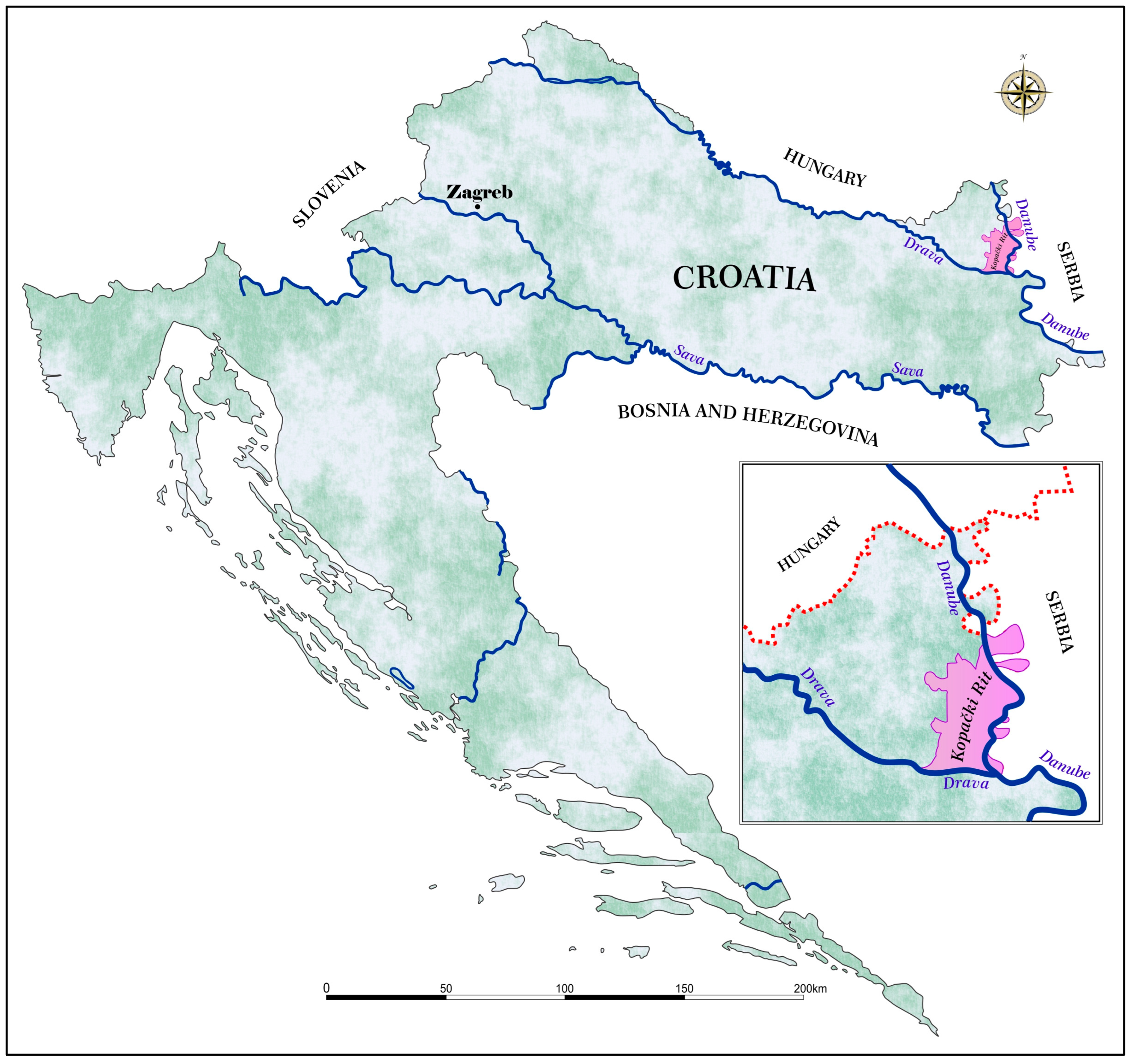
Figure 1. Study area Kopački rit Nature Park, where Prussian carp (C. gibelio) and Great Cormorant (P. carbo) nestlings were sampled during 2023 and 2024. The map was produced using QGIS 3.34 (Geographic Information System) and CorelDRAW Graphics Suite 2018.
Fishes 10 00635 g001
Figure 2. Raincloud plots showing the distribution of acetylcholinesterase (AChE), carboxylesterase (CES), and glutathione S-transferase (GST) activity (log10-transformed, nmol min−1 mgPROT−1) in brain, muscle, and gill tissues of Prussian carp, C. gibelio, sampled in 2023 and 2024 from Kopački rit Nature Park. Violin shapes represent a combination of kernel density distributions and boxplots, which together illustrate data dispersion, medians, and interquartile ranges.
Fishes 10 00635 g002
Figure 3. Raincloud plots showing the distribution of reactive oxygen species (ROS) and reduced glutathione (GSH) levels (log10-transformed, RFU) in brain, muscle, and gill tissues of Prussian carp, C. gibelio, sampled in 2023 and 2024 from Kopački rit Nature Park. Violin shapes represent a combination of kernel density distributions and boxplots, which together illustrate data dispersion, medians, and interquartile ranges.
Fishes 10 00635 g003
Figure 4. Raincloud plots showing the distribution of acetylcholinesterase (AChE), carboxylesterase (CES), and glutathione S-transferase (GST) activity (log10-transformed, nmol min−1 mgPROT−1) in plasma and S9 fractions of Great Cormorant, P. carbo, sampled in 2023 and 2024 from Kopački rit Nature Park. Violin shapes represent a combination of kernel density distributions and boxplots, which together illustrate data dispersion, medians, and interquartile ranges.
Fishes 10 00635 g004
Figure 5. Raincloud plots showing the distribution of reactive oxygen species (ROS) and reduced glutathione (GSH) levels (log10-transformed, RFU) in plasma and S9 fractions of Great Cormorant, P. carbo, sampled in 2023 and 2024 from Kopački rit Nature Park. Violin shapes represent a combination of kernel density distributions and boxplots, which together illustrate data dispersion, medians, and interquartile ranges.
Fishes 10 00635 g005
Figure 6. Exposure–response relationships between biomarker activity and metal(loid) levels in Prussian carp, C. gibelio tissues (brain, gills, muscle) sampled in 2023 and 2024. Biomarkers include acetylcholinesterase (AChE), glutathione S-transferase (GST), and carboxylesterase (CES) activities (nmol min−1 mgPROT−1) and reduced glutathione (GSH), and reactive oxygen species (ROS) levels (RFU). Metal(loid)s include arsenic (As), cadmium (Cd), and mercury (Hg) expressed as µg kg−1. Full model results are provided in Table S3. Asterisks (*) indicate significant individual trends (p < 0.05). Graphs GST ~ Hg and ROS ~ Hg exhibit significant Metal × Tissue interactions, although no significant individual tissue-level trends were detected.
Fishes 10 00635 g006
Figure 7. Exposure–response relationships between biomarker activity and metal(loid) levels in blood plasma and blood cell homogenate (S9 fraction) of Great Cormorant, P. carbo nestlings sampled in 2023 and 2024. Biomarkers shown are acetylcholinesterase (AChE) activity (nmol min−1 mgPROT−1), reduced glutathione (GSH), and reactive oxygen species (ROS) levels (RFU). Metal(loid)s include mercury (Hg), lead (Pb), and arsenic (As), expressed as µg L−1. Full model outputs are provided in Table S4. Asterisks (*) indicate significant individual trends (p < 0.05). Graphs ROS ~ As and ROS ~ Hg exhibit significant Metal × Tissue interactions, although no significant individual tissue-level trends were detected.
Fishes 10 00635 g007
Figure 8. Forest plot of TSMCR = median (Great Cormorant whole blood)/median (Prussian carp liver) on a log10 x-axis. Points show year-specific estimates (2023, 2024); horizontal bars are 95% bootstrap percentile confidence intervals (CIs). The dashed vertical line marks parity (TSMCR = 1). CIs entirely > 1 indicate higher concentrations in predator blood than in prey liver; CIs entirely < 1 indicate lower concentrations in predator blood than in prey liver. Metal(loid)s are arranged by the geometric mean TSMCR across years (computed from the year-specific median-based TSMCRs). Metal(loid)s shown are arsenic (As), selenium (Se), cadmium (Cd), mercury (Hg), and lead (Pb).
Fishes 10 00635 g008
Disclaimer/Publisher’s Note: The statements, opinions and data contained in all publications are solely those of the individual author(s) and contributor(s) and not of MDPI and/or the editor(s). MDPI and/or the editor(s) disclaim responsibility for any injury to people or property resulting from any ideas, methods, instructions or products referred to in the content.