
Article

Three Non-Invasive Tests Reveal Anxiety-like Responses During Food Anticipation in Rainbow Trout

1
Department of Genetics, Physiology and Microbiology, Faculty of Biological Sciences, Complutense University of Madrid, 28040 Madrid, Spain
2
Aquaculture Research Center, Agro-Technological Institute of Castilla y León (ITACyL), Crta Arévalo 20, Zamarramala, 40196 Segovia, Spain
*
Author to whom correspondence should be addressed.
Fishes 2025, 10(11), 564; https://doi.org/10.3390/fishes10110564

Submission received: 29 July 2025 / Revised: 20 October 2025 / Accepted: 29 October 2025 / Published: 5 November 2025
(This article belongs to the Special Issue Fish Health and Welfare in Aquaculture and Research Settings)

Abstract

Anxiety-like behavior in fish is commonly assessed using non-invasive behavioral paradigms such as the Light/Dark preference, Novel Tank, and Open Field tests. In this study, we validated these three assays in rainbow trout (Oncorhynchus mykiss), a species of commercial relevance, to characterize their anxiety-related responses. To explore behavioral changes associated with feeding anticipation and satiety, we implemented a feeding schedule consisting of two daily meals and conducted behavioral tests at specific times before and after feeding. Trout exhibited clear patterns of scototaxis, geotaxis, and thigmotaxis, consistent with anxiety-like behavior described in other teleosts. Our results showed a significant increase in anxiety-like responses before feeding, coinciding with food anticipatory activity observed prior to expected feeding schedules, which diminished after food intake, as evidenced by each test individually. Moreover, multivariate analysis combining parameters from all three tests improved discrimination between anxious and relaxed fish. The behavioral states before and after feeding resembled anxiety-like and anxiolytic conditions reported in other species, supporting that food anticipatory activity reflects an anxious state in rainbow trout as well. These findings endorse using a multi-test behavioral battery to assess anxiety-like states and provide a framework for studying neurobiological mechanisms of emotional regulation related to feeding in teleosts.
Key Contribution: This study validates a multi-test behavioral battery, including optimized Light/Dark, Novel Tank, and Open Field tests, to reliably assess anxiety-like states in rainbow trout (Oncorhynchus mykiss). Specifically, variables from the Light/Dark and Novel Tank tests—particularly latency to enter and time in the white zone, and entries to and time in the upper and middle zones—were most effective in distinguishing high- from low-anxiety states, reflecting greater vertical exploration and reduced avoidance of aversive areas. No Open Field parameters contributed meaningfully. Furthermore, we demonstrate that food anticipatory activity corresponds to an anxious behavioral state, providing a robust framework to investigate the neurobiological mechanisms underlying emotional regulation related to feeding in teleost fish.

1. Introduction

The importance of fish welfare has grown substantially in recent decades, driven by social awareness, policy developments, and the expansion of aquaculture. This has underscored the need for further research, particularly in commercially relevant species, to ensure sustainable production systems in the broadest sense, encompassing animal welfare, environmental impact, and long-term viability [1,2]. Research in this area is challenging, as animal welfare is a multifaceted concept that includes health, physiological functioning, behavior, growth, and emotional states. Furthermore, there is still no universally simple accepted, straightforward definition [3]. While classical studies on fish welfare focused primarily on stress responsiveness—mainly cortisol and other physiological parameters [4]—current approaches have incorporated additional indicators, such as fear, anxiety-related behaviors, and performance outcomes [1,2]. These newer methodologies do not replace traditional physiological markers but rather complement them, contributing to a more integrative and comprehensive welfare assessment framework.
Regardless of the specific combination of indicators used, it is now broadly accepted that welfare assessments should include at least one variable reflecting the animal’s affective state, such as fear or anxiety [3]. Behavioral studies have gained prominence over intrusive techniques such as tissue sampling (e.g., plasma cortisol, gill biopsies, or brain dissections), as they are non-invasive, faster to implement in routine assessments, and more aligned with ethical and welfare-friendly practices. In this context, numerous studies in recent years have focused on the development of behavioral tests to assess anxiety responses in fish, as valuable tools to evaluate the impact of many factors, such as temperature changes [5,6], chronodisruption [7], acidification [8] and environmental pollutants [9,10] on welfare. Moreover, behavioral tests are also increasingly used to explore the neural mechanisms underlying anxiety-like behavior and neurological disorders, particularly in zebrafish, Danio rerio [11,12,13,14]. Their validity relies on the fact that behavioral parameters such as geotaxis, scototaxis, and thigmotaxis (described below) have been consistently shown to correlate with changes in anxiolytic and anxiogenic neurochemical signals [15,16,17,18]. Thus, behavioral paradigms not only offer practical advantages in terms of feasibility and animal welfare but also serve as reliable proxies for underlying neurophysiological states.
Anxiety is a sustained state of heightened arousal and vigilance, triggered by the anticipation of a potential threat—real or imagined—and typically accompanied by specific physiological and behavioral responses [14,19]. Autonomic activation and increased arousal are among the earlier psychophysiological responses observed in a state of fear or anxiety. Although the pathways underlying this behavioral response are not yet fully understood, they involve evolutionarily conserved circuits that regulate aversive learning and emotionality [20]. In mammals, anxiety-related neural circuits include limbic structures—such as the amygdala and hippocampus—as well as other subcortical regions (e.g., hypothalamus) and cortical areas (e.g., prefrontal cortex, somatosensory cortex, insular cortex, and cingulate cortex) [19,20]. In fish, although a layered cortex is absent, functionally analogous structures have been proposed. For instance, regions of the medial and lateral telencephalic pallium are considered homologous to the mammalian amygdala and hippocampus, respectively, while the hypothalamus plays a conserved role in the regulation of emotional and neuroendocrine responses [19,21]. Beyond neuroanatomical structures, several neurotransmitter systems have been implicated in the regulation of anxiety, including monoamines (e.g., serotonin, dopamine, noradrenaline), gamma-aminobutyric acid (GABA), and corticotropin-releasing factor (CRF) among others [19,20,22,23,24]. The use of behavioral tests to assess anxiety has been instrumental in advancing our understanding of neural and neurochemical mechanisms underlying this emotional state.
Anxiety levels in animals are typically assessed using behavioral tests based on place preference, in which the animal chooses between a neutral (or preferred) and an aversive environment [14,16,17,25]. In fish, three of the most commonly used paradigms are the novel tank, the light/dark, and the open field tests [7,12,17,18,23,24,26,27]. The novel tank test is one of the most popular tests in zebrafish [14,20,23,27,28]. It leverages the zebrafish’s natural geotactic response—its tendency to dive and remain near the bottom when introduced to a novel environment—as an index of anxiety-like behavior. Although anxiety levels are commonly assessed through the ratio of time spent in the bottom versus the top zone, other indicators such as the number of transitions to the upper zone and the latency to first entry into it can also provide valuable information [18,20,28]. The light/dark test is also frequently used. It is based on scototaxis—the innate tendency of fish to prefer dark, sheltered areas, which are perceived as safer and less aversive. Anxiety-like behavior is typically evaluated by measuring the amount of time spent in the bright (i.e., aversive) versus the dark (i.e., preferred) compartment, along with latency to enter the bright zone and the number of transitions between compartments [12,23,27]. Lastly, the open field test, more recently adapted to fish, is another widely used paradigm for assessing anxiety-like behavior. This test relies on thigmotaxis, the natural tendency of fish to remain close to the walls of a novel, open area as a strategy to avoid potential threats. Anxiety is typically inferred from the amount of time spent near the periphery versus the center of the arena, along with the number of entries into the center zone [20,29]. Initially established in zebrafish, these three tests have been successfully adapted to other teleost species—such as goldfish (Carasius auratus) [7]; Mexican blind cavefish (Astyanax sp.) [30]; three-spine sticklebacks (Gasterosteus aculeatus) [31]; medaka (Oryzias latipes) [32]; or coho salmon (Oncorhynchus kisutch) [33], highlighting that aversive behaviors are deeply conserved across fish phylogeny.
Rainbow trout (Oncorhynchus mykiss) is the most commercially important freshwater species in European aquaculture and the second most farmed salmonid worldwide [34,35]. In this species, several studies have assessed stress, emotional reactivity, and related behavioral traits under diverse experimental conditions [36,37,38,39]. However, in such studies, total movement and other parameters were analyzed, and no clear results were obtained when measuring time spent in the aversive areas using the three behavioral tests previously mentioned (i.e., novel tank, light/dark, and open field tests), which are the main parameters supporting an anxiety state. Moreover, anxiety in trout has also been linked to stress and aggression behavior, with key neurochemicals involved including CRF, serotonin, and neuromedin [40,41,42,43]. However, to the best of our knowledge, no standardized behavioral tests are currently available to assess anxiety in this teleost using the novel tank, the light/dark, and the open field test paradigms. Beyond validating these behavioral tests, the present study also explored the potential relationship between anxiety and food anticipatory activity (FAA) in rainbow trout. FAA is characterized by an increase in locomotor activity that typically occurs hours before the scheduled feeding time, an anticipatory response observed in all studied vertebrates when feeding times are predictable [44]. This behavior has been well characterized in fish [45,46] including rainbow trout [47]. Notably, recent findings in goldfish suggest that FAA is accompanied by an anxiety-like state, possibly triggered by the expectation of a food reward [48]. This link between feeding behavior and anxiety is particularly relevant, as FAA in vertebrates, including fish, engages reward-related neural circuits and neuroendocrine pathways that regulate both feeding motivation and emotional arousal. In this context, anxiety may be interpreted as a reflection of the “wanting” component of the hedonic response [48]. Whether a similar anxiogenic component accompanies FAA in rainbow trout remains unknown. The present study addresses this gap by validating three behavioral tests in rainbow trout and evaluating their potential as non-invasive tools to characterize FAA as an anxiety-like state. Specifically, it aimed to (1) validate the light/dark (scototaxis), novel tank (geotaxis), and open field (thigmotaxis) tests as reliable measures of anxiety-like behavior in this species, and (2) determine whether anxiety levels are modulated during FAA.

2. Materials and Methods

2.1. Animals and Housing

Fertilized eggs of rainbow trout were purchased from a certified supplier and received in September 2024 at the Aquaculture Research Center of the Instituto Tecnológico Agrario de Castilla y León (ITACyL, Segovia, Spain). Larvae were initially maintained in a hatching tank in complete darkness until the onset of exogenous feeding. At that point, they were exposed to dim white fluorescent light for 24 h per day for several days. Then, the photoperiod was gradually reduced until reaching 12 h of light and 12 h of darkness (12L:12D) lights on at 08:00 h. During the initial stages, larvae were fed four times daily, gradually reduced to three feedings per day, always during the light phase (Inicio Plus, BIOMAR, Dueñas, Spain). Water temperature was initially maintained at 10 °C (the temperature at which the eggs were received) and was progressively increased to 15 °C, which was the temperature used for acclimation in the experimental rooms. Trout of around 1 g body weight (bw) were transferred to two 60 L glass aquaria with filtered and aerated water (n = 12 and 14 fish per tank, respectively), where they were maintained for 21 days prior to measuring anxiety-like behavior. Water temperature and photoperiod were maintained at 15 ± 1 °C and 12L:12D (lights on at 08:00 h), with light intensity at the tank surface set to approximately 30 lx. During the first 10 days of acclimation, fish were daily fed with the same commercial granulated feed (Inicio Plus, BIOMAR, Spain) three times per day (09:00, 14:00, and 18:00 h; 3% bw daily ration) using automatic feeders. Thereafter, when fish reached around 2 g bw, they were fed twice daily (09:00 and 18:00 h; 2% bw daily ration) until the end of experiments. All experimental procedures were conducted in accordance with the current regulations of the European Union (EU63/2010) and Spain (RD 53/2013) on animal welfare protection for scientific purposes. The procedures were approved by the Animal Experimentation Committee of the ITACyL (2024/06/CEEA).

2.2. Experimental Design

Juvenile rainbow trout (3.5 ± 0.4 g bw) were assigned to two behavioral testing conditions based on feeding status on the day of the tests: preprandial (PRE) and postprandial (POST). The PRE group was tested between 08:30 and 10:00 h, after 14.5–16.0 h fasting period, coinciding with the FAA that occurs before the first daily feed intake (see below in Section 2.3 and Section 3.1 how the locomotor activity recordings confirm FAA at this time). The POST group was manually fed at 10:30 h on the test day and underwent behavioral testing between 13:00 and 15:00 h (i.e., 2.5–4.5 h post-feeding). The light/dark and novel tank tests were performed consecutively on 25 fish (PRE, n = 14; POST, n = 11). Three days later, after the groups were mixed, the open field test was conducted (see Section 2.4) with 24 fish (PRE, n = 12; POST, n = 12).

2.3. Locomotor Activity Recording

Daily locomotor activity was continuously monitored for one week prior to behavioral testing using infrared-based motion detection, as previously described [10]. This monitoring aimed to confirm the presence of FAA and to identify optimal time points for subsequent anxiety-like measurements. In each tank, 9 photocells (E3S-AD12; Omron Corporation, Kyoto, Japan) were strategically positioned: 3 directly beneath the feeders to quantify feeding-associated movements, and six distributed across lower and mid-water column zones to detect general locomotor activity. Each photocell emitted a continuous infrared beam, which was interrupted by fish movement, triggering pulse events. These signals were recorded at 10 min intervals by an actimeter connected to a data acquisition system (Adq16; Micronec, Madrid, Spain). To avoid external light and visual disturbances, the tank walls were covered with opaque paper from the start of the acclimation period. Data were processed using El Temps® software v313 (Prof. Antoni Díez Noguera, University of Barcelona, Spain), generating actograms, waveform averages, and periodograms.

2.4. Behavioral Tests

Tests to assess anxiety-like behavior were performed during their designated time window (08:30–10:00 or 13:00–15:00) in the same room where fish were maintained for the previous 21 days. Trouts were carefully netted and immediately transferred from the housing tank to the designated test tanks for each behavioral assay (light/dark and open field tests), or alternatively from the dark/light tank to the novel tank to minimize cumulative handling stress. In all tests, water temperature was maintained at 15 ± 1 °C, consistent with acclimation conditions, and water was exchanged between trials involving different individuals to reduce potential confounding effects of chemical communication released during previous trials. In each test, fish movements were recorded for 10 min using a video camera, and behavioral parameters were obtained through automated tracking with EthoVision XT v17.5 software (Noldus, Wageningen, The Netherlands).

2.4.1. Dark/Light Preference Test

The dark/light preference test was employed to assess scototaxis-related behavior. The test tank consisted of a non-reflective methacrylate tank (47.0 × 14.5 × 10.0 cm; L × H × W), divided equally into black (comfort zone) and white (aversive zone) compartments (23.5 cm length each; Maze engineers, Skokie, IL, USA; Supplementary Figure S2a). It was filled with filtered water to a depth of 10 cm, with a light luminosity at the water surface of 300 lx. Each trial began by releasing the fish at the bottom of the black compartment of the tank. Quantified parameters included latency to enter the white area and time spent in each zone.

2.4.2. Novel Tank Preference Test

The novel tank preference test was used to assess geotaxis-related behavior. The test tank consisted of a trapezoidal prism tank made of methacrylate, with the front face measuring 27 cm at the top base, 22 cm at the bottom base, and non-parallel side lengths of 15 cm and 16.5 cm (Supplementary Figure S2b). The vertical height between the bases was 15 cm, and the tank extended 9 cm in depth. The interior was divided into three vertical zones: the bottom (comfort zone), middle, and upper (both, potentially aversive zones). Filtered water was added to a depth of 10 cm, and the tank walls were lined with opaque paper to reduce external visual stimuli. Illumination at the water surface averaged 252 lux. Each trial began by introducing the fish into the bottom area. Quantified parameters included latency to enter the middle and upper areas, number of entries, time spent in each zone, and average distance travel.

2.4.3. Open Field Test

The open field test was used to assess thigmotaxis-related behavior. The test tank consisted of a circular methacrylate tank (50 cm diameter, 10 cm water depth) divided into two zones: a central inner zone (75% of total area), referred as the open area (aversive zone), which indicates exploratory behavior; and a peripheral ring (the remaining 25% area) near the wall as a proxy for thigmotaxis, referred to as the wall area (comfort zone). In addition, the central area surrounding a novel object, occupying 25% of the open area, was defined as the center area (the most aversive zone). The transparent tank wall was fully covered with opaque black paper to minimize external visual stimuli, while a white bottom was maintained to facilitate image software tracking (Supplementary Figure S2c). The light intensity at the water surface was maintained at an average of 141 lx. Each trial began by releasing the fish near the wall. Quantified parameters included latency to enter the center and the open areas, number of entries and time spent in each zone, and average distance travelled.

2.5. Analysis of the Data

Behavioral data were analyzed using SigmaPlot v.12 (SYSTAT Software, San Jose, CA, USA) and GraphPad Prism v.10.4.2 (GraphPad Software, La Jolla, CA, USA). Results are presented as mean + S.E.M. (standard error of the mean). Prior to analysis, normality and homoscedasticity of each dataset were assessed using the Shapiro–Wilk and Levene tests, respectively. When parametric assumptions were not met, log or square-root transformations were applied. A Student’s t-test was used to evaluate the effects of experimental conditions (POST vs. PRE). Pearson correlation coefficients were calculated to analyze the relationship between aversive zone preferences (white and middle/upper zones) across two consecutively performed behavioral tests: the dark/light test and the novel tank preference test (Supplementary Figure S1).
Chi-square periodograms were employed to identify significant periods by Rayleigh test (p < 0.05) in daily locomotor activity rhythms using the software El Temps® (Prof. Antoni Díez Noguera, University of Barcelona, Spain). Differences in locomotor activity were assessed using one-way ANOVA followed by a Student–Newman–Keuls (SNK) post hoc test (p < 0.05). Comparisons were made among activity during FAA periods (associated with each feeding time) and the average activity across the rest of the day, as well as between diurnal and nocturnal activity levels. To ensure that increased activity during the light phase was not solely attributable to feeding-related activity (i.e., FAA and feeding itself), diurnal vs. nocturnal comparisons were conducted using two approaches: (1) average activity throughout the entire photophase, and (2) photophase activity excluding FAA and feeding periods.
Principal component analysis (PCA) was conducted to investigate the structure and relationships among behavioral parameters across tests. Outliers were identified using the ROUT method at Q = 1%. Principal components were retained until cumulative explained variance reached 90%, as reported in Supplementary Tables S2 and S3. PCA score plot visualized data patterns and component loadings highlighting variables contributing significantly to each dimension. Additionally, to statistically assess these differences, principal component scores for each subject were extracted and compared between PRE and POST conditions (see Section 3.5).

3. Results

3.1. Locomotor Activity

Figure 1 shows locomotor activity of juvenile rainbow trout maintained under 12L:12D photoperiod and fed twice daily at 09:00 and 18:00 h. The actogram (Figure 1a) and average daily profiles (Figure 1b) indicated that trout exhibited higher activity during the light phase (08:00–20:00) compared to the dark phase (20:00–08:00). This daily rhythm showed a significant 24 h period (p < 0.05, Figure 1b). Fish displayed increased locomotor activity in the hours preceding the scheduled feeding times, indicating marked FAA. The activity during both FAAs was significantly higher than the mean locomotor activity throughout the rest of the whole-day activity, without significant differences between the FAA preceding the 9:00 feeding and that prior to the 18:00 feeding (p < 0.0001 and p < 0.01, respectively; Figure 1c). In addition, locomotor activity data show that, under our maintenance conditions, trout are diurnal, as the mean of activity during daytime is higher than during nighttime (Figure 1d), even when the activity associated with feeding (i.e., FAA and feeding itself) is excluded from daytime activity (Figure 1d).

3.2. Dark/Light Preference Test

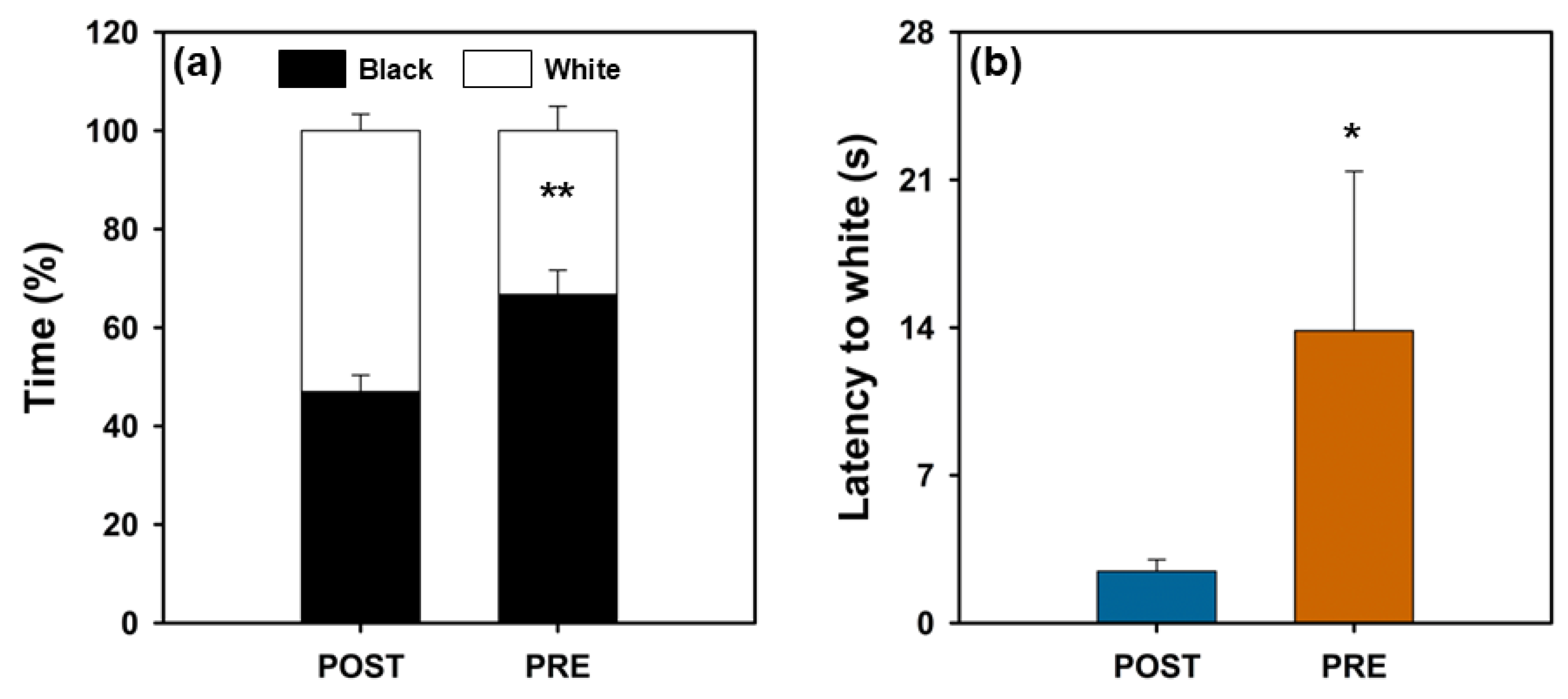
All descriptive statistics for the analyzed behavioral parameters are provided in Supplementary Table S1. Higher scototaxis (time spent in black) was observed in trout tested during the FAA phase (PRE) compared to those assessed at two hours post feeding (POST). Preprandial trout spent significantly less time in the aversive (white) zone (33% PRE vs. 53% POST, p < 0.01; Figure 2a) and showed a higher latency to visit this aversive zone (13.8 s PRE vs. 2.4 s POST, p < 0.05; Figure 2b) compared to postprandial trout. Heatmaps were not obtained in this test due to software limitations in tracking fish positions within the dark compartment.

3.3. Novel Tank Test

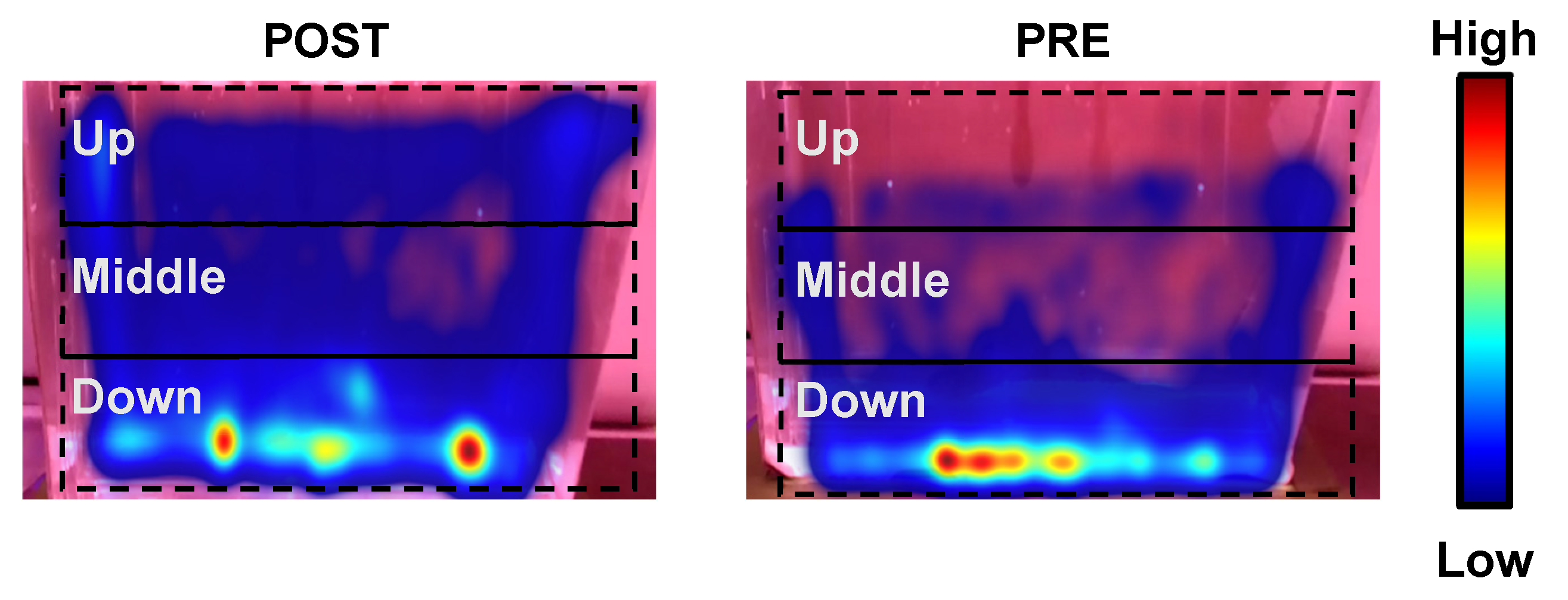
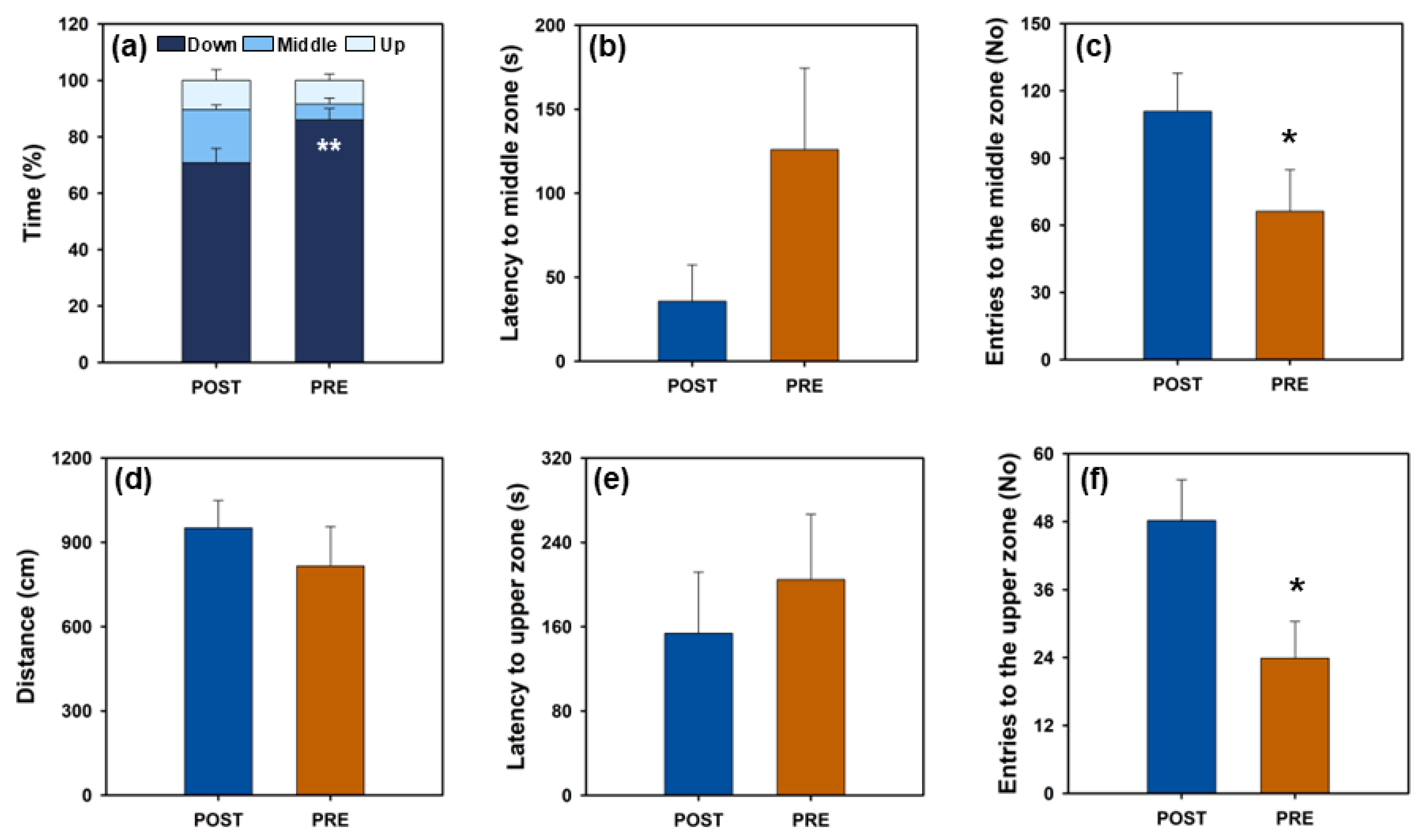
All descriptive statistics for the analyzed behavioral parameters are provided in Supplementary Table S1. Figure 3 and Figure 4 summarize the results from the novel tank preference test. Heatmaps show that trout tested at 2 h post feeding (POST) exhibited swimming activity throughout the entire tank, including the upper and middle zones (Figure 3). In contrast, trout tested prior to the expected feeding time (PRE) showed a more restricted pattern of movement, predominantly swimming near the bottom of the tank, with reduced exploration of the middle and upper areas. Quantitative analysis revealed that during preprandial time, trout spent significantly more time in the bottom zone (p < 0.01; Figure 4a), with fewer entries into the middle and upper zones (p < 0.05; Figure 4c,f). Although no significant differences in latency to entry middle and upper zones were observed between PRE and POST groups (Figure 4b,e), a trend toward higher values was noted in the preprandial group regarding latency to the middle zone (Figure 4b). Total distance travelled by trout was similar in preprandial and postprandial conditions (Figure 4d). The correlation between time spent in aversive zones in both dark/light and novel tank preference tests (i.e., time in white vs. time in middle-upper) is shown in Supplementary Figure S2. There is no significant correlation in this analysis, which indicates that the trout that spent more time in the white are not the same individuals that spent more time in upper zones, suggesting that both anxiety-behavioral tests do not measure the same component (element) of anxiety response.

3.4. Open Field Test

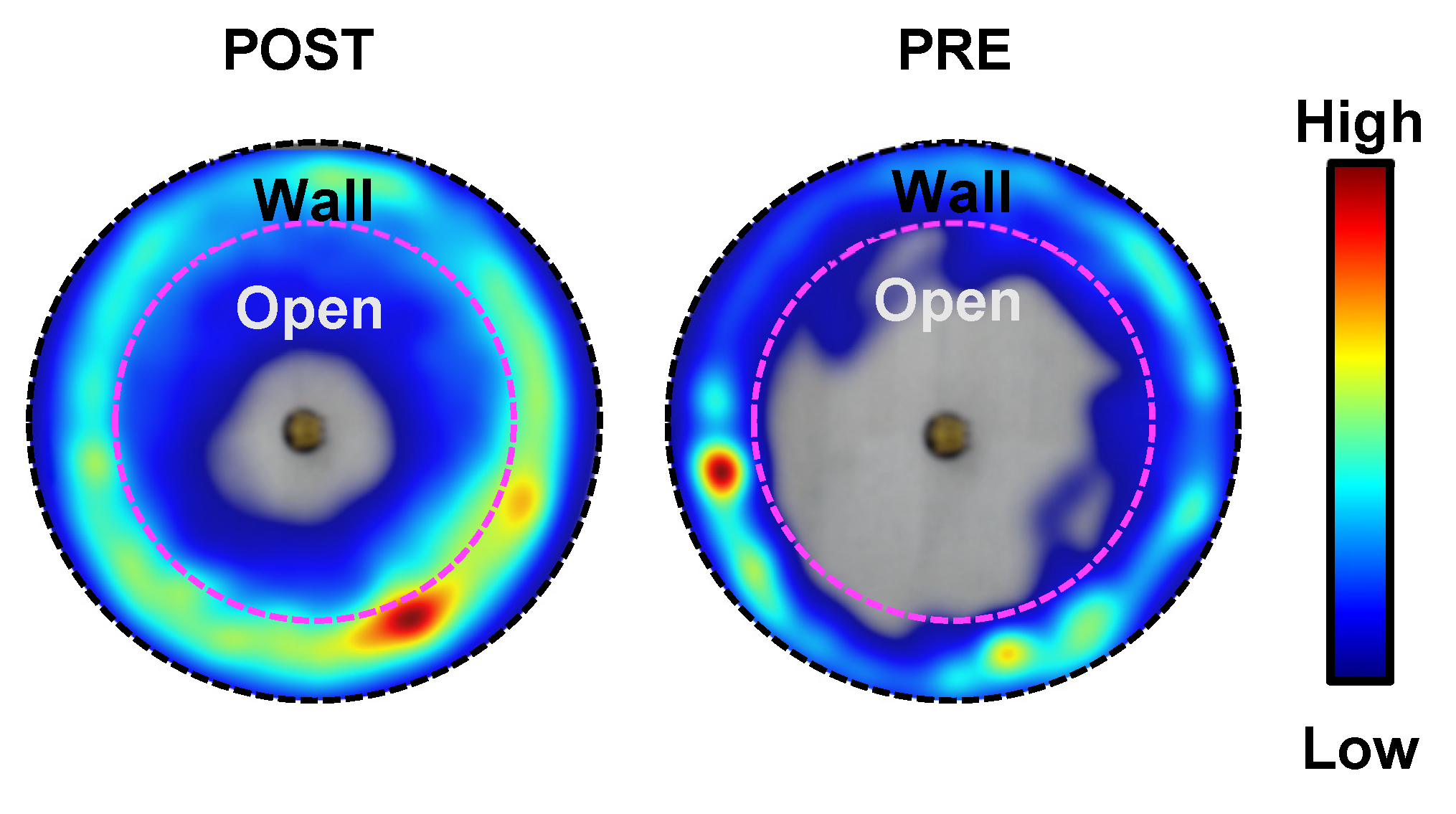
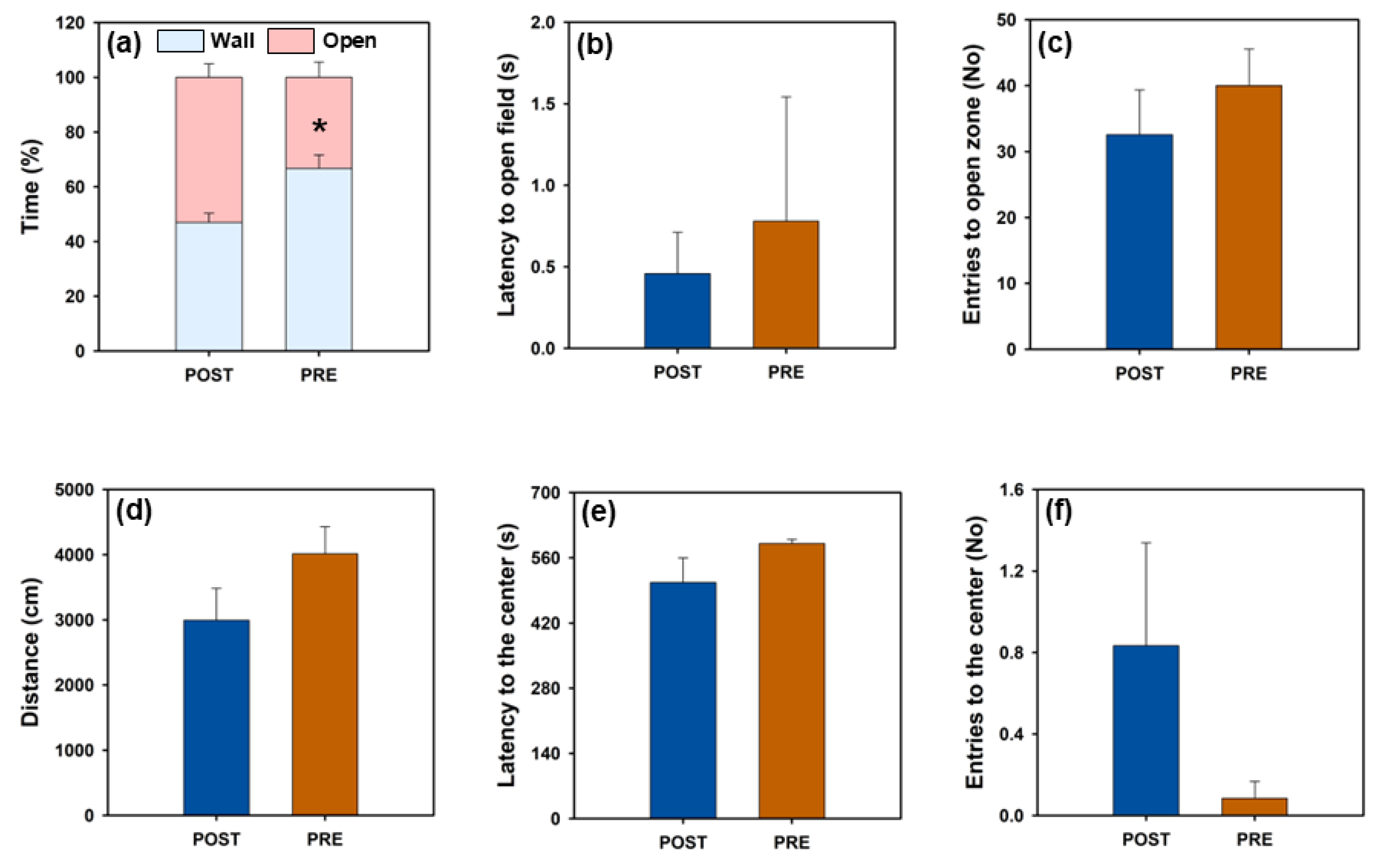
The heatmaps obtained from the open field test indicate that trout at 13–14 h since the last feeding tend to spend more time in the areas close to the wall compared to results obtained from postprandial trout, which explore the open area more extensively (Figure 5). All descriptive statistics for the analyzed behavioral parameters are provided in Supplementary Table S1. The quantification of video recordings evidenced this observation, time spent by fish in the open zone was significantly shorter under preprandial conditions than after feeding (39% PRE vs. 52% POST, p < 0.05; Figure 6a). Although no statistically significant differences were found in the other behavioral parameters analyzed, for the PRE condition it is observed a trend toward fewer entries into the center zone (Figure 6f). Entries to the open zone (Figure 6c), time required to enter (latency) both potential aversive zones (open and center zones; Figure 6b,e) and total distance travelled (Figure 6d) were similar between fasted and fed trout (Figure 6d).

3.5. Principal Component Analysis (PCA)

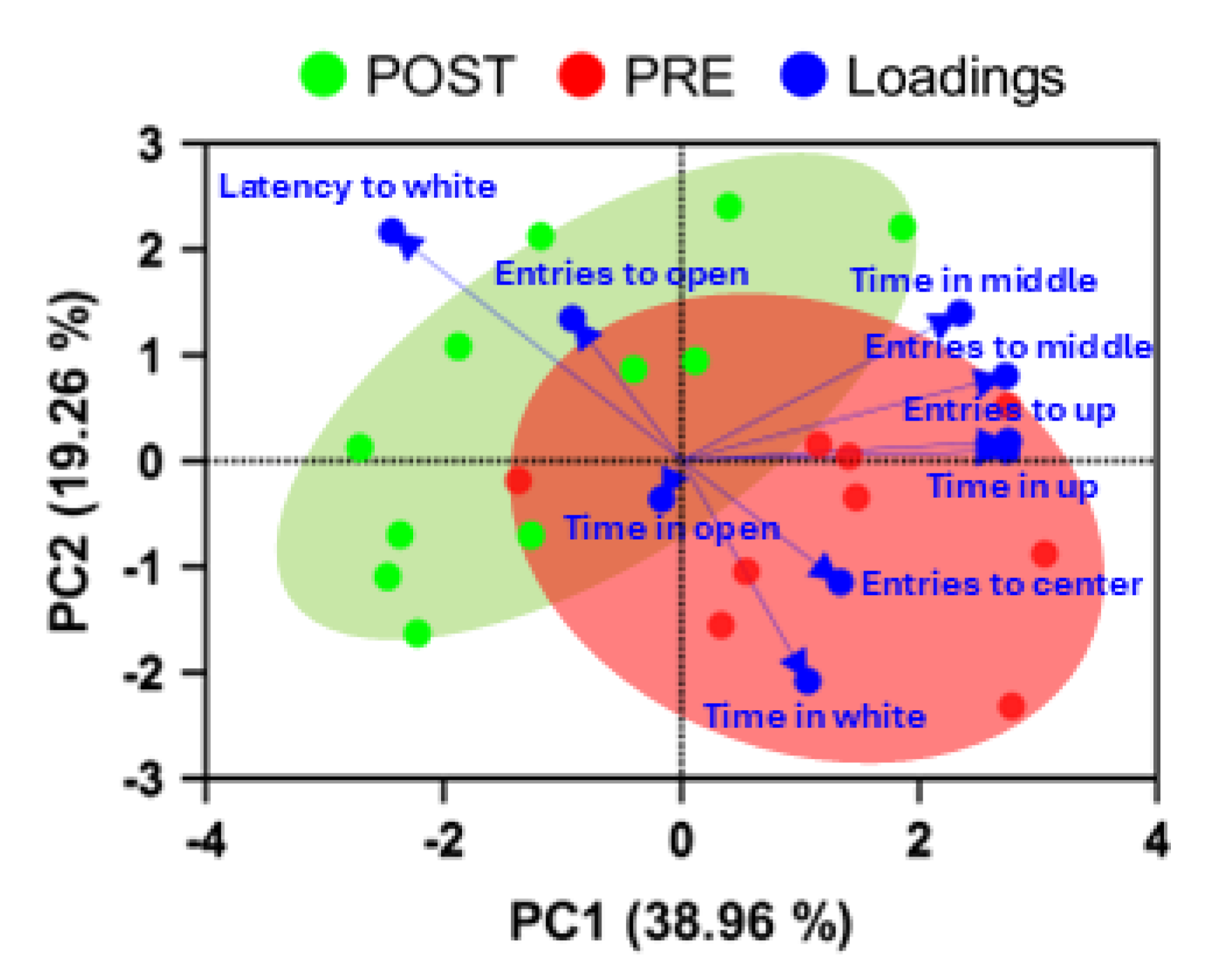
Principal Component Analysis (PCA) was used to evaluate how anxiety-related variables contributed to behavioral responses across individual trout tests, enabling differentiation between PRE and POST conditions across tests. The PCA plot revealed a clear separation along the X-axis (Figure 7). To statistically assess these differences, principal component scores for each subject were extracted and compared between PRE and POST conditions (Student t-test). This comparison of principal component scores revealed significantly higher PC1 scores (p = 0.0013) and a non-significant trend toward lower PC2 scores (p = 0.0521) in the POST compared to PRE condition. Variables contributing most strongly to PC1, in descending order of absolute loading, were: entries to upper zone (0.909), time in upper zone (0.904), entries to middle zone (0.901), time in middle zone (0.774), entries to center zone (0.442), time in white zone (0.351), and latency to enter white zone (−0.339). This axis primarily reflects increased vertical exploration and reduced latency to enter aversive areas. PC2 was mainly driven by latency to enter white zone (0.761), time in white zone (−0.675), time in middle zone (0.490), entries to open area (0.471), entries to middle zone (0.281), and entries to center zone (−0.373), capturing variation in approach–avoidance behavior toward aversive zones and open areas. Furthermore the most contributory variables across tests, based on their loadings, were the following: latency to enter the white zone (0.334) and time spent in the white zone (0.263) from the light/dark preference test, followed by entries to the upper zone (0.236), time spent in the upper zone (0.233), and entries to the middle zone (0.232) from the novel tank test. No parameters from the open field test contributed meaningfully to treatment segregation.

4. Discussion

In this study, we validated three non-invasive behavioral tests to assess anxiety-like behavior in rainbow trout. As expected, this species exhibited typical aversive responses—scototaxis, geotaxis, and thigmotaxis—patterns previously documented in other teleosts [7,18,20,23,29,30,31,32,33]. We also confirmed the presence of food anticipatory activity (FAA) in rainbow trout, consistent with prior reports [47], demonstrating their capacity to anticipate two scheduled daily feeding events. Notably, anxiety-like behavior increased during FAA, as indicated by the differences between preprandial (PRE) and postprandial (POST) individuals. Thus, our results clearly demonstrate that anxiety levels in rainbow trout are significantly elevated during FAA compared to postprandial conditions, confirming that FAA is associated with a heightened anxiety-like state in this species. This pattern suggests an intensified emotional state while awaiting food, consistent with recent findings in goldfish [48], which will be further discussed below. The specific conditions used in this work for each of the three behavioral paradigms—Light/Dark preference, Novel Tank, and Open Field Tests—proved effective in evaluating anxiety-like behavior in rainbow trout. Test design variables such as tank dimensions, shape, and light intensity require careful consideration, as they can markedly influence behavioral outcomes [16,29,49].
For the Light/Dark preference test, we used tank sizes typically employed for zebrafish [24,27]. Under these conditions, an adult zebrafish (~0.4 g) would yield a weight-to-water ratio (w/v) of approximately 0.009%, while our setup with 3.5 g trout resulted in a ratio of 0.075%, well below thresholds that could impose spatial limitations. Note that the same tank size has been used successfully in goldfish of >10 g (w/v ratio 0.21%) [7,10]. Light intensity was set to 300 lx at the water surface in our study. This parameter plays a pivotal role in modulating aversion to the white compartment, but is frequently underreported. In zebrafish, one of the most studied species, protocols that report this value vary from 100 lx [49] up to 222 lx [5] or even over 900 lx [27] in the Light/Dark preference test. However, the light intensity used during fish maintenance is not specified, despite its potential to elicit variable behavioral responses in this test [5]. In goldfish acclimated to 1000 lx, we have shown that a minimum of 600 lx is required to elicit aversion to the white compartment [7], while lower intensities (200 and 400 lx) failed to induce preference for either the white or black sides of the tank [50]. Considering species-specific requirements, rainbow trout in our study were maintained under 30 lx, and a testing intensity of 300 lx was used to elicit aversion to the white zone. This expectation was confirmed: preprandial trout spent approximately 67% of the trial in the secure dark zone—consistent with reports from other teleosts, where values range from 78% to 50% [7,27]. Data also support that trout show a scototaxic response, which can be used in anxiety-related behavioral studies, as the percentage of time spent in the dark area decreased in relaxed animals tested 2 h after feeding (≈70% to 50%). A similar trend has been reported in goldfish, which spent more time in the dark compartment during food anticipatory activity (~76%) than postprandially (~60%) [48]. This behavioral reduction parallels responses to anxiolytic treatments, such as diazepam in goldfish (~70% to ~50%) [7] and fluoxetine in zebrafish (~65% to ~45%) [16], reinforcing the interpretation of FAA as an anxiety-like state in trout, as will be further discussed below.
For the Novel Tank Test, the experimental conditions, including tank size, were based on previous protocols developed for zebrafish [51]. Light intensity, although rarely reported despite its recognized relevance [5,26,28], could range from 200 lx [5] to 600 lx [52]. In our assays, rainbow trout were maintained under low-light conditions, and a testing intensity of 250 lx was selected—close to the lower end of values used in prior studies. Under these settings, trout exhibited a pronounced bottom-dwelling behavior, spending approximately 70% of the time at the tank’s base post-feeding and up to 85% during food anticipatory activity (FAA, supporting that geotaxis is a reliable indicator of anxiety in this species). These values are comparable to those reported for zebrafish [23,52] and medaka [32]. Furthermore, reduced time expended in the bottom of the tank reflects an anxiolytic effect, consistent with behavioral changes previously documented in zebrafish following treatment with anxiolytic agents [15,16,18].
Thigmotaxis in rainbow trout was confirmed through the results obtained in the Open Field assays. The tank used (approximately 1970 cm2) was the same as that previously validated for goldfish weighing 5–15 g [7,10]. Unlike other models reported for zebrafish and medaka, the arena was circular rather than square [29,32]. Moreover, the tank was slightly larger but comparable to those used in smaller species, such as zebrafish and medaka, where open field arenas range from 900 to 1600 cm2 [29,32], thus maintaining similar proportions relative to body size. In this test, light intensity was set to 150 lux in the central zone based on previous results from our group indicating that excessive brightness can make the center highly aversive (leading to >90% of the time spent near the wall), thus limiting exploration [50]. For the same reason, we placed a novel object in the center of the tank to encourage exploration, as we have observed in some cases that goldfish only venture into the open field when there is something new to explore [50]. This paradigm is often used to assess cognition and memory in rodents, but in zebrafish and goldfish, it is also strongly associated with anxiety-like behavior [18], which seems to be the case in trout as well. In the present study, rainbow trout spent ≈ 70% of the time near the walls when tested during FAA (considered an anxious state), and decreasing to ≈50% post-feeding, a change also observed in goldfish under similar conditions [44]. This decline in wall preference, reflecting reduced avoidance of the open-field zone, has also been reported after treatment with anxiolytic drugs in goldfish [7] and zebrafish [18], supporting the use of this parameter as a reliable indicator of anxiety levels in rainbow trout as well. Overall, our data support that rainbow trout display anxiety-like behaviors quantifiable with all three paradigms. To optimize future studies with this three-test battery, researchers should treat test conditions as flexible parameters—rather than fixed endpoints—by considering all previously discussed factors and tailoring protocols to each species’ specific requirements and experimental context [5,18].
Our results from the three behavioral paradigms, along with the subsequent PCA, indicate that the percentage of time spent in aversive zones relative to secure zones is the most reliable indicator for distinguishing between higher (PRE) and lower (POST) levels of anxiety-like behavior in rainbow trout—an observation that aligns with findings in other species [7,18,29,30,31,33]. Notably, time spent in the comfort zones of each test (i.e., black area, bottom zone, or tank edges) consistently remained below 90%, facilitating clear differentiation between individuals with varying anxiety-like states. While time in aversive zones is a reliable anxiety marker across the three paradigms, our results show that additional variables also provide valuable information, as they were strongly modulated by the experimental conditions. These findings highlight the key importance of combining multiple behavioral parameters to increase the sensitivity of anxiety-like behavior assessments, as demonstrated by our PCA-based approach, but also recommended by other authors [16,52,53].
Interestingly, no correlation was found between the time spent in the white zone of the Light/Dark test and the time spent in the top zone of the Novel Tank test when analyzing individual fish behavior. This lack of association suggests that these paradigms may tap into distinct behavioral dimensions. Similar results, with no significant associations between indicators from different paradigms, have also been reported in zebrafish (Light/Dark vs. Novel Tank: [54]; Open Field vs. Novel Tank [53] and in goldfish (Light/Dark vs. Open Field [7]). Collectively, these observations support the notion that each test may capture different components of what is broadly referred to as anxiety, reinforcing the idea that this term should be used with caution. The behavioral tasks employed in each paradigm may rely on distinct neurobiological processes, involving differential gene expression, metabolic pathways, or even protein levels, as previously suggested in fish [7,16,52,54] and rodents [55,56]. This has important implications for future research. While all tests appear valid for assessing baseline anxiety, studies aiming to investigate underlying neurobiological mechanisms or pharmacological effects should consider combining multiple paradigms. Such an approach may offer a more nuanced and sensitive evaluation of anxiety-related behaviors and their biological underpinnings.
To this point, this study presents the first instance in which non-invasive behavioral tests have been developed to assess anxiety in rainbow trout, a freshwater species with high commercial importance in Europen aquaculture [34,35]. Each of the three behavioral tests employed successfully detects anxiety triggered by food anticipatory activity. However, the PCA clearly showed that combining the three tests improves the discrimination power and allows a clearer distinction between high-anxiety and low-anxiety rainbow trouts. This finding is consistent with previous works suggesting that a multi-test approach enhances sensitivity and reliability for assessing anxiety-related behavior in zebrafish and goldfish [7,28,52,53].
Additionally, this work reveals for the first time that rainbow trout can anticipate two meals a day, shown by two distinct and equally intense locomotor peaks two hours before both morning and evening feedings, whereas prior studies only reported FAA in trout fed once daily [47]. Consistent with previous findings, our data confirm that rainbow trout exhibit predominantly diurnal behavior, with elevated locomotor activity during the photophase—likely reflecting natural feeding patterns aligned with daylight. Nevertheless, food anticipatory activity (FAA) is still evident when feeding is scheduled at mid-scotophase, although its intensity is reduced to about one-third of that observed during the photophase [47]. Other teleost, such as goldfish, can also exhibit dual phasing of locomotor activity rhythms, showing two daily peaks synchronized with feeding schedules [57,58]. These findings indicate that both goldfish [57,58] and trout (present data) possess a feeding-entrainable oscillator (FEO) capable of adapting to multiple mealtimes. This supports the idea that FAA results from complex learning processes that allow animals to synchronize their physiology and behavior with the expected timing of food availability. Such synchronization likely involves a network of brain structures beyond the canonical circadian clocks and is closely linked to the hedonic and reward systems [10,59,60,61].
Finally, results obtained by the three tests employed support an increment in anxiety-like behavior in rainbow trout associated with meal anticipation, as discussed above. To date, this anxiety-like state during FAA has only recently been described in goldfish [48]. We cannot fully rule out the potential contribution of fasting or circadian time as factors influencing the preprandial anxiety-like response in trout—given that both fasting [62] and time of day [63] have been reported to affect anxiety-like behavior in zebrafish. However, this does not seem to be the case in goldfish, where FAA-related anxiety is linked to the expected mealtime: fish fasted for 30 h (measured when no meal was expected) were more relaxed than those under 24 h fasting (coinciding with the expected meal) and this FAA-related anxiety emerges even in the absence of a light–dark cycle [48]. Taken together, the ability of trout to anticipate two distinct daily meals—coupled with a feeding schedule that ensures satiety—strongly supports the notion that meal expectation, rather than time of day or fasting, underlies the heightened anxiety-like behavior observed during preprandial FAA. The mechanisms underlying this response at the neurobiological level remain unclear. However, in goldfish, ghrelin has been proposed to activate food-reward circuits during FAA [48], and the potential role of this hormone in mediating anxiety-like behavior in trout warrants further investigation. It is important to note that this study reports behavioural data from juvenile rainbow trout. Because behavioural phenotypes can be shaped by environmental factors and may vary across developmental stages, the responses observed here should be interpreted within the context of this life stage. Future studies should examine whether the patterns of FAA and associated anxiety-like behaviours described here are consistent across other ontogenetic stages, thereby providing a more comprehensive understanding of the developmental plasticity of these traits.

5. Conclusions

Our findings demonstrate that a multi-assay approach markedly enhances the discrimination of anxiety levels in rainbow trout. While each behavioral test alone can detect changes, their combined application significantly increases both sensitivity and robustness—key attributes for establishing reliable protocols to assess anxiety in this species. We further show that food anticipatory activity (FAA) in rainbow trout corresponds to an anxiety-like state. This behavior can be interpreted as a form of learned anticipation of a specific time of day or as a response to a temporally conditioned stimulus linked with the hedonic system, making this model highly valuable for exploring the neurobiological mechanisms underlying such responses.

Supplementary Materials

The following supporting information can be downloaded at: https://www.mdpi.com/article/10.3390/fishes10110564/s1, Figure S1: Behavioral testing tanks; Figure S2: Correlation analysis of time spent in aversive zones (White and Middle-Top) across two consecutively performed behavioral tests: the dark/light test and the novel tank preference test; Table S1: Descriptive statistics of all recorded behavioral parameters across tests; Table S2: Principal component analysis (PCA) of all recorded behavioral parameters across the light/dark preference test, novel tank preference test, and the open field test; Table S3: Principal component analysis (PCA) contribution matrix of all studied and behavioral variables across all tests.

Author Contributions

Conceptualization, A.B., E.I. and M.J.D.; methodology, A.B., A.M.L., E.I. and M.G.-B.; formal analysis and data curation A.B., E.I., L.H.-C., M.G.-B., M.J.D. and N.d.P.; writing—original draft preparation, A.B. and E.I.; writing—review and editing, A.B., A.M.L., E.I., L.H.-C., M.G.-B., M.J.D. and N.d.P.; funding acquisition and administration, N.d.P. and E.I. All authors have read and agreed to the published version of the manuscript.

Funding

This work was supported by the Spanish Ministry of Science and Innovation [PID2022-136288OB-C32 (MCIN/AEI//10.13039/501100011033)] to N.d.P. and E.I. L.H.-C. is beneficiary of a pre-doctoral fellow from the Universidad Complutense de Madrid (CT63/19-CT64/19).

Institutional Review Board Statement

All animal procedures were conducted in accordance with the European Directive 2010/63/EU and the Spanish legislation (RD 53/2013) governing the protection of animals used for scientific purposes. The protocol was reviewed and approved by the Animal Experimentation Committee of the Agro-Technological Institute of Castilla y León (ITACyL; approval no. 2024/06/CEEA) on 19 July 2024. No endangered or protected species were used in this study.

Data Availability Statement

Data are freely available in the UCM Data base DOCTA (https://hdl.handle.net/20.500.14352/125680, accessed on 29 July 2025).

Conflicts of Interest

The authors declare no conflicts of interest. The funders had no role in the design of this study, in the collection, analyses, or interpretation of data, in the writing of this manuscript, or in the decision to publish the results.

References

  1. Browman, H.I.; Cooke, S.J.; Cowx, I.G.; Derbyshire, S.W.G.; Kasumyan, A.; Key, B.; Rose, J.D.; Schwab, A.; Skiftesvik, A.B.; Don Stevens, E.; et al. Welfare of Aquatic Animals: Where Things Are, Where They Are Going, and What It Means for Research, Aquaculture, Recreational Angling, and Commercial Fishing. ICES J. Mar. Sci. 2019, 76, 82–92. [Google Scholar] [CrossRef]
  2. Kristiansen, T.S.; Bracke, M.B.M. A Brief Look into the Origins of Fish Welfare Science. In The Welfare of Fish; Kristiansen, T.S., Fernö, A., Pavlidis, M.A., van de Vis, H., Eds.; Springer International Publishing: Cham, Switzerland, 2020; pp. 1–17. ISBN 978-3-030-41675-1. [Google Scholar]
  3. Reimert, I.; Webb, L.E.; van Marwijk, M.A.; Bolhuis, J.E. Review: Towards an Integrated Concept of Animal Welfare. Animal 2023, 17, 1–16. [Google Scholar] [CrossRef] [PubMed]
  4. Jerez-Cepa, I.; Ruiz-Jarabo, I. Physiology: An Important Tool to Assess the Welfare of Aquatic Animals. Biology 2021, 10, 61. [Google Scholar] [CrossRef]
  5. Silva, P.F.; Garcia-de-Leaniz, C.; Freire, F.A.M.; Silveira, V.A.M.; Luchiari, A.C. Different Housing Conditions for Zebrafish: What Are the Effects? Behav. Process. 2023, 209, 921–940. [Google Scholar] [CrossRef]
  6. Nonnis, S.; Angiulli, E.; Maffioli, E.; Frabetti, F.; Negri, A.; Cioni, C.; Alleva, E.; Romeo, V.; Tedeschi, G.; Toni, M. Acute Environmental Temperature Variation Affects Brain Protein Expression, Anxiety and Explorative Behaviour in Adult Zebrafish. Sci. Rep. 2021, 11, 597. [Google Scholar] [CrossRef]
  7. Saiz, N.; Herrera-Castillo, L.; de Pedro, N.; Delgado, M.J.; Arvidsson, S.D.; Marugal-López, M.Á.; Isorna, E. Assessing Chronodisruption Distress in Goldfish: The Importance of Multimodal Approaches. Animals 2023, 13, 1311–1323. [Google Scholar] [CrossRef]
  8. Sourisse, J.M.; Tabarova, M.; Romeo, D.; Kam, Y.C.; Schunter, C. Acidification Alters Anxiety-like Behaviour and Brain Gene Expression in Zebrafish. Sci. Total Environ. 2025, 987, 179822. [Google Scholar] [CrossRef]
  9. Hasan, A.K.M.M.; Martyniuk, C.J.; Niyogi, S.; Chivers, D.P. A Comprehensive Review on the Neurobehavioural Effects of Bisphenol Compounds and the Underlying Molecular Mechanisms in Zebrafish (Danio rerio). Comp. Biochem. Physiol. Part C Toxicol. Pharmacol. 2025, 296, 110228. [Google Scholar] [CrossRef]
  10. Herrera-Castillo, L.; Hernández-Villasevil, C.; Barany, A.; Gómez-Boronat, M.; Isorna, E.; de Pedro, N. Anorexigenic and Anxiogenic Effects of the Plasticiser DEHP (Di-2-Ethylhexyl Phthalate) in Goldfish: Involvement of PPAR Signalling and Feeding-Related Neuropeptides. Comp. Biochem. Physiol. Part A Mol. Integr. Physiol. 2025, 306, 111878. [Google Scholar] [CrossRef]
  11. Clayman, C.L.; Connaughton, V.P. Neurochemical and Behavioral Consequences of Ethanol and/or Caffeine Exposure: Effects in Zebrafish and Rodents. Curr. Neuropharmacol. 2021, 20, 560–578. [Google Scholar] [CrossRef]
  12. Norton, W.; Bally-Cuif, L. Adult Zebrafish as a Model Organism for Behavioural Genetics. BMC Neurosci. 2010, 11, 90. [Google Scholar] [CrossRef]
  13. Gerlai, R. Misbehaving Fish: The Role of These Simple Vertebrates in the Analysis of Human Brain Function and Dysfunction. Brain Res. 2025, 1863, 149795. [Google Scholar] [CrossRef] [PubMed]
  14. Egan, R.J.; Bergner, C.L.; Hart, P.C.; Cachat, J.M.; Canavello, P.R.; Elegante, M.F.; Elkhayat, S.I.; Bartels, B.K.; Tien, A.K.; Tien, D.H.; et al. Understanding Behavioral and Physiological Phenotypes of Stress and Anxiety in Zebrafish. Behav. Brain Res. 2009, 205, 38–44. [Google Scholar] [CrossRef] [PubMed]
  15. López Patiño, M.A.; Yu, L.; Yamamoto, B.K.; Zhdanova, I.V. Gender Differences in Zebrafish Responses to Cocaine Withdrawal. Physiol. Behav. 2008, 95, 36–47. [Google Scholar] [CrossRef] [PubMed]
  16. Fontana, B.D.; Alnassar, N.; Parker, M.O. The Zebrafish (Danio rerio) Anxiety Test Battery: Comparison of Behavioral Responses in the Novel Tank Diving and Light–Dark Tasks Following Exposure to Anxiogenic and Anxiolytic Compounds. Psychopharmacology 2022, 239, 287–296. [Google Scholar] [CrossRef]
  17. Maximino, C.; da Silva, A.W.B.; Gouveia, A.; Herculano, A.M. Pharmacological Analysis of Zebrafish (Danio rerio) Scototaxis. Prog. Neuropsychopharmacol. Biol. Psychiatry 2011, 35, 624–631. [Google Scholar] [CrossRef]
  18. Maximino, C.; Marques De Brito, T.; De Mattos Dias, C.A.G.; Gouveia, A.; Morato, S. Scototaxis as Anxiety-like Behavior in Fish. Nat. Protoc. 2010, 5, 221–228. [Google Scholar] [CrossRef]
  19. Steimer, T. The Biology of Fear- and Anxiety-Related Behaviors. Dialogues Clin. Neurosci. 2002, 4, 231–249. [Google Scholar] [CrossRef]
  20. Stewart, A.; Gaikwad, S.; Kyzar, E.; Green, J.; Roth, A.; Kalueff, A.V. Modeling Anxiety Using Adult Zebrafish: A Conceptual Review. Neuropharmacology 2012, 62, 135–143. [Google Scholar] [CrossRef]
  21. Belzung, C.; Philippot, P. Anxiety from a Phylogenetic Perspective: Is There a Qualitative Difference between Human and Animal Anxiety? Neural Plast. 2007, 2007, 059676. [Google Scholar] [CrossRef]
  22. Takahashi, L.K. Role of CRF1 and CRF2 Receptors in Fear and Anxiety. Neurosci. Biobehav. Rev. 2001, 25, 627–636. [Google Scholar] [CrossRef]
  23. Sabadin, G.R.; Biasuz, E.; Canzian, J.; Adedara, I.A.; Rosemberg, D.B. A Novel Behavioral Paradigm to Measure Anxiety-like Behaviors in Zebrafish by the Concomitant Assessment of Geotaxis and Scototaxis. Prog. Neuropsychopharmacol. Biol. Psychiatry 2022, 118, 110579. [Google Scholar] [CrossRef]
  24. Näslund, J.; Landin, J.; Hieronymus, F.; Banote, R.K.; Kettunen, P. Anxiolytic-like Effects of Acute Serotonin-Releasing Agents in Zebrafish Models of Anxiety: Experimental Study and Systematic Review. Acta Neuropsychiatr. 2024, 37, e35. [Google Scholar] [CrossRef]
  25. Stewart, E.M.C.; Frasca, V.R.; Wilson, C.C.; Raby, G.D. Short-Term Acclimation Dynamics in a Coldwater Fish. J. Therm. Biol. 2023, 112, 103482. [Google Scholar] [CrossRef]
  26. Hillman, C.; Fontana, B.D.; Amstislavskaya, T.G.; Gorbunova, M.A.; Altenhofen, S.; Barthelson, K.; Bastos, L.M.; Borba, J.V.; Bonan, C.D.; Brennan, C.H.; et al. Housing and Husbandry Factors Affecting Zebrafish Novel Tank Test Responses: A Global Multi-Laboratory Study. Lab. Anim. 2025, 54, 156–164. [Google Scholar] [CrossRef] [PubMed]
  27. Maximino, C.; de Brito, T.M.; da Silva Batista, A.W.; Herculano, A.M.; Morato, S.; Gouveia, A. Measuring Anxiety in Zebrafish: A Critical Review. Behav. Brain Res. 2010, 214, 157–171. [Google Scholar] [CrossRef] [PubMed]
  28. Golushko, N.I.; Matrynov, D.; Galstyan, D.S.; Apukhtin, K.V.; de Abreu, M.S.; Yang, L.; Stewart, A.M.; Kalueff, A.V. Understanding (and Appreciating) Behavioral Complexity of Zebrafish Novel Tank Assays. Behav. Process. 2025, 230, 105230. [Google Scholar] [CrossRef] [PubMed]
  29. Godwin, J.; Sawyer, S.; Perrin, F.; Oxendine, S.E.; Kezios, Z.D. Adapting the Open Field Test to Assess Anxiety-Related Behavior in Zebrafish. In Zebrafish Protocols for Neurobehavioral Research; Kalueff, A.V., Stewart, A.M., Eds.; Humana Press: Totowa, NJ, USA, 2012; pp. 181–189. ISBN 978-1-61779-597-8. [Google Scholar]
  30. Sharma, S.; Coombs, S.; Patton, P.; de Perera, T.B. The Function of Wall-Following Behaviors in the Mexican Blind Cavefish and a Sighted Relative, the Mexican Tetra (Astyanax). J. Comp. Physiol. A 2009, 195, 225–240. [Google Scholar] [CrossRef]
  31. Kellner, M.; Olsén, K.H. Divergent Response to the SSRI Citalopram in Male and Female Three-Spine Sticklebacks (Gasterosteus aculeatus). Arch. Environ. Contam. Toxicol. 2020, 79, 478–487. [Google Scholar] [CrossRef]
  32. Lucon-Xiccato, T.; Loosli, F.; Conti, F.; Foulkes, N.S.; Bertolucci, C. Comparison of Anxiety-like and Social Behaviour in Medaka and Zebrafish. Sci. Rep. 2022, 12, 10926. [Google Scholar] [CrossRef]
  33. Hamilton, T.J.; Szaszkiewicz, J.; Krook, J.; Richards, J.G.; Stiller, K.; Brauner, C.J. Continuous Light (Relative to a 12:12 Photoperiod) Has No Effect on Anxiety-like Behaviour, Boldness, and Locomotion in Coho Salmon (Oncorhynchus kisutch) Post-Smolts in Recirculating Aquaculture Systems at a Salinity of Either 2.5 or 10 Ppt. Comp. Biochem. Physiol. Part A Mol. Integr. Physiol. 2022, 263, 111070. [Google Scholar] [CrossRef]
  34. D’Agaro, E.; Gibertoni, P.P.; Esposito, S. Recent Trends and Economic Aspects in the Rainbow Trout (Oncorhynchus mykiss) Sector. Appl. Sci. 2022, 12, 8773. [Google Scholar] [CrossRef]
  35. Eurostat. EU Aquaculture 2023: 1.1 Million Tonnes Produced [News Release]. European Commission. 2025. Available online: https://ec.europa.eu/eurostat/web/products-eurostat-news/w/ddn-20250407-1 (accessed on 29 July 2025).
  36. Colson, V.; Sadoul, B.; Valotaire, C.; Prunet, P.; Gaumé, M.; Labbé, L. Welfare Assessment of Rainbow Trout Reared in a Recirculating Aquaculture System: Comparison with a Flow-Through System. Aquaculture 2015, 436, 151–159. [Google Scholar] [CrossRef]
  37. Colson, V.; Mure, A.; Valotaire, C.; Le Calvez, J.M.; Goardon, L.; Labbé, L.; Leguen, I.; Prunet, P. A Novel Emotional and Cognitive Approach to Welfare Phenotyping in Rainbow Trout Exposed to Poor Water Quality. Appl. Anim. Behav. Sci. 2019, 210, 103–112. [Google Scholar] [CrossRef]
  38. McGlade, C.L.O.; Dickey, J.W.E.; Kennedy, R.; Donnelly, S.; Nelson, C.-A.; Dick, J.T.A.; Arnott, G. Behavioural Traits of Rainbow Trout and Brown Trout May Help Explain Their Differing Invasion Success and Impacts. Sci. Rep. 2022, 12, 1757. [Google Scholar] [CrossRef]
  39. Schjolden, J.; Backström, T.; Pulman, K.G.T.; Pottinger, T.G.; Winberg, S. Divergence in Behavioural Responses to Stress in Two Strains of Rainbow Trout (Oncorhynchus mykiss) with Contrasting Stress Responsiveness. Horm. Behav. 2005, 48, 537–544. [Google Scholar] [CrossRef]
  40. Carpenter, R.E.; Watt, M.J.; Forster, G.L.; Øverli, Ø.; Bockholt, C.; Renner, K.J.; Summers, C.H. Corticotropin Releasing Factor Induces Anxiogenic Locomotion in Trout and Alters Serotonergic and Dopaminergic Activity. Horm. Behav. 2007, 52, 600–611. [Google Scholar] [CrossRef]
  41. Carpenter, R.E.; Korzan, W.J.; Bockholt, C.; Watt, M.J.; Forster, G.L.; Renner, K.J.; Summers, C.H. Corticotropin Releasing Factor Influences Aggression and Monoamines: Modulation of Attacks and Retreats. Neuroscience 2009, 158, 412–425. [Google Scholar] [CrossRef][Green Version]
  42. Carpenter, R.E.; Sabirzhanov, B.; Summers, T.R.; Clark, T.G.; Keifer, J.; Summers, C.H. Anxiolytic Reversal of Classically Conditioned/Chronic Stress-Induced Gene Expression and Learning in the Stress Alternatives Model. Behav. Brain Res. 2023, 440, 114258. [Google Scholar] [CrossRef]
  43. Backström, T.; Pettersson, A.; Johansson, V.; Winberg, S. CRF and Urotensin I Effects on Aggression and Anxiety-like Behavior in Rainbow Trout. J. Exp. Biol. 2011, 214, 907–914. [Google Scholar] [CrossRef]
  44. Mistlberger, R.E. Neurobiology of Food Anticipatory Circadian Rhythms. Physiol. Behav. 2011, 104, 535–545. [Google Scholar] [CrossRef] [PubMed]
  45. Sánchez-Vázquez, F.J.; Madrid, J.A. Feeding Anticipatory Activity. In Food Intake in Fish; Blackwell Science Ltd.: Oxford, UK, 2001; pp. 216–232. ISBN 9780470999516. [Google Scholar]
  46. Isorna, E.; de Pedro, N.; Valenciano, A.I.; Alonso-Gómez, Á.L.; Delgado, M.J. Interplay between the Endocrine and Circadian Systems in Fishes. J. Endocrinol. 2017, 232, R141–R159. [Google Scholar] [CrossRef] [PubMed]
  47. Xu, H.; Shi, C.; Ye, Y.; Mu, C.; Wang, C. Photoperiod-Independent Diurnal Feeding Improved the Growth and Feed Utilization of Juvenile Rainbow Trout (Oncorhynchus mykiss) by Inducing Food Anticipatory Activity. Front. Mar. Sci. 2022, 9, 1029483. [Google Scholar] [CrossRef]
  48. Herrera-Castillo, L.; Saiz, N.; de Pedro, N.; Isorna, E. Food Reward Entrainment Increases Mealtime Anxiety in Goldfish via a Ghrelin-Dependent Mechanism. Sci. Rep. 2025, 15, 27768. [Google Scholar] [CrossRef]
  49. Córdova, S.D.; dos Santos, T.G.; de Oliveira, D.L. Water Column Depth and Light Intensity Modulate the Zebrafish Preference Response in the Black/White Test. Neurosci. Lett. 2016, 619, 131–136. [Google Scholar] [CrossRef]
  50. Arvidsson, S. Optimización de Pruebas Comportamentales en el Carpín (Carassius auratus): Buscando un Modelo para Estudiar Efectos de Neuropéptidos Reguladores de la Ingesta Sobre la Ansiedad y Sistema Hedónico en Teleósteos. Master’s Thesis, Universidad Complutense de Madrid, Madrid, Spain, 2021. [Google Scholar]
  51. Kysil, E.V.; Meshalkina, D.A.; Frick, E.E.; Echevarria, D.J.; Rosemberg, D.B.; Maximino, C.; Lima, M.G.; Abreu, M.S.; Giacomini, A.C.; Barcellos, L.J.G.; et al. Comparative Analyses of Zebrafish Anxiety-Like Behavior Using Conflict-Based Novelty Tests. Zebrafish 2017, 14, 197–208. [Google Scholar] [CrossRef]
  52. Martins, M.L.; Pinheiro, E.F.; Saito, G.A.; Lima, C.A.C.D.; Leão, L.K.R.; Batista, E.D.J.O.; Passos, A.D.C.F.; Gouveia, A., Jr.; Oliveira, K.R.H.M.; Herculano, A.M. Distinct Acute Stressors Produce Different Intensity of Anxiety-like Behavior and Differential Glutamate Release in Zebrafish Brain. Front. Behav. Neurosci. 2024, 18, 1464992. [Google Scholar] [CrossRef]
  53. De Pasquale, C.; Morando, M.; Platania, S.; Sciacca, F.; Hichy, Z.; Di Nuovo, S.; Quattropani, M.C. The Roles of Anxiety and Self-Esteem in the Risk of Eating Disorders and Compulsive Buying Behavior. Int. J. Environ. Res. Public Health 2022, 19, 16245. [Google Scholar] [CrossRef]
  54. Blaser, R.E.; Rosemberg, D.B. Measures of Anxiety in Zebrafish (Danio rerio): Dissociation of Black/White Preference and Novel Tank Test. PLoS ONE 2012, 7, e36931. [Google Scholar] [CrossRef]
  55. Ramos, A. Animal Models of Anxiety: Do I Need Multiple Tests? Trends Pharmacol. Sci. 2008, 29, 493–498. [Google Scholar] [CrossRef]
  56. Snyder, C.N.; Brown, A.R.; Buffalari, D. Similar Tests of Anxiety-like Behavior Yield Different Results: Comparison of the Open Field and Free Exploratory Rodent Procedures. Physiol. Behav. 2021, 230, 113246. [Google Scholar] [CrossRef] [PubMed]
  57. Sánchez-Vázquez, F.J.; Madrid, J.A.; Zamora, S.; Tabata, M. Feeding Entrainment of Locomotor Activity Rhythms in the Goldfish Is Mediated by a Feeding-Entrainable Circadian Oscillator. J. Comp. Physiol. A 1997, 181, 121–132. [Google Scholar] [CrossRef]
  58. Sánchez-Vázquez, F.J.; Madrid, J.A.; Zamora, S.; Iigo, M.; Tabata, M. Demand Feeding and Locomotor Circadian Rhythms in the Goldfish, Carassius auratus: Dual and Independent Phasing. Physiol. Behav. 1996, 60, 665–674. [Google Scholar] [CrossRef] [PubMed]
  59. Mendoza, J.; Angeles-Castellanos, M.; Escobar, C. Entrainment by a Palatable Meal Induces Food-Anticipatory Activity and c-Fos Expression in Reward-Related Areas of the Brain. Neuroscience 2005, 133, 293–303. [Google Scholar] [CrossRef] [PubMed]
  60. Escobar, C.; Salgado, R.; Rodriguez, K.; Blancas Vázquez, A.S.; Angeles-Castellanos, M.; Buijs, R.M. Scheduled Meals and Scheduled Palatable Snacks Synchronize Circadian Rhythms: Consequences for Ingestive Behavior. Physiol. Behav. 2011, 104, 555–561. [Google Scholar] [CrossRef]
  61. Pendergast, J.S.; Yamazaki, S. The Mysterious Food-Entrainable Oscillator: Insights from Mutant and Engineered Mouse Models. J. Biol. Rhythm. 2018, 33, 458–474. [Google Scholar] [CrossRef]
  62. Dametto, F.S.; Fior, D.; Idalencio, R.; Rosa, J.G.S.; Fagundes, M.; Marqueze, A.; Barreto, R.E.; Piato, A.; Barcellos, L.J.G. Feeding Regimen Modulates Zebrafish Behavior. PeerJ 2018, 6, e5343. [Google Scholar] [CrossRef]
  63. Pintos, S.; Lucon-Xiccato, T.; Vera, L.M.; Bertolucci, C. Daily Rhythms in the Behavioural Stress Response of the Zebrafish Danio rerio. Physiol. Behav. 2023, 268, 114241. [Google Scholar] [CrossRef]
Figure 1. Locomotor activity of trout before behavioral tests. (a) Representative double plot actogram (Y-axis represents the days on which activity was registered, and X-axis represents the time of the day of two consecutive days. (b) Average waveform of locomotor activity (values are the mean ± SEM, n = 6 days). T = period of the rhythm (Rayleigh test, $ p < 0.05). Dark phase is shown by the grey area. Red dashed square indicates the two feeding times (9:00 and 18:00 h). Food anticipatory activity (FAA) is denoted by the green shadows. (c) Locomotor activity throughout 24 h (total mean) and during FAAs (2 h interval prior to each feeding time); FAA 1, 7:00–9:00 h; FAA 2, 16:00–18:00 h. (d) Locomotor activity during the daytime (D), nighttime (N) and daytime removing feeding-related periods (FAA and feeding itself; D w/o Feeding). (c,d) Data are represented as mean + SEM (n = 6 days). One-way ANOVA followed by SNK, ** p < 0.01, **** p < 0.0001.
Fishes 10 00564 g001
Figure 2. Results from dark/light preference test in trout at 2 h postprandial (POST) and preprandial conditions (PRE, at 13–14 h since the last feeding): (a) Time spent in the white and black zones; (b) latency to enter the white zone. Mean values + S.E.M (n = 9–13 fish/group) are represented. Student t-test * p < 0.05, ** p < 0.01.
Fishes 10 00564 g002
Figure 3. Heatmaps from the novel tank preference test in trout at 2 h postprandial (POST) or preprandial (PRE, 13–14 h since the last feeding). The time spent in different areas of tank is represented using a color gradient: warm colors (red–yellow) represent higher presence, while cool colors (blue–green) represent lower presence. Mean of 11–14 fish/group.
Fishes 10 00564 g003
Figure 4. Results from novel tank preference test in trout conducted either 2 h postprandial (POST) or preprandial (PRE; 13–14 h since the last feeding), assessing the following parameters: (a) time spent in bottom, middle, and upper zones, (b) latency to enter the middle zone, (c) number of entries into the middle zone, (d) total distance traveled, (e) latency to enter the upper zone, and (f) number of entries into the upper zone. Mean values + S.E.M. (n = 11–14 fish/group) are represented. Asterisks indicate significant differences between groups; Student t-test * p < 0.05, ** p < 0.01.
Fishes 10 00564 g004
Figure 5. Heatmaps from the open field test in trout at 2 h postprandial (POST) or preprandial (PRE, after 13–14 h since the last feeding). The time spent in different areas of the tank is represented using a color gradient: warm colors (red–yellow) represent higher presence and cool colors (blue–green) represent lower presence. Mean of 12 fish/group.
Fishes 10 00564 g005
Figure 6. Results from the open field test in trouts at 2 h postprandial (POST) or preprandial (PRE, 13–14 h since the last feeding): (a) time spent in the wall and open zones, (b) latency to enter the open zone, (c) number of entries into the open zone, (d) total distance traveled, (e) latency to enter the center zone, and (f) number of entries into the center zone. Mean values + S.E.M. (n = 12 fish/group) are represented. Student t-test * p < 0.05.
Fishes 10 00564 g006
Figure 7. Principal Component Analysis (PCA)-driven integration and variable selection across behavioral tests in trout (n = 9–12) at 2 h postprandial (POST; red) and preprandial (PRE, 13–14 h fasting; green). PCA includes all recorded behavioral variable across the light/dark preference test, novel tank preference test, and the open field test. PC1 and PC2 represent the first and second principal components, with the percentage of variance explained indicated in parentheses. Loadings (shown in blue) are vectors that indicate the extent to which each original variable contributes to a principal component in a specific direction. Further details in Supplementary Tables S2 and S3.
Fishes 10 00564 g007
Disclaimer/Publisher’s Note: The statements, opinions and data contained in all publications are solely those of the individual author(s) and contributor(s) and not of MDPI and/or the editor(s). MDPI and/or the editor(s) disclaim responsibility for any injury to people or property resulting from any ideas, methods, instructions or products referred to in the content.