Article

High Connectivity in the Deep-Water Pagellus bogaraveo: Phylogeographic Assessment Across Mediterranean and Atlantic Waters


1
Department of Biological, Geological & Environmental Sciences (BiGeA), University of Bologna, 40126 Bologna, Italy
2
Centro Oceanográfico de Málaga (IEO-CSIC), 29002 Malaga, Spain
3
Laboratoire de Génétique des Populations Halieutiques, Institut National de Recherche Halieutique (INRH), Centre Régional d’Agadir, Agadir 80000, Morocco
4
AquaCOV, Centro Oceanográfico de Vigo (IEO, CSIC), 36390 Pontevedra, Spain
5
Institute for Marine Biological Resources and Biotechnology (IRBIM), National Research Council (CNR), 91026 Mazara del Vallo, Italy
6
Stazione Zoologica di Napoli Anton Dorhn, 90149 Palermo, Italy
7
Oceanographic Center of the Balearic Islands (COB), Ecosystem Oceanography Group (GRECO), Spanish Institute of Oceanography (IEO, CSIC), 07015 Palma, Spain
*
Author to whom correspondence should be addressed.
These authors contributed equally to this work.
Fishes 2025, 10(10), 527; https://doi.org/10.3390/fishes10100527
Submission received: 5 September 2025 / Revised: 30 September 2025 / Accepted: 15 October 2025 / Published: 17 October 2025
(This article belongs to the Special Issue Conservation and Population Genetics of Fishes)

Abstract

The Blackspot Seabream, Pagellus bogaraveo, is a commercially valuable species widely distributed in the northeastern Atlantic and Mediterranean. Its biology makes it vulnerable to overfishing, but its population structure and ontogenetic migration strategy remain unclear. Building on previous work based on microsatellite markers, we expanded the investigation by analysing the mitochondrial Control Region (CR) to complement nuclear data. We analysed 199 specimens from 13 sites and combined the new CR sequences with 129 published records to achieve the broadest coverage in terms of biogeographic and genetic data. We calculated genetic diversity and performed AMOVA, pairwise ΦST comparisons, and multivariate analyses. Eighty-eight haplotypes were identified, showing high haplotype diversity (Hd = 0.767–0.945) and moderate nucleotide diversity (π = 0.0026–0.0054). Most genetic variation occurred within populations, and overall analyses indicated genetic homogeneity. However, pairwise analysis and AMOVA confirmed significant differentiation of the Azores population. These results confirm extensive genetic connectivity throughout the Atlantic–Mediterranean range of P. bogaraveo, likely due to a combination of large larval dispersal and a common spawning migration strategy, but identify the Azores as a genetically distinct unit. This highlights the need to consider both large-scale connectivity and local divergence in fisheries management.
Key Contribution: This study confirmed the overall genetic homogeneity of the Pagellus bogaraveo species across almost its entire geographical area, from the Mediterranean Sea to the Eastern Atlantic Ocean, with the exception of specimens from the Azores.

1. Introduction

The Blackspot Seabream (Pagellus bogaraveo Brünnich, 1768) is a large benthopelagic species commonly found in the eastern Atlantic Ocean, from Norway and Sweden to Cape Blanc in Morocco, including the Madeira, Canary and Azores Islands. It is also found in the western and central Mediterranean Sea and the Aegean Sea [1,2,3,4]. Living in shoals on muddy and rocky bottoms, this species can be found near offshore banks, seamounts, and cold-water reefs [5,6,7]. A distinctive feature of the species is its vertical and spatial distribution that shifts with both the age of individuals and the season. Larvae are planktonic, while juveniles tend to remain near coastal zones, particularly in highly productive environments such as river deltas, which function as nursery grounds [2]. As they grow, juveniles and sub-adults are generally found at depths of up to 170 m, whereas adults inhabit the continental slope, ranging from 200 m to more than 900 m in depth [2,8,9]. The Blackspot Seabream is primarily a protandric hermaphrodite, though part of the population remains gonochoric and does not undergo sex change [6,10].
Its unique biological and life-history traits, including slow growth, large size, late sexual maturity, a long lifespan and its sexual strategy, make the species particularly vulnerable to overfishing and limit its recovery potential [10,11]. In fact, due to a heavy fishing pressure over the past decade, the species is currently considered overexploited in the Strait of Gibraltar, in the Bay of Biscay and the Alboran Sea, where it is highly prized, as well as in the Ionian and Aegean Seas [6,7,11,12,13]. For this reason, fishing pressure is currently tightly regulated through strict, albeit localised, management measures, such as periodic fishing closures, minimum size limits, restrictions on fishing gear, and total allowable catch limits in the north-east Atlantic [11]. In the Mediterranean Sea, the most recent multiannual management plan targeting the sustainable exploitation of Blackspot Seabream in the Strait of Gibraltar (GSAs 1–3) was implemented in 2022 (General Fisheries Commission for the Mediterranean—GFCM/45/2022/3), and this plan included the recommendation of temporary closures.
In response to severe overexploitation described above, in 2017, the GFCM [14] strongly highlighted the urgent need to intensify scientific efforts aimed at comprehensively investigating the species’ biology, spatial distribution, genetics, exploitation patterns, and population dynamics. Even if the stock structure remains unclear, various studies have focused on the population genetic structure of Blackspot Seabream across the Atlantic Ocean and the Mediterranean Sea.
Different types of markers were used, including nuclear markers (allozymes [15], microsatellite markers [4,16,17,18], and SNPs [19]) and mitochondrial markers (D-loop regions [4,15,20] and cytochrome b [4,17]).
Although these studies are limited in terms of geographical coverage of the species’ distribution range, they have highlighted that the greatest percentage of total variation is observed within populations. Nevertheless, while allozyme data revealed no differentiation between Atlantic and Mediterranean samples, mitochondrial DNA (mtDNA) marker and microsatellite analysis revealed that P. bogaraveo populations are structured at a regional level in the northeast Atlantic: specimens in the Azores are genetically distinct from those on the European continental slope. Moreover, in their latest study, in 2024, Cunha et al. [19] confirmed the genetic difference in the Azores’ population and described a more local differentiation along the Atlantic coast of Spain. These conflicting results may depend on the markers’ ability to distinguish between different populations, which is important for determining their effectiveness [21,22].
Previous studies [18,23] have provided valuable insights into the population genetics of P. bogaraveo by analysing nuclear and mitochondrial markers. However, each study was limited in its geographic scope. Building on these achievements, the present study integrates mitochondrial data from different regions to assemble the first dataset covering almost the entire geographical range of the species. The specific objective of this study is therefore to describe the phylogeographic patterns of P. bogaraveo across its biogeographic extent and to identify potential signals of localised divergence.
The results expanded and confirmed the lack of genetic differences between the Blackspot Seabream individuals, as reported by Ferrari et al. in 2023 [18], except for the samples collected from the Azores Islands. Remarkably, the absence of population structure is also evident at very large distances, from the Bay of Biscay to the Ionian Sea, strengthening the hypothesis that egg and larval dispersion is crucial for maintaining the genetic connectivity of this species, but not sufficient, as it needs to be accompanied by a persistent evolutionary and spawning strategy suggested by recent studies.

2. Materials and Methods

Thanks to an extensive sampling strategy carried out by EU and non-EU countries along the Atlantic and Mediterranean coasts during the “Transboundary population structure of sardine, European hake and Blackspot Seabream in the Alboran Sea and adjacent waters” (TRANSBORAN) research project carried out under the framework of the regional project CopeMed II of the Food and Agriculture Organization of the United Nations (FAO), in close collaboration with the GFCM [24]—a total of 320 specimens was collected. These ranged from the Atlantic Ocean and the Strait of Gibraltar to the western, central and eastern Mediterranean Sea—covering much of the species’ known distribution. The individuals were collected during scientific surveys from the EU-funded MEDITS data collection [25] between 2018 and 2019 and from contracted commercial fisheries along the European and African coasts, for a total of 13 sampling locations ascribable to six regional seas/macro-areas (Figure 1 and Table 1). When possible, sex and size measurements (i.e., weight, total length, and depth of capture) of individuals were recorded (Table S1).
Muscle tissue (about 1 cm3) was collected from fresh or frozen specimens and immediately preserved in 96% ethanol (Merck&Co, Darmstadt, Germany). The ID-labelled vials containing the tissue were stored at −20 °C until further processing.
Of the 320 samples collected during the TRANSBORAN project, 199 were randomly selected for this study, to include almost 10 individuals from each sampling location. The exceptions are the samples collected from GHZ sampling location (nine individuals).
The DNA extraction for all the samples was performed as described in the study Ferrari et al. published in 2023 [18], but 77 samples were re-extracted due to degradation of the previous extractions. DNA was extracted from ~20 mg of tissue using a modified salting-out method [27]. The quality of the extracted DNA was assessed on a 1% agarose gel (Sigma-Aldrich, St. Louis, MO, USA), and only samples that yielded high-quality DNA were subsequently amplified by PCR. Of the 199 individuals initially selected, DNA extraction was successful for 190, which were subsequently included in the analyses (Table 1).
The mitochondrial Control Region (CR) fragment was amplified using primers L-pro1 (5′-ACTCTCACCCCTAGCTCCCAAAG-3′) and H-DL1 (5′-CCTGAAGTAGGAACCAGATGCCAG-3′), originally developed by Ostellari et al. in the 1996 [28] and employed by Robalo et al. in their study in 2021 [20]. PCR amplifications were carried out with an initial denaturation at 94 °C for 7 min, followed by 35 cycles of 30 s at 94 °C, 30 s at 55 °C, and 60 s at 72 °C, and a final extension step of 7 min at 72 °C. Finally, the PCR products were sequenced by the external service provider Macrogen Europe (Milan, Italy).
Electropherograms were manually inspected and edited in MEGA v.11 [29]. Sequence alignments were conducted using the ClustalW algorithm [30] implemented with the same software. A total of 127 publicly available CR sequences of P. bogaraveo from Robalo et al. study published in 2021 [20], along with two additional sequences obtained from complete mitochondrial genomes reported by Ponce et al. in 2008 [26], were retrieved from NCBI and incorporated into the final CR dataset (Table 1 and Table S2 for more detailed information). The newly obtained sequences have been deposited in the NCBI GenBank database; accession numbers from PX215809 to PX215998 (Table S2).
For all genetic analyses, the samples labelled in Table 1 as SPA-18 and SPA-19 (collected during the MEDITS oceanographic campaigns carried out, respectively, in 2018 and 2019) were considered a single population, considering the species’ reproductive timing [10].
Sequences were collapsed into haplotypes using DnaSP v.6 [31], which was also used to estimate genetic diversity within each population sample, including the number of haplotypes (n), haplotype diversity (Hd), and nucleotide diversity (π). Phylogeographic relationships among haplotypes were reconstructed using the Median-Joining (MJ) network algorithm [32] implemented in PopART v.1.7 [33].
Genetic differentiation was quantified as pairwise fixation indices (ΦST) based on haplotype frequency distribution analysis [34] and corrected for inter-haplotype sequence divergence using ARLEQUIN v.3.5 [35]. Statistical significance of ΦST values was assessed through 1000 random permutations after Bonferroni correction.
Analysis of molecular variance (AMOVA) [36] was also performed in ARLEQUIN, grouping Mediterranean samples according to a three-level hierarchical geographical structure: (i) among geographical areas, (ii) among populations within geographical areas, and (iii) within populations. The significance of AMOVA-derived fixation indices was evaluated by comparing observed values with a null distribution generated from 1000 permutations.
Three alternative grouping schemes were tested in the AMOVA: (i) a single group including all populations (AMOVA-one group); (ii) six groups corresponding to the different regional seas (Atlantic Ocean, Strait of Gibraltar, Alboran Sea, Sicilian Channel, central Mediterranean, and eastern Mediterranean Sea, AMOVA-six groups); and (iii) seven groups, in which the Azores were considered as a separate group. This last grouping scheme was also based on ΦST results (AMOVA-seven groups).
Following these analyses, principal component analysis (PCoA) and non-metric Multidimensional scaling (nMDS) analyses were conducted in R v. 4.3 [37] using, respectively, “ape” [38] and “vegan” [39] packages to ordinate samples based on the genetic distance matrix. The distance matrix was generated using the Kimura 2-parameter distance method in MEGA v.11 software. nMDS was performed with k = 3. To further evaluate differences between groups, PERMANOVA analysis and post hoc pairwise comparisons were performed employing adonis2 and pairwiseAdonis functions of the “vegan” package with 9999 permutations and the Bonferroni correction applied to control for multiple testing. The beta-dispersion (homogeneity of variances) of the sample was investigated with the betadisper function in “vegan”.

3. Results

The 77 re-extracted samples during this study displayed high-quality DNA and were all amplified, bringing the total number of processed samples to 199. However, sequences suitable for subsequent analyses were obtained for only 190 of these samples despite multiple attempts (Table 1).
Along with the sequences downloaded from the NCBI online database, our final dataset consisted of 319 individual sequences (Table S2).
The final alignment contained 424 bp in length. The complete dataset is constituted by 88 distinct haplotypes. Haplotype diversity (Hd) ranged from 0.767 (STD) to 0.945 (MZR), with an overall mean Hd of 0.839. Nucleotide diversity (π) values varied between 0.00263 (GHZ) and 0.00544 (MLT), with an average π of 0.00477 across all populations. The standard deviations (SD) for haplotype diversity ranged from 0.06 (KSR) to 0.128 (ION and GHZ populations), reflecting variable levels of genetic variation among the sampled populations (Table 2).
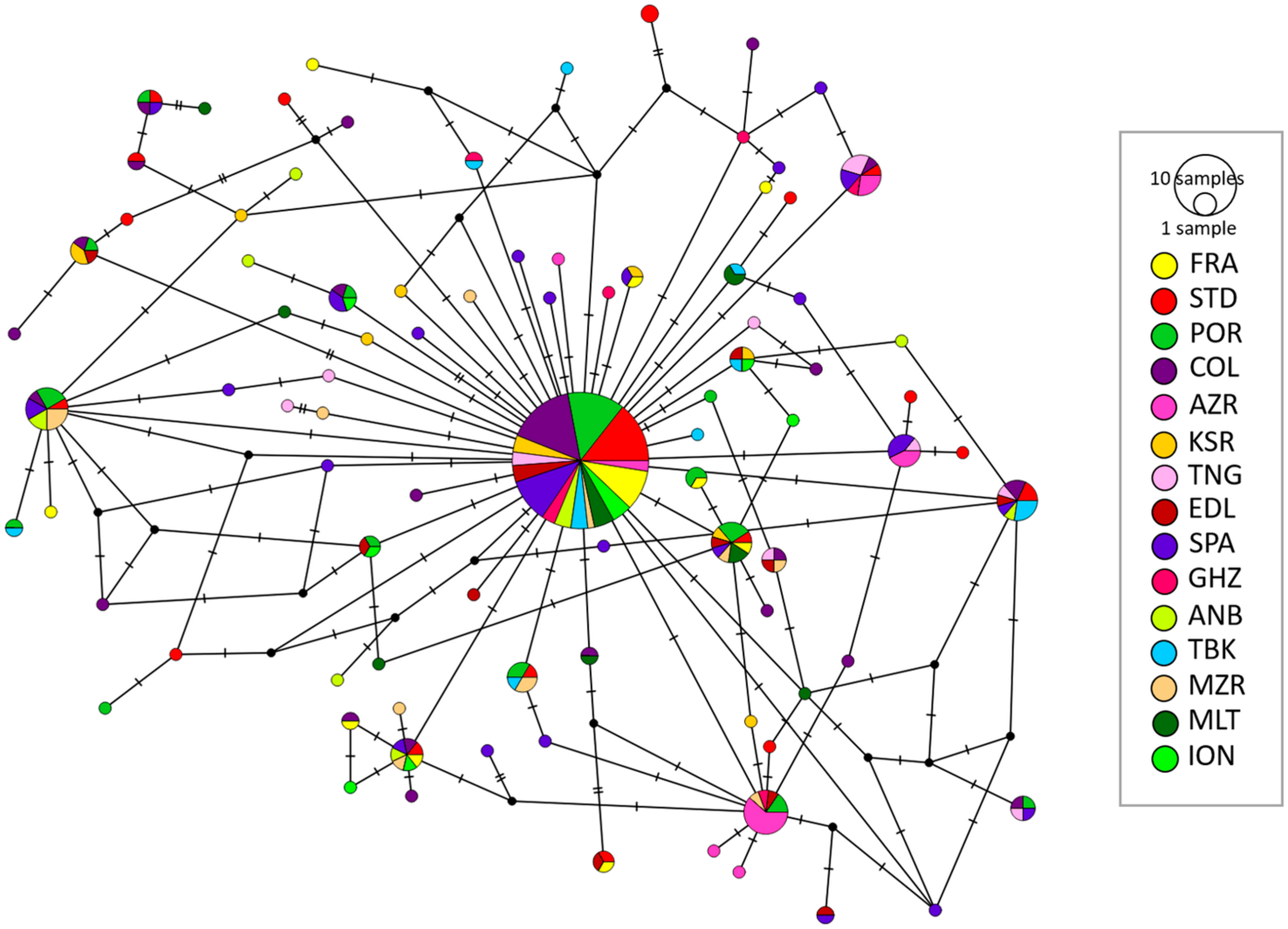
The CR haplotype network showed a star-like pattern, indicating population expansion (Figure 2).
Genetic differentiation analysis revealed that the Azores (AZR) population sample was distinct from several others, as indicated by high and significant ΦST values (p < 0.00047619 after Bonferroni correction). In particular, pairwise comparisons showed significant differentiation between the AZR population and the STD, COL, SPA, ANB, TBK, MLT and FRA populations, with p-values of 0 reported in all cases (see Table S3).
Geographic populations were grouped according to the three different partitioning scenarios described in the “Materials and Methods” section in order to perform the AMOVA analyses (Table 3).
When all populations were considered as a single group (AMOVA 1), most of the molecular variation (97.96%) was found within populations, with only 2.04% of the variation occurring among populations. The fixation index was low but statistically significant (FST = 0.02042, p = 0.00293). Under the six-group scenario (AMOVA 2), the variation among groups was slightly negative (−0.68%) and not significant (FCT = −0.00679, p = 0.61681), indicating no clear differentiation among these groups. Instead, most variation (98.12%) remained within populations, while variation among populations within groups accounted for 2.56% of the total variance and was highly significant (FSC = 0.02546, p < 0.001). In contrast, when the AZR population was treated as a separate group in a seven-group scenario (AMOVA 3), the percentage of variation among groups increased to 2.95% and was statistically significant (FCT = 0.02954, p = 0.00489). Concurrently, the variation among populations within groups decreased to −0.40% (FSC = −0.00167, p = 0.00587), while most of the variation (97.44%) was retained within populations. These results indicate that recognising AZR as a distinct group better captures the genetic differentiation among groups, as reflected by the increased molecular variation among-groups.
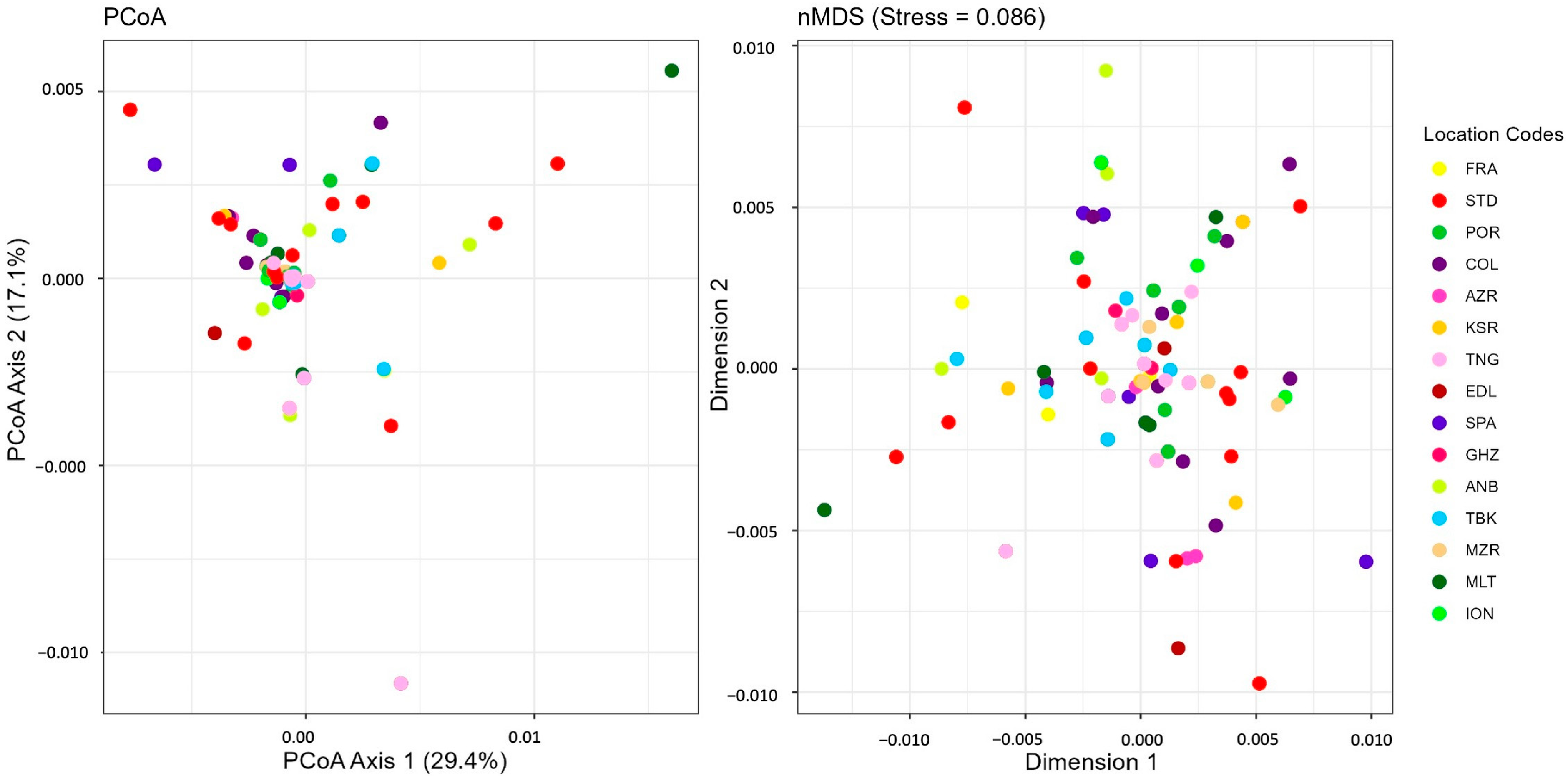
The PCoA and the nMDS analyses did not reveal a clear separation among sample groups based on their geographical origin. The points corresponding to the various categories were distributed in a largely overlapping pattern within the two-dimensional space. Although some groups displayed a few points slightly distanced from others, no strong or well-defined clusters were observed, suggesting that this dispersion is due to a high level of internal genetic variability (Figure 3).
The PERMANOVA did not detect any significant genetic differentiation between populations (pseudo-F = 1.336, p = 0.0513). However, pairwise comparisons revealed significant differences between the Azores and the remaining populations (p < 0.05 after Bonferroni correction). Notably, the test for homogeneity of multivariate dispersion (beta-dispersion) was not significant (F = 0.706, p = 0.768), suggesting that the significant results of the pairwise comparisons are not due to differences in within-group variability. Overall, these findings suggest that genetic homogeneity among most populations may hide signals of differentiation at the global level, but the pairwise analysis highlights the distinctive divergence of the Azores population from all other geographical samples.

4. Discussion

The present study, based on the mitochondrial Control Region (CR) marker, provides novel insights into the phylogeography of P. bogaraveo across its Mediterranean and Atlantic range. By combining previously published sequences produced by Ponce et al. in 2008 [26] and Robalo et al. in 2021 [20], with our newly generated ones, which cover both overlapping and complementary areas, the geographical coverage was expanded to encompass large portions of the western and central Mediterranean Sea with respect to previous studies [18,20].
Our results indicate generally comparable levels of genetic diversity across the sampled regions, with values that are entirely consistent with those obtained by Robalo and colleagues in 2021 [20].
The Azores resulted in being the only area showing significant differentiation from the others in the ΦST analysis. Our global PERMANOVA revealed no significant genetic structure across populations, suggesting a high level of mitochondrial homogeneity within the study area. However, pairwise comparisons confirmed the significant differentiation between the Azores and the other populations. This apparent discrepancy can be explained by the fact that strong homogeneity among most populations tends to hide localised divergence when tested at a global scale, a condition that has been described in other teleost species, even using different types of markers [40,41,42]. The lack of significance in the beta-dispersion test indicates that the observed differences may not be influenced by the heterogeneity in within-group variability, validating the pairwise findings and suggesting that the genetic distinctiveness of Azores reflects a true biological signal rather than a methodological artefact. Further evidence of the genetic distinctiveness of the Blackspot Seabream Azorean populations was described by Cunha and colleagues in 2024 [19], who used whole-genome sequencing SNPs to examine the genetic variation along the Atlantic coast from France to Cadiz, including the Azores. Their analyses identified three distinct genetic units based on fixation indices: (i) the Azores; (ii) the Iberian Atlantic coast from Cantabria to Peniche (Portugal); and (iii) the Gulf of Cadiz.
This is typical of scenarios where most populations experience gene flow or share a common genetic background, while one population (or a small group) undergoes localised divergence. This divergence could be driven by geographic isolation, environmental barriers, and historical demographic events that limit connectivity with neighbouring populations [41,43]. Comparable phylogeographic patterns have also been observed in other species. For instance, da Fonseca et al. in 2024 [40] reported similar genetic structuring in Sardina pilchardus (Walbaum, 1742) across the Eastern Mediterranean and the Azores using whole-genome data. Likewise, in Labridae, populations of Labrus bergylta (Ascanius, 1767) from the Azores were found to be genetically distinct from those in Portugal, Spain, France, Northern Ireland, western Ireland, western Scotland, and southern Norway when the mitochondrial CR was analysed [44]. In addition, this has also been observed in large migrating species: cod species inhabiting fjords showed significant population differentiation from the offshore specimens living on the shelf [45,46].
The observed discrepancy between mitochondrial and nuclear markers is not unexpected, given that these genomic regions have markedly different evolutionary dynamics. Mitochondrial DNA, with its rapid mutation rate, maternal inheritance, lack of recombination and smaller effective population size, often provides a sensitive signal of population differentiation [47]. Conversely, nuclear DNA (nuDNA) markers can offer greater resolution in detecting subtle or fine-scale patterns of genetic structure owing to their higher levels of polymorphism and biparental inheritance [21,22,48].
The effectiveness of mitochondrial markers in detecting population differentiation is attributable to two factors. Firstly, their lower effective population size [49], and secondly, the faster genetic drift, coupled with a significantly higher mutation rate. The latter is approximately five to ten orders of magnitude higher than that of nuDNA [50,51]. It has been demonstrated that this process serves to enhance their discriminatory power [21,22]. Within the mtDNA, the CR is the most rapidly evolving region [52]. These findings highlight the importance of considering both mitochondrial and nuclear markers to fully resolve the population structure of P. bogaraveo.
Among the factors contributing to genetic differentiation in marine fish populations, fishing pressure and resource exploitation, along with regional oceanographic features, are particularly significant [48,53]. The Azores archipelago is recognised as a biodiversity hotspot in the North Atlantic and has also been the focus of recent studies [54,55]. This status is largely due to its geographical isolation, complex geomorphology related to its volcanic origin, temperate climate and diverse habitats [56,57]. These characteristics are reflected in the growing number of recorded endemic species and the discovery of numerous cryptic or sibling species confined to the archipelago [58].
Although detailed information on the circulation around the Azores remains limited, the observed genetic differentiation of P. bogaraveo populations in this region may be strongly influenced by local oceanographic dynamics. Marine currents are known to play a critical role in shaping gene flow, promoting homogenization among populations within the Mediterranean, while the Azores are subject to Atlantic currents with different salinity, density, and temperature characteristics [59]. The structure and dynamics of Azorean populations are particularly influenced by the Azores Front, which is associated with the Azores Current. This acts as a barrier to gene flow through the Mediterranean Outflow Waters (MOW), contributing to the genetic distinctiveness of Azorean populations compared to those in the Mediterranean Sea [59]. Also relevant, the distance between the Azores and the European mainland is likely too big for larvae before they arrive at the size/age of bottom settlement, and is impeded by regional oceanography, triggering low survival according to phenotypic–environment mismatches (PEM, selection bias survival against exogenous colonisers [60]. Indeed, recent research by Nadal et al. (2022) [61] supports this hypothesis and demonstrates that larval dispersal in P. bogaraveo is strongly affected by the prevailing current patterns in the region, underlining the importance of effective fish stock management for the conservation of the species.
Finally, the lack of genetic differentiation over the rest of the Atlantic and Mediterranean samples must be attributed to two complementary processes: the large larval dispersal and a common spawning migration strategy. Recent research on otoliths collected in the known spawning area of the Gibraltar Strait showed contrasting otolith microchemistry composition in the core and the edge of otoliths, suggesting that these potential migrations may also take place at regional scales [24]. In the aforementioned study, large spatial segregation of the sampling was observed in otolith edge microchemistry, with the lack of segregation shown by otolith core microchemistry pointing to a spawning location with a common environmental signal, consistent with the hypothesis that the Strait of Gibraltar is the site of a common spawning aggregation.

5. Conclusions

This study provides a comprehensive assessment of the genetic population structure of P. bogaraveo across nearly its entire distribution range, spanning the Mediterranean Sea to the eastern Atlantic. Our findings, which were based on a wide sampling effort covering a large spatial scale, reveal broad genetic connectivity throughout the Atlantic–Mediterranean region, most likely driven by larval dispersal, but also pinpoint the Azores as a genetically distinct unit. These results emphasise the critical importance of integrating both large-scale connectivity and localised divergence into future fisheries management and conservation strategies.

Supplementary Materials

The following supporting information can be downloaded at: https://www.mdpi.com/article/10.3390/fishes10100527/s1, Table S1: Complete list of individuals’ metadata used in this study; Table S2: Complete list of downloaded Control Region sequences with their Accession Number and newly obtained sequences of this study; Table S3: FST pairwise table.

Author Contributions

Conceptualization, A.F. and A.C.; Data curation, M.S. and G.C.; Formal analysis, M.S. and G.C.; Funding acquisition, A.F. and A.C.; Investigation, M.S. and F.P.; Methodology, M.S. and F.P.; Project administration, M.S. and A.C.; Resources, A.F. and A.C.; Supervision, A.C.; Validation, M.S., F.P. and A.C.; Visualisation, M.S.; Writing—original draft, M.S. and G.C.; Writing—review and editing, M.S., G.C., F.P., A.F., C.J., K.M.-J., M.P., F.F., M.H. and A.C. All authors have read and agreed to the published version of the manuscript.

Funding

This research was funded by the Canziani grant from the University of Bologna assigned to A.C. and A.F.

Institutional Review Board Statement

We declare that the samples of Pagellus bogaraveo individuals analysed in the present work were obtained from commercial and scientific fisheries. The activity was conducted in accordance with the European Union’s Common Fisheries Policy (Regulation (EU) No 1380/2013 of the European Parliament and of the Council of 11 December 2013). The fishing operations involved the harvest of fish through standard practices, which inherently result in mortality. No experimental procedures were conducted on live animals; therefore, ethical approval was not required.

Data Availability Statement

The newly obtained sequences have been deposited in the NCBI GenBank database; accession numbers from PX215809 to PX215998.

Acknowledgments

We are grateful to all TRANSBORAN partners for their collaboration in the collection of P. bogaraveo samples. We sincerely thank Miriam Dominguez Rodriguez, Juan Gil-Herrera, Fatima Wahbi, Meryem Benziane and Sana Khemiri for their assistance in specimen collection, as well as Pilar Hernandez, Marcelo Vasconcellos, Irene Nadal, and Simone Sammartino for their valuable scientific input within the framework of the TRANSBORAN project. Finally, we thank Martina Natalini for her thesis work dedicated to this project.

Conflicts of Interest

The authors declare no conflicts of interest.

References

  1. Belcaid, S.; Benchoucha, S.; Pérez Gil, J.L.; Gil Herrera, J.; González Costas, F.; García Prieto, F.; Talbaoui, E.M.; El Arraf, S.; Hamdi, H.; Abid, N.; et al. Preliminary Joint Assessment of Pagellus Bogaraveo Stock of the Strait of Gibraltar Area between Spain and Morocco (GSAs 01 and 03). Paper Presented at the Working Group on Stock Assessment of Demersal Species (SCSA-SAC, GFCM). FAO-CopeMed II Occas Pap N° 15. Cent. Ocean. Vigo Madr. Spain 2018, 15, 18. [Google Scholar]
  2. Mytilineou, C.; Tsagarakis, K.; Bekas, P.; Anastasopoulou, A.; Kavadas, S.; Machias, A.; Haralabous, J.; Smith, C.J.; Petrakis, G.; Dokos, J.; et al. Spatial Distribution and Life-History Aspects of Blackspot Seabream Pagellus Bogaraveo (Osteichthyes: Sparidae). J. Fish. Biol. 2013, 83, 1551–1575. [Google Scholar] [CrossRef]
  3. Paruğ, Ş.; Cengiz, Ö. The Maximum Length Record of the Blackspot Seabream (Pagellus Bogaraveo Brünnich, 1768) for the Entire Aegean Sea and Turkish Territorial Waters. Turk. J. Agric. Food Sci. Technol. 2020, 8, 2125–2130. [Google Scholar] [CrossRef]
  4. Stockley, B.; Menezes, G.; Pinho, M.R.; Rogers, A.D. Genetic Population Structure in the Black-Spot Sea Bream (Pagellus Bogaraveo Brunnich, 1768) from the NE Atlantic. Mar. Biol. 2005, 146, 793–804. [Google Scholar] [CrossRef]
  5. Chilari, A.; Petrakis, G.; Tsamis, E. Aspects of the Biology of Blackspot Seabream (Pagellus Bogaraveo) in the Ionian Sea, Greece. Fish. Res. 2006, 77, 84–91. [Google Scholar] [CrossRef]
  6. Lorance, P. History and Dynamics of the Overexploitation of the Blackspot Sea Bream (Pagellus Bogaraveo) in the Bay of Biscay. ICES J. Mar. Sci. 2011, 68, 290–301. [Google Scholar] [CrossRef]
  7. Pinho, M.; Diogo, H.; Carvalho, J.; Pereira, J.G. Harvesting Juveniles of Blackspot Sea Bream (Pagellus Bogaraveo) in the Azores (Northeast Atlantic): Biological Implications, Management, and Life Cycle Considerations. ICES J. Mar. Sci. 2014, 71, 2448–2456. [Google Scholar] [CrossRef]
  8. D’Onghia, G.; Indennidate, A.; Giove, A.; Savini, A.; Capezzuto, F.; Sion, L.; Vertino, A.; Maiorano, P. Distribution and Behaviour of Deep-Sea Benthopelagic Fauna Observed Using Towed Cameras in the Santa Maria Di Leuca Cold-Water Coral Province. Mar. Ecol. Prog. Ser. 2011, 443, 95–110. [Google Scholar] [CrossRef]
  9. Sion, L.; Calculli, C.; Capezzuto, F.; Carlucci, R.; Carluccio, A.; Cornacchia, L.; Maiorano, P.; Pollice, A.; Ricci, P.; Tursi, A.; et al. Does the Bari Canyon (Central Mediterranean) Influence the Fish Distribution and Abundance? Prog. Ocean. 2019, 170, 81–92. [Google Scholar] [CrossRef]
  10. Khoukh, M.; Berday, N.; Benziane, M.; Benchoucha, S.; Chiaar, A.; Malouli Idrissi, M. Reproductive Biology of the Blackspot Seabream Pagellus Bogaraveo (Brünnich, 1768) in the Moroccan Mediterranean Side of the Strait of Gibraltar. Cah Biol. Mar. 2021, 62, 175–186. [Google Scholar] [CrossRef]
  11. ICES. Working Group on the Biology and Assessment of Deep-Sea Fisheries Resources (WGDEEP); ICES: Washington, DC, USA, 2024; Volume 6. [Google Scholar]
  12. FAO. Report of the Twenty-Fourth Session of the Scientific Advisory Committee on Fisheries, FAO Headquarters, Rome, Italy, 20–23 June 2023; FAO: Rome, Italy, 2024; Volume 1421, ISBN 978-92-5-138376-6. [Google Scholar]
  13. Sanz-Fernández, V.; Gutiérrez-Estrada, J.C.; Pulido-Calvo, I.; Gil-Herrera, J.; Benchoucha, S.; el Arraf, S. Environment or Catches? Assessment of the Decline in Blackspot Seabream (Pagellus Bogaraveo) Abundance in the Strait of Gibraltar. J. Mar. Syst. 2019, 190, 15–24. [Google Scholar] [CrossRef]
  14. FAO. Scientific Advisory Committee on Fisheries (SAC); FAO: Rome, Italy, 2017; pp. 7–12. [Google Scholar]
  15. Bargelloni, L.; Alarcon, J.A.; Alvarez, M.C.; Penzo, E.; Magoulas, A.; Reis, C.; Patarnello, T. Discord in the Family Sparidae (Teleostei): Divergent Phylogeographical Patterns across the Atlantic-Mediterranean Divide. J. Evol. Biol. 2003, 16, 1149–1158. [Google Scholar] [CrossRef]
  16. Piñera, J.A.; Blanco, G.; Vázquez, E.; Sánchez, J.A. Genetic Diversity of Blackspot Seabream (Pagellus Bogaraveo) Populations Ov Spanish Coasts: A Preliminary Study. Mar. Biol. 2007, 151, 2153–2158. [Google Scholar] [CrossRef]
  17. Lemos, A.; Freitas, A.I.; Fernandes, A.T.; Goncalves, R.; Jesus, J.; Andrade, C.; Brehm, A. Microsatellite Variability in Natural Populations of the Blackspot Seabream Pagellus Bogaraveo (Brunnick, 1768): A Database to Access Parentage Assignment in Aquaculture. Aquac. Res. 2006, 37, 1028–1033. [Google Scholar] [CrossRef]
  18. Ferrari, A.; Spiga, M.; Rodriguez, M.D.; Fiorentino, F.; Gil-Herrera, J.; Hernandez, P.; Hidalgo, M.; Johnstone, C.; Khemiri, S.; Mokhtar-Jamaï, K.; et al. Matching an Old Marine Paradigm: Limitless Connectivity in a Deep-Water Fish over a Large Distance. Animals 2023, 13, 2691. [Google Scholar] [CrossRef] [PubMed]
  19. Cunha, R.L.; Robalo, J.I.; Francisco, S.M.; Farias, I.; Castilho, R.; Figueiredo, I. Genomics Goes Deeper in Fisheries Science: The Case of the Blackspot Seabream (Pagellus Bogaraveo) in the Northeast Atlantic. Fish. Res. 2024, 270, 106891. [Google Scholar] [CrossRef]
  20. Robalo, J.I.; Farias, I.; Francisco, S.M.; Avellaneda, K.; Castilho, R.; Figueiredo, I. Genetic Population Structure of the Blackspot Seabream (Pagellus Bogaraveo): Contribution of MtDNA Control Region to Fisheries Management. Mitochondrial DNA Part A 2021, 32, 115–119. [Google Scholar] [CrossRef]
  21. Chan, A.H.E.; Chaisiri, K.; Saralamba, S.; Morand, S.; Thaenkham, U. Assessing the Suitability of Mitochondrial and Nuclear DNA Genetic Markers for Molecular Systematics and Species Identification of Helminths. Parasites Vectors 2021, 14, 1–13. [Google Scholar] [CrossRef]
  22. Raj, N.; Sukumaran, S.; Jose, A.; Nisha, K.; Roul, S.K.; Rahangdale, S.; Kizhakudan, S.J.; Gopalakrishnan, A. Population Genetic Structure of Randall’s Threadfin Bream Nemipterus Randalli in Indian Waters Based on Mitochondrial and Nuclear Gene Sequences. Sci. Rep. 2024, 14, 7556. [Google Scholar] [CrossRef]
  23. Robalo, J.I.; Castilho, R.; Francisco, S.M.; Almada, F.; Knutsen, H.; Jorde, P.E.; Pereira, A.M.; Almada, V.C. Northern Refugia and Recent Expansion in the North Sea: The Case of the Wrasse Symphodus Melops (Linnaeus, 1758). Ecol. Evol. 2012, 2, 153–164. [Google Scholar] [CrossRef] [PubMed]
  24. Hidalgo, M.; Hernández, P.; Vasconcellos, M. Transboundary Population Structure of Sardine, European Hake and Blackspot Seabream in the Alboran Sea and Adjacent Waters—A Multidisciplinary Approach; FAO: Rome, Italy, 2024; ISBN 978-92-5-138856-3. [Google Scholar]
  25. Bertrand, J.A.; Gil de Sola, L.; Papaconstantinou, C.; Relini, G.; Souplet, A. The General Specifications of the MEDITS Surveys. Sci. Mar. 2002, 66, 9. [Google Scholar] [CrossRef]
  26. Ponce, M.; Infante, C.; Jiménez-Cantizano, R.M.; Pérez, L.; Manchado, M. Complete Mitochondrial Genome of the Blackspot Seabream, Pagellus Bogaraveo (Perciformes: Sparidae), with High Levels of Length Heteroplasmy in the WANCY Region. Gene 2008, 409, 44–52. [Google Scholar] [CrossRef]
  27. Aljanabi, S. Universal and Rapid Salt-Extraction of High Quality Genomic DNA for PCR-Based Techniques. Nucleic Acids Res. 1997, 25, 4692–4693. [Google Scholar] [CrossRef]
  28. Ostellari, L.; Bargelloni, L.; Penzo, E.; Patarnello, P.; Patarnello, T. Optimization of Single-Strand Conformation Polymorphism and Sequence Analysis of the Mitochondrial Control Region in Pagellus Bogaraveo (Sparidae, Teleostei): Rationalized Tools in Fish Population Biology. Anim. Genet. 1996, 27, 423–427. [Google Scholar] [CrossRef]
  29. Tamura, K.; Stecher, G.; Kumar, S. MEGA11: Molecular Evolutionary Genetics Analysis Version 11. Mol. Biol. Evol. 2021, 38, 3022–3027. [Google Scholar] [CrossRef] [PubMed]
  30. Thompson, J.D.; Higgins, D.G.; Gibson, T.J. CLUSTAL W: Improving the Sensitivity of Progressive Multiple Sequence Alignment through Sequence Weighting, Position-Specific Gap Penalties and Weight Matrix Choice. Nucleic Acids Res. 1994, 22, 4673–4680. [Google Scholar] [CrossRef]
  31. Rozas, J.; Ferrer-Mata, A.; Sánchez-DelBarrio, J.C.; Guirao-Rico, S.; Librado, P.; Ramos-Onsins, S.E.; Sánchez-Gracia, A. DnaSP 6: DNA Sequence Polymorphism Analysis of Large Data Sets. Mol. Biol. Evol. 2017, 34, 3299–3302. [Google Scholar] [CrossRef]
  32. Bandelt, H.J.; Forster, P.; Rohl, A. Median-Joining Networks for Inferring Intraspecific Phylogenies. Mol. Biol. Evol. 1999, 16, 37–48. [Google Scholar] [CrossRef]
  33. Leigh, J.W.; Bryant, D. POPART: Full-feature Software for Haplotype Network Construction. Methods Ecol. Evol. 2015, 6, 1110–1116. [Google Scholar] [CrossRef]
  34. Weir, B.S.; Cockerham, C.C. Estimating F-Statistics for the Analysis of Population Structure. Evolution 1984, 38, 1358. [Google Scholar] [CrossRef] [PubMed]
  35. Excoffier, L.; Lischer, H.E.L. Arlequin Suite Ver 3.5: A New Series of Programs to Perform Population Genetics Analyses under Linux and Windows. Mol. Ecol. Resour. 2010, 10, 564–567. [Google Scholar] [CrossRef]
  36. Excoffier, L.; Smouse, P.E.; Quattro, J.M. Analysis of Molecular Variance Inferred from Metric Distances among DNA Haplotypes: Application to Human Mitochondrial DNA Restriction Data. Genetics 1992, 131, 479–491. [Google Scholar] [CrossRef] [PubMed]
  37. Team, R.C. R Core Team R: A Language and Environment for Statistical Computing; R Foundation for Statistical Computing: Vienna, Austria, 2023. [Google Scholar]
  38. Paradis, E.; Schliep, K. Ape 5.0: An Environment for Modern Phylogenetics and Evolutionary Analyses in R. Bioinformatics 2019, 35, 526–528. [Google Scholar] [CrossRef]
  39. Oksanen, J.; Simpson, G.L.; Blanchet, F.G.; Kindt, R.; Legendre, P.; Minchin, P.R.; O’HAra, R.; Solymos, P.; Stevens, M.H.H.; Szoecs, E.; et al. Vegan: Community Ecology Package. Ordination Methods, Diversity Analysis and Other Functions for Community and Vegetation Ecologists; The Comprehensive R Archive Network: Berkeley, CA, USA, 2018. [Google Scholar]
  40. da Fonseca, R.R.; Campos, P.F.; Rey-Iglesia, A.; Barroso, G.V.; Bergeron, L.A.; Nande, M.; Tuya, F.; Abidli, S.; Pérez, M.; Riveiro, I.; et al. Population Genomics Reveals the Underlying Structure of the Small Pelagic European Sardine and Suggests Low Connectivity within Macaronesia. Genes 2024, 15, 170. [Google Scholar] [CrossRef] [PubMed]
  41. Robinet, T.; Roussel, V.; Cheze, K.; Gagnaire, P.A. Spatial Gradients of Introgressed Ancestry Reveal Cryptic Connectivity Patterns in a High Gene Flow Marine Fish. Mol. Ecol. 2020, 29, 3857–3871. [Google Scholar] [CrossRef] [PubMed]
  42. Taylor, M.I.; Lamb, P.D.; Coscia, I.; Murray, D.S.; Brown, M.; Cameron, T.C.; Davison, P.I.; Freeman, H.A.; Georgiou, K.; Grati, F.; et al. High-Density SNP Panel Provides Little Evidence for Population Structure in European Sea Bass (Dicentrarchus Labrax) in Waters Surrounding the UK. ICES J. Mar. Sci. 2025, 82, fsaf064. [Google Scholar] [CrossRef]
  43. Quintela, M.; García-Seoane, E.; Dahle, G.; Klevjer, T.A.; Melle, W.; Lille-Langøy, R.; Besnier, F.; Tsagarakis, K.; Geoffroy, M.; Rodríguez-Ezpeleta, N.; et al. Genetics in the Ocean’s Twilight Zone: Population Structure of the Glacier Lanternfish Across Its Distribution Range. Evol. Appl. 2024, 17, e70032. [Google Scholar] [CrossRef]
  44. Almada, F.; Francisco, S.M.; Lima, C.S.; Fitzgerald, R.; Mirimin, L.; Villegas-Ríos, D.; Saborido-Rey, F.; Afonso, P.; Morato, T.; Bexiga, S.; et al. Historical Gene Flow Constraints in a Northeastern Atlantic Fish: Phylogeography of the Ballan Wrasse Labrus Bergylta across Its Distribution Range. R. Soc. Open Sci. 2017, 4, 160773. [Google Scholar] [CrossRef]
  45. Madsen, M.L.; Nelson, R.J.; Fevolden, S.-E.; Christiansen, J.S.; Præbel, K. Population Genetic Analysis of Euro-Arctic Polar Cod Boreogadus Saida Suggests Fjord and Oceanic Structuring. Polar Biol. 2016, 39, 969–980. [Google Scholar] [CrossRef]
  46. Wenne, R.; Bernaś, R.; Kijewska, A.; Poćwierz-Kotus, A.; Strand, J.; Petereit, C.; Plauška, K.; Sics, I.; Árnyasi, M.; Kent, M.P. SNP Genotyping Reveals Substructuring in Weakly Differentiated Populations of Atlantic Cod (Gadus Morhua) from Diverse Environments in the Baltic Sea. Sci. Rep. 2020, 10, 9738. [Google Scholar] [CrossRef]
  47. Harrison, R.G. Animal Mitochondrial DNA as a Genetic Marker in Population and Evolutionary Biology. Trends Ecol. Evol. 1989, 4, 6–11. [Google Scholar] [CrossRef]
  48. Gandra, M.; Assis, J.; Martins, M.R.; Abecasis, D. Reduced Global Genetic Differentiation of Exploited Marine Fish Species. Mol. Biol. Evol. 2021, 38, 1402–1412. [Google Scholar] [CrossRef]
  49. Shaw, P.W.; Arkhipkin, A.I.; Al-Khairulla, H. Genetic Structuring of Patagonian Toothfish Populations in the Southwest Atlantic Ocean: The Effect of the Antarctic Polar Front and Deep-Water Troughs as Barriers to Genetic Exchange. Mol. Ecol. 2004, 13, 3293–3303. [Google Scholar] [CrossRef] [PubMed]
  50. Allio, R.; Donega, S.; Galtier, N.; Nabholz, B. Large Variation in the Ratio of Mitochondrial to Nuclear Mutation Rate across Animals: Implications for Genetic Diversity and the Use of Mitochondrial DNA as a Molecular Marker. Mol. Biol. Evol. 2017, 34, 2762–2772. [Google Scholar] [CrossRef] [PubMed]
  51. DeSalle, R.; Schierwater, B.; Hadrys, H. MtDNA: The Small Workhorse of Evolutionary Studies. Front. Biosci.—Landmark 2017, 22, 873–887. [Google Scholar] [CrossRef]
  52. Heyer, E.; Zietkiewicz, E.; Rochowski, A.; Yotova, V.; Puymirat, J.; Labuda, D. Phylogenetic and Familial Estimates of Mitochondrial Substitution Rates: Study of Control Region Mutations in Deep-Rooting Pedigrees. Am. J. Hum. Genet. 2001, 69, 1113. [Google Scholar] [CrossRef] [PubMed]
  53. Taboun, Z.S.; Walter, R.P.; Ovenden, J.R.; Heath, D.D. Spatial and Temporal Genetic Variation in an Exploited Reef Fish: The Effects of Exploitation on Cohort Genetic Structure. Evol. Appl. 2021, 14, 1286. [Google Scholar] [CrossRef]
  54. Florencio, M.; Patiño, J.; Nogué, S.; Traveset, A.; Borges, P.A.V.; Schaefer, H.; Amorim, I.R.; Arnedo, M.; Ávila, S.P.; Cardoso, P.; et al. Macaronesia as a Fruitful Arena for Ecology, Evolution, and Conservation Biology. Front. Ecol. Evol. 2021, 9, 718169. [Google Scholar] [CrossRef]
  55. Marques, J.P.; Alves, P.C.; Amorim, I.R.; Lopes, R.J.; Moura, M.; Myers, E.; Sim-sim, M.; Sousa-Santos, C.; Alves, M.J.; Borges, P.A.V.; et al. Building a Portuguese Coalition for Biodiversity Genomics. NPJ Biodivers. 2024, 3, 27. [Google Scholar] [CrossRef]
  56. Sala, I.; Harrison, C.S.; Caldeira, R.M.A. The Role of the Azores Archipelago in Capturing and Retaining Incoming Particles. J. Mar. Syst. 2016, 154, 146–156. [Google Scholar] [CrossRef]
  57. Santos, R.S.; Hawkins, S.; Monteiro, L.R.; Alves, M.; Isidro, E.J. Marine Research, Resources and Conservation in the Azores. Aquat. Conserv. Mar. Freshw. Ecosyst. 1995, 5, 311–354. [Google Scholar] [CrossRef]
  58. Baptista, L.; Curto, M.; Waeschenbach, A.; Berning, B.; Santos, A.M.; Ávila, S.P.; Meimberg, H. Population Genetic Structure and Ecological Differentiation in the Bryozoan Genus Reteporella across the Azores Archipelago (Central North Atlantic). Heliyon 2024, 10, e38765. [Google Scholar] [CrossRef]
  59. Frazão, H.C.; Prien, R.D.; Schulz-Bull, D.E.; Seidov, D.; Waniek, J.J. The Forgotten Azores Current: A Long-Term Perspective. Front. Mar. Sci. 2022, 9, 842251. [Google Scholar] [CrossRef]
  60. Marshall, D.J.; Monro, K.; Bode, M.; Keough, M.J.; Swearer, S. Phenotype–Environment Mismatches Reduce Connectivity in the Sea. Ecol. Lett. 2010, 13, 128–140. [Google Scholar] [CrossRef] [PubMed]
  61. Nadal, A.I.; Sammartino, S.; García-Lafuente, J.; Sánchez Garrido, J.C.; Gil-Herrera, J.; Hidalgo, M.; Hernández, P. Hydrodynamic Connectivity and Dispersal Patterns of a Transboundary Species (Pagellus bogaraveo) in the Strait of Gibraltar and Adjacent Basins. Fish. Ocean. 2022, 31, 384–401. [Google Scholar] [CrossRef]
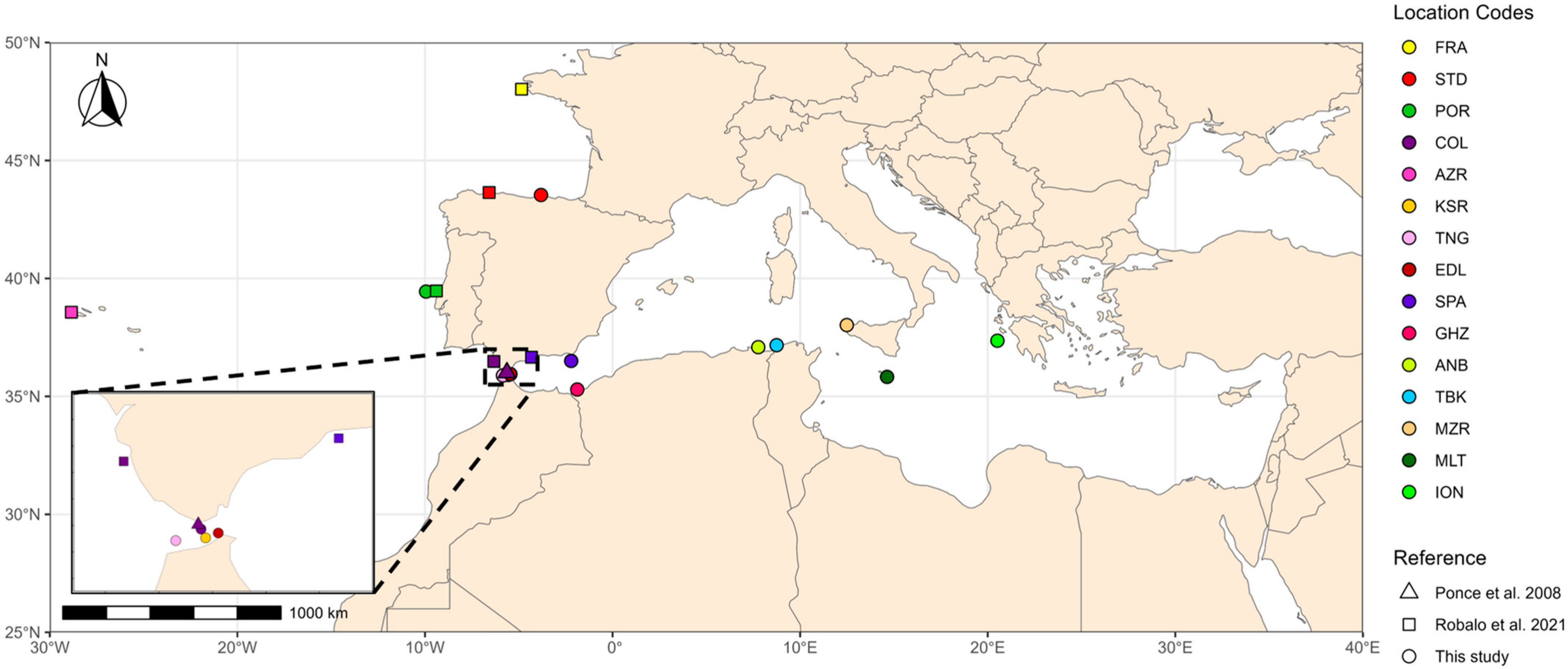
Figure 1. Pagellus bogaraveo samples distribution in the Atlantic Ocean and Mediterranean Sea: the map displays collected samples from this study, from Robalo et al. 2021 [20], and Ponce et al. 2008 [26].
Fishes 10 00527 g001
Figure 2. Median-joining network of Control Region (CR) haplotypes shown by P. bogaraveo. Circles are proportional to haplotype frequencies. Orthogonal bars between branch nodes indicate substitutions. Black circles at network nodes represent unsampled haplotypes. The codes for geographic population samples correspond to the Location Codes listed in Table 1.
Fishes 10 00527 g002
Figure 3. Principal Coordinates Analysis (PCoA) and Non-metric Multidimensional Scaling (nMDS): plots illustrating the genetic relationships among P. bogaraveo populations. Both analyses were performed using R v 4.3. Colours and population names correspond to those used in the haplotype network in Figure 2.
Fishes 10 00527 g003
Table 1. Details of population samples analysed in the present work, with their respective Sampling Location names and codes, Regional Sea and Country.
Regional Sea/Macro AreasCountryLocation CodeThis study *Robalo et al. 2021 [20] *Ponce et al. 2008 [26] *
Atlantic OceanFranceFRA 21
SpainSTD1522
PortugalPOR1425
SpainCOL15232
PortugalAZR 20
Strait of GibraltarMoroccoKSR14
TNG14
EDL15
Alboran SeaSpainSPA-181016
SPA-1915
Alboran Sea/Balearic SeaAlgeriaGHZ9
Balearic SeaANB13
Balearic Sea/Tyrrhenian SeaTunisiaTBK15
Strait of SicilyItalyMZR14
MaltaMLT15
Ionian SeaGreeceION12
Total n°1901272
* The number of individuals in the columns refers to the samples successfully analysed in the present study.
Table 2. Genetic diversity indices: calculated for each population sample of P. bogaraveo using all the 319 individuals.
Population SampleN.nHdSDπ
FRA21110.7810.0940.00438
STD37180.7670.0750.00521
POR37160.8080.0640.00454
COL42240.8390.0580.00543
AZR2070.8050.0680.00321
KSR14100.9230.060.00457
TNG1490.9010.0620.00514
EDL15110.9050.0720.00522
SPA41240.8980.0420.00524
GHZ960.8330.1270.00263
ANB1380.8590.0890.00521
TBK1590.8760.070.00396
MZR14100.9450.0450.00447
MLT1590.8860.0690.00544
ION1270.7730.1280.00379
Total n°319880.8390.0210.00477
N: number of gene copies; n: number of haplotypes; Hd: haplotype diversity; SD: haplotype diversity standard deviation; π: nucleotide diversity.
Table 3. Analysis of molecular variance (AMOVA) results obtained under three different population structure scenarios for P. bogaraveo samples. The grouping of locations for each AMOVA analysis is reported in the Materials and Methods section. * showed the significant results (p-value < 0.05).
AMOVA GroupingPercentage of VariationFixation Indexp-Value
AMOVA 1, one group
Among populations2.04
Within populations97.960.020420.00293 *
AMOVA 2, six groups
Among groups−0.68−0.006790.61681
Among populations within groups2.560.025460
Within populations98.120.018850.00293 *
AMOVA 3, seven groups
Among groups2.950.029540.00489 *
Among populations within groups−0.40−0.001670.00587 *
Within populations97.440.025580.00098 *
Disclaimer/Publisher’s Note: The statements, opinions and data contained in all publications are solely those of the individual author(s) and contributor(s) and not of MDPI and/or the editor(s). MDPI and/or the editor(s) disclaim responsibility for any injury to people or property resulting from any ideas, methods, instructions or products referred to in the content.