
Article

Comparative Critical Thermal and Salinity Maxima of a Threatened Freshwater Killifish and of the Global Invader Eastern Mosquitofish


1
Institute of Marine Biological Resources and Inland Waters, Hellenic Centre for Marine Research, 46.7 km Athens-Sounio Ave., 19013 Anavyssos, Greece
2
Laboratory of Applied Hydrobiology, Department of Animal Science, Agricultural University of Athens, Iera Odos 75, 11855 Athens, Greece
3
Bristol, Clifton & West of England Zoological Society, Hollywood Mansion House, Hollywood Estate, Bristol BS10 7TW, UK
*
Author to whom correspondence should be addressed.
Fishes 2025, 10(10), 526; https://doi.org/10.3390/fishes10100526
Submission received: 11 August 2025 / Revised: 1 October 2025 / Accepted: 7 October 2025 / Published: 16 October 2025
(This article belongs to the Section Biology and Ecology)

Abstract

Invasive fish species are a major driver of freshwater native fish biodiversity loss and their spread and impacts on the native fish are expected to increase within the current freshwater salinization and global warming crisis. In the current study, the upper thermal and salinity tolerance of the geographically range-restricted, threatened killifish Valencia robertae and its alien competitor, the globally invasive Eastern mosquitofish Gambusia holbrooki are compared in an experimental setting. Fish were exposed, after acclimation, to a continuous, dynamic temperature or salinity increase until predefined sub-lethal end points (loss of equilibrium and/or loss of buoyancy). The critical thermal and salinity maxima (CTMax and CSMax) were then calculated as the arithmetic mean of the combined thermal or salinity points at which the endpoint was attained. Finally, thermal and salinity safety margins for the two species were also calculated using abiotic data. Mosquitofish (females and males pooled) showed an average CΤmax of 35.85 °C and the killifish 36.27 °C (sexes pooled). Mosquitofish (male) showed an average CSmax of 40.25‰ and (male) killifish 42.64‰ (sexes also pooled). Killifish safety margins are much higher than those of the mosquitofish. Future impacts of global warming and salinisation on these species and on their interactions under current climate change scenarios are discussed.
Key Contribution: Experimental trials revealed that both the threatened Peloponnese killifish and the invasive Eastern mosquitofish tolerate high temperature and salinity extremes. Climate change, coupled with habitat degradation, however, is likely to favour the invasive mosquitofish, as natural killifish habitats, unlike those of the mosquitofish, remain far below these tolerance thresholds.

1. Introduction

The global trend of salinisation of freshwater ecosystems due to anthropogenic activities is combined with and often accelerated by global warming [1]. Freshwater salinisation and climate change have been identified as main drivers of freshwater biodiversity loss and of its related ecosystem services [2]. Elevated freshwater temperature and salinity can lead to major shifts in freshwater biotic communities, including freshwater fish communities [3,4,5]. Fish are ectothermic and osmoregulated organisms, and consequently, their physiology is intricately linked to the ambient temperature and salinity of their environment, exerting a direct impact on their biological processes. Increased freshwater temperatures and salinity can have profound effects on fish survival, growth, and reproduction, through impacts on their osmoregulation, biochemistry, and stress physiology [6,7,8,9,10,11].
These global environmental changes, however, are also expected to enhance the impacts on freshwater ecosystems of invasive species, one of the leading causes of the decline, range reduction, and, in some cases, extinction of the freshwater fish fauna globally [2,12]. Typically, invasive fish species have much wider environmental tolerances compared with native species, often being able to thrive in degraded habitats [13]. Climate change is expected to increase their colonisation of new habitats by removing current environmental barriers to their expansion and establishment [14,15]. Furthermore, altered thermal and salinity regimes are expected, among others, to alter/enhance the competitive dominance, predation, and/or disease transmission/virulence impacts of invasive species on native species [14,16].
In the current study, we focused on the recently described Peloponnese killifish Valencia robertae, endemic to south-western Greece, encompassing the most southern populations of the genus Valencia in Greece. Valencia robertae, though not yet assessed by IUCN, has been proposed to be assessed as Critically Endangered, with an extent of occurrence smaller than 100 km2 and an area of occupancy less than 10 km2 [17,18]. The Peloponnese killifish has a very fragmented distribution with its southernmost populations extinct or near extinction. The species had a global decline of 91% in the period 2005–2018 [19], attributed to habitat degradation and the global invader, the alien Eastern mosquitofish Gambusia holbrooki (Girard, 1859) that is found in association with the killifish in most of its lowland, freshwater, and brackish habitats [20,21].
To test the hypothesis of elevated temperatures and salinity conferring a competitive advantage on alien invasive fish compared to native fish species through enhanced survival, the upper thermal and salinity tolerance of the threatened freshwater killifish V. robertae and the alien, invasive Eastern mosquitofish G. holbrooki in controlled laboratory experiments were tested as single stressors. Our working hypothesis was that the mosquitofish would exhibit much higher thermal and salinity tolerance compared to the native killifish.

2. Materials and Methods

2.1. Fish Collection and Maintenance

Peloponnese killifish (Valencia robertae) were collected from a stream in Central Greece (Mornos River delta) on 27 November 2018 (103 individuals, size range 10–40 mm, 73 adults >17 mm, 40 females and 33 males) and on 10 October 2019 (39 individuals, size range 17–35 mm, all adults, 16 females and 23 males) using a seine net. Adult Eastern mosquitofish (Gambusia holbrooki) were collected from a small, natural pond near Athens, Attica, with hand nets in September 2019 (60 individuals, 40 females and 20 males, size range 20–45 mm). In the field, water conductivity (μS/cm), pH, and temperature (°C) were measured for the subsequent acclimation of the fish in the laboratory (Table A1).
Killifish were transferred to HCMR laboratories in individual 500 mL plastic containers with oxygen supply, while mosquitofish were transferred in a single 30 L container with oxygen supply, due to the close proximity of the collection site. After arrival at the laboratory, with zero mortalities recorded, and following acclimatisation, killifish and mosquitofish were placed in separate 180 L tanks with water maintained at temperature 20 °C, pH 8.16, and conductivity 1000 µS/cm. These values are well within the range of water parameters found in both species’ natural habitats (see Table A1). Artificial lighting with two T5 daylight 39 W, 3000 lux (at the surface) bulbs followed natural photoperiod. Fish were provided with live Ceratophyllum sp. floating plants, while a thin layer of natural gravel was placed at the bottom of the tanks. Fish were fed with commercial fish food (Sera Vipagran and Vipan, Sera GmbH, Immenhausen, Germany) once a day ad libitum. All individuals were thus acclimated under standardised laboratory conditions (temperature, salinity, diet, and photoperiod) prior to the trials to minimise potential carry-over effects from pre-experimental environmental history.

2.2. Thermal Exposures

Resistance to different temperatures in fish can be quantified in the laboratory in three different ways: (a) the incipient lethal temperature (ILT) methodology, i.e., the temperature lethal to 50% of a fish sample, (b) the chronic lethal maximum temperature (CLM) methodology in which fish are exposed to very slow increases (°C/day) until mortality occurs, and (c) the critical thermal maximum (CTMax) methodology, where individual fish are subjected to a constant rate (°C/min) until physical disruption (e.g., loss of equilibrium) but before mortality.
In the current study, the critical thermal maxima (CTMax) methodology was applied [22]. For thermal exposures, the same 12 l tank (30 × 18.5 × 26 cm) was used, equipped with an air supply (Sera air 275 R plus air pump, Sera GmbH, Heinsberg, Germany), which helped in the oxygenation and the continuous stirring of the water. All sides of the tank, except the front, were covered with Styrofoam sheets for insulation and for minimising fish visual stress [23]. Prior to each thermal exposure, the experimental tank was filled up to the 7.5 l mark with 50% water from the respective species’ holding tank (water temperature 20 ± 0.5 °C) and with 50% fresh dechlorinated water of the same temperature.
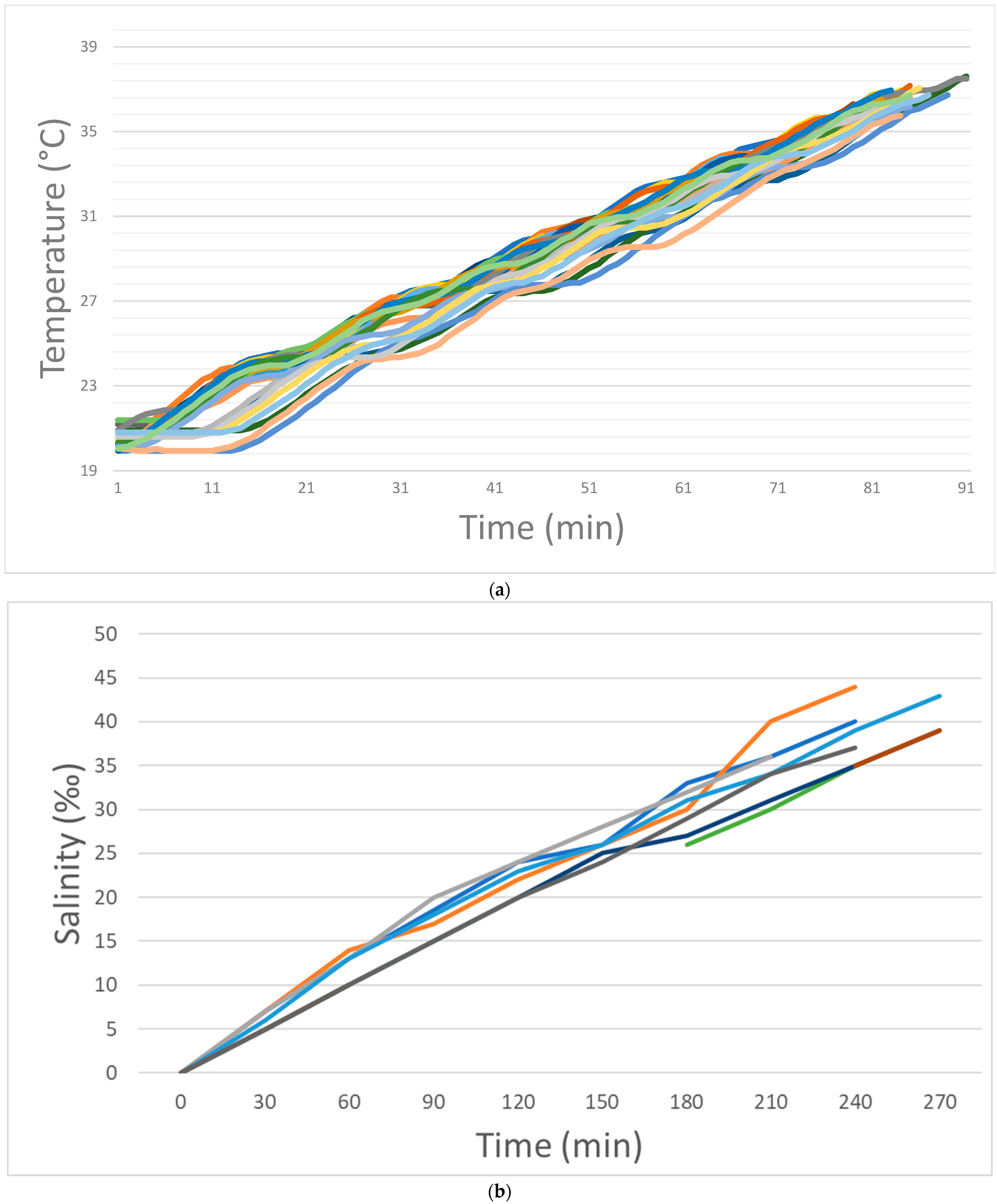
A titanium heater (300W, Schego Schemel & Goetz GmbH, Offenbach am Main, Germany) was placed in the tank, which was divided into two sections by a plastic mesh measuring 29 × 25 cm (with a mesh hole size of 0.5 × 0.5 cm) to separate the equipment at the back (heater; air-stone) from the rest of the tank in order to prevent the fish from coming into contact with the heater. The heater was regulated by a digital temperature controller (STC-1000, Xuzhou Haswell Trade Co. Ltd., Xuzhou, China) custom-programmed for a steady linear temperature increase of 1 °C every 5 min (Figure 1a). A temperature recorder (Hobo Data Logger, Onset Computers Corporation, Bourne, MA, USA) was also placed in the tank, obtaining one temperature measurement per minute for a more accurate measurement of the temperature increase. During the experiments, oxygen saturation was almost 100%.
At each thermal exposure, two fish of the same species and sex (with the exception of one thermal killifish experiment where one female and one male were used) were placed in the tank (both species are highly social; thus, adding a companion fish in the tank was expected to lower ambient stress from handling and introduction to a novel environment). It should be noted that both species exhibit sexual dimorphism, thus enabling sex identification. After a 20 min acclimatization period, fish were exposed to the gradual temperature increase to determine upper temperature tolerance using the critical thermal maximum methodology (CTMax: [24]). During each trial, fish were continuously monitored visually through a webcam, and the behavioural endpoint (at which the trial for each fish ended) was the loss of equilibrium (LOE, i.e., the fish losing the ability to hold its upright position in the water column and typically taking a fully horizontal position or tumbling), a common sub-lethal CTMax endpoint used to determine ecological upper thermal tolerance [23,24]. The thermal ramping rate of 0.2 °C/min and standardised endpoint of loss of equilibrium were based with modifications on [24,25,26]. This end point of the experiment was chosen to avoid mortalities; in this state, fish are generally rendered incapable to avoid predation or other external threats, and can thus be considered moribund [27]. Once a fish experienced LOE, it was removed from the experimental tank (removal temperature recorded) and placed in a small plastic container filled ¼ with holding tank water (at 20 °C) and ¾ with experimental tank water (at removal temperature). They were then weighted and photographed. After 20–30 min, there was gradual water change with water from the holding water tank to reach a temperature of 20 °C. The fish were then transferred to the monitoring tank (with similar conditions with holding tank). They were closely monitored for one week for any mortalities or signs of health deterioration.
A total of 32 thermal trials (with 21 male and 11 female V. robertae fish and 16 male and 16 female G. holbrooki fish) were conducted in June 2020; all fish were naïve; i.e., all fish were used for a single thermal trial. Each experiment was recorded with a digital camera (c270, Logitech Europe S.A., Ecublens, Swizerland) for later analysis.

2.3. Salinity Exposures

Upper salinity tolerance in each species using the critical salinity maxima methodology was determined (CSMax, [7]). The same insulated tank, described above, equipped with air supply was used for the salinity trials. Prior to each salinity exposure, the experimental tank was filled with 50% water from the respective species’ holding tank (salinity 0.7‰ in the killifish tank and 0.4‰ in the mosquitofish tank) and with 50% dechlorinated water (salinity 0.2‰) at a 20 °C temperature. Saltwater was then prepared by dissolving natural coarse sea salt in dechlorinated water to achieve a final concentration of 300‰.
A custom-built dosing system, consisting of a peristaltic pump (12V DC, 5000 rpm, Shenzhen Qidike Technology Co., Ltd., Shenzhen, China) controlled by an Arduino board (Uno R3, ATMEGA328P chip, Arduino SA, Chiasso, Switzerland) through an L298N motor driver module, was used for gradually increasing the salinity with highly concentrated saltwater (300‰). The pump infused 5 mL of saltwater per minute with a salinity increase rate of approx. 10‰/h (Figure 1b). Salinity was monitored during each experiment using a Salinity Refractometer (RHSN-10ATC, Sinotec, Zhangzhou, China) with salinity range 0–100ppt and resolution 1‰. Conductivity/TDS and pH were monitored with a portable coducticity/pH tester (HI98129 – EC range: 0 to 3999 µS/cm, Hanna Instruments Inc., Woonsocket, RI, USA).
At each salinity exposure, we placed two fish of the same species and sex in the tank (with one exception due to the odd number of fish available); as both species are highly social, adding a companion fish in the tank was expected to lower ambient stress from handling and introduction to a novel environment. After a 20 min acclimatization period, each fish pair was exposed to the gradual salinity increase and monitored for signs of stress-related behaviour. The behavioural sub-lethal endpoints were loss of equilibrium and loss of buoyancy [28,29]. When the ability to maintain their position in the water was completely lost, fish were removed (removal salinity recorded), weighed, and photographed. They were then placed in a tank where there was aeration and the water had the same temperature as the experimental tank but the salinity was at 15‰. After 20–30 min, there was a gradual water change with water from the holding tank to reach the same value of salinity. All the fish were transferred to a separate aquarium to monitor mortality, health deterioration, stress, or loss of appetite for four weeks. The fish were then transferred to the monitoring tank (with similar conditions with the holding tank).
A total of 12 salinity trials (with 11 male V. robertae fish and 12 male G. holbrooki fish) were conducted between September 2020 and January 2021; all fish were naïve; i.e., all fish were used for a single salinity trial. Each experiment was recorded with a digital camera (c270, Logitech Europe S.A., Ecublens, Switzerland) for later analysis.
During the experiments, pH ranged from 8.07 (at salinity 10‰) to 7.91 (at salinity 40‰), indicating that the behavioural changes observed during the experiments were due to the increase in water salinity.

2.4. Pilot Experiments

Pilot experiments were initially carried out without fish to ensure a smooth increase in temperature and salinity over time and to prevent mortalities. Prior to the thermal exposure experiment, one pilot thermal experiment with the Peloponnese killifish (a pair of males) and three pilots with mosquitofish (two pilots with pairs of females and one pilot with a pair of males) were conducted with no mortalities. Therefore, both male and female fish were used in the main thermal experiments.
For the salinity exposure, again to prevent mortalities, three pilot trials were conducted with three pairs of female mosquitofish; the first trial resulted in the death of both fish, and the second and third trial resulted in the death of one of the two fish used per trial. One pilot experiment with one male killifish, with no mortality, was also conducted. Therefore, only male mosquitofish and male killifish were used in the main salinity experiment.

2.5. Thermal Safety Margins

Thermal safety margins (TSM), i.e., TSM = CTMax – Thabmax, were calculated for the killifish and the mosquitofish to obtain an indication of the proximity of the maximum habitat temperature (Thabmax) to their upper thermal limits (CTMax) in an experimental setting. This indicates their susceptibility or capacity to adapt to climate change-induced water temperature changes [23,30,31]. Based on the available literature, Thabmax for the mosquitofish (G. affinis) is 44.5 °C [32,33], while for the killifish (V. letourneuxi) Thabmax is 22 °C [20], and thus these values were used for the calculation of TSMs.

2.6. Salinity Safety Margins

Salinity safety margins (SSM), i.e., SSM = SMax – Salmax, were calculated for the killifish and the mosquitofish to obtain an indication of the proximity of their maximum habitat salinity (Salmax) and their upper salinity limits in an experimental setting. This indicates their susceptibility or capacity to adapt to climate change-induced water salinity changes (Caparelli et al. 2022 with modifications) [31]. Based on the available literature, Salmax for the mosquitofish is 41‰ (Pyke 2008) [33] and 7.5‰ for the killifish (V. letourneuxi, [20]), and thus these values were used for the calculation of SSMs.

2.7. Statistical Analyses

Data normality and homoscedasticity were assessed using Shapiro–Wilk’s and Levene’s tests, respectively, to examine whether ANOVA assumptions were met. Thermal tolerance data were analysed by means of two-way ANOVA, followed by Tukey HSD post hoc tests for group comparisons (species and sex groups). The relationship between body mass and removal temperature was tested with Pearson’s correlation. Salinity tolerance data were non-normal in the case of Gambusia group; thus, they were analysed using the Kruskal–Wallis non-parametric test. The relationship between body mass and removal salinity was tested with Spearman’s correlation. Tests were conducted with Stata 18 (Stata Corp, College Station, TX, USA). Plots were created with Language R (version 4.1, R Core Team 2021).

3. Results

3.1. Thermal Exposures

Mean removal temperatures (mean CTMax values) were similar for all groups tested, while body mass was much lower in male mosquitofish (Table 1).
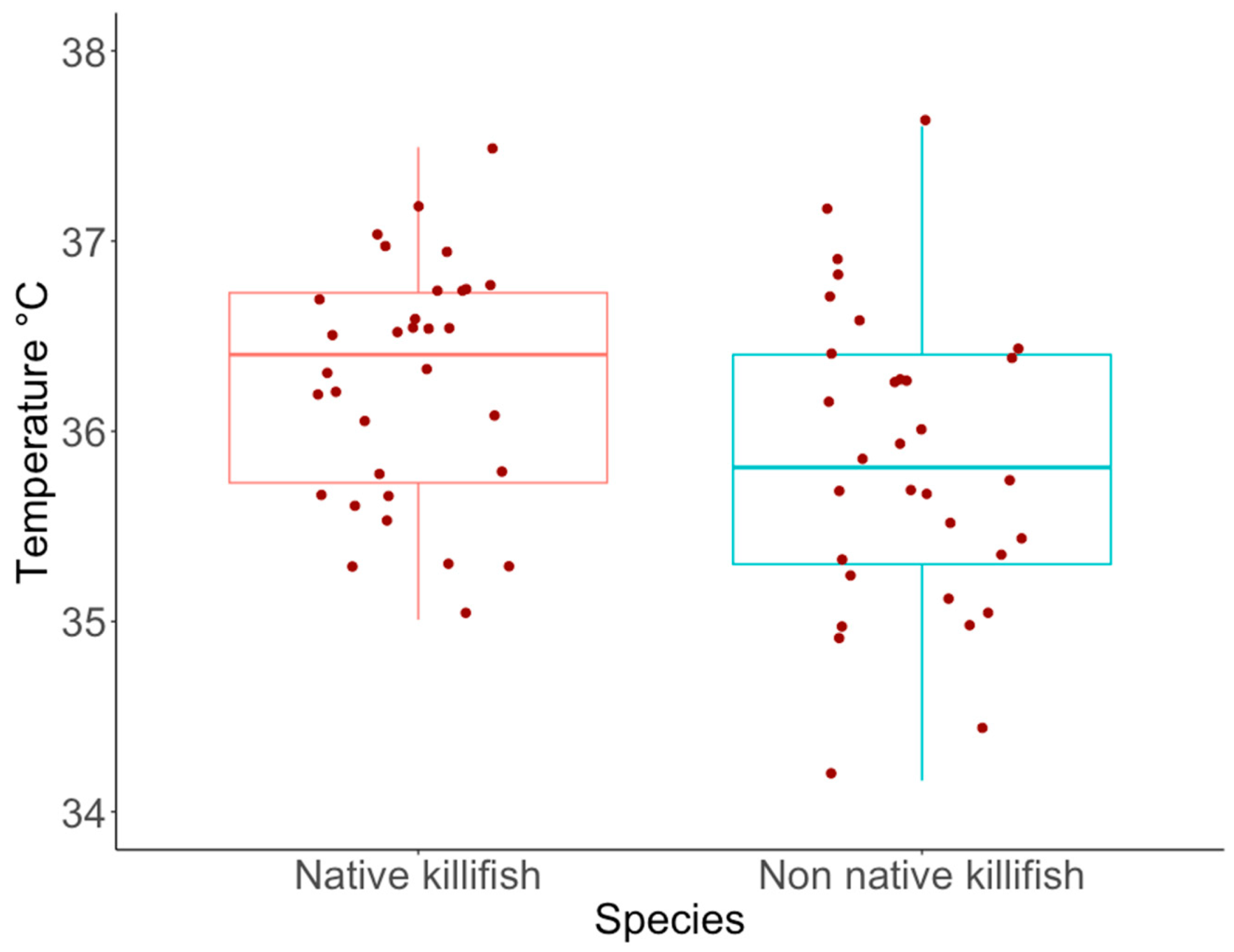
Two-way ANOVA test revealed significant species effects (F= 5.07; p = 0.028) and sex-by-species interaction effects (F = 9.73; p = 0.003), but no significant sex-specific effects. More specifically, mosquitofish (females and males pooled) showed average CΤmax 35.85 ± 0.80 °C and the killifish 36.27 ± 0.62 °C, (sexes pooled; Figure 2). Killifish removal temperature (sexes pooled) was significantly higher (Tukey test, p < 0.05) than mosquitofish removal temperature.
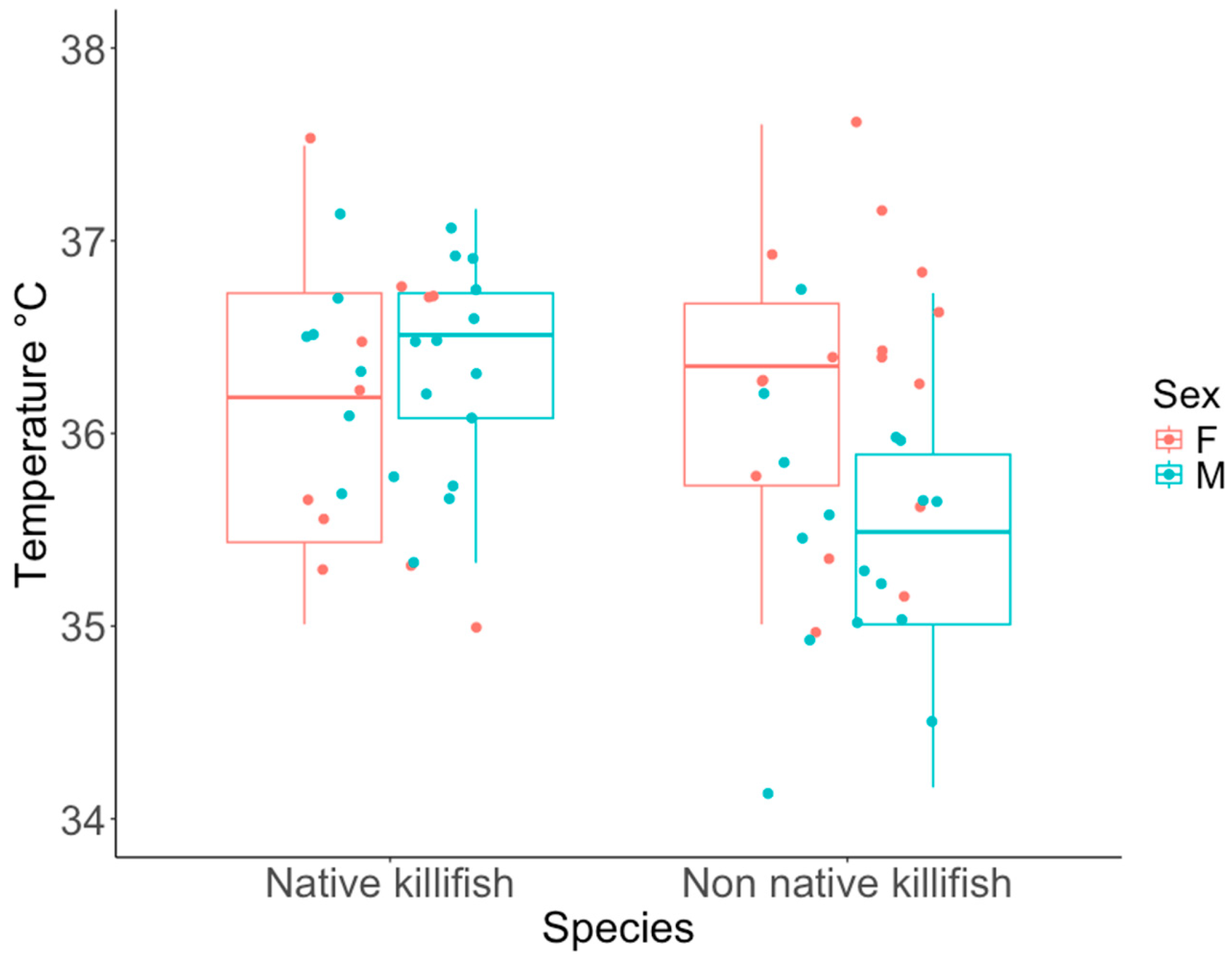
Male mosquitofish showed an average CΤmax of 35.44 °C, male killifish 36.35 °C, female killifish 36.11 °C, and female mosquitofish 36.26 °C (Figure 3); Tukey HSD analysis showed statistically significant differences in removal temperature between male killifish and male mosquitofish (Tukey test, p ≤ 0.05) and between female mosquitofish and male mosquitofish (Tukey test, p ≤ 0.05)
There was no statistically significant correlation between fish weight and removal temperature when tested with Pearson’s test (p > 0.05). No mortalities were observed either during or after the thermal experiments.

3.2. Salinity Exposures

There were significant species-specific effects as the (male) mosquitofish average CSmax (40.25‰) differed significantly from the (male) killifish average CSmax (42.64‰; Kruskal–Wallis test H = 5.322; df 1; p < 0.05).
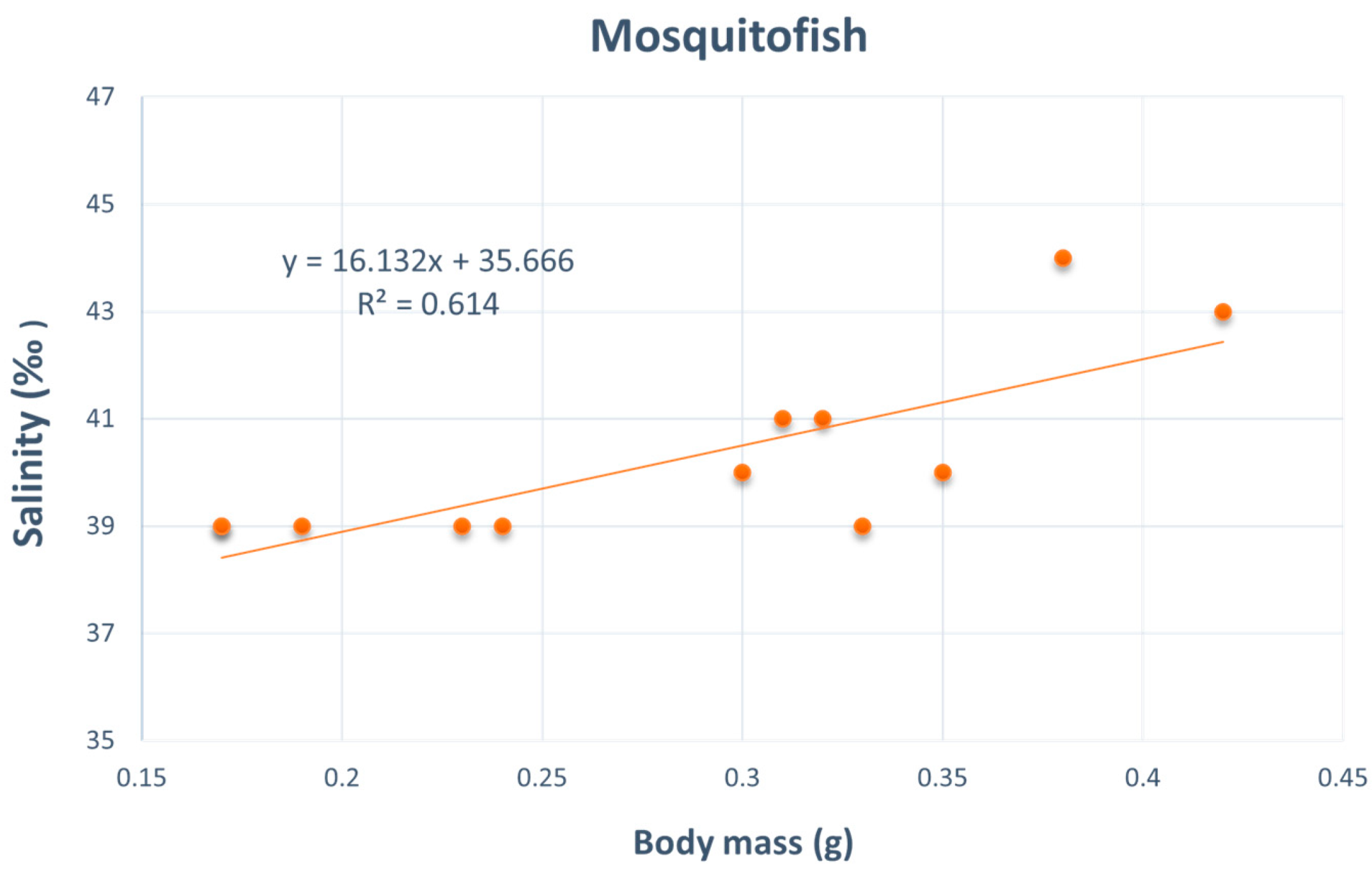
Also, Spearman’s test revealed a positive correlation between removal salinity and body weight in male mosquitofish (Figure 4; Spearman’s r = 0.78; p = 0.01; n = 12). No mortalities were observed either during or after the salinity experiments.

3.3. Thermal and Salinity Safety Margins

Based on the results, the TSM (TSM = CTMax − Thabmax) for the mosquitofish is 8.65 °C (35.85 °C in experimental settings versus 44.5 °C in nature) and for the killifish it is 13.27 °C (36.27 °C in experimental settings versus 22 °C in nature). The SSM (SSM = SMax − Salmax) for the mosquitofish is 0.75‰ (40.25‰ in experimental settings versus 41‰ in nature) and for the killifish it is 35.14‰ (42.64‰ in experimental settings versus 7.5‰ in nature).

4. Discussion

The original hypothesis was that the highly expansive mosquitofish would have greater resistance to extreme temperatures and salinities in an experimental set-up. Contrary to initial assumptions, the results showed that the Greek killifish can also reach similar thermal limits to the mosquitofish in the current experimental setting with a non-lethal behavioural endpoint. The merits of the CTM and CSM approach, as opposed to the ILT methodology, are obvious as we avoid mortalities, whereas the use of the CLM methodology is extremely time-consuming and logistically demanding. In short, CTM and CSM strike a balance between ecological relevance, experimental feasibility, and animal welfare. Nevertheless, whatever the method applied to quantify thermal and salinity resistance in fish, it is recommended to clearly distinguish between acute and chronic exposures, to apply ecologically realistic but well-controlled conditions, including solving practical problems of chronic exposure experiments, such as fish feeding, and to standardise the rates of change in temperature and salinity.
While there is no bibliographical information on the thermal tolerance of members of the Valenciidae family, there are studies with varying experimental set-ups providing information on the thermal limits of poeciliids; for example, Pacher et al. (2024) [34], using a set-up similar to that of the current study (with a heating rate of 0.4 °C min−1), indicated a CTMax for the related species Gambusia eurytstoma of 41.2 °C, close to the upper thermal limits of other poecilids). Concerning salinity tolerance, Bianco and Nordlie (2008) [35], in an experimental setting with a lethal endpoint, found that the related Corfu killifish Valencia letourneuxi had an upper lethal limit of 46‰, while Nordlie and MIrandi (1996) [36], in an experimental setting with 50% percent survival as the endpoint, indicated that the Eastern mosquitofish had an upper salinity limit of 25‰. In contrast, Chervinski (1983) [37], using a set-up of long adaptation and exposure periods, showed that the Western mosquitofish can tolerate up to 39–58‰, while Tumlison (2017) [38] showed that it can survive salinities much exceeding 33‰. The above indicate that it is very difficult to make any interspecies comparisons of thermal and salinity tolerance, unless they are treated with exactly the same experimental protocol, as in the frame of the current study.
In contrast, both thermal and salinity safety margins of the mosquitofish are much lower compared to the killifish. This indicates that the mosquitofish occupies habitats in nature that approach the species critical thermal and salinity limits, while the killifish is absent from habitats well within its thermal and salinity limits [20,33]. It is postulated that there are environmental and/or physiological factors that prevent the Greek killifish from occupying waters approaching its upper limits. More specifically, its absence from higher temperature habitats may be due to their higher degradation and usual eutrophication, mostly from agricultural pollution, as well as lower oxygen content; a recent study has shown that eutrophication is a leading factor in the decline of the Greek killifish [19]. Thus, the Peloponnese killifish is mostly found in karstic spring-fed, oligotrophic systems with high dissolved oxygen concentration and relatively low and stable temperatures in the summer [20]. Its absence from more saline habitats may be due to lower food availability and diversity in these habitats, as indicated by comparative trophic studies of killifish populations inhabiting freshwater and brackish systems [39]. Also, brackish waters are at the lower section of the river drainage basins and thus characterised by higher water pollution, limiting the colonisation by the killifish.
Current climate change scenarios predict higher average temperatures in Mediterranean lowland areas, where the killifish and mosquitofish now co-exist and where maximum temperatures are around 20 °C. It is reasonable to assume that the gradual increase in maximum temperature will confer an advantage to the mosquitofish, based on its ecology. More specifically, in the Western mosquitofish, an increase in water temperature from 20 °C to 30 °C caused a decrease in mean age at first reproduction (from 191 to 56 days) and an increase in brood size and mass of offspring [40]. Furthermore, Meffe (1992) [41] showed that the Eastern mosquitofish grew faster and matured at a younger age and at a smaller size when living at 32 °C compared to fish living at 25 °C. Climate change will also cause milder winters in the Mediterranean that will probably also increase the reproductive period and the growth period of the mosquitofish, which currently is limited to the summer months [42,43].
Also, the viviparity of the mosquitofish [44] versus the oviparity of the killifish would probably confer an additional advantage to the alien species in the case of a stochastic event, involving a sudden increase in water temperature or even desiccation due to climate change. Moreover, studies have shown that an increase in temperature increases the aggressiveness of the mosquitofish [45].
Similarly, climate change scenarios also predict higher average salinities in Mediterranean lowland areas, where the two species currently co-exist, and where now maximum salinities do not exceed 5‰ [20]. However, an increase in salinity in their natural habitats will impose a metabolic stress on both species, while the direct aggressive behaviour of the mosquitofish towards heterospecifics will possibly decrease, as shown elsewhere experimentally [45,46].

5. Conclusions

In conclusion, experimental data indicate that the Peloponnese killifish can tolerate similar temperatures and salinities compared to the invasive Eastern mosquitofish. In nature, however, the Peloponnese killifish is not found at even remotely close to these high temperature and salinity values, unlike the invasive Eastern mosquitofish which has been found to survive very close to its maximum values. Thus, if the climate change models are confirmed in the coming years with an increase in temperature and salinity in lowland areas, exacerbated by increased degradation through pollution, this will favour the mosquitofish at the expense of the Peloponnese killifish [47,48,49,50,51].

Author Contributions

Conceptualization, Y.K., I.L. and E.K.; Methodology, Y.K., I.L. and E.K.; Software, I.L. and N.K.; Validation, N.K. and B.Z.; Formal Analysis, Y.K.; Investigation, Y.K.; Resources, Y.K., B.Z. and E.K.; Data Curation, I.L. and E.K.; Writing—Original Draft, Y.K., I.L. and E.K.; Writing—Review and Editing, Y.K., N.K., B.Z. and E.K.; Visualization, I.L.; Supervision, Y.K., I.L., N.K. and E.K.; Project Administration, Y.K., B.Z. and E.K.; Funding Acquisition, B.Z. and E.K. All authors have read and agreed to the published version of the manuscript.

Funding

This research received no external funding.

Institutional Review Board Statement

The animal study protocol was approved by the Greek Ministry of Environment, Energy and Climate Change (protocol code: 143634/1894/20-7-2016; approval date: 20 July 2016).

Informed Consent Statement

Not applicable.

Data Availability Statement

The original contributions presented in this study are included in the article. Further inquiries can be directed to the corresponding author.

Acknowledgments

The authors wish to thank P. Kouraklis for assistance in fish collection. This work was conducted within the frame of project DECAGON funded by the A.G. Leventis Foundation and the Zoological Society of London (ZSL). This work forms part of the Ph.D. thesis of Y. Kapakos at the Department of Animal Science, Agricultural University of Athens (AUA).

Conflicts of Interest

The authors declare no conflicts of interest.

Appendix A

Table A1. Water physicochemical characteristics at the collection sites and the holding facilities.
Hydrographic BasinConductivitypHWater Temperature
Mornos (2018)653 μS/cm8.1018.5 °C
Mornos (2019)633 μS/cm6.9517.5 °C
Attica (2019)1102 μS/cm7.9124 °C
Holding tanks
Tank 11000 µS/cm8.1620 °C
Tank 21000 µS/cm8.1620 °C

References

  1. Cunillera-Montcusí, D.; Beklioğlu, M.; Cañedo-Argüelles, M.; Jeppesen, E.; Ptacnik, R.; Amorim, C.A.; Arnott, S.E.; Berger, S.A.; Brucet, S.; Dugan, H.A.; et al. Freshwater salinisation: A research agenda for a saltier world. Trends Ecol. Evol. 2022, 37, 440–453. [Google Scholar] [CrossRef] [PubMed]
  2. Reid, A.J.; Carlson, A.K.; Creed, I.F.; Eliason, E.J.; Gell, P.A.; Johnson, P.T.J.; Kidd, K.A.; MacCormack, T.J.; Olden, J.D.; Ormerod, S.J.; et al. Emerging threats and persistent conservation challenges for freshwater biodiversity. Biol. Rev. 2019, 94, 849–873. [Google Scholar] [CrossRef]
  3. Herbert, E.R.; Boon, P.; Burgin, A.J.; Neubauer, S.C.; Franklin, R.B.; Ardón, M.; Hopfensperger, K.N.; Lamers, L.P.M.; Gell, P. A global perspective on wetland salinization: Ecological consequences of a growing threat to freshwater wetlands. Ecosphere 2015, 6, 1–43. [Google Scholar] [CrossRef]
  4. Parmesan, C. Ecological and evolutionary responses to recent climate change. Annu. Rev. Ecol. Evol. Syst. 2006, 37, 637–669. [Google Scholar] [CrossRef]
  5. Johnson, M.F.; Albertson, L.K.; Algar, A.C.; Dugdale, S.J.; Edwards, P.; England, J.; Gibbins, C.; Kazama, S.; Komori, D.; MacColl, A.D.; et al. Rising water temperature in rivers: Ecological impacts and future resilience. Wiley Interdiscip. Rev. Water 2024, 11, e1724. [Google Scholar] [CrossRef]
  6. Clarke, A.; Johnston, N.M. Scaling of metabolic rate with body mass and temperature in teleost fish. J. Anim. Ecol. 1999, 68, 893–905. [Google Scholar] [CrossRef]
  7. Jian, C.Y.; Cheng, S.Y.; Chen, J.C. Temperature and salinity tolerances of yellowfin sea bream, Acanthopagrus latus, at different salinity and temperature levels. Aquac. Res. 2003, 34, 175–185. [Google Scholar] [CrossRef]
  8. Alfonso, S.; Gesto, M.; Sadoul, B. Temperature increase and its effects on fish stress physiology in the context of global warming. J. Fish Biol. 2021, 98, 1496–1508. [Google Scholar] [CrossRef] [PubMed]
  9. Mattioli, C.C.; Takata, R.; Leme, F.O.P.; Costa, D.C.C.; Luz, R.K. Response of juvenile Lophiosilurus alexandri to osmotic and thermic shock. Fish Physiol. Biochem. 2019, 46, 51–61. [Google Scholar] [CrossRef]
  10. Cereja, R. Critical thermal maxima in aquatic ectotherms. Ecol. Indic. 2020, 119, 106856. [Google Scholar] [CrossRef]
  11. Pleizier, N.; Schwieterman, G.D.; Birnie-Gauvin, K.; Blewett, T.A.; Dressler, T.L.; Hardison, E.A.; Jeffries, K.M.; Kraskura, K.; Teffer, A.K.; Van Wert, J.C.; et al. Conservation physiology of freshwater fishes: An illustration of pressing questions and implications for management. Conserv. Physiol. 2025, 13, coaf057. [Google Scholar] [CrossRef]
  12. Rilov, G.; Canning-Clode, J.; Guy-Haim, T. Ecological impacts of invasive ecosystem engineers: A global perspective across terrestrial and aquatic systems. Funct. Ecol. 2024, 38, 37–51. [Google Scholar] [CrossRef]
  13. Gozlan, R.E.; Andreou, D.; Asaeda, T.; Beyer, K.; Bouhadad, R.; Burnard, D.; Caiola, N.; Cakic, P.; Djikanovic, V.; Esmaeili, H.R.; et al. Pan-continental invasion of Pseudorasbora parva: Towards a better understanding of freshwater fish invasions. Fish Fish. 2010, 11, 315–340. [Google Scholar] [CrossRef]
  14. Rahel, F.J.; Olden, J.D. Assessing the effects of climate change on aquatic invasive species. Conserv. Biol. 2008, 22, 521–533. [Google Scholar] [CrossRef]
  15. Pratchett, M.S.; Bay, L.K.; Gehrke, P.C.; Koehn, J.D.; Osborne, K.; Pressey, R.L.; Sweatman, H.P.A.; Wachenfeld, D. Contribution of climate change to degradation and loss of critical fish habitats in Australian marine and freshwater environments. Mar. Freshw. Res. 2011, 62, 1062–1081. [Google Scholar] [CrossRef]
  16. Hellmann, J.J.; Byers, J.E.; Bierwagen, B.G.; Dukes, J.S. Five potential consequences of climate change for invasive species. Conserv. Biol. 2008, 22, 534–543. [Google Scholar] [CrossRef]
  17. Freyhof, J.; Bergner, L.; Ford, M. Threatened Freshwater Fishes of the Mediterranean Basin Biodiversity Hotspot: Distribution, extinction risk and the impact of hydropower. EuroNatur RiverWatch 2020, i–viii, 1–348. [Google Scholar] [CrossRef]
  18. Oikonomou, A.; Leprieur, F.; Leonardos, I.D. Biogeography of freshwater fishes of the Balkan Peninsula. Hydrobiologia 2014, 738, 205–220. [Google Scholar] [CrossRef]
  19. Kalogianni, E.; Kapakos, Y.; Oikonomou, A.; Giakoumi, S.; Zimmerman, B. Dramatic decline of two freshwater killifishes, main anthropogenic drivers and appropriate conservation actions. J. Nat. Conserv. 2022, 67, 126191. [Google Scholar] [CrossRef]
  20. Kalogianni, E.; Giakoumi, S.; Zogaris, S.; Chatzinikolaou, Y.; Zimmerman, B.; Economou, A.N. Current distribution and ecology of the critically endangered Valencia letourneuxi in Greece. Biologia 2010, 65, 128–139. [Google Scholar] [CrossRef]
  21. Kalogianni, E.; Koutsikos, N.; Vardakas, L.; Giakoumi, S.; Chatzinikolaou, Y.; Oikonomou, A. Impacts of the alien mosquitofish on the abundance and condition of two Mediterranean native fish. Mediterr. Mar. Sci. 2019, 20, 727–735. [Google Scholar] [CrossRef]
  22. Desforges, J.E.; Birnie-Gauvin, K.; Jutfelt, F.; Gilmour, K.M.; Eliason, E.J.; Dressler, T.L.; McKenzie, D.J.; Bates, A.E.; Lawrence, M.J.; Fangue, N.; et al. The ecological relevance of critical thermal maxima methodology for fishes. J. Fish Biol. 2023, 102, 1000–1016. [Google Scholar] [CrossRef]
  23. Davis, B.E.; Cocherell, D.E.; Sommer, T.; Baxter, R.D.; Hung, T.C.; Todgham, A.E.; Fangue, N.A. Sensitivities of an endemic, endangered California smelt and two non-native fishes to serial increases in temperature and salinity: Implications for shifting community structure with climate change. Conserv. Physiol. 2019, 7, coy076. [Google Scholar] [CrossRef]
  24. Beitinger, T.L.; Bennett, W.A.; McCauley, R.W. Temperature tolerances of North American freshwater fishes exposed to dynamic changes in temperature. Environ. Biol. Fishes 2000, 58, 237–275. [Google Scholar] [CrossRef]
  25. Becker, C.D.; Genoway, R.G. Evaluation of the critical thermal maximum for determining thermal tolerance of freshwater fish. Environ. Biol. Fishes 1979, 4, 245–256. [Google Scholar] [CrossRef]
  26. Jutfelt, F.; Roche, D.G.; Clark, T.D.; Norin, T.; Binning, S.A.; Speers-Roesch, B.; Amcoff, M.; Morgan, R.; Andreassen, A.H.; Andreassen, S.J.; et al. Brain cooling marginally increases maximum thermal tolerance in Atlantic cod. bioRxiv 2019, 658062. [Google Scholar] [CrossRef]
  27. Rufli, H. Introduction of moribund category to OECD fish acute test and its effect on suffering and LC50 values. Environ. Toxicol. Chem. 2012, 31, 1107–1112. [Google Scholar] [CrossRef] [PubMed]
  28. Stoessel, D.J.; Fairbrother, P.S.; Fanson, B.G.; Raymond, S.M.; Raadik, T.A.; Nicol, M.D.; Johnson, L.A. Salinity tolerance during early development of threatened Murray hardyhead (Craterocephalus fluviatilis) to guide environmental watering. Aquat. Conserv. Mar. Freshw. Ecosyst. 2020, 30, 173–182. [Google Scholar] [CrossRef]
  29. Christensen, E.A.; Grosell, M.; Steffensen, J.F. Maximum salinity tolerance and osmoregulatory capabilities of European perch Perca fluviatilis populations originating from different salinity habitats. Conserv. Physiol. 2019, 7, coz004. [Google Scholar] [CrossRef] [PubMed]
  30. Deutsch, C.A.; Tewksbury, J.J.; Huey, R.B.; Sheldon, K.S.; Ghalambor, C.K.; Haak, D.C.; Martin, P.R. Impacts of climate warming on terrestrial ectotherms across latitude. Proc. Natl. Acad. Sci. USA 2008, 105, 6668–6672. [Google Scholar] [CrossRef]
  31. Capparelli, M.V.; McNamara, J.C.; Thurman, C.L.; Pérez-Ceballos, R.; Gómez-Ponce, M.A.; Cardoso-Mohedano, J.G.; Moulatlet, G.M. Can tolerances of multiple stressors and calculated safety margins in fiddler crabs predict responses to extreme environmental conditions resulting from climate change? Mar. Pollut. Bull. 2022, 179, 113674. [Google Scholar] [CrossRef]
  32. Cherry, D.S.; Rodgers, J.H., Jr.; Cairns, J., Jr.; Dickson, K.L.; Guthrie, R.K. Responses of mosquitofish (Gambusia affinis) to ash effluent and thermal stress. Trans. Am. Fish. Soc. 1976, 105, 686–694. [Google Scholar] [CrossRef]
  33. Pyke, G.H. Plague minnow or mosquito fish? A review of the biology and impacts of introduced Gambusia species. Annu. Rev. Ecol. Evol. Syst. 2008, 39, 171–191. [Google Scholar] [CrossRef]
  34. Pacher, K.; Hernández-Román, N.; Juarez-Lopez, A.; Jiménez-Jiménez, J.E.; Lukas, J.; Sevinchan, Y.; Krause, J.; Arias-Rodríguez, L.; Bierbach, D. Thermal tolerance in an extremophile fish from Mexico is not affected by environmental hypoxia. Biol. Open 2024, 13, bio060223. [Google Scholar] [CrossRef]
  35. Bianco, P.G.; Nordlie, F. The salinity tolerance of Pseudophoxinus stymphalicus (Cyprinidae) and Valencia letourneuxi (Valenciidae) from western Greece suggests a revision of the ecological categories of freshwater fishes. Ital. J. Zool. 2008, 75, 285–293. [Google Scholar]
  36. Nordlie, F.G.; Mirandi, A. Salinity relationships in a freshwater population of eastern mosquitofish. J. Fish Biol. 1996, 49, 1226–1232. [Google Scholar] [CrossRef]
  37. Chervinski, J. Salinity tolerance of the mosquito fish, Gambusia affinis (Baird and Girard). J. Fish Biol. 1983, 22, 9–11. [Google Scholar] [CrossRef]
  38. Tumlison, R. Gradual acclimation of inland Gambusia affinis to increased salinity. Southwest. Nat. 2017, 62, 312–315. [Google Scholar] [CrossRef]
  39. Kalogianni, E.; Giakoumi, S.; Andriopoulou, A.; Chatzinikolaou, Y. Prey utilisation and trophic overlap between the non native mosquitofish and a native fish in two Mediterranean rivers. Mediterr. Mar. Sci. 2014, 15, 287–301. [Google Scholar] [CrossRef]
  40. Vondracek, B.; Wurtsbaugh, W.A.; Cech, J.J. Growth and reproduction of the mosquitofish, Gambusia affinis, in relation to temperature and ration level: Consequences for life history. Environ. Biol. Fishes 1988, 21, 45–57. [Google Scholar] [CrossRef]
  41. Meffe, G.K. Plasticity of life-history characters in eastern mosquitofish (Gambusia holbrooki: Poeciliidae) in response to thermal stress. Copeia 1992, 94–102. [Google Scholar] [CrossRef]
  42. Vargas, M.J.; De Sostoa, A. Life history of Gambusia holbrooki (Pisces, Poeciliidae) in the Ebro delta (NE Iberian peninsula). Hydrobiologia 1996, 341, 215–224. [Google Scholar] [CrossRef]
  43. Pyke, G.H. A review of the biology of Gambusia affinis and G. holbrooki. Rev. Fish Biol. Fish. 2005, 15, 339–365. [Google Scholar] [CrossRef]
  44. Mousavi, S.E.; Patil, J.G. Stages of embryonic development in the live-bearing fish, Gambusia holbrooki. Dev. Dyn. 2022, 251, 287–320. [Google Scholar] [CrossRef]
  45. Lopez, L.K.; Davis, A.R.; Wong, M.Y.L. Behavioral interactions under multiple stressors: Temperature and salinity mediate aggression between an invasive and a native fish. Biol. Invasions 2018, 20, 487–499. [Google Scholar]
  46. Alcaraz, C.; Bisazza, A.; García-Berthou, E. Salinity mediates the competitive interactions between invasive mosquitofish and an endangered fish. Oecologia 2008, 155, 205–213. [Google Scholar]
  47. Fry, F.E. The effect of environmental factors on the physiology of fish. In Fish Physiology; Elsevier: Amsterdam, The Netherlands, 1971; Volume 6, pp. 1–98. [Google Scholar] [CrossRef]
  48. Hubbs, C. Survival of Gambusia affinis in a hostile environment. Southwest. Nat. 2000, 45, 521–522. [Google Scholar] [CrossRef]
  49. Jeffries, K.M.; Connon, R.E.; Davis, B.E.; Komoroske, L.M.; Britton, M.T.; Sommer, T.; Todgham, A.E.; Fangue, N.A. Effects of high temperatures on threatened estuarine fishes during periods of extreme drought. J. Exp. Biol. 2016, 219, 1705–1716. [Google Scholar] [CrossRef]
  50. Meffe, G.K.; Weeks, S.C.; Mulvey, M.; Kandl, K.L. Genetic differences in thermal tolerance of eastern mosqyitofish (Gambusia holbrooki; Poeciliidae) from ambient and thermal ponds. Can. J. Fish. Aquat. Sci. 1995, 52, 2704–2711. [Google Scholar] [CrossRef]
  51. Root, L.; Kültz, D.; Cnaani, A.; Con, P. Intestinal proteome response to salinity stress in three tilapiine spp. FASEB J. 2018, 32, 586.3. [Google Scholar]
Figure 1. Controlled thermal increase (a) and salinity increase (b) during the main experiments.
Fishes 10 00526 g001
Figure 2. Median upper thermal limits per species.
Fishes 10 00526 g002
Figure 3. Median upper thermal limits per species and sex.
Fishes 10 00526 g003
Figure 4. Graph depicting the relationship between removal salinity and mosquitofish weight.
Fishes 10 00526 g004
Table 1. Mean weight and mean removal temperatures of the killifish and the mosquitofish used in the thermal trials.
Species (Sex)Removal Temperature (°C ± SD)Body Mass (g ± SD)
V. robertae36.35 ± 0.500.64 ± 0.28
V. robertae36.11 ±0.750.73 ± 0.23
G. holbrooki35.44 ± 0.650.31 ± 0.13
G. holbrooki36.26 ± 0.730.86 ± 0.20
Disclaimer/Publisher’s Note: The statements, opinions and data contained in all publications are solely those of the individual author(s) and contributor(s) and not of MDPI and/or the editor(s). MDPI and/or the editor(s) disclaim responsibility for any injury to people or property resulting from any ideas, methods, instructions or products referred to in the content.