
Biocultural Ethics for Human–River–Biosphere Co-Inhabitation


Abstract
1. Introduction
| May. ¿Iney feyentulayafuy? Pigeken: Ti Ko fey ta Mogen ¿Welu chem kam ta ko mvlenole Kvrvf? ¿Welu chumkey ti Kvrvf ka ti Ko mvlenole Mapu? … Welu chumkey ta Zugun mvlenole ta Mogen ñi neyen? ¿Welu chi Itrofill ñi neyen mvlenole Mogen tañi Ko? | Yes. Who can doubt it? They tell me: Water is Life. But what does Water do without Air? But what do air and water do without Earth? … But what does the Word do without the breath of Nature? But what does Nature do without the Water of Life? |
| (Chihuailaf-Nahuelpán 2020) [11]. | |
2. The “3Hs” Model as the Methodological Core of Biocultural Ethics
- (a)
- The Hermeneutic Dimension: Interpretation of Differentiated Responsibilities
- (b)
- The Normative Dimension: Orienting Habits towards biocultural co-inhibition in biocultural diversity
- (c)
- Epistemic Diversity
3. Co-Inhabitants
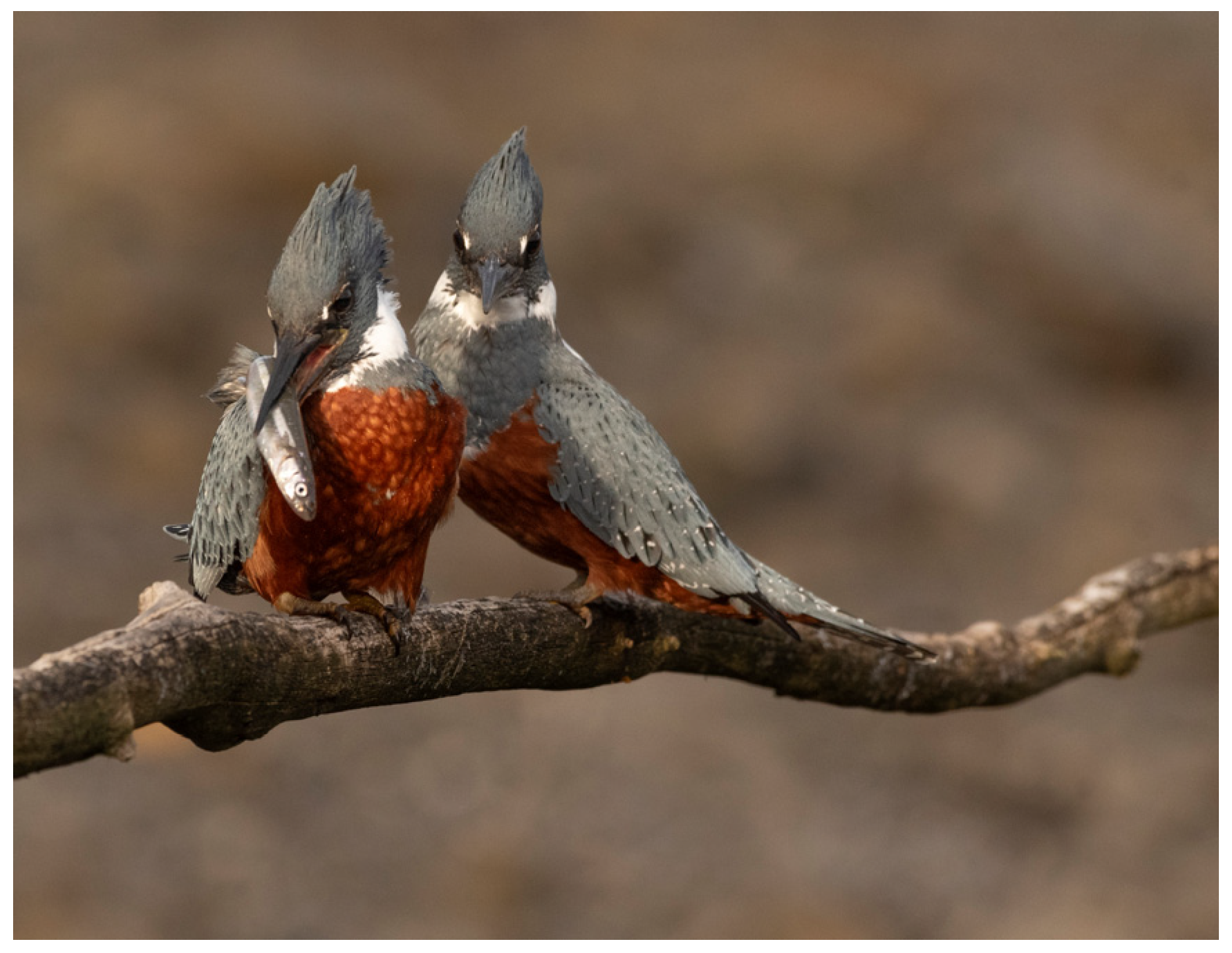
| Kekereke Challwafe üñüm Rülütu pitronkefi tachi challwa Wüne aukantulkefi pichulpichultun Uñümtun pürün kekereke kekerekewitwit Firfir wüywayken kekereke ülkantun Ka feyti pürün mülmül kürüf meu Feyti challwa fey ayiumay. ¡Kekereke kekereke kekereke kekereke kekereke kekereke kekereke kekereke! Challwa fey wepümwüwi nankalu reke Fapüle küpange pi ñi wilufuwin Allangechi nga pi feyti kekereke Ñungum ñungum ñi pañillwe weda wün Üpün amuy kümentu pitronfi doy küme We allangechi mallma challwa. ¡Kekereke kekereke kekereke kekereke kekereke kekereke kekereke kekerek | The Kingfisher From a dive, it easily pecks at the fish: first a party of entertaining movement of plumages, bird dance in the purest fisherman style. Onomatopoeia, song, whistle that is contagious. Dance in the air with provocative movement, the fish is eager to see and be distracted. Kekereke kekereke kekereke kekereke kekereke kekereke kekereke kekereke! An insistent call has enticed the fish to show itself at the surface of the water, By lightning vision echoes that a contact is approaching. The Kingfisher marvels and uses his art, more than ever, he sharpens his fisherman’s jaw. At the mere flight, he pecked at his tasty prey while the chic fish marvels at the fact. Kekereke kekereke kekereke kekereke kekereke kekereke kekereke kekereke! |
| (Lorenzo Aillapan in Aillapan and Rozzi 2001, pp. 44–45) [34]. | |
3.1. The Biophysical Dimension
3.2. The Linguistic-Cultural Dimension
3.3. The Institutional and Socio-Political Dimension
3.4. Synthesis of the Three Dimensions
- (a)
- The Descriptive meaning
- (b)
- The Normative Meaning
3.5. Companions and Co-Inhabitants
3.6. Philosophical Dimensions of the Concept of “Co-Inhabitant”
3.6.1. Ontological Implications of the Concept of “Co-Inhabitant”
- (a)
- The origin of the concept “holobiont” and its evolutionary basis
- (b)
- The origin of the concept of “hologenome”: implications for human coevolution
- (c)
- Human beings: ecosystems that think and have will
3.6.2. Epistemological Dimensions of the Concept of “Co-Inhabitant”
3.6.3. Ethical Implications of the Concept of “Co-Inhabitant”
4. Habitats
River: Why do you carrycold, secret water,water that the harsh dawn of the stoneskept in its inaccessible cathedral,to the wounded feet of my people?…Oh, harsh river born of snow!Why don’t you rise like an immense phantom,or as a new cross of stars for the forgotten?(Neruda 1950, p. 412) [91]
4.1. Need for a Biocultural Concept of Rivers
4.2. Biocultural Transformation of Ten Modern Myths
4.3. Biocultural Meanders
4.4. Multiple Ways of Knowing and Co-Inhabiting with Rivers
| Umagtuken lafken pewmamu ina nepeken challwa nepenmu. Ayeken kümemew, Ngümaken mawünmew feley ta ñi mongen, feley ta ñi nütram, fewla umagtuan. | My laughter is the midday sun, my tears the springs, My dream is the peacefulness of love, and my awakening is the life of fish. That’s how my existence is, That’s my word, and the waters continue singing to me. |
| (Lienlaf 1989) [107]. | |
5. Habits
Dreams and footsteps that connected meto the voice of the river,beings in motion,strokes of light in history,tercets ablaze like lamps.The bread and blood sangwith the nocturnal voice of the water.(Neruda 1954) [110]
- First generation: civil and political rights (freedom).
- Second generation: economic, social and cultural rights (equality).
- Third generation: solidarity rights (fraternity), including the rights of nature and of Indigenous peoples.
5.1. Biocultural Rights of Rivers
- (a)
- A new biocultural imaginary about rivers
- (b)
- New practices in river restoration
- (c)
- New regulations that recognize Nature as a subject of rights
5.2. Habits for Co-Inhabiting with Rivers
6. Coda
Hunger comes down to the river.Come with me.Who are the sufferers?I don’t know, but they call meand they tell me: “We suffer”.Come with me.(Neruda 1952, p. 76) [126]
Funding
Institutional Review Board Statement
Informed Consent Statement
Data Availability Statement
Acknowledgments
Conflicts of Interest
| 1 | In their book The Concept of the Hologenome: Human, Animal and Plant Microbiota [61], Rosenberg and Zilber-Rosenberg coined the concept of hologenome, defined as the sum of the genomes of the host organism (or host) and the symbiotic microorganisms associated with it. In biology, the term host refers to an organism that harbors another organism in the interior or surface of its body, establishing relationships that can be parasitism, commensalism or mutualism. |
| 2 | On 28 October 2007, the former president of Peru, Alan García, stated that “rivers run on both sides of the mountain range, and flow into the ocean without producing electricity.” He titled his unpopular article “The Gardener’s Dog Syndrome” to argue that local communities have resources that they do not exploit and that they do not allow anyone else to exploit. |
| 3 | The understanding of rivers has been pushed forward by Chilean Biologist Tamara Contador. |
| 4 | With thinkers such as Luis Oyarzún, Latin American philosophy anticipated what would be later articulated as an “ethics of responsibility,” developed by German philosopher Hans Jonas [128]. As French environmental philosopher Catherine Larrère [129] has argued, this restores a fuller sense of human existence by grounding technological power in ecological awareness and moral responsibility toward the living world. |
References
- Dudgeon, D.; Arthington, A.H.; Gessner, M.O.; Kawabata, Z.; Knowler, D.J.; Lévêque, C.; Naiman, R.J.; Prieur-Richard, A.; Soto, D.; Stiassny, M.L.J.; et al. Freshwater Biodiversity: Importance, Threats, Status and Conservation Challenges. Biol. Rev. 2006, 81, 163–182. [Google Scholar] [CrossRef] [Scilit] [PubMed]
- Vannote, R.L.; Minshall, G.W.; Cummins, K.W.; Sedell, J.R.; Cushing, C.E. The River Continuum Concept. Can. J. Fish. Aquat. Sci. 1980, 37, 130–137. [Google Scholar] [CrossRef] [Scilit]
- Ward, J.V. The Four-Dimensional Nature of Lotic Ecosystems. J. North Am. Benthol. Soc. 1989, 8, 2–8. [Google Scholar] [CrossRef] [Scilit] [PubMed]
- Stanford, J.A.; Ward, J.V. An Ecosystem Perspective of Alluvial Rivers: Connectivity and the Hyporheic Corridor. J. North Am. Benthol. Soc. 1993, 12, 48–60. [Google Scholar] [CrossRef] [Scilit]
- Pringle, C.M. Hydrologic Connectivity and the Management of Biological Reserves: A Global Perspective. Ecol. Appl. 2001, 11, 981–998. [Google Scholar] [CrossRef]
- Thorp, J.H.; Thoms, M.C.; Delong, M.D. The Riverine Ecosystem Synthesis: Biocomplexity in River Networks across Space and Time. River Res. Appl. 2006, 22, 123–147. [Google Scholar] [CrossRef]
- Berkes, F. Sacred Ecology; Routledge: New York, NY, USA, 2012. [Google Scholar]
- Escobar, A. Designs for the Pluriverse: Radical Interdependence, Autonomy, and the Making of Worlds; Duke University Press: Durham, NC, USA, 2018. [Google Scholar]
- Piccolo, J. The Land Ethic and Conservation of Native Salmonids. Ecol. Freshw. Fish 2017, 26, 160–164. [Google Scholar]
- Rozzi, R. Una Ética Del Co-Inhabitar Para La Conservación Biocultural de Los Ríos. Nat. Soc. Desafíos Medioambientales 2022, 3, 59–72. Available online: https://revistas.uniandes.edu.co/index.php/nys/article/download/4741/4348?inline=1 (accessed on 17 January 2025).
- Chihuailaf-Nahuelpán, E. The Water of Life. Latin American Literature Today 16, November 2020. Available online: https://latinamericanliteraturetoday.org/es/2020/11/water-life-elicura-chihuailaf/ (accessed on 17 January 2025).
- Vörösmarty, C.J.; McIntyre, P.B.; Gessner, M.O.; Dudgeon, D.; Prusevich, A.; Green, P.; Glidden, S.; Bunn, S.E.; Sullivan, C.A.; Liermann, C.R.; et al. Global Threats to Human Water Security and River Biodiversity. Nature 2010, 467, 555–561. [Google Scholar] [CrossRef] [Scilit] [PubMed]
- IPBES Secretariat. IPBES Global Assessment Report on Biodiversity and Ecosystem Services; IPBES Secretariat: Bonn, Germany, 2019. [Google Scholar]
- Tickner, D.; Opperman, J.J.; Abell, R.; Acreman, M.; Arthington, A.H.; Bunn, S.E.; Cooke, S.J.; Dalton, J.; Darwall, W.; Edwards, G.; et al. Bending the Curve of Global Freshwater Biodiversity Loss: An Emergency Recovery Plan. BioScience 2020, 70, 330–342. [Google Scholar] [CrossRef] [Scilit] [PubMed]
- Albert, J.S.; Destouni, G.; Duke-Sylvester, S.M.; Magurran, A.E.; Oberdorff, T.; Reis, R.E.; Winemiller, K.O.; Ripple, W.J. Scientists’ Warning to Humanity on the Freshwater Biodiversity Crisis. Ambio 2021, 50, 85–94. [Google Scholar] [CrossRef] [Scilit] [PubMed]
- Cambridge University Press. IPCC Climate Change 2022: Impacts, Adaptation and Vulnerability; Cambridge University Press: Cambridge, UK, 2022. [Google Scholar]
- Reid, A.J.; Carlson, A.K.; Creed, I.F.; Eliason, E.J.; Gell, P.A.; Johnson, P.T.J.; Kidd, K.A.; MacCormack, T.J.; Olden, J.D.; Ormerod, S.J.; et al. Emerging Threats and Persistent Conservation Challenges for Freshwater Biodiversity. Biol. Rev. 2019, 94, 849–873. [Google Scholar] [CrossRef] [Scilit] [PubMed]
- Grill, G.; Lehner, B.; Thieme, M.; Geenen, B.; Tickner, D.; Antonelli, F.; Babu, S.; Borrelli, P.; Cheng, L.; Crochetiere, H.; et al. Mapping the World’s Free-Flowing Rivers. Nature 2019, 569, 215–221. [Google Scholar] [CrossRef] [Scilit] [PubMed]
- Rozzi, R. Biocultural Ethics: From Biocultural Homogenization Toward Biocultural Conservation. In Linking Ecology and Ethics for a Changing World: Values, Philosophy, and Action; Rozzi, R., Ed.; Springer: Dordrecht, The Netherlands, 2013; Volume 1, pp. 9–32. [Google Scholar]
- Rozzi, R.; Massardo, F.; Poole, A. The “3Hss” (Habitats, Habits, Co-in-Habitants) of the Biocultural Ethic: A “Philosophical Lens” to Address Global Changes in the Anthropocene. In Global Changes: Ethics, Politics and Environment in the Contemporary Technological World; Valera, L., Castilla, J.C., Eds.; Springer: Cham, Switzerland, 2019; pp. 153–170. [Google Scholar]
- Leopold, A. A Sand County Almanac and Sketches Here and There; Oxford University Press: New York, NY, USA, 1949. [Google Scholar]
- Callicott, J.B. In Defense of the Land Ethic: Essays in Environmental Philosophy; State University of New York Press: Albany, NY, USA, 1989. [Google Scholar]
- Callicott, J.B. Cosmovisiones de La Tierra: Un Estudio Multicultural de Éticas Ecológicas Desde La Cuenca del Mediterráneo Hasta el Desierto Australiano; Plaza y Valdés Editores: Mexico City, Mexico, 2017. [Google Scholar]
- Piccolo, J.; Durtsche, R.D.; Watz, J.; Österling, M.; Calleset, O. Future Rivers, Dams and Ecocentrism. Ecol. Citiz. 2019, 2, 173–177. [Google Scholar]
- IPBES Secretariat. IPBES Summary for Policymakers of the Thematic Assessment of the Sustainable Use of Wild Species; IPBES Secretariat: Bonn, Germany, 2022. [Google Scholar]
- Crutzen, P.J. Geology of Mankind. Nature 2002, 415, 23. [Google Scholar] [CrossRef] [Scilit] [PubMed]
- Steffen, W.; Broadgate, W.; Deutsch, L.; Gaffney, O.; Ludwig, C. The Trajectory of the Anthropocene: The Great Acceleration. Anthr. Rev. 2015, 2, 81–98. [Google Scholar] [CrossRef] [Scilit]
- Valera, L.; Castilla, J.C. Global Changes: Ethics, Politics and Environment in the Contemporary Technological World; Springer: Cham, Switzerland, 2019. [Google Scholar]
- Simion, R. (RE)CONSIDERING GEOENGINEERING IN AN ETHICAL BIOCULTURAL FRAMEWORK. Stud. Univ. Babeș-Bolyai Philos. 2023, 68, 15–32. [Google Scholar] [CrossRef] [Scilit]
- Rozzi, R. Implications of the Biocultural Ethic for Earth Stewardship. In Earth Stewardship: Linking Ecology and Ethics in Theory and Practice; Rozzi, R., Ed.; Springer: Dordrecht, The Netherlands, 2015; Volume 2, pp. 113–136. [Google Scholar]
- Rozzi, R. Biocultural Ethics: The Vital Links between the Inhabitants, Their Habits and Regional Habitats. Environ. Ethics 2012, 34, 27–50. [Google Scholar] [CrossRef] [Scilit]
- Rozzi, R. South American Environmental Philosophy: Ancestral Amerindian Roots and Emergent Academic Branches. Environ. Ethics 2012, 34, 343–366. [Google Scholar] [CrossRef] [Scilit]
- Tauro, A.; Rozzi, R. Biocultural Ethics and Earth Stewardship: A Novel Integration to Revitalize Multiple Values of Nature. Ecol. Soc. 2025, 30, 35. [Google Scholar] [CrossRef] [Scilit]
- Aillapan, L.; Rozzi, R. Veinte Poemas Alados de Los Bosques Nativos Del Sur de Chile; Plaza y Valdés Editores: México, 2001. [Google Scholar]
- Ayala, F. La Teoría de La Evolución; Temas de Hoy: Madrid, Spain, 2001. [Google Scholar]
- Serrallonga, J. Ecología Del Comportamiento y Paleoetoecología Homínida. Estud. Psicol. 2004, 25, 129–148. [Google Scholar]
- Mayr, E. Así Es La Biología; Debate: Madrid, Spain, 2005. [Google Scholar]
- Siragusa, L.; Westman, C.N.; Moritz, S.C. Shared Breath: Human and Nonhuman Copresence through Ritualized Words and Beyond. Curr. Anthropol. 2020, 61, 471–494. [Google Scholar]
- Schiefenhövel, W. On the Human Ethology of Food Sharing. Anthropol. Rev. 2014, 77, 355–370. [Google Scholar] [CrossRef] [Scilit]
- Heins, V.M.; Unrau, C.; Avram, K. Gift-Giving and Reciprocity in Global Society: Introducing Marcel Mauss in International Studies. J. Int. Polit. Theory 2018, 14, 126–144. [Google Scholar] [CrossRef] [Scilit]
- Fischler, C. Commensality, Society and Culture. Soc. Sci. Inf. 2011, 50, 528–548. [Google Scholar] [CrossRef] [Scilit]
- Van den Berghe, P.L. Ethnic Cuisine: Culture in Nature. Ethn. Racial Stud. 1984, 7, 387–397. [Google Scholar] [CrossRef] [Scilit]
- Eibl-Eibesfeldt, I. Amor y Odio. Historia Natural del Comportamiento Humano; Salvat: Barcelona, Spain, 1994. [Google Scholar]
- Dussel, E.D. Historia de La Iglesia En América Latina; Editorial Nova Terra: Barcelona, Spain, 1972. [Google Scholar]
- Garine, E.; Rodrigo-Estevan, M.L.; Raimond, C.; Medina, F.X. Sharing Food; Centro Universitario de Ciencias Sociales y Humanidades, Universidad de Guadalajara: Guadalajara, Mexico, 2016. [Google Scholar]
- Lestar, T.; Manuela Pilato, M.; Seraphin, H. Eating Together in the Twenty-First Century: Social Challenges, Community Values, Individual Wellbeing, 1st ed.; Routledge: London, UK, 2023; ISBN 978-1-003-37389-6. [Google Scholar]
- Cascante, K. Obesidad y Desnutrición: Consecuencias de La Globalización Alimentaria; Los libros de la Catarata: Madrid, Spain, 2022. [Google Scholar]
- González-Turmo, I. Compartir: En El Límite Del Significado. In Sharing Food; Centro Universitario de Ciencias Sociales y Humanidades, Universidad de Guadalajara: Guadalajara, Mexico, 2016; pp. 98–113. [Google Scholar]
- Yang, B.; He, J. Global Land Grabbing: A Critical Review of Case Studies across the World. Land 2021, 10, 324. [Google Scholar] [CrossRef] [Scilit]
- Palombo, M.R. Thinking about the Biodiversity Loss in This Changing World. Geosciences 2021, 11, 370. [Google Scholar] [CrossRef] [Scilit]
- Rozzi, R. Biocultural Homogenization: A Wicked Problem in the Anthropocene. In From Biocultural Homogenization to Biocultural Conservation; Rozzi, R., May, R.H., Jr., Chapin, I.F.S., Massardo, F., Gavin, M.C., Klaver, I.J., Pauchard, A., Nuñez Martin, A., Simberloff, D., Eds.; Springer: Dordrecht, The Netherlands, 2018; pp. 21–47. [Google Scholar]
- Castro, Ó. Huellas En La Tierra; Editorial Andrés Bello: Santiago de Chile, Chile, 1940. [Google Scholar]
- Schlesinger, W.H.; Bernhardt, E.S. Biogeochemistry: An Analysis of Global Change; Academic Press: Washington, DC, USA, 2020. [Google Scholar]
- Guerrero, R.; Berlanga, M. Life’s Unity and Flexibility: The Ecological Link. Int. Microbiol. 2006, 9, 225. [Google Scholar] [PubMed]
- Huitzil, S.; Sandoval-Motta, S.; Frank, A.; Aldana, M. Modeling the Role of the Microbiome in Evolution. Front. Physiol. 2018, 9, 1836. [Google Scholar] [CrossRef] [Scilit] [PubMed]
- Margulis, L. Symbiogenesis and Symbionticism. In Symbiosis as a SOURCE of Evolutionary Innovation: Speciation and Morphogenesis; Margulis, L., Fester, R., Eds.; MIT Press: Cambridge, MA, USA, 1991; pp. 1–14. [Google Scholar]
- Margulis [Sagan], L. On the Origin of Mitosing Cells. J. Theor. Biol. 1967, 14, 225–274. [Google Scholar] [CrossRef] [Scilit]
- Gray, M.W. Lynn Margulis and the Endosymbiont Hypothesis: 50 Years Later. Mol. Biol. Cell 2017, 28, 1285–1287. [Google Scholar] [CrossRef] [Scilit] [PubMed]
- Lazcano, A.; Peretó, J. On the Origin of Mitosing Cells: A Historical Appraisal of Lynn Margulis Endosymbiotic Theory. J. Theor. Biol. 2017, 434, 80–87. [Google Scholar] [CrossRef] [Scilit] [PubMed]
- Martin, W.F. Physiology, Anaerobes, and the Origin of Mitosing Cells 50 Years On. J. Theor. Biol. 2017, 434, 2–10. [Google Scholar] [CrossRef] [Scilit] [PubMed]
- Rosenberg, E.; Zilber-Rosenberg, I. The Hologenome Concept: Human, Animal and Plant Microbiota; Springer International Publishing: Dordrecht, The Netherland, 2013. [Google Scholar]
- Rosenberg, E.; Zilber-Rosenberg, I. The Hologenome Concept of Evolution after 10 Years. Microbiome 2018, 6, 78. [Google Scholar] [CrossRef] [Scilit] [PubMed]
- Turnbaugh, P.J. The Human Microbiome Project. Nature 2007, 449, 804–810. [Google Scholar] [CrossRef] [Scilit] [PubMed]
- Yatsunenko, T.; Rey, F.E.; Manary, M.J.; Trehan, I.; Dominguez-Bello, M.G.; Contreras, M.; Magris, M.; Hidalgo, G.; Baldassano, R.N.; Anokhin, A.P.; et al. Human Gut Microbiome Viewed across Age and Geography. Nature 2012, 486, 222–227. [Google Scholar] [CrossRef] [Scilit] [PubMed]
- Witherspoon, D.J.; Wooding, S.; Rogers, A.R.; Marchani, E.E.; Watkins, W.S.; Batzer, M.A.; Jorde, L.B. Genetic Similarities Within and Between Human Populations. Genetics 2007, 176, 351–359. [Google Scholar] [CrossRef] [Scilit] [PubMed]
- Lloyd-Price, J.; Abu-Ali, G.; Huttenhower, C. The Healthy Human Microbiome. Genome Med. 2016, 8, 51. [Google Scholar] [CrossRef] [Scilit] [PubMed]
- Ahrodia, T.; Das, S.; Bakshi, S.; Das, B. Structure, Functions, and Diversity of the Healthy Human Microbiome. Prog. Mol. Biol. Transl. Sci. 2022, 191, 53–82. [Google Scholar] [CrossRef] [Scilit] [PubMed]
- Neri, J. The Insect and the Image: Visualizing Nature in Early Modern Europe, 1500–1700; University of Minnesota Press: Minneapolis, MN, USA, 2011. [Google Scholar]
- Esteban, J.M. Dürer’s Rhinoceros: Biocultural Homogenization of the Visual Construction of Nature. In From Biocultural Homogenization to Biocultural Conservation; Rozzi, R., Ed.; Springer: Dordrecht, The Netherlands, 2018; Volume 3, pp. 137–165. [Google Scholar]
- Rozzi, R.; Tauro, A.; Avriel-Avni, N.; Wright, T.; May, R.H., Jr. Field Environmental Philosophy: Education for Biocultural Conservation; Springer: Cham, Switzerland, 2023; Volume 5. [Google Scholar]
- Contador, T.; Rozzi, R.; Kennedy, J.; Massardo, F.; Ojeda, J.; Caballero, P.; Medina, Y.; Molina, R.; Saldivia, F.; Berchez, F.; et al. Sumergidos Con Lupa En Los Ríos Del Cabo de Hornos: Valoración Ética de Los Ecosistemas Dulceacuícolas y Sus Co-Habitantes. Magallania Punta Arenas 2018, 46, 183–206. [Google Scholar] [CrossRef] [Scilit]
- Contador, T.; Rendoll-Cárcamo, J.; Gañan, M.; Ojeda, J.; Kennedy, J.; Convey, P.; Rozzi, R. Underwater with a Hand Lens: Ecological Sciences and Environmental Ethics to Value Freshwater Biodiversity. In Field Environmental Philosophy: Education for Biocultural Conservation; Rozzi, R., Tauro, A., Avriel-Avni, N., Wright, T., May, R.H., Jr., Eds.; Springer: Dordrecht, The Netherlands, 2023; Volume 5, pp. 53–69. [Google Scholar]
- Postel, S.; Carpenter, S.R. Freshwater Ecosystem Services. In Nature’s Services: Societal Dependence on Natural Ecosystems; Daily, G.C., Ed.; Island Press: Washington, DC, USA, 1997; pp. 195–214. [Google Scholar]
- Watz, J.; Aldvén, D.; Andreasson, P.; Aziz, K.; Blixt, M.; Calles, O.; Lund Bjørnås, K.; Olsson, I.; Österling, M.; Stålhammar, S.; et al. Atlantic Salmon in Regulated Rivers: Understanding River Management through the Ecosystem Services Lens. Fish Fish. 2022, 23, 478–491. [Google Scholar] [CrossRef] [Scilit]
- Tockner, K.; Ward, J.V.; Edwards, P.J.; Kollmann, J. Riverine Landscapes: An Introduction. Freshw. Biol. 2002, 47, 497–500. [Google Scholar] [CrossRef] [Scilit]
- Frene, C. The Mirage of Drinking Water Security in Chilean Patagonia: A Socio-Ecological Perspective. Sustainability 2025, 17, 8519. [Google Scholar] [CrossRef] [Scilit]
- Klubnikin, K.; Annett, C.; Cherkasova, M.; Shishin, M.; Fotieva, I. The Sacred and the Scientific: Traditional Ecological Knowledge in Siberian River Conservation. Ecol. Appl. 2000, 10, 1296–1306. [Google Scholar] [CrossRef]
- Everard, M.; Moggridge, H.L. Rediscovering the Value of Urban Rivers. Urban Ecosyst. 2012, 15, 293–314. [Google Scholar]
- Agoramoorthy, G. Sacred Rivers: Their Spiritual Significance in Hindu Religion. J. Relig. Health 2015, 54, 1080–1090. [Google Scholar] [PubMed]
- Cooke, S.J.; Lynch, A.J.; Piccolo, J.J.; Olden, J.D.; Reid, A.J.; Ormerod, S.J. Stewardship and Management of Freshwater Ecosystems: From Leopold’s Land Ethic to a Freshwater Ethic. Aquat. Conserv. Mar. Freshw. Ecosyst. 2021, 31, 1499–1511. [Google Scholar] [CrossRef] [Scilit]
- Klain, S.C.; Olmsted, P.; Chan, K.M.; Satterfield, T. Relational Values Resonate Broadly and Differently than Intrinsic or Instrumental Values, or the New Ecological Paradigm. PLoS ONE 2017, 12, e0183962. [Google Scholar] [CrossRef] [Scilit] [PubMed]
- Brondízio, E.S.; Settele, J.; Díaz, S.; Ngo, H.T. Global Assessment Report of the Intergovernmental Science-Policy Platform on Biodiversity and Ecosystem Services; IPBES Secretariat: Bonn, Germany, 2019. [Google Scholar]
- Martin, A.; O’Farrell, P.; Kumar, R.; Eser, U.; Faith, D.P.; Gomez-Baggethun, E.; Harmackova, Z.; Horcea-Milcu, A.I.; Merçon, J.; Quaas, M.; et al. The Role of Diverse Values of Nature in Visioning and Transforming towards Just and Sustainable Futures. In Methodological Assessment Report on the Diverse Values and Valuation of Nature of the Intergovernmental Science-Policy Platform on Biodiversity and Ecosystem Services; Christie, M., Balvanera, P., Pascual, U., Baptiste, B., González-Jiménez, D., Eds.; IPBES Secretariat: Bonn, Germany, 2022; pp. 352–439. [Google Scholar]
- Martin, A.; Gomez-Baggethun, E.; Quaas, M.; Rozzi, R.; Tauro, A.; Faith, D.P.; Kumar, R.; O’Farrell, P.; Pascual, U. Plural Values of Nature Help to Understand Contested Pathways to Sustainability. One Earth 2024, 7, 806–819. [Google Scholar] [CrossRef] [Scilit]
- Pascual, U.; Balvanera, P.; Anderson, C.B.; Chaplin-Kramer, R.; Christie, M.; González-Jiménez, D.; Martin, A.; Raymond, C.M.; Termansen, M.; Vatn, A.; et al. Diverse Values of Nature for Sustainability. Nature 2023, 620, 813–823. [Google Scholar] [CrossRef] [Scilit] [PubMed]
- Tajima, Y.; Saito, T.; Dasgupta, R.; Basu, M.; Nishi, M.; Hashimoto, S. Factors Affecting Relational Values of Nature: A Case of the Nagara River, Japan. Sustain. Sci. 2026, 21, 503–515. [Google Scholar] [CrossRef] [Scilit]
- Dussler, M.R.; Williams, J.W.; Massey, S. Mindfulness and Reconnection with Freshwater Ecosystems at the Meadows Center for Water and the Environment. In Field Environmental Philosophy: Education for Biocultural Conservation; Rozzi, R., Ed.; Springer: Cham, Switzerland, 2023; Volume 5, pp. 503–518. [Google Scholar]
- Lopez, C.W.; Wade, M.T.; Julian, J.P. Nature–Human Relational Models in a Riverine Social–Ecological System: San Marcos River, TX, USA. Geographies 2023, 3, 197–245. [Google Scholar] [CrossRef] [Scilit]
- Hagen, E.J.; Gould, R.K. Relational Values and Empathy Are Closely Connected: A Study of Residents of Vermont’s Winooski River Watershed. Ecol. Soc. 2022, 27, 19. [Google Scholar] [CrossRef] [Scilit]
- Luque-Lora, R. The Trouble with Relational Values. Environ. Values 2023, 32, 411–431. [Google Scholar] [CrossRef] [Scilit]
- Neruda, P. Oda de Invierno al Río Mapocho. In Canto General (1950); Editorial Cátedra: Santiago de Chile, Chile, 1990; pp. 411–412. [Google Scholar]
- UN (United Nations). World Urbanization Prospects: The 2014 Revision, Highlights; United Nations: New York, NY, USA, 2014. [Google Scholar]
- García, A. El Síndrome del Perro del Hortelano. Available online: https://elcomercio.pe/bicentenario/2007-l-el-sindrome-del-perro-del-hortelano-l-bicentenario-noticia/ (accessed on 17 January 2026).
- Kibel, P.S. Bankside Urban: An Introduction. In Rivertown: Rethinking Urban Rivers; Kibel, P.S., Ed.; The MIT Press: Cambridge, MA, USA, 2007; pp. 1–22. [Google Scholar]
- WCD (World Commission on Dams). Dams and Development: A New Framework for Decision-Making; Earthscan Publications: London, UK, 2000. [Google Scholar]
- Johnston, B.R. Water, Culture, Power: Hydrodevelopment Dynamics. In Water, Cultural Diversity, and Global Environmental Change; Johnston, B.R., Ed.; Springer: Dordrecht, The Netherland, 2012; pp. 295–318. [Google Scholar]
- Richter, B.D. Lost in Development’s Shadow: The Downstream Human Consequences of Dams. Water Altern. 2010, 3, 14–42. [Google Scholar]
- Klaver, I.J. Reclaiming Rivers from Homogenization: Meandering and Riverspheres. In From Biocultural Homogenization to Biocultural Conservation; Rozzi, R., Ed.; Springer: Dordrecht, The Netherland, 2018; Volume 3, pp. 49–69. [Google Scholar]
- Ollero-Ojeda, A. Crecidas, Inundaciones y Resiliencia: Restauración Fluvial Contra Los Falsos Mitos. In Riesgo de inundación en España: Análisis y Soluciones Para la Generación de Territorios Resilientes; López Ortiz, I., Melgarejo Moreno, J., Eds.; Ediciones Universidad de Alicante: Alicante, Spain, 2020; pp. 549–568. [Google Scholar]
- Klaver, I. Meander(Ing) Multiplicity. In Water Scarcity, Security and Democracy: A Mediterranean Mosaic; de Châtel, F., Holst-Warhaft, G., Steenhuis, T., Eds.; Cornell University and the Atkinson Center for a Sustainable Future: Ithaca, NY, USA, 2014; pp. 36–45. [Google Scholar]
- Rozzi, R.; Hargrove, E.; Armesto, J.J.; Pickett, S.T.A.; Silander, J. “Natural Drift” as a Post-Modern Evolutionary Metaphor. Rev. Chil. Hist. Nat. 1998, 71, 5–17. [Google Scholar]
- Law, J.; Urry, J. Enacting the Social. Econ. Soc. 2004, 33, 390–410. [Google Scholar] [CrossRef] [Scilit]
- Klaver, I.J. Placing Water and Culture. In Water, Cultural Diversity, and Global Environmental Change; Johnston, B.R., Ed.; Springer: Dordrecht, The Netherland, 2012; pp. 9–29. [Google Scholar]
- Klaver, I.J. Environment Imagination Situation. In Linking Ecology and Ethics for a Changing World: Values, Philosophy, and Action; Rozzi, R., Ed.; Springer: Dordrecht, The Netherland, 2013; Volume 1, pp. 85–105. [Google Scholar]
- Nanson, G.C.; Huang, H.Q. A Philosophy of Rivers: Equilibrium States, Channel Evolution, Teleomatic Change and Least Action Principle. Geomorphology 2018, 302, 3–19. [Google Scholar] [CrossRef] [Scilit]
- Anand, N. Hydraulic City: Water and the Infrastructures of Citizenship in Mumbai; Duke University Press: Durham, UK; Londres, UK, 2017. [Google Scholar]
- Lienlaf, L. Mañkean Ñi Dungu (El Sueño de Mañkean). In Se ha Despertado el Ave de mi Corazón; Editorial Universitaria: Santiago de Chile, Chile, 1989. [Google Scholar]
- Rozzi, R. Ética Ambiental: Raíces y Ramas Latinoamericanas. In Fundamentos de Conservación Biológica: Perspectivas Latinoamericanas; Primack, R., Ed.; Fondo de Cultura Económica: Mexico City, Mexico, 2001; pp. 311–359. [Google Scholar]
- Santafe-Troncoso, V.; Loring, P.A. Traditional Food or Biocultural Threat? Concerns about the Use of Tilapia Fish in Indigenous Cuisine in the Amazonia of Ecuador. People Nat. 2021, 3, 887–900. [Google Scholar] [CrossRef] [Scilit]
- Neruda, P. El Río. In Las uvas y el Viento; Editorial Nascimento: Santiago de Chile, Chile, 1954; pp. 54–55. [Google Scholar]
- Contador, T. Benthic Macroinvertebrates of Temperate, Sub-Antarctic Streams: The Effects of Altitudinal Zoning and Temperature on the Phenology of Aquatic Insects Associated to the Róbalo River, Navarino Island (55°S), Chile; Department of Biological Sciences, University of North Texas: Denton, TX, USA, 2011. [Google Scholar]
- Harvey, D. The Right to the City. New Left Rev. 2008, 53, 23–40. [Google Scholar] [CrossRef] [Scilit]
- Vasak, K. Human Rights: A Thirty-Year Struggle. UNESCO Cour. 1977, 30, 29–32. [Google Scholar]
- Berros, M.V. Challenges for the Implementation of the Rights of Nature: Ecuador and Bolivia as the First Instances of an Expanding Movement. Lat. Am. Perspect. 2021, 48, 192–205. [Google Scholar] [CrossRef] [Scilit]
- Rozzi, R. Biocultural Conservation and Biocultural Ethics. In From Biocultural Homogenization to Biocultural Conservation; Rozzi, R., May, R.H., Jr., Chapin, I.F.S., Massardo, F., Gavin, M.C., Klaver, I.J., Pauchard, A., Nuñez Martin, A., Simberloff, D., Eds.; Springer: Dordrecht, The Netherlands, 2018; pp. 303–314. [Google Scholar]
- González-Morales, V. Biocultural Rights and Biocultural Ethics: The Case of the Atrato River, Colombia; Springer: Cham, Switzerland, 2026. [Google Scholar]
- Sentencia T-622 Principio De Precaución Ambiental y Su Aplicación Para Proteger El Derecho a La Salud de Las Personas-Caso de Comunidades Étnicas Que Habitan La Cuenca Del Río Atrato; Colombia, 2016. Available online: https://www.corteconstitucional.gov.co/relatoria/2016/t-622-16.htm (accessed on 17 January 2025).
- Seal, J. Meander: East to West, Indirectly, Along a Turkish River; Bloomsbury USA: New York, NY, USA, 2012. [Google Scholar]
- Zeedyk, B.; Clothier, V. Let the Water Do the Work: Induced Meandering, an Evolving Method for Restoring Incised Channels; Chelsea Green Publishing: Hartford, VT, USA, 2014. [Google Scholar]
- Kauffman, C.M.; Martin, P.L. When Rivers Have Rights: Case Comparisons of New Zealand, Colombia, and India. Available online: http://files.harmonywithnatureun.org/uploads/upload585.pdf (accessed on 17 January 2025).
- Camp-Horinek, C. An Indigenous Perspective: Rights of Nature Tribunal Opening Remarks. In Rights of Nature and Mother Nature: Rights-Based Law for Systemic Change; Biggs, S., Goldtooth, T.B.K., Lake, O.O., Eds.; Movement Rights, Women’s Earth & Climate Action Network, Indigenous Environmental Network: Oakland, CA, USA, 2017; pp. 12–14. [Google Scholar]
- Rozzi, R. Biocultural Ethics and Environmental Resistance: Berta Cáceres’s Defense of River Life. Philosophies 2026, 11. [Google Scholar]
- Lynch, P. Futaleufú XL: “Los Ríos Están Vivos.”. Patagon J. 2018, 21. Available online: https://www.patagonjournal.com/index.php?option=com_content&view=article&id=4050%3Afutaleufu-xl-los-rios-estan-vivos&catid=166%3Aoutdoors&Itemid=389&lang=es (accessed on 17 January 2025).
- Kahn, C.H. The Art and Thought of Heraclitus; Cambridge University Press: Cambridge, UK, 1979. [Google Scholar]
- Macpherson, E.; Torres Ventura, J.; Clavijo Ospina, F. Constitutional Law, Ecosystems, and Indigenous Peoples in Colombia: Biocultural Rights and Legal Subjects. Transnatl. Environ. Law 2020, 9, 521–540. [Google Scholar] [CrossRef] [Scilit]
- Neruda, P. El Monte y El Río. In Los Versos del Capitán (1952); Editorial Losada: Buenos Aires, Argentina, 1978; p. 76. [Google Scholar]
- Oyarzún, L. Defensa de La Tierra; Editorial Universitaria: Santiago de Chile, Chile, 1973. [Google Scholar]
- Jonas, H. El Principio de Responsabilidad: Ensayo de Una Ética Para La Civilización Tecnológica; Herder Editorial: Barcelona, Spain, 1995. [Google Scholar]
- Larrère, C. A Life Worthy of Being Called Human: The Actuality of Hans Jonas’ Maxim. Environ. Ethics 2019, 41, 147–164. [Google Scholar] [CrossRef] [Scilit]
- May, R.H., Jr. Land Grabbing and Violence Against Environmentalists. In From Biocultural Homogenization to Biocultural Conservation; Rozzi, R., May, R.H., Jr., Chapin, I.F.S., Massardo, F., Gavin, M.C., Klaver, I.J., Pauchard, A., Nuñez Martin, A., Simberloff, D., Eds.; Springer: Dordrecht, The Netherlands, 2018; pp. 109–123. [Google Scholar]



| Myth | Modern Concept That Needs to Be Corrected | Biocultural Transformation That, on the Other Hand, Considers That: |
|---|---|---|
| I | Rivers are merely continuous streams of water. | Rivers generate hydrospheres, biospheres, and atmospheres; they are dynamic socio-ecological systems. |
| II | Rivers and water are only productive resources; unused water is “lost” in the sea. | Irregular flows sustain ecological complexity; discharge into the sea is ecologically vital. |
| III | Floods are catastrophes. | Floods are essential to the regeneration of riverine, riparian, and marine ecosystems. |
| IV | Flooding occurs because reservoirs are lacking. | Reservoirs have not eliminated floods; restoring floodplains and micro-retention areas enhances resilience. |
| V | Sediments are waste or signs of river “disease.” | Sediments are foundational ecological components; conserving and mobilizing them is key to restoration. |
| VI | Riverbeds are “dirty” and must be “cleaned”. | Structural complexity (stones, logs, vegetation, sediments) is essential to ecological integrity. |
| VII | Erosion is inherently negative. | Erosion is a necessary geomorphological process enabling sediment transport and nutrient cycling. |
| VIII | After a flood, the drainage section must be expanded. | Floods rebuild riverbeds and sustain watershed-scale resilience (including riparian ecosystems, floodplains, alluvial terraces). |
| IX | Channelization solves flooding. | Channelization accelerates flow and transfers risk; in contrast, giving rivers space to meander reduces vulnerability. |
| X | Restoration means stabilizing banks and building river parks. | True restoration reactivates dynamic processes (flows, sediments, macro- and micro-biota) rather than imposing artificial stability. |
Disclaimer/Publisher’s Note: The statements, opinions and data contained in all publications are solely those of the individual author(s) and contributor(s) and not of MDPI and/or the editor(s). MDPI and/or the editor(s) disclaim responsibility for any injury to people or property resulting from any ideas, methods, instructions or products referred to in the content. |
© 2026 by the author. Licensee MDPI, Basel, Switzerland. This article is an open access article distributed under the terms and conditions of the Creative Commons Attribution (CC BY) license.
Share and Cite
Rozzi, R. Biocultural Ethics for Human–River–Biosphere Co-Inhabitation. Philosophies 2026, 11, 123. https://doi.org/10.3390/philosophies11040123
Rozzi R. Biocultural Ethics for Human–River–Biosphere Co-Inhabitation. Philosophies. 2026; 11(4):123. https://doi.org/10.3390/philosophies11040123
Chicago/Turabian StyleRozzi, Ricardo. 2026. "Biocultural Ethics for Human–River–Biosphere Co-Inhabitation" Philosophies 11, no. 4: 123. https://doi.org/10.3390/philosophies11040123
APA StyleRozzi, R. (2026). Biocultural Ethics for Human–River–Biosphere Co-Inhabitation. Philosophies, 11(4), 123. https://doi.org/10.3390/philosophies11040123