


You are currently viewing a new version of our website. To view the old version click .

Biomimetics, Volume 3, Issue 1

March 2018 - 4 articles

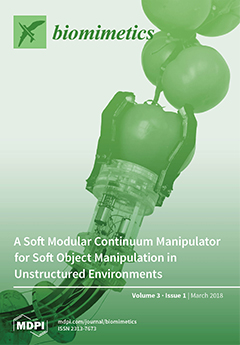
Cover Story: The developed modular continuum manipulator consists of an arm and a soft reconfigurable gripper. The arm bends up to 143°, rotates about its own axis and provides orientational stiffness. The gripper reconfigurability allows the manipulator to increase or decrease the number of grasping points according to the object shape. The combination of these arm and gripper features endows the manipulator with increased grasping and manipulation abilities; this way it can be used for more delicate and versatile applications, such as grasping vegetables and eggs, picking up bottles or opening doors. View the paper
  • Issues are regarded as officially published after their release is announced to the table of contents alert mailing list .
  • You may sign up for email alerts to receive table of contents of newly released issues.
  • PDF is the official format for papers published in both, html and pdf forms. To view the papers in pdf format, click on the "PDF Full-text" link, and use the free Adobe Reader to open them.

Articles (4)

  • Review
  • Open Access
9 Citations
5,989 Views
17 Pages

Over the past decades, a frequent co-morbidity of cerebrovascular pathology and Alzheimer’s disease has been observed. Numerous published studies indicate that the preservation of a healthy cerebrovascular endothelium can be an important therapeutic...

  • Article
  • Open Access
43 Citations
10,040 Views
16 Pages

Modular Continuum Manipulator: Analysis and Characterization of Its Basic Module

  • Anand Kumar Mishra,
  • Alessio Mondini,
  • Emanuela Del Dottore,
  • Ali Sadeghi,
  • Francesca Tramacere and
  • Barbara Mazzolai

We present the basic module of a modular continuum arm (soft compliant manipulator for broad applications (SIMBA)). SIMBA is a robotic arm with a hybrid structure, namely a combination of rigid and soft components, which makes the arm highly versatil...

  • Communication
  • Open Access
10 Citations
7,253 Views
11 Pages

Scaffold nanotopography plays the most significant role in the mimicry of the in vivo microenvironment of the hepatocytes. Several attempts have been made to develop methods and substrates suited to growing hepatocytes into aggregates. Functional bio...

Get Alerted

Add your email address to receive forthcoming issues of this journal.

XFacebookLinkedIn
Biomimetics - ISSN 2313-7673