


Abstract
Cannabis is the most-used psychoactive drug in Aotearoa—New Zealand (NZ); recreational use remains illegal, while medicinal use was legalized in 2020. Cannabis use is associated with increased risk of injury; however, there is little known on the causes and circumstances of cannabis-related fatal injuries. This retrospective population study utilized coronial case files to describe the contribution and circumstances of cannabis-related fatal injuries in NZ. Between 2012 and 2016, cannabis was reported in 273 of 3599 unintentional/assault injury deaths (1.32 deaths per 100,000 person-years, 95% CI 1.17, 1.49). High-risk groups included males aged 15–44 years, Indigenous Māori, and those in deprived areas, for whom higher rates of post mortem testing were conducted. Cannabis-related fatalities mainly resulted from road crashes and multi-drug poisonings with concomitant alcohol use common, especially in traffic crashes on public roads (49% of concomitant use). Cannabis use was mainly observed in the decedent (n = 256, 94%). One in five deaths involved a worker, either as a user or as a bystander to another’s use. Coronial files identified important opportunities for safety countermeasures targeting cannabis use among drivers and its concomitant use with alcohol. Improved coverage of post mortem testing could address data limitations, including biased testing patterns and missing medical use.
Keywords:
cannabis; cannabinoid; tetrahydrocannabinol; THC; marijuana; fatal injury; mortality; toxicology; injury; observational study 1. Introduction
Cannabis is the most used psychoactive drug in Aotearoa—New Zealand (NZ) [1]. In April 2020, the medicinal use of cannabis prescribed by a medical practitioner was legalized; however, recreational use of cannabis remains illegal in NZ [2]. Estimates of the prevalence of cannabis use in NZ vary. The findings from the 2017/18 National Health Survey estimated that 12% of NZ adults had used cannabis in the previous year, and of these one third intended to use cannabis at least weekly [1]. Estimates of lifetime cannabis use suggest 44% of New Zealanders have used cannabis [3]. Longitudinal studies based in NZ estimated that for children born in the 1970s, around four out of five reported having ‘ever used’ cannabis by their mid-twenties [4,5].
While not every instance of cannabis use is harmful, its use contributes to a myriad of health effects, including immediate harm due to cannabis-induced impairment [6]. An Australian review of all-cause mortality found cannabis-related deaths due to unintentional injury were prominent, with decedents using cannabis being three times as likely to die from unintentional injury compared with other non-injury cannabis-related causes of death [7]. In the Ministry of Health’s 2016 NZ Drug Harm Index, cannabis was attributed to 32 deaths in 2014 [8]. Cannabis involvement is commonly documented in transport-related deaths, with corresponding blood tests showing that in one in three NZ driver fatalities occurring between 2013 and 2018 the driver had used cannabis [9].
While official data sources report the prevalence of cannabis use and some of the immediate harms, there is little available description of the circumstances and causes of fatal injuries involving cannabis in NZ. This data is essential to identify whether interventions focused on reducing cannabis-related injury in NZ should be targeted. This study aims to describe the involvement of cannabis use in unintentional injury and assault deaths in NZ to allow for better understanding of how intervention strategies can address the current burden of cannabis-related fatal injuries.
2. Materials and Methods
This retrospective population study of cannabis use included those sustaining an unintentional injury or assault that resulted in a fatality being reported to a coroner. In broad terms, all deaths in NZ that are ‘sudden’ and ‘unexpected’ are required to be reported to a coroner for investigation to examine the causes and circumstances of death.
Text-searchable coronial closed case (i.e., cases for which coroners’ findings have been released) files for NZ were obtained from the National Coronial Information System (NCIS) hosted by the Victorian Department of Justice and Community Safety, Australia [10]. Coronial case files held by the NCIS typically consist of a summative coroner’s finding, as well as reports from the police, a pathologist, and from toxicological testing. Using the NCIS, fatalities that resulted from unintentional injury or assault with a date of death between 1 January 2012 and 31 December 2016 were selected for review. Cases for review were restricted to individuals aged between 0 and 84 years at the time of death.
As a first screening step, a subset of all of the deaths that occurred in 2014 was read in full and used to identify a set of appropriate ‘text words’ (or derivatives of) by which to systematically identify recording of cannabis use. The final set of text words (cannab*, tetrahyd*, bong and marij*) was applied to injury deaths held by the NCIS occurring within 2012–2016 to identify all cases where cannabis was recorded within the case file. Those with a positive free-text digital screen were further reviewed by a trained reviewer (BMcN). The reviewed case files reporting a ‘negative cannabis screening’ result were removed from further consideration.
2.1. Case Identification
Reviewed cases were considered ‘cannabis-related’ if cannabis use in the circumstances of the event leading to the fatal injury was reported in the case file by the coroner, police, or pathologist. To establish reasonable suspicion that a decedent, or other relevant person (such as a cannabis-impaired surviving driver), was under the influence of cannabis at the time of the fatal incident, two criteria were established based on toxicological investigations (in post mortem toxicology or pathology reports) and/or observational reports of cannabis consumption, impairment, or the presence of cannabis-related paraphernalia as described in police or coroners’ reports. A hierarchy of evidence to determine cannabis involvement was adopted using the following order from highest to lowest quality evidence:
(1) Any positive toxicological test for tetrahydrocannabinol (THC) or metabolites, as a measure of recent use in blood or urine;
(2) Any observation of cannabis use at, or around, the time of the injury incident;
(3) Any observation of impairment associated with cannabis use at, or around, the time of the injury incident; or
(4) Any observation of the presence of cannabis-associated paraphernalia in the immediate vicinity of the incident.
Cases involving the sole use of synthetic cannabis were excluded.
2.2. Measures Used
The coroners’ findings were reviewed to ascertain the coroner’s level of attribution of cannabis to the death, similar to that used elsewhere [11]. The categories comprised: ‘attributed’, if (a) the cause of death reported by the forensic pathologist was due to cannabis and/or (b) the coroner documented cannabis as contributing to the death; ‘mentioned’, if reference to toxicology results was made in the coroner’s findings, but with no comment as to possible contribution to the death; and (c) ‘not mentioned’, if there was no reference to toxicology results in the coroner’s findings.
Socio-demographic characteristics including age, sex, and ethnicity were obtained from the Mortality Collection. As per Ministry of Health ethnicity data protocols, ethnicity was prioritized into an individual response category for those who had multiple ethnicity responses; Māori, Pacific Peoples, Asian and other ethnicities, and European [12]. The NZ Deprivation Index (NZDep2013) was obtained from the small area (meshblock) where the injury incident occurred; this was categorized into quintiles of socioeconomically deprived areas ranging from 1–2 (least) to 9–10 (most) [13].
Mechanism of injury, agency of injury, and industry of incident were obtained from the coroners’ findings and coded using the Type of Occurrence Classification System (TOOCS-1990) and the Australian NZ Standard Industry Classification (ANZSIC-2006 V1.0.0) [14,15].
Deaths occurring in a work context were determined based on whether the decedent, at the time of the fatal incident, was working for pay, profit, or in-kind, or on a work break. This also applied to ‘bystander deaths’ where a person contributing the fatal injury event (but not the decedent) was under the influence of cannabis, such as a truck driver on work duty fatally injured in a traffic crash involving a cannabis-impaired driver in a separate vehicle.
Toxicological findings including the THC status, type of specimen, level of THC, concomitant substance use, alcohol impairment, and other drugs present were all obtained from toxicological reports. Cannabis was considered impairing at a level of 3 ng/mL of blood, consistent with NZ legislation [16]. Any other drugs with a known clinically significant interaction, as identified by the ‘Drugs.com’ Drugs Information Database [17], were identified and coded as being present. Common behaviors associated with cannabis impairment were collected using an observational checklist of symptoms of cannabis impairment [18]. Behaviors included cannabis odor, slow/sluggish responses, impaired behaviors, possession of cannabis, possession of cannabis paraphernalia, and cannabis consumption reported by eyewitnesses.
2.3. Data Analysis
To describe the burden and patterns of cannabis-related fatal injury, frequencies and percentages were calculated. The risk of cannabis-related fatal injury was calculated by age group, sex, ethnicity, and socioeconomic deprivation using incidence rates per 100,000 person-years with 95% confidence intervals (95% CI). Population estimates from the 2006 and 2013 census were obtained from Statistics NZ for those aged less than 85 years of age with counts for non-census years estimated by linear interpolation and extrapolation. All analyses were performed using Stata Version 17 SE [19].
3. Results
3.1. Cases and Population Rates
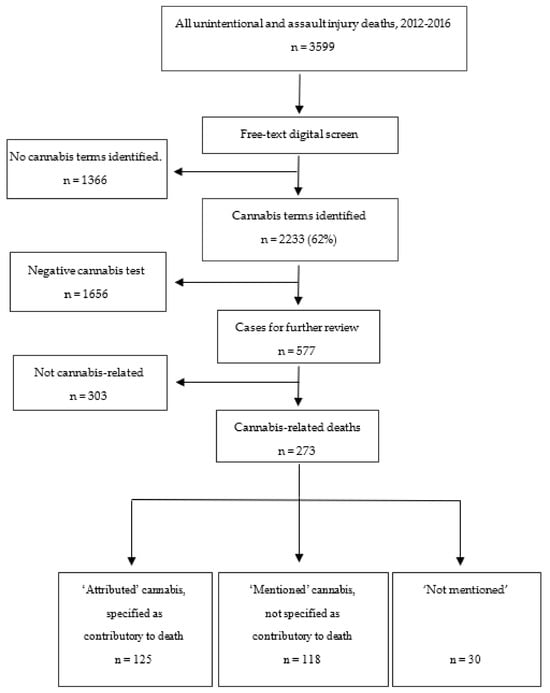
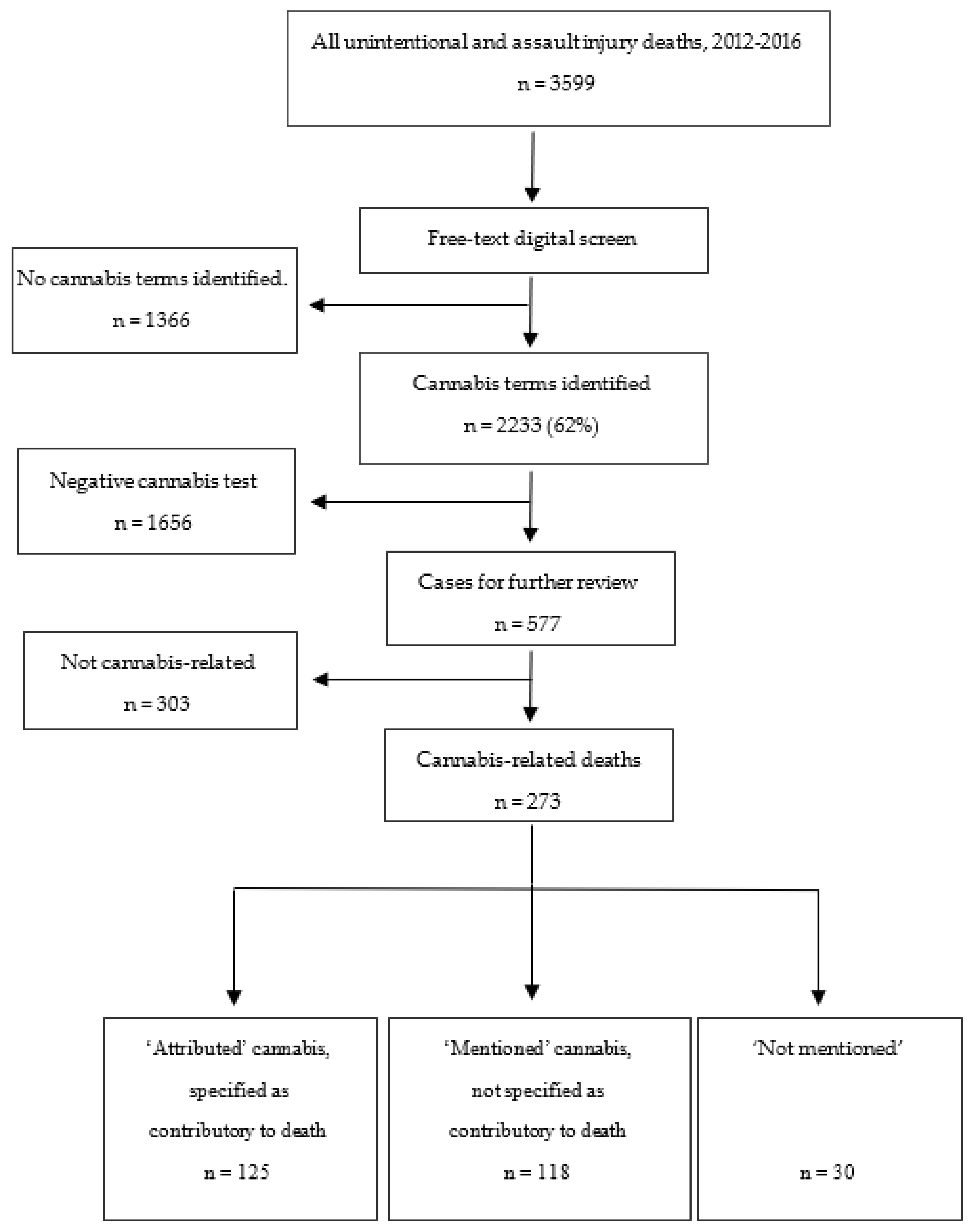
In the five-year period of this study, 3599 deaths due to unintentional injury or assault were investigated by coroners in NZ (Figure 1). Of these fatalities, 273 (7.6%) met the criteria for inclusion: 271 decedents had a toxicological investigation reported, while a further 2 decedents without a corresponding toxicological investigation had records that included a mention of cannabis use by either the investigating pathologist, the police, and/or the coroner. This corresponds to a fatality rate of 1.32 deaths per 100,000 person-years (95% CI 1.17, 1.49).
Figure 1.
Flow diagram of case selection: identifying cannabis-related fatalities within coronial records for intentional and assault injuries during 2012–2016 in those aged 0–84 years, New Zealand.
The coroners’ findings ‘attributed’ cannabis as contributing to the death in 125 (46%) cases, while in 118 cases (43%) the coroners’ findings only ‘mentioned’ toxicology results without further commentary on the possible contribution of cannabis impairment to the fatal incident (Figure 1).
3.2. Socio-Demographic Characteristics
Cannabis-related fatalities were predominantly aged 15 to 44 years of age (70%) and male (86%) (Table 1). The rate of cannabis-related fatal injury was 6 times greater in males compared with females (2.33 compared to 0.38 per 100,000 person-years). While the absolute number of fatalities was almost identical for European and Indigenous Māori ethnic groups, the rate for Māori was 3.9 times higher than the other 3 ethnic categories examined (i.e., 3.67 deaths compared to 0.95 deaths per 100,000 person-years for Europeans). The absolute numbers and rates of cannabis-related fatal injury also increased with increasing levels of relative socioeconomic deprivation. The rate of cannabis-related fatal injury was 4.8 times higher in those living in the most socioeconomically deprived areas (NZDep decile 9–10) compared with the those living in the least-deprived areas (decile 1–2). The annual number and rate of cannabis-related fatal injury was relatively stable by year, except for in 2014, which had a lower absolute number and rate of fatal injury (0.88 deaths per 100,000 person-years).
Table 1.
Socio-demographic characteristics of cannabis-related fatal unintentional or assaultive injury incidents reported to the coroner for those aged 0–84 years, New Zealand, 2012-2016 (n = 273).
3.3. Toxicology
Cases of cannabis use were predominantly identified from toxicological testing of blood samples (95%), with 256 (94%) positive cases in decedents and 17 (6%) positive cases in another involved person other than the decedent (Table 2). Most decedents were screened for the presence of THC alone (82%); of the 46 for whom THC was quantified, 16 (6%) had levels of THC at, or above, the impairment threshold of 3 ng/mL. The maximum THC content reported was 25 ng/mL.
Table 2.
Toxicology of cannabis-related fatal unintentional or assaultive injury incidents reported to the coroner for those aged 0–84 years, New Zealand, 2012–2016 (n = 273).
One third of all cannabis-related fatalities reported cannabis (THC) use alone (Table 2). Alcohol (ethanol) use was the most common concomitant toxicant found in toxicological investigations, with blood or urine alcohol levels reported at impairing levels (Blood Alcohol Concentration (BAC) ≥ 5 mg/mL) in 57% (146/256) of decedents and in 82% (14/17) of other persons involved in fatal incidents. Other toxicants were cited alongside THC in the toxicology report in 58 cases, many with multiple substances, most commonly opioids (n = 51), benzodiazepines (n = 28), and antidepressants/antipsychotics (n = 25). Of these, drugs with known clinically significant interactions with cannabis, such as tramadol, morphine, or codeine, were reported in 52 cases.
This study additionally collected data on commonly observed behaviors indicating cannabis impairment. Few observations of cannabis-impaired behaviors were reported in coronial records, diminishing their utility to determine impairment: 27 (10%) noted cannabis possession; 13 (5%) cannabis-related objects, such as bongs; 23 (8%) impaired behaviors; three (1%) slow or sluggish responses; and two (<1%) cases reported the presence of a cannabis odor. Only 37 (14%) cases mentioned eyewitness reports of recent consumption in the lead-up to the injury event(s) and 11 (4%) cases included eyewitness estimation of the time elapsed since cannabis consumption.
3.4. Causes and Circumstances of Death
The context of cannabis use was not reported systematically in the coronial case files (Table 3). In the few cases where a context of cannabis use was mentioned, it was regarding dependent or chronic use, particularly when poisonings occurred, with 15 of 51 poisoning deaths (34%) involving cannabis reported as being in dependent/chronic users.
Table 3.
Agency and mechanism of cannabis-related fatal unintentional or assault injury incidents reported to the coroner for those aged 0–84 years, New Zealand, 2012–2016 (n = 273).
Road transport crashes (n = 134, 50%) were the most prevalent mechanism of cannabis-related fatal injury in our study, followed by unintentional poisonings (n = 56, 21%) where cannabis was just one of multiple toxic drugs reported as contributing to the fatality. Only four cannabis-related injury deaths were due to assault. Mirroring the mechanism of injury, the most prevalent agency of injury was a vehicle (n = 114, 42%), followed by chemical substances (n = 51, 19%), and other road environment features (such as road surfaces and kerbs) (n = 33, 12%). Other than alcohol or drug involvement, the most prevalent contributing factors included loss of control/speeding vehicle (n = 97, 38%), presence of a co-morbid illness or disability (n = 56, 22%), lack of Personal Protective Equipment (PPE) (i.e., not wearing a seatbelt or a helmet) (n = 29, 11%) and fatigue (n = 27, 11%).
3.5. Deaths Occurring in a Road Transport Context
Of the 273 cannabis-related fatal injuries in this study, 136 (50%) fatalities were due to road transport crashes (Table 1). The coronial record ‘attributed’ cannabis as a significant contributor to the crash in 63% of these cannabis-related deaths (Table 4). In four of five transport deaths involving cannabis, the decedent driver of the vehicle had used cannabis (n = 117, 86%). Bystander deaths, where a driver was killed in a collision with a cannabis-using driver, were uncommon, with just six deaths occurring in this scenario.
Table 4.
Characteristics and toxicology of cannabis-related fatal unintentional injury incidents due to road vehicle crashes reported to the coroner for those aged 0–84 years, 2012-2016, New Zealand (n = 136).
Over half of the cannabis-related transport crashes involved single vehicles (n = 78, 57%); multiple vehicle crashes mainly involved head-on crashes between two light vehicles (n = 40, 69%). Concomitant substances were common, especially alcohol in combination with cannabis, which comprised 49% (n = 67) of these deaths. The main contributing factors, other than the involvement of alcohol or drugs, included speed/loss of control (n = 74, 47%), followed by fatigue (n = 25, 17%) and absence of PPE (n = 26, 18%), such as a lack of helmet or seatbelt use.
3.6. Deaths Occurring in a Work Context
Of the 273 cannabis-related fatal injuries in this study, 58 (21%) deaths occurred in a work context (Table 1), with one third (n = 19) of these fatalities occurring in workers (Table 5). Over half of these incidents were in non-working bystanders killed due to another’s work activity: the most common scenario involved cannabis use in a non-working bystander, who was subsequently involved in a two-vehicle collision with a working heavy vehicle. Cannabis was directly ‘attributed’ by the coroner to over half of these cannabis-related deaths (n = 18, 58%).
Table 5.
Characteristics and toxicology of cannabis-related fatal unintentional injury incidents due to work reported to the coroner for those aged 0–84 years, 2012-16, New Zealand. (n = 58).
Patterns of concomitant cannabis use differed from road transport cases, with solitary cannabis use more common, identified in 60% (n = 35) of work-related cases. Cannabis-related deaths in workers and commuters had a higher proportion of solitary (THC use only) cannabis use (68%, n = 13 and 75%, n = 6, respectively).
Transport crashes were the most common mechanism of cannabis-related work fatality (n = 39, 67%), followed by being hit by a moving object (n = 1, 26%), such as a falling tree or heavy construction item. A single hot air balloon crash represented one in five deaths in a work context, involving an impaired worker and 10 bystanders. Industry, coded to the major industry grouping, was only available for the workers, with the major industry sectors of Agriculture, Forestry and Fishing (n = 7, 37%), and Transport, Postal and Warehousing (n = 6, 32%) being most-represented.
4. Discussion
This is the first national case series examining the causes and circumstances of cannabis involvement in fatal injuries due to unintentional or assaultive intent in NZ. This study found cannabis is a frequently detected psychoactive drug in those sustaining fatal injuries, with just over one in thirteen injury fatalities being cannabis-related. Cannabis use was most often identified in deaths occurring in the context of road transport crashes, particularly amongst cannabis-using drivers. Concomitant substance use, especially with alcohol, was also common. This study provides a broader, independent attribution of cannabis-related harm than official estimates and indicates cannabis use is an important risk factor for injury, particularly in road transport settings.
Males are typically over-represented in cannabis-related fatal injuries. Australian research identified that men were three times as likely to die due to a cannabis-related fatal injury compared to women [7]. Cannabis-related fatal injuries are rarely examined by ethnic or deprivation groupings. This study found cannabis use was over-represented in Indigenous Māori decedents, at a rate over three times higher than that of those of other ethnic groups. This finding could potentially, or partially, be explained by structural inequities embedded in the practice of requesting toxicological reports: a recent report found that Māori are over-represented in requests for toxicology reports, with 84% of Māori decedents receiving post mortem toxicology testing, compared to only 24% of the NZ European and other ethnic sub-groups [20]. Recorded cannabis use was found to increase in prevalence with increasing relative socioeconomic deprivation, with the rate of cannabis use in those living in the most socioeconomically deprived areas three times that of the those living in the least-deprived areas. It is possible that systemic differences in rates of toxicological investigation by relative socioeconomic deprivation level, like those observed for sex, age, ethnicity, and cause of death, may explain these findings in part [20]. Combined, these findings point to structural inequities embedded in the practice of requesting post mortem toxicological testing that may explain the observed relationships in part.
Cannabis involvement is more commonly researched and documented in transport-related injury deaths. Cannabis consumption is known to impair the ability to drive a vehicle safely, with acute cannabis impairment in drivers at least doubling the risk of crashing a road transport vehicle when compared to unimpaired drivers [21,22,23,24,25,26]. The incidence of cannabis use in driver fatalities has therefore been well canvased in numerous countries, with population-level prevalence estimates over a similar time period to this study, 2012–2015 from Scotland and 2011 in Ontario, Canada, reporting that around 20% of driver fatalities involved cannabis use [27,28]. The prevalence of cannabis use in drivers killed on NZ roads was previously estimated at 32% (2013–2018), predominantly occurring in male drivers aged 29 to 40 years in incidents involving cars, with little change in incidence since previous studies covering the period 2004–2009 [9,29]. Our study expands these estimates by capturing the total burden of transport-related fatalities involving cannabis by including deaths in passengers and pedestrians alongside driver deaths, although passenger and pedestrian deaths were less frequent. Our study also found transport fatalities were the leading cause of unintentional injuries involving cannabis, similar to recent Australian findings: 50% of those in New Zealand compared with 75% of cannabis-related unintentional injuries in Australia [7]. Despite public safety concerns of being fatally injured due to another person’s cannabis-impaired state, bystander deaths were rare, with the vast majority of deaths occurring in cannabis-using drivers themselves.
Unlike transport-related fatalities, the relationship between cannabis use and work-related injury has been less frequently researched [30]. A recent Canadian analysis has estimated that use of cannabis at work increases the risk of a workplace injury two-fold, with similar increases in risk observed for workers in safety-sensitive and non-safety-sensitive work [31]. The few national-, state-, or county-level studies reporting available toxicology testing observed cannabis in 2.3% to 6.7% of worker fatalities [11,32,33], comparable to that found in our study of 5.0% of worker fatalities for the three years in the period 2012–2014 (12 cannabis-related deaths out of 240 work-related fatalities). Variations in the prevalence of cannabis-positive cases will be influenced by the frequency of testing, with many jurisdictions not undertaking toxicological investigations of worker deaths routinely [32,34]. Few studies have examined the industries represented; however, one reported cannabis-related fatalities occurring predominantly in the transport, agriculture, and construction sectors [11], consistent with our study findings.
Our study found most work-related incidents involving cannabis involve transport scenarios, indicating the need to control and manage overlapping risks to work, road, and air transport safety posed by cannabis-related impairment, be that of the worker or of other non-working bystanders. While the injury risks of impairment due to cannabis are most reported in the context of driving a vehicle, the prevalence of working driver use of cannabis is uncertain in NZ and elsewhere [35]. What is clear is that occupational driving is particularly influenced by driver impairment (be that an impaired worker, or in more common circumstances, impaired non-working drivers), posing another overlapping risk to be managed using both occupational health and safety and public health approaches. A recent survey of Canadian workers found 7% reported workplace use of cannabis before or at work and that this was associated with younger age, lower socioeconomic status, illicit substance use, less job visibility and less-restrictive workplace smoking policies, suggesting workplace social controls can deter workplace cannabis use [36].
Like other studies [7], this study found no deaths due to plant-derived cannabis poisoning (as opposed to synthetic cannabis). Of those deaths due to poisoning, many involved multi-drug poisoning of which cannabis was just one of many drugs present and, likely, not the main contributing toxicant in the fatal poisoning incident. Concomitant use of other substances alongside cannabis is commonly identified amongst injury fatalities, predominantly concurrent alcohol use [7]. Prior research shows the synergistic pharmacological effect of cannabis and alcohol has a greater impairing impact on driving tasks than either substance alone [37,38,39]. Our study identified concomitant alcohol and cannabis involvement in 40% of injury deaths where cannabis use was identified; however, this combination was more common in road transport-related fatalities compared with work-related fatalities. Comparable research reported 67% of injury deaths in Australia (2001–2016) involved both alcohol and cannabis, and, like our study, other impairing opioids, psychostimulants, and benzodiazepines were also reported as present in blood samples alongside cannabis use [7]. Many of these drugs have known harmful interactions with cannabis, enhancing the cognitive and physical impairment effects of both drugs [17]. Interventions to avoid cannabis-related deaths due to poisoning or the synergistic influence of concomitant substances should focus on polysubstance use, especially alcohol.
4.1. Strengths and Limitations
It is a strength that this study uses the full NCIS-held coronial record (including post mortem and toxicological findings), rather than relying solely on the coroner’s finding of the level of contribution of alcohol and/or drugs or the death certificate to identify fatalities where cannabis use is implicated. This study conducted a rigorous review of cases to identify cannabis involvement, including among bystanders and other significant individuals, beyond what is typically captured in other datasets, to assess the broader burden and patterns of cannabis use in injury-related deaths. The estimate obtained in this study reflects the societal burden of fatal unintentional and assault injury incidents due to cannabis use, which provides a shared form of impairment and provides a view on a fuller range of potential harms than other estimates of cannabis-related harm, such as those based solely on over-dose incidents [40]. It is still, however, considered a conservative measure, with biases in the requesting of toxicological investigation previously demonstrated [20].
The lack of a universally accepted method of measuring cannabis-related impairment in real-world situations is a limitation [41]. A positive forensic toxicology result indicating the presence of cannabis in the body (i.e., recent cannabis use) does not automatically indicate impairment at the time of a fatal incident, nor does it indicate cannabis’ contribution to the circumstances of the fatal injury. This study attempted to capture observational evidence of impairment; however, such observations of altered behavior or observed recent consumption were often missing from coronial records and this was of limited value in informing impairment status. In a recent systematic review, measures of cannabis-related impairment were not reported in any study [30]. Greater reporting of eyewitness observation of likely impairment as considered in this study in coronial investigations would progress understanding around impairment at the time of the incident.
A further limitation of this study is that current toxicological investigation practices in NZ only screen for THC, with many investigations not quantifying the levels of THC present in the decedent. This situation limits the estimates obtained in this study and introduces bias when selected sub-populations have different rates of testing; therefore, at best these estimates should be considered conservative. More consistent and less biased patterns of toxicological testing would improve the generalizability of these estimates to the total burden of fatal injuries. The period examined, 2012–2016, does not include the subsequent introduction of the medical cannabis legislation and may not reflect current patterns of cannabis-related fatal injury in NZ. Some studies suggest cannabis-related fatalities have decreased with the legalization of medicinal use [42] and this needs further research to establish if similar patterns are observed in NZ.
4.2. Implications
Strategies to reduce the increased risks of fatal injury from cannabis impairment are clearly needed, especially as many countries move beyond the legalization of medical cannabis use towards the legalization of recreational use. Interventions should be multifaceted to address increased risks in the context of road transport and overlapping risks additionally imposed by work and concomitant substance use. Any efforts to reduce driving while under the impairment of illegal or legal cannabis should draw upon the learning of successful public health and educational efforts to change patterns of drink-driving in many countries. Enhanced roadside testing, media messaging, and enforcement regimes can also contribute to decreases in alcohol and/or drug-related deaths involving road traffic crashes [11]. Broader education about increased injury risks from concomitant use of drugs, especially alcohol, is also needed to avoid cannabis-related deaths due to poisoning or the synergistic influence of a concomitant substance, but this can be difficult in jurisdictions where recreational cannabis use is illegal. Recent work from Canada following the legalization of recreational cannabis use indicates there is a need for more proactive education of workers on the risk of workplace cannabis use, alongside comprehensive workplace cannabis impairment policies and practices [36].
A non-binding referendum on the legalization of cannabis use in NZ was held during the 2020 general election, resulting in a narrow defeat (48% of voters supported the proposed Cannabis Legalization and Control Bill) [43]. Our study’s findings contribute to the ongoing public debate about the extent of harm caused by cannabis use and its potential impact on public safety, such as the increased risks of drug-related traffic crashes amongst those who drive under the influence of cannabis, alcohol and other impairing drugs. Much public debate on the legalization of cannabis use is driven by fear of erosion of public safety without a clear understanding of the level to which these incidents are already occurring in our society and what the opportunities are to reduce the current burden of cannabis-related fatal injury. Extensive local evidence on the extent of harms from cannabis use is lacking, especially regarding the broader influence of cannabis on the wider burden of unintentional injury. Clear detailed evidence on the causes and circumstances of drug-related fatal injury, such as those provided by this study, can inform where such legislative and preventive efforts are required to minimize the immediate injury-related harms from cannabis use.
5. Conclusions
Cannabis use was conservatively estimated as being involved in one in thirteen fatal injuries between 2012 and 2016. This study identified important injury risks that have implications for safety countermeasures focused on cannabis use, especially in the context of driving on public roads and concomitant use of alcohol and other drugs. Overlapping work and transport circumstances should be managed using both occupational health and safety and transport safety approaches. Clear detailed evidence on the causes and circumstances of cannabis-related fatal injury, such as those provided by coronial case files, can inform where such legislative and preventive efforts are required to minimize the injury risks from cannabis use. Limitations in data, including missing medicinal cannabis use and biased patterns of testing, could be overcome with improved coverage of toxicological testing post mortem.
Author Contributions
Conceptualization, R.L., B.M. and G.D.; methodology, R.L., B.M. and G.D.; formal analysis, R.L. and G.D.; investigation, B.M.; resources, B.M.; data curation, B.M.; writing—original draft preparation, R.L.; writing—review and editing, R.L., B.M. and G.D.; project administration, R.L. and B.M.; funding acquisition, R.L., B.M. and G.D.; All authors have read and agreed to the published version of the manuscript.
Funding
Salaries and working expenses were funded by a 2019 Dunedin School of Medicine Dean’s Bequest. Data collection was additionally supported by the Work-Related Fatal Injury Study, funded by the Health Research Council of New Zealand (HRC #16/173).
Institutional Review Board Statement
The study was conducted in accordance with the Declaration of Helsinki, and ethical approval was obtained from Human Ethics Committee of the University of Otago (protocol code 15/065, approval May 2015) and for the use of the relevant data by the National Coronial Information System (protocol code NZ007, approval January 2016), and Health and Disability Ethics Committee (protocol code OTA/99/02/008/AM05, approval May 2015).
Informed Consent Statement
Patient consent was waived as subjects were deceased.
Data Availability Statement
The data may be obtained from a third party and are not publicly available. The primary data used for this study were obtained from the National Coronial Information System administered by a third party. These data are not publicly available.
Acknowledgments
The authors are grateful to staff from the National Coronial Information System (NCIS) at the Department of Justice and Community Safety, Victoria, Australia, for the provision of coronial files. We would also like to acknowledge the University of Otago—Statistics New Zealand Consort Agreement for contributing financially to the provision of denominators. Nicola Campbell is acknowledged for her help with coding additional variables.
Conflicts of Interest
The authors declare no conflicts of interest. The funders had no role in the design of the study; in the collection, analyses, or interpretation of data; in the writing of the manuscript; or in the decision to publish the results.
Abbreviations
The following abbreviations are used in this manuscript:
| THC | Tetrahydrocannabinol |
| NZ | New Zealand |
| NCIS | National Coronial Information System |
References
- Ministry of Health. New Zealand Health Survey 2017/18; Ministry of Health: Wellington, New Zealand, 2018.
- New Zealand Government. Misuse of Drugs (Medical Cannabis) Regulations 2019; New Zealand Government: Wellington, New Zealand, 2019.
- Ministry of Health. Cannabis Use 2012/13: New Zealand Health Survey; Ministry of Health: Wellington, New Zealand, 2015.
- Poulton, R.; Robertson, K.; Boden, J.; Horwood, J.; Theodore, R.; Potiki, T.; Ambler, A. Patterns of recreational cannabis use in Aotearoa-New Zealand and their consequences: Evidence to inform voters in the 2020 referendum. J. Roy. Soc. N. Z. 2020, 50, 348–365. [Google Scholar] [CrossRef] [Scilit]
- Ministry of Health. National Drug Policy 2015–2020; Ministry of Health: Wellington, New Zealand, 2015.
- Memdovich, K.A.; Dowsett, L.E.; Spackman, E.; Noseworthy, T.; Clement, F. The adverse health effects and harms related to marijuana use: An overview review. CMAJ Open 2018, 6, E339–E346. [Google Scholar] [CrossRef] [Scilit]
- Zahra, E.; Darke, S.; Degenhardt, L.; Campbell, G. Rates, characteristics and manner of cannabis-related deaths in Australia 2000–2018. Drug Alcohol Depend. 2020, 212, 108028. [Google Scholar] [CrossRef] [Scilit]
- McFadden Consultancy. The New Zealand Drug Harm Index 2016, 2nd ed.; Ministry of Health: Wellington, New Zealand, 2016. [Google Scholar]
- Drug Driving Advisory Panel. Interim Report 3. Setting Statutory Limits for Blood Drug Concentrations Relation to Impaired Driving; Ministry of Transport: Wellington, New Zealand, 2020. [Google Scholar]
- National Coronial Information System. Available online: http://www.ncis.org.au/ (accessed on 21 August 2021).
- McNeilly, B.; Ibrahim, J.E.; Bugeja, L.; Ozanne-Smith, J. The prevalence of work-related deaths associated with alcohol and drugs in Victoria, Australia, 2001-6. Inj. Prev. 2010, 16, 423–428. [Google Scholar] [CrossRef] [Scilit]
- Ministry of Health. HISO 10001:2017 Ethnicity Data Protocols; Ministry of Health: Wellington, New Zealand, 2017.
- Atkinson, J.; Salmond, C.; Crampton, P. NZDep2013 Index of Deprivation; University of Otago: Wellington, New Zealand, 2014. [Google Scholar]
- National Occupational Health and Safety Commission. Type of Occurrence Classification System; Australian Government Publishing Service: Canberra, Australia, 1990. [Google Scholar]
- Australia New Zealand Standard Industrial Classification 2006 V1.0.0. Available online: http://aria.stats.govt.nz (accessed on 21 August 2021).
- New Zealand Government. Land Transport (Drug Driving) Amendment Act 2022; New Zealand Government: Wellington, New Zealand, 2022.
- Drugs Information Database. Drug A to Z: Cannabis Interactions. Available online: https://www.drugs.com/drug-interactions/cannabis-index.html (accessed on 21 August 2021).
- Mastrangelo, P.M.; McDonald, B. Defining “reasonable suspicion” of employee drug use: The Symptoms of Drug Impairment checklist. Appl. HRM. Res. 2001, 6, 1–12. [Google Scholar]
- StataCorp. Stata Statistical Software: Release 17; StataCorp LLC.: College Station, TX, USA, 2021. [Google Scholar]
- Nie, L.; Davie, G.; Lilley, R. Factors related to absence of toxicological investigation following fatal injury: A retrospective quantitative review of Coronial records in New Zealand. Forensic Sci. Med. Pathol. 2021, 17, 643–648. [Google Scholar] [CrossRef] [Scilit]
- Asbridge, M.; Hayden, J.A.; Cartwright, J.L. Acute cannabis consumption and motor vehicle collision risk: Systematic review of observational studies and meta-analysis. BMJ 2012, 344, e536. [Google Scholar] [CrossRef] [Scilit]
- Li, M.C.; Brady, J.E.; DiMaggio, C.J.; Lusardi, A.R.; Tzong, K.Y. Marijuana use and motor vehicle crashes. Epidemiol. Rev. 2012, 34, 65–72. [Google Scholar] [CrossRef] [Scilit] [PubMed]
- Baldock, M. Cannabis and the risk of crash involvement. Flinders J. Law Refor. 2008, 10, 795–814. [Google Scholar]
- Bates, M.N.; Blakely, T.A. Role of cannabis in motor vehicle crashes. Epidemiol. Rev. 1999, 21, 222–232. [Google Scholar] [CrossRef] [Scilit] [PubMed]
- Beirness, D.K.; Simpson, H.M.; Williams, A.F. Role of cannabis and benzodiazepines in motor vehicle crashes. Transp. Res. Circ. 2006, C096, 12–21. [Google Scholar]
- Ramaekers, J.G.; Berghaus, G.; van Laar, M.; Drummer, O.H. Dose related risk of motor vehicle crashes after cannabis use. Drug Alcohol Depend. 2004, 73, 109–119. [Google Scholar] [CrossRef] [Scilit]
- Hamnett, H.; Llett, M.; Izzati, F.; Smith, S.S.; Watson, K.H. Toxicological findings in driver and motorcyclist fatalities in Scotland 2012–2015. Forensic Sci. Int. 2017, 274, 22–26. [Google Scholar] [CrossRef] [Scilit]
- Woodall, K.; Chow, B.L.C.; Lauwers, A.; Cass, D. Toxicological findings in fatal motor vehicle collisions in Ontario, Canada: A one-year study. J. Forensic Sci. 2015, 60, 669–674. [Google Scholar] [CrossRef] [Scilit]
- Poulsen, H.; Moar, R.; Troncoso, C. The incidences of alcohol and other drugs in drivers killed in New Zealand road crashes 2004–2009. Forensic Sci. Int. 2012, 223, 364–370. [Google Scholar] [CrossRef] [Scilit] [PubMed]
- Biasutti, W.R.; Leffers, K.S.H.; Callaghan, R.C. Systematic review of cannabis use and risk of occupational injury. Subst. Use Misuse 2020, 55, 1733–1745. [Google Scholar] [CrossRef] [Scilit] [PubMed]
- Carnide, N.; Landsman, V.; Lee, H.; Frone, M.R.; Ferlan, A.D.; Smith, P.M. Workplace and non-workplace cannabis use and the risk of workplace injury: Findings from a longitudinal study of Canadian workers. Can. J. Public Health 2023, 114, 947–955. [Google Scholar] [CrossRef] [Scilit]
- Ramirez, M.; Bedford, R.; Sullivan, R.; Anthony, T.R.; Kraemer, J.; Faine, B.; Peek-Asa, C. Toxicology Testing in Fatally Injured Workers: A Review of Five Years of Iowa FACE Cases. Int. J. Env. Res. Public Health 2013, 10, 6154–6168. [Google Scholar] [CrossRef] [Scilit]
- Shannon, H.S.; Hope, L.; Griffith, L.; Stieb, D. Fatal occupational accidents in Ontario, 1986–1989. Am. J. Ind. Med. 1993, 23, 253–264. [Google Scholar] [CrossRef] [Scilit]
- Maskovyak, A.; Felo, J.; Kohler, L.J. Prevalence of drugs and alcohol identified in fatal work-related injuries: A two office experience. Acad. Forensic Pathol. 2015, 5, 98–104. [Google Scholar] [CrossRef] [Scilit]
- Howard, J.; Osborne, J. Cannabis and work: Need for more research. Am. J. Ind. Med. 2020, 63, 963–972. [Google Scholar] [CrossRef] [Scilit] [PubMed]
- Carnide, N.; Lee, H.; Frone, M.R.; Rulan, A.D.; Smith, P.M. Patterns and correlates of workplace and non-workplace cannabis ues among Canadian workers before legalization of non-medical cannabis. Drug Alcohol Depend. 2021, 218, 108386. [Google Scholar] [CrossRef] [Scilit]
- Hall, W. What has research over the past two decades revealed about the adverse health effects of recreational cannabis use? Addiction 2015, 110, 19–35. [Google Scholar] [CrossRef] [Scilit]
- Hall, W.; Stjepanovic, D.; Caulkins, J.; Lynskey, M.; Leung, J.; Campbell, G.; Degenardt, L. Public health implications of legalising the production and sale of cannabis for medicinal and recreational use. Lancet 2019, 394, 1580–1590. [Google Scholar] [CrossRef] [Scilit]
- Yurasek, A.M.; Aston, E.R.; Metrik, J. Co-use of Alcohol and Cannabis: A Review. Curr. Addict. Rep. 2017, 4, 184–193. [Google Scholar] [CrossRef] [Scilit] [PubMed]
- Crossin, R.; Clemland, L.; Rychert, M.; Wilkins, C.; Boden, J.M. Measuring drug harm in New Zealand: A stocktake of current data sources. N. Z. Med. J. 2022, 135, 93–104. [Google Scholar] [PubMed]
- Pabon, E.; de Wit, H. Developing a phone-based measure of impairment after acute oral tetrahydrocannabinol. J. Psychophamacol. 2019, 33, 1160–1169. [Google Scholar] [CrossRef] [Scilit]
- Anderson, D.M.; Rees, D.I.; Tekin, E. Medical marijuana laws and workplace fatalities in the United States. Int. J. Drug Policy 2018, 60, 33–39. [Google Scholar] [CrossRef] [Scilit]
- Electoral Commission. Official Referendum Results Released. 2020. Available online: https://elections.nz/media-and-news/2020/official-referendum-results-released/ (accessed on 6 September 2021).

Disclaimer/Publisher’s Note: The statements, opinions and data contained in all publications are solely those of the individual author(s) and contributor(s) and not of MDPI and/or the editor(s). MDPI and/or the editor(s) disclaim responsibility for any injury to people or property resulting from any ideas, methods, instructions or products referred to in the content. |
© 2026 by the authors. Licensee MDPI, Basel, Switzerland. This article is an open access article distributed under the terms and conditions of the Creative Commons Attribution (CC BY) license.