

Role of Mineral Processing in Enhancing Recycled Concrete Aggregate Quality—A Critical Review

 , , , and
Abstract
1. Introduction
Published RCA Processing Reviews
2. Mineral Processing
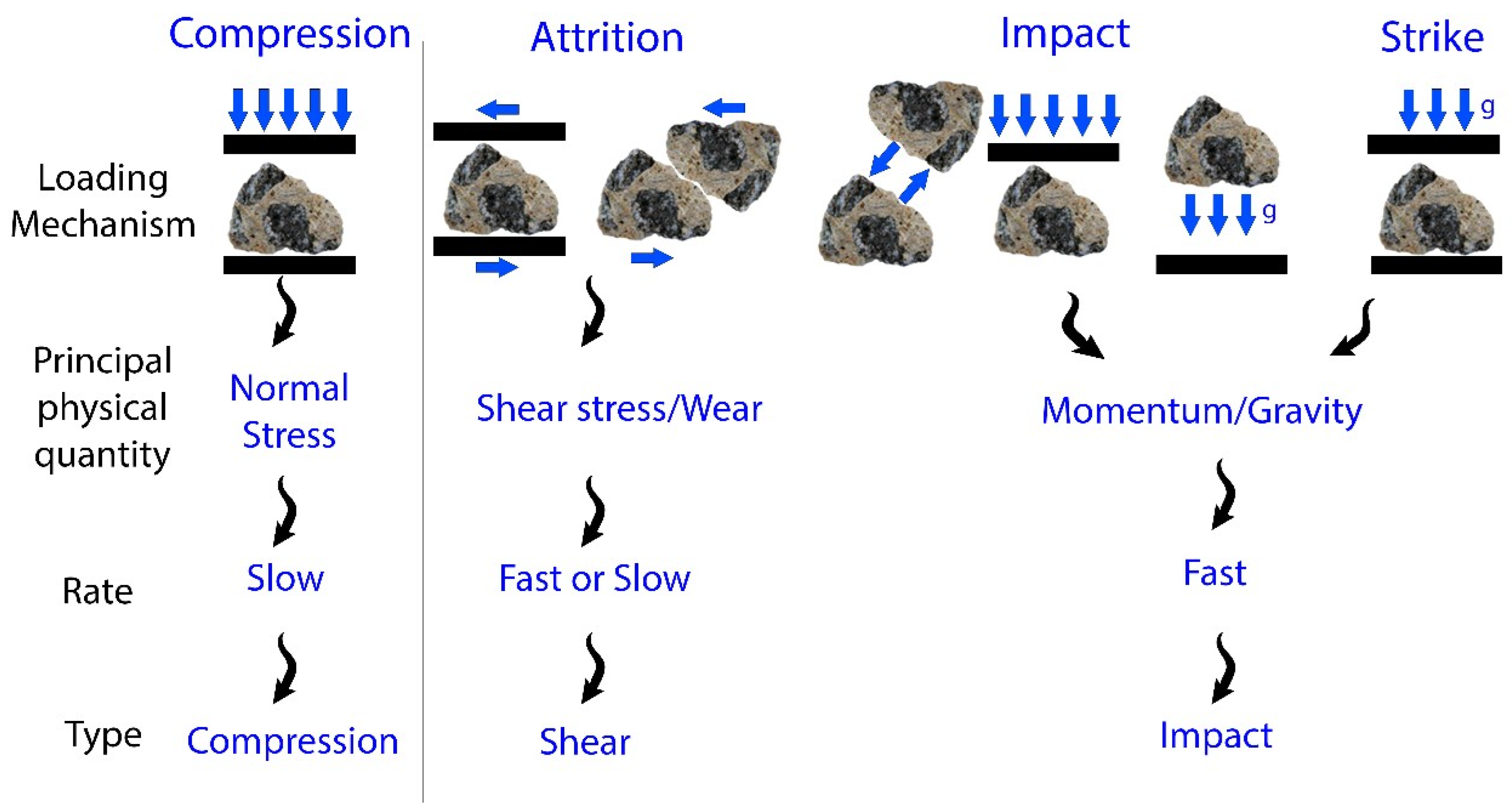
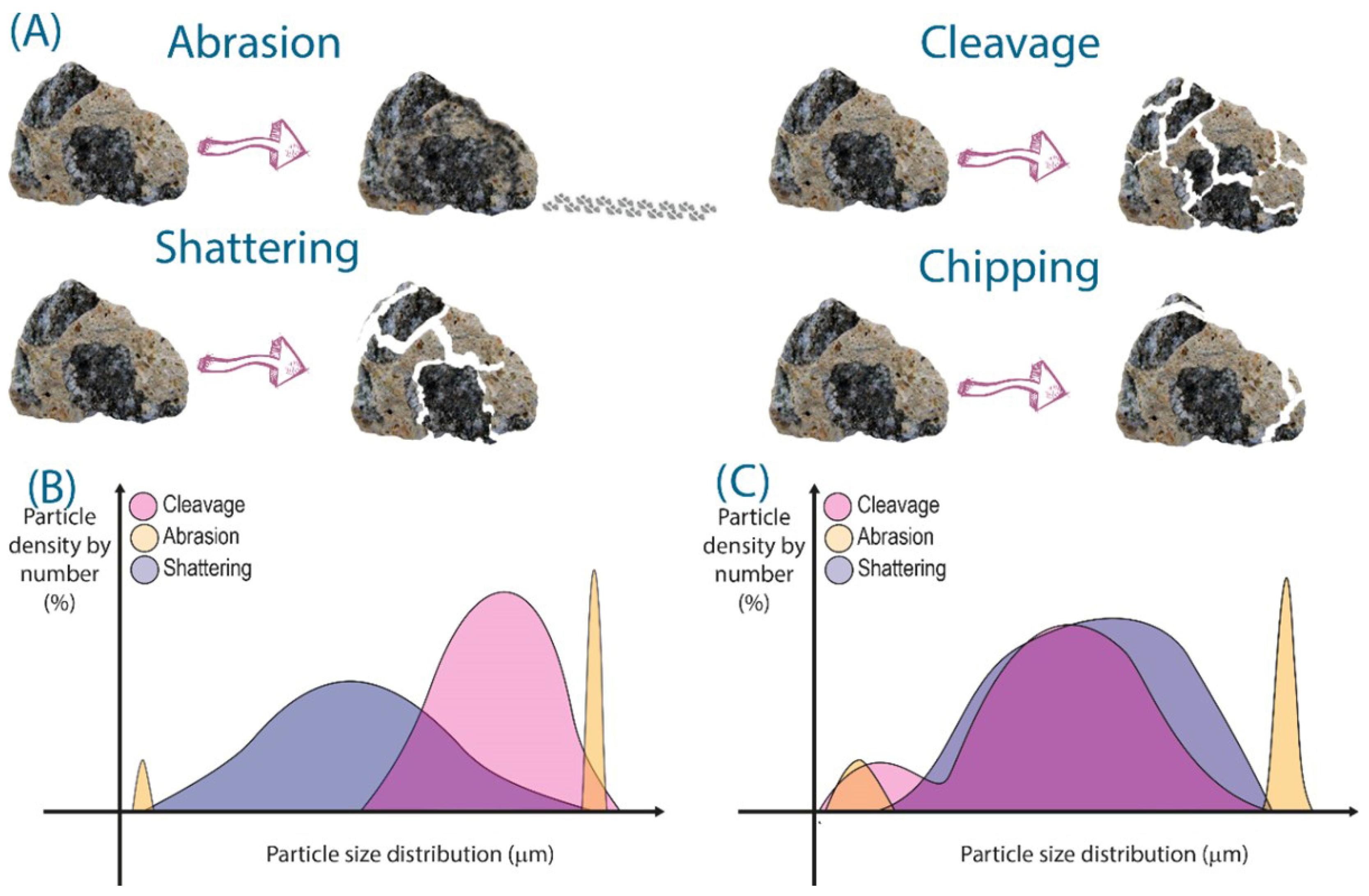
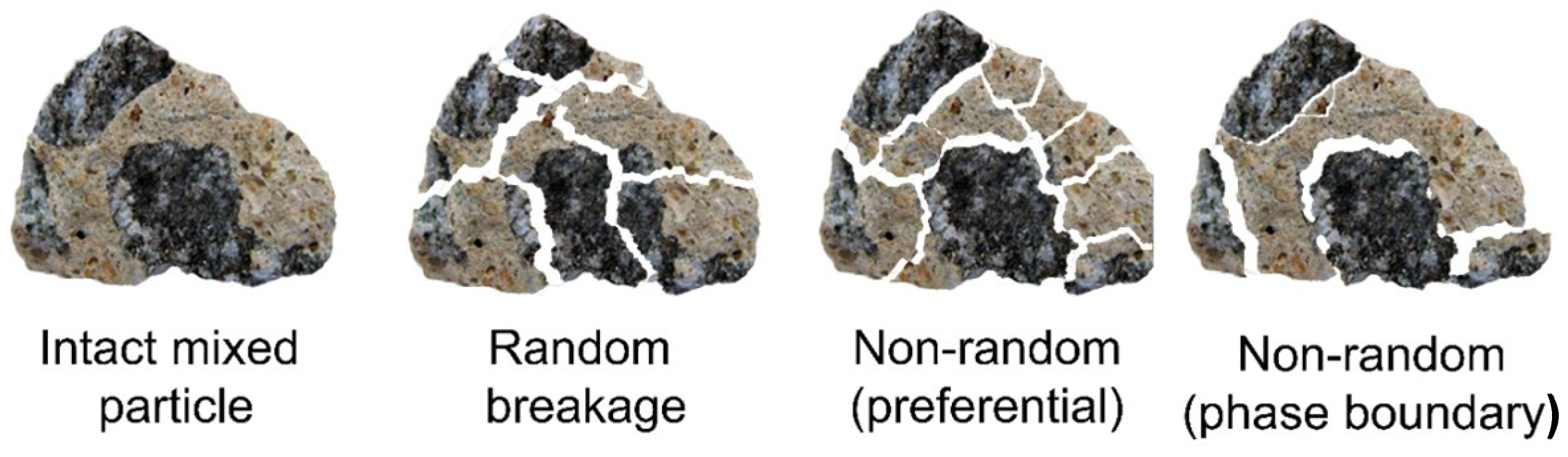
2.1. Breakage Fundamentals
- Volume percentages of the interest phase: used to assess the efficiency of selective comminution.
- Texture: grain size indicates the potential for selective comminution; grain shape affects how the material responds to the applied loading mechanism; and surface roughness influences the strength of the grain, particularly its shear strength and fracture toughness.
- Structure: information regarding the spatial orientation and distribution of the target grains helps determine the appropriate size fraction; additionally, the degree of space filling can affect the overall material strength.
2.2. Comminution Equipment
- Primary crushers: generally large machines with a reduction ratio of approximately 8:1, including jaw crushers, gyratory crushers, horizontal impact crushers, and rotary breakers.
- Secondary crushers: designed to further reduce particle size prior to grinding, with a reduction ratio between 6:1 and 8:1; these typically include cone crushers, horizontal impact crushers, and high-pressure grinding rolls.
- Tertiary crushers: characterized by a reduction ratio between 4:1 and 6:1; these typically include cone crushers and high-pressure grinding rolls.
- Quaternary crushers: also considered a coarse grinding stage, depending on the particle size range, typically including vertical shaft impact crushers (VSI).
2.3. Advanced Separation Technologies
2.4. Comminution Process Flowsheets for RA Production
3. Methodology—Bibliometric Research
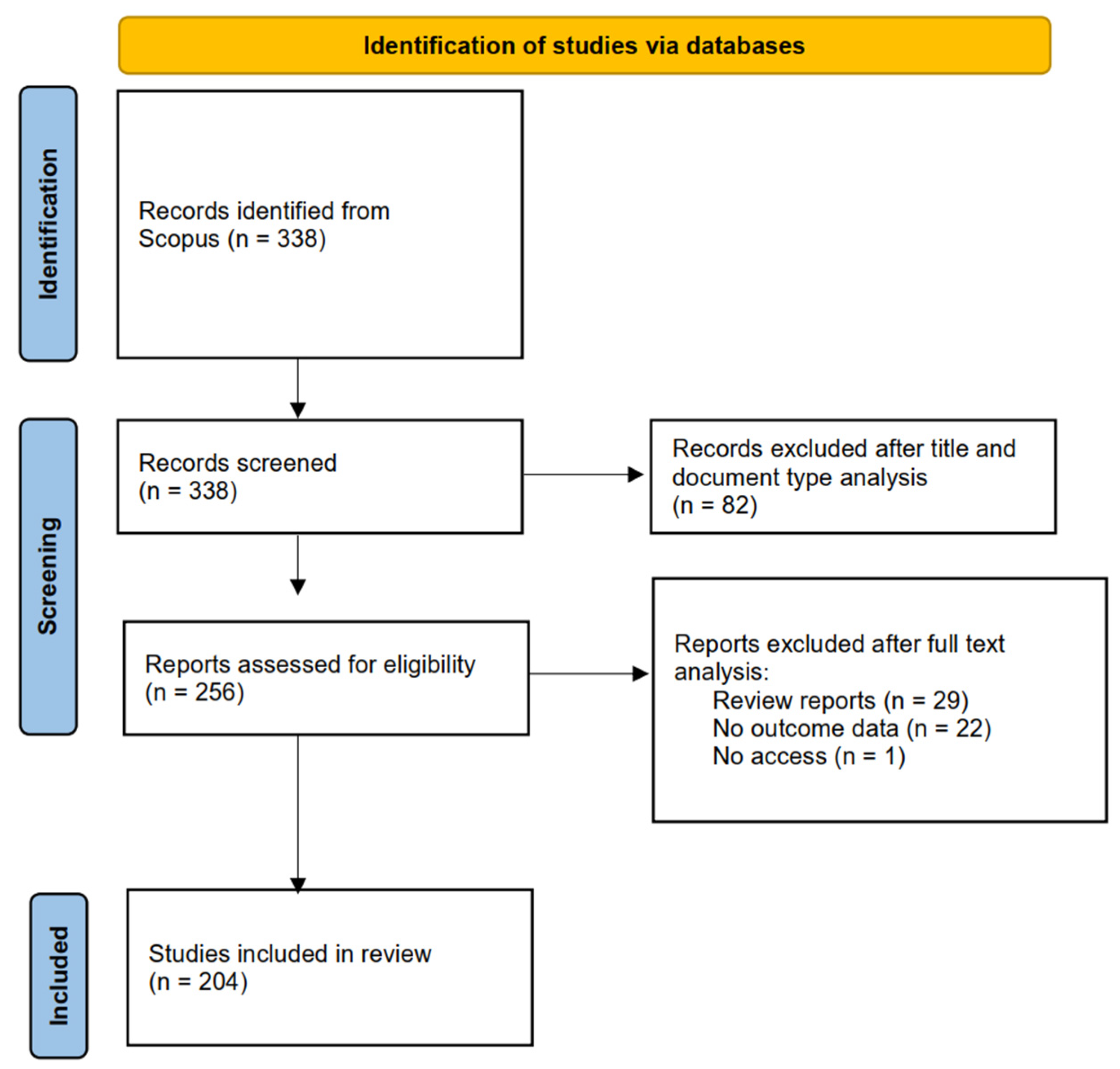
3.1. Identification
3.2. Screening, Eligibility, and Inclusion
- Does the paper mention crushing and/or grinding (e.g., jaw crusher, impact crusher, ball mill)?
- What type of crusher and/or grinding was used?
- What is the parameter of the equipment described (e.g., discharge conditions, rotor speed, number of balls)?
- Does the paper mention separation techniques?
- What is the application of the recycled concrete aggregates?
- What primary properties (aggregate properties) were analyzed for quality control?
- What secondary properties (product properties) were analyzed for evaluation quality?
4. Results and Discussion
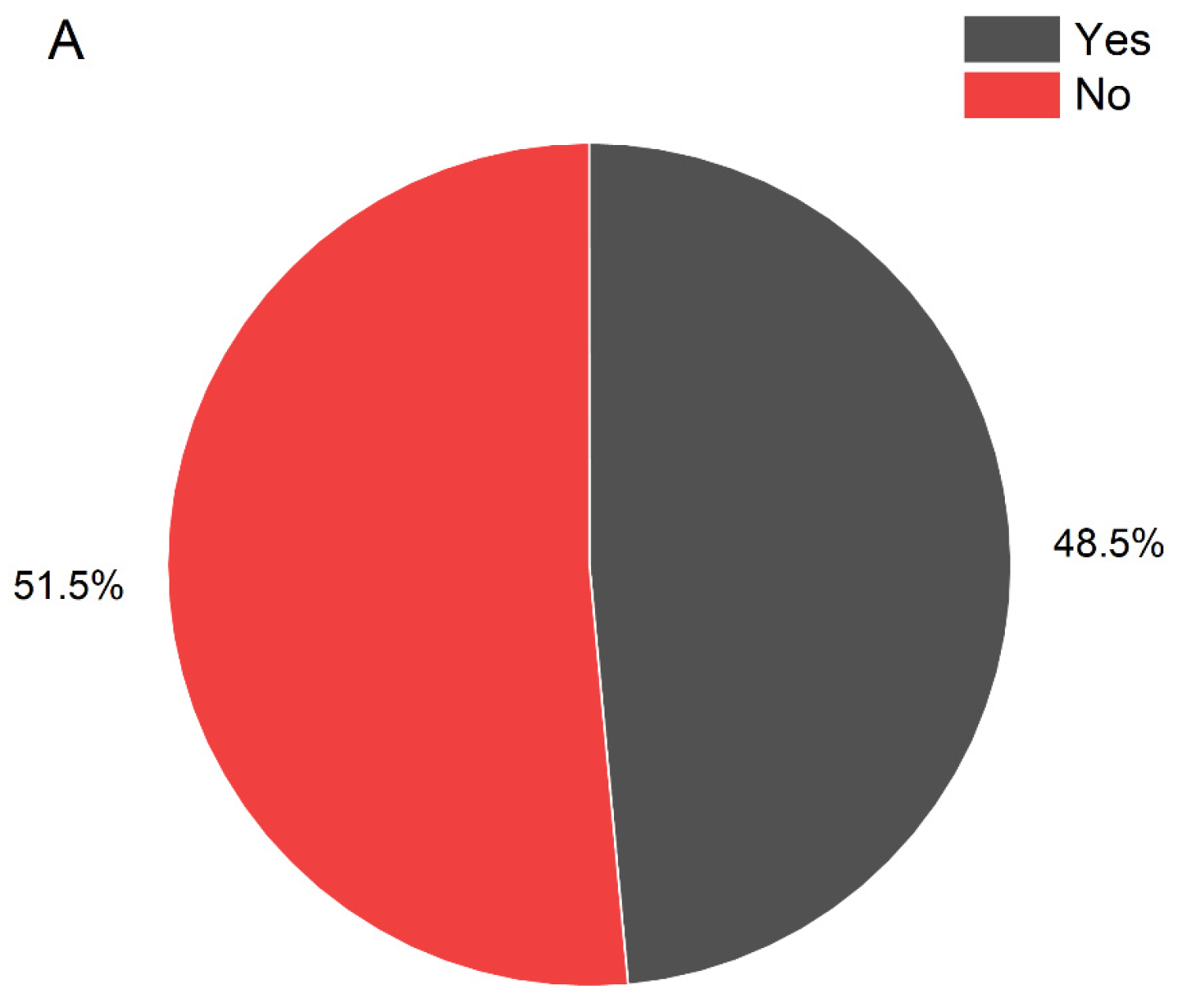
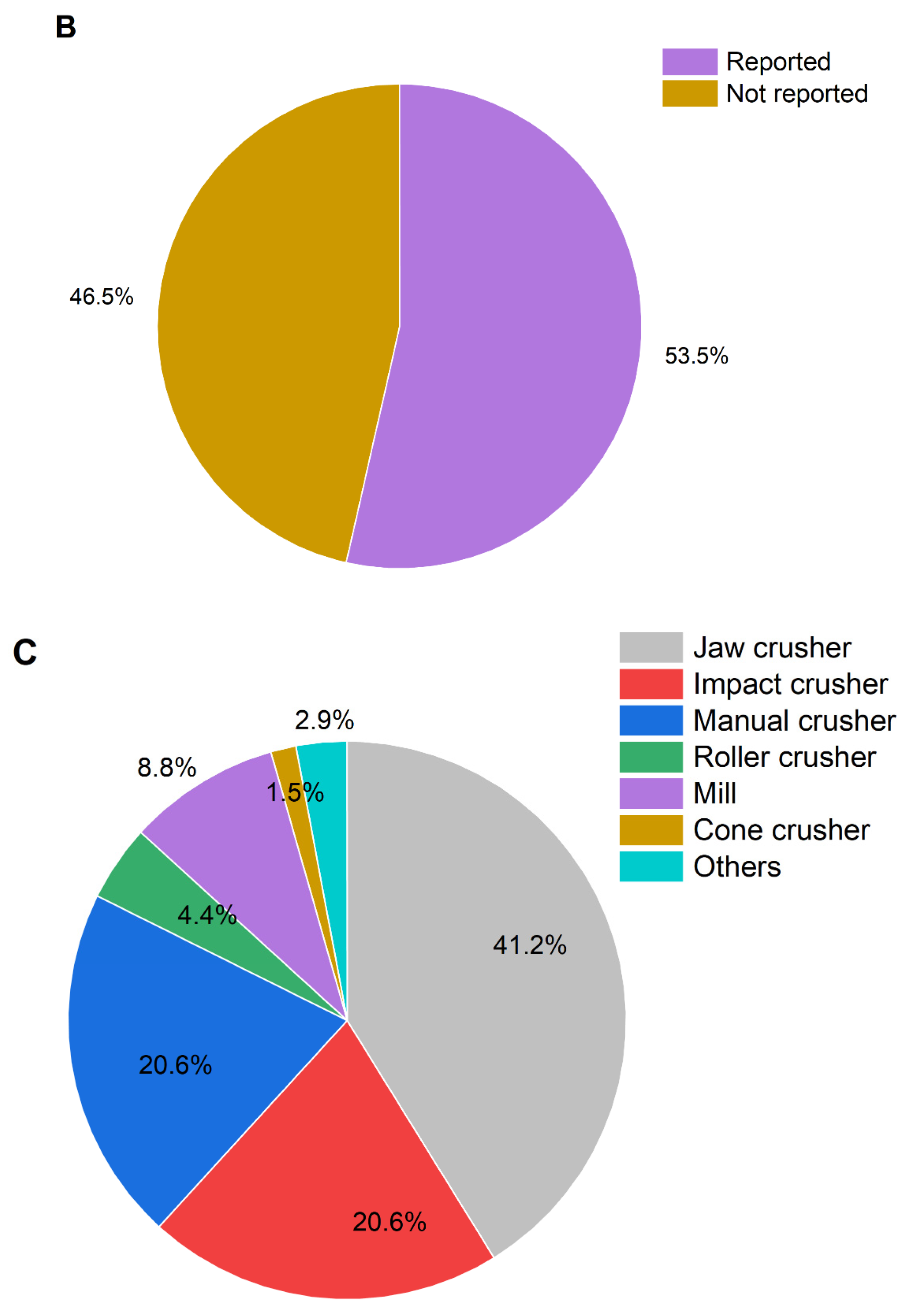
4.1. Crushing Methods
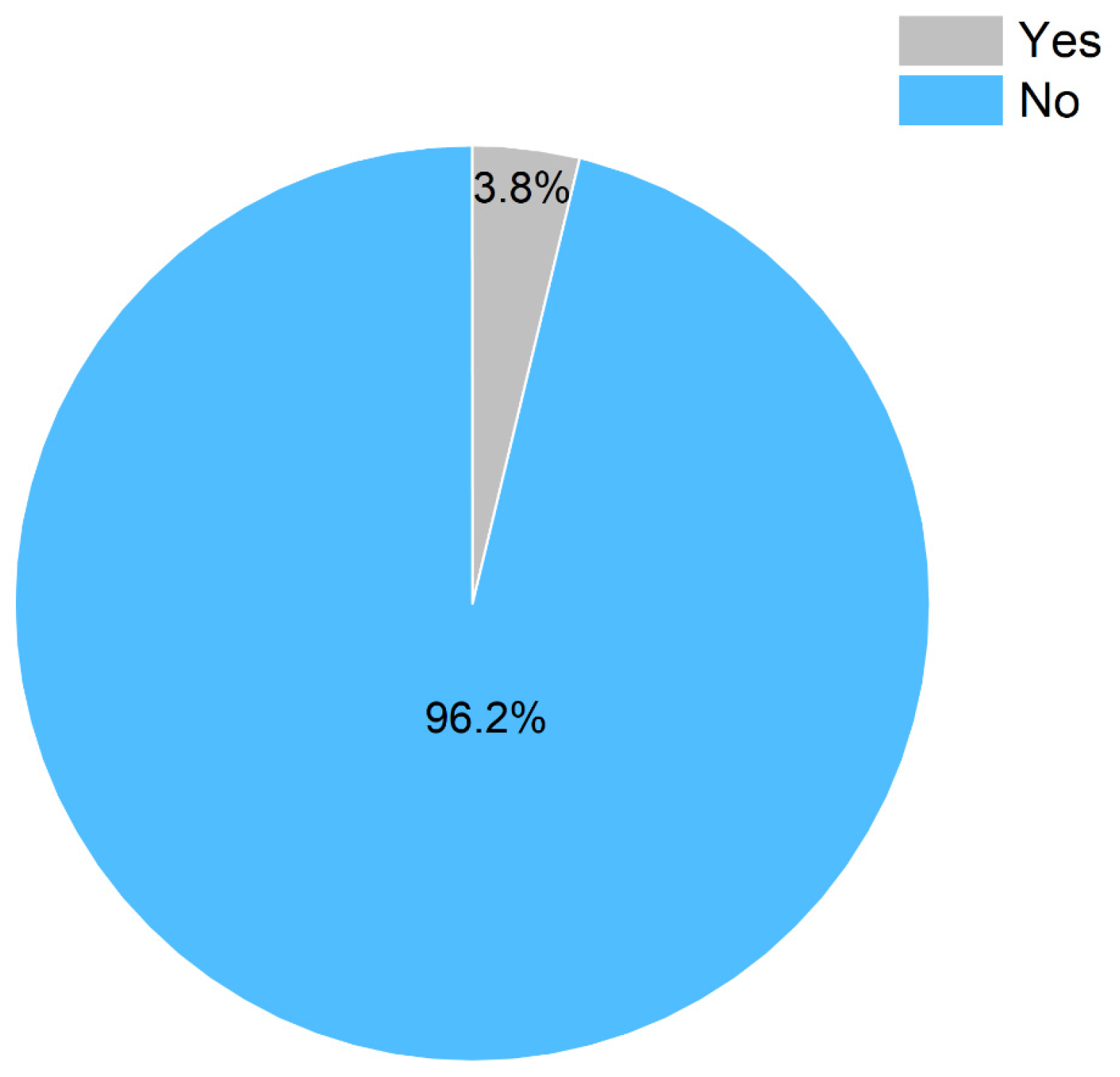
4.2. Separation Technology
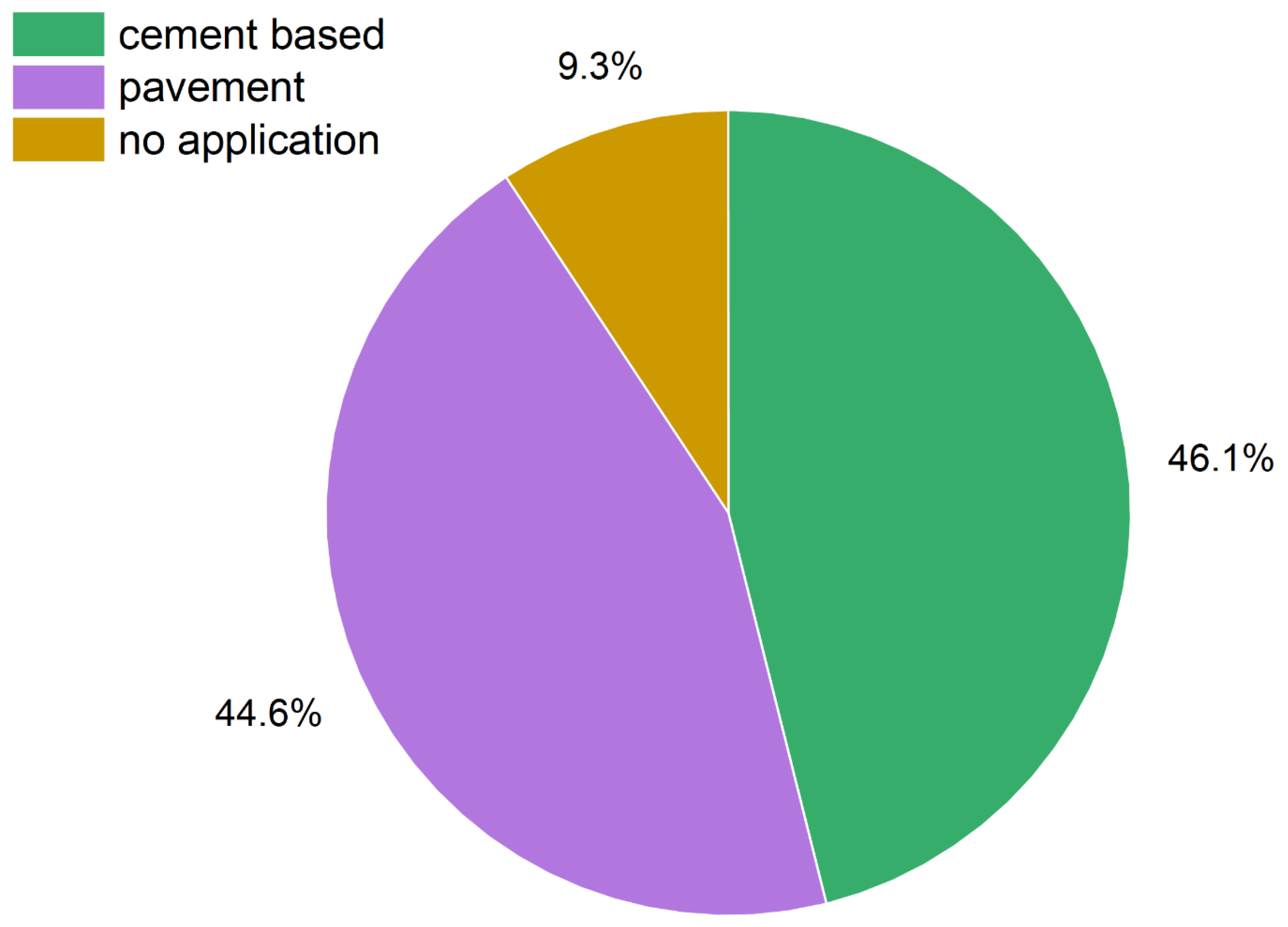
4.3. Applications and Measured Properties of Recycled Concrete Aggregates
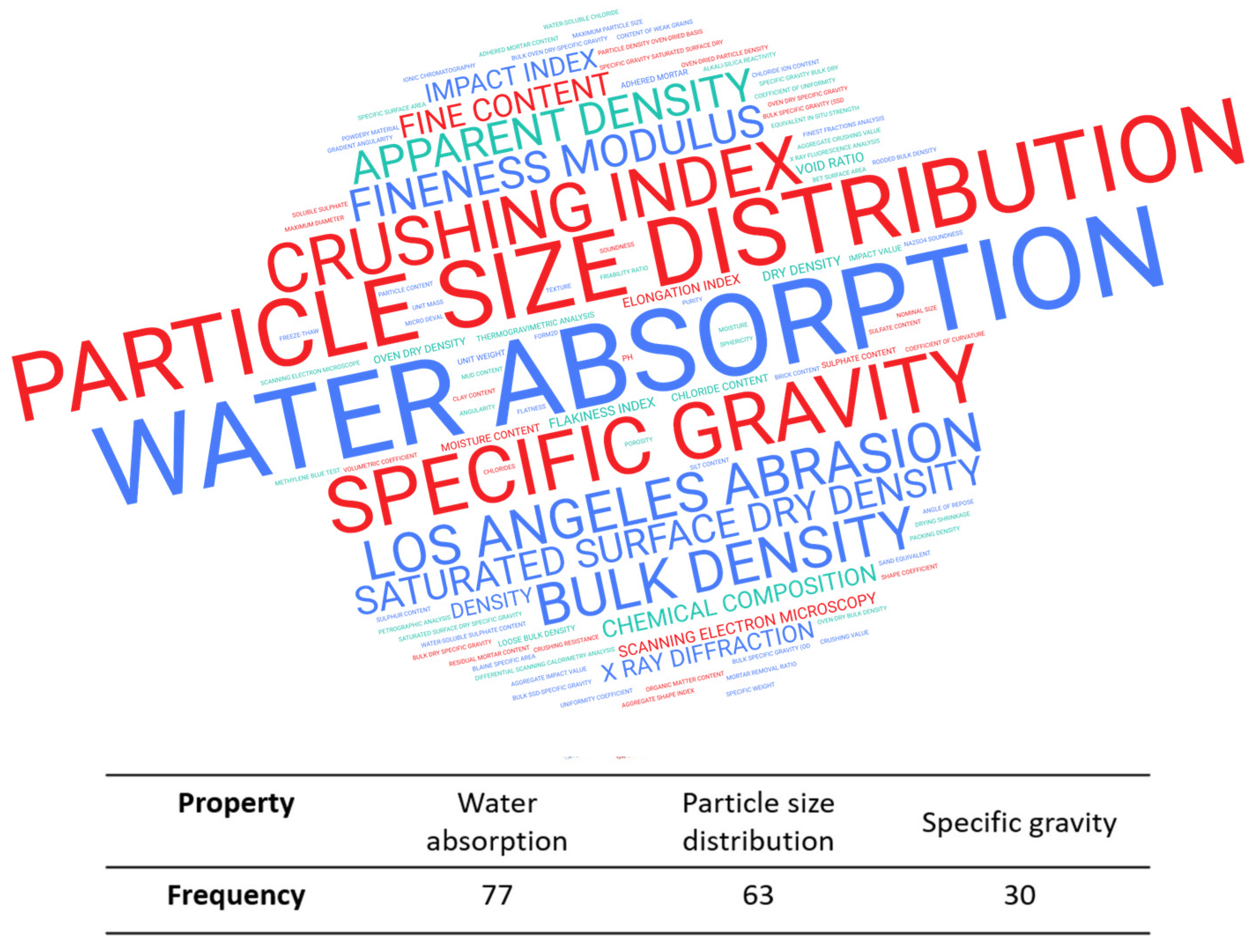
4.4. Primary Properties
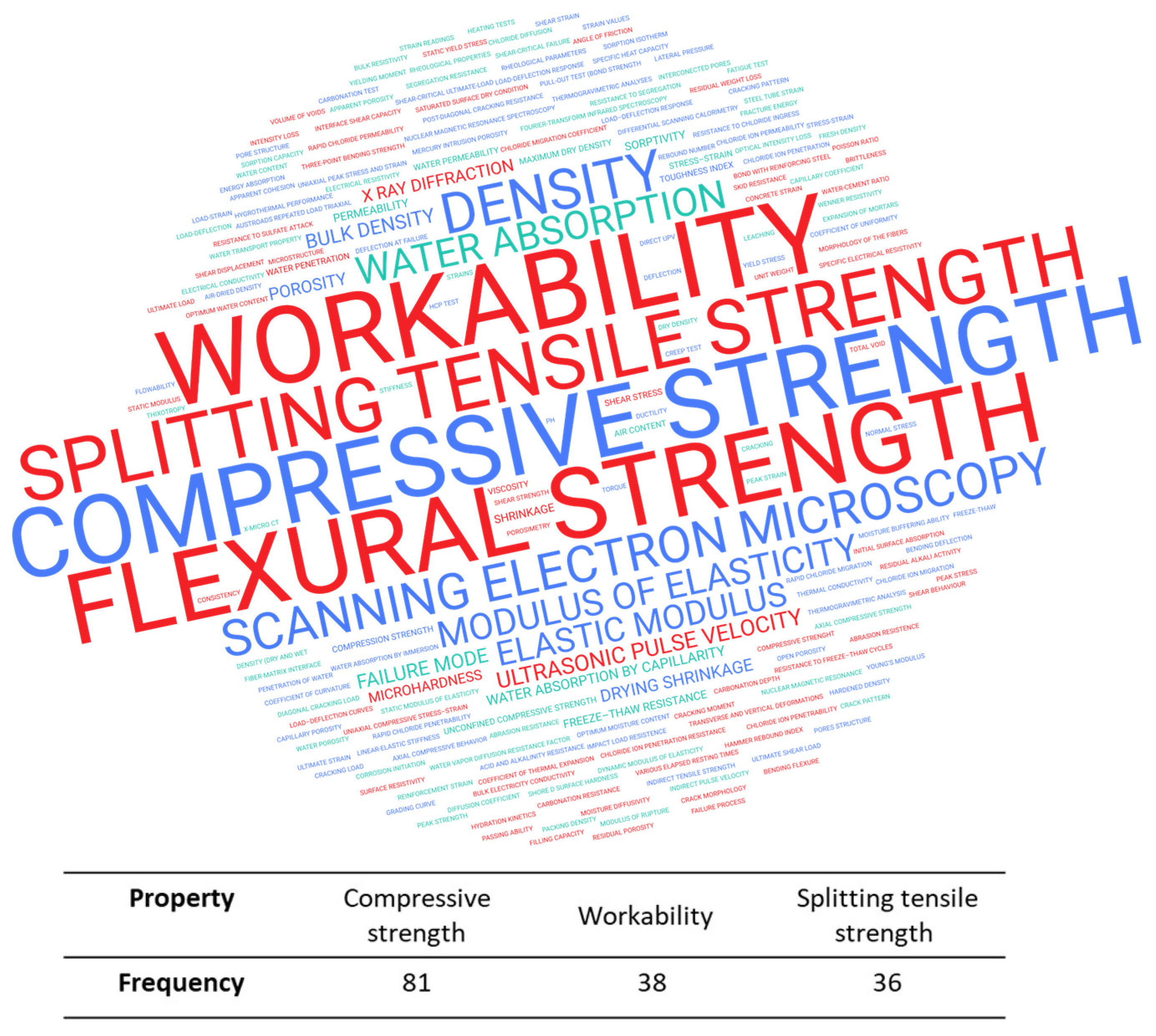
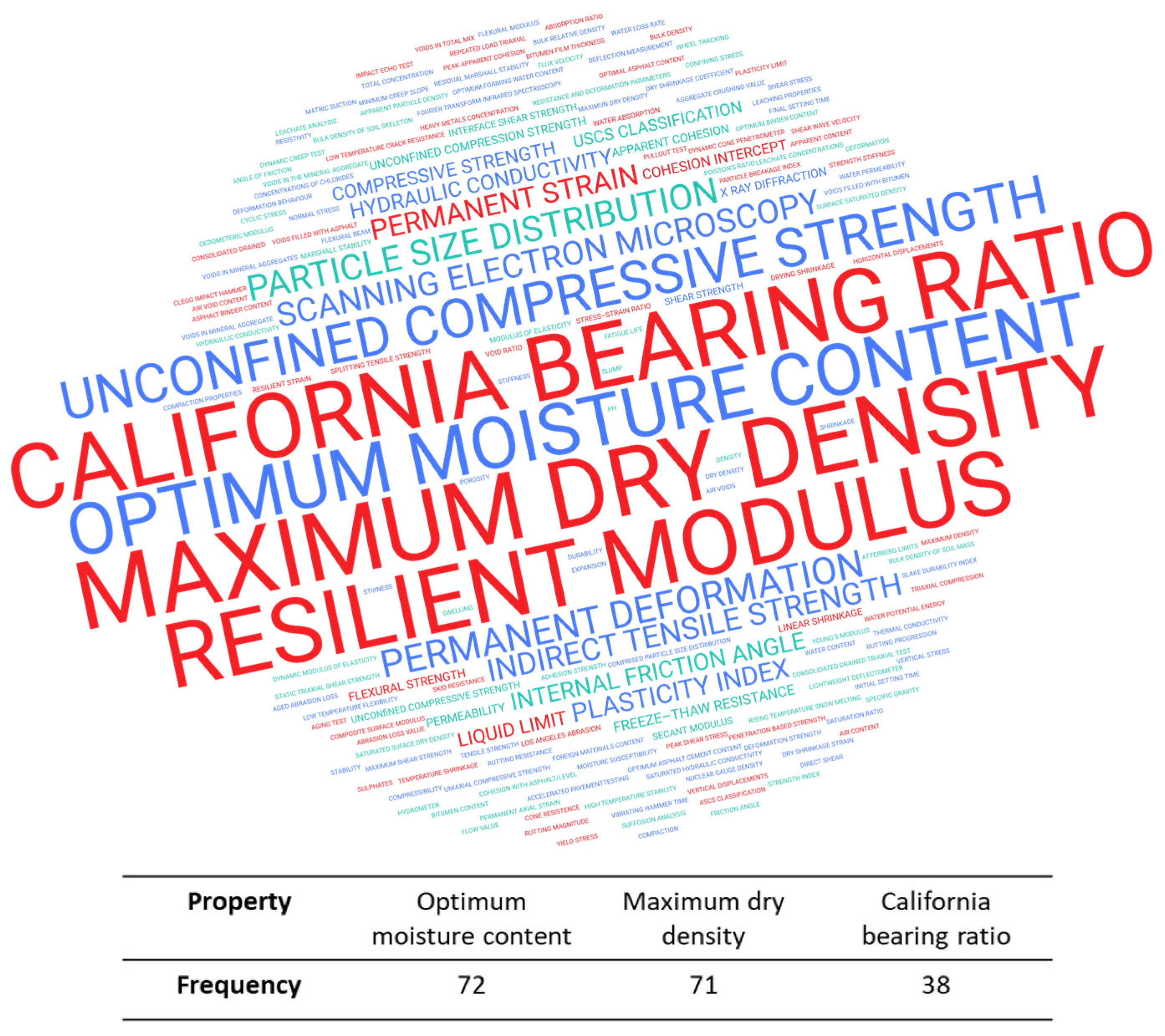
4.5. Secondary Properties
5. Best Practices in Mineral Processing for RAs
6. Future Research Perspectives
7. Conclusions
Author Contributions
Funding
Data Availability Statement
Acknowledgments
Conflicts of Interest
Abbreviations
| CDW | concrete and demolition waste |
| RCA | recycled concrete aggregate |
| RA | recycled aggregate (recycled mixed aggregates) |
| CP | cement paste |
| ITZ | interfacial transition zone |
| VSI | vertical impact crusher |
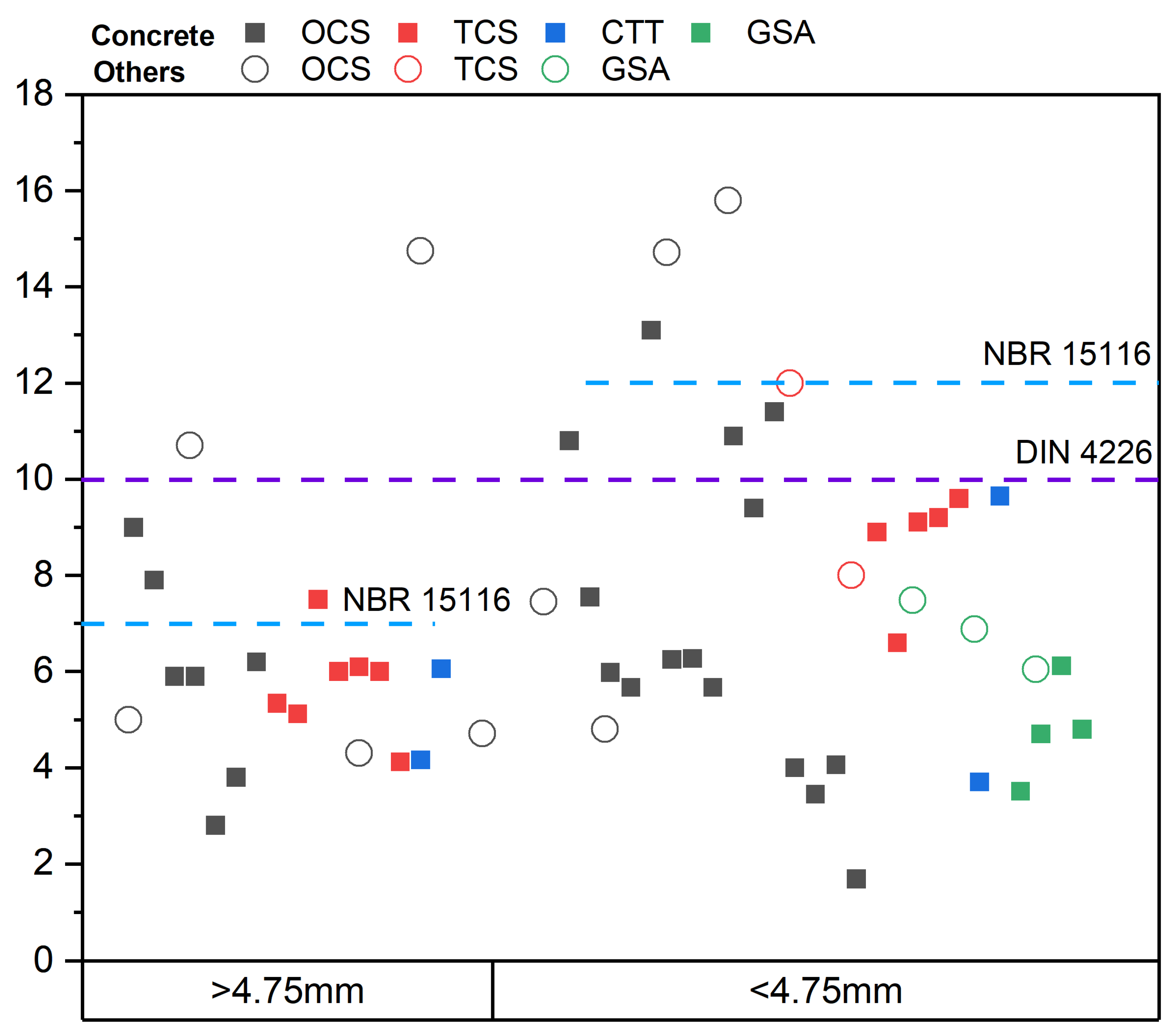
| OCS | one crushing stage |
| TCS | two or more crushing stages |
| CTT | chemical or thermal treatment |
| GSA | grinding stage added |
| PRISMA | Preferred Reporting Items for Systematic Reviews and Meta-Analyses |
| ASR | alkali–silica reaction |
Appendix A

| Breakage Mechanism | Characteristics | Types | |
|---|---|---|---|
| Jaw Crushers | Compression [15,35,311] | Operation: consists of two jaws, one fixed and one movable (connected to an eccentric shaft), or two movable jaws Size reduction: 7:1 Product: lower production of fine particles | Blake jaw crusher (single-toggle and double-toggle); Dodge crusher |
| Impact Crushers | Impact and abrasion [15,31,34,35,52] | Operation: a rotor coupled impact bars colliding the material, and throwing it against impact plates Size reduction: 40:1 Product: particles with cubic shape | Horizontal shaft impactor (HIS) Vertical shaft impactor (VSI) |
| Gyratory Crushers | Compression and abrasion [15,34,35] | Operation: a movable cone rotating in an eccentric movement of approaching and distancing from a fixed mantle Size reduction: 2:1 to 8:1 Product: particles with elongated and flaky characteristics (cone crusher) | Gyratory crusher and Cone crusher |
| Roll Crushers | Compression [15,35] | Operation: one or two steel rolls spinning in opposite directions Size reduction: 3:1 to 7:1 Product: lower production of fine particles | Single roll, double rolls and high-pressure grinding rolls |
| Ball mill | Compression, abrasion and impact [312] | Operation: a cylindrical shell, in a horizontal position. The drum is connected on hollow trunnions, and rotates on its axis Size reduction: 15:1 to 20:1 | Grinding media: rods, balls or autogenous grinding |
Appendix B
| Classification | Characteristics | Equipment | |
|---|---|---|---|
| Gravity | Jigging [37,38] | Separation occurs within a particle bed intermittently fluidized by pulsating water flow. The alternating expansion and contraction of the bed enable particles to stratify according to density differences. | Harz Jig; Denver Jig; InLine Pressure Jig; Circular Jig; IHC Radial Jig, Baum Jig; Batac Jig |
| Shaking concentrators [37] | Utilizes a horizontal shaking motion applied to the slurry–solid mixture, promoting particle stratification and fluidization that lead to the separation of lighter and heavier fractions. | Wifley table; Mozley table; Gemeni Gold table | |
| Flowing film concentrators [37] | Operates by allowing a slurry to flow over an inclined surface under gravity, causing differential particle movement and separation based on density and size. | Sluice boxes; Strake table; Spiral concentrator; Reichert cone; Centrifugal separator | |
| Dense medium | Heavy liquids [37] | Employs a fluid of intermediate density to separate particles that float or sink depending on their specific gravity. Applied in laboratory | Bromoform; Tetrabromoethane; Di-iodo methane; Clerici solution; Tungstate-based inorganic heavy liquids |
| Heavy medium [313] | Utilizes a suspension of fine, high-density solids in water that behaves as a heavy liquid, commonly used in industrial separation processes. | Ferrosilicon; Magnetite | |
| Magnetic | Low-intensity [40] | Typically employed for the concentration of ferromagnetic minerals and certain strongly paramagnetic materials | Drum separator; Cross-belt separator; Rare earth roll separator |
| High-intensity [40] | Applied to moderately paramagnetic minerals requiring stronger magnetic fields for efficient separation. | Induced roll magnetic; WHIMS (Jones separator) | |
| High-gradient [40] | Designed to recover weakly paramagnetic minerals or very fine particles by generating extremely high magnetic field gradients. | High-gradient magnetic separator; Vertical pulsating high gradient magnetic separator |
Appendix C
| Processing | Type of Waste | PSD (mm) | W.A. (%) | Application |
|---|---|---|---|---|
| Crushing and sieving [48] | Concrete | 0–5 | 10.8 | Concrete |
| 5–12 | 9.00 | |||
| 12–22 | 7.90 | |||
| Crushing [49] | Concrete | 0–4 | 7.30–7.80 | Concrete |
| 4–10 | 5.40–6.40 | |||
| 10–20 | 5.60–6.20 | |||
| Jaw crushing, sieving, cone crushing roller sand washing [51] | Concrete | 0.15–4.8 | 8.90 | Concrete |
| Jaw crushing, sieving, roll crushing and wheeled sand washing [51] | Concrete | 0.15–0.60 | 6.60 | |
| Impact crushing, jaw crushing and sieving [52] | Concrete-mansory | 0.15–3 | 12.00 | No aplication |
| Impact crushing, jaw crushing, vertical shaft impact crushing and sieving [52] | 0.15–3 | 7.00–9.00 | ||
| Pre-fragmentation and sieving [53] | Concrete | 0.15–9.5 | 5.98 | Concrete |
| Jaw crushing and sieving [53] | 0.15–4.75 | 5.67 | ||
| Jaw crushing, ball mill and sieving [53] | 0.15–1.18 | 3.51 | ||
| Jaw crusher, sieving, ball mil and granulator [54] | Concrete | 0.15–5 | 3.39–6.02 | Mortar |
| Jaw crushing and sieving [314] | Concrete | 0.074–1.19 | 13.10 | Concrete |
| Ball mil and acid treatment [315] | Concrete | 0.15–5 | 2.30–5.11 | Concrete |
| Crushing [316] | Brick | <5 | 14.75 | Concrete |
| Concrete | <5 | 6.25 | ||
| Jaw crushing and sieving [55] | Ceramic | 0–4.76 | 4.71 | Mortar |
| Ceramic-mortar | 0–4.76 | 7.45 | ||
| Concrete | 0–4.76 | 6.27 | ||
| Pre-screening, trommel separation of fines, crushing and grinding [56] | Ceramic | 0.063–4 | 7.48 | Mortar |
| Mixed | 0.063–4 | 6.88 | ||
| Concrete | 0.063–4 | 6.12 | ||
| Hammer mill [57] | Mixed | 0.075–1.2 | 4.50–7.60 | Mortar |
| Crushing and sieving [317] | Concrete | 0–5 | 5.67 | Concrete |
| Jaw crushing [318] | Concrete | <4 | 10.90 | Concrete |
| Jaw crushing and sieving [59] | Concrete | 0.15–4.75 | 9.40 | Mortar |
| RA high CP | 0.15–4.75 | 4.06 | ||
| RA low CP | 0.15–4.75 | 1.69 | ||
| Hammer and drill machine, followed by sieving [60] | Concrete | <4.75 | 11.4 | Mortar |
| Hammer and drill machine, sieving, ball mill, jaw crushing [60] | Concrete | <4.75 | 4.80 | |
| Jaw crushing [61] | Concrete | 4.75–19.0 | 2.8 | Mortar |
| Hammer and jaw crushing [61] | Concrete | 20 | 5.34 | No application |
| Jaw crushing and secondary crushing [319] | Concrete | 4.75–10.0 | 5.12 | Concrete |
| <4.75 | 9.11 | |||
| Crushing and sieving [320] | Mixed | >4.75 | 5.0 | Concrete |
| <4.75 | 4.8 | |||
| Jaw crushing and sieving [321] | Concrete | 4.75–25.0 | 3.8 | Concrete |
| Crushing and advanced dry recovery coarse [62] | Concrete | 4.0–12.0 | 4.16 | Concrete |
| Crushing, advanced dry recovery air knife and heating air classification system [62] | 0.25–4.0 | 9.65 | ||
| Crushing and sieving [322] | Concrete | 4.75–40.0 | 6.2 | Sub-base pavement |
| 0–4.8 | 4.0 | |||
| Mixed | 4.8–40 | 10.7 | ||
| 0–4.8 | 4.3 | |||
| Jaw crushing and sieving [63] | Concrete | <2 | 3.45 | Mortar |
| Jaw crushing (primary, secondary and tertiary) and sieving [64] | lightweight Concrete | 0–4 | 9.2 | Concrete |
| 4–8 | 7.5 | |||
| 8–16 | 6.0 | |||
| load-bearing Concrete | 0–4 | 9.6 | ||
| 4–8 | 6.1 | |||
| 8–16 | 6.0 | |||
| Jaw crushing, sieving and advanced dry recovery coarse [323] | Concrete | 4–16 | 6.06 | No aplication |
| Impact crushing [324] | Brick | 0–5 | 14.72 | Concrete |
| Crushing [324] | Mixed | 0–5 | 15.8 | |
| Jaw and impact crushing [325] | Concrete | 1.2–37.5 | 4.12 | Concrete |
References
- Tan, J.; Cizer, Ö.; De Vlieger, J.; Dan, H.; Li, J. Impacts of Milling Duration on Construction and Demolition Waste (CDW) Based Precursor and Resulting Geopolymer: Reactivity, Geopolymerization and Sustainability. Resour. Conserv. Recycl. 2022, 184, 106433. [Google Scholar] [CrossRef]
- Taylor, H.F.W. Cement Chemistry, 2nd ed.; Thomas Telford Publishing: London, UK, 1997. [Google Scholar]
- Mehta, P.K.; Monteiro, P.J.M. Concrete: Microstructure, Properties, and Materials, 4th ed.; McGraw-Hill Education: New York, NY, USA, 2014; ISBN 9780071797870. [Google Scholar]
- King, R.P. Comminution and Liberation of Minerals. Miner. Eng. 1994, 7, 129–140. [Google Scholar] [CrossRef]
- Semsari Parapari, P.; Parian, M.; Rosenkranz, J. Breakage Process of Mineral Processing Comminution Machines–An Approach to Liberation. Adv. Powder Technol. 2020, 31, 3669–3685. [Google Scholar] [CrossRef]
- Tam, V.W.Y.; Gao, X.F.F.; Tam, C.M.M.; Chan, C.H.H. New Approach in Measuring Water Absorption of Recycled Aggregates. Constr. Build. Mater. 2008, 22, 364–369. [Google Scholar] [CrossRef]
- Mallick, R.B.; El-Korchi, T. Pavement Engineering; CRC Press: Boca Raton, FL, USA, 2022; ISBN 9781003353492. [Google Scholar]
- Sadowska-Buraczewska, B.; Grzegorczyk-Frańczak, M. Sustainable Recycling of High-Strength Concrete as an Alternative to Natural Aggregates in Building Structures. Sustainability 2021, 13, 4286. [Google Scholar] [CrossRef]
- Müller, A.; Martins, I. Recycling of Building Materials; Springer Fachmedien Wiesbaden: Wiesbaden, Germany, 2022; ISBN 978-3-658-34608-9. [Google Scholar]
- Pepe, M.; Toledo Filho, R.D.; Koenders, E.A.B.; Martinelli, E. Alternative Processing Procedures for Recycled Aggregates in Structural Concrete. Constr. Build. Mater. 2014, 69, 124–132. [Google Scholar] [CrossRef]
- Mistri, A.; Bhattacharyya, S.K.; Dhami, N.; Mukherjee, A.; Barai, S.V. A Review on Different Treatment Methods for Enhancing the Properties of Recycled Aggregates for Sustainable Construction Materials. Constr. Build. Mater. 2020, 233, 117894. [Google Scholar] [CrossRef]
- Silva, R.V.; de Brito, J.; Dhir, R.K. Availability and Processing of Recycled Aggregates within the Construction and Demolition Supply Chain: A Review. J. Clean. Prod. 2017, 143, 598–614. [Google Scholar] [CrossRef]
- Busari, A.; Adeyanju, E.; Loto, T.; Ademola, D. Recycled Aggregate in Pavement Construction: Review of Literatures. J. Phys. Conf. Ser. 2019, 1378, 022026. [Google Scholar] [CrossRef]
- Unland, G. Chapter 4 The Principles of Single-Particle Crushing. Handb. Powder Technol. 2007, 12, 117–225. [Google Scholar] [CrossRef]
- Kelly, E.G.; Spottiswood, D.J. Introduction to Mineral Processing; John Wiley & Sons: New York, NY, USA, 1982. [Google Scholar]
- King, R.P. Comminution Operations. In Modeling and Simulation of Mineral Processing Systems; Butterworth-Heinemann: Oxford, UK, 2001; pp. 127–212. ISBN 978-0-08-051184-9. [Google Scholar]
- Fuerstenau, M.C.; Han, K.N. Principles of Mineral Processing; Society For Mining, Metallurgy, and Exploration: Englewood, CO, USA, 2003. [Google Scholar]
- Königsberger, M.; Pichler, B.; Hellmich, C. Micromechanics of ITZ-Aggregate Interaction in Concrete Part II: Strength Upscaling. J. Am. Ceram. Soc. 2014, 97, 543–551. [Google Scholar] [CrossRef]
- Chakraborty, S.; Subramaniam, K.V. Influences of Matrix Strength and Weak Planes on Fracture Response of Recycled Aggregate Concrete. Theor. Appl. Fract. Mech. 2023, 124, 103801. [Google Scholar] [CrossRef]
- Guldris Leon, L.; Hogmalm, K.J.; Bengtsson, M. Understanding Mineral Liberation during Crushing Using Grade-by-Size Analysis—A Case Study of the Penuota Sn-Ta Mineralization, Spain. Minerals 2020, 10, 164. [Google Scholar] [CrossRef]
- Hoffmann Sampaio, C.; Cazacliu, B.G.; Ambrós, W.M.; Kronbauer, M.A.; Tubino, R.M.C.; Dal Molin, D.C.C.; Oliva Moncunill, J.; Miltzarek, G.L.; Waskow, R.P.; Dos Santos, V.L.G.; et al. Characterization of Demolished Concretes with Three Different Strengths for Recycling as Coarse Aggregate. Minerals 2021, 11, 803. [Google Scholar] [CrossRef]
- Gaudin, A.M. Principles of Mineral Dressing, 5th ed.; Tata McGraw-Hill: New Delhi, India, 1971. [Google Scholar]
- Mariano, R.A.; Evans, C.L.; Manlapig, E. Definition of Random and Non-Random Breakage in Mineral Liberation—A Review. Miner. Eng. 2016, 94, 51–60. [Google Scholar] [CrossRef]
- King, R.P. Mineral Liberation. In Modeling and Simulation of Mineral Processing Systems; Butterworth-Heinemann: Oxford, UK, 2001; pp. 45–80. ISBN 978-0-08-051184-9. [Google Scholar]
- Little, L.; Mainza, A.N.; Becker, M.; Wiese, J.G. Using Mineralogical and Particle Shape Analysis to Investigate Enhanced Mineral Liberation through Phase Boundary Fracture. Powder Technol. 2016, 301, 794–804. [Google Scholar] [CrossRef]
- Hesse, M.; Popov, O.; Lieberwirth, H. Increasing Efficiency by Selective Comminution. Miner. Eng. 2017, 103–104, 112–126. [Google Scholar] [CrossRef]
- Ulsen, C.; Contessotto, R.; dos Santos Macedo, R.; Kahn, H. Quantification of the Cement Paste and Phase’s Association in Fine Recycled Aggregates by SEM-Based Image Analysis. Constr. Build. Mater. 2022, 320, 126206. [Google Scholar] [CrossRef]
- Wang, Y.; Lin, C.L.; Miller, J.D. Quantitative Analysis of Exposed Grain Surface Area for Multiphase Particles Using X-Ray Microtomography. Powder Technol. 2017, 308, 368–377. [Google Scholar] [CrossRef]
- Wang, Y.; McClung, C.; Lin, C.L.; Miller, J.D. Stereological Correction of Perimeter Based Estimates of Exposed Grain Surface Area. Miner. Eng. 2018, 126, 64–73. [Google Scholar] [CrossRef]
- Napier-Munn, T.J.; Morrell, S.; Morrison, R.D.; Kojovic, T. Mineral Comminution Circuits: Their Operation and Optimisation; Julius Kruttschnitt Mineral Research Centre, University of Queensland: Indooroopilly, Australia, 1996; Volume 2, ISBN 064628861X. [Google Scholar]
- Major, K. Types and Characteristics of Crushing Equipment and Circuit Flowsheets. In Mineral Processing Plant Design, Practice, and Control; Mular, A.L., Halbe, D.N., Barratt, D.J., Eds.; Society For Mining, Metallurgy, and Exploration: Englewood, CO, USA, 2002; pp. 566–579. [Google Scholar]
- Oliveira, P.; Gabor, F.; Maurício, M.; Bergerman, G.; Ulsen, C. Production of High Quality Fine Recycled Aggregates Using Low Energy Grinding. Ambiente Construído 2024, 24, e135205. [Google Scholar] [CrossRef]
- Yu, L.; Tong, X. Optimization of Key Components of Impact Crusher Based on “Rock Bed” Mechanism. Mech. Adv. Mater. Struct. 2022, 29, 321–329. [Google Scholar] [CrossRef]
- Rajan, B.; Singh, D. Comparison of Shape Parameters and Laboratory Performance of Coarse Aggregates Produced from Different Types of Crushing Operations. J. Mater. Civ. Eng. 2017, 29, 04017044. [Google Scholar] [CrossRef]
- Wills, B.A.; Finch, J.A. Crushers. In Wills’ Mineral Processing Technology; Butterworth-Heinemann: Oxford, UK, 2016; pp. 123–146. ISBN 978-0-08-097053-0. [Google Scholar]
- Barbery, G. Liberation 1, 2, 3: Theoretical Analysis of the Effect of Space Dimension on Mineral Liberation by Size Reduction. Miner. Eng. 1992, 5, 123–141. [Google Scholar] [CrossRef]
- Gupta, A.; Yan, D. Chapter 16—Gravity Separation. In Mineral Processing Design and Operations, 2nd ed.; Gupta, A., Yan, D., Eds.; Elsevier: Amsterdam, The Netherlands, 2016; pp. 563–628. ISBN 978-0-444-63589-1. [Google Scholar]
- Wills, B.A.; Finch, J.A. Chapter 10—Gravity Concentration. In Wills’ Mineral Processing Technology, 2nd ed.; Wills, B.A., Finch, J.A., Eds.; Butterworth-Heinemann: Boston, MA, USA, 2016; pp. 223–244. ISBN 978-0-08-097053-0. [Google Scholar]
- Gupta, A.; Yan, D. Chapter 17—Magnetic and Electrostatic Separation. In Mineral Processing Design and Operations, 2nd ed.; Gupta, A., Yan, D., Eds.; Elsevier: Amsterdam, The Netherlands, 2016; pp. 629–687. ISBN 978-0-444-63589-1. [Google Scholar]
- Wills, B.A.; Finch, J.A. Chapter 13—Magnetic and Electrical Separation. In Wills’ Mineral Processing Technology, 8th ed.; Wills, B.A., Finch, J.A., Eds.; Butterworth-Heinemann: Boston, MA, USA, 2016; pp. 381–407. ISBN 978-0-08-097053-0. [Google Scholar]
- Rosenblum, S.; Brownfield, I.K. Magnetic Susceptibilities of Minerals; Open-File Report; US Geological Survey: Reston, VA, USA, 2000. [Google Scholar]
- Svoboda, J. Principles of Material Treatment by Magnetic Means. In Magnetic Techniques for the Treatment of Materials; Springer: Dordrecht, The Netherlands, 2004; pp. 1–66. ISBN 978-1-4020-2107-7. [Google Scholar]
- Carriço, A.; Bogas, J.A.; Hu, S.; Real, S.; Costa Pereira, M.F. Novel Separation Process for Obtaining Recycled Cement and High-Quality Recycled Sand from Waste Hardened Concrete. J. Clean. Prod. 2021, 309, 127375. [Google Scholar] [CrossRef]
- Ulsen, C.; Kahn, H.; Hawlitschek, G.; Masini, E.A.; Angulo, S.C. Separability Studies of Construction and Demolition Waste Recycled Sand. Waste Manag. 2013, 33, 656–662. [Google Scholar] [CrossRef]
- Coelho, A.; De Brito, J. Preparation of Concrete Aggregates from Construction and Demolition Waste (CDW). In Handbook of Recycled Concrete and Demolition Waste; Woodhead Publishing: Cambridge, UK, 2013; pp. 210–245. ISBN 9780857096906. [Google Scholar]
- Angulo, S.C.; Carrijo, P.M.; Figueiredo, A.D.; Chaves, A.P.; John, V.M. On the Classification of Mixed Construction and Demolition Waste Aggregate by Porosity and Its Impact on the Mechanical Performance of Concrete. Mater. Struct. 2010, 43, 519–528. [Google Scholar] [CrossRef]
- Malysz, G.N.; Dal Molin, D.C.C.; Masuero, A.B. Study of the Influence of Jigging of Recycled Coarse Aggregate on the Compressive Strength of Concrete. Rev. IBRACON Estrut. Mater. 2020, 13, e13503. [Google Scholar] [CrossRef]
- Özalp, F.; Yilmaz, H.D.; Kara, M.; Kaya, Ö.; Şahin, A. Effects of Recycled Aggregates from Construction and Demolition Wastes on Mechanical and Permeability Properties of Paving Stone, Kerb and Concrete Pipes. Constr. Build. Mater. 2016, 110, 17–23. [Google Scholar] [CrossRef]
- Omary, S.; Ghorbel, E.; Wardeh, G. Relationships between Recycled Concrete Aggregates Characteristics and Recycled Aggregates Concretes Properties. Constr. Build. Mater. 2016, 108, 163–174. [Google Scholar] [CrossRef]
- Evangelista, L.; Guedes, M.; De Brito, J.; Ferro, A.C.; Pereira, M.F. Physical, Chemical and Mineralogical Properties of Fine Recycled Aggregates Made from Concrete Waste. Constr. Build. Mater. 2015, 86, 178–188. [Google Scholar] [CrossRef]
- Fan, C.C.; Huang, R.; Hwang, H.; Chao, S.J. Properties of Concrete Incorporating Fine Recycled Aggregates from Crushed Concrete Wastes. Constr. Build. Mater. 2016, 112, 708–715. [Google Scholar] [CrossRef]
- Ulsen, C.; Kahn, H.; Hawlitschek, G.; Masini, E.A.A.; Angulo, S.C.C.; John, V.M.M. Production of Recycled Sand from Construction and Demolition Waste. Constr. Build. Mater. 2013, 40, 1168–1173. [Google Scholar] [CrossRef]
- Gomes, P.C.C.; Ulsen, C.; Pereira, F.A.; Quattrone, M.; Angulo, S.C. Comminution and Sizing Processes of Concrete Block Waste as Recycled Aggregates. Waste Manag. 2015, 45, 171–179. [Google Scholar] [CrossRef] [PubMed]
- Ogawa, H.; Nawa, T. Improving the Quality of Recycled Fine Aggregate by Selective Removal of Brittle Defects. J. Adv. Concr. Technol. 2012, 10, 395–410. [Google Scholar] [CrossRef]
- Martínez, I.; Etxeberria, M.; Pavón, E.; Díaz, N. A Comparative Analysis of the Properties of Recycled and Natural Aggregate in Masonry Mortars. Constr. Build. Mater. 2013, 49, 384–392. [Google Scholar] [CrossRef]
- Saiz Martínez, P.; González Cortina, M.; Fernández Martínez, F.; Rodríguez Sánchez, A. Comparative Study of Three Types of Fine Recycled Aggregates from Construction and Demolition Waste (CDW), and Their Use in Masonry Mortar Fabrication. J. Clean. Prod. 2016, 118, 162–169. [Google Scholar] [CrossRef]
- Miranda, L.F.R.; Constantino, C.S.; Monich, C.R.; de M. Neto, A.A. Use of Recycled Sand Produced at Construction Sites in Bedding Mortars. J. Mater. Civ. Eng. 2013, 25, 236–242. [Google Scholar] [CrossRef]
- Gong, Y.; Chen, P.; Lin, Y.; Wan, Y.; Zhang, L.; Meng, T. Improvement of Recycled Aggregate Properties through a Combined Method of Mechanical Grinding and Microbial-Induced Carbonate Precipitation. Constr. Build. Mater. 2022, 342, 128093. [Google Scholar] [CrossRef]
- Ma, Z.; Shen, J.; Wang, C.; Wu, H. Characterization of Sustainable Mortar Containing High-Quality Recycled Manufactured Sand Crushed from Recycled Coarse Aggregate. Cem. Concr. Compos. 2022, 132, 104629. [Google Scholar] [CrossRef]
- Kumar Vaishnav, S.; Kumar Trivedi, M. Performance Evaluation of Treated Recycled Fine Aggregate on Mortar Properties. Mater. Today Proc. 2022, 62, 6641–6647. [Google Scholar] [CrossRef]
- Rakesh Kumar Reddy, R.; Yaragal, S.C.; Sanjay, V.K. Processing of Laboratory Concrete Demolition Waste Using Ball Mill. Mater. Today Proc. 2023, in press. [Google Scholar] [CrossRef]
- Gebremariam, A.T.; Di Maio, F.; Vahidi, A.; Rem, P. Innovative Technologies for Recycling End-of-Life Concrete Waste in the Built Environment. Resour. Conserv. Recycl. 2020, 163, 104911. [Google Scholar] [CrossRef]
- Sainz-Aja, J.; Carrascal, I.; Polanco, J.A.; Thomas, C. Fatigue Failure Micromechanisms in Recycled Aggregate Mortar by ΜCT Analysis. J. Build. Eng. 2020, 28, 101027. [Google Scholar] [CrossRef]
- Venkrbec, V.; Klanšek, U. Suitability of Recycled Concrete Aggregates from Precast Panel Buildings Deconstructed at Expired Lifespan for Structural Use. J. Clean. Prod. 2020, 247, 119593. [Google Scholar] [CrossRef]
- Mulder, E.; de Jong, T.P.R.; Feenstra, L. Closed Cycle Construction: An Integrated Process for the Separation and Reuse of C&D Waste. Waste Manag. 2007, 27, 1408–1415. [Google Scholar] [CrossRef] [PubMed]
- Kim, K.H.; Cho, H.C.; Ahn, J.W. Breakage of Waste Concrete for Liberation Using Autogenous Mill. Miner. Eng. 2012, 35, 43–45. [Google Scholar] [CrossRef]
- Sui, Y.; Mueller, A. Development of Thermo-Mechanical Treatment for Recycling of Used Concrete. Mater. Struct. 2012, 45, 1487–1495. [Google Scholar] [CrossRef]
- Shima, H.; Tateyashiki, H.; Matsuhashi, R.; Yoshida, Y. An Advanced Concrete Recycling Technology and Its Applicability Assessment through Input-Output Analysis. J. Adv. Concr. Technol. 2005, 3, 53–67. [Google Scholar] [CrossRef]
- Quattrone, M.; Angulo, S.C.; John, V.M. Energy and CO2 from High Performance Recycled Aggregate Production. Resour. Conserv. Recycl. 2014, 90, 21–33. [Google Scholar] [CrossRef]
- Linß, E.; Mueller, A. High-Performance Sonic Impulses—An Alternative Method for Processing of Concrete. Int. J. Miner. Process. 2004, 74, S199–S208. [Google Scholar] [CrossRef]
- Hentges, T.I.; Mezzeti, M.; Hecker, C.; Popov, O.; Landgraf, P.; Angulo, S.C.; Tavares, L.M.; Lieberwirth, H. Electrodynamic Fragmentation as Treatment for Concrete Comminution: Influence of Limestone Filler in the Mix Composition. In Book of Extended Abstracts of the 18th European Symposium on Comminution & Classification; Faitli, J., Rácz, Á., Eds.; Hungarian Chemical Society: Miskolc, Hungary, 2024; pp. 68–71. ISBN 978-615-6018-25-0. [Google Scholar]
- Dong, L.; Fu, Y.; He, M.; Huang, W. Recycling Coarse Aggregates from Concrete Using High Voltage Pulses. Constr. Build. Mater. 2025, 458, 139669. [Google Scholar] [CrossRef]
- Wijayasundara, M.; Mendis, P.; Crawford, R.H. Integrated Assessment of the Use of Recycled Concrete Aggregate Replacing Natural Aggregate in Structural Concrete. J. Clean. Prod. 2018, 174, 591–604. [Google Scholar] [CrossRef]
- Nataraja, M.C.; Bhat, G.; Manoj, M.; Mallya, S. Investigation on Concrete with Crushed Vitrified Tiles as Coarse Aggregates. J. Build. Pathol. Rehabil. 2022, 7, 103. [Google Scholar] [CrossRef]
- Grabois, T.M.; Caldas, L.R.; Julião, N.R.; Filho, R.D.T.; Toledo Filho, R.D. An Experimental and Environmental Evaluation of Mortars with Recycled Demolition Waste from a Hospital Implosion in Rio de Janeiro. Sustainability 2020, 12, 8945. [Google Scholar] [CrossRef]
- Saberian, M.; Li, J.; Perera, S.T.A.M.; Ren, G.; Roychand, R.; Tokhi, H. An Experimental Study on the Shear Behaviour of Recycled Concrete Aggregate Incorporating Recycled Tyre Waste. Constr. Build. Mater. 2020, 264, 120266. [Google Scholar] [CrossRef]
- Rao, A.U.; Shetty, P.P.; Bhandary, P.R.; Tantri, A.; Blesson, S.; Yaragal, S.C. Assessment of Fly Ash and Ceramic Powder Incorporated Concrete with Steam-Treated Recycled Concrete Aggregates Prioritising Nano-Silica. Emergent Mater. 2024, 7, 443–472. [Google Scholar] [CrossRef]
- Padhi, R.S.; Patra, R.K.; Mukharjee, B.B.; Dey, T. Influence of Incorporation of Rice Husk Ash and Coarse Recycled Concrete Aggregates on Properties of Concrete. Constr. Build. Mater. 2018, 173, 289–297. [Google Scholar] [CrossRef]
- Kubissa, W.; Jaskulski, R.; Brodňan, M. Influence of SCM on the Permeability of Concrete with Recycled Aggregate. Period. Polytech. Civ. Eng. 2016, 60, 583–590. [Google Scholar] [CrossRef]
- Ahimoghadam, F.; Sanchez, L.F.M.; De Souza, D.J.; Andrade, G.P.; Noël, M.; Demers, A. Influence of the Recycled Concrete Aggregate Features on the Behavior of Eco-Efficient Mixtures. J. Mater. Civ. Eng. 2020, 32, 04020252. [Google Scholar] [CrossRef]
- Agrela, F.; Cabrera, M.; Galvín, A.P.; Barbudo, A.; Ramirez, A. Influence of the Sulphate Content of Recycled Aggregates on the Properties of Cement-Treated Granular Materials Using Sulphate-Resistant Portland Cement. Constr. Build. Mater. 2014, 68, 127–134. [Google Scholar] [CrossRef]
- Barbudo, A.; De Brito, J.; Evangelista, L.; Bravo, M.; Agrela, F. Influence of Water-Reducing Admixtures on the Mechanical Performance of Recycled Concrete. J. Clean. Prod. 2013, 59, 93–98. [Google Scholar] [CrossRef]
- Suddeepong, A.; Sari, N.; Horpibulsuk, S.; Chinkulkijniwat, A.; Arulrajah, A. Interface Shear Behaviours between Recycled Concrete Aggregate and Geogrids for Pavement Applications. Int. J. Pavement Eng. 2020, 21, 228–235. [Google Scholar] [CrossRef]
- Arulrajah, A.; Rahman, M.A.; Piratheepan, J.; Bo, M.W.; Imteaz, M.A. Interface Shear Strength Testing of Geogrid-Reinforced Construction and Demolition Materials. Adv. Civ. Eng. Mater. 2013, 2, 189–200. [Google Scholar] [CrossRef]
- Ayan, V.; Limbachiya, M.C.; Azadani, S.M.N.; Omer, J.R. Investigation of Compaction in Recycled Aggregates for Application in Subbase Layer of Highway. J. Solid Waste Technol. Manag. 2012, 38, 92–102. [Google Scholar] [CrossRef]
- dos Santos Lima, G.T.; Rocha, J.C.; Cheriaf, M. Investigation of the Properties of Pervious Concrete with a Recycled Aggregate Designed with a New Combination of Admixture. Constr. Build. Mater. 2022, 340, 127710. [Google Scholar] [CrossRef]
- Anastasiou, E.; Papachristoforou, M.; Anesiadis, D.; Zafeiridis, K.; Tsardaka, E.C. Investigation of the Use of Recycled Concrete Aggregates Originating from a Single Ready-Mix Concrete Plant. Appl. Sci. 2018, 8, 2149. [Google Scholar] [CrossRef]
- Sharma, A.; Shrivastava, N.; Lohar, J. Assessment of Geotechnical and Geo-Environmental Behaviour of Recycled Concrete Aggregates, Recycled Brick Aggregates and Their Blends. Clean. Mater. 2023, 7, 100171. [Google Scholar] [CrossRef]
- Azam, A.M.; Cameron, D.A. Laboratory Evaluation of Recycled Concrete Aggregate and Recycled Clay Masonry Blends in Pavement Applications. Adv. Civ. Eng. Mater. 2013, 2, 328–346. [Google Scholar] [CrossRef]
- Mohammadinia, A.; Arulrajah, A.; Sanjayan, J.; Disfani, M.M.; Bo, M.W.; Darmawan, S. Laboratory Evaluation of the Use of Cement-Treated Construction and Demolition Materials in Pavement Base and Subbase Applications. J. Mater. Civ. Eng. 2014, 27, 04014186. [Google Scholar] [CrossRef]
- Hou, Y.; Ji, X.; Su, X.; Zhang, W.; Liu, L. Laboratory Investigations of Activated Recycled Concrete Aggregate for Asphalt Treated Base. Constr. Build. Mater. 2014, 65, 535–542. [Google Scholar] [CrossRef]
- Soleimanifar, M.; Jayasuriya, A.; Adams, M.P.; Rodriguez-Freire, L. Leaching Composition and Associated Microbial Community of Recycled Concrete Aggregate (RCA). J. Hazard. Mater. 2023, 442, 130048. [Google Scholar] [CrossRef]
- Saberian, M.; Li, J. Long-Term Permanent Deformation Behaviour of Recycled Concrete Aggregate with Addition of Crumb Rubber in Base and Sub-Base Applications. Soil Dyn. Earthq. Eng. 2019, 121, 436–441. [Google Scholar] [CrossRef]
- Aghililotf, M.; Palassi, M.; Ramezanianpour, A.M. Mechanical and Durability Assessment of Unconfined Recycled Concrete Aggregates and Natural Aggregates Used in Road Constructions. Int. J. Pavement Eng. 2021, 22, 1518–1530. [Google Scholar] [CrossRef]
- Nguyen, T.L.; Nguyen, V.T.; Nguyen, H.G.; Matsuno, A.; Sakanakura, H.; Kawamoto, K. Mechanical and Hydraulic Properties of Recycled Concrete Aggregates Mixed with Clay Brick Aggregates and Particle Breakage Characteristics for Unbound Road Base and Subbase Materials in Vietnam. Sustainability 2022, 14, 4854. [Google Scholar] [CrossRef]
- Yuan, H.; Zhu, L.; Zhang, M.; Wang, X. Mechanical Behavior and Environmental Assessment of Steel-Bars Truss Slab Using Steel Fiber-Reinforced Recycled Concrete. J. Build. Eng. 2023, 69, 106252. [Google Scholar] [CrossRef]
- Hameed, R.; Imran, M.; Shahzad, S.; Hassan, M.I.; Khadija; Arshad, E. Mechanical Performance of 100% Recycled Aggregate Concrete (RAC) Bricks. Rev. Construcción 2023, 22, 203–222. [Google Scholar] [CrossRef]
- Lopez-Uceda, A.; Agrela, F.; Cabrera, M.; Ayuso, J.; López, M. Mechanical Performance of Roller Compacted Concrete with Recycled Concrete Aggregates. Road Mater. Pavement Des. 2018, 19, 36–55. [Google Scholar] [CrossRef]
- Jayakody, S.; Gallage, C.; Kumar, A. Assessment of Recycled Concrete Aggregates as a Pavement Material. Geomech. Eng. 2014, 6, 235–248. [Google Scholar] [CrossRef]
- Wu, J.; Zhang, Y.; Zhu, P.; Feng, J.; Hu, K. Mechanical Properties and ITZ Microstructure of Recycled Aggregate Concrete Using Carbonated Recycled Coarse Aggregate. J. Wuhan Univ. Technol. Sci. Ed. 2018, 33, 648–653. [Google Scholar] [CrossRef]
- Allujami, H.M.; Abdulkareem, M.; Jassam, T.M.; Al-Mansob, R.A.; Ibrahim, A.; Ng, J.L.; Yam, H.C. Mechanical Properties of Concrete Containing Recycle Concrete Aggregates and Multi-Walled Carbon Nanotubes under Static and Dynamic Stresses. Case Stud. Constr. Mater. 2022, 17, e01651. [Google Scholar] [CrossRef]
- Liu, J.; Chen, B. Mechanical Properties of High Strength Concrete with Field-Demolished Concrete as Aggregates. J. ASTM Int. 2008, 5, 1–8. [Google Scholar] [CrossRef]
- Saberian, M.; Tajaddini, A.; Li, J.; Zhang, G.; Wang, L.; Sun, D.; Maqsood, T.; Roychand, R. Mechanical Properties of Polypropylene Fibre Reinforced Recycled Concrete Aggregate for Sustainable Road Base and Subbase Applications. Constr. Build. Mater. 2023, 405, 133352. [Google Scholar] [CrossRef]
- Akkharawongwhatthana, K.; Buritatum, A.; Suddeepong, A.; Horpibulsuk, S.; Pongsri, N.; Yaowarat, T.; Hoy, M.; Arulrajah, A. Mechanistic Performance of Hybrid Asphalt Concretes with Recycled Aggregates and Hemp Fiber for Low Traffic Roads. J. Mater. Civ. Eng. 2024, 36, 04024004. [Google Scholar] [CrossRef]
- Arulrajah, A.; Disfani, M.M.; Haghighi, H.; Mohammadinia, A.; Horpibulsuk, S. Modulus of Rupture Evaluation of Cement Stabilized Recycled Glass/Recycled Concrete Aggregate Blends. Constr. Build. Mater. 2015, 84, 146–155. [Google Scholar] [CrossRef]
- Lu, D.; Wang, D.; Wang, Y.; Zhong, J. Nano-Engineering the Interfacial Transition Zone between Recycled Concrete Aggregates and Fresh Paste with Graphene Oxide. Constr. Build. Mater. 2023, 384, 131244. [Google Scholar] [CrossRef]
- Sojobi, A.O.; Xuan, D.; Li, L.; Liu, S.; Poon, C.S. Optimization of Gas-Solid Carbonation Conditions of Recycled Aggregates Using a Linear Weighted Sum Method. Dev. Built Environ. 2021, 7, 100053. [Google Scholar] [CrossRef]
- Bidabadi, M.S.; Akbari, M.; Panahi, O. Optimum Mix Design of Recycled Concrete Based on the Fresh and Hardened Properties of Concrete. J. Build. Eng. 2020, 32, 101483. [Google Scholar] [CrossRef]
- Jayakody, S.; Gallage, C.; Ramanujam, J. Performance Characteristics of Recycled Concrete Aggregate as an Unbound Pavement Material. Heliyon 2019, 5, e02494. [Google Scholar] [CrossRef] [PubMed]
- Schafer, M.L.; Clavier, K.A.; Townsend, T.G.; Kari, R.; Worobel, R.F. Assessment of the Total Content and Leaching Behavior of Blends of Incinerator Bottom Ash and Natural Aggregates in View of Their Utilization as Road Base Construction Material. Waste Manag. 2019, 98, 92–101. [Google Scholar] [CrossRef]
- Monu, K.; Ransinchung, G.D.R.N.; Pandey, G.S.; Singh, S. Performance Evaluation of Recycled-Concrete Aggregates and Reclaimed-Asphalt Pavements for Foam-Mix Asphalt Mixes. J. Mater. Civ. Eng. 2020, 32, 04020295. [Google Scholar] [CrossRef]
- Yaghoubi, E.; Ghorbani, B.; Saberian, M.; van Staden, R.; Guerrieri, M.; Fragomeni, S. Permanent Deformation Response of Demolition Wastes Stabilised with Bitumen Emulsion as Pavement Base/Subbase. Transp. Geotech. 2023, 39, 100934. [Google Scholar] [CrossRef]
- Głuchowski, A.; Sas, W.; Dziecioł, J.; Soból, E.; Szymaňski, A. Permeability and Leaching Properties of Recycled Concrete Aggregate as an Emerging Material in Civil Engineering. Appl. Sci. 2018, 9, 81. [Google Scholar] [CrossRef]
- Arulrajah, A.; Disfani, M.M.; Horpibulsuk, S.; Suksiripattanapong, C.; Prongmanee, N. Physical Properties and Shear Strength Responses of Recycled Construction and Demolition Materials in Unbound Pavement Base/Subbase Applications. Constr. Build. Mater. 2014, 58, 245–257. [Google Scholar] [CrossRef]
- Al-Ansary, M.; Iyengar, S.R. Physiochemical Characterization of Coarse Aggregates in Qatar for Construction Industry. Int. J. Sustain. Built Environ. 2013, 2, 27–40. [Google Scholar] [CrossRef]
- Chen, M.J.; Wong, Y.D. Porous Asphalt Mixture with 100% Recycled Concrete Aggregate. Road Mater. Pavement Des. 2013, 14, 921–932. [Google Scholar] [CrossRef]
- Chen, M.J.; Wong, Y.D. Porous Asphalt Mixture with a Combination of Solid Waste Aggregates. J. Mater. Civ. Eng. 2014, 27, 04014194. [Google Scholar] [CrossRef]
- Mahedi, M.; Hossain, S.; Faysal, M.; Khan, M.S. Potential Applicability of Impact Echo Method on Pavement Base Materials as a Nondestructive Testing Technique. Transp. Res. Rec. 2017, 2657, 47–57. [Google Scholar] [CrossRef]
- Đokić, O.; Radević, A.; Zakić, D.; Đokić, B.; Ðokić, O.; Radević, A.; Zakić, D.; Ðokić, B. Potential of Natural and Recycled Concrete Aggregate Mixtures for Use in Pavement Structures. Minerals 2020, 10, 744. [Google Scholar] [CrossRef]
- Jochem, L.F.; Rocha, J.C. Potential Use of the Prewetting of Recycled and Lightweight Aggregates to Improve Cement Pastes for Residue Solidification/Stabilization Systems with Chromium and Zinc. J. Mater. Civ. Eng. 2021, 33, 04021200. [Google Scholar] [CrossRef]
- Brandes, M.R.; Kurama, Y.C. Behavior of Shear-Critical Prestressed Concrete Beams with Recycled Concrete Aggregates under Ultimate Loads. Eng. Struct. 2018, 165, 237–246. [Google Scholar] [CrossRef]
- Sabău, M.; Remolina Duran, J. Prediction of Compressive Strength of General-Use Concrete Mixes with Recycled Concrete Aggregate. Int. J. Pavement Res. Technol. 2022, 15, 73–85. [Google Scholar] [CrossRef]
- Lu, Z.; Tan, Q.; Lin, J.; Wang, D. Properties Investigation of Recycled Aggregates and Concrete Modified by Accelerated Carbonation through Increased Temperature. Constr. Build. Mater. 2022, 341, 127813. [Google Scholar] [CrossRef]
- Ayada, M.; Al-Shafi’i, N.T. Properties of Normal Strength Concrete with Treated Crushed Brick and Recycled Concrete as Coarse Aggregate. J. Eng. Sustain. Dev. 2022, 26, 30–39. [Google Scholar] [CrossRef]
- Zhang, X.; Li, H.; Wang, H.; Yan, P.; Shan, L.; Hua, S. Properties of RCA Stabilized with Alkali-Activated Steel Slag Based Materials in Pavement Base: Laboratory Tests, Field Application and Carbon Emissions. Constr. Build. Mater. 2024, 411, 134547. [Google Scholar] [CrossRef]
- Xu, G.; Shen, W.; Zhang, B.; Li, Y.; Ji, X.; Ye, Y. Properties of Recycled Aggregate Concrete Prepared with Scattering-Filling Coarse Aggregate Process. Cem. Concr. Compos. 2018, 93, 19–29. [Google Scholar] [CrossRef]
- Agrela, F.; Beltran, M.G.; Cabrera, M.; López, M.; Rosales, J.; Ayuso, J. Properties of Recycled Concrete Manufacturing with All-in Recycled Aggregates and Processed Biomass Bottom Ash. Waste Biomass Valorization 2018, 9, 1247–1259. [Google Scholar] [CrossRef]
- Zrar, Y.J.; Younis, K.H.; Sherwani, A.F.H. Properties of Sustainable Self-Compacted Concrete with Recycled Concrete and Waste Tire Crumb Rubber Aggregates. Constr. Build. Mater. 2023, 407, 133524. [Google Scholar] [CrossRef]
- Florea, M.V.A.; Brouwers, H.J.H. Properties of Various Size Fractions of Crushed Concrete Related to Process Conditions and Re-Use. Cem. Concr. Res. 2013, 52, 11–21. [Google Scholar] [CrossRef]
- Zhao, Z.; Xiao, J.; Damidot, D.; Rémond, S.; Bulteel, D.; Courard, L. Quantification of the Hardened Cement Paste Content in Fine Recycled Concrete Aggregates by Means of Salicylic Acid Dissolution. Materials 2022, 15, 3384. [Google Scholar] [CrossRef]
- Arrigoni, A.; Beckett, C.T.S.; Ciancio, D.; Pelosato, R.; Dotelli, G.; Grillet, A.C. Rammed Earth Incorporating Recycled Concrete Aggregate: A Sustainable, Resistant and Breathable Construction Solution. Resour. Conserv. Recycl. 2018, 137, 11–20. [Google Scholar] [CrossRef]
- Thapa, S.; Sharma, R.P. Evaluation of Recycled Concrete Aggregate in Reinforced Concrete Elements under Simulated Corrosion Conditions Utilising Diverse Non-Destructive Methods. Nondestruct. Test. Eval. 2024, 39, 1266–1294. [Google Scholar] [CrossRef]
- Arulrajah, A.; Piratheepan, J.; Disfani, M.M. Reclaimed Asphalt Pavement and Recycled Concrete Aggregate Blends in Pavement Subbases: Laboratory and Field Evaluation. J. Mater. Civ. Eng. 2013, 26, 349–357. [Google Scholar] [CrossRef]
- Saberian, M.; Shi, L.; Sidiq, A.; Li, J.; Setunge, S.; Li, C.Q. Recycled Concrete Aggregate Mixed with Crumb Rubber under Elevated Temperature. Constr. Build. Mater. 2019, 222, 119–129. [Google Scholar] [CrossRef]
- Yaowarat, T.; Horpibulsuk, S.; Arulrajah, A.; Mohammadinia, A.; Chinkulkijniwat, A. Recycled Concrete Aggregate Modified with Polyvinyl Alcohol and Fly Ash for Concrete Pavement Applications. J. Mater. Civ. Eng. 2019, 31, 04019103. [Google Scholar] [CrossRef]
- Kryeziu, D.; Selmani, F.; Mujaj, A.; Kondi, I. Recycled Concrete Aggregates: A Promising and Sustainable Option for the Construction Industry. J. Hum. Earth Future 2023, 4, 166–180. [Google Scholar] [CrossRef]
- Wagih, A.M.; El-Karmoty, H.Z.; Ebid, M.; Okba, S.H. Recycled Construction and Demolition Concrete Waste as Aggregate for Structural Concrete. HBRC J. 2013, 9, 193–200. [Google Scholar] [CrossRef]
- Rahman, M.A.; Imteaz, M.A.; Arulrajah, A.; Piratheepan, J.; Disfani, M.M. Recycled Construction and Demolition Materials in Permeable Pavement Systems: Geotechnical and Hydraulic Characteristics. J. Clean. Prod. 2015, 90, 183–194. [Google Scholar] [CrossRef]
- Arulrajah, A.; Ali, M.M.Y.; Disfani, M.M.; Horpibulsuk, S. Recycled-Glass Blends in Pavement Base/Subbase Applications: Laboratory and Field Evaluation. J. Mater. Civ. Eng. 2013, 26, 04014025. [Google Scholar] [CrossRef]
- Assaad, J.J.; Matar, P. Regression Models to Predict SCC Pressure Exerted on Formworks Containing Vertical and Transverse Reinforcing Bars. Mater. Struct. 2018, 51, 62. [Google Scholar] [CrossRef]
- Saberian, M.; Li, J.; Kilmartin-Lynch, S.; Boroujeni, M. Repurposing of COVID-19 Single-Use Face Masks for Pavements Base/Subbase. Sci. Total Environ. 2021, 769, 145527. [Google Scholar] [CrossRef]
- Lu, C.; Chen, J.; Gu, C.; Wang, J.; Cai, Y.; Zhang, T.; Lin, G. Resilient and Permanent Deformation Behaviors of Construction and Demolition Wastes in Unbound Pavement Base and Subbase Applications. Transp. Geotech. 2021, 28, 100541. [Google Scholar] [CrossRef]
- Arulrajah, A.; Mohammadinia, A.; D’Amico, A.; Horpibulsuk, S. Cement Kiln Dust and Fly Ash Blends as an Alternative Binder for the Stabilization of Demolition Aggregates. Constr. Build. Mater. 2017, 145, 218–225. [Google Scholar] [CrossRef]
- Ghorbani, B.; Arulrajah, A.; Narsilio, G.; Horpibulsuk, S.; Leong, M. Resilient Moduli of Demolition Wastes in Geothermal Pavements: Experimental Testing and ANFIS Modelling. Transp. Geotech. 2021, 29, 100592. [Google Scholar] [CrossRef]
- Rahman, M.A.; Arulrajah, A.; Piratheepan, J.; Bo, M.W.; Imteaz, M.A. Resilient Modulus and Permanent Deformation Responses of Geogrid-Reinforced Construction and Demolition Materials. J. Mater. Civ. Eng. 2013, 26, 512–519. [Google Scholar] [CrossRef]
- Shamsi Sosahab, J.; Ardakani, A.; Hassanlourad, M. Resilient Response and Strength of Highly Expansive Clay Subgrade Stabilized with Recycled Concrete Aggregate and Granulated Blast Furnace Slag. Constr. Build. Mater. 2023, 408, 133816. [Google Scholar] [CrossRef]
- Wang, X.; Liu, X.; Wu, Y.; Zhu, P.; Liu, H.; Chen, C.; Wang, F. Road Use and Electrothermal Performance of Graphene-Conductive Asphalt-Recycled Pervious Concrete under Severe Cold Environment. Constr. Build. Mater. 2023, 400, 132829. [Google Scholar] [CrossRef]
- Hu, K.; Chen, Y.; Naz, F.; Zeng, C.; Cao, S. Separation Studies of Concrete and Brick from Construction and Demolition Waste. Waste Manag. 2019, 85, 396–404. [Google Scholar] [CrossRef]
- Sua-iam, G.; Makul, N. Self-Compacting Concrete Produced with Recycled Concrete Aggregate Coated by a Polymer-Based Agent: A Case Study. Case Stud. Constr. Mater. 2023, 19, e02351. [Google Scholar] [CrossRef]
- Ghorbani, B.; Arulrajah, A.; Narsilio, G.; Horpibulsuk, S.; Bo, M.W. Shakedown Analysis of PET Blends with Demolition Waste as Pavement Base/Subbase Materials Using Experimental and Neural Network Methods. Transp. Geotech. 2021, 27, 100481. [Google Scholar] [CrossRef]
- Hossain, F.M.Z.; Pal, A.; Ahmed, K.S.; Bediwy, A.; Alam, M.S. Shear Behavior of Polypropylene Fiber-Reinforced Concrete Beams Containing Recycled Aggregate and Crumb Rubber. J. Clean. Prod. 2023, 412, 137370. [Google Scholar] [CrossRef]
- Ignjatović, I.S.; Marinković, S.B.; Tošić, N. Shear Behaviour of Recycled Aggregate Concrete Beams with and without Shear Reinforcement. Eng. Struct. 2017, 141, 386–401. [Google Scholar] [CrossRef]
- Gabryś, K.; Radzevičius, A.; Szymański, A.; Šadzevičius, R. Shear Strength Characteristics of Recycled Concrete Aggregate and Recycled Tire Waste Mixtures from Monotonic Triaxial Tests. Materials 2021, 14, 7400. [Google Scholar] [CrossRef]
- Yaowarat, T.; Horpibulsuk, S.; Arulrajah, A.; Maghool, F.; Mirzababaei, M.; Rashid, A.S.A.; Chinkulkijniwat, A. Cement Stabilisation of Recycled Concrete Aggregate Modified with Polyvinyl Alcohol. Int. J. Pavement Eng. 2022, 23, 349–357. [Google Scholar] [CrossRef]
- Arulrajah, A.; Mohammadinia, A.; Phummiphan, I.; Horpibulsuk, S.; Samingthong, W. Stabilization of Recycled Demolition Aggregates by Geopolymers Comprising Calcium Carbide Residue, Fly Ash and Slag Precursors. Constr. Build. Mater. 2016, 114, 864–873. [Google Scholar] [CrossRef]
- Yaghoubi, E.; Arulrajah, A.; Wong, Y.C.; Horpibulsuk, S. Stiffness Properties of Recycled Concrete Aggregate with Polyethylene Plastic Granules in Unbound Pavement Applications. J. Mater. Civ. Eng. 2016, 29, 04016271. [Google Scholar] [CrossRef]
- Kumar, G.S.; Shankar, S. Strength and Durability Characteristics of Lime Fly Ash-Stabilized Recycled Concrete Aggregate for Use in Low-Volume Rural Roads. Indian Geotech. J. 2023, 53, 78–92. [Google Scholar] [CrossRef]
- Maghool, F.; Arulrajah, A.; Ghorbani, B.; Horpibulsuk, S. Strength and Permanent Deformation Properties of Demolition Wastes, Glass, and Plastics Stabilized with Foamed Bitumen for Pavement Bases. Constr. Build. Mater. 2022, 320, 126108. [Google Scholar] [CrossRef]
- Mohammadinia, A.; Arulrajah, A.; Sanjayan, J.; Disfani, M.M.; Bo, M.W.; Darmawan, S. Strength Development and Microfabric Structure of Construction and Demolition Aggregates Stabilized with Fly Ash–Based Geopolymers. J. Mater. Civ. Eng. 2016, 28, 04016141. [Google Scholar] [CrossRef]
- Jiang, Y.; Ling, T.C.; Shi, M. Strength Enhancement of Artificial Aggregate Prepared with Waste Concrete Powder and Its Impact on Concrete Properties. J. Clean. Prod. 2020, 257, 120515. [Google Scholar] [CrossRef]
- Yang, S.; Yang, Z.; Liu, J. Study on the Construction Waste Composition and Strength Mechanism of Recycled Mixture. Adv. Mater. Sci. Eng. 2022, 2022, 6898455. [Google Scholar] [CrossRef]
- Qiu, J.; Li, L.; Li, L.; Luan, X.; Guan, X.; Niu, G. Study on the Deterioration Characteristics and Mechanisms of Recycled Brick-Concrete Aggregate Concrete under Load-Freeze-Thaw Coupling. Constr. Build. Mater. 2024, 413, 134817. [Google Scholar] [CrossRef]
- de Juan, M.S.; Gutiérrez, P.A. Study on the Influence of Attached Mortar Content on the Properties of Recycled Concrete Aggregate. Constr. Build. Mater. 2009, 23, 872–877. [Google Scholar] [CrossRef]
- Bhardwaj, B.B.; Singh, S.; Naik, B.P. Suitability Assessment of Alternative Sands for Concrete Pavement Applications. J. Mater. Civ. Eng. 2024, 36, 04024069. [Google Scholar] [CrossRef]
- Thai, H.N.; Nguyen, T.D.; Nguyen, V.T.; Nguyen, H.G.; Kawamoto, K. Characterization of Compaction and CBR Properties of Recycled Concrete Aggregates for Unbound Road Base and Subbase Materials in Vietnam. J. Mater. Cycles Waste Manag. 2022, 24, 34–48. [Google Scholar] [CrossRef]
- Rahman, M.A.; Imteaz, M.; Arulrajah, A.; Disfani, M.M. Suitability of Recycled Construction and Demolition Aggregates as Alternative Pipe Backfilling Materials. J. Clean. Prod. 2014, 66, 75–84. [Google Scholar] [CrossRef]
- Shekhar, D.; Godihal, J. Sustainable Approaches in the Built Environment with Industrial Waste and Recycled Products Derived from Construction and Demolition Waste. Res. Eng. Struct. Mater. 2023, 9, 1117–1133. [Google Scholar] [CrossRef]
- Cho, Y.H.; Yun, T.; Kim, I.T.; Choi, N.R. The Application of Recycled Concrete Aggregate (RCA) for Hot Mix Asphalt (HMA) Base Layer Aggregate. KSCE J. Civ. Eng. 2011, 15, 473–478. [Google Scholar] [CrossRef]
- Pliya, P.; Hajiloo, H.; Romagnosi, S.; Cree, D.; Sarhat, S.; Green, M.F. The Compressive Behaviour of Natural and Recycled Aggregate Concrete during and after Exposure to Elevated Temperatures. J. Build. Eng. 2021, 38, 102214. [Google Scholar] [CrossRef]
- He, H.; Senetakis, K. The Effect of Grain Size on Gmax of a Demolished Structural Concrete: A Study through Energy Dispersive Spectroscopy Analysis and Dynamic Element Testing. Soil Dyn. Earthq. Eng. 2016, 89, 208–218. [Google Scholar] [CrossRef]
- Yan, S.; Wang, B.; Ma, J.; Lyu, B. The Effect of Waste Clay Brick Content on Performance of Cement-Stabilized Recycled Concrete Aggregate in Pavement Base and Subbase Applications. J. Mater. Civ. Eng. 2023, 35, 04023135. [Google Scholar] [CrossRef]
- Dündar, B.; Tuğluca, M.S.; İlcan, H.; Şahin, O.; Şahmaran, M. The Effects of Various Operational- and Materials-Oriented Parameters on the Carbonation Performance of Low-Quality Recycled Concrete Aggregate. J. Build. Eng. 2023, 68, 106138. [Google Scholar] [CrossRef]
- Kashkash, S.; Orban, Z.; Czoboly, O. The Influence of Utilizing Recycled and Reclaimed Coarse Aggregates in Producing Concrete for Structural Applications. Teh. Vjesn. 2021, 28, 1025–1031. [Google Scholar] [CrossRef]
- Pavlu, T.; Pazderka, J.; Fořtová, K.; Řepka, J.; Mariaková, D.; Vlach, T. The Structural Use of Recycled Aggregate Concrete for Renovation of Massive External Walls of Czech Fortification. Buildings 2022, 12, 671. [Google Scholar] [CrossRef]
- Krezel, Z.A.; McManus, K.J.; Cumbo, N.; Karlie, H.; Cox, C. There Is More To Recycled Concrete AggregateThan Just Aggregate. WIT Trans. Ecol. Environ. 2007, 102, 981–989. [Google Scholar] [CrossRef]
- Yap, S.P.; Chen, P.Z.C.; Goh, Y.; Ibrahim, H.A.; Mo, K.H.; Yuen, C.W. Characterization of Pervious Concrete with Blended Natural Aggregate and Recycled Concrete Aggregates. J. Clean. Prod. 2018, 181, 155–165. [Google Scholar] [CrossRef]
- Wang, C.; Chazallon, C.; Braymand, S.; Hornych, P. Thermogravimetric Analysis (TGA) for Characterization of Self-Cementation of Recycled Concrete Aggregates in Pavement. Thermochim. Acta 2024, 733, 179680. [Google Scholar] [CrossRef]
- Arulrajah, A.; Mohammadinia, A.; Maghool, F.; Horpibulsuk, S. Tire Derived Aggregates as a Supplementary Material with Recycled Demolition Concrete for Pavement Applications. J. Clean. Prod. 2019, 230, 129–136. [Google Scholar] [CrossRef]
- Brandes, M.R.; Kurama, Y.C. Ultimate Behavior of Flexure-Critical Prestressed Concrete Beams with Recycled Concrete Aggregates. ACI Struct. J. 2019, 116, 15–28. [Google Scholar] [CrossRef]
- Hu, K.; Chen, Y.; Yu, C.; Xu, D.; Cao, S.; Pang, R. Upgrading the Quality of Recycled Aggregates from Construction and Demolition Waste by Using a Novel Brick Separation and Surface Treatment Method. Materials 2020, 13, 2893. [Google Scholar] [CrossRef] [PubMed]
- Neupane, R.P.; Imjai, T.; Makul, N.; Garcia, R.; Kim, B.; Chaudhary, S. Use of Recycled Aggregate Concrete in Structural Members: A Review Focused on Southeast Asia. J. Asian Archit. Build. Eng. 2025, 24, 1197–1220. [Google Scholar] [CrossRef]
- Kazmee, H.; Tutumluer, E.; Beshears, S. Using Accelerated Pavement Testing to Evaluate Reclaimed Asphalt Pavement Materials for Pavement Unbound Granular Layers. J. Mater. Civ. Eng. 2016, 29, 04016205. [Google Scholar] [CrossRef]
- Zhang, W.; Ingham, J.M. Using Recycled Concrete Aggregates in New Zealand Ready-Mix Concrete Production. J. Mater. Civ. Eng. 2010, 22, 443–450. [Google Scholar] [CrossRef]
- Ebrahim Abu El-Maaty Behiry, A. Utilization of Cement Treated Recycled Concrete Aggregates as Base or Subbase Layer in Egypt. Ain Shams Eng. J. 2013, 4, 661–673. [Google Scholar] [CrossRef]
- Kočí, V.; Kočí, J.; Fořt, J.; Fiala, L.; Šál, J.; Hager, I.; Černý, R. Utilization of Crushed Pavement Blocks in Concrete: Assessment of Functional Properties and Environmental Impacts. Materials 2021, 14, 7361. [Google Scholar] [CrossRef] [PubMed]
- Ouria, A.; Heidarli, E.; Karamzadegan, S. Utilization of Recycled Concrete Aggregates as Coarse Material Sandwich to Improve the Pullout Strength of Geosynthetics in a Fine Sand. Int. J. Geosynth. Ground Eng. 2022, 8, 55. [Google Scholar] [CrossRef]
- Ardalan, N.; Wilson, D.J.; Larkin, T.J. Analyzing the Application of Different Sources of Recycled Concrete Aggregate for Road Construction. Transp. Res. Rec. J. Transp. Res. Board 2020, 2674, 300–308. [Google Scholar] [CrossRef]
- He, H.; Zhang, C.; Yang, J.; Li, M.; Fu, W.; Senetakis, K.; Zhang, D.; Liu, S. Characterization of Recycled Concrete Aggregate (RCA) Particles for Geotechnical Engineering Applications: Particle Strength and Interparticle Contact Behavior. Constr. Build. Mater. 2023, 407, 133532. [Google Scholar] [CrossRef]
- Kianimehr, M.; Shourijeh, P.T.; Binesh, S.M.; Mohammadinia, A.; Arulrajah, A. Utilization of Recycled Concrete Aggregates for Light-Stabilization of Clay Soils. Constr. Build. Mater. 2019, 227, 116792. [Google Scholar] [CrossRef]
- Perera, S.; Arulrajah, A.; Wong, Y.C.; Horpibulsuk, S.; Maghool, F. Utilizing Recycled PET Blends with Demolition Wastes as Construction Materials. Constr. Build. Mater. 2019, 221, 200–209. [Google Scholar] [CrossRef]
- Dodds, W.; Christodoulou, C.; Goodier, C.; Austin, S.; Dunne, D. Durability Performance of Sustainable Structural Concrete: Effect of Coarse Crushed Concrete Aggregate on Rapid Chloride Migration and Accelerated Corrosion. Constr. Build. Mater. 2017, 155, 511–521. [Google Scholar] [CrossRef]
- Basit, A.; Hameed, R.; Abbas, S.; Karam, M.S.; Shahzad, S.; Kazmi, S.M.S.; Munir, M.J. Impact of Recycled Concrete and Brick Aggregates on the Flexural and Bond Performance of Reinforced Concrete. Appl. Sci. 2024, 14, 2719. [Google Scholar] [CrossRef]
- Mahmoodi, O.; Siad, H.; Lachemi, M.; Şahmaran, M. Combined Application of CDWs as Precursors and Aggregates in Geopolymer Composites: A Comprehensive Rheological Analysis. J. Build. Eng. 2024, 91, 109574. [Google Scholar] [CrossRef]
- Ayan, V.; Limbachiya, M.C.; Omer, J.R.; Azadani, S.M.N. Compaction Assessment of Recycled Aggregates for Use in Unbound Subbase Application. J. Civ. Eng. Manag. 2014, 20, 169–174. [Google Scholar] [CrossRef]
- Moro, C. Comparative Analysis of Multi-Criteria Decision Making and Life Cycle Assessment Methods for Sustainable Evaluation of Concrete Mixtures. Sustainability 2023, 15, 12746. [Google Scholar] [CrossRef]
- Marinković, S.; Radonjanin, V.; Malešev, M.; Ignjatović, I. Comparative Environmental Assessment of Natural and Recycled Aggregate Concrete. Waste Manag. 2010, 30, 2255–2264. [Google Scholar] [CrossRef]
- Agrela, F.; González-Gallardo, F.; Rosales, J.; Tavira, J.; Ayuso, J.; Cabrera, M. Complete Real-Scale Application of Recycled Aggregates in a Port Loading Platform in Huelva, Spain. Materials 2020, 13, 2651. [Google Scholar] [CrossRef]
- Xie, J.H.; Guo, Y.C.; Liu, L.S.; Xie, Z.H. Compressive and Flexural Behaviours of a New Steel-Fibre-Reinforced Recycled Aggregate Concrete with Crumb Rubber. Constr. Build. Mater. 2015, 79, 263–272. [Google Scholar] [CrossRef]
- Yaowarat, T.; Horpibulsuk, S.; Arulrajah, A.; Mirzababaei, M.; Rashid, A.S.A. Compressive and Flexural Strength of Polyvinyl Alcohol–Modified Pavement Concrete Using Recycled Concrete Aggregates. J. Mater. Civ. Eng. 2018, 30, 04018046. [Google Scholar] [CrossRef]
- Li, B.; Wang, C.; Yu, S.; Yu, J.; Wang, S. Compressive Constitutive Behavior of Steel Fiber Reinforced Geopolymeric Recycled Aggregate Concrete: Experimental Investigation and Analytical Model. Structures 2023, 58, 105531. [Google Scholar] [CrossRef]
- Sim, J.; Park, C. Compressive Strength and Resistance to Chloride Ion Penetration and Carbonation of Recycled Aggregate Concrete with Varying Amount of Fly Ash and Fine Recycled Aggregate. Waste Manag. 2011, 31, 2352–2360. [Google Scholar] [CrossRef] [PubMed]
- Delobel, F.; Bulteel, D.; Mechling, J.M.; Lecomte, A.; Cyr, M.; Rémond, S. Application of ASR Tests to Recycled Concrete Aggregates: Influence of Water Absorption. Constr. Build. Mater. 2016, 124, 714–721. [Google Scholar] [CrossRef]
- Haddad, K.; Haddad, O.; Aggoun, S.; Kaci, S. Correlation between the Porosity and Ultrasonic Pulse Velocity of Recycled Aggregate Concrete at Different Saturation Levels. Can. J. Civ. Eng. 2017, 44, 911–917. [Google Scholar] [CrossRef]
- Dos Reis, G.S.; Cazacliu, B.; Artoni, R.; Torrenti, J.M.; Hoffmann, C.S.; Lima, E.C. Coupling of Attrition and Accelerated Carbonation for CO2 Sequestration in Recycled Concrete Aggregates. Clean. Eng. Technol. 2021, 3, 100106. [Google Scholar] [CrossRef]
- Tam, V.W.Y.; Tam, C.M. Crushed Aggregate Production from Centralized Combined and Individual Waste Sources in Hong Kong. Constr. Build. Mater. 2007, 21, 879–886. [Google Scholar] [CrossRef]
- Martinez-Echevarria, M.J.; Lopez-Alonso, M.; Garach, L.; Alegre, J.; Poon, C.S.; Agrela, F.; Cabrera, M. Crushing Treatment on Recycled Aggregates to Improve Their Mechanical Behaviour for Use in Unbound Road Layers. Constr. Build. Mater. 2020, 263, 120517. [Google Scholar] [CrossRef]
- Al Martini, S.; Sabouni, R.; Khartabil, A.; Wakjira, T.G.; Shahria Alam, M. Development and Strength Prediction of Sustainable Concrete Having Binary and Ternary Cementitious Blends and Incorporating Recycled Aggregates from Demolished UAE Buildings: Experimental and Machine Learning-Based Studies. Constr. Build. Mater. 2023, 380, 131278. [Google Scholar] [CrossRef]
- Zhou, Y.; Gao, H.; Hu, Z.; Qiu, Y.; Guo, M.; Huang, X.; Hu, B. Ductile, Durable, and Reliable Alternative to FRP Bars for Reinforcing Seawater Sea-Sand Recycled Concrete Beams: Steel/FRP Composite Bars. Constr. Build. Mater. 2021, 269, 121264. [Google Scholar] [CrossRef]
- Dodds, W.; Goodier, C.; Christodoulou, C.; Austin, S.; Dunne, D. Durability Performance of Sustainable Structural Concrete: Effect of Coarse Crushed Concrete Aggregate on Microstructure and Water Ingress. Constr. Build. Mater. 2017, 145, 183–195. [Google Scholar] [CrossRef]
- Ghorbani, B.; Arulrajah, A.; Narsilio, G.; Horpibulsuk, S.; Bo, M.W. Dynamic Characterization of Recycled Glass-Recycled Concrete Blends Using Experimental Analysis and Artificial Neural Network Modeling. Soil Dyn. Earthq. Eng. 2021, 142, 106544. [Google Scholar] [CrossRef]
- Gerges, N.N.; Issa, C.A.; Sleiman, E.; Aintrazi, S.; Saadeddine, J.; Abboud, R.; Antoun, M.; Poulikakos, L.; Yan, L.; Wistuba, M.; et al. Eco-Friendly Optimum Structural Concrete Mix Design. Sustainability 2022, 14, 8660. [Google Scholar] [CrossRef]
- Kubissa, W.; Jaskulski, R.; Reiterman, P. Ecological Concrete Based on Blast-Furnace Cement with Incorporated Coarse Recycled Concrete Aggregate and Fly Ash Addition. J. Renew. Mater. 2017, 5, 53–61. [Google Scholar] [CrossRef]
- Gabryś, K.; Sas, W.; Soból, E.; Głuchowski, A. Application of Bender Elements Technique in Testing of Anthropogenic Soil—Recycled Concrete Aggregate and Its Mixture with Rubber Chips. Appl. Sci. 2017, 7, 741. [Google Scholar] [CrossRef]
- Saberian, M.; Li, J.; Cameron, D. Effect of Crushed Glass on Behavior of Crushed Recycled Pavement Materials Together with Crumb Rubber for Making a Clean Green Base and Subbase. J. Mater. Civ. Eng. 2019, 31, 04019108. [Google Scholar] [CrossRef]
- Saberian, M.; Li, J. Effect of Freeze–thaw Cycles on the Resilient Moduli and Unconfined Compressive Strength of Rubberized Recycled Concrete Aggregate as Pavement Base/Subbase. Transp. Geotech. 2021, 27, 100477. [Google Scholar] [CrossRef]
- Meng, T.; Wei, H.; Yang, X.; Zhang, B.; Zhang, Y.; Zhang, C. Effect of Mixed Recycled Aggregate on the Mechanical Strength and Microstructure of Concrete under Different Water Cement Ratios. Materials 2021, 14, 2631. [Google Scholar] [CrossRef]
- Shaban, W.M.; Elbaz, K.; Yang, J.; Thomas, B.S.; Shen, X.; Li, L.H.; Du, Y.; Xie, J.; Li, L. Effect of Pozzolan Slurries on Recycled Aggregate Concrete: Mechanical and Durability Performance. Constr. Build. Mater. 2021, 276, 121940. [Google Scholar] [CrossRef]
- Wang, H.; Nie, D.; Li, P.; Wang, D.; Wang, C.; Liu, W.; Du, S. Effect of Recycled Concrete Aggregate with Different Degrees of Initial Alkali–aggregate Reaction Damage on the Mechanical Behavior and Porosity of Self-Compacting Recycled Aggregate Concrete. Constr. Build. Mater. 2023, 363, 129797. [Google Scholar] [CrossRef]
- Li, B.; Gao, A.; Li, Y.; Xiao, H.; Chen, N.; Xia, D.; Wang, S.; Li, C. Effect of Silica Fume Content on the Mechanical Strengths, Compressive Stress–strain Behavior and Microstructures of Geopolymeric Recycled Aggregate Concrete. Constr. Build. Mater. 2023, 384, 131417. [Google Scholar] [CrossRef]
- Junak, J.; Sicakova, A. Effect of Surface Modifications of Recycled Concrete Aggregate on Concrete Properties. Buildings 2017, 8, 2. [Google Scholar] [CrossRef]
- Saloni; Parveen; Lim, Y.Y.; Pham, T.M. Effective Utilisation of Ultrafine Slag to Improve Mechanical and Durability Properties of Recycled Aggregates Geopolymer Concrete. Clean. Eng. Technol. 2021, 5, 100330. [Google Scholar] [CrossRef]
- Poon, C.S.; Chan, D. Effects of Contaminants on the Properties of Concrete Paving Blocks Prepared with Recycled Concrete Aggregates. Constr. Build. Mater. 2007, 21, 164–175. [Google Scholar] [CrossRef]
- Amin, M.; Zeyad, A.M.; Tayeh, B.A.; Saad Agwa, I. Effects of Nano Cotton Stalk and Palm Leaf Ashes on Ultrahigh-Performance Concrete Properties Incorporating Recycled Concrete Aggregates. Constr. Build. Mater. 2021, 302, 124196. [Google Scholar] [CrossRef]
- Pérez, P.; Agrela, F.; Herrador, R.; Ordoñez, J. Application of Cement-Treated Recycled Materials in the Construction of a Section of Road in Malaga, Spain. Constr. Build. Mater. 2013, 44, 593–599. [Google Scholar] [CrossRef]
- Paranavithana, S.; Mohajerani, A. Effects of Recycled Concrete Aggregates on Properties of Asphalt Concrete. Resour. Conserv. Recycl. 2006, 48, 1–12. [Google Scholar] [CrossRef]
- Ho, N.Y.; Lee, Y.P.K.; Lim, W.F.; Zayed, T.; Chew, K.C.; Low, G.L.; Ting, S.K. Efficient Utilization of Recycled Concrete Aggregate in Structural Concrete. J. Mater. Civ. Eng. 2013, 25, 318–327. [Google Scholar] [CrossRef]
- Rahman, M.A.; Imteaz, M.A.; Arulrajah, A.; Disfani, M.M.; Horpibulsuk, S. Engineering and Environmental Assessment of Recycled Construction and Demolition Materials Used with Geotextile for Permeable Pavements. J. Environ. Eng. 2015, 141, 04015019. [Google Scholar] [CrossRef]
- Yadav, N.; Kumar, R.; Gonawala, R. Engineering Properties of Construction and Demolition Material Blends for Pavement Subbase Applications. Int. J. Geotech. Eng. 2024, 18, 367–376. [Google Scholar] [CrossRef]
- Ismail, S.; Ramli, M. Engineering Properties of Treated Recycled Concrete Aggregate (RCA) for Structural Applications. Constr. Build. Mater. 2013, 44, 464–476. [Google Scholar] [CrossRef]
- Liang, C.; You, J.; Gu, F.; Gao, Y.; Yang, G.; He, Z.; Hou, S.; Duan, Z. Enhancing the Elastic Modulus of Concrete Prepared with Recycled Coarse Aggregates of Different Quality by Chemical Modifications. Constr. Build. Mater. 2022, 360, 129590. [Google Scholar] [CrossRef]
- Sas, W.; Dziȩcioł, J.; Głuchowski, A. Estimation of Recycled Concrete Aggregate’s Water Permeability Coefficient as Earth Construction Material with the Application of an Analytical Method. Materials 2019, 12, 2920. [Google Scholar] [CrossRef]
- Toghroli, A.; Mehrabi, P.; Shariati, M.; Trung, N.T.; Jahandari, S.; Rasekh, H. Evaluating the Use of Recycled Concrete Aggregate and Pozzolanic Additives in Fiber-Reinforced Pervious Concrete with Industrial and Recycled Fibers. Constr. Build. Mater. 2020, 252, 118997. [Google Scholar] [CrossRef]
- Salesa, Á.; Esteban, L.M.; Lopez-Julian, P.L.; Pérez-Benedicto, J.Á.; Acero-Oliete, A.; Pons-Ruiz, A. Evaluation of Characteristics and Building Applications of Multi-Recycled Concrete Aggregates from Precast Concrete Rejects. Materials 2022, 15, 5714. [Google Scholar] [CrossRef] [PubMed]
- Qamhia, I.I.A.; Tutumluer, E.; Ozer, H.; Shoup, H.; Beshears, S.; Trepanier, J. Evaluation of Chemically Stabilized Quarry Byproduct Applications in Base and Subbase Layers through Accelerated Pavement Testing. Transp. Res. Rec. J. Transp. Res. Board 2019, 2673, 259–270. [Google Scholar] [CrossRef]
- Saberian, M.; Li, J.; Boroujeni, M.; Law, D.; Li, C.Q. Application of Demolition Wastes Mixed with Crushed Glass and Crumb Rubber in Pavement Base/Subbase. Resour. Conserv. Recycl. 2020, 156, 104722. [Google Scholar] [CrossRef]
- Suddeepong, A.; Hoy, M.; Nuntasena, C.; Horpibulsuk, S.; Kantatham, K.; Arulrajah, A. Evaluation of Interface Shear Strength of Natural Kenaf Geogrid and Recycled Concrete Aggregate for Sustainable Pavement Applications. J. Nat. Fibers 2022, 19, 6165–6181. [Google Scholar] [CrossRef]
- Arulrajah, A.; Rahman, M.A.; Piratheepan, J.; Bo, M.W.; Imteaz, M.A. Evaluation of Interface Shear Strength Properties of Geogrid-Reinforced Construction and Demolition Materials Using a Modified Large-Scale Direct Shear Testing Apparatus. J. Mater. Civ. Eng. 2013, 26, 974–982. [Google Scholar] [CrossRef]
- Tabyang, W.; Suksiripattanapong, C.; Phetchuay, C.; Laksanakit, C.; Chusilp, N. Evaluation of Municipal Solid Waste Incineration Fly Ash Based Geopolymer for Stabilised Recycled Concrete Aggregate as Road Material. Road Mater. Pavement Des. 2022, 23, 2178–2189. [Google Scholar] [CrossRef]
- Saberian, M.; Li, J.; Setunge, S. Evaluation of Permanent Deformation of a New Pavement Base and Subbase Containing Unbound Granular Materials, Crumb Rubber and Crushed Glass. J. Clean. Prod. 2019, 230, 38–45. [Google Scholar] [CrossRef]
- Ho, N.Y.; Lee, Y.P.K.; Lim, W.F.; Chew, K.C.; Low, G.L.; Ting, S.K. Evaluation of RCA Concrete for the Construction of Samwoh Eco-Green Building. Mag. Concr. Res. 2015, 67, 633–644. [Google Scholar] [CrossRef]
- Senanayake, M.; Arulrajah, A.; Maghool, F.; Horpibulsuk, S. Evaluation of Rutting Resistance and Geotechnical Properties of Cement Stabilized Recycled Glass, Brick and Concrete Triple Blends. Transp. Geotech. 2022, 34, 100755. [Google Scholar] [CrossRef]
- Perera, S.; Arulrajah, A.; Wong, Y.; Maghool, F.; Horpibulsuk, S. Evaluation of Shear Strength Properties of Unbound PET Plastic in Blends with Demolition Wastes. Constr. Build. Mater. 2020, 262, 120545. [Google Scholar] [CrossRef]
- de Brito Prado Vieira, L.; Domingues de Figueiredo, A.; John, V.M. Evaluation of the Use of Crushed Returned Concrete as Recycled Aggregate in Ready-Mix Concrete Plant. J. Build. Eng. 2020, 31, 101408. [Google Scholar] [CrossRef]
- Liu, X.; Liu, L.; Zuo, J.; Zhao, P.; Xie, X.; Li, S.; Lyu, K.; Wu, C.; Shah, S.P. Evaluation of Various Modification Methods for Enhancing the Performance of Recycled Concrete Aggregate. J. Renew. Mater. 2022, 10, 2685–2698. [Google Scholar] [CrossRef]
- Lima, P.R.L.; Barros, J.A.O.; Santos, D.J.; Fontes, C.M.; Lima, J.M.F.; Toledo Filho, R. Experimental and Numerical Analysis of Short Sisal Fiber-Cement Composites Produced with Recycled Matrix. Eur. J. Environ. Civ. Eng. 2019, 23, 70–84. [Google Scholar] [CrossRef]
- Cai, X.; Wu, K.; Huang, W.; Yu, J.; Yu, H. Application of Recycled Concrete Aggregates and Crushed Bricks on Permeable Concrete Road Base. Road Mater. Pavement Des. 2021, 22, 2181–2196. [Google Scholar] [CrossRef]
- Kox, S.; Vanroelen, G.; Van Herck, J.; de Krem, H.; Vandoren, B. Experimental Evaluation of the High-Grade Properties of Recycled Concrete Aggregates and Their Application in Concrete Road Pavement Construction. Case Stud. Constr. Mater. 2019, 11, e00282. [Google Scholar] [CrossRef]
- Ghorbani, B.; Arulrajah, A.; Narsilio, G.; Horpibulsuk, S. Experimental Investigation and Modelling the Deformation Properties of Demolition Wastes Subjected to Freeze–thaw Cycles Using ANN and SVR. Constr. Build. Mater. 2020, 258, 119688. [Google Scholar] [CrossRef]
- Liu, C.; Zhu, C.; Bai, G.; Quan, Z.; Wu, J. Experimental Investigation on Compressive Properties and Carbon Emission Assessment of Concrete Hollow Block Masonry Incorporating Recycled Concrete Aggregates. Appl. Sci. 2019, 9, 4870. [Google Scholar] [CrossRef]
- Morón, A.; Ferrández, D.; Saiz, P.; Morón, C. Experimental Study with Cement Mortars Made with Recycled Concrete Aggregate and Reinforced with Aramid Fibers. Appl. Sci. 2021, 11, 7791. [Google Scholar] [CrossRef]
- Zhang, S.; Zheng, C.; Wang, X.; He, R.X.; Li, S. Fabrication and Characterization of Recycled Construction Waste Bricks Modified with Sisal Fibers. Alex. Eng. J. 2024, 105, 1–11. [Google Scholar] [CrossRef]
- Yang, J.; Guo, Y.; Tam, V.W.Y.; Tan, J.; Shen, A.; Zhang, C.; Zhang, J. Feasibility of Recycled Aggregates Modified with a Compound Method Involving Sodium Silicate and Silane as Permeable Concrete Aggregates. Constr. Build. Mater. 2022, 361, 129747. [Google Scholar] [CrossRef]
- Lin, Y.; Maghool, F.; Arulrajah, A.; Horpibulsuk, S. Feasibility of Recycled Concrete Aggregate Stabilized with One-Part Geopolymers as Semi-Rigid Inclusion Columns. Constr. Build. Mater. 2024, 424, 135825. [Google Scholar] [CrossRef]
- Del Rey, I.; Ayuso, J.; Barbudo, A.; Galvín, A.P.; Agrela, F.; de Brito, J. Feasibility Study of Cement-Treated 0–8 Mm Recycled Aggregates from Construction and Demolition Waste as Road Base Layer. Road Mater. Pavement Des. 2016, 17, 678–692. [Google Scholar] [CrossRef]
- Hu, J.; Wang, Z.; Kim, Y. Feasibility Study of Using Fine Recycled Concrete Aggregate in Producing Self-Consolidation Concrete. J. Sustain. Cem. Mater. 2013, 2, 20–34. [Google Scholar] [CrossRef]
- Bandara, H.M.S.C.H.; Thushanth, G.; Somarathna, H.M.C.C.; Jayasinghe, D.H.G.A.E.; Raman, S.N. Feasible Techniques for Valorisation of Construction and Demolition Waste for Concreting Applications. Int. J. Environ. Sci. Technol. 2023, 20, 521–536. [Google Scholar] [CrossRef]
- Bhuiyan, M.Z.I.; Ali, F.H.; Salman, F.A. Application of Recycled Concrete Aggregates as Alternative Granular Infills in Hollow Segmental Block Systems. Soils Found. 2015, 55, 296–303. [Google Scholar] [CrossRef]
- Disfani, M.M.; Arulrajah, A.; Haghighi, H.; Mohammadinia, A.; Horpibulsuk, S. Flexural Beam Fatigue Strength Evaluation of Crushed Brick as a Supplementary Material in Cement Stabilized Recycled Concrete Aggregates. Constr. Build. Mater. 2014, 68, 667–676. [Google Scholar] [CrossRef]
- Ignjatović, I.S.; Marinković, S.B.; Mišković, Z.M.; Savić, A.R. Flexural Behavior of Reinforced Recycled Aggregate Concrete Beams under Short-Term Loading. Mater. Struct. 2013, 46, 1045–1059. [Google Scholar] [CrossRef]
- Liu, E.; Lin, M.; Xie, Q.; Zhang, Y. Flexural Performance of Prestressed Composite Recycled Aggregate Slabs with Steel Tube Trusses. KSCE J. Civ. Eng. 2022, 26, 5253–5263. [Google Scholar] [CrossRef]
- Arulrajah, A.; Piratheepan, J.; Disfani, M.M.; Bo, M.W. Geotechnical and Geoenvironmental Properties of Recycled Construction and Demolition Materials in Pavement Subbase Applications. J. Mater. Civ. Eng. 2012, 25, 1077–1088. [Google Scholar] [CrossRef]
- Arulrajah, A.; Piratheepan, J.; Bo, M.W.; Sivakugan, N. Geotechnical Characteristics of Recycled Crushed Brick Blends for Pavement Sub-Base Applications. Can. Geotech. J. 2012, 49, 796–811. [Google Scholar] [CrossRef]
- Sharma, A.; Shrivastava, N. Geotechnical Characterization of Construction and Demolition Waste Material Blended with Sandy Soil. Int. J. Geosynth. Ground Eng. 2023, 9, 43. [Google Scholar] [CrossRef]
- Głuchowski, A.; Gabryś, K.; Soból, E.; Šadzevičius, R.; Sas, W. Geotechnical Properties of Anthropogenic Soils in Road Engineering. Sustainability 2020, 12, 4843. [Google Scholar] [CrossRef]
- Azam, A.M.; Cameron, D.A. Geotechnical Properties of Blends of Recycled Clay Masonry and Recycled Concrete Aggregates in Unbound Pavement Construction. J. Mater. Civ. Eng. 2012, 25, 788–798. [Google Scholar] [CrossRef]
- Arulrajah, A.; Piratheepan, J.; Ali, M.M.Y.; Bo, M.W. Geotechnical Properties of Recycled Concrete Aggregate in Pavement Sub-Base Applications. Geotech. Test. J. 2012, 35, 743–751. [Google Scholar] [CrossRef]
- Butler, L.; Tighe, S.; West, J. Guidelines for Selection and Use of Coarse Recycled-Concrete Aggregates in Structural Concrete. Transp. Res. Rec. 2013, 2335, 3–12. [Google Scholar] [CrossRef]
- Tabatabaie Shourijeh, P.; Masoudi Rad, A.; Heydari Bahman Bigloo, F.; Binesh, S.M. Application of Recycled Concrete Aggregates for Stabilization of Clay Reinforced with Recycled Tire Polymer Fibers and Glass Fibers. Constr. Build. Mater. 2022, 355, 129172. [Google Scholar] [CrossRef]
- Revilla-Cuesta, V.; Ortega-López, V.; Faleschini, F.; Espinosa, A.B.; Serrano-López, R. Hammer Rebound Index as an Overall-Mechanical-Quality Indicator of Self-Compacting Concrete Containing Recycled Concrete Aggregate. Constr. Build. Mater. 2022, 347, 128549. [Google Scholar] [CrossRef]
- Bilgen, G.; Houlihan, M.; Ryoo, S.; Wang, Y.; Aydilek, A.H. Hydraulic and Environmental Compatibility of RCA with Filters and Subgrades in Highways. Environ. Geotech. 2020, 10, 112–124. [Google Scholar] [CrossRef]
- Yaghoubi, E.; Disfani, M.M.; Arulrajah, A.; Kodikara, J. Impact of Compaction Method on Mechanical Characteristics of Unbound Granular Recycled Materials. Road Mater. Pavement Des. 2018, 19, 912–934. [Google Scholar] [CrossRef]
- Hoy, M.; Tran, N.Q.; Suddeepong, A.; Horpibulsuk, S.; Mobkrathok, M.; Chinkulkijniwat, A.; Arulrajah, A. Improved Fatigue Properties of Cement-Stabilized Recycled Materials–Lateritic Soil Using Natural Rubber Latex for Sustainable Pavement Applications. Transp. Geotech. 2023, 40, 100959. [Google Scholar] [CrossRef]
- Tran, N.Q.; Hoy, M.; Suddeepong, A.; Horpibulsuk, S.; Kantathum, K.; Arulrajah, A. Improved Mechanical and Microstructure of Cement-Stabilized Lateritic Soil Using Recycled Materials Replacement and Natural Rubber Latex for Pavement Applications. Constr. Build. Mater. 2022, 347, 128547. [Google Scholar] [CrossRef]
- Younes, A.; Elbeltagi, E.; Diab, A.; Tarsi, G.; Saeed, F.; Sangiorgi, C. Incorporating Coarse and Fine Recycled Aggregates into Concrete Mixes: Mechanical Characterization and Environmental Impact. J. Mater. Cycles Waste Manag. 2024, 26, 654–668. [Google Scholar] [CrossRef]
- Gasós, A.; Meijssen, M.; Mazzotti, M. Indirect Mineral Carbonation of Recycled Concrete Aggregate: Enhancing Calcium Extraction Using a Packed Bed Reactor. J. Clean. Prod. 2024, 449, 141745. [Google Scholar] [CrossRef]
- Radević, A.; Despotović, I.; Zakić, D.; Orešković, M.; Jevtić, D. Influence of Acid Treatment and Carbonation on the Properties of Recycled Concrete Aggregate. Chem. Ind. Chem. Eng. Q. 2018, 24, 23–30. [Google Scholar] [CrossRef]
- Arulrajah, A.; Mohammadinia, A.; Horpibulsuk, S.; Samingthong, W. Influence of Class F Fly Ash and Curing Temperature on Strength Development of Fly Ash-Recycled Concrete Aggregate Blends. Constr. Build. Mater. 2016, 127, 743–750. [Google Scholar] [CrossRef]
- Koushkbaghi, M.; Alipour, P.; Tahmouresi, B.; Mohseni, E.; Saradar, A.; Sarker, P.K. Influence of Different Monomer Ratios and Recycled Concrete Aggregate on Mechanical Properties and Durability of Geopolymer Concretes. Constr. Build. Mater. 2019, 205, 519–528. [Google Scholar] [CrossRef]
- Diógenes, L.; Maia, R.; Bessa, I.; Castelo Branco, V.; Nogueira Neto, J.; Silva, F. The Influence of Crushing Processes and Mineralogy of Aggregates on Their Shape Properties and Susceptibility to Degradation. Constr. Build. Mater. 2021, 284, 122745. [Google Scholar] [CrossRef]
- Fladvad, M.; Onnela, T. Influence of Jaw Crusher Parameters on the Quality of Primary Crushed Aggregates. Miner. Eng. 2020, 151, 106338. [Google Scholar] [CrossRef]
- Papagiannakis, A.T.; Masad, E.A. Pavement Design and Materials; John Wiley and Sons: Hoboken, NJ, USA, 2012. [Google Scholar] [CrossRef]
- Abedin Khan, Z.; Balunaini, U.; Costa, S.; Nguyen, N.H.T. A Review on Sustainable Use of Recycled Construction and Demolition Waste Aggregates in Pavement Base and Subbase Layers. Clean. Mater. 2024, 13, 100266. [Google Scholar] [CrossRef]
- Théréné, F.; Keita, E.; Naël-Redolfi, J.; Boustingorry, P.; Bonafous, L.; Roussel, N. Water Absorption of Recycled Aggregates: Measurements, Influence of Temperature and Practical Consequences. Cem. Concr. Res. 2020, 137, 106196. [Google Scholar] [CrossRef]
- Kim, Y.-H.; Park, C.-B.; Choi, B.I.; Shin, T.Y.; Jun, Y.; Kim, J.H. Quantitative Measurement of Water Absorption of Coarse Lightweight Aggregates in Freshly-Mixed Concrete. Int. J. Concr. Struct. Mater. 2020, 14, 34. [Google Scholar] [CrossRef]
- Mohajerani, A.; Nguyen, B.T.; Tanriverdi, Y.; Chandrawanka, K. A New Practical Method for Determining the LA Abrasion Value for Aggregates. Soils Found. 2017, 57, 840–848. [Google Scholar] [CrossRef]
- Deutsches Institut Fur Normung. DIN 4226-100 E: Aggregates for Concrete and Mortar: Part 100: Recycled Aggregates; Deutsches Institut fur Normung: Berlin, Germany, 2002. [Google Scholar]
- ABNT (Associação Brasileira de Normas Técnicas). NBR 15116: Agregados Reciclados Para Uso em Argamassas e Concretos de Cimento Portland-Requisitos e Métodos de Ensaios; Associação Brasileira de Normas Técnicas: Rio de Janeiro, Brazil, 2021. [Google Scholar]
- RILEM. Specifications for Concrete with Recycled Aggregates. Mater. Struct. 1994, 27, 557–559. [Google Scholar] [CrossRef]
- Alberte, E.P.V.; Handro, J.B. State-of-Art Review of Current Standards and Specifications Concerning Recycled Aggregates from CDW. Ambiente Construído 2021, 21, 305–320. [Google Scholar] [CrossRef]
- ASTM C136-06; Standard Test Method for Sieve Analysis of Fine and Coarse Aggregates. ASTM International: Conshohocken, PA, USA, 2015.
- ASTM C128-22; Standard Test Method for Relative Density (Specific Gravity) and Absorption of Fine Aggregate. ASTM International: Conshohocken, PA, USA, 2025.
- ASTM C127-24; Standard Test Method for Relative Density (Specific Gravity) and Absorption of Coarse Aggregate. ASTM International: West Conshohocken, PA, USA, 2025.
- ASTM C496-96; Standard Test Method for Splitting Tensile Strength of Cylindrical Concrete Specimens. ASTM International: West Conshohocken, PA, USA, 2017.
- ASTM C39/C39M-21; Standard Test Method for Compressive Strength of Cylindrical Concrete Specimens. ASTM International: West Conshohocken, PA, USA, 2023.
- Neville, A.M. Properties of Concrete, 5th ed.; Bookman: Sao Paulo, Brazil, 2011. [Google Scholar]
- ASTM C143/C143M-12; Standard Test Method for Slump of Hydraulic-Cement Concrete. ASTM International: West Conshohocken, PA, USA, 2015.
- Piersanti, M.; Shehata, M.H. A Study into the Alkali-Silica Reactivity of Recycled Concrete Aggregates and the Role of the Extent of Damage in the Source Structures: Evaluation, Accelerated Testing, and Preventive Measures. Cem. Concr. Compos. 2022, 129, 104512. [Google Scholar] [CrossRef]
- Barreto Santos, M.; de Brito, J.; Santos Silva, A.; Hasan Ahmed, H. Study of ASR in Concrete with Recycled Aggregates: Influence of Aggregate Reactivity Potential and Cement Type. Constr. Build. Mater. 2020, 265, 120743. [Google Scholar] [CrossRef]
- Shehata, M.H.; Christidis, C.; Mikhaiel, W.; Rogers, C.; Lachemi, M. Reactivity of Reclaimed Concrete Aggregate Produced from Concrete Affected by Alkali–silica Reaction. Cem. Concr. Res. 2010, 40, 575–582. [Google Scholar] [CrossRef]
- Xiao, R.; Prentice, D.; Collin, M.; Balonis, M.; La Plante, E.; Torabzadegan, M.; Gadt, T.; Sant, G. Calcium Nitrate Effectively Mitigates Alkali–silica Reaction by Surface Passivation of Reactive Aggregates. J. Am. Ceram. Soc. 2024, 107, 7513–7527. [Google Scholar] [CrossRef]
- Gholampour, A.; Memarzadeh, A.; Nematzadeh, M.; Valizadeh Kiamahalleh, M.; Ngo, T.D. Concrete Containing Recycled Concrete Coarse Aggregate and Crushed Glass Sand: Mitigating the Effect of Alkali–silica Reaction. Struct. Concr. 2024, 25, 3682–3702. [Google Scholar] [CrossRef]
- Xiao, J.; Li, W.; Sun, Z.; Lange, D.A.; Shah, S.P. Properties of Interfacial Transition Zones in Recycled Aggregate Concrete Tested by Nanoindentation. Cem. Concr. Compos. 2013, 37, 276–292. [Google Scholar] [CrossRef]
- ASTM D7263-21; Standard Test Methods for Laboratory Determination of Density and Unit Weight of Soil Specimens. ASTM International: West Conshohocken, PA, USA, 2021.
- ASTM D2216-19; Standard Test Methods for Laboratory Determination of Water (Moisture) Content of Soil and Rock by Mass. ASTM International: West Conshohocken, PA, USA, 2019.
- ASTM D7382-20; Standard Test Methods for Determination of Maximum Dry Unit Weight of Granular Soils Using a Vibrating Hammer. ASTM International: West Conshohocken, PA, USA, 2020.
- ASTM D1883-05; Standard Test Method for CBR (California Bearing Ratio) of Laboratory-Compacted Soils. ASTM International: West Conshohocken, PA, USA, 2010.
- Poon, C.S.; Chan, D. Feasible Use of Recycled Concrete Aggregates and Crushed Clay Brick as Unbound Road Sub-Base. Constr. Build. Mater. 2006, 20, 578–585. [Google Scholar] [CrossRef]
- Tam, V.W.Y.; Soomro, M.; Evangelista, A.C.J. A Review of Recycled Aggregate in Concrete Applications (2000–2017). Constr. Build. Mater. 2018, 172, 272–292. [Google Scholar] [CrossRef]
- Ulsen, C.; Tseng, E.; Angulo, S.C.; Landmann, M.; Contessotto, R.; Balbo, J.T.; Kahn, H. Concrete Aggregates Properties Crushed by Jaw and Impact Secondary Crushing. J. Mater. Res. Technol. 2019, 8, 494–502. [Google Scholar] [CrossRef]
- Ulsen, C.; Antoniassi, J.L.; Martins, I.M.; Kahn, H. High Quality Recycled Sand from Mixed CDW—Is That Possible? J. Mater. Res. Technol. 2021, 12, 29–42. [Google Scholar] [CrossRef]
- Utley, R.W. Selection and Sizing of Primary Crushers. In Mineral Processing Plant Design, Practice, and Control; Mular, A.L., Halbe, D.N., Barratt, D.J., Eds.; Society For Mining, Metallurgy, And Exploration: Englewood, CO, USA, 2002; pp. 584–600. [Google Scholar]
- Wills, B.A.; Finch, J.A. Grinding Mills. In Wills’ Mineral Processing Technology; Elsevier: Amsterdam, The Netherlands, 2016; pp. 147–179. ISBN 978-0-08-097053-0. [Google Scholar]
- Wills, B.A.; Finch, J.A. Chapter 11—Dense Medium Separation (DMS). In Wills’ Mineral Processing Technology; Wills, B.A., Finch, J.A., Eds.; Butterworth-Heinemann: Boston, MA, USA, 2016; pp. 245–264. [Google Scholar]
- Evangelista, L.; de Brito, J. Mechanical Behaviour of Concrete Made with Fine Recycled Concrete Aggregates. Cem. Concr. Compos. 2007, 29, 397–401. [Google Scholar] [CrossRef]
- Kim, H.-S.; Kim, J.-M.; Kim, B. Quality Improvement of Recycled Fine Aggregate Using Steel Ball with the Help of Acid Treatment. J. Mater. Cycles Waste Manag. 2018, 20, 754–765. [Google Scholar] [CrossRef]
- Khatib, J.M. Properties of Concrete Incorporating Fine Recycled Aggregate. Cem. Concr. Res. 2005, 35, 763–769. [Google Scholar] [CrossRef]
- Zhu, P.H.; Wang, X.J.; Feng, J.C. Durable Performance of Recycled Concrete Using Coarse and Fine Recycled Concrete Aggregates in Air Environment. Adv. Mater. Res. 2011, 261, 446–449. [Google Scholar] [CrossRef]
- Pereira, P.; Evangelista, L.; De Brito, J. The Effect of Superplasticisers on the Workability and Compressive Strength of Concrete Made with Fine Recycled Concrete Aggregates. Constr. Build. Mater. 2012, 28, 722–729. [Google Scholar] [CrossRef]
- Kumar, G.; Gupta, R.C.; Shrivastava, S. Sustainable Zero-Slump Concrete Containing Recycled Aggregates from Construction and Demolition Waste of a 63-Year-Old Demolished Building. J. Mater. Civ. Eng. 2022, 34, 04022115. [Google Scholar] [CrossRef]
- Contreras Llanes, M.; Romero Pérez, M.; Gázquez González, M.J.; Bolívar Raya, J.P. Construction and Demolition Waste as Recycled Aggregate for Environmentally Friendly Concrete Paving. Environ. Sci. Pollut. Res. 2022, 29, 9826–9840. [Google Scholar] [CrossRef]
- Paula Junior, A.C.; Jacinto, C.; Oliveira, T.M.; Polisseni, A.E.; Brum, F.M.; Teixeira, E.R.; Mateus, R. Characterisation and Life Cycle Assessment of Pervious Concrete with Recycled Concrete Aggregates. Crystals 2021, 11, 209. [Google Scholar] [CrossRef]
- Teijón-López-Zuazo, E.; Vega-Zamanillo, Á.; Calzada-Pérez, M.Á.; Robles-Miguel, Á. Use of Recycled Aggregates Made from Construction and Demolition Waste in Sustainable Road Base Layers. Sustainability 2020, 12, 6663. [Google Scholar] [CrossRef]
- Lotfi, S.; Rem, P.; Deja, J.; Mróz, R. An Experimental Study on the Relation between Input Variables and Output Quality of a New Concrete Recycling Process. Constr. Build. Mater. 2017, 137, 128–140. [Google Scholar] [CrossRef]
- Etxeberria, M.; Vegas, I. Effect of Fine Ceramic Recycled Aggregate (RA) and Mixed Fine RA on Hardened Properties of Concrete. Mag. Concr. Res. 2015, 67, 645–655. [Google Scholar] [CrossRef]
- Matias, D.; De Brito, J.; Rosa, A.; Pedro, D. Mechanical Properties of Concrete Produced with Recycled Coarse Aggregates—Influence of the Use of Superplasticizers. Constr. Build. Mater. 2013, 44, 101–109. [Google Scholar] [CrossRef]


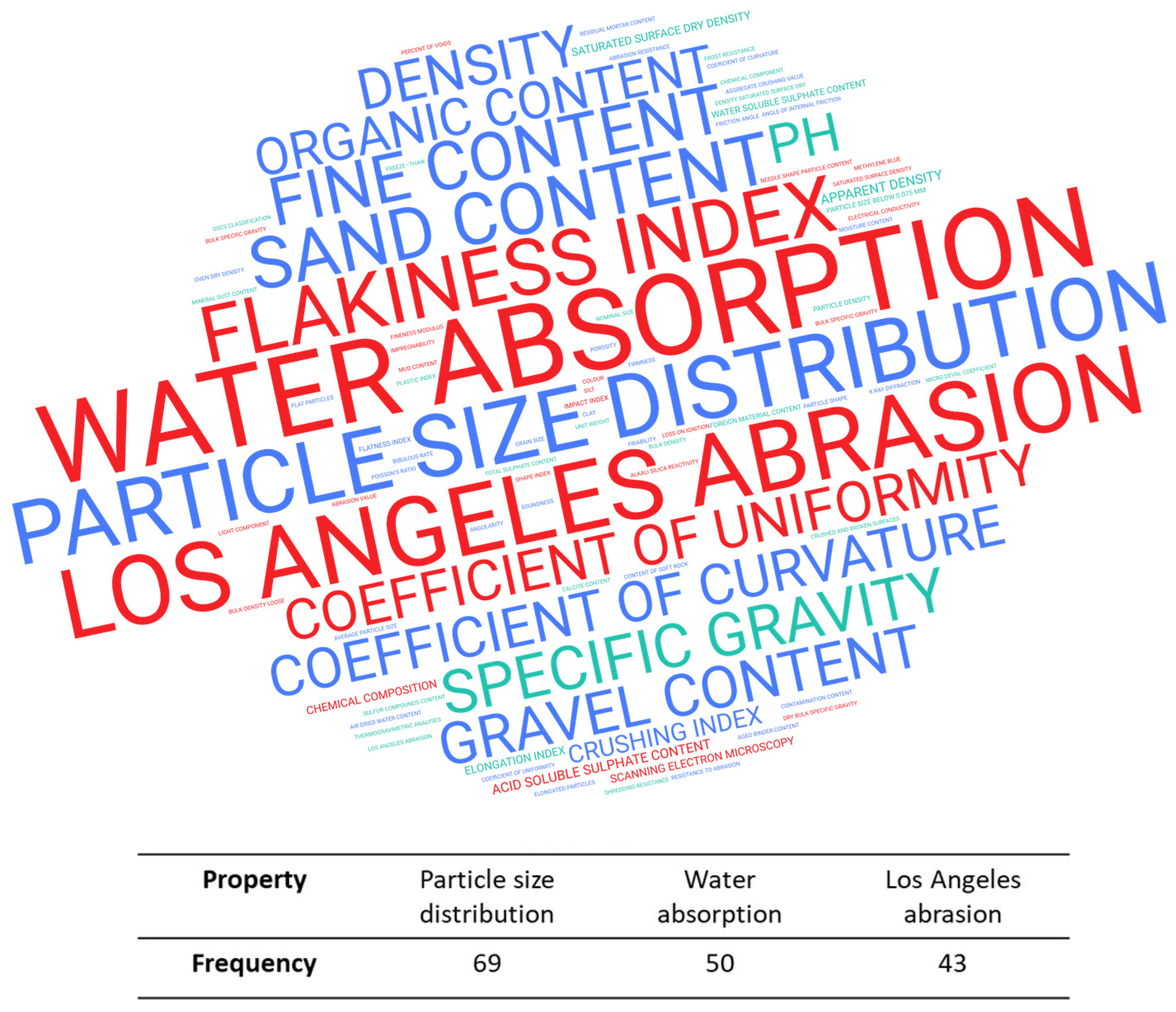


| King (2001) [24] Classification | Little et al. (2016) [25] Classification | Definition |
|---|---|---|
| Selective breakage | Preferential breakage | Fractures occur more frequently in one of the phases [24,25]. |
| Differential breakage | ||
| Preferential breakage | ||
| Phase-boundary fracture | Phase-boundary fracture | Breakage occurs preferentially along a specific phase boundary rather than across the other phases [24,25]. |
| Liberation by detachment | ||
| Boundary-region fracture |
| Step | Database | Search Field(s) | Search String | Filters Applied | Records Retrieved |
|---|---|---|---|---|---|
| 1 | Scopus | TITLE-ABS-KEY | “recycled concrete aggregates” AND applications | None | 637 |
| 2 | Scopus | ALL FIELDS | “crush*” | Applied as refinement of Step 1 | 342 |
| 3 | Scopus | — | — | Publication year: 2004–2024 | 338 |
| 4 | Scopus | — | — | Data export format: Excel | 338 |
| Screening | Bibliometric Analysis | Number | |
|---|---|---|---|
| 1 | Scopus search | 338 * | |
| 2 | English language, journal articles, indexed publication | 256 ** | |
| 3 | Bibliometric quantified papers | 204 | |
| 4 | RCA applications? (204 papers) | ||
| Number | Percentage (%) | ||
| Concrete | 94 | 46.1 | |
| Pavements | 91 | 44.6 | |
| No application | 19 | 9.3 | |
| 5 | Paper mentions crushing and/or grinding? (204 papers) | ||
| Number | Percentage (%) | ||
| Yes | 99 | 48.5 | |
| No | 105 | 51.5 | |
| 6 | What type of crusher and/or grinding was used? (99 papers) | ||
| Number | Percentage (%) | ||
| Reported | 53 | 53.5 | |
| Not reported | 46 | 46.5 | |
| 7 | Are the equipment parameters described? (53 papers) | ||
| Number | Percentage (%) | ||
| Yes | 2 | 3.77 | |
| No | 51 | 96.2 | |
| 8 | Total number of articles reporting minimum processing parameters | Number | Percentage (%) |
| 2 | 0.98 | ||
| Country | Standard | RA Type | Particle Density (kg/m3) | Water Absorption (%) |
|---|---|---|---|---|
| Germany | DIN 4226-100 [286] | Concrete rubble | ≥2000 | ≤10 |
| Demolition debris | ≤15 | |||
| Brick rubble | ≥1800 | ≤20 | ||
| Coated rubble | ≥1500 | - | ||
| Brazil | NBR 15116 [287] | Concrete | - | Coarse: ≤7 Fine: ≤12 |
| Mixed | - | Coarse: ≤12 Fine: ≤17 | ||
| International | RILEM 1994 [288] | Masonry rubble | ≥1500 | ≤20 |
| Concrete rubble | ≥2000 | ≤10 | ||
| Mixed | ≥2400 | ≤3 |
| Process Condition | Critical Condition | ||
|---|---|---|---|
| High | Medium | Low | |
| Type of equipment | X | ||
| Number of stages | X | ||
| Screen size | X | ||
| Separation methods | X | ||
| Top size | X | ||
| Material recirculation | X | ||
| Feed | X | ||
| Moisture condition | X | ||
| Equipment operational conditions | X | ||
| Sampling methodology | X | ||
| Test standards | X | ||
Disclaimer/Publisher’s Note: The statements, opinions and data contained in all publications are solely those of the individual author(s) and contributor(s) and not of MDPI and/or the editor(s). MDPI and/or the editor(s) disclaim responsibility for any injury to people or property resulting from any ideas, methods, instructions or products referred to in the content. |
© 2026 by the authors. Licensee MDPI, Basel, Switzerland. This article is an open access article distributed under the terms and conditions of the Creative Commons Attribution (CC BY) license.
Share and Cite
de Lima, P.T.B.; Macedo, R.d.S.; Bergerman, M.G.; Müller, A.; Ulsen, C. Role of Mineral Processing in Enhancing Recycled Concrete Aggregate Quality—A Critical Review. Recycling 2026, 11, 49. https://doi.org/10.3390/recycling11030049
de Lima PTB, Macedo RdS, Bergerman MG, Müller A, Ulsen C. Role of Mineral Processing in Enhancing Recycled Concrete Aggregate Quality—A Critical Review. Recycling. 2026; 11(3):49. https://doi.org/10.3390/recycling11030049
Chicago/Turabian Stylede Lima, Priscila Thalita Barros, Rafael dos Santos Macedo, Maurício Guimarães Bergerman, Anette Müller, and Carina Ulsen. 2026. "Role of Mineral Processing in Enhancing Recycled Concrete Aggregate Quality—A Critical Review" Recycling 11, no. 3: 49. https://doi.org/10.3390/recycling11030049
APA Stylede Lima, P. T. B., Macedo, R. d. S., Bergerman, M. G., Müller, A., & Ulsen, C. (2026). Role of Mineral Processing in Enhancing Recycled Concrete Aggregate Quality—A Critical Review. Recycling, 11(3), 49. https://doi.org/10.3390/recycling11030049