Author Contributions
Conceptualization, P.L. and J.J.; methodology, P.L., J.J. and D.W.; validation, C.Q.; formal analysis, R.Z.; investigation, P.L. and Y.L.; resources, C.Q. and Y.L.; data curation, R.Z.; writing—original draft preparation, P.L.; writing—review and editing, J.J. and D.W.; project administration, J.J.; funding acquisition, J.J. All authors have read and agreed to the published version of the manuscript.
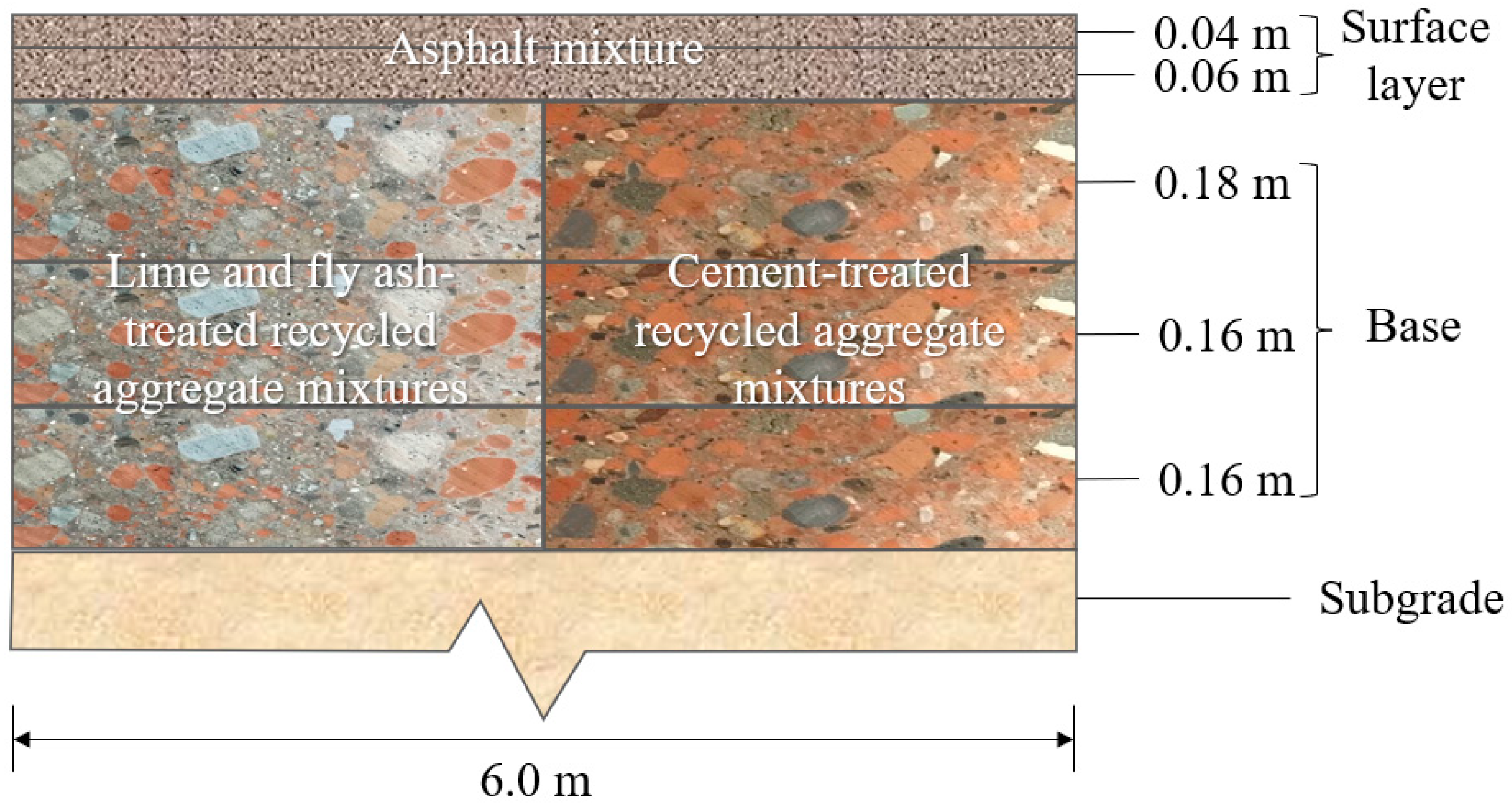
Figure 1.
Schematic of test road pavement structure.
Figure 1.
Schematic of test road pavement structure.
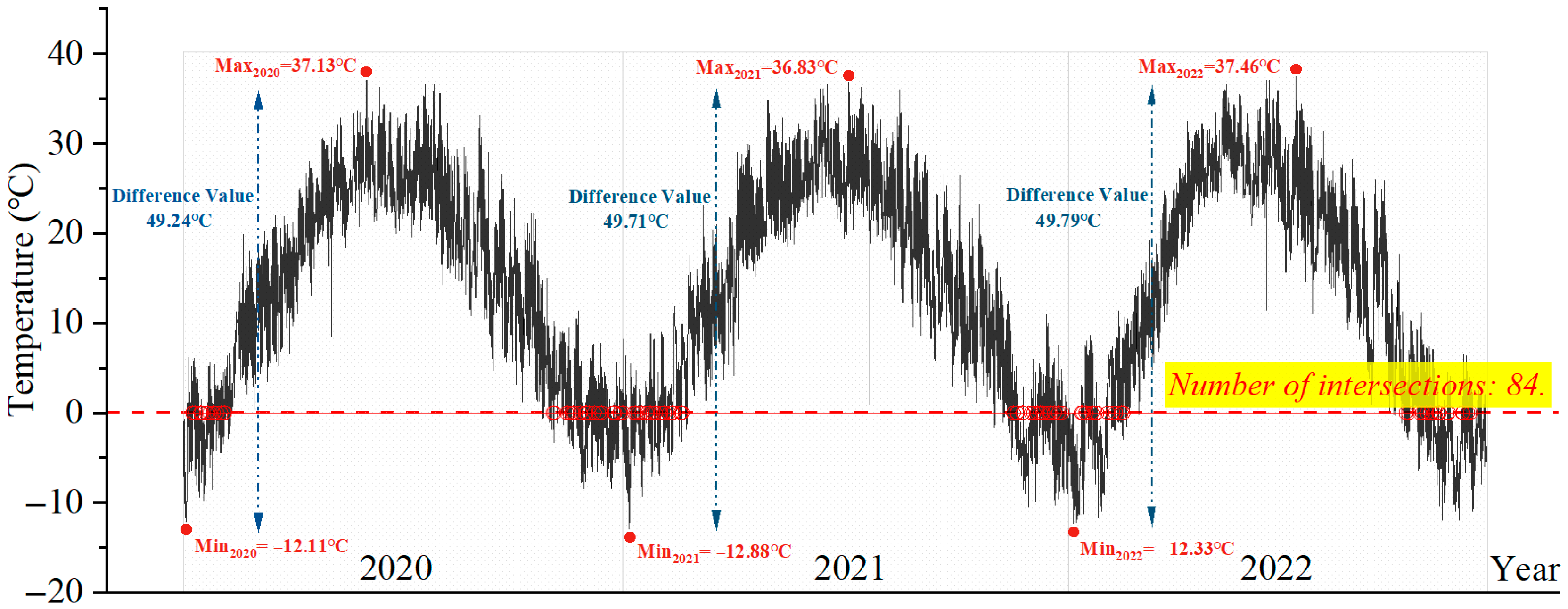
Figure 2.
Temperature variations in the test road base during service.
Figure 2.
Temperature variations in the test road base during service.
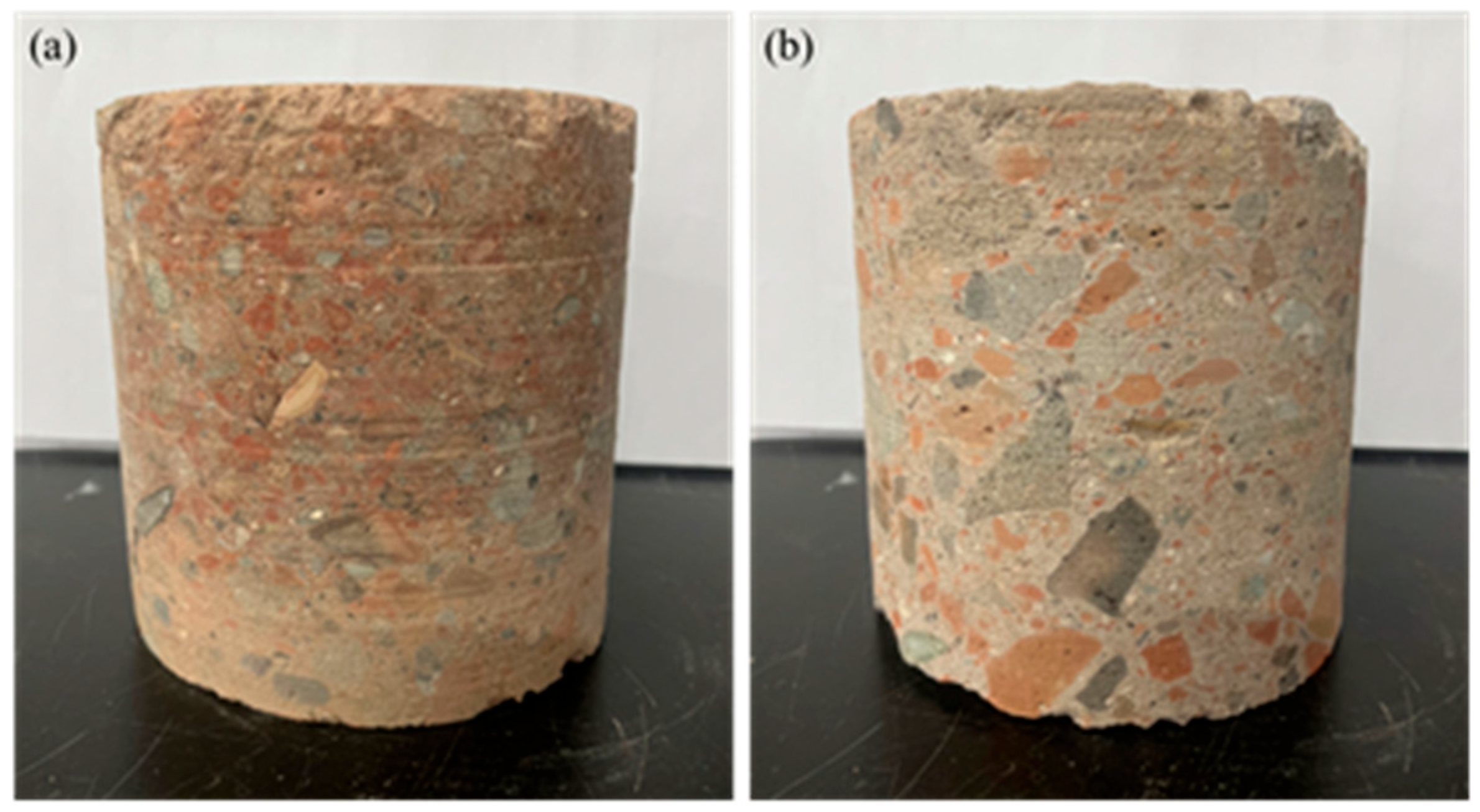
Figure 3.
Integrity of RAIM core samples. (a) CRAMs; (b) L&FRAMs.
Figure 3.
Integrity of RAIM core samples. (a) CRAMs; (b) L&FRAMs.
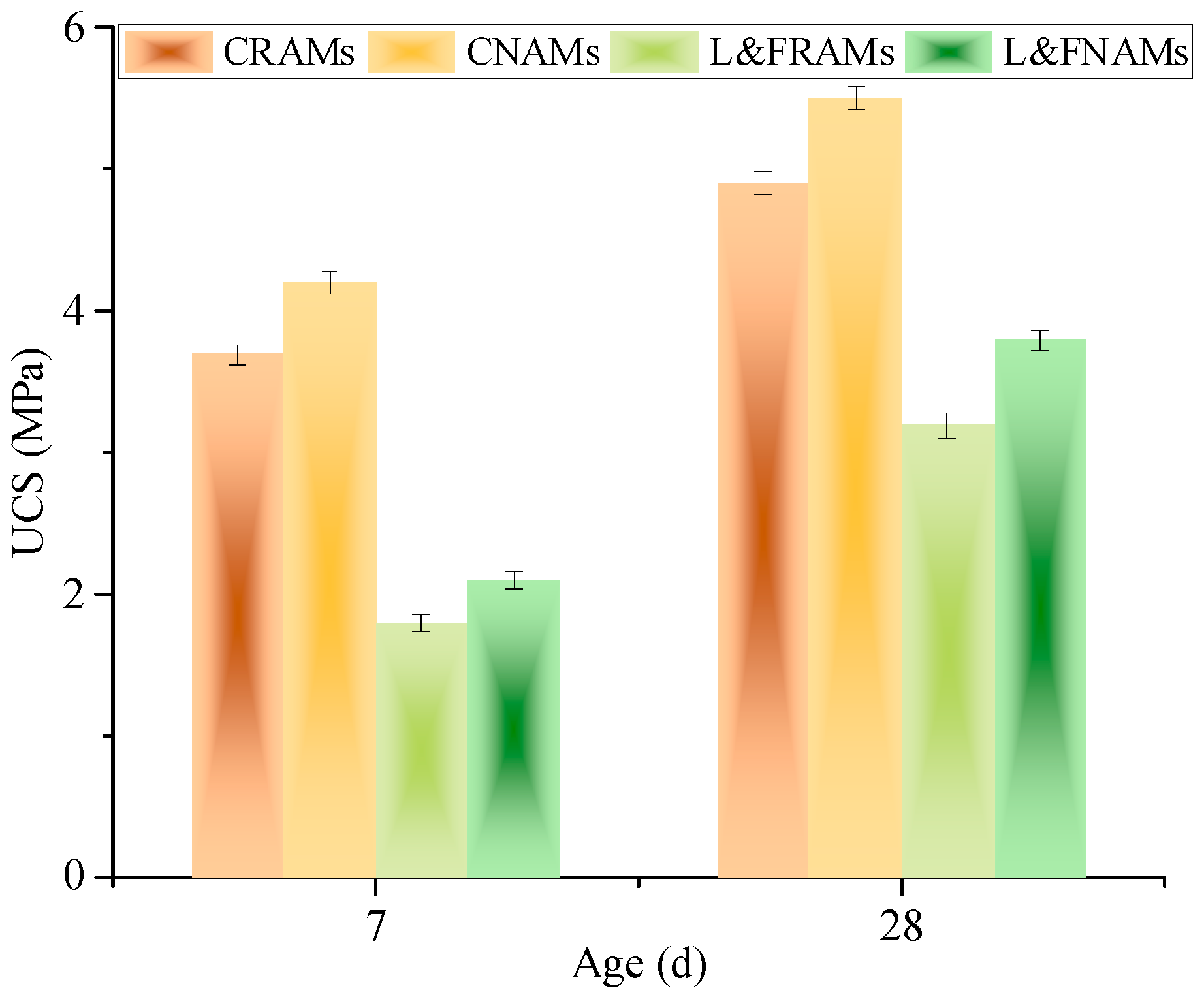
Figure 4.
Comparison of UCS between RAIMs and NAIMs.
Figure 4.
Comparison of UCS between RAIMs and NAIMs.
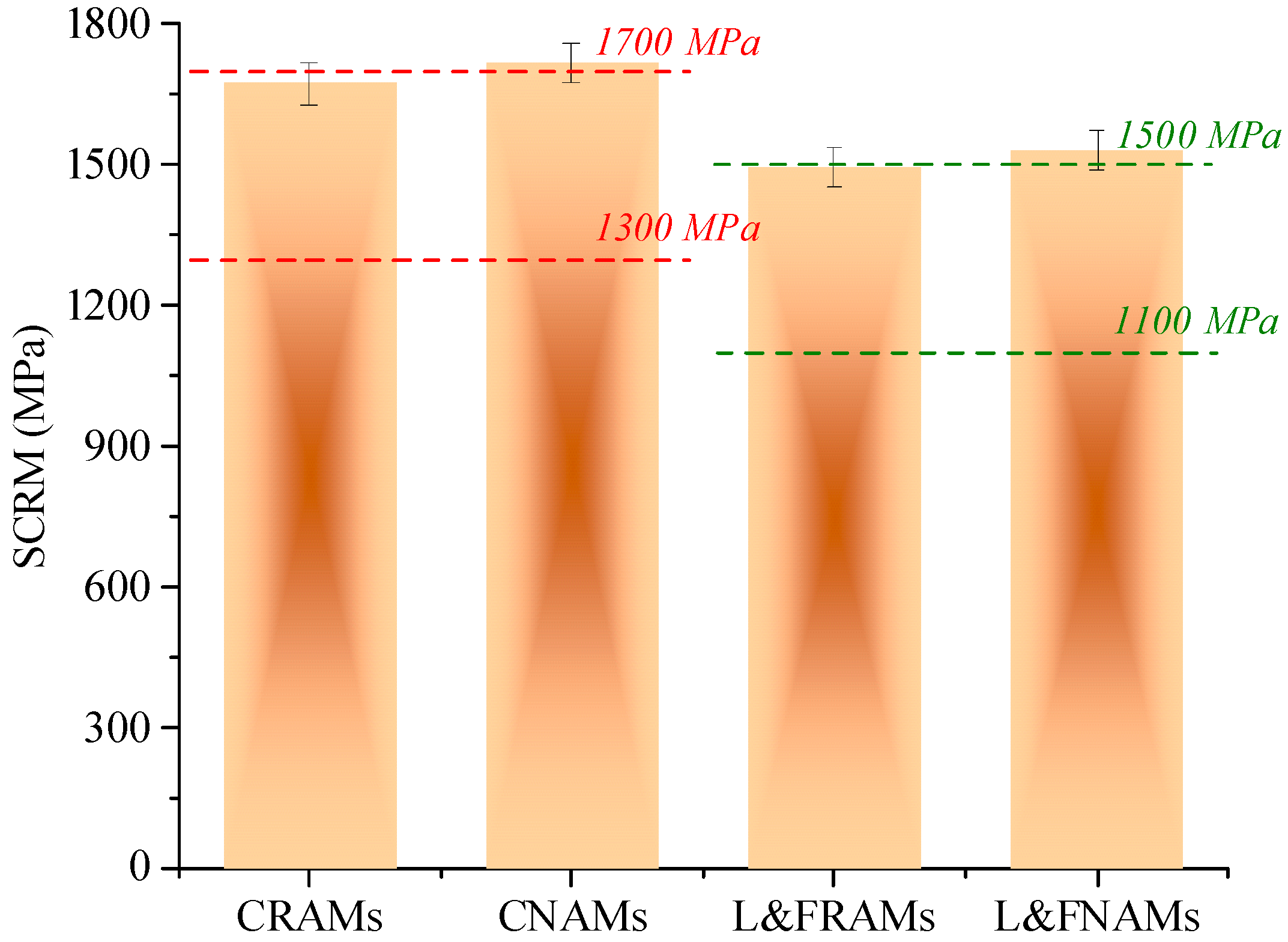
Figure 5.
Comparison of SCRM between RAIMs and NAIMs.
Figure 5.
Comparison of SCRM between RAIMs and NAIMs.
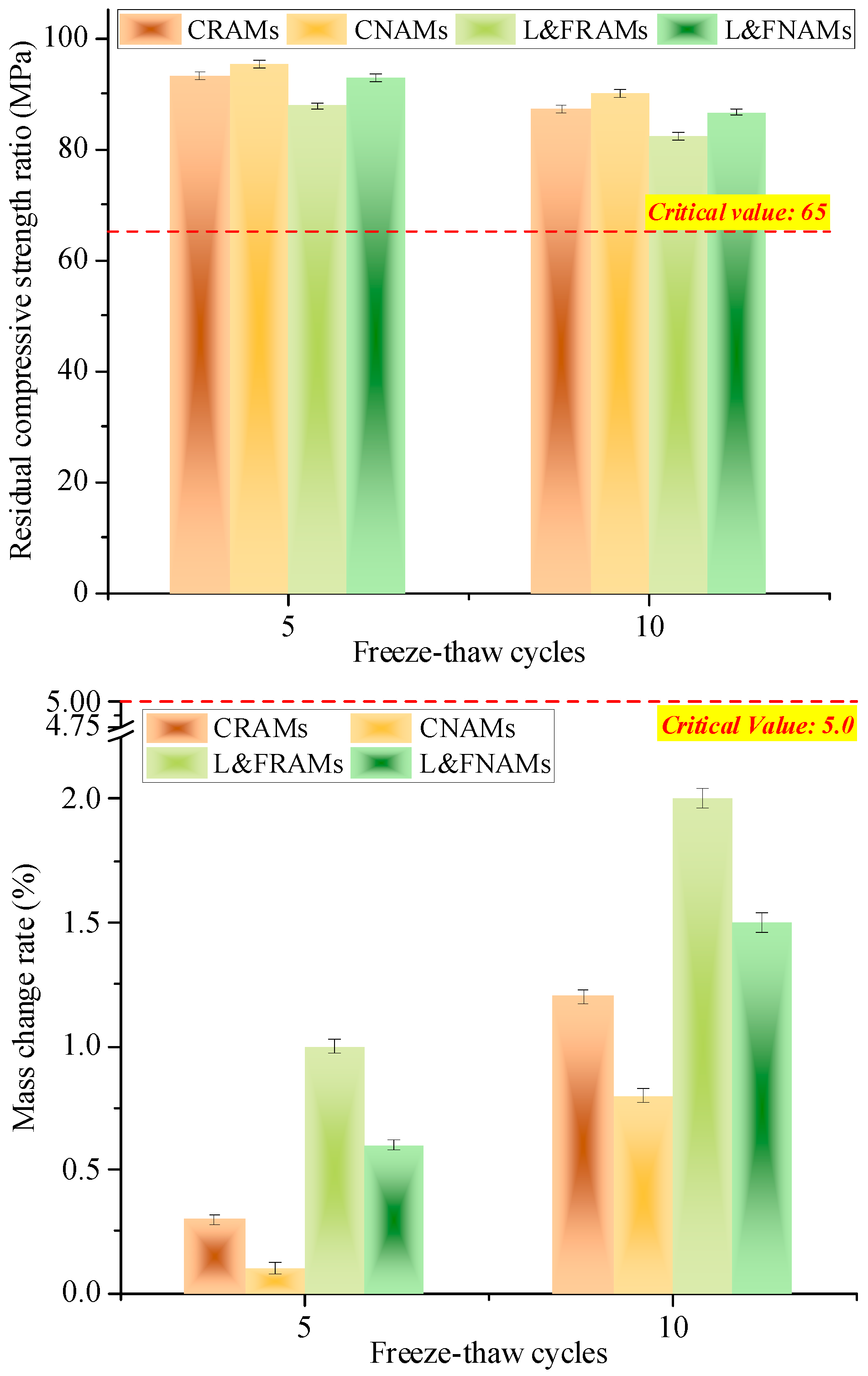
Figure 6.
Comparison of frost resistance between RAIMs and NAIMs.
Figure 6.
Comparison of frost resistance between RAIMs and NAIMs.
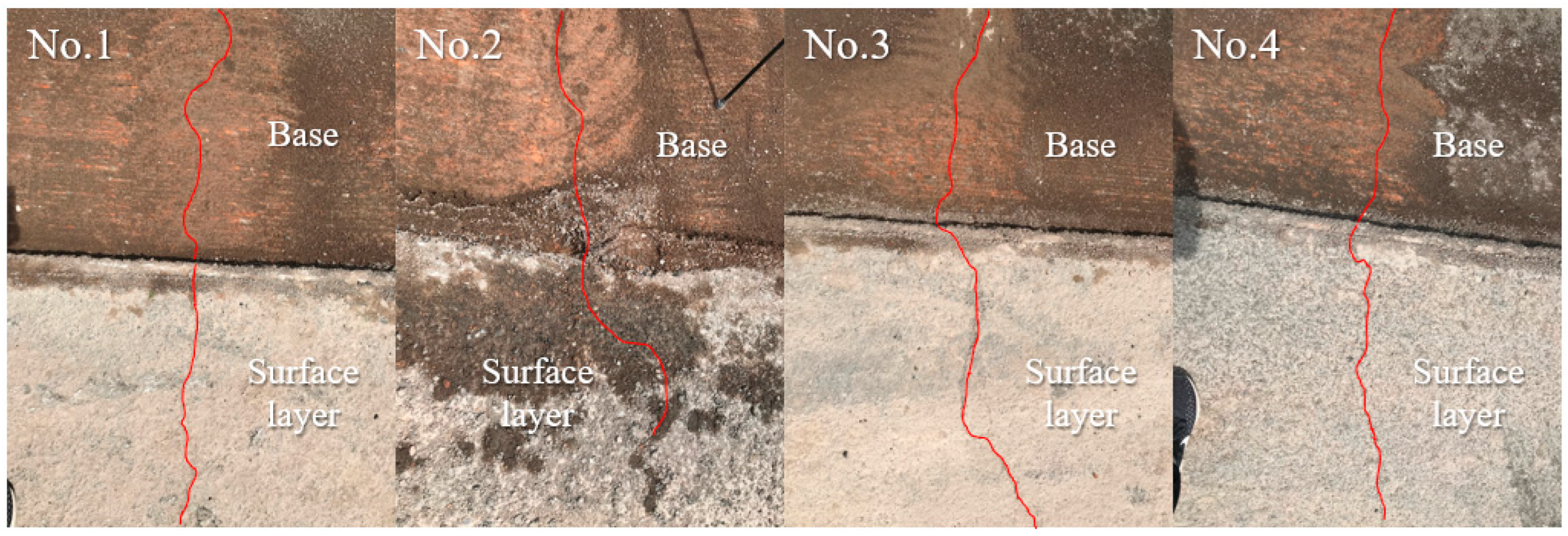
Figure 7.
Schematic of typical road base diseases.
Figure 7.
Schematic of typical road base diseases.
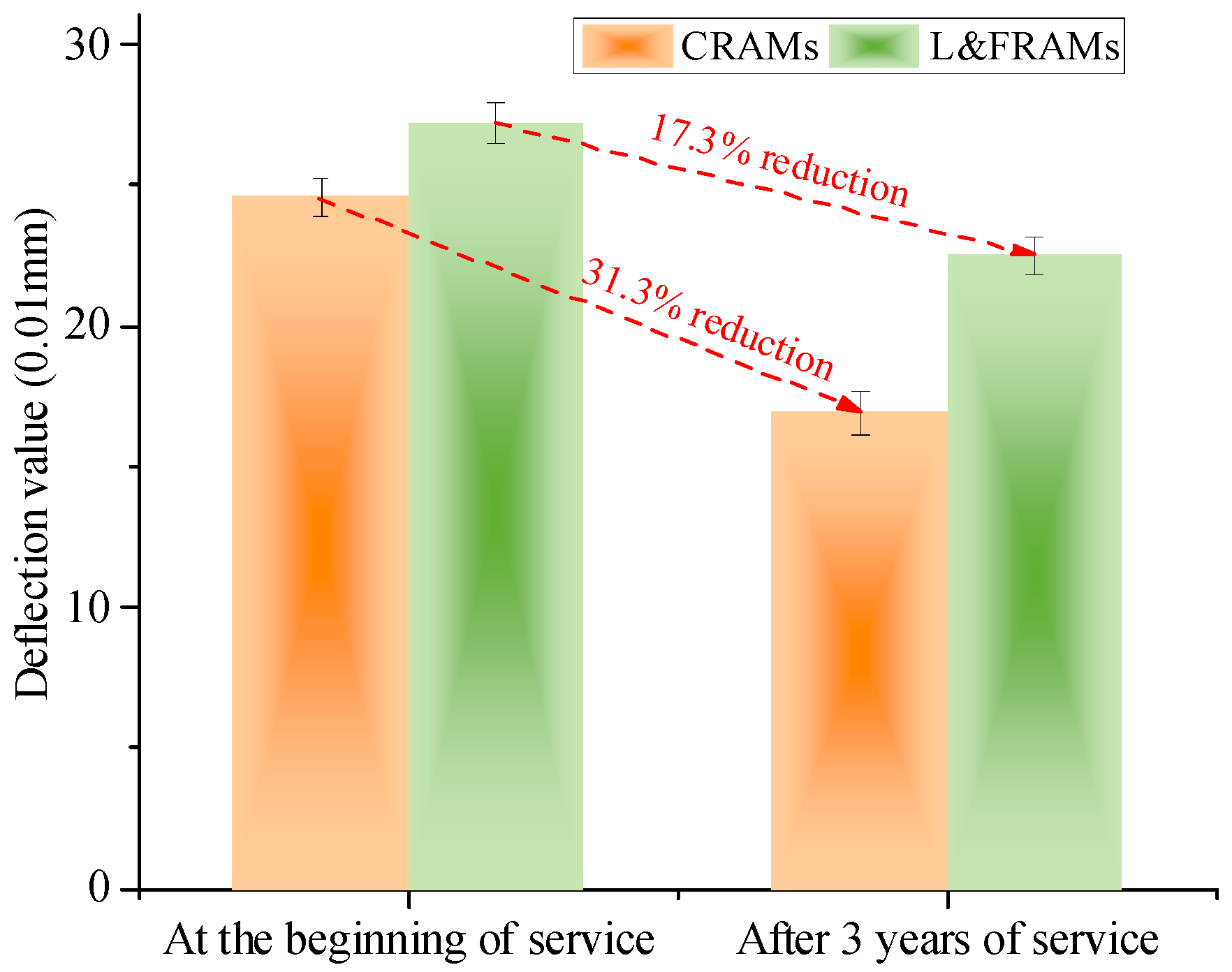
Figure 8.
Deflection values of RAIMs before and after 3 years of service.
Figure 8.
Deflection values of RAIMs before and after 3 years of service.
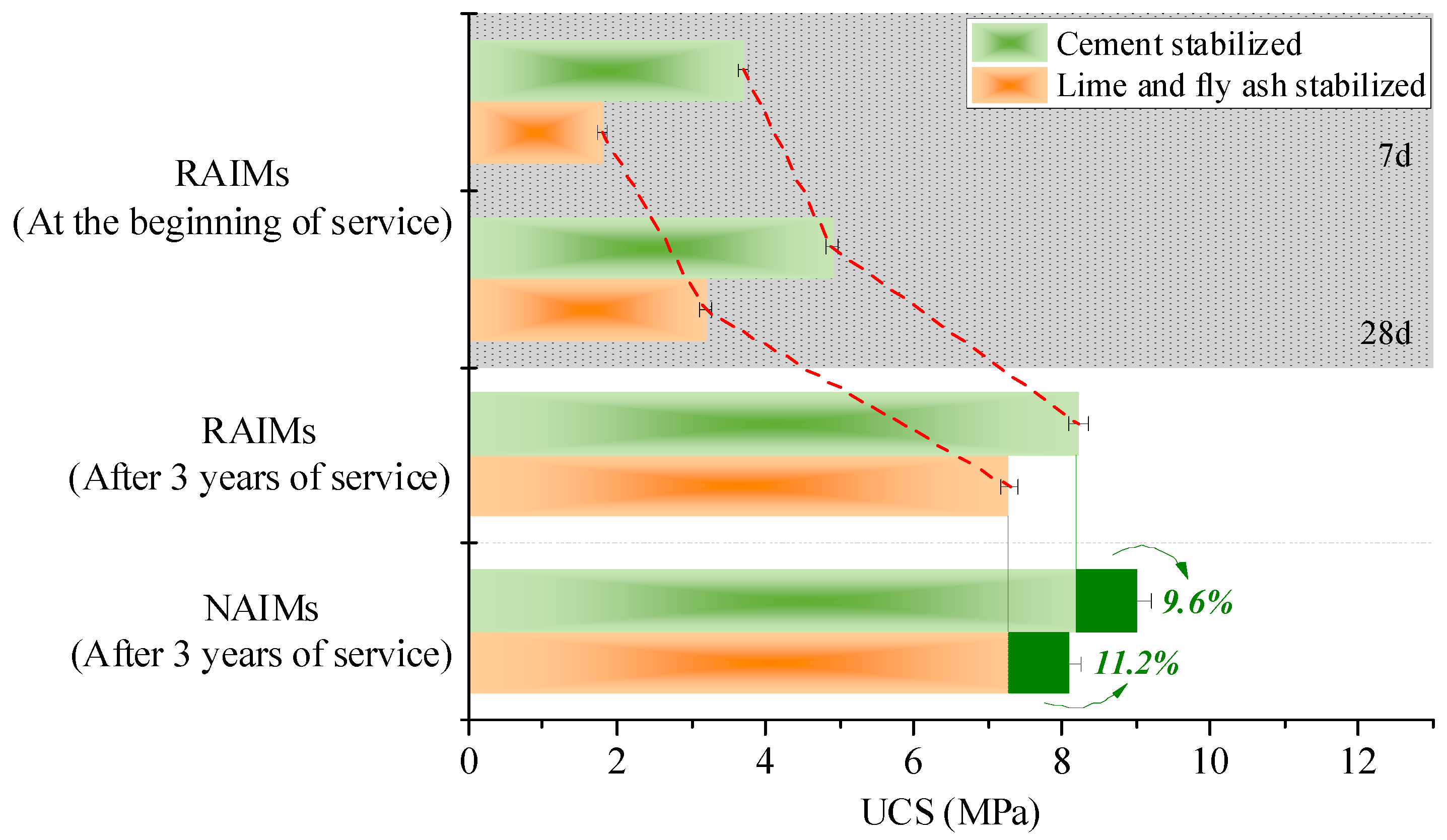
Figure 9.
Comparison of UCS between RAIMs and NAIMs before and after service.
Figure 9.
Comparison of UCS between RAIMs and NAIMs before and after service.
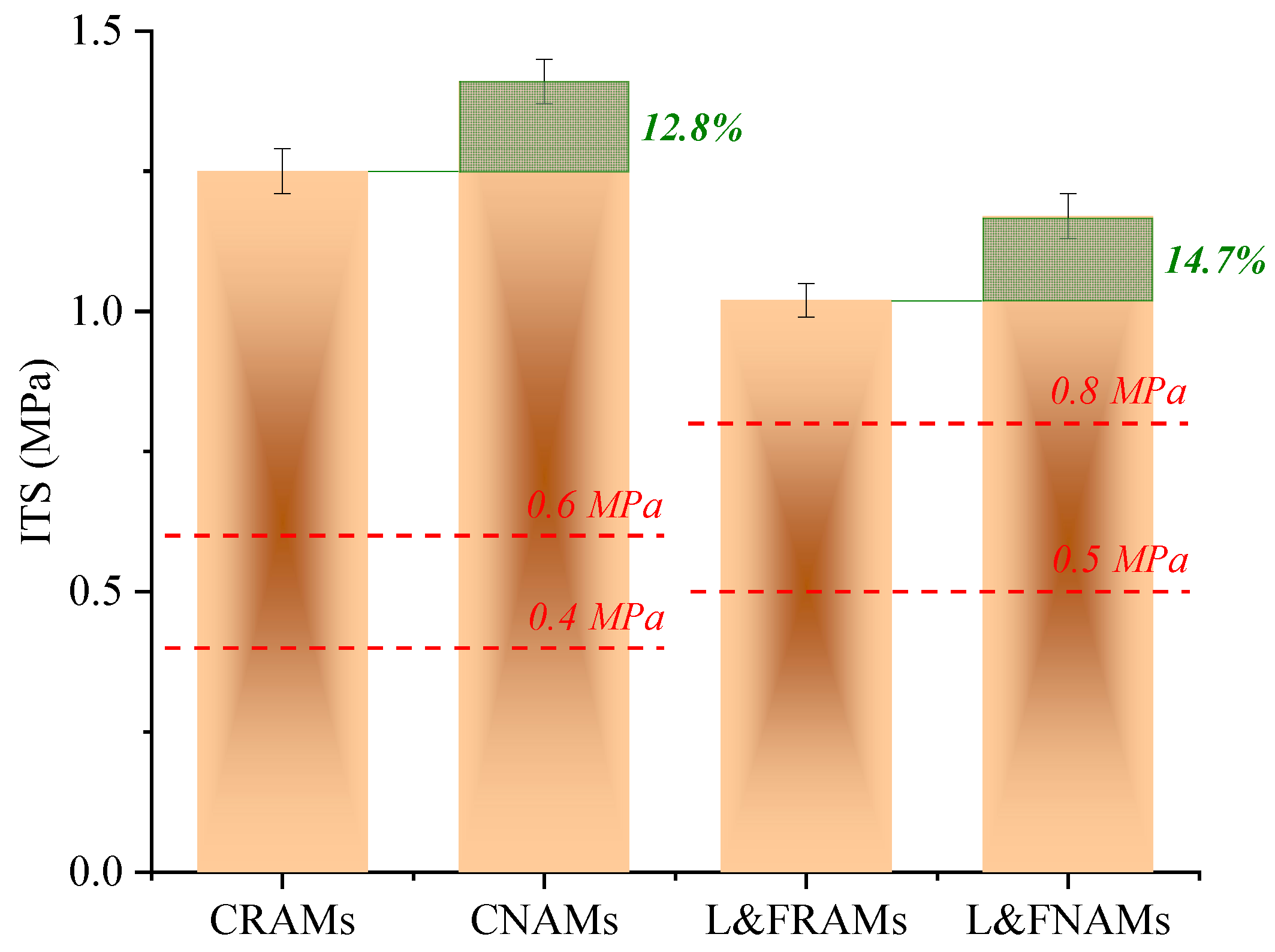
Figure 10.
Comparison of ITS between RAIMs and NAIMs after service.
Figure 10.
Comparison of ITS between RAIMs and NAIMs after service.
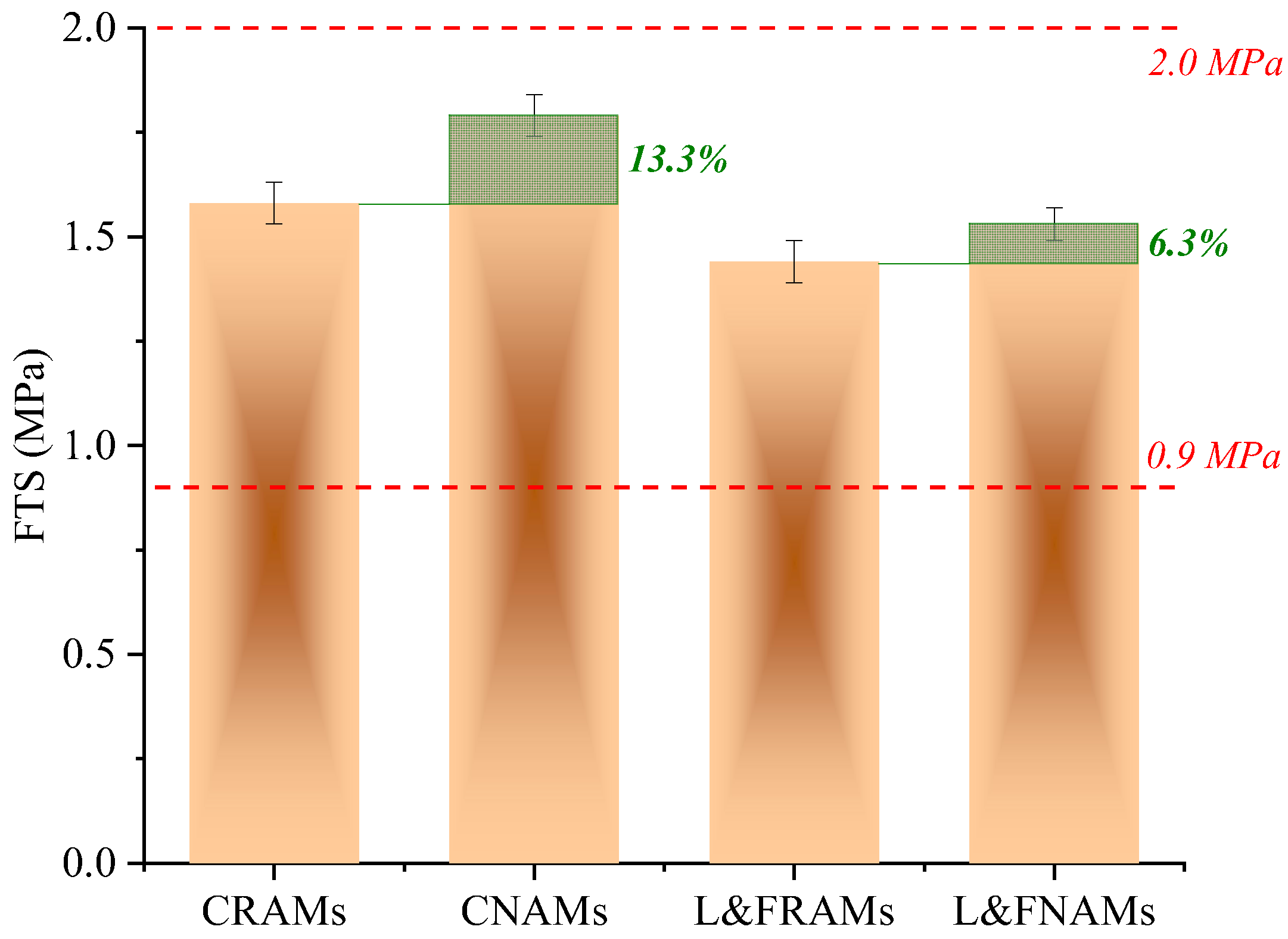
Figure 11.
Comparison of FTS between RAIMs and NAIMs after service.
Figure 11.
Comparison of FTS between RAIMs and NAIMs after service.
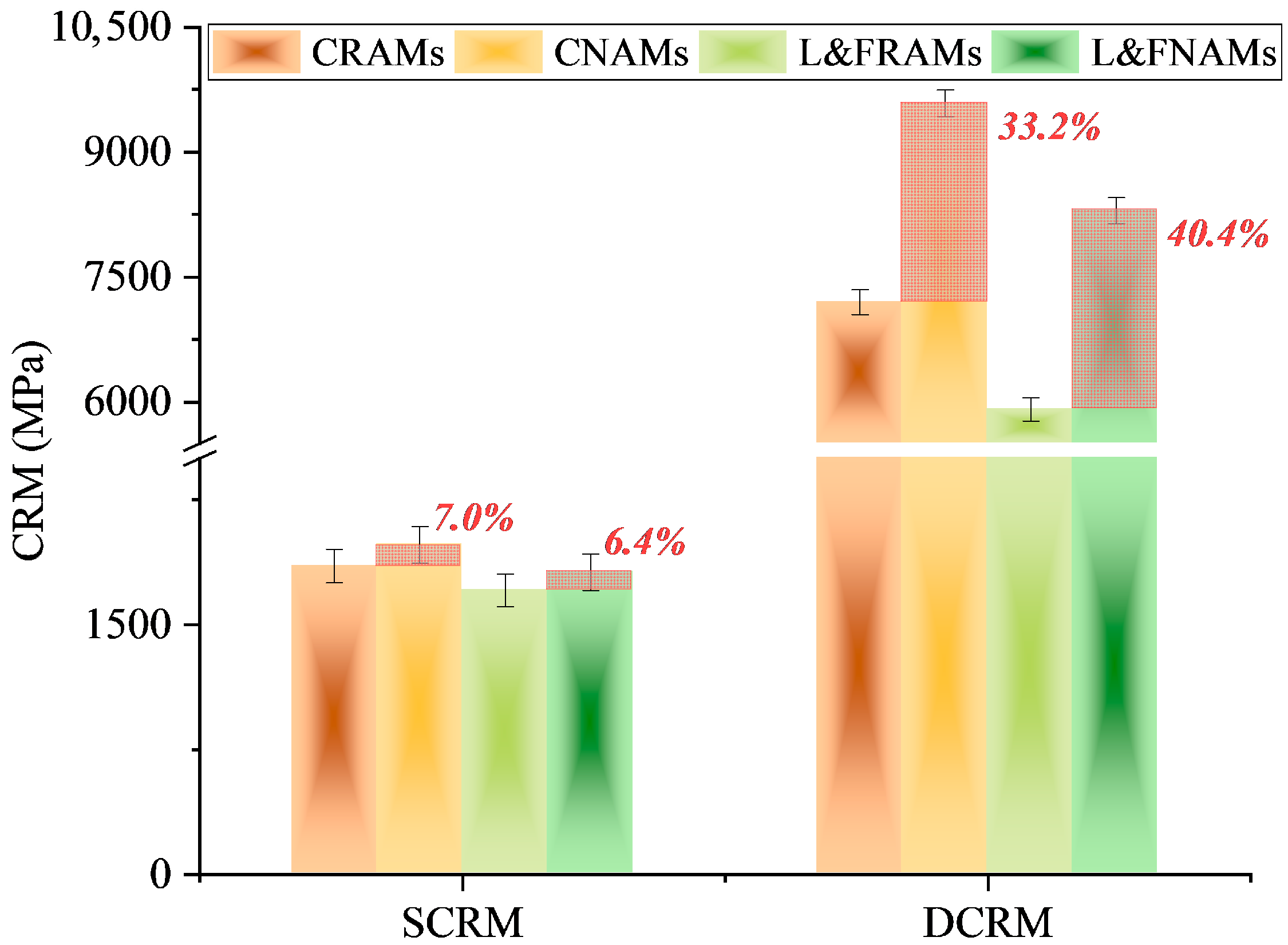
Figure 12.
Comparison of CRM between RAIMs and NAIMs after service [
24].
Figure 12.
Comparison of CRM between RAIMs and NAIMs after service [
24].
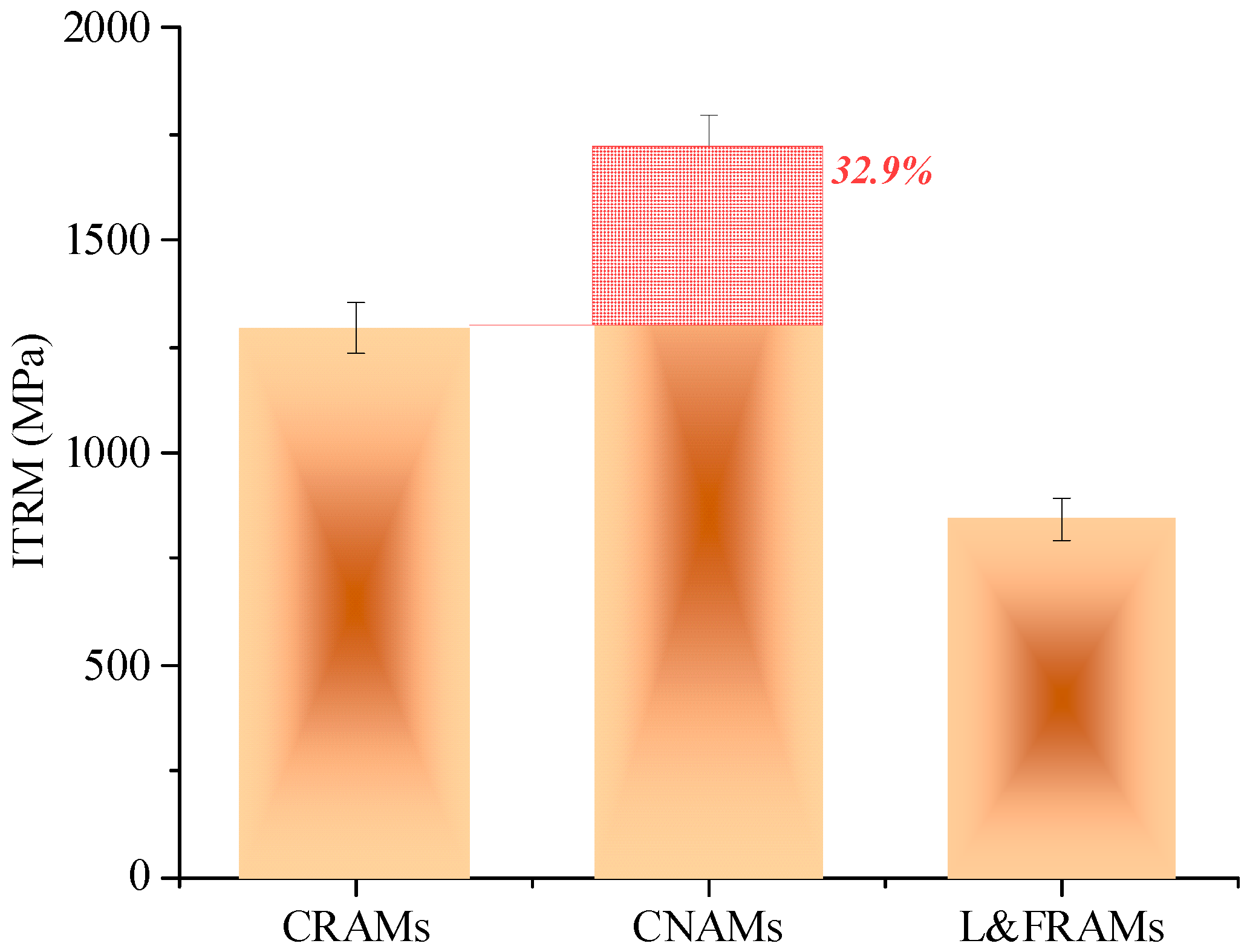
Figure 13.
Comparison of ITRM between RAIMs and NAIMs after service [
28].
Figure 13.
Comparison of ITRM between RAIMs and NAIMs after service [
28].
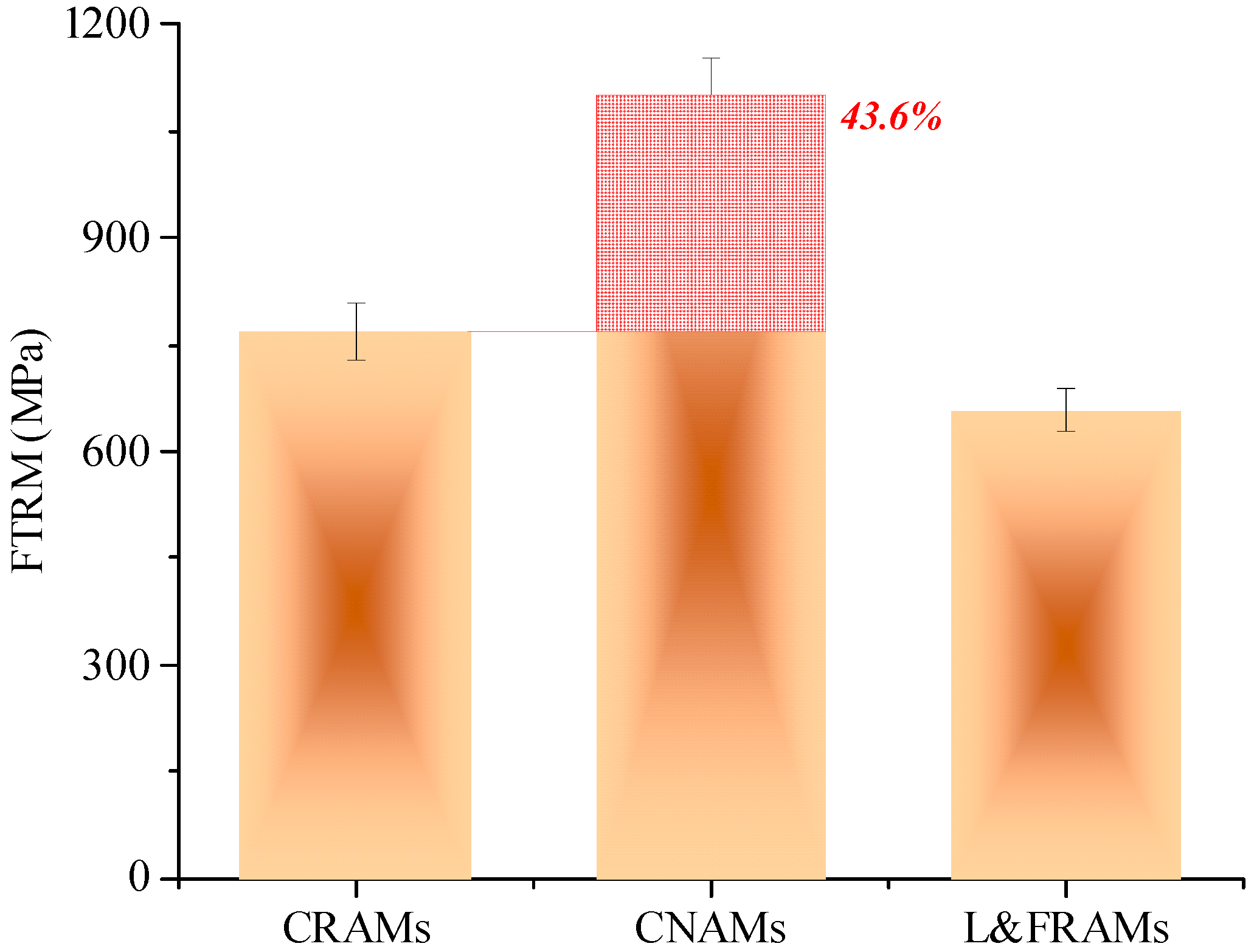
Figure 14.
Comparison of FTRM between RAIMs and NAIMs after service [
29].
Figure 14.
Comparison of FTRM between RAIMs and NAIMs after service [
29].
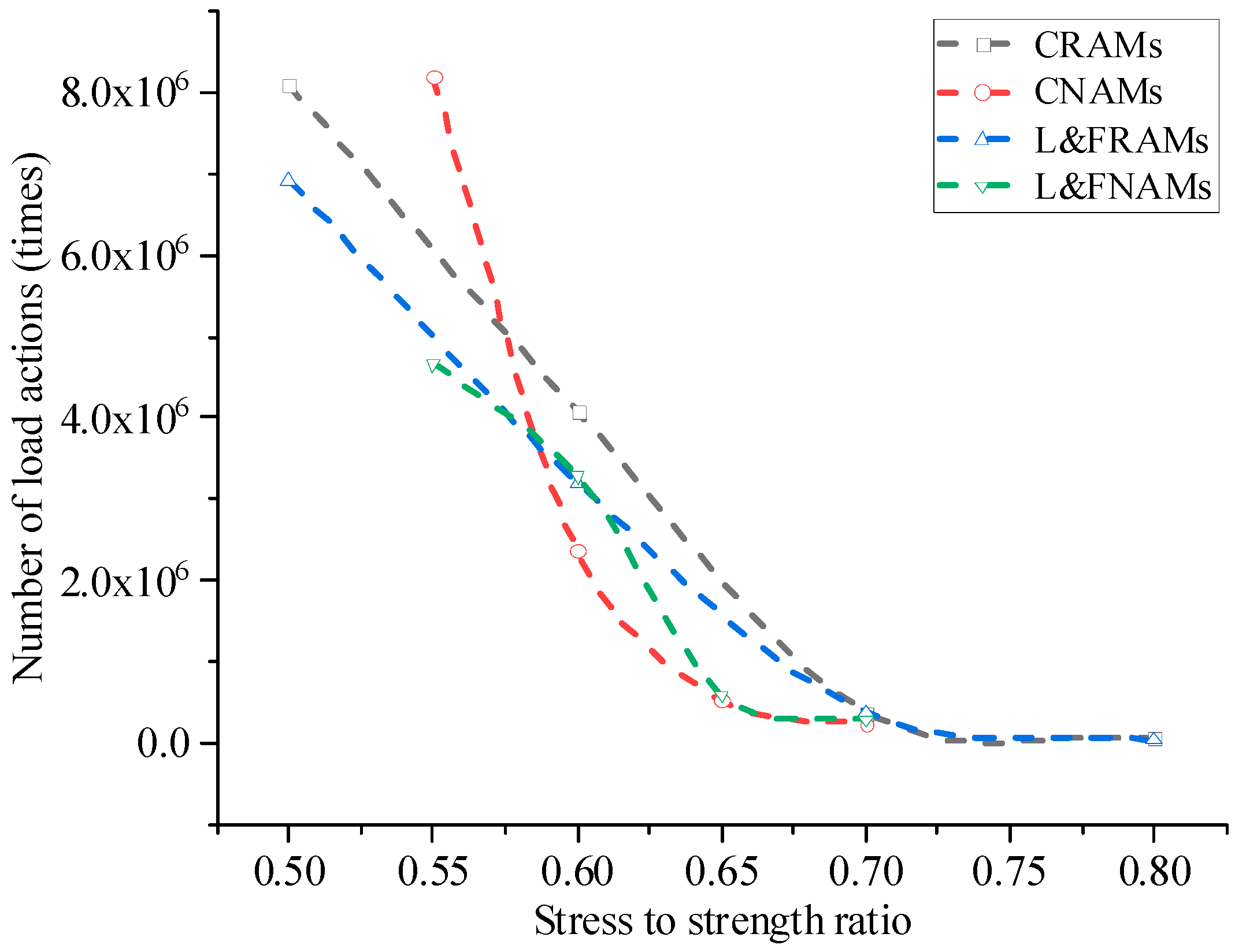
Figure 15.
Fatigue properties of RAIMs and NAIMs.
Figure 15.
Fatigue properties of RAIMs and NAIMs.
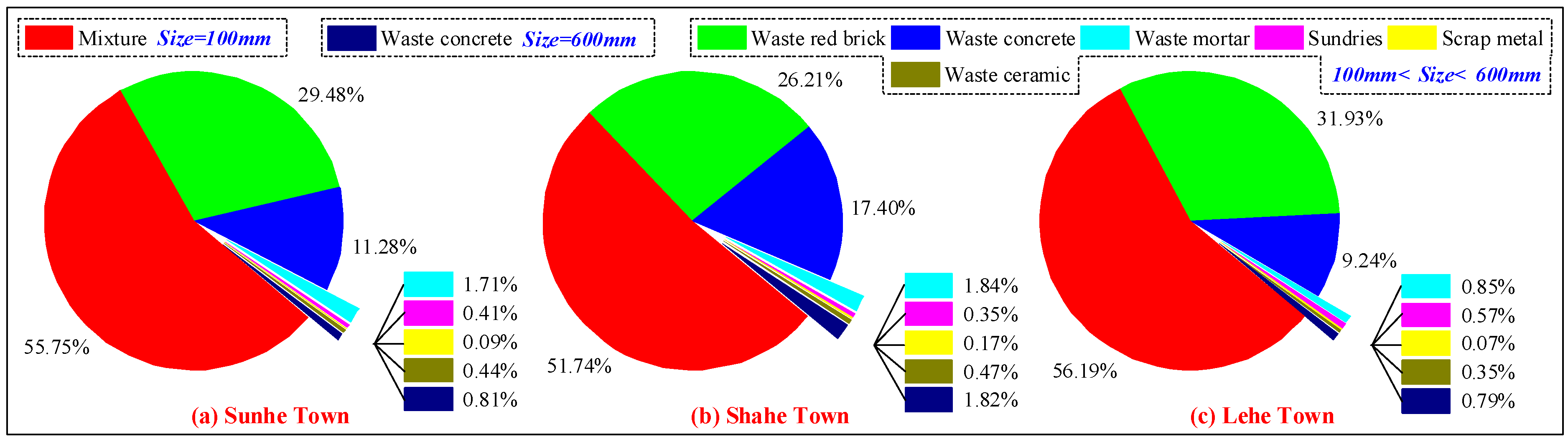
Figure 16.
Classification and composition of CDW.
Figure 16.
Classification and composition of CDW.
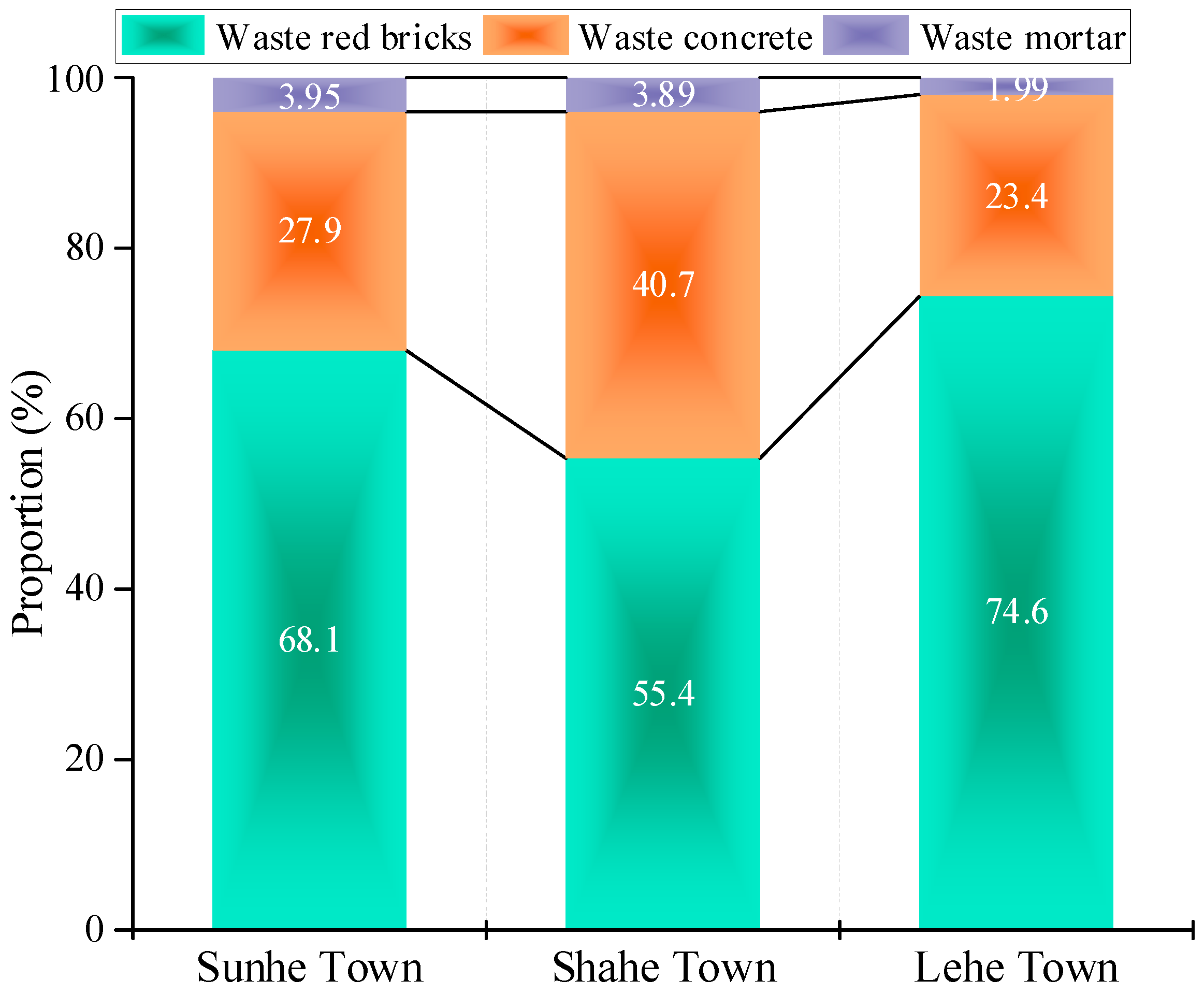
Figure 17.
Proportion of waste red bricks, waste concrete, and waste mortar in recyclable CDW components.
Figure 17.
Proportion of waste red bricks, waste concrete, and waste mortar in recyclable CDW components.
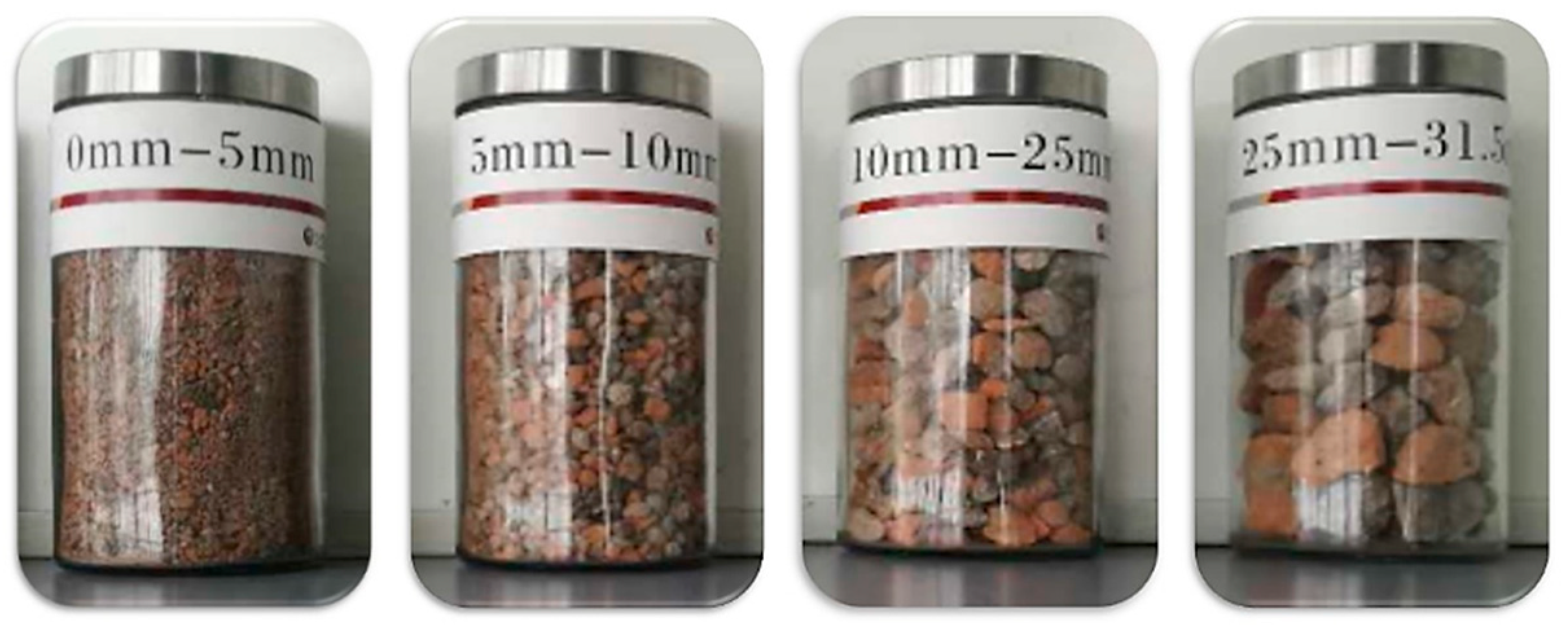
Figure 18.
CDW-derived recycled aggregates with different particle sizes.
Figure 18.
CDW-derived recycled aggregates with different particle sizes.
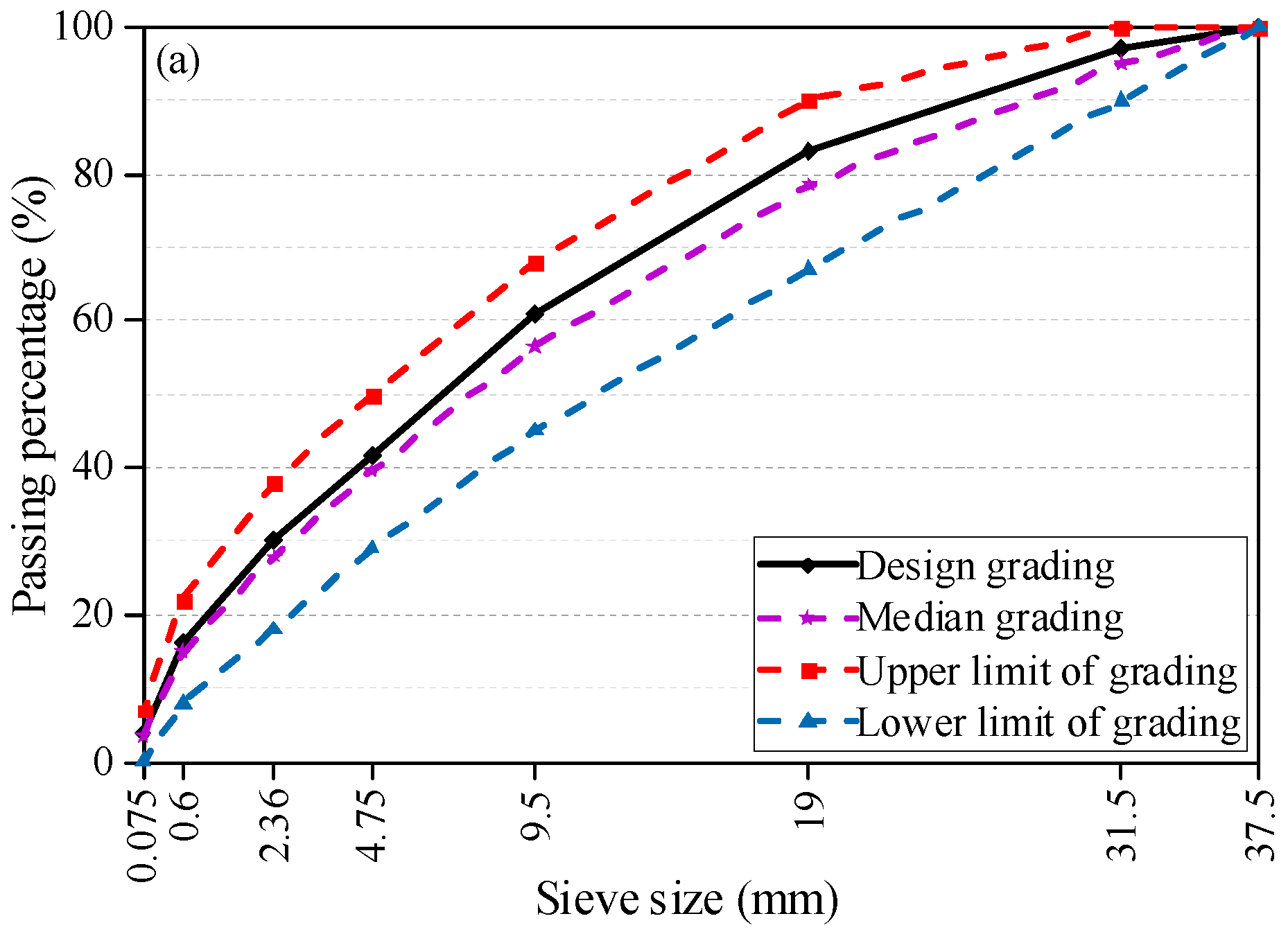
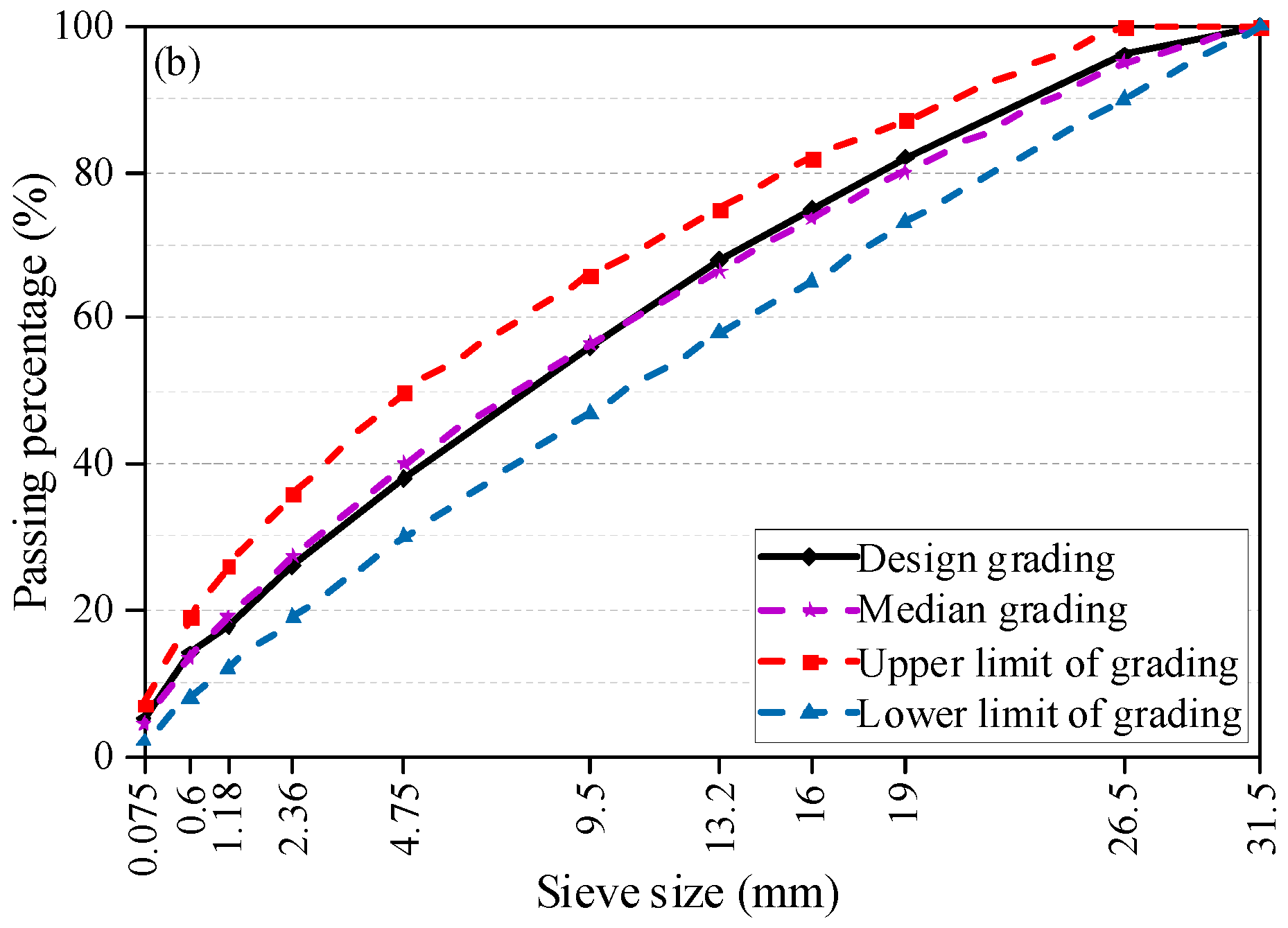
Figure 19.
Designed gradations of RAIMs. (a) Cement-treated recycled aggregate mixtures (CRAMs); (b) lime and fly ash-treated recycled aggregate mixtures (L&FRAMs).
Figure 19.
Designed gradations of RAIMs. (a) Cement-treated recycled aggregate mixtures (CRAMs); (b) lime and fly ash-treated recycled aggregate mixtures (L&FRAMs).
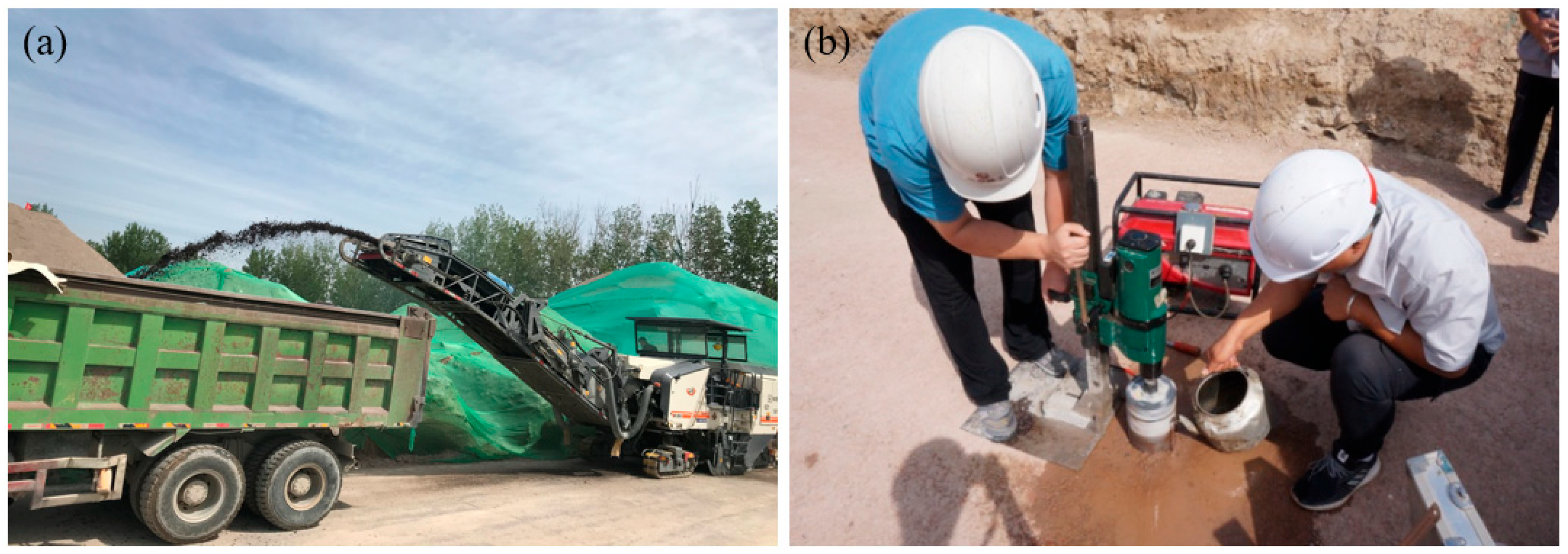
Figure 20.
Schematic of core drilling and sampling process. (a) Pavement milling; (b) Core drilling and sampling.
Figure 20.
Schematic of core drilling and sampling process. (a) Pavement milling; (b) Core drilling and sampling.
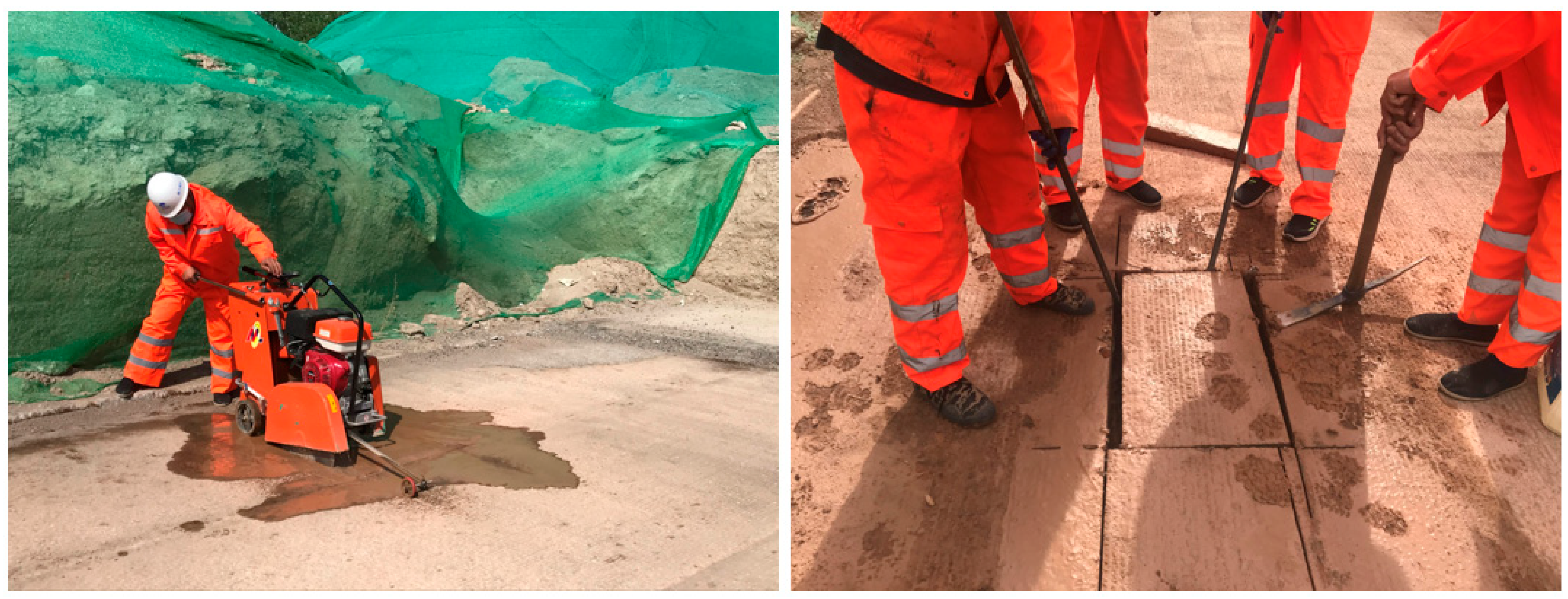
Figure 21.
Schematic of the cutting and sampling process.
Figure 21.
Schematic of the cutting and sampling process.
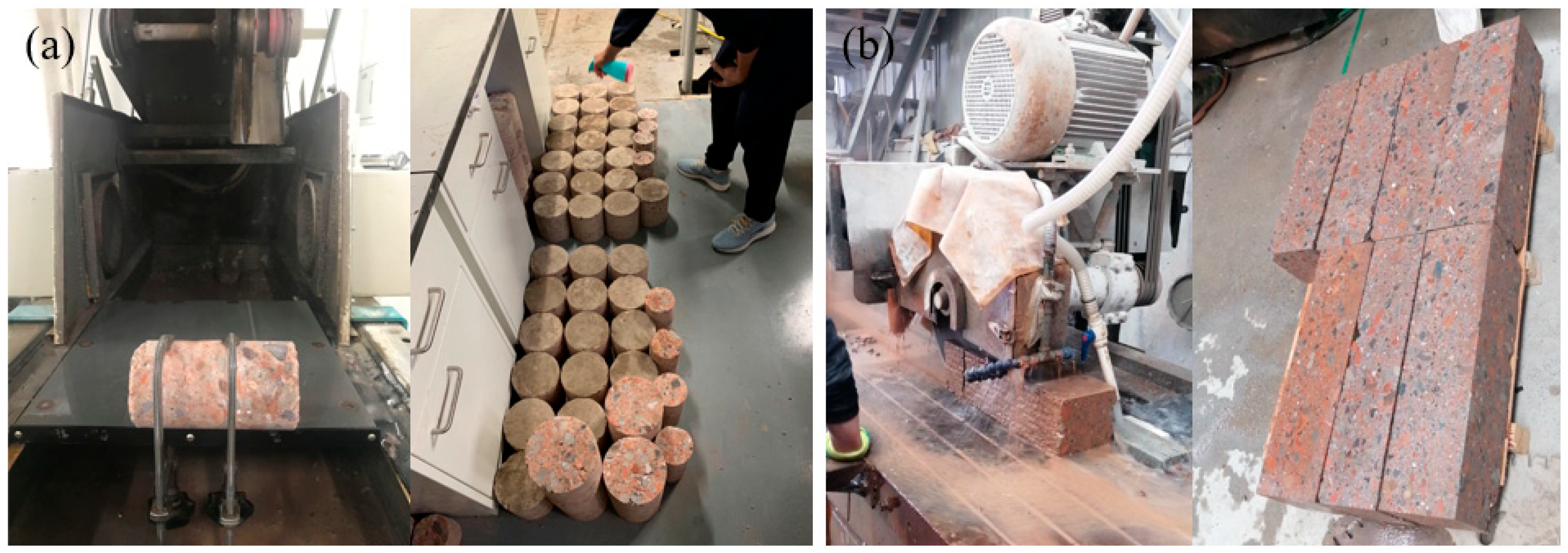
Figure 22.
Sample refinement. (a) Cylindrical samples. (b) Beam-shaped samples.
Figure 22.
Sample refinement. (a) Cylindrical samples. (b) Beam-shaped samples.
Table 1.
Construction control indicators of the test road base.
Table 1.
Construction control indicators of the test road base.
| Parameters | Compaction Degree, % | Cement Content, % | Lime Content, % | Deflection Value, 0.01 mm |
|---|
| Test result | CRAMs | 99.8 | 5.0 | – | 24.6 |
| L&FRAMs | 99.2 | – | 5.0 | 27.2 |
| Specification | CRAMs | ≥98 | 4.0–5.0 | 4.0–5.0 | ≤29.5 |
| L&FRAMs | ≤30.3 |
Table 2.
UCS of RAIMs.
| Parameters | Test Result | Specification | Test Method |
|---|
| CRAMs | L&FRAMs | CRAMs | L&FRAMs |
|---|
| 7 d age, MPa | 3.7 | 1.8 | 3.0–5.0/≥3.4 | ≥0.8/≥1.0 | T0805 |
| 28 d age, MPa | 4.9 | 3.2 | –/≥3.4 | –/≥2.7 |
Table 3.
Frost resistance of RAIMs.
Table 3.
Frost resistance of RAIMs.
| Parameters | 5 Freeze–Thaw Cycles | 10 Freeze–Thaw Cycles |
|---|
| Residual Compressive Strength Ratio, % | Mass Change Rate, % | Residual Compressive Strength Ratio, % | Mass Change Rate, % |
|---|
| Test result | CRAMs | 93.3 | 0.2 | 87.1 | 0.8 |
| L&FRAMs | 87.8 | 0.7 | 82.2 | 1.5 |
| Specification | CRAMs | – |
| L&FRAMs | ≥65 | <5.0 | ≥65 | <5.0 |
Table 4.
Statistics of typical road base diseases.
Table 4.
Statistics of typical road base diseases.
| Serial Number | Position | Length, m | Disease Type |
|---|
| 1 | K0 + 074 | Across the left and right lanes | 6.0 | Transverse crack |
| 2 | K0 + 088 | Right lane | 3.0 |
| 3 | K0 + 099 | Across the left and right lanes | 6.0 |
| 4 | K0 + 113 | 6.0 |
Table 5.
Fatigue equations of RAIMs and CAIMs.
Table 5.
Fatigue equations of RAIMs and CAIMs.
| Mixture Type | Fatigue Equation |
|---|
| CRAMs | lgN = 10.69 − 7.29 (σ/s) |
| CNAMs | lgN = 13.775 − 12.231 (σ/s) |
| L&FRAMs | lgN = 12.05 − 9.24 (σ/s) |
| L&FNAMs | lgN = 12.26 − 9.9563 (σ/s) |
Table 6.
Properties of CDW-derived recycled coarse aggregates (particle size ≥ 4.75 mm).
Table 6.
Properties of CDW-derived recycled coarse aggregates (particle size ≥ 4.75 mm).
| Parameters | Apparent Relative Density | Water Absorption, % | Crushing Value, % | Needle Flake Particle Content, % | Dust Content Below 0.075 mm, % | Lightweight Miscellaneous Content, % | Recycled Concrete Particle Content, % |
|---|
| Test result | 2.391 | 14.2 | 32.7 | 6.9 | 1.1 | 0.2 | 39.5 |
| Specification | – | – | ≤35 | ≤20 | ≤2.0 | ≤0.5 | ≥35 |
| Test method | T0308 | T0307 | T0316 | T0312 | T0310 | Appendix A of JTG/T 2321 |
Table 7.
Properties of CDW-derived recycled fine aggregates (particle size < 4.75 mm).
Table 7.
Properties of CDW-derived recycled fine aggregates (particle size < 4.75 mm).
| Parameters | Apparent Relative Density | Plasticity Index of Materials Below 0.075 mm | Sand Equivalent, % | Organic Matter Content, % | Sulfate Content, % | Mud Content, % |
|---|
| Test result | 2.454 | 7.4 | 69.3 | 0.6 | 0.08 | 1.7 |
| Specification | – | ≤17 | ≥40 | <2.0 | ≤0.25 | ≤3.0 |
| Test method | T0328 | T0118 | T0334 | T0336 | T0341 | T0335 |
Table 8.
Properties of natural coarse aggregates (particle size ≥ 4.75 mm).
Table 8.
Properties of natural coarse aggregates (particle size ≥ 4.75 mm).
| Parameters | Apparent Relative Density | Water Absorption, % | Crushing Value, % | Needle Flake Particle Content, % | Dust Content Below 0.075 mm, % | Soft Stone Content, % |
|---|
| Test result | 2.721 | 2.3 | 14.9 | 4.3 | 0.7 | 2.4 |
| Specification | – | – | ≤30 | ≤20 | – | – |
| Test method | T0308 | T0307 | T0316 | T0312 | T0310 | T0320 |
Table 9.
Properties of cement.
Table 9.
Properties of cement.
| Parameters | Cement Grade | Standard Consistency, % | Setting Time, min | Compressive Strength, MPa | Flexural Strength, MPa | Stability |
|---|
| Initial Setting | Final Setting | 3 d | 28 d | 3 d | 28 d |
|---|
| Test result | 32.5 | 28.6 | 322 | 384 | 18.6 | 43.8 | 3.8 | 9.2 | Qualified |
| Specification | 32.5 or 42.5 | – | >180 | 360–600 | – |
| Test method | – | T0505 | T0506 | T0505 |
Table 10.
Properties of lime.
Table 10.
Properties of lime.
| Parameters | Content of Effective CaO and MgO, % | Undigested Residue Content, % | Content of MgO, % |
|---|
| Test result | 66.98 | 14.27 | 5.26 |
| Specification | ≥65 | ≤20 | >5 |
| Test method | T0813 | T0815 | T0812 |
Table 11.
Properties of fly ash.
Table 11.
Properties of fly ash.
| Parameters | Total Content of SiO2, Al2O3, and Fe2O3, % | Loss on Ignition, % | Specific Surface Area, cm2/g | Passing Rate of 0.3 mm Sieve, % | Passing Rate of 0.075 mm Sieve, % | Moisture Content of Wet Fly Ash, % |
|---|
| Test result | 90.57 | 7.5 | 4800 | 99.6 | 86.3 | 20.1 |
| Specification | >70 | ≤20 | >2500 | ≥90 | ≥70 | ≤35 |
| Test method | T0816 | T0817 | T0820 | T0818 | T0818 | T0801 |
Table 12.
Maximum dry density and optimal water content of inorganic mixtures.
Table 12.
Maximum dry density and optimal water content of inorganic mixtures.
| Mixture Type | Cement Content, % | Lime Content, % | Fly Ash Content, % | Maximum Dry Density, g/cm3 | Optimal Water Content, % |
|---|
| CRAMs | 5 | – | 1.768 | 14.1 |
| L&FRAMs | – | 5 | 10 | 1.742 | 13.8 |
| CNAMs | 5 | – | 2.345 | 5.8 |
| L&FNAMs | – | 5 | 10 | 2.321 | 5.9 |