Article

Toward Generalizable State-of-Charge Prediction of Lithium-Ion Batteries Using Deep Learning and Real-World Data


ENTPE, Univ. Eiffel, EMob-Lab, 69120 Lyon, France
*
Authors to whom correspondence should be addressed.
Batteries 2026, 12(6), 185; https://doi.org/10.3390/batteries12060185
Submission received: 27 February 2026 / Revised: 5 May 2026 / Accepted: 14 May 2026 / Published: 22 May 2026

Abstract

Recently, numerous approaches have been proposed to improve State of Charge (SoC) prediction, demonstrating the potential of deep learning (DL) techniques for accurate battery state estimation. However, most of these methods are validated on laboratory-controlled or synthetic datasets and do not sufficiently consider real-world battery operating conditions. In practice, batteries operate under highly diverse usage patterns, environmental conditions, and user profiles, which can significantly affect SoC estimation accuracy. In this paper, we address this limitation by leveraging real-world data, which contains measurements from vehicle batteries under heterogeneous user behaviors and operating scenarios. The proposed methodology includes a data cleaning and filtering preprocessing stage, followed by an original DL framework designed to evaluate SoC estimation under different learning conditions. The framework is data driven and built upon a TimerV2-based architecture capable of capturing long-term temporal dependencies and nonlinear relationships in battery signals. Furthermore, transfer learning strategies are explored to enhance adaptability across different battery configurations and datasets for efficient knowledge transfer. Extensive experiments show that the proposed approach achieves high estimation accuracy and strong generalization performance, demonstrating its suitability for reliable real-time SoC estimation in practical battery management systems.

1. Introduction

Accurate estimation of the SoC is a fundamental requirement for ensuring the safety, reliability, and optimal performance of battery energy storage systems [1]. In recent years, an increasing number of studies have focused on SoC prediction for electric vehicles, highlighting the growing importance of reliable battery monitoring in real-world mobility applications [2].
Conventional SoC estimation techniques, such as Coulomb counting and model-based observers including Kalman filtering [3], rely on predefined electrochemical models and accurate knowledge of battery parameters. Although effective under controlled conditions, these methods often suffer from performance degradation when exposed to nonlinear battery behavior, dynamic load profiles, temperature variations, and aging effects [4]. Such limitations restrict their applicability in real-world operating environments.
Recent advances in artificial intelligence and deep learning have enabled data-driven approaches to emerge as powerful alternatives for SoC estimation [5]. By learning directly from measurement data, these models are capable of capturing complex nonlinear relationships and long-term temporal dependencies [6], that are difficult to represent using analytical models. Indeed, most existing studies validate their models using laboratory-controlled or synthetic datasets, which fail to fully capture the complexity and heterogeneity of real-world battery operation [7]. Furthermore, deep learning–based SoC estimators often exhibit limited generalization when applied to batteries with different chemistries, capacities, configurations, or usage patterns. This lack of transferability remains a major challenge, particularly for large-scale and heterogeneous battery systems. These limitations highlight the need for robust and generalizable frameworks capable of leveraging realistic datasets while maintaining high prediction accuracy across diverse operating conditions.
This paper proposes to address this limitation by introducing a protocol based on real-world battery data processing, SoC prediction, and transfer learning to enhance model generalization across diverse operating conditions. The proposed methodology includes a dedicated data cleaning and preprocessing stage, followed by a deep learning–based prediction framework designed to learn from realistic driving data. Transfer learning strategies are further incorporated to enable knowledge transfer across different battery configurations, usage profiles, and datasets, thereby improving robustness and adaptability.
By bridging the gap between laboratory-based modeling and real-world deployment, this work advances the state of the art in data-driven SoC estimation and contributes to the development of reliable and intelligent battery management systems tested on real-world battery dateset named CEVE [8]. The main contributions of this work are summarized as follows:
  • Data cleaning pipeline: A dedicated preprocessing stage is developed to handle real-world battery dataset challenges such as noise, outliers, and missing values commonly encountered in battery measurements.
  • Deep learning–based SoC estimation framework: An original data-driven model is proposed based on a TimerV2 architecture capable of capturing multiscale temporal dependencies and nonlinear battery dynamics to accurately estimate the SoC.
  • Transfer learning for generalization: Knowledge transfer is investigated to enhance model adaptability across different battery chemistries, configurations, and usage scenarios through an appropriate transfer learning strategy.
  • Cross-Dataset Evaluation Results: A validation protocol is proposed to assess improvements in SoC prediction under different training configurations and to validate enhanced generalization.
The remainder of this paper is organized as follows. Section 2 reviews the state of the art in SoC estimation. Section 3 introduces the battery datasets and describes the signal preprocessing pipeline utilized to ensure data quality. Section 4 details the proposed deep learning framework for SoC prediction and explains the transfer learning strategies employed to enhance generalization. Section 5 presents the experimental results and provides a comprehensive performance analysis. Finally, Section 6 concludes the paper and outlines directions for future research.

2. State of the Art

State of Charge (SoC) estimation has been extensively studied for lithium-ion battery systems, leading to a wide range of approaches that can be broadly grouped into physics-based, machine learning, and deep learning methods.
Traditional SoC estimation techniques rely on electrochemical principles and mathematical modeling, including the open circuit voltage (OCV) method [9], Coulomb counting [10], and equivalent circuit models (ECMs) [11]. While these approaches are computationally efficient and interpretable, they present several limitations in practical applications. The OCV method requires long rest periods to reach equilibrium [12], Coulomb counting accumulates errors over time due to sensor drift and capacity degradation [13], and ECM-based methods depend on accurate parameter identification and tend to lose reliability under varying temperatures, load conditions, and aging effects [11].
To overcome these limitations, machine learning (ML) techniques have been introduced to learn the relationship between measurable signals such as voltage, current, and temperature and the SoC directly from data [14]. Classical approaches, including k-nearest neighbors (KNN) [15], decision trees [16], support vector machines (SVMs) [17], extreme learning machines (ELMs) [18], and Gaussian process regression (GPR) [19], have demonstrated promising results. However, these methods often rely on handcrafted feature extraction and domain expertise, which limits their scalability and adaptability [20]. In addition, their performance typically degrades when applied to unseen operating conditions or different battery systems [21].
Recent advances in deep learning (DL) have enabled significant improvements in SoC estimation by allowing models to automatically learn representations from time-series data [22]. Neural architectures such as multilayer perceptrons (MLPs) [23], convolutional neural networks (CNNs) [24], and recurrent neural networks (RNNs) [25] have demonstrated strong capability in modeling nonlinear battery dynamics. CNNs are effective in capturing local temporal patterns [26], while RNN-based models, including Long Short-Term Memory (LSTM) networks [27] and gated recurrent units (GRUs) [28], are well suited for learning long-term dependencies in battery signals. Despite their strong performance, most DL-based approaches are evaluated on controlled laboratory datasets and limited operating conditions [29], which restricts their applicability in real-world scenarios. As battery characteristics evolve over time, model performance often degrades, highlighting a lack of adaptability [30]. A major challenge that remains across all these approaches is the limited generalization capability. Differences in battery chemistry, aging, data acquisition protocols, and operating environments hinder the transferability of models across datasets and usage conditions [31,32]. This issue is particularly critical for real-world deployment, where models must remain reliable under diverse and changing conditions.
Recent works have started to address these limitations. The BatteryML framework [33] proposes a standardized platform for benchmarking and pretraining across multiple datasets, enabling the learning of more generalizable representations. Similarly, Bat-LiNet [34] introduces an inter-cell deep learning architecture that captures shared representations across batteries with different aging conditions. In contrast to these approaches, which mainly rely on large-scale representation learning, this work investigates generalization as a means to transfer knowledge learned from controlled datasets to more realistic and heterogeneous battery data. The objective is to make models that perform well on specific datasets applicable to real-world operating conditions, where variability, noise, and data complexity are significantly higher. In this context, particular attention is given to few-shot learning strategies, enabling and generalization learning.

3. Battery Datasets

Battery research leverages diverse datasets to capture the electrical, thermal, and operational dynamics of battery cells under varied conditions. In this study, we proposed to categorize battery datasets according to their acquisition environment and operational fidelity into three tiers: laboratory-controlled datasets, test vehicle datasets, and real-world datasets:
  • Laboratory-controlled datasets: provide high-precision measurements of individual cells or modules under strictly regulated experimental conditions.
  • Test vehicle datasets: offer realistic battery pack–level load profiles obtained through controlled driving experiments (e.g., test benches) using standardized driving cycles.
  • Real-World Driving Datasets: acquired from vehicles driven in real traffic conditions, capturing long-term battery behavior under highly variable and stochastic operating environments encountered in actual applications.
To ensure both high estimation accuracy and robust generalization, this study leverages two complementary datasets from second and third categories: LG18650HG2 [35] and CEVE [8]. Such a dual-dataset evaluation framework provides a more reliable assessment of model performance and helps bridge the gap between controlled laboratory validation and practical real-world deployment of deep learning–based SoC estimation methods. The used datasets are explained in the following section.

3.1. LG Dataset

The first dataset is an open source laboratory-controlled battery dataset, corresponding to the LG18650HG2 lithium ion cell [35]. Widely adopted as a benchmark in the literature, this dataset provides high-fidelity measurements collected under controlled experimental conditions, making it well suited for baseline model training and validation.

3.2. CEVE Dataset

The second dataset is a real-world battery dataset obtained from the CEVE project (Citroen Electric Vehicle Experiment) [8]. The CEVE experiments were conducted in 2014 using a new generation electric vehicle equipped with a 16 kWh lithium ion battery. This dataset was primarily designed to analyze driver variability and to investigate energy consumption under identical driving conditions. Owing to its real-world acquisition setting, it enables the evaluation of model robustness under realistic operational variability. The experimental campaign involved 60 different drivers, enabling a detailed analysis of variations in driving behavior. Each driver followed the same 14 km predefined route, located in Bron, near Lyon, France. Data collection was performed under stable weather conditions, with no wind, no rain, and relatively constant ambient temperature. The experiments were carried out over a period of two months, ensuring consistency across all driving sessions.

4. CEVE Dataset Challenges and Processing Pipeline

While the CEVE dataset provides valuable insights into battery behavior under real-world operating conditions, working with such data also introduces several significant challenges. In this section, we present the CEVE challenges and the proposed processing pipeline.

4.1. Challenges

One of the primary challenges is the presence of outliers, which correspond to abnormal or extreme values caused by sensor errors, communication faults, or unexpected operating conditions. For example, current measurements exhibit sharp peaks, including extreme negative values reaching −200 A. These values are not necessarily erroneous; rather, they represent high-load physical events such as rapid acceleration or aggressive driving maneuvers. In contrast, voltage measurements contain clear non-physical artifacts. Although the battery typically operates around 350 V, several sensor failures record unrealistic voltage values close to 0 V or 200 V. Similarly, thermal sensors exhibit extreme errors, with reported temperatures reaching −40 °C and −10 °C, which are inconsistent with realistic operating environments. In addition, the State of Charge (SoC) signal displays physically impossible abrupt drops from high values directly to 0%, clearly identifying these samples as sensor artifacts rather than true battery behavior.
A second major challenge is the presence of missing values. Unlike controlled laboratory datasets, real-world vehicle datasets contain numerous missing entries. These missing values are not randomly distributed; rather, they are primarily concentrated at the boundaries of the recording sessions. Approximately 22% of the missing samples occur at the beginning of the files, while nearly 78% appear at the end. Importantly, the central portion of the driving recordings remains highly reliable, with almost 0% missing data in the middle of the file structure.
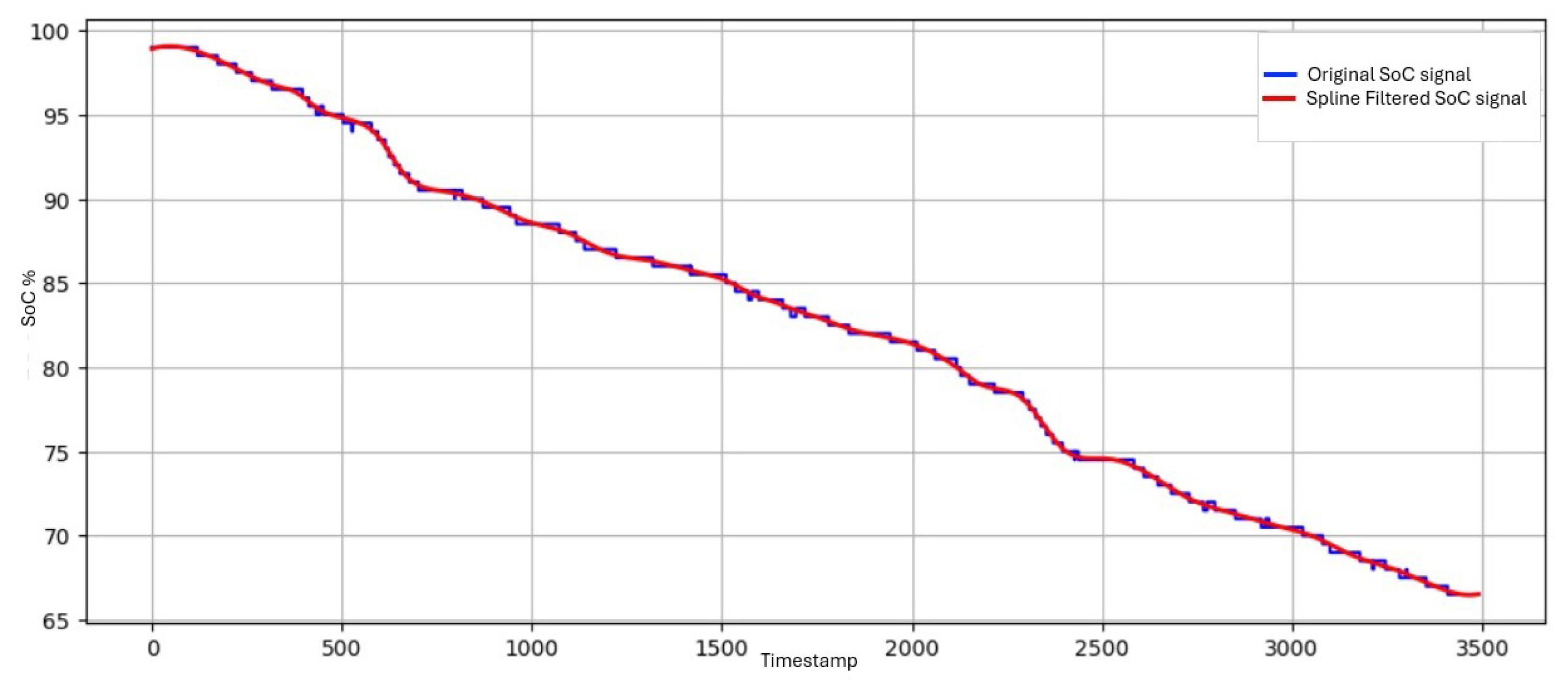
Beyond missing data and outliers, a significant quantization effect is observed in the real-world SoC signal. In the CEVE dataset, the SoC does not decrease as a smooth and continuous curve as would be expected from the physical process of battery depletion. Instead, a pronounced staircase effect is observed, where the signal remains flat for extended periods before undergoing sudden discrete drops. This behavior is a clear indicator of low sensor resolution or coarse estimation updates within the vehicle’s BMS. These long plateaus followed by abrupt transitions suggest that the BMS updates the SoC in fixed increments rather than providing a continuously refined estimate.
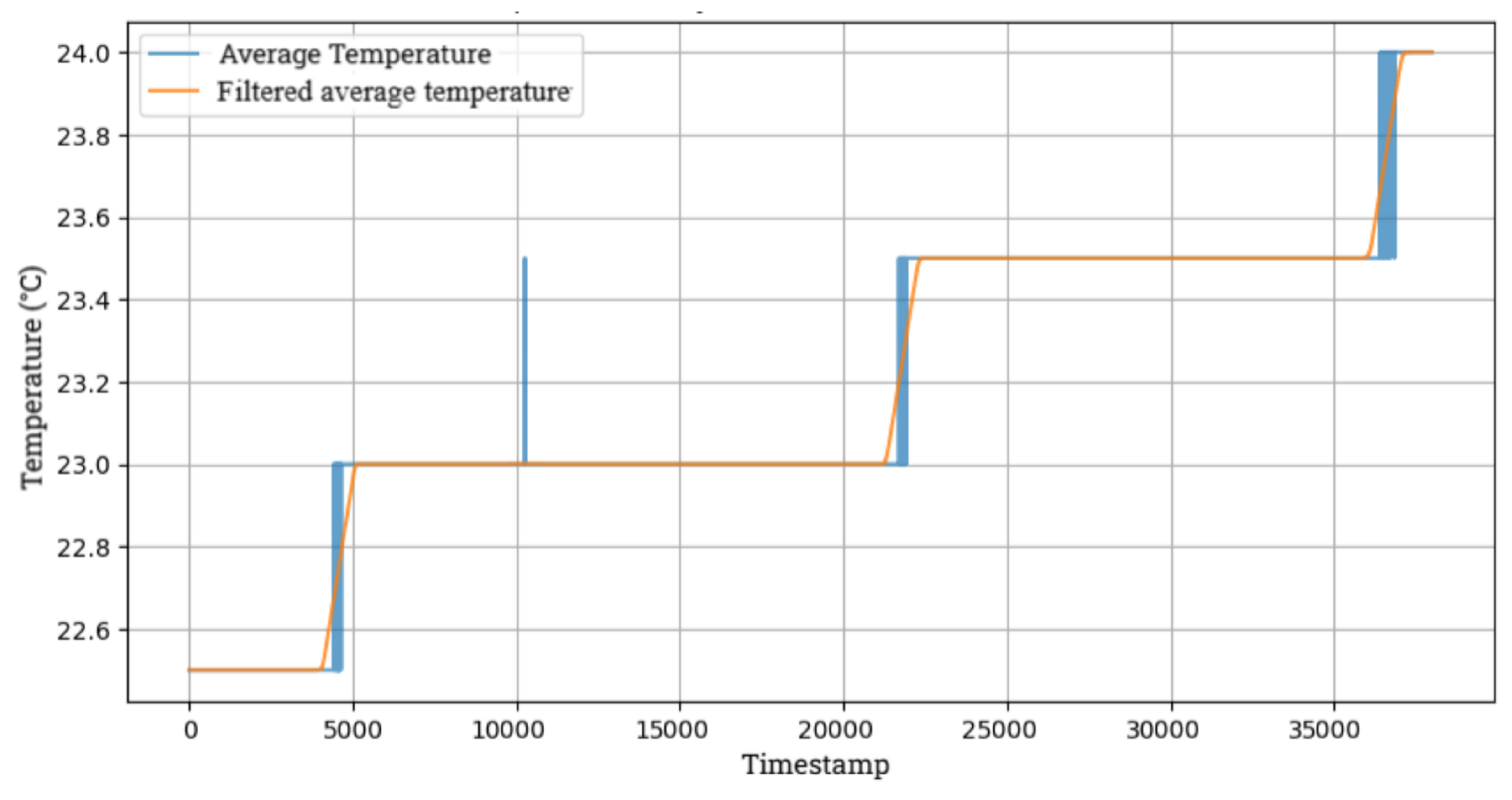
The final challenge identified in the CEVE dataset relates to temperature quantization. Similar to the SoC signal, the battery temperature measurements suffer from limited resolution. The temperature signal evolves in coarse 1 °C discrete increments, which directly reflects low sensor precision. Rather than exhibiting smooth thermal transitions, the signal displays rapid vertical oscillations between adjacent values. These oscillations indicate instability at the boundaries between quantization levels and further highlight the limitations of onboard sensing in real-world battery monitoring systems.

4.2. Processing Pipeline

To overcome the challenges inherent to real-world battery data, a classical yet robust preprocessing pipeline was implemented. This pipeline addresses missing values, outliers, signal quantization, and sensor resolution limitations to ensure physically consistent and reliable input data for subsequent modeling.

4.2.1. Missing Data and Outliers Procesing

The first preprocessing step targets missing values. Any corrupted sequences occurring at the very beginning or at the end of a driving trip are removed, as these regions contain unreliable measurements. For gaps occurring within the middle of a sequence, a linear interpolation strategy is applied to ensure smooth and mathematically consistent transitions between known data points.
Given two known samples ( t 1 , x 1 ) and ( t 2 , x 2 ) , the interpolated value x at time t [ t 1 , t 2 ] , is computed as
x ( t ) = x 1 + x 2 x 1 t 2 t 1 ( t t 1 )
This approach preserves temporal continuity while avoiding the introduction of artificial discontinuities.
The second step focuses on outlier detection and correction. Physically valid ranges for voltage current, temperature, and SoC are defined based on battery specifications and exploratory statistical analysis using boxplot (whisker) limits. Any sample falling outside these predefined intervals is flagged as an outlier.
Detected outliers are immediately replaced using the same linear interpolation method described above, ensuring consistency with neighboring valid samples while preserving the overall signal dynamics.

4.2.2. Improving SoC Quantization

A major challenge of the CEVE dataset is the quantization of the SoC signal. The ground-truth SoC is derived from the BMS estimate and is used as the reference for training. Owing to limited sensor resolution and discrete BMS update mechanisms, the SoC changes in stepwise increments, leading to a pronounced staircase effect that fails to represent the continuous nature of physical battery degradation.
To transform this stepped signal into a smooth and physically meaningful curve, a cubic smoothing spline is applied. The objective is to estimate a smooth function s ( t ) by minimizing the following cost function:
min s ( t ) i = 1 N y i s ( t i ) 2 + λ s ( t ) 2 d t
where y i are the measured data values, t i are the corresponding time instants, s ( t ) is the estimated smooth function, s ( t ) is its second derivative, N is the number of samples, and λ is the regularization parameter that controls the trade-off between data fidelity ensuring the smoothed curve remains close to the measured data and smoothness, which penalizes excessive curvature and suppresses high-frequency noise and artificial staircase effects.

4.2.3. Improving Temperature Quantization

The final preprocessing step addresses temperature quantization and sensor resolution limitations. Raw temperature measurements often evolve in coarse 1 °C increments, resulting in stair-stepped or noisy signals. To obtain a cleaner temperature signal while preserving important thermal features, a Savitzky Golay filter is applied. Unlike a simple moving average, this filter fits a low degree polynomial to the data within a sliding window using the least squares method.
For a window of size 2 k + 1 , the filtered signal at time t i is given by
x ^ i = j = k k c j x i + j
where x ^ i is the smoothed signal value at index i, x i + j are the original signal samples within the sliding window, c j are the smoothing coefficients, k is the half-window size (with window length 2 k + 1 ), and d is the degree of the fitted polynomial.
Together, these preprocessing steps significantly improve data quality, reduce sensor-induced artifacts, and ensure that the CEVE dataset accurately reflects the underlying physical behavior of the battery system. Specifically, the spline filtering applied to the SoC signal effectively smooths high-frequency fluctuations and measurement noise while preserving the long-term monotonic trends associated with charge and discharge processes, as shown in Figure 1. The resulting SoC curve exhibits improved continuity and differentiability, which is critical for learning temporal dependencies in data-driven models. Importantly, the spline interpolation maintains the physical consistency of SoC evolution by avoiding abrupt, non-physical transitions, thereby enhancing the reliability of the SoC signal for supervised learning and model validation.
Similarly, the Savitzky–Golay filtering applied to the temperature signal successfully attenuates short-term measurement noise without distorting the underlying thermal dynamics of the battery, as illustrated in Figure 2. The filtered temperature profile retains local variations and transient thermal responses induced by current load changes, which are essential for capturing the coupling between electrochemical activity and thermal behavior. By preserving the shape and slope of the temperature signal, the Savitzky–Golay filter ensures that thermally driven effects on battery performance are accurately represented, enabling more robust feature extraction and improving the generalization capability of downstream SoC prediction models.

5. Generalizable SoC Prediction via DL and Transfer Learning

In this section, we present the proposed DL-based approach for improving the SoC estimation, followed by the generalization strategy.

5.1. SoC Prediction Using DL

Once the data preprocessing stage is completed, the SoC prediction task is addressed using DL techniques. In this stage, we investigate and compare several DL architectures for SoC estimation. The analysis begins with a baseline Long Short-Term Memory (LSTM) model, which is widely adopted for modeling temporal battery dynamics.
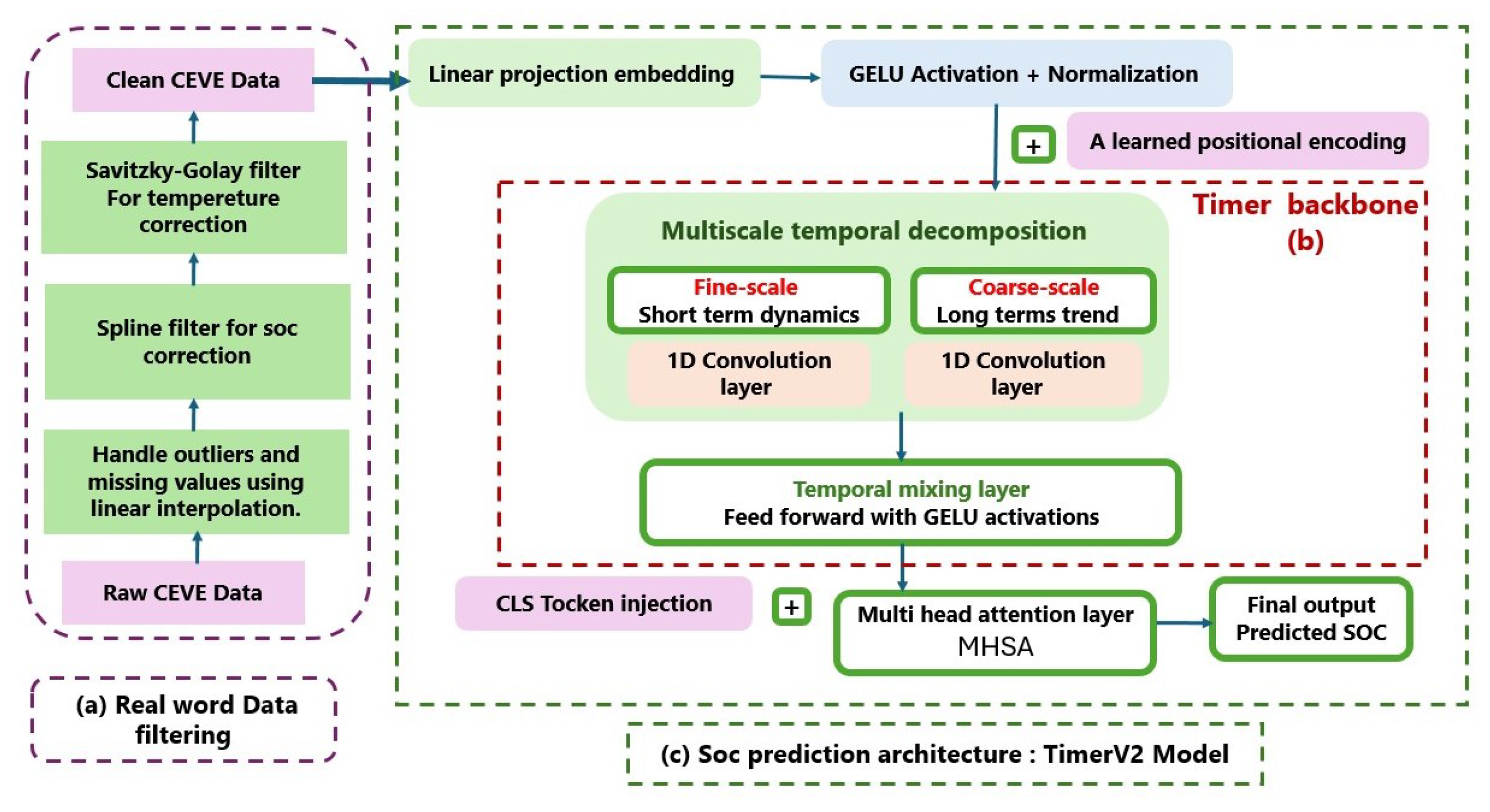
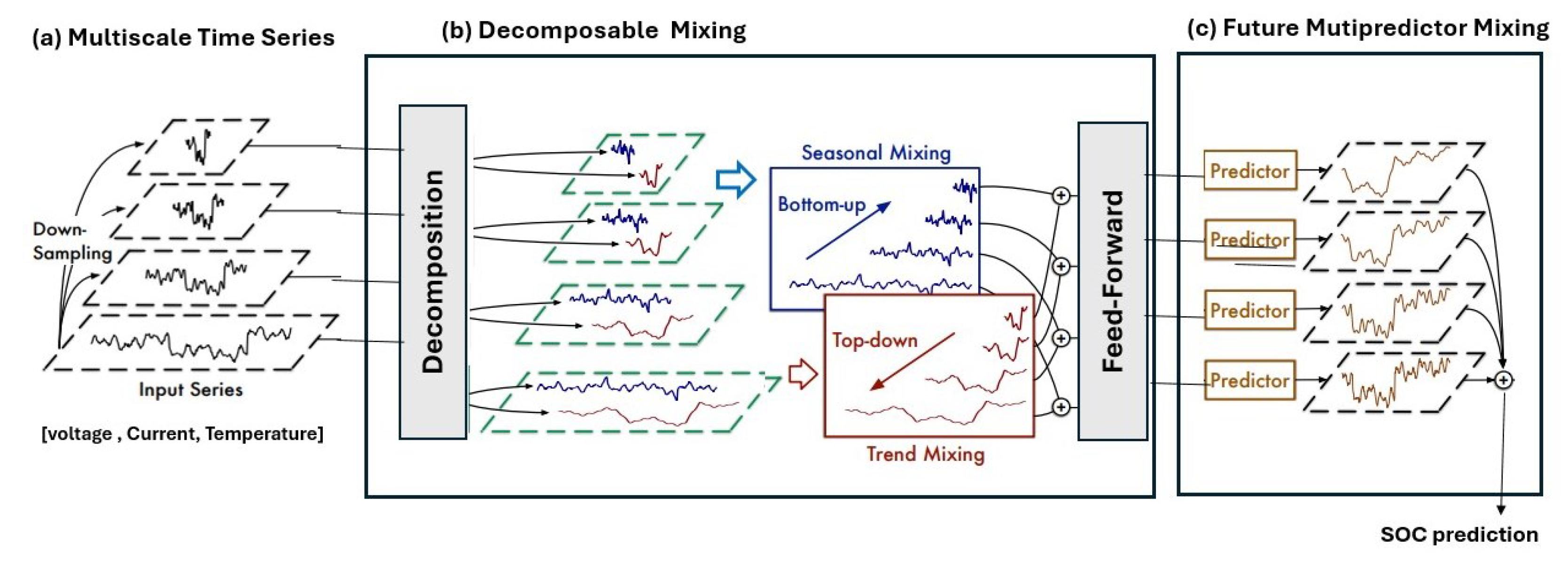
Subsequently, we introduce a TimerV2 architecture (Figure 3) built upon a Timer-based backbone (Figure 4) designed to more effectively capture complex temporal dependencies and nonlinear interactions in battery signals. Finally, transfer learning strategies are investigated to assess the model’s ability to generalize across datasets corresponding to different battery types and operating conditions. This evaluation provides insights into the robustness and adaptability of the approach when applied to heterogeneous battery datasets.

5.1.1. Data Processing and Training Strategy

Due to the high sampling rate of the LG18650HG2 and CEVE datasets (0.1 s sampling interval), each discharge cycle contains a large number of time steps. Consequently, a many-to-one learning strategy is adopted, where a fixed-length input sequence is mapped to a single output value corresponding to the SoC at the final time step.
In this configuration, for an input sequence of length n, the first n 1 samples are used as input, while the model predicts the n-th value. In practice, the input sequence length is set to 300 time steps; given an input sequence { x 1 , x 2 , , x 299 } , the model estimates the SoC at time step t 300 .
Since the input features (voltage, current, and temperature) and the target variable (SoC) exhibit different numerical ranges, direct training may bias the model toward features with larger magnitudes. To mitigate this issue, min-max normalization is applied to all input features, scaling them into the range [ 0 ,   1 ] . This ensures balanced feature contributions and improves training stability and convergence.
All proposed models are implemented using the Keras library [37]. The Adam optimizer [38] is used to update the network parameters with a learning rate of 10 5 . The models are trained for up to 1000 epochs, with early stopping applied if the validation loss does not improve for 20 consecutive epochs. The Huber loss function is adopted as the objective function, as it combines the advantages of both quadratic and linear error behavior, providing robustness to outliers while maintaining sensitivity to small errors.

5.1.2. TimerV2 Proposed Model Architecture

To overcome the limitations of traditional recurrent architectures in modeling the complex and multiscale dynamics of LIBs, this work proposes a TimerV2 model for SoC estimation using real-world electric vehicle data. The proposed TimerV2 model is built upon the Timer backbone [39], which serves as the core temporal modeling architecture within the SoC estimation framework. The TimerV2 model is employed in the prediction stage following the data preprocessing and signal conditioning procedures applied to the CEVE and LG18650HG2 datasets. Its objective is to learn a direct mapping between multivariate battery measurements such as voltage, current, temperature, and historical SoC and the target SoC value.
The modeling pipeline begins with a linear projection embedding followed by a Gaussian Error Linear Unit (GELU) activation, which transforms the raw input features into a higher-dimensional latent space. A learned positional encoding is then incorporated to preserve the temporal ordering of the battery time series signals, which is essential for capturing discharge dynamics. The core of the Timer backbone [39] consists of a multiscale temporal decomposition module implemented using parallel one-dimensional convolutional layers with different kernel sizes. This design enables the extraction of both short-term transient behaviors, such as rapid current fluctuations, and long-term temporal dependencies, such as gradual SoC decay and thermal evolution.
The extracted multi-resolution features are subsequently fused through a temporal mixing layer, allowing effective interaction across temporal scales. To further model long-range dependencies and enhance global sequence understanding, a Multi-Head Self-Attention (MHSA) mechanism is applied. In addition, a classification (CLS) token is introduced to aggregate global contextual information across the entire input window, resulting in a compact representation of the battery discharge trajectory. The final SoC estimate is obtained from this global embedding.
The overall architecture of the proposed model is illustrated in Figure 3.
The TimerV2 model was trained with four temporal mixing blocks and four attention heads, using a batch size of 128. The loss function employed was Mean Squared Error (MSE), optimized using the ADAM algorithm with a learning rate of 1 × 10 4 . Training was conducted for a maximum of 1000 epochs, with early stopping applied if validation performance did not improve for 20 consecutive epochs.
By integrating the Timer backbone [39] within the TimerV2 model and using these hyperparameters, the framework is able to capture the multiscale temporal characteristics of battery signals observed under real-world operating conditions, handling heterogeneous battery measurements and complex temporal dependencies across different datasets and battery configurations.

5.2. Enhancing Model Generalization from Open Source Dataset to Real-World Battery Dataset

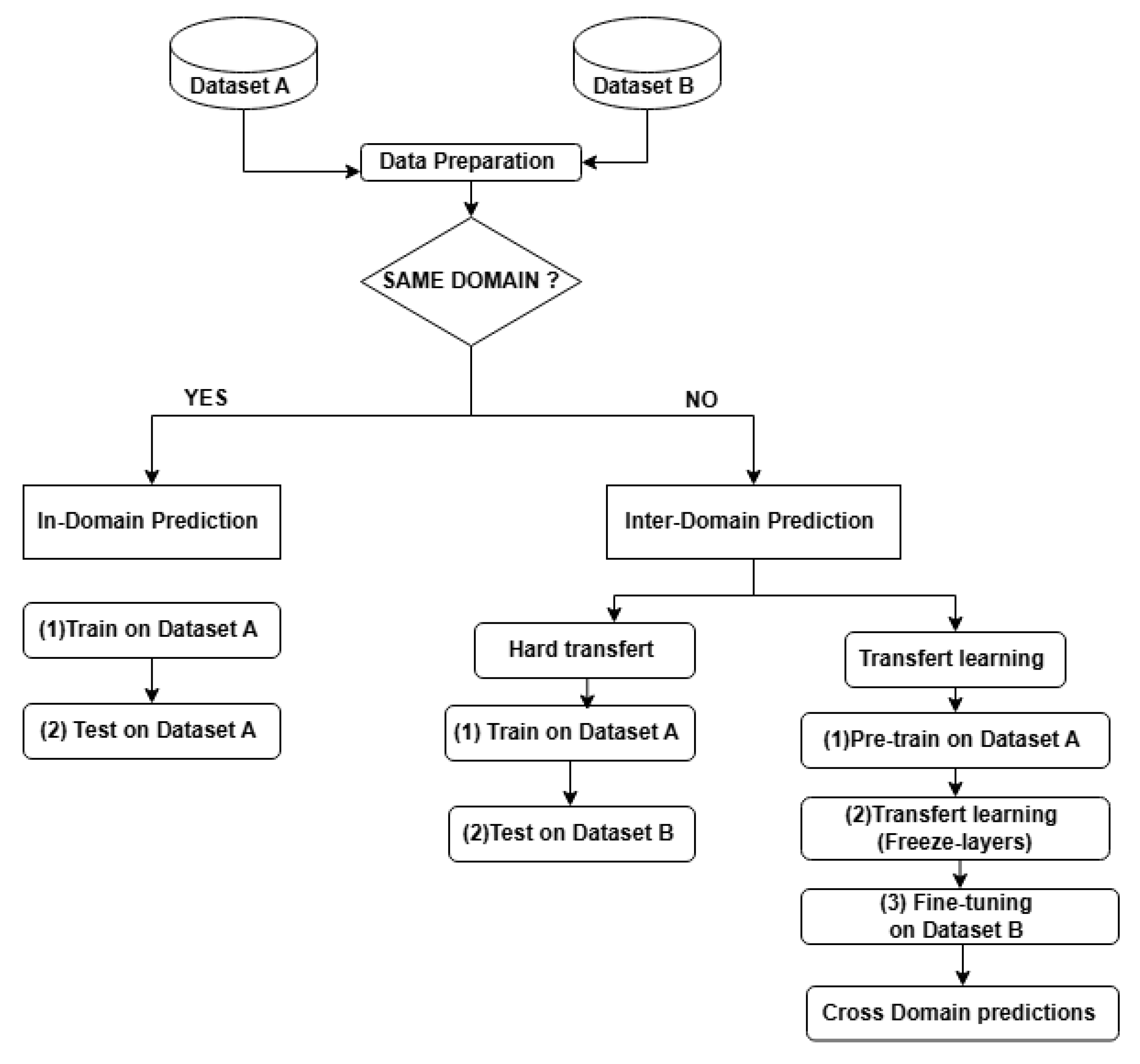
The SoC prediction process can be conceptually divided into two main components: in-domain prediction and inter-domain prediction.
In-domain prediction refers to training and evaluating the model on data collected from the same battery type or dataset. This approach allows for the assessment of the model’s baseline performance and its ability to capture the temporal dynamics and nonlinear relationships inherent to a single dataset.
Inter-domain prediction, on the other hand, involves applying transfer learning techniques to adapt the model to a different dataset or battery type. This component evaluates the model’s generalization capability and its ability to leverage knowledge learned from one domain to improve prediction accuracy in a distinct but related domain. In this study, the TimerV2 model trained on a source dataset serves as the foundation, with selective layers of the backbone fine-tuned to account for variations in battery characteristics, sampling rates, and operational conditions across datasets.
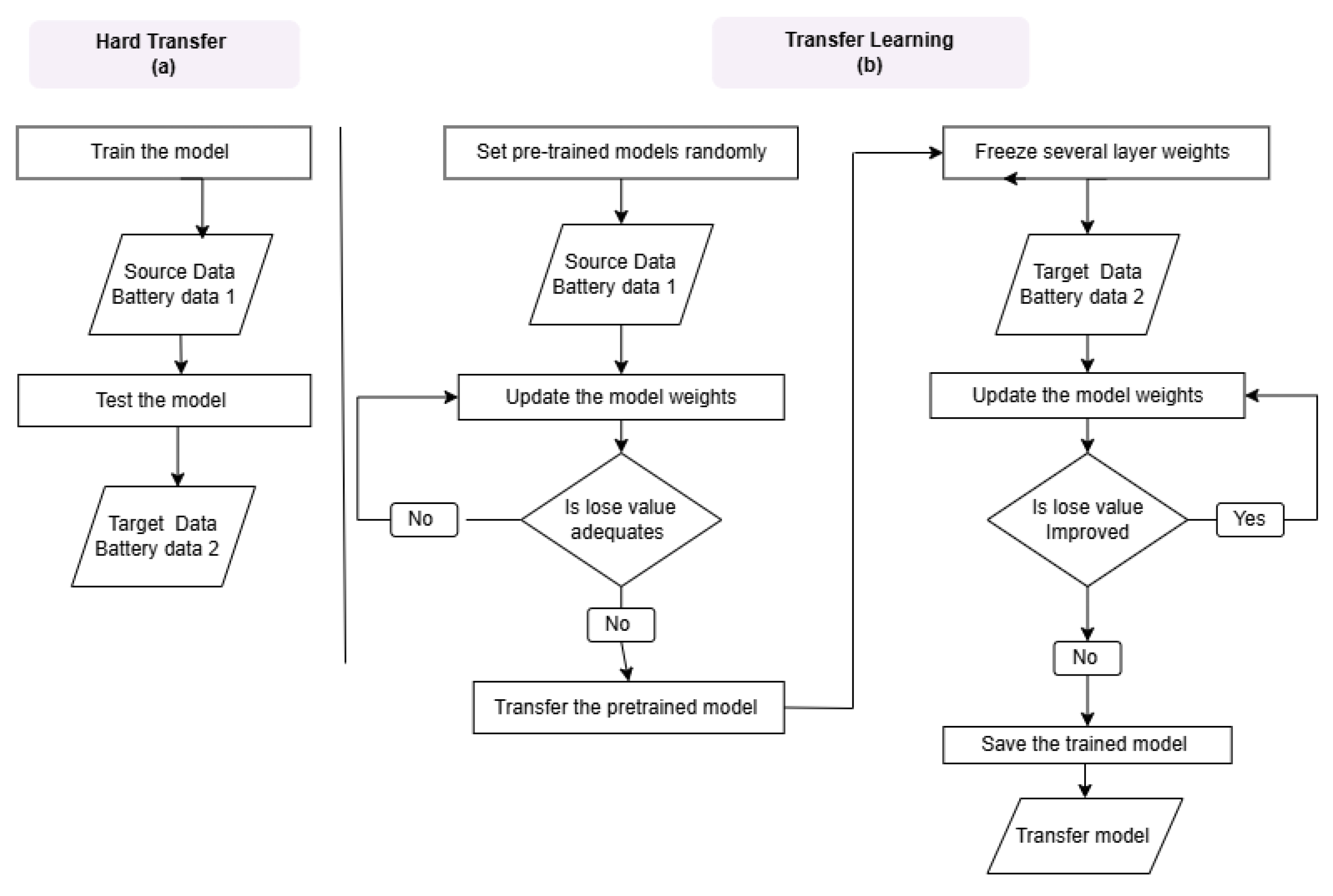
Inter-domain prediction is critical for the practical deployment of battery SoC estimation models. While in-domain prediction assesses performance on data from the same battery type, real-world applications often require the model to generalize across batteries with different chemistries, capacities, operational conditions, or datasets. The in-domain and inter-domain approaches are illustrated in the Figure 5. Directly applying a model trained on one dataset to another, referred to as hard transfer, can result in substantial performance degradation due to variations in sensor characteristics, discharge patterns, and environmental conditions (as illustrated in Figure 6). Transfer learning addresses this challenge by leveraging knowledge learned from a source domain and adapting it to a target domain with minimal additional training, as depicted in Figure 6. This approach reduces the need for large amounts of labeled data in the target domain while maintaining high prediction accuracy. In this study, the TimerV2 model trained on the source dataset forms the basis, and selective layers of the Timer backbone are fine-tuned to accommodate differences in data distribution and battery behavior. This inter-domain prediction framework enables effective cross-dataset generalization, making the model applicable to diverse real-world scenarios.
The inter-domain prediction strategy in this work employs two complementary approaches: hard transfer and fine-tuning of the Time-Mixer model from the LG18650HG2 dataset to the CEVE dataset.

5.2.1. Hard Transfer

Hard transfer involves directly applying the TimerV2 model trained on the LG dataset to the CEVE dataset without any retraining. This method evaluates the model’s inherent generalization capability when exposed to a new battery type and real-world driving conditions, highlighting differences in data distributions and operational patterns between laboratory-controlled and field-collected datasets.

5.2.2. Transfer Learning

Fine-tuning, in contrast, leverages the knowledge captured by the LG-trained TimerV2 model while allowing adaptation to the CEVE dataset. In this approach, only selected layers of the Timer backbone are retrained, specifically the MHSA module and the fully connected output layers. By keeping the remaining layers frozen, the model retains the temporal representations learned from the source dataset while adapting its global sequence understanding and output mapping to the characteristics of the target dataset. This selective fine-tuning allows the model to account for variations in battery behavior, sensor resolution, and driver-specific patterns, thereby improving SoC prediction accuracy on the CEVE dataset.

6. Results and Discussion

This section presents the evaluation methodology used to assess the proposed approach. We first introduce the baseline models considered in this study, followed by the performance metrics used for evaluation. This is followed by the in-domain evaluation protocol, which is used to validate the models on the source dataset. We then present an inter-domain evaluation protocol designed to assess the effectiveness of cross-dataset adaptation of the proposed method through transfer learning.

6.1. Baseline and Comparative Models

One of the effective deep learning approaches for SoC prediction was introduced in [6]. In this work, the authors demonstrate the potential of LSTM-based models for SoC estimation using time-series data. Since the study is conducted on the same LG16560HG2 dataset and includes extensive ablation studies, it serves as a strong and reliable reference model for our work. Building upon this reference model, we further extend the comparison by introducing two additional contemporary deep learning architectures: GRU [40] and Transformer [41]. These models are included to provide a broader and more comprehensive evaluation of temporal modeling approaches. The GRU model offers a simplified recurrent architecture for capturing sequential dependencies, while the Transformer model leverages self-attention mechanisms to model long-range temporal relationships. To ensure a fair and consistent comparison, all models are evaluated under identical training and testing conditions across both datasets.

6.2. Evaluation Metrics

The performance of the models is evaluated using standard regression metrics, namely the Root Mean Square Error (RMSE), Mean Absolute Error (MAE), and Mean Squared Error (MSE) [42]. The MSE is defined as the average of the squared differences between the predicted and ground-truth State of Charge (SoC) values:
MSE = 1 N i = 1 N ( y i y ^ i ) 2
where y i denotes the true SoC value, y ^ i the predicted SoC value, and N the number of samples.
The RMSE, obtained by taking the square root of the MSE, expresses the prediction error in the same units as the target variable:
RMSE = 1 N i = 1 N ( y i y ^ i ) 2
In contrast, the MAE computes the average of the absolute differences between the predicted and true values:
MAE = 1 N i = 1 N y i y ^ i
MAE corresponds to an L1 loss function and is well suited for real-world battery datasets, where sensor inaccuracies and measurement artifacts are common.

6.3. In-Domain Evaluation Protocol for the Proposed Approach

The LG18650HG2 dataset consists of controlled laboratory discharge cycles, providing a stable benchmark for model evaluation. In contrast, the CEVE dataset represents real-world driving conditions characterized by variable load profiles, and heterogeneous driving behaviors. This dataset comprises multiple driving cycles. For evaluation, predicted SoC trajectories are generated for each test cycle and compared against the corresponding ground-truth measurements to compute RMSE and MAE. This evaluation protocol enables the assessment of both overall prediction accuracy and sensitivity to large errors, thereby providing a comprehensive view of the model’s performance under both laboratory-controlled and real-world operating conditions.
Furthermore, the performance of both the contemporary baselines and the proposed TimerV2 architecture is evaluated on three representative datasets: the LG18650HG2 single-cell dataset, the CEVE single-cell dataset, and the CEVE battery pack dataset comprising 88 cells.
All models are assessed using a consistent data split strategy, where 80% of the data is used for training, 20% of the training data is reserved for validation, and the remaining 20% is used for testing.
The evaluation framework is structured around two complementary validation strategies: quantitative and qualitative validation. Quantitative validation relies on error-based metrics such as MAE and RMSE to provide objective measures of predictive accuracy and robustness. Qualitative validation complements this numerical analysis by visually comparing predicted SoC trajectories with ground-truth profiles over selected operating cycles, offering further insight into the models’ ability to capture both short-term temporal fluctuations and long-term SoC trends, particularly in the presence of noise, dynamic load variations, and complex real-world driving patterns.
The results reported in Table 1 confirm that all models capture temporal dependencies in SoC dynamics; however, the proposed TimerV2 consistently achieves the best performance across all datasets. TimerV2 systematically provides the lowest RMSE (in bold), while the second-best results (underlined) are mainly obtained by the GRU for the LG and CEVE cell datasets, and by the Transformer at the pack level.
For the LG cell dataset, the RMSE is reduced from 0.0202 (LSTM) and 0.0144 (GRU, second-best) to 0.0078 with TimerV2, highlighting its ability to accurately track fine-grained SoC variations. On the CEVE single-cell dataset, which reflects real-world conditions, TimerV2 achieves 0.0126 RMSE, significantly outperforming LSTM (0.0290) and GRU (0.0722, second-best), confirming its robustness to noise and variability. At the pack level, TimerV2 maintains superior performance with 0.016 RMSE, compared to 0.0270 (LSTM) and 0.1220 (Transformer, second-best), demonstrating its scalability to more complex system dynamics.
These improvements can be attributed to the multiscale temporal modeling and attention mechanisms of TimerV2, which better capture both short-term transients and long-term dependencies compared to recurrent and attention-based baselines. Overall, the consistent ranking across all datasets highlights the robustness and generalization capability of the proposed approach, from controlled scenarios to real-world and multi-cell configurations.
To complement the numerical evaluation, qualitative validation is performed by visually comparing the predicted SoC trajectories against the ground truth over selected discharge cycles. This step provides insight into how well the models capture temporal dynamics and signal variability that may not be fully reflected by aggregate metrics such as RMSE or MAE.
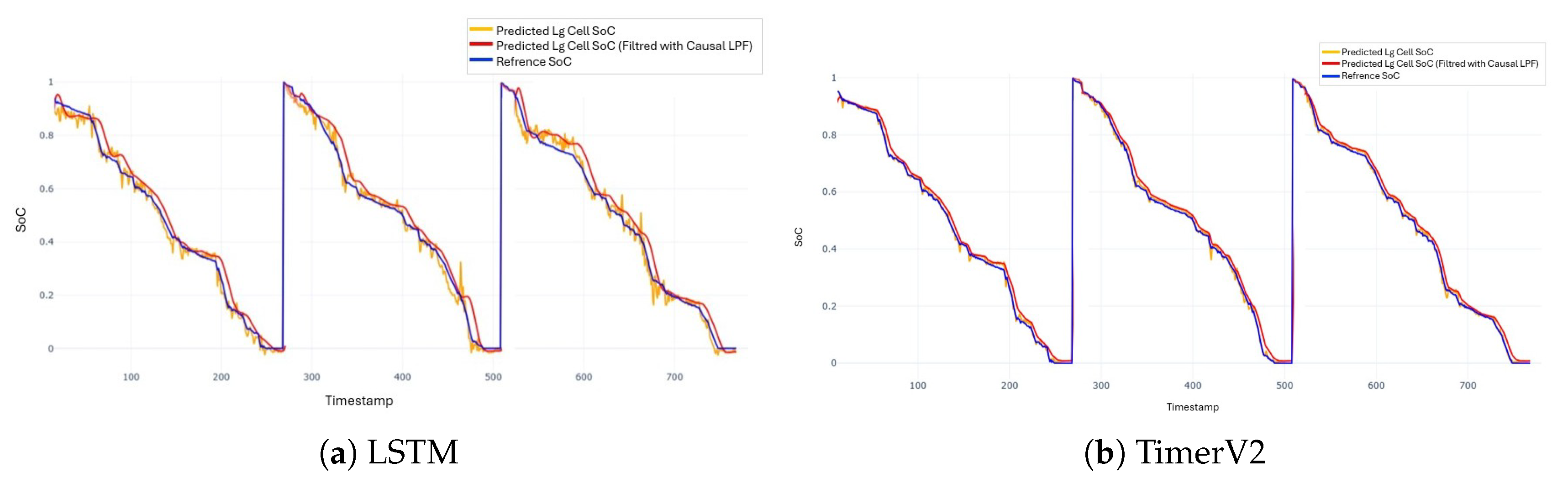
The overall results for the LG cell are summarized in Figure 7, where the baseline LSTM model captures the overall charging and discharging dynamics, closely following the reference SoC trajectories during both training and testing phases (Figure 7a). In comparison, the TimerV2 model further improves the tracking accuracy (Figure 7b).
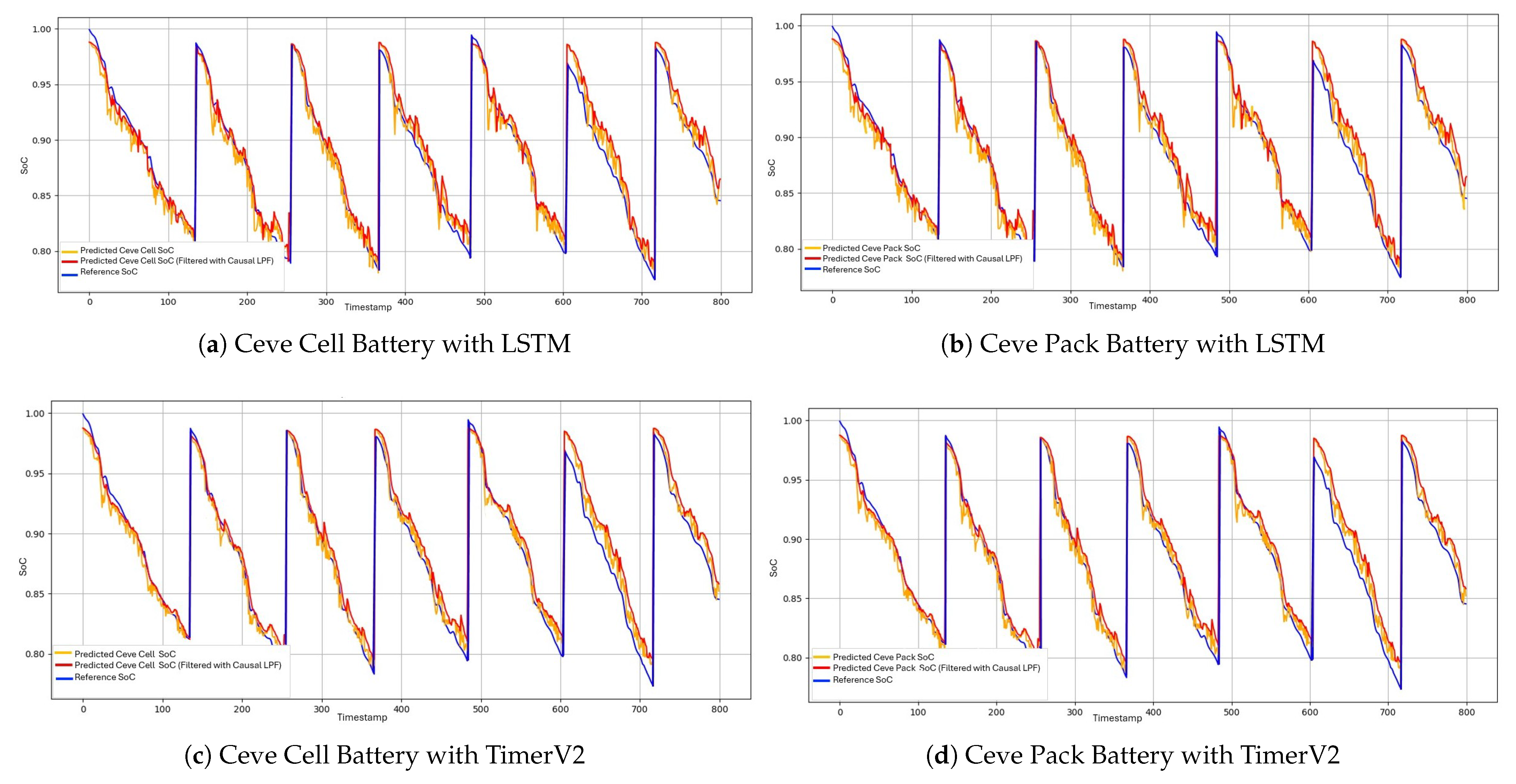
Like the CEVE dataset, the proposed framework based on TimerV2 proved its efficiency improving results compared to traditional LSTM model as pictured in Figure 8. While both models perform satisfactorily on the single-cell data, the LSTM predictions become noticeably noisier when applied to the more complex CEVE battery pack, whereas TimerV2 maintains smoother and more accurate tracking (Figure 8).
These fluctuations appear as small oscillations and jagged segments, likely resulting from inter-cell variability, signal aggregation effects, and heterogeneous operating conditions within the battery pack.
To attenuate these disturbances and ensure suitability for real-world industrial deployment, a causal low-pass filter is applied, as causality is a fundamental requirement for online and embedded battery management systems. In Figure 7 and Figure 8, the legends illustrate the raw predicted SoC and the filtered SoC obtained after applying the causal low-pass filter. Overall, the proposed TimerV2 model consistently demonstrates superior predictive accuracy and smoother SoC trajectory tracking across all evaluated datasets.
The evaluation on the CEVE battery pack dataset further underscores the generalization capability of the proposed architecture. Overall, the qualitative analysis strongly corroborates the quantitative results, confirming that the TimerV2 model captures both short-term fluctuations and long-term SoC dynamics with higher fidelity than the baseline LSTM. The consistent performance gains observed across different battery scales and operating conditions further demonstrate the robustness and scalability of the proposed approach. These encouraging results naturally motivate the next phase of this work, which aims to leverage transfer learning strategies to enhance model adaptability and enable rapid deployment across new battery chemistries and system configurations without retraining from scratch.
Having established the strong in-domain performance of the TimerV2 model for SoC estimation on both single-cell and pack-level datasets, the next step is to assess its generalization capability through inter-domain prediction using transfer learning techniques.

6.4. Inter-Domain Evaluation Protocol for the Proposed Approach

To evaluate the cross-domain generalization capability of the proposed TimerV2 model, inter-domain prediction experiments are conducted. The inter-domain prediction process is divided into two stages: hard transfer and fine-tuning. This evaluation assesses the performance of the TimerV2 model on the CEVE real-world battery dataset after being trained on the LG18650HG2 cell dataset.
In the hard transfer scenario, the TimerV2 model trained on the LG dataset is directly applied to the CEVE single-cell dataset without any retraining. The quantitative results are presented in Table 2.
The last row of Table 2 presents the performance of the hard transfer scenario, where the TimerV2 model trained on the LG cell dataset is directly tested on the CEVE cell dataset without any fine-tuning. In this case, the RMSE increases sharply to 0.1705, compared to 0.0078 for in-domain testing on the LG cell and 0.0126 for in-domain testing on the CEVE cell. This substantial degradation in predictive accuracy highlights the challenges of applying a model trained on one battery domain to a different dataset with distinct operational characteristics.
The significant performance drop can be attributed to differences in battery chemistry, cell capacity, and operating conditions between the LG and CEVE datasets. Specifically, the model trained on LG cells has learned temporal and electrochemical patterns specific to that dataset, which do not generalize directly to the CEVE dataset. The CEVE data include varying current profiles, voltage responses, and temperature variations arising from real-world driving conditions, which the model has not encountered during training. As a result, the predicted SoC deviates considerably from the ground truth, yielding high RMSE values.
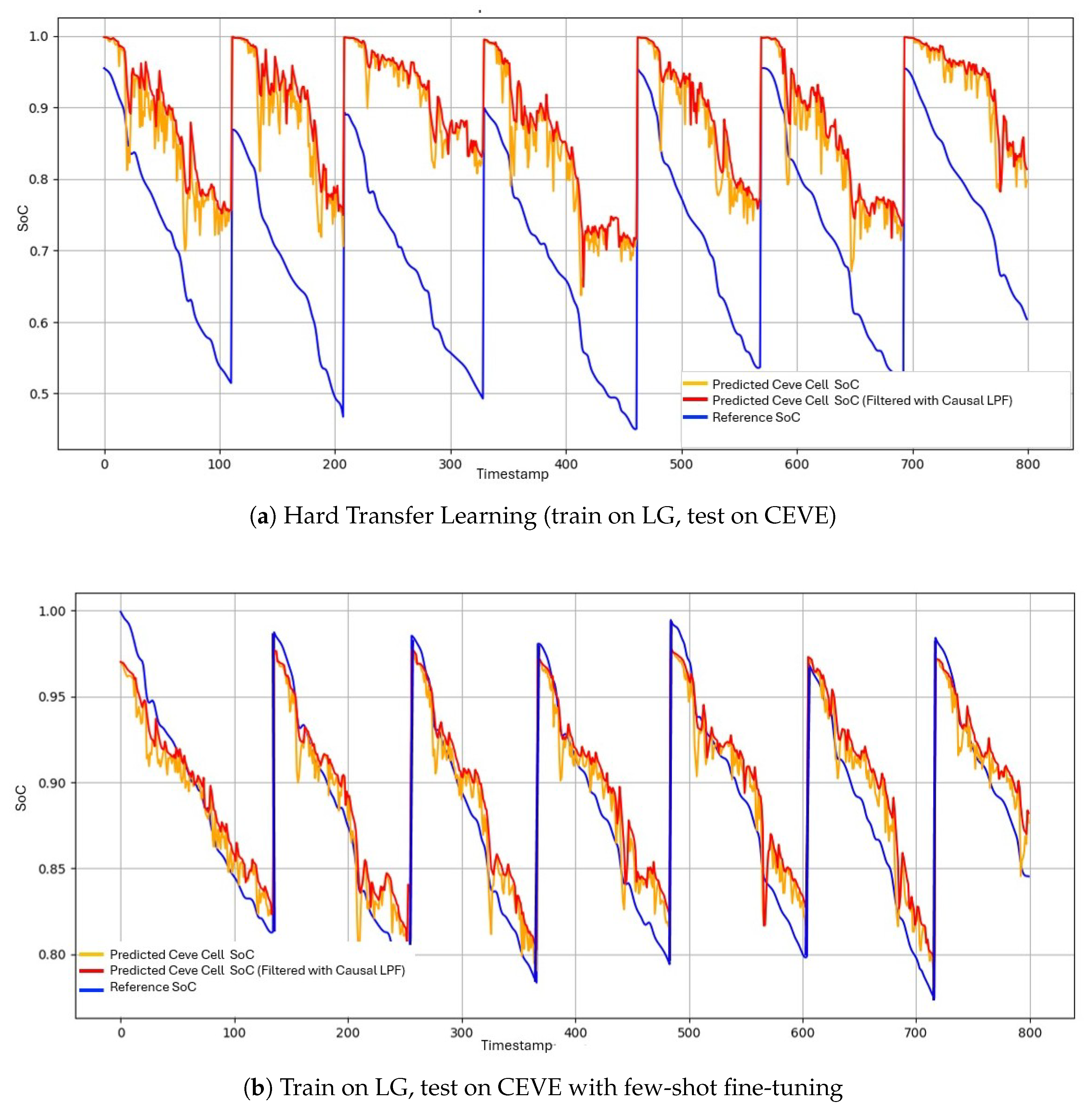
To complement the quantitative metrics, a qualitative assessment of the hard transfer scenario is conducted by visually comparing predicted and actual SoC trajectories. Figure 9a illustrates the predictions of the TimerV2 model trained on the LG cell and tested directly on the CEVE cell dataset. The results reveal substantial deviations from the reference SoC curves, particularly during high current transients and long discharge periods. The model fails to accurately capture short-term fluctuations and exhibits delayed response to changes in load and voltage patterns, which are markedly different from the LG training data. These discrepancies are consistent with the elevated RMSE observed in the quantitative analysis, confirming that the temporal and electrochemical patterns learned from the LG dataset do not generalize directly to the CEVE dataset.
While the TimerV2 model demonstrates strong predictive performance within its original training domain, the hard transfer scenario reveals substantial performance degradation, with RMSE rising to 0.1705. This result highlights that direct application across domains is insufficient due to differences in battery chemistries, operating conditions, and measurement characteristics.
To address this limitation, the TimerV2 model undergoes fine-tuning on a subset of the CEVE dataset. During this process, the MHSA and fully connected layers are updated to capture domain specific dynamics while retaining the knowledge learned from the LG training set. As reported in Table 2, fine-tuning significantly improves predictive performance, reducing the RMSE from 0.1705 in the hard-transfer scenario to 0.0207 when 20% of the CEVE dataset is used for testing. This substantial reduction demonstrates the effectiveness of transfer learning in adapting the model to new battery domains, enabling accurate SoC estimation while leveraging previously learned representations. Qualitatively, the predicted SoC trajectories after fine-tuning closely follow the ground-truth curves, accurately capturing both short-term fluctuations and long-term discharge trends as shown in Figure 9b. Compared to hard transfer Figure 9a, where the model exhibited jagged and delayed segments, fine-tuning substantially reduces these artifacts. Applying a causal low-pass filter further smooths residual oscillations, improving robustness and suitability for real-time deployment. Notably, this adaptation is achieved in only 10 fine-tuning epochs, compared to 154 epochs required for training from scratch or hard transfer, demonstrating both efficiency and effectiveness in capturing the CEVE dataset’s temporal and electrochemical patterns. These results confirm that fine-tuning is an effective transfer learning strategy. It allows the model to retain knowledge from LG cells while adapting to the CEVE dataset’s domain-specific variations, including sensor noise and operational differences. The improvement is achieved using a limited subset of CEVE data, ensuring accurate and reliable SoC estimation across heterogeneous battery datasets and effectively bridging the gap left by hard transfer.

7. Conclusions

This paper addresses the challenge of achieving accurate SoC estimation for electric vehicle batteries under real-world operating conditions, while enabling efficient adaptation to new domains through transfer learning. We proposed a comprehensive framework combining real-world data preprocessing, improved DL based prediction, and transfer learning strategies. The proposed approach was evaluated on both a reference laboratory dataset, the LG 18650HG2 dataset, and a real-world driving dataset, the CEVE dataset. Experimental results demonstrate that the framework achieves high SoC estimation accuracy while maintaining strong robustness across diverse operating conditions. Moreover, the proposed transfer learning protocol, including few shot learning, significantly enhances performance through knowledge transfer.
In future research, this work will be extended to state-of-health (SoH) estimation, leveraging the proposed framework to jointly analyze aging-related indicators and long-term battery degradation patterns. Incorporating additional diagnostic measurements and multi-task learning strategies is expected to further improve both SoC and SoH prediction accuracy in the context of real-word datasets. Overall, future efforts will aim to strengthen the reliability, adaptability, and real-world applicability of the proposed framework for practical electric vehicle battery management systems.

Author Contributions

Conceptualization, methodology, validation, formal analysis and investigation, M.K., R.S., E.R.-I. and R.T.; software, data curation and visualization, M.K. and R.S.; writing, review and editing: M.K., R.S., E.R.-I. and R.T.; supervision, project administration and funding acquisition, R.S., E.R.-I. and R.T. All authors have read and agreed to the published version of the manuscript.

Funding

This research was funded by BPI France grant number DOS0212422.

Data Availability Statement

The raw data supporting the conclusions of this article will be made available by the authors on request.

Conflicts of Interest

The authors declare no conflicts of interest.

Abbreviations

The following abbreviations are used in this manuscript:
AIArtificial Intelligence
BMSBattery Management System
DLDeep Learning
CEVECitroën Electric Vehicle Experiment
CLSClassification Token
CNNConvolutional Neural Network
ECMEquivalent Circuit Model
ELMExtreme Learning Machine
EVElectric Vehicle
GELUGaussian Error Linear Unit
GPRGaussian Process Regression
GRUGated Recurrent Unit
KNNk-Nearest Neighbors
LIBLithium-Ion Battery
LSTMLong Short-Term Memory
MAEMean Absolute Error
MHSAMulti-Head Self-Attention
MLMachine Learning
MLPMultilayer Perceptron
MSEMean Squared Error
OCVOpen Circuit Voltage
RMSERoot Mean Square Error
RNNRecurrent Neural Network
SoCState of Charge
SoHState of Health
SVMSupport Vector Machine
TimerV2Time-Series Transformer-Based Architecture (Version 2)

References

  1. Padder, S.G.; Ambulkar, J.; Banotra, A.; Modem, S.; Maheshwari, S.; Jayaramulu, K.; Kundu, C. Data-driven approaches for estimation of EV battery SoC and SoH: A review. IEEE Access 2025, 13, 35048–35067. [Google Scholar] [CrossRef] [Scilit]
  2. Karthick, A. Review on State of charge prediction of battery management system in electric vehicles. Proc. Inst. Mech. Eng. Part J. Automob. Eng. 2025. [Google Scholar] [CrossRef] [Scilit]
  3. Ko, Y.; Cho, K.; Kim, M.; Choi, W. A novel capacity estimation method for the lithium batteries using the enhanced coulomb counting method with kalman filtering. IEEE Access 2022, 10, 38793–38801. [Google Scholar] [CrossRef] [Scilit]
  4. Marongiu, A.; Roscher, M.; Sauer, D.U. Influence of the vehicle-to-grid strategy on the aging behavior of lithium battery electric vehicles. Appl. Energy 2015, 137, 899–912. [Google Scholar] [CrossRef] [Scilit]
  5. How, D.N.; Hannan, M.; Lipu, M.H.; Ker, P.J. State of charge estimation for lithium-ion batteries using model-based and data-driven methods: A review. IEEE Access 2019, 7, 136116–136136. [Google Scholar] [CrossRef] [Scilit]
  6. Wong, K.L.; Bosello, M.; Tse, R.; Falcomer, C.; Rossi, C.; Pau, G. Li-ion batteries state-of-charge estimation using deep lstm at various battery specifications and discharge cycles. In Proceedings of the Conference on Information Technology for Social Good; Association for Computing Machinery: New York, NY, USA, 2021; pp. 85–90. [Google Scholar]
  7. Ofoegbu, E.O. State of charge (SOC) estimation in electric vehicle (EV) battery management systems using ensemble methods and neural networks. J. Energy Storage 2025, 114, 115833. [Google Scholar] [CrossRef] [Scilit]
  8. Trigui, R.; Derollepot, R.; Kreczanic, P.; Poupon, L.; Philipps-Bertin, C. Use analysis and systemic modeling of a new generation EV for autonomy optimization. In EEVC 2014, European Battery, Hybrid and Fuel Cell Electric Vehicle Congress; HAL: Bruxelle, Belgium, 2014; p. 10. [Google Scholar]
  9. Liu, P.; Xu, R.; Liu, Y.; Lin, F.; Zhao, K. Computational modeling of heterogeneity of stress, charge, and cyclic damage in composite electrodes of Li-ion batteries. J. Electrochem. Soc. 2020, 167, 040527. [Google Scholar] [CrossRef] [Scilit]
  10. Xu, R.; Yang, Y.; Yin, F.; Liu, P.; Cloetens, P.; Liu, Y.; Lin, F.; Zhao, K. Heterogeneous damage in Li-ion batteries: Experimental analysis and theoretical modeling. J. Mech. Phys. Solids 2019, 129, 160–183. [Google Scholar] [CrossRef] [Scilit]
  11. Ng, M.F.; Zhao, J.; Yan, Q.; Conduit, G.J.; Seh, Z.W. Predicting the state of charge and health of batteries using data-driven machine learning. Nat. Mach. Intell. 2020, 2, 161–170. [Google Scholar] [CrossRef] [Scilit]
  12. Lipu, M.H.; Hannan, M.; Hussain, A.; Ayob, A.; Saad, M.H.; Karim, T.F.; How, D.N. Data-driven state of charge estimation of lithium-ion batteries: Algorithms, implementation factors, limitations and future trends. J. Clean. Prod. 2020, 277, 124110. [Google Scholar] [CrossRef] [Scilit]
  13. Cover, T.; Hart, P. Nearest neighbor pattern classification. IEEE Trans. Inf. Theory 1967, 13, 21–27. [Google Scholar] [CrossRef] [Scilit]
  14. Talluri, T.; Chung, H.T.; Shin, K. Study of battery state-of-charge estimation with kNN machine learning method. IEIE Trans. Smart Process. Comput. 2021, 10, 496–504. [Google Scholar] [CrossRef] [Scilit]
  15. Song, S.; Zhang, X.; Gao, D.; Jiang, F.; Wu, Y.; Huang, J.; Gong, Y.; Liu, B.; Huang, Z. A hierarchical state of charge estimation method for lithium-ion batteries via xgboost and kalman filter. In Proceedings of the 2020 IEEE International Conference on Systems, Man, and Cybernetics (SMC); IEEE: New York, NY, USA, 2020; pp. 2317–2322. [Google Scholar]
  16. Anton, J.C.A.; Nieto, P.J.G.; Viejo, C.B.; Vilán, J.A.V. Support vector machines used to estimate the battery state of charge. IEEE Trans. Power Electron. 2013, 28, 5919–5926. [Google Scholar] [CrossRef] [Scilit]
  17. Dou, J.; Ma, H.; Zhang, Y.; Wang, S.; Ye, Y.; Li, S.; Hu, L. Extreme learning machine model for state-of-charge estimation of lithium-ion battery using salp swarm algorithm. J. Energy Storage 2022, 52, 104996. [Google Scholar] [CrossRef] [Scilit]
  18. Rumelhart, D.E.; Hinton, G.E.; Williams, R.J. Learning representations by back-propagating errors. Nature 1986, 323, 533–536. [Google Scholar] [CrossRef] [Scilit]
  19. LeCun, Y.; Boser, B.; Denker, J.S.; Henderson, D.; Howard, R.E.; Hubbard, W.; Jackel, L.D. Backpropagation applied to handwritten zip code recognition. Neural Comput. 1989, 1, 541–551. [Google Scholar] [CrossRef] [Scilit]
  20. Hopfield, J.J. Neural networks and physical systems with emergent collective computational abilities. Proc. Natl. Acad. Sci. USA 1982, 79, 2554–2558. [Google Scholar] [CrossRef] [Scilit]
  21. Hannan, M.A.; Lipu, M.S.H.; Hussain, A.; Saad, M.H.; Ayob, A. Neural network approach for estimating state of charge of lithium-ion battery using backtracking search algorithm. IEEE Access 2018, 6, 10069–10079. [Google Scholar] [CrossRef] [Scilit]
  22. Bhattacharyya, H.S.; Yadav, A.; Choudhury, A.B.; Chanda, C.K. Convolution neural network-based SOC estimation of Li-ion battery in EV applications. In Proceedings of the 2021 5th International Conference on Electrical, Electronics, Communication, Computer Technologies and Optimization Techniques (ICEECCOT); IEEE: New York, NY, USA, 2021; pp. 587–592. [Google Scholar]
  23. Hochreiter, S.; Schmidhuber, J. Long short-term memory. Neural Comput. 1997, 9, 1735–1780. [Google Scholar] [CrossRef] [Scilit]
  24. Chung, J.; Gulcehre, C.; Cho, K.; Bengio, Y. Empirical evaluation of gated recurrent neural networks on sequence modeling. arXiv 2014, arXiv:1412.3555. [Google Scholar] [CrossRef] [Scilit]
  25. Liu, Z.; Jia, W.; Liu, T.; Chang, Y.; Li, J. State of charge estimation of lithium-ion battery based on recurrent neural network. In Proceedings of the 2020 Asia Energy and Electrical Engineering Symposium (AEEES); IEEE: New York, NY, USA, 2020; pp. 742–746. [Google Scholar]
  26. Cheng, M.W.; Lee, Y.S.; Liu, M.; Sun, C.C. State-of-charge estimation with aging effect and correction for lithium-ion battery. IET Electr. Syst. Transp. 2015, 5, 70–76. [Google Scholar] [CrossRef] [Scilit]
  27. Tian, J.; Xiong, R.; Shen, W. A review on state of health estimation for lithium ion batteries in photovoltaic systems. ETransportation 2019, 2, 100028. [Google Scholar] [CrossRef] [Scilit]
  28. Tian, J.; Chen, C.; Shen, W.; Sun, F.; Xiong, R. Deep learning framework for lithium-ion battery state of charge estimation: Recent advances and future perspectives. Energy Storage Mater. 2023, 61, 102883. [Google Scholar] [CrossRef] [Scilit]
  29. Ghassani, F.; Abdurohman, M.; Putrada, A.G. Prediction of smarthphone charging using k-nearest neighbor machine learning. In Proceedings of the 2018 Third International Conference on Informatics and Computing (ICIC); IEEE: New York, NY, USA, 2018; pp. 1–4. [Google Scholar]
  30. Hu, C.; Jain, G.; Zhang, P.; Schmidt, C.; Gomadam, P.; Gorka, T. Data-driven method based on particle swarm optimization and k-nearest neighbor regression for estimating capacity of lithium-ion battery. Appl. Energy 2014, 129, 49–55. [Google Scholar] [CrossRef] [Scilit]
  31. Jiang, F.; Yang, J.; Cheng, Y.; Zhang, X.; Yang, Y.; Gao, K.; Peng, J.; Huang, Z. An aging-aware soc estimation method for lithium-ion batteries using xgboost algorithm. In Proceedings of the 2019 IEEE International Conference on Prognostics and Health Management (ICPHM); IEEE: New York, NY, USA, 2019; pp. 1–8. [Google Scholar]
  32. Liu, X.; Li, K.; Wu, J.; He, Y.; Liu, X. An extended Kalman filter based data-driven method for state of charge estimation of Li-ion batteries. J. Energy Storage 2021, 40, 102655. [Google Scholar] [CrossRef] [Scilit]
  33. Zhang, H.; Gui, X.; Zheng, S.; Lu, Z.; Li, Y.; Bian, J. BatteryML: An open-source platform for machine learning on battery degradation. arXiv 2023, arXiv:2310.14714. [Google Scholar]
  34. Zhang, H.; Li, Y.; Zheng, S.; Lu, Z.; Gui, X.; Xu, W.; Bian, J. Battery lifetime prediction across diverse ageing conditions with inter-cell deep learning. Nat. Mach. Intell. 2025, 7, 270–277. [Google Scholar] [CrossRef] [Scilit]
  35. Kollmeyer, P.; Vidal, C.; Naguib, M.; Skells, M. LG 18650HG2 Li-ion Battery Data and Example Deep Neural Network xEV SOC Estimator Script, Version 3; Mendeley Data: London, UK, 2020. [CrossRef]
  36. Wang, S.; Wu, H.; Shi, X.; Hu, T.; Luo, H.; Ma, L.; Zhang, J.Y.; Zhou, J. Timemixer: Decomposable multiscale mixing for time series forecasting. arXiv 2024, arXiv:2405.14616. [Google Scholar] [CrossRef] [Scilit]
  37. Gulli, A.; Pal, S. Deep Learning with Keras; Packt Publishing Ltd.: Birmingham, UK, 2017. [Google Scholar]
  38. Kingma, D.P. Adam: A method for stochastic optimization. arXiv 2014, arXiv:1412.6980. [Google Scholar]
  39. Liu, Y.; Zhang, H.; Li, C.; Huang, X.; Wang, J.; Long, M. Timer: Generative pre-trained transformers are large time series models. arXiv 2024, arXiv:2402.02368. [Google Scholar] [CrossRef] [Scilit]
  40. Dey, R.; Salem, F.M. Gate-variants of gated recurrent unit (GRU) neural networks. In Proceedings of the 2017 IEEE 60th International Midwest Symposium on Circuits and Systems (MWSCAS); IEEE: New York, NY, USA, 2017; pp. 1597–1600. [Google Scholar]
  41. Vaswani, A.; Shazeer, N.; Parmar, N.; Uszkoreit, J.; Jones, L.; Gomez, A.N.; Kaiser, Ł.; Polosukhin, I. Attention is all you need. Adv. Neural Inf. Process. Syst. 2017, 30. Available online: https://proceedings.neurips.cc/paper_files/paper/2017/file/3f5ee243547dee91fbd053c1c4a845aa-Paper.pdf (accessed on 13 May 2026).
  42. Chicco, D.; Warrens, M.J.; Jurman, G. The coefficient of determination R-squared is more informative than SMAPE, MAE, MAPE, MSE and RMSE in regression analysis evaluation. PeerJ Comput. Sci. 2021, 7, e623. [Google Scholar] [CrossRef] [Scilit] [PubMed]
Figure 1. Comparison between raw and spline-filtered SoC signals, illustrating the effect of filtering on signal smoothness.
Batteries 12 00185 g001
Figure 2. Results of Savitzky-Golay filtering applied to battery temperature measurements, showing noise reduction and signal smoothing.
Batteries 12 00185 g002
Figure 3. Proposed SoC estimation framework based on a Timer backbone integrated within a TimerV2 architecture: from data preprocessing to SoC prediction.
Batteries 12 00185 g003
Figure 4. Overall architecture of TimerMixter, which consists of Past-Decomposable Mixing and Future-Multipredictor-Mixing for past observations and future predictions [36].
Batteries 12 00185 g004
Figure 5. Methodology for in-domain and inter-domain prediction.
Batteries 12 00185 g005
Figure 6. Evaluation protocol for assessing the effect of transfer learning.
Batteries 12 00185 g006
Figure 7. SoC prediction performance on LG cell battery data.
Batteries 12 00185 g007
Figure 8. SoC prediction performance on CEVE battery data.
Batteries 12 00185 g008
Figure 9. SoC prediction performance using the proposed TimerV2 framework with the validation protocol for assessing transfer learning efficiency.
Batteries 12 00185 g009
Table 1. Quantitative results of SoC prediction. Errors are computed on normalized SoC values. Bold indicates the best performance, while underlined values indicate the second-best performance (based on RMSE).
DatasetLSTMGRUTransformerTimerV2
MAEMSERMSEMAEMSERMSEMAEMSERMSEMAEMSERMSE
LG Cell0.00040.0004080.02020.0113320.0002070.01440.0150590.0003620.0190240.0060.00006080.0078
CEVE Cell0.00080.0008410.02900.064780.0074330.072210.061540.0059450.077100.010.0001590.0126
CEVE Pack (88 Cells)0.00070.0007290.02700.11810.0194050.13190.10260.0148810.12200.0090.0001350.0116
Table 2. Inter-domain performance of TimerV2 under different transfer scenarios. RMSE values are reported in normalized form. Bold indicates the best performance.
ScenarioDatasetMetricsEpochs
TrainTestTransfer TypeMAEMSERMSE
No TransferCEVE CellCEVE CellNone0.010.00010.0126154
Hard TransferLG CellCEVE CellHard Transfer0.1550.02910.1705154
Few-shot LearningLG CellCEVE CellFine tuning0.02220.0008050.020710
Disclaimer/Publisher’s Note: The statements, opinions and data contained in all publications are solely those of the individual author(s) and contributor(s) and not of MDPI and/or the editor(s). MDPI and/or the editor(s) disclaim responsibility for any injury to people or property resulting from any ideas, methods, instructions or products referred to in the content.