Review

Sodium-Ion Batteries: Materials, Performance, and Application in Engineering Systems

Department of Mechanical Engineering, University of Nevada-Reno, Reno, NV 89557, USA
*
Author to whom correspondence should be addressed.
Batteries 2026, 12(5), 180; https://doi.org/10.3390/batteries12050180
Submission received: 3 April 2026 / Revised: 14 May 2026 / Accepted: 17 May 2026 / Published: 20 May 2026

Abstract

Sodium-ion batteries (SIBs) are emerging as a viable alternative to lithium-ion batteries (LIBs) due to their material sustainability and cost-effectiveness, helping address the high costs, supply limits, and environmental concerns associated with lithium. This paper reviews SIB materials, designs, and applications, and surveys their electrochemical performance, challenges, and future prospects. Recent advances in electrode materials (e.g., layered oxides, hard carbon composites, metallic alloys) are greatly improving SIB stability, conductivity, capacity, and cycle life. Improvements in both solid-state and liquid electrolytes have likewise enhanced ionic conductivity, capacity retention, thermal stability, and safety. Despite their lower energy density, SIBs tolerate wider temperature ranges and carry a significantly lower risk of thermal runaway compared to lithium-based systems, making them attractive for industrial, transportation, and large-scale power storage. Continuous progress in materials and cell engineering is narrowing the performance gap between SIBs and LIBs. Meanwhile, nascent battery recycling strategies for SIBs show promise for economic and environmental viability. Overall, SIBs represent a promising option for safer, more accessible, and more sustainable energy storage technology.

1. Introduction

One of the greatest challenges engineers face is providing reliable power for modern devices and systems. Whether in handheld electronics, vehicles, or grid infrastructure, the need for efficient electrical energy storage is paramount. Rechargeable batteries are a common solution, allowing energy to be stored and released on demand. This paper explores sodium-ion batteries and their potential to become a dominant energy storage solution in the future.
LIBs are currently the most prevalent form of rechargeable energy storage, largely due to lithium’s high gravimetric energy density. LIBs are found in countless applications and have proven reliable. However, there are drawbacks to lithium-based technology. Lithium is a relatively scarce element—by 2025, roughly 25% of the Earth’s known lithium reserves had already been depleted [1]. In contrast, sodium is the sixth most abundant element on Earth, widely accessible in the form of sodium salts. Integrating sodium into batteries would mitigate raw material scarcity and reduce the cost of energy storage [2]. Additionally, sodium salts are generally less toxic than lithium salts [1]. On the other hand, SIBs have some inherent challenges. One issue is the larger ionic radius of Na+ compared to Li+, which leads to slower electrochemical kinetics in electrodes [2]. SIBs have also been more difficult to stabilize over long cycle counts, and their cells tend to have lower energy density than LIBs of comparable size [1]. Table 1 summarizes several key property differences between sodium and lithium relevant to battery performance. Ongoing research is focused on closing these performance gaps and overcoming the shortcomings of SIB technology.
In recent years, research efforts have intensified to improve SIB performance in response to these differences. There is steady progress in materials and cell design that has already begun to narrow the gap between sodium and lithium batteries.
SIB technology is particularly relevant to mechanical engineering due to its potential cost advantages and robustness. Sodium-based batteries promise to reduce material costs and ease concerns about the supply of critical resources for large-scale manufacturing. Moreover, SIBs have demonstrated better performance than LIBs over a wider operating temperature range, opening opportunities for reliable battery systems in harsh environments such as outer space, the deep sea, and polar regions [7]. Indeed, SIBs have already seen pilot implementations in parts of Asia. For example, in South Korea, aqueous SIBs are used for power grid storage—these systems utilize hard carbon or sodium titanium phosphate anodes, sodium manganese oxide cathodes, and a sodium sulfate solution as the electrolyte [8]. Such batteries are fully developed prototypes that could be scaled up further in the future. Recent studies have further highlighted the potential of sodium-ion batteries for renewable energy storage applications, demonstrating improved electrochemical performance and scalability for grid-level deployment [9]. In the United States, the company Natron Energy (now inactive) brought to market industrial rapid-discharge SIBs based on Prussian blue analog cathodes, achieving cycle lives reportedly exceeding 50,000 cycles [10]. These early implementations highlight SIBs’ potential for long service life and safe operation in industrial contexts.

2. Working Principles of Sodium-Ion Batteries

2.1. Electrochemistry Mechanism

A battery is a device that converts chemical energy into electrical energy (and vice versa) through redox reactions. It typically consists of a positive electrode (cathode), a negative electrode (anode), a separator, and an electrolyte facilitating ionic transport. During discharge, oxidation occurs at the anode (the anode loses electrons), and reduction occurs at the cathode (the cathode gains electrons). Electrons flow through the external circuit from anode to cathode, providing electrical power, while ions flow through the electrolyte to balance the charge [11]. In SIBs, the charge carrier is Na+. When the battery discharges, Na+ ions migrate from the anode to the cathode through the electrolyte, while the freed electrons travel through the external circuit from anode to cathode to do useful work [12]. Upon charging (by applying an external current), this process is reversed: Na+ ions are driven from the cathode back into the anode, and electrons are forced from the cathode to the anode via the external circuit, restoring the battery to a high-energy state.

2.2. Charge–Discharge Mechanisms

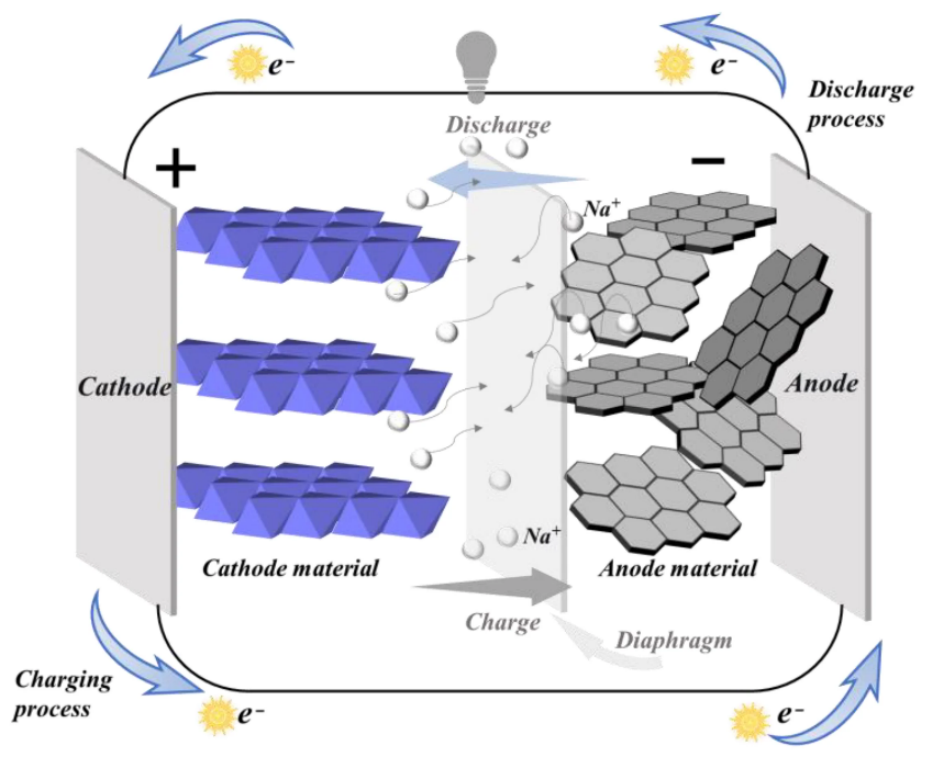
The operation of an SIB involves shuttling sodium ions between the two electrodes. During charging, an external power source (such as a charger or regenerative circuit) applies an electric current, which drives Na+ ions out of the cathode host structure and into the anode structure. In a typical SIB, Na+ ions are inserted (intercalated) into the anode material (often carbon-based) as the battery charges. During discharge, the intercalated Na+ ions are released from the anode and travel back to the cathode, while electrons flow through the external circuit to power a device [12]. One of the key challenges in designing effective SIBs is accommodating this back-and-forth movement of relatively large Na+ ions. The ionic diameter of Na+ is considerably larger than that of Li+, which means electrode materials must have sufficiently open structures to allow Na+ insertion and extraction without damaging the material [13]. If the electrode structure is too rigid or has channels too small, it can impede Na+ diffusion and lead to electrode degradation or capacity loss over repeated cycles. Ensuring the smooth and reversible diffusion of sodium ions in and out of the electrode materials is therefore a primary focus of ongoing research [14]. Advances in nanostructured electrodes and material coatings are helping to address this by providing more free volume and more stable frameworks for Na+ storage. The controlled flow of Na+ from cathode to anode during discharge is what generates the current that can be harnessed to do work in any device connected to the battery [15]. The detailed charge–discharge mechanism, including Na+ intercalation and electron flow, is illustrated in Figure 1, highlighting the reversible ion transport between electrodes.

2.3. Key Performance Metrics

The performance of a battery is commonly characterized by metrics such as cell voltage, capacity, energy density, power density, and cycle life [17]. SIBs typically operate at cell voltages in the range of about 1.0–4.2 V, depending on the electrode materials. For example, various sodium-based cathode materials yield nominal voltages around 3 V, though configurations can range roughly from 1 V up to 4.5 V in some systems [18,19]. The specific capacity of SIB electrodes can vary widely; many recent SIB cells achieve specific capacities on the order of 400–800 mAh/g (based on active material mass) after a few hundred cycles [18,19]. These values are somewhat lower than those of high-performance LIB electrodes, but research continues to improve them. Notably, a 2025 study reported a stable SIB prototype with a theoretical energy density of about 458 Wh/kg [20]. While this is still below the highest energy densities of LIBs (which can reach ~700+ Wh/kg in specialized designs [21]), it represents a significant improvement—for context, early SIBs had energy densities less than half of those of typical LIBs. Importantly, the cost per unit of energy for SIBs has been steadily declining. In 2019, SIB cells were estimated to cost roughly $0.03 more per Watt-hour of storage than LIBs, which hindered their adoption at that time [22]. However, this cost gap has been closing due to cheaper materials and economies of scale. As it stands, despite SIBs having lower gravimetric energy density and often being slightly heavier for the same capacity, they are beginning to find use in large-scale applications where the priority is lower cost and improved safety rather than ultra-high energy density. Furthermore, SIBs can exhibit excellent cycle life—their tolerance for extensive cycling can offset some of the performance disadvantages in applications like stationary storage.

3. Electrode Materials for Sodium-Ion Batteries

A central area of development in SIB technology is the discovery and optimization of electrode materials that can efficiently host Na+ ions. An ideal electrode material should provide sufficient sites for sodium intercalation, enable fast ion transport, and maintain structural stability during repeated cycling. Achieving these requirements is challenging due to the larger ionic size of Na+ compared to Li+, which can induce structural strain and sluggish kinetics [23]. Accordingly, this section reviews key advancements in cathode materials, including layered oxides, polyanionic compounds, and Prussian blue analogs, followed by anode materials such as hard carbon, alloy-based systems, and emerging two-dimensional (2D) materials.
In addition to these inorganic systems, organic cathode materials have also emerged as a promising class due to their structural diversity, sustainability, and potential for low-cost synthesis. However, despite these advantages, organic cathodes currently face challenges related to low electrical conductivity, dissolution in electrolytes, and limited long-term cycling stability [24,25]. Therefore, this review primarily focuses on inorganic cathode materials that have demonstrated greater technological maturity and suitability for engineering-scale applications.

3.1. Cathode Materials

Layered Oxides: These cathodes have a structure in which sheets of transition metal oxides are separated by layers of sodium ions. They are analogous to the layered LiCoO2-type cathodes in LIBs. Research into layered sodium transition metal oxides has shown promising results. For example, a 2020 study explored a family of layered oxides with composition NaNi0.5–yCuyMn0.5–zTizO2 (often abbreviated as NMT-type cathodes) and found that partial substitution of nickel with zinc, manganese, or copper significantly improved capacity retention by mitigating phase changes that occur at high charge voltages [26]. The doping with these divalent or monovalent cations helped stabilize the structure, resulting in better capacity retention, though the synthesis of such cathodes can be complex [26]. More recently, in 2025, manganese-rich layered oxides of the form NaxTM1−yMnyO2, (with 0.7 < x ≤ 1 and TM = other transition metals) demonstrated about 92% capacity retention after 300 cycles, a substantial improvement in stability [27]. These results indicate that layered oxide cathodes, despite initially facing issues like structural distortion upon Na+ (de)intercalation, are being refined to offer high reversible capacities and good cycle life. The primary hurdle remains the structural changes during deep charge/discharge (such as phase transitions), and the sometimes-difficult synthesis, but ongoing research is paving the way for practical layered oxide cathodes in SIBs.
Polyanionic Compounds: Polyanionic cathodes contain complex anions like phosphates, sulfates, or fluorophosphates (e.g., NASICON-type structures, where NASICON stands for sodium super-ionic conductor). These materials often have strong covalent bonds (e.g., P–O in phosphates) that can stabilize the structure and yield a high and flat operating voltage. For instance, sodium vanadium phosphate (Na3V2(PO4)3, a NASICON-structured material) and others have been investigated for SIBs. Polyanionic compounds are typically very stable structurally, but they tend to suffer from low electronic conductivity, which limits their rate performance and practical capacity. To address this, researchers have introduced conductive carbon matrices or coatings to these materials. For example, carbon coating on Na3V2(PO4)3 or mixing conductive carbon into phosphate composites has improved their electrochemical performance [28,29]. Still, the challenge is doing so without compromising the material’s stability at high temperatures (since carbon can react or detach). In 2020, a lithium-substituted iron sulfate Li2Fe(SO4)2/C was studied as a potential sodium cathode (the lithium in the formula indicates it was investigated in a mixed context), showing the field’s openness to various polyanionic frameworks [28]. More recently, in 2024, researchers synthesized complex polyanionic compounds with the formula NaxMy(XaOb)zZw (where M is a 3D transition metal, X could be S or P, and Z is an additional element like F in the structure). These compounds demonstrated voltage plateaus up to about 4.1–4.2 V, indicating high operating voltages. However, to date, most polyanionic cathodes for SIBs still exhibit lower practical capacity and poorer rate capability than layered oxides or Prussian blue analogs, mainly due to their lower electronic/ionic conductivity [29]. The consensus is that more work is needed to overcome these drawbacks before polyanionic cathodes can be widely used in SIBs.
Prussian Blue Analogs: Prussian blue (PB) is a cubic coordination compound, and its analogs (PBAs) have a general formula like NaxM[Fe(CN)6] (where M is a transition metal such as iron, manganese, nickel, copper, etc.). PBAs have an open framework with large interstitial sites and channels that allow Na+ to diffuse in three dimensions. This intrinsic structural advantage gives PBAs some of the highest accessible capacities and rate capabilities among SIB cathodes [23]. In fact, Prussian blue analogs can often be fully sodiated/desodiated with minimal structural damage, and they can support fast charging and discharging. Natron Energy’s commercial sodium-ion batteries were based on a Prussian blue analog cathode (using an iron-based PBA), chosen for its high-power capability and long cycle life. Researchers have experimented with substituting different metals into the PB framework (such as Cr, Mn, Ni, Cu, replacing some of the Fe in the lattice) to tune the cell voltage and stability [23]. One downside to traditional PBAs is that they often contain crystal water and can suffer from lattice defects (like vacancies of [Fe(CN)6 units), which can reduce capacity. Additionally, PBAs involve cyanide groups, which raises concerns about toxicity in synthesis or if the material were improperly handled at end-of-life. Current efforts are directed at synthesizing PBAs with fewer vacancies, controlling the amount of bound water, and exploring alternative “Prussian-blue-like” structures that omit toxic elements while retaining performance. Despite these considerations, PBAs stand out as a very promising cathode class for SIBs because of their exceptional Na+ mobility and already demonstrated commercial-level performance.

3.2. Anode Materials

For SIB anodes, the most common material today is hard carbon, but there is extensive research into alternatives that could offer higher capacity or other benefits. Below, we cover hard carbon, alloy-based anodes, and emerging 2D materials as anode options.
Hard Carbon: Hard carbon (also known as non-graphitizable carbon) is a disordered form of carbon made typically by pyrolyzing organic precursors at high temperature. It has an amorphous, pseudo-graphitic structure with both random orientations and nanopores. Hard carbon is currently the anode of choice for most SIB prototypes because it can reversibly insert a significant amount of sodium and is relatively stable. It typically shows a sloping voltage profile above about 0.1 V and a lower plateau near 0 V vs. Na/Na+, with a specific capacity that can range from ~250 up to 350 mAh/g depending on the material and how it is made [30]. Hard carbon’s disordered, porous nature allows it to host Na+ in various sites, including between graphene-like layers (though it is not truly graphitic) and in micropores. It also tends to maintain its structure without undergoing phase changes, even at elevated temperatures, which is beneficial for safety and longevity. Hard carbon remains the most commercially viable anode material for sodium-ion batteries due to its balance of capacity, structural stability, and cost-effectiveness. Its relatively stable cycling behavior and compatibility with existing manufacturing processes make it the preferred choice for near-term industrial applications. Ongoing research focuses on improving initial coulombic efficiency and optimizing pore structure to enhance sodium storage mechanisms and rate capability.
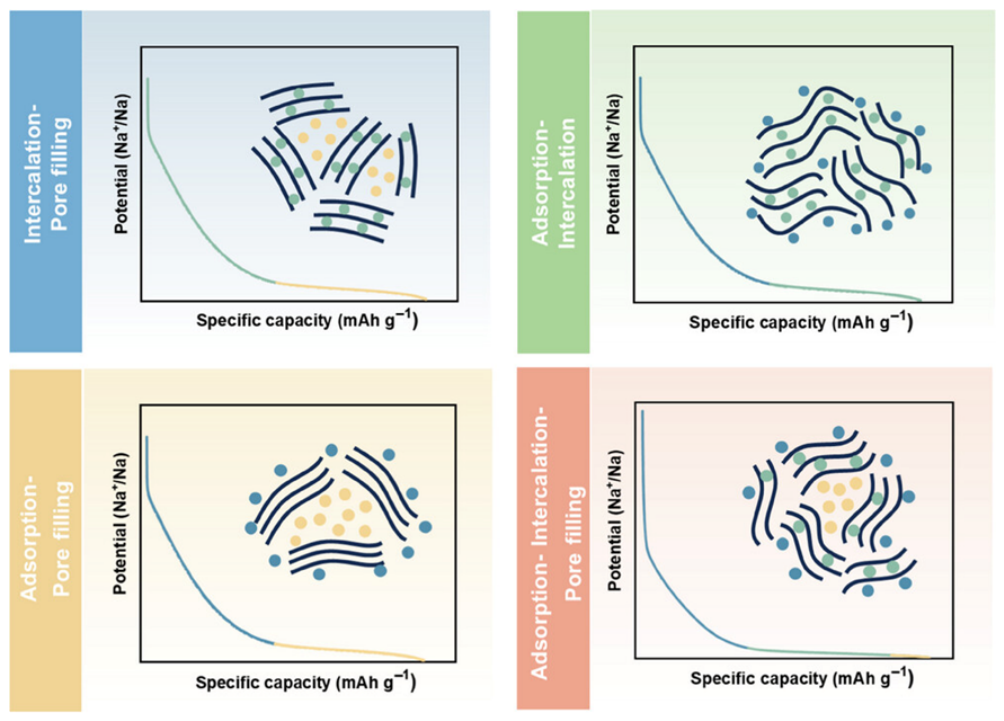
Sodium storage in hard carbon occurs through multiple complementary mechanisms, which are illustrated in Figure 2. These include (i) intercalation–pore filling, where Na+ ions are inserted between disordered graphene-like layers and subsequently accumulate within nanopores; (ii) adsorption–intercalation, where Na+ ions are adsorbed onto defect sites and partially intercalated between carbon layers; (iii) adsorption–pore filling, where surface adsorption is followed by Na+ accumulation in micropores; and (iv) combined adsorption–intercalation–pore-filling mechanisms, where all three processes occur simultaneously. The relative dominance of these mechanisms depends on the pore structure, degree of disorder, and surface chemistry of the hard carbon material.
However, there are challenges. Hard carbon often has initial coulombic inefficiency (some Na+ gets irreversibly trapped during the first charge/discharge cycles) and moderate rate capability. One issue is that electrolyte decomposition can occur on the surface of hard carbon, forming a solid–electrolyte interphase (SEI) that can clog pores and reduce the accessible capacity. Surface defects in hard carbon can catalyze this unwanted electrolyte breakdown, leading to thick SEI layers that impede Na+ insertion and reduce the reversible capacity [31]. To address these issues, researchers have experimented with different precursor materials and synthesis methods to produce hard carbons with more optimal structures (e.g., appropriate pore size distribution, fewer surface impurities) [32]. Additionally, surface coatings or additives have been used on hard carbon anodes to prevent excessive SEI formation—for instance, coating hard carbon with an artificial SEI or a thin carbon layer that is less reactive can help [32]. These strategies have been met with some success in improving initial efficiency and capacity retention, but hard carbon is by no means a perfect anode. It remains, however, the most pragmatic choice in the near term and is used in many current SIB demonstrations due to its balance of capacity (~300+ mAh/g in the low-voltage plateau region) and stability.
Alloy-Based Anodes: A variety of metals and metalloids can alloy with sodium at low potentials, offering the potential for very high specific capacities. Examples include tin (Sn), antimony (Sb), silicon (Si), germanium (Ge), phosphorus (P), and bismuth (Bi). The theoretical capacities of these elements when fully sodiated are extremely high—for instance, sodium can form Na15P, giving phosphorus a gigantic theoretical capacity (~2596 mAh/g), and Na–Si alloys can yield over 900 mAh/g [22]. Table 2 lists the theoretical capacities and the volume expansion of several candidate alloy anode materials for SIBs. The appeal of alloy anodes is clear in terms of capacity and often electronic conductivity (metals and metalloids are conductive), but the biggest problem is volume expansion. When these materials alloy with Na, they undergo huge volumetric changes (often swelling by two to four times their original volume), which is unsustainable for a stable battery anode [33,34]. The repeated expansion and contraction with each charge/discharge cycle can pulverize the anode, break electrical connections, and lead to rapid capacity loss. As shown in Table 2, for example, Sn can expand by ~420% when fully sodiated, Sb by ~390%, and even phosphorus by over 300%. These large changes limit the cycle life and mechanical integrity of alloy-based anodes if used alone.
Research is actively exploring ways to mitigate the mechanical problems of alloy anodes so that their high capacity can be harnessed. One strategy is to incorporate these alloying materials into a composite matrix that can buffer the volume changes. For instance, making a composite of tin with carbon or other inactive matrix materials can give the tin room to expand into the carbon’s porosity. A notable development in 2024 involved a composite anode of tin, antimony, and bismuth distributed in a carbon matrix (denoted C–BixSnSb in the literature) [34]. This engineered composite significantly reduced the overall volume expansion, lower than what pure Sn or Sb would undergo, and was able to retain about 85% of its capacity after 5000 cycles. The composite anode delivered a reversible capacity around 400 mAh/g, which is quite high, while maintaining far better structural integrity than a pure alloy would. However, the incorporation of carbon-buffering matrices introduces additional inactive mass, which can reduce the overall gravimetric energy density, necessitating careful optimization of carbon content to balance stability and performance. The success of this C–BixSnSb anode suggests that carefully designed multi-element alloys, especially when combined with conductive buffer phases like carbon, can overcome some of the traditional limitations. Other approaches include nano-structuring the alloys (nanoparticles, nanowires, etc.) so that absolute volume changes are smaller and can be better managed, and using binders or electrode architectures specifically to accommodate expansion. Although no alloy-based anode has yet seen commercial adoption in SIBs, continued improvements may make them viable, especially for applications where energy density is at a premium and some added cost/complexity is acceptable. Despite their high theoretical capacities, alloy-based anodes remain limited in practical applications compared to hard carbon due to challenges associated with volume expansion and mechanical degradation.
Emerging 2D Materials: Beyond carbon and alloys, two-dimensional materials have recently attracted attention as SIB anodes. The motivation is that 2D materials (such as certain MXenes, graphene analogs, or other layered compounds) can provide open surfaces and interlayer galleries that might accommodate Na+ more readily, and their thin nature means shorter diffusion paths for ions and electrons [41]. Researchers are exploring both purely 2D materials and composites where 2D sheets are combined with other nanostructures. Among emerging two-dimensional materials, MXenes (such as Ti3C2Tx) have gained significant attention due to their high electrical conductivity, tunable surface chemistry, and layered structure that facilitates Na+ intercalation. MXene-based anodes exhibit fast ion transport kinetics and good cycling stability, although challenges such as restacking and surface oxidation must be addressed for practical applications. In 2019, one study combined rhenium disulfide (ReS2) nanosheets with a graphene-like carbon framework, creating a hybrid anode that delivered about 192 mAh/g and remained stable over 4000 cycles [42]. The layered ReS2 provided sites for Na insertion and good electrical conductivity (especially with carbon support), demonstrating excellent cycle life, presumably due to the flexible 2D structure accommodating volume changes [42]. In another vein, theoretical calculations in 2020 predicted extraordinary capacities for certain 2D materials. For instance, a monolayer of B7P2 was calculated to have a possible sodium storage capacity of over 3000 mAh/g (if each formula unit could uptake multiple Na atoms) [43]. While this was purely theoretical, it highlights the potential of designing 2D materials at the atomic level to maximize storage sites. In 2024, a metallic 2D compound KCu4S3 was synthesized and tested as an SIB anode; it achieved around 355 mAh/g capacity with 100% capacity retention over 3000 cycles, a very impressive result [44]. The success of KCu4S3 is attributed to its excellent intrinsic electronic conductivity and ability to reversibly accommodate Na without structural collapse. The main drawback was that its synthesis involved a complex, high-temperature molten salt method, which might be hard to scale. Researchers have also made progress with nanocomposites like Bi2MoO6@C (bismuth molybdate nanoplatelets coated with carbon), achieving ~628 mAh/g and >95% capacity retention [45], and with composites of transition metal compounds and nitrogen-doped carbon nanotubes, reaching ~860 mAh/g (though those still suffered from some expansion and fabrication difficulties) [46]. To illustrate the rapid developments, by 2025, studies on o-Al2C2 (a 2D aluminum carbide) predicted capacities above 3000 mAh/g with fast Na diffusion [47], and an etched 2D Ti3C2 MXene with a porous structure was shown to maintain 117 mAh/g for over 1000 cycles, owing to its facilitated ion transport pathways [46]. The ability to fine-tune interlayer spacing, introduce functional groups, and create porosity in 2D materials gives scientists a rich toolbox to optimize these anodes. By precisely engineering the structure at the nanoscale, one can potentially achieve a near-ideal balance of capacity, conductivity, and stability. Although many 2D material anodes are in early research stages, their performance is improving rapidly, and they are very promising for enabling high-performance SIBs in the future. While these materials show promising electrochemical performance, their practical implementation remains at an early research stage compared to commercially established hard carbon systems.
For engineering applications, key performance metrics such as specific capacity, current density, and cycle life are critical to evaluating sodium-ion battery materials. Recent studies report hard carbon anodes with capacities in the range of ~250–350 mAh/g and cycle stability of more than 1000 cycles under moderate current densities. Alloy-based and nanostructured electrodes can achieve higher capacities, often going past 400 mAh/g, but may face challenges related to volume expansion and long-term stability. Similarly, cathode materials such as layered oxides and polyanionic compounds typically demonstrate capacities of ~100–160 mAh/g with cycle lives extending beyond several hundred cycles depending on composition and operating conditions. A summary of representative electrochemical performance metrics for both cathode and anode materials from recent studies is provided in Table 3.

4. Electrolytes and Separators

The electrolyte in a battery serves as the medium for ion transport between the electrodes. It is a crucial component that influences not only the ionic conductivity and internal resistance but also the safety and durability of the cell. In SIBs, as in LIBs, electrolytes can be either liquid or solid (including gel/polymers), and each type has its advantages and challenges [62]. This section discusses progress in liquid and solid-state electrolytes for SIBs, as well as issues related to interfacial stability and separators.

4.1. Liquid Electrolytes

Conventional SIB designs use organic liquid electrolytes similar to those in LIBs, typically consisting of sodium salt (such as NaPF6 or NaClO4) dissolved in a mixture of nonaqueous solvents (e.g., ethylene carbonate (EC) and diethyl carbonate (DEC), or propylene carbonate (PC), among others). Liquid electrolytes are popular because they generally offer high ionic conductivity (on the order of 10−3–10−2 S/cm at room temperature) and excellent wetting of electrode surfaces, ensuring intimate contact and facile ion transport [63]. They are also compatible with existing manufacturing methods and many electrode chemistries. In the context of SIBs, the use of liquid electrolytes is considered essential for practical performance at this stage. The alternative—using a dry solid electrolyte—often results in higher interfacial resistance and lower ionic conductivity at room temperature.
One advantage of liquid electrolytes is the ability to fine-tune their composition to improve cell performance. Researchers have been investigating which sodium salts and solvent combinations lead to the best results in terms of stability and performance. For example, a comparative study found that NaPF6-based electrolytes tend to provide higher energy density and better overall performance than NaClO4-based electrolytes in similar cells, making NaPF6 a preferred salt for many SIB studies [64]. NaPF6 in carbonate solvents has become a sort of “standard” electrolyte for lab-scale SIB research, analogous to LiPF6 in LIBs.
Optimizing solvent mixtures is another key area. Che et al. [65] provide a detailed discussion of how the choice of solvents (and their ratios) affects the formation of the solid–electrolyte interphase (SEI) on sodium anodes and influences long-term cycling stability. For instance, EC (a cyclic carbonate) is known to help form a stable SEI but is usually too viscous on its own, so it is mixed with DEC or other linear carbonates to reduce viscosity and improve wettability. The balance between EC and DEC can affect the thickness and composition of the SEI. In sodium cells, an optimal EC: DEC ratio can expand the electrolyte’s electrochemical stability window (enabling the cell to operate safely at higher voltages) and minimize side reactions that would otherwise degrade the electrodes [65]. Additives are also commonly used in liquid electrolytes to enhance performance and safety. Additives like fluoroethylene carbonate (FEC) have been shown in LIBs to stabilize the SEI on graphite and might play similar roles in SIBs. Others can help suppress sodium dendrite formation in case of plating or improve compatibility with particular electrode materials. Overall, liquid electrolyte design for SIBs involves selecting a combination of salt, solvents, and additives that together provide high ionic conductivity, a stable SEI, a wide electrochemical window (to support high-voltage cathodes), and thermal stability.
It is worth noting that while organic liquid electrolytes offer high performance, they come with safety considerations: they are typically flammable and can pose fire risks if a cell goes into thermal runaway. Sodium salts like NaPF6 can also release corrosive or toxic gases (e.g., PF5, HF) if overheated or if moisture contaminates the cell. Therefore, some research in SIB electrolytes also looks at aqueous electrolytes for certain applications (like stationary storage), or highly fluorinated solvents that are less flammable—but each of these comes with trade-offs in voltage and conductivity. In summary, liquid electrolytes remain the workhorse for current SIB development, and ongoing optimization of their composition is key to achieving better performance and safety.
Paul et al. [64] carried out tests comparing NaPF6 and NaClO4 in similar carbonate solvent mixtures. They found that cells with NaPF6 consistently delivered higher energy densities than those with NaClO4, all else being equal, making NaPF6 the preferred electrolyte salt in their evaluation [46]. This kind of empirical data guides the standard formulation for SIB electrolytes. Additionally, Che et al. [65] highlighted that mixtures of EC and DEC as solvents significantly affect the SEI formation: EC tends to decompose on first charge and form a protective SEI on the anode, whereas DEC remains stable and ensures low viscosity. The right ratio can minimize irreversible capacity loss and prolong the cycle life. They also noted that certain additives can drastically improve safety by suppressing sodium dendrite formation (should any plating occur on hard carbon or metallic anodes) and by enhancing the compatibility of the electrolyte with both electrodes. These improvements underscore how strategic electrolyte design—adjusting solvent blends, salt types, and additives—can yield SIBs with higher capacity retention, better rate capability, and improved safety profiles.
Beyond electrolyte composition, binder systems play a critical role in determining electrode integrity and long-term electrochemical performance in sodium-ion batteries. Among these, carboxymethylcellulose (CMC), typically used in combination with styrene–butadiene rubber (SBR), represents one of the most widely adopted binder systems due to its strong adhesion, mechanical flexibility, and compatibility with aqueous processing. These binders are particularly important for hard carbon anodes, where they help maintain structural stability during repeated cycling [48,66]. In addition to conventional polymer-based binders, alternative systems such as sodium metasilicate (SMS) have also been investigated as inorganic binder options for sodium-ion battery electrodes [21,67].

4.2. Solid-State Electrolytes

The quest for solid-state electrolytes (SSEs) in SIBs is motivated by safety: solid electrolytes are non-flammable and eliminate the leakage and many of the side reactions associated with liquid electrolytes. In a solid-state sodium-ion battery (SSIB), the liquid is replaced by a solid ion-conducting material, which could be a ceramic (like NASICON-type sodium conductors or sulfide glasses), a polymer (like a sodium-ion-conducting polymer), or a composite of the two. Early research indicates that using a solid electrolyte can greatly improve abuse tolerance—for example, it can prevent internal short circuits because a stiff SSE can block dendrites. Darjazi et al. [68] note that composite electrolytes (which combine ceramic and polymer components) have been particularly successful in enhancing safety, as they combine the benefits of each component: ceramics provide high ionic conductivity and stability, while polymers provide flexibility and good contact with electrodes [69].
One example of a promising SSE design is a NASICON-type ceramic (with formula Na1+xAlxTi2−x(PO4)3, for instance) which can have ionic conductivities in the 10−4 to 10−3 S/cm range. By itself, that conductivity is slightly lower than liquids but still reasonable, and with improvement, some sulfide-based SSEs for Na have reached >10−3 S/cm. The challenge with ceramics is often the interface: they are rigid, so ensuring good physical contact (low interfacial resistance) with solid electrodes is non-trivial. Researchers have tried mixing a bit of polymer or liquid electrolyte to form a hybrid SSE that can better wet the electrode surfaces [69]. For instance, a composite electrolyte might consist of a polymer matrix (improving flexibility and reducing brittleness) that contains dispersed ceramic particles (to carry most of the Na+ conduction). This approach can yield a safer electrolyte that still performs well. Darjazi et al. [68] argue that such hybrid designs—combining the mobility of liquid/polymer systems with the stability of solid ceramics—may dominate future advanced battery electrolytes.
Gao et al. [70] provided insights into how to maximize the performance of solid electrolytes: they showed that a lot depends on stabilizing the interfaces between the electrode and electrolyte and on engineering the microstructure of the SSE for facile ion transport. For oxide-based SSEs, surface coatings on the electrodes can reduce the interfacial resistance (e.g., a thin buffer layer can prevent a high-resistance layer from forming due to side reactions). For sulfide-based SSEs, one often has to add a coating on the cathode to prevent it from reacting with the sulfide. Gao’s work also indicated that doping the solid electrolyte (introducing certain aliovalent ions) could enhance its ionic conductivity and phase stability, as well as reduce grain boundary resistance in polycrystalline materials [70]. These modifications result in higher critical current densities (i.e., the cell can charge/discharge faster without failure) and better longevity.
Still, there are hurdles for SSEs: achieving ionic conductivities comparable to liquid electrolytes at ambient temperature is difficult (though some sulfide glasses are approaching that), and manufacturing solid-state cells requires different processes (like high-pressure pressing, etc.). Also, not all electrode materials pair easily with a given SSE—some cathodes might undergo side reactions with a sulfide electrolyte, for example, necessitating protective interlayers.
Despite these challenges, the safety upside is huge: SSEs are non-flammable, do not leak, and effectively stop dendrites from shorting the cell (especially oxide and phosphate-based SSEs, which are very mechanically robust against puncture). Table 4 below provides a comparison between typical liquid and solid electrolytes in SIBs, highlighting these differences.
The complementary nature of liquids vs. solids is evident from Table 4. Liquids excel in performance and ease of use, while solids excel in safety and stability. Because of this, a lot of current research is focusing on hybrid systems, for example, a solid electrolyte with a very thin layer of gel or liquid at the interface to mimic the wetting of a liquid, or a largely solid system that still contains a few percent of liquid for flexibility, trying to capture the best of both worlds. In the near term, hybrid electrolyte systems are considered more practical due to improved interfacial contact and reduced resistance, while fully solid-state sodium-ion batteries remain a longer-term objective pending further advancements in ionic conductivity and interface engineering.

4.3. Stability Challenges and Solutions

As SIBs approach real-world applications, several stability and operational challenges need to be addressed, especially regarding performance under extreme conditions and the longevity of materials. One notable challenge is maintaining efficient operation at sub-zero temperatures. In very cold environments, the kinetics of both ion transport in the electrolyte and the electrode reactions slow down. Recent efforts have turned to specialized electrode materials (such as certain carbon- or titanium-based compounds) that can function better under these conditions by enhancing ionic diffusion and reaction kinetics [71]. Additionally, energy density, durability, and manufacturing scalability remain overarching challenges. SIBs historically lag in energy density, but innovations like new high-capacity cathodes are gradually improving this metric.
A breakthrough in cathode design was demonstrated by Mukherjee et al. [72], who developed a hollow spherical Na3V2(PO4)2F3 cathode. This cathode can insert three Na+ per formula unit (so-called “three-sodium-ion activity”), granting it a higher capacity than typical cathodes that insert only one Na+ per formula unit. The hollow spherical architecture accommodates volume changes well and provides short diffusion paths. As a result, this cathode showed remarkable cycling stability and energy output. Its structure remained intact over many cycles, and the ionic conductivity within the cathode was excellent due to the porous, high-surface-area design. This example illustrates how innovative electrode architectures can significantly improve both the capacity and the durability of SIBs, potentially overcoming traditional energy density limitations [72].
Another issue being tackled is the air sensitivity of sodium cathodes. Some high-performance cathode materials for SIBs (for example, certain layered oxides) are found to degrade if exposed to ambient air or humidity—they might absorb moisture or CO2, leading to surface reactions that harm their structure. Jia et al. [73] reported that many sodium cathodes experience structural breakdown and rapid capacity loss upon exposure to air/moisture, due to reactions that form surface layers or change the phase of the material. Their solution involved applying protective coatings on the cathode particles (to act as a barrier against air) and synthesizing the materials in controlled environments so they have fewer defects that would react with moisture. By doing so, the cathodes retained their performance over extended cycling even when handled in a normal atmosphere [73].
Building on that idea, Zhan et al. [74] introduced the concept of high-entropy cathodes for SIBs—these are materials where multiple different metal cations are present in the lattice in a disordered (high-entropy) configuration. They studied a layered oxide with multiple metal species randomly distributed. The result was a cathode that remained stable in ambient conditions (no obvious degradation from air exposure). The high configurational entropy of the metal sublattice in the cathode is thought to stabilize the structure (thermodynamically, a high-entropy state can prevent any one component from easily segregating or reacting), and it improved cycling stability as well. Essentially, by mixing many types of metal ions in the cathode, the material became less prone to structural change or reaction—a novel and somewhat counterintuitive strategy, but one that paid off in increased robustness [74]. However, the increased compositional complexity of high-entropy cathodes may lead to higher synthesis costs and processing challenges compared to conventional layered oxides, necessitating optimization for scalable manufacturing.
These developments underscore that achieving stability—whether thermal, chemical, or mechanical—is just as important as achieving a high capacity or high conductivity. SIB researchers are finding ways to engineer stability through material composition (doping, entropy stabilization), structure (hollow spheres, coatings), and environmental control. Such innovations are steadily pushing SIB technology closer to the standards required for commercial deployment, despite historical concerns about stability and longevity.
Overall, advancements in electrode materials and electrolyte systems are closely interconnected, as their compatibility directly influences electrochemical performance, safety, and long-term stability. These material-level developments form the foundation for addressing broader mechanical and thermal challenges, as well as enabling scalable engineering applications, as discussed in the following sections.

5. Mechanical and Thermal Considerations

Building upon the material-level developments discussed in previous sections, mechanical and thermal considerations play a critical role in translating sodium-ion battery performance into reliable engineering systems.
Mechanical and thermal factors critically influence battery safety, lifespan, and performance. In SIBs, as in other batteries, electrodes undergo dimensional changes during cycling, and heat is generated during operation. These effects must be managed to ensure a reliable battery. This section highlights issues of volume expansion, mechanical degradation, and thermal stability in SIBs, along with strategies to mitigate these challenges.

5.1. Volume Expansion and Structural Stability

Volume changes in electrode materials during sodiation and desodiation introduce mechanical strain at the cell level, influencing structural integrity and long-term durability. This is particularly pronounced for high-capacity anodes that alloy with sodium. Tin (Sn) anodes, for instance, exhibit a very large volume expansion when forming Na15Sn4; this drastic swelling is proportional to tin’s high theoretical capacity, but it severely hinders cycle life if not addressed. To manage this, researchers have investigated alloying Sn with other metals to form intermetallic compounds that might undergo less expansion or maintain integrity better.
At the system level, maintaining the structural integrity of cathode materials is essential to minimize resistance buildup and capacity degradation during extended cycling. Over repeated cycles, strain and minor structural rearrangements can lead to increased internal resistance, capacity fading, and shortened life. One idea to bolster cathode stability is to introduce small amounts of a high-valent metal into the cathode lattice. Doping strategies have been widely employed to stabilize layered NaxMO2 cathodes. For example, Nb5+ incorporation into layered oxide frameworks has been shown to enhance structural ordering and suppress phase transitions, thereby improving electrochemical stability [75]. The Nb-doped cathode showed improved structural stability and reversibility, partly by suppressing irreversible chromium migration during cycling. Interestingly, this Nb-substituted NaCrO2 was also found to be compatible with solid-state battery systems, indicating that robust cathodes like these could pair well with solid electrolytes.
From a mechanical engineering perspective, altering the microstructure of electrode materials is another way to handle volume change. One effective approach is creating electrodes with hollow or porous structures. Wang et al. [76] illustrated that if you make an anode material hollow (for example, hollow nanoparticles or nanospheres of an alloy), there is interior void space for the material to expand into when sodium is inserted. This drastically reduces the stress on the particle. They also found that using alloying combinations (like Sn with Cu and Sb, as discussed earlier) can disperse the strain because different phases might form that offset some expansion or at least stop any single phase from cracking extensively. Complementary to that, on the cathode side, Cheng et al. [59] discovered that intercalating a small amount of Zn2+ into a Prussian blue cathode’s structure made the framework more rigid. The Zn2+ ions occupied certain sites and effectively propped up the structure, improving its resistance to distortion during Na+ cycling. The treated Prussian blue cathode exhibited less lattice strain and better reversibility thanks to this “pillar” effect of Zn2+.
In summary, volume expansion issues are addressed by: (a) materials design (choosing alloy compositions that expand less or form stable compound phases), (b) structural engineering (creating porosity, void space, or adding buffering elements), and (c) doping strategies (stabilizing structures with small amounts of special atoms). These interventions maintain the electrode’s mechanical integrity and thus electrical connectivity over many cycles, which is essential for durable batteries.

5.2. Mechanical Degradation and Fatigue

Beyond volume changes, batteries can suffer mechanical degradation from factors like cycling-induced stress, particle fracture, and even mishandling or vibrations in their environment. Additionally, pushing a battery beyond its intended operating window—for instance, overcharging it—can accelerate mechanical and chemical degradation. Overcharging leads to excessive delithiation/sodiation of electrodes, which can cause microstructural damage (e.g., cracking, lithium plating in LIBs, or sodium plating in SIBs if taken to extremes).
Systematic studies have been done to quantify how such abuse conditions affect battery health. Li et al. [77] used a combination of electrochemical measurements, microscopy, and mechanical testing to examine cells that were deliberately overcharged. They observed that charging to higher cut-off voltages than recommended resulted in rapid capacity loss and mechanical breakdown of electrode material. Specifically, even a relatively small overcharge (beyond the normal full charge) repeated over many cycles led to measurable capacity fading. The post-mortem analysis revealed deposition of transition metals and plating of metallic lithium on the anode surface in LIB tests; in SIB-analogous situations, one might observe sodium plating if the anode potential is driven too low. These deposits are problematic: they not only consume cyclable ions (leading to capacity loss) but can also induce internal stress and even short circuits.
Song et al. [78] complement this by showing that even keeping a battery at a high state-of-charge (a high voltage) during storage can degrade it. They reported that cells stored at elevated voltage developed gas pockets and micro-cracks faster than those stored at a lower voltage. Elevated voltage essentially puts the electrodes under more strain continuously and can cause slow side reactions that weaken the structure. The electrode–electrolyte interface is especially vulnerable under these conditions, becoming less stable and leading to phenomena like electrolyte oxidation or anode lithium/sodium plating over time.
On the other hand, Feng et al. [79] demonstrated that smart material design can alleviate some fatigue. By co-doping a layered oxide cathode with aluminum and copper, they introduced a compound that had a more robust lattice. The Al/Cu co-doped material exhibited improved mechanical properties—it was less prone to developing micro-cracks during fast-charge/discharge cycling compared to the undoped version. Microscopic examination showed that the doped cathodes maintained smoother surfaces with fewer signs of flaking or particle break-up after extensive cycling. The co-dopants likely help to stabilize the crystal structure and reduce internal stress gradients when the cathode is repeatedly deintercalated and intercalated with Na+ at high rates.

5.3. Thermal Stability and Safety Issues

Beyond electrochemical considerations, thermal stability directly impacts the operational safety and reliability of sodium-ion battery systems under practical conditions. SIBs are often touted to have better thermal stability than LIBs because of factors like lower energy density and less reactive components. Indeed, sodium-ion cells typically operate safely at temperatures where lithium-ion cells might be at risk of thermal runaway. For instance, some SIB chemistries can tolerate temperatures beyond 80–100 °C without significant degradation, whereas many LIB chemistries would suffer or become unsafe at those temperatures. However, as SIBs approach higher energy content, ensuring safety across the full temperature range (from sub-zero to high heat) remains a priority.
One interesting development for improving low- and high-temperature performance is the use of special polymer membranes as both separator and electrolyte carriers. A study by Yang et al. [80] introduced PFSA-Na (a sodium-form perfluorosulfonic acid polymer, akin to Nafion but in sodium form) membranes in a solid-state sodium battery. These membranes showed very high ionic conductivity even at sub-freezing temperatures and exhibited remarkable thermal stability and mechanical flexibility. In their solid-state cell, this polymer electrolyte enabled stable cycling at temperatures well below 0 °C, and, notably, the cell’s cyclic performance at low temperature was actually more stable than a comparable cell with a liquid electrolyte. The polymer’s ability to maintain an ionic conductive network without freezing (since it is a solid) gave it an edge in cold environments, and its lack of volatile components gave it an edge at high temperatures, too. Such findings hint that solid-state or polymer electrolytes could help SIBs operate safely across a wider temperature range than traditional liquids, which tend to become resistive in the cold and volatile in the heat.
Recent research by Sarkar et al. [81] highlights that the thermal stability of a sodium-ion cell is heavily dictated by the interface interactions. If an electrode and the electrolyte (whether liquid or solid) are not well-matched, they can react exothermically, especially at elevated temperatures. Unstable interfaces can trigger heat generation internally—for example, a poorly formed SEI might start to decompose at some temperatures, releasing heat and causing a cascade of other reactions. Sarkar’s team emphasized optimizing the compatibility between electrodes and electrolytes through materials selection (choosing stable combinations that do not react with each other) and surface engineering (pre-forming robust protective films). By having highly stable interfaces, the onset of exothermic reactions can be pushed to much higher temperatures, thereby improving the battery’s overall thermal resilience.
Wei et al. [82] conducted a comprehensive safety analysis of SIBs to identify what could lead to catastrophic failure (things like fire or explosion). They concluded that the primary culprits are similar to those in LIBs: thermal runaway (a feedback loop of heat leading to more heat via reactions), dendrite formation (which can cause internal short circuits), gas release (which can build pressure), and internal short circuits (which can spark fires). A critical insight was that these are often interconnected and typically start with the electrolyte breaking down and generating heat. Because sodium-ion systems often use safer electrolytes (e.g., some formulations are less flammable) and because their cells may operate at lower voltages, the propensity for such events is reduced. Nonetheless, Wei et al. [82] recommended several strategies to virtually eliminate these risks: incorporating flame-retardant additives into electrolytes, shifting entirely to solid or polymer electrolytes (thus removing the most flammable component), and using advanced battery management systems (potentially with machine learning algorithms) to detect and prevent hazardous conditions early. In fact, they suggest that a combination of safer electrolyte choices, materials design that avoids oxygen release or other exotherms, and smart monitoring forms a multi-layered defense against thermal runaway.
Bhutia et al. [83] echoed these conclusions, providing data that hybrid polymer electrolytes drastically reduce gas generation and the chance of short circuits. In their experiments, cells with a polymer–ionic liquid hybrid electrolyte did not exhibit the kind of gas evolution seen in traditional liquid-electrolyte cells during overcharge or abuse testing. Furthermore, these polymer-containing cells showed far superior flame resistance—when exposed to flame, they did not ignite easily, unlike conventional cells. This confirms that moving away from volatile organic electrolytes is a key step in making batteries inherently safer.
In summary, while SIBs inherently carry some safety advantages over LIBs (due to material choices and operating parameters), ensuring long-term thermal stability still requires careful design. The integration of solid or hybrid electrolytes, protective additives, robust interface coatings, and vigilant management systems all contribute to making SIBs extremely safe and reliable, even under stress. These measures are what will allow SIBs to meet the high safety standards required for applications like electric vehicles and large-scale energy storage, where the consequences of failure are severe.

6. Manufacturing and Scalability

To transition SIBs from the laboratory to the marketplace, innovations in manufacturing and scaling up production are just as important as advances in materials chemistry. Production of SIBs can leverage much of the established LIB manufacturing infrastructure, but there are nuances due to differences in materials (for instance, sodium-based materials might allow different current collectors, binders, etc.). In this section, we discuss current approaches to electrode and cell processing, the cost and resource advantages SIBs might have, and remaining industrial challenges.

6.1. Processing of Electrodes and Cells

The fabrication of SIB electrodes on an industrial scale involves coating slurries of active material, conductive carbon, and binder onto metal foils (the current collectors), followed by drying and calendaring (pressing). This is very similar to LIB manufacturing. However, because SIB active materials can have different physical properties (e.g., different densities, particle morphologies) and because water-based processing might be more feasible for SIBs (more on that below), processing parameters need optimization.
One exciting development in electrode manufacturing is the use of three-dimensional (3D) carbon-based frameworks as a scaffold for active materials. Instead of casting a powder slurry onto a flat foil, researchers have worked on integrating active materials into a pre-formed porous carbon structure. Zhang et al. [27] explored various 3D carbon architectures for both lithium and sodium battery electrodes, showing that these structures (which can be like carbon foams or lattices) provide continuous electron pathways and controlled porosity. The benefit is twofold: electrically, the carbon network ensures good conductivity throughout the electrode, and mechanically, the porosity can accommodate volume changes in the active material. Moreover, such structures can allow thicker electrodes (i.e., higher areal loading of active material) without compromising ion transport, because the porosity can be tuned to keep ion diffusion distances short. These 3D frameworks are still mostly at the research stage, but they could potentially be manufactured via templating or printing methods.
Regarding printing methods, Nyabadza et al. [28] reviewed how additive manufacturing (like screen printing, inkjet printing, extrusion, and 3D printing) could apply to battery electrodes. These methods can precisely deposit materials in specific patterns and potentially allow for multi-material layering in ways traditional casting cannot. For instance, one could print a graded electrode where composition changes gradually from the current collector towards the separator, optimizing performance. They also noted that printing can reduce waste and avoid some toxic solvents—for example, one can directly print an ink made of active material and binder (in water or another benign solvent) onto a substrate. This precise deposition can lead to improved uniformity and less need for post-processing like trimming or punching (which creates scrap in conventional manufacturing). Additionally, by integrating sensors or different materials via printing, one could conceivably print not just the electrode but aspects of a battery management sensor array directly into a cell layer.
Another area where SIB manufacturing could diverge from LIB is in binder and solvent selection. LIB cathodes typically use a polyvinylidene difluoride (PVDF) binder in N-methyl-2-pyrrolidone (NMP) solvent—a system that is effective but has environmental and safety downsides (NMP is toxic and volatile, PVDF is not environmentally friendly, and requires NMP to dissolve). Because many sodium-ion battery cathode materials exhibit relatively higher tolerance to moisture compared to certain lithium-based cathodes, aqueous processing routes have gained attention as a more sustainable and cost-effective alternative for electrode fabrication. Water-based slurry preparation reduces reliance on toxic organic solvents such as N-methyl-2-pyrrolidone (NMP), enabling environmentally friendly manufacturing. In this context, various aqueous binder systems, particularly CMC, often used in combination with SBR, along with other cellulose-derived and polymer binders, have been explored to improve electrode integrity and electrochemical performance [48,84]. However, challenges related to drying, electrode uniformity, and long-term stability still require further optimization. Moreover, water-based processes simplify recycling of manufacturing waste because it is mostly water and innocuous solids.
On the coating techniques side, SIB manufacturing can utilize the full suite of LIB machinery, slot-die coating, doctor-blade coating, etc., which deposit the slurry on foil. After coating, drying is required; interestingly, because SIB electrodes can potentially use water, the drying energy might be lower (water has a lower boiling point than NMP and carries more latent heat per gram, but overall NMP drying can be slower because NMP evaporates more slowly than water in typical conditions). While water-based processing eliminates toxic solvents such as NMP, it may require higher drying energy due to the higher latent heat of vaporization of water.
In addition, advanced modeling and AI tools are being applied to battery manufacturing to accelerate optimization. Lombardo et al. [20] created a 3D digital twin of the coating and drying process. Their model could predict how non-uniform binder distribution might be after drying, or how porosity gradients develop as solvent leaves the slurry. With such a model, one can adjust parameters (like slurry viscosity, coating speed, drying temperature profile) in simulation to minimize defects and then apply the best settings in production, saving time and materials that would otherwise go into trial-and-error. On the AI front, machine learning algorithms can analyze images of coated electrodes or X-ray scans for defects much faster and potentially more accurately than human inspection, ensuring higher quality control.
All these process innovations—3D frameworks, printing, solvent-free coating, AI monitoring—aim to bridge the gap between what material science has achieved in SIB performance and what can be consistently produced at scale. By increasing areal capacities (through thicker electrodes or higher loading via 3D structures), manufacturing improvements directly contribute to higher energy per cell. By reducing waste and eliminating toxic materials (like NMP), they cut costs and environmental impact.

6.2. Cost and Resource Advantages over Lithium

One of the often-cited advantages of SIBs is their use of cheap, Earth-abundant materials. Sodium itself is extremely common (sodium chloride is literally seawater salt), and many SIB cathodes are based on iron, manganese, etc., which are also inexpensive and abundant relative to cobalt or nickel used in many LIB cathodes. Lithium’s supply is geographically concentrated (Chile, Australia, etc.), whereas sodium can be sourced virtually anywhere (including from salt lakes or even ocean water in the future). Vaalma et al. [85] performed a cost and resource analysis, concluding that if SIBs reach mass production, their material cost could be substantially lower than LIBs—partly due to the lower cost of sodium salts and partly due to being able to use aluminum for both electrodes’ current collectors (in LIBs, copper is required for the anode, which is heavier and pricier than aluminum). Lai et al. [86] gave a quantitative comparison through life cycle assessment. They found that producing 1 Wh of energy storage with SIBs can result in up to ~30% lower greenhouse gas emissions and energy consumption compared to producing 1 Wh with LIBs. Several reasons drive this:
  • SIBs often use an aluminum current collector for the anode instead of copper. LIBs use copper foil for the anode, which is heavier and whose production is energy-intensive. Sodium does not alloy with aluminum until very low potentials (well beyond typical anode operating potential), so aluminum can serve for both anode and cathode current collectors in SIBs, whereas LIB anodes need copper because lithium will alloy with aluminum at ~0 V. Using aluminum in place of copper for the anode not only reduces weight but also simplifies recycling. While replacing copper with aluminum may reduce scrap value, the overall recycling process is simplified due to reduced material complexity.
  • SIB cathodes can be made from low-cost transition metals like Fe and Mn, which do not require the high-temperature cobalt/nickel processing that LIB cathodes (NMC, etc.) do. Fe–Mn-based cathodes (e.g., Prussian blue or certain layered oxides) have a lower embedded cost and energy.
  • The possibility of using aqueous electrolytes in some stationary SIBs (like aqueous sodium-ion batteries) could eliminate costly organics. Even for organic electrolytes, using solvents like PC (propylene carbonate), which can be bio-sourced, reduces environmental impacts.
  • SIB production can often utilize water-based processing, eliminating NMP. NMP is not only a health hazard but is also expensive to recover and recycle (which is necessary to comply with environmental regulations in LIB factories). Removing NMP simplifies production and cuts the need for expensive solvent recovery units.
  • The improved safety of SIBs might allow simpler pack designs. For instance, if SIB cells are less prone to thermal runaway, a battery pack might need less elaborate cooling systems or protective electronics, indirectly reducing costs.
Furthermore, since sodium-ion cells operate at slightly lower voltages and are somewhat safer, the safety infrastructure (like thermal fuses, heavy battery casings, fire suppression systems) might be less heavy-duty, translating to lower associated costs and weight.
Another point is factory repurposing, where existing LIB manufacturing lines could potentially be adapted to make SIBs with minimal changes, as mentioned by Lai et al. [86] and others. If a lithium battery gigafactory can switch some production to sodium-ion with only small tweaks (like using a different foil or binder), this means fast scale-up is possible when needed without building entirely new factories from scratch. That could result in hybrid production facilities pumping out both LIBs and SIBs, depending on demand, reducing capital expenditure for SIB manufacturing scale-up.
To give a concrete example: if lithium prices spike or if there is a shortage, a manufacturer could pivot to SIBs for applications where SIB is suitable (like stationary storage or low-range vehicles) and use existing equipment to do so. This flexibility could mitigate supply chain risks and provide cost stability. Sodium being globally abundant means its price is not likely to be volatile in the way lithium or cobalt can be. That in turn leads to more predictable battery costs long-term, a significant advantage for large-scale energy storage projects that budget over decades.
In short, the combination of cheap raw materials, simpler or safer processing, and compatibility with existing manufacturing implies that SIBs could indeed be a cost-effective solution, especially for large-scale applications. When produced at scale, SIB packs could undercut LIB pack prices for certain markets, particularly if lithium raw material costs remain high or rise due to demand from EVs.

6.3. Industrial Challenges

Despite the positives, there are still challenges to overcome before SIBs achieve full industrial maturity. Some of these challenges are technical, while others are logistical or related to standardization.
One issue is the lack of standardization in SIB cell formats and chemistries. LIBs have coalesced around a few form factors (18,650 cells, prismatic cells, pouch cells) and a few major chemistries (like NMC/graphite, LFP/graphite, etc.), which helps the industry align on production methods and equipment [87]. SIBs are still in flux—different companies are pursuing different chemistries (Prussian blue vs. layered oxide cathodes; hard carbon vs. intermetallic anodes), and cell designs are not yet standardized. This can limit the ability to transfer processes from one to another and poses a slight risk in the supply chain (each chemistry might need specific tweaks in binder, electrolyte, etc.).
Kühn et al. [88] pointed out difficulties in achieving uniform electrode coatings in some of the novel processes (like their solvent-free method). They noted that ensuring homogeneous mixing of the active material with binder (especially in the absence of solvents) requires very fine control. Uneven coating thickness or poor particle distribution can lead to local current hotspots or capacity variations across the electrode area, which in turn affect cycling life and reliability. Fine-tuning mixing protocols (possibly using intensive mixers or extruders) and using in-line monitoring (like laser caliper measurements of coating thickness or machine vision) can mitigate this, but these are still being developed.
Another manufacturing challenge is volume change management at scale. Some sodium active materials (especially some anodes) expand more than lithium ones. Even if the material itself is stabilized, when designing larger-format electrodes, proper calendering (controlled compression) must be done to leave enough porosity for expansion. If an electrode is calendared to be too high a density (squeezing out all pore space), an alloy anode might not have anywhere to expand and will disintegrate. Thus, process parameters used for LIBs might not directly translate—a bit less calendaring or different binder elasticity might be needed.
Large-scale drying of water-based electrodes also introduces the issue of water handling. Unlike NMP, residual water in electrodes can be problematic if not fully removed, especially since SIB electrolytes (like NaPF6) can react with water. Ensuring electrodes are thoroughly dry and that any absorbed moisture (post-drying during cell assembly) is minimized is important. This is similar to LIBs (which also must be dry), but since water is actually used in the process here, factories may need additional steps to remove absorbed moisture from certain sensitive materials before cell sealing.
Nyabadza et al. [28] suggested using AI for quality monitoring, which might become essential if manufacturing tolerances for some SIB chemistries are tight. For instance, if a certain cathode requires very uniform sodium stoichiometry, any inconsistency from batch to batch in synthesis might affect performance. AI could predict out-of-spec batches by analyzing production data in real-time (temperature profiles, etc.) and prompt adjustments.
Materials mechanical resilience under manufacturing conditions is another factor. For example, some SIB materials might be softer or more brittle than analogous LIB materials. During calendaring (where electrodes are rolled between heavy rollers to compact them), if a material is too brittle, it might fracture. Lombardo et al. [20] pointed out that one can optimize drying conditions to avoid binder migration that causes brittle spots, which is a small detail that can have a large effect on yields (if electrodes crack, they might be scrapped). Adapting processes like drying temperature ramp rates to each material helps preserve mechanical integrity.
Recycling and environmental compliance during production are further considerations. Although SIBs avoid some toxic metals, the current recycling infrastructure is mostly geared toward LIBs. For sustainability, new recycling processes will be needed to recover sodium (which itself is cheap, but the cathode metals and aluminum are worth recovering). Lai et al. [86] noted that while the aluminum and sodium could be easily recovered (e.g., dissolving the cell in water would free sodium as NaOH, and aluminum can be separated magnetically as it is not magnetic, while steel cases are, etc.), the cathode’s transition metals require the development of chemical recycling methods. The good news is that those transition metals (Fe, Mn) are less expensive, but that also means the economic incentive to recycle is lower compared to cobalt-rich LIBs. If not managed by policy, this could hinder recycling because companies may find it not cost-effective to recycle SIBs purely for material value.
Securing supply chains for materials like hard carbon is also a consideration. Graphite for LIBs is big business; similarly, manufacturing hard carbon in the quantities needed for mass production (perhaps via pyrolysis of biomass or pitch) will require scale-up. Ensuring consistency in such products is key. Purity standards (trace metals in hard carbon can affect SEI formation) need to be established to maintain performance uniformity.
Finally, training and industry know-how need to catch up—LIB technology has benefitted from 30 years of intense research and industry practice. SIB manufacturing will need similar expertise development, including workforce training, best practice guidelines, safety standards—all these need to be developed and disseminated. As companies start pilot production, any unexpected issues (like a particular electrolyte salt causing corrosion of stainless-steel equipment because of NaFSI, for example) will be learning opportunities to refine the process. Table 5 gives a summary of different electrode manufacturing methods for SIBs.
In summary, while no insurmountable manufacturing barriers have emerged for SIBs, careful optimization and adaptation of LIB processes will be required. With targeted research addressing these industrialization issues, the gap between lab-scale demonstrations and gigawatt-hour-scale production can be closed in the coming years.

7. Applications in Mechanical Engineering Systems

Sodium-ion batteries are poised to impact a variety of application domains. Mechanical engineers, in particular, are interested in how SIBs can be implemented in systems ranging from grid storage installations to electric vehicles and specialized equipment. Below, we discuss several key application areas: grid-scale energy storage, electric vehicles and hybrids, battery safety and thermal management considerations, backup power and robotics, and portable devices, concluding with an overall engineering outlook on trade-offs.

7.1. Grid-Scale Energy Storage

One of the most promising uses for SIBs is in large, stationary energy storage—such as storing energy for the electrical grid or renewable energy farms. In these applications, the emphasis is on low cost, long cycle life, and safety, whereas weight and energy density are less critical. SIBs naturally align with these needs due to sodium’s abundance and the inherent safety advantages of many sodium chemistries.
SIBs can be deployed in grid systems for tasks like load leveling, frequency regulation, and backup power for renewables. Because sodium salts like NaPF6 and NaFSI are cheaper and less supply-constrained than LiPF6, and because one can even envision aqueous sodium-ion batteries (ASIBs) that use a saltwater-based electrolyte, the overall system cost can be lower and more stable [1,88,95]. Aqueous SIBs are especially interesting for grid storage—they operate with a water-based electrolyte, which is completely non-flammable and can offer high ionic conductivity (water allows ~10−2–10−1 S/cm with proper salts, much higher than organic electrolytes) [96]. The downside of aqueous systems is limited cell voltage (water splits at ~1.23 V), but clever designs (like aqueous sodium-ion “hybrid” batteries that use a sodium intercalation cathode and a pseudocapacitor anode) can still achieve decent energy densities.
Zhao et al. [97] emphasized that for grid applications, longevity is key: some sodium cathodes (like certain Prussian blue analogs or tunnel-structured Na0.44MnO2) have demonstrated the ability to sustain over 5000 full charge–discharge cycles with minimal degradation, which is on par with or better than many lithium systems. Such resilience comes from the stable frameworks that allow sodium to shuffle in and out without major structural fatigue [96]. These robust cathodes make SIBs attractive for community energy storage, where systems might cycle daily (like with solar energy storage, charging in the day, discharging at night).
From an engineering perspective, SIB-based grid storage units offer some design simplifications. They can operate safely over a wide ambient temperature range (often cited −20 °C to +60 °C [98]). This means less climate control is needed for the battery containers—a big cost and energy saver for huge installations, which otherwise might need HVAC systems to keep LIBs in their narrow happy temperature band. Also, because SIBs are less likely to undergo thermal runaway, the safety systems can be simpler (one might not need extensive fire suppression or spaced-out container layouts for fire mitigation, as sometimes done with large LIB farms).
Mechanical engineers looking at the packaging of SIB grid batteries also note that cooling requirements are lower. LIB farms often incorporate elaborate cooling (air or liquid) to remove heat during fast charges or discharges. SIBs, producing less heat and tolerating it better, might be fine with just passive cooling or simpler airflow designs. In containerized modules of SIBs, integrated fans or just the convective cooling from natural temperature gradients might suffice to maintain uniform temperature, reducing parasitic power loss for cooling [98].
There is also interest in modular design for grid SIB systems. Because safety is less of a showstopper, one can pack cells more tightly into container modules. There are proposed designs for shipping-container-sized SIBs that can be easily transported, stacked, and connected to the grid to add incremental storage capacity. In rural electrification or off-grid scenarios, these could be dropped in place to provide stable storage for solar/wind setups with minimal infrastructure.
To highlight a real deployment, in Asia, as mentioned earlier, some demonstration plants use aqueous SIBs (with hard carbon anodes and NaMnO2-type cathodes in mild saline electrolytes) for renewable integration. They have shown high round-trip efficiency (>90%) [97] and excellent cycling, confirming that even near-term SIB tech can meet grid needs. However, such efficiency is typically achieved under controlled conditions and may decrease at extreme temperatures due to increased internal resistance and slower reaction kinetics.

7.2. Electric Vehicles and Hybrid Systems

Electrification of transport is dominated by LIBs currently, but SIBs are being considered for certain niches in this area. The main limitation is SIB’s lower gravimetric energy density—vehicles typically need high energy to maximize range. However, not all vehicles, or not all power needs within vehicles, require top energy density.
For example, there is interest in using SIBs in electric buses or low-speed vehicles where weight is less of an issue than cost and safety. Some prototype EVs in China are reportedly slated to use SIB packs for short-range city driving. These packs might be larger/heavier for the same kWh compared to LIB packs, but for a bus or a neighborhood EV, that can be acceptable if the cost per kWh is much lower and the battery is ultra-safe (buses operate in cities where a battery fire would be especially hazardous).
Another automotive role is as a hybrid capacitor or secondary storage for high-power needs. SIBs can excel in power density. Liu et al. [99] demonstrated sodium-ion capacitor devices that combine a battery-like electrode (storing energy in bulk) with a capacitor-like electrode (storing charge at the surface). These NICs achieved very high-power outputs (thousands of W/kg), meaning they can charge or discharge in seconds. While their total energy (Wh/kg) is lower than that of pure batteries, their ability to deliver or absorb quick surges is useful in vehicles for things like regenerative braking or as a boost during acceleration. In a hybrid system, one could use a main energy battery (maybe still an LIB or a fuel cell) and then a sodium-ion capacitor to buffer power demands, which could improve overall efficiency and battery life.
Zhang et al. [100] provided a recycling angle that is quite compelling: they made an SIB anode from graphene nanoplatelets recycled from spent LIB graphite. The fact that a waste product of LIBs can be turned into a functional SIB anode is interesting for EV life cycle management—old LIBs from cars could be recycled into new SIBs for stationary or auxiliary use. This kind of synergy could reduce waste and costs.
Graphene and carbon composites are quite relevant for EV SIBs in another way: they can make SIB electrodes more robust to mechanical vibration and shocks. Zhang et al. [101] showed that adding multiscale graphene scaffolds to an electrode dramatically improved its mechanical toughness (resistance to cracking under stress). In a vehicle, batteries are subject to constant vibration, shock from potholes, etc. SIB electrodes enhanced with graphene or other nanostructures can better survive these conditions without particle disconnection or other damage.
Another potential plus for SIBs in vehicles is safety under extreme conditions. There have been demonstrations of SIB cells that can be punctured or even shot without catching fire [102,103]. Iwan et al. [102], for instance, created military-grade SIB modules that withstood ballistic impacts and EMP (electromagnetic pulse) exposure. In scenarios like defense vehicles or equipment that must endure abuse, SIBs could be preferable to LIBs. Also, in automotive crashes, an SIB pack might be less likely to ignite, improving post-crash safety.
In terms of cycle life and maintenance, one interesting detail is that sodium-ion cells inherently operate at a bit lower voltage (~3.0–3.3 V for many chemistries vs. 3.6–3.8 V for Li NMC cells). This lower voltage means less aggressive electrolyte oxidation, potentially leading to longer calendar life (time before capacity fades due to sitting at high charge). Some SIB chemistries are being marketed as high-cycle batteries (e.g., an SIB bus might go through many more charge cycles than a Li bus before significant degradation). For fleet vehicles that charge daily or multiple times daily (like city buses or delivery vans), long cycle life is crucial and might justify a slight weight penalty if the battery can last 2x as many years before replacement.
Because SIBs do not plate lithium (there is no “lithium plating” equivalent; sodium plating is possible, but typically the anode potential in SIBs does not go low enough to plate out sodium metal under normal conditions), they might be more resistant to fast-charge degradation. EVs are increasingly demanding fast charging (to recharge in 15–20 min). Graphite anodes in LIBs risk lithium metal plating if charged too fast when nearly full; hard carbon anodes in SIBs might not suffer as much from a similar effect at equivalent rates, potentially allowing faster charging without the same level of damage. High-rate experiments (like doping TiO2 for high-rate SIB anodes [99]) indicate that SIBs can indeed handle very high charge currents.

7.3. Safety, Thermal Management, and Reliability

As touched on in the mechanical/thermal considerations section, SIBs have inherently strong safety characteristics. For mechanical engineers integrating batteries into systems (whether it is a car, an aerospace application, or a plant backup system), safety and reliability are paramount. Wang et al. [103] performed overcharge and penetration tests on modern SIB cells and observed that robust separators (often ceramic-coated in SIBs) and electrolyte additives prevented the runaway reactions one would expect with LIBs. The SIB cells deformed but did not ignite or explode. For system design, this implies one can reduce or eliminate heavy protective casings. LIB modules are often encased in steel to contain a thermal runaway if it happens. SIB modules might use lighter aluminum or even plastic enclosures, cutting down on weight and cost [98]. Iwan et al. [102] designed SIBs for the military and showed their resilience to extreme events. This suggests SIBs could be suitable for things like satellites or aerospace, where you might face high radiation (EMP) or extreme shock (like projectile impact in some defense scenario). In space, thermal runaway is not just a fire concern but can ruin a satellite; using SIBs could increase the reliability of spacecraft power systems.
In the realm of system simplification, SIBs’ lower cooling needs mean possibly using passive cooling like phase change materials (PCMs) that absorb heat during operation, or simple conduction plates to spread heat to the chassis [98]. This reduces complexity—no pumps, no coolant leaks to worry about. Passive thermal management also often increases reliability due to fewer moving parts. For instance, one design might bond SIB cells to aluminum cooling plates that double as structural support; given SIBs’ lower heat output, these plates could keep cell temperature in check without needing fluid cooling.
Electromagnetic resilience is another often overlooked factor. Some LIB chemistries can be sensitive to high electromagnetic fields (in extreme cases, causing local heating). The robust nature shown by SIBs in EMP tests hints at them being robust in high EMI environments, such as near radar or in electric propulsion systems.
All these safety and reliability factors make SIBs appealing for critical systems where battery failure is not an option—e.g., backup power in hospitals, aircraft emergency power, etc. If an SIB pack is less likely to fail catastrophically, engineers can design systems with fewer redundant safety features or backup units, possibly improving system-level energy density ironically.

7.4. Backup Power and Robotics

SIBs are very well-suited for stationary backup power supplies, which are often currently lead-acid batteries. For example, telecom towers and data centers often have large battery banks to provide power if the grid fails. These have historically been lead-acid (because of low cost, tolerance to float charging, etc.), but lead-acid batteries need maintenance, ventilation (they can emit hydrogen gas), and are heavy. SIBs could replace them, offering a maintenance-free solution, as they do not produce corrosive fumes and can be sealed without risk [103]. Additionally, SIBs allow deeper discharge without dramatically shortening life (lead-acid life drops if you regularly go beyond 50% discharge, whereas advanced SIBs can be cycled deep).
In robotics and automation, battery needs are often high-power bursts and quick recharge—consider factory AGVs (automated guided vehicles) that zip around moving inventory, or robotic arms that might have short, intense periods of movement. As mentioned, hybrid capacitor-style SIBs are advantageous here. They can sustain thousands of high-rate cycles, meaning a robot could rapidly charge its SIB capacitor in brief docking moments and then sprint through tasks, repeating that many times a day.
Another niche is human-collaborative robots or medical robots, where safety is again crucial. Batteries used around or worn by humans (like in exoskeletons or medical assist devices) should be extremely unlikely to cause harm. SIBs’ benign failure modes (no fires, etc.) make them attractive in these scenarios.

7.5. Lightweight and Portable Devices

Traditionally, LIBs dominate portable electronics because of their high energy density. SIBs are not yet competitive for something like a smartphone (which wants maximal energy per weight and where cost is a smaller concern). However, SIB research in nanostructured electrodes, like the graphene-enhanced Na3V2(PO4)3 cathode by Cao et al. [104], is narrowing the gap. They achieved near-theoretical capacity and excellent cycle stability with a graphene hybrid cathode, suggesting that if such cathodes and corresponding anodes (maybe hard carbon or something similarly optimized) were used, one could assemble a cell energy density approaching maybe 120–150 Wh/kg—which, while lower than LIBs, might be acceptable for some devices, especially if offset by cost or safety needs.
For instance, certain diagnostic instruments or industrial portable tools might willingly take a heavier battery if it is cheaper or handles environmental extremes better (like cold weather operations). SIBs might also find a place in personal electronics in regions where cost is a bigger factor than having the absolute lightest phone.
Mechanical engineers designing portable devices also consider form factor flexibility. Some SIB chemistries (particularly those with safer electrolytes) might allow novel shapes or flexible battery designs (like polymer electrolytes enabling bendable batteries for wearables). Graphene-based electrodes [101] are also promising for flexible batteries because graphene can maintain conductivity under deformation. If SIBs can be made into thin, flexible cells with these components, they could support emerging flexible electronics markets.
Additionally, SIBs’ low flammability is a big plus in consumer electronics from a regulatory standpoint. Airline restrictions on lithium batteries (due to fire risk) are well known. If SIBs in laptops or power banks show significantly lower risk, they might be favored in future regulations or niche products for air travel.

7.6. Trade-Offs and Engineering Outlook

SIBs present a different set of trade-offs compared to LIBs. They generally have lower energy density and slightly lower nominal voltage, which translates to either shorter run-time for a given size or a need for larger batteries for the same performance. This inherently makes SIBs less ideal for weight-sensitive, high-energy applications like long-range electric vehicles or cell phones (at least with current technology). However, SIBs bring advantages in terms of cost stability, raw material availability, operational temperature range, and safety.
As an engineering decision, choosing SIBs over LIBs will depend on which factors are prioritized for a given application:
  • If safety, cost, and cycle life are the primary drivers (e.g., grid storage, cheap EVs, backup power, industrial systems), SIBs may be the better choice, especially as their performance continues to improve with research.
  • If weight and maximum energy are critical (e.g., drones, premium long-range EVs), LIBs or other chemistries might still be necessary, though one could consider hybrids (like LIBs for energy + SIBs for power buffering, as earlier).
  • System-level optimization can mitigate some SIB drawbacks. For instance, because SIB packs are heavier, a vehicle using SIBs might need a stronger suspension or chassis to handle the extra weight, but because cooling is simpler, maybe the space/weight saved on cooling can offset battery mass. Careful design could lessen the practical difference.
The innovations mentioned, such as oxygen-functionalized carbon hosts [100,101] and 3D electrode scaffolds, are working to close the energy density gap by improving how well sodium ions can be packed into an electrode and utilized. If those succeed, we could envision SIBs reaching ~160–180 Wh/kg at the cell level, which is sufficient for many applications (for context, lithium iron phosphate LIBs are around that range and are used in EVs where range demands are not extreme).
Manufacturing maturation will likely improve SIB performance too (through better electrode packing, etc.). So, the outlook is that SIBs will carve out a place not necessarily by beating LIBs on all fronts, but by offering a combination of features that, for many uses, deliver the best value.
From a mechanical engineering landscape perspective, having SIBs as an alternative energy storage option is valuable. It diversifies design choices and reduces dependency on lithium supply. Continued research into electrode materials (like exploring new layered oxides, PBAs, alloy anodes, and 2D materials), electrolyte stability, and module engineering will further enhance SIB viability. Many experts foresee SIBs complementing LIBs—not completely replacing them across the board, but taking over significant segments of the battery market (especially where their strengths align with application needs) [104].
Ultimately, sodium-ion technology is transitioning out of the lab and into practical systems. For mechanical engineers, this means new possibilities for designing power systems that are safer, possibly cheaper, and more robust. If current trends hold, we can expect to see SIBs in our grids, vehicles, and devices within the next decade, each application leveraging the unique advantages sodium-ion batteries bring.

8. Challenges and Future Directions

While sodium-ion batteries have made significant strides, several challenges remain that must be addressed to fully realize their potential. Research is actively ongoing to improve energy density and cycle life, enhance the stability of electrode/electrolyte interfaces, and to develop better approaches for battery recycling and sustainability. In this section, we outline these key challenges and some of the promising directions for future developments in SIB technology.

8.1. Improving Energy Density and Cycle Life

As of the mid-2020s, the energy density of commercial SIB cells typically falls in the range of ~80–150 Wh/kg, whereas LIB cells commonly achieve about 150–250 Wh/kg (some advanced LIBs even reach ~265 Wh/kg, and special lithium metal batteries have demonstrated up to 700+ Wh/kg in the lab) [21,105]. Narrowing this energy density gap is a primary goal for SIB researchers, as it would expand the range of applications for which SIBs are suitable (especially in mobile and weight-sensitive devices).
One promising approach to boost energy density is to develop higher capacity electrode materials, particularly for the anode. Hard carbon, while stable, has a moderate specific capacity (typically 300 mAh/g or less usable). We discussed earlier many alternative anodes (alloy-based, 2D materials) that have much higher capacities. Realizing those in a practical cell could significantly raise the overall energy density.
A specific example highlighted in the literature is the use of spherical amorphous Bi2S3 (bismuth sulfide) particles coated with polypyrrole as an anode [23]. Long et al. [71] demonstrated that replacing the standard carbon anode with these Bi2S3@polypyrrole hollow spheres allowed much more charge to be stored per gram (bismuth’s theoretical capacity is high) and simultaneously improved rate capability and cycle life. The polypyrrole coating acts as an elastic buffer that holds the active material together during the significant volume changes as Bi2S3 reacts with Na, and it also provides conductive pathways. These hollow Bi2S3 spheres can accommodate Na+ ions in their interior voids, which helps achieve a better energy density. The study reported near-theoretical capacity (~115 mAh/g based on full cell, corresponding to ~300+ mAh/g on the anode side) and excellent retention (97% after 500 cycles). The improvement of charge/discharge rates and cycle count was attributed to mitigating the sodiation-induced expansion issue: as sodium ions enter the Bi2S3, the amorphous structure and polypyrrole shell can flex, reducing stress.
Another strategy to improve energy density lies in electrolyte additives that enable more efficient use of existing electrode materials. For instance, adding certain sodium salts to the electrolyte can prevent some of the capacity-robbing side reactions. Fernández-Ropero et al. [106] introduced sodium croconate (Na2C5O5) as an electrolyte additive. This molecule forms a very thin, sodium-rich interphase on the hard carbon anode that prevents excessive co-intercalation of solvent or continuous SEI growth. Essentially, it acts as a sacrificial agent that creates a stable “shield” on the carbon surface. With this protective film, the hard carbon does not suffer as much irreversible capacity loss from sodium trapping, and it does not expand as much either. The net effect observed was an increase in reversible capacity and extended cycle life, since the anode did not degrade as quickly [106]. In principle, such additives mean you can utilize more of the anode’s theoretical capacity without causing breakdown or thick SEI formation, thereby raising the practical energy density and life of the cell.
One key challenge is that pushing SIB energy density often means pushing materials closer to their limits—which can compromise cycle life if not carefully managed. The spherical Bi2S3 example shows one solution: encapsulate and cushion the high-capacity material so it does not fall apart. Another interesting concept was the use of bundled nanowires of K3V2(PO4)3/C reported by Wang et al. [107] as a long-life electrode. That was actually a cathode example where structuring improved cycle life. Similarly, for anodes, using nanostructures like nanowires or nanosheets can alleviate mechanical strain and maintain conductive networks, thereby reaching high capacities without quick failure.
A persistent issue in SIB cycle life is sodiation-induced stress in electrodes. As sodium cycles in and out, some carbon anodes gradually accumulate a resistive surface layer, or sodium gets trapped in “dead” forms. Yin et al. [21] note that in many battery chemistries, the electrolyte is the first thing to degrade. However, in sodium-ion batteries, it is often the anode that limits life due to accumulating solid deposition (like an insulating Na-based SEI). Addressing this—via additives, new binders that modulate SEI, or new anode materials—is central to extending cycle life.

8.2. Enhancing Electrode/Electrolyte Stability

One reason LIBs have been so successful is the careful tuning of electrolyte to form a stable SEI on carbon anodes and similarly stable cathode electrolyte interphases (CEIs) on cathodes. SIBs need analogous interphase control. However, sodium systems often involve different reaction pathways (for instance, propylene carbonate—PC—is a great LIB solvent but causes graphite to exfoliate; in SIBs, PC can be used because hard carbon does not have that issue, but PC might still react differently with Na than EC does with Li).
The limited life of some SIBs is largely due to interface degradation. Over many cycles, the SEI can thicken, increase resistance, or the cathode can become covered in a layer of electrolyte decomposition products that impede sodium access. Advanced characterization (like that by Jia et al. [73]) shows the importance of controlling moisture and preventing air exposure, because otherwise the pristine surfaces of fresh electrodes degrade prematurely. That is one aspect: manufacturing and handling to guarantee initial stability.
SIB cycle life can further be extended by structuring electrode materials to avoid particle cracking or isolation. Bundled nanowires of K3V2(PO4)3/C mentioned by Wang et al. [107] greatly improved stability precisely by maintaining connectivity and reducing strain per particle.
Similarly, one might incorporate a small portion of polymer or other additives that remain within the anode to continually “heal” the SEI or fill cracks. Some recent LIB research uses additives that polymerize upon SEI damage; something analogous could benefit SIBs.

8.3. Recycling, Sustainability, and Circular Economy Perspective

Because one key advantage of SIBs is the sustainability angle (sodium is abundant and benign), SIB technology itself must remain sustainable at end-of-life. Battery recycling is already a major topic for LIBs due to valuable metals like Co and Ni, but for SIBs, ironically, the raw materials are cheaper (iron, sodium, etc.), which means the economic incentive to recycle is less straightforward.
One approach to solving the difficult leaching problem is to alter the chemistry to be more recyclable, perhaps designing cathodes that can be more easily dissolved or separated via mild chemicals. Another approach is direct recycling—repurposing the entire electrode materials of SIBs into new batteries with minimal reprocessing. From the economic perspective, while individual SIB raw materials are cheap, recycling could become profitable if done at scale due to the recovery of bulk aluminum, bulk carbon (maybe as a fuel or filler), and because disposal costs money. Bhutia et al. [83] caution that the low value of SIB materials could hinder industrial recycling if left purely to market forces. This is where policy might come in—encouraging or mandating recycling, and maybe giving credit for recovered materials.
Interestingly, Vaalma et al. [85] and others note that sodium being so abundant means even if SIBs are just thrown away, it is less of a resource tragedy than throwing away LIBs (which contain scarce lithium and cobalt). But environmentally, you still do not want heaps of battery waste. The positive benefit on the environmental front is that SIBs, lacking cobalt, nickel, etc., are less toxic, so they pose fewer hazardous waste concerns.
Nevertheless, creative schemes could boost recycling: for example, perhaps a model where old SIBs are collected, sodium and aluminum are recovered cheaply (aluminum recycling is well-established), and iron from cathodes can be reused in the steel industry if not in batteries again. Profit margins might be thin, but volume can compensate.
One particular challenge mentioned was consumer compliance: will users bother to return SIBs for recycling without a valuable incentive? Programs or regulations might be needed to ensure SIBs are recycled, because, as the text says, “if there is no financial reward or return, the user is likely to dispose of the battery most easily.” Some countries might implement battery return deposits or include recycling fees at purchase to handle that.
A bright point is that some analyses (like one mentioned in [108]) suggest SIB recycling could be modestly profitable ($3/kg for sodium cathode vs. $2.5/kg for lithium). If those numbers hold, it could incentivize companies to set up SIB recycling lines. Another aspect is re-use before recycling. LIBs often are considered for second-life use (like an old EV battery used in stationary storage). SIBs might have similar or even better potential for a second life because of their long cycle life. If an SIB from a bike or car still has 80% capacity after years, it could be redeployed into a less demanding role (like backup power) for many more years, delaying recycling and maximizing usage.
In terms of the circular economy, sodium’s abundance means we will not have the same urgency to reclaim sodium, but recycling still saves energy and reduces mining impacts. For instance, producing new battery-grade salts and materials has an environmental cost; recycling can cut that by reusing what’s already been refined once.
In summary, SIB technology has achieved impressive progress, but to truly compete and complement LIBs across all fronts, work must continue. Energy density is on an upward trajectory with new materials and a better understanding of interfacial chemistry. Stability and cycle life are being improved by doping, protective interphases, and structural design. Meanwhile, thought is being given to the full life cycle of SIBs, aiming to ensure that they remain a green solution from cradle to grave.

9. Conclusions

Sodium-ion batteries have rapidly evolved from a theoretical alternative to lithium-ion technology into a tangible energy storage solution. Although SIBs do not yet match LIBs in raw energy density, they offer compelling advantages in terms of resource availability, cost, and safety that are driving their development and early adoption. Sodium is far more abundant and geographically accessible than lithium, which translates to potentially lower and more stable material costs and a reduced risk of supply bottlenecks or price volatility. This abundance, combined with the relative ease of processing sodium-based materials, positions SIBs as a more environmentally friendly and potentially economical option for large-scale energy storage once manufacturing is scaled up.
Research efforts are currently focused on closing the remaining performance gaps between SIBs and LIBs. A major area of work is improving electrode materials to boost SIB energy density and rate capability. The inherently larger ionic radius of Na+ has presented challenges—slower ion diffusion and greater volume changes in electrodes—but innovative materials like Prussian blue analog cathodes and 2D nanostructured anodes have demonstrated that these challenges can be overcome. These materials are specifically designed to accommodate the larger sodium ions more gracefully, maintaining structure and performance over many cycles. For example, the use of Prussian blue analogs has shown that high capacity and long cycle life are achievable by leveraging open frameworks that allow easy sodium insertion. Likewise, advanced anode materials (such as nano-engineered hard carbons, alloy composites, or novel 2D materials) are addressing issues of undesired reactions and volume expansion during sodiation, which historically led to rapid electrode degradation. By mitigating these issues—through surface coatings, buffering matrices, and careful structural control—researchers have markedly improved the durability and capacity retention of SIB electrodes.
One particularly attractive feature of SIBs is their thermal stability. SIB cells are intrinsically less prone to overheating and thermal runaway; they can often operate without active cooling in scenarios where LIBs would require it. This safety margin is expected to draw significant interest from industries focused on mobility and personal electronics once the performance nears parity. For instance, if SIBs can be made energy-dense enough for portable electronics or electric vehicles, their superior thermal stability and the lack of need for heavy cooling systems could become a strong selling point. Even in their current state, SIBs find a niche in environments that are too harsh for LIBs without extensive support—such as extremely cold climates or high-temperature industrial settings—because SIB chemistry can tolerate such conditions with less performance loss and without elaborate safety frameworks.
Overall, the advances in sodium-ion battery electrodes, electrolytes, and manufacturing techniques witnessed in recent years paint a promising picture for the widespread adoption of SIB technology. Where SIBs once lagged significantly behind LIBs in capacity and power, the gap has been substantially narrowed by innovations like high-capacity Na+ host structures, improved electrolyte formulations, and novel cell designs. With continued research and development, SIBs will likely establish themselves as a complementary technology to LIBs—offering safer, more cost-effective, and more sustainable energy storage for a broad range of applications. Given sodium’s ubiquity and low cost, the rise in SIBs could usher in a future where energy storage is not only more affordable but also more geographically distributed (since production can occur anywhere, not just near lithium sources).
In essence, sodium-ion batteries are transitioning from an emerging technology to a mature and competitive option in the battery landscape. They stand as a testament to how thoughtful engineering and materials science can resurrect an older concept (using sodium, one of the earliest battery chemistries studied) and make it highly relevant to today’s needs for clean, safe, and accessible energy storage. As SIB research continues to tackle the remaining challenges, we can expect sodium-ion batteries to play an increasingly important role alongside lithium-ion systems, helping to meet the world’s growing demand for reliable and sustainable energy storage solutions.

Author Contributions

Writing—original draft preparation, S.A.J., B.L., A.H., J.H. and J.J.; writing—review and editing, S.A.J.; supervision, P.L.M. All authors have read and agreed to the published version of the manuscript.

Funding

This research received no external funding.

Data Availability Statement

No new data were created or analyzed in this study. Data sharing is not applicable to this article.

Conflicts of Interest

The authors declare no conflicts of interest.

References

  1. Gong, D.; Wei, C.; Liang, Z.; Tang, Y. Recent Advances on Sodium-Ion Batteries and Sodium Dual-Ion Batteries: State-of-the-Art Na+ Host Anode Materials. Small Sci. 2021, 1, 2100014. [Google Scholar] [CrossRef] [PubMed]
  2. Yu, Y. Introduction to Sodium-Ion Batteries. In Sodium-Ion Batteries; John Wiley & Sons, Ltd.: Hoboken, NJ, USA, 2022; pp. 1–16. ISBN 978-3-527-83162-3. [Google Scholar]
  3. Tedla, T.S.; Hlongwa, N.W.; Nkambule, T.T.I.; Kebede, M.A. Advancements in Sodium-Ion Batteries Technology: A Comprehensive Review of Recent Development on Materials, Mechanisms, Applications, and Prospects for Energy Storage. Energy Rep. 2025, 14, 3175–3203. [Google Scholar] [CrossRef]
  4. Zhang, Z.; Hu, X.; Zhou, Y.; Wang, S.; Yao, L.; Pan, H.; Su, C.-Y.; Chen, F.; Hou, X. Aqueous Rechargeable Dual-Ion Battery Based on Fluoride Ion and Sodium Ion Electrochemistry. J. Mater. Chem. A 2018, 6, 8244–8250. [Google Scholar] [CrossRef]
  5. Song, B.; Cheng, Y.; Zhao, G.; Jia, K.; Shi, Q.; Li, X.; Wang, Z.; Zhou, Y.; Zou, G.; Ji, X. Sodium Ion Batteries: From Basic Research to Industrialization. Adv. Funct. Mater. 2025, 35, e10872. [Google Scholar] [CrossRef]
  6. Xu, H.; Zhang, G.; Zhang, J.; Zhang, J.; Wu, H.; Jiang, L.; Jiang, W.; Liu, J.; Peng, K. Comparative Analysis of Electrochemical Properties and Thermal Behaviors of Sodium Ion and Lithium Ion Batteries. Int. J. Electrochem. Sci. 2025, 20, 101027. [Google Scholar] [CrossRef]
  7. Lei, Q.; Yang, M.; Wen, Y.; Dong, Z.; Zhou, Y.; Wang, H.; Li, Y.; Peng, P.; Chen, M.; Li, Y. Research Progress on Sodium Ion Batteries under Extreme Temperature Conditions. DeCarbon 2025, 10, 100138. [Google Scholar] [CrossRef]
  8. Hwang, J.-Y.; Myung, S.-T.; Sun, Y.-K. Sodium-Ion Batteries: Present and Future. Chem. Soc. Rev. 2017, 46, 3529–3614. [Google Scholar] [CrossRef] [PubMed]
  9. Li, L.; Zhang, Y.; Chen, B.; Fan, J.; Hu, X.; Liu, Z.; Huang, J.; Chen, Z.; Zou, K. Precursor Microstructure Regulation via Co-Precipitation: Unlocking Balanced Electrochemical Performance of O3-Type Layered Sodium Cathode. Chin. Chem. Lett. 2026, 2026, 112755. [Google Scholar] [CrossRef]
  10. Murray, C. Natron Energy Starts Manufacturing “50,000+ Cycle-Life” Sodium-Ion Batteries at Michigan Factory. Energy Storage News. 30 April 2024. Available online: https://www.energy-storage.news/natron-energy-starts-manufacturing-50000-cycle-life-sodium-ion-batteries-at-michigan-factory/ (accessed on 16 May 2026).
  11. Özsin, G. An Overview of Sodium-Ion Batteries as next-Generation Sustainable Electrochemical Devices beyond the Traditional Lithium-Ion Framework. Turk. J. Chem. 2025, 49, 1–28. [Google Scholar] [CrossRef]
  12. Gupta, P.; Pushpakanth, S.; Haider, M.A.; Basu, S. Understanding the Design of Cathode Materials for Na-Ion Batteries. ACS Omega 2022, 7, 5605–5614. [Google Scholar] [CrossRef]
  13. Zhang, Z.; Wang, R.; Zeng, J.; Shi, K.; Zhu, C.; Yan, X. Size Effects in Sodium Ion Batteries. Adv. Funct. Mater. 2021, 31, 2106047. [Google Scholar] [CrossRef]
  14. Mukherjee, S.; Bin Mujib, S.; Soares, D.; Singh, G. Electrode Materials for High-Performance Sodium-Ion Batteries. Materials 2019, 12, 1952. [Google Scholar] [CrossRef] [PubMed]
  15. Tiwari, V.K.; Singh, R.K. Nanostructured Coating Strategies of Cathode for Improved Sodium Ion Battery Performance. Chem. Eng. J. 2023, 471, 144592. [Google Scholar] [CrossRef]
  16. Jia, Q.; Li, Z.; Ruan, H.; Luo, D.; Wang, J.; Ding, Z.; Chen, L. A Review of Carbon Anode Materials for Sodium-Ion Batteries: Key Materials, Sodium-Storage Mechanisms, Applications, and Large-Scale Design Principles. Molecules 2024, 29, 4331. [Google Scholar] [CrossRef] [PubMed]
  17. Hasan, M.M.; Haque, R.; Jahirul, M.I.; Rasul, M.G.; Fattah, I.M.R.; Hassan, N.M.S.; Mofijur, M. Advancing Energy Storage: The Future Trajectory of Lithium-Ion Battery Technologies. J. Energy Storage 2025, 120, 116511. [Google Scholar] [CrossRef]
  18. Huang, J.; Yao, Y.; Huang, M.; Zhang, Y.; Xie, Y.; Li, M.; Yang, L.; Wei, X.; Li, Z. Creating Unidirectional Fast Ion Diffusion Channels in G/NiS2-MoS2 Heterostructures for High-Performance Sodium-Ion Batteries. Small 2022, 18, 2200782. [Google Scholar] [CrossRef]
  19. Wang, L.; Han, Z.; Zhao, Q.; Yao, X.; Zhu, Y.; Ma, X.; Wu, S.; Cao, C. Engineering Yolk–Shell P-Doped NiS2/C Spheres via a MOF-Template for High-Performance Sodium-Ion Batteries. J. Mater. Chem. A 2020, 8, 8612–8619. [Google Scholar] [CrossRef]
  20. Lombardo, T.; Lambert, F.; Russo, R.; Zanotto, F.M.; Frayret, C.; Toussaint, G.; Stevens, P.; Becuwe, M.; Franco, A.A. Experimentally Validated Three-Dimensional Modeling of Organic-Based Sodium-Ion Battery Electrode Manufacturing. Batter. Supercaps 2022, 5, e202200116. [Google Scholar] [CrossRef]
  21. Xu, R.; Pamidi, V.; Tang, Y.; Fuchs, S.; Stein, H.S.; Dasari, B.; Zhao-Karger, Z.; Behara, S.; Hu, Y.; Trivedi, S.; et al. Greener, Safer and Better Performing Aqueous Binder for Positive Electrode Manufacturing of Sodium Ion Batteries. ChemSusChem 2024, 17, e202301154. [Google Scholar] [CrossRef]
  22. Tan, H.; Chen, D.; Rui, X.; Yu, Y. Peering into Alloy Anodes for Sodium-Ion Batteries: Current Trends, Challenges, and Opportunities. Adv. Funct. Mater. 2019, 29, 1808745. [Google Scholar] [CrossRef]
  23. Yu, Y. Design Principles for Sodium-Ion Batteries. In Sodium-Ion Batteries; John Wiley & Sons, Ltd.: Hoboken, NJ, USA, 2022; pp. 17–39. ISBN 978-3-527-83162-3. [Google Scholar]
  24. Mo, J.; Xu, X.; Tan, J.; Fan, W.; Zhao, J.; Liu, J.; Huo, Y. Emerging Organic Polymers as Electrode Materials for Sodium-Ion Batteries: Mechanism, Characteristics, Challenges, and Strategies. Energy Storage Mater. 2025, 82, 104557. [Google Scholar] [CrossRef]
  25. Xu, Y.; Zhou, M.; Lei, Y. Organic Materials for Rechargeable Sodium-Ion Batteries. Mater. Today 2018, 21, 60–78. [Google Scholar] [CrossRef]
  26. Mariyappan, S.; Marchandier, T.; Rabuel, F.; Iadecola, A.; Rousse, G.; Morozov, A.V.; Abakumov, A.M.; Tarascon, J.-M. The Role of Divalent (Zn2+/Mg2+/Cu2+) Substituents in Achieving Full Capacity of Sodium Layered Oxides for Na-Ion Battery Applications. Chem. Mater. 2020, 32, 1657–1666. [Google Scholar] [CrossRef]
  27. Zhang, T.; Ran, F. Design Strategies of 3D Carbon-Based Electrodes for Charge/Ion Transport in Lithium Ion Battery and Sodium Ion Battery. Adv. Funct. Mater. 2021, 31, 2010041. [Google Scholar] [CrossRef]
  28. Nyabadza, A.; Titus, A.; Makhesana, M.; Fogarty, B.; Kariminejad, M.; Ryan, S.; Azoulay-Younes, L.; McCann, R.; McAfee, M.; Raghavendra, R.; et al. A Review of Printing Methods, Materials, and Artificial Intelligence Applications in Sodium-Ion Battery Manufacturing and Management Systems. Chem. Eng. J. Adv. 2025, 23, 100787. [Google Scholar] [CrossRef]
  29. Jiang, S.; Wang, H.; Wang, T.; Zhou, L.; Xia, H.; Liu, H.-K.; Dou, S.-X.; Chen, M. Electrochemical Activity of 3d Transition Metal Ions in Polyanionic Compounds for Sodium-Ion Batteries. Battery Energy 2024, 3, 20230071. [Google Scholar] [CrossRef]
  30. Zhou, Y.; Zhou, L.; You, Z.; Zhao, C.; Yang, J.; Huang, S.; Wang, M.; Zhong, Q.; Xiao, J. Progress in Hard Carbon Anodes for Sodium-Ion Batteries: Storage Mechanisms, Precursors, and Optimization Strategies. J. Energy Storage 2025, 138, 118768. [Google Scholar] [CrossRef]
  31. Wang, F.; Jiang, Z.; Zhang, Y.; Zhang, Y.; Li, J.; Wang, H.; Jiang, Y.; Xing, G.; Liu, H.; Tang, Y. Revitalizing Sodium-Ion Batteries via Controllable Microstructures and Advanced Electrolytes for Hard Carbon. eScience 2024, 4, 100181. [Google Scholar] [CrossRef]
  32. Gan, S.; Huang, Y.; Hong, N.; Zhang, Y.; Xiong, B.; Zheng, Z.; He, Z.; Gao, S.; Deng, W.; Zou, G.; et al. Comprehensive Understanding of Closed Pores in Hard Carbon Anode for High-Energy Sodium-Ion Batteries. Nano-Micro Lett. 2025, 17, 325. [Google Scholar] [CrossRef]
  33. Wang, X.; Zhao, X.; Wang, L. Bulk Alloy Anodes for Sodium-Ion Batteries. Batter. Supercaps 2025, 8, e202400551. [Google Scholar] [CrossRef]
  34. Zhao, J.; Liu, B.; Yao, W.; Ding, X. The C-BixSnSb Composite toward Fast-Charging and Long-Life Sodium-Ion Batteries. J. Energy Storage 2024, 93, 112407. [Google Scholar] [CrossRef]
  35. Li, G.; Sun, S.; Chi, C.; Ma, G.; Zhang, Q.; Li, J.; Jin, H.; Zhao, S.; Wang, S.; Bo, X. Tin-Based Alloys for Advanced Lithium/Sodium Storage: Fabrication Designs, Optimization Strategies and Fundamental Mechanisms. Chem. Eng. J. 2025, 519, 165176. [Google Scholar] [CrossRef]
  36. Murugesan, S.; Volokh, M.; Mokari, T. Antimony-Based Materials for Supercapacitor Applications: A Focused Review. J. Power Sources 2026, 669, 239338. [Google Scholar] [CrossRef]
  37. Fereydooni, A.; Yue, C.; Chao, Y. A Brief Overview of Silicon Nanoparticles as Anode Material: A Transition from Lithium-Ion to Sodium-Ion Batteries. Small 2024, 20, 2307275. [Google Scholar] [CrossRef]
  38. Jung, S.C.; Kim, H.-J.; Kang, Y.-J.; Han, Y.-K. Advantages of Ge Anode for Na-Ion Batteries: Ge vs. Si and Sn. J. Alloys Compd. 2016, 688, 158–163. [Google Scholar] [CrossRef]
  39. Santhoshkumar, P.; Shaji, N.; Nanthagopal, M.; Park, J.W.; Senthil, C.; Lee, C.W. Multichannel Red Phosphorus with a Nanoporous Architecture: A Novel Anode Material for Sodium-Ion Batteries. J. Power Sources 2020, 470, 228459. [Google Scholar] [CrossRef]
  40. Man, X.; Min, X.; Yan, Y.; Gong, H.; Dai, Y.; Li, T.; Xiao, P.; Sun, Y.; Yin, L.; Wang, R. Prospect of Bismuth and Its Compounds in Sodium-Ion Batteries: A Review. Energy Storage Mater. 2025, 75, 104076. [Google Scholar] [CrossRef]
  41. Antony Jose, S.; Price, J.; Lopez, J.; Perez-Perez, E.; Menezes, P.L. Advances in MXene Materials: Fabrication, Properties, and Applications. Materials 2025, 18, 4894. [Google Scholar] [CrossRef]
  42. Chen, B.; Li, H.; Liu, H.; Wang, X.; Xie, F.; Deng, Y.; Hu, W.; Davey, K.; Zhao, N.; Qiao, S.-Z. Sodium-Ion Batteries: 1T′-ReS2 Confined in 2D-Honeycombed Carbon Nanosheets as New Anode Materials for High-Performance Sodium-Ion Batteries (Adv. Energy Mater. 30/2019). Adv. Energy Mater. 2019, 9, 1970117. [Google Scholar] [CrossRef]
  43. Zhu, C.; Lin, S.; Zhang, M.; Li, Q.; Su, Z.; Chen, Z. Ultrahigh Capacity 2D Anode Materials for Lithium/Sodium-Ion Batteries: An Entirely Planar B7P2 Monolayer with Suitable Pore Size and Distribution. J. Mater. Chem. A 2020, 8, 10301–10309. [Google Scholar] [CrossRef]
  44. Lu, C.; Liu, L.; He, S.; Li, B.; Du, Z.; Du, H.; Wang, X.; Zhang, S.; Ai, W. A 2D Metallic KCu4S3 Anode for Fast-Charging Sodium-Ion Batteries. Adv. Energy Mater. 2024, 14, 2401221. [Google Scholar] [CrossRef]
  45. Deng, X.; Zhao, X.; Zhang, X.; Zhang, L.; Zhang, J. Enhanced Electrochemical Performances of 2D Flaky Bi2MoO6 with Amorphous Carbon for Lithium/Sodium-Ion Battery Anode. Inorg. Chem. Commun. 2025, 182, 115439. [Google Scholar] [CrossRef]
  46. Tang, L.; Zhang, L.; Yin, G.; Tao, X.; Yu, L.; Wang, X.; Sun, C.; Sun, Y.; Hong, E.; Zhao, G.; et al. 2D Porous Ti3C2 MXene as Anode Material for Sodium-Ion Batteries with Excellent Reaction Kinetics. Molecules 2025, 30, 1100. [Google Scholar] [CrossRef] [PubMed]
  47. Agouri, M.; Benaddi, A.; Khossossi, N.; El Filali, S.; Abbassi, A.; Hasnaoui, A.; Taj, S.; Manaut, B. First-Principles Investigation of 2D o-Al2C2 Monolayer: A High-Performance Anode for Li/Na–Ion Batteries. ChemPhysChem 2025, 26, e202500025. [Google Scholar] [CrossRef]
  48. Wang, J.; Fan, J.; Yue, X.; Fan, M.; Xie, Z.; Yang, Z.; Zhang, J.; Abudula, A.; Guan, G. Hard Carbon Anodes for Advanced Sodium Ion Batteries: A Review on Sodium Storage Mechanism and Strategies to Improve the Initial Coulombic Efficiency. Chem. Eng. J. 2025, 511, 161953. [Google Scholar] [CrossRef]
  49. Stevens, D.A.; Dahn, J.R. High Capacity Anode Materials for Rechargeable Sodium-Ion Batteries. J. Electrochem. Soc. 2000, 147, 1271. [Google Scholar] [CrossRef]
  50. Mahender Reddy, N.; Ramesh, G.V.; Saritha, D. Contemporary Advancement on the Alloy-Based Anodes for Sodium-Ion Batteries. Mater. Today Proc. 2022, 64, 290–294. [Google Scholar] [CrossRef]
  51. Wang, G.; Xiong, X.; Lin, Z.; Yang, C.; Lin, Z.; Liu, M. Sb/C Composite as a High-Performance Anode for Sodium Ion Batteries. Electrochim. Acta 2017, 242, 159–164. [Google Scholar] [CrossRef]
  52. Kempf, A.; Graczyk-Zajac, M.; Riedel, R. High-Capacity C/Sn-Composites as Next-Generation Anodes for Sodium-Ion Batteries. ACS Mater. Lett. 2025, 7, 275–285. [Google Scholar] [CrossRef]
  53. Darwiche, A.; Marino, C.; Sougrati, M.T.; Fraisse, B.; Stievano, L.; Monconduit, L. Better Cycling Performances of Bulk Sb in Na-Ion Batteries Compared to Li-Ion Systems: An Unexpected Electrochemical Mechanism. J. Am. Chem. Soc. 2012, 134, 20805–20811. [Google Scholar] [CrossRef]
  54. Zuo, W.; Innocenti, A.; Zarrabeitia, M.; Bresser, D.; Yang, Y.; Passerini, S. Layered Oxide Cathodes for Sodium-Ion Batteries: Storage Mechanism, Electrochemistry, and Techno-Economics. Acc. Chem. Res. 2023, 56, 284–296. [Google Scholar] [CrossRef] [PubMed]
  55. Zhuo, H.; Li, M.; Wang, K.; Gu, Y.; Guan, Z.; Yang, X.; Deng, M.; Pang, G.; Yang, A.; Ye, Y.; et al. A Comprehensive Review on Layered Oxide Cathodes for Sodium-Ion Batteries: Design, Manufacturing, and Commercialization. Adv. Energy Mater. 2026, e70980. [Google Scholar] [CrossRef]
  56. Liu, H.; Deng, W.; Gao, X.; Chen, J.; Yin, S.; Yang, L.; Zou, G.; Hou, H.; Ji, X. Manganese-Based Layered Oxide Cathodes for Sodium Ion Batteries. Nano Sel. 2020, 1, 200–225. [Google Scholar] [CrossRef]
  57. Zhang, X.; Rui, X.; Chen, D.; Tan, H.; Yang, D.; Huang, S.; Yu, Y. Na3V2(PO4)3: An Advanced Cathode for Sodium-Ion Batteries. Nanoscale 2019, 11, 2556–2576. [Google Scholar] [CrossRef]
  58. Komenda, A.; Piątek, J. Prussian Blue Analogues in Sodium-Ion Batteries: Comparison with Lithium Technologies, Recent Advances, and Prospects. Renew. Sustain. Energy Rev. 2025, 217, 115677. [Google Scholar] [CrossRef]
  59. Cheng, H.; Qin, Y.; Liu, Y.-N.; Yu, Z.-E.; Li, R.; Chen, R.; Zhou, J.; Liu, Y.; Guo, B. Introducing Zinc Ions into Manganese-Based Prussian Blue for Improving the Structural Stability of Sodium-Ion Batteries. J. Mater. Chem. C 2024, 12, 6785–6792. [Google Scholar] [CrossRef]
  60. Gao, Y.; Zhang, H.; Peng, J.; Wang, J.; Liu, X.; Zhang, L.; Xiao, Y.; Li, L.; Liu, Y.; Qiao, Y.; et al. Structural Modulation of Cu-Mn-Fe Prussian Blue Analogs for Practical Sodium Ion Cylinder Cells. Adv. Mater. 2025, 37, 2417876. [Google Scholar] [CrossRef]
  61. Lee, J.; Baek, J.; Kim, Y.; Jeong, W.; Kim, H.; Oh, G.; Oh, Y.; Jeong, S.; Kansara, S.; Sambandam, B.; et al. Cu-Substituted Prussian White with Low Crystal Defects as High-Energy Cathode Materials for Sodium-Ion Batteries. Mater. Today Chem. 2023, 33, 101741. [Google Scholar] [CrossRef]
  62. Antony Jose, S.; Gallant, A.; Gomez, P.L.; Jaggers, Z.; Johansson, E.; LaPierre, Z.; Menezes, P.L. Solid-State Lithium Batteries: Advances, Challenges, and Future Perspectives. Batteries 2025, 11, 90. [Google Scholar] [CrossRef]
  63. Guo, Z.; Ma, Z.; Zhao, W.; Wang, S.; Zhao, H.; Ren, L. Quantitative Investigation on the Overcharge Cycling-Induced Severe Degradation of Electrochemical and Mechanical Properties of Lithium-Ion Battery Cells. Energy 2025, 318, 134900. [Google Scholar] [CrossRef]
  64. Paul, S.; Acharyya, D.; Punetha, D. Benchmarking the Performance of Lithium and Sodium-Ion Batteries With Different Electrode and Electrolyte Materials. Energy Storage 2024, 6, e70068. [Google Scholar] [CrossRef]
  65. Che, H.; Chen, S.; Xie, Y.; Wang, H.; Amine, K.; Liao, X.-Z.; Ma, Z.-F. Electrolyte Design Strategies and Research Progress for Room-Temperature Sodium-Ion Batteries. Energy Environ. Sci. 2017, 10, 1075–1101. [Google Scholar] [CrossRef]
  66. Beda, A.; Zallouz, S.; Hajjar-Garreau, S.; El Marouazi, H.; Simonin, L.; Matei Ghimbeu, C. Impact of Na-carboxymethyl cellulose binder type on hard carbon performance and Sei formation in sodium-ion batteries. ACS Appl. Mater. Interfaces 2024, 16, 68664–68679. [Google Scholar] [CrossRef]
  67. Trivedi, S.; Pamidi, V.; Bautista, S.P.; Shamsudin, F.N.A.; Weil, M.; Barpanda, P.; Bresser, D.; Fichtner, M. Water-Soluble Inorganic Binders for Lithium-Ion and Sodium-Ion Batteries. Adv. Energy Mater. 2024, 14, 2303338. [Google Scholar] [CrossRef]
  68. Darjazi, H.; Falco, M.; Colò, F.; Balducci, L.; Piana, G.; Bella, F.; Meligrana, G.; Nobili, F.; Elia, G.A.; Gerbaldi, C. Electrolytes for Sodium Ion Batteries: The Current Transition from Liquid to Solid and Hybrid Systems. Adv. Mater. 2024, 36, 2313572. [Google Scholar] [CrossRef] [PubMed]
  69. Du, G.; Tao, M.; Li, J.; Yang, T.; Gao, W.; Deng, J.; Qi, Y.; Bao, S.-J.; Xu, M. Low-Operating Temperature, High-Rate and Durable Solid-State Sodium-Ion Battery Based on Polymer Electrolyte and Prussian Blue Cathode. Adv. Energy Mater. 2020, 10, 1903351. [Google Scholar] [CrossRef]
  70. Gao, X.; Xing, Z.; Wang, M.; Nie, C.; Shang, Z.; Bai, Z.; Dou, S.X.; Wang, N. Comprehensive Insights into Solid-State Electrolytes and Electrode-Electrolyte Interfaces in All-Solid-State Sodium-Ion Batteries. Energy Storage Mater. 2023, 60, 102821. [Google Scholar] [CrossRef]
  71. Long, B.; Qiao, Z.; Zhang, J.; Zhang, S.; Balogun, M.-S.; Lu, J.; Song, S.; Tong, Y. Polypyrrole-Encapsulated Amorphous Bi2S3 Hollow Sphere for Long Life Sodium Ion Batteries and Lithium–Sulfur Batteries. J. Mater. Chem. A 2019, 7, 11370–11378. [Google Scholar] [CrossRef]
  72. Mukherjee, A.; Rosy; Sharabani, T.; Perelshtein, I.; Noked, M. High-Rate Na0.7Li2.3V2(PO4)2F3 Hollow Sphere Cathode Prepared via a Solvothermal and Electrochemical Ion Exchange Approach for Lithium Ion Batteries. J. Mater. Chem. A 2020, 8, 21289–21297. [Google Scholar] [CrossRef]
  73. Jia, S.; Kumakura, S.; McCalla, E. Unravelling Air/Moisture Stability of Cathode Materials in Sodium Ion Batteries: Characterization, Rational Design, and Perspectives. Energy Environ. Sci. 2024, 17, 4343–4389. [Google Scholar] [CrossRef]
  74. Zhan, J.; Huang, J.; Li, Z.; Yuan, J.; Dou, S.-X.; Liu, H.-K.; Wu, C. Air-Stable High-Entropy Layered Oxide Cathode with Enhanced Cycling Stability for Sodium-Ion Batteries. Nano Lett. 2024, 24, 9793–9800. [Google Scholar] [CrossRef] [PubMed]
  75. Shi, Q.; Qi, R.; Feng, X.; Wang, J.; Li, Y.; Yao, Z.; Wang, X.; Li, Q.; Lu, X.; Zhang, J.; et al. Niobium-Doped Layered Cathode Material for High-Power and Low-Temperature Sodium-Ion Batteries. Nat. Commun. 2022, 13, 3205. [Google Scholar] [CrossRef] [PubMed]
  76. Wang, W.; Zhu, X.; Zhang, Y.; Liu, Y.; Zhang, Q.; Fu, L. Structural Designs for Accommodating Volume Expansion in Sodium Ion Batteries. Chin. J. Chem. 2018, 36, 866–874. [Google Scholar] [CrossRef]
  77. Li, Q.; Li, Y.; Zhou, Q.; Long, B.; Wang, Y.; Li, Y.; Qiu, Z.; Wang, Z.; Zhang, Y.; Wu, C.; et al. Mitigating Jahn–Teller Distortion toward High-Capacity P2-Type Layered Oxide Cathodes for Sodium-Ion Batteries. Adv. Funct. Mater. 2026, 36, e14451. [Google Scholar] [CrossRef]
  78. Song, T.; Kishore, B.; Lakhdar, Y.; Chen, L.; Slater, P.R.; Kendrick, E. Effects of Storage Voltage upon Sodium-Ion Batteries. Batteries 2024, 10, 361. [Google Scholar] [CrossRef]
  79. Feng, S.; Zheng, C.; Song, Z.; Wu, X.; Wu, M.; Xu, F.; Wen, Z. Boosting Fast Ionic Transport and Stability of O3-NaNi1/3Fe1/3Mn1/3O2 Cathode via Al/Cu Synergistically Modulating Microstructure for High-Rate Sodium-Ion Batteries. Chem. Eng. J. 2023, 475, 146090. [Google Scholar] [CrossRef]
  80. Yang, H.-L.; Zhang, B.-W.; Konstantinov, K.; Wang, Y.-X.; Liu, H.-K.; Dou, S.-X. Progress and Challenges for All-Solid-State Sodium Batteries. Adv. Energy Sustain. Res. 2021, 2, 2000057. [Google Scholar] [CrossRef]
  81. Sarkar, S.; Karmakar, A.; Vishnugopi, B.S.; Jeevarajan, J.A.; Mukherjee, P.P. Electrode–Electrolyte Interactions Dictate Thermal Stability of Sodium-Ion Batteries. Chem. Commun. 2024, 60, 12868–12871. [Google Scholar] [CrossRef]
  82. Wei, T.; Xian, X.-L.; Dou, S.-X.; Chen, W.; Chou, S.-L. Comprehensive Analysis and Mitigation Strategies for Safety Issues of Sodium-Ion Batteries. Rare Met. 2024, 43, 1343–1349. [Google Scholar] [CrossRef]
  83. Bhutia, P.T.; Grugeon, S.; El Mejdoubi, A.; Laruelle, S.; Marlair, G. Safety Aspects of Sodium-Ion Batteries: Prospective Analysis from First Generation Towards More Advanced Systems. Batteries 2024, 10, 370. [Google Scholar] [CrossRef]
  84. Lakienko, G.P.; Bobyleva, Z.V.; Korneeva, E.Y.; Babkin, A.V.; Drozhzhin, O.A.; Yashina, L.V.; Antipov, E.V. Effect of Binder on the Electrochemical, Mechanical, and Thermal Properties of Hard Carbon Anodes in Na-Ion Batteries. Energy 2025, 9, 100373. [Google Scholar] [CrossRef]
  85. Vaalma, C.; Buchholz, D.; Weil, M.; Passerini, S. A Cost and Resource Analysis of Sodium-Ion Batteries. Nat. Rev. Mater. 2018, 3, 18013. [Google Scholar] [CrossRef]
  86. Lai, X.; Chen, J.; Chen, Q.; Han, X.; Lu, L.; Dai, H.; Zheng, Y. Comprehensive Assessment of Carbon Emissions and Environmental Impacts of Sodium-Ion Batteries and Lithium-Ion Batteries at the Manufacturing Stage. J. Clean. Prod. 2023, 423, 138674. [Google Scholar] [CrossRef]
  87. Hemmelder, A.; Panda, A.; Peiseler, L.; Lux, S.; Leker, J.; Schmidt, T.S. Knowledge Interdependencies between Lithium- and Sodium-Ion Battery Chemistries. Nat. Energy 2026, 11, 313–323. [Google Scholar] [CrossRef]
  88. Kühn, J.; Schmidt, F.; Seete, P.; Boenke, T.; Hoffmann, F.S.; Dupuy, A.; Schumm, B.; Abendroth, T.; Althues, H.; Kaskel, S. Towards Scalable Production of Sodium-Ion Batteries: Solvent-Free Layered-Oxide Cathodes and Aqueous-Processed Hard Carbon Anodes for Cost-Effective Full-Cell Manufacturing. Batter. Supercaps 2025, 8, e202400572. [Google Scholar] [CrossRef]
  89. Chen, Y.; Zhao, B.; Yang, Y.; Cao, A. Toward High-Areal-Capacity Electrodes for Lithium and Sodium Ion Batteries. Adv. Energy Mater. 2022, 12, 2201834. [Google Scholar] [CrossRef]
  90. Li, S.; Dong, R.; Li, Y.; Lu, X.; Qian, J.; Wu, F.; Wu, C.; Bai, Y. Advances in Free-Standing Electrodes for Sodium Ion Batteries. Mater. Today 2024, 72, 207–234. [Google Scholar] [CrossRef]
  91. Kareeklin, N.; Phukhrongthung, A.; Krittayavathananon, A.; Wang, B.; Luanwuthi, S.; Iamprasertkun, P. Binder Chemistry of Na3V2(PO4)2F3 Cathodes in Aqueous Sodium-Ion Batteries: From “Salt-in-Water” to “Water-in-Salt”. ACS Appl. Polym. Mater. 2026, 8, 4163–4172. [Google Scholar] [CrossRef]
  92. Rahul, M.; Date, P.P.; Jabbari, M.; Sivapirakasam, S.P. Solvent-Free Additive Manufacturing and Post-Print Debinding of Na3V2(PO4)3 Cathodes for Sodium-Ion Batteries. J. Energy Storage 2026, 150, 120437. [Google Scholar] [CrossRef]
  93. Down, M.P.; Martínez-Periñán, E.; Foster, C.W.; Lorenzo, E.; Smith, G.C.; Banks, C.E. Next-Generation Additive Manufacturing of Complete Standalone Sodium-Ion Energy Storage Architectures. Adv. Energy Mater. 2019, 9, 1803019. [Google Scholar] [CrossRef]
  94. Lombardo, T.; Duquesnoy, M.; El-Bouysidy, H.; Årén, F.; Gallo-Bueno, A.; Jørgensen, P.B.; Bhowmik, A.; Demortière, A.; Ayerbe, E.; Alcaide, F.; et al. Artificial Intelligence Applied to Battery Research: Hype or Reality? Chem. Rev. 2022, 122, 10899–10969. [Google Scholar] [CrossRef]
  95. Rao, R.; Chen, L.; Su, J.; Cai, S.; Wang, S.; Chen, Z. Issues and Challenges Facing Aqueous Sodium-Ion Batteries toward Practical Applications. Battery Energy 2024, 3, 20230036. [Google Scholar] [CrossRef]
  96. Zhang, H.; Gao, Y.; Liu, X.; Zhou, L.; Li, J.; Xiao, Y.; Peng, J.; Wang, J.; Chou, S.-L. Long-Cycle-Life Cathode Materials for Sodium-Ion Batteries toward Large-Scale Energy Storage Systems. Adv. Energy Mater. 2023, 13, 2300149. [Google Scholar] [CrossRef]
  97. Zhao, L.; Zhang, T.; Li, W.; Li, T.; Zhang, L.; Zhang, X.; Wang, Z. Engineering of Sodium-Ion Batteries: Opportunities and Challenges. Engineering 2023, 24, 172–183. [Google Scholar] [CrossRef]
  98. Velumani, D.; Bansal, A. Thermal Behavior of Lithium- and Sodium-Ion Batteries: A Review on Heat Generation, Battery Degradation, Thermal Runway—Perspective and Future Directions. Energy Fuels 2022, 36, 14000–14029. [Google Scholar] [CrossRef]
  99. Liu, S.; Cai, Z.; Zhou, J.; Pan, A.; Liang, S. Nitrogen-Doped TiO2 Nanospheres for Advanced Sodium-Ion Battery and Sodium-Ion Capacitor Applications. J. Mater. Chem. A 2016, 4, 18278–18283. [Google Scholar] [CrossRef]
  100. Zhang, J.; Lei, Y.; Zhou, L.; Chen, X.; Huang, S.; Liu, L.; Liu, H.; Dou, S.; Xu, J. Ball-Milling Synthesis of Richly Oxygenated Graphene-Like Nanoplatelets from Used Lithium Ion Batteries and Its Application for High Performance Sodium Ion Battery Anode. Adv. Funct. Mater. 2024, 34, 2314160. [Google Scholar] [CrossRef]
  101. Zhang, Y.; Xia, X.; Liu, B.; Deng, S.; Xie, D.; Liu, Q.; Wang, Y.; Wu, J.; Wang, X.; Tu, J. Multiscale Graphene-Based Materials for Applications in Sodium Ion Batteries. Adv. Energy Mater. 2019, 9, 1803342. [Google Scholar] [CrossRef]
  102. Iwan, A.; Bogdanowicz, K.A.; Pich, R.; Gonciarz, A.; Miedziak, J.; Plebankiewicz, I.; Przybyl, W. The Safety Engineering of Sodium-Ion Batteries Used as an Energy Storage System for the Military. Energies 2025, 18, 978. [Google Scholar] [CrossRef]
  103. Wang, Y.; Ou, R.; Yang, J.; Xin, Y.; Singh, P.; Wu, F.; Qian, Y.; Gao, H. The Safety Aspect of Sodium Ion Batteries for Practical Applications. J. Energy Chem. 2024, 95, 407–427. [Google Scholar] [CrossRef]
  104. Cao, X.; Pan, A.; Liu, S.; Zhou, J.; Li, S.; Cao, G.; Liu, J.; Liang, S. Chemical Synthesis of 3D Graphene-Like Cages for Sodium-Ion Batteries Applications. Adv. Energy Mater. 2017, 7, 1700797. [Google Scholar] [CrossRef]
  105. Palaniselvam, T.; Goktas, M.; Anothumakkool, B.; Sun, Y.-N.; Schmuch, R.; Zhao, L.; Han, B.-H.; Winter, M.; Adelhelm, P. Sodium Storage and Electrode Dynamics of Tin–Carbon Composite Electrodes from Bulk Precursors for Sodium-Ion Batteries. Adv. Funct. Mater. 2019, 29, 1900790. [Google Scholar] [CrossRef]
  106. Fernández-Ropero, A.J.; Zarrabeitia, M.; Baraldi, G.; Echeverria, M.; Rojo, T.; Armand, M.; Shanmukaraj, D. Improved Sodiation Additive and Its Nuances in the Performance Enhancement of Sodium-Ion Batteries. ACS Appl. Mater. Interfaces 2021, 13, 11814–11821. [Google Scholar] [CrossRef]
  107. Wang, X.; Niu, C.; Meng, J.; Hu, P.; Xu, X.; Wei, X.; Zhou, L.; Zhao, K.; Luo, W.; Yan, M.; et al. Novel K3V2(PO4)3/C Bundled Nanowires as Superior Sodium-Ion Battery Electrode with Ultrahigh Cycling Stability. Adv. Energy Mater. 2015, 5, 1500716. [Google Scholar] [CrossRef]
  108. Baumann, M.; Häringer, M.; Schmidt, M.; Schneider, L.; Peters, J.F.; Bauer, W.; Binder, J.R.; Weil, M. Prospective Sustainability Screening of Sodium-Ion Battery Cathode Materials. Adv. Energy Mater. 2022, 12, 2202636. [Google Scholar] [CrossRef]
Figure 1. Working principle of the sodium-ion cell. Reproduced from [16], open access.
Batteries 12 00180 g001
Figure 2. Schematic illustration of sodium storage mechanisms in hard carbon, including intercalation–pore filling, adsorption–intercalation, adsorption–pore filling, and combined adsorption–intercalation–pore-filling processes. Reproduced with permission from [31].
Batteries 12 00180 g002
Table 1. Key properties of sodium vs. lithium relevant to battery performance.
PropertySodium-Ion Battery (SIB)Lithium-Ion Battery (LIB)Reference
Ionic radius (Å)~1.02 (Na+)~0.76 (Li+)[3]
Theoretical anode capacity~1165 mAh/g (Na metal)~3860 mAh/g (Li metal)[4]
Crustal abundance~23,000 ppm (very high)~20 ppm (limited)[5]
Raw material cost~$150 per ton (Na salts)~$5000 per ton (Li salts)[4]
Cell voltage (typical)~2.0–3.5 V~3.2–4.0 V[4]
Thermal runaway riskVery lowModerate to high[6]
Table 2. Theoretical capacity and volume expansion of selected Na-alloy anodes.
Alloy Anode MaterialTheoretical Capacity (mAh/g)Volume Expansion (%)Reference
Tin (Sn)847~420%[35]
Antimony (Sb)660~390%[36]
Silicon (Si)924~114%[37]
Germanium (Ge)576~205%[38]
Phosphorus (P)2596>300%[39]
Bismuth (Bi)385~250%[40]
Table 3. Representative performance metrics for SIB materials.
CategoryMaterial TypeMaterial ExampleCapacity (mAh/g)Current DensityCycle LifeReferences
Anode MaterialsHard carbonBiomass-derived HC250–350~0.1–1 A/g>1000 cycles[8,48]
Hard carbon compositePorous hard carbon~300~0.2 A/g~500 cycles[49]
Alloy-basedSn-based composite300–500~0.1–2 A/g200–500 cycles[50]
Alloy-basedSb/C composite~450~0.1–1 A/g~300 cycles[51,52,53]
Cathode MaterialsLayered oxideNaxMO2120–160~0.1–1 C300–800 cycles[54,55]
Layered oxideMn-rich layered oxide~140~0.1–0.5 C~300 cycles[56]
PolyanionicNa3V2(PO4)3100–120~1 C>1000 cycles[57]
PBA cathodeNaxFe[Fe(CN)6]120–150~1–5 C>2000 cycles[58,59]
PBA cathodeCu-substituted PBA~130~1 C~1000 cycles[60,61]
Table 4. Comparison of liquid and solid-state electrolytes in sodium-ion batteries. Data adapted from [68], open access.
PropertyLiquid ElectrolytesSolid-State Electrolytes
CompositionNaPF6, NaClO4 in organic solvents (e.g., EC/DEC or PC mixtures)Ceramic (NASICON, sulfide glasses) or polymer–ceramic composites (hybrid SSEs)
Ionic Conductivity~10−3–10−2 S·cm−1 (high, at room temp)~10−5–10−3 S·cm−1 (moderate, improving with new materials)
SafetyFlammable; risk of gas evolution and fire under abuseNon-flammable; no liquid leakage; inherently safer
Electrode InterfaceExcellent wettability; conforms to electrode surfacesRequires engineered contact (coatings, pressure); tends to have higher interfacial resistance
Thermal StabilityDegrades above ~100 °C (solvents boil/decompose)Stable at >200 °C (ceramics will not decompose; polymers can be stable if well-chosen)
Mechanical StrengthLiquid—provides no structural support; cannot block dendritesSolid—can act as separator; resists dendrite growth and puncture
ManufacturingWell-established, low-cost mixing and filling processesMore complex fabrication (sintering or casting), requires good interface control
Commercial OutlookHigh performance in current cells but safety-limitedMuch safer; improving conductivity; key to next-gen high-safety batteries
Table 5. Summary of sodium-ion battery electrode manufacturing methods.
Manufacturing MethodKey Process FeaturesAdvantagesLimitationsReferences
Conventional Slurry CoatingUses PVDF binder with NMP solvent, roll-to-roll dryingMature and compatible with Li-ion equipmentToxic solvent, high drying cost[89,90]
Aqueous Binder ProcessingWater-based cellulose or CMC/SBR bindersEco-friendly, lower carbon footprintBinder swelling, slower drying[21,91]
Solvent-Free Electrode LaminationDry mixing and mechanical compressionEliminates solvents, scalableAdhesion control, pressure sensitivity[88,92]
Additive ManufacturingScreen or inkjet printing of active inksPrecise geometry, reduce wasteEquipment cost, throughput[93]
Ai-Assisted Digital ControlReal-time modeling and defect predictionHigher yield, better uniformityRequires larger data sets[3,94]
Disclaimer/Publisher’s Note: The statements, opinions and data contained in all publications are solely those of the individual author(s) and contributor(s) and not of MDPI and/or the editor(s). MDPI and/or the editor(s) disclaim responsibility for any injury to people or property resulting from any ideas, methods, instructions or products referred to in the content.