
Article

Synergistic Effect of Fe Doping and Oxygen Vacancies on the Optical Properties and CO2 Reduction Mechanism of Bi4O5Br2

1
Network Information Center, Yan’an University, Yan’an 716000, China
2
School of Petroleumn Engineering and Environmental Engineering, Yan’an University, Yan’an 716000, China
3
New Energy Department of China National Offshore Oil Corporation (CNOOC, China), Beijing 100010, China
4
School of Physics and Electronic Information, Yan’an University, Yan’an 716000, China
*
Authors to whom correspondence should be addressed.
Magnetochemistry 2026, 12(2), 26; https://doi.org/10.3390/magnetochemistry12020026
Submission received: 29 November 2025 / Revised: 30 January 2026 / Accepted: 9 February 2026 / Published: 11 February 2026

Abstract

In this study, the synergistic effects of Fe doping and oxygen vacancies on the structural, electronic, and optical properties of Bi4O5Br2, as well as their influence on the photocatalytic CO2 reduction mechanism, were systematically explored through first-principles calculations. The results reveal that Fe-doped, oxygen-defective, and Fe–Vo co-modified Bi4O5Br2 systems exhibit excellent thermodynamic and dynamic stability. Oxygen vacancies introduce defect states near the Fermi level, narrowing the band gap and enhancing charge localization and CO2 adsorption, while Fe doping induces strong spin polarization and introduces Fe 3d impurity levels that effectively couple with O 2p orbitals, promoting charge transfer and visible-light absorption. The coexistence of Fe dopants and oxygen vacancies produces a significant synergistic effect, forming a continuous energy-level bridge that enhances charge separation and broadens the light absorption range. Gibbs free energy analyses further demonstrate that the Fe–Vo–BOB system exhibits the lowest energy barriers and the most favorable thermodynamics for CO2-to-CO conversion. This study provides deep insight into the defect–dopant synergy in Bi4O5Br2 and offers valuable theoretical guidance for engineering highly efficient visible-light-driven photocatalysts in solar energy conversion and environmental remediation.

1. Introduction

Recently, the global energy threat and environmental challenges have grown increasingly severe. In particular, the large-scale combustion of fossil fuels has led to excessive CO2 emissions, which are widely recognized as one of the primary drivers of global warming and ecological imbalance [1,2]. Efficient capture and utilization of CO2 are therefore of great significance, not only for mitigating the greenhouse effect but also for achieving carbon neutrality and sustainable development. Photocatalytic CO2 reduction is regarded as one of the most promising green energy technologies among numerous CO2 conversion and utilization techniques [3,4,5]. This is due to its ability to directly harness solar energy to convert CO2 into high-value-added carbon-based fuels such as CO, CH4, and CH3OH. However, current photocatalytic CO2 reduction still suffers from several intrinsic limitations, including insufficient light absorption, severe charge carrier recombination, and high reaction energy barriers. Hence, the exploitation of novel and highly efficient photocatalysts has emerged as a central focus in this research field [6,7].
Bismuth-based oxyhalides (BiOX, X = Cl, Br, I) have attracted increasing attention as promising photocatalysts due to their unique layered architectures and outstanding electronic characteristics [8,9]. Nevertheless, their practical applications remain constrained by the mismatch between the conduction band position and redox potentials as well as by the low efficiency of charge carrier separation. From the viewpoint of electronic band structure, the valence band of BiOX predominantly consists of hybridized O 2p and X np orbitals, whereas the conduction band is mainly contributed by Bi 6p orbitals [10,11]. Modulating the Bi/O/X ratio (BixOyXz) tunes the band structure (gap and band edges), thereby improving reduction capability and overall photocatalytic performance. Within the BiOX family, Bi4O5Br2 possesses a layered architecture consisting of alternating [Bi2O2]2+ slabs and Br22− layers, which imparts excellent visible-light absorption and a pronounced internal electric field [12,13]. Compared with BiOBr and BiOCl, Bi4O5Br2 exhibits a lower carrier recombination rate and superior photochemical stability, demonstrating outstanding performance in pollutant degradation, hydrogen evolution, and CO2 reduction reactions [14,15,16]. However, its photocatalytic efficiency remains restricted by insufficient visible-light utilization arising from its intrinsic band-gap characteristics. Moreover, excessive band narrowing tends to exacerbate carrier recombination, while the insufficient CO2 adsorption and activation ability leads to high reaction energy barriers [17]. Consequently, improving the electronic structure and surface chemical properties through appropriate modification strategies has become essential for boosting its photocatalytic performance.
Defect engineering has proven to be an effective strategy for improving photocatalytic performance. For Bi-based oxyhalides (BiOBrxI1−x), the introduction of oxygen vacancies (Vo) not only generates defect states within the band gap to extend light absorption into the visible region, but also serves as electron-trapping centers, which effectively suppress electron-hole recombination and prolong carrier lifetimes, improving charge separation efficiency [18]. In addition, the presence of oxygen vacancies can significantly enhance the adsorption and activation of CO2, lower the reaction energy barriers, and accelerate surface reaction kinetics [19,20]. Oxygen vacancies in oxides can exist in multiple charge states. Depending on the Fermi level and local compensation, an oxygen vacancy may appear as an empty doubly charged vacancy (Vo2+), a singly occupied vacancy (Vo+), often referred to as an F+ center), or a doubly occupied neutral vacancy (Vo0, an F center). These charge states exhibit distinct optical signatures, paramagnetic (notably for F+), and different diffusion/thermal-stability behaviors, which should be distinguished when interpreting defect-induced electronic/optical responses [21,22]. Furthermore, transition metal doping represents another promising strategy to optimize the performance of Bi4O5Br2. Introducing transition metals (e.g., Fe, Mn, Co, and Ni) can adjust the local electronic structure, improve carrier mobility, and fine-tune the band-edge positions to optimize the reduction reaction energetics [23]. In particular, Fe [24,25], Mn [26,27], and Ni [28,29] doping has been demonstrated to narrow the band gap and induce a significant red-shift in the absorption edge, thereby improving visible-light harvesting of Bi4O5Br2. Meanwhile, the introduction of metal 3d impurity levels facilitate charge carrier separation and migration, suppressing electron-hole recombination and generating additional surface-active sites. Therefore, Bi4O5Br2 modified with transition-metal dopants displays significantly enhanced photocatalytic efficiency in both CO2 reduction and pollutant degradation. Similar dopant–vacancy coupling effects have been reported in Fe-doped BiOCl nanosheets with oxygen vacancies and Fe-BiOBr composites enriched with surface oxygen vacancies, highlighting the general importance of Fe–Vo regulation in Bi-based oxyhalides [30].
Building on the above analysis, this study employs first-principles calculations to comprehensively explore the electronic structure, optical properties, and CO2 reduction mechanism of Bi4O5Br2 under defect and doping regulation. First, the intrinsic Bi4O5Br2 was analyzed in terms of its lattice parameters, band structure, density of states, optical absorption spectrum, and dielectric function to clarify its fundamental physical characteristics. Then, a single oxygen vacancy was introduced to explore its effects on band structure tuning, electronic state redistribution, and optical properties, as well as to elucidate the role of defect levels in promoting charge-carrier separation. On this basis, the influence of Fe doping was further examined, elucidating its advantages in band gap modulation and enhancement of visible-light absorption. And finally, the combined influence of oxygen vacancies and Fe doping was thoroughly examined. By comparing the CO2 reduction energy barriers under different modification strategies, the kinetic advantages of the synergistic regulation were revealed, offering insights into the photocatalytic CO2 reduction mechanism of defect-engineered and doped Bi4O5Br2. Motivated by the above gap, previous transition-metal-doped Bi4O5Br2 studies (e.g., Ni/Mn/Co or Fe doping) mainly discussed the role of single dopants, while the coupled dopant–defect (Fe–Vo) synergy and its mechanistic impact on both optical response and CO2 reduction energetics remain insufficiently clarified. In this work, we go beyond single-dopant descriptions by constructing a consistent set of models (pristine, Fe-doped, VO-containing, and Fe–VO coupled Bi4O5Br2) and comparing them under the same computational framework. This enables us to explicitly reveal how the Fe–VO coupled defect modulates the electronic structure/optical absorption and facilitates the CO2 → CO pathway, thereby providing a clear mechanistic basis for defect–dopant co-engineering in Bi-based oxyhalides [31].

2. Computational Details

All calculations in this work were carried out within the framework of density functional theory (DFT) using the Device Studio integrated Projector Augmented-Wave (DS-PAW) method package [32]. The electronic wave functions were represented by a plane-wave basis set with a cutoff energy of 450 eV. The convergence thresholds for total energy and atomic forces were set to 1 × 10⁻⁵ eV and 0.05 eV/Å, respectively. A 4 × 7 × 4 Monkhorst-Pack k-point mesh was employed to sample the Brillouin zone. Exchange-correlation effects were described using the Perdew–Burke–Ernzerhof (PBE) functional under the generalized gradient approximation (GGA) [33,34], and the calculation precision was set to ‘Accurate’. Unless otherwise stated, oxygen vacancies were modeled in a charge-neutral supercell (q = 0). Surface slab model for CO2 adsorption and CO2RR. CO2 adsorption and reaction calculations were performed on the Bi4O5Br2 (020) surface. The slab was generated by cleaving the bulk along (020) with the top position set to fractional 2.964 and a slab thickness of 4.0 Å (corresponding to ‘Thickness = 21.82 Å’ in the Angstrom scale), without bond capping. A vacuum spacing of ~21.82 Å was added along the surface normal to avoid spurious interactions between periodic images.
To accurately capture the electronic correlations of the Fe 3d states, the DFT+U method was applied to the Fe-doped systems. The U value for Fe 3d orbitals was set to 3.3 eV [35], based on previous studies and to better describe the localized nature of the Fe 3d states. This correction helps address the self-interaction errors typically associated with DFT for transition metal systems, and improves the accuracy of the electronic structure, especially in terms of magnetic properties, charge transfer, and optical properties.
For CO2 adsorption, only one adsorption configuration was considered (no multi-site screening). To enable a consistent energetic comparison among BOB, Vo–BOB, Fe–BOB, and Fe–Vo–BOB, the slab orientation/termination, thickness, vacuum size, and the bottom-fixed constraint scheme were kept identical. During geometry optimizations, atoms in a bottom slab region (with a prescribed thickness along the surface normal) were fixed to mimic the bulk, while all remaining atoms and adsorbates were fully relaxed.
Dipole correction. Dipole corrections were not applied in our slab calculations (LDIPOL was not enabled) because the constructed (020) slab adopts effectively symmetric termination along the surface normal; thus, no significant net dipole is expected in the vacuum direction.
Ab initio molecular dynamics (AIMD). AIMD simulations were performed at 300 K with a constant target temperature (TEBEG = TEEND = 300 K). The time step was 1.0 fs (POTIM = 1.0), and each trajectory was propagated for 6000 steps (NSW = 6000), corresponding to a total simulation time of ~6 ps. The simulations were carried out using IBRION = 0 (Born–Oppenheimer AIMD) in the NVT ensemble controlled by a Nosé-type thermostat (SMASS = 0.02), with a fixed simulation cell (constant volume). An initial equilibration stage was observed at the beginning of the trajectory; after equilibration, the temperature fluctuates around the target value (e.g., an average of ~300 K over the last ~5 ps), and the equilibrated part of the trajectory was used for stability assessment.
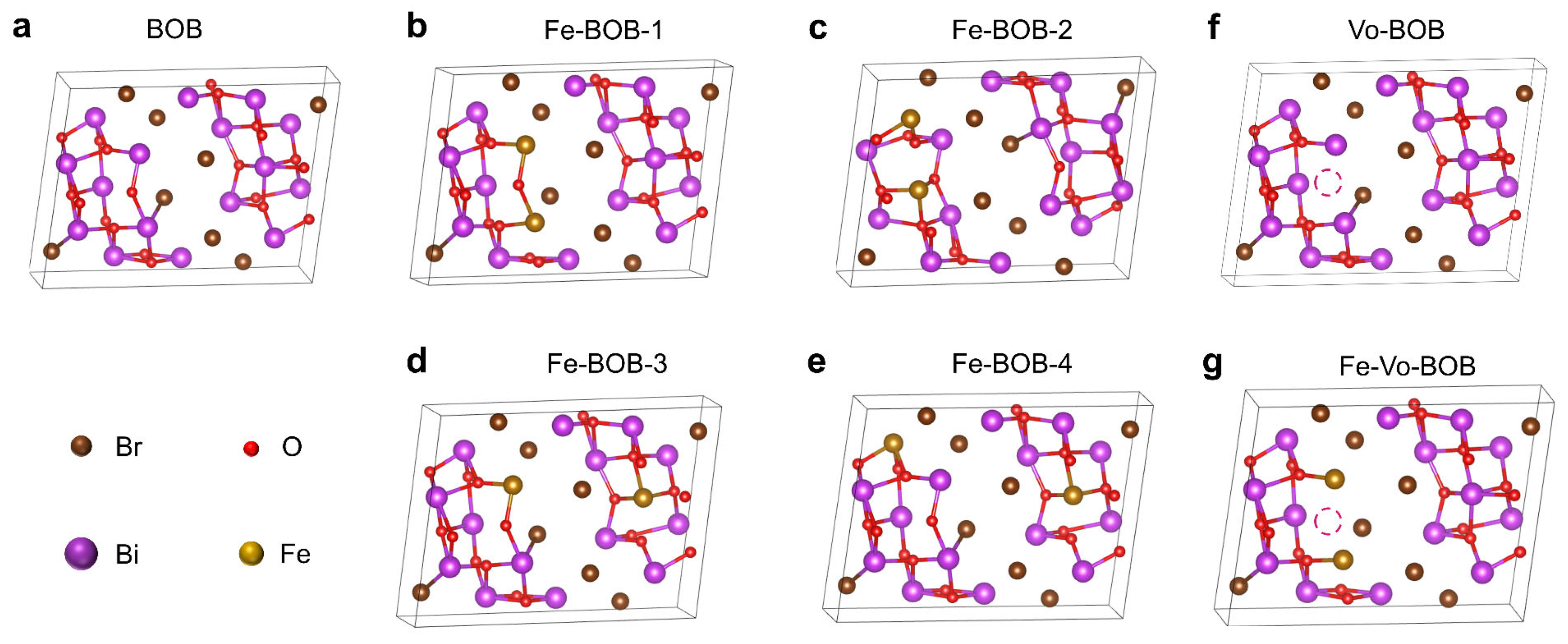
In the model construction, all calculations were performed based on the intrinsic Bi4O5Br2 supercell (Figure 1a), containing 16 Bi, 20 O, and 8 Br atoms. On this basis, Fe-doped and defect-engineered models were constructed. For Fe doping, Fe was introduced substitutionally at Bi sites, and four symmetry-inequivalent Fe configurations (Fe–BOB-1 to Fe–BOB-4; Figure 1b–e) were considered to evaluate the effects of dopant position and local coordination environment. Specifically, these configurations cover two Fe substitutions on the same side/plane versus opposite sides/planes, and within each category, adjacent (sharing/neighboring O coordination) versus separated placements, including symmetric and asymmetric substitution positions. The most stable configuration (Fe–BOB-1) was selected for subsequent property calculations. In addition, an oxygen-vacancy model was built by removing one O atom from Bi4O5Br2 (Figure 1f). For the coupled Fe–Vo system, the oxygen vacancy was created in Fe–BOB-1 by removing an O atom directly coordinated to the two Fe dopants, to probe the nearest-neighbor Fe–Vo interaction (Figure 1g) and systematically evaluate the synergistic effect of simultaneous doping and defect engineering on the electronic structure and physicochemical properties of Bi4O5Br2. This Fe-adjacent vacancy model is physically motivated, since Fe-oxygen-vacancy coupling in Bi-based oxyhalides has been reported to strongly modulate charge separation and surface reactivity (e.g., Fe-doped BiOCl with oxygen vacancies) [30,36].

3. Results and Discussion

3.1. Formation Energy

Based on the optimized structures, the formation energies (ΔEFe) of four distinct Fe-doped Bi4O5Br2 models were calculated using the equation below [37,38]:
ΔEFe = EX-BOBEBOB + 2EBi − 2EFe
where EX-BOB is the total energy (eV) of Fe-doped Bi4O5Br2, EBOB refers to the total energy (eV) of pristine Bi4O5Br2, while EFe and EBi correspond to the energies (eV) of a single Fe atom and a Bi ion, respectively. As summarized in Table 1, the Fe–BOB-1 model exhibited the lowest formation energy of 0.685 eV, indicating its superior thermodynamic stability. Therefore, the Fe–BOB-1 configuration was selected as the representative structure for subsequent calculations and property analyses in this study.
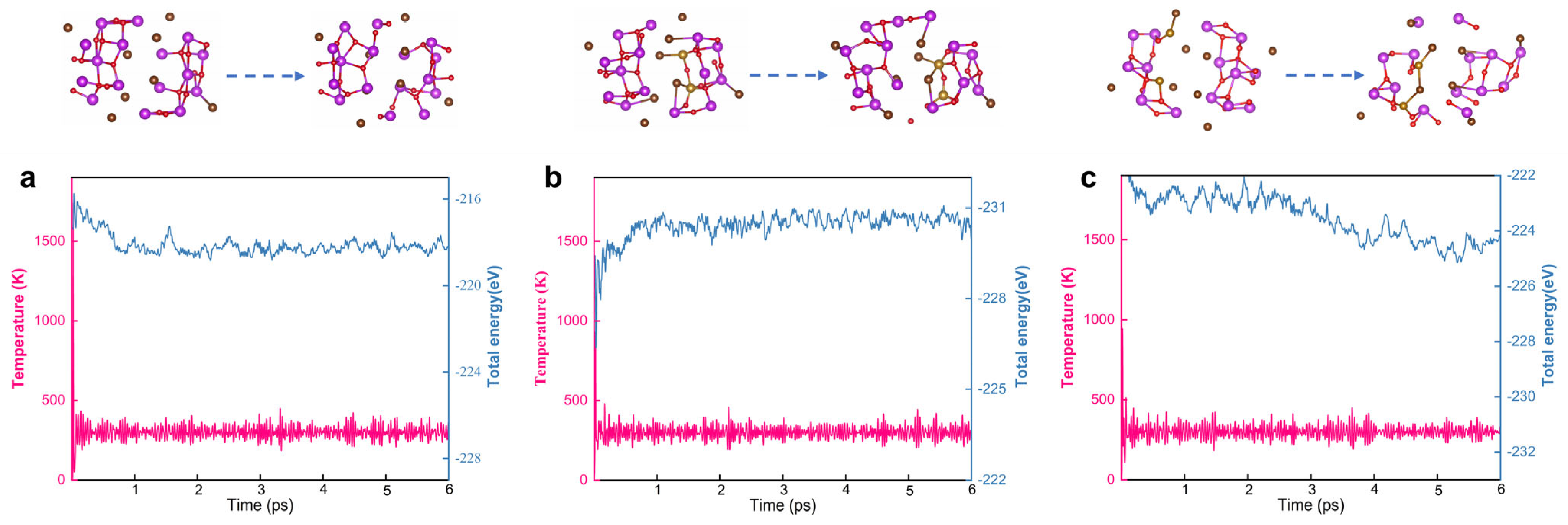
Structural stability under thermal perturbations was assessed for the Vo–BOB, Fe–BOB, and Fe–Vo–BOB models by ab initio molecular dynamics (AIMD) at 300 K. As shown in Figure 2, all structures remain intact over the simulation without signs of structural collapse. Quantitatively, the equilibrated trajectories exhibit bounded RMSD values (Table S2): 0.397 ± 0.070 Å (max 0.514 Å) for Vo–BOB, 0.476 ± 0.085 Å (max 0.663 Å) for Fe–BOB, and 0.875 ± 0.418 Å (max 1.464 Å) for Fe–Vo–BOB, indicating only thermal vibrations around the equilibrated configurations. Meanwhile, the temperature fluctuates around the target value (300 K), and the total energy Etot (electron + ion + thermostat) fluctuates around a stable mean with no pronounced drift over the production segment (Table S2). These results support the thermodynamic/dynamic stability of the defect/doped Bi4O5Br2 models under thermal perturbation [39].

3.2. Electron Localization Function

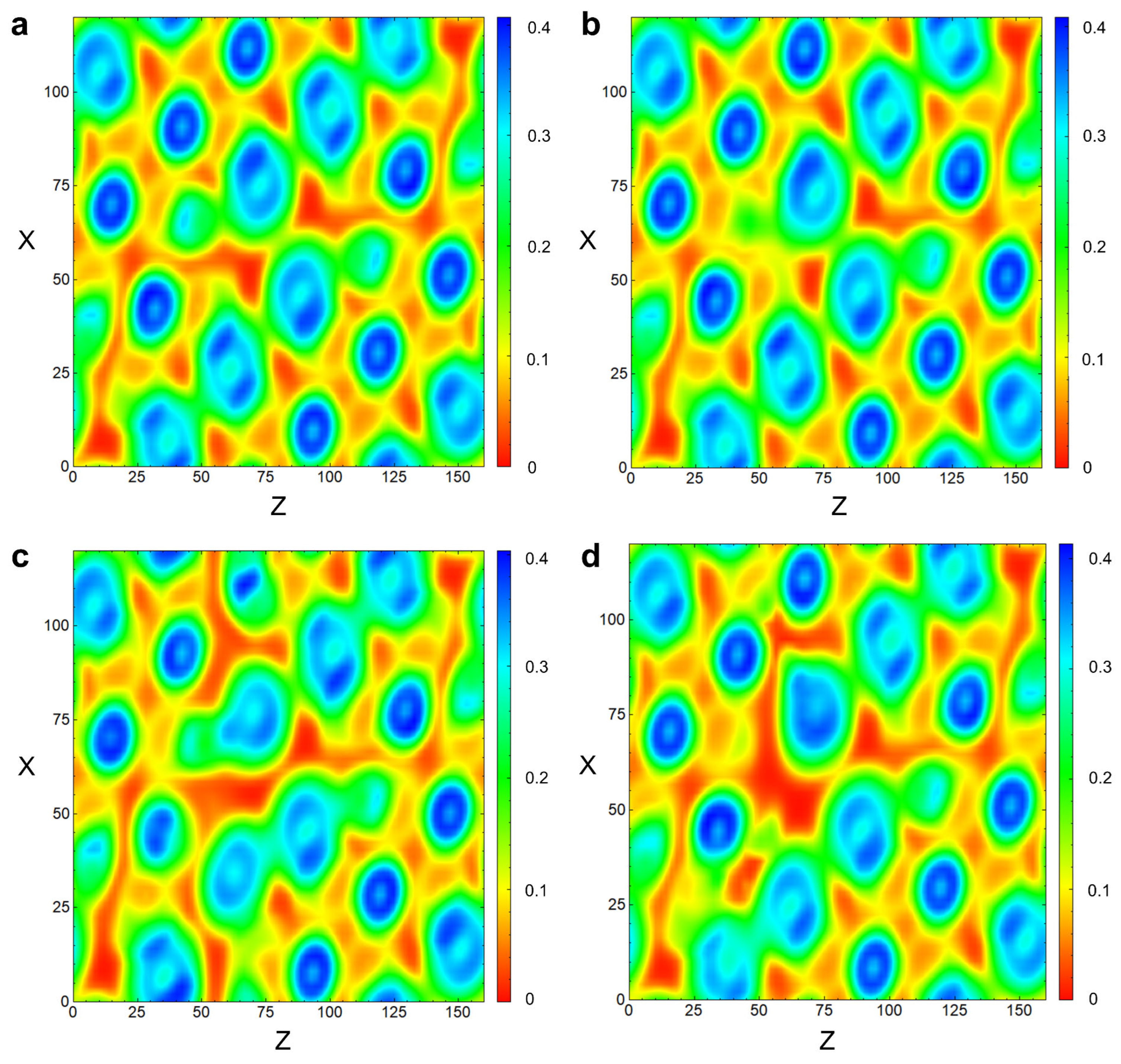
The electron localization function (ELF) quantifies the likelihood of finding two electrons with the same spin in close proximity and is thus widely used to evaluate electron localization and to elucidate the nature of chemical bonding in materials [40,41]. As demonstrated in Figure 3a, the ELF distributions revealed that in pristine Bi4O5Br2, electrons were primarily localized around O atoms, exhibiting a pronounced O-Bi covalent bonding feature. Conversely, the electron density within the Br layer exhibited a more delocalized character. This indicated that the interlayer interactions were mainly governed by ionic bonding and van der Waals forces, endowing the overall structure with high stability. Upon introducing an oxygen vacancy (Figure 3b), electron localization near the defect region was enhanced, with partial electron redistribution toward adjacent Bi atoms, resulting in an asymmetric local charge density and the formation of potential reactive sites. In the Fe-doped system (Figure 3c), a significant increase in electron density was observed around the Fe atoms, and the Fe-O bond region exhibited strong electronic localization, collectively confirming the effective Fe 3d and O 2p orbital hybridization. This hybridization enhanced Bi4O5Br2 charge polarization and carrier transport properties [28,42]. When Fe doping coexisted with oxygen vacancies (Figure 3d), electrons underwent synergistic redistribution among Fe, Bi, and defect regions, forming new localized charge-rich zones with stronger electronic coupling. This cooperative effect facilitated the modulation of the electronic structure and promoted charge separation, improving the electrical responsiveness and surface catalytic activity of Bi4O5Br2.

3.3. Energy Band Structure

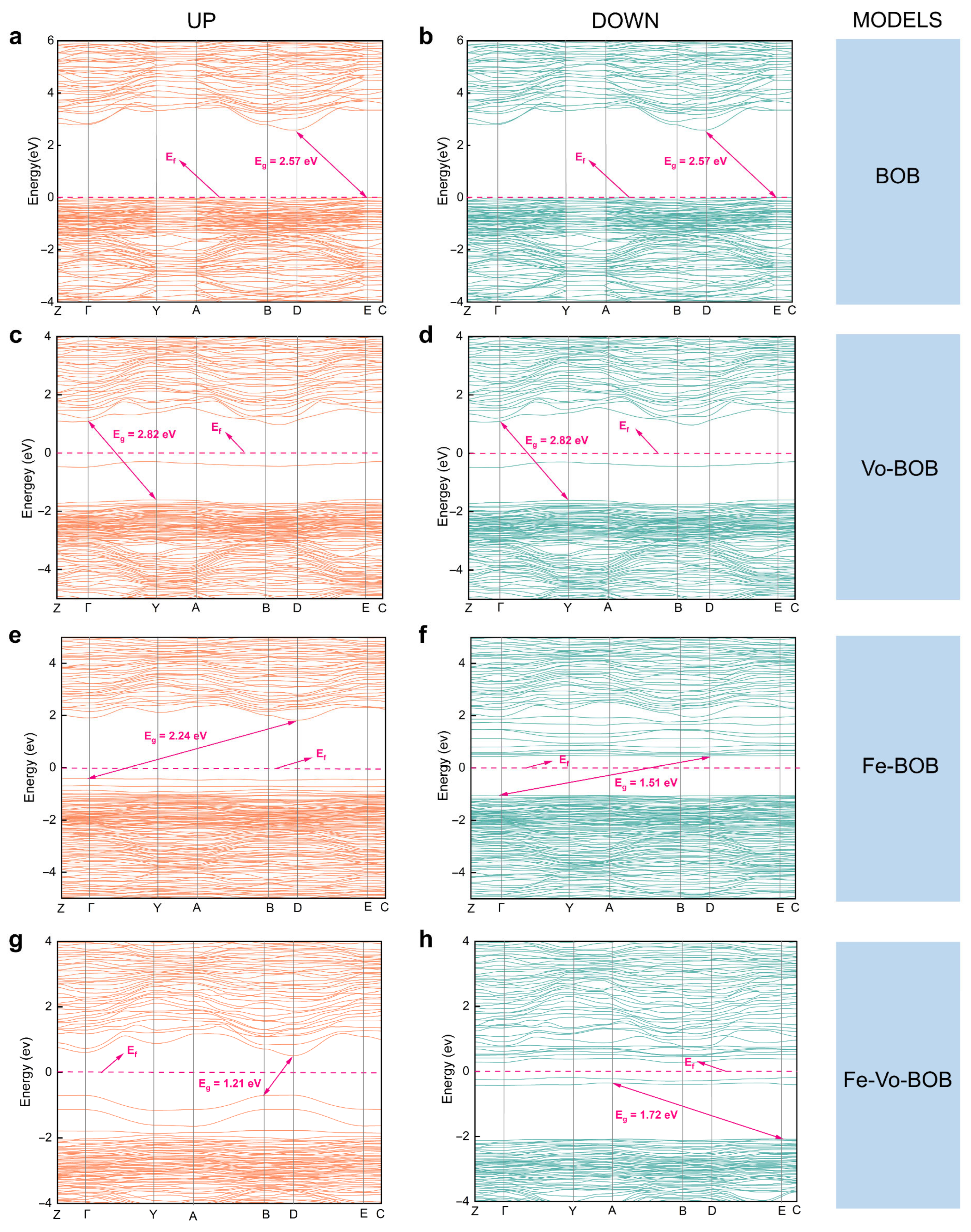
As illustrated in Figure 4, the spin-polarized band structures of pristine Bi4O5Br2 (BOB), the oxygen vacancy-doped system (Vo–BOB), the Fe-doped system (Fe–BOB), and the Fe-doped with oxygen vacancy synergy (Fe–Vo–BOB) were presented, with the Fermi level (Ef) aligned at 0 eV for energy referencing. In Figure 4a,b, the valence band maximum (VBM) of pristine Bi4O5Br2 was positioned at the Y point, whereas the conduction band minimum (CBM) occurred at the Γ point. This spatial separation of the band extrema in the Brillouin zone confirmed that Bi4O5Br2 is an indirect bandgap semiconductor. Using PBE, pristine Bi4O5Br2 shows an indirect band gap of 2.57 eV, consistent with reported experimental values ranging from 2.18 to 2.75 eV [43,44,45,46,47,48,49,50,51] and theoretical calculations between 2.15 and 2.64 eV [25,26,27,29,52] (Figure 4a,b; Table S1). Additionally, we compared our results with the experimentally measured and theoretically predicted band gaps of Bi4O5Br2 reported in the literature (Table S1). For VO–BOB, the spin-up and spin-down electronic structures are nearly identical, suggesting a closed-shell defect configuration, which is consistent with a doubly occupied neutral oxygen vacancy (F center, Vo0). Upon introducing oxygen vacancies, distinct impurity levels appeared near the Fermi level (approximately within the −1 to 0 eV region, as seen in Figure 4c,d). This new energy level effectively lowered the energy barrier for electron transitions originating from the valence band to the CBM, consequently reducing the optical bandgap of Bi4O5Br2. The introduction of oxygen vacancies disrupted the local electronic structure, inducing the transition of partial valence band electrons to the defect energy level, significantly enhancing the localization of electrons [19,53]. Furthermore, the slight upward shift in the valence band top indicated that the presence of oxygen vacancies elevated the energy level of valence band electrons, reducing the probability of electron-hole recombination. From the perspective of band structure, these results further confirm that oxygen vacancies played a crucial role in enhancing the photoelectronic response and photocatalytic activity of Bi4O5Br2.
Further examination of the Fe-doped system (Fe–BOB) revealed pronounced asymmetry between the spin-up and spin-down channels, indicating that Fe doping induced a significant spin polarization effect. As illustrated in Figure 4e,f, the bandgap dramatically decreased to approximately 2.24 eV in the spin-up channel and to about 1.51 eV in the spin-down channel, suggesting that Fe 3d states introduced impurity levels within the forbidden gap, altering the positions of the band edges. This modification not only diminished the transition barrier for electrons from the valence band to the conduction band—boosting the visible-light absorption capability of Bi4O5Br2—but also created additional electronic transport channels through the Fe 3d states, which ensured the efficient separation and migration of photogenerated charge carriers [54]. As shown in Figure 4g,h, when Fe doping coexisted with oxygen vacancies (Fe–Vo–BOB), the band structure underwent more pronounced changes. An increased number of impurity states appeared near the Fermi level, and the bandgap further narrowed, indicating a strong synergistic interaction between Fe doping and oxygen vacancies. The strong coupling between Fe 3d orbitals and defect-induced localized states formed a continuous energy-level bridge between the defect regions and the metal centers, markedly enhancing carrier transport and light absorption. This synergistic effect optimized the electronic structure of Bi4O5Br2 and provided more favorable electronic excitation and transfer pathways for photocatalytic CO2 reduction reactions.
In summary, from the pristine system to the doped, defective, and synergistically modified systems, the electronic structure of Bi4O5Br2 was significantly regulated and optimized. Specifically, Fe doping generated 3d impurity levels that enhanced visible-light absorption and facilitated the separation and migration of photogenerated carriers, while oxygen vacancies provided electron-trapping and activation sites that further improved charge transport. The synergistic interaction between Fe doping and oxygen vacancies resulted in stronger electronic coupling and more favorable band structure modulation, providing a solid theoretical basis for improving the photocatalytic activity and CO2 reduction kinetics of Bi4O5Br2.

3.4. Density of States

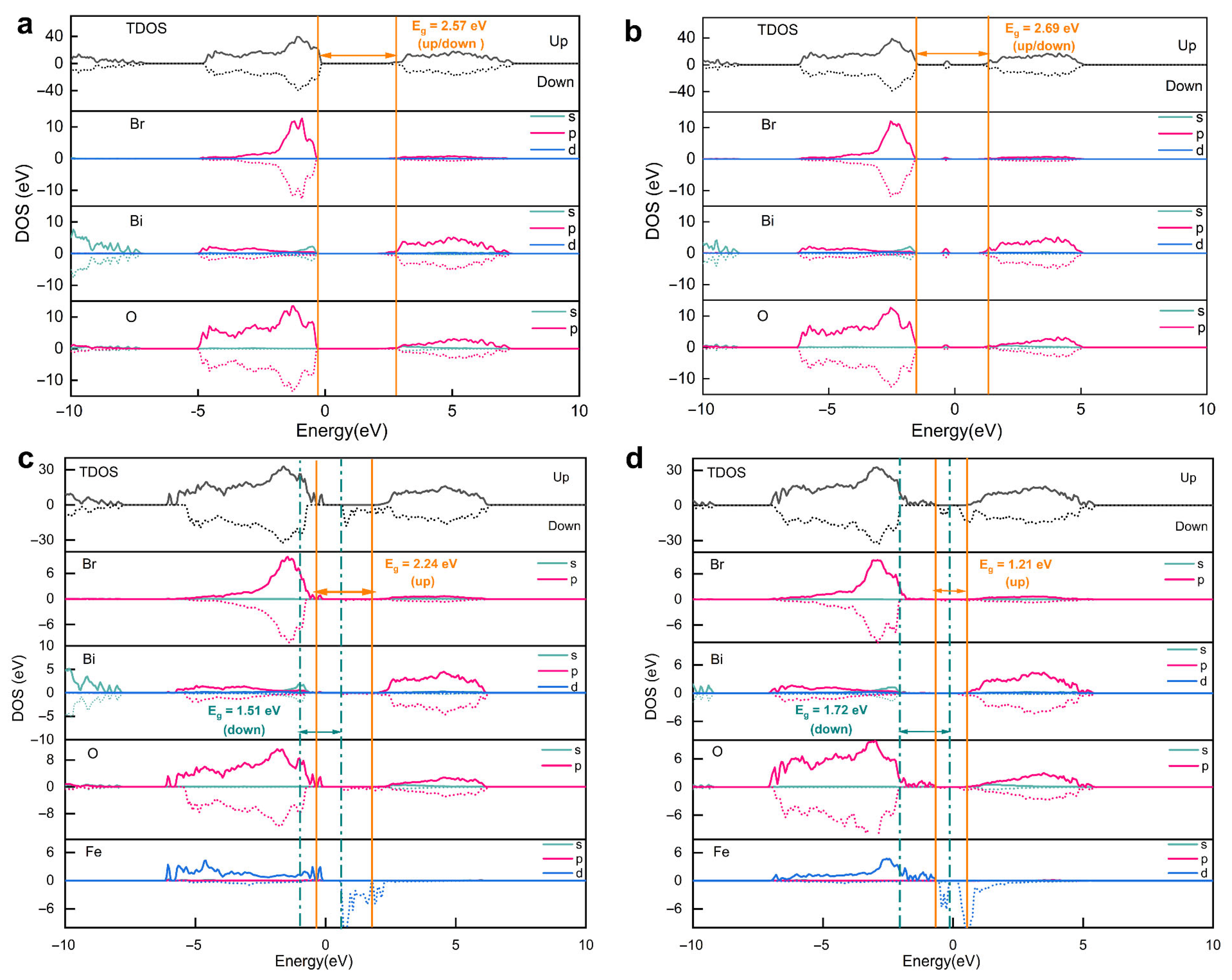
Figure 5 compares the density of states (DOS) of pristine Bi4O5Br2 and its variants modified by oxygen vacancies, Fe doping, and their synergistic regulation. As illustrated in Figure 5a, the upper valence band of pristine Bi4O5Br2 was mainly composed of O 2p and Br 4p orbitals, with a small contribution from Bi 6p states. The lower valence band was dominated by Bi 6s orbitals, while the conduction band was primarily formed by Bi 6p and O 2p states.
After introducing oxygen vacancies (Figure 5b), new defect states appeared near the Fermi level, originating mainly from Bi 6p and partly from O 2p orbitals. The emergence of these impurity levels suggested that oxygen vacancies facilitated electronic transitions from the valence band maximum to the conduction band minimum, enhancing the excitation and separation of photogenerated carriers and improving the photoelectronic performance of Bi4O5Br2 [55].
As shown in Figure 5c, the DOS of Fe–BOB exhibited a pronounced asymmetry between the spin-up and spin-down channels, indicating a strong spin-polarization effect induced by Fe doping. The Fe 3d orbitals introduced distinct impurity levels near the Fermi level, significantly increasing the DOS and providing additional electronic transition pathways. The localized Fe 3d states near the Fermi level show a local magnetic moment of 3.93 μB, and the spin-polarization ratio between the up and down spin channels is approximately 2.1. This indicates strong spin polarization around Fe atoms and a significant modification of the electronic structure. The increase in DOS due to Fe 3d orbitals near the Fermi level is approximately 0.45 eV for the spin-up channel and 0.25 eV for the spin-down channel.
In the Fe–Vo–BOB system (Figure 5d), a more pronounced spin asymmetry was observed, confirming strong spin polarization. The upper valence band was chiefly composed of O 2p, Br 4p, and Fe 3d states, whereas the conduction band mainly derived from Bi 6p and O 2p orbitals. The localized Fe 3d states near the Fermi level strongly hybridized with O 2p orbitals, leading to an enhanced DOS at the conduction band edge. The local magnetic moment of Fe is 3.93 μB, and the spin-polarization ratio between the spin-up and spin-down channels is 2.3, indicating significant spin-polarized charge transfer and enhanced magnetic behavior. The excess electrons introduced by oxygen vacancies further promoted the formation and occupation of impurity states. These results were consistent with the band structure analysis, confirming the critical role of the synergistic doping–defect strategy in optimizing the photoelectronic properties of Bi4O5Br2.

3.5. Absorption Spectrum and Dielectric Function

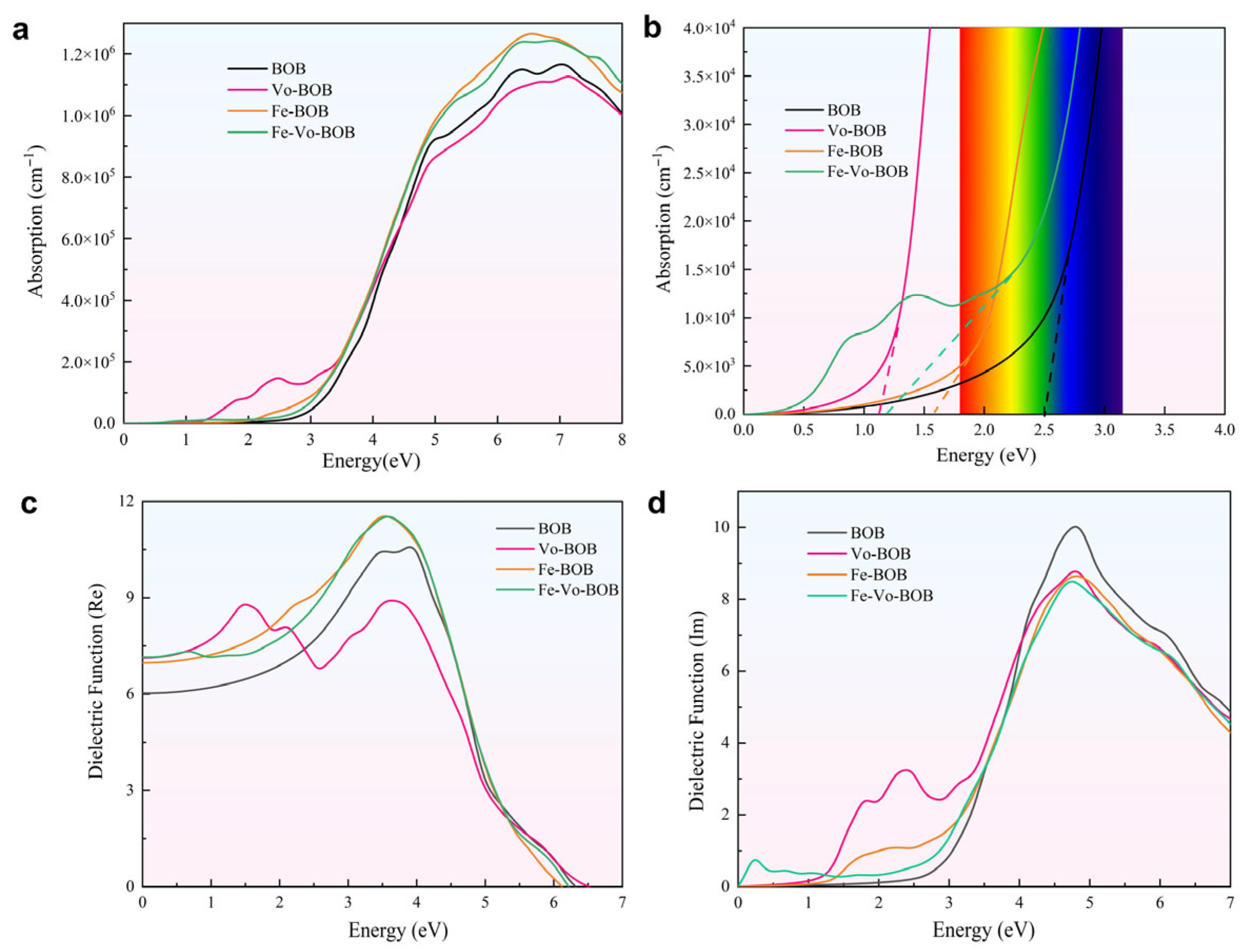
As shown in Figure 6a,b, the UV-vis absorption characteristics of Bi4O5Br2 and its modified systems (Vo–BOB, Fe–BOB, Fe–Vo–BOB) were analyzed. Compared to pristine BOB, both Fe-doping and oxygen vacancies induced a significant red shift in the absorption edge along with enhanced visible-light absorption intensity. This suggests that the introduction of Fe 3d orbitals and oxygen vacancies effectively modulates the band structure, improving Bi4O5Br2′s response to low-energy photons and making it more efficient for visible-light-driven photocatalysis. The Vo–BOB system introduced shallow defect states in the band gap, promoting near-edge electronic excitation and stronger absorption in the low-energy region. Notably, the Fe-doped and Fe–Vo co-modified systems showed the strongest absorption across the entire visible-light region, highlighting the synergistic effect between Fe doping and oxygen vacancies. The Tauc extrapolation method (Figure 6b) revealed that the optical band gaps of BOB, Vo–BOB, Fe–BOB, and Fe–Vo–BOB were 2.56 eV, 1.2 eV, 1.51 eV, and 1.25 eV, respectively, indicating that both oxygen vacancies and Fe doping significantly narrow the band gap, with Fe–Vo–BOB showing the smallest band gap of 1.25 eV [56,57]. These modifications not only enhanced light absorption but also improved charge separation, suggesting that the Fe–Vo co-modification offers a promising strategy for enhancing photocatalytic CO2 reduction under visible light.
The dielectric function analysis shown in Figure 6c,d provides insights into the optical properties of Bi4O5Br2 and its modified systems. Compared with the original BOB (black curve), Vo–BOB (red curve) and Fe–BOB (orange curve) exhibit enhanced responses in the low-energy and middle-energy regions, respectively. The Vo–BOB system shows a clear peak at approximately 1.5 electron volts, mainly due to the electron transitions from the O 2p and Bi 6p orbitals of the impurity levels to the conduction band bottom. This indicates that the introduction of oxygen vacancies creates shallow defect states within the band gap, promoting electron excitation and enhancing light absorption in the visible light region. In the Fe–BOB system, the Fe doping introduces new Fe 3d states, resulting in a wider dielectric response, especially in the middle energy region, and promoting charge transfer and enhanced optical response. The Fe–Vo–BOB system (green curve) shows the most significant improvement, exhibiting enhanced absorption throughout the visible light range. This indicates that the synergistic effect of iron doping and oxygen vacancies not only optimizes the polarization properties of the material but also significantly enhances its ability to absorb light, making it extremely outstanding in visible light-driven photocatalytic applications. This analysis shows that Fe–Vo–BOB provides the best overall optical performance for photocatalytic applications due to the synergistic effect of iron doping and oxygen vacancies. This is consistent with the experimental results of Wu et al. [34], where iron elements and oxygen vacancies were introduced into bismuth-based materials (such as BiOCl and BiOBr), which have been proven to significantly alter the electronic structure, enhance light absorption capacity, and promote charge separation.

3.6. Photocatalytic CO2 Reduction

The photocatalytic reduction of CO2 fundamentally depends on the catalyst’s capacity to harvest solar energy and produce photogenerated electrons and holes, which subsequently participate in converting CO2 to CO on the catalyst surface. This process generally involves several key steps: (i) CO2 molecules are first adsorbed onto the catalyst surface, establishing the necessary conditions for the reaction; (ii) upon light absorption, electrons in the valence band are excited to the conduction band, generating electron-hole pairs; (iii) the generated charge carriers are then separated and migrate to active sites on the catalyst surface; (iv) under light irradiation, some charge carriers may recombine, while others participate in the CO2 reduction reaction; and (v) photogenerated electrons react with the adsorbed CO2 molecules, yielding the target CO product. During the conversion of CO2 to CO, the specific reaction pathway and the formation of intermediates are determined by the nature of the surface-active sites of the catalyst, with the overall reduction process generally proceeding through multiple elementary steps. The primary elementary reactions involved in the reduction of CO2 to CO are as follows [42]
CO2 → *CO2
*CO2 + e → *CO2
*CO2 + H+ → *COOH
*COOH + H+ + e → *CO + H2O
*CO → CO
To thoroughly understand the synergistic impact of Fe doping and oxygen vacancies on the photocatalytic CO2 reduction performance of Bi4O5Br2, density functional theory (DFT) calculations were performed to assess the Gibbs free energy changes (ΔG) of the key intermediates (*CO2, *COOH, and *CO) involved in the CO2 reduction pathway. By constructing Gibbs free energy profiles, the CO2 reduction pathways over pristine BOB, oxygen-vacancy-modified BOB (Vo–BOB), Fe-doped BOB (Fe–BOB), and Fe–Vo co-modified BOB (Fe–Vo–BOB) surfaces were systematically compared, providing theoretical insights into the thermodynamic mechanisms underlying the enhanced reactivity and selectivity induced by the synergistic regulation of Fe doping and oxygen vacancies.
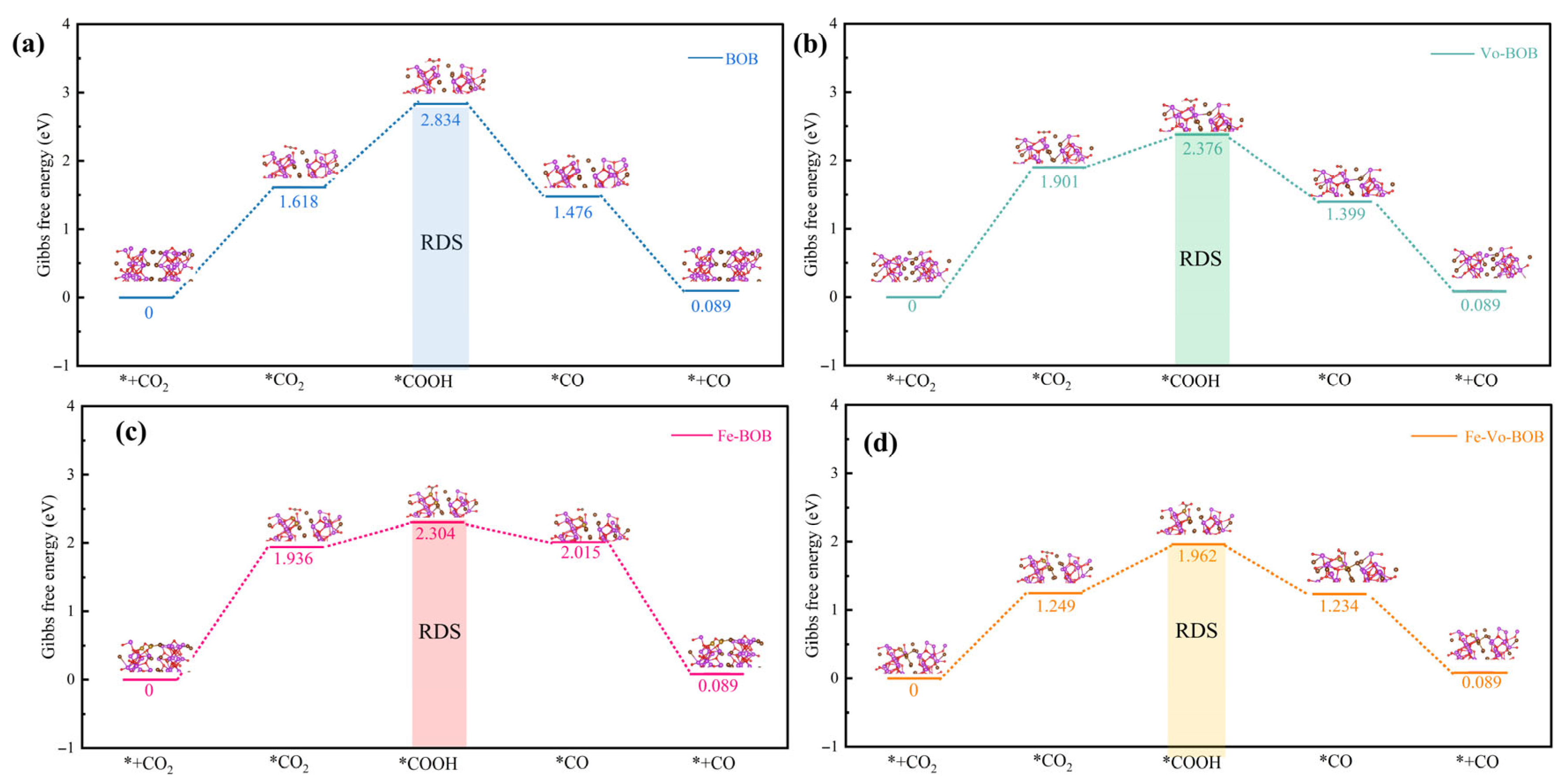
The structural models shown in Figure 7 correspond to the fully relaxed adsorption/intermediate states on the same (020) slab with the same surface setup (termination/thickness/vacuum) and the same adsorbate loading (one CO2 per periodic surface cell) for all BOB-derived models. As shown in Figure 7a, the pristine BOB system exhibits the highest free energy barrier of 2.834 eV at the COOH formation step, which serves as the rate-determining step (RDS) of the overall reaction. This indicates that CO2 activation and the associated proton-electron coupling are thermodynamically unfavorable in the pristine system. The high energy barrier for COOH formation suggests that the material is inefficient at stabilizing intermediates and promoting CO2 activation.
As shown in Figure 7b, after introducing Vo–BOB, the energy barriers for COOH and CO intermediates decrease significantly to 2.376 eV and 1.399 eV, respectively, compared to the pristine BOB system. This indicates that oxygen vacancies facilitate electron accumulation, enhancing CO2 adsorption and activation. The marked reduction in the energy barriers suggests that oxygen vacancies contribute to more effective electron donation and stabilization of intermediates, thereby providing a more favorable reaction pathway for CO2 reduction.
In the Fe–BOB, as shown in Figure 7c, the energy barrier for the COOH intermediate further decreases to 2.304 eV, indicating that the Fe 3d orbitals provide additional electronic channels that hybridize with CO2 molecular orbitals, promoting charge transfer and stabilizing the reaction intermediates. The introduction of Fe doping aids in facilitating electron transfer and stabilizing the intermediates, thereby lowering the overall energy barrier for CO2 activation [58].
Notably, the Fe–Vo–BOB system, as shown in Figure 7d, exhibits the lowest overall energy barriers. The RDS for CO2 reduction is reduced to 1.249 eV at the CO2 adsorption step, with the COOH intermediate stabilized at 1.962 eV. The CO formation step becomes an exergonic reaction with a value of 1.234 eV, indicating that the entire reaction pathway is energetically favorable. Mechanistically, oxygen vacancies enhance charge localization and CO desorption, while Fe doping introduces 3d states, promoting electron transfer and stabilizing the reaction intermediates. The synergistic effect between the two forms a continuous energy bridge between the defect regions and metal centers, optimizing the reaction pathway, enhancing the migration efficiency of photo-generated electrons, and effectively promoting CO2 conversion to CO [59].

4. Conclusions

This study involved carrying out first-principles calculations to systematically explore the synergistic effects of iron (Fe) doping and oxygen vacancies on the structural, electronic and optical properties of bismuth (IV) oxide (Bi4O5Br2), as well as its photocatalytic CO2 reduction mechanism. The results demonstrated that the Fe-doped, oxygen-defective, and Fe–Vo co-modified Bi4O5Br2 systems possess excellent thermodynamic and dynamic stability, confirming their structural reliability under realistic operating conditions. The introduction of oxygen vacancies generates defect levels near the Fermi level, effectively narrowing the band gap, enhancing charge localization, and improving CO2 adsorption and activation capability. Meanwhile, Fe doping induces strong spin polarization and introduces Fe 3d impurity states that couple efficiently with O 2p orbitals, leading to improved charge-carrier transport, enhanced electronic conductivity, and increased visible-light absorption. When both Fe dopants and oxygen vacancies coexist, a remarkable synergistic interaction occurs, forming a continuous energy-level bridge between Fe 3d states and defect-induced localized states. This strong electronic coupling substantially improves charge separation efficiency, extends light-harvesting capacity into the visible and near-infrared regions, and optimizes dielectric polarization, collectively boosting the efficiency of light-to-energy conversion. Gibbs free energy analyses further revealed that the Fe–Vo–BOB system exhibits the lowest reaction energy barriers and the most favorable thermodynamic pathway for CO2 adsorption, activation, and subsequent conversion into CO, highlighting its superior photocatalytic reactivity compared to the singly modified systems. Overall, the cooperative regulation of Fe doping and oxygen vacancy engineering effectively tailors the band structure and charge transfer dynamics of Bi4O5Br2, resulting in improved optical properties and heightened photocatalytic CO2 reduction performance. These results offer important theoretical guidance for the rational design of high-performance photocatalysts co-modulated by defects and dopants, and provide key insights for developing next-generation visible-light-driven catalysts for solar-to-chemical energy conversion and environmental remediation. In summary, the main advance of this work is the explicit identification of a nearest-neighbor Fe-VO coupled defect in Bi4O5Br2 and the demonstration of its synergistic mechanism through a consistent comparison of pristine, Fe-only, VO-only, and Fe–VO models. This coupled defect exhibits a more favorable electronic/optical response and improves the CO2 → CO reaction energetics compared with single-dopant cases, thereby advancing beyond prior Ni/Mn/Co doping and earlier Fe-doping descriptions that did not explicitly address dopant–vacancy coupling.

Supplementary Materials

The following supporting information can be downloaded at: https://www.mdpi.com/article/10.3390/magnetochemistry12020026/s1, Table S1: Comparison of Experimental and Theoretical Band Gaps of Bi4O5Br2; Table S2: AIMD settings and quantitative stability metrics.

Author Contributions

Conceptualization, F.Z.; formal analysis, X.H. and H.S.; methodology, X.Y. and N.D.; visualization, G.L. and S.L.; writing—original draft, G.L.; writing—review and editing, F.Z. and S.X. All authors have read and agreed to the published version of the manuscript.

Funding

This work was funded by the National Natural Science Foundation of China (62264015) and Shaanxi Provincial Department of Education (Grant No. 22JK0623). G.H Liu was partially supported by the postgraduate research opportunities program of HZW-TECH (HZWTECH-PROP).

Institutional Review Board Statement

Not applicable.

Informed Consent Statement

Not applicable.

Data Availability Statement

The original contributions presented in this study are included in the article/Supplementary Materials. Further inquiries can be directed to the corresponding authors.

Conflicts of Interest

Author Xiangzhou Yan was employed by the company New Energy Department of China National Offshore Oil Corporation (CNOOC, China). The remaining authors declare that the research was conducted in the absence of any commercial or financial relationships that could be construed as a potential conflict of interest.

References

  1. Sun, L.; Zhang, Z.; Bian, J.; Bai, F.; Su, H.; Li, Z.; Xie, J.; Xu, R.; Sun, J.; Bai, L.; et al. A Z-scheme heterojunctional photocatalyst engineered with spatially separated dual redox sites for selective CO2 reduction with water: Insight by in situ μs-transient absorption spectra. Adv. Mater. 2023, 35, 2300064. [Google Scholar] [CrossRef] [PubMed]
  2. Pan, W.; Wei, Z.; Su, Y.; Lian, Y.; Zheng, Z.; Yuan, H.; Qin, Y.; Xie, X.; Bai, Q.; Jiao, Z.; et al. Hydroxylated metal-organic-layer nanocages anchoring single atomic cobalt sites for robust photocatalytic CO2 reduction. Nano Res. 2024, 17, 2410–2419. [Google Scholar] [CrossRef]
  3. Wu, J.; Zhu, J.; Fan, W.; He, D.; Hu, Q.; Zhu, S.; Yan, W.; Hu, J.; Zhu, J.; Chen, Q.; et al. Selective photoreduction of CO2 to CH4 triggered by metal-vacancy pair sites. Nano Lett. 2024, 24, 696–702. [Google Scholar] [CrossRef] [PubMed]
  4. Li, X.; Wang, M.; Wang, R.; Wang, Y.; Zhu, M.; Zhang, L.; Shi, J. Construction of Ru single-atoms on ceria to reform the products of CO2 photoreduction. ACS Nano 2024, 18, 5741–5751. [Google Scholar] [CrossRef]
  5. Dong, J.; Zhao, J.; Yan, X.; Li, L.; Liu, G.; Ji, M.; Wang, B.; She, Y.; Li, H.; Xia, J. Construction of carbonized polymer dots/potassium doped carbon nitride nanosheets van der Waals heterojunction by ball milling method for facilitating photocatalytic CO2 reduction performance in pure water. Appl. Catal. B Environ. Energy 2024, 351, 123993. [Google Scholar] [CrossRef]
  6. Wang, Y.; Yan, Y.; Zhang, H.; Peng, X.; Huang, H.; Zhang, S.; Shi, L. Stabilizing electron-rich Ni single-atoms on black phosphorus nanosheets boosts photocatalytic carbon dioxide reduction. J. Colloid Interface Sci. 2024, 658, 324–333. [Google Scholar] [CrossRef]
  7. Chen, Z.; Jin, X.; Lan, Q.; Li, X.; Huang, Q.; Liu, W.; Guo, Y.; Xie, H.; Ye, L. Achieving high carrier separation over Bi4O5I2 through Ni doping for improved photocatalytic CO2 reduction. Nanotechnology 2023, 34, 405201. [Google Scholar] [CrossRef]
  8. Li, C.; Lu, X.; Chen, L.; Xie, X.; Qin, Z.; Ji, H.; Su, T. WO3/BiOBr S-scheme heterojunction photocatalyst for enhanced photocatalytic CO2 reduction. Materials 2024, 17, 3199. [Google Scholar] [CrossRef]
  9. Lin, H.; Li, X.; Cao, J.; Chen, S.; Chen, Y. Novel I-doped BiOBr composites: Modulated valence bands and largely enhanced visible light phtotocatalytic activities. Catal. Commun. 2014, 49, 87–91. [Google Scholar] [CrossRef]
  10. Shang, J.; Hao, W.C.; Lv, X.J.; Wang, T.; Wang, X.; Du, Y.; Dou, S.; Xie, T.; Wang, D.; Wang, J. Bismuth oxybromide with reasonable photocatalytic reduction activity under visible light. ACS Catal. 2014, 4, 954–961. [Google Scholar] [CrossRef]
  11. Kato, D.; Hongo, K.; Maezono, R. Valence band engineering of layered bismuth oxyhalides toward stable visible-light water splitting: Madelung site potential analysis. J. Am. Chem. Soc. 2017, 139, 18725–18731. [Google Scholar] [CrossRef] [PubMed]
  12. Wang, X.; Zhang, Y.; Miao, W.; Zhang, X.; Shi, Y.; Tang, Z.; Shi, H. Insight into the pathway, improvement of performance and photocatalytic mechanism of active carbon/Bi4O5Br2 composite for cefixime and rhodamine B removal. J. Photochem. Photobiol. A Chem. 2023, 444, 114892. [Google Scholar] [CrossRef]
  13. Zhang, Z. Construction and Photocatalytic Degradation Performance of Bi4O5Br2-Based Heterojunction Photocatalysts. Master’s Thesis, South China University of Technology, Guangzhou, China, 2022. (In Chinese) [Google Scholar]
  14. Lu, S.; Li, J.; Duan, F.; Duan, L.; Du, M.; Chen, M. One-step preparation of Bi4O5BrxI2−x solid solution with superior photocatalytic performance for organic pollutants degradation under visible light. Appl. Surf. Sci. 2019, 475, 577–586. [Google Scholar] [CrossRef]
  15. Di, J.; Ji, M.; Xia, J.; Li, X.; Fan, W.; Zhang, Q.; Li, H. Bi4O5Br2 ultrasmall nanosheets in situ strong coupling to MWCNT and improved photocatalytic activity for tetracycline hydrochloride degradation. J. Mol. Catal. A Chem. 2016, 424, 331–341. [Google Scholar] [CrossRef]
  16. Qian, X.; Ma, Y.; Xia, X.; Xia, J.; Ye, J.; He, G.; Chen, H. Recent progress on Bi4O5Br2-based photocatalysts for environmental remediation and energy conversion. Catal. Sci. Technol. 2024, 14, 1085–1104. [Google Scholar] [CrossRef]
  17. Zhang, L.; Li, Y.; Li, Q.; Fan, J.; Carabineiro, S.A.C.; Lv, K. Recent advances on bismuth-based photocatalysts: Strategies and mechanisms. Chem. Eng. J. 2021, 419, 129484. [Google Scholar] [CrossRef]
  18. Wang, Q.; Liu, Z.; Liu, D.; Liu, G.; Yang, M.; Cui, F.; Wang, W. Ultrathin two-dimensional BiOBrxI1−x solid solution with rich oxygen vacancies for enhanced visible-light-driven photoactivity in environmental remediation. Appl. Catal. B 2018, 236, 222–232. [Google Scholar] [CrossRef]
  19. Mao, D.; Hu, Y.; Yang, S.; Liang, J.; He, H.; Yang, S.; Xu, Z.; Sun, C.; Zeng, S.; Jiang, Z.; et al. Oxygen-vacancy-induced charge localization and atomic site activation in ultrathin Bi4O5Br2 nanotubes for boosted CO2 photoreduction. Chem. Eng. J. 2022, 452, 139304. [Google Scholar] [CrossRef]
  20. Jiang, Z.; Xiao, C.; Yin, X.; Xu, L.; Liu, C.; Wang, H. Facile preparation of a novel Bi24O31Br10/nano-ZnO composite photocatalyst with enhanced visible light photocatalytic ability. Ceram. Int. 2020, 46, 10771–10778. [Google Scholar] [CrossRef]
  21. Popov, A.; Koto, E.; Kuklja, M. Quantum Chemical Calculations of the Electron Center Diffusion in MgO Crystals. Phys. Status Solidi 1996, 195, 61. [Google Scholar] [CrossRef]
  22. Lushchik, A.; Podelinska, A.; Seeman, V.; Shablonin, E.; Kotomin, E.; Kuzovkov, V. Open Questions on the Thermal Stability of Primary Electronic Centers in Irradiated MgO Single Crystals. J. Phys. Chem. C 2025, 129, 2775–2781. [Google Scholar] [CrossRef]
  23. Di, J.; Xia, J.; Chisholm, M.F.; Zhong, J.; Chen, C.; Cao, X.; Dong, F.; Chi, Z.; Chen, H.; Weng, X.; et al. Defect-tailoring mediated electron-hole separation in single-unit-cell Bi3O4Br nanosheets for boosting photocatalytic hydrogen evolution and nitrogen fixation. Adv. Mater. 2019, 31, 1807576. [Google Scholar] [CrossRef] [PubMed]
  24. Zhang, W.; Zhu, G.; Yang, W.; Sun, Q.; Wu, Q.; Tian, Y.; Zhang, Z.; Zhang, S.; Cheng, S.; Zhang, C.; et al. Fe-doped Bi4O5Br2 visible light photocatalyst: A first principles investigation. J. Theor. Comput. Chem. 2018, 17, 1850031. [Google Scholar] [CrossRef]
  25. Zhu, G.; Hojamberdiev, M.; Zhang, W.; Taj Ud Din, S.; Joong Kim, Y.; Lee, J.; Yang, W. Enhanced photocatalytic activity of Fe-doped Bi4O5Br2 nanosheets decorated with Au nanoparticles for pollutants removal. Appl. Surf. Sci. 2020, 526, 146760. [Google Scholar] [CrossRef]
  26. Zhang, W.; Xiao, X.; Wu, Q.; Fan, Q.; Chen, S.; Yang, W.; Zhang, F. Facile synthesis of novel Mn-doped Bi4O5Br2 for enhanced photocatalytic NO removal activity. J. Alloys Compd. 2020, 826, 154204. [Google Scholar] [CrossRef]
  27. Zhang, W.; Chen, S.; He, M.; Zhu, G.; Yang, W.; Tian, Y.; Zhang, Z.; Zhang, S.; Zhang, F.; Wu, Q. Enhanced photocatalytic properties of Bi4O5Br2 by Mn doping: A first principles study. Mater. Res. Express 2018, 5, 075512. [Google Scholar] [CrossRef]
  28. Yang, Z.; Hu, B.; Wang, X.; Selishchev, D.; Zhang, G. Enhanced photocatalytic CO2 reduction over Ni-doped Bi4O5Br2/NiCo2O4 heterojunction: Synergistic enhancement effect between spin polarization and built-in electric field. ACS Sustain. Chem. Eng. 2025, 13, 1095–1105. [Google Scholar] [CrossRef]
  29. Sheng, H.; Zhang, X.; Xin, S.; Shi, H.; Liu, G.; Wu, Q.; Xue, S.; Wang, X.; Shao, T.; Liu, Y.; et al. First-principles study of electronic structure and optical properties of Ni-doped Bi4O5Br2. Coatings 2024, 14, 67. [Google Scholar] [CrossRef]
  30. Wu, H.; Liu, X.; Xu, H.; Yang, X.; Ye, J. Efficient photodegradation of 2-chloro-4-nitrophenol over Fe-doped BiOCl nanosheets with oxygen vacancy. Catal. Sci. Technol. 2021, 11, 5119. [Google Scholar] [CrossRef]
  31. Wang, Y.; Ban, C.; Meng, J.; Ma, J.; Zou, H.; Feng, Y.; Ding, J.; Duan, Y.; Gan, L.; Zhou, X. Charge localization induced by Fe doping in porous Bi5O7I Micro-flower for enhanced photoreduction of CO2 to CO. Sep. Purif. Technol. 2023, 312, 123379. [Google Scholar] [CrossRef]
  32. Blöchl, P.E. Projector augmented-wave method. Phys. Rev. B 1994, 50, 17953. [Google Scholar] [CrossRef] [PubMed]
  33. Grimme, S. Semiempirical GGA-type density functional constructed with a long range dispersion correction. J. Comput. Chem. 2006, 27, 1787–1799. [Google Scholar] [CrossRef] [PubMed]
  34. Perdew, J.P.; Burke, K.; Ernzerhof, M. Generalized gradient approximation made simple. Phys. Rev. Lett. 1996, 77, 3865–3868. [Google Scholar] [CrossRef] [PubMed]
  35. Shih, Y.; Sergienko, A.; Rubin, M.; Kiess, T.; Alley, C. Two-photon entanglement in type-II parametric down-conversion. Phys. Rev. A 1994, 50, 23. [Google Scholar] [CrossRef]
  36. An, W.; Wang, H.; Yang, T.; Xu, J.; Wang, Y.; Liu, D.; Hu, J.; Cui, W.; Liang, Y. Enriched photocatalysis-Fenton synergistic degradation of organic pollutants and coking wastewater via surface oxygen vacancies over Fe-BiOBr composites. Chem. Eng. J. 2023, 451, 138653. [Google Scholar] [CrossRef]
  37. Liu, G.; Dai, R.; Shi, H.; Dong, N.; Zhang, B.; Li, S.; Wang, W.; Liu, Y.; Shao, T.; Zhang, M.; et al. Using Er/Cd-Co doped Bi4O5Br2 microspheres to enhance antibiotic degradation under visible illumination: A combined experimental and DFT investigation. J. Phys. Chem. B 2024, 128, 9373–9384. [Google Scholar] [CrossRef]
  38. Dai, R. Preparation of Metal Ion-Doped Bi4O5Br2 Materials and Investigation of Their Photocatalytic Properties. Master’s Thesis, Yan’an University, Yan’an, China, 2022. (In Chinese) [Google Scholar]
  39. Liu, G.; Shi, H.; Dong, N.; Cao, X.; Gao, X.; Xue, S.; Zhang, F. First-principles exploration of the electronic structure and optical properties of S-doped Bi4O5Br2. Catalysts 2025, 15, 228. [Google Scholar] [CrossRef]
  40. Zhang, Q.; Wang, X.; Zhang, F.; Fang, C.; Liu, D.; Zhou, Q. A High-throughput screening toward efficient nitrogen fixation: Transition metal single-atom catalysts anchored on an emerging π-π conjugated graphitic carbon nitride (g-C10N3) substrate with dirac dispersion. ACS Appl. Mater. Interfaces 2023, 15, 11812–11826. [Google Scholar] [CrossRef]
  41. Jacques, K.; Desmarais, G.V.; Bencheikh, K.; Erba, A.; Pittalis, S. Electron localization function for noncollinear spins. Phys. Rev. Lett. 2024, 133, 136401. [Google Scholar] [CrossRef]
  42. Zeng, J.; Jiang, Z.; Lv, K.; Ahmad, S.A.; Chen, X.; Zhang, W.; Xie, J.; Zhu, T. Experimental and calculation investigations of the photocatalytic selective and performance for CO2 reduction by cobalt-doped Bi4O5Br2 nanosheets. Ceram. Int. 2024, 51, 1801–1812. [Google Scholar] [CrossRef]
  43. Vadivel, S.; Fujii, M.; Rajendran, S. Novel S-scheme 2D/2D Bi4O5Br2 nanoplatelets/g-C3N5 heterojunctions with enhanced photocatalytic activity towards organic pollutants removal. Environ. Res. 2022, 213, 113736. [Google Scholar] [CrossRef] [PubMed]
  44. Zhao, C.; Li, X.; Yue, L.; Ren, X.; Yuan, S.; Zeng, Z.; Hu, X.; Wu, Y.; He, Y. Bi4O5Br2 nanoflower and CdWO4 nanorod heterojunctions for photocatalytic synthesis of ammonia. ACS Appl. Nano Mater. 2023, 6, 15709–15720. [Google Scholar] [CrossRef]
  45. Shi, H.; Wang, W.; Zhang, L.; Tang, Z.; Fan, J. Enhancement of photocatalytic disinfection performance of the Bi4O5Br2 with the modification of silver quantum dots. J. Environ. Chem. Eng. 2021, 9, 105867. [Google Scholar] [CrossRef]
  46. Di, J.; Xia, J.; Ji, M.; Yin, S.; Li, H.; Xu, H.; Zhang, Q.; Li, H. Controllable synthesis of Bi4O5Br2 ultrathin nanosheets for photocatalytic removal of ciprofloxacin and mechanism insight. J. Mater. Chem. A 2015, 3, 15108. [Google Scholar] [CrossRef]
  47. Yang, H. Study on the Preparation and Photocatalytic Performance of Modified Bi4O5Br2. Professional Master’s Thesis, Northwest University, Xi’an, China, 2021. (In Chinese) [Google Scholar]
  48. Xia, J.; Ge, Y.; Di, J.; Xu, L.; Yin, S.; Chen, Z.; Liu, P.; Li, H. Ionic liquid-assisted strategy for bismuth-rich bismuth oxybromides nanosheets with superior visible light-driven photocatalytic removal of bisphenol-A. J. Colloid Interface Sci. 2016, 473, 112–119. [Google Scholar] [CrossRef]
  49. Bai, Y.; Chen, T.; Wang, P.; Wang, L.; Ye, L. Bismuth-rich Bi4O5X2 (X = Br, and I) nanosheets with dominant {1 0 1} facets exposure for photocatalytic H2 evolution. Chem. Eng. J. 2016, 304, 454–460. [Google Scholar] [CrossRef]
  50. Xiao, X.; Tu, S.; Lu, M.; Zhong, H.; Zheng, C.; Zuo, X.; Nan, J. Discussion on the reaction mechanism of the photocatalytic degradation of organic contaminants from a viewpoint of semiconductor photo-induced electrocatalysis. Appl. Catal. B Environ. 2016, 198, 124–132. [Google Scholar] [CrossRef]
  51. Guo, Y.; Zhang, W.; Yang, Y.; Wang, C. The photocatalytic efficiency enhancement of Bi4O5Br2 by Li-intercalation for NO removal. J. Phys. Chem. Solids 2021, 159, 110256. [Google Scholar] [CrossRef]
  52. Zhang, J.; Liu, Y.; Xin, S.; Lin, S.; Zhang, X.; Wang, J.; Guo, X.; Zhang, H.; Ramachandran, A.; Ma, H.; et al. First-principles study of the effect of Bi content on the photocatalytic performance of bismuth bromide oxide-based catalysts. Phys. Chem. Chem. Phys. 2025, 27, 3612–3621. [Google Scholar] [CrossRef]
  53. Zhao, L.; Fang, W.; Meng, X.; Wang, L.; Bai, H.; Li, C. In-situ synthesis of metal Bi to improve the stability of oxygen vacancies and enhance the photocatalytic activity of Bi4O5Br2 in H2 evolution. J. Alloys Compd. 2022, 910, 164883. [Google Scholar] [CrossRef]
  54. Zhang, L.; Wang, Z.; Li, T.; Hu, C.; Yang, M. Ultrathin Bi4O5Br2 nanosheets with surface oxygen vacancies and strong interaction with Bi2O2CO3 for highly efficient removal of water contaminants. Environ. Sci.-Nano 2022, 9, 1341. [Google Scholar] [CrossRef]
  55. Cao, L.; Zhou, Y.; Gao, L.; Yin, H.; Zhang, M.; Zhang, H.; Ju, P.; Dou, K.; Ai, S. Ascorbic acid induced the improved oxygen vacancy defects of Bi4O5Br2 and its application on photoelectrochemical detection of DNA demethylase MBD2 with improved detection sensitivity. Small 2023, 20, 2306365. [Google Scholar] [CrossRef]
  56. Qu, S.Y.; Xiong, Y.H.; Zhang, J. Graphene oxide and carbon nanodots co-modified BiOBr nanocomposites with enhanced photocatalytic 4-chlorophenol degradation and mechanism insight. J. Colloid Interface Sci. 2018, 527, 78–86. [Google Scholar] [CrossRef]
  57. Bai, Y.; Shi, X.; Wang, P.Q.; Wang, L.; Zhang, K.; Zhou, Y.; Xie, H.Q.; Wang, J.N.; Ye, L.Q. BiOBrxI1−x/BiOBr heterostructure engineering for efficient molecular oxygen activation. Chem. Eng. J 2018, 23, 179–186. [Google Scholar] [CrossRef]
  58. Liu, L.; Wang, K.; Zhang, J.; Li, Y.; Li, Y.; Yang, N.; Guo, N. Study on Fe-doped BiOBr with enhanced visible photocatalytic activity forthe degradation of levofloxacin. Mater. Lett. 2024, 373, 137122. [Google Scholar] [CrossRef]
  59. Zhang, N.; Li, L.; Shao, Q.; Zhu, T.; Huang, X.; Xiao, X. Fe-Doped BiOCl Nanosheets with Light-Switchable Oxygen Vacancies for Photocatalytic Nitrogen Fixation. ACS Appl. Energy Mater. 2019, 2, 8394–8398. [Google Scholar] [CrossRef]
Figure 1. The models of (a) pure Bi4O5Br2, (be) Fe-doped Bi4O5Br2, (f) Bi4O5Br2 with oxygen vacancies, and (g) Fe-doped Bi4O5Br2 with oxygen vacancies.
Magnetochemistry 12 00026 g001
Figure 2. AIMD simulation results of (a) Vo–BOB, (b) Fe–BOB, and (c) Fe–Vo–BOB models.
Magnetochemistry 12 00026 g002
Figure 3. Electron localization function (ELF) of (a) Bi4O5Br2, (b) Vo–BOB, (c) Fe–BOB, and (d) Fe–Vo–BOB.
Magnetochemistry 12 00026 g003
Figure 4. Energy band diagrams of (a) BOB-up, (b) BOB-down, (c) Vo–BOB-up, (d) Vo–BOB-down, (e) Fe–BOB-up, (f) Fe–BOB-down, (g) Fe–Vo–BOB-up, and (h) Fe–Vo–BOB-down.
Magnetochemistry 12 00026 g004
Figure 5. Density of states plots for (a) BOB, (b) Vo–BOB, (c) Fe–BOB, and (d) Fe–Vo–BOB.
Magnetochemistry 12 00026 g005
Figure 6. (a) Absorption spectrum and (b) localized magnification in the visible light range for BOB, Vo–BOB, Fe–BOB, and Fe–Vo–BOB. (c) Real part and (d) imaginary part of the dielectric function for BOB, Vo–BOB, Fe–BOB, and Fe–Vo–BOB.
Magnetochemistry 12 00026 g006
Figure 7. Pathways and activation energies of (a) BOB, (b) Vo–BOB, (c) Fe–BOB, and (d) Fe–Vo–BOB in the CO2 reduction reaction.
Magnetochemistry 12 00026 g007
Table 1. Formation energy of different Fe-doped Bi4O5Br2 configurations.
ConfigurationFe–BOB-1Fe–BOB-2Fe–BOB-3Fe–BOB-4
Fe-Bi4O5Br2−40,451.727733−40,451.623687−40,451.492143−40,451.26327
Bi4O5Br2−43,175.60554−43,175.60554−43,175.60554−43,175.60554
Fe−601.825309−601.825309−601.825309−601.825309
Bi−1963.421754−1963.421754−1963.421754−1963.421754
Energy (eV)0.68492050.78896650.92051051.1493855
Disclaimer/Publisher’s Note: The statements, opinions and data contained in all publications are solely those of the individual author(s) and contributor(s) and not of MDPI and/or the editor(s). MDPI and/or the editor(s) disclaim responsibility for any injury to people or property resulting from any ideas, methods, instructions or products referred to in the content.