Article

Hydroxypropyl-β-Cyclodextrin Improves Removal of Polycyclic Aromatic Hydrocarbons by Fe3O4 Nanocomposites

1
Centers for Disease Control and Prevention of Nantong, Nantong 226007, China
2
Public Health Application Research Institute of Nantong University, Nantong University, Nantong 226007, China
*
Author to whom correspondence should be addressed.
Magnetochemistry 2026, 12(1), 4; https://doi.org/10.3390/magnetochemistry12010004 (registering DOI)
Submission received: 4 November 2025 / Revised: 12 December 2025 / Accepted: 23 December 2025 / Published: 26 December 2025
(This article belongs to the Special Issue Applications of Magnetic Materials in Water Treatment—2nd Edition)

Abstract

The contamination of water bodies by polycyclic aromatic hydrocarbons (PAHs) poses a significant concern for the ecological systems, along with public health. Magnetic adsorption stands out as a green and practical solution for treating polluted water. To make the process more efficient and economical, it is important to create materials that not only absorb contaminants effectively but also allow for easy recovery and reuse. This study proposes a simple yet effective method for coating Fe3O4 nanoparticles with hydroxypropyl-β-cyclodextrin polymer (HP-β-CDCP). The physicochemical properties of the synthesized sorbent were characterized using a transmission electron microscope (TEM), Fourier-transform infrared spectroscopy (FT-IR), X-ray diffraction (XRD), and Vibrating Sample Magnetometer (VSM) analysis. The adsorption performance of HP-β-CDCP/Fe3O4 nanoparticles was well-described by the pseudo-second-order kinetic model, thermodynamic analysis, and the Freundlich isotherm model, indicating multiple interaction mechanisms with PAHs, such as π–π interactions, hydrogen bonding, and van der Waals forces. Using HP-β-CDCP/Fe3O4 nanoparticles as the adsorbent, the purification rates for the fifteen representative PAHs were achieved within the range of 33.9–93.1%, compared to 15.3–64.8% of the unmodified Fe3O4 nanoparticles. The adsorption of all studied PAHs onto HP-β-CDCP/Fe3O4 nanocomposites was governed by pH, time, and temperature. Equilibrium in the uptake mechanism was obtained within 15 min, with the largest adsorption capacities for PAHs in competitive adsorption mode being 6.46–19.0 mg·g−1 at 20 °C, pH 7.0. This study points to the practical value of incorporating cyclodextrins into tailored polymer frameworks for improving the removal of PAHs from polluted water.

1. Introduction

Pollution of water bodies with polycyclic aromatic hydrocarbons (PAHs) has raised widespread concern, largely because of the serious risks they pose to both the biosphere and human populations [1,2]. These compounds are commonly released into the environment through a range of industrial processes, such as oil refineries, gas plants, coal tar plants, etc. [3,4]. These compounds are resistant to degradation/biodegradation and may remain in the environment for a long time [5]. Benzopyrene was officially classified as a Group 1 carcinogen (indicating conclusive evidence of carcinogenicity in humans) by the International Agency for Research on Cancer (IARC) of the World Health Organization (WHO) in 2017. Currently, 16 PAHs were designated as priority control pollutants in the United States, with eight of these compounds included in China’s list of environmental priority control pollutants, underscoring their recognized risk to human health and the environment [6,7,8]. Accordingly, the implementation of reliable remediation approaches for their extraction from aquatic matrices is essential.
Their limited solubility and resistance to breakdown make PAHs difficult to eliminate using common methods like oxidation and ultrasound-based treatments [9,10]. Among various treatment strategies, adsorption stands out for its efficiency and low cost. Activated carbon and resins are commonly employed to remove PAHs from contaminated water [11,12]. However, the prolonged processing time and elevated expenses associated with these materials restrict their use for large-scale wastewater treatment [13]. Magnetic adsorption is recognized as a simplified and low-cost approach to removing pollutants from wastewater [14,15]. For example, Liu et al. reported the use of ionic liquids-functionalized magnetic nanocomposites as sorbents to isolate five PAHs [16]. Hashemi et al. evaluated magnetic activated carbon aimed at removing aniline from contaminated water [17]. Badruddoza et al. used cyclodextrin polymer-functionalized magnetic nanocomposites as sorbents to selectively extract heavy metals from industrial effluents [18]. Even with the advances achieved so far, scholars are still seeking magnetic adsorbents that offer both high efficiency and low production cost.
Cyclodextrins are cyclic oligosaccharides consisting of 6(a), 7(β), 8(γ) glucopyranose units linked via (1–4) linkages. They adopt a torus-shaped ring structure featuring a nonpolar internal cavity, with primary hydroxyl groups positioned externally and secondary hydroxyl groups located within [19]. Hydroxypropyl-β-cyclodextrin is the derivative of cyclodextrin [20]. It demonstrates the ability to encapsulate a diverse spectrum of organic molecules via inclusion complex formation [21,22,23]. Magnetic nanocomposites have shown promising results for removing heavy metals from wastewater. However, their potential for adsorbing PAHs in environmental contexts remains largely overlooked [24,25].
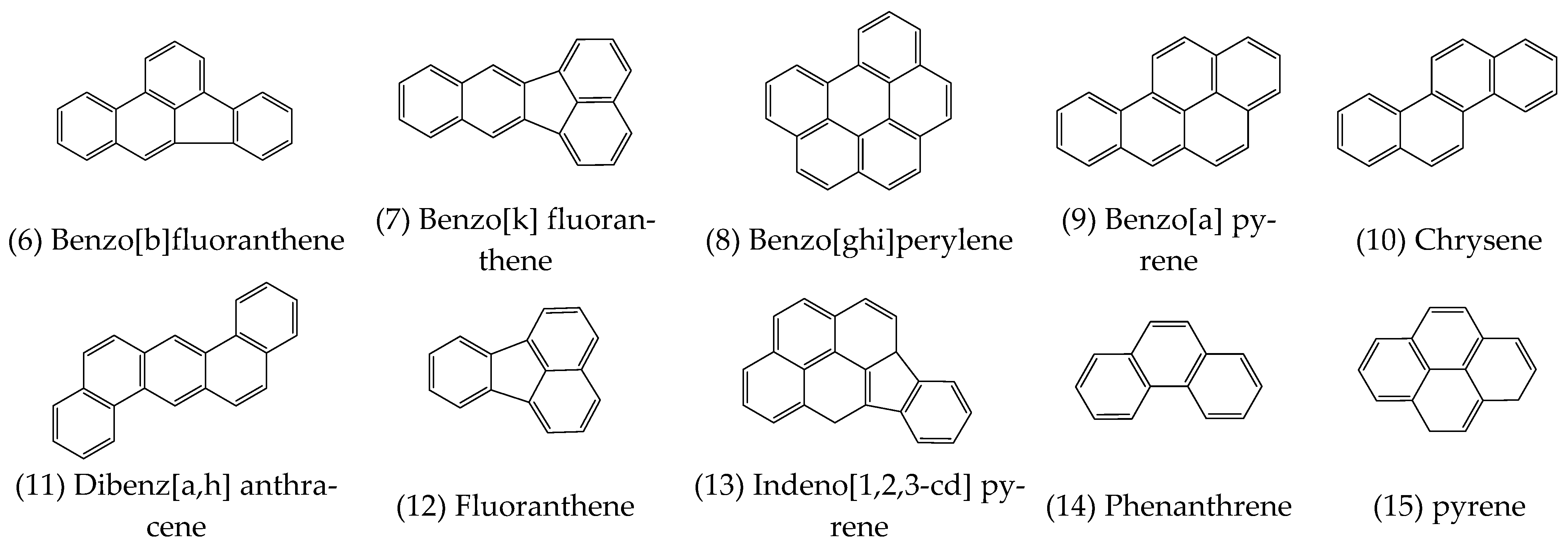
For the purpose of enhancing the adsorbability of Fe3O4 nanoparticles, hydroxypropyl-β-cyclodextrin polymer (HP-β-CDCP) was prepared and applied to graft onto Fe3O4 nanoparticles. By grafting the polymer onto magnetic nanoparticles, a recyclable and easily retrievable adsorbent was developed, which effectively removed a range of fifteen PAHs (including naphthalene (NaP), fluorene (FLu), acenaphthene (Ana), anthracene (Ant), benzo[a]anthracene (BaA), benzo[b]fluoranthene (BbF), benzo[k] fluoranthene (BkF), benzo[ghi]perylene (BpE), benzo[a]pyrene (BaP), chrysene (ChR), dibenz[a,h]anthracene (DbA), fluoranthene (Flt), indeno[1,2,3-cd]pyrene (Ipy), phenanthrene (Phe), and pyrene (Pyr)) from contaminated water. Figure 1 illustrates the chemical structures of fifteen PAHs. Attempts were intended to clarify the effects of adsorption conditions and to explore the reusability of these nanocomposites.

2. Materials and Methods

2.1. Chemicals and Reagents

PAHs were purchased from O2Si Smart Solutions (Charleston, SC, USA) with a concentration of 100 mg·L−1 and a purity was 99.5%. A standard stock solution of 200 μg·mL−1 was prepared in acetonitrile, and working solutions were freshly obtained by diluting the stock solution with the mobile phase prior to use.
Hydroxypropyl-β-cyclodextrin, carbinol, ethanol, epoxy chloropropane, acetone, sodium chloroacetate, ferrisulphas, and ferric trichloride were sourced from Shanghai Chemical Reagent Corporation (Shanghai, China). Acetonitrile was obtained from Merck Reagents (Darmstadt, Germany). Acetonitrile utilized in this study was of high-performance liquid chromatography (HPLC) grade, whereas the remaining solvents and chemicals conformed to analytical-grade standards. Ultrapure water was obtained via the Milli-Q™ Advantage A10 water purification system (Madrid, Spain).

2.2. Synthesis of HP-β-CDCP/Fe3O4 Nanocomposites

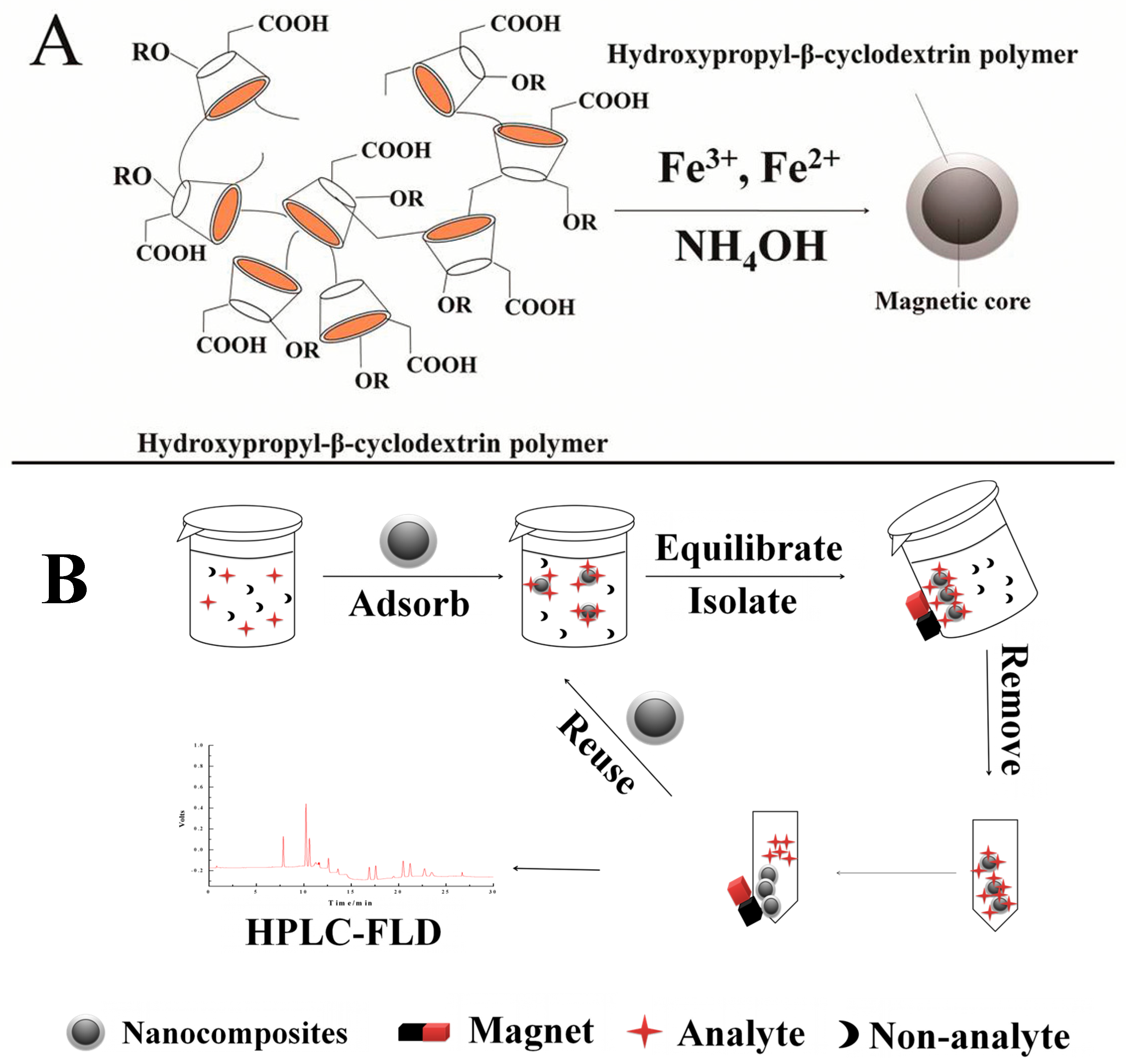
The nanocomposites were synthesized by the protocol shown in Figure 2A. Carboxymethyl-HP-β-CDCP was produced according to Badruddoza et al. [18]. HP-β-CDCP/Fe3O4 nanocomposites were prepared through a single-step co-precipitation technique. A total of 1.21 g of FeSO4.7H2O, 1.42 g FeCl3, and 3.0 g carboxymethyl-HP-β-CDCP were dispersed in 40 mL of ultrapure water and stirred at 1200 rpm. After heating the solution to 90 °C, 5 mL of NH4OH (25%) was introduced. Resulting nanoparticles were prepared after stirring for 1 h.

2.3. Analytical Technique

Magnetic solid-phase extraction procedure is shown in Figure 2B. First, HP-β-CDCP/Fe3O4 nanocomposites were introduced to a 100 mL water sample with fifteen kinds of PAHs (pH 7.0), and the product was transferred to a platform shaker at low speed and equilibrated for 15 min at 30 °C. A neodymium magnet was positioned under the conical flask, extracting the nanocomposites from the suspension. The liquid supernatant was analyzed with an HPLC system equipped with a fluorescence detector (FLD), model Agilent 1260, purchased from Agilent Technologies, Inc. (Santa Clara, CA, USA). The Agilent 1260 detector thermal condition was remained maintained at 25 °C and 2.2 mL min−1. A mixture of acetonitrile and water was adopted as the mobile phase. Table 1 outlines the gradient elution program, while Table 2 summarizes the time program of fluorescence detection.

2.4. Adsorption Kinetics

In the procedure, 60 mg (m) of HP-β-CDCP/Fe3O4 nanocomposites was added into a centrifuge tube with each PAH (BaP and Ant) of 100 mL (V) of working solution. To promote efficient adsorbate–adsorbent interaction, the solution was oscillated at 20 °C across a series of contact times (1, 2, 4, 6, 8, 12, 15, 20, 25, and 30 min). After extraction, the adsorbent was magnetically extracted, and the residual content of PAHs was analyzed using HPLC. The removal rate of PAHs was quantified as follows:
R %   =   C 0     C e C 0 × 100 %
where R represents the removal rate of PAHs, and Ce and C0 represent the ultimate concentration and initial concentration of PAHs (μg·L−1), respectively:
Q t   =   c 0     c t m V
Qt (mg·g−1) represents the adsorption capacity of the adsorbent for each PAH as a function of time, and Ct (μg·L−1) represents the concentration of ions remaining in the solution at time t (h):
Q e = c 0     c e m V
Qe (mg·g−1) represents the equilibrium constant.
The kinetic models of pseudo-first and pseudo-second order were evaluated. The parameters of these models are expressed as follows:
Pseudo-First   Order   kinetic   model :   Q t   =   Q e ( 1   e k 1 t )
k1 represents the rate constant (min−1).
Pseudo-Second   Order   kinetic   model :   Q t = t ( 1 k 2 Q e 2 ) + t Q e
k2 represents the constant rate (g·mg−1·min−1).

2.5. Adsorption Isotherms

The isothermal adsorption model could be used to analyze the mechanism of equilibrium adsorption between solid and liquid. At 298 K, by changing the initial concentration of PAHs, the maximum adsorption capacity of HP-β-CDCP/Fe3O4 nanocomposites was investigated, and the Langmuir (6) and the Freundlich (7) isotherm models were utilized for fitting:
C e Q e = 1 K L Q m a x + C e Q m a x
ln Q e = ln K F + ( 1 n F ) ln C e
In these equations, Ce represents the equilibrium concentration (mg·L−1), and Qe and Qmax represent the equilibrium adsorption amount and the maximum adsorption amount (mg·g−1), respectively. KL was the Langmuir constant (L·mg−1), nF and KF were the Freundlich constants (mg(1−n)·g−1·Ln).

2.6. Adsorption Thermodynamics

In order to investigate whether the adsorption process on HP-β-CDCP/Fe3O4 nanocomposites was endothermic or exothermic and whether it was a spontaneous process, the thermodynamic parameters of adsorption were calculated. The calculation of thermodynamic parameters under standard conditions was as follows:
k d = ( C 0 C e ) × V m × C e
ln k d = Δ S θ R Δ H θ R T
Δ G θ = Δ H θ T Δ S θ
Among them, ΔSθ was the entropy change (J·(mol·K)−1), ΔHθ was the enthalpy change (J·(mol·K)−1), R was the gas constant (8.3145 J·mol−1·K−1), kd was the distribution coefficient, and ΔGθ was the Gibbs free energy (kJ·mol−1).

3. Results

3.1. Characterization of HP-β-CDCP/Fe3O4 Nanocomposites

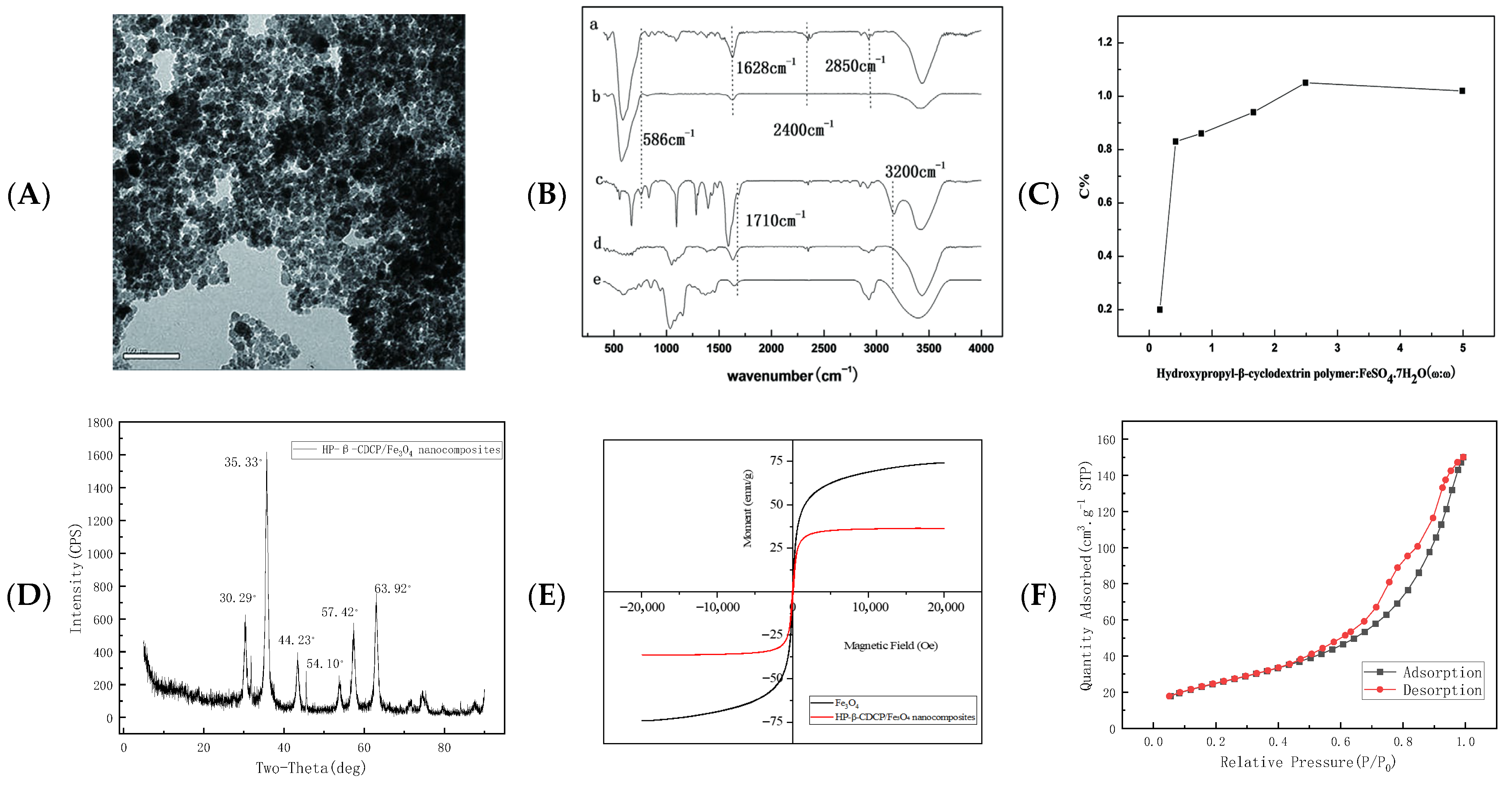
Figure 3A illustrates the transmission electron microscopy (TEM) images of HP-β-CDCP/Fe3O4. As exhibited in the images, the nanoparticles possessed a well-defined spherical core–shell structure, with an average diameter of 20 nm (statistically calculated from more than 50 randomly selected particles in the TEM field of view), which was consistent with the typical size range of cyclodextrin-functionalized magnetic nanomaterials reported in the literature [26].
Figure 3B presents FTIR spectra of HP-β-CDCP/Fe3O4 nanocomposites (curve a), Fe3O4 nanocomposites (curve b), carboxymethyl-HP-β-CDCP (curve c), HP-β-CDCP (curve d), and hydroxypropyl-β-cyclodextrin (curve e). Characterization data are provided below.
Carboxymethyl-hydroxypropyl-β-cyclodextrin polymer (curve c): A stretching vibration peak of C=O (ν(C=O)) appeared at 1710 cm−1, and a stretching vibration peak of O–H (ν(O–H)) was observed at 3200 cm−1. These peaks were consistent with the characteristic infrared responses of carboxyl groups (–COOH), confirming that –COOH has been successfully grafted onto the backbone of the hydroxypropyl-β-cyclodextrin polymer.
Hydroxypropyl-β-cyclodextrin polymer/Fe3O4 nanocomposites (curve a): The absorption peak at 586 cm−1 corresponded to the characteristic vibration of Fe–O bonds in the tetrahedral sites of Fe3O4 (a typical infrared marker for magnetic nanoparticles). Meanwhile, C–H stretching vibration peaks (ν(C–H)) were detected at 2400 cm−1 and 2850 cm−1, along with a C=O vibration peak at 1628 cm−1 (which underwent a redshift compared to curve c, attributed to the coordination interaction between C=O and the Fe3O4 surface). The coexistence of these characteristic peaks, combined with the observation that only the 586 cm−1 peak exists in curve b (pure Fe3O4), confirmed that the carboxymethyl-hydroxypropyl-β-cyclodextrin polymer has been successfully coated on the surface of Fe3O4 nanoparticles.
Figure 3C shows the carbon mass fraction (C%) in hydroxypropyl-β-cyclodextrin polymer-coated Fe3O4 nanocomposites as a function of the molar feed ratio (n) of hydroxypropyl-β-cyclodextrin polymer to FeSO4·7H2O. As n increased from 0 to 1, C% rose sharply from 0.2 to 0.8: this rapid increase was attributed to the progressive coating of the Fe3O4 surface by the carbon-rich cyclodextrin polymer. When n was further increased to 2, C% reached approximately 1.0 and then stabilized. The observed plateau suggested that the Fe3O4 nanoparticles were fully encapsulated by the polymer, as the finite surface area of Fe3O4 restricts further polymer adsorption—consistent with the limited number of coordination sites available on Fe3O4 for polymer binding.
As shown in Figure 3D, the XRD pattern of the HP-β-CDCP/Fe3O4 nanocomposites exhibits six distinct diffraction peaks at 2θ values of 30.29°, 35.33°, 44.23°, 54.10°, 57.42°, and 63.92°, which correspond well with the reference pattern of Fe3O4 (JCPDS card No. 19-629) from the International Centre for Diffraction Data.
Figure 3E shows the hysteresis curves of Fe3O4 particles and HP-β-CDCP/Fe3O4 nanocomposites, respectively. The measured saturation magnetization values for the two materials were 74.6 emu·g−1 and 36.8 emu·g−1, respectively. The coercivity values of both adsorbents were found to be close to zero, indicating excellent superparamagnetic behavior. After modification of Fe3O4 nanoparticles with non-magnetic HP-β-CDCP, a reduction in saturation magnetization was observed. However, the HP-β-CDCP/Fe3O4 nanocomposites still maintained strong magnetic properties, enabling effective magnetic separation under an external magnetic field.
To analyze the specific surface area and porosity of the material, N2 adsorption–desorption isotherms were performed, with the corresponding results presented in Figure 3F. As shown in Figure 3F, the N2 adsorption–desorption isotherm of the material exhibited a Type IV isotherm with H3 hysteresis loop observed in the relative pressure (P/P0) range of 0.4–1.0, indicating a mesoporous structure (pore size range: 2–50 nm). Based on the isotherm data, the Brunauer–Emmett–Teller (BET) specific surface area was equal to 91.5 m2·g−1, and the total pore volume was calculated as 0.230 cm3·g−1.

3.2. Effects of Operation Parameters on PAH Removal

3.2.1. Effect of HP-β-CDCP

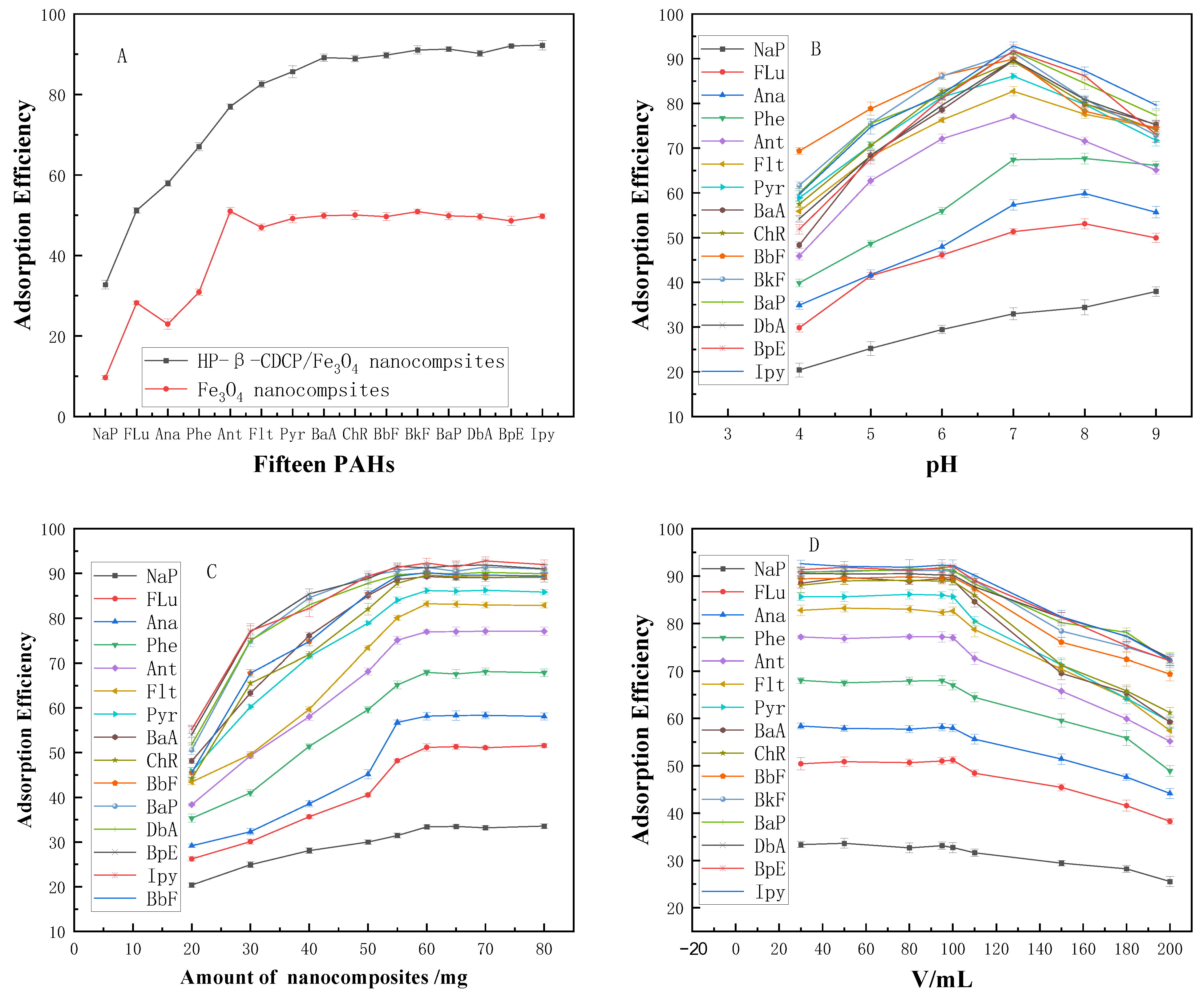
In this study, Fe3O4 nanocomposites and HP-β-CDCP/Fe3O4 nanocomposites were synthesized. The adsorption performance of PAHs with HP-β-CDCP/Fe3O4 nanocomposites as sorbent was significantly elevated compared to Fe3O4 nanocomposites in Figure 4A, due to the inclusion interaction between PAHs and HP-β-CDCP of HP-β-CDCP/Fe3O4 nanocomposites.

3.2.2. Effect of pH

The solution’s pH impacts the adsorption process, especially the efficiency of the adsorbent–analyte interaction. The influence of initial solution pH for the adsorption of fifteen PAHs onto HP-β-CDCP/Fe3O4 nanocomposites was investigated at pH 4.0–9.0. Based on the removal performance for all analytes (Figure 4B), we could come to the following conclusions. The adsorption efficiency of PAHs enhanced with the pH surged from 4.0 to 7.0. The extraction efficiency of NaP, Flu, Ana, and Phe increased further with a further surge in pH and reached the maximum at pH 8.0; meanwhile, the extraction efficiency of other PAHs decreased gradually. The removal performance of all analytes onto HP-β-CDCP/Fe3O4 nanocomposites reached almost the optimal value (33.9–93.1%) in pH 7.0. The experimental results demonstrated that the cavity size and hydrophobicity of the HP-β-CDCP/Fe3O4 nanocomposites were closely correlated with the protonation state of the surface hydroxyl groups. Under acidic conditions, protonation of the hydroxyl moieties elevated the cavity polarity, which attenuated the hydrophobic interactions between the cavity and PAHs and, consequently, impaired the inclusion efficiency. At neutral pH, the HP-β-CD cavities exhibited an optimal hydrophobic microenvironment, which facilitated the embedding of PAH molecules and thus maximized the host–guest inclusion effect. In alkaline media, deprotonation of the hydroxyl groups induced subtle alterations in the cavity structure. This conformational change favored the encapsulation of specific PAHs with matching molecular sizes (e.g., NaP and Flu), while diminishing the encapsulation affinity for PAHs with mismatched dimensions. So, pH 7.0 was selected for this work.

3.2.3. Effect of Extraction Time

To investigate the influence of extraction time on the removal efficiency of PAHs, various durations ranging from 1 to 30 min were tested. The extraction efficiency increased with time and plateaued after 15 min, indicating equilibrium. Therefore, 15 min was selected as the optimal extraction time.

3.2.4. Effect of Nano-Adsorbent Dosage

Amount of HP-β-CDCP/Fe3O4 nanocomposite impact on the adsorption efficiency of PAHs. Different amounts of nanocomposites were analyzed with 20~80 mg (Figure 4C). An increase in HP-β-CDCP/Fe3O4 nanocomposites led to a corresponding rise in adsorption efficiency, and this reached the maximum when the amount of nanocomposites was 60 mg. A further increase in adsorbent dosage (exceeding 60 mg) did not improve the adsorption efficiency, which was attributed to the aggregation of nanocomposite particles. Excessive adsorbents tended to form aggregates in the solution, which reduced the specific surface area accessible to PAHs and hindered the diffusion of PAH molecules to the internal active sites, resulting in the plateau of adsorption efficiency. Therefore, 60 mg was identified as the most effective.

3.2.5. Effect of Sample Volume

For improved removal performance in reduced operational time, the sample volume was studied from 30 to 200 mL with a fixed amount of PAHs and nanocomposites. As the sample volume > 100 mL, the extraction performance decreased in Figure 4D. This study used a sample volume of 100 mL.

3.3. Adsorption Kinetics of HP-β-CDCP/Fe3O4 Nanocomposites

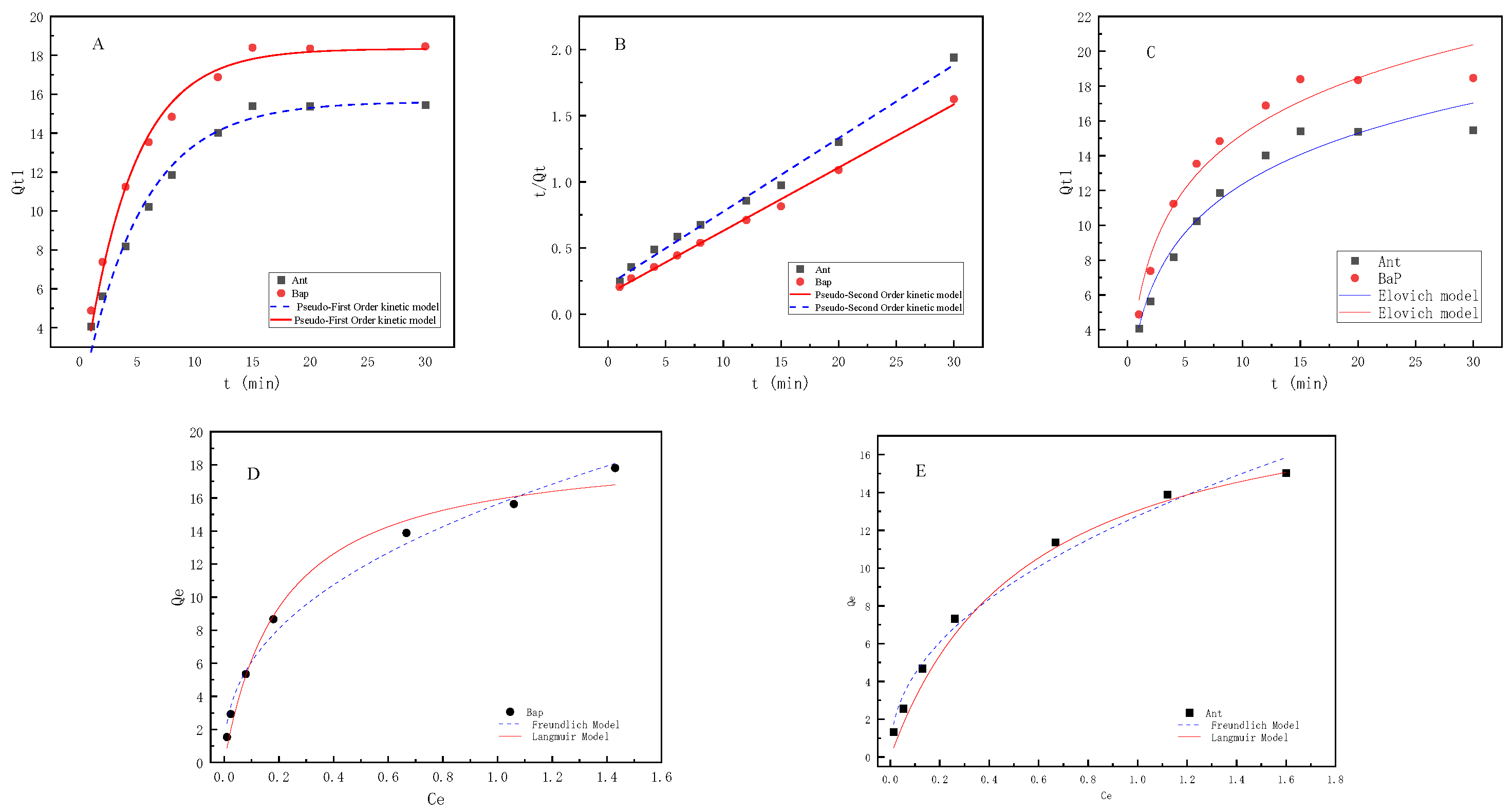
To evaluate the adsorption kinetics of the HP-β-CDCP/Fe3O4 nanocomposites, benzo[a]pyrene (BaP) and anthracene (Ant) were selected as representative PAHs. The kinetic behavior was simulated via both pseudo-first-order and pseudo-second-order equations (Figure 5A,B). The kinetic parameters obtained from the fitting results are detailed in Table 3. Among the two models, the pseudo-second-order model demonstrated a better fit, with higher correlation coefficients (R2), suggesting it more accurately describes the extraction process. This outcome indicates that the adsorption mechanism of HP-β-CDCP/Fe3O4 involves a combination of physisorption and chemisorption processes [27]. As in Figure 5C, the Elovich model demonstrated enhanced fitting performance, indicating that the adsorption process was controlled by chemical adsorption mechanisms. These mechanisms involve specific interactions between heterogeneous active sites on the composite surface and PAH molecules. The hydrophobic cavity of HP-β-CD can encapsulate the benzene rings of PAHs through hydrophobic effects and van der Waals forces, resulting in the formation of host–guest complexes. This interaction exhibits a certain degree of specificity and can be regarded as a type of weak chemical adsorption.

3.4. Adsorption Isotherms of HP-β-CDCP/Fe3O4 Nanocomposites

The isothermal adsorption model was employed to investigate the equilibrium adsorption mechanism between solid and liquid phases. At 298.15 K, the maximum adsorption capacity of HP-β-CDCP/Fe3O4 nanocomposites was evaluated by varying the initial concentrations of Ant and Bap. The experimental data were fitted using the Langmuir Equation (6) and the Freundlich Equation (7), and the data results are presented in Table 4 and Figure 5D,E. Comparative analysis of the linear correlation coefficients revealed that the R2 values for PAHs in the Freundlich isothermal model (Ant: 0.9838; Bap: 0.9903) were higher than those in the Langmuir model (Ant: 0.9747; Bap: 0.9838), suggesting a heterogeneous adsorption surface and the occurrence of multilayer adsorption. Furthermore, all 1/nF values were less than 1, indicating a nonlinear relationship between analyte concentration and adsorption capacity. This implies that while analyte concentration influences adsorption, other factors—such as chemical interactions—also contribute significantly, thereby enhancing the overall adsorption potential.

3.5. Adsorption Thermodynamics of HP-β-CDCP/Fe3O4 Nanocomposites

The adsorptions of Ant and Bap onto HP-β-CDCP/Fe3O4 nanocomposites were examined at 298.15, 308.15, and 318.15 K. Thermodynamic parameters, calculated using Equations (8)–(10), were summarized in Table 5. The negative ΔG values indicated a spontaneous adsorption process. Given that ΔG lies between –20 kJ mol−1 and 0 kJ mol−1, the adsorption of PAHs was interpreted as predominantly physical, such as π–π interactions, hydrogen bonding, and Van der Waals forces. The negative ΔH further confirmed the exothermic nature of adsorption. In addition, the positive ΔS suggested that adsorptions of both Ant and Bap were spontaneous across the studied temperature range.

3.6. Analyses

3.6.1. Regeneration and Reusability Study

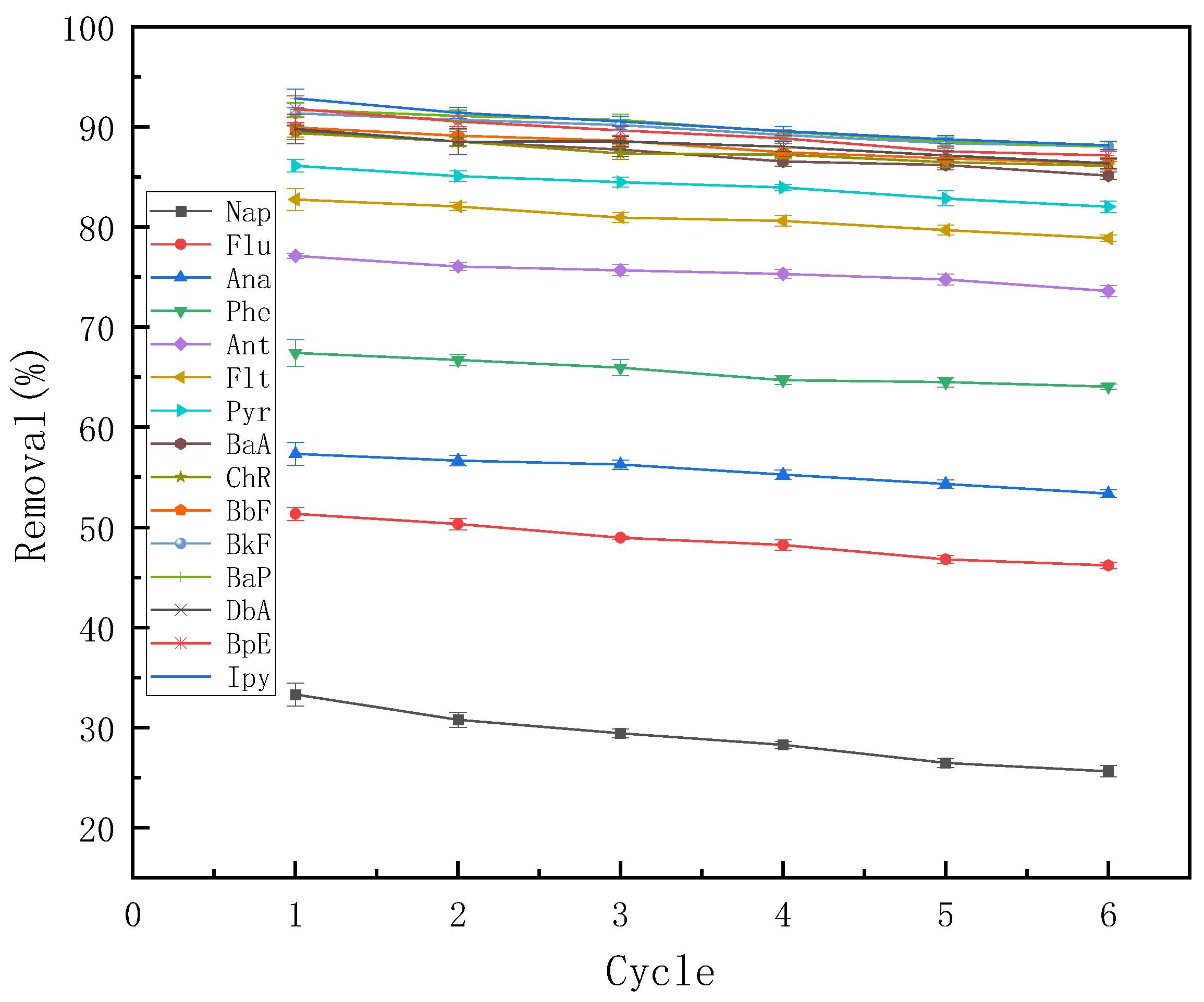
To study the regeneration and reusability potential of these nanocomposites as an adsorbent, desorption experiments were conducted. Acetonitrile was, consequently, chosen as the optimal eluent, and the nanocomposites were rinsed with 3 mL acetonitrile twice following each PAH’s adsorption. PAHs’ adsorptions on the nanocomposites are dominated by hydrophobic interactions and host–guest inclusion complex formation between PAHs’ molecules and the hydrophobic cavities of HP-β-CD. Acetonitrile’s solubility parameter (24.5 MPa1/2) was highly compatible with that of PAHs (18.0–22.0 MPa1/2), facilitating strong solvation of PAHs and promoting their transfer from HP-β-CD cavities to the eluent phase. According to Figure 6, the highest removal efficiencies (%) for PAHs on the surface of the HP-β-CDCP/Fe3O4 nanocomposites were achieved in the 1st cycle. After the 6th cycle, the removal efficiencies have exhibited a decline of 3% to 6%. This decrease in the removal efficiency may be attributed to the damage of some adsorption sites and the blockage of the others due to the failure to desorb the PAHs as a result of the strong interaction between PAHs and HP-β-CDCP/Fe3O4 nanocomposites. Recyclability tests demonstrated that the prepared nanoadsorbents can be used many successive times for the removal of PAHs from wastewater.

3.6.2. Adsorption Capacity

The adsorption capacity (i.e., the equilibrium dosage of PAHs adsorbed per gram of the nanocomposites in a competitive system) is an important factor for evaluation of the HP-β-CDCP/Fe3O4 nanocomposites. In this study, the maximum uptakes for NaP, FLu, Ana, Phe, Ant, Flt, Pyr, BaA, ChR, BbF, BkF, BaP, DbA, BpE, and Ipy in competitive adsorption mode were 6.46 mg·g−1, 10.2 mg·g−1, 11.8 mg·g−1, 13.6 mg·g−1, 15.4 mg·g−1, 16.6 mg·g−1, 17.6 mg·g−1, 18.1 mg·g−1, 17.9 mg·g−1, 18.2 mg·g−1, 18.5 mg·g−1, 18.4 mg·g−1, 18.0 mg·g−1, 18.6 mg·g−1, and 19.0 mg·g−1, respectively.

3.6.3. Analysis of Simulated Wastewater

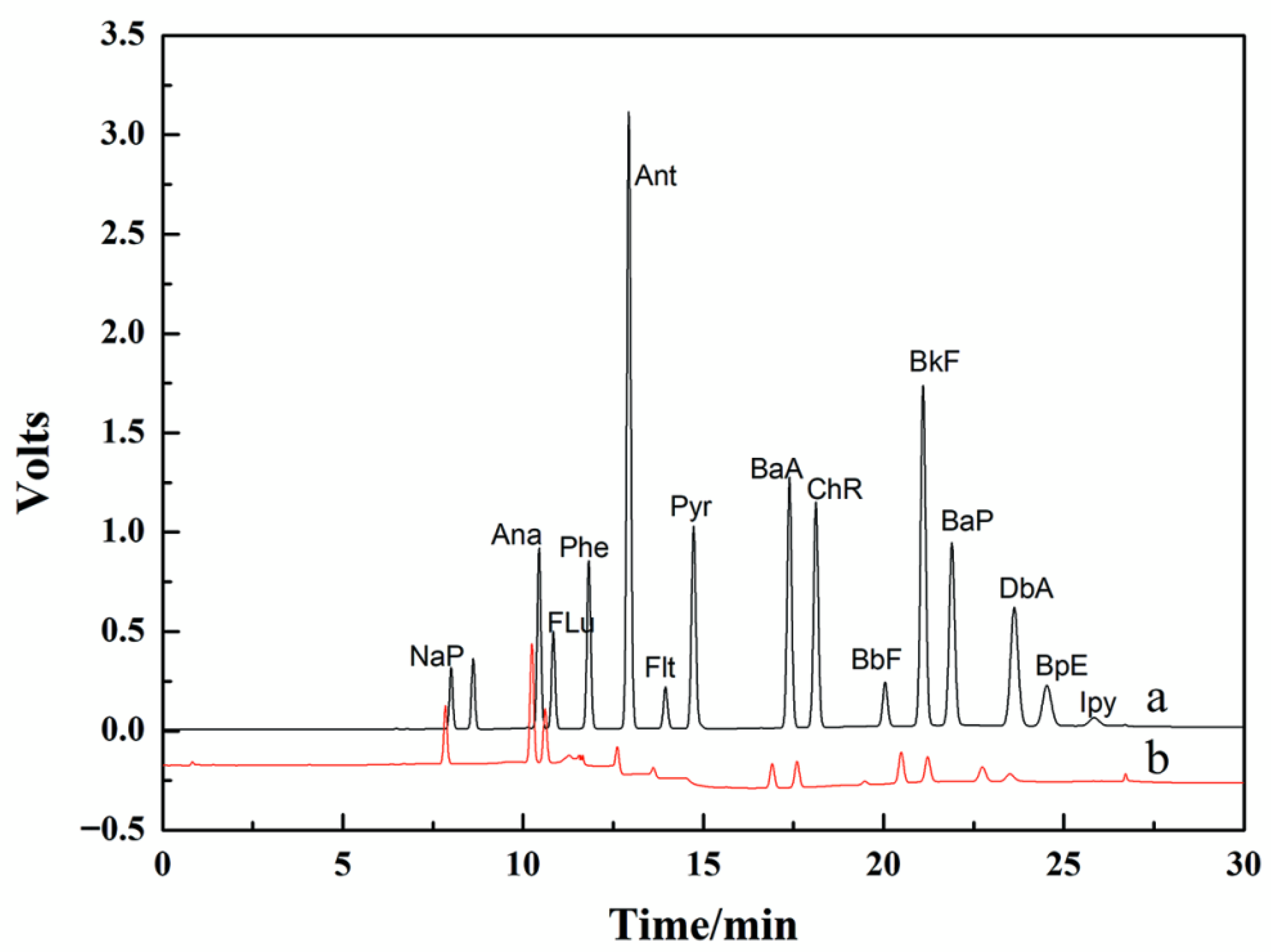
To validate its practical applicability, the adopted approach was employed to quantify PAHs in simulated wastewater. Figure 7 illustrates HPLC-FLD chromatograms of wastewater samples before and after extraction. By comparing the peak area of curve a and curve b, the absorption efficiency is enhanced with the increasing ring number of PAHs. This indicated that the clathration is a key factor influencing this adsorption process. Correction curve, correlation coefficient, and removal efficiency of PAHs are listed in Table 6.

3.7. Comparative Study

To evaluate the adsorption performance of the HP-β-CDCP/Fe3O4 nanocomposite, a comparative analysis was conducted against various adsorbents documented in the existing literature. The findings are presented in Table 7. Conventional adsorbents, such as GAC, exhibited relatively weak adsorption capacities toward PAHs. Although the G-mCS/GO composite demonstrated superior adsorption performance for Nap compared with HP-β-CDCP/Fe3O4 nanocomposites, the latter displayed a stronger affinity for PAHs with polycyclic skeletons (e.g., Flt). Furthermore, the adsorptive performance of the material developed in this work outperforms that of β-CD-MSNs, which could be attributed to the fact that β-CD polymers provided more binding sites for PAHs than β-CD monomers, while the incorporation of Fe3O4 endowed the composite with magnetically separable capability. When benchmarked against emerging adsorbents reported in recent years (e.g., DNA magnetic nanoparticles and polyester microfibers), HP-β-CDCP/Fe3O4 nanocomposites also show advantages in both adsorption capacity and applicable PAH range. The results demonstrated that the HP-β-CDCP/Fe3O4 nanocomposite developed herein exhibits distinct advantages in the adsorption capacity towards PAHs, coupled with superior overall adsorption performance. These characteristics indicate that the HP-β-CDCP/Fe3O4 nanocomposite represents a promising high-performance adsorbent for the remediation of trace persistent organic pollutants in wastewater.

4. Conclusions

In this study, Fe3O4 nanocomposites modified with HP-β-CDCP were prepared and demonstrated excellent adsorption capacity for PAHs in wastewater. The pH, temperature, and extraction time that altered the interaction of PAHs with the nanocomposites were evaluated by single-factor tests. The adsorption kinetics were evaluated using pseudo-first-order and pseudo-second-order models, with the results showing that the pseudo-second-order model more accurately described the adsorption behavior of PAHs. Isotherm data were fitted to both Langmuir and Freundlich models, and the Freundlich model provided a better fit to the experimental data, indicating heterogeneous surface adsorption with multilayer characteristics. Thermodynamic analysis revealed that the adsorption of PAHs was spontaneous and exothermic, involving multiple interaction mechanisms such as π–π interactions, hydrogen bonding, and van der Waals forces. This nano-adsorbent showed exceptional adsorption performance and enabled efficient extraction of PAHs from large sample volumes within a short time. Therefore, we can expect extensive application of HP-β-CDCP/Fe3O4 nanocomposites in wastewater treatment.

Author Contributions

Conceptualization, W.P. and Q.Y.; methodology, W.P.; software, Y.S.; validation, J.Y. and X.C.; formal analysis, J.Y.; investigation, W.Z.; resources, W.Z.; data curation, Y.S.; writing—original draft preparation, W.P.; writing—review and editing, Q.Y.; visualization, Q.Y.; supervision, W.Z.; project administration, Q.Y.; funding acquisition, Q.Y. All authors have read and agreed to the published version of the manuscript.

Funding

This research was funded by the Nantong Municipal Natural Science Foundation under grant number JCZ2024003; the Health Commission of Nantong City under grant number MS2024086; and the Health Commission of Jiangsu Province under grant number Z2024030. The APC was funded by the Health Commission of Nantong City under grant number MS2024086.

Institutional Review Board Statement

Not applicable.

Informed Consent Statement

Not applicable.

Data Availability Statement

The original contributions presented in this study are included in the article. Further inquiries can be directed to the corresponding author.

Conflicts of Interest

The authors declare no conflict of interest.

References

  1. Wang, Z.; Zhao, H.; Zhao, L. Distribution Characteristics and Pollution Sources Analysis of Polycyclic Aromatic Hydrocarbons and Phthalate Esters in the Seawater of Land-Based Outlets around Zhanjiang Bay in Spring. Water 2024, 16, 948. [Google Scholar] [CrossRef]
  2. Dai, Q.; Wang, Y.; Chen, L.; Li, P.; Xia, S.; Huang, Q. Contamination of 16 priority polycyclic aromatic hydrocarbons (PAHs) in urban source water at the tidal reach of the Yangtze River. Environ. Sci. Pollut. Res. 2022, 29, 61222. [Google Scholar] [CrossRef]
  3. Półtorak, A.; Onopiuk, A.; Kielar, J.; Chojnacki, J.; Najser, T.; Kukiełka, L.; Najser, J.; Mikeska, M.; Gaze, B.; Knutel, B.; et al. Polycyclic Aromatic Hydrocarbons (PAHs) in Wheat Straw Pyrolysis Products Produced for Energy Purposes. Sustainability 2024, 16, 9639. [Google Scholar] [CrossRef]
  4. Choi, E.; Lee, J.Y.; Kim, Y.P. Long-term (1993–2018) particulate polycyclic aromatic hydrocarbons (PAHs) concentration trend in the atmosphere of Seoul: Changes in major sources and health effects. Atmos. Environ. 2024, 325, 11. [Google Scholar] [CrossRef]
  5. Alharbi, H.A.; Alotaibi, K.D.; EL-Saeid, M.H.; Giesy, J.P. Polycyclic Aromatic Hydrocarbons (PAHs) and Metals in Diverse Biochar Products: Effect of Feedstock Type and Pyrolysis Temperature. Toxics 2023, 11, 96. [Google Scholar] [CrossRef] [PubMed]
  6. Cheng, M.; Tan, Z.; Zeng, X.; Liu, Z.; Liu, P.; Ali, A.; Qiu, H.; Jiang, W.; Qin, H. Contamination and Health Risk Assessment of Polycyclic Aromatic Hydrocarbons in Seasoning Flour Products in Hunan, China. Int. J. Environ. Res. Public Health 2023, 20, 963. [Google Scholar] [CrossRef] [PubMed]
  7. Du, W.; Sun, J.; Wang, J.; Sun, H.Z.; Liu, W.; Zhang, Y.; Lin, N.; Chen, Y.; Shen, G. Inhalation exposure to polycyclic aromatic hydrocarbons (PAHs) bound to very fine particles (VFPs): A multi-provincial field investigation in China. Build. Environ. 2024, 261, 8. [Google Scholar] [CrossRef]
  8. Jacob, A.A.; Oparinu, A.R.; Haleemat, A.T.; Oladapo, A.O. Sources, Toxicity, Health and Ecological Risks of Polycyclic Aromatic Hydrocarbons (PAHs) in the Sediment of an Osogbo Tourist River. Soil Sediment Contam. 2022, 31, 669. [Google Scholar]
  9. Abbasi, M.; Aziz, R.; Rafiq, M.T. Efficient performance of InP and InP/ZnS quantum dots for photocatalytic degradation of toxic aquatic pollutants. Environ. Sci. Pollut. Res. 2024, 31, 19986. [Google Scholar] [CrossRef]
  10. Singh, A.; Dhau, J.; Kumar, R.; Badru, R.; Singh, P.; Mishra, Y.K.; Kaushik, A. Tailored carbon materials (TCM) for enhancing photocatalytic degradation of polyaromatic hydrocarbons. Prog. Mater. Sci. 2024, 144, 101289. [Google Scholar] [CrossRef]
  11. Wang, X.; Zhang, Z.; Ru, J. Hierarchical porous MOFs@COFs-based molecular trap solid-phase microextraction for efficient capture of PAHs and adsorption mechanisms. Sep. Purif. Technol. 2024, 328, 125041. [Google Scholar] [CrossRef]
  12. Law, S.K.; Fung, Y.; Chan, H.Y.; Han, J.; Lo, C.M. A Mini-Review for an Adsorption of Polycyclic Aromatic Hydrocarbons (PAHs) by Physical Gel. Biointerface Res. Appl. Chem. 2021, 6, 8195. [Google Scholar] [CrossRef]
  13. Pathak, S.; Pant, K.K.; Kaushal, P. Modified Sugarcane leaf biochar for remediation of polycyclic aromatic hydrocarbons (PAHs) from wastewater: Activation, optimization, mechanism. Bioresour. Technol. Rep. 2025, 30, 102113. [Google Scholar] [CrossRef]
  14. Jiang, B.; Feng, S.; Zhang, J. The Adsorption and Regeneration of Magnetic Modified Bentonite Composite for Dye Wastewater. Key Eng. Mater. 2022, 905, 338. [Google Scholar]
  15. Tee, G.T.; Gok, X.Y.; Yong, W.F. Adsorption of pollutants in wastewater via biosorbents, nanoparticles and magnetic biosorbents: A review. Environ. Res. 2022, 212, 113248. [Google Scholar] [CrossRef]
  16. Liu, X.F.; Lu, X.; Huang, Y.; Liu, C.W.; Zhao, S.L. Fe3O4@ionic liquid@methyl orange nanoparticles as a novel nano-adsorbent for magnetic solid-phase extraction of polycyclic aromatic hydrocarbons in environmental water samples. Talant 2014, 119, 341. [Google Scholar] [CrossRef]
  17. Hashemi, S.H.; Soleimani, M. Usage of magnetic activated carbon as a potential adsorbent for aniline adsorption from wastewater. Sci. Rep. 2025, 15, 4570. [Google Scholar] [CrossRef]
  18. Badruddoza, A.Z.M.; Shawon, Z.B.Z.; Daniel, T.W.J.; Hidajat, K.; Uddin, M.S. Fe3O4/cyclodextrin polymer nanocomposites for selective heavy metals removal from industrial wastewater. Carbohyd. Polym. 2013, 91, 322. [Google Scholar] [CrossRef] [PubMed]
  19. Hong, S.J.; Park, B.R.; Lee, B.H.; Cho, J.Y.; Park, B.S.; Kim, Y.M. A comparative study on the characteristics and properties of cyclodextrans, cyclodextrins, and their complexes with biologically active compounds. Food Hydrocoll. 2025, 168, 111587. [Google Scholar] [CrossRef]
  20. Zhao, X.; Zhou, X.; Cheng, Q.; Liu, Y. Blue phosphorescent solid supramolecular assemblies between hydroxypropyl-β-cyclodextrin and triazine derivatives for achieving multicolor delayed fluorescence. Nano Today 2025, 60, 102561. [Google Scholar] [CrossRef]
  21. Lu, Y.; Sun, G. Hydroxypropyl-β-cyclodextrin encapsulated stationary phase based on silica monolith particles for enantioseparation in liquid chromatography. J. Sep. Sci. 2020, 44, 735. [Google Scholar] [CrossRef]
  22. Prabhu, A.A.M.; Kumar, G.S.S.; Rajendiran, N.; Sathiyaseelan, K.; Balamathi, M. Interactions between Diphenylamine with 2-Hydroxypropyl β-Cyclodextrin based on Spectral, Biological and Theoretical Investigations. J. Macromol. Sci. Part B 2024, 63, 536. [Google Scholar] [CrossRef]
  23. Maniyazagan, M.; Chakraborty, S.; Sánchez, H.P.; Stalin, T. Encapsulation of triclosan within 2-hydroxypropyl-β-cyclodextrin cavity and its application in the chemisorption of rhodamine B dye. J. Mol. Liq. 2019, 282, 235. [Google Scholar] [CrossRef]
  24. Niki, J.; Watson, M.; Tubi, A.; Oli, M.; Agbaba, J. Recent trends in the application of magnetic nanocomposites for heavy metals removal from water: A review. Sep. Sci. Technol. 2024, 59, 40. [Google Scholar] [CrossRef]
  25. Mehmood, A.; Khan, F.S.A.; Mubarak, N.M.; Tan, Y.H.; Mazari, S.A. Magnetic nanocomposites for sustainable water purification—A comprehensive review. Environ. Sci. Pollut. Res. 2021, 28, 19563. [Google Scholar] [CrossRef]
  26. Vinu, A.; Miyahara, M.; Ariga, K. Biomaterial immobilization in nanoporous carbon molecular sieves: Influence of solution pH, pore volume, and pore diameter. J. Phys. Chem. B 2005, 109, 6436–6441. [Google Scholar] [CrossRef]
  27. Wang, X.S. Preparation of Nitro/Amino-Functionalized Magnetic Covalent Organic Frame Adsorbents and Their Application in Bisphenol Analysis. Master’s Dissertation, Northwest University of China, Xi’ an, China, 2021. [Google Scholar]
  28. Eeshwarasinghe, D.; Loganathan, P.; Vigneswaran, S. Simultaneous removal of polycyclic aromatic hydrocarbons and heavy metals from water using granular activated carbon. Chemosphere 2019, 223, 616. [Google Scholar] [CrossRef]
  29. Queiroz, R.N.; Neves, T.D.F.; Silva, M.G.C.D.; Mastelaro, V.R.; Vieira, M.G.A.V.; Prediger, P. Comparative efficiency of polycyclic aromatic hydrocarbon removal by novel graphene oxide composites prepared from conventional and green synthesis. J. Clean. Prod. 2022, 361, 132244. [Google Scholar] [CrossRef]
  30. Jiang, H.; Li, J.; Ma, J.; Huang, G.X.; Yan, L.J. Adsorption performance of DNA magnetic nanoparticles to phenanthrene in Water. Chin. J. Environ. Eng. 2024, 18, 503. [Google Scholar]
  31. Wisniowska, E.; Wlodarczyk-Makula, M. Adsorption of selected 3- and 4-ring polycyclic aromatic hydrocarbons on polyester microfibers preliminary studies. Desalin. Water Treat. 2021, 232, 414. [Google Scholar] [CrossRef]
  32. Topuz, F.; Uyar, T. Cyclodextrin-functionalized mesostructured silica nanoparticles for removal of polycyclic aromatic hydrocarbons. J. Colloid Interface Sci. 2017, 497, 233. [Google Scholar] [CrossRef] [PubMed]
Figure 1. Chemical structure of fifteen PAHs.
Magnetochemistry 12 00004 g001aMagnetochemistry 12 00004 g001b
Figure 2. (A) Illustration of CDCP grafting on Fe3O4 nanoparticles; (B) procedure of magnetic solid-phase extraction of the target PAHs using nanocomposites.
Magnetochemistry 12 00004 g002
Figure 3. (A) TEM of HP-β-CDCP/Fe3O4 nanocomposites (magnification: ×97,000; scale bar: 100 nm); (B) FTIR spectra: a: HP-β-CDCP/Fe3O4 nanocomposites, b: Fe3O4 nanocomposites, c: carboxymethyl-HP-β-CDCP, d: HP-β-CDCP, and e: hydroxypropyl-β-cyclodextrin; (C) the elemental analysis of HP-β-CDCP/Fe3O4; (D) the XRD of HP-β-CDCP/Fe3O4 nanocomposites; (E) the magnetic field (Oe) of Fe3O4 particles and HP-β-CDCP/Fe3O4 nanocomposites; (F) the N2 adsorption–desorption isotherm of HP-β-CDCP/Fe3O4 nanocomposites.
Magnetochemistry 12 00004 g003
Figure 4. (A) The adsorption properties of Fe3O4 nanocomposites and HP-β-CDCP/Fe3O4 nanocomposites; (B) effect of solution pH on adsorption of fifteen PAHs; (C) effect of nanocomposite dosage for adsorbing fifteen PAHs; (D) effect of sample volume for adsorbing fifteen PAHs.
Magnetochemistry 12 00004 g004
Figure 5. (A) Pseudo-first-order adsorption kinetics analysis; (B) pseudo-second-order adsorption kinetics; (C) Elovich adsorption kinetics analysis; (D) Langmuir and Freundlich isotherms of Bap; (E) Langmuir and Freundlich isotherms of Ant.
Magnetochemistry 12 00004 g005
Figure 6. The reusability study of HP-β-CDCP/Fe3O4 nanocomposites for the removal of PAHs up to six cycles.
Magnetochemistry 12 00004 g006
Figure 7. HPLC-FLD chromatograms of the simulated wastewater: (a) simulated wastewater sample without magneto-solid-phase extraction; and (b) simulated wastewater sample after magneto-solid-phase extraction using HP-β-CDCP/Fe3O4 nanocomposites.
Magnetochemistry 12 00004 g007
Table 1. The gradient elution program.
Time/Min0.000.6620.025.027.030.0
Mobile
Phase
Acetonitrile (%)40401001004040
Water (%)6060006060
Table 2. The time program of fluorescence detection.
Time/Min0.011.512.513.514.519.025.2
Wavelength
λex (nm)280254254290270290305
λem (nm)340350400460390410500
Table 3. Fitting analysis for adsorption kinetics constant of HP-β-CDCP/Fe3O4 nanocomposites.
ModelParameterValue
BaPAnt
Pseudo-first order kinetic modelR20.98770.9801
k10.2370.195
Qe18.315.6
Pseudo-second order kinetic modelR20.99650.9929
k20.0150.070
Qe18.315.6
Table 4. Fitting results of adsorption isotherm constants of Ant and Bap on HP-β-CDCP/Fe3O4 nanocomposites.
AnalystLangmuir ModelFreundlich ModelElovich Model
QmaxKLR2LnFKFR2FabR2
(mg·g1)
Ant16.80.550.97471.1712.750.98386.870.2270.9564
Bap19.20.210.98401.4515.630.990310.90.2080.9534
Table 5. Parameters of thermodynamics.
AnalystΔHθ/
(kJ·mol−1)
ΔSθ/(J (mol·K)−1)ΔGθ/(kJ·mol−1)
298.15 K308.15 K318.15 K
Ant−5.761.83−6.29−6.37−6.32
Bap−5.354.42−6.67−6.70−6.76
Table 6. The correction curve, correlation coefficient, and removal efficiency of fifteen kinds of PAHS.
CompoundMolecular FormulaMolecular WeightCorrection CurveR2Removal Efficiency (%)
NaPC10H8128.17y = 135.11x + 0.680.999933.9
FLuC13H10166.22y = 231.56x + 0.970.999851.5
AnaC12H10154.21y = 419.60x + 3.940.999758.5
PheC14H10178.23y = 411.59x + 3.360.999868.0
AntC14H10178.23y = 1555.9x + 12.11177.3
FltC16H10202.25y = 115.4x + 0.40 183.2
PyrC16H10202.25y = 597.09x − 0.120.999886.3
BaAC18H12228.29y = 737.14x − 0.100.999889.7
ChRC18H12228.29y = 688.39x + 0.0440.999889.6
BbFC22H12252.31y = 139.27x + 0.84190.1
BkFC22H12252.31y = 1108x + 5.210.999991.8
BaPC20H12252.3y = 1022.4x − 11.880.999891.9
DbAC22H14278.35y = 602.19x − 1.480.999790.3
BpEC22H12276.33y = 294.04x − 2.330.999192.1
IpyC22H12276.33y = 55.38x − 0.31193.1
Table 7. Comparison of PAHs’ removal performance of different adsorbents.
MaterialPollutantAdsorption Quantity (mg·g−1)Removal Efficiency (%)Ref.
Granular activated carbon (GAC)Ana, Phe2.63, 7.36-[28]
G-mCS/GONaP, Ant, Flt11.9, 15.8, 15.493.6, 89.2, 62.3[29]
DNA magnetic nanoparticlesPhe0.22088.0[30]
Polyester microfibers3- and 4-ring PAHs0.0250–1.4262.0–88.0[31]
β-CD-MSNsPyr, Ant, Phe, Flu, Flt0.3–1.65-[32]
HP-β-CDCP/Fe3O4 nanocompositesFifteen representative PAHs6.46–19.033.9–93.1This work
Disclaimer/Publisher’s Note: The statements, opinions and data contained in all publications are solely those of the individual author(s) and contributor(s) and not of MDPI and/or the editor(s). MDPI and/or the editor(s) disclaim responsibility for any injury to people or property resulting from any ideas, methods, instructions or products referred to in the content.