


Abstract
Strawberry fruit is highly perishable and susceptible to oxidative stress and rapid quality deterioration during postharvest storage. This study evaluated the effectiveness of an edible coating based on xanthan gum (XG), enriched with citric acid (CA) and/or ascorbic acid (AA), in preserving the quality of ‘Rossetta’ strawberries stored at 4 ± 1 °C for 9 days. Coated fruits showed higher values of firmness, titratable acidity, and color parameters compared to the control, along with a more gradual increase in total soluble solids, indicating reduced dehydration and delayed ripening. In addition, treated samples retained higher levels of bioactive compounds, including total phenolics, flavonoids, and anthocyanins, as well as antioxidant activity, confirming improved nutraceutical quality during storage. By the end of storage, the combined XG+CA+AA coating modulated the antioxidant enzymatic system, enhancing the activity of superoxide dismutase (44.6%), catalase (31.6%) and ascorbate peroxidase (44.6%) in counteracting oxidative stress, accompanied by a 32.8, 45.9 and 29.8% reduction in polyphenol oxidase and lipoxygenase activities, as well as malondialdehyde content, compared to the control, respectively. Overall, the combined XG+CA+AA coating was the most effective, highlighting a synergistic action of the acids and confirming its potential to extend shelf life and preserve strawberry quality.
1. Introduction
Strawberry (Fragaria × ananassa, Duch.) is one of the most widely consumed berries, both fresh and in processed forms. According to FAOSTAT [1] data for 2024, the global area devoted to strawberry cultivation totals approximately 436.067 hectares, while world production reaches about 10.73 million tons, indicating a high average yield. Asia accounts for the largest share of production (45.3%), followed by the Americas (26.2%) and Europe (21.3%), while Africa (6.6%) and Oceania (0.6%) contribute to a much lesser extent. Within the European context, Italy plays a significant role, particularly regarding protected-environment production. According to national data (ISTAT) [2] for 2025, strawberry cultivation in greenhouses covers a total area of approximately 2.744 hectares, with a total production of about 97.410 tons.
Strawberries are characterized by an extremely short shelf life and rapid spoilage, phenomena attributable to their high sensitivity to mechanical stress, excessive softening of the tissues, and physiological changes [3]. These factors make the fruit particularly susceptible to damage during harvesting, transport, storage, and processing, increasing the risk of infection by a variety of fungal and bacterial pathogens. Their high perishability is closely linked to their unique structural characteristics: a water content ranging from 90 to 95%, a thin epidermis, and a high susceptibility to microbial infections [4]. The combination of delicate tissues, high water content, and active post-harvest metabolism contributes to limiting the fruit’s shelf life, posing a significant challenge for commercial preservation and large-scale distribution. This fruit is characterized by a rich and diverse nutritional profile, including sugars, vitamins, and minerals, as well as numerous bioactive compounds such as ascorbic acid, carotenoids, polyphenols, and folates [5].
The rapid deterioration of strawberries is a critical factor in their postharvest storage. Under refrigerated conditions, at a temperature of approximately 4 °C, the product’s shelf life is generally limited to about five days [6]. This limited shelf life is primarily attributable to the fruit’s high respiration rate, which accelerates metabolic and senescence processes. Over the past few decades, numerous approaches have been developed to extend the shelf life of strawberries and mitigate their rapid quality deterioration. These strategies include low-temperature storage [7], modified atmosphere (MA) packaging [8], and irradiation treatments using ultraviolet, gamma [9], or X-rays [10] and high-intensity ultrasound (HIU) [11]. In response to these challenges, scientific research has recently focused on innovative solutions that not only counteract deterioration processes but also ensure environmental sustainability and protect consumer health. In this context, edible coatings are emerging as one of the most promising technologies in the field of post-harvest preservation of fruits [12]. These coatings, applied directly to the fruit’s surface, form a semipermeable barrier that regulates gas exchange and moisture loss. They reduce transpiration and limit oxygen diffusion, thereby slowing down oxidative and respiratory processes [13,14]. Furthermore, they contribute to improving the product’s mechanical properties, increasing resistance to physical damage during handling and distribution [15], and can preserve or even enhance sensory characteristics such as texture, appearance, and overall acceptability [16].
Several studies have tested edible coatings based on polysaccharides, such as gellan gum [17,18], pullulan [19,20], alginate [21], chitosan [3,22], pectin [23], and carboxymethylcellulose [24] to prolong the shelf life of strawberries. These biopolymer-based coatings have been widely reported to act as semi-permeable barriers to gases and moisture, thereby reducing respiration rates, transpiration, and oxidative processes. In addition, they can serve as carriers for functional compounds such as antioxidants and antimicrobials, further enhancing their preservative effects. Overall, these coatings have demonstrated effectiveness in delaying ripening, maintaining firmness, reducing microbial growth, and preserving key quality attributes, such as color, texture, and nutritional value during storage [17,18,19,20,21,22,23,24]. However, despite the extensive research on individual polysaccharides, limited information is available on the combined use of xanthan gum with organic acids to enhance both the physicochemical stability and the antioxidant response of strawberries. This study investigated the effect of an edible coating based on xanthan gum (XG, 0.3% w/v), used as a film-forming polysaccharide matrix, in combination with citric acid (CA, 2.0% w/v) and/or ascorbic acid (AA, 1.0% w/v), on the postharvest quality of ‘Rossetta’ strawberries. The aim was to evaluate the effectiveness of different coating formulations in preserving the physicochemical and qualitative attributes of the fruits during storage. The modulation of the antioxidant enzymatic system and the mitigation of oxidative damage were evaluated during cold storage (4 ± 1 °C) up to 9 days.
2. Materials and Methods
2.1. Strawberries Samples and Edible Coatings
Strawberries (‘Rossetta®’) were harvested at the commercial ripeness stage from the experimental field of ‘Cooperativa Sole’ (Parete, Caserta, Italy; 40.9605736 N, 14.1482696 E). The fruits were transported to the CREA-OFA laboratory and carefully selected to ensure the absence of defects. Randomly selected strawberries were subjected to three different coating treatments, placed in 16 polyethylene terephthalate (PET) containers with lids and stored at 4 ± 1 °C for 9 days. The containers were not hermetically sealed; therefore, gas exchange with the external environment was not completely prevented and could occur during storage.
The strawberries were dipped into three different solutions for 60 s: xanthan gum (XG, 0.3% w/v) combined with citric acid (CA, 2.0% w/v); XG with ascorbic acid (AA, 1.0% w/v); and XG with both CA and AA. Control samples were immersed in sterile distilled water. Xanthan gum was selected due to its excellent film-forming ability, high viscosity at low concentrations, stability over a wide range of pH and temperature conditions, and proven safety and biodegradability, which make it suitable for postharvest applications. Compared with other polysaccharides, it also provides good oxygen-barrier properties and mechanical stability of the coating layer. Citric acid and ascorbic acid were included due to their well-documented antioxidant properties and their ability to enhance the oxidative stability of coated fruits. The concentrations of xanthan gum (0.3% w/v), citric acid (2.0% w/v), and ascorbic acid (1.0% w/v) were selected based on preliminary optimization trials carried out prior to the main experiment. All reagents were of analytical grade and were purchased from Merck Life Science S.r.l. (Milan, Italy).
After treatment, fruits were air-dried at room temperature and then stored in transparent PET containers, each containing eight strawberries. Three biological replicates were prepared for each treatment. Sampling was carried out at harvest (day 0) and after 3, 6, and 9 days of storage. In addition, fruits were visually inspected daily throughout the whole cold storage period.
2.2. Physico-Chemical Characterization
Fruit color variations during cold storage were evaluated by recording the CIE L*, a*, and b* parameters. Measurements were carried out on the fruit surface (n = 10) using a Minolta colorimeter (CR5, Minolta Camera Co., Osaka, Japan). The L* value represents lightness (from dark to bright), a* indicates the green–red component, and b* reflects the blue–yellow component. The hue angle (H*) and Chroma (C) were calculated using the chromaticity values a and b according to McGuire [25]. Total titratable acidity (TA; g of citric acid/L) was determined by an alkaline solution (0.1 M sodium hydroxide) to the end point at pH 8.1. Total soluble solids (TSS; °Brix) were evaluated by using a digital refractometer (Sinergica Soluzioni, DBR35, Pescara, Italy). The firmness (F) of the strawberries (n = 10) was measured using a penetrometer (TR snc, Forlì, Italy) equipped with a 6 mm probe and expressed in Newtons.
2.3. Bioactive Compounds and Antioxidant Activity
Extraction of bioactive compounds was carried out according to the procedure reported by Petriccione et al. [3]. Total phenolic content (TPC) was quantified using the Folin–Ciocalteu spectrophotometric method as described by Singleton & Rossi [26]. Analyses were performed in triplicate for each sample using 20 µL of extract in a final reaction volume of 2 mL, and the absorbance was monitored at 765 nm. The results were expressed as mg of gallic acid equivalents (GAE) per 100 g of fresh weight (FW).
Total flavonoid content (TFC) was assessed using the aluminum chloride colorimetric method as described by Zhishen et al. [27]. The assay was carried out with 200 µL of extract in a final volume of 2 mL, and results were expressed as mg of catechin equivalents (CE) per 100 g FW.
Total anthocyanin content was determined using the pH differential spectrophotometric method [28]. Briefly, 100 µL of extract was diluted separately in potassium chloride buffer (0.025 M, pH 1.0) and sodium acetate buffer (0.4 M, pH 4.5). Absorbance of each solution was measured using a UV–Vis spectrophotometer at 520 and 700 nm. Anthocyanin concentration was calculated based on the difference in absorbance between the two pH conditions and expressed as mg of cyanidin-3-glucoside equivalents (CGEs) per 100 g of fresh weight (FW).
Antioxidant activity was assessed by measuring the change in ABTS absorbance at 720 nm following the addition of the extract. The assay was performed according to the procedure described by Ferrara et al. [29], with a final reaction volume of 1 mL. The percentage reduction in ABTS concentration was determined relative to the initial value. Trolox was used as the standard, and the results were expressed as µmol Trolox equivalents (TEs) per gram of fresh weight (FW).
2.4. Enzymatic Activities
The activities of enzymes involved in oxidative processes and cellular defense were determined, including superoxide dismutase (SOD), catalase (CAT), ascorbate peroxidase (APX), polyphenol oxidase (PPO), and lipoxygenase (LOX).
2.4.1. Crude Extract
Strawberries were frozen in liquid nitrogen and ground into a fine powder using a pre-chilled mortar. The powder was resuspended (1:5 w/v) in extraction buffer containing potassium dihydrogen phosphate (500 mM; pH 7.8), sodium ethylenediaminetetraacetate (Na-EDTA) (10 mM; pH 7.0), 2% (w/v) polyvinylpolypyrrolidone, and 5 mM ascorbic acid (used exclusively for APX extraction). Samples were centrifuged at 14.000 × g for 15 min at 4 °C. The supernatant was collected into fresh tubes and used for enzymatic activity assays of CAT, SOD and APX.
2.4.2. Catalase, Superoxide and Ascorbate Peroxidase Activity
Catalase (CAT, EC 1.11.1.6) activity was assayed as reported by Petriccione et al. [3]. The reaction mixture consisted of 500 mM potassium phosphate buffer (pH 7.0), 88 mM H2O2, and 200 μL of crude enzyme extract, with a final volume of 1.5 mL. The enzymatic activity was monitored spectrophotometrically as a decrease in absorbance at 240 nm, and the results were expressed as nmol g−1 fresh weight (FW).
Superoxide dismutase (SOD; EC 1.15.1.1) and ascorbate peroxidase activities (APX; EC 1.11.1.11) were determined spectrophotometrically, as described by Pasquariello et al. [30]. The activity of SOD was assayed with a method based on the inhibition of photochemical reduction of nitroblue tetrazolium (NBT) in the presence of riboflavin. The mixture (final volume 1.5 mL) was made up of 50 mM potassium phosphate buffer (pH 7.8), 0.1 mM Na-EDTA, 13 mM methionine, 75 μM NBT, 2 μM riboflavin, and 400 μL of crude enzyme extract. Samples were then exposed to continuous light for 15 min, after which the level of absorption at a wavelength of 560 nm was measured. Enzyme activity was expressed as U g−1 fresh weight (FW).
APX activity was assayed in a 1.5 mL reaction mix containing potassium phosphate buffer (100 mM, pH 7.0), ascorbic acid (0.33 mM), H2O2 (0.35 mM), sodium EDTA (0.66 mM), and crude extract (50 μL). The activity was determined as the decrease in absorbance at 290 nm due to ascorbate oxidation, and the results were expressed as nmol g−1 fresh weight (FW).
2.4.3. Polyphenol Oxidase Activity
Polyphenol oxidase (PPO; EC.1.10.3.1) activity was determined according to Chen et al. [31], with slight modifications. The enzyme extract was obtained by homogenizing 2 g of the sample in 5 mL of sodium phosphate buffer (200 mM; pH 6.5) with 5% (w/w) PVPP. The homogenate was centrifuged at 12,500 g for 15 min at 4 °C. Then, 100 μL of supernatant was incubated with 1.4 mL of catechol (500 mM), and the increase in absorbance was monitored at 398 nm. PPO activity was expressed as nmol of catechol oxidized g−1 fresh weight (FW).
2.4.4. Lipoxygenase Activity
Lipoxygenase (LOX; EC 1.13.11.12) activity was assayed following the method described by Pasquariello et al. [30]. Frozen fruit powder (1:3 w/v) was homogenized in a potassium phosphate buffer (50 mM, pH 7.8) containing 1 mM Na-EDTA and 2% w/v PVPP. The reaction mixture (1.5 mL) contained sodium phosphate buffer (pH 6.0, 0.093 M), sodium linoleate (0.17 mM) and 50 μL of enzyme extract. LOX activity was assessed spectrophotometrically at 234 nm, and the results were expressed as nmol g−1 of fresh weight (FW).
2.4.5. Malondialdehyde Content
The malondialdehyde (MDA) content was determined according to the method described by Goffi et al. [32], with minor modifications. Briefly, 1.0 g of frozen fruit tissue powder was homogenized in 10 mL of a solution containing 10% (w/v) trichloroacetic acid (TCA), 0.25% (w/v) thiobarbituric acid, and 0.25 N HCl. The mixture was heated at 95 °C for 30 min in a boiling water bath and then rapidly cooled in an ice bath to stop the reaction. After centrifugation, the absorbance of the supernatant was measured at 450, 532, and 600 nm using a spectrophotometer. MDA concentration was calculated using the formula reported by Bao et al. [33] to correct for non-specific turbidity and the presence of interfering sugars. Results were expressed as nmol g−1 fresh weight (FW).
2.5. Statistical Analysis
All data are expressed as the mean ± standard deviation (S.D). Statistical differences between uncoated and coated fruits were determined by Duncan’s test. Differences were considered significant at p < 0.05 and are indicated with different letters. Principal components analysis (PCA) was used to identify the principal components contributing to most of the variations within the dataset, evaluating the physico-chemical, nutraceutical, and enzymatic changes during storage in uncoated and coated strawberries. Factor analysis was performed with orthogonal rotation using the Varimax method with Kaiser normalization to maximize the variance of the squared loadings. All analyses were carried out using the SPSS software package, version 20.0 (SPSS Inc., Chicago, IL, USA).
3. Results and Discussion
3.1. Evaluation of Edible Coatings on Physico-Chemical Traits in Strawberry
The main physico-chemical parameters monitored during cold storage of strawberries, comparing untreated control samples (CTRL) with fruits coated with edible coatings based on xanthan gum, combined respectively with citric acid (XG+CA), ascorbic acid (XG+AA), and both acids (XG+CA+AA), are shown in Table 1.
Table 1.
Firmness, total soluble solids (TSS), titratable acidity (TA), and colorimetric parameters (L*: lightness, C*: chroma, and H°: hue angle), of ‘Rossetta’ strawberries uncoated (CTRL) and coated with xanthan gum (XG, 0.3% w/v) combined with citric acid (CA, 2.0% w/v), ascorbic acid (AA, 1.0% w/v), or both CA and AA, during nine days of cold storage (CS).
In uncoated fruit, a progressive decrease in firmness was observed, with values declining from 11.3 to 7.1 N. This trend can be attributed to the natural softening of tissues due to cell wall degradation and loss of turgor pressure [3,34]. In contrast, coated samples showed higher initial firmness values and a slower reduction in texture over time. In particular, the XG+AA and XG+CA treatments were more effective in slowing the rate of fruit firmness loss, maintaining structural integrity even at later storage stages, suggesting in preserving cell membrane stability. These results are consistent with Chu et al. [19], who reported that pullulan coatings enriched with cinnamon essential oil nanoemulsions effectively slowed firmness loss in strawberries during storage.
Similarly, total soluble solids (TSS) increased in all samples during storage. The increase in TSS may be attributed to the more advanced ripening process in untreated fruit, which promotes the hydrolysis of polysaccharides and the conversion of reserve carbohydrates into soluble sugars. However, this increase was significantly lower in coated fruits compared to the control, indicating a reduction in dehydration processes due to slowed gas exchange and water loss, thereby contributing to more stable sugar levels [35]. These findings are consistent with previous studies reporting that xanthan gum-based coatings applied to strawberries and blackberries can slow down quality deterioration during storage [35,36].
Titratable acidity showed a decreasing trend in all samples, reflecting the consumption of organic acids during respiratory metabolism. The decrease was significantly higher in the control sample (from 8.2 to 6.9 citric acid g/L), whereas coated fruits, particularly those treated with XG+AA and XG+CA+AA, exhibited greater stability in acidity levels. This contributed to the maintenance of a balanced sugar/acid ratio, a key parameter closely related to sensory quality and consumer acceptability [37]. During storage, certain organic acids in strawberries are converted into sugars, resulting in a progressive decrease in acidity; however, different edible coatings can help slow this decline and preserve acidity levels [3,19,35].
Changes in colorimetric parameters were consistent with the progression of ripening. In control fruits, a progressive reduction in lightness (L*), which reflects surface brightness, was observed throughout storage. Conversely, coated samples maintained more stable chroma (C*) and hue angle (H°) values over time, indicating a better preservation of the original color attributes and a reduced degradation of pigments, resulting in improved visual quality during cold storage (Figure S1). Edible coatings maintain color and gloss by forming a semipermeable barrier that reduces oxygen permeability and water loss [35].
Overall, the results agree with previous studies on strawberries treated with edible coatings, which have demonstrated a positive effect in slowing metabolic processes and preserving physicochemical quality attributes during storage [38,39].
3.2. Effect of Edible Coatings on Non-Enzymatic Antioxidant System in Strawberry
Strawberries represent a rich source of essential nutrients as well as non-nutritive bioactive compounds such as flavonoids, anthocyanins, and phenolic acids. These bioactive compounds play a key role in plant defense mechanisms and significantly contribute to the overall antioxidant capacity of the fruit [40]. Among them, anthocyanins, a subclass of flavonoids, are responsible for the characteristic red–purple coloration of the fruit and are known for their cellular protective properties, as they modulate antioxidant responses, neutralize free radicals, and reduce cellular damage induced by oxidative stress, inflammation, and cytotoxicity [41].
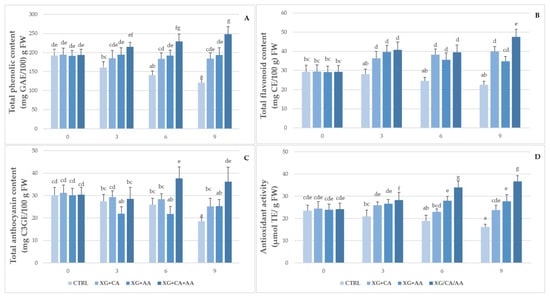
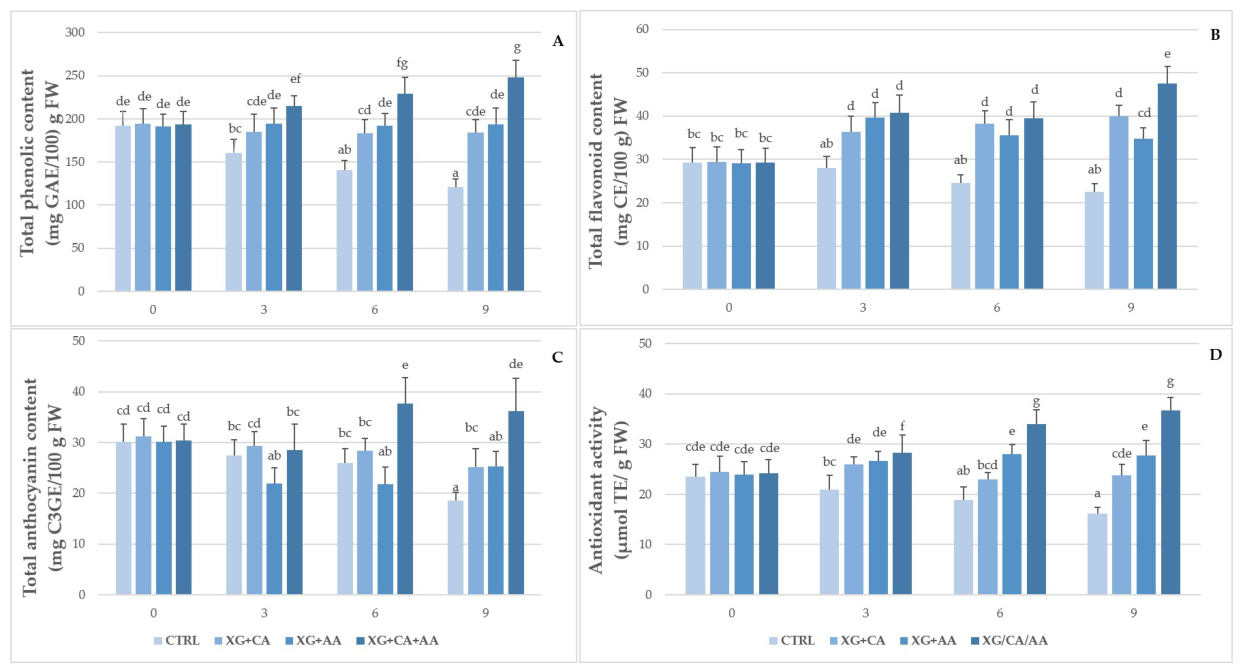
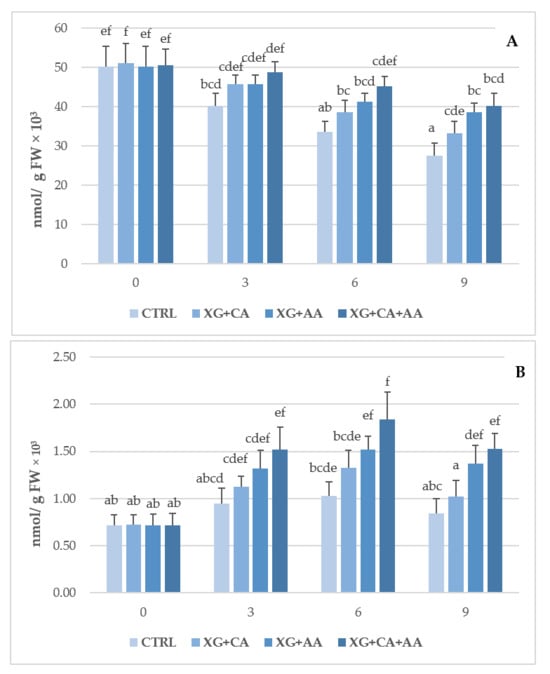
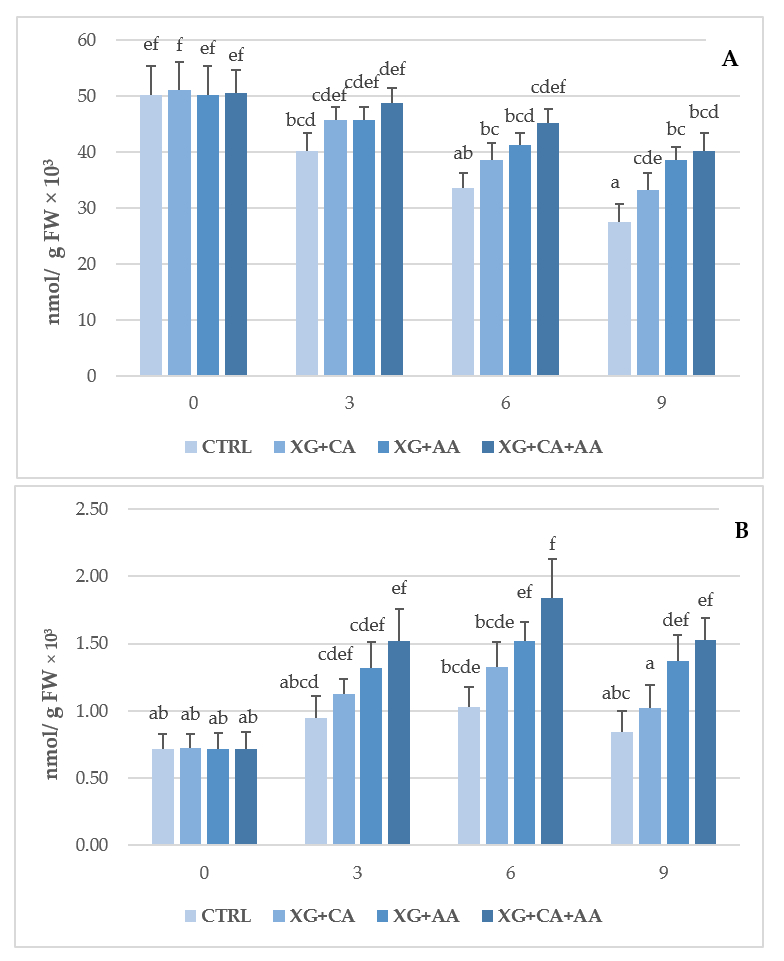
In this study, the content of bioactive compounds and antioxidant activity were monitored at the beginning of the experiment and after 3, 6, and 9 days of cold storage, as reported in Figure 1. Total phenolic content in the uncoated sample was significantly lower than in the coated ones throughout the storage period, showing a significant reduction after 9 days. Coatings with XG+CA and XG+AA induced an increase in total phenolic content compared to the initial value, maintaining relatively stable levels during cold storage. In fruits coated with XG+CA+AA, a statistically significant increase in total phenolic content was observed throughout the whole storage period, reaching the highest value on day 9 (Figure 1A). A similar trend was observed for total flavonoid content; the values remained relatively stable on day 0, whereas coated samples, particularly XG+CA+AA, showed significantly higher levels from day 3 onward. In contrast, the control sample progressively decreased over time, indicating flavonoid degradation in uncoated fruit (Figure 1B).
Figure 1.
Polyphenols (A), flavonoids (B), anthocyanins content (C) and antioxidant activity (D) of ‘Rossetta’ strawberry uncoated (CTRL) and coated with xanthan gum (XG, 0.3% w/v) combined with citric acid (CA, 2.0% w/v), ascorbic acid (AA, 1.0% w/v), or both CA and AA, during cold storage at 4 °C for nine days. Different letters indicate significant differences between different treatments (p < 0.05; Duncan test).
Anthocyanin content is commonly used as an indicator of strawberry ripeness, as these compounds are closely associated with fruit ripening. In addition, they play a key role in determining the visual quality of strawberries by contributing to the characteristic red coloration of fully ripe fruits [42]. Anthocyanin content in the control sample showed a statistically significant decrease during storage, reaching the lowest value on day 9. The XG+CA coating allowed the anthocyanin content to remain stable up to day 6 of storage. In contrast, fruits coated with XG/AA showed an increase in anthocyanin content on day 9 compared to the initial value. The combined XG+CA+AA coating induced a statistically significant increase in anthocyanin content after 3 and 6 days of storage compared to the initial value, with levels remaining stable until the end of cold storage (Figure 1C). The decline in anthocyanin content during storage may be attributed to senescence and tissue deterioration [43]. However, several studies investigating different edible coatings applied to strawberry fruit have reported an increase in anthocyanin content during storage [21,24,43].
All coated treatments improved antioxidant capacity over time, with the strongest effect again observed in the combined coating. The control showed a gradual decline, highlighting the protective role of coatings in maintaining the bioactive compounds content and the highest antioxidant activity (Figure 1D). Similarly, chitosan-based composite coating loaded with ascorbic acid and curcumin maintained a higher antioxidant activity compared to uncoated strawberries during 15 days of cold storage [44].
Bioactive compounds play a key role in mitigating oxidative stress and prolonging the shelf-life of fruits [12]. Edible coatings form a protective layer around the fruit, limiting oxygen availability and thereby slowing the enzymatic oxidation of bioactive compounds; consequently, they enhance the non-enzymatic antioxidant system and overall antioxidant capacity, helping to neutralize the accumulation of reactive oxygen species (ROS) during storage in different fruits [3,35,45].
3.3. Evaluation of the Enzymatic Antioxidant System
In fruits, antioxidant systems slow down ROS-induced damage and preserve quality during storage [12]. A key mechanism is the enzymatic detoxification of ROS, involving enzymes such as superoxide dismutase, catalase and those of the ascorbate–glutathione cycle. These enzymes work together to scavenge ROS, maintain redox balance, and protect cells from oxidative stress [46].
The enzymatic antioxidant system in strawberries highlights the role of SOD, CAT, and APX in counteracting oxidative stress induced by superoxide radicals (O2•−) and hydrogen peroxide (H2O2) during cold storage. SOD converts superoxide radicals into hydrogen peroxide, thereby reducing the initial damage caused by reactive oxygen species. CAT and APX then convert hydrogen peroxide into water, protecting fruit cells. The edible coatings modulate the activity of antioxidant enzymes, reducing oxidative damage. In particular, SOD, CAT, and APX act in a coordinated manner to neutralize ROS, limiting browning and oxidative deterioration of strawberries during cold storage.
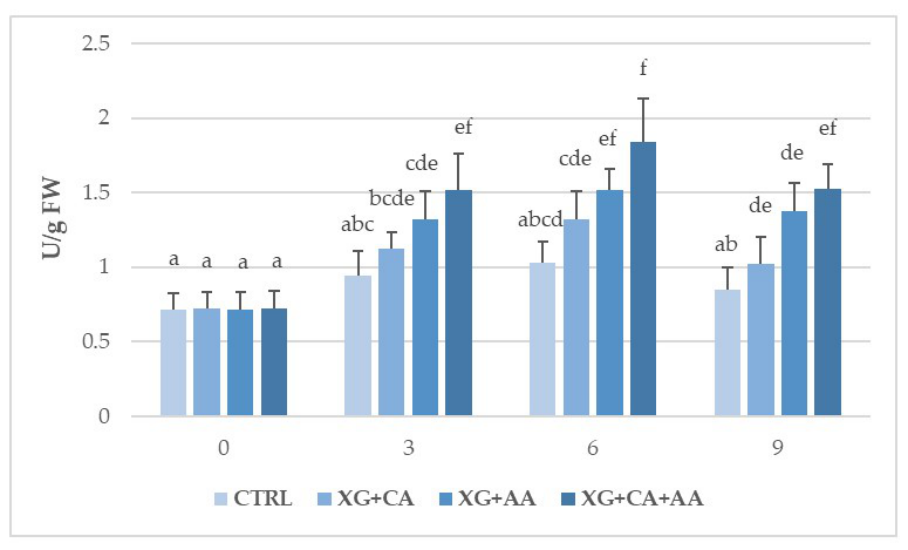
Overall, SOD activity increased over time in all samples, with a more pronounced rise in treated fruits compared to the control. Xanthan gum (XG)-based treatments, especially in combination with other components, showed higher superoxide dismutase (SOD) activity during the later stages of storage, suggesting an improved capacity to scavenge superoxide radicals and alleviate oxidative stress (Figure 2). This is consistent with the findings of Hong et al. [47], who reported that elevated SOD activity is an important indicator of strawberry tolerance to adverse environmental conditions.
Figure 2.
Superoxide dismutase activity of ‘Rossetta’ strawberry uncoated (CTRL) and coated with xanthan gum (XG, 0.3% w/v) combined with citric acid (CA, 2.0% w/v), ascorbic acid (AA, 1.0% w/v), or both CA and AA, during cold storage at 4 °C for nine days. Different letters indicate significant differences between different treatments (p < 0.05; Duncan test).
In contrast, CAT activity showed a general decreasing trend during storage. However, treated samples maintained higher CAT levels than the control throughout the storage period, indicating that coatings helped preserve hydrogen peroxide detoxification capacity and delay oxidative deterioration (Figure 3A).
Figure 3.
Catalase (A) and ascorbate peroxidase (B) activity of ‘Rossetta’ strawberry uncoated (CTRL) and coated with xanthan gum (XG, 0.3% w/v) combined with citric acid (CA, 2.0% w/v), ascorbic acid (AA, 1.0% w/v), or both CA and AA, during cold storage at 4 °C for nine days. Different letters indicate significant differences between different treatments (p < 0.05; Duncan test).
Similarly, APX activity increased progressively during storage, with significantly higher values in coated fruits. The combined treatments (XG+AA and XG+CA+AA) were particularly effective, highlighting a stronger activation of the ascorbate–glutathione cycle and improved ROS scavenging (Figure 3B).
These results suggest that edible coatings enhance the antioxidant defense system by modulating key enzymatic activities, thereby contributing to improved oxidative stability and prolonged postharvest quality of the fruit. Azam et al. [35] demonstrated that XG-based edible coatings can regulate the enzymatic antioxidant defense system in blackberries, thereby mitigating oxidative stress and delaying postharvest deterioration.
3.4. Evaluation of Enzymatic Browning and Membrane Damage
All edible coatings, particularly the XG+CA+AA formulation, led to a statistically significant reduction in polyphenol oxidase (PPO) and lipoxygenase (LOX) activities, as well as malondialdehyde (MDA) content, compared with the control at 6 and 9 days after treatment (Table 2).
Table 2.
Polyphenol oxidase (PPO) and lipoxygenase (LOX) activity and malondialdehyde content of ‘Rossetta’ strawberries uncoated (CTRL) and coated with xanthan gum (XG, 0.3% w/v) combined with citric acid (CA, 2.0% w/v), ascorbic acid (AA, 1.0% w/v), or both CA and AA, during nine days of cold storage (CS).
Polyphenol oxidase (PPO) and lipoxygenase (LOX) activities in ‘Rossetta’ strawberries increased progressively over 9 days of cold storage across all treatments, indicating an overall induction of oxidative processes associated with fruit senescence. However, clear differences were observed among treatments (Table 2).
In control samples, PPO activity exhibited the highest values throughout storage, with a continuous increase up to day 9. Among the treatments, XG+CA+AA showed the lowest PPO activity (p < 0.05), suggesting a synergistic effect when the two organic acids are combined. Citric and ascorbic acids act as anti-browning agents through different mechanisms, with ascorbic acid reducing quinones back to colorless diphenols and inhibiting PPO activity, while citric acid lowers PPO activity by acidifying the environment and chelating copper at the enzyme’s active site [48,49].
A similar trend was observed for LOX activity, although with a more pronounced increase over time. The control sample showed the highest LOX values, particularly on day 6 and day 9, indicating enhanced lipid peroxidation and membrane degradation during storage. Coated samples significantly reduced LOX activity, with XG+CA+AA being the most effective treatment in limiting enzymatic activity, especially at later storage stages (Table 2).
The MDA content increased during cold storage in all treatments, indicating a continuous rise in lipid peroxidation and oxidative stress in strawberry tissues.
On day 0, all samples showed low MDA levels, suggesting uniform initial physiological status among treatments. After 3 days of cold storage, an increase was observed in all groups, although the MDA content varied among treatments. The CTRL showed the highest MDA level (256.00 µmol/100 g FW), while the combined coating treatment (XG+CA+AA) exhibited the lowest value (192.17 µmol/100 g FW), indicating a protective effect against oxidative damage.
This trend became more evident on day 6, where MDA content further increased in all samples. Again, CTRL fruits exhibited the highest accumulation (293.40 µmol/100 g FW), whereas XG-based treatments, particularly those containing both CA and AA, maintained significantly lower levels (201.37–261.03 µmol/100 g FW), suggesting improved membrane stability.
By day 9, MDA reached its maximum values in all treatments, ranging from 231.63 µmol/100 g FW in XG+CA+AA to 330.10 µmol/100 g FW in CTRL. Notably, the combined treatment consistently showed the lowest MDA levels throughout storage, highlighting its superior effectiveness in delaying lipid peroxidation (Table 2).
Overall, the results demonstrate that edible coatings, particularly when xanthan gum is combined with both citric and ascorbic acid, effectively slow down oxidative enzyme activities. This suggests improved preservation of membrane integrity and a reduced rate of browning and senescence processes during cold storage.
These results agree with previous studies on strawberries treated with edible coatings based on chia seed mucilage, bacterial cellulose, and chitosan, which have shown similar effects in modulating enzymatic activities during cold storage [3,50].
3.5. Principal Component Analysis (PCA)
PCA is a reliable tool for monitoring the postharvest behavior of fruit, as previously demonstrated in several studies [3,30,51]. In this work, PCA was applied to evaluate the effectiveness of three different coatings on ‘Rossetta’ strawberry fruits during cold storage, based on the analysis of physico-chemical quality attributes and enzymatic activities related to oxidative stress, enzymatic browning, and membrane integrity.
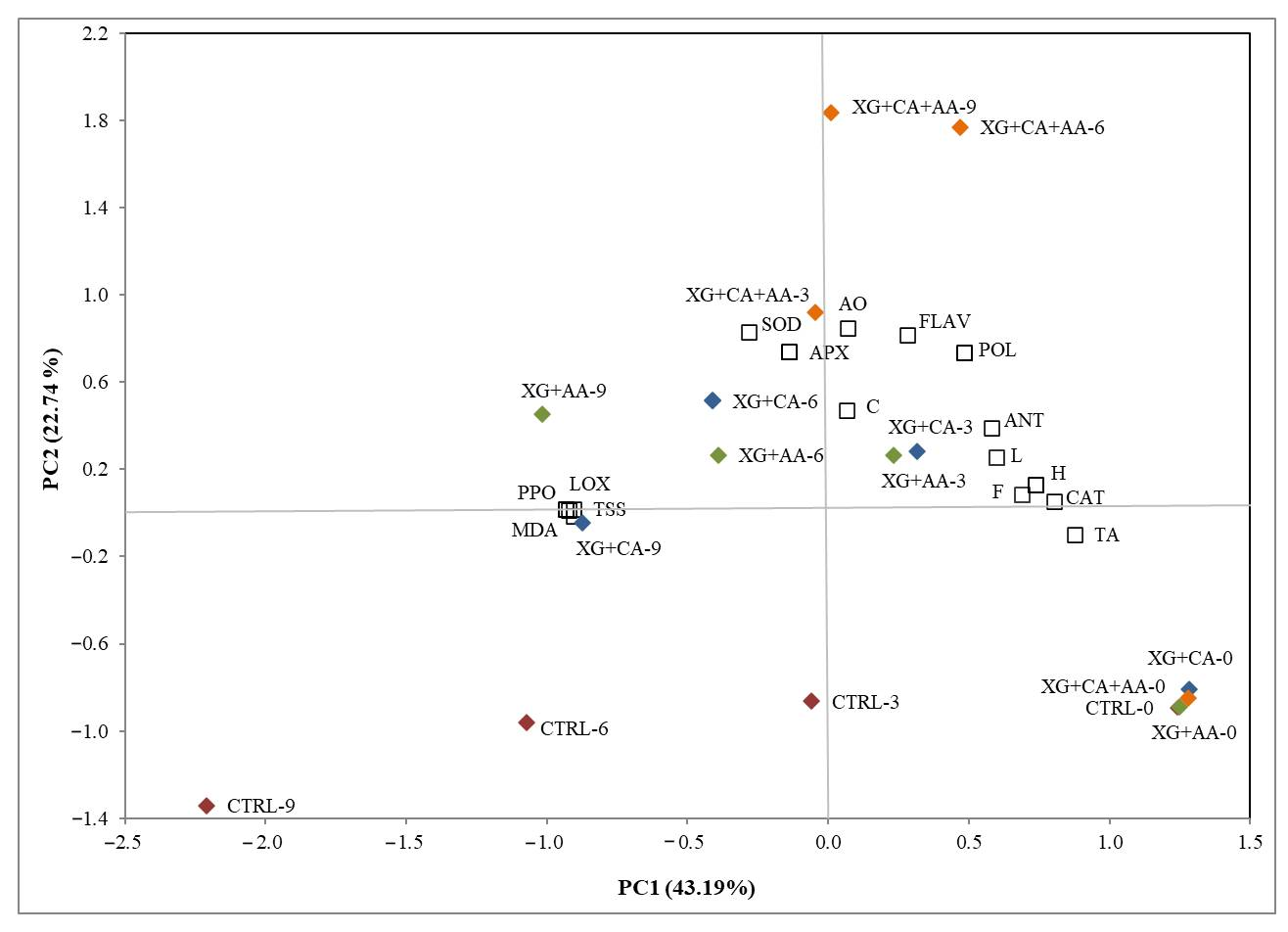
The eigenvalues of the covariance matrix indicated that the first two principal components accounted for 65.94% of the total variance in the dataset during cold storage. Specifically, PC1 and PC2 explained 43.19% and 22.74% of the total variance, respectively. The PCA biplot showed a clear separation among strawberry samples according to both treatment and storage time, highlighting distinct clustering patterns associated with coating application and storage duration (Figure 4).
PC1 primarily separates samples according to storage progression and quality deterioration. Control samples (CTRL-3, CTRL-6, CTRL-9) are positioned on the negative side of PC1, closely associated with higher levels of MDA, LOX, and PPO, indicating enhanced lipid peroxidation and oxidative stress during storage. In contrast, coated samples, particularly those treated with XG-based formulations, are distributed on the positive side of PC1, reflecting better preservation of fruit quality attributes, such as total acidity (TA), flavonoids (FLAVs), phenolics (POLs), and antioxidant-related enzymes.
PC2 further differentiates the effects of coating composition and storage time. Early storage samples (day 0 and day 3) cluster closer to the origin, indicating limited physiological divergence at initial stages. As storage progresses, samples treated with combined coatings (XG+CA+AA-6 and XG+CA+AA-9) are clearly separated in the upper-right quadrant, showing association with antioxidant enzymes such as SOD and APX, as well as antioxidant compounds (ANTs). This suggests that these treatments effectively enhance the antioxidant defense system during prolonged storage.
Overall, the PCA highlights a relationship between coating applications and preservation of strawberry quality.
The superior performance of the XG+CA+AA coating may be attributed to the complementary functions of citric acid and ascorbic acid. Ascorbic acid acts as a potent antioxidant, scavenging reactive oxygen species and delaying the oxidation of phenolic compounds, thereby preserving fruit quality and antioxidant capacity during storage [52]. Citric acid contributes through pH reduction and metal-ion chelation, inhibiting polyphenol oxidase activity and limiting oxidation reactions catalyzed by transition metals [53]. Moreover, CA can stabilize AA by maintaining an acidic microenvironment, prolonging its antioxidant effectiveness. The combined use of AA and CA has been reported to provide greater antioxidant protection than either compound alone. Additionally, both organic acids may interact with the xanthan gum matrix, promoting a more compact film structure with enhanced barrier properties against oxygen and water vapor transfer [54]. These effects can reduce moisture loss, oxidative deterioration, and quality degradation, ultimately explaining the improved efficacy of the XG+CA+AA coating compared with single-acid formulations.
Figure 4.
2D-principal component analysis plot in ‘Rossetta’ strawberry uncoated (CTRL) and coated with xanthan gum (XG, 0.3% w/v) combined with citric acid (CA, 2.0% w/v), ascorbic acid (AA, 1.0% w/v), or both CA and AA, at harvest (0) and after 3, 6 and 9 days of cold storage at 4 °C. (F: firmness; TSS: total soluble solid content; TA: titratable acidity; L: L* value; H: hue angle; POL: polyphenol content; FLAV: flavonoid content; AO: antioxidant activity; SOD: superoxide dismutase; CAT: catalase; APX: ascorbate peroxidase; LOX: lipoxygenase; PPO: polyphenol oxidase; MDA: malondialdehyde content).
4. Conclusions
Edible coatings based on xanthan gum enriched with citric acid and ascorbic acid represent a promising and sustainable strategy to support the preservation of postharvest quality in ‘Rossetta’ strawberries during cold storage. The XG+CA+AA formulation showed better overall performance compared with coatings containing citric acid or ascorbic acid alone, which may be associated with complementary effects of the two organic acids within the xanthan gum matrix. In particular, the combined treatment contributed to more effective maintenance of fruit firmness, slower progression of ripening-related changes, and better preservation of key physico-chemical parameters, including titratable acidity and color stability. Moreover, treated fruits generally exhibited higher levels of bioactive compounds and antioxidant activity, together with enhanced activity of enzymes involved in the response to oxidative stress.
At the same time, the coatings appeared to reduce enzymatic browning and lipid peroxidation, as suggested by lower polyphenol oxidase and lipoxygenase activities, as well as malondialdehyde content.
Overall, these results suggest that edible coatings enriched with natural organic acids may contribute to improving the postharvest quality and extending the marketability period of strawberries, representing a potential eco-friendly approach for postharvest management in fresh fruit supply chains.
Supplementary Materials
The following supporting information can be downloaded at https://www.mdpi.com/article/10.3390/horticulturae12070779/s1; Figure S1: Strawberries fruit during storage at 0, 3, 6, and 9 days. U = uncoated fruit; C = coated fruit.
Author Contributions
Conceptualization, M.P. and E.F.; methodology, A.L., E.F. and T.M.; software, A.L., E.F. and T.M.; validation, A.L., E.F. and T.M.; formal analysis, C.M.P., P.R., G.C., E.F., A.L. and T.M.; investigation, C.M.P., P.R., G.C., E.F., A.L. and T.M.; resources, M.P.; data curation, A.L., E.F. and T.M.; writing—original draft preparation, A.L., C.M.P., E.F. and T.M.; writing—review and editing, A.L., E.F. and M.P.; supervision, M.P.; project administration, M.P.; funding acquisition, M.P. All authors have read and agreed to the published version of the manuscript.
Funding
This research was carried out within the framework of the project ‘Ricerca e Sviluppo in materia di metodi di produzione sostenibili di fragola’ (CUP C63C23000540007) and was financially supported by Cooperativa Sole.
Data Availability Statement
The data used to support the findings of this study can be made available by the corresponding author upon request.
Acknowledgments
We sincerely thank the administrative staff for their essential support in facilitating the project and the timely procurement of laboratory materials. Their assistance was fundamental to the successful completion of this work.
Conflicts of Interest
The authors declare no conflicts of interest.
References
- FAO. FAOSTAT Database; FAO: Rome, Italy, 2024; Available online: https://www.fao.org/statistics/en (accessed on 18 March 2026).
- ISTAT. Coltivazioni Legnose Fruttifere; ISTAT: Rome, Italy, 2026; Available online: https://esploradati.istat.it/ (accessed on 18 March 2026).
- Petriccione, M.; Mastrobuoni, F.; Pasquariello, M.S.; Zampella, L.; Nobis, E.; Capriolo, G.; Scortichini, M. Effect of chitosan coating on the postharvest quality and antioxidant enzyme system response of strawberry fruit during cold storage. Foods 2015, 4, 501–523. [Google Scholar] [CrossRef] [Scilit] [PubMed]
- Khodaei, D.; Hamidi-Esfahani, Z.; Rahmati, E. Effect of edible coatings on the shelf-life of fresh strawberries: A comparative study using TOPSIS–Shannon entropy method. NFS J. 2021, 23, 17–23. [Google Scholar] [CrossRef] [Scilit]
- Liu, C.; Zheng, H.; Sheng, K.; Liu, W.; Zheng, L. Effects of melatonin treatment on the postharvest quality of strawberry fruit. Postharvest Biol. Technol. 2018, 139, 47–55. [Google Scholar] [CrossRef] [Scilit]
- Perdones, A.; Sánchez-González, L.; Chiralt, A.; Vargas, M. Effect of chitosan–lemon essential oil coatings on storage-keeping quality of strawberry. Postharvest Biol. Technol. 2012, 70, 32–41. [Google Scholar] [CrossRef] [Scilit]
- Cordenunsi, B.R.; Genovese, M.I.; Nascimento, J.R.O.; Hassimotto, N.M.A.; Santos, R.J.; Lajolo, F.M. Effects of temperature on the chemical composition and antioxidant activity of three strawberry cultivars. Food Chem. 2005, 91, 113–121. [Google Scholar] [CrossRef] [Scilit]
- Kahramanoğlu, İ. Effects of lemongrass oil application and modified atmosphere packaging on strawberry fruits. Sci. Hortic. 2019, 256, 108527. [Google Scholar] [CrossRef] [Scilit]
- Filho, M.d.J.; Scolforo, C.Z.; Saraiva, S.H.; Pinheiro, C.J.G.; Silva, P.I.; Della Lucia, S.M. Physicochemical, microbiological and sensory changes in strawberries caused by gamma radiation. Sci. Hortic. 2018, 238, 187–194. [Google Scholar] [CrossRef] [Scilit]
- Yoon, Y.S.; Kim, J.K.; Lee, K.C.; Eun, J.B.; Park, J.H. Effects of electron-beam irradiation on strawberry quality. J. Food Process. Preserv. 2020, 44, e14665. [Google Scholar] [CrossRef] [Scilit]
- Yıldız, G.; Yildiz, G. Ultrasound-assisted postharvest preservation of strawberries. Food Bioprocess Technol. 2025, 18, 7899–7914. [Google Scholar] [CrossRef] [Scilit]
- Ferrara, E.; Cice, D.; Migliozzi, T.; Lizzio, A.; Vicigrado, F.; Petriccione, M. Advances in composite edible films and coatings. In Edible Films and Coatings: Formulation, Advances, and Applications in Food Systems, 1st ed.; Yousuf, B., Panesar, P.S., Eds.; CRC Press: Boca Raton, FL, USA, 2026; pp. 86–107. [Google Scholar] [CrossRef] [Scilit]
- Bonilla, J.; Atarés, L.; Vargas, M.; Chiralt, A. Edible films and coatings to prevent the detrimental effect of oxygen on food quality: Possibilities and limitations. J. Food Eng. 2012, 110, 208–213. [Google Scholar] [CrossRef] [Scilit]
- Moghadas, H.C.; Smith, J.S.; Tahergorabi, R. Recent advances in edible coatings for strawberries. Food Bioprocess Technol. 2025, 18, 1079–1103. [Google Scholar] [CrossRef] [Scilit]
- Shahdadi, F.; Behrouz, A.; Ranjbarinasab, Z.; Seyedi, A. Enhancing strawberry storage life with Aloe vera gel edible coating enriched with rosemary essential oil. Sci. Rep. 2025, 15, 33237. [Google Scholar] [CrossRef] [Scilit]
- Breceda-Hernandez, T.G.; Martínez-Ruiz, N.R.; Serna-Guerra, L.; Hernández-Carrillo, J.G. Effect of a pectin edible coating obtained from orange peels with lemon essential oil on the shelf life of table grapes. Int. Food Res. J. 2020, 27, 585–596. [Google Scholar]
- Tomadoni, B.; Moreira, M.R.; Pereda, M.; Ponce, A.G. Gellan-based coatings in fresh-cut strawberries. LWT-Food Sci. Technol. 2018, 97, 384–389. [Google Scholar] [CrossRef] [Scilit]
- González-Cuello, R.; Parada-Castro, A.L.; Ortega-Toro, R. Application of a multicomponent edible coating for strawberries. J. Compos. Sci. 2024, 8, 515. [Google Scholar] [CrossRef] [Scilit]
- Chu, Y.; Cheng, W.; Chao, M.; Peng, J.; Wu, W. Pullulan coatings with cinnamon essential oil nanoemulsion. LWT-Food Sci. Technol. 2020, 122, 109054. [Google Scholar] [CrossRef] [Scilit]
- Yao, L.; Tao, Q.; Xian, F.; Chen, Z.; Huang, L.; Zhong, N.; Gao, J. Development of pullulan/gellan gum films loaded with astaxanthin nanoemulsion for enhanced strawberry preservation. Food Res. Int. 2025, 201, 115644. [Google Scholar] [CrossRef] [Scilit] [PubMed]
- Dhital, R.; Mora, N.B.; Watson, D.G.; Kohli, P.; Choudhary, R. Efficacy of limonene nano coatings on postharvest quality of strawberries. LWT-Food Sci. Technol. 2018, 97, 124–134. [Google Scholar] [CrossRef] [Scilit]
- Jiang, Y.; Yu, L.; Hu, Y.; Zhu, Z.; Zhuang, C.; Zhao, Y.; Zhong, Y. Ethanol-soluble chitosan coating with different molecular weight: Preparation and its application on cherry tomato. Int. J. Biol. Macromol. 2020, 151, 278–285. [Google Scholar] [CrossRef] [Scilit] [PubMed]
- Hernández-Carrillo, J.G.; Valdez-Fragoso, A.; Cárdenas-López, J.L.; Mújica-Paz, H. Incorporation of reuterin into pectin-based edible coatings and its effect on the shelf life of strawberries. Food Packag. Shelf Life 2021, 30, 100760. [Google Scholar] [CrossRef] [Scilit]
- Gol, N.B.; Patel, P.R.; Rao, T.V.R. Improvement of quality and shelf-life of strawberries with edible coatings enriched with chitosan. Postharvest Biol. Technol. 2013, 85, 185–195. [Google Scholar] [CrossRef] [Scilit]
- McGuire, R.G. Reporting of objective colour measurements. HortScience 1992, 27, 1254–1255. [Google Scholar] [CrossRef] [Scilit]
- Singleton, V.L.; Rossi, J.A. Colorimetry of total phenolics with phosphomolybdic–phosphotungstic acid reagents. Am. J. Enol. Vitic. 1965, 16, 144–158. [Google Scholar] [CrossRef] [Scilit]
- Zhishen, J.; Mengcheng, T.; Jianming, W. The determination of flavonoid contents in mulberry and their scavenging effects on superoxide radicals. Food Chem. 1999, 64, 555–559. [Google Scholar] [CrossRef] [Scilit]
- Giusti, M.M.; Wrolstad, R.E. Characterization and measurement of anthocyanins by UV-visible spectroscopy. Curr. Protoc. Food Anal. Chem. 2001, F1.2.1–F1.2.13. [Google Scholar] [CrossRef] [Scilit]
- Ferrara, E.; Pecoraro, M.T.; Cice, D.; Piccolella, S.; Formato, M.; Esposito, A.; Petriccione, M.; Pacifico, S. A joint approach of morphological and UHPLC-HRMS analyses to study the autochthonous ‘Verdole’ chestnut. Molecules 2022, 27, 8924. [Google Scholar] [CrossRef] [Scilit] [PubMed]
- Pasquariello, M.S.; Di Patre, D.; Mastrobuoni, F.; Zampella, L.; Scortichini, M.; Petriccione, M. Influence of postharvest chitosan treatment on enzymatic browning and antioxidant enzyme activity in sweet cherry fruit. Postharvest Biol. Technol. 2015, 109, 45–56. [Google Scholar] [CrossRef] [Scilit]
- Chen, S.; Zhang, M.; Wang, S. Quality responses of pear to 1-MCP. J. Sci. Food Agric. 2010, 90, 1317–1322. [Google Scholar] [CrossRef] [Scilit] [PubMed]
- Goffi, V.; Magri, A.; Botondi, R.; Petriccione, M. Response of antioxidant system to postharvest ozone treatment in ‘Soreli’ kiwifruit. J. Sci. Food Agric. 2020, 100, 961–968. [Google Scholar] [CrossRef] [Scilit] [PubMed]
- Bao, A.K.; Wang, S.M.; Wu, G.Q.; Xi, J.J.; Zhang, J.L.; Wang, C.M. Overexpression of the Arabidopsis H+-PPase enhances resistance to salt and drought stress in transgenic alfalfa (Medicago sativa L.). Plant Sci. 2009, 176, 232–240. [Google Scholar] [CrossRef] [Scilit]
- Lufu, R.; Ambaw, A.; Opara, U.L. Water loss of fresh fruit: Influencing pre-harvest, harvest and postharvest factors. Sci. Hortic. 2020, 272, 109519. [Google Scholar] [CrossRef] [Scilit]
- Azam, M.; Munir, M.U.; Chaudhary, B.; Umer, M.A.; Khan, A.S.; Khan, T.A.; Niaz, M.U.; Muqadas, S.; Shahid, M.A. Xanthan gum edible coating extends storage life and maintains quality of blackberry fruit. Int. J. Biol. Macromol. 2026, 351, 151116. [Google Scholar] [CrossRef] [Scilit] [PubMed]
- Gautam, A.; Gill, P.P.S.; Singh, N.; Jawandha, S.K.; Arora, R.; Singh, A.; Ajay. Composite coating of xanthan gum with sodium nitroprusside alleviates quality deterioration in strawberry fruit. Food Hydrocoll. 2024, 155, 110208. [Google Scholar] [CrossRef] [Scilit]
- Ma, W.-F.; Li, Y.-B.; Nai, G.-J.; Liang, G.-P.; Ma, Z.-H.; Chen, B.-H.; Mao, J. Changes in sugar and organic acids under water deficit stress. PeerJ 2022, 10, e13691. [Google Scholar] [CrossRef] [Scilit] [PubMed]
- Kaynarca, G.B.; Kamer, D.D.A.; Yücel, E.; Gümüş, T. Proposed use of polyvinyl alcohol with grape pomace extract as an edible coating for strawberries. Pol. J. Food Nutr. Sci. 2023, 73, 151–162. [Google Scholar] [CrossRef] [Scilit]
- De Bruno, A.; Gattuso, A.; Ritorto, D.; Piscopo, A.; Poiana, M. Effect of edible coating enriched with natural antioxidant extract and bergamot essential oil on the shelf life of strawberries. Foods 2023, 12, 488. [Google Scholar] [CrossRef] [Scilit] [PubMed]
- Hu, W.; Sarengaowa; Guan, Y.; Feng, K. Biosynthesis of phenolic compounds and antioxidant activity in fresh-cut fruits and vegetables. Front. Microbiol. 2022, 13, 906069. [Google Scholar] [CrossRef] [Scilit] [PubMed]
- Giampieri, F.; Forbes-Hernández, T.Y.; González-Paramás, A.M.; Bompadre, S.; Quiles, J.L.; Alvarez-Suarez, J.M.; Battino, M. The strawberry: Composition, nutritional quality, and impact on human health. Nutrition 2012, 28, 9–19. [Google Scholar] [CrossRef] [Scilit] [PubMed]
- Ayala-Zavala, J.F.; Wang, S.Y.; Wang, C.Y.; González-Aguilar, G.A. Effect of storage temperatures on antioxidant capacity and aroma compounds in strawberry fruit. LWT-Food Sci. Technol. 2004, 37, 687–695. [Google Scholar] [CrossRef] [Scilit]
- Wang, S.Y.; Gao, H. Effect of chitosan-based edible coating on antioxidants and postharvest fruit quality of strawberries. LWT-Food Sci. Technol. 2013, 52, 71–79. [Google Scholar] [CrossRef] [Scilit]
- Zhou, M.; Ma, J.; Yi, Y.; Min, T.; Wang, H.; Wei, Z.; Wang, H.; Zhou, M. Chitosan-based edible coating containing ascorbic acid/curcumin for strawberry. J. Future Foods 2025. [Google Scholar] [CrossRef] [Scilit]
- Gull, S.; Ejaz, S.; Ali, S.; Ali, M.M.; Sardar, H.; Ali, M.; Deng, H.; Yousef, A.F.; Alrefaei, A.F.; Almutairi, M.H. Xanthan gum-based edible coating effectively preserves postharvest quality of ‘Gola’ guava fruits by regulating physiological and biochemical processes. BMC Plant Biol. 2024, 24, 450. [Google Scholar] [CrossRef] [Scilit] [PubMed]
- Racchi, M.L. Antioxidant defenses in plants with attention to Prunus and Citrus spp. Antioxidants 2013, 2, 340–369. [Google Scholar] [CrossRef] [Scilit] [PubMed]
- Hong, W.; Xie, C.; Zhao, J.; Dai, Z. Application of plasma-activated hydrogen peroxide solution synergized with Ag@SiO2-modified polyvinyl alcohol coating for strawberry preservation. Heliyon 2024, 10, e31239. [Google Scholar] [CrossRef] [Scilit] [PubMed]
- Sedaghat, N.; Zahedi, Y. Edible coating and acidic washing for mushrooms (Agaricus bisporus). Food Sci. Technol. Int. 2012, 18, 523–530. [Google Scholar] [CrossRef] [Scilit] [PubMed]
- Ali, H.M.; El-Gizawy, A.M.; El-Bassiouny, R.E.; Saleh, M.A. Browning inhibition mechanisms and polyphenol oxidase reactions. J. Food Sci. Technol. 2015, 52, 3651–3659. [Google Scholar] [CrossRef] [Scilit] [PubMed]
- Mousavi, S.R.; Rahmati-Joneidabad, M.; Noshad, M. Chia mucilage/bacterial cellulose coating on strawberries. Int. J. Biol. Macromol. 2021, 190, 618–623. [Google Scholar] [CrossRef] [Scilit] [PubMed]
- Maurizzi, E.; Bigi, F.; Volpelli, L.A.; Pulvirenti, A. Edible packaging based on guar gum and HPMC for fruit storage. Food Packag. Shelf Life 2023, 40, 101178. [Google Scholar] [CrossRef] [Scilit]
- Golly, M.K.; Ma, H.; Sarpong, F.; Dotse, B.P.; Oteng-Darko, P.; Dong, Y. Shelf-life extension of grape (Pinot noir) by Xanthan Gum enriched with ascorbic and citric acid during cold temperature storage. J. Food Sci. Technol. 2019, 56, 4867–4878. [Google Scholar] [CrossRef] [Scilit] [PubMed]
- Avramescu, S.M.; Butean, C.; Popa, C.V.; Ortan, A.; Moraru, I.; Temocico, G. Edible and functionalized films/coatings-performances and perspectives. Coatings 2020, 10, 687. [Google Scholar] [CrossRef] [Scilit]
- De’Nobili, M.D.; Soria, M.; Martinefski, M.R.; Tripodi, V.P.; Fissore, E.N.; Rojas, A.M. Stability of l-(+)-ascorbic acid in alginate edible films loaded with citric acid for antioxidant food preservation. J. Food Eng. 2016, 175, 1–7. [Google Scholar] [CrossRef] [Scilit]

Disclaimer/Publisher’s Note: The statements, opinions and data contained in all publications are solely those of the individual author(s) and contributor(s) and not of MDPI and/or the editor(s). MDPI and/or the editor(s) disclaim responsibility for any injury to people or property resulting from any ideas, methods, instructions or products referred to in the content. |
© 2026 by the authors. Licensee MDPI, Basel, Switzerland. This article is an open access article distributed under the terms and conditions of the Creative Commons Attribution (CC BY) license.