


Abstract
Continuous cropping obstacles (CCOs) seriously constrain tomato yield and quality in facility agriculture, primarily due to rhizosphere microbial imbalance. Indigenous synthetic microbial communities (SynCom) offer superior colonization and stability compared to single strains. This study aimed at constructing a simplified SynCom from indigenous rhizobacteria in Northwest China to alleviate tomato CCOs. A total of 155 rhizobacterial strains (29 genera) were isolated. Sixteen strains with significant growth-promoting effects were selected through seedling assays. Based on the carbon source niche overlap index (NOI > 70%) with Ralstonia solanacearum QL-Rs1115, eight candidate strains were retained. Using the broken-stick model, 29 simplified SynComs were constructed. SynCom28, composed of six functionally complementary strains (Azospirillum brasilense, Massilia niabensis, Enterobacter hormaechei, Chryseobacterium sp., Priestia megaterium and Pseudomonas brassicacearum), showed the best performance. Pot experiments revealed that SynCom28 reduced the bacterial wilt disease index to 32.41, with a biocontrol efficacy of 41.72%. Greenhouse trials under continuous cropping demonstrated that SynCom28 significantly increased seedling Dickson quality index (DQI), stem diameter and biomass. Fruit yield increased by 12.98–15.30% across the 2nd to 4th cropping cycles (p < 0.05). Fruit quality parameters were also enhanced, with soluble sugar, lycopene, and vitamin C contents increasing by 47.22–65.07%, 33.07–81.71% and 80.56–166.67%, respectively. In conclusion, the indigenous simplified SynCom28 effectively alleviates tomato CCOs, enhancing growth, yield, and quality while suppressing bacterial wilt, providing a promising strategy for sustainable facility agriculture.
1. Introduction
Tomato (Solanum lycopersicum L.) is one of the most widely cultivated vegetable crops worldwide due to its high nutritional value, including lycopene, vitamins, and various antioxidant compounds, as well as its considerable economic importance [1,2]. Under intensive agricultural systems, continuous monocropping has become a dominant cultivation practice in tomato production because it improves land-use efficiency and short-term economic returns [3]. However, the long-term adoption of this practice has led to the increasing occurrence of continuous cropping obstacles (CCOs), which have become a major constraint on the sustainable development of tomato production [4].
CCOs in tomato are typically characterized by inhibited plant growth, reduced yield, and deterioration of fruit quality [5]. These negative effects result from multiple interacting factors, including the deterioration of soil physicochemical properties, the accumulation of allelopathic autotoxins, and imbalances in soil microbial communities [6,7]. Among these factors, disruption of the soil microbiome is considered a key biological driver. Specifically, beneficial indigenous microorganisms (e.g., Bacillus and Streptomyces) decrease in abundance, whereas pathogenic microorganisms (e.g., Ralstonia solanacearum) progressively dominate ecological niches. This shift leads to a transition of the rhizosphere micro-ecosystem from a beneficial to a pathogenic state. Therefore, restoring microbial balance in the soil is essential for alleviating tomato CCOs [8].
The use of beneficial microorganisms, particularly plant growth-promoting microorganisms (PGPMs), has emerged as a promising strategy for regulating rhizosphere ecosystems and mitigating CCOs. PGPMs can promote plant growth and enhance stress tolerance through multiple mechanisms, including improved nutrient acquisition, phytohormone production, pathogen suppression, and induction of systemic resistance [9]. However, the application of single microbial strains is often limited by poor colonization and low functional stability under complex soil conditions, resulting in inconsistent field performance [10,11]. To address these limitations, synthetic microbial communities (SynCom) have gained increasing attention. SynCom are artificially assembled consortia designed to achieve functional complementarity and synergistic interactions among multiple microbial species, thereby improving the stability and efficacy of microbial inoculants [12]. Compared with single-strain inoculants, SynCom exhibit multiple advantages, including functional complementarity and synergistic interactions that enhance plant growth and disease suppression, improved colonization and stability through niche differentiation and metabolic cooperation, and greater resilience to environmental perturbations [13,14]. For example, SynComs composed of dominant taxa such as Pseudomonas have been reported to significantly promote tomato growth and reshape rhizosphere microbial communities, particularly by influencing rare taxa, while maintaining stable rhizosphere colonization [15,16].
Indigenous microorganisms derived from local environments represent an important resource for sustainable agricultural practices. Compared with exogenous inoculants, indigenous microbes are better adapted to local soil and climatic conditions, exhibiting often a better colonization and ecological fitness [17]. Therefore, the selection of functional strains from indigenous microbial communities for SynCom construction may further enhance the effectiveness and stability of microbiome-based strategies. Previous studies have demonstrated that indigenous microbial communities play key roles in maintaining soil ecological balance and improving plant stress resistance, highlighting their potential in alleviating CCOs [18,19].
China is the largest producer of tomatoes globally in terms of both cultivation area and total production, and the tomato industry is a key component of the vegetable sector [2,20]. In particular, Northwest China (e.g., Xinjiang and Inner Mongolia) has become a major tomato-producing region due to its unique environmental conditions. However, long-term facility cultivation combined with continuous monocropping has intensified soil-borne diseases, especially bacterial wilt caused by R. solanacearum, leading to increasingly severe CCOs. This issue represents a significant challenge for sustainable agricultural development and food safety. Current studies [21,22,23] mainly focus on exogenous intervention strategies, whereas systematic exploration of indigenous microbial resources and their application in SynCom construction in this region remains limited.
In summary, tomato CCOs are closely associated with rhizosphere microbial imbalance. Microbiome-based approaches, particularly SynCom, show great potential for alleviating these obstacles. However, most studies [12,24,25] have focused on exogenous microbial consortia, with limited attention given to SynCom derived from indigenous microorganisms, especially in typical continuous cropping regions of Northwest China. Therefore, this study aims to explore indigenous microbial resources from tomato rhizospheres in Northwest China and to construct SynCom capable of mitigating CCOs. The results are expected to provide a theoretical and practical basis for the development of sustainable strategies to overcome continuous cropping constraints and improve food security.
2. Materials and Methods
2.1. Isolation and Identification of Root-Associated Bacteria of Tomato
The tomato cultivar used in this study was Hanmu Series “Kouershuang” (Chifeng Herun Agricultural High-tech Industry Development Co., Ltd., Inner Mongolia, China). Rhizosphere soils and roots of tomato were collected from eight greenhouses at two sites, in City Hohhot, Northwest China (111°45′5″–111°50′4″ E, 40°39′48″–40°43′22″ N; 111°48′36″–111°49′12″ E, 40°42′36″–40°43′12″ N). Root-associated bacteria, i.e., rhizobacteria and root endophytic bacteria, were isolated and purified on agar media of Reasoner’s 2A (R2A), modified Reasoner’s 2A (mR2A) and Lysogeny Broth (LB) using spread and streak plating technique at 28 °C, respectively. The composition of the mR2A medium is as follows: 0.1425 g sodium formate, 0.0085 g sodium acetate, 0.0675 g sodium propionate, 0.0525 g sodium butyrate, 0.5 g each of soluble starch, casein acid hydrolysate, bacteriological peptone, and yeast extract powder, 0.3 g each of sodium pyruvate and potassium dihydrogen phosphate, 0.05 g magnesium sulfate heptahydrate, 1.0 mL TES solution, and distilled water to a final volume of 500 mL. The pH is approximately 7.2. The purified strains were stored in 40% glycerol at −80 °C ready to use.
The genomic DNA of bacterial strain was extracted and purified using a genomic DNA isolation kit (Tiangen Biotech Co.; Ltd., Beijing, China). The 16S rRNA gene was PCR amplified and sequenced using primer pairs 27F and 1492R [26]. The obtained sequence was analyzed on the platform of Ez-BioCloud (http://www.ezbiocloud.net/eztaxon, accessed on 8 December 2024) to identify its strain. The sequences of most related type species were recovered from the website and used to construct a phylogenetic tree using Kimura 2-parameter by Mega 11 [27]. The resulting tree was visualized by TVBOT (https://www.chiplot.online/tvbot.html, accessed on 15 September 2025) [28].
2.2. Screening of Tomato Growth-Promoting Bacteria
Bacterial strain was cultivated in liquid 1/2 strength R2A. The cells were collected by centrifugation during the logarithmic growth phase and resuspended in sterile saline solution of 0.85% to 1.0 of OD600nm.
Tomato seeds were disinfected firstly with 70% alcohol and then 3% NaClO, and finally washed several times with sterile deionized water to remove the used disinfectants. Then the seeds were sowed into sterilized nursery substrates (Pindstrup Mosebrug A/S, Ryomgaard, Denmark) to grow seedlings under the conditions of 342 μmol m−2·s−1 light-intensity, a light/dark cycle of 16 h/8 h and a temperature of 28 ± 2 °C in a room. When the seedling had two full-developed leaves, the bacterial suspension of 20 mL was irrigated into the nursery substrates of 5 g. Each strain and non-inoculating control were set up five repeats, respectively.
After cultivated 45 days, the seedlings were dug out to determine plant height, stem diameter, and biomass (dry weights) of above- and below-ground to calculate Dickson Quality Index (DQI) [29] using Formula (1):
In Formula (1), Weight represented total biomass, Height–Diameter Quotient represented the ratio of plant height to stem diameter, and Shoot–Root ratio represented the ratio of above-ground to underground dry biomass.
Compared with the control group, strains with a significant increase in DQI after inoculation and a DQI greater than 100% were selected as candidate strains of tomato growth-promoting bacteria (p < 0.05) and used for subsequent simplified SynCom construction.
2.3. Simplified SynCom Construction
To further evaluate the niche overlap between the candidate strains and the plant pathogen R. solanacearum, carbon utilization was analyzed using Biolog GEN III (Biolog Inc., Hayward, CA, USA) and further calculate niche overlap index (NOI) [30] using Formula (2). NOI greater than 70% may have a significant inhibitory effect on pathogens. Therefore, we created 48 communities by the use of eight different strains, which we combined following a substitutive design as described previously [31] and model [32] to obtain initial richness levels of 1, 2, 4, and 8 strains (Table S2-1). The diversity gradient was assembled so that each strain was drawn randomly, allowing disentangling the effects of strain identity and community diversity. We used a substitutive design so that the total biomass of every Pseudomonas community inoculant was kept the same in all treatments but the proportion of every single strain decreased with increasing community richness (100%, 50%, 25%, and 12.5% for 1-, 2-, 4-, and 8-strain communities, respectively). The virulent R. solanacearum QL-Rs1115 was kindly provided by Prof. Wei Zhong, Nanjing Agricultural University.
All combinations were also applied to nursery seedlings as above, and one most significant increased DQI was chosen as a final simplified SynCom. The SynCom was used in a greenhouse experiment to evaluate its effect on the performance of tomato.
2.4. Plant Growth-Promoting Traits of Bacteria Strains in Simplyfied SynCom
The testing methods for plant growth-promoting traits were described in relevant literature [33,34,35], including the production of extracellular polysaccharides (EPS), siderophores and indoleacetic acid (IAA), biofilm formation, inorganic phosphorus dissolution, nitrogen fixation, and the activity of 1-aminocyclopropane-1-carboxylic acid (ACC) deaminase.
2.5. Biocontrol of Simplyfied SynCom to Bacteria Wilt of Tomato
Two treatments were set up in this test, one SynCom inoculated and another non-inoculated, with five repeats for each treatment. Tomato plants were cultivated under the same conditions as above nursing. Soils of top surface 20 cm were collected from the greenhouses and loaded into black plastic pots (4 × 4.2 cm). Bacterial strains in SynCom were separately cultured in liquid 1/2 R2A. The cells were harvested by centrifugation, mixed on equal number ratio and resuspended 1.0 at OD600 nm by sterile saline solution of 0.85%. Two-leaves seedlings were transplanted into pots and irrigated 10 mL SynCom suspension for inoculation treatment and 10 mL sterile saline solution for non-inoculated treatment each pot, respectively. After 7 days, all plants were inoculated with R. solanacearum QL-Rs1115 using the root-wounding inoculation method [36]. Each plant was inoculated 10 mL (OD600 = 0.8), and was further cultivated for an additional 7 days. During the later cultivation, disease index (DI) and biocontrol efficacy was investigated and calculated [37,38] using the following formulas. Disease development, expressed as disease incidence (DI) based on a disease index (di) on a scale of 0–4, where 0 = no wilting, 1 = 1–25% wilting; 2 = 26–50% wilting, 3 = 51–75% wilting, and 4 = 76–100% wilted or dead, was recorded 5 weeks after challenge.
2.6. Greenhouse Experiment
Owing to the impact of the COVID-19 pandemic, first cropping cycle of tomato plant and fruit could not be sampled and analyzed. To evaluate the effects of SynCom on the growth, yield and quality of tomato under three-times continuous-cropping (cycles 2–4), a greenhouse experiment was conducted during May of 2023 to August of 2024. In this experiment, two treatments were also set up, one SynCom inoculated and another non-inoculated to nurse seedlings, with five repeats for each treatment. Seedlings of each treatment were transplanted in five blocks (10 m × 6 m for each) random distributed in a greenhouse located at City Hohhot of China (111°45′5″ E, 40°39′48″ N), respectively. Two rows planting was adopted to plant with a within-row spacing of 0.5 m and between-row spacing of 1.2 m. All lateral shoots were removed to maintain single-stem pruning. Water and fertilizer were delivered by a drip irrigation system. When grown to five flower trusses, tomato plants were topped. The greenhouse soil was black loessial soil, with EC 525 μS/cm and pH 8.16. The number of tomato plants used in the experiment was 1320.
For the continuous cropping cycles 2–4, plants and matured fruits were sampled at the stages of seedling (one week after transplanted, S), flowering–fruiting (F) and ripening (R), respectively. Agronomic traits were determined, including plant height, stem diameter, biomass (above- and below-ground dry-weights), and total weight of fruits on first, second and third flower trusses. Additionally, the fruits on third flower trusses were subjected to quality analysis, for which the contents of key nutritional indices, such as lycopene (Ly), vitamin C (VC), soluble protein (SP) and soluble sugar (SS), were determined as described by Ouyang et al. [39].
2.7. Statistical Analysis
Statistical analysis was performed using Excel 2021. Data analysis was performed using One-way analysis of variance (One-way ANOVA) and Duncan’s multiple range test. Comparisons between groups were performed using Student’s t-test for significance analysis. Differences were considered statistically significant at the significance levels of p < 0.05 or p < 0.01, denoted by lowercase and uppercase letters, respectively.
3. Results
3.1. Isolation, Identification and Screening of Tomato Growth-Promoting Rhiobacteria
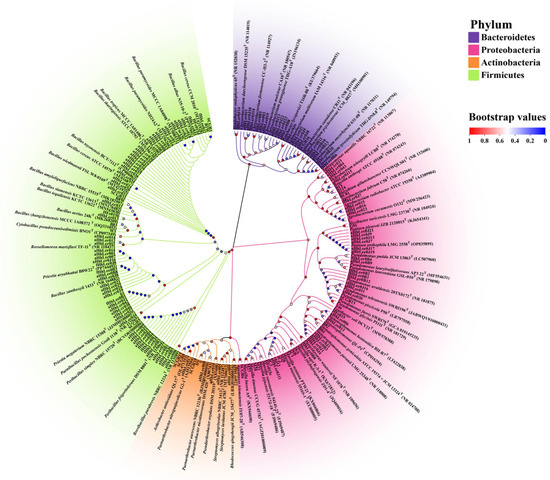
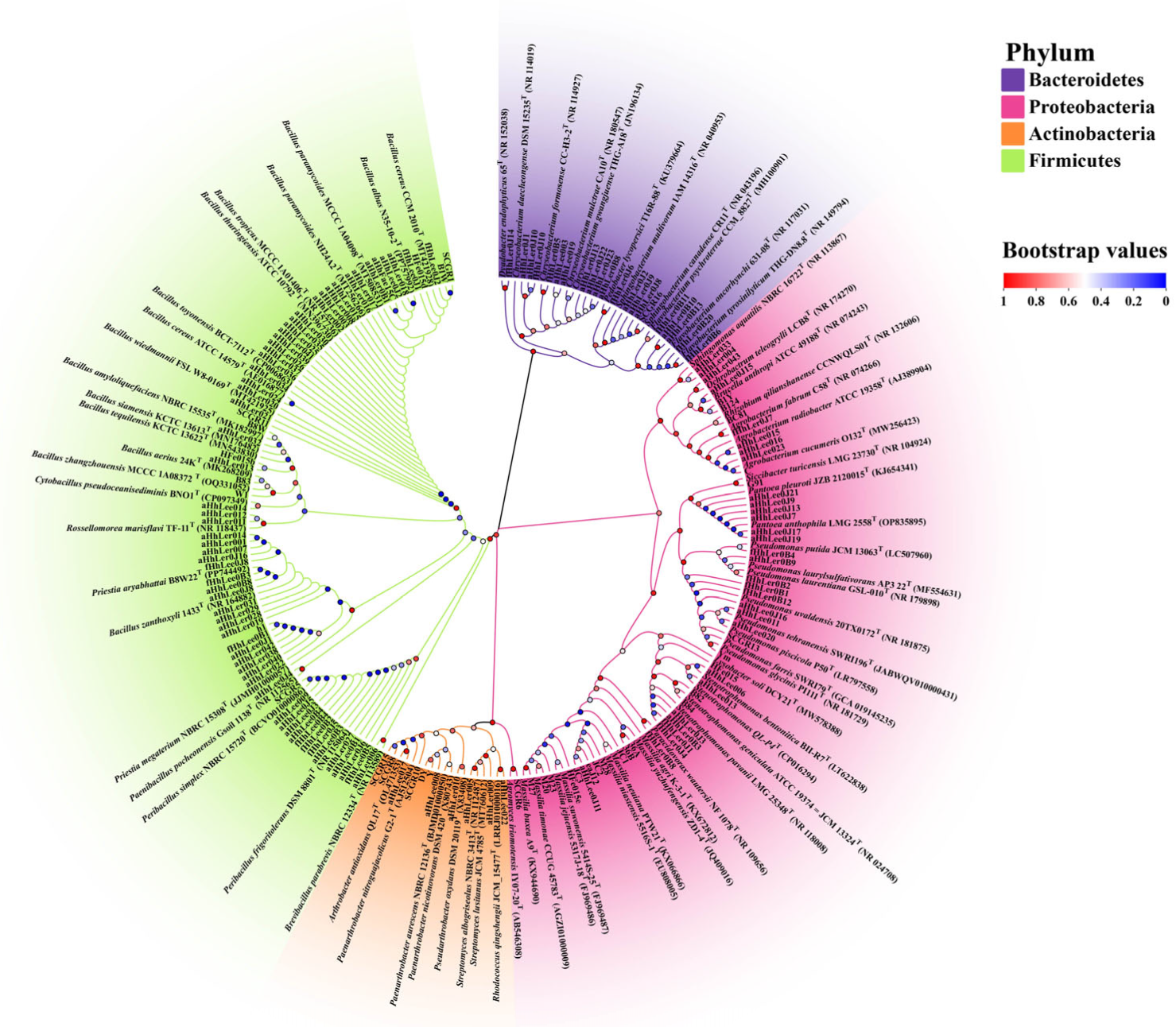
A total of 155 rhizobacterial strains were isolated and identified. They were classified into four phyla: Actinobacteria (7.10%), Bacterodidota (13.55%), Firmicutes (45.81%), and Proteobacteria (33.55%), belonging to 29 genera, among which the dominant (relative abundance >5%) were Bacillus, Priestia, Peribacillus, Massilia, Pseudomonas, Chryseobacterium and Stenotrophomonas (Figure 1).
Figure 1.
Phylogeny of tomato rhizobacteria based on 16S rRNA gene sequences.
All isolates were inoculated to nurse tomato seedling. Compared with the non-inoculated control, most strains exhibited growth-promoting effects. Notably, 16 strains showed a significant increase in the DQI of over 100% (p < 0.05) (Table 1), indicating the strong ability of these rhizobacteria in producing high-quality seedlings. These strains were selected as primary candidates for constructing simplified SynCom. They comprised four Pseudomonas spp., two Chryseobacterium spp., two Massilia spp., and one each from the genera of Azospirillum, Enterobacter, Hymenobacter, Peribacillus, Priestia, Rhizobium and Sphingomonas.
Table 1.
The inoculation of strains increased DQI over 100% in comparison with no microbe inoculated.
These strains were further screened based on the niche overlap in terms of carbon utilization with R. solanacearum. The results showed that eight strains had NOI exceeding 70% with R. solanacearum, and they all could utilize L-glutamic acid (Table S1). Therefore, they were retained for the subsequent SynCom construction.
3.2. Simplyfied SynCom Construction and Screening
Following NOI-based screening, simplified SynComs was constructed using these eight strains, resulting in 48 SynComs (Table S2-1). Since the plant growth-promoting effects of individual strains have been validated, only the plant growth-promoting effects of SynComs listed in Supplementary Materials Table S2-2 were further evaluated in subsequent experiments.
Seedling growth assays revealed that nearly all 29 SynComs significantly promoted the growth of tomato, with increases ranging from 13.74% to 64.69% in plant height, 14.45% to 42.11% in stem diameter, 38.53% to 86.69% in above-ground biomass, 62.42% to 232.80% in below-ground biomass and 4.51% to 9.91% in DQI (p < 0.05) (Table 2 and Table S3). Among these, SynCom28 exhibited most pronounced growth-promoting effect, achieving the highest DQI of 0.0255 and was therefore selected as the final simplified SynCom for further experiments. SynCom28 was composed of strains JN25 (Azospirillum brasilense), M20 (Massilia niabensis), FN0603 (Enterobacter hormaechei), aHhLer0J1 (Chryseobacterium sp.), fHhLee0B1 (Priestia megaterium) and BP16 (Pseudomonas brassicacearum). The strains JN25, M20, FN0603, fHhLee0B1 and BP16 had more than 99.5% 16S rRNA gene sequence similarity with Azospirillum brasilense species, Massilia timonae species, Enterobacter hormaechei species, Priestia megaterium species and Pseudomonas brassicacearum species. Only the strains aHhLer0J1 were taxonomically identified as Chryseobacterium sp., which had 97.91% 16S rRNA gene sequence similarity with Chryseobacterium daecheongense (Table S4). Multiple plant growth-promoting traits were detected in these strains, including nitrogen fixation, inorganic phosphorus solubilizing, biofilm formation and production of IAA, EPS, siderophore, ACC deaminase (Table S5). Most of these abilities between these strains were complementary. For examples, strain JN25 lacked ACC deaminase and cellulase activities whereas strain fHhLee0B1 exhibited high and positive activities for both. However, all strains demonstrated strong EPS production and biofilm formation, suggesting their good rhizosphere colonization potential.
Table 2.
Growth-promoting effects of SynComs on tomato seedlings.
3.3. Biocontrol of SynCom on Bacterial Wilt Disease
A pot experiment showed that the simplified SynCom apparently alleviated bacterial wilt disease caused by R. solanacearum (Figure S1). Disease symptom assessment further demonstrated that DI was significantly reduced to 32.41, and biocontrol efficacy reached 41.72% with SynCom treatment (Table 3) (p < 0.05).
Table 3.
Biocontrol effects of SynCom on R. solanacearum wilt disease.
3.4. Effects of SynCom on Tomato Performance
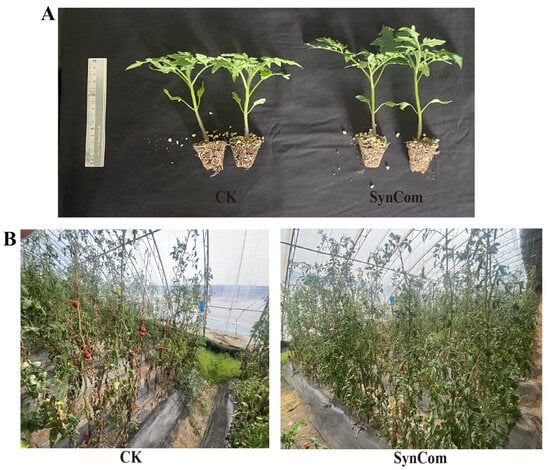
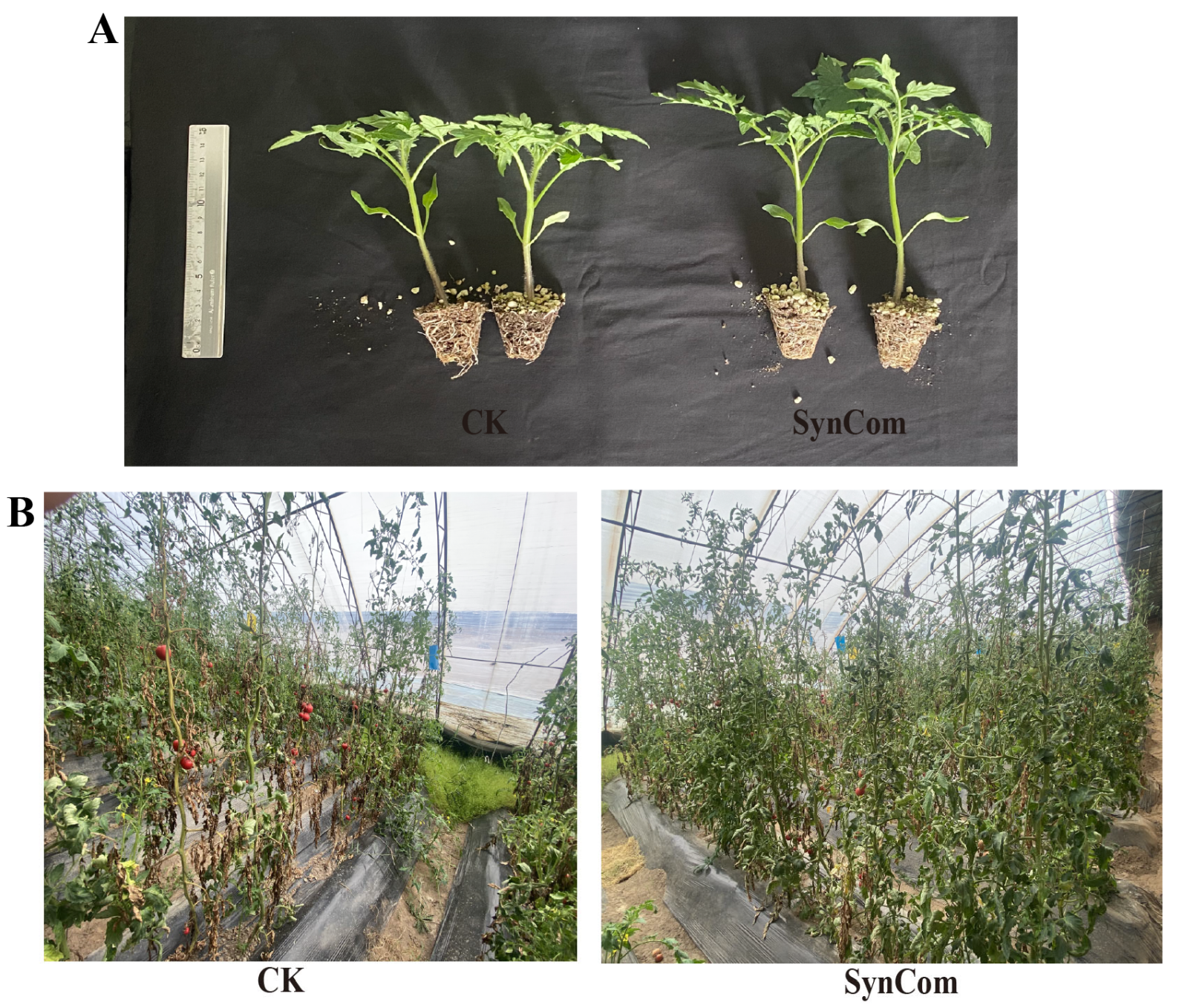
Greenhouse experiments revealed that the simplified SynCom significantly altered tomato plant morphology and improved performance, including growth, fruit yield and fruit quality. Notably, with increasing continuous cropping frequency, SynCom-treated tomato plants exhibited greater root development, wider stem and higher biomass at each growth stage (Figure 2). For instance, under the fourth continuous cropping cycle, SynCom significantly increased DQI by 65.73% at seedling stage (p < 0.01), and enhanced stem diameter by 15.17% at flowering–fruiting stage in comparison with non-inoculated control (p < 0.05). Additionally, SynCom increased fruit yields by 12.98%, 14.71% and 15.30% during the second, third and fourth continuous croppings, respectively. Similarly, key fruit quality parameters, including soluble sugar content (47.22%, 49.33% and 65.07%), lycopene content (33.07%, 40.26% and 81.71%) and vitamin C content (80.56%, 123.21% and 166.67%) were significantly enhanced (Table 4) (p < 0.05).
Figure 2.
Schematic diagram of tomato growth stages under different treatments. (A) Seedling stage. (B) Ripening stage.
Table 4.
Effects of the SynCom on the yield and quality of tomato fruits.
4. Discussion
Tomato is one of the world’s major vegetable crops and frequently cultivated under continuous cropping systems. This practice often leads to severe soil degradation and an increased incidence of bacteria wilt caused by R. solanacearum. Native rhizobacteria play a vital role in plant growth-promoting and pathogen suppression [40]. In this study, the indigenous rhizobacteria were isolated and identified from tomato rhizosphere soils across multiple greenhouses in Northwest China. The dominant genera (relative abundance > 5%) included Bacillus, Pseudomonas, Massilia, Priestia, Peribacillus, Chryseobacterium and Stenotrophomonas (Figure 1). Most of these genera are well recognized for their plant growth-promoting and biocontrol properties [41]. The high proportion of growth-promoting isolates underscores the functional richness of the tomato rhizosphere and supports the use of native strains for SynCom construction. While Bacillus and Pseudomonas are frequently reported as the most abundant rhizosphere isolates [15,42,43,44,45,46,47,48], Massilia—although widely distributed in soils and rhizospheres [49]—has been less frequently isolated from tomato rhizosphere and is less characterized for tomato growth promotion. However, Massilia has been predicted as an initial keystone taxon for plant disease suppression [50] and has been shown to decline under continuous tomato cropping [51], which may reflect the high cropping frequency in the sampled greenhouses. This interpretation is supported by the observation that Massilia sp. KC009 promoted root development in continuously cropped chrysanthemum cuttings [52].
The DQI is a comprehensive indicator integrating morphological and biomass parameters, offering greater reliability than single growth metrics [53]. In this study, DQI was employed in the initial screening of plant growth-promoting rhizobacteria (PGPR) to efficiently identify strains with strong seedling vigor-enhancing potential. Sixteen strains were identified that increased DQI by more than 100% (Table 1). Nutrient niche overlap can limit pathogen growth through competitive exclusion [54], and L-glutamic acid is known to promote the pathogenicity of R. solanacearum [55]. Therefore, further selection based on carbon source niche overlap with R. solanacearum aimed to reduce direct resource competition between SynCom members and the pathogen, thereby potentially enhancing biocontrol efficacy. Eight of the 16 strains exhibited an NOI exceeding 70% with R. solanacearum, all of which utilized L-glutamic acid (Table S1), indicating their high potential for biocontrol of bacterial wilt.
The Broken-stick Model was employed to efficiently reduce the complexity of SynCom design while preserving functional diversity. The resulting 29 consortia, assembled from the eight strains, consistently promoted growth, with SynCom28 demonstrating the highest efficacy (Table 2 and Table S2-2). This simplified SynCom comprised six strains: A. brasilense JN25, M. niabensis M20, E. hormaechei FN0603, C. sp. aHhLer0J1, P. megaterium fHhLee0B1 and P. brassicacearum BP16. These strains exhibited complementary plant growth-promoting traits, including nitrogen fixation, phosphorus solubilization, and production of phytohormones and biofilm-related components. Functional complementarity is considered a key determinant of SynCom stability and performance [56]. EPS production and biofilm formation are critical for rhizosphere colonization by beneficial bacteria [57]. Notably, all six constituent strains displayed strong EPS-producing and biofilm-forming abilities (Table S5), suggesting robust colonization potential in the tomato rhizosphere.
In pot experiments, the simplified SynCom significantly reduced the incidence of bacterial wilt, achieving a biocontrol efficacy exceeding 40% (Figure S1, Table 3). Competition for carbon sources, such as L-glutamic acid, may represent a key mechanism underlying pathogen suppression [54,55]. PGPR from the genera Azospirillum, Priestia, Pseudomonas, Massilia and Enterobacter have been reported to exhibit effective antibacterial activity against R. solanacearum through type VI secretion systems and antibiotic production [58,59,60,61], whereas Chryseobacterium may suppress the pathogen by reducing iron availability via the novel siderophore chryseochelins [62]. The biocontrol activity of PGPR against plant pathogens is attributed to multiple mechanisms, including direct pathogen suppression, induced systemic resistance, and niche competition [63]. Collectively, these findings suggest that the constituent strains of SynCom28 likely act synergistically to suppress R. solanacearum through a combination of direct and indirect mechanisms.
Greenhouse experiments further demonstrated that the simplified SynCom enhanced tomato growth, fruit yield, and fruit quality under continuous cropping conditions (Figure S2, Table 4). Notably, the beneficial effects became more pronounced with increasing cropping cycles compared to the non-inoculated control. Consistent with these findings, several studies have reported that single PGPR strains, such as Bacillus sp. and Pseudomonas sp., can alleviate continuous cropping obstacles in tomato by suppressing bacterial wilt and enhancing yield [42,64,65,66]. Single strains of PGPR and beneficial fungi have also been shown to improve tomato fruit quality [67,68], while co-inoculation with multiple strains can simultaneously enhance fruit yield and quality [69,70]. However, previous improvements in quality indices have primarily focused on fruit morphology, soluble solids, and vitamin C [71]. To our knowledge, this study is the first to observe that PGPR inoculation leads to the accumulation of lycopene in tomato fruits, but the related molecular matrix requires further investigation [72,73]. It should be noted that the growth-promoting effects observed in this study are based on data from the second to fourth planting cycles, and do not include the first planting cycle. Therefore, these results may also be influenced by other factors, such as dynamic changes in soil physicochemical properties, natural succession of the microbial community, changes in pathogen pressure, or plant adaptation processes.
Despite these promising results, several limitations should be acknowledged. First, the mechanisms underlying growth promotion and biocontrol were inferred from in vitro trait assays and require further validation using genetic and molecular approaches. Second, the performance of SynCom28 under varying environmental conditions and soil types remains to be evaluated. Finally, the long-term ecological impacts of SynCom application on the resident soil microbiome warrant further investigation.
5. Conclusions
In this study, a collection of 155 rhizobacterial strains isolated from the tomato rhizosphere was systematically evaluated for growth-promoting and biocontrol potential. Using DQI-based screening and carbon source niche overlap analysis with R. solanacearum, a simplified synthetic community (SynCom28) comprising six complementary bacterial strains was constructed. SynCom28 exhibited robust colonization traits, significantly enhanced tomato seedling quality, and provided effective biocontrol against bacterial wilt, achieving over 40% disease reduction. Moreover, under continuous cropping conditions, SynCom28 consistently improved plant growth, fruit yield, and key fruit quality parameters, including soluble sugars, vitamin C and notably, lycopene content—an effect not previously reported for PGPR-based interventions. These findings highlight the potential of rationally designed, simplified SynComs derived from native rhizobacteria as a sustainable strategy to enhance crop productivity and resilience under continuous cropping systems. Future research should focus on elucidating the molecular mechanisms underlying SynCom function, evaluating its efficacy under field conditions and assessing its ecological impact on the native soil microbiome.
Supplementary Materials
The following supporting information can be downloaded at https://www.mdpi.com/article/10.3390/horticulturae12070780/s1, Figure S1: Biocontrol of simplified SynCom on tomato Ralstonia solanacearum wilt disease. A, only the pathogen inoculated; B, both SynCom and the pathogen inoculated; Figure S2: Effects of simplified SynCom on tomato growth indexes. CK and SynCom representing the treatments of non-inoculated and inoculated SynCom, respectively. A and B showing the morphology at the seedling and ripening stages, respectively. Table S1: Carbon utilization of candidate strains for SynCom and their overlap with Ralstonia solanacearum QL-Rs1115; Table S2-1: The composition of the synthetic community constructed in this study; Table S2-2: SynComs composition used to verify the growth-promoting effect; Table S3: Growth-promoting effects of SynComs on tomato seedlings; Table S4: Molecular identification of SynCom28 strains using 16S rRNA gene sequencing and sequences analysis; Table S5: The plant-promoting traits of SynCom strains.
Author Contributions
Conceptualization, F.F. and Y.G.; methodology, Y.G.; software, Y.G., K.T. and Y.L. (Yungang Liang); validation, Y.G., J.M. and Y.L. (Yang Liu); formal analysis, Y.G.; investigation, Y.G., Y.T. and Y.L. (Yang Liu); resources, F.F.; data curation, Y.G.; writing—original draft preparation, Y.G.; writing—review and editing, Y.G., Y.T., K.T., Y.L. (Yang Liu), J.M. and Y.L. (Yungang Liang) and F.F.; visualization, Y.G.; supervision, F.F.; project administration, F.F.; funding acquisition, F.F. All authors have read and agreed to the published version of the manuscript.
Funding
This research was funded by the Science and Technology Program of Inner Mongolia Autonomous Region (2026YFHH0073) and Inner Mongolia Autonomous Region Direct University Basic Research Grant (BR251306). Additionally, the Article Processing Charge (APC) was funded by the Science and Technology Program of Inner Mongolia Autonomous Region (2026YFHH0073).
Data Availability Statement
The 16S rRNA sequences of the SynCom strains FN0603, BP16, M20, fHhLee0B1, aHhLer0J1 and JN25 have been submitted to the NCBI database under accession numbers OP326194, MG887164, PZ193920, PZ193921, PZ193922 and PZ193923, respectively.
Conflicts of Interest
The authors declare no conflicts of interest.
References
- Li, N.; Wu, X.; Zhuang, W.; Xia, L.; Chen, Y.; Wu, C.; Rao, Z.; Du, L.; Zhao, R.; Yi, M.; et al. Tomato and lycopene and multiple health outcomes: Umbrella review. Food Chem. 2020, 343, 128396. [Google Scholar] [CrossRef] [Scilit] [PubMed]
- FAOSTAT. FAOSTAT Statistics Database [Dataset]. 2025. Available online: http://www.fao.org/faostat (accessed on 13 February 2026).
- Fu, H.; Zhang, G.; Zhang, F.; Sun, Z.; Geng, G.; Li, T. Effects of Continuous Tomato Monoculture on Soil Microbial Properties and Enzyme Activities in a Solar Greenhouse. Sustainability 2017, 9, 317. [Google Scholar] [CrossRef] [Scilit]
- Arafat, Y.; Tayyab, M.; Khan, M.U.; Chen, T.; Amjad, H.; Awais, S.; Lin, X.; Lin, W.; Lin, S. Long-Term Monoculture Negatively Regulates Fungal Community Composition and Abundance of Tea Orchards. Agronomy 2019, 9, 466. [Google Scholar] [CrossRef] [Scilit]
- Zhao, H.T.; Li, T.P.; Zhang, Y.; Hu, J.; Bai, Y.-C.; Shan, Y.-H.; Ke, F. Effects of vermicompost amendment as a basal fertilizer on soil properties and cucumber yield and quality under continuous cropping conditions in a greenhouse. J. Soils Sediments 2017, 17, 2718–2730. [Google Scholar] [CrossRef] [Scilit]
- Han, S.; Ji, X.; Huang, L.; Liu, G.; Ye, J.; Wang, A. Effects of aftercrop tomato and maize on the soil microenvironment and microbial diversity in a long-term cotton continuous cropping field. Front. Microbiol. 2024, 15, 1410219. [Google Scholar] [CrossRef] [Scilit] [PubMed]
- Xiong, W.; Li, Z.; Liu, H.; Xue, C.; Zhang, R.; Wu, H.; Li, R.; Shen, Q. The Effect of Long-Term Continuous Cropping of Black Pepper on Soil Bacterial Communities as Determined by 454 Pyrosequencing. PLoS ONE 2015, 10, e0136946. [Google Scholar] [CrossRef] [Scilit] [PubMed]
- Wang, K.; Qiaofang, L.U.; Dou, Z.; Chi, Z.; Cui, D.; Jing, M.A.; Wang, G.; Kuang, J.; Wang, N.; Zuo, Y. A review of research progress on continuous cropping obstacles. Front. Agric. Sci. Eng. 2024, 11, 253–270. [Google Scholar] [CrossRef] [Scilit]
- Garcia, J.; Moravek, M.; Fish, T.; Thannhauser, T.; Fei, Z.; Sparks, J.P.; Giovannoni, J.; Kao-Kniffin, J. Rhizosphere microbiomes derived from vermicompost alter gene expression and regulatory pathways in tomato (Solanum lycopersicum, L.). Sci. Rep. 2024, 14, 21362. [Google Scholar] [CrossRef] [Scilit] [PubMed]
- O’Callaghan, M.; Ballard, R.A.; Wright, D. Soil microbial inoculants for sustainable agriculture: Limitations and opportunities. Soil Use Manag. 2022, 38, 1340–1369. [Google Scholar] [CrossRef] [Scilit]
- Martins, S.J.; Pasche, J.; Silva, H.A.O.; Selten, G.; Savastano, N.; Abreu, L.M.; Bais, H.P.; Garrett, K.A.; Kraisitudomsook, N.; Pieterse, C.M.J.; et al. The Use of Synthetic Microbial Communities to Improve Plant Health. Phytopathology 2023, 113, 1369–1379. [Google Scholar] [CrossRef] [Scilit] [PubMed]
- Zhang, W.; Li, S.; Zhang, P.; Han, X.; Xing, Y.; Yu, C. The Colonization of Synthetic Microbial Communities Carried by Bio-Organic Fertilizers in Continuous Cropping Soil for Potato Plants. Microorganisms 2024, 12, 2371. [Google Scholar] [CrossRef] [Scilit] [PubMed]
- Singh, M.; Jha, S.; Pathak, D.; Maisnam, G. Advancing biofertilizers: The evolution from single-strain formulations to synthetic microbial communities (SynCom) for sustainable agriculture. Discov. Plants 2025, 2, 226. [Google Scholar] [CrossRef] [Scilit]
- Zhang, Y.; Jing, M.; Lyu, L.; Nie, L.; Xu, X.; Sun, R.; Xu, X.; Chen, S.; He, S.; Zhang, Y.; et al. Principles for Rigorous Design and Application of Synthetic Microbial Communities. Adv. Sci. 2026, 13, e14750. [Google Scholar] [CrossRef] [Scilit] [PubMed]
- Nicotra, D.; Mosca, A.; Dimaria, G.; Tessitori, M.; Vetukuri, R.R.; Catara, V. Temporal dynamics of the tomato rhizosphere microbiome in response to synthetic communities of plant growth-promoting rhizobacteria. Sci. Rep. 2026, 16, 7829. [Google Scholar] [CrossRef] [Scilit] [PubMed]
- Li, J.; A, Y.; Liu, M.; Li, X.; Zhan, Y.; Khashi, U.; Rahman, M.; Zhou, X. Pseudomonas sp. F204 Promoted Tomato Growth and Altered Rhizosphere Bacteria Community. Curr. Microbiol. 2025, 82, 382. [Google Scholar] [CrossRef] [Scilit] [PubMed]
- Zhou, Y.; Liu, D.; Li, F.; Dong, Y.; Jin, Z.; Liao, Y.; Li, X.; Peng, S.; Delgado-Baquerizo, M.; Li, X. Superiority of native soil core microbiomes in supporting plant growth. Nat. Commun. 2024, 15, 6599. [Google Scholar] [CrossRef] [Scilit] [PubMed]
- Liu, M.; Kochian, L.V.; Helgason, B.L. The native soil microbiome is critical for early root-associated microbiota assembly and canola growth. Environ. Microbiome 2025, 20, 112. [Google Scholar] [CrossRef] [Scilit] [PubMed]
- Li, A.; Jin, K.; Zhang, Y.; Deng, X.; Chen, Y.; Wei, X.; Hu, B.; Jiang, Y. Root exudates and rhizosphere microbiota in responding to long-term continuous cropping of tobacco. Sci. Rep. 2024, 14, 11274. [Google Scholar] [CrossRef] [Scilit] [PubMed]
- Zhao, F.; Zhang, Y.; Li, Z.; Shi, J.; Zhang, G.; Zhang, H.; Yang, L. Vermicompost improves microbial functions of soil with continuous tomato cropping in a greenhouse. J. Soils Sediments 2020, 20, 380–391. [Google Scholar] [CrossRef] [Scilit]
- Mohanram, S.; Kumar, P. Rhizosphere microbiome: Revisiting the synergy of plant-microbe interactions. Ann. Microbiol. 2019, 69, 307–320. [Google Scholar] [CrossRef] [Scilit]
- Shayanthan, A.; Ordoñez, P.A.C.; Oresnik, I.J. The Role of Synthetic Microbial Communities (SynCom) in Sustainable Agriculture. Front. Agron. 2022, 4, 896307. [Google Scholar] [CrossRef] [Scilit]
- Zhang, S.; Liu, X.; Zhou, L.; Deng, L.; Zhao, W.; Liu, Y.; Ding, W. Alleviating Soil Acidification Could Increase Disease Suppression of Bacterial Wilt by Recruiting Potentially Beneficial Rhizobacteria. Microbiol. Spectr. 2022, 10, e0233321. [Google Scholar] [CrossRef] [Scilit] [PubMed]
- Hao, X.; Wang, X.; Wang, X.; Wang, C.; Li, C.; Lu, Y.; Cheng, Q.; Chen, Z.; Zhu, L.; Li, C.; et al. Synthetic community derived from the root core microbes of a desert shrub Caragana korshinskii enhances wheat drought tolerance. Microbiome 2026, 14, 76. [Google Scholar] [CrossRef] [Scilit] [PubMed]
- Zhou, Q.; Wang, Y.; Yue, L.; Ye, A.; Xie, X.; Zhang, M.; Tian, Y.; Liu, Y.; Turatsinze, A.N.; Constantine, U.; et al. Impacts of Continuous Cropping on the Rhizospheric and Endospheric Microbial Communities and Root Exudates of Astragalus mongholicus. BMC Plant Biol. 2024, 24, 340. [Google Scholar] [CrossRef] [Scilit] [PubMed]
- Guo, Y.; Tang, K.; Yao, T.; Zhang, J.; Liu, Y.; Meng, J.; Feng, F. Sphingosinicella rhizophila sp. nov., Isolated from Oat (Avena sativa L.) Rhizosphere Soil. Curr. Microbiol. 2025, 82, 163. [Google Scholar] [CrossRef] [Scilit] [PubMed]
- Tamura, K.; Stecher, G.; Kumar, S. MEGA11: Molecular Evolutionary Genetics Analysis Version 11. Mol. Biol. Evol. 2021, 38, 3022–3027. [Google Scholar] [CrossRef] [Scilit] [PubMed]
- Xie, J.; Chen, Y.; Cai, G.; Cai, R.; Hu, Z.; Wang, H. Tree Visualization by One Table (tvBOT): A web application for visualizing, modifying and annotating phylogenetic trees. Nucleic Acids Res. 2023, 51, W587–W592. [Google Scholar] [CrossRef] [Scilit] [PubMed]
- Dickson, A.; Leaf, A.L.; Hosner, J.F. Quality Appraisal of White Spruce and White Pine Seedling Stock in Nurseries. For. Chron. 1960, 36, 10–13. [Google Scholar] [CrossRef] [Scilit]
- Ji, P.; Wilson, M. Assessment of the importance of similarity in carbon source utilization profiles between the biological control agent and the pathogen in biological control of bacterial speck of tomato. Appl. Environ. Microbiol. 2002, 68, 4383–4389. [Google Scholar] [CrossRef] [Scilit] [PubMed]
- Hu, J.; Wei, Z.; Friman, V.P.; Gu, S.H.; Wang, X.F.; Eisenhauer, N.; Yang, T.J.; Ma, J.; Shen, Q.R.; Xu, Y.C.; et al. Probiotic Diversity Enhances Rhizosphere Microbiome Function and Plant Disease Suppression. mBio 2016, 7, e01790-16. [Google Scholar] [CrossRef] [Scilit] [PubMed]
- Becker, J.; Eisenhauer, N.; Scheu, S.; Jousset, A. Increasing antagonistic interactions cause bacterial communities to collapse at high diversity. Ecol. Lett. 2012, 15, 468–474. [Google Scholar] [CrossRef] [Scilit] [PubMed]
- Kumar, B.P.; Trimurtulu, N.; Gopal, A.V. Potential Screening of Indigenous Drought Stress Tolerant Bacteria for Plant Growth Promotion (PGP) Traits: An In-vitro Study. Int. Res. J. Pure Appl. Chem. 2021, 22, 8–21. [Google Scholar] [CrossRef] [Scilit]
- O’Toole, G.A.; Kolter, R. Initiation of biofilm formation in Pseudomonas fluorescens WCS365 proceeds via multiple, convergent signalling pathways: A genetic analysis. Mol. Microbiol. 1998, 28, 449–461. [Google Scholar] [CrossRef] [Scilit] [PubMed]
- Biełło, K.A.; Lucena, C.; López-Tenllado, F.J.; Hidalgo-Carrillo, J.; Rodríguez-Caballero, G.; Cabello, P.; Sáez, L.P.; Luque-Almagro, V.; Roldán, M.D.; Moreno-Vivián, C.; et al. Holistic view of biological nitrogen fixation and phosphorus mobilization in Azotobacter chroococcum NCIMB 8003. Front. Microbiol. 2023, 14, 1129721. [Google Scholar] [CrossRef] [Scilit] [PubMed]
- Kim, S.G.; Hur, O.S.; Ro, N.Y.; Ko, H.C.; Rhee, J.H.; Sung, J.S.; Ryu, K.Y.; Lee, S.Y.; Baek, H.J. Evaluation of Resistance to Ralstonia solanacearum in Tomato Genetic Resources at Seedling Stage. Plant Pathol. J. 2016, 32, 58–64. [Google Scholar] [CrossRef] [Scilit] [PubMed]
- Wei, Z.; Yang, X.; Yin, S.; Shen, Q.; Ran, W.; Xu, Y. Efficacy of Bacillus-fortified organic fertiliser in controlling bacterial wilt of tomato in the field. Appl. Soil Ecol. 2011, 48, 152–159. [Google Scholar] [CrossRef] [Scilit]
- Lee, S.M.; Kong, H.G.; Song, G.C.; Ryu, C.M. Disruption of Firmicutes and Actinobacteria abundance in tomato rhizosphere causes the incidence of bacterial wilt disease. ISME J. 2021, 15, 330–347. [Google Scholar] [CrossRef] [Scilit] [PubMed]
- Ouyang, Z.; Tian, J.; Yan, X.; Shen, H. Effects of different concentrations of dissolved oxygen on the growth, photosynthesis, yield and quality of greenhouse tomatoes and changes in soil microorganisms. Agric. Water Manag. 2021, 245, 106579. [Google Scholar] [CrossRef] [Scilit]
- Jofré, F.M.; Mammana, B.S.; Rodriguez, P.; Micaela, M.; Silva, F.M.; Gomez, V.F.J. Native rhizobacteria improve drought tolerance in tomato plants by increasing endogenous melatonin levels and photosynthetic efficiency. Sci. Hortic. 2024, 329, 112984. [Google Scholar] [CrossRef] [Scilit]
- Ehinmitan, E.; Losenge, T.; Mamati, E.; Ngumi, V.; Juma, P.; Siamalube, B. BioSolutions for Green Agriculture: Unveiling the Diverse Roles of Plant Growth-Promoting Rhizobacteria. Int. J. Microbiol. 2024, 2024, 6181491. [Google Scholar] [CrossRef] [Scilit] [PubMed]
- Adedayo, A.A.; Babalola, O.O.; Prigent-Combaret, C.; Cruz, C.; Stefan, M.; Kutu, F.; Glick, B.R. The application of plant growth-promoting rhizobacteria in Solanum lycopersicum production in the agricultural system: A review. PeerJ 2022, 10, e13405. [Google Scholar] [CrossRef] [Scilit] [PubMed]
- Sato, Y.; Miwa, T.; Inaba, T.; Akachi, T.; Tanaka, E.; Hori, T.; Murofushi, K.; Takagi, H.; Futamata, H.; Aoyagi, T.; et al. Microbially produced fertilizer provides rhizobacteria to hydroponic tomato roots by forming beneficial biofilms. Appl. Microbiol. Biotechnol. 2023, 107, 7365–7374. [Google Scholar] [CrossRef] [Scilit] [PubMed]
- Zhao, Y.; Hong, Y.; Wang, P.; Gou, Y.; Zeng, R.; Zhang, Q.; Chen, D.; Song, Y. Assembly of Tomato Rhizobacteria from Different Functional Groups Improves Seedling Photosynthesis and Growth. Plants 2023, 12, 4000. [Google Scholar] [CrossRef] [Scilit] [PubMed]
- Mekonnen, H.; Kibret, M.; Assefa, F.; Kabtimer, N. Potential of plant growth promoting rhizobacteria for enhancement of tomato growth. Agrosyst. Geosci. Environ. 2025, 8, e70036. [Google Scholar] [CrossRef] [Scilit]
- Almirón, C.; Petitti, T.D.; Ponso, M.A.; Romero, A.M.; Areco, V.A.; Bianco, M.I.; Espariz, M.; Yaryura, P.M. Functional and genomic analyses of plant growth promoting traits in Priestia aryabhattai and Paenibacillus sp. isolates from tomato rhizosphere. Sci. Rep. 2025, 15, 3498. [Google Scholar] [CrossRef] [Scilit] [PubMed]
- Wang, N.; Ping, L.; Mei, X.; Zhang, Y.; Zhang, Y.; Yang, X.; Guo, Y.; Gao, Y.; Xu, Y.; Shen, Q.; et al. Succinic acid reduces tomato bacterial wilt disease by recruiting Sphingomonas sp. Environ. Microbiome 2025, 20, 85. [Google Scholar] [CrossRef] [Scilit] [PubMed]
- Taman; Kaur, J.; Walia, S.S. Co-inoculation of Indigenous Pseudomonas sp. and Priestia sp. to Improve the Soil Health, Plant Growth, Yield and Fruit Quality Parameters of Tomato (Solanum lycopersicum L.). Curr. Microbiol. 2025, 82, 210. [Google Scholar] [CrossRef] [Scilit] [PubMed]
- Wang, D.; He, X.; Baer, M.; Lami, K.; Yu, B.; Tassinari, A.; Salvi, S.; Schaaf, G.; Hochholdinger, F.; Yu, P. Lateral root enriched Massilia associated with plant flowering in maize. Microbiome 2024, 12, 124. [Google Scholar] [CrossRef] [Scilit] [PubMed]
- Wei, Z.; Gu, Y.; Friman, V.P.; Kowalchuk, G.A.; Jousset, A. Initial soil microbiome composition and functioning predetermine future plant health. Sci. Adv. 2019, 5, eaaw0759. [Google Scholar] [CrossRef] [Scilit] [PubMed]
- Su, L.; Li, H.; Wang, J.; Gao, W.; Shu, X.; Sun, X.; Wang, K.; Duan, Y.; Liu, Y.; Kuramae, E.E.; et al. Composition, function and succession of bacterial communities in the tomato rhizosphere during continuous cropping. Biol. Fertil. Soils 2023, 59, 723–732. [Google Scholar] [CrossRef] [Scilit]
- Lu, C.; Dong, H.; Jiao, Y.; Muhammad, M.; Yang, Y.; Zhang, J.; Liu, R.; Cao, Y. Study on the rooting promotion of chrysanthemum cuttings by Massilia consociata KC 009. Front. Plant Sci. 2025, 16, 1685038. [Google Scholar] [CrossRef] [Scilit] [PubMed]
- Gallegos-Cedillo, V.M.; Diánez, F.; Nájera, C.; Santos, M. Plant Agronomic Features Can Predict Quality and Field Performance: A Bibliometric Analysis. Agronomy 2021, 11, 2305. [Google Scholar] [CrossRef] [Scilit]
- Yang, X.; Yang, T.; Zhang, Z.; Zhang, Y.; Mei, X.; Gao, Y.; Wang, N.; Jiang, G.; Xu, Y.; Shen, Q.; et al. Substrate utilization and cross-feeding synergistically determine microbiome resistance to pathogen invasion. Nat. Ecol. Evol. 2026, 10, 211–220. [Google Scholar] [CrossRef] [Scilit] [PubMed]
- Shen, F.; Yin, W.; Song, S.; Zhang, Z.; Ye, P.; Zhang, Y.; Zhou, J.; He, F.; Li, P.; Deng, Y. Ralstonia solanacearum promotes pathogenicity by utilizing l-glutamic acid from host plants. Mol. Plant Pathol. 2020, 21, 1099–1110. [Google Scholar] [CrossRef] [Scilit] [PubMed]
- Bittleston, L.S. Connecting microbial community assembly and function. Curr. Opin. Microbiol. 2024, 80, 102512. [Google Scholar] [CrossRef] [Scilit] [PubMed]
- Wang, D.; Zeng, N.; Pang, J.; Li, C.; Zhang, D.; Ge, J.; Zhao, D.; Li, J.; Ran, R.; Gao, X.; et al. Synergistic interaction in mixed pant growth promoting rhizobacteria consortium enhances biofilm formation and rhizosphere colonization to promote tomato (Solanum lycopersicum) growth. Sci. Hortic. 2025, 351, 114383. [Google Scholar] [CrossRef] [Scilit]
- Cassan, F.D.; Coniglio, A.; Amavizca, E.; Maroniche, G.; Cascales, E.; Bashan, Y.; de-Bashan, L.E. The Azospirillum brasilense type VI secretion system promotes cell aggregation, biocontrol protection against phytopathogens and attachment to the microalgae Chlorella sorokiniana. Environ. Microbiol. 2021, 23, 6257–6274. [Google Scholar] [CrossRef] [Scilit] [PubMed]
- Li, C.; Cao, P.; Du, C.; Zhang, X.; Bing, H.; Li, L.; Sun, P.; Xiang, W.; Zhao, J.; Wang, X. Massilia rhizosphaerae sp. nov., a rice-associated rhizobacterium with antibacterial activity against Ralstonia solanacearum. Int. J. Syst. Evol. Microbiol. 2021, 71. [Google Scholar] [CrossRef] [Scilit] [PubMed]
- Messiha, N.A.S.; Elhalag, K.M.A.; Abd El-Rahman, A.F.; Abdelaziz, A.M.R.A.; ElBadry, N.; Hussien, A. Enhancement of soil suppressive potential to bacterial wilt disease caused by Ralstonia solanacearum. Arch. Phytopathol. Plant Prot. 2023, 56, 1127–1165. [Google Scholar] [CrossRef] [Scilit]
- Jordan, S.; de Maayer, P.; Smits, T.H.M.; Coutinho, T.A. Enterobacter Species: Opportunistic Human and Plant Pathogens with Plant-Beneficial Traits. Mol. Plant Pathol. 2026, 27, e70231. [Google Scholar] [CrossRef] [Scilit] [PubMed]
- Rehm, K.; Vollenweider, V.; Gu, S.; Friman, V.P.; Kümmerli, R.; Wei, Z.; Bigler, L. Chryseochelins-structural characterization of novel citrate-based siderophores produced by plant protecting Chryseobacterium spp. Metallomics 2023, 15, mfad008. [Google Scholar] [CrossRef] [Scilit] [PubMed]
- Lee, J.; Kim, S.; Jung, H.; Koo, B.-K.; Han, J.A.; Lee, H.-S. Exploiting Bacterial Genera as Biocontrol Agents: Mechanisms, Interactions and Applications in Sustainable Agriculture. J. Plant Biol. 2023, 66, 485–498. [Google Scholar] [CrossRef] [Scilit]
- Wang, H.W.; Zhu, Y.X.; Xu, M.; Cai, X.; Tian, F. Co-application of spent mushroom substrate and pgpr alleviates tomato continuous cropping obstacle by regulating soil microbial properties. Rhizosphere 2022, 23, 100563. [Google Scholar] [CrossRef] [Scilit]
- Díaz-Narváez, L.; Atanasov, K.E.; Murillo, E.; Rubén, A. Pararhizobium sp. strains enhancing chilling stress tolerance and yield in tomato plants. Plant Stress 2024, 14, 100587. [Google Scholar] [CrossRef] [Scilit]
- Pan, T.; Chen, Y.; Wang, L.; Hafeez, A.; Muramoto, J.; Shennan, C.; Hafeez, A.; Muramoto, J.; Shennan, C.; Cai, Y.; et al. Integrated anaerobic soil disinfestation and bio-organic fertilizers to alleviate continuous cropping obstacles: Improving soil health and changing bacterial communities. Agric. Ecosyst. Environ. 2025, 385, 109562. [Google Scholar] [CrossRef] [Scilit]
- Fu, W.; Li, P.; Sun, C.; Sun, B.; Kong, Z.; Zhu, Y.; Tian, H.; Guo, Q.; Lai, H. Lysobacter Orchestrates Plant-Microbiome Crosstalk to Enhance Tomato Fruit Quality. J. Agric. Food Chem. 2025, 73, 32348–32362. [Google Scholar] [CrossRef] [Scilit] [PubMed]
- Tahiri, A.; Meddich, A.; Raklami, A.; Alahmad, A.; Bechtaoui, N.; Anli, M.; Göttfert, M.; Heulin, T.; Achouak, W.; Oufdou, K. Assessing the Potential Role of Compost, PGPR, and AMF in Improving Tomato Plant Growth, Yield, Fruit Quality, and Water Stress Tolerance. J. Soil Sci. Plant Nutr. 2022, 22, 743–764. [Google Scholar] [CrossRef] [Scilit]
- Torres-Solórzano, P.; Reyes-De la Cruz, H.; Altamirano-Hernández, J.; Macías-Rodríguez, L.; Campos-García, J.; Luna-Cruz, A. Inoculation with Pseudomonas spp. in Solanum lycopersicum increases yield and fruit quality under nutrient shortage conditions. PeerJ 2025, 13, e19796. [Google Scholar] [CrossRef] [Scilit] [PubMed]
- Shi, W.-X.; Guo, J.-J.; Yu, X.-X.; Li, Z.-X.; Weng, B.-Y.; Wang, D.-X.; Su, S.-H.; Sun, Y.-F.; Tan, J.-F.; Xie, R.-H. Diversity and interactions of rhizobacteria determine multinutrient traits in tomato host plants under nitrogen and water disturbances. Hortic. Res. 2025, 12, 290. [Google Scholar] [CrossRef] [Scilit] [PubMed]
- Fu, W.; Sun, C.; Sun, B.; Li, P.; Ding, X.; Guo, Q.; Yuan, J.; Lai, H. Flavonoid-mediated bacterial spermidine biosynthesis enhances vitamin accumulation in tomato fruits. Nat. Commun. 2026, 17, 1524. [Google Scholar] [CrossRef] [Scilit] [PubMed]
- Jurić, S.; Vlahoviček-Kahlina, K.; Jurić, O.; Uher, S.F.; Jalšenjak, N.; Vinceković, M. Increasing the lycopene content and bioactive potential of tomato fruits by application of encapsulated biological and chemical agents. Food Chem. 2022, 393, 133341. [Google Scholar] [CrossRef] [Scilit] [PubMed]
- Rouphael, Y.; Formisano, L.; Ciriello, M.; Cardarelli, M.; Luziatelli, F.; Ruzzi, M.; Ficca, A.G.; Bonini, P.; Colla, G. Natural biostimulants as upscale substitutes to synthetic hormones for boosting tomato yield and fruits quality. Italus Hortus 2021, 28, 88–99. [Google Scholar] [CrossRef] [Scilit]

Disclaimer/Publisher’s Note: The statements, opinions and data contained in all publications are solely those of the individual author(s) and contributor(s) and not of MDPI and/or the editor(s). MDPI and/or the editor(s) disclaim responsibility for any injury to people or property resulting from any ideas, methods, instructions or products referred to in the content. |
© 2026 by the authors. Licensee MDPI, Basel, Switzerland. This article is an open access article distributed under the terms and conditions of the Creative Commons Attribution (CC BY) license.