1. Introduction
Vitis vinifera L. cv. País, historically known as cv. Listán Prieto in Spain, Mission in California, and Criolla Chica in Argentina, was among the first grapevine cultivars introduced to the Americas from Tenerife (Spain) in the early sixteenth century [
1,
2]. In Chile, this variety has played a dominant role in viticulture for more than four centuries and forms the basis of traditional wines and fermented beverages such as “pipeño”, “chicha”, and “asoleado”. Today, its cultivation remains particularly associated with the dryland viticultural landscapes of the Maule and Itata valleys, where more than 10,000 ha remain planted, representing one of the most extensive historical vineyard heritages in South America [
2,
3].
Despite its historical and cultural importance, cv. País experienced a marked decline in prestige and vineyard surface during the late nineteenth and twentieth centuries following the introduction and subsequent dominance of French cultivars such as Cabernet Sauvignon and Merlot [
4]. This shift in varietal preference, together with evolving market dynamics, progressively relegated cv. País to a marginal position within both the Chilean wine industry and academic research agendas [
5]. As a result, the chemical and sensory characteristics of wines produced from this cultivar remain comparatively underexplored in the scientific literature.
In recent decades, however, cv. País has attracted renewed attention as a heritage grapevine cultivar capable of expressing regional identity under traditional dry-farmed viticultural systems. These rainfed vineyards, often located on marginal soils and steep slopes, preserve valuable biodiversity and long-standing viticultural knowledge [
2]. Moreover, their low-input management and natural adaptation to water-limited environments make them particularly relevant under current scenarios of climate change and increasing water scarcity in Mediterranean viticultural regions [
6,
7,
8]. In this context, traditional cultivars such as País may represent valuable genetic and agronomic resources for climate-resilient wine production.
From an oenological perspective, wines produced from cv. País are generally characterized by moderate phenolic concentrations, relatively low anthocyanin levels, and sensory profiles dominated by floral and red fruit notes with moderate astringency [
9,
10]. Nevertheless, scientific studies addressing the chemical and sensory characteristics of País wines remain limited, particularly those focusing on dry-farmed vineyards. This lack of integrated compositional studies restricts a deeper understanding of the factors shaping wine typicity in these traditional viticultural systems.
The chemical composition of grapes and wines is strongly influenced by environmental conditions. Solar radiation and temperature regulate enzymatic pathways involved in the biosynthesis of secondary metabolites, while soil properties and vineyard management practices modulate vine water status, ripening dynamics, and grape composition. These factors ultimately affect phenolic accumulation, acidity, aroma development, colour attributes, and sensory perception in wine [
11].
The Maule and Itata valleys represent two of the most important dryland viticultural regions in south-central Chile, where cv. País is widely cultivated. Vineyards in these territories are commonly established on coastal plains and on the eastern slopes of the Coastal Mountain Range under rainfed conditions, where vine growth and productivity largely depend on winter precipitation and the water retained within the soil profile. Consequently, soil physical properties, water-holding capacity, and landscape position play a critical role in determining vine water status and grape development. The soils of these environments are highly heterogeneous and originate from granitic, metamorphic, and sedimentary parent materials, frequently exhibiting low natural fertility and variable drainage conditions. The pronounced hilly topography promotes catena sequences in which runoff predominates on slopes while water accumulates in lower positions, generating substantial spatial variability in soil water availability and vine vigor [
12,
13].
Both valleys are characterized by a temperate Mediterranean-type climate with warm, dry summers and rainy winters, where precipitation is largely concentrated during the winter months and extended dry periods typically occur during the growing season. Despite these broadly similar climatic conditions, the two valleys display notable geomorphological and pedological contrasts that contribute to spatial variability in vine water status and vineyard performance [
13,
14,
15,
16,
17,
18].
País vines are well adapted to these dryland environments and show notable resistance to pests and diseases [
19]. This resilience becomes particularly relevant under increasingly restrictive climatic conditions. A better understanding of the compositional and sensory attributes of País wines is therefore essential to support sustainable production strategies and enhance the recognition of this heritage cultivar in both domestic and international markets [
20,
21].
Wine quality is largely determined by secondary metabolites, including phenolic compounds and volatile constituents, which are strongly influenced by terroir-related factors such as soil characteristics, climate, and topography, as well as grape maturity at harvest [
22,
23,
24]. Volatile compounds—especially esters, terpenes, and aldehydes—play a central role in defining varietal character and consumer perception [
8,
13,
25,
26]. In cv. País wines, free aroma compounds are mainly influenced by ripeness, whereas volatile precursors present as glycosides appear to be more sensitive to site-specific factors such as slope orientation and soil composition [
8,
9]. In addition, polysaccharides are key modulators of wine texture and mouthfeel, interacting with phenolic compounds and aroma constituents to influence balance, stability, and sensory integration [
27,
28].
In recent years, coordinated national initiatives involving both public and private sectors have promoted diversification in País-based wine styles, including carbonic maceration wines, organic and low-alcohol wines, white País, traditional “pipeños”, rosés, late-harvest wines, and distilled beverages, many of which have gained renewed consumer interest [
2,
17,
20].
Importantly, previous studies on cv. País wines have primarily focused on phenolic composition and have reported limited and statistically weak relationships between chemical composition and sensory perception [
10]. In contrast, the present study adopts a multi-component approach integrating phenolic fractions, polysaccharides, volatile compounds, and sensory data within a single experimental framework under controlled winemaking conditions. This integrative design allows evaluation of whether expanding the compositional space provides a broader framework to explore chemical–sensory relationships.
Within this context, the present study aimed to provide a comprehensive chemical and sensory characterization of monovarietal País wines produced under dry-farmed conditions in the Maule and Itata valleys. Ten non-commercial wines vinified under standardized conditions were analysed for phenolic composition, tannins, anthocyanins, polysaccharides, and volatile profiles, together with a descriptive sensory analysis performed by a trained panel. By documenting the chemical and sensory distinctiveness of these wines, this work contributes to the scientific valorisation of cv. País and supports ongoing efforts to reposition this heritage cultivar within Chile’s contemporary viticultural landscape.
2. Materials and Methods
2.1. Chemicals and Solvents
Methylcellulose (1500 cP viscosity at 20 g/L) and standards of (+)-catechin (puri- (55–70% and 20–34%, respectively)), were used as external calibration standards for quantitative analysis (Sigma Aldrich Co., St Louis, MO, USA).
Polyethylene membranes of 0.22 μm pore size were acquired from EMD Millipore (Billerica, MA, USA). Merck (Darmstadt, Germany) supplied ammonium sulphate, vanillin (990 g/L), ethyl acetate, sodium disulfite, diethyl ether, sodium hydroxide, hydrochloric acid, sulfuric acid, high-performance liquid chromatography (HPLC)-grade acetonitrile, acetic acid, formic acid and methanol. All reagents were of analytical grade or higher. Sep-Pack Plus Environmental C18 cartridges (900 mg) and Sep-PackPlus Short C18 cartridges (400 mg) were obtained from Waters (Milford, MA, USA). Phosphate buffer (pH 7) was acquired from Mallinckrodt Baker (Phillipsburg, NJ, USA). Nitrogen gas was supplied by Indura SA (Santiago, Chile).
All the chemicals used were analytical-reagent grade and provided from the following sources: ethyl isobutyrate, ethyl butyrate, ethyl 2-methylbutyrate, ethyl isovalerate, ethyl crotonate, ethyl hexanoate, ethyl octanoate, ethyl undecanoate, ethyl decanoate, ethyl 2-furoate, ethyl succinate, ethyl phenylacetate, isobutyl acetate, isoamyl acetate, isoamyl butanoate, isoamyl hexanoate, isoamyl lactate, isoamyl octanoate, methyl octanoate, methyl decanoate, isobutanol, butanol, 3-methyl-1-butanol, 2 ethyl-1-hexanol, heptanol, hexanal cis-3-hexenol, 3-methyl-1-pentanol, hexanol, 3-hexen-1-ol, 2,3-butanediol, 1-nonanol, 1-decanol, 2-phenylethanol, 4-ethylphenol, limonene, o-cymene, trans-2-pinalol, linalool, citronellol, nerol, α-terpineol, hexanoic acid, octanoic acid, decanoic acid, furfural, benzaldehyde, 5-methyl-furfural, β-damascenone, and oaklactone were purchased from Sigma-Aldrich (Steinheim, Germany).
The internal standard employed, 4-methyl-2-pentanol, and also acetic acid, ethyl acetate and sodium chloride were purchased from Merck (Darmstadt, Germany).
2.2. Red Wine Samples
This study was conducted using own-rooted
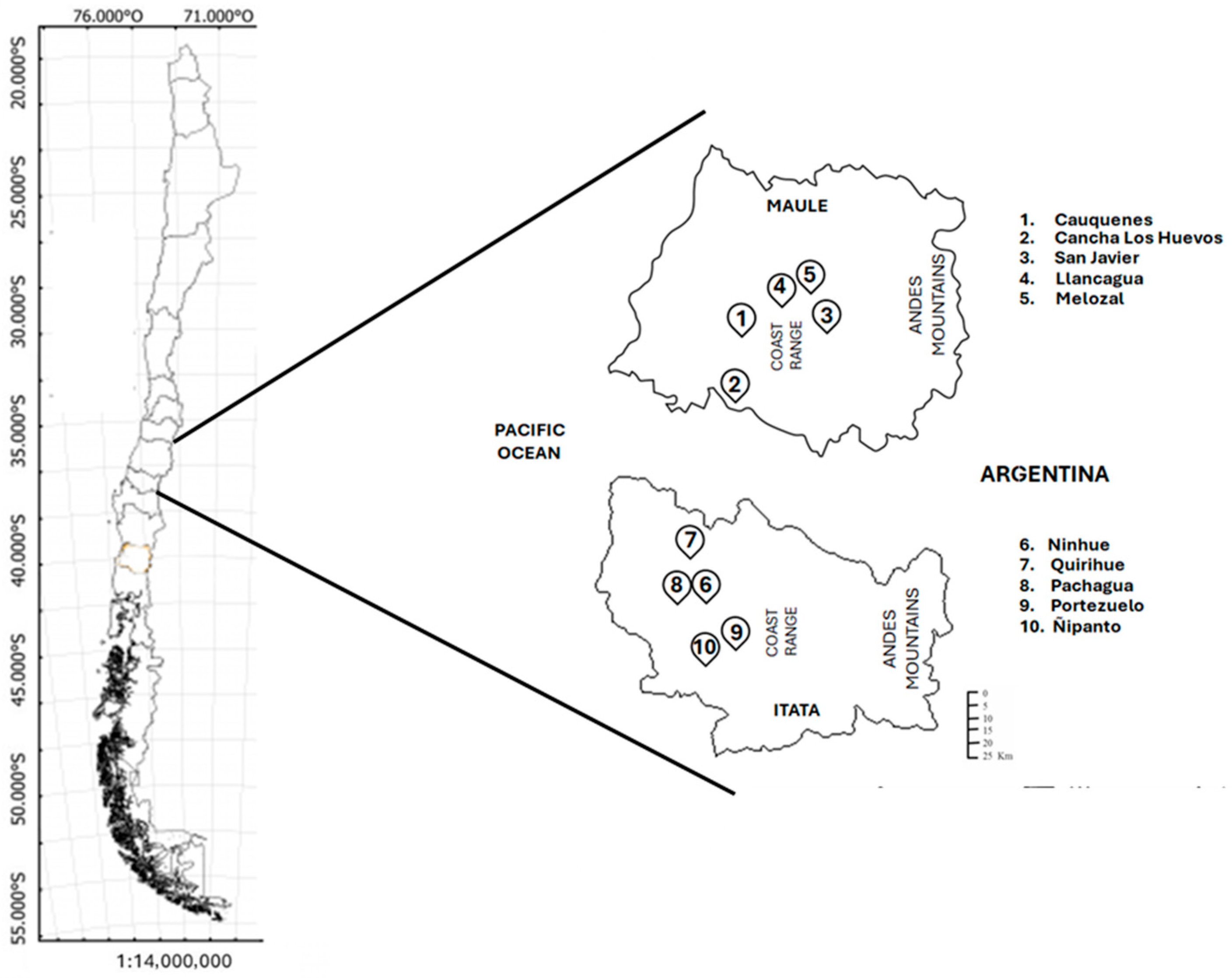
Vitis vinifera L. cv. País vines, estimated to be approximately 100 ± 20 years old. Vines were planted at a spacing of 3 × 2 m and trained according to the traditional gobelet system. The vineyards were distributed along a southeast–northwest transect across ten sites located in the dry-farmed areas of the Maule and Itata Valleys, Chile (
Table 1 and
Table S1,
Figure 1).
Each valley included five independent vineyard sites. For each site, three standardized microvinifications were carried out under controlled winemaking conditions. Fermentations were performed in triplicate, and the mean value of the three replicates was used for statistical analysis, considering the vineyard site (n = 5 per valley) as the experimental unit.
Grape maturity was monitored through periodic measurements of pH, titratable acidity, and total soluble solids (°Brix) to establish a comparable harvest stage among sites. Harvest was performed manually in March 2018 when berries reached approximately 23.5 ± 0.5°Brix. Grapes were collected from around 60 vines located within homogeneous soil zones at each vineyard site. Fruit was transported in 30 kg plastic boxes to the Department of Agro-Industry and Enology, University of Chile.
Upon arrival, grapes from each site were divided into three independent lots corresponding to the microvinification replicates. Each lot was destemmed and crushed (Delta E2, Bucher Vaslin, Santiago, Chile), sulphited (100 mg K2S2O5 kg−1), and transferred into 25 L fermentation vessels. Alcoholic fermentation was initiated using a selected Saccharomyces cerevisiae strain (Lalvin® EC1118, Lallemand Inc., Montreal, QC, Canada) at a dosage of 200 mg kg−1 to ensure standardized and reproducible fermentation kinetics across all samples. Fermentations were conducted in a temperature-controlled room at 20 °C.
Fermentation progress was monitored daily through measurements of must density and temperature. Cap management was adjusted according to fermentation stage to ensure adequate phenolic extraction while maintaining standardized conditions among all microvinifications. At the beginning of alcoholic fermentation, two gentle punch-down operations (approximately 5 min each) were performed daily, one in the morning and one in the afternoon, to promote homogeneous extraction and oxygen distribution. Once the fermentation reached a density of approximately 1.050, cap management was reduced to one punch-down per day until the end of alcoholic fermentation, which was considered complete when residual reducing sugars were below 2 g L−1.
After completion of fermentation and a total maceration period of two days, wines were racked, sulphited (200 mg K2S2O5 L−1), and stored at 4 °C for 15 days to allow tartaric stabilization. Subsequently, wines were bottled in 750 mL green glass bottles, sealed with natural cork closures, and stored in a dark cellar at 16 °C until analysis. Chemical and sensory evaluations were conducted three months after bottling.
2.3. Spectrophotometric Measurement
All data collection was performed using official O.I.V. methods. Measurements were performed using a Hewlett-Packard UV-Vis 1700 Pharmaspec spectrophotometer (Shimadzu, Kyoto, Japan). Distilled water was used for measurements (blank) and equipment calibration. CIELab colour parameters (L*, C*, a*, b* and h*) were determined based on the Commission Internationale de l’Eclairage (CIE) [
29,
30], using the CIE 1964 standard observer of 10° and the CIE D65 standard illuminant.
The CIELAB uniform space is defined by several parameters: L*, a photometric indicator of lightness, correlates with the property of lightness according to which each color in the grayscale goes from black (L* = 0) to white (L* = 100); the hue angle (h*) is the qualitative attribute, defined as red (0°/360°), yellow (90°), green (180°) or blue (270°); and the chroma (C*) is defined as the saturation of the colour compared to a grey colour with the same lightness, also considered a quantitative and qualitative attribute of colour, respectively.
2.4. Fractionation of Proanthocyanidins with Sep-Pak C18 Cartridges
Proanthocyanidins were fractionated according to their degree of polymerization using Sep-Pak tC18 cartridges (Waters, Milford, MA, USA). A 7 mL wine sample was used and concentrated to dryness in a rotary evaporator at <30 °C. The concentrate was dissolved in 20 mL of 67 mmol/L phosphate buffer (pH 7).
After adjusting the pH to 7 under a nitrogen atmosphere, the sample was passed through two preconditioned neutral Sep-Pak tC18 cartridges connected in series (top, Sep-Pak Plus Environmental tC18 cartridge (900 mg); bottom, Sep-Pak Plus Short tC18 cartridge (400 mg).
For each fraction obtained previously (monomeric, oligomeric and polymeric fractions), flavan-3-ols were quantified by vanillin assay, with spectrophotometric measurement with absorbance at 500 nm and methanol was used as a blank instead of vanillin [
31].
2.5. Anthocyanin Profiling by HPLC-DAD
Anthocyanin analyses were performed using an 1100 Series HPLC system (Agilent Technologies, Santa Clara, CA, USA) consisting of a G1315B photodiode array detector (DAD), a G1311A quaternary pump, a G1379A degasser, and a G1329A autosampler. Water-formic acid (90:10) was used as solvent A and acetonitrile as solvent B. The injection volume was 100 μL.
A LiChroCart C18 reversed-phase column (250 mm × 4.0 mm ID, 5 μm; Merck, Darmstadt, Germany) was used. Chromatographic conditions were as follows: flow rate was 1.1 mL/min from 0 to 22 min and 1.5 mL/min from 22 to 35 min as follows: 96–85% A and 4–15% B from 0 to 12 min, 85–85% A and 15–15% B from 12 to 22 min, 85–70% A and 15–30% B from 22 to 35 min. A final wash with 100% methanol and column re-equilibration were also used [
32].
UV–Vis spectra were recorded from 210 to 600 nm with a bandwidth of 2.0 nm. Prior to direct injection, samples were filtered through a 0.22 μm pore size membrane. The wavelength of 520 nm was used for quantification by comparing the areas and retention times with the malvidin-3-glucoside standard [
33].
2.6. Polysaccharide Analysis
High-performance size exclusion chromatography with refractive index detection (HPSEC-RID) was used to determine the molecular distributions and concentrations of polysaccharides. HPSEC-RID was performed using an Agilent 1260 Infinity Series liquid chromatograph (Agilent Technologies, Santa Clara, CA, USA) equipped with a G1362A refractive index detector (RID), a G1311B quaternary pump, a G1316A column oven with two Shodex columns, an OHpak SB-803 HQ and an SB-804 HQ connected in series (300 mm × 8 mm I.D., 6 μm and 10 μm, respectively; Showa Denko, Tokyo, Japan), and a G1329A autosampler. The quantification of the polysaccharide fractions was carried out using dextrans (
Leuconostoc mesenteroides) and pectins to prepare the calibration curves [
34].
2.7. Headspace Solid-Phase Micro-Extraction (HS-SPME) and GC/MS Conditions
The HS-SPME method was used to obtain an efficient extraction and desorption of wine volatile compounds. Extraction conditions were set at an incubation temperature of 35 °C, an extraction time of 30 min, a desorption time of 300 s, and a sodium chloride concentration of 1.5 g.
A 20 mL glass vial containing 7 mL of wine was supplemented with sodium chloride and 10 μL of 4-methyl-2-pentanol (internal standard, 0.75 g/L). The vial was then sealed and placed in the autosampler tray for automated HS-SPME analysis. Prior to extraction, the fibre was conditioned according to the manufacturer’s recommendations (1 h at 270 °C before first use and 5 min before each extraction).
Static headspace sampling was performed under agitation (500 rpm), and volatile compounds were extracted using a 2 cm, 50/30 μm carboxen/DVB/PDMS SPME fibre (Supelco, Bellefonte, PA, USA). After extraction, the fibre was thermally desorbed in the GC injector under the programmed analytical conditions.
Gas chromatographic analysis was carried out using an Agilent 7890B GC system coupled to an Agilent 5977 inert quadrupole mass spectrometer (Agilent Technologies, Palo Alto, CA, USA). Separation was achieved on a DB-Wax capillary column (60 m × 0.25 mm × 0.25 μm; J&W Scientific, Folsom, CA, USA), using helium as carrier gas at a flow rate of 1 mL/min. Mass spectra were acquired in full-scan mode (40–300 amu) under electron ionization at 70 eV. Data acquisition and processing were performed using ChemStation MS F.01.01.2317 software [
35].
2.8. Identification and Quantification of Volatile Compounds
Compound identification was performed by comparing mass spectra with those in the NIST 2.0 library and, when available, by agreement with retention data obtained under the same chromatographic conditions. Volatile compounds were classified according to the level of identification as follows: (A) compounds positively identified by comparison with authentic reference standards; (B) compounds identified based on mass spectral matching together with agreement of linear retention indices (LRI) with literature data; and (C) tentatively identified compounds based on mass spectral matching only. This classification approach has been previously applied in studies of wine volatile composition from our research group [
35,
36].
Quantification was carried out using calibration curves constructed at five concentration levels in triplicate for compounds for which commercial standards were available. Relative peak areas were calculated as the ratio between the target ion of each compound and that of the internal standard (4-methyl-2-pentanol). For compounds lacking authentic standards, semi-quantitative estimation was performed using the calibration curve of structurally related compounds with similar chromatographic behaviour, or alternatively by relative area, following previously reported approaches in wine volatile analysis [
35,
36].
The volatile analysis was applied in this study as a comparative analytical approach, aiming to evaluate differences between wines processed and analysed under identical experimental conditions. Formal limits of detection (LOD) and quantification (LOQ) were not established for all analytes within the scope of this work. Furthermore, it is acknowledged that HS-SPME extraction efficiency is compound-dependent and may be influenced by matrix effects. Therefore, the reported concentrations should be interpreted primarily in a comparative context rather than as absolute quantitative values for all volatile compounds.
2.9. Sensory Analysis
A descriptive sensory analysis was conducted on all wine samples using a trained panel of 15 individuals (nine women and six men, aged 25–40 years), all with prior experience in wine evaluation. Sessions took place in individual booths under controlled conditions (20 °C, white lighting, spittoon, and a call button). Wines were served at a temperature of 16 °C in standardized INAO tasting glasses, each containing 20 mL of wine and coded with random three-digit numbers. Panellists received a glass of water and were allowed rest periods between samples to restore oral conditions and avoid sensory fatigue.
The evaluation included visual attributes (colour intensity and hue), olfactory attributes (aromatic intensity, red fruit aroma, floral aroma, and retronasal red fruit aroma), and gustatory attributes (acidity, astringency, bitterness, body, and finish/persistence). Attribute intensities were rated on a 15 cm unstructured line scale, where 0 indicated the absence of the attribute and 15 its maximum perceived intensity, according to standard descriptive analysis procedures used in wine sensory studies [
36,
37]. All procedures involving human participants were conducted in accordance with the Declaration of Helsinki and were approved by the University of Chile Human Ethics Committee (026/2020).
2.10. Data and Statistical Analysis
All chemical and sensory data were subjected to statistical analysis to evaluate differences between valley origin (Maule vs. Itata) and to explore relationships among compositional and sensory variables. The vineyard site was treated as the experimental unit to avoid pseudoreplication.
Prior to analysis, chemical variables were examined for normality and homoscedasticity using the Shapiro–Wilk and Levene tests, respectively. When necessary, variables were log- or square-root transformed to meet parametric assumptions.
Univariate comparisons between valleys were performed using Student’s t-test for normally distributed chemical variables with homogeneous variances. When these assumptions were not met, the non-parametric Mann–Whitney U test was applied. Results are reported as mean ± standard deviation, and statistical significance was established at p < 0.05.
Sensory data were analysed using the mean intensity scores obtained from the trained panel for each wine sample, considering the wine as the experimental unit.
Effect sizes (Cohen’s d) were calculated to complement p-values and provide a quantitative estimate of the magnitude of differences between valleys. This approach was included to avoid relying exclusively on statistical significance in a dataset with a limited number of independent vineyard sites.
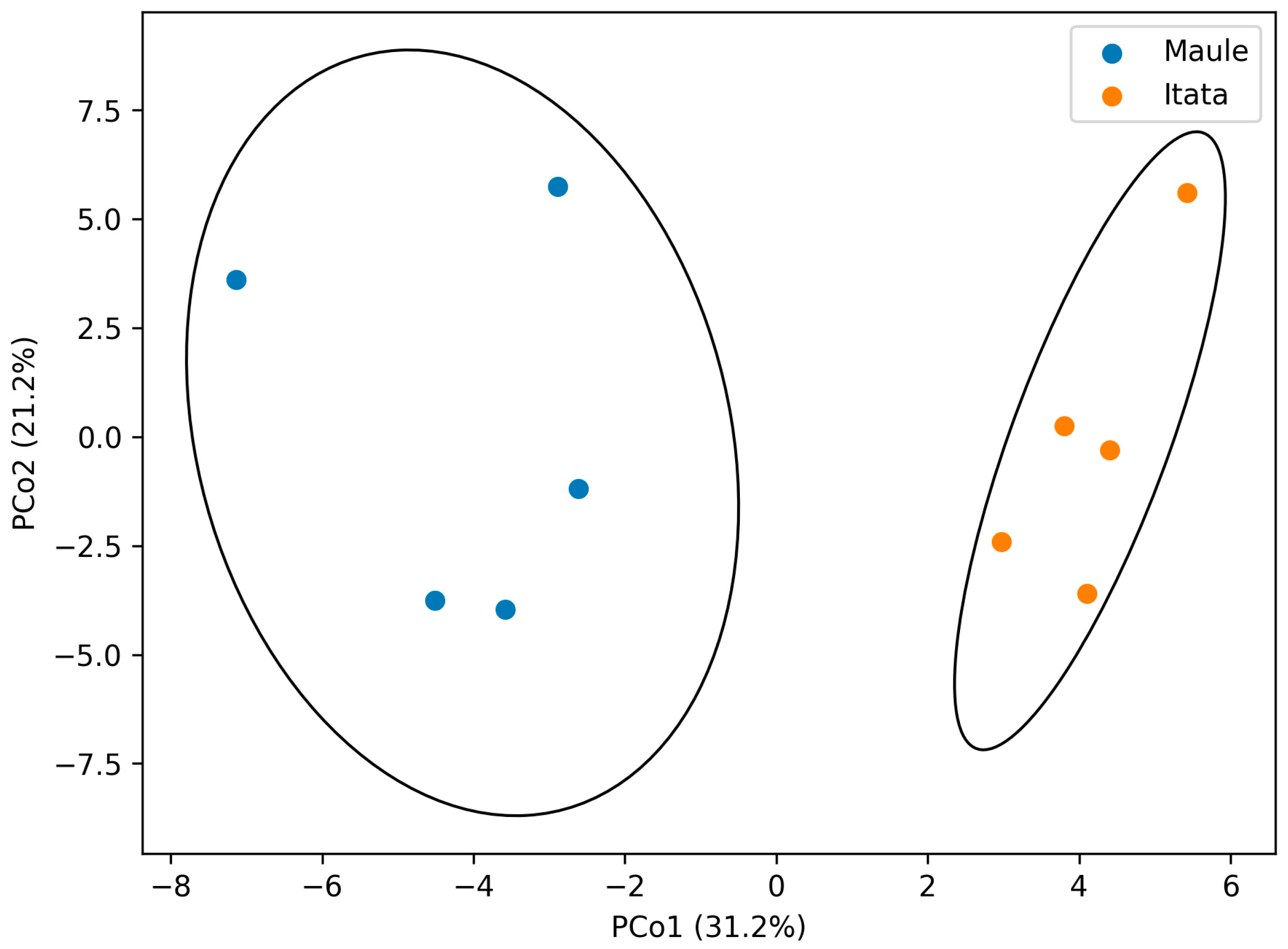
Multivariate analysis of the chemical dataset was conducted using a distance-based approach. Principal coordinates analysis (PCoA) was applied to autoscaled chemical variables using Euclidean distances to visualize multivariate relationships among wines. As an ordination method, PCoA was used for exploratory visualization, while statistical inference of group differences was assessed using PERMANOVA.
To statistically evaluate multivariate differences between valleys, a permutational multivariate analysis of variance (PERMANOVA) was performed on the same distance matrix using 9999 permutations.
To further assess multivariate structure, the distribution of Euclidean distances was analysed by comparing within-valley and between-valley distances, providing a complementary evaluation of group dispersion and overlap.
Given the limited number of independent vineyard sites (n = 5 per valley), supervised classification methods such as PLS-DA or OPLS-DA were not applied due to the high risk of overfitting and inflated classification performance.
Relationships between chemical composition and sensory attributes were explored using Pearson correlation analysis. However, given the limited sample size, only correlations with |r| ≥ 0.60 and p < 0.05 were considered, and results were interpreted as exploratory.
All statistical analyses were performed using R software (version 4.2.2; R Core Team, Vienna, Austria). Data processing and visualization were conducted using base R functions and relevant packages, including vegan for PERMANOVA and PCoA, and ggplot2 for graphical representation.
3. Results and Discussion
3.1. Basic Chemical Parameters and Chromatic Attributes of País Wines
The País wines from both regions exhibited elevated pH values (
Table 2), with Maule at 3.87 ± 0.10 and Itata at 3.72 ± 0.36, though the difference was not statistically significant. These values position the wines near the upper limit of the typical red wine pH range (2.8–3.8), indicating lower acidity and potentially greater susceptibility to microbial spoilage and colour loss through oxidation [
32]. For comparison, Cabernet Sauvignon typically exhibits a pH of 3.58–3.70 and Carignan between 2.95 and 3.23 [
34,
38], highlighting País as comparatively less acidic. Earlier studies on País (i.e., Listán Prieto) reported pH values averaging 4.16 [
39] and 3.6 [
10,
40], aligning with our data.
Titratable acidity (TA) was also low in both valleys (~3.4–3.5 g H
2SO
4·L
−1), falling near the lower end of the acceptable TA range [
31,
34]. These lower TA levels suggest limited buffering capacity and could impair colour stability and microbial protection over time [
32].
3.2. Chromatic Properties of País Wines
The chromatic profile of cv. País wines from the Maule and Itata valleys showed no statistically significant differences in colour intensity (CI), hue, or CIELAB coordinates (L*, a*, b*, C*, H*) (
Table 2).
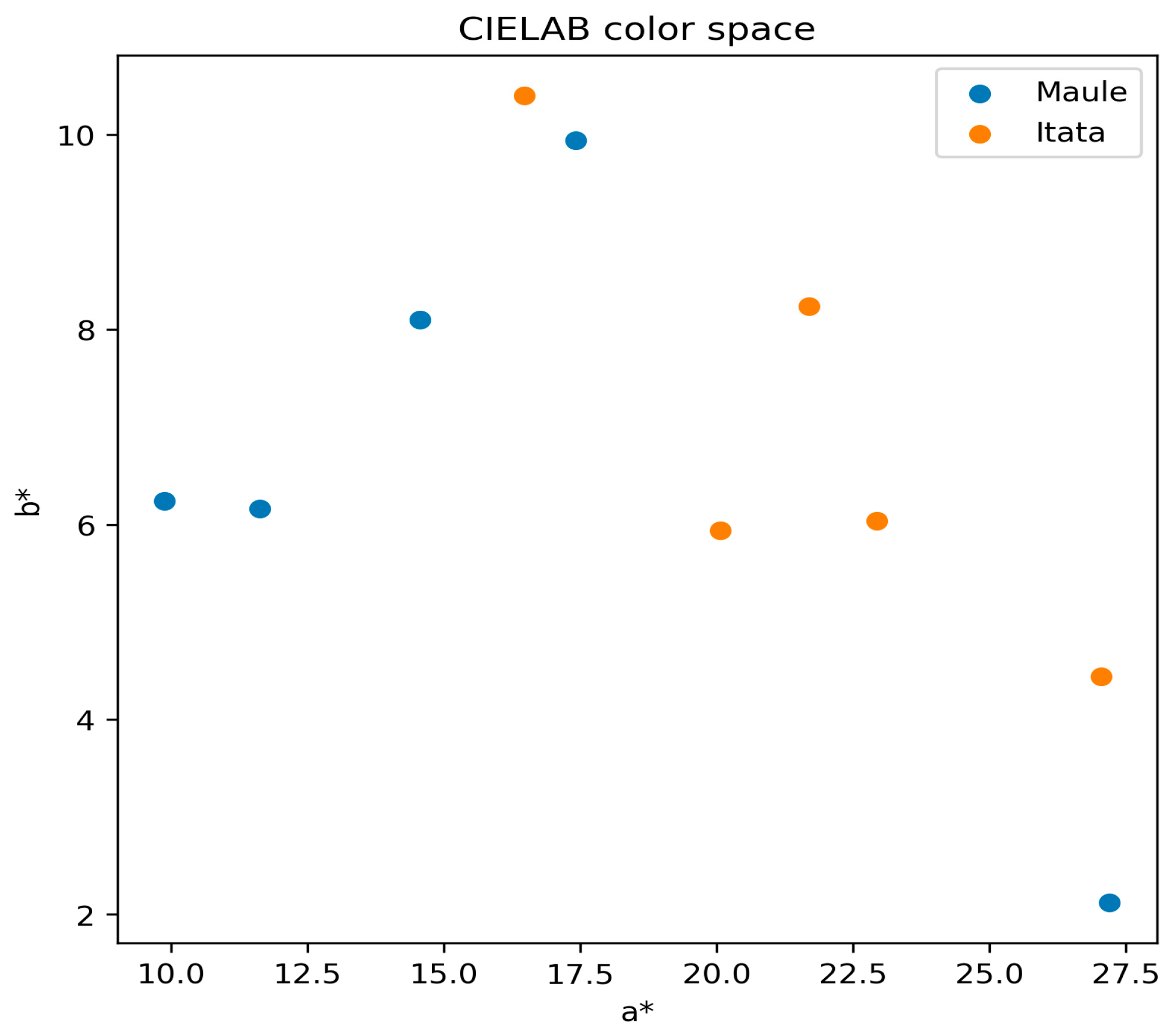
As shown in
Figure 2, the distribution of CIELAB coordinates (a* and b*) exhibited a substantial overlap between valleys, indicating limited differentiation in chromatic attributes under the conditions of this study. This pattern is consistent with the absence of statistically significant differences in the measured colour parameters.
Colour intensity (CI) values were within the range typically reported for País wines, with slightly higher mean values observed in Itata wines compared with Maule. Similarly, hue values tended to be higher in Maule wines, suggesting a relatively greater contribution of yellow tones. However, these differences were not statistically significant and should therefore be interpreted cautiously.
The CIELAB coordinates provided a complementary description of colour characteristics. Maule wines exhibited slightly higher L* values, indicating a tendency toward higher lightness, while Itata wines showed higher mean a* and C* values, suggesting a tendency toward more intense red chromatic components. The b* coordinate remained relatively similar between valleys, reflecting a comparable contribution of yellow tones in both groups. In agreement with these trends, H* values were lower in Itata wines, consistent with a shift toward redder hues.
Although these patterns are consistent with previous studies linking anthocyanin composition with CIELAB parameters [
30,
38], the substantial overlap observed between samples indicates that these differences are not sufficiently robust to distinguish wines according to valley under the present conditions.
Overall, the chromatic data reflect the characteristic colour profile of País wines, typically associated with relatively low colour intensity and moderate chromatic saturation compared with other red wine varieties [
32,
39]. The variability observed within each valley highlights the importance of site-specific factors and supports the interpretation of these results as indicative rather than definitive within a single-vintage dataset.
3.3. Phenolic Composition
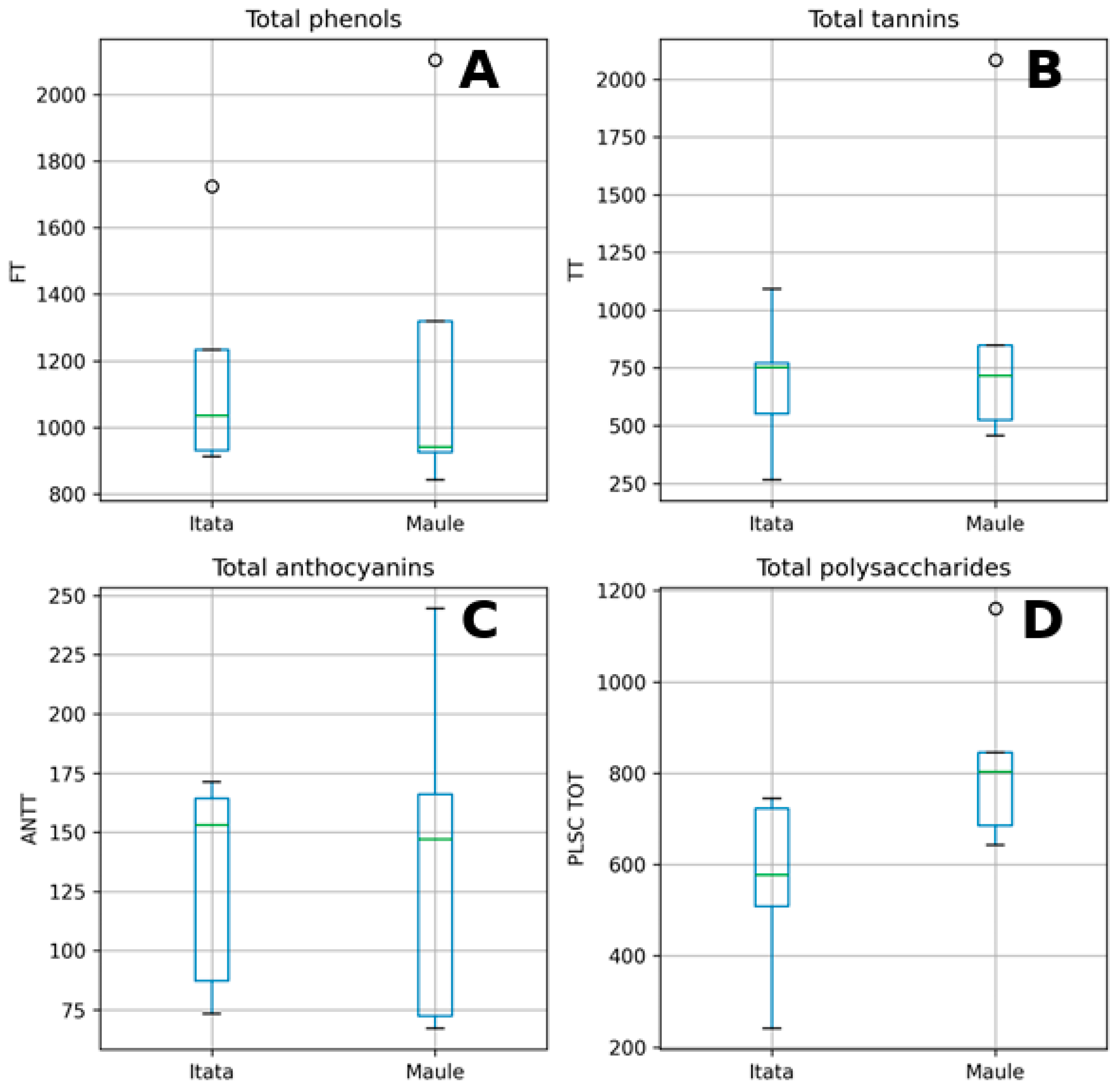
The phenolic compositions of cv. País wines from the Maule and Itata valleys are summarized in
Table S2 and
Figure 3. Total phenols showed similar values in both valleys (~1200 mg GAE·L
−1), with no statistically significant differences. As shown in
Figure 3A, a substantial overlap between samples was observed, indicating high intra-valley variability. These values are consistent with those reported for País wines in previous studies [
39,
40].
Total anthocyanin concentrations were also low (~130 mg malvidin-3-glucoside·L
−1) and did not differ significantly between valleys (
Figure 3C). These levels fall within the lower range reported for red wines [
32] and are consistent with previous findings for País [
10,
40]. The anthocyanin profile comprised a limited number of compounds, including four monoglucosides (delphinidin, petunidin, peonidin, and malvidin) and two acylated derivatives, with malvidin-3-glucoside as the predominant form. This reduced diversity is in agreement with earlier reports and reflects the relatively simple anthocyanin composition described for this cultivar [
10,
40].
Total tannin concentrations were also moderate and showed no statistically significant differences between valleys, although slightly higher mean values were observed in Maule wines (
Figure 3B). Overall levels were lower than those typically reported for many red wine varieties [
32], but consistent with previous studies on País wines [
10].
In contrast, significant differences were observed in flavanol fractions (
Table S2). Monomeric and oligomeric flavanols were significantly higher in Maule wines compared with Itata, whereas polymeric flavanols did not differ significantly between valleys. As shown in
Table S2, polymeric flavanols represented the largest proportion of total flavanols (~70–80%), followed by oligomeric fractions, while monomeric flavanols accounted for a minor proportion. This distribution is consistent with patterns reported for other red wine cultivars [
34,
38,
41].
Although total phenolic parameters showed limited differentiation between valleys, the observed differences in flavanol composition suggest that subtle variations in phenolic structure may occur. However, given the variability within each valley, these differences should be interpreted as indicative rather than definitive within the context of the present study.
3.4. Polysaccharides
Wine polysaccharides exhibit a high degree of structural diversity, which enables their interaction with other wine constituents involved in mouthfeel through mechanisms such as hydrogen bonding and hydrophobic associations [
42,
43,
44]. The distribution of polysaccharides is presented in
Table S3 and
Figure 3D. Total polysaccharide content was significantly higher in Maule wines compared with Itata wines. However, as shown in
Figure 3D, a certain degree of variability was observed within each valley.
No statistically significant differences were detected among the individual polysaccharide fractions (FI, FII, and FIII). In relative terms, Fraction II (mid-range molecular weight) was the predominant fraction in Maule wines, whereas Fraction III (low molecular weight) showed a higher proportional contribution in Itata wines. Fraction I (high molecular weight) represented the smallest proportion in both valleys.
This distribution pattern is consistent with previous studies on red wine polysaccharides, including cultivars such as Carignan [
38] and Carménère [
42], where similar fraction dominance has been reported.
Overall, the observed differences in total polysaccharide content suggest variation in polysaccharide extraction or composition between valleys. However, given the variability within groups, these differences should be interpreted with caution within the context of the present study.
3.5. Volatile Compound Composition
The volatile profile of cv. País wines from the Maule and Itata valleys comprised 37 compounds, including 17 esters, 9 alcohols, 4 terpenes, 4 volatile acids, 2 norisoprenoids, and 1 aldehyde (
Table S4). This composition is consistent with previous reports on cv. País grapes and wines from similar geographical regions, where comparable numbers of volatile compounds have been identified [
8,
37].
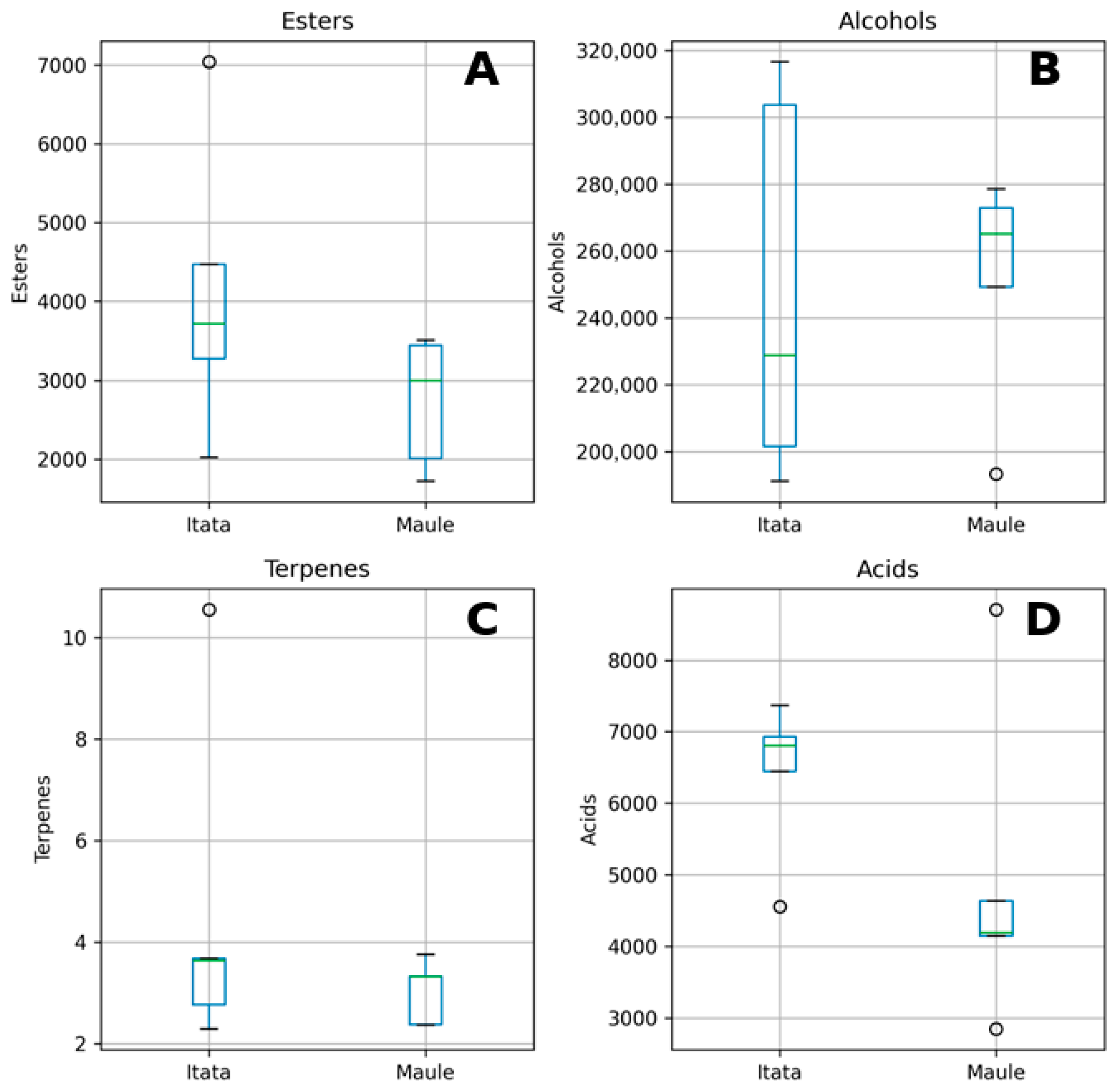
The distribution of major volatile families is shown in
Figure 4. Esters represented the most abundant group in terms of number of compounds and showed a tendency toward higher concentrations in Itata wines compared with Maule wines. Alcohols were present at relatively high concentrations in both valleys and constituted the second most abundant group, followed by acids, while terpenes and norisoprenoids were detected at much lower concentrations. A substantial overlap between valleys was observed for all volatile families, reflecting high intra-valley variability.
Terpenes exhibited slightly higher values in Itata wines, although differences were not statistically significant. These compounds have been widely associated with floral and citrus-related aromatic descriptors in wines [
37].
A statistically significant difference was observed for aldehydes, with Maule wines showing markedly higher concentrations than Itata wines (
Table S4), mainly due to the contribution of benzaldehyde. This compound is commonly associated with almond-like aromatic notes and may originate from oxidative reactions or fermentation-related transformations. Although aldehydes represent a minor fraction of the overall volatile composition, their presence may reflect differences in oxidation-related processes between wines.
Norisoprenoids, including β-damascenone and TDN, were detected at very low concentrations in both valleys. These compounds were not previously reported in País wines used as base wines for sparkling production [
37], which may be related to differences in vinification practices, particularly the longer skin contact typical of red wine production.
The observed volatile composition reflects the transformation of grape-derived precursors during alcoholic fermentation, where esters and higher alcohols are formed through yeast metabolism, while additional compounds may arise from enzymatic release of bound aroma precursors [
32,
37]. Although several of the identified volatile compounds are commonly associated with specific aroma descriptors, their direct sensory contribution cannot be established in the absence of odor activity values (OAVs).
Overall, the volatile profile observed in this study is consistent with the aromatic typicity described for cv. País wines, characterized by the predominance of esters and higher alcohols, moderate terpene levels, and the presence of acid- and norisoprenoid-derived compounds. While some tendencies between valleys were observed, the substantial overlap between samples suggests that these differences should be interpreted as indicative rather than definitive within the context of a single-vintage study.
3.6. Sensory Analysis
A descriptive sensory evaluation conducted by a trained panel revealed significant differences in 5 out of 11 evaluated attributes between Maule and Itata wines (
Table 3,
Figure S1). Overall, the sensory profiles of the wines showed both shared characteristics and some degree of differentiation between valleys.
Visual attributes exhibited clear differences. Wines from Itata were perceived as having significantly higher colour intensity, whereas Maule wines showed higher hue values, corresponding to a tendency toward more evolved or brick-like tonalities. These differences are consistent with sensory perception; however, they contrast with the absence of statistically significant differences in instrumental colour parameters, suggesting that visual perception may be influenced by factors not fully captured by bulk chromatic measurements.
In terms of aroma, no significant differences were observed in orthonasal aroma intensity or red fruit perception. However, Itata wines were characterized by higher floral aroma and retronasal red fruit perception. These differences are consistent with the compositional trends observed in volatile compounds (
Section 3.5), where slightly higher concentrations of esters, terpenes, and norisoprenoids were found in Itata wines. These relationships should be interpreted as associative trends rather than causal relationships.
This interpretation is consistent with the broader wine-sensory literature, where volatile compounds, phenolics, and polysaccharides may contribute to perception through additive, suppressive, or matrix-dependent interactions rather than through simple one-to-one relationships [
44].
Gustatory attributes showed fewer differences between valleys. Acidity, bitterness, body, and persistence did not differ significantly. In contrast, astringency was significantly higher in Itata wines compared with Maule wines. This observation contrasts with the higher total tannin and polysaccharide contents measured in Maule wines, indicating that astringency perception cannot be explained solely by the concentration of individual phenolic components. Similar patterns have been reported for cv. País wines, where sensory differences were only partially associated with phenolic composition and more strongly linked to site-related factors and the overall wine matrix [
10]. These findings reinforce the view that wine mouthfeel results from complex interactions among phenolic compounds, polysaccharides, and other matrix constituents rather than from single compositional variables.
Instead, these results highlight the importance of the overall wine matrix and the relative composition of phenolic fractions. Differences in flavanol composition, particularly the relative abundance of monomeric and oligomeric forms, together with variations in polysaccharide content, may contribute to differences in tactile perception through mechanisms such as protein–polyphenol interactions and polysaccharide-mediated modulation of astringency [
36,
42,
43,
44]. However, given the variability observed within each valley, these relationships should be interpreted with caution.
An additional factor to consider is the age of the vineyards, as all wines were produced from old-vine País plantings (~100 years). Old vines are often associated with lower yields, altered source–sink balance, and differences in berry composition, which may influence both phenolic and aromatic profiles. While vine age was not evaluated as an experimental factor in this study, it likely contributes to the overall compositional and sensory characteristics observed and may be considered part of the broader context of traditional dry-farmed systems.
Overall, the sensory results indicate that, although wines from both valleys share a common varietal profile, some consistent differences in visual, aromatic, and gustatory attributes can be observed. These differences are aligned with compositional trends but should be interpreted as indicative within the context of a single-vintage study.
Pearson correlation analysis was explored to examine potential relationships between chemical and sensory variables; however, given the limited number of independent samples, these associations were not considered sufficiently robust for detailed interpretation and are therefore not presented.
This outcome confirms that, even after incorporating a broader compositional dataset than previous studies on cv. País, the relationship between chemical composition and sensory perception remains complex and only partially explained by the measured variables. Accordingly, the present study should be understood as an integrative characterization of compositional and sensory patterns rather than as a validated predictive model of sensory behaviour.
3.7. Multivariate Analysis of Chemical Composition
To evaluate multivariate patterns in the chemical composition of País wines, a distance-based approach was adopted. Principal coordinates analysis (PCoA), a distance-based ordination method widely used in complex compositional datasets [
45,
46], was applied to the autoscaled dataset using Euclidean distances. This approach provides a graphical representation of the multivariate structure that is directly consistent with the statistical framework used for hypothesis testing (
Figure 5).
The first two principal coordinates explained a substantial proportion of the variance contained in the distance matrix, allowing visualization of sample relationships in a reduced-dimensional space. The PCoA plot suggested a structured separation between valleys along the first coordinate, with Itata wines distributed toward positive values and Maule wines toward negative values. In addition, Maule wines exhibited a broader dispersion compared to Itata wines, indicating greater within-valley compositional variability.
Despite this apparent structure, PERMANOVA did not indicate a statistically significant valley effect (pseudo-F = 1.40, R2 = 0.15, p = 0.141; 9999 permutations). This suggests that the observed separation should be interpreted as a tendency in the dataset rather than as robust multivariate discrimination between valleys.
This interpretation is further supported by the analysis of Euclidean distance distributions (
Figure S2), where the overlap between within-valley and between-valley distances indicates that variability among wines within each valley is comparable to the variability observed between valleys.
Overall, the multivariate analysis provides an integrative view of the chemical dataset, in which differences between valleys emerge as structured patterns but are not supported by statistical evidence of group separation. These results should therefore be interpreted as exploratory trends within the context of the present dataset, which is limited by the number of independent vineyard sites and the single-vintage design.
4. Conclusions
This study provides a comparative chemical and sensory characterization of dry-farmed País wines from the Maule and Itata valleys in Chile, produced under standardized microvinification conditions. The results indicate that wines from both valleys share a broadly similar compositional base, with differences emerging only in specific chemical and sensory domains.
At the chemical level, differences between valleys were observed in selected compositional fractions rather than in global phenolic parameters. Maule wines exhibited higher concentrations of monomeric and oligomeric flavanols, total polysaccharides, and aldehydes, whereas Itata wines tended to show higher ester levels. In contrast, total phenolic and anthocyanin concentrations were comparable between valleys, indicating that regional variation was not primarily associated with bulk phenolic content.
Sensory evaluation revealed differences in color intensity, floral aroma, retronasal red-fruit notes, and astringency. These differences were consistent with compositional trends; however, they likely reflect the combined influence of multiple components of the wine matrix rather than the effect of individual compounds.
At the multivariate level, a structured separation between valleys was observed in the PCoA; however, this pattern was not supported by PERMANOVA results, indicating that the observed differences do not translate into statistically robust valley-level discrimination.
Overall, given the single-vintage design and the limited number of independent vineyard sites, these findings should be interpreted as exploratory. While the inclusion of multiple compositional domains provides a more comprehensive characterization of País wines than phenolic-focused approaches, it does not fully resolve the previously reported limitations in linking chemical composition with sensory perception. Therefore, the present study provides an incremental but relevant contribution toward understanding País wine typicity rather than a predictive framework for sensory behavior.




 ,
,