Article

Dopamine and GR24 Alleviate Cadmium Stress and Reduce Cadmium Uptake in Grapevines

College of Horticulture, Sichuan Agricultural University, Chengdu 611130, China
*
Author to whom correspondence should be addressed.
Horticulturae 2026, 12(2), 226; https://doi.org/10.3390/horticulturae12020226
Submission received: 10 January 2026 / Revised: 5 February 2026 / Accepted: 7 February 2026 / Published: 12 February 2026
(This article belongs to the Section Biotic and Abiotic Stress)

Abstract

To alleviate cadmium (Cd) stress and reduce Cd uptake in fruit trees, the effects of dopamine (100 μmol/L, based on previous studies) and strigolactone analog GR24 (1 μmol/L, based on previous studies) on the growth and Cd accumulation of grapevines under Cd stress (5 mg/L, based on preliminary study) were investigated. Compared with control, Cd treatment inhibited grapevine growth by decreasing the plant height, root length, biomass, and photosynthetic capacity. In contrast, under Cd stress, treatments with dopamine or GR24 increased the plant height, root length, biomass, and photosynthetic capacity compared with Cd treatment. Dopamine and GR24 treatments also affected the activities of antioxidant enzymes (peroxidase, superoxide dismutase, and catalase) and the levels of osmotic regulatory substances (soluble protein, proline, and soluble sugar) in different ways. Moreover, dopamine and GR24 treatments reduced the Cd content and translocation factor in grapevines under Cd stress. Specifically, compared with Cd treatment, dopamine treatment reduced root Cd content by 18.92% and shoot Cd content by 35.18%, whereas GR24 treatment reduced root Cd content by 10.93% and shoot Cd content by 22.61%. In conclusion, both dopamine and GR24 treatments can mitigate Cd stress, promote growth, and reduce Cd uptake in grapevines.

1. Introduction

Cadmium (Cd) contamination is characterized by its tendency to accumulate and resist degradation, leading to damage of soil ecological health [1,2]. When Cd accumulates in plants beyond a certain threshold, it inhibits the respiration and photosynthesis, reduces enzyme activity, and decreases the levels of soluble sugars and proteins. These effects result in stunted growth, leaf yellowing, and dwarfism, ultimately reducing crop yield and posing risks to the product quality and safety [3,4]. Furthermore, Cd can enter the human body through the food chain, causing various chronic diseases [5]. Therefore, identifying and developing more effective methods to reduce Cd accumulation in crops is of significant practical importance.
Dopamine (DA) is a crucial catecholamine that not only regulates plant growth and development but also enhances the resistance to various abiotic stresses [6,7]. Studies have shown that DA alleviates the detrimental effects of excessive Cd on the levels of photosynthetic pigments by increasing magnesium and iron content, thereby promoting the synthesis of chlorophyll a, chlorophyll b, total chlorophyll, and carotenoids [8]. This helps maintain photosynthetic pigment levels and improves photosynthetic capacity by increasing stomatal conductance, ultimately promoting plant growth [9]. Additionally, DA acts as a free radical scavenger, enhancing plant antioxidant capacity by activating the antioxidant enzyme system [6]. At the same time, DA can inhibit Cd absorption and transport by regulating the expression of Cd metabolism-related genes such as NRAMP3 and HMA4 in apple and reduces Cd uptake and minimizes its translocation from roots to aboveground parts [10,11]. Moreover, DA significantly increases levels of ethylene precursor 1-aminocyclopropane-1-carboxylic acid (ACC) and abscisic acid (ABA), free amino acids like arginine and phenylalanine, and polyphenolic compounds in plants under Cd stress, thereby reducing Cd accumulation [11]. In Cd hyperaccumulator plants such as duckweed, DA enhances chlorophyll content and photosynthetic efficiency by boosting the activity and stability of photosystem I (PSI) and photosystem II (PSII). It also increases Cd uptake rates in duckweed roots by upregulating the nitrate transporter (NRT1) expression [12]. Therefore, DA plays a significant role in regulating plant growth and Cd accumulation.
Strigolactones are carotenoid-derived compounds that play extensive roles in plant growth, development, and stress responses. The synthetic strigolactone analog GR24 is widely used to regulate crop growth and development [13]. GR24 can alleviate Cd-induced growth inhibition by promoting root morphogenesis in plants such as chili peppers, resulting in increased root surface area, enhanced root vitality, and more efficient water and nutrient uptake [14]. Additionally, GR24 improves chlorophyll content and photosynthetic capacity under Cd stress by maintaining PSII supercomplex stability, enhancing photosynthetic electron transport, and optimizing the supply of adenosine triphosphate (ATP) and nicotinamide adenine dinucleotide phosphate (NADPH) in the Calvin cycle [15]. GR24 also modulates the activity of transcription factors such as AP2/ERF and MYB under Cd stress, thereby increasing the antioxidant enzyme activity to mitigate the Cd-induced oxidative damage and membrane lipid peroxidation [16]. Furthermore, GR24 influences heavy metal transporters, affecting the competition between Cd and other mineral elements, which leads to reduced Cd uptake and accumulation in crops, thereby alleviating Cd stress [17,18]. In Cd-hyperaccumulator plants such as Solanum nigrum var. humile and Galinsoga parviflora, GR24 has shown no significant effect on biomass under Cd stress, possibly due to its primary role in regulating plant branching, which varies among plant species [19,20,21]. At the same time, GR24 reduces peroxidase (POD) activity while increasing superoxide dismutase (SOD) and catalase (CAT) activities in Cd-stressed crops. It also enhances photosynthetic pigment content and photosynthetic capacity by inhibiting chlorophyll degradation enzyme activity, thus promoting Cd uptake and increasing phytoremediation potential [19,22]. Collectively, these studies indicate that GR24 plays a crucial role in regulating plant growth and Cd accumulation.
Grape (Vitis vinifera) is a perennial, deciduous, woody vine that produces sweet, sour, and juicy berries [23]. With the acceleration of industrialization and agricultural modernization, Cd contamination in orchard soils has become increasingly prominent, adversely affecting the safe production of grapes [24,25]. We hypothesize that the application of DA and GR24 to grapevines may reduce their Cd uptake. In this study, we investigated the effects of DA and GR24 on the growth and Cd accumulation of grapevines under Cd stress and compared the efficacy between a direct antioxidant (DA) and a growth regulator (GR24). The aim was to improve the tolerance of grapevines to Cd stress and reduce their Cd uptake.

2. Materials and Methods

2.1. Materials

The variety of the grape was ‘Summer Black’ (a triploid seedless grape). One-year-old grapevine branches were collected from the vineyard at Modern Agricultural Research and Development Base of Sichuan Agricultural University (30°33′46″ N, 103°39′36″ E), Chengdu, China, in December 2024 and stored in moist sand. In February 2025, the branches with 10 cm in length and one bud were cut and planted in plug trays filled with moist perlite, with the same cultivating conditions as the previous study [26].
DA was obtained from Shanghai Aladdin Biochemical Technology Co., Ltd. (Shanghai, China).
GR24 was obtained from Beijing Coolaber Science & Technology Co., Ltd. (Beijing, China).

2.2. Experimental Design

The experiment was conducted in a rain shelter at Chengdu Campus of Sichuan Agricultural University, Chengdu, China. In April 2025, when the new grapevine shoots had developed three leaves, the plants were transplanted into plastic pots (12 cm in diameter, 10 cm in height) filled with moist perlite (pH 7.05, electrical conductivity 0.43 mS/cm, and no Cd detected), with one plant per pot. The cultivating conditions were the same as the previous study [26]. The experiment included the following four treatments: (1) control; (2) Cd treatment: 5 mg/L Cd; (3) DA treatment: 5 mg/L Cd + 100 μmol/L DA; and (4) GR24 treatment: 5 mg/L Cd + 1 μmol/L GR24, based on previous studies [12,17,18]. The experiment followed a completely randomized design, and each treatment was replicated three times, with three pots per replicate. Hoagland nutrient solution was applied every three days. Cd was supplied by adding CdCl2·2.5H2O directly to the Hoagland solution, achieving a final concentration of 5 mg/L in the relevant treatments. DA and GR24 were applied by foliar spraying once a week, for a total of three applications. The positions of the pots were rotated randomly, and plant samples were harvested one month after the first DA and GR24 treatments.

2.3. Determination of Parameters

Mature leaves from grapevines at the same position were selected to measure photosynthetic gas exchange parameters, including net photosynthetic rate, stomatal conductance, intercellular CO2 concentration, and transpiration rate, using a LI-6400 portable photosynthesis system (LI-COR, Lincoln, NE, USA) [26]. Subsequently, the same mature grapevine leaves were collected to determine the contents of photosynthetic pigments (chlorophyll a, chlorophyll b, and carotenoids), the activities of antioxidant enzymes (SOD, POD, and CAT), and soluble protein content, following the methods of Zhang and Zhai [27]. Afterward, the entire grapevines were excavated and separated into shoots and roots to measure the plant height and root length using a tape measure. Root and shoot samples were washed and removed the metal from the root surface using 0.01 mol/L HCl. Then, the samples were dried at 80 °C to constant weight, and their biomass (dry weight) was determined using an electronic balance. The finely ground dried samples were used to determine soluble sugar and proline contents by the anthrone colorimetric method and the indophenol colorimetric method, respectively [27]. To determine Cd content, the finely ground, dried samples were digested in a mixture of HNO3–HClO4 (9:1), and the resulting solution was analyzed using an atomic absorption spectrophotometer (PinAAcle 900H, PerkinElmer, Waltham, MA, USA) [28]. Additionally, the translocation factor was calculated as the ratio of shoot Cd content to root Cd content [29].

2.4. Statistical Analysis

Data analysis was performed using SPSS 28.0 software (IBM Corp, Armonk, NY, USA). After standardization and homogeneity tests, one-way analysis of variance (ANOVA) was applied, followed by Duncan’s multiple range test (p < 0.05). Pearson’s correlation analysis was conducted to analyze the relationships among the different parameters under Cd stress. Additionally, all parameters under Cd stress underwent a principal component analysis (PCA) and cluster analysis using Origin 2024 software (OriginLab Corporation, Northampton, MA, USA).

3. Results

3.1. Effects of DA and GR24 Treatments on the Growth Parameters of Grapevines

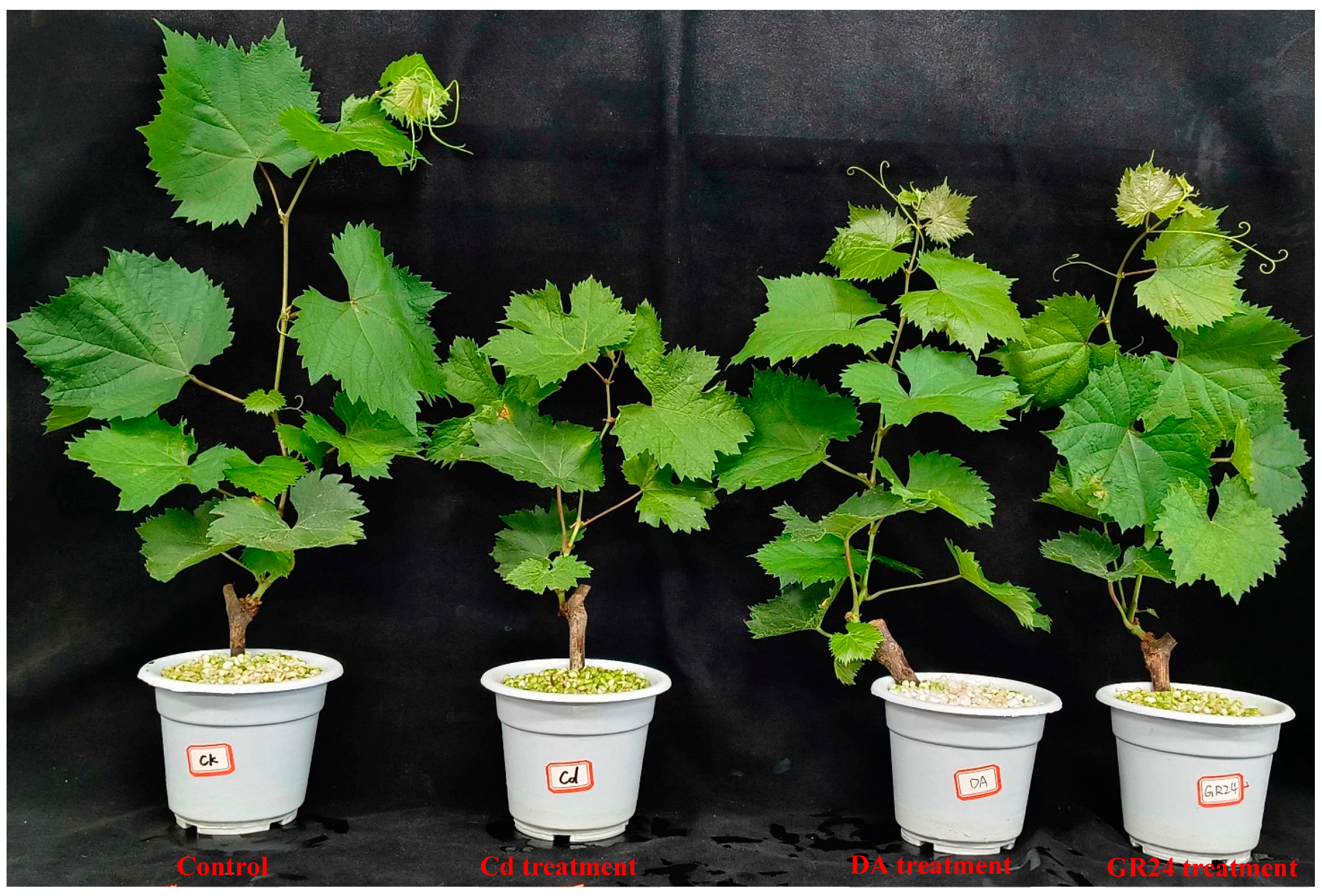
Cd treatment inhibited the growth of grapevines (Figure 1). Compared with control, Cd treatment decreased the plant height, root length, root biomass, and shoot biomass by 45.58%, 17.44%, 18.20%, and 35.57%, respectively (Table 1). Under Cd stress, grapevines treated with DA and GR24 exhibited lower plant height, root length, root biomass, and shoot biomass than control. However, compared with Cd treatment, the plant height, root length, and shoot biomass in DA treatment increased by 33.58%, 7.75%, and 18.12%, respectively, while there was no significant difference in the root biomass between DA and Cd treatment. Additionally, in GR24 treatment, the plant height, root length, root biomass, and shoot biomass were higher than those under Cd treatment, with increases of 50.92%, 12.68%, 9.50%, and 43.89%, respectively. Moreover, under Cd stress, plant height, root biomass, and shoot biomass in DA treatment were lower than those in GR24 treatment, while root length showed no significant difference between DA and GR24 treatments.

3.2. Effects of DA and GR24 Treatments on the Photosynthetic Pigment Content in Grapevines

Cd treatment decreased the contents of photosynthetic pigments in grapevines (Table 2). Compared with control, Cd treatment reduced the contents of chlorophyll a, chlorophyll b, and carotenoids by 35.08%, 24.22%, and 16.11%, respectively. DA treatment increased the chlorophyll a content by 12.50% compared with Cd treatment, while it had no significant effect on the contents of chlorophyll b and carotenoids under Cd stress. In addition, compared with Cd treatment, GR24 treatment increased the contents of chlorophyll a, chlorophyll b, and carotenoids by 16.53%, 6.77%, and 8.00%, respectively, under Cd stress. There were no significant differences in the contents of photosynthetic pigments between DA and GR24 treatments.

3.3. Effects of DA and GR24 Treatments on the Photosynthetic Gas Exchange Parameters of Grapevines

Compared with control, Cd treatment decreased the net photosynthetic rate, stomatal conductance, and transpiration rate of grapevines by 30.54%, 33.07%, and 18.69%, respectively, while increasing the intercellular CO2 concentration by 11.58% (Table 3). Relative to Cd treatment, DA treatment increased the net photosynthetic rate, stomatal conductance, and transpiration rate by 10.13%, 35.29%, and 24.09%, respectively, whereas GR24 treatment increased these parameters by 10.94%, 38.82%, and 52.82%, respectively, under Cd stress. Neither DA nor GR24 treatments significantly affected the intercellular CO2 concentration compared with Cd treatment. No significant differences in gas exchange parameters were observed between DA and GR24 treatments.

3.4. Effects of DA and GR24 Treatments on the Antioxidant Enzyme Activity of Grapevines

Compared with control, Cd treatment increased POD activity, decreased SOD activity, and had no effect on CAT activity in grapevines (Table 4). DA treatment had no effect on POD activity, but increased SOD activity and decreased CAT activity under Cd stress compared with Cd treatment. GR24 treatment, compared with Cd treatment, reduced POD activity by 28.45% and increased SOD and CAT activities by 14.33% and 11.24%, respectively, under Cd stress. POD activity in DA treatment was higher than that in GR24 treatment. There was no significant difference in SOD activity between DA and GR24 treatments. CAT activity in DA treatment was lower than that in GR24 treatment.

3.5. Effects of DA and GR24 Treatments on the Contents of Osmotic Regulatory Substances in Grapevines

Compared with control, Cd treatment increased the contents of soluble protein and soluble sugar in grapevines by 3.76% and 14.39%, respectively, while decreasing the proline content by 6.13% (Table 5). Under Cd stress, DA treatment had no significant effect on the contents of soluble protein or soluble sugar, but it increased the proline content compared with Cd treatment. In contrast, GR24 treatment under Cd stress decreased the soluble protein content, did not affect the proline content, and increased the soluble sugar content compared with Cd treatment. The contents of soluble protein and proline were higher in DA treatment than in GR24 treatment, whereas the soluble sugar content was lower in DA treatment than in GR24 treatment.

3.6. Effects of DA and GR24 Treatments on the Cd Content and Translocation Factor of Grapevines

Under Cd stress, the contents of root and shoot Cd in grapevines subjected to Cd treatment were 22.15 ± 0.48 mg/kg and 0.199 ± 0.012 mg/kg, respectively. Both DA and GR24 treatments reduced the Cd contents in roots and shoots (Table 6). Compared with Cd treatment, DA decreased the root and shoot Cd contents by 18.92% and 35.18%, respectively, while GR24 reduced them by 10.93% and 22.61%. The Cd contents in both roots and shoots were lower in DA treatment than in GR24 treatment. Additionally, DA and GR24 treatments both reduced the translocation factor, with no significant difference between the two treatments.

3.7. Correlation Analysis

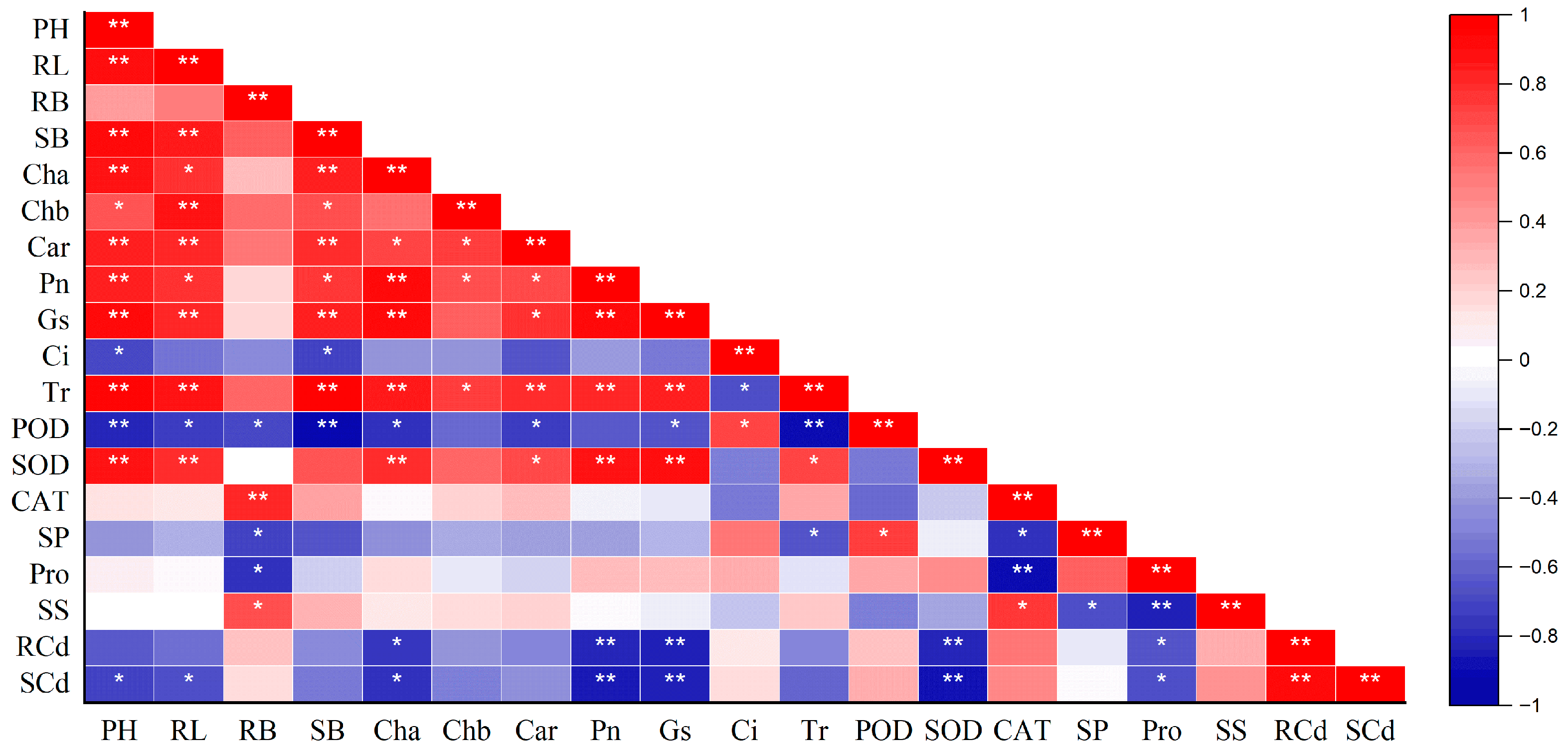
Correlation analysis was used to analyze the relationships among the different parameters under Cd stress (Figure 2). The root biomass exhibited a highly significant (p < 0.01) positive correlation with the CAT activity, a significant (0.01 ≤ p < 0.05) positive correlation with the soluble sugar content, and a significant (0.01 ≤ p < 0.05) negative correlation with the soluble protein content and proline content. The shoot biomass showed a highly significant (p < 0.01) positive correlation with the plant height, root length, chlorophyll a content, carotenoid content, stomatal conductance, and transpiration rate. The shoot biomass also exhibited a significant (0.01 ≤ p < 0.05) positive correlation with the chlorophyll b content and net photosynthetic rate, negatively correlated with the intercellular CO2 concentration (0.01 ≤ p < 0.05), and highly significantly negatively correlated with the POD activity (p < 0.01). The root Cd content and shoot Cd content both exhibited highly significant (p < 0.01) negative correlations with the net photosynthetic rate, stomatal conductance, and SOD activity, and significant (0.01 ≤ p < 0.05) negative correlations with the plant height, root length, chlorophyll a content, and proline content. The shoot Cd content showed a highly significant (p < 0.01) positive correlation with the root Cd content.

3.8. PCA and Cluster Analysis

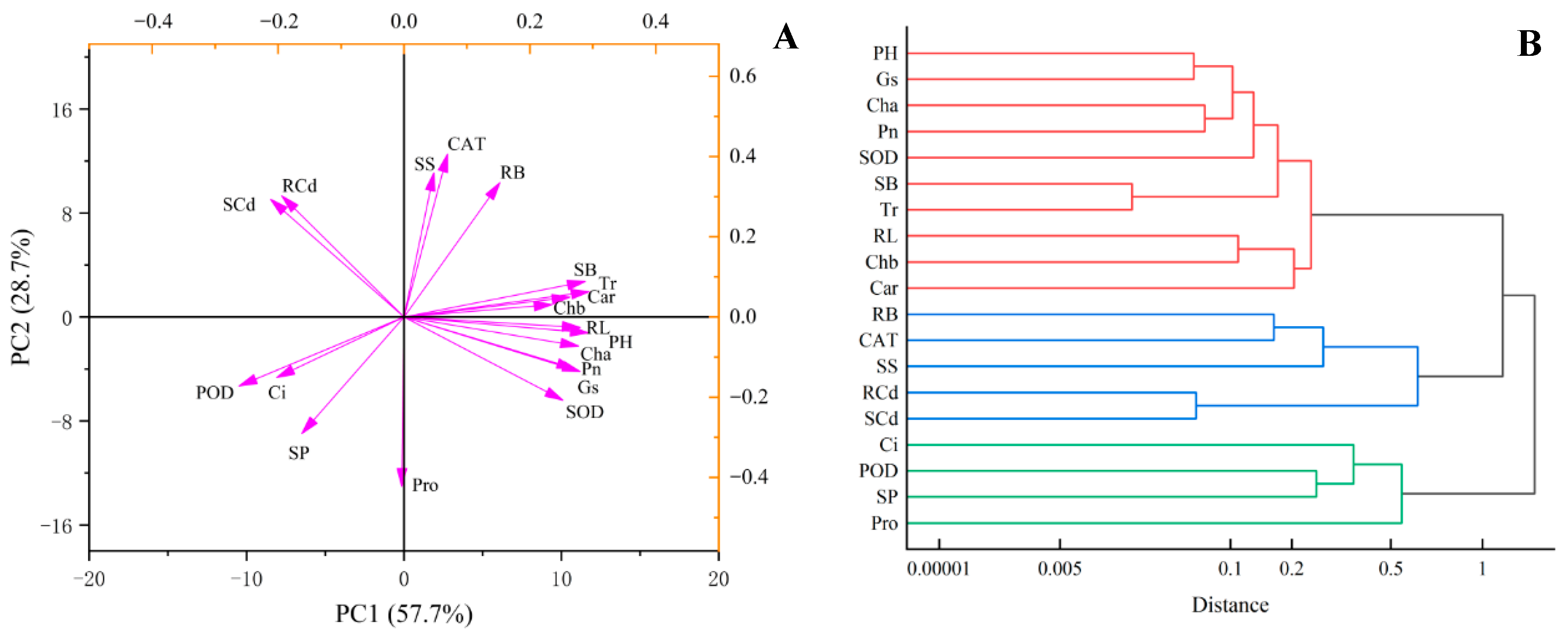
PCA and cluster analysis were conducted to evaluate the effects of DA and GR24 treatments on the different parameters under Cd stress (Figure 3A,B). The variances explained by PC1 and PC2 in the principal component analysis were 84.4% and 10.4%, respectively, accounting for total variance is 94.8%. The two principal components (PC1 and PC2) collectively explained 57.7% and 28.7%, respectively, with 86.4% of the total variance. The root Cd content showed a strong association with the shoot Cd content. The POD activity was closely related to the intercellular CO2 concentration and soluble protein content, while the soluble sugar content and CAT activity were strongly associated with the root biomass. The shoot biomass showed a strong association with the transpiration rate, carotenoid content, chlorophyll b content, root length, plant height, chlorophyll a content, net photosynthetic rate, stomatal conductance, and SOD activity. However, the proline content did not show a significant correlation with any of other parameters. In addition, cluster analysis showed that all parameters under Cd stress were grouped into five categories when the distance was 0.5. The proline content was grouped into a single category. The second category includes soluble protein content, POD activity, and intercellular CO2 concentration. The third category includes the root Cd content and shoot Cd content. The fourth category includes the soluble sugar content, CAT activity, and root biomass. The other parameters were grouped into a category.

4. Discussion

Cd stress inhibits plant growth, leading to toxic symptoms such as slow development, stunted plants, and reduced yield [30]. Research indicates that Cd disrupts cellular homeostasis, inhibits cell division and elongation, and ultimately limits overall plant growth as well as biomass accumulation [31,32]. Exogenous application of DA and GR24 can alleviate the suppression of crop growth caused by Cd stress [33,34]. In this study, Cd treatment reduced plant height, root length, and biomass of grapevines (Figure 1, Table 1), indicating that Cd imposes stress on grapevines and inhibits their growth, consistent with the findings of previous study [35]. Both DA and GR24 treatments increased plant height, root length, and biomass in grapevines under Cd stress (Figure 1, Table 1), in agreement with earlier reports [14,36]. DA promotes crop growth under Cd stress by increasing endogenous dopamine levels and enhancing root vitality [11,34]. It may also mitigate growth inhibition by activating the IAA signaling pathway, synergistically enhancing antioxidant defenses and osmotic regulation capabilities, thereby promoting biomass accumulation [20]. GR24 improves crop growth under Cd stress by promoting root hair elongation, which expands water and nutrient uptake areas, directly limits plant Cd accumulation, and potentially enhances seedling growth [37]. It may also increase antioxidant enzyme activity, ensure efficient functioning of the ASA-GSH cycle, accelerate ROS scavenging, and strengthen Cd resistance, thereby alleviating the inhibitory effects of Cd toxicity on crop growth [18].
Cd stress inhibits plant photosynthetic rates, alters chloroplast ultrastructure, causes stomatal closure, and induces toxic symptoms such as stunted growth and leaf necrosis [38]. Application of DA and GR24 alleviates these symptoms and enhances both photosynthetic pigment content and photosynthetic parameters in crops under Cd stress [18,39]. In this study, Cd treatment reduced photosynthetic pigment content, net photosynthetic rate, stomatal conductance, and transpiration rate in grapevines (Table 2 and Table 3), consistent with previous findings [40]. These effects may result from substantial Cd accumulation within plant cells, which interferes with aminoacyl-CoA synthase synthesis or binds to thiol groups of enzymes involved in chlorophyll synthesis, thereby reducing chlorophyll synthase activity and inhibiting photosynthetic pigment synthesis [41]. At the same time, Cd directly damages the chloroplast membrane system and thylakoid structures, compromising light energy capture. It also inhibits the activity of key enzymes such as Rubisco, thereby hindering carbon fixation and ultimately reducing photosynthetic rates [38]. Furthermore, Cd treatment increased the intercellular CO2 concentration in grapevines in this study (Table 3). This likely results from the grapevines’ self-protection mechanisms under Cd stress—such as reduced stomatal conductance—which diminish CO2 utilization efficiency, leading to its accumulation in the intercellular space [42]. In this study, DA treatment increased photosynthetic pigment content, net photosynthetic rate, stomatal conductance, and transpiration rate in grapevines under Cd stress, without significantly affecting intercellular CO2 concentration (Table 2 and Table 3), consistent with previous reports [43]. This effect may be due to DA promoting the expression of light-harvesting complex proteins (Lhca3, Lhcb1, and Lhcb6), thereby enhancing both photosynthetic pigment content and photosynthetic capacity under Cd stress [12]. Additionally, DA may enhance photosynthetic efficiency by increasing leaf stomatal conductance [44]. These findings suggest that DA improves photosynthesis by directly protecting and optimizing the photochemical efficiency and electron transport chains of PSI and PSII [45]. Similarly, in this study, GR24 treatment increased photosynthetic pigment content, net photosynthetic rate, stomatal conductance, and transpiration rate in grapevines under Cd stress, without significantly affecting intercellular CO2 concentration (Table 2 and Table 3), in accordance with previous studies [46]. This may occur because GR24 alleviates Cd-induced oxidative stress by enhancing the activity of antioxidant enzymes, thereby protecting the photosynthetic apparatus. In addition, GR24 acts as a positive regulator of active chlorophyll synthesis, directly promoting increased photosynthetic pigment content [18]. Furthermore, GR24 may improve stomatal conductance and leaf water status by increasing soluble sugar content, reducing membrane lipid peroxidation products, and regulating K+/Na+ homeostasis, thereby creating a more favorable internal environment for photosynthesis [47,48].
Antioxidant enzymes serve as scavengers of ROS, thereby mitigating heavy metal-induced damage in crops [49]. Cd stress induces excessive ROS production, leading to oxidative damage in crops [50,51]. In this study, Cd treatment increased POD activity, decreased SOD activity, and did not affect CAT activity in grapevines (Table 4), suggesting that Cd exposure imposes oxidative stress on grapevines. Both DA and GR24 have been reported to significantly enhance antioxidant enzyme activity in crops, thereby reducing Cd toxicity [52,53]. In the present study, DA treatment did not affect POD activity, but increased SOD activity and decreased CAT activity in grapevines under Cd stress (Table 4), consistent with previous findings [54]. This effect is likely due to the potent antioxidant capacity of DA, which enables it to directly participate in scavenging ROS and lipid peroxidation products and protect the thiol groups of enzymes. Alternatively, DA may enhance the antioxidant defense system by increasing the levels of amino acids and their derivatives in crops, thereby stimulating antioxidant enzyme activity involved in ROS detoxification [10,11]. Similarly, GR24 treatment decreased POD activity while increasing both SOD and CAT activities in grapevines under Cd stress (Table 4), indicating its role in regulating the plant oxidative defense system. This finding is consistent with previous studies [55] and may be attributed to the ability of GR24 to upregulate the expression of genes encoding relevant antioxidant enzymes in crops [56]. For instance, GR24 can increase the expression of antioxidant enzyme genes such as SOD1, CAT1, and CEVI1 [57], and enhance antioxidant activity by activating specific signaling pathways that promote the expression of genes like FaCAT1 and FaPOD2 [58]. Additionally, GR24 may further boost antioxidant capacity by increasing nitric oxide synthase activity in crops [14]. Collectively, these findings indicate that GR24 enhances crop antioxidant capacity through complex regulatory mechanisms.
Osmotic regulatory substances help stabilize cell structure, maintain osmotic pressure, and protect enzyme activity [59]. In this study, Cd treatment increased the contents of soluble protein and soluble sugar in grapevines, while decreasing the proline content (Table 5). These results further indicate that Cd treatment imposes stress on grapevines. DA treatment increased the proline content in grapevines under Cd stress, consistent with previous studies [60,61]. This effect is likely due to DA acting as a signaling molecule that activates osmotic regulators, thereby enhancing their production. This mechanism helps alleviate osmotic potential imbalances caused by Cd-induced damage to plant cell membranes, ultimately improving seedling tolerance to Cd stress [62]. Notably, DA did not affect the levels of soluble protein and soluble sugar in grapevines under Cd stress in this study (Table 5). This discrepancy is likely because DA achieves osmotic protection primarily through nitrogen metabolism and amino acid pathways [63,64]. In this study, GR24 treatment decreased the soluble protein content, had no significant effect on proline content, and increased the soluble sugar content in grapevines under Cd stress (Table 5). This suggests that GR24 enhances the osmotic regulation capacity of grapevines by elevating the levels of osmotic regulators, thereby strengthening cellular osmotic pressure and maintaining normal water and nutrient uptake [65]. Furthermore, GR24 may also enhance osmotic regulation by directly promoting the accumulation of soluble sugars via carbon metabolism [63,64].
Both DA and GR24 treatments have been shown to reduce Cd accumulation in crops [17,62]. In the present study, DA and GR24 treatments decreased both the Cd content and the translocation factor in grapevines under Cd stress, with DA treatment resulting in lower Cd levels compared to GR24 (Table 6). These findings are consistent with previous research [43,66]. DA may decrease Cd content in crops by protecting root cell membranes from Cd-induced oxidative damage or by promoting the synthesis of cuticle-related compounds, thereby facilitating the sequestration of Cd within cell walls [67,68]. In addition, DA preferentially enhances Cd efflux from roots, limiting its transport to the shoots and thus lowering the translocation factor [62]. Conversely, GR24 may competitively inhibit Cd uptake by regulating the absorption and transport systems for mineral elements such as zinc, iron, and calcium, thereby effectively reducing Cd absorption and accumulation [18]. However, the specific mechanism by which GR24 lowers the Cd translocation factor remains to be elucidated. Correlation, PCA, and cluster analyses revealed the strongest relationship between shoot and root Cd content, indicating that reducing Cd levels in roots effectively decreases shoot Cd accumulation (Figure 2 and Figure 3). Furthermore, shoot Cd content was significantly negatively correlated with net photosynthetic rate, stomatal conductance, and SOD activity, suggesting that enhanced photosynthetic capacity and antioxidant defense help reduce Cd uptake and mitigate its toxicity, and DA and GR24 may transform passive absorption of Cd by grape roots into active selective absorption.

5. Conclusions

Under Cd stress, both DA and GR24 increased photosynthetic capacity and growth of grapevines, while exerting varying effects on the antioxidant enzyme activities and levels of osmotic regulatory substances. DA and GR24 also reduced the Cd content and translocation factor in grapevines exposed to Cd stress. Therefore, DA and GR24 can alleviate Cd stress and decrease Cd uptake in grapevines. In future studies, the potential mechanisms by which DA and GR24 mitigate Cd stress in grapevines should be further explored.

Author Contributions

Conceptualization, F.W. and J.W.; investigation, F.W., X.L. (Xinglin Liu) and X.D.; data curation, L.L. and X.L. (Xiulan Lv); writing—original draft preparation, F.W.; writing—review and editing, L.L., X.L. (Xiulan Lv), and J.W.; supervision, J.W.; project administration, J.W. All authors have read and agreed to the published version of the manuscript.

Funding

This work was financially supported by the Sichuan Innovation Team of National Modern Agricultural Industry Technology System (SCCXTD-2024-4), Chengdu Science and Technology Bureau Program (2025-YF05-00586-SN), and Sichuan Science and Technology Program (2020JDPT0004).

Data Availability Statement

The raw data supporting the conclusions of this article will be made available by the authors on request.

Conflicts of Interest

The authors declare no conflicts of interest.

References

  1. He, M.; Guo, J.; Yang, J.; Zheng, G.; Chen, T.; Meng, X.; Li, Y.; Liu, J. Screening of Accumulating Plants in Farmland Surrounding Typical Lead and Zinc Smelting Enterprises. Chin. J. Eco-Agric. 2023, 31, 954–966. [Google Scholar]
  2. Rai, P.K.; Lee, S.S.; Zhang, M.; Tsang, Y.F.; Kim, K.-H. Heavy Metals in Food Crops: Health Risks, Fate, Mechanisms, and Management. Environ. Int. 2019, 125, 365–385. [Google Scholar] [CrossRef]
  3. Liu, H.; Zhang, C.; Wang, J.; Zhou, C.; Feng, H.; Mahajan, M.D.; Han, X. Influence and Interaction of Iron and Cadmium on Photosynthesis and Antioxidative Enzymes in Two Rice Cultivars. Chemosphere 2017, 171, 240–247. [Google Scholar] [CrossRef] [PubMed]
  4. Yang, C.; Zhang, L.; Niu, T.; Wang, J. Effects of Cadmium Stress at Different Concentrations on Physiological Characteristics and Cadmium Accumulation of Maize Seedlings. J. Beijing Univ. Agric. 2023, 38, 8–11. [Google Scholar] [CrossRef]
  5. Huang, Y.; Yuan, H.; Huang, Z.; Lu, Y. Progress in Research on Environmental Exposure and Health Hazards of Heavy Metals in China. Chin. J. Public Health 2016, 32, 1113–1116. [Google Scholar]
  6. Jiao, X.; Li, Y.; Zhang, X.; Liu, C.; Liang, W.; Li, C.; Ma, F.; Li, C. Exogenous Dopamine Application Promotes Alkali Tolerance of Apple Seedlings. Plants 2019, 8, 580. [Google Scholar] [CrossRef]
  7. Liang, B.; Li, C.; Ma, C.; Wei, Z.; Wang, Q.; Huang, D.; Chen, Q.; Li, C.; Ma, F. Dopamine Alleviates Nutrient Deficiency-Induced Stress in Malus hupehensis. Plant Physiol. Biochem. 2017, 119, 346–359. [Google Scholar] [CrossRef]
  8. Carmo, A.S.; Pontes, C.V.d.S.; Augusto, C.C.; Batista, B.L.; Lobato, A.K.d.S. Dopamine Spraying Protects against Cadmium-Induced Oxidative Stress and Stimulates Photosynthesis in Soybean Plants. Plants 2025, 14, 3411. [Google Scholar] [CrossRef]
  9. Wang, X.; Xu, J.; Luo, X.; Luo, Y.; Lin, L.; Huang, K.; Zhang, H.; Deng, Q. Effects of Exogenous Dopamine on Photosynthesis Characteristics and Antioxidant System of Loquat Seedlings Under Drought Stress. J. Northwest Agric. For. Univ. (Nat. Sci. Ed.) 2025, 53, 109–116. [Google Scholar] [CrossRef]
  10. Zhang, Z.; Tang, Z.; Jing, G.; Gao, S.; Liu, C.; Ai, S.; Liu, Y.; Liu, Q.; Li, C.; Ma, F. Dopamine Confers Cadmium Tolerance in Apples by Improving Growth, Reducing Reactive Oxygen Species, and Changing Secondary Metabolite Levels. Environ. Exp. Bot. 2023, 208, 105264. [Google Scholar] [CrossRef]
  11. Tang, Z. Functional Study of Dopamine in Regulating Cadmium and Copper Stress in Apple. Master’s Thesis, Northwest A&F University, Xianyang, China, 2022. [Google Scholar]
  12. Wang, W.; Yang, Y.; Ma, X.; He, Y.; Ren, Q.; Huang, Y.; Wang, J.; Xue, Y.; Yang, R.; Guo, Y.; et al. New Insight into the Function of Dopamine (DA) during Cd Stress in Duckweed (Lemna turionifera 5511). Plants 2023, 12, 1996. [Google Scholar] [CrossRef] [PubMed]
  13. Xiao, L. Chinese Scientists Made Breakthrough Progresses in Elucidating the Molecular Mechanism of Regulating Plant Architecture by Strigolactones. Chin. Bull. Bot. 2015, 50, 407–411. [Google Scholar]
  14. Chang, D.; Huang, Y.; Tian, M.; Cai, Y.; Meng, J. Effects of Exogenous Strigolactones on Growth and Physiological Characteristics of Two Primulina Species under Drought Stress. Chin. J. Appl. Ecol. 2025, 36, 802–810. [Google Scholar] [CrossRef]
  15. Tai, Z.; Yin, X.; Fang, Z.; Shi, G.; Lou, L.; Cai, Q. Exogenous GR24 Alleviates Cadmium Toxicity by Reducing Cadmium Uptake in Switchgrass (Panicum virgatum) Seedlings. Int. J. Environ. Res. Public Health 2017, 14, 852. [Google Scholar] [CrossRef]
  16. Chen, X.; Shi, X.; Ai, Q.; Han, J.; Wang, H.; Fu, Q. Transcriptomic and Metabolomic Analyses Reveal That Exogenous Strigolactones Alleviate the Response of Melon Root to Cadmium Stress. Hortic. Plant J. 2022, 8, 637–649. [Google Scholar] [CrossRef]
  17. Ashraf, H.; Ghouri, F.; Ali, S.; Bukhari, S.A.H.; Haider, F.U.; Zhong, M.; Xia, W.; Fu, X.; Shahid, M.Q. The Protective Roles of Oryza glumaepatula and Phytohormone in Enhancing Rice Tolerance to Cadmium Stress by Regulating Gene Expression, Morphological, Physiological, and Antioxidant Defense System. Environ. Pollut. 2025, 364, 125311. [Google Scholar] [CrossRef]
  18. Zhang, C. Mechanisms of Alleviation Effects of Exogenous GR24 on Cadmium Toxicity in Barley (Hordeum vulgare). Master’s Thesis, Zhejiang University, Hangzhou, China, 2019. [Google Scholar]
  19. Wang, H.; Xu, Y.; Yang, M.; Jin, X.; Li, X.; Dai, Z.; Zhang, D.; Zhou, K.; Lin, L.; Wang, J. Exogenous Strigolactone Improves the Cadmium Accumulation in Solanum nigrum var. humile. Environ. Prog. Sustain. Energy 2024, 43, e14379. [Google Scholar] [CrossRef]
  20. Selwal, N.; Wani, A.K.; Akhtar, N.; Kaur, M.; Jassal, P.S. Molecular Insights of Strigolactone Biosynthesis, Signalling Pathways, Regulatory Roles, and Hormonal Crosstalks in Plant Systems. S. Afr. J. Bot. 2023, 160, 9–22. [Google Scholar] [CrossRef]
  21. Yang, Y.; Zheng, Q.; Zhou, K.; Xiao, Y.; Huang, C.; Hu, R.; Lin, L.; Wang, J. Effects of Exogenous Strigolactone on the Cadmium Accumulation in Galinsoga parviflora cav. Chem. Ecol. 2024, 40, 292–304. [Google Scholar] [CrossRef]
  22. Wani, K.I.; Zehra, A.; Choudhary, S.; Naeem, M.; Khan, M.M.A.; Khan, R.; Aftab, T. Exogenous Strigolactone (GR24) Positively Regulates Growth, Photosynthesis, and Improves Glandular Trichome Attributes for Enhanced Artemisinin Production in Artemisia annua. J. Plant Growth Regul. 2022, 42, 4606–4615. [Google Scholar] [CrossRef]
  23. Zhang, W.; Zhang, X.; Yang, Z.; Miao, Q.; Qiu, G. Pesticide Residue Level and Risk Assessment in Grapes Sale in Lanzhou City. J. Anhui Agric. Sci. 2020, 48, 175–178. [Google Scholar] [CrossRef]
  24. Yousaf, B.; Liu, G.; Wang, R.; Imtiaz, M.; Zia-Ur-Rehman, M.; Munir, M.A.M.; Niu, Z. Bioavailability Evaluation, Uptake of Heavy Metals and Potential Health Risks via Dietary Exposure in Urban-Industrial Areas. Environ. Sci. Pollut. Res. 2016, 23, 22443–22453. [Google Scholar] [CrossRef] [PubMed]
  25. Guo, L. The Evaluation on the Heavy Metal Content of Vineyards in the Changsha-Zhuzhou-Xiangtan Area and the Effects of Cd on the Physiological Characteristics of the Grape. Master’s Thesis, Hunan Agricultural University, Changsha, China, 2016. [Google Scholar]
  26. Li, Z.; Fan, R.; Peng, X.; Shu, J.; Liu, L.; Wang, J.; Lin, L. Salicylic Acid Alleviates Selenium Stress and Promotes Selenium Uptake of Grapevine. Physiol. Mol. Biol. Plants 2022, 28, 625–635. [Google Scholar] [CrossRef] [PubMed]
  27. Zhang, Z.; Qu, W. Experimental Guide for Plant Physiology; Higher Education Press: Beijing, China, 2003; ISBN 978-7-04-012168-1. [Google Scholar]
  28. Bao, S.D. Soil Agro-Chemistrical Analysis; China Agriculture Press: Beijing, China, 2000. [Google Scholar]
  29. Rastmanesh, F.; Moore, F.; Keshavarzi, B. Speciation and Phytoavailability of Heavy Metals in Contaminated Soils in Sarcheshmeh Area, Kerman Province, Iran. Bull. Environ. Contam. Toxicol. 2010, 85, 515–519. [Google Scholar] [CrossRef]
  30. Zhang, J.; Huang, W. Advances on Physiological and Ecological Effects of Cadmium on Plants. Acta Ecol. Sin. 2000, 20, 514–523. [Google Scholar]
  31. Fan, P.; Wu, L.; Wang, Q.; Wang, Y.; Luo, H.; Song, J.; Yang, M.; Yao, H.; Chen, S. Physiological and Molecular Mechanisms of Medicinal Plants in Response to Cadmium Stress: Current Status and Future Perspective. J. Hazard. Mater. 2023, 450, 131008. [Google Scholar] [CrossRef]
  32. Zulfiqar, U.; Ayub, A.; Hussain, S.; Waraich, E.A.; El-Esawi, M.A.; Ishfaq, M.; Ahmad, M.; Ali, N.; Maqsood, M.F. Cadmium Toxicity in Plants: Recent Progress on Morpho-Physiological Effects and Remediation Strategies. J. Soil Sci. Plant Nutr. 2022, 22, 212–269. [Google Scholar] [CrossRef]
  33. Sattar, A.; Sher, A.; Ijaz, M.; Ul-Allah, S.; Abbas, T.; Hussain, S.; Hussain, J.; Khalil, H.B.; Alharbi, B.M.; El-Yazied, A.A.; et al. Silicon and Strigolecton Application Alleviates the Adversities of Cadmium Toxicity in Maize by Modulating Morpho-Physiological and Antioxidants Defense Mechanisms. Agronomy 2023, 13, 2352. [Google Scholar] [CrossRef]
  34. Liu, X. Study on the Function of Dopamine in Response to Low Nitrogen and Alkaline Stress in Apples. Ph.D. Thesis, Northwest Agriculture and Forestry University, Xianyang, China, 2021. [Google Scholar]
  35. Celekli, A.; Kapı, M.; Bozkurt, H. Effect of Cadmium on Biomass, Pigmentation, Malondialdehyde, and Proline of Scenedesmus quadricauda var. longispina. Bull. Environ. Contam. Toxicol. 2013, 91, 571–576. [Google Scholar] [CrossRef]
  36. Du, P.; Yin, B.; Zhou, S.; Li, Z.; Zhang, X.; Cao, Y.; Han, R.; Shi, C.; Liang, B.; Xu, J. Melatonin and Dopamine Mediate the Regulation of Nitrogen Uptake and Metabolism at Low Ammonium Levels in Malus hupehensis. Plant Physiol. Biochem. 2022, 171, 182–190. [Google Scholar] [CrossRef]
  37. Ahsan, M.; Abdullah, M.; Radicetti, E.; Elsadek, M.F.; Bakhsh, A.; Sajid, M.; Valipour, M.; Jamal, A.; Gul, H.; Abbas, S.M. Cadmium Toxicity Affects Morpho-Physiological and Biochemical Attributes in Gladiolus grandiflorus L.: The Mitigating Roles of Exogenous Strigolactone (GR24). Water Air Soil Pollut. 2025, 236, 450. [Google Scholar] [CrossRef]
  38. Ismael, M.A.; Elyamine, A.M.; Moussa, M.G.; Cai, M.; Zhao, X.; Hu, C. Cadmium in Plants: Uptake, Toxicity, and Its Interactions with Selenium Fertilizers. Metallomics 2019, 11, 255–277. [Google Scholar] [CrossRef]
  39. Zahra, N.; Hafeez, M.B.; Ghaffar, A.; Kausar, A.; Zeidi, M.A.; Siddique, K.H.M.; Farooq, M. Plant Photosynthesis under Heat Stress: Effects and Management. Environ. Exp. Bot. 2023, 206, 105178. [Google Scholar] [CrossRef]
  40. Alyemeni, M.N.; Ahanger, M.A.; Wijaya, L.; Alam, P.; Bhardwaj, R.; Ahmad, P. Selenium Mitigates Cadmium-Induced Oxidative Stress in Tomato (Solanum lycopersicum L.) Plants by Modulating Chlorophyll Fluorescence, Osmolyte Accumulation, and Antioxidant System. Protoplasma 2018, 255, 459–469. [Google Scholar] [CrossRef] [PubMed]
  41. Yang, L.; Zhu, J.; Wang, P.; Zeng, J.; Tan, R.; Yang, Y.; Liu, Z. Effect of Cd on Growth, Physiological Response, Cd Subcellular Distribution and Chemical Forms of Koelreuteria paniculata. Ecotoxicol. Environ. Saf. 2018, 160, 10–18. [Google Scholar] [CrossRef] [PubMed]
  42. Jia, Y.; Liu, C.; Lan, X.; Zhao, J.; Xiang, Y.; Pan, Y. Effect of Cadmium Stress on the Growth and Physiological Characteristics of Primula forbesii Seedlings. Acta Bot. Boreali-Occident. Sin. 2020, 40, 454–462. [Google Scholar]
  43. Cao, Y.; Du, P.; Zhang, J.; Ji, J.; Xu, J.; Liang, B. Dopamine Alleviates Cadmium Stress in Apple Trees by Recruiting Beneficial Microorganisms to Enhance the Physiological Resilience Revealed by High-Throughput Sequencing and Soil Metabolomics. Hortic. Res. 2023, 10, uhad112. [Google Scholar] [CrossRef]
  44. Gao, T.; Zhang, Z.; Liu, X.; Wu, Q.; Chen, Q.; Liu, Q.; Van Nocker, S.; Ma, F.; Li, C. Physiological and Transcriptome Analyses of the Effects of Exogenous Dopamine on Drought Tolerance in Apple. Plant Physiol. Biochem. 2020, 148, 260–272. [Google Scholar] [CrossRef]
  45. Zhang, W. Integrated Multiomics and Physiological Analyses Reveal The Regulatory Mechanism of Dopamine Response to Cadmium. Master’s Thesis, Henan Agricultural University, Zhengzhou, China, 2025. [Google Scholar]
  46. Shi, C.; Wei, F.; Huang, C.; Deng, X. Effects of exogenous on the physiological characteristics of tomato seed-lings under Pb stress. China Cucurbits Veg. 2024, 37, 115–123. [Google Scholar] [CrossRef]
  47. Lu, J.; Shen, Y.; Yang, Y.; Li, X.; Li, X.; Liu, D.; Wang, L. Synthetic Strigolactone GR24 Alleviates Salt Stress in Alfalfa. Grassl. Sci. 2024, 70, 23–34. [Google Scholar] [CrossRef]
  48. Zhao, C.; Yang, M.; Wu, X.; Wang, Y.; Zhang, R. Physiological and Transcriptomic Analyses of the Effects of Exogenous Melatonin on Drought Tolerance in Maize (Zea mays L.). Plant Physiol. Biochem. 2021, 168, 128–142. [Google Scholar] [CrossRef] [PubMed]
  49. Amri, B.; Khamassi, K.; Ali, M.B.; Teixeira da Silva, J.A.; Bettaieb Ben Kaab, L. Effects of Gibberellic Acid on the Process of Organic Reserve Mobilization in Barley Grains Germinated in the Presence of Cadmium and Molybdenum. S. Afr. J. Bot. 2016, 106, 35–40. [Google Scholar] [CrossRef]
  50. Yang, H.; Yu, H.; Wang, S.; Bayouli, I.T.; Huang, H.; Ye, D.; Zhang, X.; Liu, T.; Wang, Y.; Zheng, Z.; et al. Root Radial Apoplastic Transport Contributes to Shoot Cadmium Accumulation in a High Cadmium-Accumulating Rice Line. J. Hazard. Mater. 2023, 460, 132276. [Google Scholar] [CrossRef] [PubMed]
  51. Yu, S.; Wang, S.; Tang, M.; Pan, S.; Wang, M. Integrative Study of Subcellular Distribution, Chemical Forms, and Physiological Responses for Understanding Cadmium Tolerance in Two Garden Shrubs. J. Plant Physiol. 2025, 306, 154419. [Google Scholar] [CrossRef]
  52. Qiu, C.-W.; Zhang, C.; Wang, N.-H.; Mao, W.; Wu, F. Strigolactone GR24 Improves Cadmium Tolerance by Regulating Cadmium Uptake, Nitric Oxide Signaling and Antioxidant Metabolism in Barley (Hordeum vulgare L.). Environ. Pollut. 2021, 273, 116486. [Google Scholar] [CrossRef]
  53. Zouari, M.; Ben Ahmed, C.; Zorrig, W.; Elloumi, N.; Rabhi, M.; Delmail, D.; Ben Rouina, B.; Labrousse, P.; Ben Abdallah, F. Exogenous Proline Mediates Alleviation of Cadmium Stress by Promoting Photosynthetic Activity, Water Status and Antioxidative Enzymes Activities of Young Date Palm (Phoenix dactylifera L.). Ecotoxicol. Environ. Saf. 2016, 128, 100–108. [Google Scholar] [CrossRef]
  54. Hashem, H.A. Cadmium Toxicity Induces Lipid Peroxidation and Alters Cytokinin Content and Antioxidant Enzyme Activities in Soybean. Botany 2013, 92, 1–7. [Google Scholar] [CrossRef]
  55. Yu, Y. The Physiological and Molecular Mechanisms of Salt Tolerance Regulation in Grape Seedlings by Strigolactones. Master’s Thesis, Shandong Agricultural University, Tai’an, China, 2023. [Google Scholar]
  56. Xu, J.; Li, L.; Liu, Y.; Yu, Y.; Li, H.; Wang, X.; Pang, Y.; Cao, H.; Sun, Q. Molecular and Physiological Mechanisms of Strigolactones-Mediated Drought Stress in Crab Apple (Malus hupehensis Rehd.) Seedlings. Sci. Hortic. 2023, 311, 111800. [Google Scholar] [CrossRef]
  57. Lu, T. Alleviation of Adverse Impacts of Low Light on Tomato Plants: New Insight into the Protective Role of Strigolactones. Ph.D. Thesis, Chinese Academy of Agricultural Sciences, Beijing, China, 2019. [Google Scholar]
  58. Gong, J. Mechanisms of Strigolactone Regulation in Response to Low-Light Stress in Tall Fescue. Master’s Thesis, Northwest A&F University, Xianyang, China, 2024. [Google Scholar]
  59. Li, M.; Heng, Q.; Hu, C.; Wang, Z.; Jiang, Y.; Wang, X.; He, X.; Yong, J.W.H.; Dawoud, T.M.; Rahman, S.U.; et al. Phytoremediation Efficiency of Poplar Hybrid Varieties with Diverse Genetic Backgrounds in Soil Contaminated by Multiple Toxic Metals (Cd, Hg, Pb, and As). Ecotoxicol. Environ. Saf. 2024, 283, 116843. [Google Scholar] [CrossRef]
  60. Li, S.; Zeng, X.; Leng, Y.; Feng, L.; Kang, X. Indole-3-Butyric Acid Mediates Antioxidative Defense Systems to Promote Adventitious Rooting in Mung Bean Seedlings under Cadmium and Drought Stresses. Ecotoxicol. Environ. Saf. 2018, 161, 332–341. [Google Scholar] [CrossRef]
  61. Upadhyay, R.K. Metal Stress in Plants: Its Detoxification in Natural Environment. Braz. J. Bot. 2014, 37, 377–382. [Google Scholar] [CrossRef]
  62. Kong, M. Study on the Alleviating Effect of Exogenous Dopamine on Cadmium Stress in Pyrus betulifolia. Master’s Thesis, Shandong Agricultural University, Tai’an, China, 2024. [Google Scholar]
  63. Sedaghat, M.; Sarvestani, Z.T.; Emam, Y.; Bidgoli, A.M.; Sorooshzadeh, A. Foliar-Applied GR24 and Salicylic Acid Enhanced Wheat Drought Tolerance. Russ. J. Plant Physiol. 2020, 67, 733–739. [Google Scholar] [CrossRef]
  64. Wang, F.; Wan, C.; Wu, W.; Pan, Y.; Cheng, X.; Li, C.; Pi, J.; Chen, X. Exogenous Methyl Jasmonate (MeJA) Enhances the Tolerance to Cadmium (Cd) Stress of Okra (Abelmoschus esculentus L.) Plants. Plant Cell Tissue Organ Cult. 2023, 155, 907–922. [Google Scholar] [CrossRef]
  65. Lu, J. Research on the Physiological Mechanism of Spraying Strigolactone Alleviating Salt Stress in Alfalfa. Master’s Thesis, Yangzhou University, Yangzhou, China, 2024. [Google Scholar]
  66. Yao, P. Analysis of Strigolactones Synthesis Gene NtCCD8 Involved in Regulating Tobacco Development and Cadmium Stress Tolerance. Master’s Thesis, Henan Agricultural University, Zhengzhou, China, 2023. [Google Scholar]
  67. He, J.; Zhuang, X.; Zhou, J.; Sun, L.; Wan, H.; Li, H.; Lyu, D. Exogenous Melatonin Alleviates Cadmium Uptake and Toxicity in Apple Rootstocks. Tree Physiol. 2020, 40, 746–761. [Google Scholar] [CrossRef]
  68. Han, Y.; Sa, G.; Sun, J.; Shen, Z.; Zhao, R.; Ding, M.; Deng, S.; Lu, Y.; Zhang, Y.; Shen, X.; et al. Overexpression of Populus euphratica Xyloglucan Endotransglucosylase/Hydrolase Gene Confers Enhanced Cadmium Tolerance by the Restriction of Root Cadmium Uptake in Transgenic Tobacco. Environ. Exp. Bot. 2014, 100, 74–83. [Google Scholar] [CrossRef]
Figure 1. Growth morphology of grapevines.
Horticulturae 12 00226 g001
Figure 2. Heatmap of correlation analysis of the different parameters under Cd stress. ** indicates that correlation is highly significant (p < 0.01); * indicates that correlation is significant (0.01 ≤ p < 0.05). N = 9, r0.01 = 0.797, r0.05 = 0.666. PH = plant height; RL = root length; RB = root biomass; SB = shoot biomass; Cha = chlorophyll a content; Chb = chlorophyll b content; Car = carotenoid content; Pn = net photosynthetic rate; Gs = stomatal conductance; Ci = intercellular CO2 concentration; Tr = transpiration rate; POD = POD activity; SOD = SOD activity; CAT = CAT activity; SP = soluble protein content; Pro = proline content; SS = soluble sugar content; RCd = root Cd content; SCd = shoot Cd content.
Horticulturae 12 00226 g002
Figure 3. PCA (A) and cluster analysis (B) of the different parameters under Cd stress. PH = plant height; RL = root length; RB = root biomass; SB = shoot biomass; Cha = chlorophyll a content; Chb = chlorophyll b content; Car = carotenoid content; Pn = net photosynthetic rate; Gs = stomatal conductance; Ci = intercellular CO2 concentration; Tr = transpiration rate; POD = POD activity; SOD = SOD activity; CAT = CAT activity; SP = soluble protein content; Pro = proline content; SS = soluble sugar content; RCd = root Cd content; SCd = shoot Cd content.
Horticulturae 12 00226 g003
Table 1. Growth parameters of grapevines.
TreatmentPlant Height
(cm)
Root Length
(cm)
Root Biomass
(g/plant)
Shoot Biomass
(g/plant)
Control49.8 ± 1.0 a17.2 ± 0.8 a0.566 ± 0.026 a3.607 ± 0.228 a
Cd treatment27.1 ± 1.2 d14.2 ± 0.6 c0.463 ± 0.021 c2.324 ± 0.107 d
DA treatment36.2 ± 1.9 c15.3 ± 0.4 b0.436 ± 0.013 c2.745 ± 0.083 c
GR24 treatment40.9 ± 1.1 b16.0 ± 0.3 b0.507 ± 0.003 b3.344 ± 0.062 b
Values are mean ± standard deviation of three replicates. Different lowercase letters indicate significant differences among the treatments (Duncan’s multiple range test, p < 0.05).
Table 2. Photosynthetic pigment content in grapevines.
TreatmentChlorophyll a Content
(mg/g)
Chlorophyll b Content
(mg/g)
Carotenoid Content
(mg/g)
Control2.218 ± 0.092 a0.896 ± 0.021 a0.149 ± 0.005 a
Cd treatment1.440 ± 0.027 c0.679 ± 0.026 c0.125 ± 0.002 c
DA treatment1.620 ± 0.054 b0.704 ± 0.017 bc0.130 ± 0.004 bc
GR24 treatment1.678 ± 0.045 b0.725 ± 0.022 b0.135 ± 0.003 b
Values are mean ± standard deviation of three replicates. Different lowercase letters indicate significant differences among the treatments (Duncan’s multiple range test, p < 0.05).
Table 3. Photosynthetic Gas exchange parameters of grapevines.
TreatmentNet Photosynthetic Rate
(µmol CO2/m2/s)
Stomatal Conductance
(mmol H2O/m2/s)
Intercellular CO2 Concentration
(µmol CO2/mol)
Transpiration Rate
(mmol H2O/m2/s)
Control4.250 ± 0.099 a0.127 ± 0.006 a320.990 ± 9.051 b1.220 ± 0.034 b
Cd treatment2.952 ± 0.032 c0.085 ± 0.002 c358.150 ± 3.557 a0.992 ± 0.067 c
DA treatment3.251 ± 0.038 b0.115 ± 0.004 b356.190 ± 5.509 a1.231 ± 0.050 b
GR24 treatment3.275 ± 0.109 b0.118 ± 0.001 b347.390 ± 5.167 a1.516 ± 0.009 a
Values are mean ± standard deviation of three replicates. Different lowercase letters indicate significant differences among the treatments (Duncan’s multiple range test, p < 0.05).
Table 4. Antioxidant enzyme activity of grapevines.
TreatmentPOD Activity
(U/g/min)
SOD Activity
(U/g)
CAT Activity
(mg/g/min)
Control142.840 ± 5.041 b123.670 ± 5.575 a3.683 ± 0.172 b
Cd treatment189.650 ± 7.196 a96.990 ± 3.140 c3.675 ± 0.138 b
DA treatment178.240 ± 2.235 a112.690 ± 1.402 b2.873 ± 0.073 c
GR24 treatment135.700 ± 8.476 b110.890 ± 3.377 b4.088 ± 0.150 a
Values are mean ± standard deviation of three replicates. Different lowercase letters indicate significant differences among the treatments (Duncan’s multiple range test, p < 0.05).
Table 5. Contents of osmotic regulatory substances in grapevines.
TreatmentSoluble Protein Content
(mg/g)
Proline Content
(mg/g)
Soluble Sugar Content
(%)
Control2.768 ± 0.001 b0.212 ± 0.001 b9.660 ± 0.475 c
Cd treatment2.872 ± 0.009 a0.199 ± 0.009 c11.050 ± 0.800 b
DA treatment2.907 ± 0.069 a0.235 ± 0.004 a9.840 ± 0.811 bc
GR24 treatment2.778 ± 0.013 b0.193 ± 0.005 c11.620 ± 0.386 a
Values are mean ± standard deviation of three replicates. Different lowercase letters indicate significant differences among the treatments (Duncan’s multiple range test, p < 0.05).
Table 6. Cd content and translocation factor of grapevines.
TreatmentRoot Cd Content
(mg/kg)
Shoot Cd Content
(mg/kg)
Translocation Factor
Control---
Cd treatment22.15 ± 0.48 a0.199 ± 0.012 a0.00898 ± 0.00073 a
DA treatment17.96 ± 0.61 c0.129 ± 0.006 c0.00720 ± 0.00022 b
GR24 treatment19.73 ± 0.32 b0.154 ± 0.005 b0.00781 ± 0.00023 b
Values are mean ± standard deviation of three replicates. Different lowercase letters indicate significant differences among the treatments (Duncan’s multiple range test, p < 0.05). Translocation factor = shoot Cd content/root Cd content. The Cd content in control was not detected.
Disclaimer/Publisher’s Note: The statements, opinions and data contained in all publications are solely those of the individual author(s) and contributor(s) and not of MDPI and/or the editor(s). MDPI and/or the editor(s) disclaim responsibility for any injury to people or property resulting from any ideas, methods, instructions or products referred to in the content.