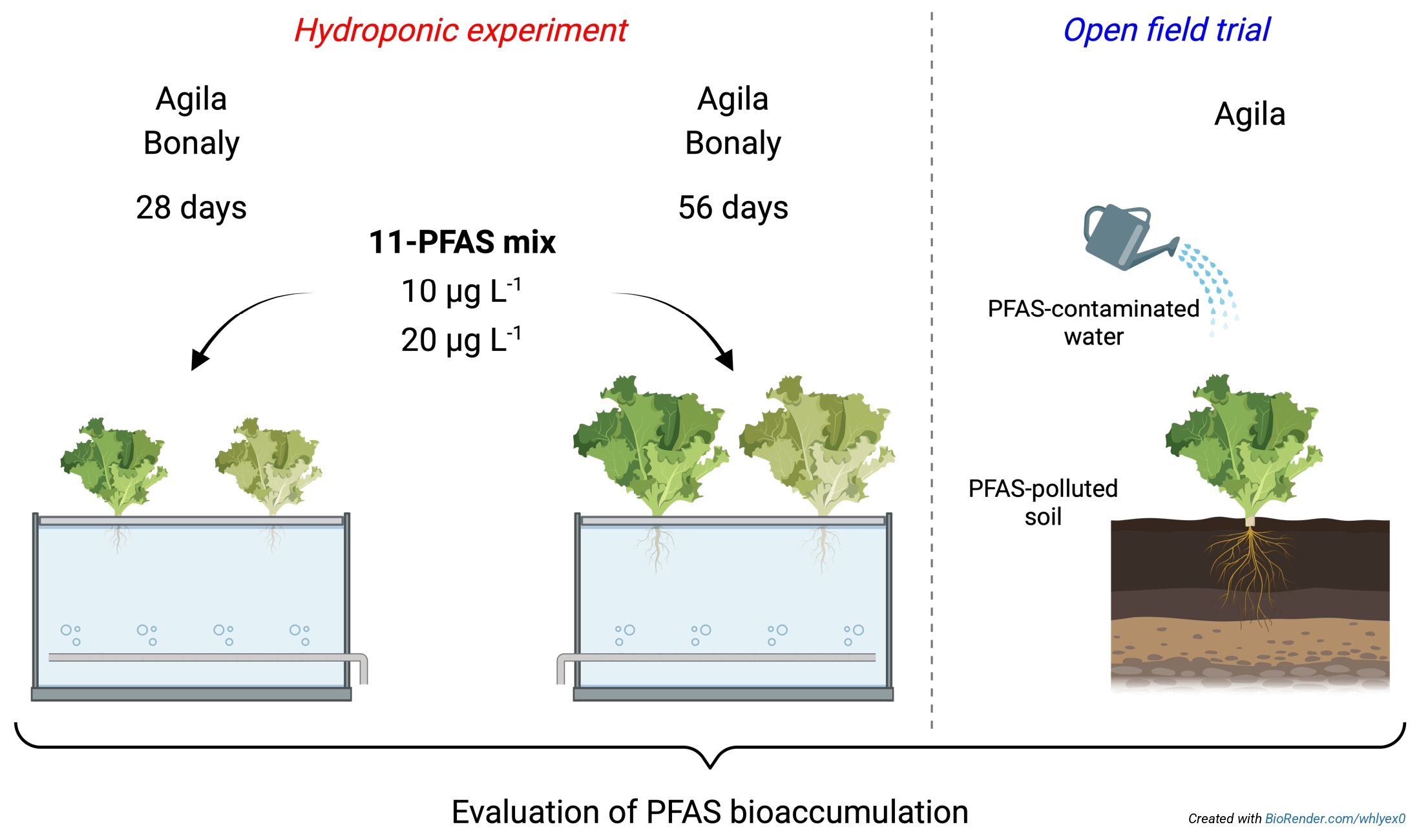


Perfluoroalkyl Substances Accumulation in Lettuce: Effects of Cultivar, Growth Stage, and Cultivation Conditions on Food Safety

 , , ,
, , , 
 ,
,  and
and Abstract
Share and Cite
Sabia, A.; Battisti, I.; Trentin, A.R.; Wei, X.; Nicoletto, C.; Renella, G.; Masi, A. Perfluoroalkyl Substances Accumulation in Lettuce: Effects of Cultivar, Growth Stage, and Cultivation Conditions on Food Safety. Horticulturae 2025, 11, 775. https://doi.org/10.3390/horticulturae11070775
Sabia A, Battisti I, Trentin AR, Wei X, Nicoletto C, Renella G, Masi A. Perfluoroalkyl Substances Accumulation in Lettuce: Effects of Cultivar, Growth Stage, and Cultivation Conditions on Food Safety. Horticulturae. 2025; 11(7):775. https://doi.org/10.3390/horticulturae11070775
Chicago/Turabian StyleSabia, Andrea, Ilaria Battisti, Anna Rita Trentin, Xudong Wei, Carlo Nicoletto, Giancarlo Renella, and Antonio Masi. 2025. "Perfluoroalkyl Substances Accumulation in Lettuce: Effects of Cultivar, Growth Stage, and Cultivation Conditions on Food Safety" Horticulturae 11, no. 7: 775. https://doi.org/10.3390/horticulturae11070775
APA StyleSabia, A., Battisti, I., Trentin, A. R., Wei, X., Nicoletto, C., Renella, G., & Masi, A. (2025). Perfluoroalkyl Substances Accumulation in Lettuce: Effects of Cultivar, Growth Stage, and Cultivation Conditions on Food Safety. Horticulturae, 11(7), 775. https://doi.org/10.3390/horticulturae11070775