Seed Asymbiotic Germination Morphological Traits and Seedling Development in Cymbidium faberi Rolfe (Orchidaceae)

Abstract
1. Introduction
2. Materials and Methods
2.1. Plant Material and Sterilization
2.2. The Germination of the Seeds and Protocorm Development
2.3. In Vitro Seedling Development
2.4. Histological and Morphological Analyses
2.5. Transplantation and Acclimatization
2.6. Data Analysis
3. Results
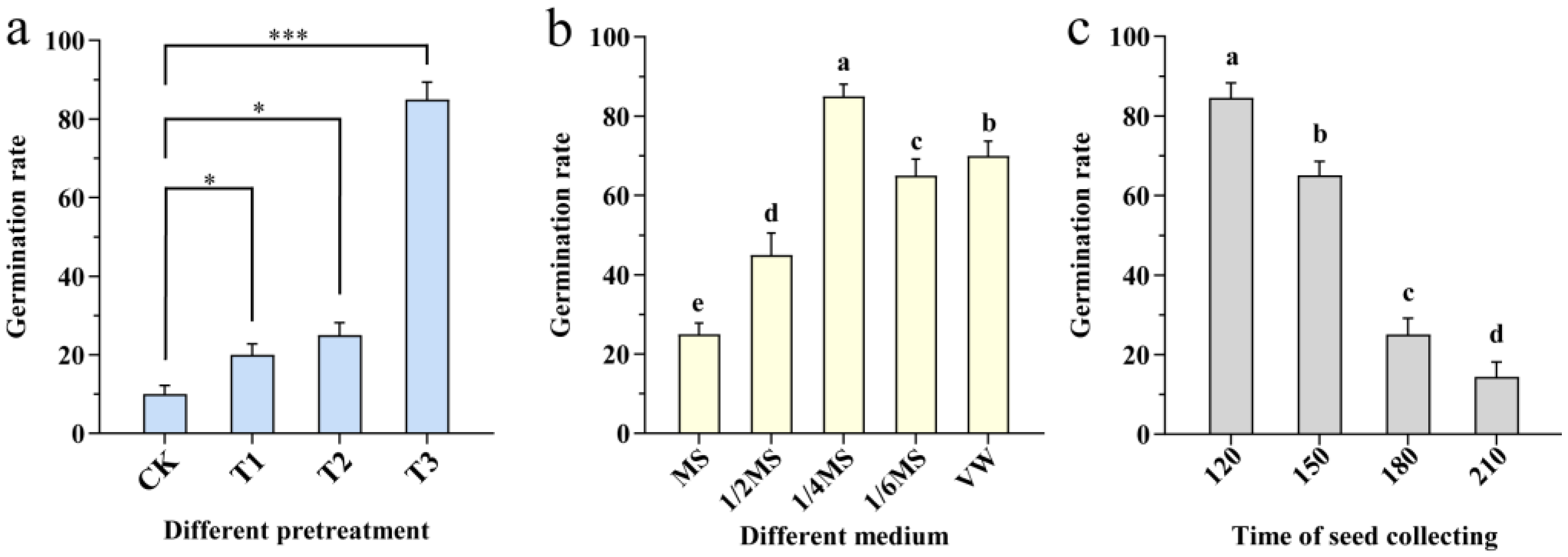
3.1. Effect of Different Pretreatments, Media, and Time of Seed Collecting on Seed Germination
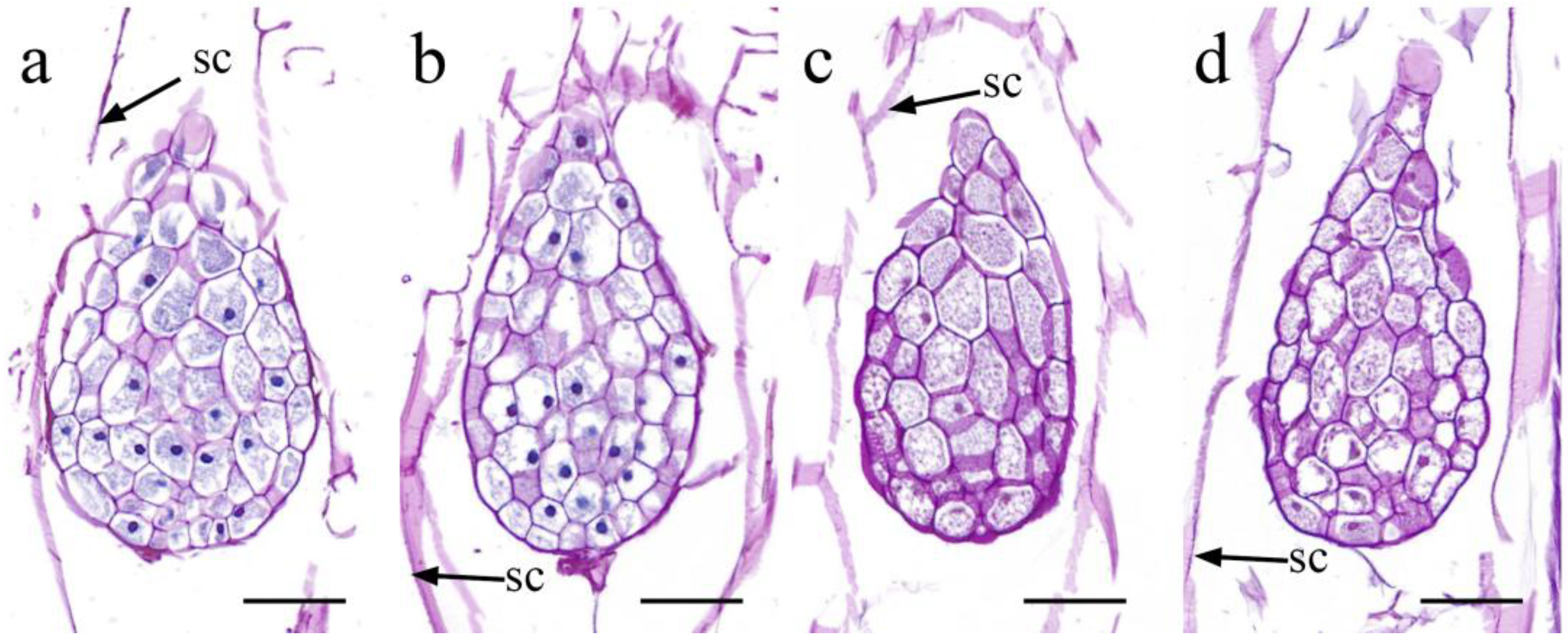
3.2. Embryo Development
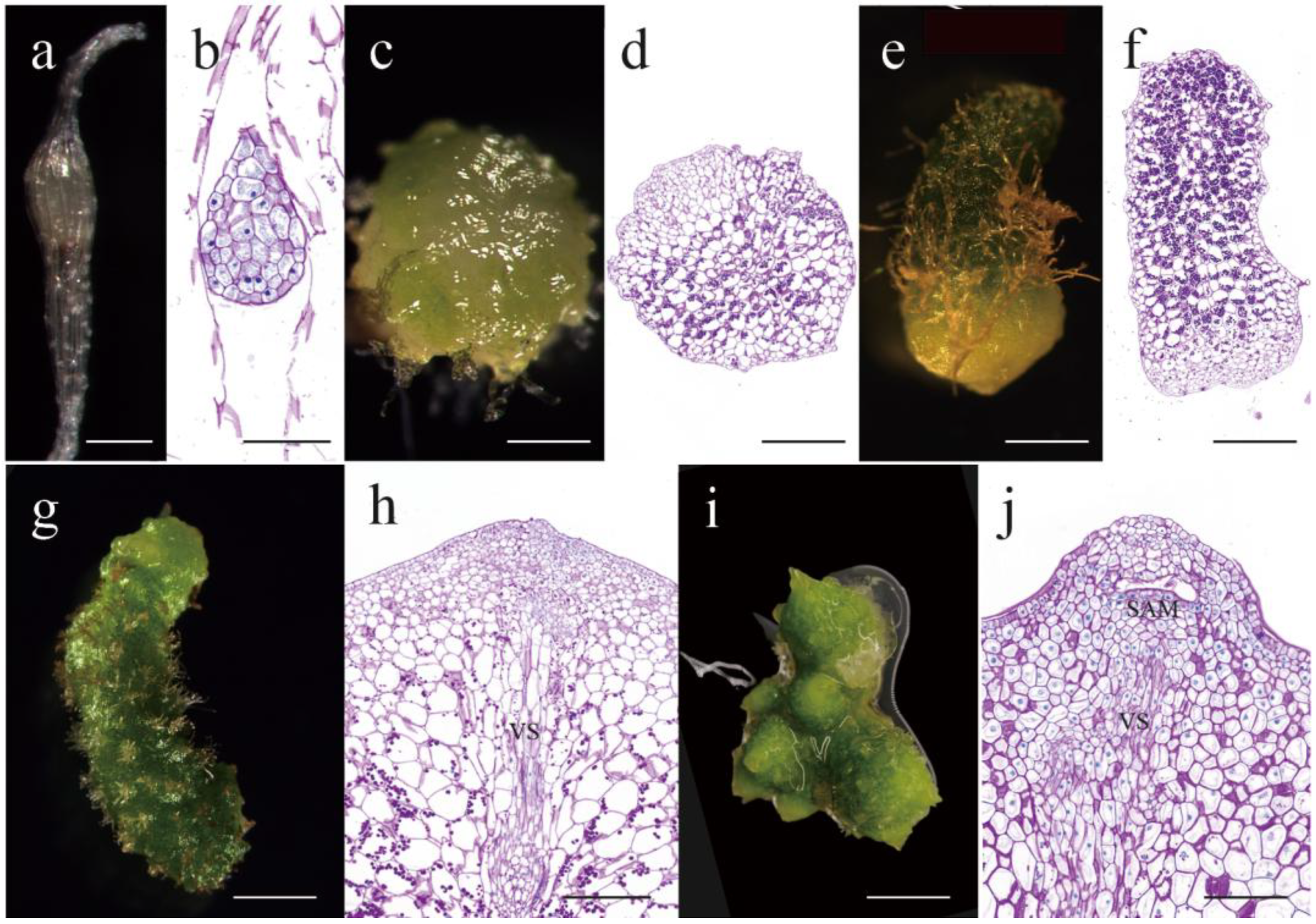
3.3. Morpho-Anatomical Changes from Seed to Protocorm
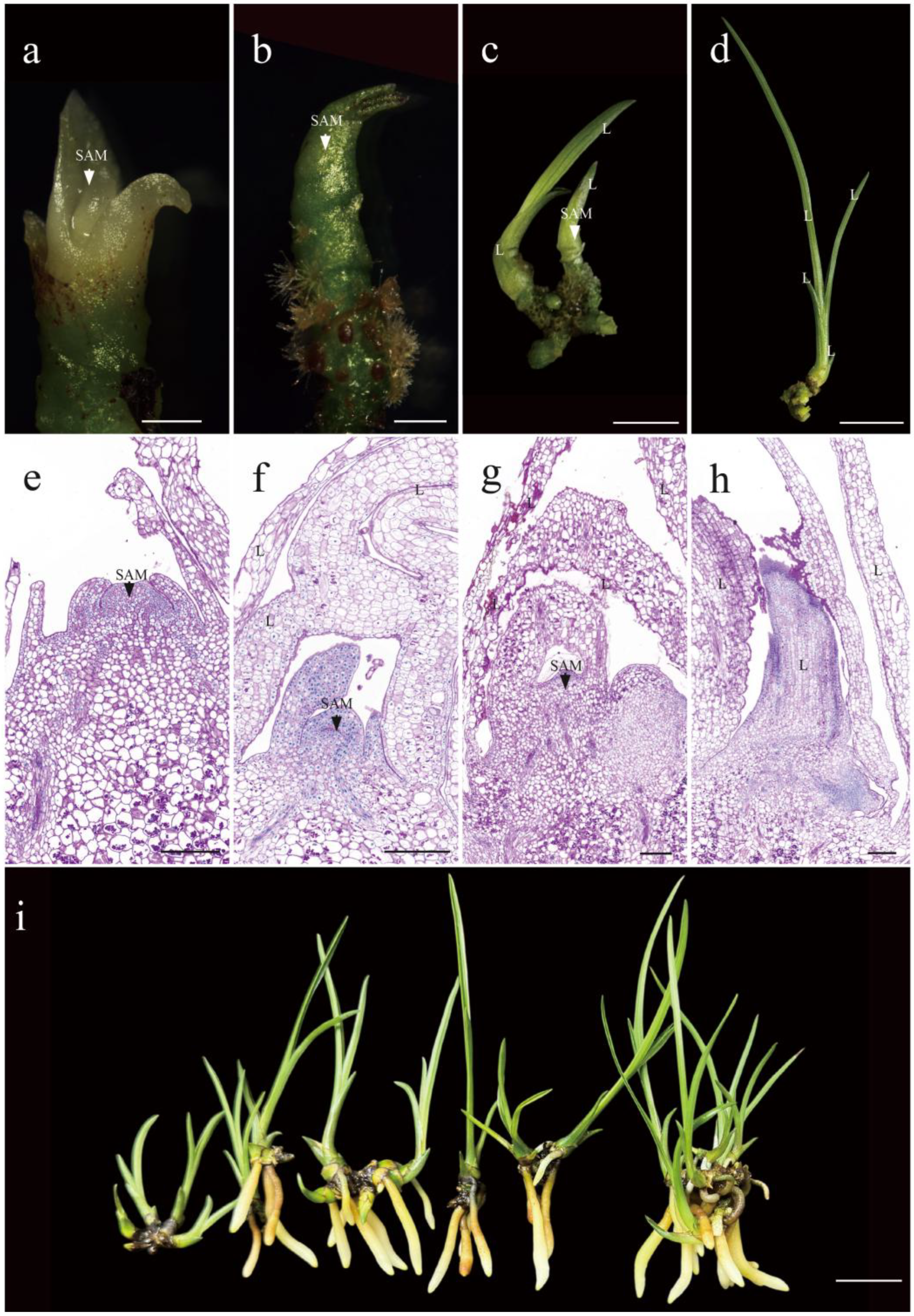
3.4. Morpho-Anatomical Changes from Protocorm to Seedling
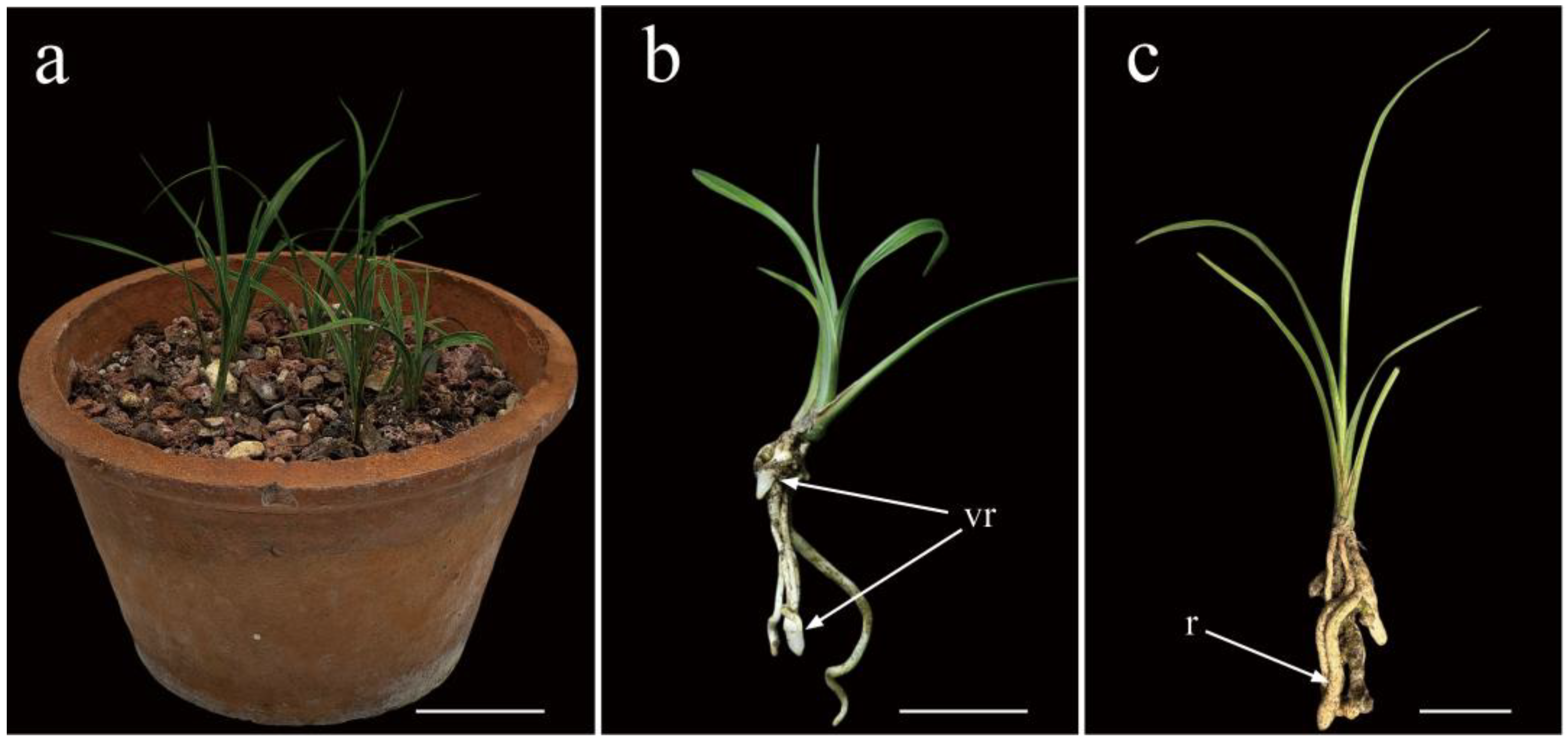
3.5. Transplantation and Acclimatization of Seedling
4. Discussion
5. Conclusions
Author Contributions
Funding
Data Availability Statement
Conflicts of Interest
References
- Tian, C.; Liu, S.; Jiang, L.; Tian, S.; Wang, G. The expression characteristics of methyl jasmonate biosynthesis-related genes in Cymbidium faberi and influence of heterologous expression of CfJMT in Petunia hybrida. Plant Physiol. Biochem. 2020, 151, 400–410. [Google Scholar] [CrossRef]
- Yang, F.X.; Gao, J.; Wei, Y.L.; Ren, R.; Zhang, G.Q.; Lu, C.Q.; Jin, J.P.; Ai, Y.; Wang, Y.Q.; Chen, L.J.; et al. The genome of Cymbidium sinense revealed the evolution of orchid traits. Plant Biotechnol. J. 2021, 19, 2501–2516. [Google Scholar] [CrossRef]
- Zhang, G.Q.; Chen, G.Z.; Chen, L.J.; Zhai, J.W.; Huang, J.; Wu, X.Y.; Li, M.H.; Peng, D.H.; Rao, W.H.; Liu, Z.J.; et al. Phylogenetic incongruence in Cymbidium orchids. Plant Divers. 2021, 43, 452–461. [Google Scholar] [CrossRef]
- Li, J.; Wang, L.; Chen, X.; Zeng, L.; Su, Y.; Liu, Z. Characterization of Two AGAMOUS-like Genes and Their Promoters from the Cymbidium faberi (Orchidaceae). Plants 2023, 12, 2740. [Google Scholar] [CrossRef]
- Jiao, X.; Long, M.; Liu, Z. Prediction and Influencing Factors of Wild Cymbidium faberi in China Using MaxEnt Model. J. N. For. Univ. 2023, 51, 96–101+122. [Google Scholar] [CrossRef]
- Li, Y.; Liu, Z. Development of Male and Female Gametes and Embryos in Cymbidium faberi Rolfe. J. N. For. Univ. 2024, 52, 19–24. [Google Scholar] [CrossRef]
- Ai, Y.; Li, Z.; Sun, W.H.; Chen, J.; Zhang, D.; Ma, L.; Zhang, Q.H.; Chen, M.K.; Zheng, Q.D.; Liu, J.F.; et al. The Cymbidium genome reveals the evolution of unique morphological traits. Hortic. Res. 2021, 8, 255. [Google Scholar] [CrossRef] [PubMed]
- Lu, Z.; Qin, H.; Jin, X.; Zhang, Z.; Yang, Q.; Hong, D.; Li, D.; Li, K.; Yuan, L.; Zhou, Z. On the necessity, principle and process of updating the List of National Key Protected Wild Plants. Biodivers. Sci. 2021, 29, 1577–1582. [Google Scholar] [CrossRef]
- Roberts, D.L.; Dixon, K.W. Orchids. Curr. Biol. 2008, 18, R325–R329. [Google Scholar] [CrossRef]
- Chen, X.G.; Wu, Y.H.; Li, N.Q.; Gao, J.Y. What role does the seed coat play during symbiotic seed germination in orchids: An experimental approach with Dendrobium officinale. BMC Plant Biol. 2022, 22, 375. [Google Scholar] [CrossRef]
- Phillips, R.D.; Reiter, N.; Peakall, R. Orchid conservation: From theory to practice. Ann. Bot. 2020, 126, 345–362. [Google Scholar] [CrossRef]
- Zhao, D.K.; Mou, Z.M.; Ruan, Y.L. Orchids acquire fungal carbon for seed germination: Pathways and players. Trends Plant Sci. 2024, 29, 733–741. [Google Scholar] [CrossRef]
- Rasmussen, H.N.; Dixon, K.W.; Jersáková, J.; Těšitelová, T. Germination and seedling establishment in orchids: A complex of requirements. Ann. Bot. 2015, 116, 391–402. [Google Scholar] [CrossRef] [PubMed]
- Tian, F.; Wang, J.C.; Bai, X.X.; Yang, Y.B.; Huang, L.; Liao, X.F. Symbiotic seed germination and seedling growth of mycorrhizal fungi in Paphiopedilum hirsutissimun (Lindl.Ex Hook.) Stein from China. Plant Signal Behav. 2023, 18, 2293405. [Google Scholar] [CrossRef]
- Pujasatria, G.C.; Miura, C.; Kaminaka, H. In vitro symbiotic germination: A revitalized heuristic approach for orchid species conservation. Plants 2020, 9, 1742. [Google Scholar] [CrossRef] [PubMed]
- Jolman, D.; Batalla, M.I.; Hungerford, A.; Norwood, P.; Tait, N.; Wallace, L.E. The challenges of growing orchids from seeds for conservation: An assessment of asymbiotic techniques. Appl. Plant Sci. 2022, 10, e11496. [Google Scholar] [CrossRef] [PubMed]
- Yamazaki, J.; Miyoshi, K. In vitro asymbiotic germination of immature seed and formation of protocorm by Cephalanthera falcata (Orchidaceae). Ann. Bot. 2006, 98, 1197–1206. [Google Scholar] [CrossRef]
- Kauth, P.J.; Kane, M.E.; Vendrame, W.A.; Reinhardt-Adams, C. Asymbiotic germination response to photoperiod and nutritional media in six populations of Calopogon tuberosus var. tuberosus (Orchidaceae): Evidence for ecotypic differentiation. Ann. Bot. 2008, 102, 783–793. [Google Scholar] [CrossRef]
- Abraham, S.; Augustine, J.; Thomas, T.D. Asymbiotic seed germination and in vitro conservation of Coelogyne nervosa A. Rich. an endemic orchid to Western Ghats. Physiol. Mol. Biol. Plants 2012, 18, 245–251. [Google Scholar] [CrossRef][Green Version]
- Teixeira da Silva, J.A.; Tsavkelova, E.A.; Ng, T.B.; Parthibhan, S.; Dobránszki, J.; Cardoso, J.C.; Rao, M.V.; Zeng, S. Asymbiotic in vitro seed propagation of Dendrobium. Plant Cell Rep. 2015, 34, 1685–1706. [Google Scholar] [CrossRef]
- Long, B.; Niemiera, A.X.; Cheng, Z.Y.; Long, C.L. In vitro propagation of four threatened Paphiopedilum species (Orchidaceae). Plant Cell Tissue Organ Cult. 2010, 101, 151–162. [Google Scholar] [CrossRef]
- Zeng, S.J.; Huang, W.; Wu, K.; Zhang, J.; da Silva, J.A.T.; Duan, J. In vitro propagation of Paphiopedilum orchids. Crit. Rev. Biotechnol. 2016, 36, 521–534. [Google Scholar]
- Zhang, Y.Y.; Wu, K.L.; Zhang, J.X.; Deng, R.F.; Duan, J.; Teixeira da Silva, J.A.; Huang, W.C.; Zeng, S.J. Embryo development in association with asymbiotic seed germination in vitro of Paphiopedilum armeniacum S. C. Chen et F. Y. Liu. Sci. Rep. 2015, 5, 16356. [Google Scholar] [CrossRef] [PubMed]
- Quiroz, K.; Saavedra, J.; Vogel, H.; Verdugo, G.; Caligari, P.D.S.; García-Gonzáles, R. In vitro asymbiotic germination for micropropagation of the recalcitrant terrestrial orchid Chloraea crispa (Orchidaceae). Appl. Plant Sci. 2017, 5, apps.1600142. [Google Scholar] [CrossRef]
- Kim, D.H.; Kang, K.W.; Enkhtaivan, G.; Jan, U.; Sivanesan, I. Impact of activated charcoal, culture medium strength and thidiazuron on non-symbiotic in vitro seed germination of Pecteilis radiata (Thunb.) Raf. S. Afr. J. Bot. 2019, 124, 144–150. [Google Scholar] [CrossRef]
- Kang, H.; Kang, K.W.; Kim, D.H.; Sivanesan, I. In Vitro Propagation of Gastrochilus matsuran (Makino) Schltr., an Endangered Epiphytic Orchid. Plants 2020, 9, 524. [Google Scholar] [CrossRef] [PubMed]
- Arcidiacono, M.; Catalano, C.; Motisi, A.; Sajeva, M.; Carimi, F.; Carra, A. Influence of Culture Conditions on In Vitro Asymbiotic Germination of Anacamptis longicornu and Ophrys panormitana (Orchidaceae). Plants 2021, 10, 2543. [Google Scholar] [CrossRef]
- Nabieva, A.Y. Asymbiotic seed germination and in vitro seedling development of Orchis militaris, an endangered orchid in Siberia. J. Genet. Eng. Biotechnol. 2021, 19, 122. [Google Scholar] [CrossRef]
- Yeh, C.H.; Chen, K.Y.; Lee, Y.I. Asymbiotic germination of Vanilla planifolia in relation to the timing of seed collection and seed pretreatments. Bot. Stud. 2021, 62, 6. [Google Scholar] [CrossRef]
- Šoch, J.; Šonka, J.; Ponert, J. Acid scarification as a potent treatment for an in vitro germination of mature endozoochorous Vanilla planifolia seeds. Bot. Stud. 2023, 64, 9. [Google Scholar] [CrossRef]
- Zale, P.J.; Clayton, A.; Nix, J.; Taylor, M. Asymbiotic in vitro seed germination, in vitro seedling development, and ex vitro acclimatization of Spiranthes. Appl. Plant Sci. 2022, 10, e11494. [Google Scholar] [CrossRef] [PubMed]
- Perner, H.; Zhou, R.; Perner, W.; Jiang, H.; Lee, Y.I. Cypripedium subtropicum embryo development and cytokinin requirements for asymbiotic germination. Bot. Stud. 2022, 63, 28. [Google Scholar] [CrossRef]
- Park, H.B.; An, J.; Bae, K.H.; Hong, S.H.; Park, H.J.; Kim, S.; Lee, C.W.; Lee, B.D.; Baek, J.H.; Kim, N.Y.; et al. Asymbiotic Seed Germination and In Vitro Seedling Development of the Endangered Orchid Species Cypripedium guttatum. Plants 2023, 12, 3788. [Google Scholar] [CrossRef] [PubMed]
- Wongsa, T.; Piapukiew, J.; Kuenkaew, K.; Somsanook, C.; Sapatee, O.; Linjikao, J.; Kunakhonnuruk, B.; Kongbangkerd, A. Asymbiotic Seed Germination and In Vitro Propagation of the Thai Rare Orchid Species; Eulophia bicallosa (D.Don) P.F.Hunt & Summerh. Plants 2025, 14, 2212. [Google Scholar] [CrossRef]
- Diantina, S.; Kartikaningrum, S.; McCormick, A.C. Comparative in vitro seed germination and seedling development in tropical and temperate epiphytic and temperate terrestrial orchids. Plant Cell Tissue Organ Cult. 2020, 143, 619–633. [Google Scholar] [CrossRef]
- Yeung, E.C. A perspective on orchid seed and protocorm development. Bot. Stud. 2017, 58, 33. [Google Scholar] [CrossRef]
- Fang, S.C.; Chen, J.C.; Wei, M.J. Protocorms and protocorm-like bodies are molecularly distinct from zygotic embryonic tissues in Phalaenopsis aphrodite. Plant Physiol. 2016, 171, 2682–2700. [Google Scholar] [CrossRef]
- Sussex, I.M. Developmental programming of the shoot meristem. Cell 1989, 56, 225–229. [Google Scholar] [CrossRef]
- Murashige, T.; Skoog, F. A revised medium for rapid growth and bioassays with tobacco tissue cultures. Physiol. Plant. 1962, 15, 473–497. [Google Scholar] [CrossRef]
- Vacin, E.F.; Went, F.W. Some pH changes in nutrient solutions. Bot. Gaz. 1949, 110, 605–613. [Google Scholar] [CrossRef]
- Stewart, S.L.; Kane, M.E. Symbiotic seed germination of Habenaria macroceratitis (Orchidaceae), a rare Florida terrestrial orchid. Plant Cell Tissue Organ Cult. 2006, 86, 159–167. [Google Scholar] [CrossRef]
- Guo, B.; Chen, H.; Yin, Y.; Wang, W.; Zeng, S. Tissue culture via protocorm-like bodies in an orchid hybrid Paphiopedilum SCBG Huihuang90. Plants 2024, 13, 197. [Google Scholar] [CrossRef]
- Zhi, Y.Q.; Wang, C.H.; Yang, Y.; Wei, Q.; Wang, S.; Wang, M.; Ramakrishnan, M.; Fu, B.; Wang, L.L. Establishment of an Efficient System for Rhizome Proliferation and In Vitro Flowering Induction from Protocorm Explants in Cymbidium goeringii. Horticulturae 2025, 11, 738. [Google Scholar] [CrossRef]
- Knudson, L. Non-symbiotic germination of orchid seeds. Bot. Gaz. 1922, 73, 1–25. [Google Scholar] [CrossRef]
- Van der Kinderen, G. Abscisic acid in terrestrial orchid seeds: A possible impact on their germination. Lindleyana 1987, 2, 84–87. [Google Scholar]
- Yeung, E.C.; Law, S.K. Embryology of Calypso bulbosa. II. Embryo development. Can. J. Bot. 1992, 70, 461–468. [Google Scholar] [CrossRef]
- Vinogradova, T.N.; Andronova, E.V. Development: Development of Orchid Seeds and Seedlings. In Orchid Biology: Reviews and Perspectives, VIII; Springer: Dordrecht, The Netherlands, 2002; pp. 167–234. [Google Scholar]
- Lee, Y.I.; Yeung, E.C.; Lee, N.; Chung, M.-C. Embryology of Phalaenopsis amabilis var. formosa: Embryo development. Bot. Stud. 2008, 49, 139–146. [Google Scholar]
- Raghavan, V.; Goh, C.J. DNA synthesis and mRNA accumulation during germination of embryos of the orchid Spathoglottis plicata. Protoplasma 1994, 183, 137–147. [Google Scholar] [CrossRef]



| Treatment | Description |
|---|---|
| CK | incubation under 14 h light/10 h dark photoperiod at 25 °C for 60 days |
| T1 | surface sterilization with 1% NaClO for 30 min + incubation under 14 h light/10 h dark photoperiod at 25 °C for 60 days |
| T2 | dark incubation for 30 d + incubation under 14 h light/10 h dark photoperiod at 25 °C for 30 days |
| T3 | surface sterilization 1% NaClO for 30 min + dark incubation for 30 d + incubation under 14 h light/10 h dark photoperiod at 25 °C for 30 days |
| Nutrient Component | MS | 1/2 MS | 1/4 MS | 1/6 MS | VW |
|---|---|---|---|---|---|
| Macronutrient (mg·L−1) | |||||
| Ammonium Nitrate | 1650 | 825 | 412.5 | 275 | |
| Ammonium Sulfate | 500 | ||||
| Calcium Chloride | 440 | 166.1 | 110 | 55.37 | |
| Tricalcium Phosphate | 200 | ||||
| KH2PO4 | 170 | 85 | 42.5 | 28.3 | 250 |
| Magnesium Sulfate | 180.7 | 90.35 | 40.18 | 30.12 | |
| Potassium Nitrate | 1900 | 950 | 475 | 316.7 | 525 |
| Micronutrients (mg·L−1) | |||||
| Boric Acid | 6.2 | 6.2 | 6.2 | 6.2 | |
| Copper Sulfate | 0.025 | 0.025 | 0.025 | 0.025 | |
| Cobalt Chloride | 0.025 | 0.025 | 0.025 | 0.025 | |
| Manganese Sulfate | 16.9 | 16.9 | 16.9 | 16.9 | 5.68 |
| Potassium Iodide | 0.83 | 0.83 | 0.83 | 0.83 | |
| Sodium Molybdate | 0.25 | 0.25 | 0.25 | 0.25 | |
| Zinc Sulfate | 8.6 | 8.6 | 8.6 | 9.6 | |
| Iron source (mg·L−1) | |||||
| Ferrous Sulfate | 0 | 0 | 0 | 0 | 27.8 |
| Na2EDTA | 36.7 | 36.7 | 36.7 | 36.7 | 37.26 |
| Organics (mg·L−1) | |||||
| Glycine | 2 | 2 | 2 | 2 | |
| Myo-Inositol | 100 | 100 | 100 | 100 | |
| Nicotinic Acid | 0.5 | 0.5 | 0.5 | 0.5 | |
| Pyridoxine HCl | 0.5 | 0.5 | 0.5 | 0.5 | |
| Thiamine HCl | 0.1 | 0.1 | 0.1 | 0.1 | 0.4 |
| Acclimatization Time | Survival Rate (%) | Average Height of Shoot (cm) | Average Number of Leaves |
|---|---|---|---|
| 0 d | 100 a | 5.15 ± 0.17 c | 3.33 ± 0.14 c |
| 30 d | 89.58 ± 1.44 b | 5.41 ± 0.17 c | 3.5 ± 0.15 c |
| 60 d | 86.25 ± 1.52 b | 6.18 ± 0.19 b | 4.17 ± 0.17 b |
| 90 d | 80 ± 1.23 c | 7.84 ± 0.32 a | 4.91 ± 0.15 a |
Disclaimer/Publisher’s Note: The statements, opinions and data contained in all publications are solely those of the individual author(s) and contributor(s) and not of MDPI and/or the editor(s). MDPI and/or the editor(s) disclaim responsibility for any injury to people or property resulting from any ideas, methods, instructions or products referred to in the content. |
© 2025 by the authors. Licensee MDPI, Basel, Switzerland. This article is an open access article distributed under the terms and conditions of the Creative Commons Attribution (CC BY) license (https://creativecommons.org/licenses/by/4.0/).
Share and Cite
Zhou, Z.; Han, S.; Huang, H.; Liu, Z. Seed Asymbiotic Germination Morphological Traits and Seedling Development in Cymbidium faberi Rolfe (Orchidaceae). Horticulturae 2025, 11, 1491. https://doi.org/10.3390/horticulturae11121491
Zhou Z, Han S, Huang H, Liu Z. Seed Asymbiotic Germination Morphological Traits and Seedling Development in Cymbidium faberi Rolfe (Orchidaceae). Horticulturae. 2025; 11(12):1491. https://doi.org/10.3390/horticulturae11121491
Chicago/Turabian StyleZhou, Zhiqing, Siyu Han, Hao Huang, and Zhixiong Liu. 2025. "Seed Asymbiotic Germination Morphological Traits and Seedling Development in Cymbidium faberi Rolfe (Orchidaceae)" Horticulturae 11, no. 12: 1491. https://doi.org/10.3390/horticulturae11121491
APA StyleZhou, Z., Han, S., Huang, H., & Liu, Z. (2025). Seed Asymbiotic Germination Morphological Traits and Seedling Development in Cymbidium faberi Rolfe (Orchidaceae). Horticulturae, 11(12), 1491. https://doi.org/10.3390/horticulturae11121491