Article

Comparative Analysis of Chloroplast Genomes Reveals Phylogenetic Relationships and Variation in Chlorophyll Fluorescence In Vitis

1
The Key Laboratory of Special Fruits and Vegetables Cultivation Physiology and Germplasm Resources Utilization of Xinjiang Production and Construction, Department of Horticulture, Agricultural College of Shihezi University, Shihezi 832003, China
2
Shanghai Collaborative Innovation Center of Agri-Seeds, School of Agriculture and Biology, Shanghai Jiao Tong University, Shanghai 200240, China
3
Shanghai Shiquan Grape Professional Cooperative, Shanghai 200240, China
*
Authors to whom correspondence should be addressed.
Horticulturae 2025, 11(11), 1330; https://doi.org/10.3390/horticulturae11111330
Submission received: 3 September 2025 / Revised: 2 November 2025 / Accepted: 2 November 2025 / Published: 4 November 2025

Abstract

Grapes (Vitis spp.) are a globally significant fruit crop with a long history of cultivation and substantial cultivar diversity. Their high genetic differentiation and complex evolutionary history make them a valuable system for studying plant evolution. The chloroplast genome, known for its structural conservation and uniparental inheritance, offers a reliable molecular marker for phylogenetic reconstruction. In this study, we sequenced and assembled the complete chloroplast genomes of nine representative grape cultivars, analyzed their phylogenetic relationships, and compared structural variations. All chloroplast genomes displayed a typical quadripartite structure, with high conservation in genomic architecture, gene order and content, codon usage, and simple sequence repeats (SSRs). However, additional sequence comparisons revealed seven regions with high variation, including the genes rbcL and ndhF, and the intergenic regions rps16-trnQ, ndhC-trnV, accD-psaI, ndhF-rpl32, and trnL-ccsA. At the same time, seven natural variation sites were identified in the amino acid sequences of rbcL and ndhF. Additionally, the study’s maximum likelihood (ML) phylogenetic trees and photosynthetic index measurements suggest that developmental characteristics of grape photosynthesis may be related to the evolutionary origins of different populations. This phylogenetic classification not only elucidates the evolutionary origins of these germplasm resources but also provides a foundation for molecular-assisted breeding by identifying distinct genetic groups.

1. Introduction

Grapes (Vitis vinifera L.) are among the most economically important fruit crops worldwide, underpinning a multifaceted industry that includes table fruit consumption, wine production, and nutraceutical applications [1]. According to the Food and Agriculture Organization (FAO), world grape production exceeded 77 million tons in 2023, accompanied by wine consumption of 23.4 billion liters and a total industrial economic value surpassing 300 billion USD (https://www.fao.org/statistics, accessed on 24 May 2025) [2,3].
Taxonomically, the grape belongs to the Vitaceae family and the Vitis genus. The Vitis genus is divided into two subgenera: Muscadinia and Vitis. The Muscadinia subgenus comprises approximately 3 species, with a chromosome base number of 20 (2n = 40) [4]. The Vitis subgenus contains over 70 species, with a chromosome base number of 19 (2n = 38), widely distributed across the Northern Hemisphere’s temperate regions [5]. The European (V. vinifera), American (V. labrusca), and East Asian (V. amurensis) species serve as primary cultivated or breeding resources [6]. Over 23,000 grape cultivars are registered in the Vitis International Variety Catalogue (VIVC; https://www.vivc.de), reflecting substantial genetic diversity. Recent genomic studies have greatly enhanced our understanding of grape domestication. A landmark study published on the cover of Science in 2023, based on whole-genome resequencing of 3525 accessions, demonstrated a dual origin of cultivated grapes [7]. Table grapes were domesticated in West Asia, whereas wine grapes originated in the Caucasus region, with both events dating back to the early Holocene approximately 11,000 years ago. Subsequent dispersal of these cultivars occurred along human migration routes across Eurasian continents [8]. However, grape genomic research remains inadequate given its economic importance, particularly in the systematic elucidation of varietal evolutionary relationships, the identification of adaptive genes, and the conservation of germplasm resources, thereby limiting varietal innovation and sustainable industry development [9].
Chloroplasts, essential organelles responsible for photosynthesis, are thought to have originated from an endosymbiotic event between a eukaryotic ancestor and cyanobacteria [10]. Throughout evolutionary processes, although most primitive genes have transferred to the nuclear genome, chloroplasts retain their independent genome [11,12]. The chloroplast genome is characterized by structural conservation, uniparental inheritance, and high copy number per cell, making it an ideal tool for phylogenetic reconstruction and species identification [13]. In recent years, sequence comparative has played crucial roles in investigating crop origins [14], variety identification [15], and adaptive evolution [16,17]. Since the first complete chloroplast DNA (cpDNA) sequence of V. vinifera (approximately 160 kb containing about 130 genes) was published in 2006 [18]. With sequencing technology’s development, an increasing number of Vitis cpDNAs have been determined, establishing foundations for comparative genomic analyses. Research demonstrates that cpDNAs across different species and varieties exhibit highly conserved structures [19]. These studies confirm that the chloroplast genome in Vitis exhibits a highly conserved quadripartite structure, consisting of large single-copy (LSC) and small single-copy (SSC) regions separated by a pair of inverted repeats (IRs).
Notably, hypervariable regions such as psbZ-trnG, atpF-atpH, and repetitive sequences (including SSRs and long repeats) have been identified as informative molecular markers for resolving phylogenetic relationships among closely related grape species [17,20,21]. CpDNA has been extensively applied in studies of various plants. However, significant research gaps persist regarding its use within the genus Vitis, such as the limited number of publicly available complete cpDNA sequences, particularly for wild relatives and indigenous cultivars, which constrains a comprehensive assessment of the genus’s chloroplast diversity [9,19,22]. Furthermore, the evolutionary dynamics of the chloroplast genome throughout the history of grape domestication and selection remain poorly understood particularly regarding potential structural or expressional changes influenced by domestication.
To address these questions, this study employed a uniform reference genome and assembly pipeline to assemble and annotate the chloroplast genomes of nine representative grape cultivars. We further evaluated the influence of genotypic variation on phenotypic traits and photosynthetic performance. The research encompassed three primary objectives: (1) Comparative assessment of phenotypic characteristics and photosynthetic capacity among the cultivars; (2) Characterization of the cpDNA structure, features, and sequence divergence across the different varieties; (3) Infer a robust phylogeny to establish a phylogenetically informed classification system for grape cultivars.

2. Materials and Methods

2.1. Plant Materials and Detection

Dormant hardwood cuttings from four grape, V. berlandieri × V. riparia ‘5BB’, V. berlandieri × V. rupestris ‘1103P’, V. vinifera × V. labrusca ‘Shine Muscat’, V. vinifera ‘Thompson Seedless’ cultivars were collected in October 2024. The cuttings were stored at 4 °C until planting. In March 2025, the cuttings were planted in the experimental field of the School of Agriculture and Biology, Shanghai Jiao Tong University, Shanghai, China. Each cultivar was represented by 20 cuttings, resulting in a total of 80 plants. For some detailed information on the notes and growing status of these grape varieties, refer to Table S1 and Figure S1.
They received standard pest control, disease control, and horticultural practices. The fifth to seventh functional leaves, from bottom to top, were selected as the test material. In May 2025, key physiological traits were measured on functional leaves. The net photosynthetic rate (Pn), transpiration rate (Tr), stomatal conductance (Gs), and intercellular CO2 concentration (Ci) were recorded using a CI-RAS-3 infrared gas analyzer (PP Systems, Amesbury, MA, USA) [23]. Chlorophyll a fluorescence transients were measured, and the OJIP test was conducted, using a Hansatech Handy PEA photosynthesis efficiency analyzer (Hansatech Instruments Ltd., Norfolk, England, UK). The derived parameters are listed in Table S2 [24]. Total chlorophyll was extracted and quantified following the method of Lichtenthaler [25]. Briefly, functional leaves were homogenized in 95% (v/v) ethanol, and chlorophyll content was determined spectrophotometrically. All measurements were conducted with five biological replicates per cultivar.

2.2. Data Sources and Analyses

Our research relies on a comprehensive collection of genomic sequences, encompassing both newly acquired sequences from our laboratory and previously reported sequences from other academic research institutions [19,26,27]. These grapevine raw sequencing data are publicly accessible through the NCBI (https://www.ncbi.nlm.nih.gov/gene, accessed on 30 May 2025) Sequence Read Archive (SRA) database and the National Genomics Data Center (NGDC) database, with specific accession numbers detailed in Table S1.

2.3. Genome Assembly and Annotation

In this study, we analyzed a dataset consisting of eight samples. The initial phase involved stringent quality control: raw sequencing data were evaluated using FastQC (version 0.12.1) [28] to identify potential anomalies, followed by adapter trimming and quality filtering with Trimmomatic (version 0.39) [29] under default parameters to obtain high-quality clean reads for subsequent analysis. Subsequently, the chloroplast genome was assembled using GetOrganelle (version 1.7.1) [30] with default settings. The circular plastid graphs generated were validated using Bandage (version 0.8.1) [31], ensuring the quality and authenticity of the assembled sequences. Annotation of the chloroplast genomes for the eight Vitis species was performed with GeSeq (https://chlorobox.mpimp-golm.mpg.de/geseq.html, accessed on 30 May 2025) [32], using the grapevine reference sequence (GenBank accession NC 007957) as the guide. The schematic diagram of the chloroplast genome structure was generated using the online tool Chloroplot (https://irscope.shinyapps.io/Chloroplot/, accessed on 31 May 2025) [33], with Vitis vinifera (NC 007957) as the reference.

2.4. Comparative Analysis

To elucidate the degree of variation, we employed the mVISTA (https://genome.lbl.gov/vista/mvista/submit.shtml, accessed on 30 May 2025) [34] online tool in default mode for genomic comparisons, using Vitis vinifera as the reference species. Additionally, we aligned the sequences using MAFFT (https://mafft.cbrc.jp/alignment/server/, accessed on 30 May 2025) [35], adhering to default parameters to optimize alignment accuracy. To assess nucleotide diversity (π), DnaSP version 6 was utilized, with a window length of 600 base pairs and a step size of 200 base pairs, thereby providing a fine-grained perspective on intraspecific genetic diversity [36]. The boundaries of the inverted repeat (IR) regions were visualized using IR Scope (version 0.1.R) [37]. To identify dispersed repeats, including forward (F), palindromic (P), reverse (R), and complementary (C) variants, REPuter (v3.0) was employed with a maximum computational repeat threshold of 50 base pairs, a minimum repeat size of 30 base pairs, and a permitted Hamming distance of 3 base pairs, ensuring a rigorous analytical framework [38]. Furthermore, the MISA program was used to detect simple sequence repeats (SSRs) across the species of Vitaceae, with detection thresholds set at 12 for mononucleotides, 6 for dinucleotides, 5 for trinucleotides, 3 for tetranucleotides, 3 for pentanucleotides, and 2 for hexanucleotides, thereby ensuring a comprehensive examination of repetitive genomic patterns [39].

2.5. Construction of Phylogenetic Tree

Phylogenetic tree was constructed using a dataset that integrated nine chloroplast genomes previously used in this study and an additional 23 sequences retrieved from the SRA database Table S3. Two kinds of Vitis rotundifolia Michx were chosen as the outgroup based on a previous study [22]. In total, 32 nucleotide sequences using the MAFFT v 7 (version 7) online tool were aligned. The detailed parameters were as follows: 200 PAM/K = 2 (Scoring matrix) and a 1.53 gap open penalty. The choice of the best nucleotide sequence substitution model (the GTRGAMMA model) was determined using Modeltest v 3.7 [35]. Using MEGA11 with 1000 bootstrap replicates under the GTRGAMMA model, a maximum likelihood (ML) phylogenetic tree was constructed [40].

2.6. Statistical Analysis

Phenotypic traits and physiological indices of plants were recorded and organized using Microsoft Excel 2016. Statistical analysis was performed using SPSS 19.0 (IBM Corp., Armonk, NY, USA) through one-way ANOVA to assess differences among treatments or varieties. The graphical representations in this study, such as bar plots, line charts, and scatter plots, were plotted using Origin 2022 (OriginLab, Northampton, MA, USA). Subsequently, the final figures were composed and arranged by assembling the individual plots in Microsoft PowerPoint 2019 to create publication-ready multi-panel figures.

3. Results

3.1. The Structural Characteristics of the Chloroplast Genome

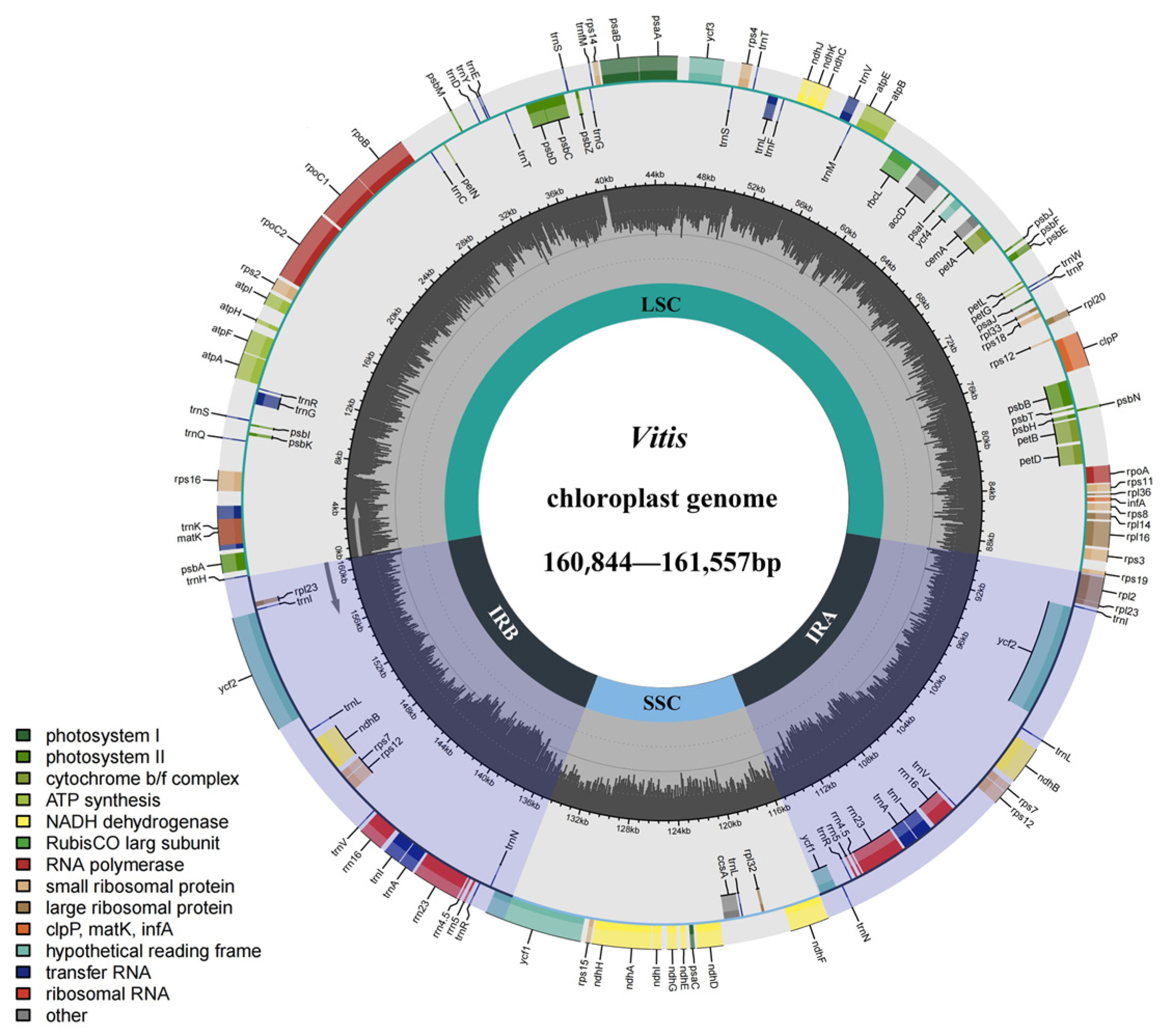
In the analysis of nine Vitis Chloroplast genomes (Figure 1, Table 1 and Table S4), chloroplast genome annotation identified a total of 133 to 134 genes across the specimens, comprising 88 to 89 protein-coding genes (PCGs), 37 transfer RNA (tRNA) genes, and 8 ribosomal RNA (rRNA) genes. Among these, the large single-copy (LSC) region harbored 84 to 86 genes, while the small single-copy (SSC) region contained only 12 genes. The IRa region comprised 17 genes, and the IRb region included 16 genes. Additionally, 5 to 6 genes were distributed across the four junctions. Complete cpDNAs were successfully assembled for all nine Vitis species, demonstrating highly conserved genomic organization in terms of structure, gene order, orientation, and GC content. The total genome length varied among accessions, ranging from 160,844 bp in ‘Muscat Hamburg’ to 161,557 bp in ‘Shuanghong’. Structurally, all cpDNAs exhibited the canonical quadripartite architecture, consisting of a pair of inverted repeats (IRs; 52,706–52,772 bp), a large single-copy region (LSC; 89,065–89,514 bp), and a small single-copy region (SSC; 19,022–19,335 bp).
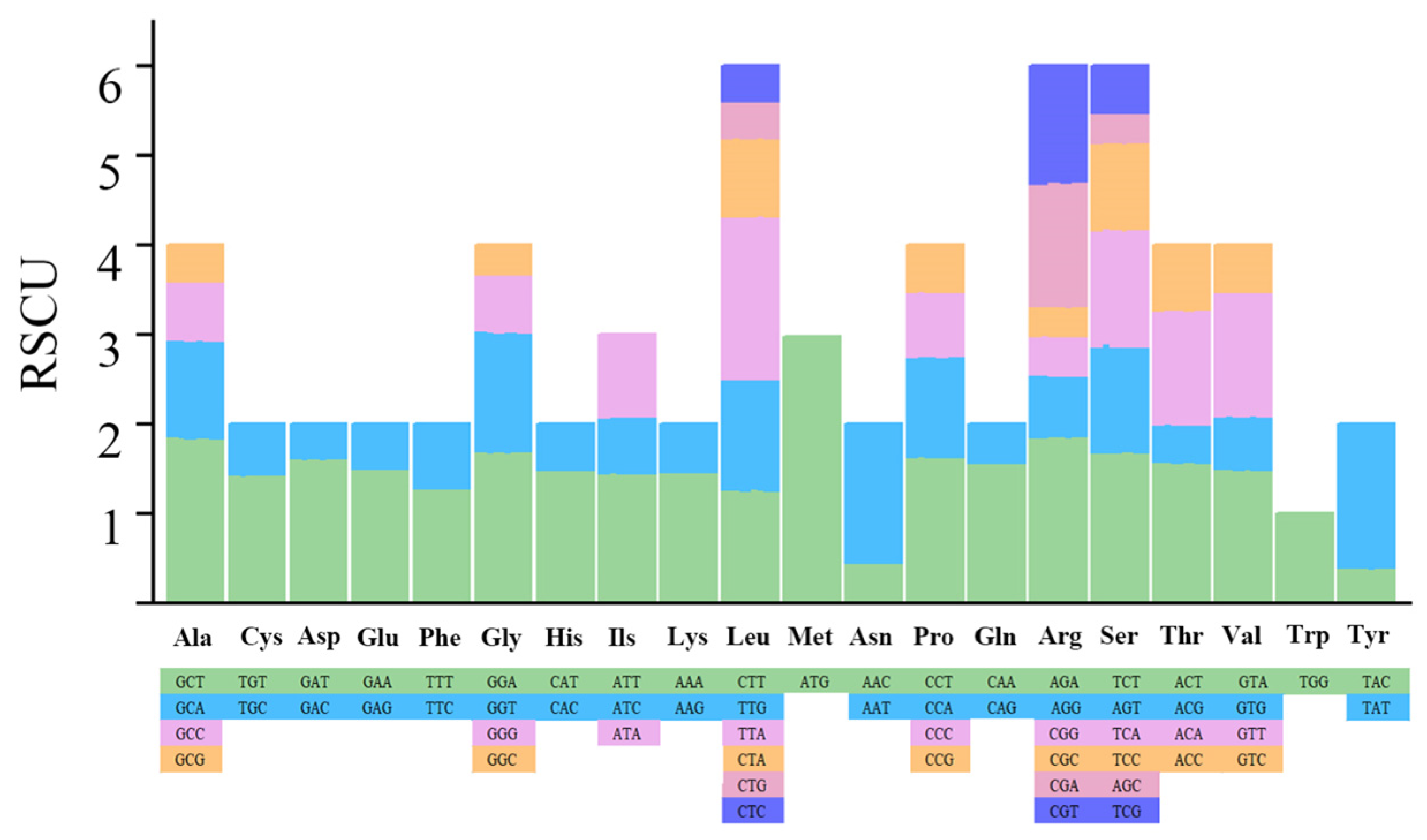
Analysis of the chloroplast genome across Vitis species revealed highly conserved patterns of relative synonymous codon usage (RSCU) [41,42]. Specifically, certain codons display high RSCU values: AGA (1.840–1.854), TTA (1.822–1.829), and GCT (1.828–1.851) (Table S5, Figure 2). In contrast, other codons such as AGC (0.324–0.333), CGC (0.326–0.330), and GGC (0.334–0.336) show low RSCU values. Additionally, the RSCU values of some codons vary very little; for example, TGG is fixed at 1, ACG ranges from 0.420 to 0.424, GCC ranges from 0.649 to 0.668, and AAA ranges from 1.451 to 1.458. The pronounced conservation in codon usage patterns implies the action of shared evolutionary mechanisms [41,43], such as selection for translational efficiency, tRNA abundance, or GC content constraints that have collectively influenced the evolution of the grapevine chloroplast genome. Notably, among the analyzed codons, 31 exhibited RSCU values exceeding 1, while the start codon AUG and UUG constituted exceptions to this trend.
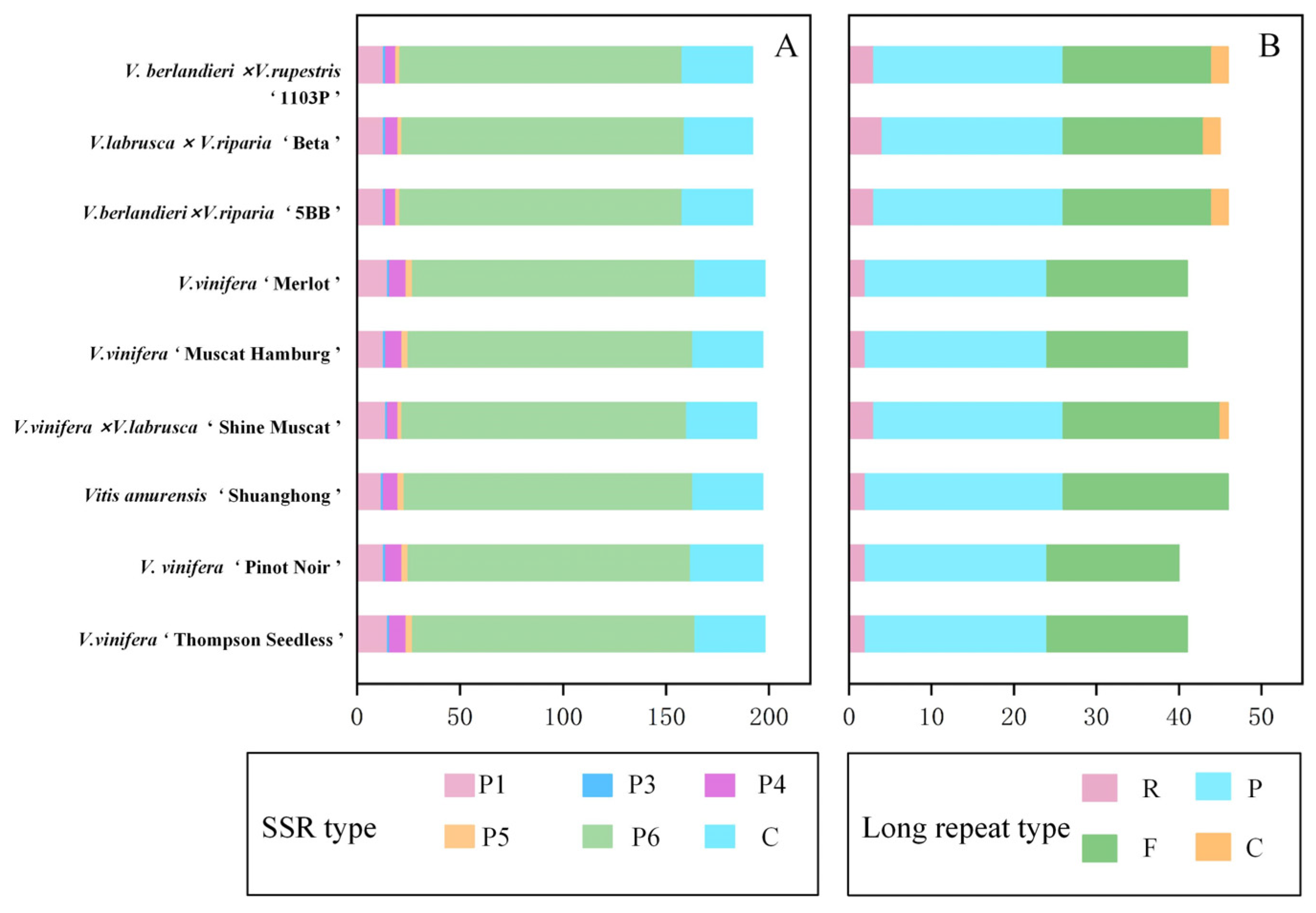
In the analysis of simple sequence repeats (SSRs) in the cpDNAs of 9 Vitis accessions, the total number of SSRs ranged from 158 to 164 (Table S6, Figure 3A). Among them, ‘Merlot’ and ‘Thompson Seedless’ exhibited the highest SSR abundance (164), while ‘5BB’ and ‘1103P’ had the lowest number of 158 SSRs. Hexanucleotide repeats (P6 type) were identified as the predominant SSR type, and the base lengths of most SSRs were concentrated between 12 and 15 bp. These length-specific repeats play a key role in the development of molecular markers for cultivar identification.
Through analysis using REPuter (https://bibiserv.cebitec.uni-bielefeld.de/reputer, accessed on 30 May 2025) software (Table S7, Figure 3B), they were found to contain 40 to 46 long repeats. Among them, the variety ‘Pinot Noir’ had the lowest number of 40 repeats, while the variety ‘5BB’, ‘1103P’, ‘Shine Muscat’, ‘Shuanghong’ had the highest number of 46 repeats. Overall, P-type repeats occurred 22 to 24 times, F-type repeats 16 to 20 times, R-type repeats 2 to 4 times, and C-type repeats 0 to 2 times.

3.2. Comparative Genomic Analysis of Chloroplast DNA Sequences

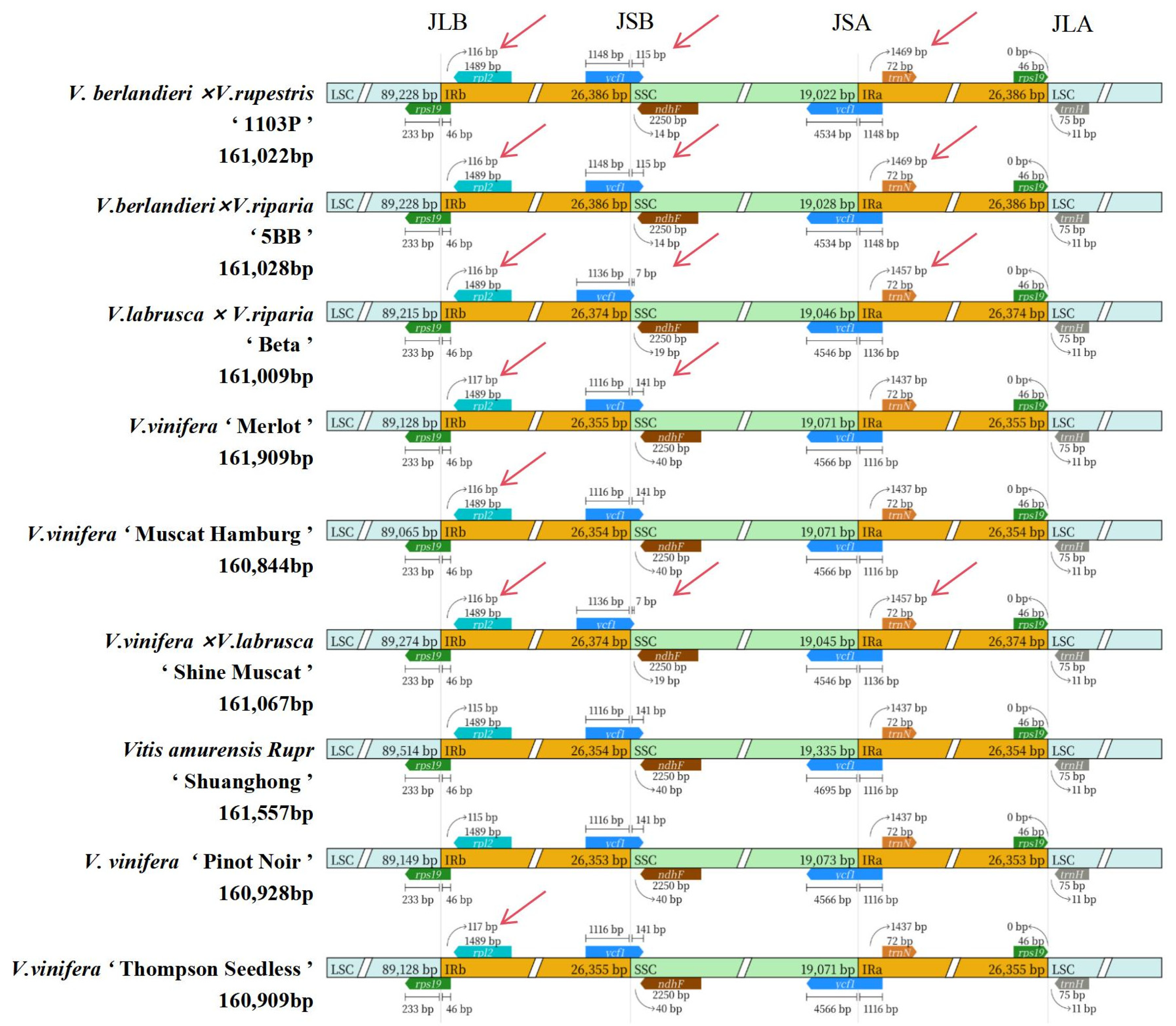
Analysis of the junction regions between inverted repeat (IR) and single-copy regions (LSC and SSC) revealed both conserved features and species-specific variations in gene distribution (Figure 4). Across all examined species, rps19 and rpl2 were consistently located near the LSC/IRB boundary: rps19 extended 233 bp into the LSC region, while rpl2 was situated 115–117 bp from the junction. Two distinct distribution patterns were observed for ycf1 and ndhF at the IRB/SSC boundary. Similarly, ycf1 and ndhN exhibited two localization types at the IRA/SSC interface in most species. In contrast, the positions of rps19 and trnH at the IRA/LSC boundary were strictly conserved among all cultivars, showing no interspecific variation.
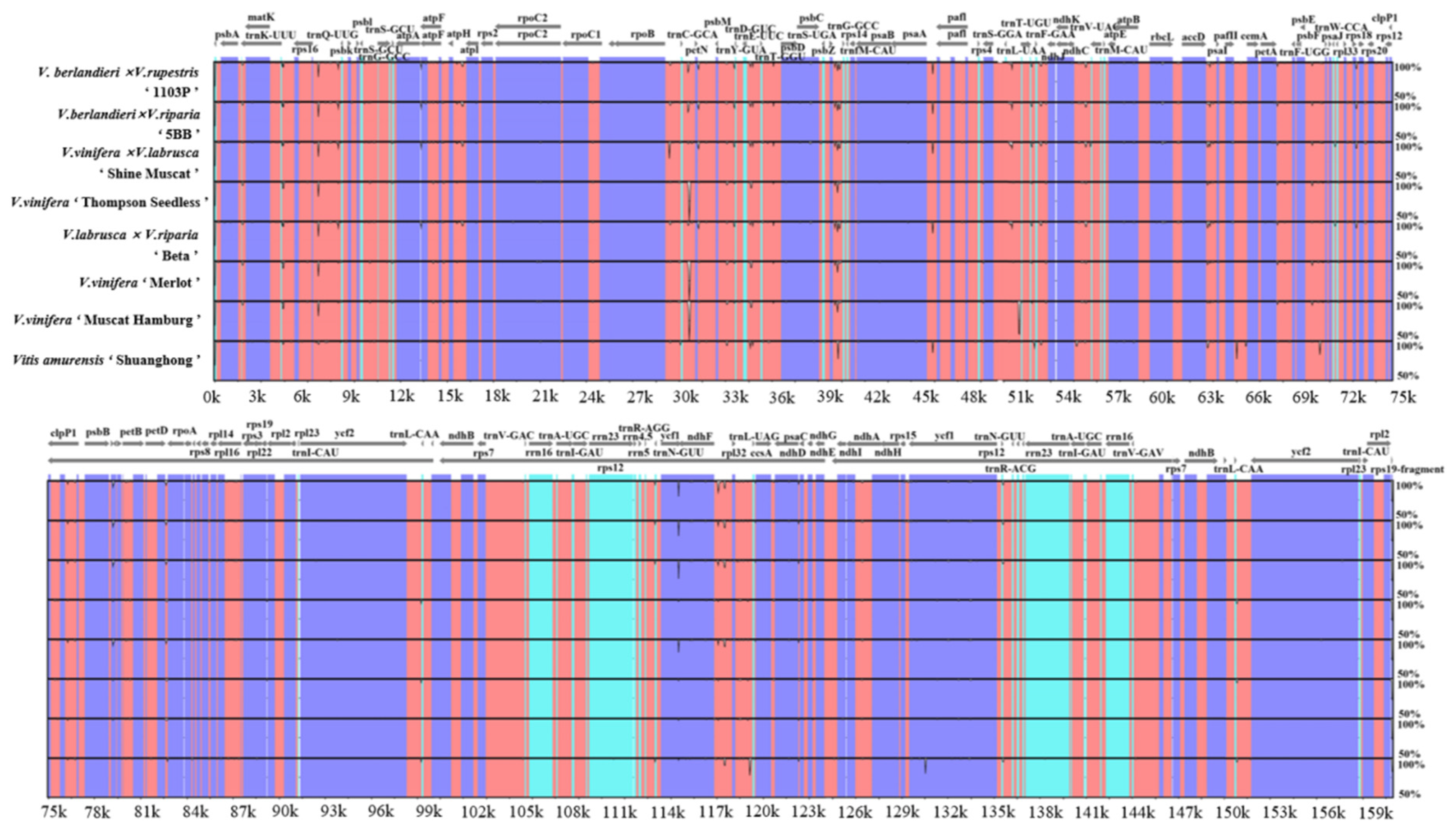
We performed a mVISTA tool alignment (Figure 5). The results showed that genetic variations were mainly enriched in non-coding sequence (CNS) regions. The high-variation regions included, but were not limited to, the intergenic regions between rps16 and tRNA-Gln (trnQ-UUG), between tRNA-Ser (trnS-GCU) and tRNA-Gly (trnG-GCC), between tRNA-Cys (trnC-GCA) and petN, and the junction region between psbZ and tRNA-Gly (trnG-GCC). In contrast, untranslated regions (UTRs) and the vast majority of coding sequence (CDS) regions exhibited high conservation, with limited sequence variation only detected in a few genes, such as the ATP synthase alpha subunit-encoding gene atpA.
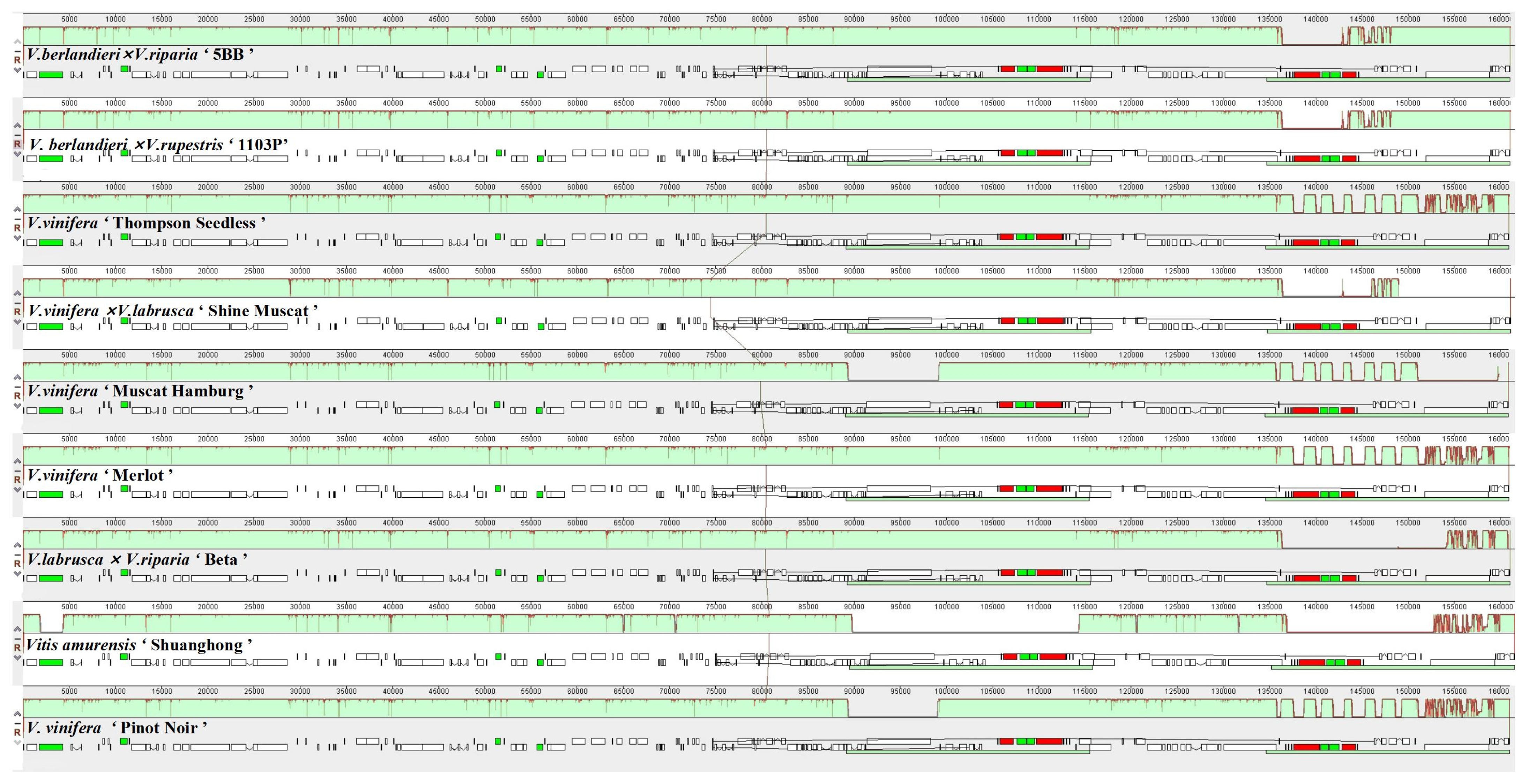
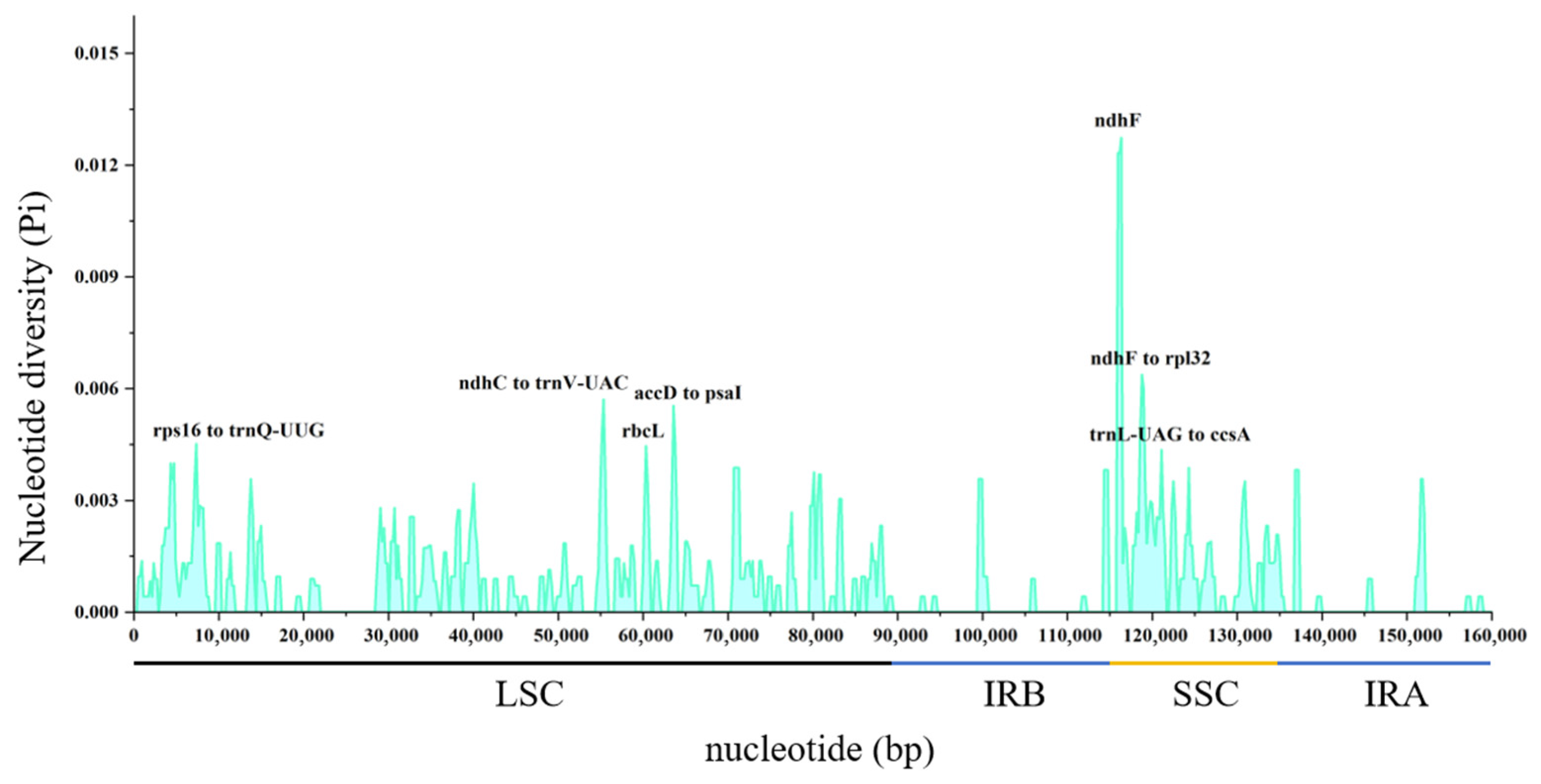
Based on collinearity analysis performed with Mauve (version 2.4.0) software (Figure 6), the chloroplast genomes of the nine Vitis species exhibited a high degree of structural conservation, with no inversions or genomic rearrangements detected, further confirming their evolutionary stability. Nevertheless, there are still a large number of point mutation sites among different varieties. Further sequence comparison identified seven regions with high variation. Functional annotation revealed that these regions include two protein-coding genes rbcL and ndhF, as well as five fragments located in introns and non-coding regions: rps16-trnQ, ndhC-trnV, accD-psaI, ndhF-rpl32, and trnL-ccsA. The nucleotide diversity (Pi) values of all these regions were higher than 0.004 (Figure 7).
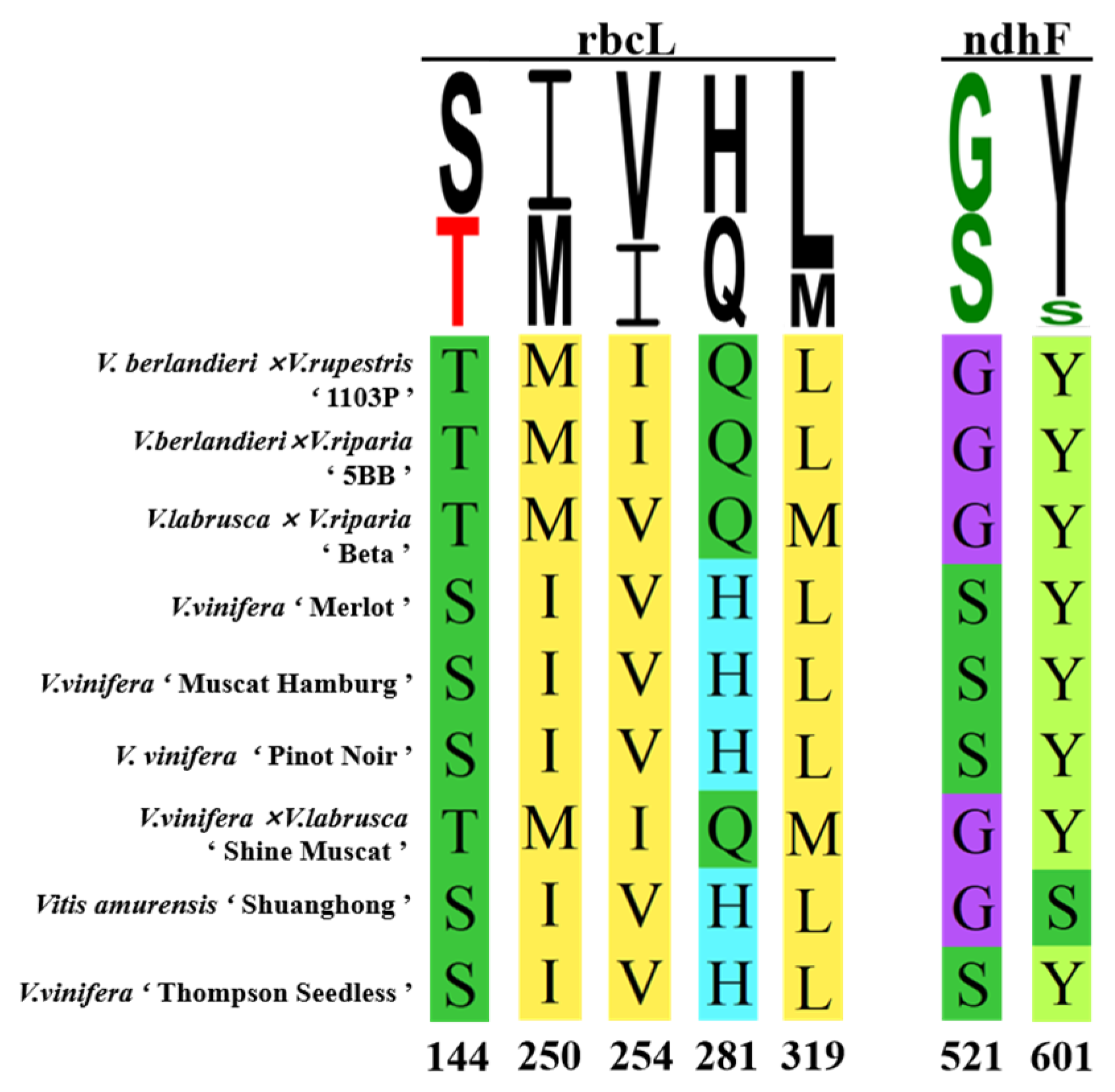
Analysis of positively selected sites was performed on the amino acid sequences of rbcL and ndhF exhibiting high sequence divergence (Figure 8). Five natural variation sites were identified in rbcL, while ndhF contained two natural variation sites. Key amino acid substitutions include:rbcL Position 250: Isoleucine, (I) to Methionine (M), rbcL Position 319: Leucine (L) to Methionine (M), ndhF Position 521: Glycine (G) to Serine (S), Notably, the substitution at ndhF position 521 represents a shift from a nonpolar (G) to a polar (S) amino acid. Alterations between polar and nonpolar residues may induce conformational changes in protein tertiary structure, potentially modifying gene function.

3.3. General Differences in Photosynthetic Characteristics

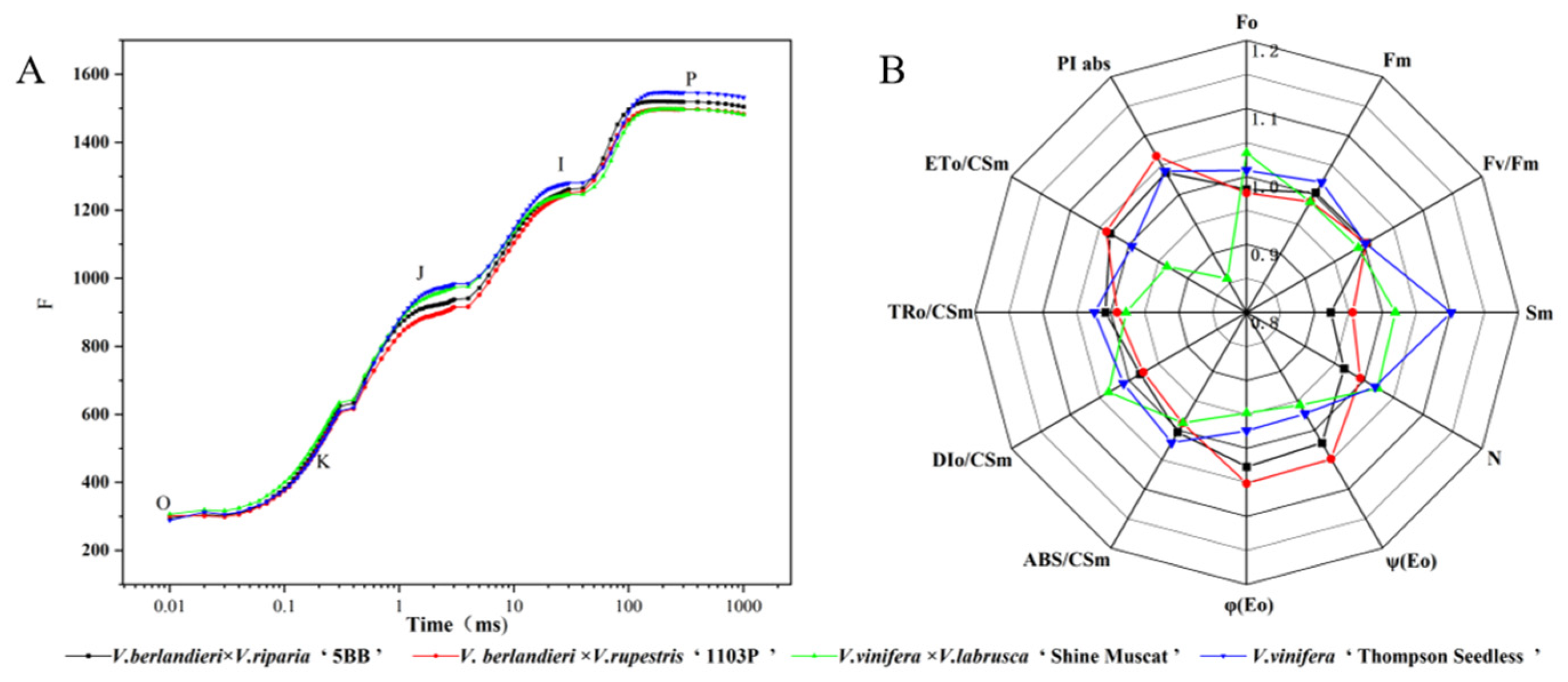
The chloroplast serves as the sole site for photosynthesis. The characteristics of photosynthesis vary significantly among different plant species and genotypes. Additionally, studies have confirmed that the chloroplast genome contains numerous variant sites related to photosynthetic pathways. We speculate that these point mutations may have caused the differences in photosynthetic capabilities among these varieties. This study analyzed four representative varieties and found significant differences in their photosynthetic physiological profiles (Table 2). One-way ANOVA indicated that the cultivar type had a significant effect (p < 0.05) on most of the measured gas exchange, chlorophyll fluorescence, and chlorophyll content parameters. Among the four cultivars, ‘5BB’ exhibited the highest net photosynthetic rate (Pn) and chlorophyll content, whereas ‘Shine Muscat’ showed the highest transpiration rate (Tr), stomatal conductance (Gs), and intercellular CO2 concentration (Ci), but the lowest Pn and chlorophyll content. As shown in Figure 9A, the OJIP transient curves of all four cultivars exhibited the typical O, J, I, and P-steps. Cultivar type also influenced the OJIP kinetics. The O-J phase was the lowest in ‘1103P’, while ‘Thompson Seedless’ displayed the highest O-P phase. To elucidate the status of Photosystem II, a radar chart was constructed based on selected JIP-test parameters derived from the chlorophyll fluorescence induction curves (Figure 9B). Each variable was normalized to the average value across all four cultivars. The results showed that ‘5BB’ exhibited higher values in the parameters φE0, ψE0, Eto/CSm, and the Performance Index (PIabs), indicating that it possesses the strongest photosynthetic capacity.

3.4. Phylogenetic Analyses

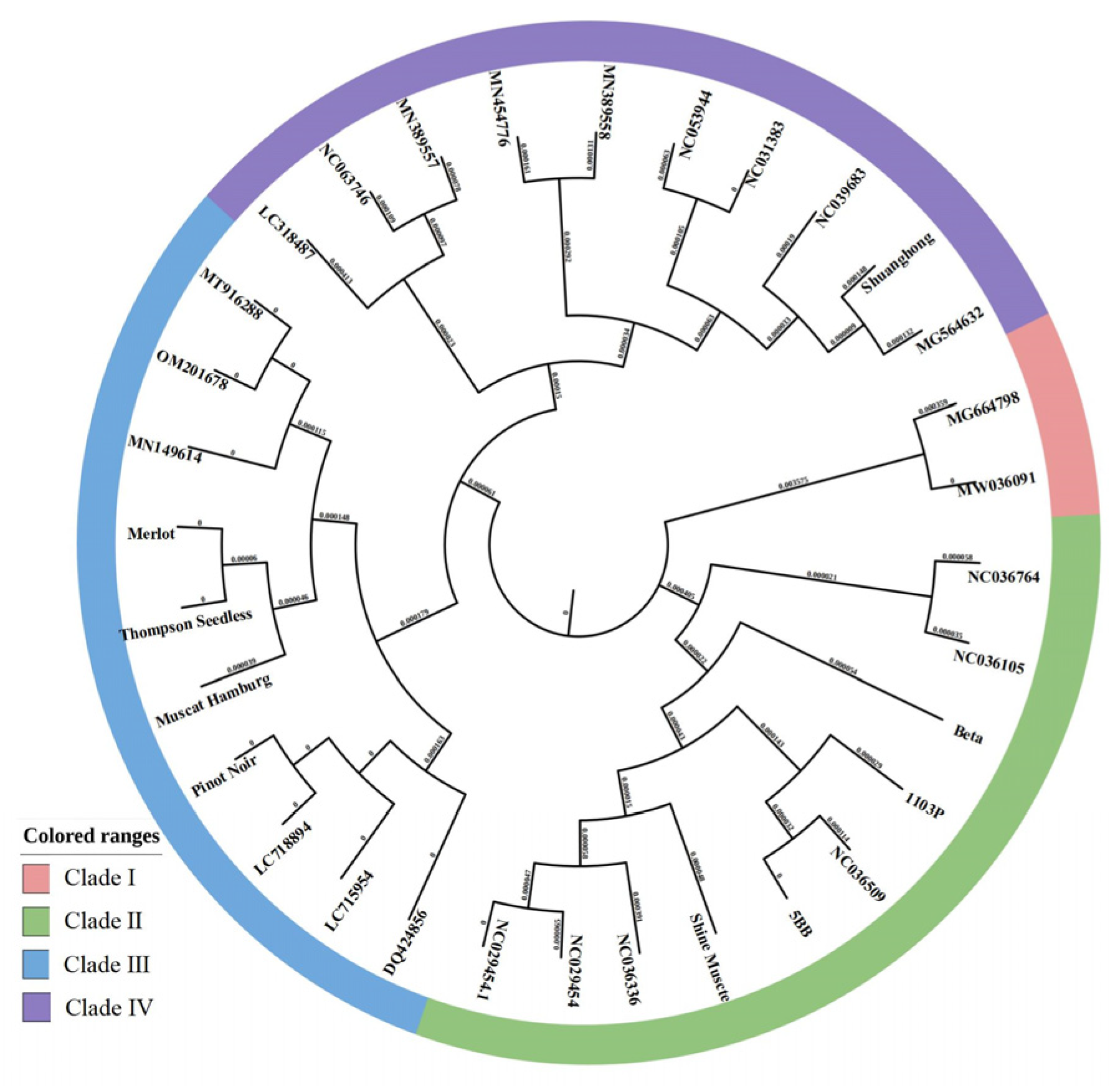
To elucidate the phylogenetic relationships among multiple varieties within the genus Vitis, a maximum likelihood (ML) tree was constructed based on the complete cpDNA sequences of 32 Vitis species, with muscadine grape designated as the outgroup. The analysis strongly supports the division of these species into four major evolutionary clades (Figure 10). This topology, with high bootstrap support values (≥95%), provides a robust molecular phylogenetic framework for understanding the species diversity and systematic classification within the genus Vitis. This evidence aligns with previous studies that have identified distinct clades within the genus, highlighting the power of cpDNA analysis in elucidating evolutionary relationships. This evidence aligns with previous studies that have identified distinct clades within the genus: our phylogenetic analysis divided the tree into four clades, consisting of Vitis rotundifolia, American grape species, Vitis amurensis, and Vitis vinifera (Eurasian grape) varieties. Specifically, the rootstock varieties clustered within the American grape clade. Cultivars including wine-making or table grape varieties were classified within the V. vinifera clade, while ‘Shuanghong’ was grouped within the V. amurensis clade.

4. Discussion

4.1. The Architecture Features of the Chloroplast Genome in Grapes

CpDNA sequences provide valuable data for reconstructing phylogenetic relationships [10]. By assembling and annotating the chloroplast genomes of the nine grape cultivars studied, we confirmed that the grape plastid genome exhibits the typical quadripartite structure. These genomes showed conservation in structure, size, and gene content. The sequences of rRNA, tRNA, and protein-coding genes were all highly conserved. Across the nine samples, a total of 133 genes were annotated, comprising 88 protein-coding genes, 37 tRNA genes, and 8 rRNA genes (Table 1). These structural and compositional features are consistent with previous reports on chloroplast genomes within the genus Vitis [26]. High similarity was also observed in codon usage bias, the distribution of SSR loci, and the types of repeat sequences [19,22].
SSR markers are widely employed in plant germplasm resource research due to their abundant polymorphism, codominant nature, high reproducibility, and reliability. In this study, between 158 and 164 SSRs were identified within the cpDNAs of the nine grape cultivars (Table S5). P6-type constituted the predominant category of SSRs (Figure 3). These findings regarding SSR abundance, type distribution, and repeat unit length are consistent with previous analyses of SSRs in other grape cpDNAs. The identified simple sequence repeats (SSRs) serve as valuable molecular markers. These resources will support future studies on genetic diversity and phylogenetic relationships within the genus Vitis [22].

4.2. Comparative Analysis of Chloroplast Genomes

The slight variations in cpDNA size observed among the grape cultivars are primarily attributable to the expansion and contraction of the IR boundaries [44,45]. This phenomenon is a common occurrence observed in angiosperm cpDNAs. Comparative analysis of the IR/SC region boundaries across the nine grape cultivars revealed relatively minor differences in their positions (Figure 4). Based on the sequence alignment and collinearity analysis (Figure 5 and Figure 6), the chloroplast genomes of the nine Vitis species exhibited high conservation in both UTR and CDS regions. No inversions or genomic rearrangements were detected, further confirming their evolutionary stability. This observed structural conservation aligns with the close phylogenetic relationships among these cultivars. Species sharing close evolutionary ties often exhibit similar responses to environmental stimuli, potentially leading to subtle shifts in their IR boundaries [46,47]. These findings are consistent with previous reports on IR boundary dynamics within the genus Vitis [19]. However, universal or common molecular markers are ineffective for this specific taxon. Mutation events are not random but are clustered in hotspot regions of the chloroplast genome sequence [48,49,50]. Thus, variable markers or species-specific barcodes can be identified within the chloroplast genome. Based on nucleotide diversity analysis, seven regions with high π values were proposed in Vitis, which show great potential as markers for addressing taxonomic issues within the genus and can serve as DNA barcodes for species identification (Figure 7). Among these, the non-coding regions rps16-trnQ, ndhC-trnV, and ndhF-rpl32 have been reported as highly variable loci in the chloroplast genomes of Vitaceae [19] and Aristolochiaceae [51], and can serve as informative markers for phylogenetic reconstruction. In addition, the coding genes rbcL and ndhF have played crucial roles in phylogenetic analysis and species identification across a wide range of plant taxa [52,53].

4.3. Genotype and Photosynthetic Capacity

The significant physiological variations observed among the four cultivars underscore the profound genetic influence on photosynthetic machinery in grapevines [54]. Photosynthetic pigments are integral components of the photosynthetic apparatus [55]. Genotype serves as a key determinant of photosynthetic efficiency, which directly influences biomass accumulation and potential yield. This study shows that the superior performance of ‘5BB’, as evidenced by its highest Pn and chlorophyll content, suggests a highly efficient photosynthetic apparatus (Table 2). Studies on the photosynthetic capacity of grapevines have revealed that leaf pigment content in different cultivars reflects their growth potential, which is consistent with the results obtained in the present study. This is further corroborated by its elevated JIP-test parameters (φE0, ψE0, ETo/CSm, and PIabs) (Figure 9). The PIabs, a holistic parameter reflecting the overall performance of PSII, is particularly indicative of robust photochemical activity and a well-balanced energy partitioning between photochemistry and dissipation [56]. The co-occurrence of high Pn and high PIabs in ‘5BB’ indicates that the high carbon assimilation rate is likely driven by enhanced light harvesting efficiency (suggested by high chlorophyll content), superior electron transport capacity, and effective conversion of photochemical energy into biochemical processes. In studies of grape, it has been demonstrated that PIabs exhibits a strong correlation with grain yield, suggesting its utility as a reliable proxy for assessing yield potential [57]. This conclusion is consistent with the research.

4.4. Phylogenetic Relationships

CpDNA analysis provides a robust framework for elucidating evolutionary lineages in plant species [16,58]. Advancements in genome sequencing and assembly technologies have introduced new dimensions to phylogenetic studies within the genus Vitis. Leveraging the highly conserved nature and strict maternal inheritance of plant cpDNAs, we constructed phylogenetic trees using the Maximum Likelihood (ML) method. ML phylogenetic trees exhibited highly consistent topologies. Crucially, nearly all sampled Vitis accessions were readily incorporated into the ML tree framework using complete cpDNA sequences. The resulting phylogenetic structure revealed strongly supported branches (high bootstrap values) corresponding to cultivars from distinct geographic origins. Conversely, lower bootstrap support was observed within groups of cultivars originating from the same geographic region. The 32 analyzed cpDNAs were resolved into 4 major clades: Subg. Muscadinia, Vitis amurensis and Vitis berlandieri Clade, Eurasian Clade, American Hybrid Clade (Figure 10). As observed in the phylogenetic analysis, American grape species frequently employed as rootstocks, such as ‘5BB’, ‘Beta’ and ‘1103P’, clustered into one distinct clade. In contrast, Eurasian cultivars predominantly cultivated for winemaking and fresh consumption, including Morlet, ‘Thompson Seedless’ and ‘Muscat Hamburg’, formed a separate clade. This phylogenetic division corresponds to the historical breeding efforts following the phylloxera epidemic in Europe, which drove the development of resistant rootstocks from American Vitis species [59,60]. Notably, the table grape cultivar Shine Muscat was classified within the American clade, likely due to its partial genetic ancestry derived from American grape species. Significantly, this study clarifies a long-standing taxonomic ambiguity. Unlike previous studies based on limited cpDNA regions such rbcL sequences, which reported indistinct clustering between subgenera Muscadinia and Euvitis, our comprehensive cpDNA-based phylogeny clearly delineates the genus Vitis into the two recognized subgenera: Subg. Euvitis and Subg. Muscadinia.

5. Conclusions

In conclusion, the divergence in photosynthetic capacity among grapevine cultivars can be attributed to variations in light absorption, photochemical efficiency, and physiological and biochemical characteristics at the mesophyll level. This in-depth comparative study of the cpDNA structure across nine Vitis cultivars has unveiled substantial genomic resources. The high degree of sequence conservation observed provides valuable insights into the evolutionary history and lineages within this subfamily. Furthermore, we identified seven mutation hotspot regions. These hotspots comprise two protein-coding genes (rbcL and ndhF) and five intergenic spacer regions (IGSs): rps16-trnQ-UUG, ndhC-trnV-UAC, accD-psa I, ndhF-rpl 32, and trnL-UAG-ccsA. These regions, particularly those associated with photosynthesis-related variation, exhibit significant potential as specific DNA barcodes for grape cultivar identification and phylogenetic studies. Additionally, maximum likelihood (ML) phylogenetic analysis based on 32 complete cpDNAs revealed that all Vitis cultivars form a strongly supported monophyletic clade. This robustly confirms Vitis as a distinct evolutionary lineage. Within the genus, four major clades were identified. Significantly, this phylogeny clearly distinguishes key species, including V. vinifera, V. berlandieri, and V. amurensis. Collectively, these findings provide novel insights into the evolutionary diversity, global distribution patterns, and adaptive divergence of species within the genus Vitis.

Supplementary Materials

The following supporting information can be downloaded at: https://www.mdpi.com/article/10.3390/horticulturae11111330/s1, Table S1: nine grape germplasm resources. Figure S1: Planting status of four grape varieties in the experimental field; Table S2: Definitions and explanations of selected JIP-test parameters used in the present study; Table S3: The genebank number of the chloroplast genome sequence downloaded from NCBI; Table S4: The genebank number of the chloroplast genome sequence downloaded from NCBI; Table S5: Relative synonymous codon usage (RSCU) values in the 9 grape cpDNAs; Table S6: Types and numbers of SSRs detected in 9 Vitis cultivars; Table S7: The number of four long repeat types in the 9 Vitis cultivars.

Author Contributions

C.M. and H.L. conceived this experiment and designed this study. Y.T. performed the experiments and wrote the original draft. J.L. (Junpeng Li), C.D. and D.F. was responsible for data acquisition and curation. Y.S., X.L. and Y.X. analyzed the data. Z.Z. and L.W. provided critical reagents and analytical tools. J.L. (Junjie Lu) and Y.M. were involved in investigation and provided resources. L.Z. and J.H. revised the manuscript. All authors have read and agreed to the published version of the manuscript.

Funding

This work was supported by the Shanghai Agricultural Science and Technology Innovation Program (Grant No. 2023-02-08-00-12-F04607), the AI+ project of Shanghai Municipal Education Commission (2024AIZD010) and the earmarked fund for CARS-29.

Data Availability Statement

The original contributions presented in this study are included in the article/Supplementary Material. Further inquiries can be directed to the corresponding authors.

Conflicts of Interest

The authors declare no conflicts of interest.

References

  1. Gerrath, J.; Posluszny, U.; Melville, L. Humans and grapes. In Taming the Wild Grape: Botany and Horticulture in the Vitaceae; Springer: Berlin/Heidelberg, Germany, 2015; pp. 103–114. [Google Scholar]
  2. Anjom-Shoae, J.; Milajerdi, A.; Larijani, B.; Esmaillzadeh, A. Effects of grape seed extract on dyslipidaemia: A systematic review and dose–response meta-analysis of randomised controlled trials. Br. J. Nutr. 2020, 124, 121–134. [Google Scholar] [CrossRef]
  3. Corder, R.; Mullen, W.; Khan, N.; Marks, S.; Wood, E.; Carrier, M.; Crozier, A. Red wine procyanidins and vascular health. Nature 2006, 444, 566. [Google Scholar] [CrossRef]
  4. Kadereit, J.W.; Jeffrey, C. Flowering Plants. Eudicots; Springer: Berlin/Heidelberg, Germany, 2018. [Google Scholar]
  5. Wen, J.; Nie, Z.-L.; Soejima, A.; Meng, Y. Phylogeny of Vitaceae based on the nuclear GAI1 gene sequences. Botany 2007, 85, 731–745. [Google Scholar] [CrossRef]
  6. Bozkurt, A.; Yağcı, A. A General Overview of Grape Breeding in Consideration of Literature from Past to Present. CHAPTERS Vitic. 2022, 3, 3–24. [Google Scholar]
  7. Dong, Y.; Duan, S.; Xia, Q.; Liang, Z.; Dong, X.; Margaryan, K.; Musayev, M.; Goryslavets, S.; Zdunić, G.; Bert, P.-F. Dual domestications and origin of traits in grapevine evolution. Science 2023, 379, 892–901. [Google Scholar] [CrossRef]
  8. Myles, S.; Boyko, A.R.; Owens, C.L.; Brown, P.J.; Grassi, F.; Aradhya, M.K.; Prins, B.; Reynolds, A.; Chia, J.-M.; Ware, D. Genetic structure and domestication history of the grape. Proc. Natl. Acad. Sci. USA 2011, 108, 3530–3535. [Google Scholar] [CrossRef] [PubMed]
  9. Liu, M.; Xu, Y.; Song, Y.; Fan, D.; Li, J.; Zhang, Z.; Wang, L.; He, J.; Chen, C.; Ma, C. Hierarchical Regulatory Networks Reveal Conserved Drivers of Plant Drought Response at the Cell-Type Level. Adv. Sci. 2025, 12, 2415106. [Google Scholar] [CrossRef]
  10. Whatley, J.M.; Whatley, F.R. Chloroplast Evolution. New Phytol. 1981, 87, 233–247. [Google Scholar] [CrossRef]
  11. Martin, W.; Stoebe, B.; Goremykin, V.; Hansmann, S.; Hasegawa, M.; Kowallik, K.V. Gene transfer to the nucleus and the evolution of chloroplasts. Nature 1998, 393, 162–165. [Google Scholar] [CrossRef] [PubMed]
  12. Howe, C.J.; Barbrook, A.C.; Koumandou, V.L.; Nisbet, R.E.R.; Symington, H.A.; Wightman, T.F. Evolution of the chloroplast genome. Philos. Trans. R. Soc. Lond. Ser. B Biol. Sci. 2003, 358, 99–107. [Google Scholar] [CrossRef] [PubMed]
  13. Rogalski, M.; do Nascimento Vieira, L.; Fraga, H.P.; Guerra, M.P. Plastid genomics in horticultural species: Importance and applications for plant population genetics, evolution, and biotechnology. Front. Plant Sci. 2015, 6, 586. [Google Scholar] [CrossRef] [PubMed]
  14. Hu, H.; Wang, J.; Nie, S.; Zhao, J.; Batley, J.; Edwards, D. Plant pangenomics, current practice and future direction. Agric. Commun. 2024, 2, 100039. [Google Scholar] [CrossRef]
  15. Samarina, L.S.; Koninskaya, N.G.; Shkhalakhova, R.M.; Simonyan, T.A.; Kuzmina, D.O. DNA-Barcoding for Cultivar Identification and Intraspecific Diversity Analysis of Agricultural Crops. Int. J. Mol. Sci. 2025, 26, 6808. [Google Scholar] [CrossRef]
  16. Cauz-Santos, L.A.; da Costa, Z.P.; Sader, M.A.; van den Berg, C.; Vieira, M.L.C. Chloroplast genomic insights into adaptive evolution and rapid radiation in the genus Passiflora (Passifloraceae). BMC Plant Biol. 2025, 25, 192. [Google Scholar] [CrossRef]
  17. Yang, Y.; Liu, X.; He, L.; Li, Z.; Yuan, B.; Fang, F.; Wang, M.; Li, A.; Liu, C.; He, M.; et al. Comparative Chloroplast Genomics and Codon Usage Bias Analysis in Hevea Genus. Genes 2025, 16, 201. [Google Scholar] [CrossRef]
  18. Jansen, R.K.; Kaittanis, C.; Saski, C.; Lee, S.-B.; Tomkins, J.; Alverson, A.J.; Daniell, H. Phylogenetic analyses of Vitis (Vitaceae) based on complete chloroplast genome sequences: Effects of taxon sampling and phylogenetic methods on resolving relationships among rosids. BMC Evol. Biol. 2006, 6, 32. [Google Scholar] [CrossRef]
  19. Zhang, L.; Song, Y.; Li, J.; Liu, J.; Zhang, Z.; Xu, Y.; Fan, D.; Liu, M.; Ren, Y.; He, J.; et al. Identification, comparative and phylogenetic analysis of eight Vitis species based on the chloroplast genome revealed their contribution to heat tolerance in grapevines. Sci. Hortic. 2024, 327, 112833. [Google Scholar] [CrossRef]
  20. Guo, Q.; Xue, X.; Wang, D.; Zhang, L.; Liu, W.; Wang, E.; Cui, X.; Hou, X. Genetic diversity and population genetic structure of Paeonia suffruticosa by chloroplast DNA simple sequence repeats (cpSSRs). Hortic. Plant J. 2025, 11, 367–376. [Google Scholar] [CrossRef]
  21. Wang, L.-L.; Li, Y.; Zheng, S.-S.; Kozlowski, G.; Xu, J.; Song, Y.-G. Complete Chloroplast Genomes of Four Oaks from the Section Cyclobalanopsis Improve the Phylogenetic Analysis and Understanding of Evolutionary Processes in the Genus Quercus. Genes 2024, 15, 230. [Google Scholar] [CrossRef] [PubMed]
  22. Song, Y.; Wang, L.; Zhang, L.; Li, J.; Teng, Y.; Zhang, Z.; Xu, Y.; Fan, D.; He, J.; Ma, C. Unified Assembly of Chloroplast Genomes: A Comparative Study of Grapes Representing Global Geographic Diversity. Horticulturae 2024, 10, 1218. [Google Scholar] [CrossRef]
  23. Von Caemmerer, S.v.; Farquhar, G.D. Some relationships between the biochemistry of photosynthesis and the gas exchange of leaves. Planta 1981, 153, 376–387. [Google Scholar] [CrossRef] [PubMed]
  24. Stirbet, A. On the relation between the Kautsky effect (chlorophyll a fluorescence induction) and photosystem II: Basics and applications of the OJIP fluorescence transient. J. Photochem. Photobiol. B Biol. 2011, 104, 236–257. [Google Scholar] [CrossRef]
  25. Lichtenthaler, H.K.; Wellburn, A.R. Determinations of total carotenoids and chlorophylls a and b of leaf extracts in different solvents. Biochem. Soc. Trans. 1983, 11, 591–592. [Google Scholar] [CrossRef]
  26. Guo, D.; Li, D.; Wang, R.; Han, B.; Song, S.; Xu, W.; Wang, S.; Wang, L.; Niu, J.; Ma, C. The complete chloroplast genome sequence of Vitis amurensis ‘Shuanghong’. Mitochondrial DNA Part B 2020, 5, 2537–2538. [Google Scholar] [CrossRef]
  27. Guo, D.; Li, D.; Li, H.; Wang, S.; Wang, L.; Niu, J.; Ma, C. The complete chloroplast genome sequence of Vitis vinifera Muscat Hamburg. Mitochondrial DNA Part B 2020, 5, 117–118. [Google Scholar] [CrossRef]
  28. Brown, J.; Pirrung, M.; McCue, L.A. FQC Dashboard: Integrates FastQC results into a web-based, interactive, and extensible FASTQ quality control tool. Bioinformatics 2017, 33, 3137–3139. [Google Scholar] [CrossRef]
  29. Bolger, A.M.; Lohse, M.; Usadel, B. Trimmomatic: A flexible trimmer for Illumina sequence data. Bioinformatics 2014, 30, 2114–2120. [Google Scholar] [CrossRef] [PubMed]
  30. Jin, J.-J.; Yu, W.-B.; Yang, J.-B.; Song, Y.; DePamphilis, C.W.; Yi, T.-S.; Li, D.-Z. GetOrganelle: A fast and versatile toolkit for accurate de novo assembly of organelle genomes. Genome Biol. 2020, 21, 241. [Google Scholar] [CrossRef] [PubMed]
  31. Wick, R.R.; Schultz, M.B.; Zobel, J.; Holt, K.E. Bandage: Interactive visualization of de novo genome assemblies. Bioinformatics 2015, 31, 3350–3352. [Google Scholar] [CrossRef]
  32. Greiner, S.; Lehwark, P.; Bock, R. OrganellarGenomeDRAW (OGDRAW) version 1.3. 1: Expanded toolkit for the graphical visualization of organellar genomes. Nucleic Acids Res. 2019, 47, W59–W64. [Google Scholar] [CrossRef] [PubMed]
  33. Zheng, S.; Poczai, P.; Hyvönen, J.; Tang, J.; Amiryousefi, A. Chloroplot: An online program for the versatile plotting of organelle genomes. Front. Genet. 2020, 11, 576124. [Google Scholar] [CrossRef] [PubMed]
  34. Frazer, K.A.; Pachter, L.; Poliakov, A.; Rubin, E.M.; Dubchak, I. VISTA: Computational tools for comparative genomics. Nucleic Acids Res. 2004, 32, W273–W279. [Google Scholar] [CrossRef]
  35. Katoh, K.; Standley, D.M. MAFFT multiple sequence alignment software version 7: Improvements in performance and usability. Mol. Biol. Evol. 2013, 30, 772–780. [Google Scholar] [CrossRef]
  36. Rozas, J.; Ferrer-Mata, A.; Sánchez-DelBarrio, J.C.; Guirao-Rico, S.; Librado, P.; Ramos-Onsins, S.E.; Sánchez-Gracia, A. DnaSP 6: DNA sequence polymorphism analysis of large data sets. Mol. Biol. Evol. 2017, 34, 3299–3302. [Google Scholar] [CrossRef]
  37. Amiryousefi, A.; Hyvönen, J.; Poczai, P. IRscope: An online program to visualize the junction sites of chloroplast genomes. Bioinformatics 2018, 34, 3030–3031. [Google Scholar] [CrossRef]
  38. Kurtz, S.; Choudhuri, J.V.; Ohlebusch, E.; Schleiermacher, C.; Stoye, J.; Giegerich, R. REPuter: The manifold applications of repeat analysis on a genomic scale. Nucleic Acids Res. 2001, 29, 4633–4642. [Google Scholar] [CrossRef]
  39. Beier, S.; Thiel, T.; Münch, T.; Scholz, U.; Mascher, M. MISA-web: A web server for microsatellite prediction. Bioinformatics 2017, 33, 2583–2585. [Google Scholar] [CrossRef]
  40. Tamura, K.; Stecher, G.; Kumar, S. MEGA11: Molecular evolutionary genetics analysis version 11. Mol. Biol. Evol. 2021, 38, 3022–3027. [Google Scholar] [CrossRef]
  41. Parvathy, S.T.; Udayasuriyan, V.; Bhadana, V. Codon usage bias. Mol. Biol. Rep. 2022, 49, 539–565. [Google Scholar] [CrossRef] [PubMed]
  42. Peña, F.; Univaso, L.; Román-Figueroa, C.; Paneque, M. In Silico Genomic Analysis of Chloroplast DNA in Vitis Vinifera L.: Identification of Key Regions for DNA Coding. Genes 2025, 16, 686. [Google Scholar] [CrossRef] [PubMed]
  43. Komar, A.A. The Yin and Yang of codon usage. Hum. Mol. Genet. 2016, 25, R77–R85. [Google Scholar] [CrossRef] [PubMed]
  44. Sharko, F.; Petrova, K.; Patrushev, M.; Fedosov, D.; Toshchakov, S. Chloroplast genome variation and phylogenetic relationships of autochthonous varieties of Vitis vinifera from the Don valley. Int. J. Mol. Sci. 2024, 25, 9928. [Google Scholar] [CrossRef] [PubMed]
  45. Dong, S.; Zhou, M.; Zhu, J.; Wang, Q.; Ge, Y.; Cheng, R. The complete chloroplast genomes of Tetrastigma hemsleyanum (Vitaceae) from different regions of China: Molecular structure, comparative analysis and development of DNA barcodes for its geographical origin discrimination. BMC Genom. 2022, 23, 620. [Google Scholar] [CrossRef]
  46. Park, S.; An, B.; Park, S. Reconfiguration of the plastid genome in Lamprocapnos spectabilis: IR boundary shifting, inversion, and intraspecific variation. Sci. Rep. 2018, 8, 13568. [Google Scholar] [CrossRef]
  47. Park, S.; Jun, M.; Park, S.; Park, S. Lineage-specific variation in IR boundary shift events, inversions, and substitution rates among Caprifoliaceae sl (Dipsacales) Plastomes. Int. J. Mol. Sci. 2021, 22, 10485. [Google Scholar] [CrossRef]
  48. Abdullah; Mehmood, F.; Shahzadi, I.; Ali, Z.; Islam, M.; Naeem, M.; Mirza, B.; Lockhart, P.J.; Ahmed, I.; Waheed, M.T. Correlations among oligonucleotide repeats, nucleotide substitutions, and insertion–deletion mutations in chloroplast genomes of plant family Malvaceae. J. Syst. Evol. 2021, 59, 388–402. [Google Scholar] [CrossRef]
  49. Ogihara, Y.; Terachi, T.; Sasakuma, T. Structural analysis of length mutations in a hot-spot region of wheat chloroplast DNAs. Curr. Genet. 1992, 22, 251–258. [Google Scholar] [CrossRef]
  50. Wang, W.; Chen, S.; Zhang, X. Whole-genome comparison reveals heterogeneous divergence and mutation hotspots in chloroplast genome of Eucommia ulmoides Oliver. Int. J. Mol. Sci. 2018, 19, 1037. [Google Scholar] [CrossRef]
  51. Li, X.; Zuo, Y.; Zhu, X.; Liao, S.; Ma, J. Complete Chloroplast Genomes and Comparative Analysis of Sequences Evolution among Seven Aristolochia (Aristolochiaceae) Medicinal Species. Int. J. Mol. Sci. 2019, 20, 1045. [Google Scholar] [CrossRef]
  52. Bogler, D.J.; Pires, J.C.; Francisco-Ortega, J. Phylogeny of Agavaceae Based on ndhF, rbcL, and its Sequences. Aliso J. Syst. Florist. Bot. 2006, 22, 313–328. [Google Scholar] [CrossRef]
  53. Olmstead, R.G.; Reeves, P.A. Evidence for the polyphyly of the Scrophulariaceae based on chloroplast rbcL and ndhF sequences. Ann. Mo. Bot. Gard. 1995, 82, 176–193. [Google Scholar] [CrossRef]
  54. Macklin, S.C.; Mariani, R.O.; Young, E.N.; Kish, R.; Cathline, K.A.; Robertson, G.; Martin, A.R. Intraspecific leaf trait variation across and within five common wine grape varieties. Plants 2022, 11, 2792. [Google Scholar] [CrossRef] [PubMed]
  55. Simkin, A.J.; Kapoor, L.; Doss, C.G.P.; Hofmann, T.A.; Lawson, T.; Ramamoorthy, S. The role of photosynthesis related pigments in light harvesting, photoprotection and enhancement of photosynthetic yield in planta. Photosynth. Res. 2022, 152, 23–42. [Google Scholar] [CrossRef] [PubMed]
  56. Filacek, A.; Zivcak, M.; Barboricova, M.; Misheva, S.P.; Pereira, E.G.; Yang, X.; Brestic, M. Diversity of responses to nitrogen deficiency in distinct wheat genotypes reveals the role of alternative electron flows in photoprotection. Photosynth. Res. 2022, 154, 259–276. [Google Scholar] [CrossRef]
  57. Wang, R.; Zhong, H.; Zhang, F.; Zhou, X.; Cheng, M.; Liu, H.; Lin, S.; Wang, L.; Wu, X.; Liu, L. Evaluation of Photosynthetic Performance and Adaptability of Grape Varieties in Arid Regions. Horticulturae 2025, 11, 1041. [Google Scholar] [CrossRef]
  58. Wang, W.; Li, H.; Chen, Z. Analysis of plastid and nuclear DNA data in plant phylogenetics—Evaluation and improvement. Sci. China Life Sci. 2014, 57, 280–286. [Google Scholar] [CrossRef] [PubMed]
  59. Ollat, N.; Bordenave, L.; Tandonnet, J.-P.; Boursiquot, J.-M.; Marguerit, E. Grapevine rootstocks: Origins and perspectives. In Proceedings of the I International Symposium on Grapevine Roots, Rauscedo, Italy, 16–17 October 2014; Volume 1136, pp. 11–22. [Google Scholar]
  60. Rahemi, A.; Peterson, J.C.D.; Lund, K.T. Grape Rootstocks and Related Species; Springer: Berlin/Heidelberg, Germany, 2022. [Google Scholar]
Figure 1. Gene map of the grape chloroplast genome. Genes located outside the circle are transcribed in the counterclockwise direction, while those inside the circle are transcribed clockwise. The dark gray band in the inner circle represents the GC content of the chloroplast genome. Different colors represent genes belonging to different functional groups.
Horticulturae 11 01330 g001
Figure 2. Relative synonymous codon usage (RSCU) of protein-coding genes (PCGs) in the chloroplast genomes of nine grape varieties.
Horticulturae 11 01330 g002
Figure 3. Repeat analysis of the nine chloroplast genomes. (A) SSR statistics in grape chloroplast genomes. Different types of SSRs are indicated by different colors. P1 to P6 represent mononucleotide, dinucleotide, trinucleotide, tetranucleotide, pentanucleotide, and hexanucleotide SSRs, respectively, while C denotes compound SSRs. (B) Long repeat sequence statistics in grape chloroplast genomes. Different types of repeats are marked with different colors. F represents forward repeats, R indicates reverse repeats, P corresponds to palindromic repeats, and C refers to complementary repeats.
Horticulturae 11 01330 g003
Figure 4. Comparison of junctions between LSC (light blue), SSC (light green), and IR (orange) regions among nine Vitis complete chloroplast genomes. The distance in the figure is not to scale. JLB represents the junction between the LSC and IRb, JSB indicates the junction between the SSC and IRb, JSA reverse the junction between the SSC and Ira, JLA refers to the junction between the LSC and IRa.
Horticulturae 11 01330 g004
Figure 5. mVISTA alignment for cpDNAs. Grey arrows indicate the orientation of genes. Blue and red are gene regions and inter-gene regions, respectively. The Y-axis represents the percent identity between 50% and 100%.
Horticulturae 11 01330 g005
Figure 6. Chloroplast genome mauve alignment of nine grape species. With V. vinifera ‘Pinot Noir’ set as a reference genome. The relevant colored boxes reveal locally collinear blocks, which present homologous gene clusters.
Horticulturae 11 01330 g006
Figure 7. Analysis of chloroplast genome nucleotide variability values (Pi) among nine grape species. With V. vinifera ‘Pinot Noir’ set as a reference genome.
Horticulturae 11 01330 g007
Figure 8. Analysis of positive selection sites in two genes with high levels of variance.
Horticulturae 11 01330 g008
Figure 9. Comparison of OJIP fluorescence rise (A) and fluorescence characteristic parameters of four grape varieties (B). All JIP parameters were normalized against the mean of the four varieties and standardized to a reference value of 1.
Horticulturae 11 01330 g009
Figure 10. Phylogenetic tree of maximum likelihood (ML) based on complete chloroplast genome sequence. Clade I (red) represents the muscadine grape group, Clade II (green) represents the American grape species, Clade III (blue) represents the V. vinifera clade, and Clade IV (purple) represents the wild V. amurensis clade.
Horticulturae 11 01330 g010
Table 1. Comparison of chloroplast genome characteristics of nine grape varieties.
TaxonTotal Length (bp)LSC (bp)SSC (bp)IR (bp)LSC GC
Content (%)
SSC
GC Content (%)
IR
GC Content (%)
Total
GC Content (%)
Total
Genes
CDS
Genes
rRNA
Genes
tRNA
Genes
V. berlandieri × V. riparia
‘5BB’
161,02889,22819,02852,77235.3231.6442.9537.3813388837
V. berlandieri × V. rupestris
‘1103P’
161,02289,22819,02252,77235.3231.6542.9537.3813388837
V. vinifera × V. labrusca
‘Shine Muscat’
161,06789,27419,04552,74835.3231.6542.9537.3813388837
V. vinifera
‘Thompson Seedless’
160,90989,12819,07152,71035.3231.6942.9637.3913388837
V. labrusca × V. riparia
‘Beta’
161,00989,21519,04652,74835.3331.6542.9637.3913489837
V. vinifera
‘Muscat Hamburg’
160,84489,06519,07152,70835.3231.6842.9637.3913388837
V. vinifera
‘Merlot’
160,90989,12819,07152,71035.3231.6942.9637.3913388837
Vitis amurensis
‘Shuanghong’
161,55789,51419,33552,70837.3631.5442.9537.3613388837
V. vinifera
‘Pinot Noir’
160,92889,14919,07352,70637.431.6742.9637.413388837
Table 2. Comparison of photosynthetic parameters and chlorophyll content of four grape varieties.
TaxonPn
µmol m−2 s−1
Tr
mmol m−2 s−1
Gs
mmol m−2 s−1
Ci
µmol mol−1
Chl a
(mg/g FW)
Chl b
(mg/g FW)
Total Chl
(mg/g FW)
Total Car
(mg/g FW)
V. berlandieri × V. riparia
‘5BB’
9.48 ± 1.43 a8.02 ± 0.55 b84.4 ± 8.02 b300 ± 12.7 b1.463 ± 0.004 a0.16 ± 0.011 a1.623 ± 0.011 a0.411 ± 0.004 a
V. berlandieri × V. rupestris
‘1103P’
9.12 ± 1.61 a7.28 ± 1.68 b75.2 ± 20.64 b292 ± 19.6 b1.439 ± 0.02 a0.15 ± 0.021 ab1.589 ± 0.018 b0.391 ± 0.009 b
V. vinifera × V. labrusca
‘Shine Muscat’
7.98 ± 1.28 a10.5 ± 1.61 a125 ± 28.04 a325 ± 6.82 a1.188 ± 0.038 c0.067 ± 0.03 c1.255 ± 0.013 d0.287 ± 0.015 d
V. vinifera
‘Thompson Seedless’
8.58 ± 0.5 a7.41 ± 1.03 b77 ± 13.32 b302 ± 6.26 b1.338 ± 0.008 b0.116 ± 0.013 b1.454 ± 0.016 c0.334 ± 0.003 c
Mean ± SD values followed by different lowercase letters are significantly different by Duncan’s multiple range test (p > 0.05).
Disclaimer/Publisher’s Note: The statements, opinions and data contained in all publications are solely those of the individual author(s) and contributor(s) and not of MDPI and/or the editor(s). MDPI and/or the editor(s) disclaim responsibility for any injury to people or property resulting from any ideas, methods, instructions or products referred to in the content.