

Increased Flux of Lipid Metabolism Enhances Bioethanol Fermentability and Inhibitor Tolerance of Xylose-Utilizing Zymomonas mobilis
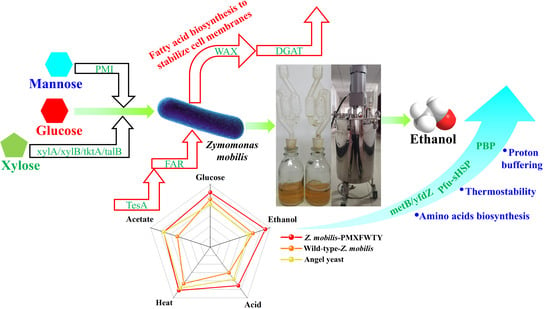
Abstract
Share and Cite
Hu, J.; Wang, W.; Zhang, F.; Jiang, X.; Peng, L.; Fang, Y.; Wang, H. Increased Flux of Lipid Metabolism Enhances Bioethanol Fermentability and Inhibitor Tolerance of Xylose-Utilizing Zymomonas mobilis. Fermentation 2023, 9, 569. https://doi.org/10.3390/fermentation9060569
Hu J, Wang W, Zhang F, Jiang X, Peng L, Fang Y, Wang H. Increased Flux of Lipid Metabolism Enhances Bioethanol Fermentability and Inhibitor Tolerance of Xylose-Utilizing Zymomonas mobilis. Fermentation. 2023; 9(6):569. https://doi.org/10.3390/fermentation9060569
Chicago/Turabian StyleHu, Junyi, William Wang, Feifei Zhang, Xuequan Jiang, Lida Peng, Yichao Fang, and Haoyong Wang. 2023. "Increased Flux of Lipid Metabolism Enhances Bioethanol Fermentability and Inhibitor Tolerance of Xylose-Utilizing Zymomonas mobilis" Fermentation 9, no. 6: 569. https://doi.org/10.3390/fermentation9060569
APA StyleHu, J., Wang, W., Zhang, F., Jiang, X., Peng, L., Fang, Y., & Wang, H. (2023). Increased Flux of Lipid Metabolism Enhances Bioethanol Fermentability and Inhibitor Tolerance of Xylose-Utilizing Zymomonas mobilis. Fermentation, 9(6), 569. https://doi.org/10.3390/fermentation9060569