
Article

Upcycling Jackfruit Seeds as a Sustainable Malt Substitute for Beer Fermentation: Impacts on Physicochemical Quality and Volatile Profile

by
Nyan Minn Paing
1,
Witsaponr Jorsungnoen
1,
Sumittra Thaingoea
1,
Shankar Neupane
1,2,
Do Quyen Nguyen
1,3 and
Nattaya Konsue
1,4,*
1
Food Science and Technology Program, School of Agro-Industry, Mae Fah Luang University, Chiang Rai 57100, Thailand
2
Department of Food Technology and Quality Control, Kathmandu 44600, Nepal
3
Faculty of Chemical Engineering and Food Technology, Nong Lam University, Ho Chi Minh City 70000, Vietnam
4
Research Center of Innovative Food Packaging and Biomaterials, Mae Fah Luang University, Chiang Rai 57100, Thailand
*
Author to whom correspondence should be addressed.
Fermentation 2026, 12(8), 368; https://doi.org/10.3390/fermentation12080368
Submission received: 29 June 2026 / Revised: 27 July 2026 / Accepted: 3 August 2026 / Published: 6 August 2026
(This article belongs to the Special Issue Microbial Fermentation: A Sustainable Approach to Food Production)

Abstract

Jackfruit seeds (JFSs) are an underutilized agro-industrial by-product with considerable nutritional and functional potential for sustainable food fermentation. This study evaluated the feasibility of using jackfruit seed flour as a partial malt substitute in beer brewing at replacement levels of 0%, 25%, 50%, and 75% (w/w). Fresh jackfruit seeds were processed into flour, gelatinized, and mashed with pale ale malt in the presence of α-amylase before fermentation with Saccharomyces cerevisiae, Lutra kveik ale yeast. The physicochemical properties of the raw materials, starch hydrolysis during mashing, beer quality attributes, and volatile aroma compounds were investigated. Compared with pale ale malt, JFS contained higher crude protein (13.22%), total phenolic content (476.66 mg GAE/100 g), and antioxidant activity. HPLC-IR analysis demonstrated the formation of fermentable sugars during mashing, although starch conversion from JFS remained incomplete at higher substitution levels. Increasing JFS substitution significantly enhanced beer foamability (up to 142.22%) and foam stability (112.84 s), which was attributed to the higher protein content of the seeds. However, beers containing higher proportions of JFS exhibited darker color and increased turbidity, reaching 680 NTU at 75% substitution. HS-SPME-GC-MS analysis revealed changes in alcohols, esters, and ketones with increasing JFS substitution. These findings demonstrate that jackfruit seed flour can serve as a sustainable malt adjunct for beer production, improving selected quality attributes while valorizing agricultural by-products. The study highlights the potential of jackfruit seeds as a functional brewing ingredient that supports the development of sustainable and next-generation fermented beverages.

1. Introduction

The increasing generation of agricultural by-products and food processing waste has become a significant challenge for environmental sustainability and resource utilization. Large quantities of plant-derived residues are generated annually during food processing, many of which remain underutilized despite containing valuable nutrients and functional components. In response, the valorization of agro-industrial by-products into value-added products has received growing attention as a strategy to reduce waste generation, improve resource efficiency, and support sustainable production systems [1]. The conversion of underutilized biomass into food ingredients, fermentation substrates, and other biobased products is increasingly recognized as an important component of the circular bioeconomy.
Beer is one of the most widely consumed alcoholic beverages worldwide. In addition to its physicochemical properties, beer quality is largely determined by its volatile and non-volatile composition. Volatile compounds, including higher alcohols, esters, aldehydes, ketones, sulfur compounds, and hop-derived terpenes, are the principal contributors to beer aroma and flavor, thereby strongly influencing sensory quality, consumer acceptance, and overall product quality. Furthermore, changes in volatile composition can reflect fermentation performance and raw material utilization, making volatile profiling an important approach for beer quality evaluation and quality control [2]. Non-volatile constituents, particularly fermentable sugars, are equally important because they govern yeast metabolism, ethanol production, and the formation of flavor-active metabolites during fermentation. Consequently, comprehensive characterization of both volatile and non-volatile profiles is essential when evaluating novel brewing adjuncts. Fermentable sugars are commonly determined using high-performance liquid chromatography coupled with a refractive index detector (HPLC-RI), whereas volatile aroma compounds are widely characterized using headspace solid-phase microextraction coupled with gas chromatography–mass spectrometry (HS-SPME-GC-MS) owing to its high sensitivity and minimal sample preparation [3].
Increasing malt costs, fluctuations in barley supply, and growing interest in sustainable brewing practices have encouraged the exploration of alternative raw materials that can partially replace conventional malt. Various cereal and non-cereal adjuncts, including rice, maize, sorghum, cassava, and sweet potato, have been investigated for brewing applications to reduce production costs, diversify product characteristics, and promote the utilization of locally available resources [4]. However, the suitability of these adjuncts largely depends on their ability to generate fermentable sugars during mashing. Differences in starch composition and enzymatic susceptibility may influence sugar release, yeast performance, alcohol yield, and aroma development in the final product. Therefore, understanding the effects of alternative starch sources on sugar formation and fermentation-related metabolites is critical when evaluating their potential application in brewing systems [5,6].
Jackfruit (Artocarpus heterophyllus Lam.) is a tropical fruit widely cultivated throughout Southeast Asia. Although highly valued for its edible bulbs, a substantial proportion of the fruit consists of non-edible portions that are commonly discarded. It has been reported that only approximately 30–35% of the fruit is consumed, whereas the peel and seeds account for a considerable amount of processing waste [7]. Jackfruit seeds represent approximately 8–15% of the total fruit weight and are often treated as low-value residues despite their rich nutritional composition.
Jackfruit seeds (JFSs) contain high levels of starch (70–85%), together with proteins, dietary fiber, minerals, and phenolic compounds [8,9]. Owing to these characteristics, JFSs have attracted attention as an alternative food ingredient. Previous studies have incorporated jackfruit seed flour into bakery products such as biscuits, bread, and cakes, where improvements in nutritional quality have been reported [10,11,12]. These findings indicate that JFSs possess considerable potential for value-added applications beyond their current limited utilization.
In addition to food applications, JFSs have demonstrated potential as substrates for fermentation processes due to their high carbohydrate content. Previous studies have reported successful ethanol production from fermented jackfruit seed substrates, suggesting that the carbohydrates present in JFS can be effectively converted into fermentable sugars and utilized by microorganisms during fermentation [13,14,15]. Such findings highlight the possibility of employing JFS as an alternative brewing adjunct capable of contributing fermentable substrates during beer production.
Despite these advantages, information regarding the use of JFS in beer production remains scarce. Limited information is available concerning the effects of JFS substitution on fermentable sugar generation during mashing and the formation of volatile compounds during fermentation. These parameters are of particular importance because sugar availability directly affects yeast metabolism and fermentation efficiency, while volatile compounds contribute substantially to beer aroma and overall product quality. Therefore, a better understanding of the influence of JFS on these characteristics is necessary to determine its suitability as a malt substitute in brewing applications.
Therefore, this study aimed to evaluate the potential of jackfruit seed flour as a partial substitute for malt in beer production. Different substitution levels were investigated to determine their effects on beer quality, with particular emphasis on reducing sugar formation and volatile compound development. High-performance liquid chromatography (HPLC) was employed to monitor individual sugars during the mashing process, while gas chromatography–mass spectrometry (GC–MS) was used to characterize volatile compounds in the final beer. The results of this study provide insight into the feasibility of utilizing JFS as a sustainable brewing adjunct and contribute to the valorization of an underutilized agricultural by-product within the brewing industry.

2. Materials and Methods

2.1. Materials

Jackfruit seeds (Thong Prasert variety, Artocarpus heterophyllus Lam.), harvested during May-June of 2025, were purchased from Chainatfruitfire (Chinat, Thailand). Chateau Pale Ale malt, Cascade hop pellets (Yakima variety, harvest year of 2025), and α-amylase were obtained from Homebrewthai (Bangkok, Thailand). Lutra kveik ale yeast (Saccharomyces cerevisiae) was purchased from Thaibrewshop (Samut Prakan, Thailand). All raw materials used in this study were obtained from a single purchase and used throughout the study to minimize batch-to-batch variation. Fresh jackfruit seeds were purchased from the same local supplier and processed immediately after procurement. Malt, Cascade hops, yeast, and α-amylase enzyme were obtained from the same suppliers and used for all brewing treatments.
Analytical-grade chemicals were used throughout the study. Concentrated sulfuric acid (H2SO4) was purchased from Acros (Geel, Belgium). Sodium hydroxide (NaOH), Folin–Ciocalteu reagent, D-(+)-glucose, and ferric chloride (FeCl3) were obtained from Loba Chemie (Mumbai, India). Hydrochloric acid (HCl), petroleum ether, and sucrose were purchased from Qrec (Auckland, New Zealand). Sodium carbonate (Na2CO3), methanol, and acetonitrile were obtained from Labscan (Bangkok, Thailand). Gallic acid and 2,2-diphenyl-1-picrylhydrazyl (DPPH) were purchased from Sigma-Aldrich (St. Louis, MO, USA). Methyl red was obtained from Fisher Scientific (Hampton, NH, USA), while L-(+)-ascorbic acid and sodium chloride (NaCl) were supplied by Univar/Ajax Finechem (Seven Hills, NSW, Australia). Fructose and maltose were purchased from TM Media (Delhi, India).

2.2. Methods

2.2.1. Preparation of Raw Materials

Fresh JFSs were washed thoroughly with clean water to remove surface impurities. The cleaned seeds were drained and visually inspected for defects. Seeds showing sprouting [16], discoloration, deformation, or physical damage were discarded [17]. Only intact seeds with typical oblong-ellipsoidal shape, smooth and uniform surface, and a wax-like seed coat were selected for further processing [18]. The selected seeds were cut longitudinally into halves and dried in a tray dryer at 65 °C for 48 h [19]. After drying, the outer seed coats were manually removed. The dried kernels were then ground using an electric stainless-steel pulverizer grinder (Retsch, Haan, Germany) to obtain coarse powder. The JFS powder was sieved to a particle size of 0.5–1.0 mm using a vibratory sieve shaker (Retsch, Haan, Germany) (AS 200 control) operating at 3.0 amplitude, for 5 min [20]. The resulting ground JFS was collected and stored in sealed plastic bags in a cool, dry, and dark environment until analysis.
Chateau Pale Ale malt (Castle Malting, Beloeil, Belgium) was processed using a hammer mill (Generic, DAM-MHM), which gives an output particle size of 3–15 mm. The milled malt was used immediately to prevent moisture absorption and oxidation.
Lutra kveik ale yeast (Saccharomyces cerevisiae) (Omega Yeast, Chicago, IL, USA) was used as the fermentation starter. The strain is characterized by medium-to-high flocculation, an apparent attenuation of 75–82%, and an optimal fermentation temperature range of 20–35 °C. The yeast was stored in sealed packages at −18 °C until use. α-Amylase enzyme powder (1000 U/g activity; Shanghai Shinge Biochemical Industry Co., Ltd., Shanghai, China), exhibiting optimal activity at 50–75 °C and pH 5.5–7.5, was stored in airtight containers at 4 °C until use. Cascade hops (Yakima Chief Hops, Yakima, WA, USA) were vacuum-sealed in laminated aluminum foil and stored at −18 °C until use.

2.2.2. Analysis of Chemical Composition in Raw Materials

The chemical composition of the raw materials, including malt and JFS, was determined by measuring moisture content, crude protein, and crude fat according to the standard methods of the Association of Official Analytical Chemists (AOAC). Moisture content was determined by the oven-drying method (AOAC 925.10) [21], crude protein by the Kjeldahl method (AOAC 2001.11) [22], and crude fat by Soxhlet extraction (AOAC 960.39) [23,24].
Sample extraction was performed according to the method described by Xu et al. [25] with minor modifications. Briefly, 1 g of each sample was transferred into a 50 mL centrifuge tube and extracted with 9 mL of 80% (v/v) methanol at room temperature (29–31 °C) for 30 min under shaded conditions to minimize photodegradation. The extract was then centrifuged at 5000 rpm for 10 min, and the supernatant was collected and stored in amber glass bottles at 10–12 °C until further analysis.
Total phenolic content (TPC) was determined according to the method described by Lim et al. [26] with minor modifications. Briefly, 0.3 mL of the sample extract was mixed with 1.5 mL of 10% (v/v) Folin–Ciocalteu reagent and 1.2 mL of 7.5% (w/v) sodium carbonate (Na2CO3) solution. The reaction mixture was vortex-mixed and incubated in the dark at room temperature for 30 min. The absorbance was measured at 765 nm using a UV–Vis spectrophotometer (GENESYS 180, Thermo Scientific, Waltham, MA, USA). Total phenolic content is expressed as milligrams of gallic acid equivalents per 100 g dry matter (mg GAE/100 g DM) and calculated using Equation (1).
TPC = y b V D F 100 a m 100 % M C % 1000   ( mg   GAE / 100   g   DM )
where y = sample absorbance, b = y-intercept of the calibration curve, V = extract volume (mL), DF = dilution factor, a = slope of the calibration curve, m = sample mass (g), and MC = moisture content (%).
A 2,2-diphenyl-1-picrylhydrazyl (DPPH) radical-scavenging assay was performed according to the method described by Phuong et al. [27]. A DPPH working solution was prepared by dissolving 3.94 mg of DPPH in 100 mL of methanol. Briefly, 0.6 mL of the sample extract was mixed with 2.0 mL of the DPPH solution, vortex-mixed, and incubated in the dark at room temperature for 30 min. The absorbance was measured at 517 nm using a UV–Vis spectrophotometer. Antioxidant activity is expressed as milligrams of ascorbic acid equivalents per 100 g dry matter (mg AAE/100 g DM) and calculated using Equation (2).
Antioxidant   Activity = y b V D F 100 a m 100 % M C % 1000   ( mg   AAE / 100   g   DM )
where the variables are the same as described for Equation (1).

2.2.3. Wort Preparation

Ground JFS was used as a partial substitute for pale ale malt at levels of 0%, 25%, 50%, and 75% (w/w). JFS was mixed with water at a ratio of 1:5 (w/v) and boiled for 30 min to gelatinize the starch. Subsequently, pale ale malt was added to achieve the desired JFS substitution levels, and the total volume was adjusted to 12 L with water. The mashing step, controlled at a pH of 5.2–5.4, was carried out at 70 °C for 60 min with the addition of 0.5% (w/w) α-amylase, based on the weight of JFS, to enhance the conversion of starch into fermentable sugars [28,29].

2.2.4. Sugar Profile Analysis

Sugar profiles of wort samples collected every 15 min during the mashing process were analyzed using a Waters Acquity Arc HPLC (Milford, MA, USA) system equipped with a refractive index (RI) detector, following a method adapted from Muntean and Bărăscu [30]. Prior to analysis, samples were purified using SEClute HLB solid-phase extraction (SPE) cartridges (6 cc/200 mg, S*Pure Pte Ltd., Singapore). The cartridges were conditioned with 4 mL of ultrapure water at a flow rate of 1 mL/min. A 5 mL aliquot of sample was loaded onto the cartridge, the first 1 mL of eluate was discarded, and the remaining eluate was collected. The purified samples were filtered through a 0.45 μm membrane filter and transferred into HPLC vials fitted with caps. Chromatographic separation was performed using a VertiSep GES NH2 column (4.6 × 150 mm, 5 μm, Vertical Chromatography Co., Ltd., Nonthaburi, Thailand) maintained at 30 °C. The mobile phase consisted of acetonitrile and water (75:25, v/v) delivered isocratically at a flow rate of 1.0 mL/min. The RI detector temperature was maintained at 35 °C, and the injection volume was 20 μL. Individual sugars were identified by comparing retention times with authentic standards and confirmed by spiking experiments. Quantification was performed using the external standard method based on five-point calibration curves prepared from maltose, fructose, glucose, and sucrose standards.

2.2.5. Filtration and Wort Boiling

Following mashing, the mash was filtered through a double layer of cheesecloth to collect clear wort. The wort was then boiled for 60 min for microbial inactivation and flavor development. After boiling, the wort was cooled to 80 °C, and 9 g of Cascade hop pellets (packed in sterile cheesecloth) were added for aroma extraction [31,32,33,34,35,36,37,38,39]. The hopped wort was subsequently cooled to room temperature (22–26 °C) and transferred to the fermentation tank.

2.2.6. Fermentation

Lutra kveik ale yeast (Saccharomyces Cerevisiae, 11 g) was rehydrated in sterilized water (35–39 °C) at a 1:10 (w/v) ratio for 30 min prior to inoculation [40]. The rehydrated yeast was aseptically added to 10 L of the cooled wort in the fermentation tank. Fermentation was carried out at room temperature (22–26 °C) for 7 days [41,42]. One independent brewing batch was prepared for each treatment (0%, 25%, 50%, and 75% JFS substitution), and all physicochemical analyses were performed in triplicate.

2.2.7. Carbonation and Bottling

After fermentation, the tank was chilled at 4 °C to promote sedimentation, allowing yeast and other particulates to settle at the bottom [43,44,45]. The clear beer was carefully decanted into a keg maintained at 4 °C and carbonated by applying 50 psi of CO2 for 5 min. The carbonated beer was then aseptically filled into 250 mL sterilized aluminum cans and manually sealed under sterile conditions [46].

2.2.8. Analysis

A commercially available India Pale Ale (Tawandang IPA, Tawandang German Brewery Co., Ltd., Bangkok, Thailand) was used as a reference sample for comparison with the experimental beers. The reference beer was selected because it belongs to the same beer style as the beers produced in this study and therefore provides a practical market benchmark for evaluating the physicochemical and volatile characteristics of experimental products. The commercial IPA was stored according to the manufacturer’s recommendations and analyzed under the same experimental conditions as the brewed samples. Since differences in recipe formulation, raw materials, hop composition, yeast strain, and industrial-scale brewing conditions may differ from those used in this study, comparisons among experimental treatments were based on the 0% JFS beer, which was brewed using the same formulation and processing conditions as the JFS-substituted beers.
Physical Analysis
The physical properties of the finished beer, including color, turbidity, foamability, and foam stability, were analyzed [47,48]. Beer color was determined using a UV–Vis spectrophotometer at a wavelength of 430 nm. The results are expressed as standard reference method (SRM) units, calculated according to Equation (3):
SRM = 12.7 × A430
where A430 represents the absorbance of the beer sample [49]. Turbidity was assessed using a calibrated turbidity meter (Lovibond, Amesbury, UK), with values reported in nephelometric turbidity units (NTU). Foam properties were evaluated to determine both formability and foam stability. Foamability was quantified based on the relative height of the foam generated immediately after pouring. It was calculated using Equation (4):
Foamability (%) = (Foam height/Beer height) ∗ 100%
Foam stability was evaluated using the Rudin method. Briefly, a 100 mL aliquot of beer was transferred into a 250 mL graduated cylinder from a standardized height of 30 cm to induce foam formation. The initial foam height was recorded immediately, and the decrease in height was monitored. Stability is expressed as the foam half-life (t1/2), defined as the time required for the foam to collapse to 50% of its original height; higher t1/2 values indicated superior foam retention [50].
Chemical Analysis
The chemical properties of the beer, including pH, alcohol content, total soluble solids (TSS), total phenolic content (TPC), antioxidant activity, and volatile compounds, were evaluated [51]. The pH was measured using a calibrated pH meter (FiveEasy FE28, Mettler Toledo, Greifensee, Switzerland), alcohol by volume (ABV) was determined using an ebulliometer (Dujardin-Salleron, Noizay, France), and TSS was measured as °Brix using a digital refractometer (PAL-1, ATAGO, Tokyo, Japan). All beer samples were analyzed under identical analytical conditions using the same instrument and measurement. Total phenolic content and antioxidant activity (DPPH radical-scavenging assay) were determined as described in Section 2.2.2.
Volatile compounds were analyzed by headspace solid-phase microextraction coupled with gas chromatography–mass spectrometry (HS-SPME-GC–MS) according to the method of Claudia Gonzalez Viejo [52] with minor modifications. Briefly, 5.0 mL of beer was transferred into a 20 mL screw-cap headspace vial and sealed with an 18 mm magnetic screw cap fitted with a polytetrafluoroethylene/silicone (PTFE/silicone) septum. The sealed samples were stored at 4 °C for 24 h prior to analysis to minimize excessive foam formation.
GC–MS analysis was performed using an Agilent 8890 gas chromatograph coupled with a 5977B mass selective detector (Agilent Technologies, Santa Clara, CA, USA) equipped with a PAL3 autosampler (CTC Analytics AG, Zwingen, Switzerland). Separation was achieved using an HP-5MS capillary column (30 m × 0.25 mm i.d., 0.25 μm film thickness; Agilent Technologies). Samples were incubated at 60 °C for 1 min under agitation prior to extraction. The fiber was exposed to the sample headspace for 10 min, followed by thermal desorption in the GC inlet for 5 min. The fiber was conditioned in a dedicated conditioning station at 230 °C before and after each analysis. Separation was achieved using an HP-INNOWax capillary column (30 m × 0.25 mm i.d., 0.25 μm film thickness; Agilent Technologies) with helium as the carrier gas at a constant flow rate of 1.5 mL min−1. The oven temperature program was as follows: initial temperature of 60 °C held for 1 min, increased to 250 °C at 5 °C min−1, and held for 10 min. The injector was operated in splitless mode at 240 °C. The mass spectrometer was operated in full-scan acquisition mode over an m/z range of 29–330, with the ion source and quadrupole temperatures maintained at 230 °C and 150 °C, respectively. No internal standard was employed; therefore, the GC-MS data should be regarded as semi-quantitative, and peak areas were used only for comparison of volatile profiles among treatments.
A total of 1381 detected features were initially obtained. Features detected at low frequency were excluded, followed by one-way ANOVA (p < 0.05) and fold-change filtering (>2.0). Partial least squares-discriminant analysis (PLS-DA) was subsequently performed, and variables with a variable importance in projection (VIP) score greater than 1.0 were selected for further interpretation.
Statistical Analysis
The experiment was conducted using a completely randomized design (CRD). All physical and chemical measurements were performed in triplicate (n = 3). The collected data were analyzed using IBM SPSS Statistics software (Version 31.0.1.0). One-way Analysis of Variance (ANOVA) was employed to determine statistical differences between samples. Where significant effects were observed, means were compared using Duncan’s Multiple Range Test (DMRT) at a significance level of p < 0.05.

3. Results and Discussion

3.1. The Chemical Compositions of Raw Materials

The comparative analysis of raw materials revealed significant compositional distinctions between malt and JFS (Table 1), which directly impact brewing potential. The JFS exhibited a notably higher crude protein content (13.22% dwb) compared to the malt 9.99% dwb), aligning with the literature confirming JFS as a protein-rich material [53,54,55]. This protein advantage suggests improved yeast nutrition and potential enhancement of foam stability in the final beer. Furthermore, the JFS contained significantly greater TPC and antioxidant activity determined by DPPH assay compared to the malt. The TPC of JFS (476.66 mg GAE/100 g DM) is supported by its known abundance in bioactive compounds, such as phenolic acids [56]. This elevated antioxidant activity is a crucial finding for valorization, as it predicts enhanced oxidative stability and potentially longer shelf-life for the beer. While the crude fat levels were comparable, the higher moisture content of the JFS must be accounted for during grist formulation [53]. In summary, JFS is not merely a starch source but also a functionally superior adjunct regarding protein and antioxidant contribution, offering tangible benefits for beer quality and stability.

3.2. Effect of JFS Substitutions on Physical Properties of Beer

The incorporation of JFS significantly altered the physical properties of the beer (Table 2). A direct correlation was observed between the level of JFS substitution and the increase in both color and turbidity of melanoidins and other color-forming compounds introduced during seed preparation [57,58,59]. Similarly, turbidity increased substantially across all substitution levels, reaching a peak of 680 NTU at 75%. This haze formation is likely associated with the increased concentrations of proteins, non-starch polysaccharides, and polyphenolic compounds introduced by JFS, which may promote the formation of protein–polyphenol complexes that contribute to colloidal haze in beer [29], in addition to the effects of non-starch polysaccharides on beer turbidity [60,61]. In contrast, the foam characteristics showed an increase in amount according to the higher substation level for both foamability (142.22%) and foam stability 112.84 s. This improvement is primarily attributed to the higher protein content of JFS (Table 1), as foam-active proteins adsorb at the gas–liquid interface and strengthen the beer foam. Furthermore, interactions between proteins and polyphenols may further stabilize the foam while also contributing to haze formation. Therefore, the enhanced foam stability and increased turbidity observed at higher JFS substitution levels are likely interconnected, indicating a trade-off between improved foam performance and reduced beer clarity [62].

3.3. Effect of JFS Substitutions on Sugar Profiles During Mashing

The release of soluble sugars during the 60-min mashing process is presented in Figure 1. In all treatments, sugar concentrations increased rapidly during the first 30–45 min before reaching a plateau toward the end of mashing, indicating that most of the accessible starch had been hydrolyzed. Maltose was the predominant sugar detected throughout the process, followed by glucose, whereas fructose and sucrose remained at comparatively low concentrations. Maltotriose, another important fermentable sugar in brewer’s wort, was not included in the HPLC-RI analytical method. Therefore, the present discussion is limited to the quantified sugars (glucose, fructose, sucrose, and maltose) rather than the complete fermentable sugar profile.
Increasing the substitution of malt with JFS markedly reduced the concentration of quantified sugars, particularly maltose. The control treatment (0% JFS) produced more than 50 g/L of maltose after 60 min of mashing (Figure 1a), whereas only approximately 18 g/L was detected in the 75% JFS treatment (Figure 1d). A similar decreasing trend was observed for glucose, demonstrating that increasing JFS substitution reduced the efficiency of starch conversion into those quantified sugars.
Although JFS contains a high starch content (70–85%), it lacks the endogenous diastatic enzymes naturally present in malted barley, especially β-amylase, which is responsible for releasing maltose from starch during mashing. To improve starch hydrolysis, commercial α-amylase was added to all JFS-containing treatments. However, α-amylase primarily hydrolyzes internal α-1,4-glycosidic linkages, producing dextrins and short-chain oligosaccharides, whereas β-amylase sequentially releases maltose from the non-reducing ends of starch molecules. Consequently, the reduction in malt-derived β-amylase with increasing JFS substitution limited maltose formation despite the addition of commercial α-amylase, resulting in the accumulation of dextrins that are largely unfermentable by brewing yeast [63].
Fructose and sucrose remained at relatively low concentrations throughout the mashing process and exhibited only minor changes among treatments (Figure 1a–d). Unlike maltose and glucose, these sugars are not produced through the enzymatic hydrolysis of starch during mashing. Instead, they originate from naturally occurring free sugars present in barley malt and JFS, which readily dissolve into the wort upon heating [64]. Because their concentrations depend primarily on the composition of the raw materials rather than enzymatic starch degradation, increasing the proportion of JFS had only limited effect on their levels. Moreover, fructose and sucrose represented only a small fraction in the wort compared with maltose and glucose, indicating that they contributed minimally to the overall sugar profile and subsequent fermentation process.

3.4. Effect of JFS Substitutions on Chemical Properties of Beer

The chemical properties of the final beers are presented in Table 3. Alcohol by volume (ABV) decreased significantly (p < 0.05) as the level of JFS substitution increased, declining from 4.83% in the control beer to 3.13% at 75% JFS substitution. This reduction is consistent with the sugar profile observed during mashing (Figure 1), where increasing JFS substitution resulted in markedly lower concentrations of fermentable sugars, particularly maltose and glucose. As these sugars are the primary substrates utilized by S. cerevisiae during alcoholic fermentation, their reduced availability limited yeast metabolism and ethanol production. ABV was determined using an ebulliometer, and the reported values should be interpreted as comparative measurements among treatments because residual extract and other volatile compounds may affect the accuracy of absolute alcohol determination. Although commercial α-amylase was added during mashing to enhance starch hydrolysis, the amount of fermentable sugars produced was still considerably lower than that of the control treatment. This indicates that the added α-amylase alone could not fully compensate for the reduction in endogenous malt enzymes associated with increasing JFS substitution. Consequently, starch conversion into fermentable sugars became less efficient, reducing the sugar available for yeast fermentation and resulting in lower alcohol production [65,66]. Similar reductions in ABV have been reported when starch-rich adjuncts partially replaced malt, as these materials possess limited endogenous enzymatic activity and therefore produce lower concentrations of fermentable sugars, ultimately reducing fermentation efficiency [67]. These findings demonstrate that although JFS is rich in starch, its limited enzymatic capacity restricts starch saccharification and ethanol production as the substitution level increases.
The final pH increased significantly from 4.93 in the control beer to 5.74 at 75% JFS substitution. This increase may be attributed to the relatively high protein and mineral contents of JFS (Table 1), which can enhance the buffering capacity of the wort and reduce the extent of pH decline during fermentation. Wort naturally possesses a buffering system that resists changes in pH during mashing, and differences in raw material composition can influence this buffering capacity. Although the mash pH was maintained within the recommended brewing range (5.2–5.4) using distilled water during wort preparation, the elevated final beer pH at higher JFS substitution levels suggests that the buffering properties of JFS and reduced acidification during fermentation had a greater influence on the final beer pH than the mash conditions. In addition, the lower concentrations of fermentable sugars and the corresponding reduction in alcohol production observed at higher JFS substitution levels may have limited yeast metabolism and the production of organic acids during fermentation, thereby contributing to the higher final pH. Similar effects of protein-rich adjuncts on beer pH have been reported previously [68,69]. The elevated final beer pH may also have implications for beer quality because the naturally low pH of beer is one of the intrinsic hurdles that contributes to microbiological stability by inhibiting the growth of spoilage microorganisms. In addition, beer pH is an important quality parameter that can influence flavor perception and colloidal stability during storage [70].
TPC and DPPH antioxidant activity increased significantly with increasing JFS substitution, reaching 1050.96 mg GAE/L and 837.19 mg AAE/L, respectively, at 75% substitution. This trend reflects the naturally high phenolic and antioxidant contents of JFS (Table 1), which were transferred into the final beer during the brewing process. Phenolic compounds are known to contribute to the antioxidant capacity of beer by scavenging free radicals and protecting against oxidative deterioration. Similar increases in phenolic content and antioxidant activity have been reported when phenolic-rich plant materials or brewing adjuncts were incorporated into beer formulations, resulting in beer with enhanced functional properties while maintaining acceptable brewing performance [71,72,73]. However, increased concentrations of phenolic compounds may also influence sensory characteristics, as polyphenols can contribute to bitterness and astringency depending on their composition and concentration [74]. Furthermore, the beers containing higher levels of JFS exhibited increased turbidity and elevated final pH. Although these characteristics may be associated with the compositional properties of JFS, elevated beer pH and haze may influence product stability during storage. Beer pH is an important intrinsic factor contributing to microbiological stability, while excessive haze may affect the physical quality and consumer perception of beer [75]. Overall, these findings demonstrate that although JFS was less effective than malt in supporting ethanol production, it substantially enhanced the phenolic content and antioxidant capacity of the beer. Therefore, JFS shows considerable potential as a sustainable functional brewing adjunct, particularly for developing beers with improved bioactive properties while simultaneously promoting the valorization of an underutilized agricultural by-product.

3.5. Volatile Profiles of Beers Produced with Different Levels of JFS Substitution

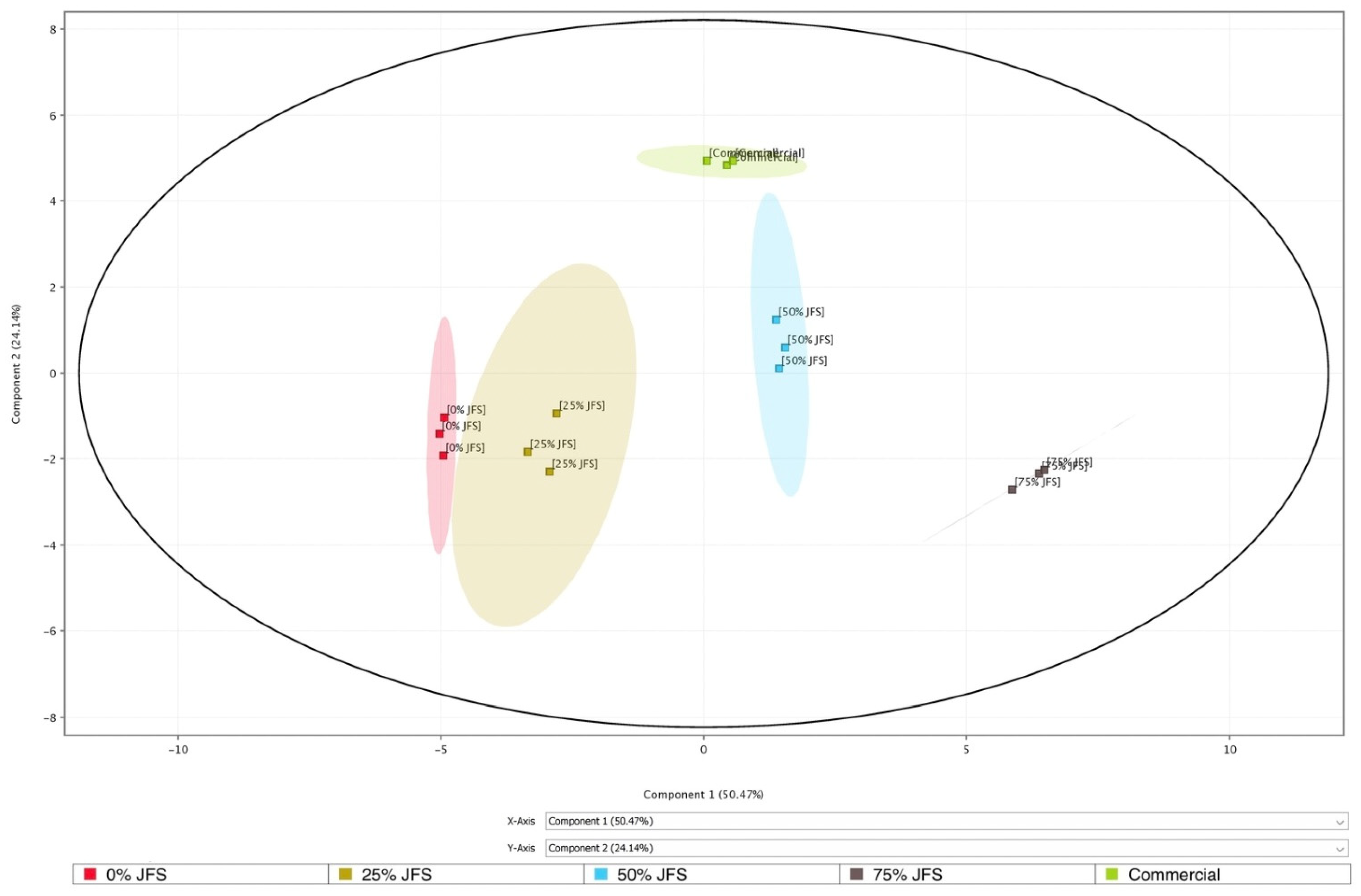
Principal component analysis (PCA) was performed using the 32 discriminant volatile compounds (Variable Importance in Projection or VIP > 1) to evaluate the effect of JFS substitution on the volatile profiles of the beers (Figure 2). The first two principal components explained 74.61% of the total variation, with PC1 and PC2 accounting for 50.47% and 24.14%, respectively, indicating that they captured most of the variation among the samples. Replicate samples clustered closely within each treatment, demonstrating good analytical reproducibility. The PCA score plot showed clear separation among beers containing different levels of JFS substitution, suggesting that replacing malt with JFS altered the overall volatile composition. The commercial IPA formed a separate cluster from the experimental beers, reflecting differences in formulation and brewing process. Therefore, subsequent discussion focuses primarily on comparisons among the experimental beers (0–75% JFS).
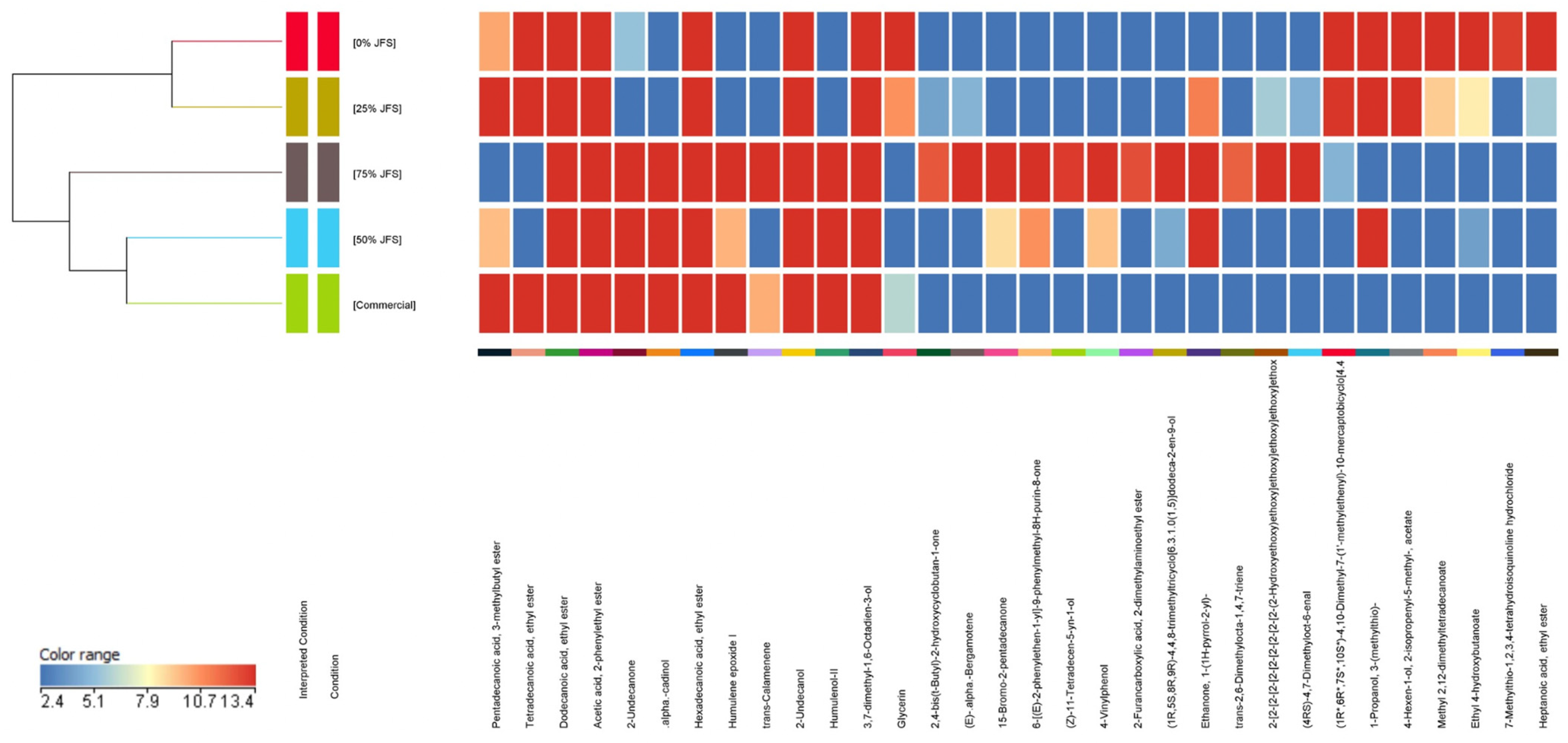
Hierarchical cluster analysis (HCA) combined with the heatmap provided a detailed visualization of the abundance patterns of the 32 selected volatile compounds across the different beer formulations (Figure 3). Among the identified compounds, 3,7-dimethyl-1,6-octadien-3-ol, acetic acid, 2-phenylethyl ester, dodecanoic acid, ethyl ester, and hexadecanoic acid, ethyl ester exhibited the highest relative abundances. The predominance of these compounds is likely attributable to their important roles as major fermentation- and hop-derived aroma constituents in beer. Esters such as acetic acid, 2-phenylethyl ester and dodecanoic acid, ethyl ester are synthesized by brewing yeast through alcohol acetyltransferase-mediated reactions between higher alcohols and acyl-CoA molecules, whereas long-chain fatty acid ethyl esters, including hexadecanoic acid, ethyl ester, are common products of yeast lipid metabolism during fermentation [2]. Likewise, 3,7-dimethyl-1,6-octadien-3-ol is a terpene-related alcohol associated with hop-derived floral and citrus aroma characteristics. The relatively high abundances of these compounds therefore likely reflect the combined contributions of hop-derived precursors and normal yeast fermentation metabolism [76]. Furthermore, substitution of malt with JFS, which exhibited higher protein, TPC, and antioxidant activity than malt (Table 1), may have altered the nutritional composition of the wort. Changes in wort composition can influence yeast metabolism and the formation of aroma-active volatile compounds by modifying the availability of nutrients required for yeast growth and fermentation [77].
Compounds including ethanone, 1-(1H-pyrrol-2-yl)-, 15-bromo-2-pentadecanone, 4-vinylphenol, and 6-[(E)-2-phenylethen-1-yl]-9-phenylmethyl-8H-purin-8-one exhibited relatively higher abundances in beers containing higher levels of JFS substitution, suggesting that replacement of malt with JFS modified the formation or occurrence of specific volatile compounds. The increased relative abundances of these compounds may be associated with changes in wort composition resulting from malt replacement. Because JFS contains higher levels of protein and phenolic compounds than malt, its incorporation may have altered the availability of nitrogenous compounds, phenolic precursors, and other metabolites required for yeast metabolism and secondary metabolite biosynthesis [78]. In addition, the higher antioxidant capacity of JFS could influence oxidative reactions occurring during brewing and fermentation, thereby affecting the stability, transformation, and retention of certain volatile compounds.
Alcohols represented one of the major groups of volatile compounds detected in the beers (Table 4). Among them, 3,7-dimethyl-1,6-octadien-3-ol increased significantly with increasing JFS substitution. This hop-derived terpene alcohol is associated with floral and citrus aroma characteristics [79]. The higher abundance observed in beers containing greater proportions of JFS is likely related to the changes in wort composition and fermentation behaviors resulting from malt replacement, as discussed in Table 3. Among the remaining alcohols, 2-undecanol showed a moderate increase with increasing JFS substitution, whereas α-cadinol and humulenol-II were detected only in beers containing 50% and 75% JFS. Both compounds are hop-derived sesquiterpene alcohols associated with woody and herbal aroma characteristics [80].
Esters represented another major class of volatile compounds detected in the beers (Table 4). Among the identified esters, acetic acid, 2-phenylethyl ester and dodecanoic acid, ethyl ester exhibited significant decreases in relative abundance with increasing JFS substitution, whereas hexadecanoic acid, ethyl ester showed only a slight decrease. These esters are important contributors to the floral, fruity, and sweet aroma characteristics of beer and are primarily produced by yeast during fermentation. The reduction in ester abundance observed with increasing JFS substitution may be attributed to changes in yeast metabolic activity resulting from partial malt replacement. As discussed in Table 3, JFS substitution reduced fermentable sugar availability and alcohol production, which could have decreased the availability of metabolic intermediates required for ester synthesis [81]. Furthermore, the altered nutrient composition of JFS-containing wort may have affected yeast metabolism, thereby influencing the production of fermentation-derived esters.
Ketones contribute to the complexity of beer aroma through buttery, caramel-like, roasted, and nutty sensory notes, depending on their chemical structure. Among the identified ketones, ethanone, 1-(1H-pyrrol-2-yl)-exhibited a significant increase in relative abundance with increasing JFS substitution (Table 4). This compound is a nitrogen-containing heterocyclic ketone belonging to the pyrrole family, a class of aroma compounds primarily formed through Maillard reactions during thermal processing [82]. Therefore, the higher abundance of this compound observed with increasing levels of JFS substitution is likely attributable to the enhanced formation of Maillard reaction products.

4. Conclusions

This study demonstrated that jackfruit seed can be successfully used as a partial substitute for pale ale malt in beer production, providing a sustainable approach to valorizing an underutilized agricultural by-product. JFS exhibited higher protein, total phenolic content, and antioxidant activity than pale ale malt, contributing to the functional properties of the resulting beer. Although increasing JFS substitution reduced the production of fermentable sugars during mashing and consequently decreased alcohol content, satisfactory fermentation was achieved using S. cerevisiae Lutra kveik yeast. The incorporation of JFS also enhanced foam stability and produced beers with distinct physicochemical characteristics, including increased turbidity, which is consistent with the sensory attributes of contemporary hazy beer styles. Furthermore, HS-SPME-GC-MS demonstrated that partial replacement of malt with JFS altered the volatile composition of the beers by modifying the relative abundance of key aroma-active compounds. These findings suggest that changes in wort composition associated with JFS substitution influenced yeast metabolism and the production of fermentation-derived volatiles. Overall, JFS shows considerable potential as an alternative brewing adjunct for developing functional and sustainable craft beers. Future studies should optimize starch hydrolysis during mashing through the application of complementary amylolytic enzymes to improve fermentable sugar production, fermentation efficiency, and alcohol yield.

Author Contributions

Conceptualization, N.K.; methodology, N.K., N.M.P., W.J., S.T. and D.Q.N.; formal analysis, N.M.P., W.J., S.T. and D.Q.N.; investigation, N.M.P., W.J., S.T., D.Q.N. and S.N.; resources, N.K.; writing—original draft preparation, N.M.P., W.J. and S.T.; writing—review and editing, S.N., N.K.; visualization, N.M.P., W.J., S.T. and D.Q.N.; supervision, N.K.; project administration, N.M.P. and W.J.; funding acquisition, N.K. All authors have read and agreed to the published version of the manuscript.

Funding

This research was funded by Mae Fah Luang University through the final-year project research fund.

Institutional Review Board Statement

Not applicable.

Informed Consent Statement

Not applicable.

Data Availability Statement

The original contributions presented in this study are included in the article. Further inquiries can be directed to the corresponding author.

Conflicts of Interest

The authors declare no conflicts of interest.

Abbreviations

The following abbreviations are used in this manuscript:
JFSJackfruit seed
HPLCHigh-performance liquid chromatography
GC-MSGas chromatography-Mass spectrometry
AOACAssociation of Official Analytical Chemists
TPCTotal phenolic content
SPESolid-phase extraction
SRMStandard reference method
NTUNephelometric turbidity units
TSSTotal soluble solid
PTFEPolytetrafluoroethylene
IPAIndian pale ale

References

  1. Gómez-García, R.; Campos, D.A.; Aguilar, C.N.; Madureira, A.R.; Pintado, M. Valorisation of food agro-industrial by-products: From the past to the present and perspectives. J. Environ. Manag. 2021, 299, 113571. [Google Scholar] [CrossRef] [Scilit] [PubMed]
  2. Olaniran, A.O.; Hiralal, L.; Mokoena, M.P.; Pillay, B. Flavour-active volatile compounds in beer: Production, regulation and control. J. Inst. Brew. 2017, 123, 13–23. [Google Scholar] [CrossRef] [Scilit]
  3. Herkenhoff, M.E.; Brödel, O.; Frohme, M. Aroma component analysis by HS-SPME/GC–MS to characterize Lager, Ale, and sour beer styles. Food Res. Int. 2024, 194, 114763. [Google Scholar] [CrossRef] [Scilit] [PubMed]
  4. Rošul, M.Đ.; Mandić, A.I.; Mišan, A.Č.; Đerić, N.R.; Pejin, J.D. Review of trends in formulation of functional beer. Food Feed. Res. 2019, 46, 23–35. [Google Scholar] [CrossRef] [Scilit]
  5. Bogdan, P.; Kordialik-Bogacka, E. Alternatives to malt in brewing. Trends Food Sci. Technol. 2017, 65, 1–9. [Google Scholar] [CrossRef] [Scilit]
  6. Ledley, A.J.; Elias, R.J.; Cockburn, D.W. The role of starch digestion in the brewing of gluten-free beers. Food Biosci. 2024, 61, 104949. [Google Scholar] [CrossRef] [Scilit]
  7. Suzihaque, M.U.H.; Zaki, N.A.M.; Alwi, H.; Ibrahim, U.K.; Abd Karim, S.F.; Anuar, N.K. Jackfruit seed as an alternative replacement for starch flour. Mater. Today Proc. 2022, 63, S451–S455. [Google Scholar] [CrossRef] [Scilit]
  8. Brahma, R.; Ray, S. Finding out various potentials and possibilities of jackfruit seed and its usage in the industry: A review. Food Prod. Process. Nutr. 2023, 5, 55. [Google Scholar] [CrossRef] [Scilit]
  9. Waghmare, R.; Memon, N.; Gat, Y.; Gandhi, S.; Kumar, V.; Panghal, A. Jackfruit seed: An accompaniment to functional foods. Braz. J. Food Technol. 2019, 22, e2018207. [Google Scholar] [CrossRef] [Scilit]
  10. Butool, S.; Butool, M. Nutritional Quality on Value Addition to Jack Fruit Seed Flour. Int. J. Sci. Res. (IJSR) 2013, 4, 2406–2411. [Google Scholar]
  11. Hossain, M.T.; Sarker, M.; Shuvo, A.N.; Alam, M.M.; Rahman, M.S. Development and Quality Evaluation of Bread Supplemented with Jackfruit Seed Flour. Int. J. Nutr. Food Sci. 2014, 3, 484. [Google Scholar] [CrossRef] [Scilit]
  12. Akter, B.; Haque, M.; Ahiduzzaman, M.; Haque, M.; Ali, M. Formulation of Jackfruit Seed Protein Enriched Cake. Ann. Bangladesh Agric. 2021, 24, 17–39. [Google Scholar] [CrossRef] [Scilit]
  13. Minh, N.P. Evaluating the use of jackfruit (Artocarpus heterophyllus) seeds for ethanol fermentation. Res. Crops 2022, 23, 628–633. [Google Scholar] [CrossRef] [Scilit]
  14. Ochaikul, D.; Noiprasert, N.; Laoprasert, W.; Pookpon, S. Ethanol production on jackfruit seeds by selected fungi and yeast from Loog-pang. Curr. Appl. Sci. Technol. 2012, 12, 1–6. [Google Scholar]
  15. Chongkhong, S.; Lolharat, B.; Chetpattananondh, P. Optimization of Ethanol Production from Fresh Jackfruit Seeds Using Response Surface Methodology. J. Sustain. Energy Environ. 2012, 3, 97–101. [Google Scholar] [CrossRef]
  16. Fahmi, I.; Astuti, W.; Saibun, S. Isolation Amylase from Sprouts Seed of Jackfruit (Artocarpus heterophyllus Lam). J. At. 2017, 2, 140–142. [Google Scholar]
  17. Fathima, S.; Navaneetha, R. Development and Evaluation of Nutri Choco Bites Enriched with Jackfruit Seed Flour. Int. J. Health Sci. Res. 2023, 13, 146–152. [Google Scholar] [CrossRef] [Scilit]
  18. Nelluri, P.; Venkatesh, T.; Kothakota, A.; Pandiselvam, R.; Garg, R.; Khaneghah, A.M. Artocarpus heterophyllus Lam (jackfruit) processing equipment: Research insights and perspectives. J. Food Process. Eng. 2022, 45, e13920. [Google Scholar] [CrossRef] [Scilit]
  19. Choy, S.Y.; Prasad, K.M.N.; Wu, T.Y.; Raghunandan, M.E.; Yang, B.; Phang, S.-M.; Ramanan, R.N. Isolation, characterization and the potential use of starch from jackfruit seed wastes as a coagulant aid for treatment of turbid water. Environ. Sci. Pollut. Res. 2017, 24, 2876–2889. [Google Scholar] [CrossRef] [Scilit] [PubMed]
  20. Madruga, M.S.; de Albuquerque, F.S.M.; Silva, I.R.A.; Amaral, D.S.D.; Magnani, M.; Neto, V.Q. Chemical, morphological and functional properties of Brazilian jackfruit (Artocarpus heterophyllus L.) seeds starch. Food Chem. 2014, 143, 440–445. [Google Scholar] [CrossRef] [Scilit] [PubMed]
  21. Ahn, J.Y.; Kil, D.Y.; Kong, C.; Kim, B.G. Comparison of oven-drying methods for determination of moisture content in feed ingredients. Asian-Australas. J. Anim. Sci. 2014, 27, 1615–1622. [Google Scholar] [CrossRef] [Scilit] [PubMed]
  22. Thiex, N. Evaluation of analytical methods for the determination of moisture, crude protein, crude fat, and crude fiber in distillers dried grains with solubles. J. AOAC Int. 2009, 92, 61–73. [Google Scholar] [CrossRef] [Scilit]
  23. Albarbary, N.; Karmi, M.; Maky, M. Proximate Composition Analysis of Beef Sausage (Correction Manuscript 2). Aswan Univ. J. Environ. Stud. 2021, 2, 155–161. [Google Scholar] [CrossRef] [Scilit]
  24. Latimer, G.W., Jr. (Ed.) Official Methods of Analysis of AOAC INTERNATIONAL; Oxford University Press: Oxford, UK, 2023. [Google Scholar] [CrossRef] [Scilit]
  25. Xu, G.H.; Chen, J.C.; Liu, D.H.; Zhang, Y.H.; Jiang, P.; Ye, X.Q. Minerals, phenolic compounds, and antioxidant capacity of citrus peel extract by hot water. J. Food Sci. 2008, 73, C11–C18. [Google Scholar] [CrossRef] [Scilit] [PubMed]
  26. Lim, Y.Y.; Lim, T.T.; Tee, J.J. Antioxidant properties of several tropical fruits: A comparative study. Food Chem. 2007, 103, 1003–1008. [Google Scholar] [CrossRef] [Scilit]
  27. Phuong, N.N.M.; Le, T.T.; Dang, M.Q.; van Camp, J.; Raes, K. Selection of extraction conditions of phenolic compounds from rambutan (Nephelium lappaceum L.) peel. Food Bioprod. Process. 2020, 122, 222–229. [Google Scholar] [CrossRef] [Scilit]
  28. Beltagy, E.A.; Abouelwafa, A.; Barakat, K.M. Bioethanol production from immobilized amylase produced by marine Aspergillus flavus AUMC10636. Egypt. J. Aquat. Res. 2022, 48, 325–331. [Google Scholar] [CrossRef] [Scilit]
  29. Ditrych, M.; Mertens, T.; Filipowska, W.; Soszka, A.; Jaskula-Goiris, B.; de Rouck, G.; de Cooman, L.; Aerts, G.; Andersen, M.L. Effect of Mashing-in pH on the Biochemical Composition and Staling Properties of the Sweet Wort. J. Am. Soc. Brew. Chem. 2024, 82, 238–251. [Google Scholar] [CrossRef] [Scilit]
  30. Muntean, E.; Bărăscu, N. Soluble Carbohydrates in Several Transylvanian Potato Cultivars. Plants 2023, 12, 70. [Google Scholar] [CrossRef] [Scilit] [PubMed]
  31. de Keukeleire, D. Fundamentals of beer and hop chemistry. Quim. Nova 2000, 23, 108–112. [Google Scholar] [CrossRef] [Scilit]
  32. Hrnčič, M.K.; Španinger, E.; Košir, I.J.; Knez, Ž.; Bren, U. Hop compounds: Extraction techniques, chemical analyses, antioxidative, antimicrobial, and anticarcinogenic effects. Nutrients 2019, 11, 257. [Google Scholar] [CrossRef] [Scilit] [PubMed]
  33. Jaskula, B.; Kafarski, P.; Aerts, G.; de Cooman, L. A kinetic study on the isomerization of hop α-acids. J. Agric. Food Chem. 2008, 56, 6408–6415. [Google Scholar] [CrossRef] [Scilit] [PubMed]
  34. Korpelainen, H.; Pietiläinen, M. Hop (Humulus lupulus L.): Traditional and Present Use, and Future Potential. Econ. Bot. 2021, 75, 302–322. [Google Scholar] [CrossRef] [Scilit]
  35. Rettberg, N.; Biendl, M.; Garbe, L.-A. Hop aroma and hoppy beer flavor: Chemical backgrounds and analytical tools—A review. J. Am. Soc. Brew. Chem. 2018, 76, 1–20. [Google Scholar] [CrossRef] [Scilit]
  36. Böhm, W.; Stegmann, R.; Gulbis, O.; Henle, T. Amino acids and glycation compounds in hot trub formed during wort boiling. Eur. Food Res. Technol. 2022, 249, 119–131. [Google Scholar] [CrossRef] [Scilit]
  37. Haseleu, G.; Intelmann, D.; Hofmann, T. Structure determination and sensory evaluation of novel bitter compounds formed from β-acids of hop (Humulus lupulus L.) upon wort boiling. Food Chem. 2009, 116, 71–81. [Google Scholar] [CrossRef] [Scilit]
  38. Kappler, S.; Krahl, M.; Geissinger, C.; Becker, T.; Krottenthaler, M. Degradation of iso-α-acids during wort boiling. J. Inst. Brew. 2010, 116, 332–338. [Google Scholar] [CrossRef] [Scilit]
  39. Starowicz, M.; Granvogl, M. Effect of Wort Boiling on Volatiles Formation and Sensory Properties of Mead. Molecules 2022, 27, 710. [Google Scholar] [CrossRef] [Scilit] [PubMed]
  40. Tracey, R.; Simpson, E. Effect of Rehydration Temperature of Active Dried Yeast on Wine Production and quality. S. Afr. J. Enol. Vitic. 2017, 7, 66–70. [Google Scholar] [CrossRef] [Scilit]
  41. Barazani, B.; Piercey, M.; Paulson, A.; Warnat, S.; Hubbard, T.; MacIntosh, A.J. Rehydration of active dried yeast: Impact on strength and stiffness of yeast cells measured using microelectromechanical systems. J. Inst. Brew. 2018, 125, 53–59. [Google Scholar] [CrossRef] [Scilit]
  42. Walker, G.M.; Stewart, G.G. Saccharomyces cerevisiae in the production of fermented beverages. Beverages 2016, 2, 30. [Google Scholar] [CrossRef] [Scilit]
  43. Briggs, D.E.; Boulton, C.A.; Brookes, P.A.; Stevens, R. Brewing: Science and Practice; Elsevier: Amsterdam, The Netherlands, 2004. [Google Scholar] [CrossRef] [Scilit]
  44. Kunze, W. Technology Brewing and Malting; VLB Berlin: Berlin, Germany, 2004. [Google Scholar]
  45. Stewart, G.G. Yeast flocculation—Sedimentation and flotation. Fermentation 2018, 4, 28. [Google Scholar] [CrossRef] [Scilit]
  46. Lorencová, E.; Salek, R.N.; Černošková, I.; Buňka, F. Evaluation of force-carbonated Czech-type lager beer quality during storage in relation to the applied type of packaging. Food Control 2019, 106, 106706. [Google Scholar] [CrossRef] [Scilit]
  47. Cocuzza, S.; Peifer, F.; Steiner, S.H.; Zarnkow, M.; Jacob, F.; Stallforth, A. The impact of dry hopping on selected physical and chemical attributes of beer. BrewingScience 2019, 72, 118–124. [Google Scholar] [CrossRef] [Scilit]
  48. Thongon, R.; Netramai, S.; Kijchavengkul, T.; Yaijam, G.; Debhakam, R. Mathematical modeling and optimization of pasteurization for the internal pressure and physical quality of canned beer. Heliyon 2023, 9, e21493. [Google Scholar] [CrossRef] [Scilit] [PubMed]
  49. Habschied, K.; Krstanović, V.; Mastanjević, K. Beer Quality Evaluation—A Sensory Aspect. Beverages 2022, 8, 15. [Google Scholar] [CrossRef] [Scilit]
  50. Constant, M. A Practical Method for Characterizing Poured Beer Foam Quality. J. Am. Soc. Brew. Chem. 1992, 50, 37–47. [Google Scholar] [CrossRef] [Scilit]
  51. Tiwari, A.; Singh, N.; Singh, A. Physico-Chemical Analysis of Developed Rice Beer from Oryza sativa. Asian Food Sci. J. 2023, 22, 28–34. [Google Scholar] [CrossRef] [Scilit]
  52. Gonzalez Viejo, C.; Fuentes, S.; Torrico, D.D.; Godbole, A.; Dunshea, F.R. Chemical characterization of aromas in beer and their effect on consumers liking. Food Chem. 2019, 293, 479–485. [Google Scholar] [CrossRef] [Scilit] [PubMed]
  53. Dey, K.C.; Begum, R.; Islam, M.S.; Khatun, M.; Chandra Dey, K. A Study on Nutritional and Functional Properties Analysis of Jackfruit Seed Flour and Value Addition to Biscuits. Int. J. Eng. Res. Technol. 2015, 4, 139–147. [Google Scholar]
  54. Fox, G.P. Chemical composition in barley grains and malt quality. In Advanced Topics in Science and Technology in China; Springer: Berlin/Heidelberg, Germany, 2010. [Google Scholar] [CrossRef] [Scilit]
  55. Sy Mohamad, S.F.; Mohd, S.F.; Abdul Munaim, M.S.; Mohamad, S.; Wan Sulaiman, W.M.A. Proximate composition, minerals contents, functional properties of Mastura variety jackfruit (Artocarpus heterophyllus) seeds and lethal effects of its crude extract on zebrafish (Danio rerio) embryos. Food Res. 2019, 3, 546–555. [Google Scholar] [CrossRef] [Scilit] [PubMed]
  56. Chavez-Santiago, J.O.; Rodríguez-Castillejos, G.C.; Montenegro, G.; Bridi, R.; Valdés-Gómez, H.; Alvarado-Reyna, S.; Cas-tillo-Ruiz, O.; Santiago-Adame, R. Phenolic content, antioxidant and antifungal activity of jackfruit extracts (Artocarpus heterophyllus Lam.). Food Sci. Technol. 2022, 42, e02221. [Google Scholar] [CrossRef] [Scilit]
  57. Coghe, S.; D’Hollander, H.; Verachtert, H.; Delvaux, F.R. Impact of dark specialty malts on extract composition and wort fermentation. J. Inst. Brew. 2005, 111, 51–60. [Google Scholar] [CrossRef] [Scilit]
  58. Echavarría, A.P.; Pagán, J.; Ibarz, A. Melanoidins Formed by Maillard Reaction in Food and Their Biological Activity. Food Eng. Rev. 2012, 4, 203–223. [Google Scholar] [CrossRef] [Scilit]
  59. Liguori, L.; de Francesco, G.; Orilio, P.; Perretti, G.; Albanese, D. Influence of malt composition on the quality of a top fermented beer. J. Food Sci. Technol. 2021, 58, 2295–2303. [Google Scholar] [CrossRef] [Scilit] [PubMed]
  60. Kahle, E.-M.; Zarnkow, M.; Jacob, F. Beer Turbidity Part 1: A Review of Factors and Solutions. J. Am. Soc. Brew. Chem. 2021, 79, 99–114. [Google Scholar] [CrossRef] [Scilit]
  61. Speers, R.A.; Jin, Y.-L.; Paulson, A.T.; Stewart, R.J. Effects of β-Glucan, Shearing and Environmental Factors on the Turbidity of Wort and Beer. J. Inst. Brew. 2003, 109, 236–244. [Google Scholar] [CrossRef] [Scilit]
  62. Bamforth, C.W. The relative significance of physics and chemistry for beer foam excellence: Theory and practice. J. Inst. Brew. 2004, 110, 259–266. [Google Scholar] [CrossRef] [Scilit]
  63. Haque, M.A.; Akter, F.; Rahman, H.; Baqui, M.A. Jackfruit Seeds Protein Isolate by Spray Drying Method: The Functional and Physicochemical Characteristics. Food Nutr. Sci. 2020, 11, 355–374. [Google Scholar] [CrossRef]
  64. Evans, E. Brewing: Science and practice. DE Briggs, CA Boulton, PA Brookes and R Stevens Woodhead Publishing, Cambridge UK/CRC Press, Boca Raton, Florida, USA, 2004. 881 pp ISBN 0-8493-2547-1. J. Sci. Food Agric. 2006, 86, 169. [Google Scholar] [CrossRef] [Scilit]
  65. Kushwaha, R.; Fatima, N.T.; Singh, M.; Singh, V.; Kaur, S.; Puranik, V.; Kumar, R.; Kaur, D. Effect of cultivar and maturity on functional properties, low molecular weight carbohydrate, and antioxidant activity of Jackfruit seed flour. J. Food Process. Preserv. 2021, 45, e15146. [Google Scholar] [CrossRef] [Scilit]
  66. Cadenas, R.; Caballero, I.; Nimubona, D.; Blanco, C.A. Brewing with starchy adjuncts: Its influence on the sensory and nutritional properties of beer. Foods 2021, 10, 1726. [Google Scholar] [CrossRef] [Scilit] [PubMed]
  67. Fumi, M.D.; Galli, R.; Lambri, M.; Donadini, G.; de Faveri, D.M. Effect of full-scale brewing process on polyphenols in Italian all-malt and maize adjunct lager beers. J. Food Compos. Anal. 2011, 24, 568–573. [Google Scholar] [CrossRef] [Scilit]
  68. Evans, D.E.; Collins, H.; Eglinton, J.; Wilhelmson, A. Assessing the impact of the level of diastatic power enzymes and their thermostability on the hydrolysis of starch during wort production to predict malt fermentability. J. Am. Soc. Brew. Chem. 2005, 63, 185–198. [Google Scholar] [CrossRef] [Scilit]
  69. Devolli, A.; Dara, F.; Stafasani, M.; Shahinasi, E.; Kodra, M. The Influence of Protein Content on Beer Quality and Colloidal Stability. Int. J. Innov. Approaches Agric. Res. 2018, 2, 391–407. [Google Scholar] [CrossRef] [Scilit]
  70. De Francesco, G.; Sileoni, V.; Marconi, O. Influence of Selected Technological Conditions on the Flavour Stability of Unpasteurised Top-Fermented Craft Beer. Food Bioprocess Technol. 2025, 18, 6406–6421. [Google Scholar] [CrossRef] [Scilit]
  71. Holzmann, A.; Piendl, A. Malt Modification and Mashing Conditions as Factors Influencing the Minerals of Wort. J. Am. Soc. Brew. Chem. 1977, 35, 1–8. [Google Scholar] [CrossRef]
  72. Piazzon, A.; Forte, M.; Nardini, M. Characterization of phenolics content and antioxidant activity of different beer types. J. Agric. Food Chem. 2010, 58, 10677–10683. [Google Scholar] [CrossRef] [Scilit] [PubMed]
  73. Zhao, H.; Chen, W.; Lu, J.; Zhao, M. Phenolic profiles and antioxidant activities of commercial beers. Food Chem. 2010, 119, 1150–1158. [Google Scholar] [CrossRef] [Scilit]
  74. Habschied, K.; Košir, I.J.; Krstanović, V.; Kumrić, G.; Mastanjević, K. Beer polyphenols—Bitterness, astringency, and off-flavors. Beverages 2021, 7, 38. [Google Scholar] [CrossRef] [Scilit]
  75. Çobo, M.; Charles-Vegdahl, A.; Kirkpatrick, K.; Worobo, R. Survival of Foodborne Pathogens in Low and Nonalcoholic Craft Beer. J. Food Prot. 2023, 86, 100183. [Google Scholar] [CrossRef] [Scilit] [PubMed]
  76. van Opstaele, F.; de Rouck, G.; Janssens, P.; Montandon, G.G. An exploratory study on the impact of the yeast strain on hop flavour expressions in heavily hopped beers: New England IPA. BrewingScience 2020, 73, 26–40. [Google Scholar] [CrossRef] [Scilit]
  77. Pires, E.J.; Teixeira, J.A.; Brányik, T.; Vicente, A.A. Yeast: The soul of beer’s aroma—A review of flavour-active esters and higher alcohols produced by the brewing yeast. Appl. Microbiol. Biotechnol. 2014, 98, 1937–1949. [Google Scholar] [CrossRef] [Scilit] [PubMed]
  78. McCabe, A.K.; Keyes, J.K.; Hemetsberger, H.; Kurr, C.V.; Albright, B.; Ward, M.G.; McKinley, M.L.; Breezley, S.J.; Cole, C.A. Aroma Profile Development in Beer Fermented with Azacca, Idaho-7, and Sultana Hops. Molecules 2023, 28, 5802. [Google Scholar] [CrossRef] [Scilit] [PubMed]
  79. Svedlund, N.; Evering, S.; Gibson, B.; Krogerus, K. Fruits of their labour: Biotransformation reactions of yeasts during brewery fermentation. Appl. Microbiol. Biotechnol. 2022, 106, 4929–4944. [Google Scholar] [CrossRef] [Scilit] [PubMed]
  80. Peacock, V.E.; Deinzer, M.L.; McGill, L.A.; Wrolstad, R.E. Hop Aroma in American Beer. J. Agric. Food Chem. 1980, 28, 774–777. [Google Scholar] [CrossRef] [Scilit]
  81. Ferreira, I.M.; Guido, L.F. Impact of wort amino acids on beer flavour: A review. Fermentation 2018, 4, 23. [Google Scholar] [CrossRef] [Scilit]
  82. Yaylayan, V.A. Recent advances in the chemistry of strecker degradation and amadori rearrangement: Implications to aroma and color formation. Food Sci. Technol. Res. 2003, 9, 1–6. [Google Scholar] [CrossRef] [Scilit]
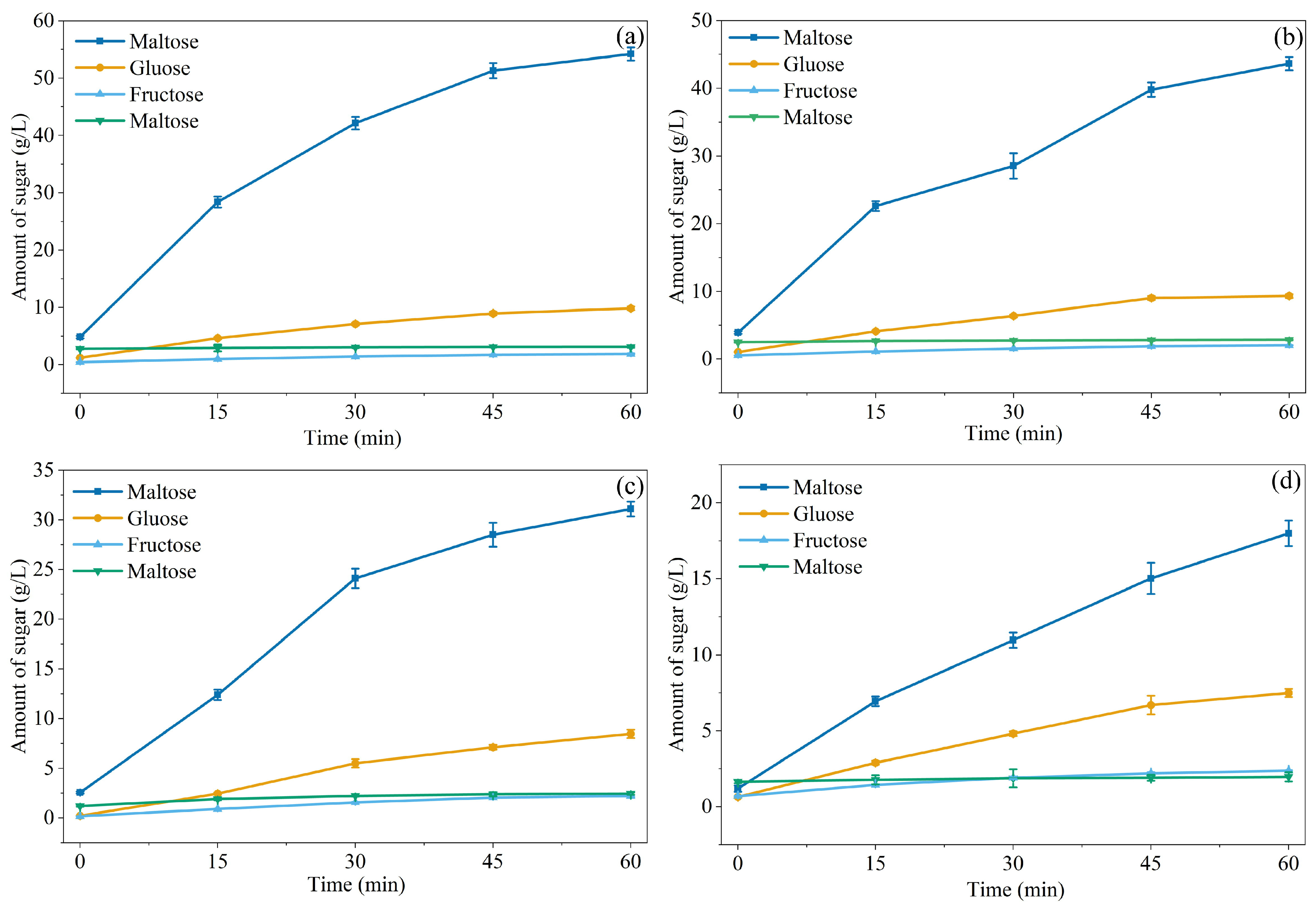
Figure 1. Sugar profile kinetics (maltose, glucose, fructose, and sucrose) quantified by HPLC-RI during a 60-min mashing process at different JFS substitution levels: (a) 0% JFS control, (b) 25% JFS, (c) 50% JFS, and (d) 75% JFS. Values represent mean ± standard deviation (n = 3).
Fermentation 12 00368 g001
Figure 2. Principal component analysis (PCA) score plot of the volatile profiles of beers brewed with different levels of jackfruit seed flour (JFS) substitution based on the 32 selected volatile compounds (VIP > 1).
Fermentation 12 00368 g002
Figure 3. Heatmap with hierarchical cluster analysis (HCA) of the 32 selected volatile compounds in beers with different levels of jackfruit seed flour substitution.
Fermentation 12 00368 g003
Table 1. Chemical compositions of raw materials.
ParametersMaltJackfruit Seed
Moisture Content (%)5.63 ± 0.06 b12.68 ± 0.12 a
Crude Protein (dwb) (%)9.99 ± 1.26 b13.22 ± 0.11 a
Crude Fat (dwb) (%)0.89 ± 0.08 a0.81 ± 0.07 a
Total Phenolic Content (mg/100 g DM)316.54 ± 8.70 b476.66 ± 7.47 a
Antioxidant Activity (mg/100 g DM)73.46 ± 0.06 b77.65 ± 0.06 a
Values are expressed as mean ± standard deviation (n = 3). Values in the same row with different superscript letters are significantly different (p < 0.05). dwb = dry weight basis, DM = dry matter.
Table 2. The physical properties of commercial and JFS-substituted beer.
SampleColor (°SRM)Turbidity (NTU)Foamability (%)Foam Stability (s)
Commercial9.36 ± 0.04 e111.67 ± 0.58 e110.56 ± 2.55 b92.9 ± 14.14 b
0% JFS17.49 ± 0.27 d339.33 ± 5.13 d82.78 ± 3.47 d59.01 ± 1.29 d
25% JFS28.71 ± 0.20 c390.67 ± 3.51 c100.56 ± 2.55 c68.63 ± 1.60 c
50% JFS31.48 ± 0.22 b415.33 ± 2.89 b111.11 ± 4.19 b93.85 ± 3.31 b
75% JFS39.67 ± 0.01 a680.00 ± 3.61 a142.22 ± 3.47 a112.84 ± 2.34 a
Values are expressed as mean ± standard deviation (n = 3). Values in the same column with different superscript letters are significantly different (p < 0.05). Commercial = the commercial IPA beer, °SRM = degree SRM (Standard Reference Method), NTU = Nephelometric Turbidity Unit, s = second.
Table 3. The chemical properties of commercial and JFS-substituted beer.
SampleAlcohol
(%ABV)
pHTPC
(mg GAE/L)
DPPH (mg AAE/L)
Commercial5.47 ± 0.06 a4.79 ± 0.01 e580.64 ± 5.70 e807.02 ± 2.19 e
0% JFS4.83 ± 0.15 b4.93 ± 0.01 d755.07 ± 2.74 d803.86 ± 1.22 d
25% JFS4.70 ± 0.20 b5.33 ± 0.06 c940.46 ± 4.19 c812.28 ± 0.61 c
50% JFS3.97 ± 0.06 c5.53 ± 0.02 b979.73 ± 5.48 b818.95 ± 1.05 b
75% JFS3.13 ± 0.12 d5.74 ± 0.01 a1050.96 ± 4.75 a837.19 ± 0.61 a
Values are expressed as mean ± standard deviation (n = 3). Values in the same column with different superscript letters are significantly different (p < 0.05). %ABV = percentage alcohol by volume, GAE = gallic acid equivalent, AAE = ascorbic acid equivalent.
Table 4. The volatile compounds found in different levels of JFS-substituted beer.
Chemical GroupVolatile CompoundRT
(min)
Odor DescriptionPeak Area
Commercial Beer0% JFS25% JFS50% JFS75% JFS
Alcohol2-Undecanol16.78Floral234,255.85 ± 18,025.93 a39,318.49 ± 3380.81 c47,115.96 ± 2519.29 c81,764.64 ± 11,025.45 b78,982.61 ± 6678.05 b
3,7-Dimethyl-1,6-octadien-3-ol12.98Floral, citrus3,526,529 ± 128,916.53 a538,680.75 ± 31,487.70 d624,133.29 ± 19,043.27 d1,151,005.77 ± 122,524.02 c1,589,709.27 ± 112,811.73 b
α-Cadinol25.63Woody175,748.24 ± 37,288.79 an.d.n.d.26,419.96 ± 3420.32 b26,430.01 ± 4250.29 b
Humlenol-II27.69Woody153,191.14 ± 5405.13 bn.d.n.d.55,096.51 ± 4848.87 c202,860.23 ± 45,040.70 a
Glycerin29.01Sweet119,073.20 ± 98,181.13 a126,051.43 ± 24,997.82 a40,038.91 ± 34,746.89 an.d.n.d.
(Z)-11-Tetradecen-5-yn-1-ol24.45Greenn.d.n.d.n.d.n.d.9382.51 ± 2472.58 a
(1R,5S,8R,9R)-4,4,8-trimethyltricyclo[6.3.1.0(1,5)]dodeca-2-en-9-ol25.91Woodyn.d.n.d.n.d.3186.38 ± 5517.23 b18,050.65 ± 5492.24 a
EsterAcetic acid, 2-phenylethyl ester18.86Floral, rose, honey1,145,064.60 ± 35,598.14 a791,235.90 ± 35,372.75 b391,901.01 ± 10,856.51 c225,975.45 ± 42,992.70 d189,060.65 ± 17,821.73 d
Dodecanoic acid, ethyl ester19.30Fruity, sweet, fatty616,996.58 ± 60,540.58 a276,203.70 ± 15,609.21 b186,608.39 ± 17,268.15 c184,730.41 ± 21,389.27 c152,211.20 ± 9470.94 c
Tetradecanoic acid, ethyl ester23.37Fruity, fatty103,879.95 ± 39,487.57 a64,254.89 ± 7095.58 b49,412.92 ± 18,173.06 bn.d.n.d.
Hexadecanoic acid, ethyl ester27.11Fatty, waxy81,679.51 ± 30,362.26 b156,711.26 ± 24,377.09 a130,643.63 ± 5135.19 a48,462.91 ± 7323.37 b46,900.56 ± 9550.85 b
Heptanoic acid, ethyl ester8.22Fruity, pineapple-liken.d.137,110.89 ± 1465.80 a38,442.18 ± 66,582.08 bn.d.n.d.
Pentadecanoic acid, 3-methylbutyl ester19.71Waxy, fatty278,610.79 ± 38,904.55 a23,232.92 ± 20,325.25 b20,241.54 ± 1585.87 b13,237.51 ± 11,927.82 bn.d.
Ethyl 4-hydroxybutanoate18.74Fruityn.d.18,212.12 ± 2893.93 a3858.97 ± 3353.32 b1292.47 ± 2236.89 bn.d.
Methyl 2,12-dimethyltetradecanoate24.66Fatty, waxyn.d.17,494.26 ± 3653.24 a9058.49 ± 7847.52 bn.d.n.d.
4-Hexen-1-ol, 2-isopropenyl-5-metyl-, acetate17.51Herbal, fruityn.d.38,229.98 ± 3416.61 a37,435.98 ± 1943.14 an.d.n.d.
TerpeneHumulene epoxide I22.77Woody, spicy, hop-like150,325.31 ± 65,505.75 an.d.n.d.17,102.90 ± 15,051.06 c100,642.66 ± 32,399.78 b
(E)-α-Bergamotene17.09Citrus, woodyn.d.n.d.6055.33 ± 104.41 bn.d.70,368.25 ± 1039.37 a
trans-Calamenene20.19Herbal, woody19,613.79 ± 17,168.69 bn.d.n.d.n.d.65,184.22 ± 1190.21 a
trans-2,6-Dimethylocta-1,4,7-triene21.79Citrus, terpenen.d.n.d.n.d.n.d.4130.76 ± 493.39 a
Ketone2-Undecanone14.14Fruity, herbal, citrus14,399,582.00 ± 1,044,633.20 a18,542.22 ± 32,114.33 bn.d.57,004.04 ± 4295.29 b166,522.58 ± 8651.25 b
15-Bromo-2-pentadecanone19.34-n.d.n.d.n.d.7839.62 ± 104.41 b13,195.15 ± 9791.02 a
2,4-bis(t-Butyl)-2-hydroxycyclobutan-1-one26.53-n.d.n.d.1645.10 ± 2847.67 bn.d.4971.08 ± 480.89 a
Ethanone, 1-(1H-pyrrol-2-yl)-22.16Roasted, nuttyn.d.n.d.68,408.10 ± 59,337.16 c175,277.42 ± 13,570.33 b 255,021.31 ± 8348.70 a
Phenolic4-Vinylphenol29.68Clove, spicy, smokyn.d.n.d.n.d.11,152.38 ± 9658.00 a12,720.31 ± 8379.77 a
Aldehydes(4RS)-4,7-Dimethyloct-6-enal17.18Citrus, greenn.d.n.d.4642.53 ± 803.94 bn.d.40,588.34 ± 8816.95 a
Sulphur1-Propanol, 3-(methylthio)-16.85Sulfurn.d.274,979.61 ± 21,763.27 a120,087.22 ± 27,062.66 b92,725.88 ± 31,210.85 bn.d.
(1R*,6R*,7S*,10S*)-4,10-Dimethyl-7-(1′-methylethenyl)-10-mercaptobicyclo[4.4.0]dec-4-ene23.25Sulfur, hop-liken.d.78,113.80 ± 62,826.19 a9767.22 ± 393.31 bn.d.6194.15 ± 1072.68 b
7-Methylthio-1,2,3,4-tetrahydroisoquinoline hydrochloride32.29Sulfurn.d.8348.32 ± 113.76 an.d.n.d.n.d.
Nitrogen2-Furancarboxylic acid, 2-dimethylaminoethyl ester17.61Carameln.d.n.d.n.d.n.d.6142.98 ± 130.43 a
6-[(E)-2-phenylethen-1-yl]-9-phenylmethyl-8H-purin-8-one16.46-n.d.n.d.n.d.46,497.19 ± 52,379.70 a44,532.54 ± 17,201.23 a
Polyether2-[2-[2-[2-[2-[2-[2-[2-[2-[2-(2-Hydroxyethoxy)ethoxy]ethoxy]ethoxy]ethoxy]ethoxy]ethoxy]ethoxy]ethoxy]ethoxy]ethanol43.31-n.d.n.d.45,582.33 ± 78,949.19 bn.d.1,640,120.20 ± 1,776,491.58 a
Values are expressed as mean ± standard deviation (n = 3). Values in the same row with different superscript letters are significantly different (p < 0.05). n.d. = not detected.
Disclaimer/Publisher’s Note: The statements, opinions and data contained in all publications are solely those of the individual author(s) and contributor(s) and not of MDPI and/or the editor(s). MDPI and/or the editor(s) disclaim responsibility for any injury to people or property resulting from any ideas, methods, instructions or products referred to in the content.