Review

Emerging Solid-State Fermentation in Functional Foods: Bioactive Compounds, Functionality, Sensory Quality, Microbiota Influence and Industrial Perspectives


GICOM, Research Group on Bioconversion of Organic Residues and Advanced Materials, Department of Chemical, Biological and Environmental Engineering, Escola d’Enginyeria, Universitat Autònoma de Barcelona, 08193 Cerdanyola del Vallès, Barcelona, Spain
*
Author to whom correspondence should be addressed.
Fermentation 2026, 12(6), 266; https://doi.org/10.3390/fermentation12060266
Submission received: 20 April 2026 / Revised: 20 May 2026 / Accepted: 26 May 2026 / Published: 30 May 2026

Abstract

Although solid-state fermentation (SSF) has long been used in food production in various traditional contexts, it is now emerging as a particularly promising strategy for the development of functional food ingredients from plant materials and agro-industrial side streams. This review examines recent advances in the application of SSF to enhance the nutritional, functional, sensory, and technological properties of food matrices. Current evidence indicates that SSF can increase the bioactive potential of plant-based substrates by promoting the release and biotransformation of phenolic compounds, while also improving antioxidant capacity, protein digestibility, and techno-functional performance. In addition, the process may support the formation of food-relevant metabolites, including vitamins, peptides, organic acids, and other secondary compounds, while reducing selected antinutritional, allergenic, and undesirable constituents. These compositional changes are often accompanied by modifications in aroma, volatile profiles, visual attributes, and, more recently, gut microbiota-related effects. Attention is given to the use of fungal-based processes for the valorization of cereals, legumes, fruit by-products, and other underutilized substrates. The review also addresses the growing industrial interest in SSF, especially in relation to mycelium-based foods, alternative proteins, functional ingredients, and feed applications. Despite its clear potential, the broader implementation of SSF will require further research and development to support its effective translation into food applications.

1. Introduction

Solid-state fermentation (SSF) has been part of food production since ancient times. Historical sources indicate that, as early as 2600 B.C., Egyptians were already using forms of SSF in bread making [1], while the production of natural wines such as Chinese yuanjiu dates back nearly 5000 years and relied on spontaneous fermentation under natural conditions, without the initial use of isolated saccharifying agents [2]. These early practices progressively evolved into more organized food technologies, particularly across Asia, where SSF became a central component of traditional food systems. A key example is the “Koji” process, in which fungal starters hydrolyze cereal starch into fermentable sugars, enabling the production of soy sauce, miso, and rice wine [3,4]. Similar principles also shaped the manufacture of Baijiu, sufu, and cereal-based vinegars, all of which illustrate the long-standing use of solid-state microbial processes to improve stability, digestibility, and sensory quality in cereal- and legume-based foods [2,5].
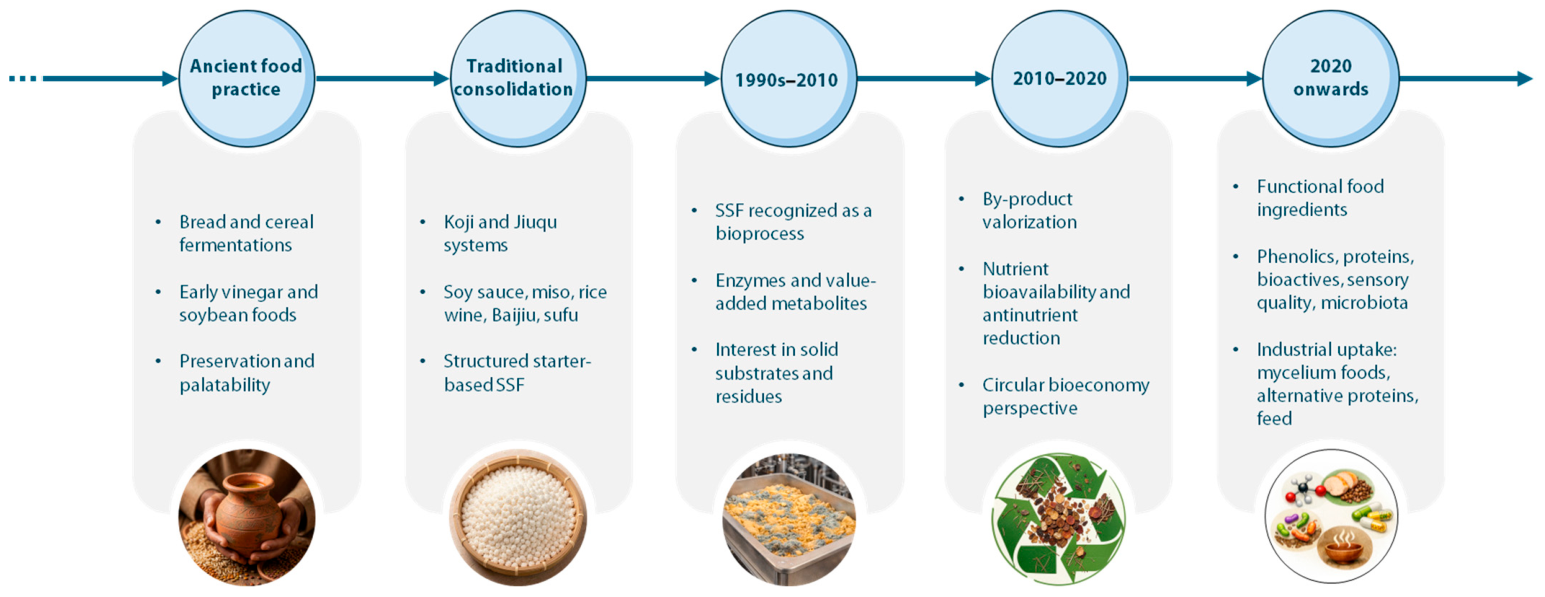
Although SSF is deeply rooted in traditional food processing, its broader recognition as a biotechnological platform has intensified only in recent decades. This renewed interest is closely related to its capacity to operate on moist solid substrates with little or no free water, while supporting efficient microbial growth and bioconversion. In the food field, SSF is now valued for much more than preservation. It is increasingly used to improve nutritional quality, digestibility, functionality, and sensory properties. At the same time, its compatibility with agricultural side streams and other underutilized biomasses has positioned SSF as an attractive tool within circular and sustainability-oriented food systems. Figure 1 illustrates the evolution of SSF in the food sector, from its traditional origins to its current role in the development of functional and sustainable food systems.
More broadly, previous reviews on cereal- and legume-based fermentations have already shown that fermentation can improve nutrient bioavailability, reduce antinutritional factors, and enhance sensory quality, although the magnitude and direction of these changes remain strongly system-dependent [6]. This variability is not surprising, since the outcome depends on the interaction between the substrate, the microorganism, and the processing conditions applied. Even so, the growing demand for clean-label foods, plant-based ingredients, and low-impact production strategies has further strengthened the relevance of SSF in contemporary food research. In this context, the present review examines recent food-related applications of SSF, focusing on emerging processing approaches and on the specific functional changes they induce in food matrices. Rather than considering SSF only as a traditional fermentation practice, the review addresses its current use as a versatile tool to modulate composition, improve functionality, and support the development of more sustainable food systems.

2. Recent Advances in Food-Related Applications of SSF

Recent research has expanded the range of food-related applications of SSF, particularly in connection with the development of ingredients with improved nutritional characteristics. Research on this topic has increased steadily over time, highlighting its growing relevance within the scientific community. A search in the Scopus database using the query TITLE-ABS-KEY (“solid state fermentation” AND “food”) showed that the number of published articles rose from 88 in 2016 to 292 in 2025, corresponding to an increase of approximately 232% over the last decade. For the purposes of this review, only articles published from 2021 onwards and indexed up to March 2026 were considered. This search yielded 1163 records. To identify the most relevant studies for each section of this review, additional topic-specific terms, such as antioxidant and microbiota, were subsequently incorporated. Priority was given to articles addressing broader and more informative aspects of each topic, and the selected studies are discussed below. Importantly, the bibliographic search was designed to capture studies directly related to food applications of SSF. Studies related to animal feed were not the main target of the search and are only mentioned when they provide particularly useful mechanistic, technological, or translational insights, or when their relevance extends to both food and feed systems.
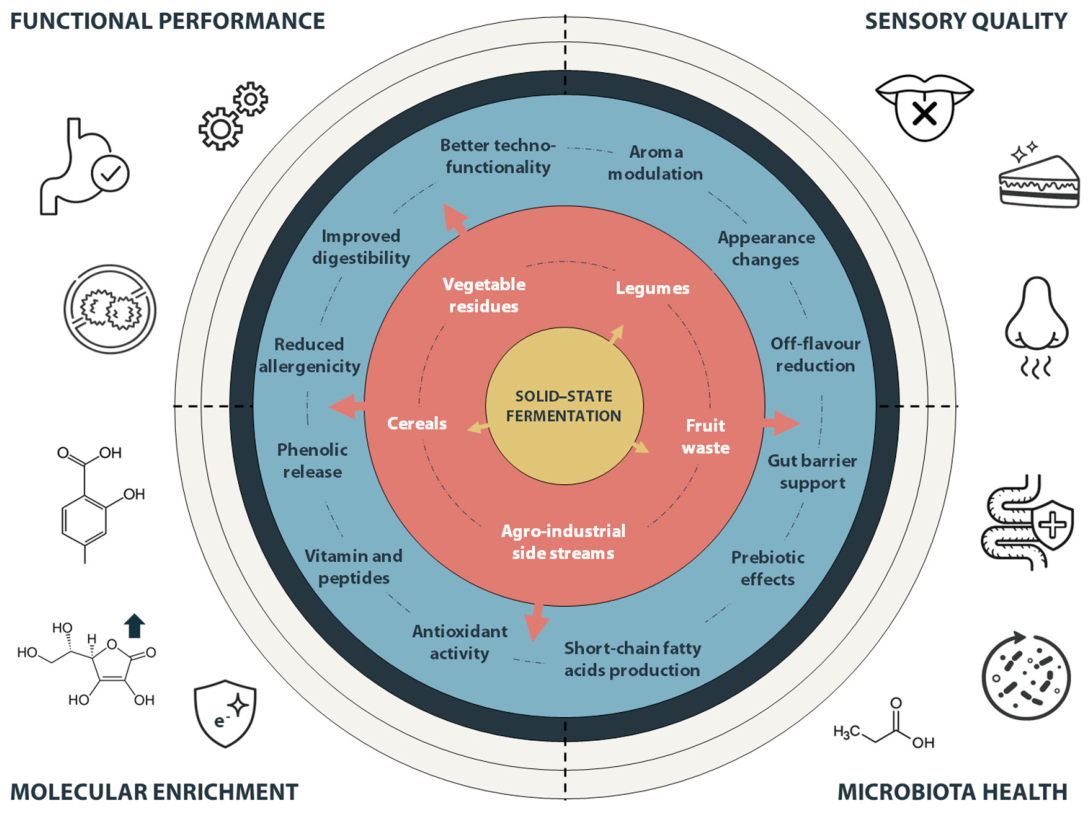
From a general perspective, most of the retrieved food-related studies were centered on cereals, legumes, and by-products from their processing, highlighting these materials as the dominant substrates currently explored for SSF-based functional food development. Among the microorganisms employed, filamentous fungi were the most frequently reported, particularly Aspergillus, Rhizopus, Monascus, Eurotium, and Pleurotus species, although lactic acid bacteria and Bacillus spp. also appeared recurrently depending on the target functionality and substrate type. In technological terms, most studies were conducted at laboratory scale, generally using static tray, flask, bag, or Petri dish-type systems, whereas comparatively fewer reports addressed pilot-scale operation or more controlled reactor configurations. This distribution is relevant for interpreting the literature discussed below, since the type of substrate, the microorganism selected, and the level of process development strongly condition both the functional outcomes observed and the prospects for industrial translation. Figure 2 summarizes the main target food applications associated with SSF of plant-based substrates, together with the principal functional outcomes examined throughout this review.

2.1. Antioxidants and Phenolic Compounds

Among current bioprocessing strategies, solid-state fermentation mediated by filamentous fungi or bacteria has emerged as a particularly effective approach for enhancing the bioactive potential of plant-based matrices. Within recent literature, this effect has been described most often in cereal brans, legumes, and related by-products, which are especially attractive substrates because they combine high phenolic potential with clear opportunities for valorization. The improvement in antioxidant properties is largely attributed to the secretion of a diverse enzymatic system, including cellulases, xylanases, and pectinases, which disrupt cell-wall architecture and promote the release of phenolic compounds that are originally present in bound, conjugated, or otherwise inaccessible forms. The extent of this phenolic enrichment is strongly dependent on the substrate–microorganism combination, as well as on the processing conditions applied. In wheat bran, for instance, SSF with Aspergillus niger, especially when combined with physical pretreatments such as ultrasound and microwave irradiation, markedly accelerated the liberation of phenolic acids. Under these conditions, substantial increases were reported for vanillic acid, while protocatechuic acid reached the highest concentrations after ultrasound-assisted treatment [7]. These changes were associated with the metabolic degradation of ferulic acid, which likely acted as a precursor for downstream phenolic derivatives of greater functional relevance.
A similar trend has been described in quinoa seeds, where fermentation with Rhizopus chinensis, Rhizopus oryzae, and Aspergillus oryzae not only increased total phenolic content but also promoted the formation of 4-hydroxyphenylacetic acid, a metabolite absent from the native matrix and of particular interest due to its reported hepatoprotective and anxiolytic properties [8]. In parallel, the concentration of soluble quercetin derivatives increased significantly and showed a direct correlation with the radical-scavenging capacity of the fermented flour, suggesting that fungal biotransformation may generate phenolic profiles with enhanced antioxidant performance.
In avocado seed, Aspergillus awamori proved more effective than A. oryzae, leading to an increase of more than 12% in total phenolic content after 96 h of fermentation [9]. Over the same period, flavonoid levels increased progressively, whereas condensed tannins decreased, pointing to an enzymatic depolymerization of complex phenolic structures into simpler and potentially more bioaccessible molecules. This pattern is consistent with the concept that SSF does not merely release phenolics from the matrix but can also reshape their chemical profile through targeted bioconversion.
Comparable effects have also been observed in legumes. Green-kernel black soybeans fermented with Eurotium cristatum showed higher polyphenol and flavonoid contents, but the most relevant change from a functional perspective was the conversion of glycosylated isoflavones into their aglycone forms, such as daidzein and genistein, which are widely recognized as more bioactive counterparts [10]. These aglycones are generally regarded as more bioavailable and biologically active in the human intestine, particularly in relation to estrogenic and antioxidant effects [11]. Likewise, acacia seeds showed a 46% increase in soluble phenolics after fermentation with Rhizopus oryzae [12]. Additional evidence supports this broad phenolic enrichment in plant by-products. In pomelo peel fermented with Aspergillus oryzae, total phenolic content rose to nearly four times its initial level after eight days of fermentation, confirming the effectiveness of SSF for mobilizing antioxidant compounds from structurally complex matrices [13]. A similar response was observed in okara fermented with Monascus purpureus, where total phenolics and flavonoids increased roughly double and triple their initial levels, respectively, further highlighting the suitability of SSF for upgrading soybean-derived side streams into antioxidant-rich ingredients [14]. These results indicate that fungal fermentation improves both the content and the functional performance of phenolic compounds in a wide range of phylogenetically distinct plant substrates.
Although fungi remain the dominant microorganisms in this application, available evidence indicates that bacteria can also contribute meaningfully to phenolic release and antioxidant enhancement under SSF conditions. In pulse protein isolates, for example, fermentation with Lactobacillus plantarum led to the highest total phenolic values in chickpea and faba bean, while bacterial growth at 37 °C also promoted marked phenolic enrichment in lentil, supporting the view that bacterial SSF can mobilize redox-active compounds in protein-rich legume matrices [15]. More broadly, reviews on cereal- and legume-based SSF suggest that lactic acid bacteria and Bacillus spp. act not only through acidification, but also through hydrolytic enzymes such as β-glucosidase, cellulase, xylanase, and related activities that favor the liberation or transformation of bound phenolics, including ferulic acid derivatives, in substrates such as rice bran, oat, wheat bran, lentil, and soybean products [16,17,18].
Beyond compositional changes, SSF often translates into a measurable enhancement of antioxidant activity, commonly evaluated through assays that measure the ability to neutralize free radicals. This improvement is generally linked to the liberation of free hydroxyl groups during enzymatic hydrolysis, as well as to the generation of low-molecular-weight antioxidant metabolites [19]. In distillery side-streams fermented with A. awamori, for example, the antioxidant activity of aqueous extracts increased significantly by the fifth day of fermentation, also releasing melanoidins and other Maillard reaction-derived chromophores with known radical-quenching capacity [20]. In wheat bran, radical-scavenging activity likewise peaked on day 5, supporting the view that SSF can effectively improve the oxidative stability and functional value of cereal by-products [7].
Nevertheless, the relationship between phenolic release and antioxidant performance is not always directly proportional. A noteworthy exception was reported in another acacia seeds study, where the increase in soluble phenolics was accompanied by a decline in overall antioxidant activity [12]. This observation suggests that fermentation may, in some cases, deplete specific antioxidant metabolites or disrupt the native synergistic interactions among redox-active compounds. Therefore, although SSF generally enhances antioxidant potential, the outcome remains highly matrix-dependent and should be interpreted considering the broader biochemical reorganization induced by microbial metabolism. Mechanistically, this effect may not be explained only by the release of compounds already present in the substrate. In fermented herbal root residues fermented with Cordyceps militaris, total phenols increased by 106.6%, together with changes consistent with the stimulation of phenylpropanoid-related metabolism and improved antioxidant functionality [21].
Overall, the studies reviewed suggest that antioxidant enhancement during SSF is usually driven by a combination of cell-wall disruption, enzymatic hydrolysis, and microbial biotransformation of bound or conjugated phenolics. However, the magnitude of this response differs markedly among matrices because phenolic compounds are not equally distributed or bound in cereals, legumes, oilseed residues, or fruit by-products. Therefore, fungal systems do not necessarily outperform bacterial systems in all cases, although they often provide broader extracellular enzyme activity. A further limitation is that antioxidant activity is commonly assessed through chemical radical-scavenging assays, which are useful for comparison but do not fully predict bioavailability or biological activity after digestion and food processing.

2.2. Proteins and Food Functionality

Plant proteins can experience substantial structural, nutritional, and techno-functional changes during fermentation, which may increase their suitability for food applications. Focusing on serving as a preservation or bioconversion approach, this process can improve protein quality through enzymatic hydrolysis, amino acid release and disruption of the plant matrix, ultimately contributing to enhanced nutritional value and functional performance in processed foods. In this sense, SSF may be regarded as a form of enzymatic predigestion, whereby microbial proteases convert storage proteins into smaller and more digestible fractions while simultaneously generating compounds with added biological functionality [22].
Across cereal matrices, these effects are particularly evident in relation to protein quality indices. In rice and barley, fermentation improved overall protein quality and increased indices related to essential amino acid balance by around 30%, particularly in relation to lysine, the main limiting amino acid [23]. Along the same lines, fermentation of maize with Ganoderma sinense significantly increased crude protein and lysine contents, further supporting the potential of SSF to enhance the amino acid balance of cereal-based substrates [24]. Eurotium cristatum promoted a 24.3% increase in branched-chain amino acids when using black soybean as a substrate, improving the nutritional density of legume proteins through microbial biotransformation [10]. Recent evidence further indicates that this effect can translate into a measurable increase in protein digestibility, with improvements ranging from 12% to 28% depending on the matrix and fermentation system, largely because of the microbial breakdown of complex storage proteins into more accessible fragments [22]. Comparable improvements have been reported in other protein-rich substrates such as fava bean, where fermentation with Pleurotus ostreatus increased total protein content by 16% and raised essential amino acids by 25%, with particularly increases in lysine and leucine [25].
The direction of these changes is not always beneficial and depends strongly on the microorganisms and the substrate composition. When using chickpea and oat matrices, for example, fermentation with Pleurotus ostreatus led to a reduction in protein nitrogen, as the fungus partially utilized substrate proteins for the synthesis of fungal biomass rich in chitin [26]. This observation highlights that, in some systems, apparent losses in native protein may accompany the generation of new structural biomass components, which can alter both nutritional interpretation and ingredient functionality. Wheat proteins such as glutenin and gliadin have been identified as relevant nitrogen sources to produce metabolites such as monacolin K, showing that protein fractions can contribute not only to nutrition but also to functional biotransformation [27].
Even so, these compositional shifts do not necessarily imply a deterioration in protein quality, as fermentation can simultaneously enhance protein accessibility and improve techno-functional performance. This was clearly observed in red beans fermented with Rhizopus oligosporus [28], where fungal growth disrupted the cell-wall structure of cotyledon tissues, facilitating protein accessibility during digestion and leading to a 2.5-fold increase in free amino acids after in vitro gastrointestinal digestion. Such structural disassembly is especially relevant in plant materials in which protein bodies are embedded within compact cellular networks that hinder enzymatic access. A comparable effect was reported in acacia seeds, where SSF enhanced protein hydrolysis, increasing the degree of hydrolysis by 155%, while also improving the techno-functional properties of the resulting flour [12]. These changes were accompanied by higher emulsifying activity (53–60%) and a significant increase in water absorption capacity. This improvement is generally attributed to fermentation-induced protein hydrolysis and conformational changes, which expose hydrophobic and hydrophilic groups, enhancing interfacial activity and water-binding capacity. From a food perspective, these modifications are particularly relevant, as they can improve the stability and texture of emulsified systems. Such effects are of particular interest for the development of protein-enriched flours and functional ingredients for complex food systems.
If we focus on bacterial systems, solid-state fermentation can also drive relevant modifications in protein structure and functionality. In pulse protein isolates, fermentation with L. plantarum has been shown to induce moderate degrees of hydrolysis (around 10–15%), increasing protein solubility and altering surface charge, which reflects changes in protein conformation and accessibility. However, these effects are strongly matrix-dependent, as different legume substrates such as lentil, chickpea and faba bean respond differently in terms of solubility and emulsifying properties after fermentation [15]. At a more mechanistic level, solid-state fermentation of green lentils with Lactiplantibacillus plantarum led to the generation of distinct peptide profiles derived mainly from vicilin, convicilin and legumin fractions, increasing the proportion of hydrophobic peptides and enhancing their transepithelial transport potential, while also improving peptidases inhibitory activity in a Caco-2 intestinal model [29]. These results indicate that lactic acid bacteria contribute not only to protein hydrolysis but also to the formation of bioactive peptide fractions with potential physiological relevance. In addition, other bacterial groups such as Bacillus spp. have been identified as strong producers of extracellular proteases and other hydrolytic enzymes, supporting protein degradation, peptide release and flavor development in solid fermented foods, particularly in cereal- and legume-based systems [30].
Beyond digestibility itself, SSF may also enhance the biological functionality of proteins through the release of low-molecular-weight bioactive peptides. Recent reports indicate a 20–40% increase in the diversity of these peptides after fermentation, including sequences with antihypertensive potential through angiotensin-converting-enzyme inhibitors, as well as peptides associated with antioxidant responses mediated by the Nrf2-KEAP1 pathway [22].
Another relevant effect of SSF is the reduction in food allergenicity through protein degradation. This was demonstrated in Lupinus albus, where fermentation with R. oligosporus degraded β-conglutin and led to a near-complete reduction in allergen-derived peptides in that experimental system [31]. This observation is in line with recent evidence indicating that fermentation-based processing can reduce allergenic peptide occurrence and limit accessibility through proteolysis and structural modification [32].
Together, these findings support the potential of fermentation-based processing, including fungal and bacterial systems, to produce legume ingredients with lower immunoreactivity, although this aspect still deserves further investigation across a wider range of substrates and fermentation systems. It is also worth noting that, whereas many recent studies in this area rely on filamentous fungi, bacteria were historically among the microorganisms most frequently used in SSF, including not only lactic acid bacteria but also other groups such as Bacillus spp., as highlighted in earlier reviews [33,34]. This shift in trend is noteworthy, since fungal systems generally offer higher extracellular enzymatic capacity, which may favor deeper protein hydrolysis and matrix breakdown, but often at the expense of longer processing times.
The available evidence indicates that both fungal and bacterial SSF can improve protein accessibility, although through partly different mechanisms. Fungal systems generally promote stronger matrix disruption and deeper proteolysis, which may be advantageous for digestibility and allergen reduction, whereas bacterial systems often provide more moderate hydrolysis and may be easier to integrate into controlled food fermentations. However, increased peptide release or diversity should not be interpreted as direct evidence of biological functionality unless supported by targeted bioactivity assays. From an application perspective, the most relevant question is therefore not whether fungi or bacteria are universally superior, but which microorganism–substrate combination provides reproducible improvements under realistic processing conditions.

2.3. Other Bioactive Compounds

Beyond improvements in phenolic composition and protein functionality, SSF can also promote the de novo synthesis and selective release of secondary metabolites with marked nutritional and pharmacological relevance. Through this bioprocess, low-value agro-industrial by-products may be transformed into functional ingredients with enhanced added value.
Particularly notable is the capacity of SSF to support the production of bioactive nucleosides and vitamins that are otherwise costly to obtain from conventional natural sources. In this regard, Cordyceps militaris cultivated under SSF on mixtures of cereals and by-products such as sugarcane bagasse produced cordycepin at concentrations of up to 1.996 mg/g [35]. This nucleoside is of considerable interest due to its antiproliferative, anti-inflammatory, and hypoglycemic properties [36]. In addition, substrate combination not only enhanced cordycepin accumulation but also favored the production of its precursors, adenosine and adenine, thereby contributing to lower industrial production costs [35]. Alongside this, in situ fortification with active vitamin B12 has been achieved in wheat and oat bran through fermentation with Propionibacterium freudenreichii. Among the substrates tested by [37], wheat bran proved to be the most suitable matrix after supplementation with precursors such as cobalt. This approach represents a promising strategy for the sustainable enrichment of plant-based foods, particularly those intended for populations at risk of B12 deficiency, including vegetarians. A related biofortification strategy has recently been reported in corn flour, where successive SSF with edible fungi followed by UV-B irradiation increased vitamin D2 levels up to 18.98 μg/100 g, while also enhancing free amino acids and bioactive peptide content, thereby expanding the relevance of SSF as a platform for micronutrient enrichment [38].
Currently, microbial metabolism during fermentation can modify the chemical structure of endogenous phytochemicals, often leading to compounds with improved bioavailability or biological activity. SSF with A. awamori was used to valorize distillery spent grains through the solubilization and breakdown of complex melanoidins. Because these Maillard reaction-derived compounds can contribute to the functional properties of the aqueous extract, the resulting material may be considered a promising health-related food ingredient [20]. Comparable biotransformation has been described in Apios americana, where it showed the conversion of isoflavone glycosides into aglycone forms while simultaneously increasing free amino acids and mineral content [39].
This process can also generate functional ingredients by breaking down complex carbohydrates and producing organic acids with well-established technological value. The bioproduction of citric acid by Aspergillus niger on fruit residues, including apple pomace and kiwi peels, is a representative case, as this organic acid remains a key functional ingredient in the food industry owing to its acidifying and stabilizing properties [40]. In parallel, marked shifts in dietary fiber composition have been observed in fermented legumes. Fermentation also induced marked changes in carbohydrate-related functionality, including an increase in soluble dietary fiber and a concomitant reduction in insoluble fractions, thereby improving digestibility and potentially enhancing the prebiotic and gastrointestinal health value of the resulting product. A related effect has been reported for antinutritional factors: although quinoa saponins were not degraded by Rhizopus or Aspergillus strains, highly effective phytate breakdown was detected. Indeed, strains such as R. oryzae reduced phytic acid levels by up to 62%, which is especially relevant for improving the bioaccessibility of essential minerals such as zinc [8]. This mineral-enhancing effect has also been reported elsewhere [41], where SSF improved the concentration and bioavailability of micronutrients such as calcium, magnesium, iron, and zinc, mainly through the degradation of antinutritional compounds that otherwise form insoluble complexes with these elements.
As discussed in Section 2.2. Proteins and food functionality, another relevant outcome of SSF, is the selective proteolysis of storage proteins into low-molecular-weight peptides and free amino acids. These peptide fractions, often below 3–6 kDa, have been associated with antioxidant, antihypertensive, antidiabetic, and immunomodulatory activities, and generate bioactive nitrogenous ingredients in addition to phenolic and carbohydrate-derived compounds [42]. In this context, the fermentation of agro-industrial by-products with strains of Aspergillus and Bacillus has been reported to increase peptides linked to immune support and cardiovascular health, further expanding the functional relevance of SSF-derived ingredients [41,43]. Beyond these effects, fermentation of black Tartary buckwheat with Monascus purpureus and Eurotium cristatum significantly increased total amino acids and γ-aminobutyric acid, while mixed fermentation showed enhanced hypolipidemic activity, illustrating how it can simultaneously improve compositional quality and health-related functionality in cereal-based matrices [44]. A related example of SSF-derived bioactive compounds was recently reported for bacteriocin production by Lactiplantibacillus plantarum LD1 on wheat bran, where optimization of the process increased bacteriocin yield from 391.69 to 582.86 AU/mL, while also reducing medium costs and supporting scalable production [45].
Lastly, beyond the generation of beneficial metabolites, SSF may also contribute to the reduction in undesirable compounds of toxicological or nutritional concern, while improving microbiological stability during processing. The low water activity conditions that characterize SSF could restrict the proliferation of pathogenic bacteria, thus providing an inherent hygienic advantage over other systems [46]. The incorporation of lactic acid bacteria may suppress spoilage microbiota and reinforce biological preservation throughout fermentation [47]. Beyond microbial control, SSF has also been linked to the reduction in chemical contaminants, including benzene derivatives that are not permitted in foods, although the underlying mechanisms may involve both transformation and volatilization during fermentation [48]. Its relevance to food safety is further supported by recent evidence showing that SSF-based processing can reduce other undesirable compounds of toxicological or nutritional concern. Odukoya et al. (2024) further showed that maize-based systems subjected to SSF-related processing displayed reduced levels of relevant mycotoxins, including fumonisins [49]. In the same study, products fermented with L. plantarum exhibited lower concentrations of aflatoxin B1, deoxynivalenol, and 15-acetyldeoxynivalenol, although the extent of these reductions depended on the fermentation scheme and the microbial combination employed. A comparable trend has been described in lentils, where lactic acid bacteria in SSF decreased total biogenic amine content in both red and green lentils, indicating a lower accumulation of potentially harmful metabolites in the final substrate [50]. Likewise, SSF has been shown to reduce antinutritional factors such as phytic acid, tannins, and trypsin inhibitor activity in whole wheat flour, which is relevant not only to nutritional quality but also to the overall suitability and safety of the resulting ingredient for food application [51].
The studies reviewed in this section indicate a clear trend toward using SSF not only to enrich substrates with bioactive metabolites, but also to convert or reduce compounds that limit their nutritional, technological, or safety value. The main mechanistic driver appears to be microbial enzymatic activity, which can release bound compounds, transform endogenous phytochemicals, degrade antinutritional factors, and support the formation of new metabolites. However, an unresolved issue is whether these compositional changes translate into meaningful functionality in the final food matrix, especially after processing, digestion, and storage. From an industrial perspective, this distinction is important because SSF-derived ingredients will be more attractive when the fermented material itself can be used directly and when the targeted bioactive or safety-related improvement is reproducible, stable, and relevant for the intended food application.

2.4. Sensory Properties

As described before, the literature suggests that the biochemical remodeling triggered during SSF reshapes the metabolite and volatile compound profiles of fermented matrices. This affects not only the functionality and nutritional value of foods, but also their sensory properties. This metabolic reconfiguration is equally relevant from an organoleptic perspective, since it can attenuate undesirable sensory notes that frequently compromise the acceptability of plant-based ingredients. Green kernel black beans fermented with Eurotium cristatum showed marked changes in sensory attributes and metabolic pathways, together with a clear reduction in sourness, pointing to a progressive reorganization of flavor-active compounds during processing [10]. Similarly, cereal vinegar systems exhibited variations in volatile compounds that were closely associated with shifts in the microbial community, underscoring the importance of microbial succession for quality control and consistency in solid-state fermented foods [52]. A similar matrix-dependent response has been described in oats, where different inoculum combinations generated clearly distinct volatile patterns, confirming that microbial selection can strongly influence aroma development during SSF [28].
Hexanal, for instance, is one of the main contributors to the grassy or beany note typical of legume-based products, and its impact may be modulated during fermentation together with that of other undesirable volatiles [48]. In lentil and quinoa flours fermented with Pleurotus ostreatus, SSF markedly increased volatile complexity and promoted the formation of compounds such as 1-octen-3-ol, benzaldehyde, 3-octanone and hexanal, shifting the aromatic profile toward sweeter, cocoa-like and mushroom-like notes and broadening the technological potential of the resulting ingredients [53]. Likewise, sulfur-containing compounds associated with putrid or moldy odors may be reduced under appropriately controlled fermentation conditions [47,54]. This relationship between volatile composition and consumer response was also evident in fermented Protaetia brevitarsis larvae, where odor liking depended more strongly on odor profile than on odor intensity, and yeast-fermented samples were more positively associated with acceptable chocolate-like notes than those fermented with lactic acid bacteria [55].
Recently, some authors have provided more detailed evidence that the sensory consequences of SSF are not limited to the attenuation of off-notes but also involve the targeted generation of aroma-active compounds through controlled microbial and metabolic modulation. In green coffee, SSF was shown to enhance fruity flavor perception and overall preference, yielding samples with greater sensory complexity and, in some cases, specialty-grade profiles; these changes were associated with shifts in sugars, chlorogenic acids, and key volatile markers such as hexanal, benzaldehyde, heptanal, and 2-ethyl-1-hexanol, highlighting the close relationship between volatile and non-volatile metabolism during aroma development [56]. Recent reviews indicate that aroma formation under SSF depends strongly on the interaction between substrate composition and inoculum selection, since pathways linked to proteolysis, lipolysis, carbohydrate metabolism, and amino acid catabolism give rise to esters, alcohols, aldehydes, and other volatile organic compounds that define the final sensory profile [57]. This level of control is also illustrated by current work on Feng-flavor Baijiu, where the inoculation of selected yeast strains significantly increased ester and sweet honey-like aroma compounds, including ethyl acetate, ethyl hexanoate, phenethyl acetate, 2-phenylethanol, and ethyl 3-phenylpropanoate, while also showing that single-strain inoculation exerted stronger flavor modulation than mixed-culture fermentation [58]. Related evidence has been reported in Keemun black tea fermented with Cordyceps militaris, where SSF reduced bitterness and astringency while promoting woody, floral, and aged aroma characteristics, resulting in a fungal aroma that remained acceptable in the final product [10]. In green Coffea canephora beans, fungal SSF likewise produced strain-specific aroma modulation after roasting, with Aspergillus and Mucor species generating distinct volatile signatures, which further supports the possibility of directing sensory differentiation through selective fermentation [59]. Soaking with L. plantarum before SSF with Rhizopus microsporus altered both the volatile and sensory profile of faba bean–oat tempeh-like products. LAB pre-treatment reduced beany off-flavor compounds such as hexanal, while increasing esters, acids, pyrazines, and ketones linked to roasted, nutty, buttery, and sour notes. Sensory analysis showed higher sourness, umami, chewiness, and compactness in LAB-treated samples. Products containing whole-grain oats were better accepted by consumers than those made only from faba bean, confirming that both pre-treatment and substrate composition strongly shape the final sensory quality [60].
Scarce literature can be found on the visual aspects of SSF-derived foods; nevertheless, some changes in product appearance were reported through both pigment biosynthesis and the biotransformation of endogenous color-related compounds. A recent example was provided by López et al. (2025), who applied SSF with kefir to yellow pea flour and reported not only a clear attenuation of the characteristic pea-like odor, flavor, and aftertaste in gluten-free bread, but also a more yellow crumb, which the authors associated with intensified Maillard reactions during baking [61]. Visual changes in greater magnitude have also been reported in cereal-based systems. Parmigiani et al. (2021) showed that SSF of wheat with Monascus ruber promoted the formation of red pigments, and that partial replacement of white flour with fermented wheat flour produced progressively darker and redder breads, with higher chroma and lower lightness, together with visible changes in crumb structure at higher substitution levels [62]. A comparable effect was observed in tea matrices: Xu et al. (2025) reported that SSF with Eurotium cristatum changed the dry leaf color from dark green to golden yellow and transformed the infusion from a pale yellow-green liquor into a deep amber-brown beverage, a shift associated with the microbial conversion of catechins and other polyphenols into teabrownins [63]. Visual modifications have also been reported in chickpea-enriched bread, where the incorporation of probiotically treated Cicer arietinum increased red and yellow color coordinates relative to the control, indicating a clear effect on crumb appearance in bakery products [64].

2.5. Effects on Gut Microbiota and Intestinal Health

Another potential effect recently reported on foods obtained through SSF is their influence in gut microbiota. However, this topic should be interpreted with caution, because most of the available evidence comes from in vitro colonic fermentation models or animal studies, whereas direct human intervention studies remain limited. For this reason, changes in microbiota composition should not be automatically considered as evidence of measurable health benefits. In this regard, one of the most consistent observations is a shift toward a more diverse and potentially healthier gut microbial profile, together with changes in major bacterial groups commonly associated with improved metabolic balance (reduction in the Firmicutes/Bacteroidota ratio), a shift commonly associated with lower obesity risk [65,66]. Nevertheless, this ratio should be regarded only as a broad ecological indicator, since its biological significance depends strongly on the host, diet, health status, and baseline microbiota composition. At the same time, other ingredients have been shown to promote the enrichment of beneficial genera such as Lactobacillus and Bifidobacterium, while reducing the abundance of potentially pathogenic or pro-inflammatory taxa, including Clostridium and certain members of the Ruminococcaceae family [67,68]. A related response was reported for adlay seed hull polysaccharides, where the steam-exploded fraction resisted simulated gastrointestinal digestion and selectively enriched genera which produce short-chain fatty acid (SCFA), such as Dialister, Mitsuokella, Prevotella, Megasphaera, Bifidobacterium, and Faecalibacterium, leading to the highest total SCFA production among the tested fractions [69]. Such results are valuable for identifying potential mechanisms, but simulated digestion and fermentation models cannot fully reproduce the complexity of the human gastrointestinal tract, where microbial responses are strongly shaped by interindividual variability.
Beyond these taxonomic changes, foods produced through SSF may also favor the proliferation of SCFA-producing bacteria. In animal models, consumption of fermented wheat bran or quinoa significantly increased the abundance of taxa such as Lachnospiraceae, Muribaculaceae, Bacteroides, and Parabacteroides [65,66]. Other studies, based on in vitro colonic fermentation systems inoculated with human fecal microbiota, have also shown that fermented substrates can modify microbial activity and SCFA production, although these models cannot fully predict the response that would occur after regular consumption in humans [70]. These microbial groups are involved in the fermentation of fibers and polyphenols released during processing, ultimately leading to greater colonic production of acetate, propionate and butyrate [66]. Such metabolites not only serve as energy sources for colonocytes but also contribute to the maintenance of intestinal barrier integrity by upregulating tight junction proteins such as ZO-1 and occludin, thereby reducing systemic inflammation and endotoxin translocation [68]. Similarly, SSF of spent coffee grounds with Aspergillus oryzae increased oligosaccharide content to 14.15 mg/100 g and supported SCFA production, particularly in the distal colon, while also favoring the presence of Akkermansia, which points to the potential of fermented coffee residues as prebiotic ingredients with gut health relevance [71]. Since this evidence was obtained under experimental conditions, further animal and human studies are required to determine whether these effects are maintained after consumption as part of a real diet.
A further point of interest is that this approach allows a more targeted modulation of microbial communities through bioaugmentation with selected strains during fermentation. The incorporation of strains such as L. plantarum or Lacticaseibacillus casei has been shown to alter microbial community structure in a predictable manner and to redirect metabolic flux toward the accumulation of desirable isomers such as L-lactate, thus improving the functional quality of the final product [72]. A related effect has also been observed in more complex biological systems such as the rumen, where fermentation of agricultural by-products favored the selection of taxa with strong fiber- and protein-degrading capacity, including Rikenellaceae RC9, thereby enhancing nutrient digestibility [73]. These findings are relevant for feed applications, but they should not be directly extrapolated to the human intestinal ecosystem because rumen fermentation differs substantially from human colonic fermentation.
The use of this technology in the development of functional foods targeting gut microbiota influence appears highly promising, and the available literature suggests considerable potential for its application. Nevertheless, current evidence remains preliminary and heterogeneous, and responses to SSF-derived ingredients may vary depending on both processing conditions and the host’s baseline microbiota. Therefore, future research should prioritize well-controlled human studies and functional markers beyond microbiota composition alone. Larger studies and a deeper understanding of the underlying mechanisms are still needed to support the broader exploitation of SSF-derived ingredients in functional food products.

3. Industry Adoption of SSF

Although SSF has reached industrial implementation more recently than conventional food fermentation technologies, its adoption in food-related sectors has expanded steadily in recent years. According to the SSF company database compiled by Barak [74], nearly half of the identified enterprises are directly associated with the food sector, suggesting that food applications are emerging as one of the main industrial drivers of SSF adoption. Table 1 presents selected examples of companies included in this database that are applying SSF to the production of products for the food sector and/or animal nutrition. Current industrial activity is concentrated mainly on mycelium-based foods, alternative proteins, aromatic and functional ingredients, and feed-oriented products, which illustrates the broad technological scope of SSF in the agri-food domain. Another noteworthy feature is that many of these companies rely on side streams, food waste, or other low-value residual biomasses as fermentation substrates, reinforcing the close connection between SSF and circular bioeconomy strategies. Recent literature suggests that the microbial diversity used in SSF-based manufacturing is also expanding, which may further broaden its industrial relevance beyond current food and feed applications [75]. Altogether, these trends indicate that industrial uptake is being shaped not only by the search for sustainable protein alternatives but also by the growing interest in valorizing underutilized raw materials through low-impact bioprocessing routes. Among the microorganisms reported by these companies, filamentous fungi and edible mushroom species predominate, including Pleurotus ostreatus, Antrodia cinnamomea, mycorrhizal fungi, and other wild mushroom species.
Despite this growing industrial activity, the feasibility of SSF-based food processes remains strongly dependent on the specific product and production model. The use of low-cost substrates and the possibility of using the fermented solid directly as an ingredient may reduce costs, especially when extensive extraction or purification is not required. However, industrial profitability still depends on achieving sufficient productivity, reproducible product quality, and adequate process control. Energy requirements should also be considered, from substrate preparation (e.g., milling, grinding, mixing, and moisture adjustment) to the fermentation stage itself (e.g., aeration and temperature control), as well as downstream processing/post-fermentation stabilization steps such as drying or other treatments required to obtain a safe and stable final product [76].
At the industrial level, the use of side streams also introduces important constraints related to substrate logistics, food safety, and process standardization. Although these materials can improve sustainability and reduce raw material costs, their seasonal and compositional variability may complicate continuous production and affect product reproducibility. Contamination risks must also be carefully managed, since heterogeneous or insufficiently controlled substrates may compromise food safety. In addition, consumer acceptance of mycelium-based foods depends not only on perceived benefits, but also on associations with molds, naturalness, and potential disgust, although product format and the perceived risk–benefit balance appear more influential than the substrate source itself [77]. Regulatory aspects are also critical, since in the European context, fungal fruiting bodies with a history of consumption may be treated differently from the corresponding mycelium, which can require novel food authorization before commercialization [78]. Therefore, successful market adoption of SSF-derived foods will depend on demonstrating safety, consistent quality, and clear value for consumers.
Industrial interest in SSF extends beyond edible products alone. Several companies have adopted this technology to develop mycelium-based biomaterials, including leather-like textiles, cushioning materials, and sustainable packaging, as reported for ComuLabs, Earthform, and Ecovative. Others, such as Agrivalle and AQUA Cultured Foods, apply SSF to obtain agricultural bioproducts, including biopesticides and biostimulants, through the fermentation of Bacillus or Trichoderma strains. Although these applications do not directly target food production, they may still be relevant to the agrifood sector within a circular economic framework, as they can support more sustainable production systems and indirectly contribute to the development of the food chain. Additional applications have also emerged in bioremediation, where mycelial systems are used to capture pollutants from soil or assist in the treatment of oil-contaminated water. In many of these cases, the fermentation process is based on solid residues from the agri-food sector, reinforcing the role of SSF as a circular strategy for waste valorization.
Notably, around 15% of the companies included in [74] database are recently founded start-ups, highlighting the growing attractiveness of SSF-based business models within sustainability-driven innovation frameworks. This trend is consistent with broader policy priorities that promote green technologies, climate-neutral production, and the valorization of secondary biomass streams worldwide. In the European context, such ventures may be particularly well positioned to access public funding schemes and public–private partnerships designed to accelerate the deployment of low-impact bioprocesses [79].

4. Gaps and Critical Sight

The state-of-the-art on SSF in food systems has progressed rapidly in the last few years, yet several gaps still limit its broader implementation. A first challenge concerns comparability across studies. The selection of the most suitable microorganism to enhance a given target, such as phenolic release, remains strongly matrix-dependent, and results are often difficult to compare because fermentation conditions, extraction procedures and analytical assays are not standardized, as well as due to the inherent variability of the substrates themselves. This makes it difficult to identify robust microbial–substrate combinations and to draw conclusions that extend beyond a specific experimental system.
A second important limitation concerns the mechanistic interpretation of SSF-induced functional changes. In many studies, increases in antioxidant activity are associated with higher phenolic content, but this relationship should not be interpreted as exclusively causal, since peptides, Maillard reaction products, organic acids, and other microbial metabolites may also contribute to the observed response. Similarly, changes in volatile profiles do not necessarily translate into perceived sensory improvements unless they are supported by sensory validation. In the same way, an increase in peptide diversity or in the abundance of selected microbial taxa should be considered as an indicator of potential functionality. Therefore, future studies should combine compositional analyses with targeted bioactivity assays, sensory evaluation, and, when relevant, biological validation in appropriate experimental models.
Another point that deserves more attention is the way functional improvements are assessed. It is noteworthy to highlight that most studies compare fermented substrates only with the corresponding unfermented raw matrix. However, these ingredients are rarely consumed in that form. They are usually boiled, grilled, compacted, extruded, or incorporated into more complex formulations. Because such steps may reduce or alter the stability of polyphenols, peptides, vitamins, and other beneficial compounds [80], future studies should also compare SSF-derived food formulas with processed controls under realistic end-use conditions. This would be particularly relevant for matrices intended for plant-based foods, powdered formulations and other structured products.
The application of SSF should also be viewed from a broader perspective. Beyond improving the composition of raw materials, this technology may contribute to more sustainable food systems through the production of ingredients and molecules with direct technological relevance for food processing and food packaging, among others. A similar broader perspective has recently been proposed for other fermentation-derived molecules such as biosurfactants, whose potential applications in food packaging, carrier systems to improve bioavailability, and circular by-product valorization further illustrate how fermentation can contribute to more sustainable food systems beyond compositional improvement alone [81]. At the same time, animal feed represents an especially promising outlet, particularly in regions where low-cost by-products could be upgraded into safer and more digestible feed ingredients [20]. In that sense, SSF may offer value not only for human food applications, but also for livestock systems seeking more efficient and circular feeding strategies.
On top of research, as indicated previously, one approach that could also be used is to move beyond compositional analyses and incorporate more realistic biological validation. Although some studies have already included in vitro digestion assays, such as [82], in vivo evidence is still very limited. This should be addressed not only in human nutrition but also in animal feeding trials, where SSF-derived ingredients could be evaluated under practical conditions. Expanding validation in this way would help determine whether the improvements observed at the compositional level are effectively maintained after digestion, processing and consumption.
Finally, although tray-based fermentation systems are already well established for food applications, further process intensification remains a major challenge. Other bioreactor configurations, such as packed-bed systems, may help improve productivity and process control; however, heat and mass transfer limitations, together with the inherent heterogeneity of solid substrates, remain important constraints under these conditions. Several strategies are already being explored to mitigate these drawbacks. Among them, trickling systems have been proposed as a useful approach to improve nutrient distribution throughout the solid matrix [83]. The same authors also proposed the use of thermophilic strains as a strategy to reduce the impact of temperature gradients during SSF, particularly under larger-scale operating conditions [84]. In this regard, recent work further suggests that thermophilic environments may represent a valuable source of robust SSF-adapted microorganisms, as shown by the isolation of promising thermophilic bacterial, fungal and actinobacterial producers from compost-related matrices [85]. Likewise, improved scale-up will probably require stronger predictive and monitoring tools, since recent data-driven approaches in solid fermented food systems have shown that process evolution can be identified and controlled more objectively through real-time sensing and modeling strategies [86].
Even so, the establishment of an economically efficient and environmentally sustainable approach remains a major challenge when scaling up. Although techno-economic and life-cycle studies remain scarce in SSF specifically aimed at food applications, available assessments in related SSF systems already provide useful guidance. Environmental evaluations have shown that downstream processing may become the main hotspot when the objective is the recovery of purified products [87]. This point should, however, be interpreted carefully in the context of food applications, since in many SSF-based systems the fermented solid itself is intended as the final ingredient or product, and product extraction is therefore not always required. Under these conditions, the environmental and economic burden associated with downstream processing may be considerably lower. By contrast, when the aim is to recover specific bioactive compounds or purified fractions, downstream processing becomes an additional challenge that must be considered from the outset because of its associated technical, economic and environmental costs, as has also been highlighted in broader reviews on SSF bioproduct recovery [76].

5. Conclusions and Future Perspectives

Based on the studies discussed in this review, solid-state fermentation, although rooted in ancient food practices, remains a highly relevant approach for improving the quality and functionality of plant-based food materials. Across the different matrices examined, SSF has frequently been associated with the release and biotransformation of phenolic compounds, improvements in protein digestibility and techno-functional performance, the generation of bioactive metabolites, and, in several cases, reductions in antinutritional, allergenic, or otherwise undesirable compounds. These changes have often been accompanied by modifications in aroma-related compounds, sensory attributes, and, in some systems, gut microbiota-related parameters, further supporting the relevance of SSF for functional food development. Nevertheless, the magnitude and direction of these effects depend on the substrate, microorganism, and processing conditions, highlighting the importance of careful system-specific evaluation.
Based on the literature reviewed, SSF should be regarded as more than a fermentation step aimed at compositional improvement. It represents a broader bioprocessing platform capable of converting low-value plant materials and agro-industrial side streams into ingredients with enhanced nutritional, technological, and health-related value. Indeed, fermentation is a complex process, and food components do not act in isolation, but as part of an integrated matrix. Accordingly, the outcome of SSF is influenced by the substrate type, composition of the raw material, the fermenting microorganism, as well as by the operations applied before and after fermentation. These interrelated factors help explain why results are often strongly matrix-dependent and why comparisons across studies remain difficult. Hence, to fully exploit the potential of SSF in food applications, more research should be conducted with stronger emphasis on process standardization, realistic post-processing evaluation, and biological validation beyond in vitro assays. Important future directions also include food processing and food packaging applications, the development of food and feed ingredients from side streams, and the integration of techno-economic and life cycle analyses. Ultimately, the relevance of SSF extends beyond the improvement of individual ingredients, pointing instead to its potential contribution to the design of more sustainable and function-oriented food systems.

Author Contributions

Conceptualization, J.B.-M.; methodology, J.B.-M.; writing—original draft preparation, J.B.-M.; writing—review and editing, A.A., R.B., A.S. and T.G.; supervision, A.A., R.B. and A.S.; project administration, T.G.; funding acquisition, T.G. All authors have read and agreed to the published version of the manuscript.

Funding

This work received financial support from the Spanish Ministerio de Ciencia e Innovación (Project PID2023-146978OB-I00, SOLSTICE). Jose Bueno-Mancebo acknowledges the Spanish Ministerio de Ciencia e Innovación for his predoctoral contract (FPI PRE2021-097852).

Institutional Review Board Statement

Not applicable.

Informed Consent Statement

Not applicable.

Data Availability Statement

No new data were created or analyzed in this study. Data sharing is not applicable to this article.

Acknowledgments

During the preparation of this manuscript, the authors used Microsoft M365 Copilot to generate images included in Figure 1. The authors reviewed and edited the generated content and take full responsibility for the content of this publication.

Conflicts of Interest

The authors declare no conflicts of interest.

Abbreviations

The following abbreviations are used in this manuscript:
KEAP1Kelch-like ECH-associated protein 1
LABLactic acid bacteria
Nrf2Nuclear factor erythroid 2-related factor 2
SCFAShort-chain fatty acid
SSFSolid-state fermentation

References

  1. Couto, S.R.; Sanromán, M.Á. Application of Solid-State Fermentation to Food Industry—A Review. J. Food Eng. 2006, 76, 291–302. [Google Scholar] [CrossRef] [Scilit]
  2. Chen, J.; Zhu, Y. Solid State Fermentation for Foods and Beverages; Taylor & Francis Group: London, UK, 2014; ISBN 978-1-138-19932-3. [Google Scholar]
  3. Han, B.-Z.; Rombouts, F.M.; Nout, M.J.R. A Chinese Fermented Soybean Food. Int. J. Food Microbiol. 2001, 65, 1–10. [Google Scholar] [CrossRef] [Scilit]
  4. Jin, G.; Zhu, Y.; Xu, Y. Mystery behind Chinese Liquor Fermentation. Trends Food Sci. Technol. 2017, 63, 18–28. [Google Scholar] [CrossRef] [Scilit]
  5. Pandey, A. Solid-State Fermentation. Biochem. Eng. J. 2003, 13, 81–84. [Google Scholar] [CrossRef] [Scilit]
  6. Adebo, J.A.; Njobeh, P.B.; Gbashi, S.; Oyedeji, A.B.; Ogundele, O.M.; Oyeyinka, S.A.; Adebo, O.A. Fermentation of Cereals and Legumes: Impact on Nutritional Constituents and Nutrient Bioavailability. Fermentation 2022, 8, 63. [Google Scholar] [CrossRef] [Scilit]
  7. Nemes, S.A.; Mitrea, L.; Teleky, B.-E.; Dulf, E.H.; Călinoiu, L.F.; Ranga, F.; Elekes, D.-G.-A.; Diaconeasa, Z.; Dulf, F.V.; Vodnar, D.C. Integration of Ultrasound and Microwave Pretreatments with Solid-State Fermentation Enhances the Release of Sugars, Organic Acids, and Phenolic Compounds in Wheat Bran. Food Chem. 2025, 463, 141237. [Google Scholar] [CrossRef] [Scilit]
  8. Starzyńska-Janiszewska, A.; Stodolak, B.; Duliński, R.; Fernández-Fernández, C.; Martín-García, B.; Gómez-Caravaca, A.M. Evaluation of Saponin and Phenolic Profile of Quinoa Seeds after Fungal Fermentation. J. Cereal Sci. 2023, 111, 103656. [Google Scholar] [CrossRef] [Scilit]
  9. Villasante, J.; Vilas-Franquesa, A.; Fogliano, V. Solid-State Fermentation of Avocado Seed by Aspergillus oryzae and Aspergillus awamori: Effects on Nutritional Composition, Antioxidant Activity, and Volatile Compounds. Food Chem. 2025, 489, 144990. [Google Scholar] [CrossRef] [Scilit]
  10. Zhang, Y.; Qi, B.; Li, Q.; Yang, C.; Yu, P.; Yang, X.; Li, T. Dynamic Changes on Sensory Property, Nutritional Quality and Metabolic Profiles of Green Kernel Black Beans during Eurotium cristatum-Based Solid-State Fermentation. Food Chem. 2024, 455, 139846. [Google Scholar] [CrossRef] [Scilit] [PubMed]
  11. Hsiao, Y.-H.; Ho, C.-T.; Pan, M.-H. Bioavailability and Health Benefits of Major Isoflavone Aglycones and Their Metabolites. J. Funct. Foods 2020, 74, 104164. [Google Scholar] [CrossRef] [Scilit]
  12. Drabo, M.S.; Savadogo, A.; Raes, K. Effects of Tempeh Fermentation Using Rhizopus oryzae on the Nutritional and Flour Technological Properties of Zamnè (Senegalia Macrostachya Seeds): Exploration of Processing Alternatives for a Hard-to-Cook but Promising Wild Legume. Food Biosci. 2023, 54, 102823. [Google Scholar] [CrossRef] [Scilit]
  13. Zheng, Z.; Xu, Y.; Qu, H.; Zhou, H.; Yang, H. Enhancement of Anti-Diabetic Activity of Pomelo Peel by the Fermentation of Aspergillus oryzae CGMCC23295: In Vitro and in Silico Docking Studies. Food Chem. 2024, 432, 137195. [Google Scholar] [CrossRef] [Scilit]
  14. Kim, H.; Lee, H.; Park, S.; Yang, S.; Kim, G.J.; Lee, S.; Mok, I.-K.; Lee, J.Y.; Park, S.; Pal, K.; et al. Value-Adding Okara via Monascus purpureus Solid-State Fermentation: Microstructural Remodeling, Metabolite Enrichment, and Bioactivity Enhancement. Food Chem. 2025, 495, 146443. [Google Scholar] [CrossRef] [Scilit]
  15. Stone, A.K.; Shi, D.; Liu, E.; Jafarian, Z.; Xu, C.; Bhagwat, A.; Lu, Y.; Akhov, L.; Gerein, J.; Han, X.; et al. Effect of Solid-State Fermentation on the Functionality, Digestibility, and Volatile Profiles of Pulse Protein Isolates. Food Biosci. 2024, 61, 104580. [Google Scholar] [CrossRef] [Scilit]
  16. Arya, P.; Vaidya, D.; Devi, S.; Kaushal, M.; Myathtwe, H.; Devi, D.; Gupta, A. Fermentation-Driven Bioactive Enhancement in Cereal Grains: Mechanisms, Nutritional Improvements, and Functional Food Applications. Trends Food Sci. Technol. 2025, 166, 105403. [Google Scholar] [CrossRef] [Scilit]
  17. De Villa, R.; Roasa, J.; Mine, Y.; Tsao, R. Impact of Solid-State Fermentation on Factors and Mechanisms Influencing the Bioactive Compounds of Grains and Processing by-Products. Crit. Rev. Food Sci. Nutr. 2023, 63, 5388–5413. [Google Scholar] [CrossRef] [Scilit]
  18. Garrido-Galand, S.; Asensio-Grau, A.; Calvo-Lerma, J.; Heredia, A.; Andrés, A. The Potential of Fermentation on Nutritional and Technological Improvement of Cereal and Legume Flours: A Review. Food Res. Int. 2021, 145, 110398. [Google Scholar] [CrossRef] [Scilit]
  19. Roasa, J.; De Villa, R.; Mine, Y.; Tsao, R. Phenolics of Cereal, Pulse and Oilseed Processing by-Products and Potential Effects of Solid-State Fermentation on Their Bioaccessibility, Bioavailability and Health Benefits: A Review. Trends Food Sci. Technol. 2021, 116, 954–974. [Google Scholar] [CrossRef] [Scilit]
  20. Yang, S.; Arslan-Tontul, S.; Fogliano, V.; Casertano, M.; Fan, W.; Xu, Y.; Nie, Y.; Vilas-Franquesa, A. Upcycling of Melanoidin-Rich Chinese Distilled Spent Grain through Solid-State Fermentation by Aspergillus awamori. Bioresour. Technol. 2025, 416, 131817. [Google Scholar] [CrossRef] [Scilit]
  21. Wang, C.; Wang, Y.; Shan, W.; Han, Y.; Li, X. Solid-State Fermentation with Lactic Acid Bacteria of Citric Acid Degrading for Hawthorn Fruit Improvement: Sensory, Flavor, Antioxidant Properties. Food Biosci. 2024, 62, 105402. [Google Scholar] [CrossRef] [Scilit]
  22. Zhang, Y.; Ishikawa, M.; Jiang, N.; Zhang, X. Fermentation-Based Strategies for the Feed Industry: Nutritional Augmentation, Environmental Sustainability. Fermentation 2026, 12, 103. [Google Scholar] [CrossRef] [Scilit]
  23. Zwinkels, J.; Wolkers-Rooijackers, J.; Smid, E.J. Solid-State Fungal Fermentation Transforms Low-Quality Plant-Based Foods into Products with Improved Protein Quality. LWT 2023, 184, 114979. [Google Scholar] [CrossRef] [Scilit]
  24. Lou, H.; Yang, C.; Gong, Y.; Li, Y.; Li, Y.; Tian, S.; Zhao, Y.; Zhao, R. Edible Fungi Efficiently Degrade Aflatoxin B1 in Cereals and Improve Their Nutritional Composition by Solid-State Fermentation. J. Hazard. Mater. 2023, 451, 131139. [Google Scholar] [CrossRef] [Scilit]
  25. Muñoz-Pina, S.; Khvostenko, K.; García-Hernández, J.; Heredia, A.; Andrés, A. In Vitro Digestibility and Angiotensin Converting Enzyme (ACE) Inhibitory Activity of Solid-State Fermented Fava Beans (Vicia faba L.). Food Chem. 2024, 455, 139867. [Google Scholar] [CrossRef] [Scilit]
  26. Ayllón-Parra, N.; Castellari, M.; Gou, P.; Ribas-Agustí, A. Effects of Solid-State Fermentation with Pleurotus ostreatus on the Nutritional and Techno-Functional Properties of Alternative Protein Ingredients. Food Chem. 2025, 490, 145090. [Google Scholar] [CrossRef] [Scilit]
  27. Guo, Z.; Lai, Y.; Gou, Y.; Guo, J.; Lian, X. Screening of Monascus to Produce High-Yield Monacolin K by Solid-State Fermentation on Medium of Coix Seed and Gluten Fractions. Food Biosci. 2025, 63, 105754. [Google Scholar] [CrossRef] [Scilit]
  28. Sun, W.; He, J.; Wang, H.; Zhang, Q.; Li, W.; Rui, X. Solid-State Fermentation Alters the Fate of Red Kidney Bean Protein during Buccal and Gastrointestinal Digestion: Relationship with Cotyledon Cell Wall Integrity. Food Chem. 2023, 410, 135370. [Google Scholar] [CrossRef] [Scilit]
  29. Di Stefano, E.; Hüttmann, N.; Dekker, P.; Tomassen, M.M.M.; Oliviero, T.; Fogliano, V.; Udenigwe, C.C. Solid-State Fermentation of Green Lentils by Lactiplantibacillus plantarum Leads to Formation of Distinct Peptides That Are Absorbable and Enhances DPP-IV Inhibitory Activity in an Intestinal Caco-2 Cell Model. Food Funct. 2024, 15, 11220–11235. [Google Scholar] [CrossRef] [Scilit]
  30. Liu, S.; Zhao, L.; Li, M.; Zhu, Y.; Liang, D.; Ma, Y.; Sun, L.; Zhao, G.; Tu, Q. Probiotic Bacillus as Fermentation Agents: Status, Potential Insights, and Future Perspectives. Food Chem. X 2024, 22, 101465. [Google Scholar] [CrossRef] [Scilit]
  31. Tahmasian, A.; Drew, R.; Broadbent, J.A.; Juhász, A.; Nye-Wood, M.; Colgrave, M.L. Conventional Solid-State Fermentation Impacts the White Lupin Proteome Reducing the Abundance of Allergenic Peptides. Food Chem. 2023, 426, 136622. [Google Scholar] [CrossRef] [Scilit] [PubMed]
  32. Yousefi, N.; Shokrollahi Yancheshmeh, B.; Gernaey, K.V. The Potential of Fermentation-Based Processing on Protein Modification: A Review. Foods 2025, 14, 3461. [Google Scholar] [CrossRef] [Scilit]
  33. Li, Z.; Zheng, M.; Zheng, J.; Gänzle, M.G. Bacillus Species in Food Fermentations: An Underappreciated Group of Organisms for Safe Use in Food Fermentations. Curr. Opin. Food Sci. 2023, 50, 101007. [Google Scholar] [CrossRef] [Scilit]
  34. Soccol, C.R.; da Costa, E.S.F.; Letti, L.A.J.; Karp, S.G.; Woiciechowski, A.L.; Vandenberghe, L.P.d.S. Recent Developments and Innovations in Solid State Fermentation. Biotechnol. Res. Innov. 2017, 1, 52–71. [Google Scholar] [CrossRef] [Scilit]
  35. Borde, M.; Singh, S.K. Enhanced Production of Cordycepin under Solid-State Fermentation of Cordyceps militaris by Using Combinations of Grains/Substrates. Braz. J. Microbiol. 2023, 54, 2765–2772. [Google Scholar] [CrossRef] [Scilit] [PubMed]
  36. Duan, X.; Yang, H.; Wang, C.; Liu, H.; Lu, X.; Tian, Y. Microbial Synthesis of Cordycepin, Current Systems and Future Perspectives. Trends Food Sci. Technol. 2023, 132, 162–170. [Google Scholar] [CrossRef] [Scilit]
  37. Călinoiu, L.F.; Odochean, R.; Martău, G.-A.; Mitrea, L.; Nemes, S.A.; Ștefănescu, B.-E.; Vodnar, D.C. In Situ Fortification of Cereal By-Products with Vitamin B12: An Eco-Sustainable Approach for Food Fortification. Food Chem. 2024, 460, 140766. [Google Scholar] [CrossRef] [Scilit]
  38. Duru, B.N.; Doğan, N.; Berktas, S.; Cam, M.; Doğan, C. Successive Fungal Solid-State Fermentation and UV-B Irradiation: A Novel Strategy to Boost Bioactive Potential and Vitamin D2 Levels of Corn Flour. Food Chem. 2025, 492, 145430. [Google Scholar] [CrossRef] [Scilit]
  39. Lee, H.Y.; Kim, H.S.; Kim, M.J.; Seo, Y.H.; Cho, D.Y.; Lee, J.H.; Lee, G.Y.; Jeong, J.B.; Jang, M.Y.; Lee, J.H.; et al. Comparison of Primary and Secondary Metabolites and Antioxidant Activities by Solid-State Fermentation of Apios Americana Medikus with Different Fungi. Food Chem. 2024, 461, 140808. [Google Scholar] [CrossRef] [Scilit]
  40. West, T.P. Citric Acid Production by Aspergillus niger Using Solid-State Fermentation of Agricultural Processing Coproducts. Appl. Biosci. 2023, 2, 1–13. [Google Scholar] [CrossRef] [Scilit]
  41. Amos, A.T.; Kareem, D.U.; Adeleye, T.M.; Adeyeye, E.A.; Abatan, M.O.; Ayorinde, O.S.; Adeboye, E.O.; Sbardella, M.; Fafiolu, A.O.; Oso, A.O.; et al. The Effects of Solid-State Fermentation by Aspergillus spp. on the Nutritional Profile of Selected Agro-Industrial by-Products as Potential Feedstuffs for Weaner Rabbits. Fermentation 2025, 11, 356. [Google Scholar] [CrossRef] [Scilit]
  42. Yegin, S. Solid-State Fermentation as a Strategy for Improvement of Bioactive Properties of the Plant-Based Food Resources. Bioresour. Bioprocess. 2025, 12, 140. [Google Scholar] [CrossRef] [Scilit]
  43. Feng, X.; Ng, K.; Ajlouni, S.; Zhang, P.; Fang, Z. Effect of Solid-State Fermentation on Plant-Sourced Proteins: A Review. Food Rev. Int. 2024, 40, 2580–2617. [Google Scholar] [CrossRef] [Scilit]
  44. Du, J.; Xiong, L.; Chen, X.; Zhou, Y.; Yu, W.; Xiao, Y.; Yao, Y.; Huang, Y.; Gao, H. Individual and Collaborative Solid-State Fermentation by Monascus purpureus and Eurotium cristatum: Impact on Metabolite Profiling and Hypolipidemic Properties of Black Tartary Buckwheat. Food Chem. 2025, 495, 146309. [Google Scholar] [CrossRef] [Scilit]
  45. Rani, P.; Singh, B.; Tiwari, S.K. Bacteriocin Production by Lactiplantibacillus plantarum LD1 in Solid-State Fermentation Using Lignocellulosic Substrates. Fermentation 2025, 11, 233. [Google Scholar] [CrossRef] [Scilit]
  46. Liu, X.; Yan, Y.; Zhao, P.; Song, J.; Yu, X.; Wang, Z.; Xia, J.; Wang, X. Oil Crop Wastes as Substrate Candidates for Enhancing Erythritol Production by Modified Yarrowia lipolytica via One-Step Solid State Fermentation. Bioresour. Technol. 2019, 294, 122194. [Google Scholar] [CrossRef] [Scilit] [PubMed]
  47. Wang, R.; Guo, F.; Zhao, J.; Feng, C. Myofibril Degradation and Structural Changes in Myofibrillar Proteins of Porcine Longissimus Muscles during Frozen Storage. Food Chem. 2024, 435, 137671. [Google Scholar] [CrossRef] [Scilit]
  48. Nacchio, B.L.; Avila Hael, N.; Medina, R.B.; Garro, M.S. Aroma Compounds and Consumer Acceptability of Soybean Paste Fermented by Lactobacilli. J. Food Sci. Technol. 2022, 59, 1948–1957. [Google Scholar] [CrossRef] [Scilit]
  49. Odukoya, J.O.; De Saeger, S.; De Boevre, M.; Adegoke, G.O.; Devlieghere, F.; Croubels, S.; Antonissen, G.; Odukoya, J.O.; Njobeh, P.B. Influence of Traditional Dehulling on Mycotoxin Reduction and GC-HRTOF-MS Metabolites Profile of Fermented Maize Products. Heliyon 2024, 10, e23025. [Google Scholar] [CrossRef] [Scilit] [PubMed]
  50. Mockus, E.; Zokaityte, E.; Starkute, V.; Klupsaite, D.; Ruibys, R.; Rocha, J.M.; Bartkevics, V.; Bartkiene, E. Influence of Different Lactic Acid Bacteria Strains and Milling Process on the Solid-State Fermented Green and Red Lentils (Lens culinaris L.) Properties Including Gamma-Aminobutyric Acid Formation. Front. Nutr. 2023, 10, 1118710. [Google Scholar] [CrossRef] [Scilit]
  51. Chinma, C.E.; Ezeocha, V.C.; Adebo, O.A.; Adebo, J.A.; Sonibare, A.O.; Abbah, J.N.; Danbaba, N.; Makinde, F.M.; Wilkin, J.; Bamidele, O.P. Physicochemical Properties, Anti-nutritional and Bioactive Constituents, in Vitro Digestibility, and Techno-functional Properties of Bioprocessed Whole Wheat Flour. J. Food Sci. 2024, 89, 2202–2217. [Google Scholar] [CrossRef] [Scilit]
  52. Liu, A.; Ou, Y.; Shu, H.; Mou, T.; Li, Q.; Li, J.; Hu, K.; Chen, S.; He, L.; Zhou, J.; et al. Exploring the Role of Sichuan Baoning Vinegar Microbiota and the Association with Volatile Flavor Compounds at Different Fermentation Depths. Front. Microbiol. 2023, 14, 1135912. [Google Scholar] [CrossRef] [Scilit]
  53. Sánchez-García, J.; Muñoz-Pina, S.; García-Hernández, J.; Heredia, A.; Andrés, A. Volatile Profile of Quinoa and Lentil Flour under Fungal Fermentation and Drying. Food Chem. 2024, 430, 137082. [Google Scholar] [CrossRef] [Scilit]
  54. Qian, L.; Song, S.; He, S.; Zhou, L.; Tan, Y.; Liu, Y. Microbial Deodorization of Gastrodia elata: Aroma Profile Improvement and Gastrodin Enrichment via ANN-GA-Guided Fermentation. Fermentation 2025, 11, 651. [Google Scholar] [CrossRef] [Scilit]
  55. Cha, J.Y.; Han, J.; Heo, J.; Yu, H.H.; Kim, Y.-J.; Jang, H.W.; Kim, M.-R.; Choi, Y.-S. Variation of Volatile Compounds and Sensory Profile for Protaetia Brevitarsis Larvae Fermented with Lactic Acid Bacteria and Yeast. Food Chem. 2024, 452, 139480. [Google Scholar] [CrossRef] [Scilit]
  56. Moreno, S.; Dereix, J.D.; Ramírez, A.; Velásquez, S.; Sepúlveda, T.; León-Inga, A.M.; Zapata, J.; Cala, M.P. Enhancement of the Fruity Flavor in Coffee Beverages by Solid-State Fermentation in Green Coffee: A Multi-Block Approach. Food Res. Int. 2025, 221, 117312. [Google Scholar] [CrossRef] [Scilit] [PubMed]
  57. Latha-Ravi, J.; Ghosh, P.; Ahmad, F.; Haque, S.; Barciela, P.; Chamorro, F.; Jorge, A.O.S.; Prieto, M.A.; Rana, S.S. Microbial Conversion of Vegetable Waste for Flavor Additives via Solid-State Fermentation: A Comprehensive Review. Front. Nutr. 2025, 12, 1445189. [Google Scholar] [CrossRef] [Scilit]
  58. Zhang, Y.; Liu, K.; Ding, X.; Feng, Y.; Jing, C.; Zhang, Y.; Bai, L. Unlocking the Feng-Flavor Baijiu Code: Single-Strain Yeast Inoculants Outperform Co-Cultures in Enhancing Sweet Honey-Ester Aroma. Food Res. Int. 2026, 230, 118518. [Google Scholar] [CrossRef] [Scilit] [PubMed]
  59. Tang, V.C.Y.; Sun, J.; Cornuz, M.; Yu, B.; Lassabliere, B. Effect of Solid-State Fungal Fermentation on the Non-Volatiles Content and Volatiles Composition of Coffea Canephora (Robusta) Coffee Beans. Food Chem. 2021, 337, 128023. [Google Scholar] [CrossRef] [Scilit]
  60. Fernandez Castaneda, L.A.; Saini, S.; Laaksonen, O.; Kårlund, A.; Leong, S.L.; Newson, W.R.; Passoth, V.; Hanhineva, K.; Langton, M.; Zamaratskaia, G. Sensory and Volatile Compound Profiles in Tempeh-like Products from Faba Bean and Oats. Curr. Res. Food Sci. 2025, 10, 101029. [Google Scholar] [CrossRef] [Scilit]
  61. López, D.N.; Forastieri, P.S.; Calvo, N.L.; Cossia, M.B.; Tedaldi, C.; Llopart, E.E.; Steffolani, M.E.; Boeris, V. Yellow Pea Flour Fermented with Kefir as a Valuable Ingredient for the Techno-Functional and Sensory Improvement of Gluten-Free Bread. Fermentation 2025, 11, 521. [Google Scholar] [CrossRef] [Scilit]
  62. Monteiro, A.B.P.; Gil Prados, C.R.M.; Silva, M.d.L.R.; Silva, E.P.; Damiani, C.; Vendruscolo, F. Production of Monascus Pigments by Solid-State Cultivation of Wheat Grains and Application in Bread Formulations. Int. J. Gastron. Food Sci. 2021, 24, 100313. [Google Scholar] [CrossRef] [Scilit]
  63. Xu, S.; Song, L.; Zhao, Y.; Zhao, D. Effects of Solid-State Fermentation with Eurotium cristatum on the Physicochemical, Sensory, and Volatile Profiles of Summer–Autumn Green Tea. Foods 2025, 14, 3681. [Google Scholar] [CrossRef] [Scilit] [PubMed]
  64. Skrzypczak, K.; Wirkijowska, A.; Przygoński, K.; Terpiłowski, K.; Blicharz-Kania, A. Quality and Functional Properties of Bread Containing the Addition of Probiotically Fermented Cicer Arietinum. Food Chem. 2024, 448, 139117. [Google Scholar] [CrossRef] [Scilit]
  65. Cui, Y.; Ding, C.; Liu, Q.; Xi, J.; Meng, J.; Dong, T.; Jia, T.; Du, T. Effects of Solid-State Fermented Wheat Bran on Inflammation Level, Serum Lipid Profiles and Intestinal Microbiota in Kunming Mice. Food Biosci. 2024, 62, 105366. [Google Scholar] [CrossRef] [Scilit]
  66. Huang, K.; Chu, G.; Yang, P.; Liu, Y.; Zhang, Y.; Guan, X.; Li, S.; Song, H.; Zhang, Y. Benefits of Monascus anka Solid-State Fermentation for Quinoa Polyphenol Bioaccessibility and the Anti-Obesity Effect Linked with Gut Microbiota. Food Funct. 2024, 15, 2208–2220. [Google Scholar] [CrossRef] [Scilit] [PubMed]
  67. Li, Y.-Z.; Shi, J.-Y.; Wu, H.; Wong, K.-H.; Cheung, P.C.K.; Lv, X.-C.; Yang, Q.-Q.; Zhang, B.-B. Effects of Pomelo Sponge Fermented by Monascus ruber on Cholesterol Metabolism and Intestinal Microbiota in High-Fat Diet Mice. Food Biosci. 2023, 56, 103376. [Google Scholar] [CrossRef] [Scilit]
  68. Yang, R.; Yang, Y.; Zhou, Y.; Shen, Y.; Shi, Y.; Liu, J. Focus on Gut Microbiota Regulation: Exploring the Potential of Fermented Traditional Chinese Medicines in the Prevention and Treatment of Type 2 Diabetes Mellitus. Front. Microbiol. 2026, 17, 1763653. [Google Scholar] [CrossRef] [Scilit]
  69. Zhang, A.; Zhang, W.; Guo, X.; Wang, J.; Liang, K.; Zhou, Y.; Lang, F.; Zheng, Y.; Wang, M. Sequential Bioaugmentation of the Dominant Microorganisms to Improve the Fermentation and Flavor of Cereal Vinegar. Food Chem. X 2025, 25, 101952. [Google Scholar] [CrossRef] [Scilit]
  70. Gomez-Gomez, E.; Asensio-Grau, A.; Heredia, A.; García-Hernández, J.; Calvo-Lerma, J.; Andrés, A. Screening of the Effect of New Food Prototypes Based on Fermented Lentil and Quinoa Flours on the Colonic Microbiota of Older Adults through a Static in Vitro Colonic Fermentation Model. Food Funct. 2025, 16, 570–582. [Google Scholar] [CrossRef] [Scilit]
  71. Arslan-Tontul, S.; Yang, S.; Casertano, M.; Pellegrini, N.; Fogliano, V. Upcycling of Spent Coffee Grounds Solid-State Fermentation by Aspergillus Strains: In Vitro Assessment of Prebiotic Activity and Gut Health Benefits. Food Chem. 2026, 499, 147310. [Google Scholar] [CrossRef] [Scilit]
  72. Chai, L.-J.; Shen, M.-N.; Sun, J.; Deng, Y.-J.; Lu, Z.-M.; Zhang, X.-J.; Shi, J.-S.; Xu, Z.-H. Deciphering the D-/l-Lactate-Producing Microbiota and Manipulating Their Accumulation during Solid-State Fermentation of Cereal Vinegar. Food Microbiol. 2020, 92, 103559. [Google Scholar] [CrossRef] [Scilit]
  73. Mi, H.; Wang, Z.; Xiao, H.; Zhu, J.; Hou, P.; Zhou, C.; Xiao, D. Fermented Palm Kernel Cake Improves the Nutrient Degradation of Beef Cattle by Modulating the Rumen Microbiota. Front. Microbiol. 2025, 16, 1712275. [Google Scholar] [CrossRef] [Scilit]
  74. Barak, D. Database of Solid-State Fermentation Resources. 2025. Available online: https://solid-state.shinyapps.io/SSF_DB/ (accessed on 20 May 2026).
  75. Bamidele, M.O.; Bamikale, M.B.; Cárdenas-Hernández, E.; Bamidele, M.A.; Castillo-Olvera, G.; Sandoval-Cortes, J.; Aguilar, C.N. Bioengineering in Solid-State Fermentation for next Sustainable Food Bioprocessing. Next Sustain. 2025, 6, 100105. [Google Scholar] [CrossRef] [Scilit]
  76. Catalán, E.; Komilis, D.; Sánchez, A. Environmental Impact of Cellulase Production from Coffee Husks by Solid-State Fermentation: A Life-Cycle Assessment. J. Clean. Prod. 2019, 233, 954–962. [Google Scholar] [CrossRef] [Scilit]
  77. Fischer, A.R.; Hilboesen, O. Consumer acceptance of mycelium as protein source. Food Qual. Prefer. 2025, 122, 105304. [Google Scholar] [CrossRef] [Scilit]
  78. Bergmann, P.; Juhrich, L.; Fraatz, M.A.; Gand, M. Mycelium as food. When will it be approved as a Novel Food? Ernahr. Umsch. 2025, 72, 168–173. [Google Scholar]
  79. Circular Bio-Based Europe Joint Undertaking. Annual Work Programme and Budget; Circular Bio-Based Europe Joint Undertaking: Brussels, Belgium, 2023; pp. 1–121.
  80. Orozco-Angelino, X.; Espinosa-Ramírez, J.; Serna-Saldívar, S.O. Extrusion as a Tool to Enhance the Nutritional and Bioactive Potential of Cereal and Legume By-Products. Food Res. Int. 2023, 169, 112889. [Google Scholar] [CrossRef] [Scilit] [PubMed]
  81. Bueno-Mancebo, J.; Artola, A.; Barrena, R.; Rivero-Pino, F. Potential Role of Sophorolipids in Sustainable Food Systems. Trends Food Sci. Technol. 2024, 143, 104265. [Google Scholar] [CrossRef] [Scilit]
  82. Costa, T.M.; Timm, T.G.; Longhi, A.L.; Helm, C.V.; Dos Santos, L.D.; Da Silva, M.K. Lentinula Edodes- and Black Soldier Fly-Based Meals as Alternative Ingredients for Dog Food: Characterization and In Vitro Digestibility. Waste Biomass Valorization 2026. [Google Scholar] [CrossRef] [Scilit]
  83. Bueno-Mancebo, J.; Gea, T.; Artola, A.; Barrena, R. Trickle-Bed Reactor for Solid-Substrate Fermentation: Overcoming Nutrient Distribution Limitations in Sophorolipid Production. J. Environ. Chem. Eng. 2025, 13, 119361. [Google Scholar] [CrossRef] [Scilit]
  84. Bueno-Mancebo, J.; Artola, A.; Farooq, S.A.; Barrena, R.; Gea, T. Addressing Temperature Gradient Challenge in Scaling up Solid-State Fermentation: A Strategy Using Thermophilic Strains for Biosurfactant Production. Biochem. Eng. J. 2026, 227, 110037. [Google Scholar] [CrossRef] [Scilit]
  85. Farooq, S.A.; Barrena, R.; Gea, T. Mining of Thermophilic Biosurfactant Producers for Solid-State Fermentation. J. Environ. Chem. Eng. 2024, 12, 114084. [Google Scholar] [CrossRef] [Scilit]
  86. Du, L.; Zhou, J.; Tang, Y.; Liu, X.; Zhong, J.; Yang, B.; He, Y.; Tuo, X.; Du, H. Intelligent Recognition of the Fermentation Stage of Baijiu Based on Multi-Dimensional Data Fusion and Interpretable Machine Learning. Food Res. Int. 2026, 229, 118451. [Google Scholar] [CrossRef] [Scilit] [PubMed]
  87. Oiza, N.; Moral-Vico, J.; Sánchez, A.; Oviedo, E.R.; Gea, T. Solid-State Fermentation from Organic Wastes: A New Generation of Bioproducts. Processes 2022, 10, 2675. [Google Scholar] [CrossRef] [Scilit]
Figure 1. Evolution of solid-state fermentation in food systems, from traditional uses to current functional and industrial applications.
Fermentation 12 00266 g001
Figure 2. Target food applications associated with solid-state fermentation of plant-based substrates.
Fermentation 12 00266 g002
Table 1. Examples of companies adopting solid-state fermentation for food applications (Adapted from [74]).
CompanyLocationProductFeedstockWeb
AlltechUnited StatesEnzymes for animal feed digestibilityAgricultural sidestreamshttps://www.alltech.com/
BiohifasLithuaniaFood-grade substratesNo specific wastehttps://www.biohifas.com/
Biomush FinlandFlavor productsFood wastehttps://biomush.fi/
Bosque FoodsGermanyMycelium-based foodAgricultural sidestreamshttps://www.bosquefoods.com/
Chunk FoodsUnited StatesMycelium-based foodFood wastehttps://www.chunkfoods.com/
EsenciaGermanyMycelium-based foodLegumeshttps://www.esenciafoods.co/
Fungi Perfecti LLCUnited StatesMycelium-based foodOrganic brown ricehttps://fungi.com/
Fungu’itFranceAromatic ingredientsNot available informationhttps://funguit.fr/en/
King’s Ground BiotechTaiwanFunctional food and ingredientsMung and black beanshttps://en.kgbio.com.tw/
MillowSwedenMycelium-based foodOathttps://millow.co/
Myco4FoodUnited StatesEdible fungiOrganic wastehttps://www.myco4food.dk/
MyForest FoodsUnited StatesMycelium-based foodNot available informationhttps://myforestfoods.com/
Norwegian MyceliumNorwayMycelium-based foodFood industry side streamshttps://www.nomy.no/
Seaqure LabsSwedenMycoproteins aqualcultureAgricultural sidestreamshttps://www.seaqurelabs.com/
SomaTech Ltd.IrelandFood and beverage industryLocal wastehttps://www.somatech.ie/
The Protein BreweryThe NetherlandsProtein- and fiber-rich powderFood wastehttps://www.theproteinbrewery.nl/
Zeus Biotech PvtIndiaAnimal feedingFeed-based substrateshttps://www.zeusbiotech.com/
Disclaimer/Publisher’s Note: The statements, opinions and data contained in all publications are solely those of the individual author(s) and contributor(s) and not of MDPI and/or the editor(s). MDPI and/or the editor(s) disclaim responsibility for any injury to people or property resulting from any ideas, methods, instructions or products referred to in the content.