1. Introduction
Currently, plant-based resources are receiving increasing attention for their potential applications in human health, mainly due to their richness in bioactive compounds that exhibit a broad spectrum of pharmacological properties. Among these plants,
Moringa oleifera has attracted considerable interest due to its high nutritional value and medicinal potential.
M. oleifera is native to Asia and Africa and is widely distributed in tropical and subtropical regions, including Mexico. The plant has been traditionally used in many countries for medicinal purposes and is currently recognized as a valuable source of nutrients and bioactive compounds for human consumption [
1,
2].
M. oleifera is widely used as a food ingredient and nutritional supplement because of its high protein content (22–36.7 g protein/100 g dry weight) and its abundance of essential minerals such as calcium, potassium, phosphorus, and iron, as well as vitamins A and D. Almost all parts of the plant (leaves, roots, bark, seeds, and pods) can be consumed raw, cooked, or processed into powders and extracts used in food products and dietary supplements. Recent studies have highlighted that
M. oleifera contains several classes of bioactive compounds including phenolic acids, flavonoids, alkaloids, and tannins, which are associated with important biological activities [
3,
4]. Several pharmacological properties have been attributed to these compounds, including anti-inflammatory, antimicrobial, antioxidant, anticancer, and immunomodulatory activities. These biological properties have attracted growing interest in the incorporation of
M. oleifera into functional food formulations and nutraceutical products. Its rich phytochemical profile not only contributes to disease prevention but also supports overall health by modulating oxidative stress and inflammation-related pathways. Additionally, the versatility of its bioactive compounds makes it a promising candidate for the development of natural additives and alternative therapeutic agents [
5]. Extracts obtained from
M. oleifera leaves have demonstrated antimicrobial activity against several pathogenic microorganisms such as
Escherichia coli,
Pseudomonas aeruginosa, and
Staphylococcus aureus, as well as antifungal activity against different fungal species. These biological effects are mainly related to the presence of phenolic compounds and flavonoids with strong antioxidant and antimicrobial properties [
6,
7].
In recent years, increasing attention has been given to the role of phenolic compounds in preventing oxidative stress-related diseases and their relevance in human health. These compounds act as natural antioxidants by scavenging free radicals, chelating metal ions, and modulating cellular pathways associated with inflammation and oxidative damage. In
Moringa oleifera, phenolic-rich extracts have been widely reported to contribute to antioxidant defense mechanisms and exhibit antimicrobial effects against pathogenic microorganisms, supporting their potential application in functional foods and nutraceuticals. Furthermore, emerging evidence indicates that the biological effectiveness of these compounds depends not only on their concentration but also on their chemical structure, bioavailability, and interactions within the plant matrix, which can be significantly influenced by processing and extraction methods [
5,
8].
Bioactive compounds from
M. oleifera have traditionally been extracted using conventional techniques such as maceration or infusion; however, these methods present several disadvantages, including high solvent consumption, long extraction times, and possible degradation of thermolabile compounds. Consequently, there is increasing interest in developing alternative extraction technologies that are more efficient, environmentally friendly, and aligned with sustainable or “green extraction” processes. Several emerging extraction techniques have been explored for the recovery of plant bioactive compounds, including pulsed electric field extraction, supercritical carbon dioxide extraction, high-pressure hydrostatic processing, microwave-assisted extraction, and ultrasound-assisted extraction. These methods have shown promising results in improving extraction efficiency while reducing processing time and solvent usage [
1].
In addition, alternative approaches based on bioprocesses using microorganisms or enzymes have been developed for the extraction of bioactive compounds. These strategies include fermentation-assisted extraction and enzyme-assisted extraction, which can enhance the release of intracellular compounds by degrading plant cell walls and facilitating the liberation of phenolic compounds [
9,
10]. Among these approaches, fungal-assisted extraction (FAE) through solid-state fermentation (SSF) has emerged as a promising green technology for the recovery of bioactive metabolites from plant materials [
11]. In this process, fungal strains produce extracellular enzymes capable of degrading structural components of plant tissues, promoting the release and sometimes the biotransformation of phenolic compounds with enhanced biological activities [
11,
12]. Furthermore, SSF processes require low water activity and reduced solvent consumption, making them attractive for sustainable bioprocessing applications [
11].
Recent studies have demonstrated that SSF using filamentous fungi such as
Aspergillus and
Rhizopus can significantly increase the extraction of phenolic compounds and improve antioxidant properties in different plant substrates and agro-industrial by-products [
13]. These improvements are often associated with enzymatic hydrolysis of plant cell walls and metabolic transformations occurring during fermentation [
10,
11].
In addition to enhancing extraction efficiency, SSF has been increasingly recognized for its ability to improve the functional properties of plant-derived extracts through microbial-driven biotransformation. During fermentation, microorganisms can modify the chemical structure of phenolic compounds, generating metabolites with altered bioactivity, solubility, and stability. These transformations may include deglycosylation, hydroxylation, and oxidative reactions that influence the interaction of phenolics with biological systems. Studies have shown that such modifications can lead to either enhancement or reduction in antioxidant and antimicrobial activities depending on the fermentation conditions and substrate used [
14,
15]. Therefore, SSF should be considered not only as an extraction technique but also as a dynamic process that reshapes the chemical and functional profile of bioactive compounds.
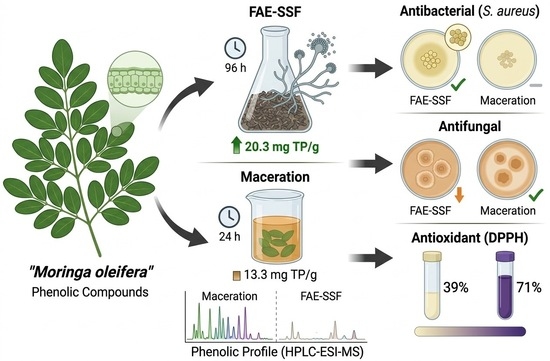
Therefore, the aim of this research was to evaluate fungal-assisted extraction using solid-state fermentation (FAE-SSF) as an alternative method for the recovery of phenolic compounds from Moringa oleifera leaves, comparing its performance with conventional maceration and evaluating the antimicrobial and antioxidant properties of the obtained extracts. Unlike most previous studies that report simultaneous increases in phenolic content and antioxidant activity after SSF, this work demonstrates that enhanced phenolic extraction may be accompanied by reduced biological activity. This highlights a critical trade-off between yield and functionality, which has not been sufficiently addressed in Moringa oleifera systems.
2. Materials and Methods
2.1. Reagents
The culture media Nutrient Broth, Müller–Hinton Agar, and Potato Dextrose Agar were purchased from BD Bioxon (Franklin Lakes, NJ, USA). Amberlite® XAD-16 resin and 2,2-diphenyl-1-picrylhydrazyl (DPPH) were obtained from Sigma-Aldrich Co. (St. Louis, MO, USA). All reagents used in this study were of analytical grade and were purchased from Productos Químicos de Monterrey (Monterrey, Mexico) and Jalmek Científica (San Nicolás de los Garza, Mexico).
2.2. Plant Material and Microbial Strains
Dried, powdered leaves of Moringa oleifera were obtained in Ciudad Valles, San Luis Potosí, Mexico. The plant material was collected from local sources. The collected material constitutes a composite sample from multiple plants, as is typically found in local production systems.
Upon arrival at the Food Research Laboratory of the Autonomous University of San Luis Potosí (Faculty of Professional Studies, Huasteca Region), the material underwent a second drying stage in a convection oven (Ecoshel, Ciudad de México, México) at 70 °C for 24 h to ensure the removal of moisture. The dried samples were then stored in airtight bags and protected from light until further use. The plant material was treated as a representative substrate under typical local conditions.
The microbial strains Aspergillus niger, Penicillium digitatum, Staphylococcus aureus, and Shigella sp. were obtained from the Food Research Laboratory of the Autonomous University of San Luis Potosí (UASLP). Additionally, Aspergillus oryzae DIA-MF, Mucor sp., Colletotrichum sp., Fusarium oxysporum, and Sclerotinia sp. were provided by the Food Research Department of the Autonomous University of Coahuila.
2.3. Selection of Fungal Strain by FAE-SSF
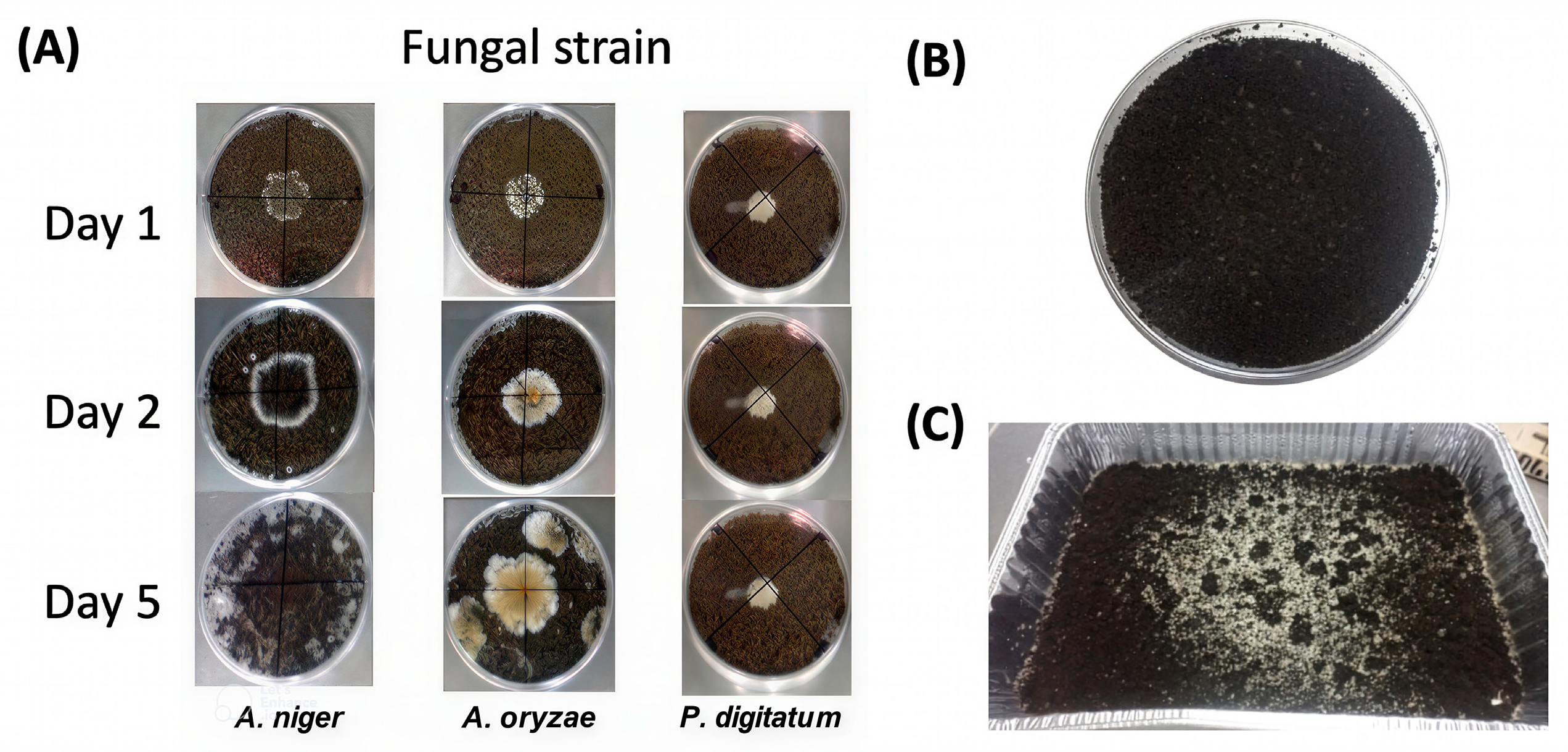
A screening of fungal strains (A. niger, P. digitatum, and A. oryzae) was carried out through SSF using dried M. oleifera leaves as substrate. The evaluation was performed by determining the radial growth kinetics of each fungal strain. Fungal strains were first activated on Potato Dextrose Agar plates at 30 °C for 5 days. Subsequently, spores were harvested using 30 mL of sterile Tween 80 solution (0.1%, v/v). The obtained spore suspensions were inoculated (2 × 10⁷ spores/g of support, 500 µL) at the center of Petri dishes containing 5 g of M. oleifera leaves adjusted to 70% moisture. Petri dishes were incubated at 30 °C for six days. Radial fungal growth was measured every 24 h for 120 h at four fixed points, and the average growth rate was calculated to determine the most suitable fungal strain. All experiments were performed in triplicate.
2.4. Extraction by FAE-SSF of Phenolic Compounds
The fungal strain selected in the previous step (
A. niger) was used for the extraction of phenolic compounds from
M. oleifera leaves using fungal-assisted extraction under solid-state fermentation (FAE-SSF). Petri dishes containing 5 g of dried leaves were prepared with 70% moisture and inoculated with 2 × 10
7 spores/g of support. The fermentation process was monitored kinetically every 24 h for 144 h. Bioactive compounds released during fermentation were recovered by adding 20 mL of 70% ethanol into 250 mL Erlenmeyer flasks followed by agitation at 220 rpm for 10 min. The resulting extracts were filtered through filter paper and subsequently through 0.45 µm membrane filters. Crude extracts were stored at −20 °C in darkness until further analysis. The selected SSF conditions were based on previous reports [
16,
17] indicating optimal growth and enzymatic activity of
Aspergillus niger in solid-state systems. All experiments were performed in triplicate.
Conventional maceration was performed as a comparative extraction method. For this purpose, 5 g of dried M. oleifera leaves were placed in 500 mL Erlenmeyer flasks containing 50 mL of 70% ethanol. The mixture was agitated at 136 rpm for five days and sampled every 24 h. Extracts were filtered using filter paper and 0.45 µm membrane filters. The procedure was carried out in duplicate, while all other analyses were performed in triplicate, and crude extracts were stored at −20 °C in darkness until analysis.
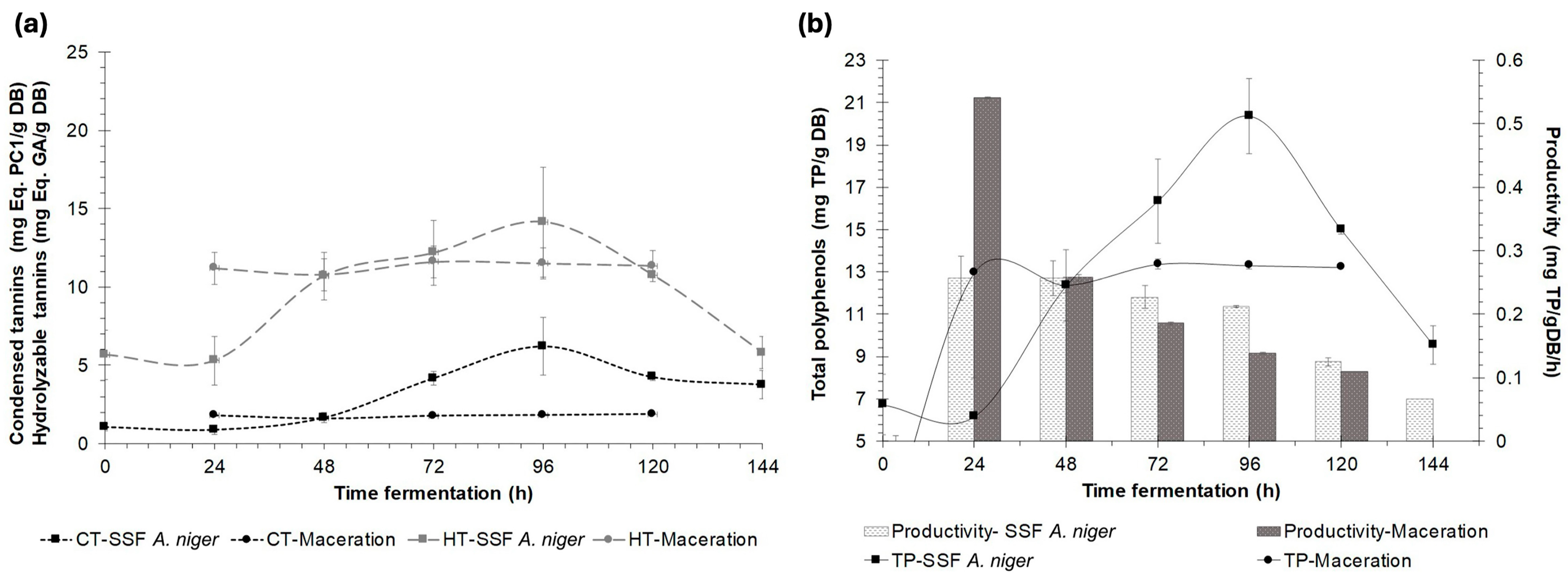
Total polyphenols were quantified in samples obtained from FAE-SSF and maceration processes and expressed as mg total polyphenols per gram of dry basis (mg TP/g db). Total polyphenols were calculated as the sum of hydrolysable and condensed tannins.
Hydrolysable tannins were determined using the Folin–Ciocalteu method, following previously reported procedures with slight modifications [
18]. Briefly, 800 µL of sample (1 g/L) were mixed with 800 µL of Folin–Ciocalteu reagent. After 5 min, 800 µL of Na
2CO
3 solution (0.01 M) and 5 mL of distilled water were added. The mixture was incubated at room temperature, and absorbance was measured at 790 nm using a spectrophotometer (Cary 50 Bio, Varian Inc., Palo Alto, CA, USA). Results were expressed as mg gallic acid equivalents per gram of dry basis (mg GAE/g db) using a gallic acid calibration curve (R
2 = 0.995). All analyses were performed in triplicate.
Condensed tannins were quantified using the n-butanol/HCl/Fe
3+ method as described by Porter et al. [
19]. Samples were prepared at a concentration of 2 g/L in methanol. Subsequently, 250 µL of each sample were mixed with 1.5 mL of 1-butanol:HCl solution (95:5,
v/
v) and 50 µL of iron reagent [(NH
4Fe(SO
4)
2·12H
2O) in 2 M HCl, 2%
w/
v]. The reaction mixtures were heated at 90 °C for 40 min in a water bath, and absorbance was measured at 550 nm. Condensed tannins were quantified using a procyanidin C1 calibration curve and expressed as mg procyanidin C1 equivalents per gram of dry basis (mg PC1/g db). All assays were performed in triplicate.
The fermentation time corresponding to the maximum release of phenolic compounds was selected based on total polyphenol content.
2.5. Purification of Bioactive Compounds
Before purification of the bioactive compounds, FAE-SSF at final time was developed. According to the results obtained in the previous procedure, a SSF was performed in a tray artisanal bioreactor packed with 50 g of dry leaves M. oleifera at the same culture conditions mentioned above: temperature (30 °C), humidity (70%), inoculum size (2 × 10⁷ spores/g of support) during 96 h (final time). Immediately, bioactive compounds were recovered by agitation (220 rpm) during 10 min in 200 mL of ethanol 70%. To compare, maceration was carried out as following: 35 g of dry leaves M. oleifera were extracted with 350 mL of ethanol (70%) by agitation at 136 rpm during 96 h at 36 °C. Both extracts were centrifuged, filtered and concentrated in rotatory evaporator at final volume of 10 mL.
Purification was carried out in an open column packed with Amberlite XAD-16 resin as stationary phase. First, the elution was using 100 mL of water, 100 mL of ethanol and 100 mL of acetone. The fractions were concentrated in rotatory evaporator (Büchi Labortechnik AG, Flawil, Switzerland) at final volume of 10 mL. In addition, for determination of extraction yield, an aliquot of all concentrate samples was exposed at 90 °C during 24 h for solvents evaporation and then total solids purified were gravimetrically calculated as percentage (w/w) and stored in darkness.
2.6. Biological Properties Evaluation
2.6.1. Antimicrobial Properties
Antimicrobial activity was assayed testing the antibacterial and antifungal activities for each fermented and maceration extract and fractions. In antibacterial activity against
Shigella sp and
Staphylococcus aureus the diffusion in disk method was used [
20]. The bacterial strains were activated first in nutritious broth and after in Müller Hinton medium, each one at 35 °C during 24 h. Assay was carried out in a Petri dishes containing Müller Hinton agar and inoculated with 1.5 × 10
8 UFC/mL. Disks with concentrations of 5, 15, 25 and 50 g/L were tested of each fermented extract and fraction, incubated at 35 °C during 24 h. All experiments were realized in triplicated. Presences of an inhibition halo was considered as positive inhibition in each sample.
2.6.2. Antifungal Properties
For antifungal activity, the methodology described previously [
21] with modifications as following: six orifices of 5 mm on PDA agar were inoculated with 10 µL of spores suspension (previously activated in PDA, 30 °C, 5 days) from
Mucor sp.,
Colletotrichum sp.,
Fusarium oxysporum and
Sclerotinia sp. respectively and 10 µL of crude extracts and purified ethanolic fractions. Ethanol (70%,
v/
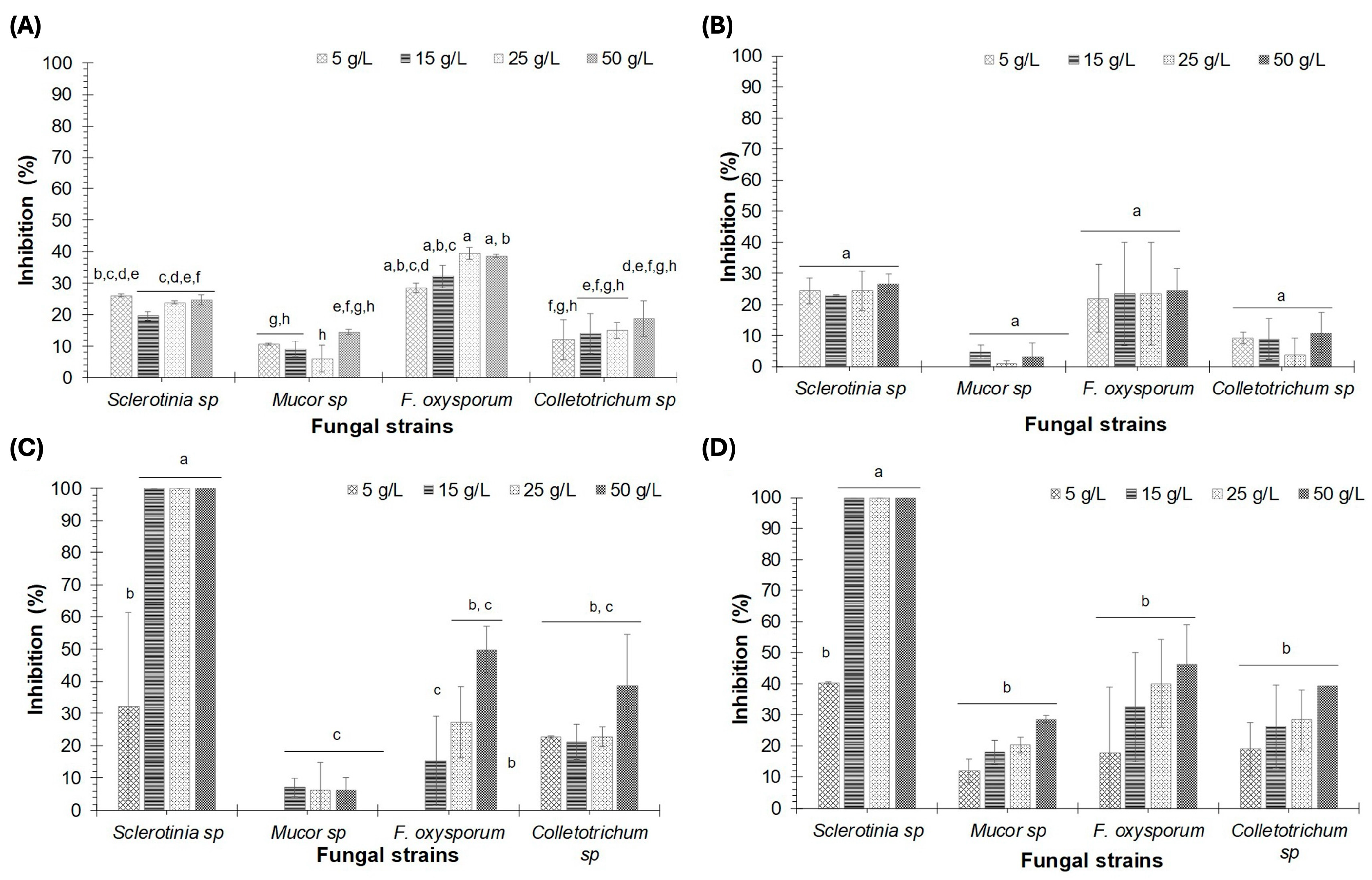
v) and sterile water were used as controls. The concentrations of each fermented extract and fractions were 5, 15, 25 and 50 g/L. The Petri dishes were incubated at 30 °C for 48 h. Radial growth was measured and expressed as inhibition percentage compared with control with sterile water. All experiments were performed in triplicate.
2.6.3. Antioxidant Properties
The 2,2-diphenyl-1-picrylhydracyl (DPPH) free radical inhibition activity was performed according to previous studies [
22]. The assay was performed using 7 µL of sample (concentration of 1 g/L, previously prepared in 70% ethanol) with 193 µL DPPH-ethanol (concentration of 60 µM) in microplates. Lectures were measured at 517 nm in Epoch (BioTek Instruments, Inc., Winooski, VT, USA) at 30 min. DPPH-ethanol and ethanol were used as control and blank, respectively. The DPPH inhibition was expressed as %, which was calculated with the next equation. All assays were performed in triplicate.
2.7. HPLC-ESI-MS Characterization of Bioactive Compounds
Phytochemical characterization was carried out using a high-performance liquid chromatography system (HPLC, Varian ProStar, Varian Inc., Palo Alto, CA, USA) equipped with a diode array detector (Varian ProStar 330, Varian Inc., Palo Alto, CA, USA) and coupled to an electrospray ionization mass spectrometer (Varian 500-MS ion trap, Varian Inc., Palo Alto, CA, USA). A Denali C18 (150 mm × 2.1 mm, 3 μm, Grace Davison Discovery Sciences, Deerfield, IL, USA) column at 30 °C was used. The conditions of system were as follows: 0.2% (v/v) formic acid (A dissolvent) and acetonitrile (dissolvent B). A gradient pattern of 3% B; 0–5 min; 9% B lineal, 5–15 min;16% B lineal, 15–45 min; 50% B lineal, was used. The flow rate was maintained at 0.2 mL/min and the samples were monitored at 245, 280, 320 and 410 nm. The whole effluent (0.2 mL/min) was injected into the source of the mass spectrometer, without splitting. Nitrogen was used as nebulizing gas and helium as damping gas. The ion source parameters were: spray voltage 5.0 kV and, capillary voltage and temperature were 90.0 V and 350 °C, respectively. The operation was carried out in negative mode in the range of 50–2000 m/z. When necessary, MS/MS analyses were performed on a series of selected precursor ions. The data was processed with MS Workstation (V 6.9) software.
2.8. Statistical Analysis
All experiments were performed at least in triplicate unless otherwise stated. Data were expressed as mean ± standard deviation. Data were analyzed using analysis of variance (ANOVA). When required, comparison of treatment means was performed using Tukey’s multiple range test with a 95% confidence level. Statistical analyses were conducted using Minitab 17 Statistical Software (Minitab Inc., State College, PA, USA).
4. Discussion
The present study evaluated the effectiveness of FAE-SSF as an alternative green extraction strategy for recovering phenolic compounds from M. oleifera leaves, in comparison with conventional maceration. The results demonstrated that SSF using A. niger significantly enhances the release of phenolic compounds; however, its impact on biological activity is strongly dependent on the structural modifications that occur during fermentation and subsequent processing steps.
The increase in phenolic content observed during FAE-SSF, particularly at 96 h, may be associated with the enzymatic machinery produced by
Aspergillus niger, including cellulases, hemicellulases, and β-glucosidases. These enzymes are known to promote the degradation of lignocellulosic structures, facilitating the release of phenolic compounds bound to plant cell walls. However, since enzymatic activities were not directly measured in this study, this explanation should be considered as a proposed mechanism based on previous reports [
23,
24].
In addition to cell wall degradation, SSF may also promote the conversion of conjugated phenolics into more extractable forms. For instance, glycosylated phenolic compounds can be hydrolyzed into their aglycone forms through β-glucosidase activity, which may increase their solubility and extractability [
25,
26]. This bioconversion has been widely observed during SSF, where a decrease in glycoside forms is accompanied by a significant increase in aglycone phenolics due to microbial enzymatic activity [
25]. Additionally, SSF has been shown to alter the phenolic profile by generating new metabolites or transforming existing compounds, leading to a shift toward aglycone-dominated profiles [
27]. However, this transformation can also lead to instability or further degradation depending on fermentation conditions, as prolonged SSF may result in oxidation or breakdown of phenolic structures decreasing the biological potential. Therefore, SSF should not be considered solely as an extraction enhancement process but also as a biotransformation system that modifies the chemical profile of plant metabolites [
28].
Compared to previous studies on
M. oleifera, the increase in phenolic content observed in this study is consistent with the trends described, although with a lower magnitude. In the present work, FAE-SSF resulted in a 1.53-fold increase (~53%) in total polyphenols compared to maceration (from 13.3 to 20.3 mg TP/g db). In contrast, increases of up to 136% in total phenolic content have been reported following SSF of moringa leaves, and even greater increases (up to ~395%) have been described in moringa seeds, depending on fermentation conditions and solvent systems [
29,
30]. These differences suggest that, although SSF effectively enhances phenolic release in
M. oleifera, the magnitude of improvement is highly dependent on process variables such as substrate type, fermentation time, microbial strain, and extraction conditions. Previous studies commonly employ optimized solvent systems (e.g., 80% ethanol or acetone) and controlled fermentation parameters, which may partly explain the higher yields reported compared to the present study.
Interestingly, the results also showed that phenolic content did not increase significantly during the first 24 h of SSF, followed by a progressive increase until 96 h and a subsequent decrease. The observed phenolic release pattern is strongly influenced by SSF process conditions. Parameters such as moisture content, temperature, and fermentation time are known to play a critical role in microbial growth, oxygen transfer, and enzymatic activity [
15]. Moisture content affects substrate porosity and nutrient diffusion, while temperature influences fungal metabolism and enzyme kinetics [
15,
31]. Fermentation time determines the balance between phenolic release and degradation, as prolonged SSF may lead to oxidation or microbial consumption of phenolic compounds [
31,
32]. Therefore, small variations in these parameters could significantly alter both the yield and functional properties of the extracts, highlighting the importance of process optimization in SSF systems [
24]. This is consistent with the results obtained in this study, where maximum phenolic content was reached at 96 h, followed by a decrease, suggesting a transition from release-dominated to degradation-dominated stages. This pattern is consistent with previous findings, where early fermentation stages are characterized by microbial adaptation, while maximal enzymatic activity and phenolic release occur at intermediate fermentation times [
33]. Prolonged fermentation may lead to degradation, oxidation, or polymerization of phenolic compounds, which explains the decline observed after 96 h. Despite the higher phenolic yield obtained by FAE-SSF, maceration showed superior productivity due to the shorter extraction time required to reach maximum yield. This observation highlights a fundamental trade-off between extraction efficiency and process time. While SSF improves compound release and reduces solvent consumption, conventional maceration remains advantageous for rapid extraction. Similar trade-offs have been reported in SSF systems applied to plant matrices, where increased yields are achieved at the expense of longer processing times [
15].
The purification process using Amberlite XAD-16 further confirmed that solvent polarity plays a critical role in phenolic recovery. The higher yields obtained in ethanolic fractions compared to acetonic fractions indicate that phenolic compounds present in
M. oleifera extracts are predominantly of intermediate polarity. Similar findings have been reported in SSF-assisted extraction systems, where adsorption–desorption processes using polymeric resins favor the recovery of phenolics in ethanol-rich fractions [
24]. However, the lower recovery observed in FAE-SSF ethanolic fractions compared to maceration suggests that fermentation may alter the polarity and chemical structure of phenolic compounds, potentially affecting their adsorption behavior. This is consistent with previous reports indicating that SSF not only increases phenolic release but also induces structural transformations, including the formation of new metabolites and modification of existing compounds [
34]. It has been reported that the adsorption of phenolic compounds depends strongly on their chemical structure and functional groups, particularly hydroxyl groups and aromatic rings, which determine their affinity toward hydrophobic or polar phases [
35]. Therefore, changes in phenolic structure induced by SSF, such as oxidation, cleavage, or derivatization, may alter their adsorption behavior and explain the differences observed during purification [
34].
Regarding antimicrobial activity, the results demonstrated that FAE-SSF improved antibacterial activity against
S. aureus, whereas no activity was observed against
Shigella sp. This selective activity is consistent with previous reports on
M. oleifera, where fermented extracts exhibited antimicrobial effects mainly against Gram-positive bacteria [
29]. The resistance observed in Gram-negative bacteria can be explained by the presence of an outer membrane that limits the penetration of phenolic compounds. Previous studies have reported the generation of phenolic derivatives and other metabolites during fermentation that are not present in unfermented materials [
29]. This could explain the improved antibacterial activity observed in FAE-SSF samples, despite the reduction in certain phenolic compounds detected by HPLC. The antimicrobial behavior observed can be further explained by the mechanisms through which phenolic compounds interact with bacterial cells. Phenolics, particularly flavonoids, are known to disrupt cell membranes by increasing permeability, leading to leakage of intracellular components such as ions and proteins. This effect is more pronounced in Gram-positive bacteria due to the absence of an outer membrane, which facilitates compound penetration [
36]. Additionally, phenolics can inhibit key intracellular enzymes involved in energy metabolism and DNA replication, further impairing bacterial growth [
37]. Fermentation processes such as SSF may enhance these effects by generating more reactive or bioavailable phenolic derivatives, contributing to the improved antibacterial activity observed in FAE-SSF extracts [
14]. It is important to note that the antimicrobial assessment performed in this study was qualitative, based on the presence or absence of inhibition. While this approach provides an initial indication of antimicrobial potential, it does not allow for precise quantification of activity. Therefore, future studies should include quantitative measurements such as inhibition zone diameters, minimum inhibitory concentration (MIC), and minimum bactericidal concentration (MBC) to provide a more comprehensive evaluation.
In contrast to the antibacterial results, antifungal activity was not improved by FAE-SSF and, in some cases, was reduced compared to maceration. This suggests that compounds responsible for antifungal activity may be more susceptible to degradation or transformation during fermentation. Similar observations have been reported in SSF systems, where extended fermentation leads to a reduction in specific phenolic compounds and associated biological activities [
33]. It has been demonstrated that although SSF can initially increase phenolic content, prolonged fermentation may result in the degradation of key bioactive molecules such as flavonoids and phenolic acids, which are strongly associated with antifungal activity. Furthermore, SSF is known to involve complex enzymatic and oxidative processes that can alter the chemical structure of phenolics. Enzymes such as polyphenol oxidases and peroxidases can promote oxidation and polymerization reactions, leading to the formation of higher molecular weight compounds with reduced bioavailability and lower antimicrobial effectiveness. In addition, microbial metabolism can consume certain phenolic compounds as carbon sources, particularly under extended fermentation conditions, contributing to their depletion [
38].
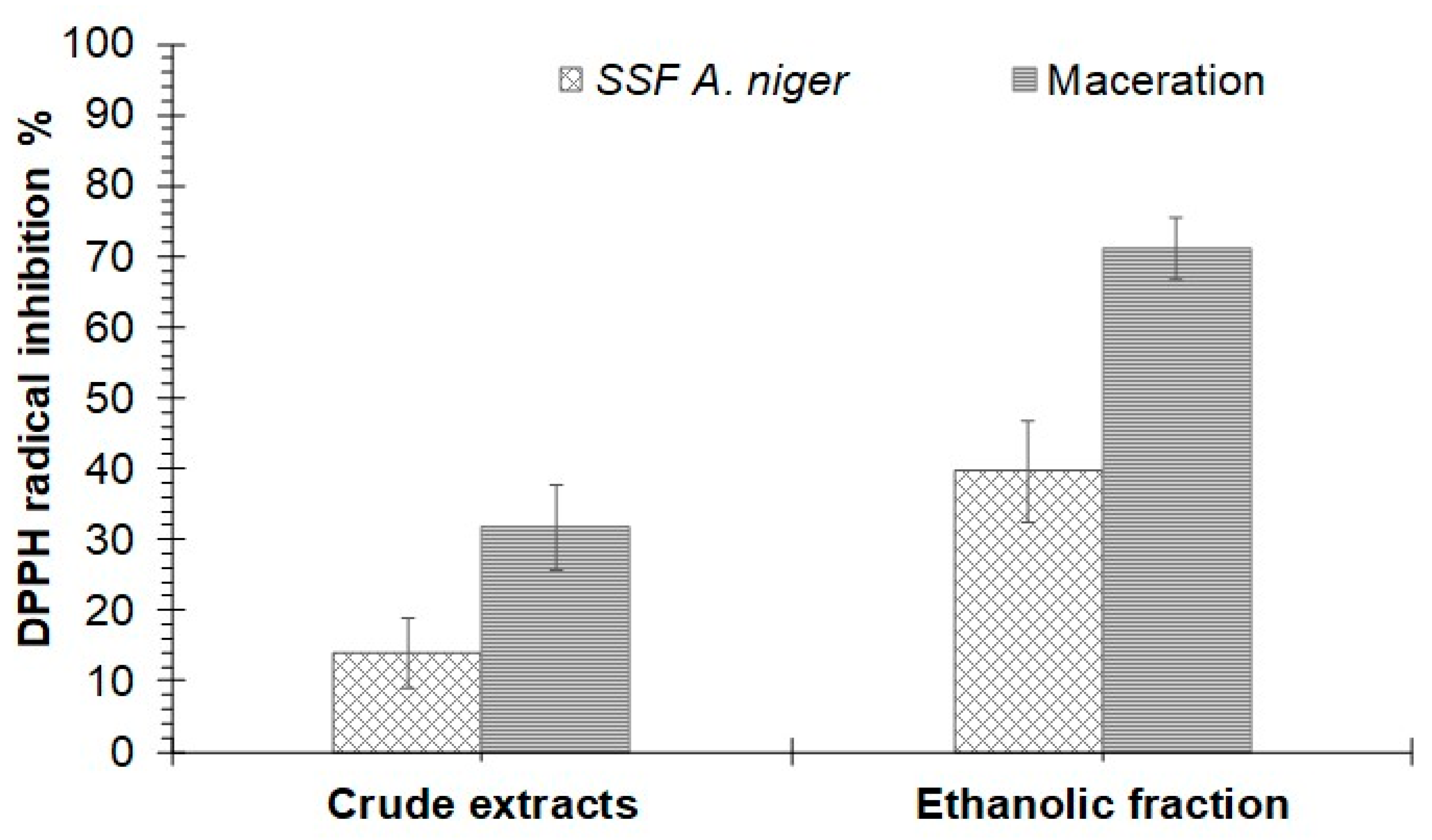
The antioxidant activity results revealed that FAE-SSF did not enhance DPPH radical scavenging capacity, despite increasing phenolic content. This finding is particularly relevant because it contrasts with the commonly reported positive correlation between total phenolic content and antioxidant activity in SSF systems. Therefore, the results of this study demonstrate that an increase in total phenolics does not necessarily translate into improved biological functionality. This apparent contradiction highlights the importance of phenolic composition rather than total content, as well as the limitations of single-method antioxidant evaluation, suggesting that SSF acts not only as an extraction process but also as a biotransformation system that can modify the functional properties of the resulting extracts. However, studies explicitly reporting this type of inverse relationship between phenolic content and antioxidant activity in
M. oleifera under SSF conditions remain limited, highlighting the relevance of the present findings [
13,
23]. Other studies on
M. oleifera have shown that prolonged fermentation can decrease antioxidant capacity due to degradation of key flavonoids such as quercetin and kaempferol derivatives [
33]. Therefore, the results suggest that SSF may shift the phenolic profile toward compounds with lower radical-scavenging capacity, even if total phenolic content increases. It is important to note that the antioxidant activity in this study was evaluated using the DPPH assay, which primarily measures radical scavenging capacity [
39]. However, antioxidant activity is a multifaceted phenomenon that depends on different mechanisms, including electron transfer and metal chelation [
40]. Therefore, the use of a single method may not fully reflect the overall antioxidant potential of the extracts. Additional assays such as ABTS and FRAP could provide complementary information and should be considered in future studies [
41]. Several studies have reported that although SSF can increase the total phenolic content, the resulting extracts may exhibit reduced or unchanged antioxidant activity due to structural modifications that affect radical scavenging efficiency [
15,
33]. In particular, the degradation of highly active flavonoids and the formation of less reactive phenolic derivatives during fermentation can significantly alter the antioxidant performance of the extracts.
Another important aspect is the role of synergistic interactions among phenolic compounds. Antioxidant activity often results from combined effects rather than individual molecules. During SSF, enzymatic reactions and microbial metabolism may disrupt these interactions, leading to reduced antioxidant activity despite increased phenolic content [
14]. This phenomenon may explain why FAE-SSF extracts in this study showed lower antioxidant activity despite higher phenolic levels. Furthermore, the impact of SSF on phenolic bioaccessibility and bioavailability should also be considered. While fermentation processes can enhance the release of bound phenolics, they may also generate compounds with lower absorption or reduced biological effectiveness in vivo. Therefore, the net effect of SSF on health-related properties is highly dependent on the balance between compound release, transformation, and stability. Additionally, it is important to highlight that fermentation conditions such as temperature, moisture content, oxygen availability, and fermentation time play a critical role in determining the final phenolic profile and bioactivity of the extracts. Small variations in these parameters can lead to significant differences in enzymatic activity and metabolic pathways, resulting in either enhancement or degradation of bioactive compounds [
27]. This reinforces the need for precise optimization of SSF conditions to achieve the desired functional properties. SSF should therefore be regarded not only as an extraction-enhancing process but as a transformation stage that reshapes the chemical profile and functional performance of plant-derived phenolics. Consequently, future studies should integrate compositional, functional, and bioavailability analyses to better understand the real impact of SSF on the biological potential of plant-derived extracts.
Overall, these results highlight a trade-off between phenolic yield and bioactivity during SSF. Although fermentation enhances total phenolic content, structural modifications and loss of key compounds can reduce antioxidant performance. This confirms that biological activity depends more on phenolic composition than total content [
42]. This finding challenges the commonly assumed direct relationship between total phenolic content and biological activity, as several studies have shown that higher phenolic concentrations do not necessarily correlate with stronger antioxidant capacity [
43]. Instead, the results emphasize that the biological effectiveness of plant extracts depends strongly on the specific composition, structural characteristics, stability, and interactions of individual phenolic compounds [
44]. Therefore, SSF should be carefully optimized not only to maximize extraction yield but also to preserve or selectively generate compounds associated with the desired bioactivity.
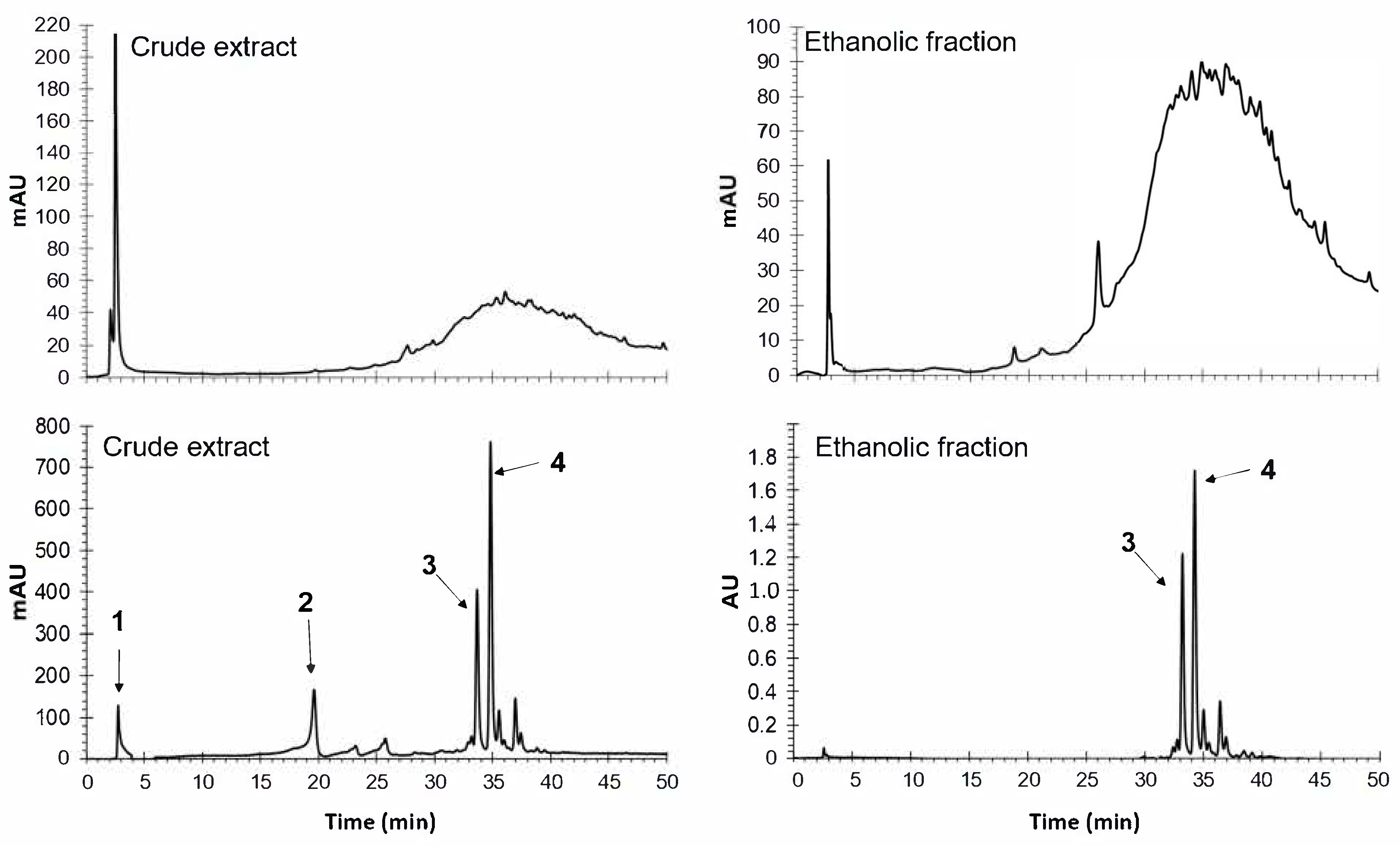
The HPLC-ESI-MS analysis supported these findings, showing that maceration preserved a higher diversity and abundance of phenolic compounds, particularly flavonoids. In contrast, FAE-SSF samples exhibited a reduced number of detectable compounds, indicating that fermentation induced biotransformation or degradation processes. This behavior is consistent with studies on
M. oleifera, where flavonoids such as quercetin and kaempferol glycosides represent the major phenolic constituents, but their concentration significantly decreases during extended SSF due to enzymatic degradation and metabolic transformation [
33]. The phenolic compounds identified in this study are known to contribute differently to biological activity, particularly antioxidant capacity. Flavonoids such as quercetin derivatives (e.g., quercetin-3-O-glucoside) are widely recognized for their strong radical scavenging activity due to their hydroxyl group configuration, which enhances their ability to donate electrons and stabilize free radicals [
45]. Similarly, phenolic acids such as caffeoylquinic acid contribute to antioxidant activity, although generally to a lesser extent than flavonoids [
46]. The reduced presence and relative abundance of these flavonoid compounds in FAE-SSF extracts, as observed in the chromatographic profiles, may explain the lower antioxidant activity despite the increase in total phenolic content [
42]. In contrast, maceration preserved a wider diversity of these bioactive compounds, which may contribute to the higher antioxidant capacity observed. These findings reinforce the concept that the biological activity of plant extracts depends not only on the total phenolic content but also on the specific composition and structural characteristics of the individual compounds.
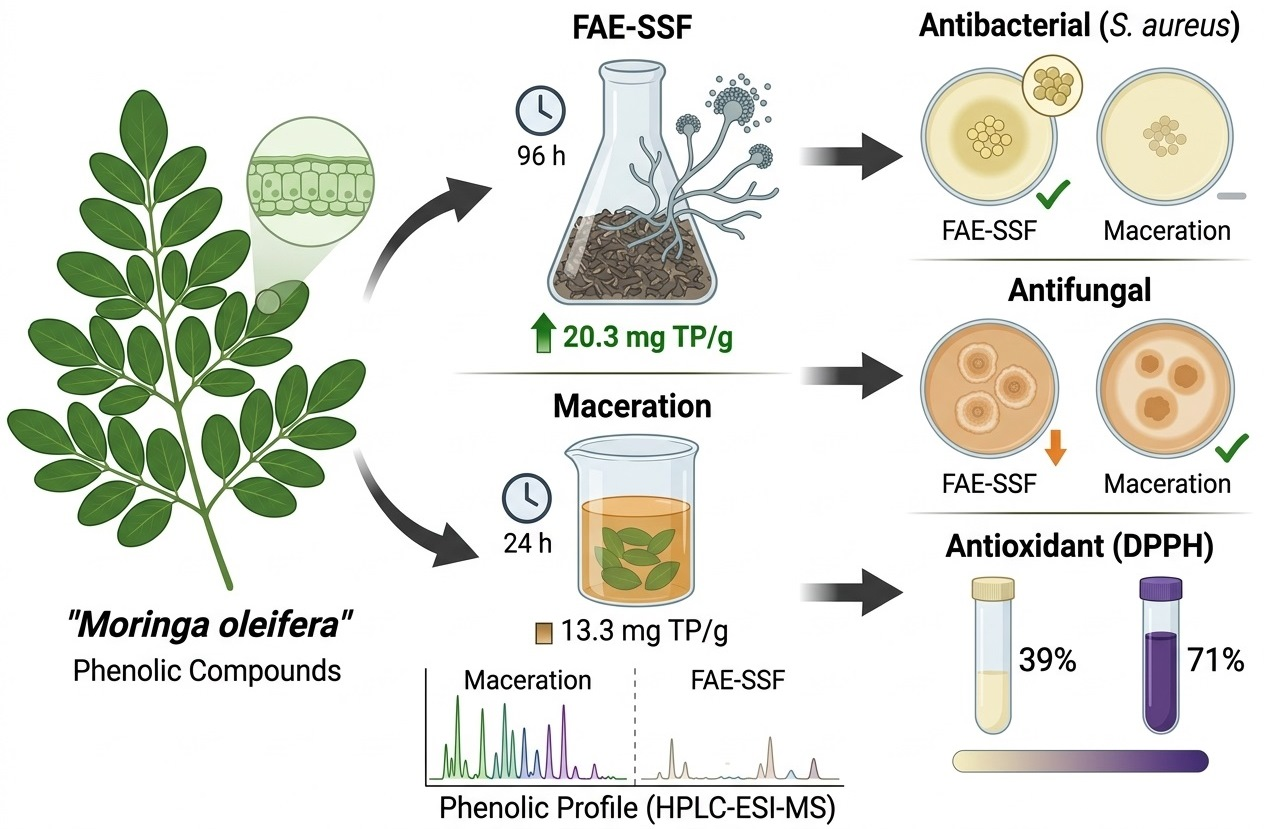
From an applied perspective, the results indicate that FAE-SSF is a promising green technology for enhancing phenolic extraction from M. oleifera. However, its application should be carefully optimized depending on the desired functional property. While SSF improved antibacterial activity, it reduced antioxidant and antifungal activities, suggesting that process conditions should be tailored to specific applications. From a safety perspective, it is important to consider that although Aspergillus niger is widely used in food and biotechnological applications and is generally recognized as safe (GRAS), certain strains may produce secondary metabolites such as mycotoxins under specific conditions. Therefore, the selection of non-toxigenic strains and the control of fermentation parameters are essential to ensure the safety of SSF-derived products. Future research should focus on monitoring enzymatic activity during SSF, as well as on developing metabolomic profiles to track phenolic transformations and assessing safety-related aspects, including the potential production of mycotoxins. Furthermore, comparisons with enzyme-assisted extraction would help distinguish between the effects of enzymatic hydrolysis and those of microbial metabolism.




 ,
,