


Article

Lactic-Fermented Tomato as a Natural Colorant and Bioprotective Ingredient Replacing Cochineal Carmine in Fresh Pork Sausage

1
BRC Ingredientes Ltd., Rio Claro 13506-816, SP, Brazil
2
Federal Center for Technological Education Celso Suckow da Fonseca (CEFET/RJ), Rio de Janeiro 20271-110, RJ, Brazil
*
Author to whom correspondence should be addressed.
Fermentation 2026, 12(5), 220; https://doi.org/10.3390/fermentation12050220
Submission received: 23 February 2026 / Revised: 18 March 2026 / Accepted: 27 March 2026 / Published: 29 April 2026

Abstract

This study aimed to develop a biotechnological process for producing a lactic-fermented tomato ingredient (Solanum lycopersicum) capable of acting as a natural reddish colorant and enhancing microbiological stability in fresh pork sausage, reducing dependence on cochineal carmine, whose market price has fluctuated substantially. The bioprocess was conducted at industrial scale using a 10% tomato flour solution subjected to enzymatic hydrolysis with pectinases to release lycopene, followed by co-culture fermentation with Lacticaseibacillus paracasei ATCC 25302 and Pediococcus acidilactici ATCC 8042 to convert sugars into lactic acid. The antimicrobial potential of the ingredient was assessed through minimum inhibitory concentration assays using the Computational Microbial Density Scanning method against microbiota isolated from fresh pork sausage. A dose-dependent inhibitory effect was observed, with significant growth reduction from 2%. The fermented ingredient was then applied at 2% (w/w) in fresh pork sausage, partially or fully replacing cochineal carmine. Instrumental color analysis showed that 2% enabled a 50% reduction in cochineal carmine without compromising color. Microbiological stability evaluated using the MicroLab_ShelfLife method revealed a substantial reduction in microbial growth rates in treated groups. Overall, lactic-fermented tomato can partially replace cochineal carmine while preserving sensory color and providing an antimicrobial function, thereby enhancing product stability and shelf-life.

1. Introduction

Fresh pork sausages represent one of the most relevant meat products in the Brazilian market, from both an industrial and a consumer perspective [1]. For the meat industry, fresh pork sausages play a strategic role by enabling the industrial processing and valorization of pork meat, while for consumers, they are deeply embedded in Brazilian food culture [2,3]. Their popularity is largely associated with affordability, ease of preparation, and culinary versatility, being commonly prepared by grilling, frying, or incorporation into traditional dishes [4,5].
Pork meat is among the most produced and consumed animal proteins in Brazil [3]. According to data from the Associação Brasileira de Proteína Animal (ABPA), pork production has increased consistently in recent years, with per capita consumption reaching approximately 18.6 kg per person [6]. A substantial share of pork production is directed toward processed meat products, particularly fresh pork sausages, which represent an important outlet for industrial utilization of retail cuts and trimmings generated along the pork production chain [1,7].
Fresh pork sausages are typically manufactured using pork lean meat, pork fat, water, and authorized additives, stuffed into natural casings, and commercialized under refrigerated or frozen conditions [8]. Due to their formulation and processing characteristics, these products are highly susceptible to deterioration [9]. Fresh pork sausages provide favorable conditions for microbial growth due to their high water activity and nutrient-rich composition [10]. Since they are produced without a microbial kill step, they retain a diverse microbiota and can reach microbial loads on the order of 105–106 colony-forming unit (cfu)/g at early stages of refrigerated storage [11]. The microbiota associated with fresh pork sausages generally includes lactic acid bacteria, Enterobacteriaceae, Pseudomonas spp., Brochothrix spp., and other spoilage-related microorganisms [11,12]. The metabolic activity of these microbial groups is directly responsible for quality defects such as off-odor development, slime formation, gas production, and a rapid reduction in shelf-life during refrigerated storage [12,13].
In addition to microbiological stability, product color is a critical quality attribute determining consumer acceptance of fresh pork sausages [14,15]. Consumer preference is strongly associated with a stable reddish appearance, and visual discoloration is often perceived as an indicator of loss of freshness [14,15,16]. In this product category, red coloration is achieved mainly through two complementary mechanisms. The first involves curing reactions, in which nitrite participates in a sequence of chemical transformations leading to the formation of nitric oxide, which binds to myoglobin to form nitrosomyoglobin, a red pigment responsible for the characteristic color of cured fresh pork products [17,18]. The second mechanism relies on the use of colorants, which are commonly applied to enhance and standardize product appearance throughout storage [19].
Under Brazilian legislation, only natural colorants are permitted for use in fresh pork sausages, with cochineal carmine being the most widely used [19,20]. However, cochineal carmine production is geographically concentrated, primarily in Peru, making its availability and price highly dependent on fluctuations in supply, global demand, and competition with other food sectors, including pet food [21,22,23]. In recent years, the Brazilian market has experienced a substantial increase in the price of cochineal carmine, driven by expanded applications beyond meat products and limitations in production capacity [21,22]. This economic pressure has motivated the meat industry to search for alternative natural colorants [22,24]. Although plant-based ingredients such as beetroot powder and other botanical sources have been explored, their application has often been limited by inadequate color stability throughout the shelf-life of fresh pork sausages, particularly under refrigerated storage conditions [19,25].
In parallel, global trends in meat preservation have increasingly favored the use of natural fermented ingredients, which exert antimicrobial effects through the combined action of organic acids and other fermentation-derived metabolites [26,27,28]. These ingredients are typically obtained through the growth of lactic acid bacteria in substrates containing fermentable carbohydrates, proteins, minerals, and buffering agents, leading to the formation of bioactive compounds capable of inhibiting spoilage and pathogenic microorganisms [29,30]. In addition to acidification, the use of complementary lactic acid bacterial co-cultures has been reported to enhance metabolic diversity during fermentation, favoring the formation of organic acids and other compounds that may exert synergistic effects on microbial inhibition and oxidative stability [31,32,33]. Several studies have demonstrated the efficacy of fermented ingredients in extending shelf-life, often showing performance comparable to, or synergistic with, conventional preservatives based on organic acids such as lactic, acetic, and propionic acids [26,33,34,35].
Tomato represents a particularly suitable matrix for the development of fermented multifunctional ingredients, as it simultaneously provides fermentable carbohydrates and naturally occurring red pigments, mainly lycopene [36,37]. However, both sugar availability and pigment extractability are limited by the structural complexity of the plant cell wall, in which polysaccharides such as pectins partially entrap intracellular compounds [38]. Enzymatic treatments targeting pectic substances have been reported as an effective strategy to disrupt this matrix, facilitating the release of fermentable sugars and enhancing the accessibility of lycopene for technological applications [37]. When combined with controlled lactic acid fermentation, this approach enables the generation of a stable ingredient enriched in organic acids, antioxidant compounds, and other fermentation-derived metabolites with potential antimicrobial activity, while preserving the intense red coloration associated with lycopene [26,37]. Such characteristics suggest that fermented tomato-based ingredients may act not only as natural colorants, but also as bioprotective agents capable of contributing to the microbiological stability of fresh pork sausages [33,34].
Based on these considerations, the objective of this study was to evaluate whether a lactic-fermented tomato powder could simultaneously improve microbiological stability and provide a stable red coloration in fresh pork sausage. The study focused on assessing its ability to partially or fully replace cochineal carmine while extending shelf-life through reduced microbial growth rates and improved color stability during refrigerated storage.

2. Materials and Methods

2.1. Characterization of Tomato Flour

A commercially sourced tomato flour (Fuchs Gewürze do Brasil Ltd., São Paulo, Brazil) was selected as the substrate for lactic fermentation. Based on the manufacturer’s nutritional specifications, the product contained (per 100 g): carbohydrates (22 g), protein (1 g), total lipids (7 g), dietary fiber (7 g), sodium (27 mg), calcium (161 mg), and iron (4 mg).
The pH of the samples was measured using the procedure outlined in ISO 10523:2012 [39]. Samples were dispersed in distilled water at a defined ratio (1:10, w/v) and homogenized to obtain a uniform suspension. A portable pH meter (pH Classic, Akso, Brazil), equipped with electrode (IP65, Akso, Brazil) and automatic temperature compensation, was employed for the measurements. Prior to use, the device was calibrated using standard buffer solutions: pH 7.0 (prepared from a mixture of disodium hydrogen phosphate and potassium dihydrogen phosphate) and pH 4.0 (potassium hydrogen phthalate in aqueous solution), ensuring accuracy and stability during analysis.
Color analysis was performed using a portable colorimeter (450G, Delta Color, São Leopoldo, RS, Brazil), equipped with an 8 mm diameter measurement aperture and a 50 mm illumination area. Measurements were taken under Illuminant A (tungsten-filament lighting, 2857 K) and using a 10° standard observer, which emphasizes red wavelengths and scans a larger surface area. Color was expressed using the CIELAB coordinates: L* (lightness, 0 = black, 100 = white), a* (redness/greenness; positive = red, negative = green), and b* (yellowness/blueness; positive = yellow, negative = blue).

2.2. Lactic Acid Bacteria (LAB) Strains

Two LAB strains were used as starter cultures: Lacticaseibacillus paracasei ATCC 25302 and Pediococcus acidilactici ATCC 8042. Both strains were duly registered in the Brazilian National System for Genetic Heritage and Associated Traditional Knowledge (SisGen) under the ex situ category. The complete genome sequence of Lacticaseibacillus paracasei ATCC 25302 (co-identical with strain JCM 8130) has been deposited in the DDBJ/ENA/GenBank databases under the accession numbers AP012541–AP012543, corresponding to the chromosome and associated replicons [40]. For Pediococcus acidilactici ATCC 8042, the complete chromosome genome sequence is available in DDBJ/ENA/GenBank under the accession number CP033438 [41].
Lyophilized cultures were stored at −30 °C until use. Prior to inoculation, culture viability was verified by plate enumeration following ISO 4833-1:2013 [42]. Counts were performed on de Man, Rogosa and Sharpe (MRS) agar (HiMedia, Mumbai, India), with incubation at 30 °C for 48 h. Microbial concentrations were expressed as colony-forming units per milliliter (cfu/mL).

2.3. Upstream Bioprocessing

The fermentation medium was prepared by dispersing tomato flour at a concentration of 2% (w/v) in distilled water under continuous mechanical agitation in a 3000 L stainless steel bioreactor (Mundinox, Lambari-MG, Brazil), constructed from food-grade AISI 304 stainless steel with an internal surface roughness of Ra ≤ 0.8 µm to ensure sanitary operation. The bioreactor features a vertical cylindrical design with a domed top and bottom, measuring 1.5 m in diameter and 1.9 m in height. Agitation is provided by a top-mounted mechanical stirrer equipped with anchor-type impellers, also fabricated from AISI 304 stainless steel, and driven by a variable-speed motor to ensure homogeneous mixing of the fermentation medium. The heating system is based on an electric boiler, which circulates steam through a double-jacketed wall surrounding the tank. Temperature control is achieved using a digital PID temperature controller connected to high-precision PT100 sensors, enabling a controlled heating rate of approximately 1.0 °C per minute. For cooling, the system operates through external recirculation: the fermentation medium is drained from the tank and passed through a plate heat exchanger, where it is rapidly cooled (heating down approximately 10 °C for minute) by indirect contact with chilled water, before being returned to the tank. Beyond PT100 temperature probes, the tank is equipped with pH sensors, and dissolved oxygen probes.
The suspension was supplemented with a commercial pectinolytic enzyme preparation (EC 3.2.1.15) derived from Aspergillus niger (Pectinamax®, Novozymes, Araucária-PR, Brazil) at a concentration of 1000 U/L, corresponding to 18 mg of lyophilized enzyme for a total working volume of 3000 L containing tomato flour, aimed at facilitating lycopene release from the plant matrix. Enzymatic hydrolysis was conducted at 42 °C for 60 min under gentle, continuous agitation to promote the disintegration of plant cell wall polysaccharides and enhance matrix loosening. Following hydrolysis, enzyme activity was terminated by thermal inactivation at 80 °C for 5 min, after which the medium was rapidly cooled to 36 °C to minimize thermal stress. The pH was subsequently adjusted to the target value using sterile acid or alkali solutions. Finally, the inoculum, produced in the laboratory through sequential 1:10 scale-up to 30 L, was cultivated at 36 °C for 18 h (log phase) and added at 1% (v/v), yielding an initial load of ~7 log cfu/mL for each culture.

2.4. Fermentation

A co-culture fermentation system was operated for 15 h at 36 °C under controlled conditions, with continuous inline monitoring to ensure process stability and reproducibility. Throughout the fermentation, temperature, pH, and oxidation–reduction potential (ORP) were continuously measured using calibrated inline sensors (integrated into the bioreactor control system). ORP was monitored using a sensor equipped with a platinum electrode and an Ag/AgCl reference electrode, allowing real-time assessment of metabolic activity and environmental conditions. Temperature was maintained via an automated heating–cooling jacket, while pH fluctuations resulting from microbial metabolism were recorded continuously and, when necessary, corrected by the controlled addition of sterile acid or alkali solutions. Dissolved oxygen levels were monitored to evaluate oxygen availability and respiratory activity, with agitation and aeration adjusted as required to maintain the desired oxygen transfer conditions.
Microbial growth and viability were assessed at regular sampling intervals by phenotypic cell enumeration using a Neubauer counting chamber, following appropriate sample dilution. Cell morphology, aggregation behavior, and motility were also visually inspected to support viability assessment. In parallel, the presence of potential contaminating microorganisms was evaluated phenotypically based on cell morphology and population homogeneity using a Neubauer counting chamber (hemocytometer), enabling real-time detection of deviations from the expected co-culture profile throughout the fermentation period.

2.5. Downstream Bioprocessing

The cultivated broth was subjected to a thermal treatment at 80 °C for 5 min to ensure microbial inactivation and process stabilization prior to packaging. This heat treatment was applied under controlled conditions using a jacketed holding system to guarantee uniform temperature distribution throughout the broth and to avoid localized overheating. The selected temperature–time combination was established and approved by the competent regulatory authority during the product authorization process and was therefore strictly followed as a validated critical control step. Immediately after thermal treatment, the broth was hot-filled into 20 L polypropylene containers under hygienic conditions, minimizing the risk of post-process contamination. The containers were subsequently sealed while the product remained at elevated temperature, allowing the combined effect of thermal processing and hot filling to enhance microbiological stability during storage and distribution.

2.6. Efficacy Assessment

Fresh pork sausage was selected as a representative meat model to assess the technological applicability of the fermented lactic-fermented tomato flour. Three experimental formulations were prepared based on a standard sausage recipe: control formulation (T1), containing carmine cochineal dye at the conventional level; T2, in which 50% of the carmine was replaced by the lactic-fermented tomato flour; and T3, in which carmine was fully replaced by the lactic-fermented tomato flour. The detailed composition of each formulation is presented in Table 1. Results from the minimum inhibitory concentration (MIC) assay were used to define the concentration of lactic-fermented tomato flour (2.0%) incorporated into formulations T2 and T3.

2.6.1. Minimal Inhibitory Concentration Test

The antimicrobial activity of the lactic-fermented tomato flour was evaluated following the Computational Microbial Density Scanning (CMDS) protocol, using the natural microbiota obtained from fresh pork sausage. For this purpose, a sample group consisting of five packages prepared according to formulation T1 (Table 1) was produced. Microbial collection was performed at time zero and after 1 and 2 days of incubation at 7 °C and 25 °C. For each sampling point, a 0.1 mL aliquot of the initial suspension, prepared by homogenizing 25 g of sample in 225 mL of sterile 0.1% peptone water, was transferred into a tube containing 5 mL of brain heart infusion (BHI) broth, followed by incubation at 30 °C for 24 h.
After incubation, tubes exhibiting significant microbial growth—defined as an optical density at 600 nm greater than 0.2 absorbance units, measured using a spectrophotometer (IL-593-S-BI, Kasuaki, China)—were selected for inoculum preparation. The microbial suspensions were centrifuged (LBGLGI-MC-1008B, Kasvi, China) at 6000× g for 6 min to separate the cell biomass. The supernatant was discarded to remove secondary microbial metabolites potentially toxic to the microbiota. The resulting cell pellet was resuspended in 5 mL of phosphate buffer (pH 7.2) and homogenized using a vortex mixer (K45-2810, Kasvi, São José dos Pinhais, Brazil) until complete dispersion was achieved. This washing step was performed to obtain cell suspensions free of residual metabolic by-products.
The washed cell pellet was further diluted with phosphate buffer (pH 7.2) until turbidity equivalent to the 0.5 McFarland nephelometric standard was obtained, corresponding to approximately 8 log cfu/mL. Turbidity adjustment was verified spectrophotometrically (IL-593-S-BI, Kasuaki, China). A decimal dilution was then performed by transferring 1 mL of the standardized microbial suspension into 9 mL of BHI broth, yielding the working inoculum.
A 10% (w/v) stock solution of the lactic-fermented tomato flour was prepared in a volumetric flask using BHI broth as diluent and sterilized by membrane filtration (0.22 µm pore size). Filtration was performed using a sterile syringe–filter assembly, and the permeate was collected in a sterile vial. Two subsequent serial dilution levels were prepared by transferring 0.1 mL aliquots into microcentrifuge tubes containing 0.9 mL of BHI broth.
Antimicrobial assays were conducted in sterile 96-well microtiter plates made of transparent polypropylene, containing lactic-fermented tomato flour concentrations of 1.0%, 2.0%, 3.0%, 4.0%, 5.0%, 10.0%, 15.0%, 20.0%, and 25.0%. Microbial growth in each well was monitored for 24 h using an automated microplate reader (Epoch2, Biotek, Agilent, Santa Clara, CA, USA) coupled with proprietary analysis software (Gen6, Biotek, Agilent, Santa Clara, CA, USA). The instrument was equipped with an integrated temperature control system and an orbital shaking mechanism activated prior to each reading. The incubation chamber temperature was maintained at 30 °C throughout the analysis.
Optical density measurements were recorded at 620 nm at 30 min intervals, with microbial biomass expressed on an absorbance scale. Before each reading, the plate was automatically agitated by orbital shaking at 282 rpm (3 mm amplitude) for 5 s to ensure homogeneous cell suspension. Results were expressed as the maximum specific growth rate (Ymax), defined as the slope of the microbial growth curve based on biomass formation during the exponential phase, and the absolute microbial growth (Xmax), defined as the difference between the final and initial biomass levels.
The parameters maximum specific growth rate (Ymax) and absolute microbial growth (Xmax) were statistically analyzed using the Shapiro–Wilk normality test followed by analysis of variance (ANOVA) and Tukey’s post hoc test, adopting a 95% confidence level. The lag phase duration was also determined and defined as the period during which absorbance values remained below 0.2 units, indicating microbial adaptation prior to exponential growth.

2.6.2. Shelf-Life Study

A shelf-life study was conducted on sample groups T1, T2, and T3 according to the proprietary method named MicroLab_ShelfLife. This method enables predictive modeling of microbial growth under different temperature profiles through the integration of in vitro and in silico approaches. In the in vitro trial, each sample group consisted of five units of the meat product. One sample was analyzed immediately after production to determine the initial microbial concentration. The remaining samples were incubated in pairs at two different temperatures (7 °C and 25 °C). After 1 and 2 days of incubation, the samples were removed and subjected to microbial counting, according to the horizontal method described in ISO 4833-1:2013, for the enumeration of mesophilic aerobic microorganisms. At each collection point, the initial suspension was prepared by weighing 25 g of the sample into an appropriate homogenization bag (Stomacher 80 Biomaster, Seward Limited, Worthing, West Sussex, United Kingdom).), followed by the addition of 225 mL of sterile 0.1% peptone water diluent. After homogenizing the initial suspension for 60 s in a stomacher-type homogenizer, eight subsequent dilution levels were prepared by transferring a 1 mL aliquot of the subsequent dilution to a tube containing 9 mL of sterile 0.1% peptone water diluent. The 1 mL aliquots of the dilutions were seeded, in duplicate, onto Petri dishes, followed by the addition of 25 mL of melted standard cell count agar (PCA) kept warm in a thermostatic bath at 55 °C. The plates were homogenized on the bench by figure-eight movements until the agar completely solidified and incubated in a bacteriological incubator at 30 °C for 48 h. Colonies were counted using a colony counter. The results were calculated using two successive dilution levels, according to Equation (1), reported in ISO 7218 (2024) [43], as shown below:
N = C V   [ n 1 + 0.1 n 2 )   d
where ∑c is the sum of the colonies counted on the two retained plates from two successive dilutions (at least one of which contains a minimum of 10 colonies), V is the volume of inoculum seeded on each plate (mL), n1 and n2 are the number of plates selected in the first dilution and the number of plates selected in the second dilution, respectively, and d is the level of the first retained dilution.
In the in silico trial, the colony count results were entered into the MicroLab_ShelfLife application to model the kinetics of microbial growth in the exponential growth (N(growth)) and deceleration (N(deceleration)) phases, in dynamic temperature profiles: constant refrigeration at 7 °C, refrigeration with moderate abuse and ambient temperature, and room temperature [44]. The upper marginal limit of 9.3 log cfu/g was used to indicate the end of the shelf-life of the meat products [45]. Unlike traditional static models, the system employs proprietary temperature-sensitive linear growth models that adapt microbial kinetics in real time according to fluctuating environmental conditions. Microbial growth is described through three main phases: an exponential phase, in which growth rate is dynamically modulated as a function of temperature; a deceleration phase, governed by the FT(n) factor, which accounts for progressive physiological limitations and environmental constraints affecting microbial proliferation; and a stationary phase, representing the stabilization of the microbial population as growth approaches its maximum capacity, according to Equations (2)–(6).
N T g r o w t h = α H T α L T 2 1 H T L T ÷ 24
where N(Tgrowth) is the microbial growth rate (log cfu/g/h/°C), α(HT) is the microbial growth rate observed at the highest incubation temperature, α(LT) is the microbial growth rate observed at the lowest incubation temperature, HT is the highest incubation temperature used in the experiment (°C), and LT is the lowest incubation temperature used in the experiment (°C)
The microbial growth rate during the exponential phase (Ngrowth) was calculated as the sum of hourly growth rates over a 24 h period according to Equation (3).
N g r o w t h = k = 1 24 n N ( T g r o w t h ) .
where Ngrowth is the daily microbial growth rate (log cfu/g/day), and n is the number of hours corresponding to each temperature segment.
To represent the reduction in microbial growth rate approaching the stationary phase, a correction factor was introduced by Equation (4).
F T n = 0.088 Τ + 0.8971
where FT(n) is the temperature-dependent deceleration factor, and T is the average temperature of the profile.
The hourly microbial growth rate during the deceleration phase was calculated according to Equation (5).
N T d e c e l e r a t i o n = N T g r o w t h F T n
The daily microbial growth rate during the deceleration phase is given according to Equation (6):
N d e c e l e r a t i o n = k = 1 24 n N ( T d e c e l e r a t i o n ) F T ( n )
This modeling strategy allows the MicroLab_ShelfLife approach to simulate microbial growth curves while accounting for temperature fluctuations and reduced growth rates near the stationary phase.

2.6.3. Color Measurement

Color measurements of fresh pork sausage samples were carried out using a portable colorimeter (450G, Delta Color, Brazil) equipped with an 8 mm measurement aperture and a 50 mm illumination area. Prior to analysis, the instrument was calibrated using a standard white reference plate according to the manufacturer’s instructions. Measurements were performed under Illuminant A (tungsten-filament light source, 2857 K) with a 10° standard observer, conditions that enhance sensitivity to red color attributes typically associated with fresh pork sausage products. Color determinations (n = 15 per treatment) were obtained at randomly selected points on the surface of the sausages, avoiding visible fat particles and casing irregularities to ensure measurement consistency. Measurements were performed on raw fresh pork sausages and repeated after cooking to assess the impact of thermal processing on color stability. Color attributes were expressed in the CIELAB color space as L* (lightness; 0 = black, 100 = white), a* (redness/greenness; positive values indicate red and negative values indicate green), and b* (yellowness/blueness; positive values indicate yellow and negative values indicate blue).

2.7. Statistical Analysis

The CMDS package and XLSTAT software (version 2025; Addinsoft, New York, NY, USA) were used to assess data normality using the Shapiro–Wilk test. Statistical comparisons were performed by one-way analysis of variance (ANOVA), followed by Tukey’s post hoc test at a 95% confidence level.

3. Results

Regarding tomato flour characterization, the product exhibited moderate lightness, with L* values of 56.3 ± 1.4, indicating intermediate brightness typical of dehydrated tomato matrices. The chromaticity coordinates revealed a pronounced red component, with a* values of 24.8 ± 0.9, reflecting the high contribution of red pigments, primarily lycopene and related carotenoids. The b* values were 18.6 ± 1.1, indicating a noticeable yellow contribution, which may be associated with residual carotenoids as well as thermal and oxidative reactions occurring during the drying process. In addition, the tomato flour presented an acidic pH of 4.32 ± 0.05, consistent with the natural organic acid profile of tomatoes and the concentration effect induced by dehydration.
The results indicated that the fermented lactic-fermented tomato flour exhibited potential to enhance the sensory attributes of meat products, particularly with respect to color. The incorporation of 2% lactic-fermented tomato flour allowed a 50% reduction in cochineal carmine without causing perceptible sensory impairment in the final product (Table 2 and Figure 1).
Overall, the results demonstrate that the lactic-fermented tomato flour exhibits a clear dose-dependent antimicrobial effect, significantly reducing both microbial growth rate and final population density. The 2.0% concentration represents the inflection point for the onset of significant inhibition, whereas concentrations of 3.0% or higher were sufficient to promote near-complete suppression of microbial growth. These findings highlight the strong potential of the lactic-fermented tomato flour for application in meat product formulations, particularly in contexts requiring effective control of spoilage and pathogenic microbiota (Table 3).
The shelf-life study results demonstrated that treatment T1 was the most sensitive to temperature increase, with N(growth) increasing from 0.12 log cfu/g/day under constant refrigeration to 1.22 log cfu/g/day under ambient temperature. T2 showed intermediate growth (0.09 to 0.98 log cfu/g/day), while T3 was the most stable, with limited growth even under ambient conditions (0.55 log cfu/g/day). These data indicate that lactic-fermented tomato flour was able to reduce the growth of natural microbiota in the meat product, contributing to a greater retention of the red color of the sample group (Table 4). The correlation between microbial growth and color degradation in meat products are intrinsically related factors, as bacterial metabolism can induce the oxidation of meat myoglobin and the degradation of pigments. Thus, the results indicate that treatment T3 not only inhibits the growth of undesirable microorganisms but also contributes to greater color retention during the shelf-life of the meat product, even under adverse storage conditions.

4. Discussion

4.1. Color Attributes

Color is a key quality attribute in fresh pork sausages, strongly influencing consumer perception and purchase intention [46]. In the present study, instrumental color analysis using the CIELab system revealed that the partial or total replacement of cochineal carmine with a lactic-fermented tomato flour resulted in measurable changes in color parameters. Although studies directly addressing the substitution of cochineal carmine by fermented tomato ingredients are scarce, the observed colorimetric trends are consistent with previously reported effects of tomato-based and carotenoid-rich ingredients applied to meat systems.

4.1.1. Partial Replacement of Cochineal Carmine with Lactic-Fermented Tomato Flour

The formulation containing 0.4% cochineal carmine combined with 2.0% lactic-fermented tomato flour (T2, Sample B) did not show significant differences in lightness (L*) compared to the control formulation containing 0.8% cochineal carmine (T1, Sample A), indicating that partial substitution did not compromise the overall brightness of the fresh pork sausage matrix (Table 2). Lightness is a critical parameter for visual freshness perception in fresh pork sausages, and its preservation suggests that the lactic-fermented tomato flour did not negatively affect this attribute [14,15].
Similarly, although the a* value of Sample B was numerically higher than that of the control, no statistically significant difference was observed (Table 2). This result indicates that redness was effectively maintained despite a 50% reduction in cochineal carmine. Comparable findings have been reported by Eyiler and Oztan, who observed that tomato-derived ingredients were able to sustain red color intensity in sausage formulations, and by Kim et al., who demonstrated that tomato powder contributed to maintaining acceptable redness in pork sausages during storage [47,48].
In contrast, Sample B (T2) exhibited significantly higher b* values, indicating an increased yellow component in the color profile relative to the control (Table 2). This shift toward higher b* values is consistent with the presence of carotenoid pigments naturally occurring in tomato matrices, such as lycopene and β-carotene [37]. Similar increases in yellowness have been reported in meat products formulated with tomato powder, tomato pomace, or fermented tomato ingredients. Bartkiene et al., working with fermented tomato matrices applied to minced meat systems, also reported significant increases in b* values associated with tomato-derived pigmentation [49].
The increase in chroma (C*) observed for Sample B indicates higher color saturation and vividness compared to the control formulation (Table 2). Higher chroma values are generally associated with more intense and visually appealing colors [14]. This behavior agrees with observations reported by Mikami et al., who found that the addition of tomato-based ingredients to pork sausages enhanced color vividness without causing undesirable discoloration [50].
Additionally, Sample B (T2) exhibited a significantly higher hue angle () compared to the control (Table 2), indicating a controlled shift from pure red toward orange-red tones. Such shifts are characteristic of carotenoid-dominated pigmentation systems and have been widely reported in meat products enriched with tomato-derived ingredients [51]. According to Skwarek et al., the incorporation of tomato pomace into fermented sausages resulted in higher hue angle values, reflecting a similar tendency toward warmer color tones [52].
Overall, the partial replacement of cochineal carmine with lactic-fermented tomato flour resulted in a modulation of color attributes rather than a deterioration of visual quality. The preservation of lightness and redness, combined with increased chroma and a moderate shift in hue, suggests that this formulation strategy can produce a visually attractive product while reducing reliance on cochineal carmine (Table 2, Figure 1).

4.1.2. Total Replacement of Cochineal Carmine by Lactic-Fermented Tomato Flour

In contrast, the formulation in which cochineal carmine was completely replaced by 2.0% lactic-fermented tomato flour (T3, Sample C) showed more pronounced changes in color parameters (Table 2). Sample C (T3) exhibited a significantly higher L* value compared to both the control and partially substituted formulations, indicating a lighter appearance. This increase in lightness may be attributed to the absence of cochineal carmine, a pigment with high coloring strength, combined with the light-scattering effects of the fermented tomato matrix within the meat system [14,49,53].
Sample C (T3) also showed a significantly lower a* value relative to the control, confirming a reduction in redness (Table 2). This finding suggests that, while lactic-fermented tomato flour contributes to coloration, it does not fully replicate the red intensity provided by cochineal carmine when used as the sole coloring agent. Similar reductions in a* values have been reported in studies where traditional red colorants were replaced by carotenoid-based systems in meat products, as discussed by Eyiler and Oztan [48], Kim et al. [51] and Mikami et al. [50].
Interestingly, the chroma (C*) value of Sample C (T3) did not differ significantly from that of the control (Table 2), indicating that overall color saturation was preserved despite changes in lightness and redness. However, Sample C (T3) exhibited the highest hue angle (h°) among all formulations, indicating a pronounced shift toward yellow–orange tones (Table 2, Figure 1). This behavior is consistent with carotenoid-dominated pigmentation systems and has been reported in sausage formulations enriched with tomato-derived ingredients, as described by Kim et al. [47] and Mikami et al. [50].

4.1.3. Technological Implications

Although direct comparisons with lactic-fermented tomato flour replacing cochineal carmine are limited in the literature, the colorimetric trends observed in this study are consistent with previous reports on tomato-derived ingredients applied to meat systems. Studies by Bartkiene et al. [49], Skwarek et al. [52], and Mikami et al. [50] consistently describe increases in b*, C*, and angle associated with tomato-based ingredients, alongside variable effects on redness and lightness depending on formulation and processing conditions.
Cochineal carmine has long been recognized for its high pigment strength and stability in processed meat products, as reported in classical studies on meat coloration [14,53]. Against this benchmark, the present results demonstrate that lactic-fermented tomato flour can successfully replace 50% of cochineal carmine without negatively affecting key color attributes. Even under total replacement conditions, the characteristic red appearance of fresh pork sausage was largely preserved, despite statistically significant shifts in instrumental parameters (Table 2, Figure 1).
From a technological perspective, these findings support the feasibility of using lactic-fermented tomato flour as a multifunctional ingredient, contributing simultaneously to coloration and preservation. In particular, the partial replacement strategy appears promising for reducing the use of cochineal carmine while maintaining desirable visual quality, aligning with current trends toward natural, sustainable, and multifunctional food ingredients.

4.2. Microbiological Analysis

4.2.1. Dose-Dependent Antimicrobial Activity in the In Vitro Model

The analysis of the Ymax, which reflects microbial growth rate during the exponential phase, demonstrated a clear dose-dependent response to increasing lactic-fermented tomato flour concentrations (Table 3). Lactic-fermented tomato flour concentrations up to 2.0% did not differ statistically from the positive control, indicating not effective in reducing microbial growth rate. This behavior suggests that, at lower concentrations, the antimicrobial compounds present in the fermented matrix were insufficient to significantly interfere with microbial metabolism and cell division. Similar concentration-dependent thresholds for antimicrobial effectiveness have been reported for fermented vegetable matrices, where inhibitory effects only become evident above specific concentration levels, as described by Zhu et al. (2021) and Ricci et al. (2021) in studies evaluating fermented tomato and vegetable-derived products [54,55].
From concentrations equal to or greater than 3.0%, a statistically significant reduction in Ymax was observed (Table 3). At these levels, Ymax values approached zero, indicating strong inhibition of microbial growth during the exponential phase. This pronounced reduction in growth rate is consistent with the action of fermentation-derived antimicrobial metabolites, including organic acids and bacteriocins, which are known to impair cellular homeostasis and energy metabolism in bacteria [56,57]. According to Agriopoulou et al. (2020), the antimicrobial efficacy of lactic acid bacteria fermentation products is strongly associated with metabolite accumulation and is typically concentration-dependent, supporting the behavior observed in the present study [58].
The evaluation of Xmax, representing the absolute microbial growth, further confirmed the dose-dependent antimicrobial effect of the lactic-fermented tomato flour (Table 3). Concentrations up to 1.0% did not differ from the positive control, indicating that these levels were insufficient to limit the final microbial load. However, from 2.0% onward, Xmax values decreased significantly, with distinct statistical groupings observed as concentration increased. The most pronounced reductions were observed at concentrations of 3.0% and higher, indicating a progressive bacteriostatic effect.
The strongest antimicrobial effect was observed at 5.0% (Table 3). Although this concentration demonstrated maximal antimicrobial activity, concentrations above approximately 3% may be impractical for industrial application due to formulation and economic limitations [59,60]. Nevertheless, these results clearly demonstrate the intrinsic antimicrobial potential of the lactic-fermented tomato flour, which is consistent with previous findings on fermented tomato matrices reported by Bartkiene et al. (2015) [49] and Zhu et al. (2021) [54].
Overall, the in vitro results indicate that concentrations above 2.0% represent a critical threshold for the onset of significant antimicrobial activity, particularly in terms of reducing microbial growth velocity, while higher concentrations further enhance bacteriostatic effects by limiting final population density (Table 3).

4.2.2. Antimicrobial Performance in the Meat Matrix and Growth Kinetics

To validate the in vitro findings under more realistic conditions, the antimicrobial efficacy of the lactic-fermented tomato flour was evaluated in a fresh pork sausage matrix using a combined in vitro enumeration and in silico modeling approach (Table 4). This methodology allowed the assessment of microbial growth kinetics under different temperature profiles representative of commercial storage and handling conditions.
Under refrigerated conditions, treatment T1 (without lactic-fermented tomato flour) exhibited the highest microbial growth rate, with an N(growth) value of 0.12 log cfu/g/day. In contrast, treatments T2 and T3, both containing 2.0% lactic-fermented tomato flour, showed reduced growth rates of 0.09 and 0.05 log cfu/g/day, respectively (Table 4). These results demonstrate that the incorporation of the lactic-fermented tomato flour into the meat matrix effectively reduced microbial growth velocity, even under optimal storage conditions.
When refrigeration with temperature abuse was simulated, microbial growth rates increased in all treatments, as expected. However, the same ranking was maintained, with T1 showing the highest N(growth) value (0.22 log cfu/g/day), followed by T2 (0.17 log cfu/g/day) and T3 (0.09 log cfu/g/day) (Table 4). This indicates that the antimicrobial effect of the lactic-fermented tomato flour persisted under adverse storage conditions, which are commonly associated with accelerated spoilage.
At room temperature, microbial growth was markedly higher in all treatments; however, significant differences were observed among formulations. Treatment T1 exhibited the highest growth rate (1.22 log cfu/g/day), whereas T2 and T3 showed substantially lower values of 0.98 and 0.55 log cfu/g/day, respectively (Table 4). These results confirm that the lactic-fermented tomato flour significantly reduces microbial growth kinetics in the meat matrix, particularly under conditions that strongly favor microbial proliferation.
Similar reductions in microbial growth and improved stability during storage have been reported in meat products formulated with tomato-derived ingredients. Kim et al. (2013) observed that the incorporation of tomato powder into pork products reduced microbial proliferation during storage, contributing to extended shelf-life [51]. Bartkiene et al. (2015) also reported that fermented tomato-based ingredients could be successfully incorporated into meat matrices, supporting the technological feasibility of such applications [49].

4.2.3. Shelf-Life Extension

The reduction in microbial growth rates observed in lactic-fermented tomato resulted in an extended predicted shelf-life, as determined by in silico modeling using a microbial threshold of 9.3 log cfu/g as the end-of-shelf-life criterion (Table 4) [45].
Under refrigerated storage, treatment T1 reached the spoilage threshold after 48 days, whereas treatments T2 and T3 extended this period to 64 and 129 days, respectively. Under refrigeration with temperature abuse, shelf-life was reduced to 28 days for T1, compared to 37 days for T2 and 70 days for T3. At room temperature, predicted shelf-life was limited to 6 days for T1, while T2 and T3 extended this period to 7 and 15 days, respectively (Table 4).
These results demonstrate that lactic-fermented tomato flour not only reduces microbial growth velocity but also substantially increases the microbiological shelf-life of fresh pork sausage across different storage scenarios. The superior performance of treatment T3 suggests that the remains effective even when used as a complete replacement for cochineal carmine, reinforcing its multifunctional role as both a preservative and a colorant.
In addition to direct antimicrobial effects, the reduced microbial activity observed in lactic-fermented tomato flour-treated samples may indirectly contribute to improved color stability during storage. Microbial metabolism is known to accelerate pigment degradation and myoglobin oxidation through the production of organic acids, enzymes, and reactive metabolites [15]. Therefore, the inhibition of microbial growth likely contributes to the greater color retention observed in formulations containing lactic-fermented tomato flour, further supporting its dual technological functionality.
Taken together, the in vitro, in situ, and in silico results consistently demonstrate that lactic-fermented tomato flour exhibits strong, concentration-dependent antimicrobial activity, effectively reducing microbial growth kinetics and extending the shelf-life of fresh pork sausage (Table 3 and Table 4).

5. Conclusions

This study demonstrated that lactic-fermented tomato flour can be successfully developed at industrial scale and applied as a multifunctional ingredient in fresh pork sausage, acting simultaneously as a natural colorant and a bioprotective agent. The combined enzymatic hydrolysis and controlled lactic fermentation process enabled the release and stabilization of lycopene while generating fermentation-derived metabolites with antimicrobial activity.
Instrumental color analysis showed that the incorporation of 2.0% lactic-fermented tomato flour allowed a 50% reduction in cochineal carmine without compromising key color attributes, particularly lightness and redness. Although complete replacement of cochineal carmine resulted in statistically significant shifts in color parameters, the characteristic reddish appearance of fresh pork sausage was largely preserved, indicating that the observed changes are compatible with acceptable visual quality.
Microbiological evaluations demonstrated a clear dose-dependent antimicrobial effect of the lactic-fermented tomato flour. In vitro assays revealed that concentrations above 2.0% significantly reduced both microbial growth rate and final population density, with strong bacteriostatic effects observed at higher concentrations. When applied to the sausage matrix, the lactic-fermented tomato flour effectively reduced microbial growth kinetics under refrigerated, temperature abuse, and room conditions, resulting in substantial extension of predicted microbiological shelf-life.
The integration of in vitro, in situ, and in silico approaches provided consistent evidence that the lactic-fermented tomato flour contributes to enhanced microbiological stability while simultaneously supporting color retention during storage. These effects are attributed to the combined action of organic acids, bacteriocins, and other fermentation-derived metabolites, together with the antioxidant and pigment properties of lycopene.
Overall, the results support the feasibility of using lactic-fermented tomato as a natural, multifunctional ingredient capable of partially or fully replacing cochineal carmine in fresh pork sausage. This strategy offers a technologically viable alternative to mitigate dependence on geographically constrained and price-volatile natural colorants, while simultaneously improving product stability and shelf-life. The approach aligns with current industry trends toward natural, sustainable, and multifunctional food ingredients and presents potential for broader application in fresh and minimally processed meat products.

6. Patents

A patent application has been filed for the technology described herein, BR 10 2025 013339 3.

Author Contributions

Conceptualization, A.F.G., C.A.G. and L.M.C.; methodology, C.A.G. and L.M.C.; software, C.A.G.; validation, C.A.G. and L.M.C.; formal analysis, C.A.G.; investigation, L.M.C.; data curation, L.M.C.; writing—original draft preparation, C.A.G.; writing—review and editing, A.F.G.; supervision, A.F.G.; project administration, A.F.G.; funding acquisition, L.M.C. All authors have read and agreed to the published version of the manuscript.

Funding

This research received no external funding.

Institutional Review Board Statement

Not applicable.

Informed Consent Statement

Not applicable.

Data Availability Statement

The original contributions presented in this study are included in the article. Further inquiries can be directed to the corresponding author.

Acknowledgments

During the preparation of this manuscript, the authors used ChatGPT (OpenAI, GPT-5.2) for the purposes of language refinement, grammatical correction, and improvement of clarity and academic style. The authors critically reviewed, edited, and validated all generated content and take full responsibility for the accuracy, originality, and integrity of this publication.

Conflicts of Interest

Authors C.A.G. and L.M.C. were employed by the company BRC Ingredientes Ltd. The remaining author declares that the research was conducted in the absence of any commercial or financial relationships that could be construed as potential conflicts of interest.

Abbreviations

The following abbreviations are used in this manuscript:
LABLactic acid bacteria
CMDSComputational Microbial Density Scanning
BHIBrain Heart Infusion
MRSde Man, Rogosa and Sharpe (agar)
CFUColony-forming units
w/vWeight per volume
v/vVolume per volume
ISOInternational Organization for Standardization
PIDProportional–Integral–Derivative
ANOVAAnalysis of variance
HSDHonestly Significant Difference
PCAPlate Count Agar
ODOptical density
CIELABCommission Internationale de l’Éclairage Lab* color space
L*Lightness
a*Redness/greenness coordinate
b*Yellowness/blueness coordinate
C*Chroma
Hue angle
YmaxMaximum specific growth rate
XmaxAbsolute microbial growth
N(growth)Microbial growth kinetics in the exponential phase
N(deceleration)Microbial growth kinetics in the deceleration phase
PT100Platinum resistance temperature sensor

References

  1. de Barcellos, M.D.; de Melo Saab, M.S.; Pérez-Cueto, F.A.; Perin, M.G.; Neves, M.F.; Verbeke, W. Pork Consumption in Brazil: Challenges and Opportunities for the Brazilian Pork Production Chain. J. Chain Netw. Sci. 2011, 11, 99–114. [Google Scholar] [CrossRef]
  2. de Andrade, J.C.; Nalério, E.S.; Giongo, C.; de Barcellos, M.D.; Ares, G.; Deliza, R. Consumer Sensory and Hedonic Perception of Sheep Meat Coppa under Blind and Informed Conditions. Meat Sci. 2018, 137, 201–210. [Google Scholar] [CrossRef]
  3. Hötzel, M.J.; Vandresen, B. Brazilians’ Attitudes to Meat Consumption and Production: Present and Future Challenges to the Sustainability of the Meat Industry. Meat Sci. 2022, 192, 108893. [Google Scholar] [CrossRef]
  4. Leroy, F.; Degreef, F. Convenient Meat and Meat Products. Societal and Technological Issues. Appetite 2015, 94, 40–46. [Google Scholar] [CrossRef]
  5. Arildsen Jakobsen, L.M.; Vuholm, S.; Aaslyng, M.D.; Kristensen, M.; Sørensen, K.V.; Raben, A.; Kehlet, U. Sensory Characteristics and Consumer Liking of Sausages with 10% Fat and Added Rye or Wheat Bran. Food Sci. Nutr. 2014, 2, 534–546. [Google Scholar] [CrossRef]
  6. Associação Brasileira de Proteína Animal (ABPA). Relatório Anual ABPA 2025; Associação Brasileira de Proteína Animal (ABPA): São Paulo, Brazil, 2025. [Google Scholar]
  7. Matera, J.A.; Cruz, A.G.; Raices, R.S.L.; Silva, M.C.; Nogueira, L.C.; Quitério, S.L.; Cavalcanti, R.N.; Freiras, M.Q.; Conte Júnior, C.A. Discrimination of Brazilian Artisanal and Inspected Pork Sausages: Application of Unsupervised, Linear and Non-Linear Supervised Chemometric Methods. Food Res. Int. 2014, 64, 380–386. [Google Scholar] [CrossRef]
  8. do Amaral, D.S.; Cardelle-Cobas, A.; do Nascimento, B.M.S.; Monteiro, M.J.; Madruga, M.S.; Pintado, M.M.E. Development of a Low Fat Fresh Pork Sausage Based on Chitosan with Health Claims: Impact on the Quality, Functionality and Shelf-Life. Food Funct. 2015, 6, 2768–2778. [Google Scholar] [CrossRef]
  9. Luong, N.-D.M.; Jeuge, S.; Coroller, L.; Feurer, C.; Desmonts, M.-H.; Moriceau, N.; Anthoine, V.; Gavignet, S.; Rapin, A.; Frémaux, B.; et al. Spoilage of Fresh Turkey and Pork Sausages: Influence of Potassium Lactate and Modified Atmosphere Packaging. Food Res. Int. 2020, 137, 109501. [Google Scholar] [CrossRef] [PubMed]
  10. Chaillou, S.; Chaulot-Talmon, A.; Caekebeke, H.; Cardinal, M.; Christieans, S.; Denis, C.; Hélène Desmonts, M.; Dousset, X.; Feurer, C.; Hamon, E.; et al. Origin and Ecological Selection of Core and Food-Specific Bacterial Communities Associated with Meat and Seafood Spoilage. ISME J. 2015, 9, 1105–1118. [Google Scholar] [CrossRef] [PubMed]
  11. Benson, A.K.; David, J.R.; Gilbreth, S.E.; Smith, G.; Nietfeldt, J.; Legge, R.; Kim, J.; Sinha, R.; Duncan, C.E.; Ma, J.; et al. Microbial Successions Are Associated with Changes in Chemical Profiles of a Model Refrigerated Fresh Pork Sausage during an 80-Day Shelf-life Study. Appl. Environ. Microbiol. 2014, 80, 5178–5194. [Google Scholar] [CrossRef] [PubMed]
  12. Essid, I.; Medini, M.; Hassouna, M. Technological and Safety Properties of Lactobacillus plantarum Strains Isolated from a Tunisian Traditional Salted Meat. Meat Sci. 2009, 81, 203–208. [Google Scholar] [CrossRef]
  13. Mertens, L.; Van Derlinden, E.; Van Impe, J.F. A Novel Method for High-Throughput Data Collection in Predictive Microbiology: Optical Density Monitoring of Colony Growth as a Function of Time. Food Microbiol. 2012, 32, 196–201. [Google Scholar] [CrossRef]
  14. Mancini, R.A.; Hunt, M.C. Current Research in Meat Color. Meat Sci. 2005, 71, 100–121. [Google Scholar] [CrossRef]
  15. Faustman, C.; Cassens, R.G. The Biochemical Basis for Discoloration in Fresh Meat: A Review. J. Muscle Foods 1990, 1, 217–243. [Google Scholar] [CrossRef]
  16. Okraszewska-Lasica, W.; Bolton, D.J.; Sheridan, J.J.; McDowell, D.A. Airborne Salmonella and Listeria Associated with Irish Commercial Beef, Sheep and Pig Plants. Meat Sci. 2014, 97, 255–261. [Google Scholar] [CrossRef]
  17. Shakil, M.H.; Trisha, A.T.; Rahman, M.; Talukdar, S.; Kobun, R.; Huda, N.; Zzaman, W. Nitrites in Cured Meats, Health Risk Issues, Alternatives to Nitrites: A Review. Foods 2022, 11, 3355. [Google Scholar] [CrossRef]
  18. McClure, B.N.; Sebranek, J.G.; Kim, Y.H.; Sullivan, G.A. The Effects of Lactate on Nitrosylmyoglobin Formation from Nitrite and Metmyoglobin in a Cured Meat System. Food Chem. 2011, 129, 1072–1079. [Google Scholar] [CrossRef]
  19. Bellucci, E.R.B.; Barretto, T.L.; Rodriguez, J.M.L.; Bis-Souza, C.V.; Barba, F.J.; Barretto, A.C.d.S. Natural Colorants Improved the Physicochemical and Sensorial Properties of Frozen Brazilian Sausage (Linguiça) with Reduced Nitrite. Sci. Agric. 2021, 78. [Google Scholar] [CrossRef]
  20. Brazil. Ministry of Agriculture, Livestock and Food Supply (MAPA). Normative Instruction No. 4 of 31 March 2000: Technical Regulation of Identity and Quality for Sausages. Available online: https://www.in.gov.br/en/web/dou/-/portaria-sda/mapa-n-971-de-8-de-dezembro-de-2023-5302711662000; (accessed on 7 February 2026).
  21. Food and Agriculture Organization of the United Nations (FAO). International Trade in Non-Wood Forest Products: Cochineal (Dactylopius coccus); FAO: Rome, Italy, 1993. [Google Scholar]
  22. Sigurdson, G.T.; Tang, P.; Giusti, M.M. Natural Colorants: Food Colorants from Natural Sources. Annu. Rev. Food Sci. Technol. 2017, 8, 261–280. [Google Scholar] [CrossRef] [PubMed]
  23. Delgado-Vargas, F.; Jiménez, A.R.; Paredes-López, O. Natural Pigments: Carotenoids, Anthocyanins, and Betalains—Characteristics, Biosynthesis, Processing, and Stability. Crit. Rev. Food Sci. Nutr. 2000, 40, 173–289. [Google Scholar] [CrossRef] [PubMed]
  24. Kumar, Y.; Yadav, D.N.; Ahmad, T.; Narsaiah, K. Recent Trends in the Use of Natural Antioxidants for Meat and Meat Products. Compr. Rev. Food Sci. Food Saf. 2015, 14, 796–812. [Google Scholar] [CrossRef]
  25. Herbach, K.M.; Stintzing, F.C.; Carle, R. Betalain Stability and Degradation—Structural and Chromatic Aspects. J. Food Sci. 2006, 71, R41–R50. [Google Scholar] [CrossRef]
  26. Leroy, F.; De Vuyst, L. Lactic Acid Bacteria as Functional Starter Cultures for the Food Fermentation Industry. Trends Food Sci. Technol. 2004, 15, 67–78. [Google Scholar] [CrossRef]
  27. Gálvez, A.; Abriouel, H.; López, R.L.; Omar, N.B. Bacteriocin-Based Strategies for Food Biopreservation. Int. J. Food Microbiol. 2007, 120, 51–70. [Google Scholar] [CrossRef]
  28. Lücke, F.-K. Utilization of Microbes to Process and Preserve Meat. Meat Sci. 2000, 56, 105–115. [Google Scholar] [CrossRef] [PubMed]
  29. De Vuyst, L.; Leroy, F. Bacteriocins from Lactic Acid Bacteria: Production, Purification, and Food Applications. J. Mol. Microbiol. Biotechnol. 2007, 13, 194–199. [Google Scholar] [CrossRef]
  30. Guerra, A.F.; de Paula, B.P.; dos Santos Gomes, E.L.; Guerra, C.A.; Costa, L.M.; Zarur Coelho, M.A.; Luchese, R.H.; Giacomini, A.; Corich, V. Optimization of Culture Medium for Lacticaseibacillus paracasei DTA-83 to Produce Biopreservatives Enhancing Meat Product Durability. Biocatal. Agric. Biotechnol. 2025, 67, 103684. [Google Scholar] [CrossRef]
  31. He, W.; Zeng, Y.; Shen, J.; Li, K.; Zhou, Y.; Zeng, X.; Pan, D. Enhanced Bacteriocin Production by Lactic Acid Bacteria by Co-Culture of Lactiplantibacillus plantarum and Limosilactobacillus fermentum. Food Biosci. 2025, 68, 106358. [Google Scholar] [CrossRef]
  32. Khubber, S.; Marti-Quijal, F.J.; Tomasevic, I.; Remize, F.; Barba, F.J. Lactic Acid Fermentation as a Useful Strategy to Recover Antimicrobial and Antioxidant Compounds from Food and By-Products. Curr. Opin. Food Sci. 2022, 43, 189–198. [Google Scholar] [CrossRef]
  33. Fioravante Guerra, A.; Gava Barreto, A.; Rodrigues Viviani, I.; Marques Costa, L.; Alberto Guerra, C.; Corich, V.; Giacomini, A.; Lemos Junior, W.J.F. Impact of a Biopreservative Derived from Lactic Fermentation on Quality after Food Processing: A Case Study on Sliced Cooked Ham. Fermentation 2024, 10, 336. [Google Scholar] [CrossRef]
  34. Barcenilla, C.; Ducic, M.; López, M.; Prieto, M.; Álvarez-Ordóñez, A. Application of Lactic Acid Bacteria for the Biopreservation of Meat Products: A Systematic Review. Meat Sci. 2022, 183, 108661. [Google Scholar] [CrossRef]
  35. de Lima, A.L.; Guerra, C.A.; Costa, L.M.; de Oliveira, V.S.; Lemos Junior, W.J.F.; Luchese, R.H.; Guerra, A.F. A Natural Technology for Vacuum-Packaged Cooked Sausage Preservation with Potentially Postbiotic-Containing Preservative. Fermentation 2022, 8, 106. [Google Scholar] [CrossRef]
  36. Rao, A.V.; Agarwal, S. Role of Lycopene as Antioxidant Carotenoid in the Prevention of Chronic Diseases: A Review. Nutr. Res. 1999, 19, 305–323. [Google Scholar] [CrossRef]
  37. Shi, J. Lycopene in Tomatoes: Chemical and Physical Properties Affected by Food Processing. Crit. Rev. Biotechnol. 2000, 20, 293–334. [Google Scholar] [CrossRef] [PubMed]
  38. Voragen, A.G.J.; Coenen, G.-J.; Verhoef, R.P.; Schols, H.A. Pectin, a Versatile Polysaccharide Present in Plant Cell Walls. Struct. Chem. 2009, 20, 263–275. [Google Scholar] [CrossRef]
  39. ISO 10523:2012; Water Quality—Determination of PH. ISO: Geneva, Switzerland, 2012.
  40. Toh, H.; Oshima, K.; Nakano, A.; Takahata, M.; Murakami, M.; Takaki, T.; Nishiyama, H.; Igimi, S.; Hattori, M.; Morita, H. Genomic Adaptation of the Lactobacillus casei Group. PLoS ONE 2013, 8, e75073. [Google Scholar] [CrossRef]
  41. Cho, S.W.; Yang, J.; Park, S.; Kim, B.; Seo, S.W. Complete Genome Sequence of Lactic Acid Bacterium Pediococcus acidilactici Strain ATCC 8042, an Autolytic Anti-Bacterial Peptidoglycan Hydrolase Producer. Biotechnol. Bioprocess Eng. 2019, 24, 483–487. [Google Scholar] [CrossRef]
  42. ISO 4833-1; Microbiology of the Food Chain—Horizontal Method for the Enumeration of Microorganisms—Part 1: Colony Count at 30 Degrees C by the Pour Plate Technique. ISO: Geneva, Switzerland, 2013.
  43. ISO 7218:2024; Microbiology of the Food Chain—General Requirements and Guidance for Microbiological Examinations. ISO: Geneva, Switzerland, 2024.
  44. Guerra, C.A.; Barboza Júnior, E.P.; Alves, L.G.d.O.; Guerra, A.F. Biosafe Control of Staphylococcal Enterotoxins Production in Shelf-Stable Bacon. Fermentation 2025, 11, 566. [Google Scholar] [CrossRef]
  45. Guerra, C.A.; Costa, L.M.; de Oliveira, V.S.; de Paula, B.P.; Junior, W.J.F.L.; Luchese, R.H.; Corich, V.; Giacomini, A.; Guerra, A.F. Correlation between Natural Microbial Load and Formation of Ropy Slime Affecting the Superficial Color of Vacuum-Packaged Cooked Sausage. Meat Sci. 2023, 201, 109197. [Google Scholar] [CrossRef]
  46. Saldaña, E.; Soletti, I.; Martins, M.M.; Menegali, B.S.; Merlo, T.C.; Selani, M.M.; Teixeira, A.C.B.; da Silva, F.G.; Contreras-Castillo, C.J. Understanding Consumers’ Dynamic Sensory Perception for Bacon Smoked with Different Brazilian Woods. Meat Sci. 2019, 154, 46–53. [Google Scholar] [CrossRef]
  47. Kim, I.-S.; Jin, S.-K.; Mandal, P.K.; Kang, S.-N. Quality of Low-Fat Pork Sausages with Tomato Powder as Colour and Functional Additive during Refrigerated Storage. J. Food Sci. Technol. 2011, 48, 591–597. [Google Scholar] [CrossRef]
  48. Eyiler, E.; Oztan, A. Production of Frankfurters with Tomato Powder as a Natural Additive. LWT-Food Sci. Technol. 2011, 44, 307–311. [Google Scholar] [CrossRef]
  49. Bartkiene, E.; Gražina, J.; Zadeike, D.; Viskelis, P.; Urbonaviciene, D. The Use of Tomato Powder Fermented with Pediococcus pentosaceus and Lactobacillus sakei for the Ready-to-Cook Minced Meat Product Quality Improvement. Food Technol. Biotechnol. 2015, 53, 163–170. [Google Scholar] [CrossRef] [PubMed]
  50. Mikami, N.; Yamashiro, Y.; Nagaoka, S.; Akamatsu, Y.; Maeda, H.; Shimada, K. Effects of Different Tomato Products on the Lipid Oxidation, Color, and Texture of Uncured Cooked Pork Sausages in Storage. Food Sci. Technol. Res. 2023, 29, 433–440. [Google Scholar] [CrossRef]
  51. Kim, I.S.; Jin, S.K.; Yang, M.R.; Chu, G.M.; Park, J.H.; Rashid, R.H.I.; Kim, J.Y.; Kang, S.N. Efficacy of Tomato Powder as Antioxidant in Cooked Pork Patties. Asian-Australas. J. Anim. Sci. 2013, 26, 1339–1346. [Google Scholar] [CrossRef] [PubMed]
  52. Skwarek, P.; Karwowska, M. Fatty Acids Profile and Antioxidant Properties of Raw Fermented Sausages with the Addition of Tomato Pomace. Biomolecules 2022, 12, 1695. [Google Scholar] [CrossRef]
  53. Madsen, H.L.; Stapelfeldt, H.; Bertelsen, G.; Skibsted, L.H. Cochineal as a Colorant in Processed Pork Meat. Colour Matching and Oxidative Stability. Food Chem. 1993, 46, 265–271. [Google Scholar] [CrossRef]
  54. Zhu, R.; Liu, X.; Li, X.; Zeng, K.; Yi, L. Transformation of Inferior Tomato into Preservative: Fermentation by Multi-Bacteriocin Producing Lactobacillus paracasei WX322. Foods 2021, 10, 1278. [Google Scholar] [CrossRef]
  55. Ricci, A.; Bertani, G.; Maoloni, A.; Bernini, V.; Levante, A.; Neviani, E.; Lazzi, C. Antimicrobial Activity of Fermented Vegetable Byproduct Extracts for Food Applications. Foods 2021, 10, 1092. [Google Scholar] [CrossRef]
  56. Cotter, P.D.; Hill, C.; Ross, R.P. Bacteriocins: Developing Innate Immunity for Food. Nat. Rev. Microbiol. 2005, 3, 777–788. [Google Scholar] [CrossRef]
  57. Ricke, S.C. Perspectives on the Use of Organic Acids and Short Chain Fatty Acids as Antimicrobials. Poult. Sci. 2003, 82, 632–639. [Google Scholar] [CrossRef]
  58. Agriopoulou, S.; Stamatelopoulou, E.; Sachadyn-Król, M.; Varzakas, T. Lactic Acid Bacteria as Antibacterial Agents to Extend the Shelf-life of Fresh and Minimally Processed Fruits and Vegetables: Quality and Safety Aspects. Microorganisms 2020, 8, 952. [Google Scholar] [CrossRef] [PubMed]
  59. Kaveh, S.; Hashemi, S.M.B.; Abedi, E.; Amiri, M.J.; Conte, F.L. Bio-Preservation of Meat and Fermented Meat Products by Lactic Acid Bacteria Strains and Their Antibacterial Metabolites. Sustainability 2023, 15, 10154. [Google Scholar] [CrossRef]
  60. Bhattacharya, D.; Nanda, P.K.; Pateiro, M.; Lorenzo, J.M.; Dhar, P.; Das, A.K. Lactic Acid Bacteria and Bacteriocins: Novel Biotechnological Approach for Biopreservation of Meat and Meat Products. Microorganisms 2022, 10, 2058. [Google Scholar] [CrossRef] [PubMed]
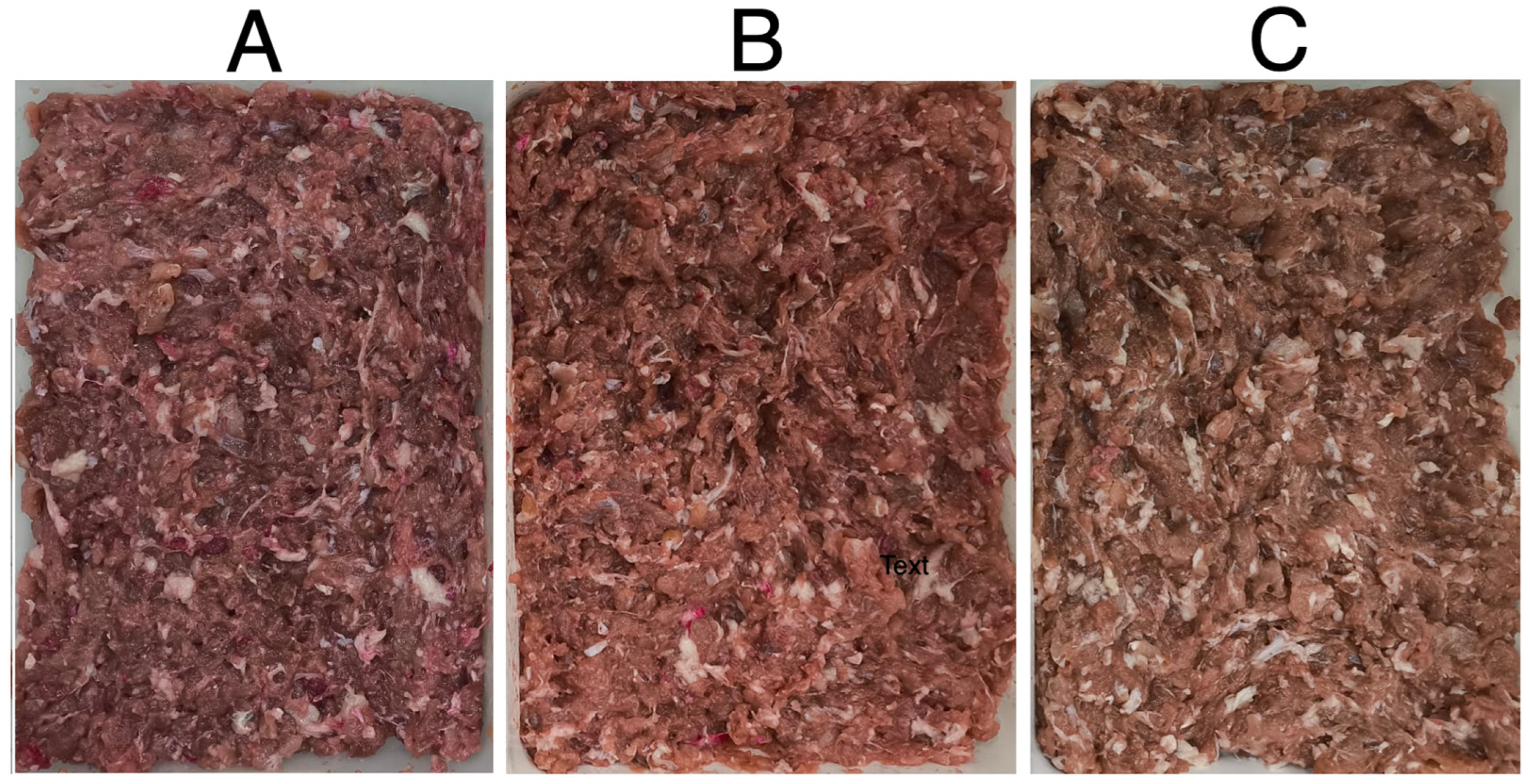
Figure 1. Fresh pork sausage masses before stuffing, formulated with 0.8% cochineal carmine (A), 0.4% cochineal carmine and 2.0% lactic-fermented tomato flour (B) and 2.0% lactic-fermented tomato flour (C).
Fermentation 12 00220 g001
Table 1. Formulation of the fresh pork sausage sample groups.
IngredientsTreatments (%)
T1T2T3
Pork leg84.3580.7583.15
Water12.0012.0012.00
Lactic-fermented tomato flour 2.002.00
Sodium chloride1.501.501.50
MasterMix Toscana 0822/BR *1.101.101.10
Master Cura SM **0.250.250.25
Cochineal carmine *** 0.800.40 
* Sodium chloride (60%), sodium erythorbate (10%), sodium tripolyphosphate (10%), powdered black pepper (10%), powdered onion (10%); ** Sodium chloride (90%), sodium nitrite (10%); *** Carminic acid (3%).
Table 2. Instrumental measurement (mean ± standard deviation) of the sample groups of fresh pork sausage.
ParametersT1T2T3
L*42.91 ± 2.21 a41.38 ± 4.05 a45.38 ± 1.55 b
a*15.29 ± 3.45 ab18.70 ± 3.54 a12.74 ± 2.65 b
b*7.80 ± 1.11 b14.02 ± 1.00 a13.55 ± 3.07 a
C*17.16 ± 3.51 b23.37 ± 1.24 a18.60 ± 3.45 b
27.05 ± 2.43 a36.85 ± 5.12 b46.76 ± 1.19 c
Different letters on the same line indicate a significant difference according to Tukey’s post hoc test, HSD (Honestly Significant Difference), with 95% confidence.
Table 3. Parametricity test (Shapiro–Wilk) and one-way analysis of variance (ANOVA) to evaluate the susceptibility of spoilage microbiota of fresh pork sausage to different concentrations of lactic-fermented tomato flour.
Shapiro–Wilk Test
ParametersαTest Statistic (p)Critical Value (pr)Conclusion
Xmax.0.0516.90870.916Parametric
Ymax.29.4126Parametric
ANOVA
Concentrations (%)Ymax *Xmax **
CP0.105 ± 0.021 a1.289 ± 0.111 a
0.5%0.108 ± 0.051 a1.232 ± 0.151 a
1.0%0.079 ± 0.022 a1.266 ± 0.091 a
2.0%0.034 ± 0.027 a0.883 ± 0.081 b
3.0%0.000 ± 0.0000.258 ± 0.024 c
4.0%0.000 ± 0.0000.053 ± 0.011 c
5.0%0.000 ± 0.0000.103 ± 0.022 c
10.0%0.000 ± 0.0000.120 ± 0.01 c
15.0%0.001 ± 0.0000.113 ± 0.012 c
20.0%0.000 ± 0.0000.113 ± 0.009 c
25.0%0.000 ± 0.0000.054 ± 0.029 c
CN0.000 ± 0.0000.000 ± 0.000
Values are expressed as mean ± standard deviation. Different superscript letters within the same column indicate statistically significant differences according to ANOVA followed by Tukey’s post hoc test (p < 0.05); * Maximum specific growth rate; ** Absolute microbial growth.
Table 4. Shelf-life study of fresh pork sausage.
In Vitro Trial
IncubationTotal Microbial Count (log CFU/g)
Temperature (°C)Time (Days)T1T2T3
 03.953.904.01
714.123.994.02
24.354.214.13
2516.545.675.01
29.018.566.57
In Silico Trial
Temperature profileParameters   
RefrigeratedN(growth) *0.120.090.05
N(deceleration) **0.080.060.03
Refrigerated with abuseN(growth) *0.220.170.09
N(deceleration) **0.120.100.05
RoomN(growth) *1.220.980.55
N(deceleration) **0.350.280.16
Shelf-Life (Days) ***
Refrigerated 4864129
Refrigerated with abuse 283770
Room 6715
* N(growth)—kinetics of microbial growth in the exponential phase (log cfu/g/day); ** N(deceleration)—kinetics of microbial growth in the deceleration phase (log cfu/g/day); *** The upper marginal limit of 9.3 log CFU/g was used to indicate the end of the shelf-life of meat products.
Disclaimer/Publisher’s Note: The statements, opinions and data contained in all publications are solely those of the individual author(s) and contributor(s) and not of MDPI and/or the editor(s). MDPI and/or the editor(s) disclaim responsibility for any injury to people or property resulting from any ideas, methods, instructions or products referred to in the content.


