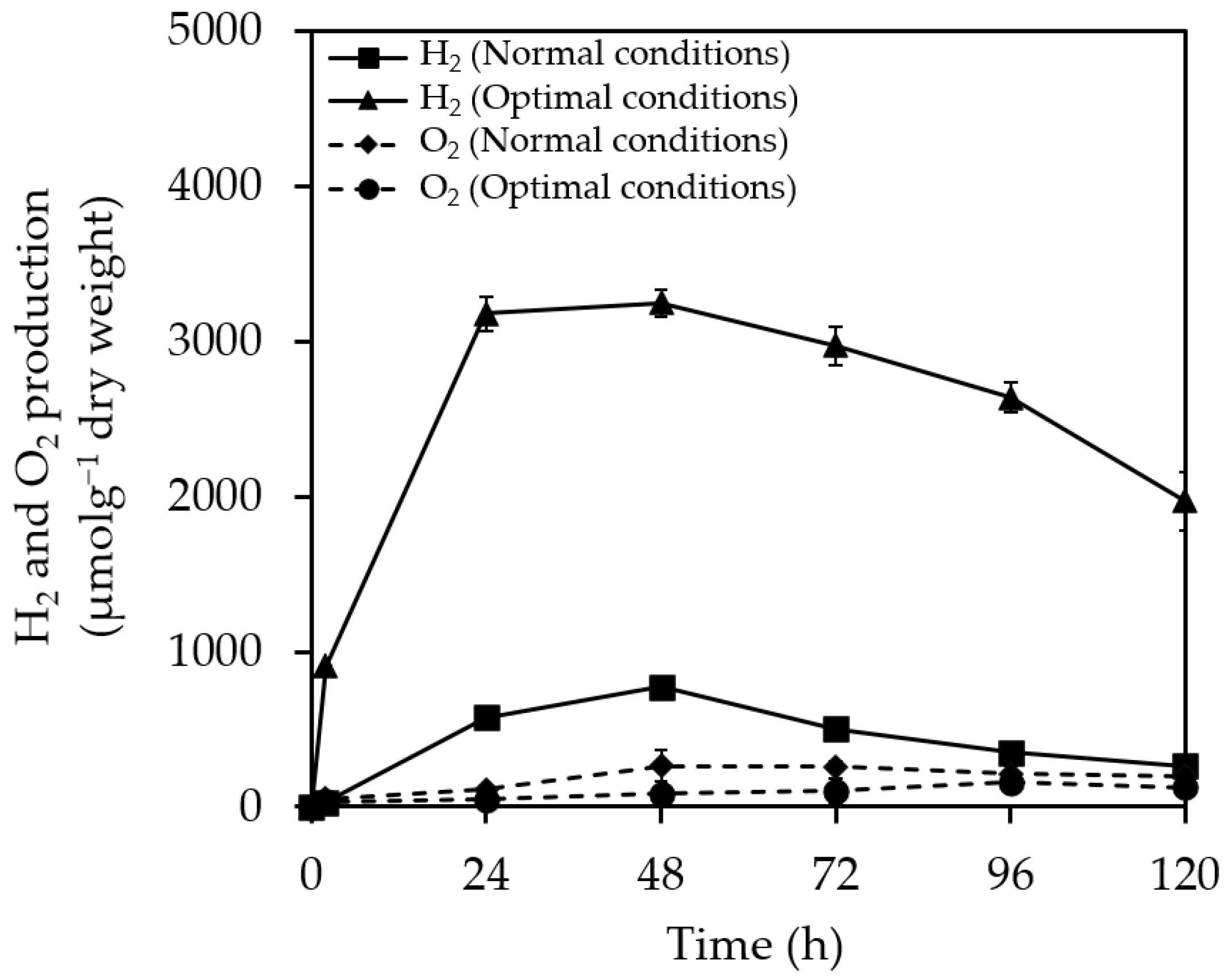

Enhanced Hydrogen Production by the Halotolerant Cyanobacterium Aphanothece halophytica Through Bacterial Co-Cultivation

Abstract
1. Introduction
2. Materials and Methods
2.1. Cyanobacterial Cultivation
2.2. Bacterial Cultivation
2.3. Co-Cultivation of Cyanobacteria with Bacteria
2.4. Screening of Bacterial Partners for Enhancing H2 Production by A. halophytica
2.5. Measurement of H2 and O2 Production
2.6. Bidirectional H2ase Activity Measurement
2.7. Effect of Bacterial Cell Age, Cell Density, and Inoculum Ratio on H2 Production
2.8. Investigation of the Effect of Carbon Sources and Concentration on H2 Production
2.9. Investigation of the Effect of Salinity on H2 Production
2.10. Investigation of the Effect of pH and Temperature on H2 Production
2.11. Statistical Analysis
3. Results
3.1. Bacterial Screening for Enhancement of H2 Production in Co-Culture
3.2. Effect of S. aureus TISTR 746 Cell Age on H2 Production
3.3. Effect of S. aureus TISTR 746 Cell Density on H2 Production
3.4. Impact of Inoculum Ratio on H2 Production, O2 Production, and Bidirectional H2ase Activity
3.5. Effect of Carbon Sources and Concentrations on H2 Production
3.6. Effect of Salinity on H2 Production
3.7. Effect of pH and Temperature on H2 Production
3.8. H2 Production Under Optimal Conditions
4. Discussion
5. Conclusions
Author Contributions
Funding
Institutional Review Board Statement
Informed Consent Statement
Data Availability Statement
Acknowledgments
Conflicts of Interest
References
- Atwoli, L.; Erhabor, G.E.; Gbakima, A.A.; Haileamlak, A.; Ntumba, J.-M.K.; Kigera, J.; Laybourn-Langton, L.; Mash, R.; Muhia, J.; Mulaudzi, F.M.; et al. COP27 Climate Change Conference: Urgent Action Needed for Africa and the World. Lancet Infect. Dis. 2023, 23, 19–21. [Google Scholar] [CrossRef]
- Wang, J.; Azam, W. Natural Resource Scarcity, Fossil Fuel Energy Consumption, and Total Greenhouse Gas Emissions in Top Emitting Countries. Geosci. Front. 2024, 15, 101757. [Google Scholar] [CrossRef]
- Hassan, Q.; Algburi, S.; Sameen, A.Z.; Jaszczur, M.; Salman, H.M. Hydrogen as an Energy Carrier: Properties, Storage Methods, Challenges, and Future Implications. Environ. Syst. Decis. 2024, 44, 327–350. [Google Scholar] [CrossRef]
- Wallington, T.J.; Woody, M.; Lewis, G.M.; Keoleian, G.A.; Adler, E.J.; Martins, J.R.R.A.; Collette, M.D. Hydrogen as a Sustainable Transportation Fuel. Renew. Sustain. Energy Rev. 2025, 217, 115725. [Google Scholar] [CrossRef]
- Osman, A.I.; Chen, L.; Yang, M.; Msigwa, G.; Farghali, M.; Fawzy, S.; Rooney, D.W.; Yap, P.-S. Cost, Environmental Impact, and Resilience of Renewable Energy under a Changing Climate: A Review. Environ. Chem. Lett. 2023, 21, 741–764. [Google Scholar] [CrossRef]
- Roumezi, B.; Avilan, L.; Risoul, V.; Brugna, M.; Rabouille, S.; Latifi, A. Overproduction of the Flv3B Flavodiiron, Enhances the Photobiological Hydrogen Production by the Nitrogen-Fixing Cyanobacterium Nostoc PCC 7120. Microb. Cell Fact. 2020, 19, 65. [Google Scholar] [CrossRef] [PubMed]
- Broussos, P.-I.; Romanos, G.E.; Stamatakis, K. H2 Production by the Unicellular Freshwater Cyanobacterium Synechococcus elongatus PCC7942 PAMCOD Strain. Int. J. Hydrogen Energy 2024, 52, 1298–1303. [Google Scholar] [CrossRef]
- Jiao, H.; Tsigkou, K.; Elsamahy, T.; Pispas, K.; Sun, J.; Manthos, G.; Schagerl, M.; Sventzouri, E.; Al-Tohamy, R.; Kornaros, M.; et al. Recent Advances in Sustainable Hydrogen Production from Microalgae: Mechanisms, Challenges, and Future Perspectives. Ecotoxicol. Environ. Saf. 2024, 270, 115908. [Google Scholar] [CrossRef]
- Zarei, Z.; Malekshahi, P.; Morowvat, M.H.; Trzcinski, A.P. A Review of Bioreactor Configurations for Hydrogen Production by Cyanobacteria and Microalgae. Int. J. Hydrogen Energy 2024, 49, 472–495. [Google Scholar] [CrossRef]
- Taikhao, S.; Junyapoon, S.; Incharoensakdi, A.; Phunpruch, S. Factors Affecting Biohydrogen Production by Unicellular Halotolerant Cyanobacterium Aphanothece halophytica. J. Appl. Phycol. 2013, 25, 575–585. [Google Scholar] [CrossRef]
- Taikhao, S.; Incharoensakdi, A.; Phunpruch, S. Dark Fermentative Hydrogen Production by the Unicellular Halotolerant Cyanobacterium Aphanothece halophytica Grown in Seawater. J. Appl. Phycol. 2015, 27, 187–196. [Google Scholar] [CrossRef]
- Jaramillo, A.; Satta, A.; Pinto, F.; Faraloni, C.; Zittelli, G.C.; Silva Benavides, A.M.; Torzillo, G.; Schumann, C.; Méndez, J.F.; Berggren, G.; et al. Outlook on Synthetic Biology-Driven Hydrogen Production: Lessons from Algal Photosynthesis Applied to Cyanobacteria. Energy Fuels 2025, 39, 4987–5006. [Google Scholar] [CrossRef]
- Chinchusak, N.; Incharoensakdi, A.; Phunpruch, S. Dark Fermentative Hydrogen Production and Transcriptional Analysis of Genes Involved in the Unicellular Halotolerant Cyanobacterium Aphanothece halophytica under Nitrogen and Potassium Deprivation. Front. Bioeng. Biotechnol. 2023, 10, 1028151. [Google Scholar] [CrossRef] [PubMed]
- Chinchusak, N.; Incharoensakdi, A.; Phunpruch, S. Enhancement of Dark Fermentative Hydrogen Production in Nitrogen-Deprived Halotolerant Unicellular Cyanobacterium Aphanothece halophytica by Treatment with Reducing Agents. Biomass Bioenergy 2022, 167, 106624. [Google Scholar] [CrossRef]
- Pansook, S.; Incharoensakdi, A.; Phunpruch, S. Enhanced Dark Fermentative H2 Production by Agar-Immobilized Cyanobacterium Aphanothece halophytica. J. Appl. Phycol. 2019, 31, 2869–2879. [Google Scholar] [CrossRef]
- Pansook, S.; Incharoensakdi, A.; Phunpruch, S. Effects of the Photosystem II Inhibitors CCCP and DCMU on Hydrogen Production by the Unicellular Halotolerant Cyanobacterium Aphanothece halophytica. Sci. World J. 2019, 2019, 1030236. [Google Scholar] [CrossRef] [PubMed]
- Javed, M.A.; Zafar, A.M.; Al-Zuhair, S.; El Badawy, A.; Aly Hassan, A. Exogenous Carbon Substrates for Biohydrogen Production and Organics Removal Using Microalgal-Bacterial Co-Culture. ACS Sustain. Chem. Eng. 2022, 10, 15490–15500. [Google Scholar] [CrossRef]
- Mohammed Al Nuaimi, M.; Javed, M.A.; El-Tarabily, K.A.; Hyoung Lee, W.; Aly Hassan, A. Biohydrogen Production of a Halophytic Cyanobacteria Phormidium keutzingium and Activated Sludge Co-Culture Using Different Carbon Substrates and Saline Concentrations. Energy Convers. Manag. X 2023, 20, 100487. [Google Scholar] [CrossRef]
- Fakhimi, N.; Tavakoli, O. Improving Hydrogen Production Using Co-Cultivation of Bacteria with Chlamydomonas reinhardtii Microalga. Mater. Sci. Energy Technol. 2019, 2, 1–7. [Google Scholar] [CrossRef]
- Yu, Q.; He, J.; Zhao, Q.; Wang, X.; Zhi, Y.; Li, X.; Li, X.; Li, L.; Ge, B. Regulation of Nitrogen Source for Enhanced Photobiological H2 Production by Co-Culture of Chlamydomonas reinhardtii and Mesorhizobium sangaii. Algal Res. 2021, 58, 102422. [Google Scholar] [CrossRef]
- Fakhimi, N.; Dubini, A.; Tavakoli, O.; González-Ballester, D. Acetic Acid Is Key for Synergetic Hydrogen Production in Chlamydomonas-Bacteria Co-Cultures. Bioresour. Technol. 2019, 289, 121648. [Google Scholar] [CrossRef]
- Laurinavichene, T.; Laurinavichius, K.; Shastik, E.; Tsygankov, A. Long-Term H2 Photoproduction from Starch by Co-Culture of Clostridium butyricum and Rhodobacter sphaeroides in a Repeated Batch Process. Biotechnol. Lett. 2018, 40, 309–314. [Google Scholar] [CrossRef] [PubMed]
- Rippka, R.; Stanier, R.Y.; Deruelles, J.; Waterbury, J.B. Generic Assignments, Strain Histories and Properties of Pure Cultures of Cyanobacteria. Microbiology 1979, 111, 1–61. [Google Scholar] [CrossRef]
- Garlick, S.; Oren, A.; Padan, E. Occurrence of Facultative Anoxygenic Photosynthesis among Filamentous and Unicellular Cyanobacteria. J. Bacteriol. 1977, 129, 623–629. [Google Scholar] [CrossRef]
- Sereetrakul, K.; Taikhao, S.; Chinchusak, N.; Phunpruch, S. Enhanced Hydrogen Production by Green Alga Scenedesmus obliquus TISTR 8546 under Atmospheric Air through Potassium Deprivation and Cysteine Supplementation. Algal Res. 2026, 94, 104559. [Google Scholar] [CrossRef]
- Zidan, A.; Javed, M.A.; Hassan, A.A. Optimization of Hydrogen Production Using a Coculture of Chlamydomonas reinhardtii and Activated Sludge Bacteria. Chemosphere 2024, 369, 143789. [Google Scholar] [CrossRef] [PubMed]
- Fakhimi, N.; Gonzalez-Ballester, D.; Fernández, E.; Galván, A.; Dubini, A. Algae-Bacteria Consortia as a Strategy to Enhance H2 Production. Cells 2020, 9, 1353. [Google Scholar] [CrossRef]
- Wang, S.; Tang, H.; Peng, F.; Yu, X.; Su, H.; Xu, P.; Tan, T. Metabolite-Based Mutualism Enhances Hydrogen Production in a Two-Species Microbial Consortium. Commun. Biol. 2019, 2, 82. [Google Scholar] [CrossRef]
- Neerincx, A.H.; Linders, Y.A.M.; Vermeulen, L.; Belderbos, R.A.; Mandon, J.; van Mastrigt, E.; Pijnenburg, M.W.; van Ingen, J.; Mouton, J.W.; Kluijtmans, L.A.J.; et al. Hydrogen Cyanide Emission in the Lung by Staphylococcus aureus. Eur. Respir. J. 2016, 48, 577–579. [Google Scholar] [CrossRef]
- Troitzsch, A.; Loi, V.V.; Methling, K.; Zühlke, D.; Lalk, M.; Riedel, K.; Bernhardt, J.; Elsayed, E.M.; Bange, G.; Antelmann, H.; et al. Carbon Source-Dependent Reprogramming of Anaerobic Metabolism in Staphylococcus aureus. J. Bacteriol. 2021, 203, e00639-20. [Google Scholar] [CrossRef] [PubMed]
- Mazumder, P.; Nath, D.; Manhar, A.K.; Gupta, K.; Saikia, D.; Mandal, M. Dark Fermentative Hydrogen Production from Lignocellulosic Agro-Waste by a Newly Isolated Bacteria Staphylococcus epidermidis B-6. In Resilience, Response, and Risk in Water Systems; Kumar, M., Munoz-Arriola, F., Furumai, H., Chaminda, T., Eds.; Springer Transactions in Civil and Environmental Engineering; Springer: Singapore, 2020; pp. 381–395. [Google Scholar]
- Greening, C.; Constant, P.; Hards, K.; Morales, S.E.; Oakeshott, J.G.; Russell, R.J.; Taylor, M.C.; Berney, M.; Conrad, R.; Cook, G.M. Atmospheric Hydrogen Scavenging: From Enzymes to Ecosystems. Appl. Environ. Microbiol. 2015, 81, 1190–1199. [Google Scholar] [CrossRef]
- Hupp, B.; Huszár, G.; Farkas, A.; Maróti, G. Algal Hydrogen Production and Exopolysaccharide Patterns in Chlorella–Bacillus Inter-Kingdom Co-Cultures. Fermentation 2023, 9, 424. [Google Scholar] [CrossRef]
- Li, Z.; Wang, J.; Feng, K.; Li, Y.; Ding, J.; Liu, B.; Ren, N.; Xing, D. Rapid Recruitment of Hydrogen-Producing Biofilms for Hydrogen Production in a Moving Bed Biofilm Reactor by a Sequential Immobilization and Deoxygenization Approach. Bioresour. Technol. 2020, 317, 123979. [Google Scholar] [CrossRef] [PubMed]
- Tognon, M.; Köhler, T.; Luscher, A.; Van Delden, C. Transcriptional Profiling of Pseudomonas aeruginosa and Staphylococcus aureus during in Vitro Co-Culture. BMC Genom. 2019, 20, 30. [Google Scholar] [CrossRef] [PubMed]
- Steinhilper, R.; Höff, G.; Heider, J.; Murphy, B.J. Structure of the Membrane-Bound Formate Hydrogenlyase Complex from Escherichia coli. Nat. Commun. 2022, 13, 5395. [Google Scholar] [CrossRef] [PubMed]
- Beaton, S.E.; Evans, R.M.; Finney, A.J.; Lamont, C.M.; Armstrong, F.A.; Sargent, F.; Carr, S.B. The Structure of Hydrogenase-2 from Escherichia coli: Implications for H2-Driven Proton Pumping. Biochem. J. 2018, 475, 1353–1370. [Google Scholar] [CrossRef]
- Lakatos, G.; Deák, Z.; Vass, I.; Rétfalvi, T.; Rozgonyi, S.; Rákhely, G.; Ördög, V.; Kondorosi, É.; Maróti, G. Bacterial Symbionts Enhance Photo-Fermentative Hydrogen Evolution of Chlamydomonas Algae. Green Chem. 2014, 16, 4716–4727. [Google Scholar] [CrossRef]
- Wu, S.; Li, X.; Yu, J.; Wang, Q. Increased Hydrogen Production in Co-Culture of Chlamydomonas reinhardtii and Bradyrhizobium japonicum. Bioresour. Technol. 2012, 123, 184–188. [Google Scholar] [CrossRef]
- Chen, P.-C.; Fan, S.-H.; Chiang, C.-L.; Lee, C.-M. Effect of Growth Conditions on the Hydrogen Production with Cyanobacterium Anabaena sp. Strain CH3. Int. J. Hydrogen Energy 2008, 33, 1460–1464. [Google Scholar] [CrossRef]
- Sukrachan, T.; Incharoensakdi, A. Enhanced Hydrogen Production by Nostoc sp. CU2561 Immobilized in a Novel Agar Bead. J. Appl. Phycol. 2020, 32, 1103–1115. [Google Scholar] [CrossRef]
- Bozieva, A.M.; Khasimov, M.K.; Rao, M.S.; Sinetova, M.A.; Voloshin, R.A.; Dunikov, D.O.; Tsygankov, A.A.; Leong, Y.K.; Chang, J.-S.; Allakhverdiev, S.I.; et al. Optimizing Cyanobacterial Hydrogen Production: Metabolic and Genetic Strategies with Glycerol Supplementation. Front. Energy Res. 2025, 13, 1547215. [Google Scholar] [CrossRef]
- Richardson, A.R. Virulence and Metabolism. Microbiol. Spectr. 2019, 7, GPP3-0011-2018. [Google Scholar] [CrossRef] [PubMed]
- Vitko, N.P.; Grosser, M.R.; Khatri, D.; Lance, T.R.; Richardson, A.R. Expanded Glucose Import Capability Affords Staphylococcus aureus Optimized Glycolytic Flux during Infection. mBio 2016, 7, e00296-16. [Google Scholar] [CrossRef] [PubMed]
- Laloknam, S.; Tanaka, K.; Buaboocha, T.; Waditee, R.; Incharoensakdi, A.; Hibino, T.; Tanaka, Y.; Takabe, T. Halotolerant Cyanobacterium Aphanothece halophytica Contains a Betaine Transporter Active at Alkaline pH and High Salinity. Appl. Environ. Microbiol. 2006, 72, 6018–6026. [Google Scholar] [CrossRef] [PubMed]
- Ochiai, T. Salt-Sensitive Growth of Staphylococcus aureus: Stimulation of Salt-Induced Autolysis by Multiple Environmental Factors. Microbiol. Immunol. 1999, 43, 705–709. [Google Scholar] [CrossRef]
- Feng, Y.; Ming, T.; Zhou, J.; Lu, C.; Wang, R.; Su, X. The Response and Survival Mechanisms of Staphylococcus aureus under High Salinity Stress in Salted Foods. Foods 2022, 11, 1503. [Google Scholar] [CrossRef]
- Yang, W.; Wang, F.; Liu, L.-N.; Sui, N. Responses of Membranes and the Photosynthetic Apparatus to Salt Stress in Cyanobacteria. Front. Plant Sci. 2020, 11, 713. [Google Scholar] [CrossRef]
- Rodionova, M.V.; Poudyal, R.S.; Tiwari, I.; Voloshin, R.A.; Zharmukhamedov, S.K.; Nam, H.G.; Zayadan, B.K.; Bruce, B.D.; Hou, H.J.M.; Allakhverdiev, S.I. Biofuel Production: Challenges and Opportunities. Int. J. Hydrogen Energy 2017, 42, 8450–8461. [Google Scholar] [CrossRef]
- Lee, H.; Park, J.H.; Park, Y.K.; Kim, H.J. Mathematical Modeling for the Growth of Salmonella spp. and Staphylococcus aureus in Cake at Fluctuating Temperatures. Appl. Sci. 2021, 11, 2475. [Google Scholar] [CrossRef]
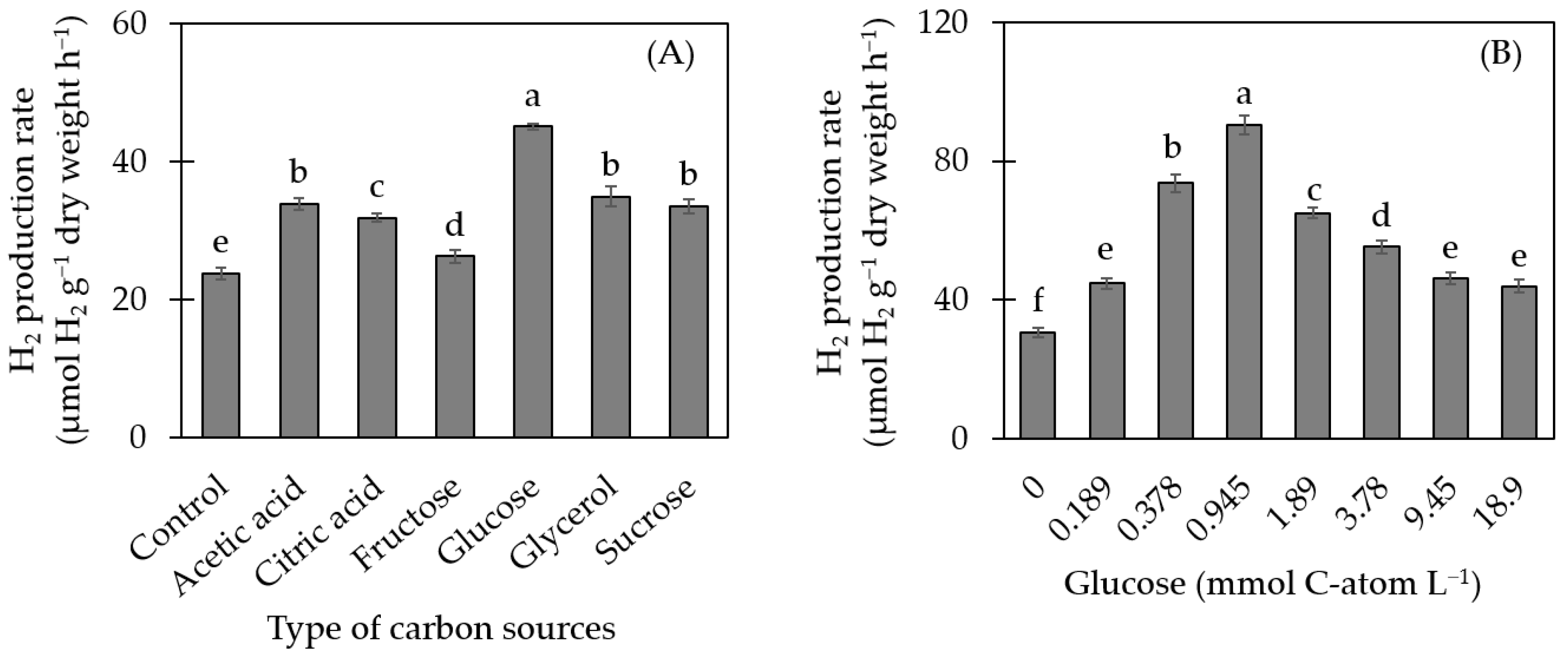
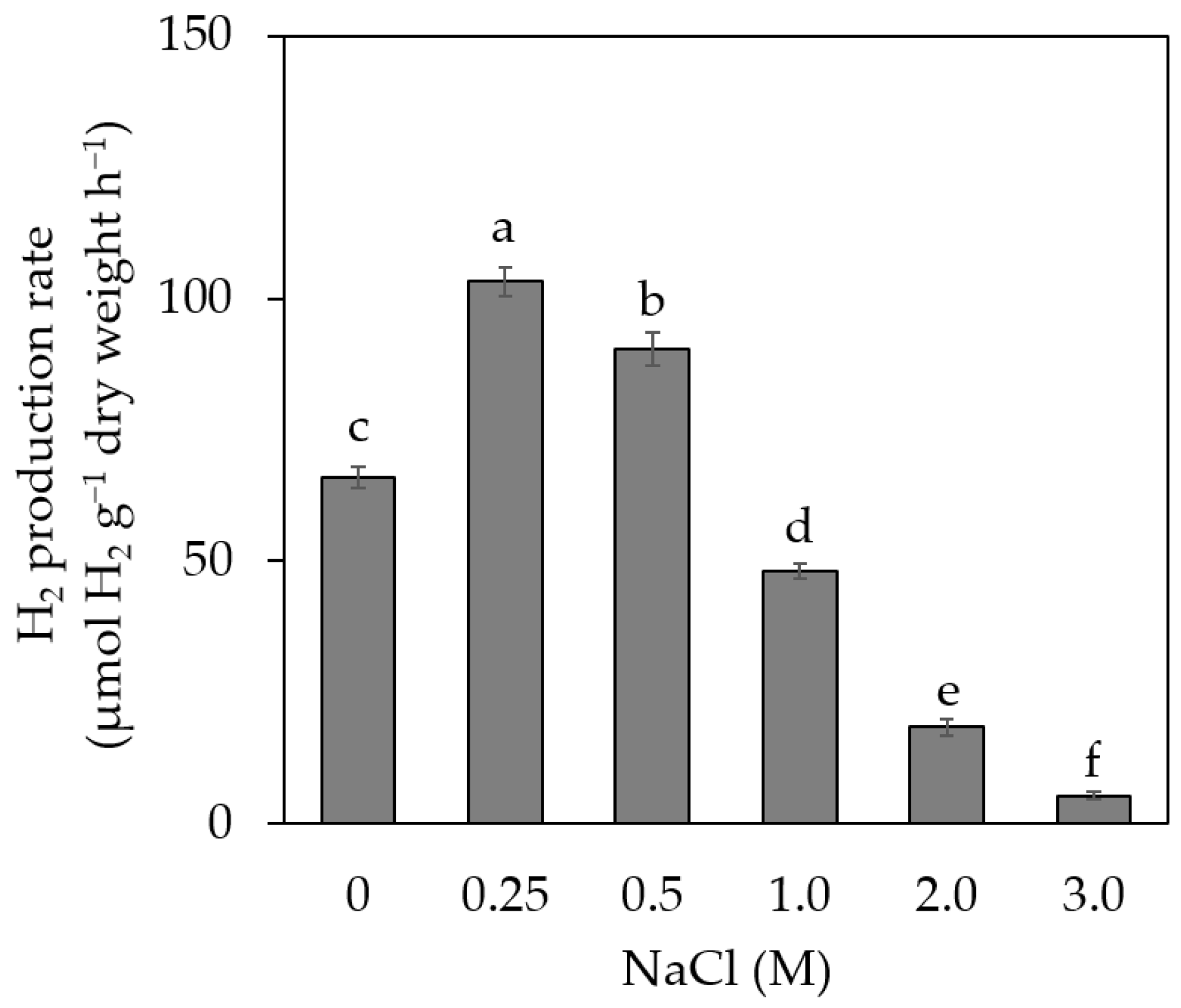
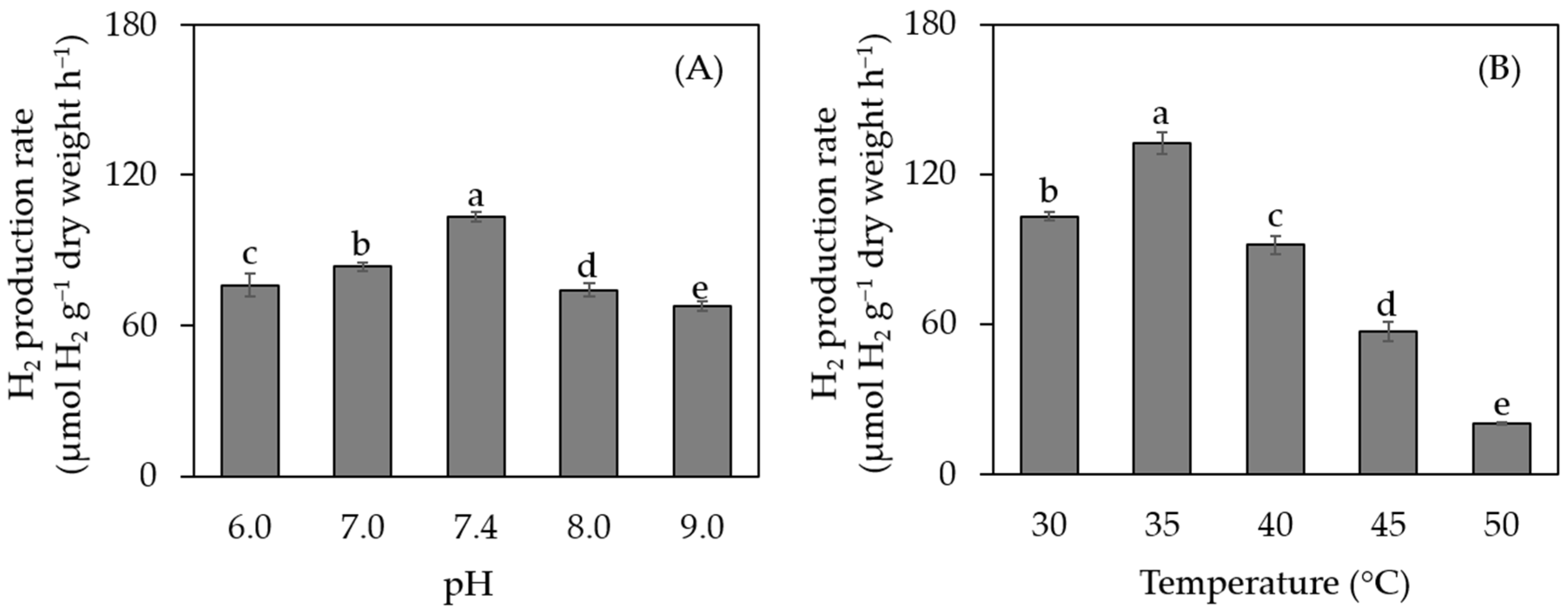


| Microorganisms | Maximum H2 Production Rate (µmol H2 g−1 Dry Weight h−1) | Maximum Cumulative H2 Production (µmol H2 g−1 Dry Weight) | O2 Production Rate (µmol O2 g−1 Dry Weight h−1) |
|---|---|---|---|
| Monocultures | |||
| A. halophytica | 4.87 ± 0.19 c | 116.97 ± 4.50 d | 22.27 ± 0.22 d |
| B. cereus TISTR 1449 | 0.20 ± 0.01 e | 23.41 ± 1.84 g | 2.77 ± 0.03 a |
| E. coli TISTR 074 | nd 1 | nd 1 | nd 1 |
| M. luteus TISTR 2374 | 0.19 ± 0.01 e | 23.28 ± 1.64 g | nd 1 |
| P. aeruginosa TISTR 2370 | 0.50 ± 0.04 d | 63.72 ± 4.77 e | 3.11 ± 0.10 a |
| S. aureus TISTR 746 | 0.66 ± 0.07 d | 57.19 ± 4.39 f | 3.47 ± 0.11 a |
| Co-cultures of A. halophytica with | |||
| B. cereus TISTR 1449 | 9.50 ± 0.43 b | 265.47 ± 9.12 b | 14.67 ± 0.60 c |
| E. coli TISTR 074 | 0.27 ± 0.08 e | 6.49 ± 1.81 h | 21.84 ± 1.12 d |
| M. luteus TISTR 2374 | 9.59 ± 0.36 b | 230.21 ± 8.58 c | 14.36 ± 0.79 c |
| P. aeruginosa TISTR 2370 | 9.72 ± 0.30 b | 233.35 ± 7.31 c | 14.12 ± 0.60 c |
| S. aureus TISTR 746 | 11.11 ± 0.18 a | 293.46 ± 5.12 a | 10.03 ± 0.28 b |
| S. aureus Cell Age (h) | Maximum H2 Production Rate (µmol H2 g−1 Dry Weight h−1) | Cumulative H2 Production (µmol H2 g−1 Dry Weight) | ||
|---|---|---|---|---|
| Incubation Time 24 h | Incubation Time 48 h | Incubation Time 72 h | ||
| 6 | 12.05 ± 0.20 c | 289.26 ± 4.74 c | 330.18 ± 11.70 c | 235.11 ± 4.51 c |
| 12 | 17.92 ± 0.21 a | 429.99 ± 4.93 a | 473.74 ± 13.31 a | 307.31 ± 8.63 a |
| 18 | 15.23 ± 0.21 b | 365.52 ± 4.95 b | 373.42 ± 17.03 b | 253.72 ± 5.38 b |
| 24 | 11.12 ± 0.25 d | 266.79 ± 5.95 d | 293.18 ± 8.40 d | 207.54 ± 8.80 d |
| OD600 | Cell Concentration (×108 CFU mL−1) | Maximum H2 Production Rate (µmol H2 g−1 Dry Weight h−1) | Maximum Cumulative H2 Production (µmol H2 g−1 Dry Weight) | O2 Production Rate (µmol O2 g−1 Dry Weight h−1) |
|---|---|---|---|---|
| 0.5 | 2.6 ± 0.1 | 2.77 ± 0.18 d | 66.38 ± 4.29 e | 14.52 ± 0.23 d |
| 1.0 | 5.1 ± 0.3 | 2.89 ± 0.19 d | 438.57 ± 3.84 d | 12.68 ± 0.26 c |
| 2.0 | 15.2 ± 0.9 | 17.98 ± 0.39 c | 480.07 ± 7.82 c | 9.86 ± 0.26 b |
| 4.0 | 37.3 ± 3.4 | 21.33 ± 0.50 a | 700.04 ± 6.47 a | 7.13 ± 0.20 a |
| 6.0 | 53.6 ± 6.5 | 18.79 ± 0.57 b | 584.20 ± 8.06 b | 7.19 ± 0.21 a |
| A. halophytica to S. aureus (v/v) | Maximum H2 Production Rate (µmol H2 g−1 Dry Weight h−1) | O2 Production Rate (µmol O2 g−1 Dry Weight h−1) | H2ase Activity (µmol H2 g−1 Dry Weight min−1) | Maximum Cumulative H2 Production (µmol H2 g−1 Dry Weight) |
|---|---|---|---|---|
| 5:0 | 5.19 ± 0.26 e | 18.20 ± 0.52 f | 0.83 ± 0.03 d | 124.66 ± 6.13 f |
| 4:1 | 23.97 ± 0.54 a | 4.61 ± 0.10 a | 1.55 ± 0.08 a | 771.56 ± 8.20 a |
| 2:1 | 22.80 ± 0.53 b | 6.31 ± 0.17 b | 1.39 ± 0.11 b | 714.87 ± 9.07 b |
| 1:1 | 21.05 ± 0.37 c | 7.18 ± 0.11 c | 1.02 ± 0.07 c | 699.27 ± 7.65 c |
| 1:2 | 20.32 ± 0.38 c | 7.98 ± 0.15 d | 0.82 ± 0.06 d | 588.37 ± 7.30 d |
| 1:4 | 18.84 ± 0.56 d | 8.97 ± 0.19 e | 0.78 ± 0.86 d | 517.39 ± 8.99 e |
Disclaimer/Publisher’s Note: The statements, opinions and data contained in all publications are solely those of the individual author(s) and contributor(s) and not of MDPI and/or the editor(s). MDPI and/or the editor(s) disclaim responsibility for any injury to people or property resulting from any ideas, methods, instructions or products referred to in the content. |
© 2026 by the authors. Licensee MDPI, Basel, Switzerland. This article is an open access article distributed under the terms and conditions of the Creative Commons Attribution (CC BY) license.
Share and Cite
Somsin, C.; Chinchusak, N.; Incharoensakdi, A.; Phunpruch, S. Enhanced Hydrogen Production by the Halotolerant Cyanobacterium Aphanothece halophytica Through Bacterial Co-Cultivation. Fermentation 2026, 12, 221. https://doi.org/10.3390/fermentation12050221
Somsin C, Chinchusak N, Incharoensakdi A, Phunpruch S. Enhanced Hydrogen Production by the Halotolerant Cyanobacterium Aphanothece halophytica Through Bacterial Co-Cultivation. Fermentation. 2026; 12(5):221. https://doi.org/10.3390/fermentation12050221
Chicago/Turabian StyleSomsin, Chutikarn, Nattanon Chinchusak, Aran Incharoensakdi, and Saranya Phunpruch. 2026. "Enhanced Hydrogen Production by the Halotolerant Cyanobacterium Aphanothece halophytica Through Bacterial Co-Cultivation" Fermentation 12, no. 5: 221. https://doi.org/10.3390/fermentation12050221
APA StyleSomsin, C., Chinchusak, N., Incharoensakdi, A., & Phunpruch, S. (2026). Enhanced Hydrogen Production by the Halotolerant Cyanobacterium Aphanothece halophytica Through Bacterial Co-Cultivation. Fermentation, 12(5), 221. https://doi.org/10.3390/fermentation12050221