
Ozone as a Sanitation Method in Winemaking: Improving Fermentation Control in the Context of Climate Change




Abstract
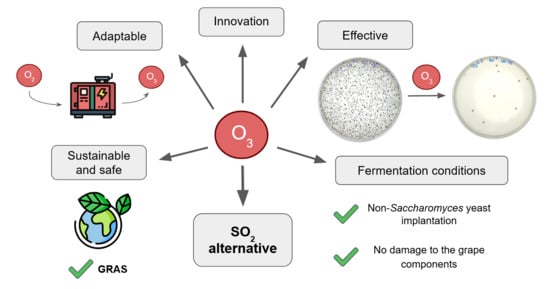
1. Introduction
1.1. The Impact of Climate Change on Viticulture
1.2. Non-Saccharomyces Yeasts as a Biotechnological Tool for Adaptation and Improvement
1.3. Non-Thermal Sanitization Technologies as an Alternative for Sulfites
1.4. Objective
2. Ozone as a Sanitizing Agent
2.1. General Information
2.2. Antimicrobial Mechanism of Action
2.3. Applications in the Wine Industry
2.4. Regulatory Framework
3. Comparison with Other Methods of Grape Sanitization
4. Conclusions
Author Contributions
Funding
Institutional Review Board Statement
Informed Consent Statement
Data Availability Statement
Conflicts of Interest
Abbreviations
| SO2 | Sulfur dioxide |
| O3 | Ozone |
| OIV | International Organisation of Vine and Wine |
| PEF | Pulsed Electric Field |
| PL | Pulsed Light |
| HHP | High Hydrostatic Pressure |
| US | Ultrasound |
| COD | Chemical Oxygen Demand |
| ROS | Reactive Oxygen Species |
| CFU | Colony-Forming Unit |
| VOCs | Volatile Organic Compounds |
| FDA | Food and Drug Administration |
| GRAS | Generally Recognized as Safe |
References
- Dinis, L.-T.; Bernardo, S.; Yang, C.; Fraga, H.; Malheiro, A.C.; Moutinho-Pereira, J.; Santos, J.A. Mediterranean Viticulture in the Context of Climate Change. Ciência Téc. Vitiv. 2022, 37, 139–158. [Google Scholar] [CrossRef]
- OIV-State_of_the_World_Vine-and-Wine-Sector-in-2024.Pdf. Available online: https://www.oiv.int/sites/default/files/documents/OIV-State_of_the_World_Vine-and-Wine-Sector-in-2024.pdf (accessed on 2 December 2025).
- Diaz, J.; Linares, C.; Negev, M.; Martinez, G.S. Climate and Environmental Change in the Mediterranean Basin—Current Situation and Risks for the Future; First Mediterranean Assessment Report; Union for the Mediterranean, Plan Bleu, UNEP/MAP: Marseille, France, 2020. [Google Scholar]
- Drappier, J.; Thibon, C.; Rabot, A.; Geny-Denis, L. Relationship between Wine Composition and Temperature: Impact on Bordeaux Wine Typicity in the Context of Global Warming—Review. Crit. Rev. Food Sci. Nutr. 2019, 59, 14–30. [Google Scholar] [CrossRef] [PubMed]
- van Leeuwen, C.; Darriet, P. The Impact of Climate Change on Viticulture and Wine Quality. J. Wine Econ. 2016, 11, 150–167. [Google Scholar] [CrossRef]
- Dominguez, D.L.E.; Cirrincione, M.A.; Deis, L.; Martínez, L.E. Impacts of Climate Change-Induced Temperature Rise on Phenology, Physiology, and Yield in Three Red Grape Cultivars: Malbec, Bonarda, and Syrah. Plants 2024, 13, 3219. [Google Scholar] [CrossRef] [PubMed]
- Mira de Orduña, R. Climate Change Associated Effects on Grape and Wine Quality and Production. Food Res. Int. 2010, 43, 1844–1855. [Google Scholar] [CrossRef]
- Ciani, M.; Comitini, F.; Mannazzu, I.; Domizio, P. Controlled Mixed Culture Fermentation: A New Perspective on the Use of Non-Saccharomyces Yeasts in Winemaking. FEMS Yeast Res. 2010, 10, 123–133. [Google Scholar] [CrossRef]
- Maicas, S. Advances in Wine Fermentation. Fermentation 2021, 7, 187. [Google Scholar] [CrossRef]
- Morata, A.; Loira, I.; Tesfaye, W.; Bañuelos, M.A.; González, C.; Suárez Lepe, J.A. Lachancea thermotolerans Applications in Wine Technology. Fermentation 2018, 4, 53. [Google Scholar] [CrossRef]
- Morata, A. Enological Repercussions of Non-Saccharomyces Species in Wine Biotechnology. Fermentation 2019, 5, 72. [Google Scholar] [CrossRef]
- Muñoz, V.A.P.; Del Rocío Castro-López, L.; Hernández, L.E.M.; Herrera, D.C.; Martínez, G.H.; Castillo, G. Evaluation of Bio-Acidifying Yeast Lachancea thermotolerans as a Strategy to Reduce the Effects of Climate Change in Tempranillo Grape Must Vinification. In Proceedings of the BIO Web of Conferences; EDP Sciences: London, UK, 2023; Volume 56. [Google Scholar]
- Sánchez-Suárez, F.; Martínez-García, R.; Peinado, R.A. Climate Change Adaptation in Winemaking: Combined Use of Non-Saccharomyces Yeasts to Improve the Quality of Pedro Ximénez Wines. Microorganisms 2025, 13, 1908. [Google Scholar] [CrossRef]
- Comitini, F.; Gobbi, M.; Domizio, P.; Romani, C.; Lencioni, L.; Mannazzu, I.; Ciani, M. Selected Non-Saccharomyces Wine Yeasts in Controlled Multistarter Fermentations with Saccharomyces cerevisiae. Food Microbiol. 2011, 28, 873–882. [Google Scholar] [CrossRef]
- Wang, X.; Fan, G.; Peng, Y.; Xu, N.; Xie, Y.; Zhou, H.; Liang, H.; Zhan, J.; Huang, W.; You, Y. Mechanisms and Effects of Non-Saccharomyces Yeast Fermentation on the Aromatic Profile of Wine. J. Food Compos. Anal. 2023, 124, 105660. [Google Scholar] [CrossRef]
- Del Fresno, J.M.; Morata, A.; Loira, I.; Bañuelos, M.A.; Escott, C.; Benito, S.; González Chamorro, C.; Suárez-Lepe, J.A. Use of Non-Saccharomyces in Single-Culture, Mixed and Sequential Fermentation to Improve Red Wine Quality. Eur. Food Res. Technol. 2017, 243, 2175–2185. [Google Scholar] [CrossRef]
- Granchi, L.; Patrignani, F.; Bianco, A.; Braschi, G.; Budroni, M.; Canonico, L.; Capece, A.; Cauzzi, A.; Ciani, M.; Chinnici, F.; et al. Comparison between Metschnikowia pulcherrima and Torulaspora delbrueckii Used in Sequential Wine Fermentations with Saccharomyces cerevisiae. Front. Microbiol. 2025, 16, 1590561. [Google Scholar] [CrossRef] [PubMed]
- Wang, C.; Yu, J.; Zhou, W.; Xu, Y. Research Progress on the Application of Non-Saccharomyces during Wine Fermentation. Sci. Agric. Sin. 2023, 56, 529–548. [Google Scholar] [CrossRef]
- Vaquero, C.; Loira, I.; Raso, J.; Álvarez, I.; Delso, C.; Morata, A. Pulsed Electric Fields to Improve the Use of Non-Saccharomyces Starters in Red Wines. Foods 2021, 10, 1472. [Google Scholar] [CrossRef]
- Delso, C.; Berzosa, A.; Sanz, J.; Álvarez, I.; Raso, J. Pulsed Electric Field Processing as an Alternative to Sulfites (SO2) for Controlling Saccharomyces cerevisiae Involved in the Fermentation of Chardonnay White Wine. Food Res. Int. 2023, 165, 112525. [Google Scholar] [CrossRef] [PubMed]
- Ortega-Rivas, E.; Salmerón-Ochoa, I. Nonthermal Food Processing Alternatives and Their Effects on Taste and Flavor Compounds of Beverages. Crit. Rev. Food Sci. Nutr. 2014, 54, 190–207. [Google Scholar] [CrossRef] [PubMed]
- Escott, C.; Loira, I.; Morata, A. Pulsed Light for Grape and Wine Processing. In Emerging Food Processing Technologies; Gavahian, M., Ed.; Springer: New York, NY, USA, 2022; pp. 133–143. [Google Scholar]
- Escott, C.; Vaquero, C.; del Fresno, J.M.; Bañuelos, M.A.; Loira, I.; Han, S.; Bi, Y.; Morata, A.; Suárez-Lepe, J.A. Pulsed Light Effect in Red Grape Quality and Fermentation. Food Bioprocess. Technol. 2017, 10, 1540–1547. [Google Scholar] [CrossRef]
- Bañuelos, M.A.; Loira, I.; Escott, C.; Del Fresno, J.M.; Morata, A.; Sanz, P.D.; Otero, L.; Suárez-Lepe, J.A. Grape Processing by High Hydrostatic Pressure: Effect on Use of Non-Saccharomyces in Must Fermentation. Food. Bioprocess Technol. 2016, 9, 1769–1778. [Google Scholar] [CrossRef]
- Buzrul, S. High Hydrostatic Pressure Treatment of Beer and Wine: A Review. Innov. Food Sci. Emerg. Technol. 2012, 13, 1–12. [Google Scholar] [CrossRef]
- Chemat, F.; Zill-e-Huma; Khan, M.K. Applications of Ultrasound in Food Technology: Processing, Preservation and Extraction. Ultrason. Sonochemistry 2011, 18, 813–835. [Google Scholar] [CrossRef] [PubMed]
- Montalvo-González, E.; Anaya-Esparza, L.M.; Domínguez-Avila, J.A.; González-Aguilar, G.A. Ultrasonic Processing Technology for Postharvest Disinfection. In Postharvest Disinfection of Fruits and Vegetables; Academic Press: Cambridge, MA, USA, 2018; pp. 101–119. [Google Scholar]
- Bellincontro, A.; Catelli, C.; Cotarella, R.; Mencarelli, F. Postharvest Ozone Fumigation of Petit Verdot Grapes to Prevent the Use of Sulfites and to Increase Anthocyanin in Wine. Aust. J. Grape Wine Res. 2017, 23, 200–206. [Google Scholar] [CrossRef]
- Botondi, R.; De Sanctis, F.; Moscatelli, N.; Vettraino, A.M.; Catelli, C.; Mencarelli, F. Ozone Fumigation for Safety and Quality of Wine Grapes in Postharvest Dehydration. Food Chem. 2015, 188, 641–647. [Google Scholar] [CrossRef]
- Cravero, F.; Englezos, V.; Rantsiou, K.; Torchio, F.; Giacosa, S.; Segade, S.R.; Gerbi, V.; Rolle, L.; Cocolin, L. Ozone Treatments of Post Harvested Wine Grapes: Impact on Fermentative Yeasts and Wine Chemical Properties. Food Res. Int. 2016, 87, 134–141. [Google Scholar] [CrossRef]
- Milella, R.A.; Forte, G.; Gentilesco, G.; Caponio, G.; Francese, G.; D’Alessandro, A.; Giannandrea, M.A.; Coletta, A. Ozonated Water for Enhancing Quality and Antioxidant Activity in Ready-to-Eat Table Grapes During Cold Storage. Horticulturae 2025, 11, 555. [Google Scholar] [CrossRef]
- Morata, A.; Loira, I.; Vejarano, R.; González, C.; Callejo, M.J.; Suárez-Lepe, J.A. Emerging Preservation Technologies in Grapes for Winemaking. Trends Food Sci. Technol. 2017, 67, 36–43. [Google Scholar] [CrossRef]
- Brodowska, A.J.; Nowak, A.; Śmigielski, K. Ozone in the Food Industry: Principles of Ozone Treatment, Mechanisms of Action, and Applications: An Overview. Crit. Rev. Food Sci. Nutr. 2018, 58, 2176–2201. [Google Scholar] [CrossRef]
- Khadre, M.A.; Yousef, A.E.; Kim, J.-G. Microbiological Aspects of Ozone Applications in Food: A Review. J. Food Sci. 2001, 66, 1242–1252. [Google Scholar] [CrossRef]
- Mostashari, P.; Gavahian, M.; Jafarzadeh, S.; Guo, J.-H.; Hadidi, M.; Pandiselvam, R.; Huseyn, E.; Mousavi Khaneghah, A. Ozone in Wineries and Wine Processing: A Review of the Benefits, Application, and Perspectives. Compr. Rev. Food Sci. Food Saf. 2022, 21, 3129–3152. [Google Scholar] [CrossRef] [PubMed]
- Guzzon, R.; Nardin, T.; Micheletti, O.; Nicolini, G.; Larcher, R. Antimicrobial Activity of Ozone. Effectiveness against the Main Wine Spoilage Microorganisms and Evaluation of Impact on Simple Phenols in Wine. Aust. J. Grape Wine Res. 2013, 19, 180–188. [Google Scholar] [CrossRef]
- Greene, A.K.; Güzel-Seydim, Z.B.; Seydim, A.C. Chemical and Physical Properties of Ozone. In Ozone in Food Processing; John Wiley & Sons, Ltd.: Hoboken, NJ, USA, 2012; pp. 19–32. [Google Scholar]
- Xue, W.; Macleod, J.; Blaxland, J. The Use of Ozone Technology to Control Microorganism Growth, Enhance Food Safety and Extend Shelf Life: A Promising Food Decontamination Technology. Foods 2023, 12, 814. [Google Scholar] [CrossRef] [PubMed]
- Hamid, Z.; Meyrick, B.K.; Macleod, J.; Heath, E.A.; Blaxland, J. The Application of Ozone within the Food Industry, Mode of Action, Current and Future Applications, and Regulatory Compliance. Lett. Appl. Microbiol. 2024, 77, ovae101. [Google Scholar] [CrossRef] [PubMed]
- Watanabe, M.; Masaki, H.; Mori, T.; Tsuchiya, T.; Konuma, H.; Hara-Kudo, Y.; Takatori, K. Inactivation Effects of UV Irradiation and Ozone Treatment on the Yeast and the Mold in Mineral Water. J. Food Prot. 2010, 73, 1537–1542. [Google Scholar] [CrossRef]
- Guzzon, R.; Franciosi, E.; Moser, S.; Carafa, I.; Larcher, R. Application of Ozone during Grape Drying for the Production of Straw Wine. Effects on the Microbiota and Compositive Profile of Grapes. J. Appl. Microbiol. 2018, 125, 513–527. [Google Scholar] [CrossRef]
- Feliziani, E.; Romanazzi, G.; Smilanick, J.L. Application of Low Concentrations of Ozone during the Cold Storage of Table Grapes. Postharvest Biol. Technol. 2014, 93, 38–48. [Google Scholar] [CrossRef]
- Río Segade, S.; Vilanova, M.; Pollon, M.; Giacosa, S.; Torchio, F.; Rolle, L. Grape VOCs Response to Postharvest Short-Term Ozone Treatments. Front. Plant Sci. 2018, 9, 1826. [Google Scholar] [CrossRef]
- Río Segade, S.; Vilanova, M.; Giacosa, S.; Perrone, I.; Chitarra, W.; Pollon, M.; Torchio, F.; Boccacci, P.; Gambino, G.; Gerbi, V.; et al. Ozone Improves the Aromatic Fingerprint of White Grapes. Sci. Rep. 2017, 7, 16301. [Google Scholar] [CrossRef]
- Paissoni, M.A.; Río Segade, S.; Giacosa, S.; Torchio, F.; Cravero, F.; Englezos, V.; Rantsiou, K.; Carboni, C.; Gerbi, V.; Teissedre, P.-L.; et al. Impact of Post-Harvest Ozone Treatments on the Skin Phenolic Extractability of Red Winegrapes Cv Barbera and Nebbiolo (Vitis vinifera L.). Food Res. Int. 2017, 98, 68–78. [Google Scholar] [CrossRef]
- Modesti, M.; Brizzolara, S.; Forniti, R.; Ceccantoni, B.; Bellincontro, A.; Catelli, C.; Mencarelli, F.; Tonutti, P. Postharvest Ozone Fumigation of Grapes (Cv Sangiovese) Differently Affects Volatile Organic Compounds and Polyphenol Profiles of Berries and Wine. Aust. J. Grape Wine Res. 2023, 2023, 8244309. [Google Scholar] [CrossRef]
- Gabler, F.M.; Smilanick, J.L.; Mansour, M.F.; Karaca, H. Influence of Fumigation with High Concentrations of Ozone Gas on Postharvest Gray Mold and Fungicide Residues on Table Grapes. Postharvest Biol. Technol. 2010, 55, 85–90. [Google Scholar] [CrossRef]
- Gao, C.; Lin, Q.; Dong, C.; Ji, H.; Yu, J.; Chen, C.; Zhu, Z.-Q.; Ban, Z.; Zhang, N.; Bao, Y. Effects of Ozone Concentration on the Postharvest Quality and Microbial Diversity of Muscat Hamburg Grapes. RSC Adv. 2020, 10, 9037–9045. [Google Scholar] [CrossRef] [PubMed]
- Carbone, K.; Mencarelli, F. Influence of Short-Term Postharvest Ozone Treatments in Nitrogen or Air Atmosphere on the Metabolic Response of White Wine Grapes. Food. Bioprocess Technol. 2015, 8, 1739–1749. [Google Scholar] [CrossRef]
- Morata, A.; Escott, C.; Vaquero, C.; del Fresno, J.M.; Loira, I.; Cuerda, R.; González, C. Use of Ozonation to Sanitize the Grapes during Red Wine Making. Effect on Acidification, Phenols, Aroma, Sensory Profile, and Implications in the Implantation of Lachancea thermotolerans Yeasts and SO2 Reduction. Food Biosci. 2025, 63, 105700. [Google Scholar] [CrossRef]
- Rodríguez, Y.; del Fresno, J.M.; González, C.; Bañuelos, M.A.; Morata, A. Ozone in Gaseous and Aqueous Phases as a Sanitizing Agent for Grapes Used in Winemaking and Its Impact on the Implantation of Lachancea thermotolerans. Sustain. Food Technol. 2025, 4, 496–506. [Google Scholar] [CrossRef]
- Lisov, N.; Čakar, U.; Milenković, D.; Čebela, M.; Vuković, G.; Despotović, S.; Petrović, A. The Influence of Cabernet Sauvignon Ripeness, Healthy State and Maceration Time on Wine and Fermented Pomace Phenolic Profile. Fermentation 2023, 9, 695. [Google Scholar] [CrossRef]
- Guzzon, R.; Widmann, G.; Malacarne, M.; Nardin, T.; Nicolini, G.; Larcher, R. Survey of the Yeast Population inside Wine Barrels and the Effects of Certain Techniques in Preventing Microbiological Spoilage. Eur. Food Res. Technol. 2011, 233, 285–291. [Google Scholar] [CrossRef]
- Romanazzi, G.; Lichter, A.; Gabler, F.M.; Smilanick, J.L. Recent Advances on the Use of Natural and Safe Alternatives to Conventional Methods to Control Postharvest Gray Mold of Table Grapes. Postharvest Biol. Technol. 2012, 63, 141–147. [Google Scholar] [CrossRef]
- Guillen, A.C.; Kechinski, C.P.; Manfroi, V. The Use of Ozone in a CIP System in the Wine Industry. Ozone Sci. Eng. 2010, 32, 355–360. [Google Scholar] [CrossRef]
- Secondary Direct Food Additives Permitted in Food for Human Consumption. Available online: https://www.federalregister.gov/documents/2001/06/26/01-15963/secondary-direct-food-additives-permitted-in-food-for-human-consumption (accessed on 16 January 2026).
- European Union. Commission Implementing Regulation (EU) 2023/1078 of 2 June 2023 Approving Ozone Generated from Oxygen as an Active Substance for Use in Biocidal Products of Product-Types 2, 4, 5 and 11 in Accordance with Regulation (EU) No 528/2012 of the European Parliament and of the Council (Text with EEA Relevance); European Union: Luxembourg, 2023; Volume 144. [Google Scholar]
- Oms-Oliu, G.; Martín-Belloso, O.; Soliva-Fortuny, R. Pulsed Light Treatments for Food Preservation. A Review. Food Bioprocess Technol. 2010, 3, 13–23. [Google Scholar] [CrossRef]
- Aguiló-Aguayo, I.; Charles, F.; Renard, C.M.G.C.; Page, D.; Carlin, F. Pulsed Light Effects on Surface Decontamination, Physical Qualities and Nutritional Composition of Tomato Fruit. Postharvest Biol. Technol. 2013, 86, 29–36. [Google Scholar] [CrossRef]
- Nawaz, A.; Irshad, S.; Luo, X.; Walayat, N.; Harlina, P.W.; Qin, Z.; Afzaal, M.; Islam, F. Advances in Green Food Processing Technologies: Enhancing Efficiency, Safety, and Sustainability. Food Control 2026, 181, 111715. [Google Scholar] [CrossRef]
- Bermúdez-Aguirre, D.; Mobbs, T.; Barbosa-Cánovas, G.V. Ultrasound Applications in Food Processing. In Ultrasound Technologies for Food and Bioprocessing; Feng, H., Barbosa-Canovas, G., Weiss, J., Eds.; Springer: New York, NY, USA, 2011; pp. 65–105. [Google Scholar]
- Gowshmeed, S.; Vithiya, R.; Ramassamy, E. Pulsed Electric Field for Food Preservation. In Proceedings of the 2023 International Conference on System, Computation, Automation and Networking (ICSCAN), Puducherry, India, 17–18 November 2023; pp. 1–5. [Google Scholar]
- Divol, B.; du Toit, M.; Duckitt, E. Surviving in the Presence of Sulphur Dioxide: Strategies Developed by Wine Yeasts. Appl. Microbiol. Biotechnol. 2012, 95, 601–613. [Google Scholar] [CrossRef] [PubMed]
- Guerrero, R.F.; Cantos-Villar, E. Demonstrating the Efficiency of Sulphur Dioxide Replacements in Wine: A Parameter Review. Trends Food Sci. Technol. 2015, 42, 27–43. [Google Scholar] [CrossRef]
- Elmnasser, N.; Guillou, S.; Leroi, F.; Orange, N.; Bakhrouf, A.; Federighi, M. Pulsed-Light System as a Novel Food Decontamination Technology: A Review. Can. J. Microbiol. 2007, 53, 813–821. [Google Scholar] [CrossRef]
- Gómez-López, V.M.; Devlieghere, F.; Bonduelle, V.; Debevere, J. Intense Light Pulses Decontamination of Minimally Processed Vegetables and Their Shelf-Life. Int. J. Food Microbiol. 2005, 103, 79–89. [Google Scholar] [CrossRef]
- Morata, A.; Escott, C.; Loira, I.; López, C.; Palomero, F.; González, C. Emerging Non-Thermal Technologies for the Extraction of Grape Anthocyanins. Antioxidants 2021, 10, 1863. [Google Scholar] [CrossRef]
- Corrales, M.; Toepfl, S.; Butz, P.; Knorr, D.; Tauscher, B. Extraction of Anthocyanins from Grape By-Products Assisted by Ultrasonics, High Hydrostatic Pressure or Pulsed Electric Fields: A Comparison. Innov. Food Sci. Emerg. Technol. 2008, 9, 85–91. [Google Scholar] [CrossRef]
- Yordanov, D.G.; Angelova, G.V. High Pressure Processing for Foods Preserving. Biotechnol. Biotechnol. Equip. 2010, 24, 1940–1945. [Google Scholar] [CrossRef]
- Mercanti, N.; Macaluso, M.; Pieracci, Y.; Flamini, G.; Scappaticci, G.; Marianelli, A.; Zinnai, A. Towards Sulphite-Free Winemaking: A New Horizon of Vinification and Maturation. Foods 2024, 13, 1108. [Google Scholar] [CrossRef]
- Silva, F.V.M.; van Wyk, S. Emerging Non-Thermal Technologies as Alternative to SO2 for the Production of Wine. Foods 2021, 10, 2175. [Google Scholar] [CrossRef] [PubMed]



| Grape Variety | Ozone Treatment | Conditions and Purpose | Results | Reference |
|---|---|---|---|---|
| Moscato bianco | Two different ozone concentrations of gaseous ozone for 24 and 48 h | 20 ± 2 °C and 60 ± 5% relative humidity (RH). Improvement in grape characteristics for subsequent fermentation | Changes in volatile organic compound concentrations present in grapes after ozone treatment | [43] |
| Moscato giallo, Sauvignon blanc, Gewürztraminer and Riesling | After a preliminary step of saturation of the chamber (30 min), continuous gaseous ozone for 6 h every 6 days for 6 weeks | 20 °C Sanitization and conservation in the drying process | Control the microorganisms in grapes that cause deterioration without altering the volatile profile of the grapes. | [41] |
| Moscato bianco | 24 days under air ozone-enriched atmosphere | 20 ± 2 °C and 60 ± 5% RH. Improvement in grape characteristics for subsequent fermentation | Increase in the total content of volatile organic compounds. | [44] |
| Nebbiolo and Barbera | Continuous 30 μL/L ozone concentration for 24 and 72 h | 20 °C and 70% RH. Improvement in grape characteristics for subsequent fermentation | The extraction capacity of phenolic compounds is not affected or even improves in grapes treated with ozone, depending on the variety and exposure time. | [45] |
| Sangiovese | Continuous gaseous ozone at the maximum flow rate for 12 h | In a cold room at 4 ± 0.5 °C and 70% RH. Improvement in grape characteristics for subsequent fermentation | Increase in total polyphenol and flavonoid content and upregulation of specific genes involved in polyphenol biosynthesis in grapes. | [46] |
| Thompson Seedless’, ‘Autumn Seedless’, ‘Redglobe’, ‘Black Seedless’, and ‘Ruby Seedless’ | Fumigation with ozone gas at various concentrations and for different periods of time. | 5 ± 2 °C Sanitization and conservation of table grapes | High concentrations of ozone significantly reduced the number of Botrytis cinerea infections. | [47] |
| Muscat Hamburg | Three different concentrations of ozone for 30 min every day for 80 days | 0 ± 1 °C Preservation of the grape during storage | Changes in the fungal community on the surface of the grape and reduction in fungal diversity, which reduces the occurrence of diseases. | [48] |
| Petit Verdot | Ozone fumigation overnight (12 h) | In a cold room at 4 °C and 70% RH Sanitization and improvement in grape characteristics for subsequent fermentation | Reduction in the microbial count of the initial population in the grapes and increase in the extraction of phenolic substances and the aroma of the final wine. | [28] |
| Pignola | Ozone fumigation for 18 h | 10 °C Sanitization and conservation in the drying process | Reduction of microbial count in grapes without affecting their polyphenol and carotenoid content. | [29] |
| Grechetto | Constant ozone fumigation in air and nitrogen atmosphere for 12 h | 10 ± 1 °C and 90 ± 2% RH Improvement in grape characteristics for subsequent fermentation | Preserves fruit quality and has a great impact on secondary metabolites like flavonols. | [49] |
| Barbera | Recirculation of ozone-enriched air for 12 and 24 h + Spray with aqueous ozone for 6 and 12 min | 20 ± 1 °C and 57 ± 3% RH and water temperature of 25 °C for aqueous ozone Sanitizing the grapes for subsequent controlled fermentation. | Reduction in the initial population of microorganisms on grape skin | [30] |
| Tempranillo | Spray ozonated water on a sorting table | Water temperature of 15 °C Sanitizing the grapes for subsequent controlled fermentation. | Reduction in the initial population of microorganisms on the grape skin, allowing the implantation of non-Saccharomyces yeast. | [50] |
| Red Globe | After a preliminary step of atmosphere saturation, continuous fumigation with gaseous ozone for 30 min and immersion in ozonated water for 30 min | 20 °C Sanitizing the grapes for subsequent controlled fermentation. | Reduction in the initial population of microorganisms on the grape skin with both treatments, allowing the implantation of non-Saccharomyces yeast. | [51] |
| Methodology | Antimicrobial Effectiveness | Implications for Product Quality | Safety Concerns | Cost Analysis | Environmental and Health Impact |
|---|---|---|---|---|---|
| Ozone (O3) | ● | ● | ● | ● | ● |
| Pulsed Light (PL) | ● | ● | ● | ● | ● |
| High Hydrostatic Pressure (HHP) | ● | ● | ● | ● | ● |
| Ultrasound (US) | ● | ● | ● | ● | ● |
| Pulsed Electric Field (PEF) | ● | ● | ● | ● | ● |
| Sulfur Dioxide (SO2) | ● | ● | ● | ● | ● |
Disclaimer/Publisher’s Note: The statements, opinions and data contained in all publications are solely those of the individual author(s) and contributor(s) and not of MDPI and/or the editor(s). MDPI and/or the editor(s) disclaim responsibility for any injury to people or property resulting from any ideas, methods, instructions or products referred to in the content. |
© 2026 by the authors. Licensee MDPI, Basel, Switzerland. This article is an open access article distributed under the terms and conditions of the Creative Commons Attribution (CC BY) license.
Share and Cite
Rodríguez, Y.; Del Fresno, J.M.; González, C.; Morata, A. Ozone as a Sanitation Method in Winemaking: Improving Fermentation Control in the Context of Climate Change. Fermentation 2026, 12, 190. https://doi.org/10.3390/fermentation12040190
Rodríguez Y, Del Fresno JM, González C, Morata A. Ozone as a Sanitation Method in Winemaking: Improving Fermentation Control in the Context of Climate Change. Fermentation. 2026; 12(4):190. https://doi.org/10.3390/fermentation12040190
Chicago/Turabian StyleRodríguez, Yaiza, Juan Manuel Del Fresno, Carmen González, and Antonio Morata. 2026. "Ozone as a Sanitation Method in Winemaking: Improving Fermentation Control in the Context of Climate Change" Fermentation 12, no. 4: 190. https://doi.org/10.3390/fermentation12040190
APA StyleRodríguez, Y., Del Fresno, J. M., González, C., & Morata, A. (2026). Ozone as a Sanitation Method in Winemaking: Improving Fermentation Control in the Context of Climate Change. Fermentation, 12(4), 190. https://doi.org/10.3390/fermentation12040190