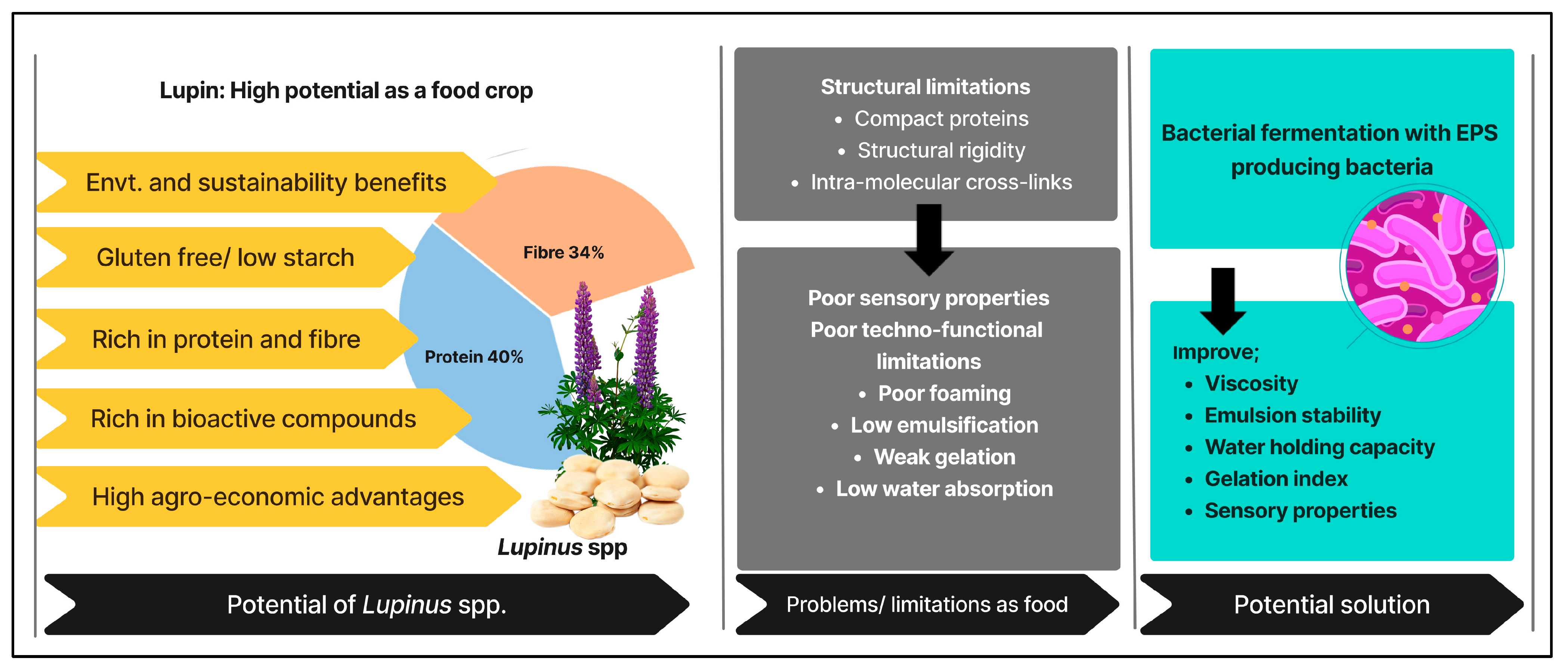

Exploring the Potential of Lupin Fermentation with Exopolysaccharide-Producing Lactic Acid Bacteria to Enhance Techno-Functional Properties

 , ,
, ,  and
and
Abstract
1. Introduction
2. Nutritional Profile and Benefits of Lupin
2.1. Nutritional Composition
2.2. Health Benefits
2.3. Environmental and Agricultural Benefits
3. Techno-Functional Properties of Lupin
3.1. Solubility
3.2. Rheological Properties
3.3. Water Absorption and Oil Absorption Capacity
3.4. Swelling Capacity
3.5. Gelation Properties
3.6. Emulsification Properties
3.7. Foaming Properties
4. Fermenting with EPS-Producing LAB as a Strategy to Overcome Techno-Functional Challenges
5. Conclusion and Future Directions
Author Contributions
Funding
Institutional Review Board Statement
Informed Consent Statement
Data Availability Statement
Conflicts of Interest
References
- Chiofalo, B.; Presti, V.L.; Chiofalo, V.; Gresta, F. The productive traits, fatty acid profile and nutritional indices of three lupin (Lupinus spp.) species cultivated in a Mediterranean environment for the livestock. Anim. Feed. Sci. Technol. 2012, 171, 230–239. [Google Scholar] [CrossRef]
- Sujak, A.; Kotlarz, A.; Strobel, W. Compositional and nutritional evaluation of several lupin seeds. Food Chem. 2006, 98, 711–719. [Google Scholar] [CrossRef]
- Ruiz-López, M.A.; Barrientos-Ramírez, L.; García-López, P.M.; Valdés-Miramontes, E.H.; Zamora-Natera, J.F.; Rodríguez-Macias, R.; Salcedo-Pérez, E.; Bañuelos-Pineda, J.; Vargas-Radillo, J.J. Nutritional and Bioactive Compounds in Mexican Lupin Beans Species: A Mini-Review. Nutrients 2019, 11, 1785. [Google Scholar] [CrossRef]
- Pereira, A.; Ramos, F.; Sanches Silva, A. Lupin (Lupinus albus L.) Seeds: Balancing the Good and the Bad and Addressing Future Challenges. Molecules 2022, 27, 8557. [Google Scholar] [CrossRef]
- Lemus-Conejo, A.; Rivero-Pino, F.; la Paz, S.M.-D.; Millan-Linares, M.C. Nutritional composition and biological activity of narrow-leafed lupins (Lupinus angustifolius L.) hydrolysates and seeds. Food Chem. 2023, 420, 136104. [Google Scholar] [CrossRef]
- Lucas, M.M.; Stoddard, F.L.; Annicchiarico, P.; Frías, J.; Martínez-Villaluenga, C.; Sussmann, D.; Duranti, M.; Seger, A.; Zander, P.M.; Pueyo, J.J. The future of lupin as a protein crop in Europe. Front. Plant Sci. 2015, 6, 705. [Google Scholar] [CrossRef]
- van de Noort, M. Lupin: An Important Protein and Nutrient Source. In Sustainable Protein Sources: Advances for a Healthier Tomorrow, 2nd ed.; Nadathur, S., Wanasundara, J.P.D., Scanlin, L., Eds.; Academic Press: London, UK, 2024; pp. 219–239. [Google Scholar] [CrossRef]
- Gresta, F.; Wink, M.; Prins, U.; Abberton, M.; Capraro, J.; Scarafoni, A.; Hill, G. Lupins in European cropping systems. In Legumes in Cropping Systems; Murphy-Bokern, D., Stoddard, F.L., Watson, C.A., Eds.; CAB International: Wallingford, UK, 2017; pp. 88–108. [Google Scholar] [CrossRef]
- Johnson, S.K.; Clements, J.; Villarino, C.B.J.; Coorey, R. Lupins: Their Unique Nutritional and Health-Promoting Attributes. In Gluten-Free Ancient Grains; Taylor, J.R.N., Awika, J.M., Eds.; Woodhead Publishing: Duxford, UK, 2017; pp. 179–221. [Google Scholar] [CrossRef]
- Motzo, R.; Giunta, F. Triticale–lupin intercropping offers a viable option for low-input systems in Mediterranean environments. Ann. Appl. Biol. 2025, 187, 264–279. [Google Scholar] [CrossRef]
- Chukwuejim, S.; Utioh, A.; Choi, T.D.; Aluko, R.E. Lupin Seed Proteins: A Comprehensive Review of Composition, Extraction Technologies, Food Functionality, and Health Benefits. Food Rev. Int. 2023, 40, 691–714. [Google Scholar] [CrossRef]
- Jimenez-Lopez, J.C. Narrow-leafed lupin (Lupinus angustifolius L.) β-conglutin: A multifunctional family of proteins with roles in plant defence, human health benefits, and potential uses as functional food. Legum. Sci. 2020, 2, e33. [Google Scholar] [CrossRef]
- FAO. FAO/INFOODS Global database for pulses on dry matter basis. Version 1.0- PulsesDM1.0; FAO: Rome, Italy, 2017; p. 22. [Google Scholar]
- U.S. Department of Agriculture; Agricultural Research Service; Beltsville Human Nutrition Research Center. FoodData Central. Available online: https://fdc.nal.usda.gov/ (accessed on 10 December 2025).
- Wanniarachchi, P.C.; Shea, G.; Mocerino, M.; Bennett, S.J.; Bhattarai, R.R.; Coorey, R. What Makes Lupins Less Palatable to Consumers? Can the Sensory Quality of Lupin be Improved and Commercialized? Compr. Rev. Food Sci. Food Saf. 2025, 24, e70265. [Google Scholar] [CrossRef]
- Raikos, V.; Neacsu, M.; Russell, W.; Duthie, G. Comparative study of the functional properties of lupin, green pea, fava bean, hemp, and buckwheat flours as affected by pH. Food Sci. Nutr. 2014, 2, 802–810. [Google Scholar] [CrossRef]
- Huamaní-Perales, C.; Vidaurre-Ruiz, J.; Salas-Valerio, W.; Cabezas, D.M.; Repo-Carrasco-Valencia, R. A review of techno-functional properties of legume proteins and their potential for development of new products. Eur. Food Res. Technol. 2024, 250, 2069–2092. [Google Scholar] [CrossRef]
- Hojilla-Evangelista, M.P.; Sessa, D.J.; Mohamed, A. Functional properties of soybean and lupin protein concentrates produced by ultrafiltration-diafiltration. J. Am. Oil Chem. Soc. 2004, 81, 1153–1157. [Google Scholar] [CrossRef]
- Lo, B.; Kasapis, S.; Farahnaky, A. Lupin protein: Isolation and techno-functional properties, a review. Food Hydrocoll. 2021, 112, 106318. [Google Scholar] [CrossRef]
- Al-Ali, H.A.; Shah, U.; Hackett, M.J.; Gulzar, M.; Karakyriakos, E.; Johnson, S.K. Technological strategies to improve gelation properties of legume proteins with the focus on lupin. Innov. Food Sci. Emerg. Technol. 2021, 68, 102634. [Google Scholar] [CrossRef]
- Estivi, L.; Buratti, S.; Fusi, D.; Benedetti, S.; Rodríguez, G.; Brandolini, A.; Hidalgo, A. Alkaloid content and taste profile assessed by electronic tongue of Lupinus albus seeds debittered by different methods. J. Food Compos. Anal. 2022, 114, 104810. [Google Scholar] [CrossRef]
- Kaczmarska, K.T.; Chandra-Hioe, M.V.; Frank, D.; Arcot, J. Aroma characteristics of lupin and soybean after germination and effect of fermentation on lupin aroma. LWT 2018, 87, 225–233. [Google Scholar] [CrossRef]
- Shrestha, S.; Hag, L.V.; Haritos, V.S.; Dhital, S. Lupin proteins: Structure, isolation and application. Trends Food Sci. Technol. 2021, 116, 928–939. [Google Scholar] [CrossRef]
- Sinkovič, L.; Pipan, B.; Šibul, F.; Nemeš, I.; Horecki, A.T.; Meglič, V. Nutrients, Phytic Acid and Bioactive Compounds in Marketable Pulses. Plants 2022, 12, 170. [Google Scholar] [CrossRef]
- Senanayake, D.; Torley, P.J.; Chandrapala, J.; Terefe, N.S. Microbial Fermentation for Improving the Sensory, Nutritional and Functional Attributes of Legumes. Fermentation 2023, 9, 635. [Google Scholar] [CrossRef]
- Shiferaw Terefe, N.; Augustin, M.A. Fermentation for tailoring the technological and health related functionality of food products. Crit. Rev. Food Sci. Nutr. 2020, 60, 2887–2913. [Google Scholar] [CrossRef] [PubMed]
- Schlegel, K.; Leidigkeit, A.; Eisner, P.; Schweiggert-Weisz, U. Technofunctional and Sensory Properties of Fermented Lupin Protein Isolates. Foods 2019, 8, 678. [Google Scholar] [CrossRef]
- Schlegel, K.; Lidzba, N.; Ueberham, E.; Eisner, P.; Schweiggert-Weisz, U. Fermentation of Lupin Protein Hydrolysates—Effects on Their Functional Properties, Sensory Profile and the Allergenic Potential of the Major Lupin Allergen Lup an 1. Foods 2021, 10, 281. [Google Scholar] [CrossRef]
- Malekipoor, R.; Johnson, S.K.; Bhattarai, R.R. Lupin Kernel Fibre: Nutritional Composition, Processing Methods, Physicochemical Properties, Consumer Acceptability and Health Effects of Its Enriched Products. Nutrients 2022, 14, 2845. [Google Scholar] [CrossRef]
- Nwodo, U.U.; Green, E.; Okoh, A.I. Bacterial Exopolysaccharides: Functionality and Prospects. Int. J. Mol. Sci. 2012, 13, 14002–14015. [Google Scholar] [CrossRef]
- Mende, S.; Rohm, H.; Jaros, D. Influence of exopolysaccharides on the structure, texture, stability and sensory properties of yoghurt and related products. Int. Dairy J. 2016, 52, 57–71. [Google Scholar] [CrossRef]
- Ruas-Madiedo, P.; Hugenholtz, J.; Zoon, P. An overview of the functionality of exopolysaccharides produced by lactic acid bacteria. Int. Dairy J. 2002, 12, 163–171. [Google Scholar] [CrossRef]
- Terefe, G. Preservation techniques and their effect on nutritional values and microbial population of brewer’s spent grain: A review. CABI Agric. Biosci. 2022, 3, 1–8. [Google Scholar] [CrossRef]
- Tiwari, S.; Kavitake, D.; Devi, P.B.; Shetty, P.H. Bacterial exopolysaccharides for improvement of technological, functional and rheological properties of yoghurt. Int. J. Biol. Macromol. 2021, 183, 1585–1595. [Google Scholar] [CrossRef]
- Kavitake, D.; Delattre, C.; Devi, P.B.; Pierre, G.; Michaud, P.; Shetty, P.H.; Andhare, P. Physical and functional characterization of succinoglycan exopolysaccharide produced by Rhizobium radiobacter CAS from curd sample. Int. J. Biol. Macromol. 2019, 134, 1013–1021. [Google Scholar] [CrossRef] [PubMed]
- Yang, T.; Wu, K.; Wang, F.; Liang, X.; Liu, Q.; Li, G.; Li, Q. Effect of exopolysaccharides from lactic acid bacteria on the texture and microstructure of buffalo yoghurt. Int. Dairy J. 2014, 34, 252–256. [Google Scholar] [CrossRef]
- Zhu, Y.; Wang, X.; Pan, W.; Shen, X.; He, Y.; Yin, H.; Zhou, K.; Zou, L.; Chen, S.; Liu, S. Exopolysaccharides produced by yogurt-texture improving Lactobacillus plantarum RS20D and the immunoregulatory activity. Int. J. Biol. Macromol. 2019, 121, 342–349. [Google Scholar] [CrossRef]
- Petterson, D.S. Composition and Food Uses of Lupins. In Lupins as Crop Plants: Biology, Production and Utilization; Gladstones, J., Atkins, C., Hamblin, J., Eds.; CAB International: Wallingford, UK, 1998; pp. 353–384. [Google Scholar]
- Jul, L.B.; Flengmark, P.; Gylling, M.; Itenov, K. Lupin seed (Lupinus albus and Lupinus luteus) as a protein source for fermentation use. Ind. Crop. Prod. 2003, 18, 199–211. [Google Scholar] [CrossRef]
- Nørgaard, J.V.; Fernández, J.A.; Jørgensen, H. Ileal digestibility of sunflower meal, pea, rapeseed cake, and lupine in pigs. J. Anim. Sci. 2012, 90, 203–205. [Google Scholar] [CrossRef]
- Duranti, M.; Consonni, A.; Magni, C.; Sessa, F.; Scarafoni, A. The major proteins of lupin seed: Characterisation and molecular properties for use as functional and nutraceutical ingredients. Trends Food Sci. Technol. 2008, 19, 624–633. [Google Scholar] [CrossRef]
- Emkani, M.; Moundanga, S.; Oliete, B.; Saurel, R. Protein composition and nutritional aspects of pea protein fractions obtained by a modified isoelectric precipitation method using fermentation. Front. Nutr. 2023, 10, 1284413. [Google Scholar] [CrossRef] [PubMed]
- Djemaoune, Y.; Cases, E.; Saurel, R. The Effect of High-Pressure Microfluidization Treatment on the Foaming Properties of Pea Albumin Aggregates. J. Food Sci. 2019, 84, 2242–2249. [Google Scholar] [CrossRef]
- Berghout, J.A.M.; Boom, R.M.; van der Goot, A.J. Understanding the differences in gelling properties between lupin protein isolate and soy protein isolate. Food Hydrocoll. 2015, 43, 465–472. [Google Scholar] [CrossRef]
- Santoso, T.; Al-Shaikhli, Y.; Ho, T.M.; Rajapakse, M.; Le, T.T. Optimising Enzymatic Cross-Linking: Impact on Physicochemical and Functional Properties of Lupin Flour and Soy Protein Isolate. Foods 2025, 14, 1976. [Google Scholar] [CrossRef]
- Devkota, L.; Kyriakopoulou, K.; Fernandez, D.; Bergia, R.; Dhital, S. Techno-functional and rheological characterisation of protein isolates from two Australian lupin species as affected by processing conditions. Int. J. Food Sci. Technol. 2023, 59, 774–784. [Google Scholar] [CrossRef]
- Zhu, P.; Yang, J.; Chen, L. Protein–water–protein interaction: Viscosity and gelation. In Functionality of Plant Proteins: Properties, Methods of Assessment, Modifications and Applications; Wanasundara, J.P.D., Schmitt, C., Lamsal, B.P., Eds.; Academic Press: London, UK, 2024; pp. 115–150. [Google Scholar] [CrossRef]
- Naumann, S.; Schweiggert-Weisz, U.; Martin, A.; Schuster, M.; Eisner, P. Effects of extrusion processing on the physiochemical and functional properties of lupin kernel fibre. Food Hydrocoll. 2021, 111, 106222. [Google Scholar] [CrossRef]
- Ferchichi, N.; Toukabri, W.; Vrhovsek, U.; Nouairi, I.; Angeli, A.; Masuero, D.; Mhamdi, R.; Trabelsi, D. Proximate composition, lipid and phenolic profiles, and antioxidant activity of different ecotypes of Lupinus albus, Lupinus luteus and lupinus angustifolius. J. Food Meas. Charact. 2021, 15, 1241–1257. [Google Scholar] [CrossRef]
- Bryant, L.; Rangan, A.; Grafenauer, S. Lupins and Health Outcomes: A Systematic Literature Review. Nutrients 2022, 14, 327. [Google Scholar] [CrossRef]
- Fechner, A.; Fenske, K.; Jahreis, G. Effects of legume kernel fibres and citrus fibre on putative risk factors for colorectal cancer: A randomised, double-blind, crossover human intervention trial. Nutr. J. 2013, 12, 101. [Google Scholar] [CrossRef]
- Yaver, E.; Bilgiçli, N. Ultrasound-treated lupin (Lupinus albus L.) flour: Protein- and fiber-rich ingredient to improve physical and textural quality of bread with a reduced glycemic index. LWT 2021, 148, 111767. [Google Scholar] [CrossRef]
- Yang, X.; Croft, K.D.; Lee, Y.P.; Mori, T.A.; Puddey, I.B.; Sipsas, S.; Barden, A.; Swinny, E.; Hodgson, J.M. The Effects of a Lupin-Enriched Diet on Oxidative Stress and Factors Influencing Vascular Function in Overweight Subjects. Antioxidants Redox Signal. 2010, 13, 1517–1524. [Google Scholar] [CrossRef] [PubMed]
- Khan, M.K.; Karnpanit, W.; Nasar-Abbas, S.M.; Huma, Z.; Jayasena, V. Phytochemical composition and bioactivities of lupin: A review. Int. J. Food Sci. Technol. 2015, 50, 2004–2012. [Google Scholar] [CrossRef]
- Sulas, L.; Canu, S.; Ledda, L.; Carroni, A.M.; Salis, M. Yield and nitrogen fixation potential from white lupine grown in rainfed Mediterranean environments. Sci. Agricola 2016, 73, 338–346. [Google Scholar] [CrossRef]
- Palmero, F.; Fernandez, J.A.; Garcia, F.O.; Haro, R.J.; Prasad, P.V.; Salvagiotti, F.; Ciampitti, I.A. A quantitative review into the contributions of biological nitrogen fixation to agricultural systems by grain legumes. Eur. J. Agron. 2022, 136, 126514. [Google Scholar] [CrossRef]
- Menegat, S.; Ledo, A.; Tirado, R. Greenhouse gas emissions from global production and use of nitrogen synthetic fertilisers in agriculture. Sci. Rep. 2022, 12, 14490, https://doi.org/10.1038/s41598-022-18773-w. Correction in Sci. Rep. 2022, 12, 19777. [Google Scholar] [CrossRef]
- Annicchiarico, P.; Romani, M.; Pecetti, L. White lupin (Lupinus albus) variation for adaptation to severe drought stress. Plant Breed. 2018, 137, 782–789. [Google Scholar] [CrossRef]
- French, R.J.; Buirchell, B.J. Lupin: The largest grain legume crop in Western Australia, its adaptation and improvement through plant breeding. Aust. J. Agric. Res. 2005, 56, 1169–1180. [Google Scholar] [CrossRef]
- Sathe, S.K. Protein Solubility and Functionality. In Food Proteins and Peptides; Hettiarachchy, N.S., Sato, K., Marshall, M.R., Kannan, A., Eds.; CRC Press: Boca Raton, FL, USA, 2012; pp. 95–124. [Google Scholar]
- Domínguez, R.; Bermúdez, R.; Pateiro, M.; Lucas-González, R.; Lorenzo, J.M. Optimization and Characterization of Lupin Protein Isolate Obtained Using Alkaline Solubilization-Isoelectric Precipitation. Foods 2023, 12, 3875. [Google Scholar] [CrossRef]
- Chukwuejim, S.; Aluko, R.E. Comparative study of the emulsifying properties of blue lupin, white lupin, and soybean protein isolates. LWT 2024, 206, 116544. [Google Scholar] [CrossRef]
- Trevino, S.R.; Scholtz, J.M.; Pace, C.N. Measuring and Increasing Protein Solubility. J. Pharm. Sci. 2008, 97, 4155–4166. [Google Scholar] [CrossRef]
- Doxastakis, G. Lupin seed proteins. In Developments in Food Science: Novel Macromolecules in Food Systems; Doxastakis, G., Kiosseoglou, V., Eds.; Elsevier: Amsterdam, Netherlands, 2000; Volume 41, pp. 7–38. [Google Scholar] [CrossRef]
- Gao, Z.; Shen, P.; Lan, Y.; Cui, L.; Ohm, J.-B.; Chen, B.; Rao, J. Effect of alkaline extraction pH on structure properties, solubility, and beany flavor of yellow pea protein isolate. Food Res. Int. 2020, 131, 109045. [Google Scholar] [CrossRef]
- El-Adawy, T.; Rahma, E.; El-Bedawey, A.; Gafar, A. Nutritional potential and functional properties of sweet and bitter lupin seed protein isolates. Food Chem. 2001, 74, 455–462. [Google Scholar] [CrossRef]
- Muranyi, I.S.; Volke, D.; Hoffmann, R.; Eisner, P.; Herfellner, T.; Brunnbauer, M.; Koehler, P.; Schweiggert-Weisz, U. Protein distribution in lupin protein isolates from Lupinus angustifolius L. prepared by various isolation techniques. Food Chem. 2016, 207, 6–15. [Google Scholar] [CrossRef]
- Devkota, L.; Kyriakopoulou, K.; Bergia, R.; Dhital, S. Structural and Thermal Characterization of Protein Isolates from Australian Lupin Varieties as Affected by Processing Conditions. Foods 2023, 12, 908. [Google Scholar] [CrossRef]
- Mazumder, K.; Biswas, B.; Kerr, P.G.; Blanchard, C.; Nabila, A.; Golder, M.; Aziz, M.G.; Farahnaky, A. Comparative assessment of nutritional, thermal, rheological and functional properties of nine Australian lupin cultivars. Sci. Rep. 2021, 11, 21515. [Google Scholar] [CrossRef]
- Alu’Datt, M.H.; Rababah, T.; Alhamad, M.N.; Ereifej, K.; Gammoh, S.; Kubow, S.; Tawalbeh, D. Preparation of mayonnaise from extracted plant protein isolates of chickpea, broad bean and lupin flour: Chemical, physiochemical, nutritional and therapeutic properties. J. Food Sci. Technol. 2017, 54, 1395–1405. [Google Scholar] [CrossRef]
- Kyriakopoulou, K.; Keppler, J.K.; van der Goot, A.J. Functionality of Ingredients and Additives in Plant-Based Meat Analogues. Foods 2021, 10, 600. [Google Scholar] [CrossRef]
- Lampart-Szczapa, E.; Konieczny, P.; Nogala-Kałucka, M.; Walczak, S.; Kossowska, I.; Malinowska, M. Some functional properties of lupin proteins modified by lactic fermentation and extrusion. Food Chem. 2006, 96, 290–296. [Google Scholar] [CrossRef]
- Spina, A.; Summo, C.; Timpanaro, N.; Canale, M.; Sanfilippo, R.; Amenta, M.; Strano, M.C.; Allegra, M.; Papa, M.; Pasqualone, A. Lupin as Ingredient in Durum Wheat Breadmaking: Physicochemical Properties of Flour Blends and Bread Quality. Foods 2024, 13, 807. [Google Scholar] [CrossRef]
- Rodríguez-Ambriz, S.L.; Martínez-Ayala, A.L.; Millán, F.; Dávila-Ortíz, G. Composition and Functional Properties of Lupinus campestris Protein Isolates. Plant Foods Hum. Nutr. 2005, 60, 99–107. [Google Scholar] [CrossRef]
- Flory, J.; Xiao, R.; Li, Y.; Dogan, H.; Talavera, M.J.; Alavi, S. Understanding Protein Functionality and Its Impact on Quality of Plant-Based Meat Analogues. Foods 2023, 12, 3232. [Google Scholar] [CrossRef]
- Batista, A.P.; Portugal, C.A.; Sousa, I.; Crespo, J.G.; Raymundo, A. Accessing gelling ability of vegetable proteins using rheological and fluorescence techniques. Int. J. Biol. Macromol. 2005, 36, 135–143. [Google Scholar] [CrossRef] [PubMed]
- Pasqualone, A.; Costantini, M.; Coldea, T.E.; Summo, C. Use of Legumes in Extrusion Cooking: A Review. Foods 2020, 9, 958. [Google Scholar] [CrossRef]
- Makri, E.; Papalamprou, E.; Doxastakis, G. Study of functional properties of seed storage proteins from indigenous European legume crops (lupin, pea, broad bean) in admixture with polysaccharides. Food Hydrocoll. 2005, 19, 583–594. [Google Scholar] [CrossRef]
- Ivanov, M.; Munialo, C.D. The investigation of the functional properties of single and mixed milk/lupine protein systems. Int. J. Food Sci. Technol. 2023, 58, 5728–5737. [Google Scholar] [CrossRef]
- Chih, V.J.H.J.; Nasar-Abbas, S.M. Functional Properties of Sweet Lupin Protein Isolated and Tested at Various pH Levels. Res. J. Agric. Biol. Sci. 2010, 6, 130–137. [Google Scholar]
- Amagliani, L.; Silva, J.V.; Saffon, M.; Dombrowski, J. On the foaming properties of plant proteins: Current status and future opportunities. Trends Food Sci. Technol. 2021, 118, 261–272. [Google Scholar] [CrossRef]
- Cano-Medina, A.; Jiménez-Islas, H.; Dendooven, L.; Herrera, R.P.; González-Alatorre, G.; Escamilla-Silva, E.M. Emulsifying and foaming capacity and emulsion and foam stability of sesame protein concentrates. Food Res. Int. 2011, 44, 684–692. [Google Scholar] [CrossRef]
- Anaemene, D.; Fadupin, G. Anti-nutrient reduction and nutrient retention capacity of fermentation, germination and combined germination-fermentation in legume processing. Appl. Food Res. 2022, 2, 100059. [Google Scholar] [CrossRef]
- Samtiya, M.; Aluko, R.E.; Dhewa, T. Plant food anti-nutritional factors and their reduction strategies: An overview. Food Prod. Process. Nutr. 2020, 2, 6. [Google Scholar] [CrossRef]
- Laaksonen, O.; Kahala, M.; Marsol-Vall, A.; Blasco, L.; Järvenpää, E.; Rosenvald, S.; Virtanen, M.; Tarvainen, M.; Yang, B. Impact of lactic acid fermentation on sensory and chemical quality of dairy analogues prepared from lupine (Lupinus angustifolius L.) seeds. Food Chem. 2021, 346, 128852. [Google Scholar] [CrossRef] [PubMed]
- Latha Ravi, J.; Ghosh, P.; Ahmad, F.; Haque, S.; Barciela, P.; Chamorro, F.; Jorge, A.O.S.; Prieto, M.A.; Rana, S.S. Microbial conversion of vegetable waste for flavor additives via solid-state fermentation: A comprehensive review. Front. Nutr. 2025, 12, 1445189. [Google Scholar] [CrossRef] [PubMed]
- Emkani, M.; Oliete, B.; Saurel, R. Effect of Lactic Acid Fermentation on Legume Protein Properties, a Review. Fermentation 2022, 8, 244. [Google Scholar] [CrossRef]
- Emkani, M. Impact of lactic Fermentation on pea Protein Composition and Their Aromatic Profile in a Modified Isoelectric Precipitation Extraction Method. Impact de la Fermentation Lactique sur la Composition des Protéines de pois et Leur Profil Aromatique dans une Méthode Modifiée D’extraction par Précipitation Isoélectrique. Doctoral Thesis, Université Bourgogne Franche-Comté, Besançon, France, 2023. [Google Scholar]
- Sharma, R.; Garg, P.; Kumar, P.; Bhatia, S.K.; Kulshrestha, S. Microbial Fermentation and Its Role in Quality Improvement of Fermented Foods. Fermentation 2020, 6, 106. [Google Scholar] [CrossRef]
- Sun, W.; Shahrajabian, M.H.; Lin, M. Research Progress of Fermented Functional Foods and Protein Factory-Microbial Fermentation Technology. Fermentation 2022, 8, 688. [Google Scholar] [CrossRef]
- Abedi, E.; Hashemi, S.M.B. Lactic acid production—Producing microorganisms and substrates sources-state of art. Heliyon 2020, 6, e04974. [Google Scholar] [CrossRef]
- Sáez, G.D.; Sabater, C.; Fara, A.; Zárate, G. Fermentation of chickpea flour with selected lactic acid bacteria for improving its nutritional and functional properties. J. Appl. Microbiol. 2021, 133, 181–199. [Google Scholar] [CrossRef]
- Korcz, E.; Varga, L. Exopolysaccharides from lactic acid bacteria: Techno-functional application in the food industry. Trends Food Sci. Technol. 2021, 110, 375–384. [Google Scholar] [CrossRef]
- Prete, R.; Alam, M.K.; Perpetuini, G.; Perla, C.; Pittia, P.; Corsetti, A. Lactic Acid Bacteria Exopolysaccharides Producers: A Sustainable Tool for Functional Foods. Foods 2021, 10, 1653. [Google Scholar] [CrossRef]
- Osemwegie, O.O.; Adetunji, C.O.; Ayeni, E.A.; Adejobi, O.I.; Arise, R.O.; Nwonuma, C.O.; Oghenekaro, A.O. Exopolysaccharides from bacteria and fungi: Current status and perspectives in Africa. Heliyon 2020, 6, e04205. [Google Scholar] [CrossRef] [PubMed]
- Lobo, R.E.; Figueroa, T.; Navarro, D.; Gómez, M.I.; de Valdez, G.F.; Torino, M.I. Techno-functional properties of HoPS from lactic acid bacteria of different origins as potential food additives. Food Chem. 2021, 356, 129627. [Google Scholar] [CrossRef]
- Jindal, N.; Singh Khattar, J. Microbial Polysaccharides in Food Industry. In Biopolymers for Food Design: Handbook of Food Bioengineering; Grumezescu, A.M., Holban, A.M., Eds.; Academic Press: London, UK, 2018; pp. 95–123. [Google Scholar] [CrossRef]
- Diether, N.E.; Willing, B.P. Microbial Fermentation of Dietary Protein: An Important Factor in Diet–Microbe–Host Interaction. Microorganisms 2019, 7, 19. [Google Scholar] [CrossRef]
- Jurášková, D.; Ribeiro, S.C.; Silva, C.C.G. Exopolysaccharides Produced by Lactic Acid Bacteria: From Biosynthesis to Health-Promoting Properties. Foods 2022, 11, 156. [Google Scholar] [CrossRef]
- Che, H.; Zhang, H.; Tian, Y.; Lai, P.F.; Xia, Y.; Wang, S.; Ai, L. Exopolysaccharide from Streptococcus thermophilus as stabilizer in fermented dairy: Binding kinetics and interactions with casein of milk. Int. J. Biol. Macromol. 2019, 140, 1018–1025. [Google Scholar] [CrossRef]
- Tarazanova, M.; Huppertz, T.; Kok, J.; Bachmann, H. Altering textural properties of fermented milk by using surface-engineered Lactococcus lactis. Microb. Biotechnol. 2018, 11, 770–780. [Google Scholar] [CrossRef]
- Zhang, L.M.; Zhou, J.F.; Hui, P.S. Thickening, shear thinning and thixotropic behavior of a new polysaccharide-based polyampholyte in aqueous solutions. Colloids Surfaces A Physicochem. Eng. Asp. 2005, 259, 189–195. [Google Scholar] [CrossRef]
- Gagnaire, V.; Lechevalier, V.; Famelart, M.; Croguennec, T.; Bouhallab, S. The Role of Proteins in the Development of Food Structure. In Handbook of Food Structure Development; Spyropoulos, F., Lazidis, A., Norton, I., Eds.; The Royal Society of Chemistry: Cambridge, UK, 2019; pp. 29–58. [Google Scholar] [CrossRef]
- Sim, S.Y.J.; SRV, A.; Chiang, J.H.; Henry, C.J. Plant Proteins for Future Foods: A Roadmap. Foods 2021, 10, 1967. [Google Scholar] [CrossRef]
- Daba, G.M.; Elnahas, M.O.; Elkhateeb, W.A. Contributions of exopolysaccharides from lactic acid bacteria as biotechnological tools in food, pharmaceutical, and medical applications. Int. J. Biol. Macromol. 2021, 173, 79–89. [Google Scholar] [CrossRef] [PubMed]
- Deng, Q.; Li, H.; Sun, H.; Sun, Y.; Li, Y. Hyperbranched exopolysaccharide-enhanced foam properties of sodium fatty alcohol polyoxyethylene ether sulfate. Colloids Surfaces B Biointerfaces 2016, 141, 206–212. [Google Scholar] [CrossRef] [PubMed]
- Yang, J.; Faber, I.; Berton-Carabin, C.C.; Nikiforidis, C.V.; van der Linden, E.; Sagis, L.M. Foams and air-water interfaces stabilised by mildly purified rapeseed proteins after defatting. Food Hydrocoll. 2021, 112, 106270. [Google Scholar] [CrossRef]
- Tian, L.; Xiong, D.; Jia, J.; Liu, X.; Zhang, Y.; Duan, X. Mechanism study on enhanced emulsifying properties of phosvitin and calcium-binding capacity of its phosphopeptides by lactic acid bacteria fermentation. LWT 2022, 155, 113002. [Google Scholar] [CrossRef]
- Abid, Y.; Azabou, S. Exopolysaccharides from Lactic Acid Bacteria. In Polysaccharides of Microbial Origin; Oliveira, J., Radhouani, H., Reis, R.L., Eds.; Springer: Cham, Switzerland, 2021. [Google Scholar] [CrossRef]
- Maalej, H.; Hmidet, N.; Boisset, C.; Bayma, E.; Heyraud, A.; Nasri, M. Rheological and emulsifying properties of a gel-like exopolysaccharide produced by Pseudomonas stutzeri AS22. Food Hydrocoll. 2016, 52, 634–647. [Google Scholar] [CrossRef]
- Oloyede, O.O.; James, S.; Ocheme, O.B.; Chinma, C.E.; Akpa, V.E. Effects of fermentation time on the functional and pasting properties of defatted Moringa oleifera seed flour. Food Sci. Nutr. 2016, 4, 89–95. [Google Scholar] [CrossRef]
- Gutierrez, T.; Berry, D.; Yang, T.; Mishamandani, S.; McKay, L.; Teske, A.; Aitken, M.D. Role of Bacterial Exopolysaccharides (EPS) in the Fate of the Oil Released during the Deepwater Horizon Oil Spill. PLoS ONE 2013, 8, e67717. [Google Scholar] [CrossRef]
- Afoakwa, E.O.; Aidoo, P.R. Effect of Solid State Fermentation on the PhysicoChemical, Functional and Textural Properties of Nixtamalized Maize. Int. J. Food Eng. 2006, 2, 1. [Google Scholar] [CrossRef]
- Dou, X.; Ren, X.; Zheng, Q.; He, Y.; Lv, M.; Liu, L.; Yang, P.; Hao, Y.; Chen, F.; Tang, X. Effects of Lactic Acid Bacteria Fermentation on the Physicochemical Properties of Rice Flour and Rice Starch and on the Anti-Staling of Rice Bread. Foods 2023, 12, 3818. [Google Scholar] [CrossRef]
- Visvanathan, R.; Madhujith, T.; Gamage, A.; Zhang, N. Lupin. In Pulses: Processing and Product Development; Manickavasagan, A., Thirunathan, P., Eds.; Springer International Publishing: Cham, Switzerland, 2020; pp. 169–203. [Google Scholar] [CrossRef]
- Escudero-Feliu, J.; Lima-Cabello, E.; Rodríguez de Haro, E.; Morales-Santana, S.; Jimenez-Lopez, J.C. Functional Association between Storage Protein Mobilization and Redox Signaling in Narrow-Leafed Lupin (Lupinus angustifolius L.) Seed Germination and Seedling Development. Genes 2023, 14, 1889. [Google Scholar] [CrossRef]
- Foley, R.C.; Gao, L.-L.; Spriggs, A.; Soo, L.Y.; Goggin, D.E.; MC Smith, P.; Atkins, C.A.; Singh, K.B. Identification and characterisation of seed storage protein transcripts from Lupinus angustifolius. BMC Plant Biol. 2011, 11, 59. [Google Scholar] [CrossRef]
- Balk, M.; Sofia, P.; Neffe, A.T.; Tirelli, N. Lignin, the Lignification Process, and Advanced, Lignin-Based Materials. Int. J. Mol. Sci. 2023, 24, 11668. [Google Scholar] [CrossRef]
- Wu, J.; Han, X.; Ye, M.; Li, Y.; Wang, X.; Zhong, Q. Exopolysaccharides synthesized by lactic acid bacteria: Biosynthesis pathway, structure-function relationship, structural modification and applicability. Crit. Rev. Food Sci. Nutr. 2023, 63, 7043–7064. [Google Scholar] [CrossRef]
- Ge, Z.; Wang, D.; Zhao, W.; Wang, P.; Zhao, X. Advancements in the Structure, Spatial Configuration, Functional Properties, and Dairy Applications of Lactic Acid Bacteria Exopolysaccharides. Food Rev. Int. 2025, 42, 1–30. [Google Scholar] [CrossRef]
- Lahiri, D.; Nag, M.; Dutta, B.; Dey, A.; Sarkar, T.; Pati, S.; Edinur, H.A.; Abdul Kari, Z.; Mohd Noor, N.H.; Ray, R.R. Bacterial Cellulose: Production, Characterization, and Application as Antimicrobial Agent. Int. J. Mol. Sci. 2021, 22, 12984. [Google Scholar] [CrossRef]
- Narasimhan, B.N.; Deijs, G.S.; Manuguri, S.; Ting, M.S.H.; Williams, M.A.K.; Malmström, J. A comparative study of tough hydrogen bonding dissipating hydrogels made with different network structures. Nanoscale Adv. 2021, 3, 2934–2947. [Google Scholar] [CrossRef]
- Turgeon, S.L.; Beaulieu, M. Improvement and modification of whey protein gel texture using polysaccharides. Food Hydrocoll. 2001, 15, 583–591. [Google Scholar] [CrossRef]
- Xu, Y.; Wang, Y.; Coda, R.; Säde, E.; Tuomainen, P.; Tenkanen, M.; Katina, K. In situ synthesis of exopolysaccharides by Leuconostoc spp. and Weissella spp. and their rheological impacts in fava bean flour. Int. J. Food Microbiol. 2017, 248, 63–71. [Google Scholar] [CrossRef] [PubMed]
- Xu, Y.; Coda, R.; Shi, Q.; Tuomainen, P.; Katina, K.; Tenkanen, M. Exopolysaccharides Production during the Fermentation of Soybean and Fava Bean Flours by Leuconostoc mesenteroides DSM 20343. J. Agric. Food Chem. 2017, 65, 2805–2815. [Google Scholar] [CrossRef]
- Li, C.; Li, W.; Chen, X.; Feng, M.; Rui, X.; Jiang, M.; Dong, M. Microbiological, physicochemical and rheological properties of fermented soymilk produced with exopolysaccharide (EPS) producing lactic acid bacteria strains. LWT 2014, 57, 477–485. [Google Scholar] [CrossRef]
- Xu, Y.; Coda, R.; Holopainen-Mantila, U.; Laitila, A.; Katina, K.; Tenkanen, M. Impact of in situ produced exopolysaccharides on rheology and texture of fava bean protein concentrate. Food Res. Int. 2019, 115, 191–199. [Google Scholar] [CrossRef]
- Galli, V.; Venturi, M.; Coda, R.; Maina, N.H.; Granchi, L. Isolation and characterization of indigenous Weissella confusa for in situ bacterial exopolysaccharides (EPS) production in chickpea sourdough. Food Res. Int. 2020, 138, 109785. [Google Scholar] [CrossRef] [PubMed]
- Zhang, B.; Omedi, J.O.; Zheng, J.; Huang, W.; Jia, C.; Zhou, L.; Zou, Q.; Li, N.; Gao, T. Exopolysaccharides in sourdough fermented by Weissella confusa QS813 protected protein matrix and quality of frozen gluten-red bean dough during freeze-thaw cycles. Food Biosci. 2021, 43, 101180. [Google Scholar] [CrossRef]
- Grosu-Tudor, S.-S.; Stancu, M.-M.; Stefan, I.-R.; Cornea, C.-P.; Zamfir, M. Physicochemical and rheological properties of some exopolysaccharides produced by lactic acid bacteria isolated from plant origin materials. Rom. Biotechnol. Lett. 2017, 22, 12694–12705. [Google Scholar]
- Hickisch, A.; Beer, R.; Vogel, R.; Toelstede, S. Influence of lupin-based milk alternative heat treatment and exopolysaccharide-producing lactic acid bacteria on the physical characteristics of lupin-based yogurt alternatives. Food Res. Int. 2016, 84, 180–188. [Google Scholar] [CrossRef]
- Poulsen, V.K.; Moghadam, E.G.; Kračun, S.K.; Svendsen, B.A.; Nielsen, W.M.; Oregaard, G.; Krarup, A. Versatile Lactococcus lactis strains improve texture in both fermented milk and soybean matrices. FEMS Microbiol. Lett. 2022, 369, fnac117. [Google Scholar] [CrossRef]
- Nakata, H.; Imamura, Y.; Saha, S.; Lobo, R.E.; Kitahara, S.; Araki, S.; Tomokiyo, M.; Namai, F.; Hiramitsu, M.; Inoue, T.; et al. Partial Characterization and Immunomodulatory Effects of Exopolysaccharides from Streptococcus thermophilus SBC8781 during Soy Milk and Cow Milk Fermentation. Foods 2023, 12, 2374. [Google Scholar] [CrossRef]
- Lin, T.Y.; Chien, M.-F.C. Exopolysaccharides production as affected by lactic acid bacteria and fermentation time. Food Chem. 2007, 100, 1419–1423. [Google Scholar] [CrossRef]
- Ali, P.; Shah, A.A.; Hasan, F.; Hertkorn, N.; Gonsior, M.; Sajjad, W.; Chen, F. A Glacier Bacterium Produces High Yield of Cryoprotective Exopolysaccharide. Front. Microbiol. 2020, 10, 3096. [Google Scholar] [CrossRef] [PubMed]
- Kaur, N.; Dey, P. Bacterial exopolysaccharides as emerging bioactive macromolecules: From fundamentals to applications. Res. Microbiol. 2023, 174, 104024. [Google Scholar] [CrossRef] [PubMed]
- Netrusov, A.I.; Liyaskina, E.V.; Kurgaeva, I.V.; Liyaskina, A.U.; Yang, G.; Revin, V.V. Exopolysaccharides Producing Bacteria: A Review. Microorganisms 2023, 11, 1541. [Google Scholar] [CrossRef]


| Legume | Total Protein (g) | Carbohydrate (g) | Total Fat (g) | Total Dietary Fibre (g) | Ash (g) |
|---|---|---|---|---|---|
| Chickpea (Cicer arietinum) | 19.9 | 52.4 | 5.5 | 19.0 | 3.2 |
| Common bean (Phaseolus vulgaris) | 23.4 | 45.4 | 1.7 | 25.3 | 4.3 |
| Fava bean (Vicia fava) | 27.2 | 46.5 | 2.3 | 20.8 | 3.1 |
| Lentil (Lens culinaris) | 27.0 | 49.6 | 1.7 | 19.0 | 3.0 |
| Lupin (Lupinus spp.) | 34.0 | 9.5 | 7.2 | 46.6 | 2.6 |
| 39.6–42.4 | 7.3–11.1 | 7.1–8.8 | 37.5–40.2 | 2.8–3.8 | |
| Pea (Pisum sativum) | 26.4 | 43.3 | 2.3 | 25.0 | 3.0 |
| Soybean (Glycine max) | 36.5 | 30.2 | 19.9 | 9.3 | 4.9 |
| Techno- Functional Property | Mechanism of Enhancement by Fermentation | Mechanism of Enhancement by EPS Bacterial Fermentation | Reference |
|---|---|---|---|
| Protein solubility | Microbial enzymatic activity hydrolyses complex protein structures to simpler amino acids increasing hydrophilicity. | Electrostatic interactions between EPS and proteins stabilise dispersion by influencing the charges on the protein surface. | [87,100] |
| Viscosity | Alters protein structure, leading to greater molecular interaction and thereby thickening the solution. | EPS acts as a thickening agent, increasing the viscosity of the solution by forming a network that impedes flow. | [101,102] |
| Gelation | Breakdown of proteins into smaller peptides and amino acids, producing organic acids such as lactic acid, which acidify the food matrix and alter ionic strength, all of which may promote protein interactions that form a gel network. | Gel formation by crosslinking with proteins, creating a three-dimensional network that traps water and enhances gel strength. | [103,104,105] |
| Foaming properties | Breakdown of proteins into peptides, enhance their ability to stabilise air–water interfaces and form stable foams through improved surface activity and intermolecular interactions. | Stabilising air bubbles in the foam, reducing coalescence and improving foaming stability and creating hydrogen bonds at the air–water interface. | [106,107] |
| Emulsification properties | Alter protein conformation, enhancing their ability to stabilise oil–water interfaces through improved surface activity and interactions. | Stabilising emulsions by forming a protective layer around oil droplets, preventing coalescence, droplet aggregation, and promoting dispersion in the aqueous phase. | [108,109,110] |
| Oil absorption capacity | Modifying the surface properties of substrates, facilitating greater oil uptake. | EPS forms a matrix that traps oil droplets, increasing their retention within the system and enhancing oil absorption capacity. | [111,112] |
| Water absorption capacity | Promote hydration and swelling of broken-down starch granules, thereby enhancing substrate structure and water retention. | EPS, especially hydrophilic ones absorb water molecules and form a hydrated gel network, increasing water retention and swelling capacity. | [30,113,114] |
| Food Substrate and End Product | EPS-Producing Bacteria and Fermentation Conditions | Changes After Fermentation | Reference |
|---|---|---|---|
| Dough from fava bean flour | Leuconostoc spp. and Weissella spp. 25% sucrose 30 °C, 24 h | Among the strains tested, Leuconostoc pseudomesenteroides DSM 20193 produced the highest amount of EPS, increasing viscosity, thickening, and gelling capacity. | [124] |
| Dough from soybean and fava bean flour | Leuconostoc mesenteroides DSM 20343 sucrose (5–15%) and raffinose (10%) 30 °C, 24 h | Significant increase in viscosity in both types of flours with the same sucrose content. | [125] |
| Soy milk from soy extract | Lactobacillus plantarum 70810 4% sucrose 37 °C, 12 h | Improve texture, flavour, viscosity, and water absorption. | [126] |
| Paste made from fava bean protein concentrates with addition | Weissella confusa VTT E-143403 5% sucrose 30 °C, 24 h | Improvement of viscosity and texture. | [127] |
| Sourdough made from chickpea | Weissella confusa Ck15 2% sucrose 35 °C, 24 h | Improvement of viscosity Increase antioxidant activity. | [128] |
| Frozen dough from red bean | Weissella confusa QS813 10% sucrose 30 °C, 24 h | Enhance water absorption in freezing thawing cycle of frozen red bean dough and reduce distortions and increase structural tolerance due to ice crystallisation. | [129] |
| Fermented soy milk made from soy milk | Leuconostoc mesenteroides 109 50 g/L sucrose 28 °C, overnight | Improvement of viscosity and texture. | [130] |
| Lupin protein isolates Lupin-based yoghurt | Lactobacillus plantarum TMW 1.460 and TMW 1.1468; Pediococcus pentosaceus BGT B34; Lactobacillus brevis BGT L150 pH 4.5, 14–35 h | Denser protein network formation Improved viscosity and texture. | [131] |
| Fermented soy milk made from soy milk | Lactococcus lactis subsp. cremoris 30 °C 1% v/v of overnight-grown Lactococcus lactis strains | Enhance texture, viscosity, and shear-stress resistance. | [132] |
| Fermented soy milk made from soy milk | Streptococous thermophilus strain SBC8781 37 °C, 24 h | Enhance EPS production: 200–240 mg/L; functional properties not measured in this study. | [133] |
Disclaimer/Publisher’s Note: The statements, opinions and data contained in all publications are solely those of the individual author(s) and contributor(s) and not of MDPI and/or the editor(s). MDPI and/or the editor(s) disclaim responsibility for any injury to people or property resulting from any ideas, methods, instructions or products referred to in the content. |
© 2026 by the authors. Licensee MDPI, Basel, Switzerland. This article is an open access article distributed under the terms and conditions of the Creative Commons Attribution (CC BY) license.
Share and Cite
Senanayake, D.; Torley, P.J.; Chandrapala, J.; Terefe, N.S. Exploring the Potential of Lupin Fermentation with Exopolysaccharide-Producing Lactic Acid Bacteria to Enhance Techno-Functional Properties. Fermentation 2026, 12, 34. https://doi.org/10.3390/fermentation12010034
Senanayake D, Torley PJ, Chandrapala J, Terefe NS. Exploring the Potential of Lupin Fermentation with Exopolysaccharide-Producing Lactic Acid Bacteria to Enhance Techno-Functional Properties. Fermentation. 2026; 12(1):34. https://doi.org/10.3390/fermentation12010034
Chicago/Turabian StyleSenanayake, Dhananga, Peter J. Torley, Jayani Chandrapala, and Netsanet Shiferaw Terefe. 2026. "Exploring the Potential of Lupin Fermentation with Exopolysaccharide-Producing Lactic Acid Bacteria to Enhance Techno-Functional Properties" Fermentation 12, no. 1: 34. https://doi.org/10.3390/fermentation12010034
APA StyleSenanayake, D., Torley, P. J., Chandrapala, J., & Terefe, N. S. (2026). Exploring the Potential of Lupin Fermentation with Exopolysaccharide-Producing Lactic Acid Bacteria to Enhance Techno-Functional Properties. Fermentation, 12(1), 34. https://doi.org/10.3390/fermentation12010034