
Fermentation Unlocks the Functional Role of Amaranth in Modulating Wheat/Amaranth Sourdough Microbiota and Inhibiting Yeast Growth of Refrigerated Doughs



Abstract
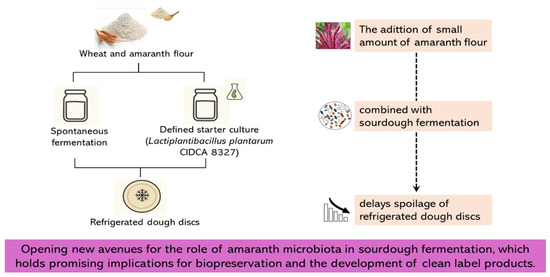
1. Introduction
2. Materials and Methods
2.1. Dough Ingredients and Formulations
2.2. Physicochemical Characterization of Ingredients and Empanada Discs
2.3. Starter
2.4. Sourdough Preparation
2.5. Disc Preparation
2.6. Enumeration of Viable Microorganisms on Sourdoughs and Empanada Discs
2.7. Acidification Kinetics
2.8. Lactic Acid and Acetic Acid Quantification
2.9. DNA Isolation
2.10. PCR Amplification
2.11. Denaturing Gradient Gel Electrophoresis (DGGE)
2.12. Mass Sequencing Analysis Using Ion Torrent PGM
2.13. Statistical Analysis
3. Results
3.1. Wheat and Amaranth Flour Composition
3.2. Characterization of Sourdough Prepared with Wheat and Wheat–Amaranth Blend
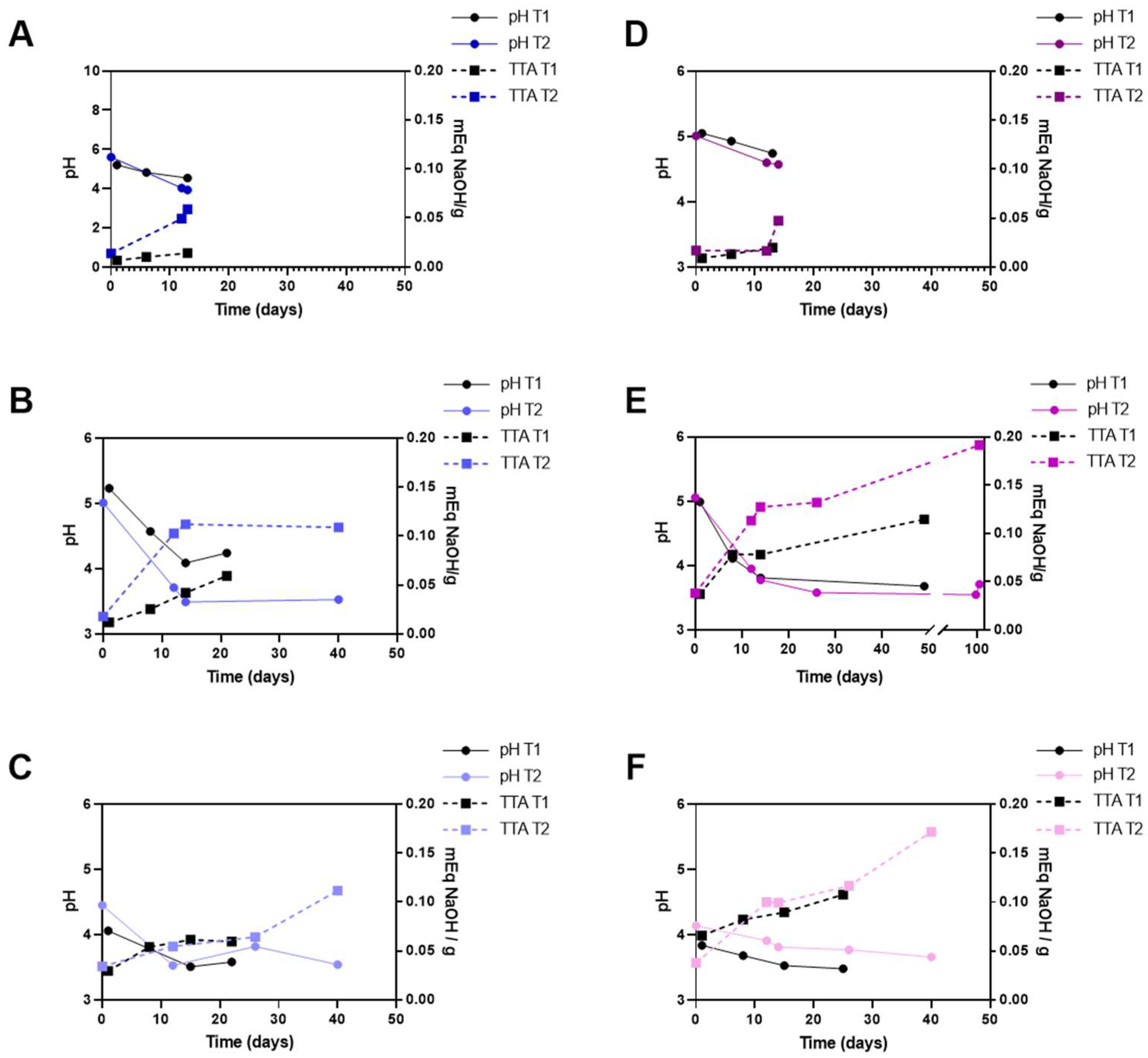
3.2.1. pH and Titratable Acidity of Sourdough Prepared with Wheat and Wheat–Amaranth Blend
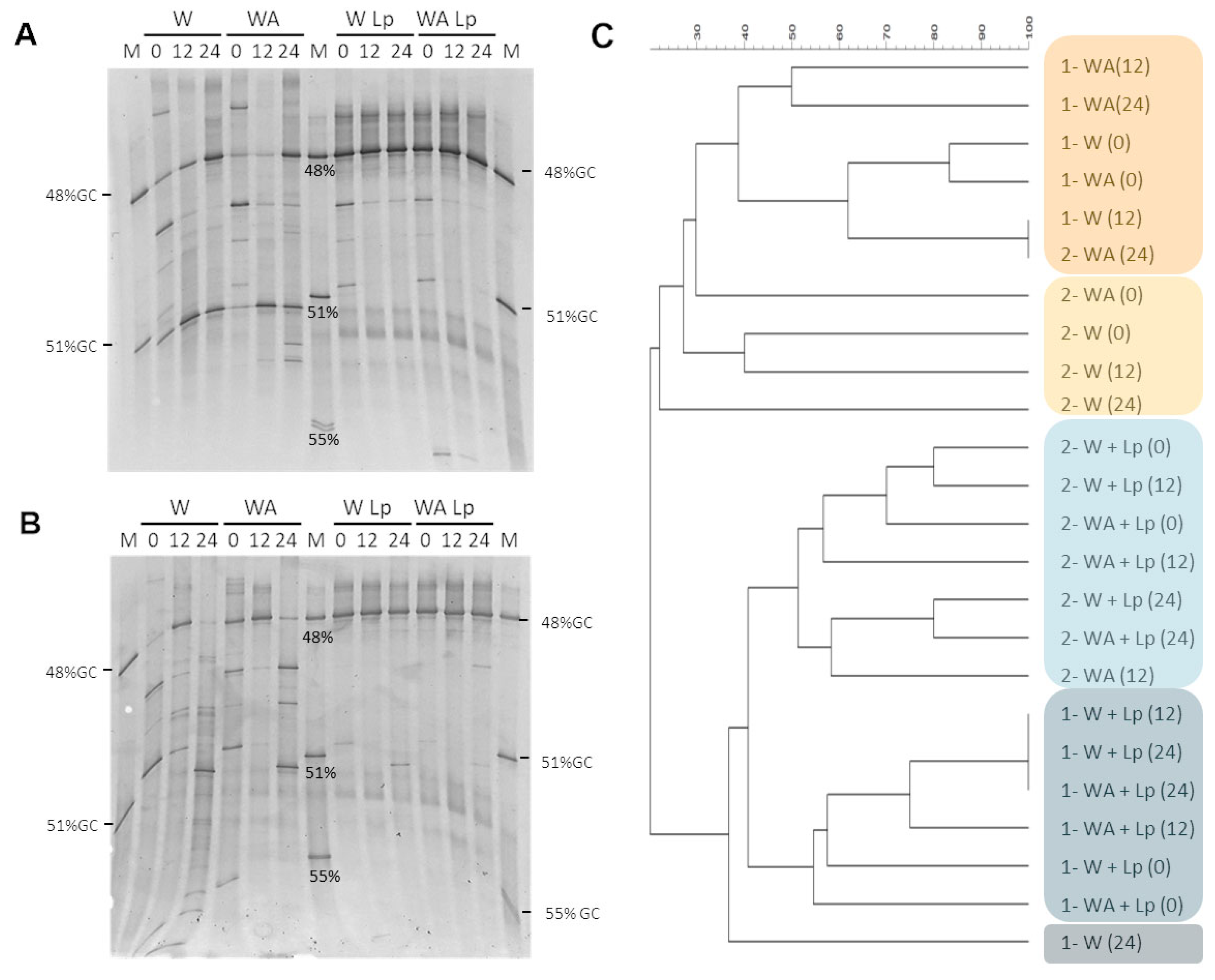
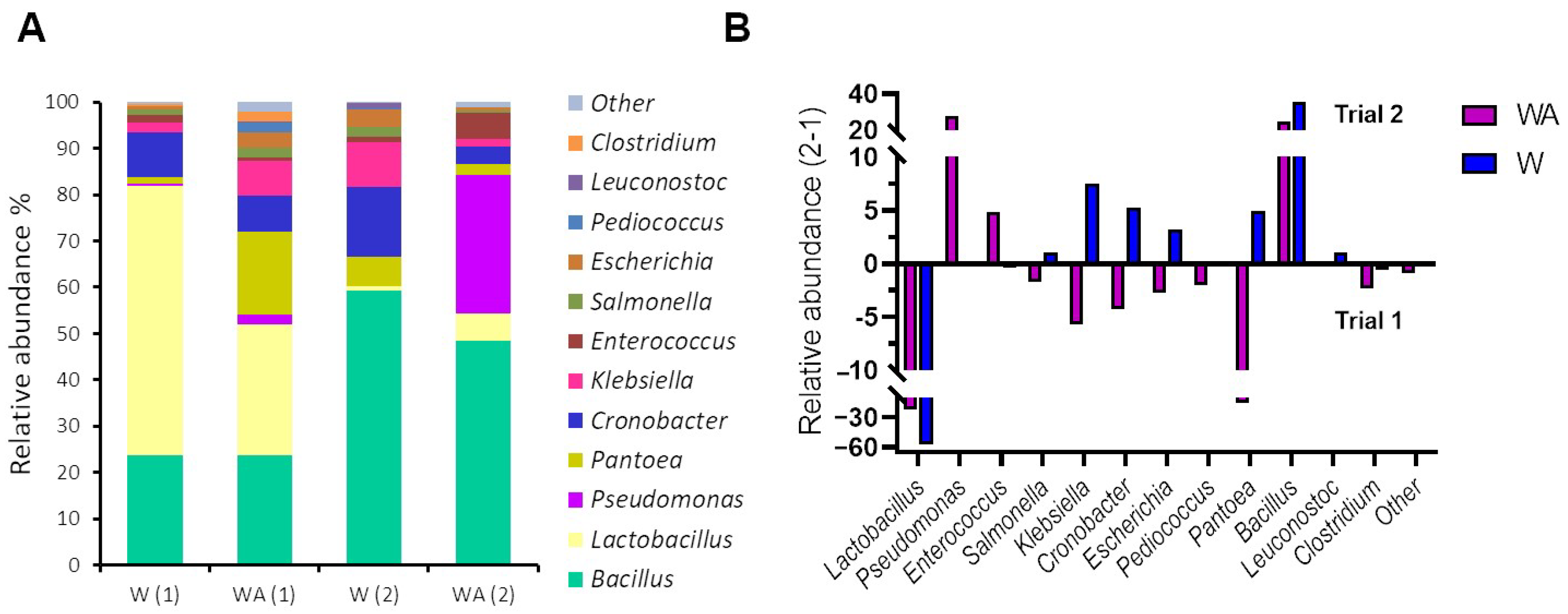
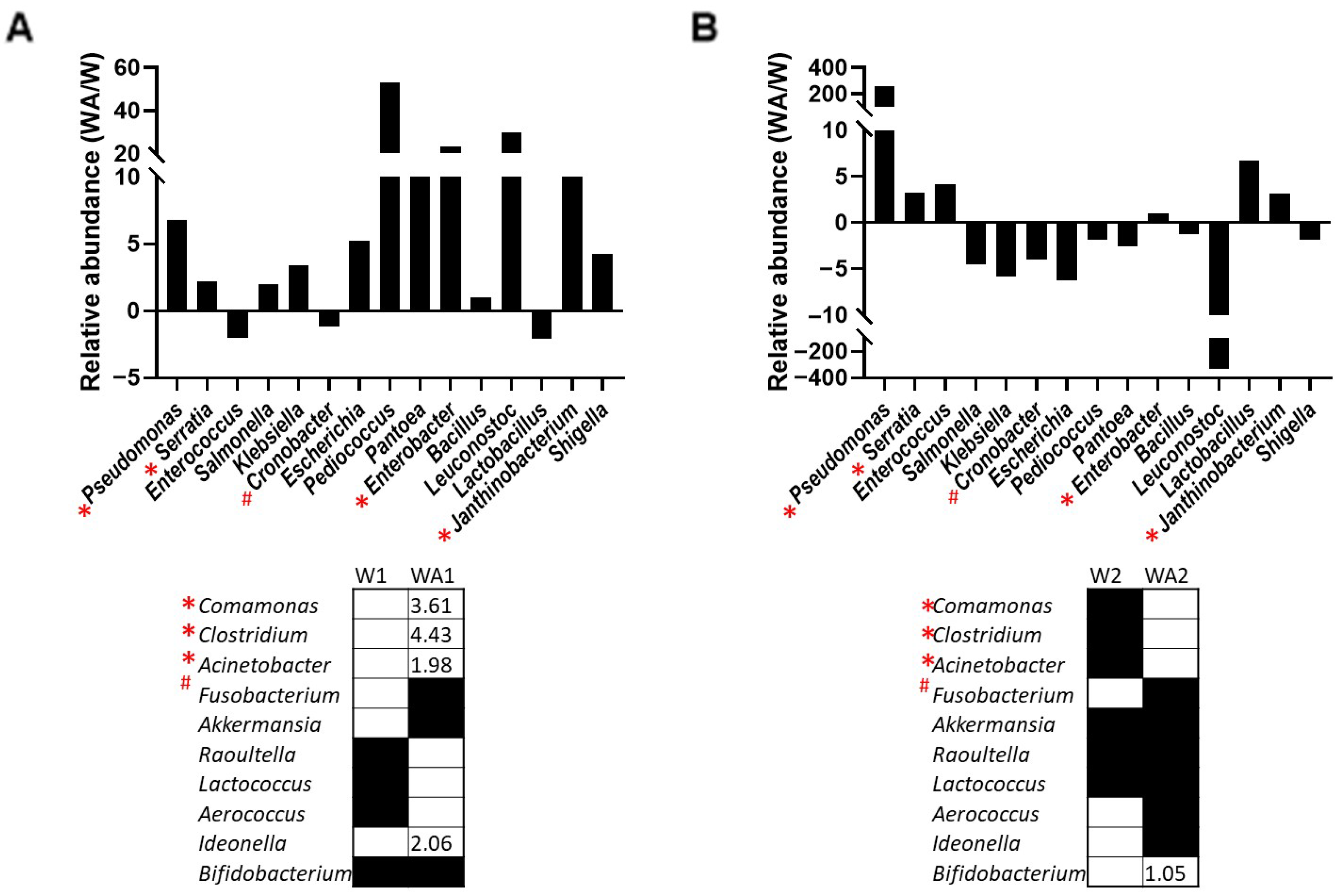
3.2.2. Sourdough Microbiota Evolution During Fermentation
3.3. Characterization of Empanada Discs During Refrigerated Storage
4. Discussion
5. Conclusions
Supplementary Materials
Author Contributions
Funding
Institutional Review Board Statement
Informed Consent Statement
Data Availability Statement
Acknowledgments
Conflicts of Interest
Abbreviations
| Wnf | non-fermented discs made with wheat flour |
| WAnf | non-fermented discs made with wheat and amaranth flour |
| W | sourdough or discs made with wheat flour |
| WA | sourdough or discs made with wheat flour wheat and amaranth flour |
| W Lp | sourdough or discs made with wheat flour and the starter culture L. plantarum CIDCA 8327 |
| WA Lp | sourdough or discs made with wheat flour, amaranth flour, and the starter culture L. plantarum CIDCA 8327 |
References
- Branen, L.; Fletcher, J.; Hilbert, L. Snack Consumption and Waste by Preschool Children Served “Cute” versus Regular Snacks. J. Nutr. Educ. Behav. 2002, 34, 279–282. [Google Scholar] [CrossRef]
- Asioli, D.; Aschemann-Witzel, J.; Caputo, V.; Vecchio, R.; Annunziata, A.; Næs, T.; Varela, P. Making Sense of the “Clean Label” Trends: A Review of Consumer Food Choice Behavior and Discussion of Industry Implications. Food Res. Int. 2017, 99, 58–71. [Google Scholar] [CrossRef] [PubMed]
- Vargas, M.C.A.; Simsek, S. Clean Label in Bread. Foods 2021, 10, 2054. [Google Scholar] [CrossRef]
- NielsenIQ (NIQ). Wellness Trends Influencing Consumers in 2024; NielsenIQ: Chicago, IL, USA, 2024. [Google Scholar]
- NielsenIQ (NIQ). 2025 Global Health & Wellness Trends; NielsenIQ: Chicago, IL, USA, 2025. [Google Scholar]
- Leyva Salas, M.; Mounier, J.; Valence, F.; Coton, M.; Thierry, A.; Coton, E. Antifungal Microbial Agents for Food Biopreservation—A Review. Microorganisms 2017, 5, 37. [Google Scholar] [CrossRef]
- de Oliveira do Nascimento, K.; do Nascimento Dias Paes, S.; Maria Augusta, I. A Review “Clean Labeling”: Applications of Natural Ingredients in Bakery Products. J. Food Nutr. Res. 2018, 6, 285–294. [Google Scholar] [CrossRef]
- Sadeghi, A.; Ebrahimi, M.; Mortazavi, A.; Abedfar, A. Application of the Selected Antifungal LAB Isolate as a Protective Starter Culture in Pan Whole-Wheat Sourdough Bread. Food Control 2018, 95, 298–307. [Google Scholar] [CrossRef]
- Mantzourani, I.; Plessas, S.; Odatzidou, M.; Alexopoulos, A.; Galanis, A.; Bezirtzoglou, E.; Bekatorou, A. Effect of a Novel Lactobacillus paracasei Starter on Sourdough Bread Quality. Food Chem. 2019, 271, 259–265. [Google Scholar] [CrossRef]
- De Vuyst, L.; Comasio, A.; Kerrebroeck, S. Van Sourdough Production: Fermentation Strategies, Microbial Ecology, and Use of Non-Flour Ingredients. Crit. Rev. Food Sci. Nutr. 2023, 63, 2447–2479. [Google Scholar] [CrossRef] [PubMed]
- Arendt, E.K.; Ryan, L.A.M.; Dal Bello, F. Impact of Sourdough on the Texture of Bread. Food Microbiol. 2007, 24, 165–174. [Google Scholar] [CrossRef]
- Guerzoni, M.E.; Vernocchi, P.; Ndagijimana, M.; Gianotti, A.; Lanciotti, R. Generation of Aroma Compounds in Sourdough: Effects of Stress Exposure and Lactobacilli–Yeasts Interactions. Food Microbiol. 2007, 24, 139–148. [Google Scholar] [CrossRef]
- Yan, B.; Sadiq, F.A.; Cai, Y.; Fan, D.; Zhang, H.; Zhao, J.; Chen, W. Identification of Key Aroma Compounds in Type I Sourdough-Based Chinese Steamed Bread: Application of Untargeted Metabolomics Analysis. Int. J. Mol. Sci. 2019, 20, 818. [Google Scholar] [CrossRef] [PubMed]
- Landis, E.A.; Oliverio, A.M.; McKenney, E.A.; Nichols, L.M.; Kfoury, N.; Biango-Daniels, M.; Shell, L.K.; Madden, A.A.; Shapiro, L.; Sakunala, S.; et al. The Diversity and Function of Sourdough Starter Microbiomes. eLife 2021, 10, e61644. [Google Scholar] [CrossRef] [PubMed]
- Lau, S.W.; Chong, A.Q.; Chin, N.L.; Talib, R.A.; Basha, R.K. Sourdough Microbiome Comparison and Benefits. Microorganisms 2021, 9, 1355. [Google Scholar] [CrossRef] [PubMed]
- Ontiveros-Martínez, M.d.R.; Ochoa-Martínez, L.A.; González-Herrera, S.M.; Delgado-Licon, E.; Bello-Pérez, L.A.; Morales-Castro, J. Effect of Sourdough on Quality and Acceptability of Wheat Flour Tortillas. J. Food Sci. 2011, 76, C1278–C1283. [Google Scholar] [CrossRef]
- Montemurro, M.; Coda, R.; Rizzello, C.G. Recent Advances in the Use of Sourdough Biotechnology in Pasta Making. Foods 2019, 8, 129. [Google Scholar] [CrossRef]
- Chis, M.S.; Paucean, A.; Man, S.M.; Bonta, V.; Pop, A.; Stan, L.; Beldean, B.V.; Pop, C.R.; Muresan, V.; Muste, S. Effect of Rice Flour Fermentation with Lactobacillus spicheri DSM 15429 on the Nutritional Features of Gluten-Free Muffins. Foods 2020, 9, 822. [Google Scholar] [CrossRef]
- Dingeo, C.; Difonzo, G.; Paradiso, V.M.; Rizzello, C.G.; Pontonio, E. Teff Type-I Sourdough to Produce Gluten-Free Muffin. Microorganisms 2020, 8, 1149. [Google Scholar] [CrossRef]
- Catzeddu, P.; Fois, S.; Tolu, V.; Sanna, M.; Braca, A.; Vitangeli, I.; Anedda, R.; Roggio, T. Quality Evaluation of Fresh Pasta Fortified with Sourdough Containing Wheat Germ and Wholemeal Semolina. Foods 2023, 12, 2641. [Google Scholar] [CrossRef]
- Hernández-Parada, N.; González-Ríos, O.; Suárez-Quiroz, M.L.; Hernández-Estrada, Z.J.; Figueroa-Hernández, C.Y.; Figueroa-Cárdenas, J.d.D.; Rayas-Duarte, P.; Figueroa-Espinoza, M.C. Exploiting the Native Microorganisms from Different Food Matrices to Formulate Starter Cultures for Sourdough Bread Production. Microorganisms 2022, 11, 109. [Google Scholar] [CrossRef]
- Shen, J.; Shi, K.; Dong, H.; Yang, K.; Lu, Z.; Lu, F.; Wang, P. Screening of Sourdough Starter Strains and Improvements in the Quality of Whole Wheat Steamed Bread. Molecules 2022, 27, 3510. [Google Scholar] [CrossRef]
- Gänzle, M.G.; Qiao, N.; Bechtner, J. The Quest for the Perfect Loaf of Sourdough Bread Continues: Novel Developments for Selection of Sourdough Starter Cultures. Int. J. Food Microbiol. 2023, 407, 110421. [Google Scholar] [CrossRef]
- Nasrollahzadeh, A.; Mokhtari, S.; Khomeiri, M.; Saris, P.E.J. Antifungal Preservation of Food by Lactic Acid Bacteria. Foods 2022, 11, 395. [Google Scholar] [CrossRef]
- Schettino, R.; Pontonio, E.; Gobbetti, M.; Rizzello, C.G. Extension of the Shelf-Life of Fresh Pasta Using Chickpea Flour Fermented with Selected Lactic Acid Bacteria. Microorganisms 2020, 8, 1322. [Google Scholar] [CrossRef]
- González-Alonso, V.; Pradal, I.; Wardhana, Y.R.; Cnockaert, M.; Wieme, A.D.; Vandamme, P.; De Vuyst, L. Microbial Ecology and Metabolite Dynamics of Backslopped Triticale Sourdough Productions and the Impact of Scale. Int. J. Food Microbiol. 2024, 408, 110445. [Google Scholar] [CrossRef]
- Coda, R.; Di Cagno, R.; Gobbetti, M.; Rizzello, C.G. Sourdough Lactic Acid Bacteria: Exploration of Non-Wheat Cereal-Based Fermentation. Food Microbiol. 2014, 37, 51–58. [Google Scholar] [CrossRef] [PubMed]
- De Vuyst, L.; Leroy, F. Bacteriocins from Lactic Acid Bacteria: Production, Purification, and Food Applications. J. Mol. Microbiol. Biotechnol. 2007, 13, 194–199. [Google Scholar] [CrossRef]
- Calvert, M.D.; Madden, A.A.; Nichols, L.M.; Haddad, N.M.; Lahne, J.; Dunn, R.R.; McKenney, E.A. A Review of Sourdough Starters: Ecology, Practices, and Sensory Quality with Applications for Baking and Recommendations for Future Research. PeerJ 2021, 9, e11389. [Google Scholar] [CrossRef]
- Gänzle, M.G.; Zheng, J. Lifestyles of Sourdough Lactobacilli—Do They Matter for Microbial Ecology and Bread Quality? Int. J. Food Microbiol. 2019, 302, 15–23. [Google Scholar] [CrossRef] [PubMed]
- Montemurro, M.; Celano, G.; De Angelis, M.; Gobbetti, M.; Rizzello, C.G.; Pontonio, E. Selection of Non-Lactobacillus Strains to Be Used as Starters for Sourdough Fermentation. Food Microbiol. 2020, 90, 103491. [Google Scholar] [CrossRef] [PubMed]
- Zheng, J.; Wittouck, S.; Salvetti, E.; Franz, C.M.A.P.; Harris, H.M.B.; Mattarelli, P.; Toole, W.O.; Pot, B.; Vandamme, P.; Walter, J.; et al. A Taxonomic Note on the Genus Lactobacillus: Description of 23 Novel Genera, Emended Description of the Genus Lactobacillus Beijerinck 1901, and Union of Lactobacillaceae and Leuconostocaceae. Int. J. Syst. Evol. Microbiol. 2020, 70, 2782–2858. [Google Scholar] [CrossRef]
- Yu, A.O.; Leveau, J.H.J.; Marco, M.L. Abundance, Diversity and Plant-Specific Adaptations of Plant-Associated Lactic Acid Bacteria. Environ. Microbiol. Rep. 2020, 12, 16–29. [Google Scholar] [CrossRef]
- Yilmaz, B.; Bangar, S.P.; Echegaray, N.; Suri, S.; Tomasevic, I.; Lorenzo, J.M.; Melekoglu, E.; Rocha, J.M.; Ozogul, F. The Impacts of Lactiplantibacillus plantarum on the Functional Properties of Fermented Foods: A Review of Current Knowledge. Microorganisms 2022, 10, 826. [Google Scholar] [CrossRef]
- Oleinikova, Y.; Amangeldi, A.; Zhaksylyk, A.; Saubenova, M.; Sadanov, A. Sourdough Microbiota for Improving Bread Preservation and Safety: Main Directions and New Strategies. Foods 2025, 14, 2443. [Google Scholar] [CrossRef] [PubMed]
- Golowczyc, M.A.; Gugliada, M.J.; Hollmann, A.; Delfederico, L.; Garrote, G.L.; Abraham, A.G.; Semorile, L.; De Antoni, G. Characterization of Homofermentative Lactobacilli Isolated from Kefir Grains: Potential Use as Probiotic. J. Dairy Res. 2008, 75, 211–217. [Google Scholar] [CrossRef] [PubMed]
- Bengoa, A.A.; Iraporda, C.; Garrote, G.L.; Abraham, A.G. Kefir Micro-organisms: Their Role in Grain Assembly and Health Properties of Fermented Milk. J. Appl. Microbiol. 2019, 126, 686–700. [Google Scholar] [CrossRef] [PubMed]
- Gangoiti, M.V.; Puertas, A.I.; Hamet, M.F.; Peruzzo, P.J.; Llamas, M.G.; Medrano, M.; Abraham, A.G. Lactobacillus plantarum CIDCA 8327: An α -Glucan Producing-Strain Isolated from Kefir Grains. Carbohydr. Polym. 2017, 170, 52–59. [Google Scholar] [CrossRef]
- Lorenzo, G.; Zaritzky, N.E.; Califano, A.N. Rheological Characterization of Refrigerated and Frozen Non-Fermented Gluten-Free Dough: Effect of Hydrocolloids and Lipid Phase. J. Cereal Sci. 2009, 50, 255–261. [Google Scholar] [CrossRef]
- Lorenzo, G.; Ranalli, N.; Andrés, S.; Zaritzky, N.; Califano, A. Textural Characteristics and Viscoelastic Behavior of Traditional Argentinian Foods. In Textural Characteristics of World Foods; John Wiley & Sons Ltd.: Hoboken, NJ, USA, 2020; pp. 89–106. [Google Scholar] [CrossRef]
- Martinez-Lopez, A.; Millan-Linares, M.C.; Rodriguez-Martin, N.M.; Millan, F.; Montserrat-de la Paz, S. Nutraceutical Value of Kiwicha (Amaranthus caudatus L.). J. Funct. Foods 2020, 65, 103735. [Google Scholar] [CrossRef]
- Mirhosseini, H.; Abdul Rashid, N.F.; Tabatabaee Amid, B.; Cheong, K.W.; Kazemi, M.; Zulkurnain, M. Effect of Partial Replacement of Corn Flour with Durian Seed Flour and Pumpkin Flour on Cooking Yield, Texture Properties, and Sensory Attributes of Gluten Free Pasta. LWT-Food Sci. Technol. 2015, 63, 184–190. [Google Scholar] [CrossRef]
- López, D.N.; Galante, M.; Robson, M.; Boeris, V.; Spelzini, D. Amaranth, Quinoa and Chia Protein Isolates: Physicochemical and Structural Properties. Int. J. Biol. Macromol. 2018, 109, 152–159. [Google Scholar] [CrossRef]
- Antoniewska, A.; Rutkowska, J.; Pineda, M.M.; Adamska, A. Antioxidative, Nutritional and Sensory Properties of Muffins with Buckwheat Flakes and Amaranth Flour Blend Partially Substituting for Wheat Flour. LWT 2018, 89, 217–223. [Google Scholar] [CrossRef]
- Cruz-Casas, D.E.; Aguilar, C.N.; Ascacio-Valdés, J.A.; Rodríguez-Herrera, R.; Chávez-González, M.L.; Flores-Gallegos, A.C. Bioactive protein hydrolysates obtained from amaranth by fermentation with lactic acid bacteria and Bacillus species. Heliyon 2023, 9, e13491. [Google Scholar] [CrossRef]
- Suárez, S.E.; Quiroga, A.; Sabbione, A.C.; Rodríguez, M.; Nardo, A.E.; Jardin, J.; Scilingo, A.; Tironi, V.; Speroni, F.; Añón, M.C. Multitarget Peptides Released by In Vitro Static Gastrointestinal Digestion of an Amaranth Protein Beverage. Plant Foods Hum. Nutr. 2024, 80, 27. [Google Scholar] [CrossRef] [PubMed]
- Pedersen, B.; Kalinowski, L.S.; Eggum, B.O. The Nutritive Value of Amaranth Grain (Amaranthus caudatus)—1. Protein and Minerals of Raw and Processed Grain. Qual. Plant. Plant Foods Hum. Nutr. 1987, 36, 309–324. [Google Scholar] [CrossRef]
- Lamothe, L.M.; Srichuwong, S.; Reuhs, B.L.; Hamaker, B.R. Quinoa (Chenopodium quinoa W.) and Amaranth (Amaranthus caudatus L.) Provide Dietary Fibres High in Pectic Substances and Xyloglucans. Food Chem. 2015, 167, 490–496. [Google Scholar] [CrossRef]
- Gowele, V.F.; Kinabo, J.; Jumbe, T.; Kirschmann, C.; Frank, J.; Stuetz, W. Provitamin A Carotenoids, Tocopherols, Ascorbic Acid and Minerals in Indigenous Leafy Vegetables from Tanzania. Foods 2019, 8, 35. [Google Scholar] [CrossRef]
- Wolosik, K.; Markowska, A. Amaranthus cruentus Taxonomy, Botanical Description, and Review of Its Seed Chemical Composition. Nat. Prod. Commun. 2019, 14, 1934578X1984414114. [Google Scholar] [CrossRef]
- Johnson, S.A.; Prenni, J.E.; Heuberger, A.L.; Isweiri, H.; Chaparro, J.M.; Newman, S.E.; Uchanski, M.E.; Omerigic, H.M.; Michell, K.A.; Bunning, M.; et al. Comprehensive Evaluation of Metabolites and Minerals in 6 Microgreen Species and the Influence of Maturity. Curr. Dev. Nutr. 2021, 5, nzaa180. [Google Scholar] [CrossRef]
- Moronta, J.; Smaldini, P.L.; Docena, G.H.; Añón, M.C. Peptides of Amaranth Were Targeted as Containing Sequences with Potential Anti-Inflammatory Properties. J. Funct. Foods 2016, 21, 463–473. [Google Scholar] [CrossRef]
- Sabbione, A.C.; Suárez, S.; Añón, M.C.; Scilingo, A. Amaranth Functional Cookies Exert Potential Antithrombotic and Antihypertensive Activities. Int. J. Food Sci. Technol. 2019, 54, 1506–1513. [Google Scholar] [CrossRef]
- Rivero Meza, S.L.; Hirsch Ramos, A.; Cañizares, L.; Raphaelli, C.d.O.; Bueno Peres, B.; Gaioso, C.A.; Egea, I.; Estrada, Y.; Flores, F.B.; de Oliveira, M. A Review on Amaranth Protein: Composition, Digestibility, Health Benefits and Food Industry Utilisation. Int. J. Food Sci. Technol. 2023, 58, 1564–1574. [Google Scholar] [CrossRef]
- Muyzer, G.; De Waal, E.C.; Uitterlinden, A.G. Profiling of Complex Microbial Populations by Denaturing Gradient Gel Electrophoresis Analysis of Polymerase Chain Reaction-Amplified Genes Coding for 16S RRNA. Appl. Environ. Microbiol. 1993, 59, 695–700. [Google Scholar] [CrossRef] [PubMed]
- Cocolin, L.; Bisson, L.F.; Mills, D.A. Direct Profiling of the Yeast Dynamics in Wine Fermentations. FEMS Microbiol. Lett. 2000, 189, 81–87. [Google Scholar] [CrossRef]
- Bengoa, A.A.; Dardis, C.; Gagliarini, N.; Garrote, G.L.; Abraham, A.G. Exopolysaccharides From Lactobacillus paracasei Isolated From Kefir as Potential Bioactive Compounds for Microbiota Modulation. Front. Microbiol. 2020, 11, 583254. [Google Scholar] [CrossRef]
- Atfaoui, K.; Lebrazi, S.; Raffak, A.; Chafai, Y.; El Kabous, K.; Fadil, M.; Ouhssine, M. Impact of Selected Starter-Based Sourdough Types on Fermentation Performance and Bio-Preservation of Bread. Fermentation 2025, 11, 449. [Google Scholar] [CrossRef]
- Minervini, F.; De Angelis, M.; Di Cagno, R.; Gobbetti, M. Ecological Parameters Influencing Microbial Diversity and Stability of Traditional Sourdough. Int. J. Food Microbiol. 2014, 171, 136–146. [Google Scholar] [CrossRef] [PubMed]
- Bartkiene, E.; Özogul, F.; Rocha, J.M. Bread Sourdough Lactic Acid Bacteria-Technological, Antimicrobial, Toxin-Degrading, Immune System-, and Faecal Microbiota-Modelling Biological Agents for the Preparation of Food, Nutraceuticals and Feed. Foods 2022, 11, 452. [Google Scholar] [CrossRef]
- Woldemariamyohannes, K.; Wan, Z.; Yu, Q.; Li, H.; Wei, X.; Liu, Y.; Wang, J.; Sun, B. Prebiotic, Probiotic, Antimicrobial, and Functional Food Applications of Bacillus amyloliquefaciens. J. Agric. Food Chem. 2020, 68, 14709–14727. [Google Scholar] [CrossRef]
- Vrancken, G.; De Vuyst, L.; Van Der Meulen, R.; Huys, G.; Vandamme, P.; Daniel, H.M. Yeast Species Composition Differs between Artisan Bakery and Spontaneous Laboratory Sourdoughs. FEMS Yeast Res. 2010, 10, 471–481. [Google Scholar] [CrossRef]
- De Vuyst, L.; Harth, H.; Van Kerrebroeck, S.; Leroy, F. Yeast Diversity of Sourdoughs and Associated Metabolic Properties and Functionalities. Int. J. Food Microbiol. 2016, 239, 26–34. [Google Scholar] [CrossRef]
- Menezes, L.A.A.; Sardaro, M.L.S.; Duarte, R.T.D.; Mazzon, R.R.; Neviani, E.; Gatti, M.; De Dea Lindner, J. Sourdough Bacterial Dynamics Revealed by Metagenomic Analysis in Brazil. Food Microbiol. 2020, 85, 103302. [Google Scholar] [CrossRef]
- Axel, C.; Brosnan, B.; Zannini, E.; Furey, A.; Coffey, A.; Arendt, E.K. Antifungal Sourdough Lactic Acid Bacteria as Biopreservation Tool in Quinoa and Rice Bread. Int. J. Food Microbiol. 2016, 239, 86–94. [Google Scholar] [CrossRef]
- Baraniak, J.; Kania-Dobrowolska, M. The Dual Nature of Amaranth-Functional Food and Potential Medicine. Foods 2022, 11, 618. [Google Scholar] [CrossRef]
- Moyer, T.B.; Heil, L.R.; Kirkpatrick, C.L.; Goldfarb, D.; Lefever, W.A.; Parsley, N.C.; Wommack, A.J.; Hicks, L.M. PepSAVI-MS Reveals a Proline-Rich Antimicrobial Peptide in Amaranthus tricolor. J. Nat. Prod. 2019, 82, 2744–2753. [Google Scholar] [CrossRef] [PubMed]
- Guo, L.; Wang, Y.; Bi, X.; Duo, K.; Sun, Q.; Yun, X.; Zhang, Y.; Fei, P.; Han, J. Antimicrobial Activity and Mechanism of Action of the Amaranthus tricolor Crude Extract against Staphylococcus aureus and Potential Application in Cooked Meat. Foods 2020, 9, 359. [Google Scholar] [CrossRef] [PubMed]
- Shi, C.; Maktabdar, M. Lactic Acid Bacteria as Biopreservation Against Spoilage Molds in Dairy Products—A Review. Front. Microbiol. 2022, 12, 819684. [Google Scholar] [CrossRef]
- Pandey, C.; Prabha, D.; Negi, Y.K.; Maheshwari, D.K.; Dheeman, S.; Gupta, M. Macrolactin A mediated biocontrol of Fusarium oxysporum and Rhizoctonia solani infestation on Amaranthus hypochondriacus by Bacillus subtilis BS-58. Front. Microbiol. 2023, 14, 1105849. [Google Scholar] [CrossRef] [PubMed]



| Components | Wheat (W) | Amaranth (A) |
|---|---|---|
| Carbohydrates, FCB | 67.1 ± 1 | 49 ± 1 |
| Carbohydrates, Anthrone | 64.4 ± 1 | 48.8 ± 0.7 |
| Proteins | 8.8 ± 0.2 | 14.1 ± 0.7 |
| Fats | 1.07 ± 0.06 | 5.6 ± 0.1 |
| Ashes | 0.43 ± 0.01 | 3.05 ± 0.01 |
| Fibre | 3.13 ± 0.06 | 12 ± 1 |
| DISCS | Trial 1 | Trial 2 | ||
|---|---|---|---|---|
| Days of Storage | Relative Relation (X/Wnf) | Days of Storage | Relative Relation (X/Wnf) | |
| Wnf | 13 | 1 | 13 | 1 |
| W | 21 | 1.61 | 48 | 3.69 |
| W Lp | 22 | 1.69 | 40 | 3.08 |
| WAnf | 13 | 1 | 18 | 1.38 |
| WA | 49 | 3.77 | 103 | 7.92 |
| WA Lp | 25 | 1.92 | 53 | 4.08 |
| AN | YGC | pH | ||||
|---|---|---|---|---|---|---|
| Initial | Two Weeks | Initial | Two Weeks | Initial | Two Weeks | |
| Wnf | 3.68 ± 0.34 A | 7.88 ± 0.43 A,* | 3.94 ± 0.69 A | 7.5 ± 0.11 A,* | 5.40 ± 0.28 A | 4.29 ± 0.36 A,C |
| W | 7.90 ± 0.09 B | 8.56 ± 0.07 B,* | 3.26 ± 0.20 A | 5.38 ± 0.09 B,* | 5.12 ± 0.16 A | 3.90 ± 0.27 A,B,* |
| W Lp | 8.88 ± 0.16 C | 8.69 ± 0.07 B,D | 3.91 ± 0.74 A | 6.19 ± 0.28 B,* | 4.255 ± 0.26 B | 3.52 ± 0.01 B |
| WAnf | 3.49 ± 0.18 A | 6.96 ± 0.20 C,* | 3.37 ± 0.18 A | 6.58 ± 0.61 A,* | 5.03 ± 0.03 A | 4.67 ± 0.10 C |
| WA | 7.87 ± 0.01 B | 8.14 ± 0.18 A | 4.06 ± 0.47 A | 3.68 ± 0.77 C | 5.025 ± 0.05 A | 3.88 ± 0.10 A,B,* |
| WA Lp | 8.82 ± 0.07 C | 9.16 ± 0.02 D | 3.24 ± 0.34 A | 3.92 ± 0.04 C | 3.99 ± 0.21 B | 3.72 ± 0.27 A,B |
Disclaimer/Publisher’s Note: The statements, opinions and data contained in all publications are solely those of the individual author(s) and contributor(s) and not of MDPI and/or the editor(s). MDPI and/or the editor(s) disclaim responsibility for any injury to people or property resulting from any ideas, methods, instructions or products referred to in the content. |
© 2026 by the authors. Licensee MDPI, Basel, Switzerland. This article is an open access article distributed under the terms and conditions of the Creative Commons Attribution (CC BY) license.
Share and Cite
Dardis, C.; Bilbao, E.; Añón, M.C.; Abraham, A.G. Fermentation Unlocks the Functional Role of Amaranth in Modulating Wheat/Amaranth Sourdough Microbiota and Inhibiting Yeast Growth of Refrigerated Doughs. Fermentation 2026, 12, 80. https://doi.org/10.3390/fermentation12020080
Dardis C, Bilbao E, Añón MC, Abraham AG. Fermentation Unlocks the Functional Role of Amaranth in Modulating Wheat/Amaranth Sourdough Microbiota and Inhibiting Yeast Growth of Refrigerated Doughs. Fermentation. 2026; 12(2):80. https://doi.org/10.3390/fermentation12020080
Chicago/Turabian StyleDardis, Carolina, Emiliano Bilbao, María Cristina Añón, and Analía G. Abraham. 2026. "Fermentation Unlocks the Functional Role of Amaranth in Modulating Wheat/Amaranth Sourdough Microbiota and Inhibiting Yeast Growth of Refrigerated Doughs" Fermentation 12, no. 2: 80. https://doi.org/10.3390/fermentation12020080
APA StyleDardis, C., Bilbao, E., Añón, M. C., & Abraham, A. G. (2026). Fermentation Unlocks the Functional Role of Amaranth in Modulating Wheat/Amaranth Sourdough Microbiota and Inhibiting Yeast Growth of Refrigerated Doughs. Fermentation, 12(2), 80. https://doi.org/10.3390/fermentation12020080