


Abstract
This study investigated the effect of fermentation time (24 and 48 h) on the pH, titratable acidity (TTA), phytochemicals, antioxidants, phenolic compounds, colour, functional, pasting, and thermal properties of flours from selected legumes (mung beans, haricot beans, butter beans, and black beans). The pH dropped significantly (p ≤ 0.05) after 48 h (6.61–4.91) of fermentation, with a corresponding increase in TTA, which ranged from 0.3 to 1.28 g lactic acid/100 g sample. Colour analysis showed that fermentation caused a decrease in L* values (2.97–23.86% reduction), with the highest reduction observed in black bean flour (23.86% at 24 h), along with an increase in the browning index. The total phenolic content increased significantly (p ≤ 0.05) in all the samples, with the most pronounced increase observed in mung bean 24 h (6.85 mg GAE/g). Similarly, the values for total flavonoid increased from 2.26 to 6.48 mg QE/g, and antioxidant activities such as DPPH ranged from 45.04 to 74.51%, FRAP from 1.65 to 8.03 Mm TE/g, and ABTS from 60.86 to 90.01%. Ultra-high performance liquid chromatography–photodiode array quantification of the targeted phenolic compounds showed a significant increase, with the highest notable increase for trans-ferulic acid in mung bean (330% after 48 h). Water absorption capacity generally showed an increase, whereas bulk density ranged from 0.55 to 0.91 g/cm3 and decreased in all legumes. There were differences in the pasting properties of the selected legumes. The peak time of unfermented butter bean was 33.08 min and remained constant at 33.15 min at 24 and 48 h of fermentation. Thermal analysis indicated the alteration of gelatinization parameters, with a decrease in peak temperature, whereas higher gelatinization enthalpy was observed. Findings from this study show that fermentation with the starter cultures can significantly improve the bioactive compound and functional properties of legume flours and thus act as potential ingredients in functional food development.
1. Introduction
The global food system is facing challenges of achieving sustainable nutrition security while reducing the adverse effects of environmental degradation and climate change. The achievement of the United Nations’ Sustainable Development Goals (SDGs)—primarily SDG 2: Zero Hunger, SDG 3: Good Health and Well-Being, and SDG 12: Responsible Consumption and Production, necessitates a fundamental transformation of current food production and consumption patterns. One of the most promising strategies for reducing the environmental impact is to rely less on animal-based products and more on sustainable and environmentally friendly plant-based sources, capable of lowering the current global contribution of agriculture revolving around greenhouse gas emissions [1,2]. In this context, legumes are critical for food security and the achievement of sustainable food systems because they not only provide an environmentally friendly food source but also present agroecological benefits by promoting nitrogen fixation and soil health [3,4]. Despite such benefits, legume-based crops can only thrive in food systems if effective processing technologies are employed to ensure that legume-based end-products meet a wide range of desired food formulations.
Legume seeds are used globally as cost-effective substitutes for protein, which provides essential nutrients to people, mostly in low- and middle-income countries where the affordability of animal proteins remains a challenge. Legumes, also known as nutrient-dense crops, are rich in vitamins (particularly B-complex vitamins), proteins (17–40%), minerals (calcium, magnesium, iron, and zinc), and bioactive compounds such as flavonoids and phenolic acids, as well as carotenoids [5,6,7]. Legumes can reduce type 2 diabetes, inflammation, cardiovascular disease, high blood pressure, obesity, and dyslipidemia and promote gut microbiota diversity as well as mitigate oxidative stress [7,8]. Despite these benefits, utilization of legumes is yet to be fully explored in human diets and food applications. Antinutritional factors such as tannins, lectins, and phytates present in raw legume seeds can interfere with nutrient absorption and cause flatulence. Meanwhile, the intrinsic challenges can be addressed through efficient processing methods, including germination, cooking, fermentation, etc., as sustainable approaches for enhancing the nutritional and functional properties of legume-based food products or their consumer acceptability.
Fermentation, like other food bioprocessing techniques, is one of the oldest and most used food preservation methods. This technique is required for food transformation prior to consumption, resulting in the formation, modification, structural changes, and/or degradation of compounds, whereby a decrease/increase in these components can occur [9]. Fermentation may naturally be induced by microorganisms (yeast, bacteria, fungi) or through controlled growth, and these are performed under specific conditions. According to ref. [10], controlled fermentation involves selecting starter cultures and strains with specific biotechnological features based on the aim of producing a product of desired properties. Fermentation using starter cultures has proven to yield safe products with consistent physicochemical, sensory, and nutritional qualities [11]. Among the uses of controlled fermentation, lactic acid bacteria (LABs) have gained attention and are generally recognized as safe (GRAS) for the application of food [12]. LABs are known for their positive effect on the nutritional composition of food, physicochemical properties such as viscosity modification and pH regulation, and prolonged shelf life [13].
LABs have been used to ferment different selections of food substrates, such as cereals, legumes, milk products, vegetables, etc. Increasing interest in the fermentation of legumes using LABs is evident in the scientific literature, especially on legume seed-, flour-, or protein-enriched ingredients, with the fermentation method, LAB strain, legume type, and genetic variety influencing the functionality and efficiency of the fermentation process [14,15]. Such starter culture-driven fermentation is known to promote enzymatic hydrolysis of cell wall-bound phenolic compounds based on the activity of various microbial enzymes such as β-glucosidases, esterases, and phenolic acid decarboxylases, and to enhance acidification patterns as well as bioaccessibility [12,16,17]. In contrast, natural fermentation depends on the indigenous microflora with different metabolic activities that make it impossible to properly control the process of fermentation. The superiority of controlled fermentation also makes it possible to develop robust functional food ingredients in light of the improved bioaccessibility of target health-promoting compounds. While some studies on the fermentation of legumes have been reported, there remains a strong research gap in the use of LAB-starter cultures on legume substrates and in the investigation of changes in specific phenolics, antioxidant properties, and techno-functionality. Therefore, this study was conducted to determine the effect of controlled fermentation on phytochemicals, antioxidants, targeted phenolic compounds, and the functional, pasting, and thermal properties of selected legume flours.
2. Materials and Methods
2.1. Materials
Selected legumes, such as haricot beans (HBs) (Phaseolus vulgaris), black beans (BBs) (Phaseolus vulgaris), mung beans (MBs) (Vigna radiata), and butter beans (BBs) (Phaseolus lunatus) were procured from Multi Snacks (Pty) Ltd., Cape Town, South Africa, and Deli (Pty) Ltd., Johannesburg, South Africa. The selected grains were cleaned to remove foreign objects or debris and milled using a laboratory mill (HR2056/90, Koninklijke Philips N.V., Eindhoven, The Netherlands). Each of the respective milled flours were sieved and passed through a 500 µm mesh (Analysette 3 Spartan, Fritsch GmbH, Idar-Oberstein, Germany) to obtain a uniform particle size distribution.
2.2. Fermentation of Selected Legume Flours
Fermentation of the selected legume was performed using the method of [18]. Briefly, each of the legume flours (100 g) was individually fermented (no composite or mixed-legume fermentation was performed) by inoculation with 0.4 g of the starter culture (CHN-22, CHR Hansen, Holding A/S, Hørsholm, Denmark). From the manufacturer specification, the CHN-22 is a mesophilic starter culture consisting of Lactococcus lactis subsp. lactis, Lactococcus lactis subsp. cremoris, Leuconostoc mesenteroides, Lactococcus lactis subsp. lactis biovar, diacetylactis, and Leuconostoc pseudomesenteroides. This starter culture was generally recognized as safe, selected to ensure a controlled fermentation process, and has been successfully applied to cereal and legume substrates [18,19,20]. Using a properly characterized heterofermentative LAB makes it possible to achieve a consistent acidification process and uniform metabolic changes, thus enabling an accurate assessment of fermentation’s impact on the parameters investigated and subsequent use industrially.
Subsequently, 100 mL of distilled water was added into the container, mixed using a spoon, and allowed to ferment in an incubator (Incotherm, Labotec, Johannesburg, South Africa) at 35 °C for 24 and 48 h. Subsequent to fermentation, the legume samples were transferred into centrifuge tubes, frozen, and subsequently freeze-dried (LyoQuest laboratory freeze dryer, Telstar, Barcelona, Spain) at −56 °C for 48 h. After this, the legume samples were processed into flours and passed through a 500 μm mesh sieve (Analysette 3 Spartan; Fritsch GmbH, Idar-Oberstein, Germany). Each of the fermented legume samples was kept in an airtight container, labelled, and stored at 4 °C in a refrigerator for further analysis.
2.3. pH and Total Titratable Acidity (TTA)
The pH of the fermented legume samples was determined using a standardized pH metre (EcoSense pH10A; YSI Inc., Yellow Springs, OH, USA), and 10 g of each flour was combined with 90 mL of distilled water [21]. The TTA was assessed by titrating the same flour suspension with 0.1 M NaOH using phenolphthalein as an indicator (2–3 drops) until a persistent faint pink endpoint was observed. TTA was expressed as grams of lactic acid per 100 g of sample (g lactic acid/100 g).
2.4. Colour Profiles of Unfermented and Fermented Selected Bean Flours
The colour profiles of the fermented selected legume flours were determined using a chroma metre (CR 410, Konica Minolta, Inc., Tokyo, Japan). The colour parameters investigated on the CIELAB system include a* (redness), b* (yellowness), and L* (lightness). The colour metrics such as C* (chroma), YI (yellowness index), WI (whiteness index), and Ho (hue angle) were calculated using Equations (1)–(4), respectively [22]. The browning index was expressed using Equations (5) and (6) [23].
2.5. Phytochemicals, Antioxidant Properties, and Targeted Phenolic Compounds of Unfermented and Fermented Selected Bean Flours
2.5.1. Extraction
The procedure of [18] was used to extract the fermented selected legume flours. Briefly, 5 mL of 1% hydrochloric acid in 80% methanol (methanolic acid) was combined with a 0.25 g flour sample in a centrifuge tube. The mixtures were homogenized, agitated for 2 h using a Model 36110740 Mixer (Darmstadt, Germany), and subjected to sonication in an ultrasonic bath (AU 220, Argo Lab, Carpi, Italy), then agitated for another 2 h. Subsequently, the samples were centrifuged (Eppendorf 5702R, Merck, Darmstadt, Germany) at 4000 rpm for 10 min. The supernatant was filtered into a 15 mL centrifuge tube for further analysis.
2.5.2. Total Flavonoid and Total Phenolic Contents
Determination of the total flavonoid content (TFC) of the fermented samples was achieved using the method of ref. [20]. The extracts (10 µL) were added into a 96-well microplate (Hirschmann Laborgerate GmbH & Co., Eberstadt, Germany), followed by the addition of 30 µL of 1.25% AlCl3, 10 µL of 2.5% NaNO2, and 100 µL of 2% NaOH in rapid succession. The plate was covered with an aluminum foil and incubated in the absence of light for 30 min. TFC was quantified using a quercetin calibration curve (0–2.0 mg/mL), which followed the linear equation y = 0.987x + 0.012 (R2 = 0.993), where y represents absorbance at 450 nm (Accuris™ SmartReader™ 96, model: MR9600; Edison, NJ, USA) and x represents quercetin concentration (mg/mL). TFC was calculated and expressed as milligrams of quercetin equivalent per gram of sample (mg QE/g).
The total phenolic content (TPC) of the fermented samples was achieved using the method of ref. [24] and evaluated using Folin–Ciocalteu reducing capacity. Briefly, 10 µL of the sample extract was combined with 50 µL of 7.5% sodium carbonate (Na2CO3) and 50 µL of dilute Folin–Ciocalteu reagent. The mixture was incubated at 25 °C in the absence of light for 30 min; subsequently, TPC was quantified using a gallic acid calibration curve (0–0.2 mg/mL), which showed good linearity following the equation y = 4.321x + 0.018 (R2 = 0.997), where y represents absorbance at 750 nm and x represents gallic acid concentration (mg/mL). The total phenolic content was quantified as milligrams of gallic acid equivalent per gram of sample (mg GAE/g).
2.5.3. Antioxidant Properties
The ferric reducing antioxidant power (FRAP) assay was performed using the method of ref. [20]. The extract (10 μL) was combined with 240 μL of the FRAP working solution and 10 μL of the 0–1 mM Trolox standard in a 96-well microplate. A solution of 75% ethanol served as the blank. The microplate was incubated at 30 °C in the absence of light for 30 min. The absorbance of the solutions was measured after 30 min at 593 nm using the Accuris SmartReader 96 (model: MR9600, Edison, NJ, USA), and the FRAP values were expressed as millimolar of Trolox equivalent per gram (mM TE/g).
The method of ref. [25] was used to determine the 2,2-azinobis-(3-ethylbenzthiazolin-6-sulfonic acid) (ABTS) free radical scavenging activity. ABTS working solution was mixed in a 96-well plate with extract solutions and allowed to incubate for 30 min at room temperature. The absorbance of the reaction mixture and blank was assessed at a wavelength of 734 nm using a microplate reader (Accuris SmartReader 96). The % inhibition of the ABTS radical was determined using the measured absorbances.
The 2,2-diphenyl-1-picrylhydrazyl (DPPH) radical scavenging was achieved using the method of ref. [26]. Briefly, 50 μL of the 100 μL methanolic extract and 1900 μL methanol were mixed with 950 μL of the standard DPPH solution. Afterward, the resultant mixture was incubated in the dark using a Labcon, Krugersdorp, South Africa, incubator at 25 °C for 30 min. The absorbance of the reacted solution was measured against a blank at 515 nm using an Eppendorf Biospectrometer kinetic (Eppendorf AG 6136, Hamburg, Germany). The percentage of DPPH inhibition was calculated using Equation (7) in order to determine the antioxidant activity of the methanolic extracts.
where A—sample absorbance and B—DPPH standard solution absorbance.
2.5.4. Targeted Phenolic Compounds on Ultra-High Performance Liquid Chromatography–Photodiode Array
The targeted phenolic compounds, comprising trans-ferulic, p-coumaric, sinapic, and chlorogenic acids (phenolic acids), as well as quercetin, apigenin, and luteolin (flavonoids), were quantified using a UHPLC-PDA (ultra-high performance liquid chromatography–photodiode array) (Shimadzu Corporation, Kyoto, Japan). The system’s operating conditions, mobile phase, type of column, and gradient programme were consistent with the study of ref. [26]. Separation was performed using the C18 column with dimensions 4.6 × 250 mm and 5 μm particle size (Waters, Dublin, Ireland) with a binary mobile phase of A and B. Mobile phase A was prepared from Milli-Q water and 0.10% formic acid, whereas B was prepared from 49.95% methanol, 49.95% acetonitrile, and 0.10% formic acid. The binary mobile phase was used at a programmed solvent gradient at 0.50 mL/min. The solvent gradient was started from 10% solvent B, 0% solvent B from 0.00 to 0.50 min; 90% solvent B from 0.50 to 7.50 min; 100% solvent B from 7.50 to 8.50 min, held at 100% solvent B from 8.50 to 9.50 min; held at 90% solvent B from 9.50 to 10.00 min; 10% solvent B from 10.00 to 11.00 min; and finally 10% solvent B held for 14.00 to 15.00 min. The column temperature was maintained at 40 °C. The phenolic compounds were scanned at a wavelength of 220 nm to 550 nm. The content of each phenolic compound in the extracts was quantified using standard calibration curves (LabSolutions software v. 5.99, Shimadzu Corporation, Kyoto, Japan) of the corresponding phenolics (Merck, Darmstadt, Germany) such as trans-ferulic (R2 = 0.999), p-coumaric (R2 = 0.999), sinapic (R2 = 0.986), chlorogenic acid (R2 = 0.986), quercetin (R2 = 0.995), apigenin (R2 = 0.999), and luteolin (R2 = 0.999), and expressed as mg/kg.
2.6. Functional Properties of Unfermented and Fermented Selected Bean Flours
According to the study of ref. [6,27], methods based on functional properties such as swelling capacity, bulk density, and water and oil absorption capacity have been used for the fermented selected legume flours.
2.6.1. Bulk Density
Fifty grams of legume flour was weighed into each of the 100 mL graduated cylinders to determine the bulk density. The graduated cylinder was tapped to a constant volume. The final volume of the tapped material was taken, and bulk density was recorded. The BD, measured in g/cm3, was calculated as the weight of the sample per volume of the tapped sample.
2.6.2. Swelling Capacity
Each of the samples was filled up to the 10 mL mark using a 100 mL graduated cylinder, while distilled water was added to adjust the total volume to 50 mL. The samples were then tightly covered at the top and mixed by inverting the cylinder. The mixing was repeated after 2 min, and the suspension was then allowed to stand for a further 30 min. The volume occupied by the sample was taken after 30 min.
2.6.3. Water and Oil Absorption Capacity
A sample of 1 g of each of the selected legume flours and 10 mL of distilled water or oil was added, vortexed, and maintained at room temperature for 30 min. Finally, the mixtures were centrifuged (Eppendorf 5702R, Merck, Darmstadt, Germany) at 2000× g for 10 min in a preweighed centrifuge tube, with the supernatant liquid decanted. The values obtained were expressed on a dry basis in grams of water/oil per gram of flour sample.
2.7. Thermal and Pasting Properties of Unfermented and Fermented Selected Bean Flours
The thermal properties of the fermented selected legume flours were evaluated using a differential scanning calorimeter (DSC) system integrated with STARe software v. 17.00 (CH-8606, Mettler Toledo, Greifensee, Switzerland). This method was previously described by ref. [6,22]. Briefly, 10 mg of the sample was measured into the DSC pan, distilled water (30 μL) was added, and the pan was then sealed. The sealed pan was equilibrated for 24 h at ambient temperature, and the scanning process was conducted between 25 °C and 140 °C at a rate of 10 °C per min. Indium (Tp = 156.6 °C, 28.5 J/g) served as the calibration standard, with an empty pan used as the reference. Onset temperature (To), endset temperature (Te), peak temperature (Tp), and gelatinization enthalpy (ΔHG) were measured.
The pasting properties of the fermented selected legume flours was determined using a Rheometer (Anton Paar MCR 72, Ostfildern, Germany). Each of the flour samples (3.4 g, db) was dispersed in distilled water and adjusted by weight to 34 g. The slurries were stirred at 960 rpm for 10 min to ensure even temperature (50 °C) distribution and hydration. After that, the stirring rate decreased to 160 rpm, and a temperature protocol from 50 to 95 °C in a 15 min isotherm and the inverse, 95 °C to 50 °C in 15 min, was applied, with a final holding period at 50 °C for 2 min. The recorded pasting parameters including peak viscosity, peak time, peak temperature, holding strength, breakdown viscosity, final viscosity, setback viscosity, and trough viscosity were automatically computed and obtained from the rheometer software (RheoCompass v. 1.31.70, Anton Paar MCR 72, Ostfildern, Germany).
2.8. Statistical Analysis
All fermentations were conducted in triplicates, and experimental data obtained from each replicate was calculated for the mean value using one-way analysis of variance (ANOVA). The means were separated afterward using Duncan’s multiple range test at p ≤ 0.05 significance (IBM SPSS Statistics, version 30.0, Armonk, NY, USA). The significance level in the Results section is marked with different superscript letters. Pearson correlation was conducted to evaluate the relationships between phytochemicals and antioxidant activities. Correlations were considered statistically significant at p ≤ 0.05.
3. Results and Discussion
3.1. pH and Total Titratable Acidity
The pH of selected legumes (haricot beans, black beans, mung beans, and butter beans) fermented at different times (24 and 48 h) is shown in Table 1. The pH of the unfermented legumes ranges from 6.48 to 6.61, while the pH of the fermented legumes at 24 h ranges from 4.95 to 5.05, and in fact shows a significant (p ≤ 0.05) decrease. Extended fermentation to 48 h further decreased pH to 4.91–4.96, with mung beans (MBs) exhibiting the lowest pH (4.91). The pH measurements showed that the starter culture successfully gave the needed acidity for the fermented legumes. According to ref. [28], the presence of organic acids, particularly lactic acid, is known to reduce the pH value to 5.0 or less. This decline can be linked to acid dissociation as a result of the subsequent release of hydrogen ions, which alters the solution balance and decreases the pH [28].
Table 1.
pH and titratable acidity of selected legumes fermented at different times.
Microorganisms present in or subjected to acidic foods or environments possess mechanisms to adapt to low pH levels [29]. Despite minimal decrease in pH, titratable acidity (TTA) continued to increase between 24 and 48 h and was more pronounced in butter beans (BTs), which ranged from 0.3 to 1.28 g lactic acid/100 g, and black beans (BBs) (from 0.34 to 1.20 g lactic acid/100 g) (Table 1). There were significant (p ≤ 0.05) differences between the unfermented BTs and the fermented BTs at 24 and 48 h. A similar trend was observed in the BB samples, while no significant (p ≤ 0.05) differences were observed between haricot beans fermented at 24 h (HB 24) and HBs at 48 h, as well as MBs at 24 h and MBs at 48 h. A previous study had indicated that LABs use nutrients (i.e., proteins and carbohydrates) to produce and increase organic acids, leading to an increase in TTA and decreased pH [30]. Rapid reduction in pH contributes to a natural inhibition process through bio-preservation, thus minimizing wastage of foods through increasing shelf life in the value chain without using chemical preservatives.
3.2. Colour Profiles of Unfermented and Fermented Selected Legumes
The colour profile of unfermented and fermented legumes at different times, 24 and 48 h, is delineated in Table 2. The lightness (L*) values ranged from 54.03 to 77.10. The result indicated that fermentation shows a significant (p ≤ 0.05) reduction in L* values as observed across all legume samples. Black beans (BBs) demonstrated the most pronounced darkening, with L* values decreasing from 70.96 to 54.03 at 24 h and 54.46 at 48 h fermentation, and this gives a reduction of approximately 23 to 24%. Unfermented haricot beans (HB 0) and butter beans (BT 0) exhibited the highest values of 77.10 and 76.89, respectively. On the other hand, HBs and BTs still relatively maintained higher L* values despite fermentation. According to a previous study by ref. [6], the L* index in raw HBs and BTs exhibited higher values and possibly linked them with better appearance and higher market value, while BBs had the lowest value.
Table 2.
Colour profile of unfermented and fermented selected bean flours.
Distinct patterns were observed in the redness (a*) index among the legume types. The a* values of BTs and HBs showed a slight decrease at 24 h fermentation (0.16–0.40) and a slight increase at 48 h (0.30–0.66) compared to unfermented samples (0.36–0.70), resulting in minimal colour shift towards redness. Black beans had a* values between 1.11 and 3.13 at 24 h, and towards the 48 h fermentation, a slight decrease (3.06) was detected, indicating pronounced redness development. Mung beans (MBs) showed consistently negative a* values ranging from −1.67 (in the unfermented MBs) to −1.34 at 24 h and −0.89 at 48 h, suggesting a greenish colouration that relatively remained stable throughout fermentation. The yellowness (b*) values increased significantly (p ≤ 0.05) during the fermentation of BTs and HBs, indicating a clear shift towards yellow colouration. However, MBs showed an increase in the b* values at 24 h and then a slight decrease at 48 h. There was a different trend in the BBs, as the b* values show a decrease at 24 h and later an increase at 48 h fermentation.
The chroma (C*) values increased during fermentation for BTs (10.76 to 15.51–15.64), HBs (7.59 to 14.62–15.07), and MBs (10.98 to 14.34–13.96). The C* index showed relatively lower values, decreasing during fermentation for BBs (4.14 to 3.33–3.69), and this can be attributed to the reduced colour saturation intensity, despite the BBs’ increase in redness. The whiteness index (WI) values significantly (p ≤ 0.05) decreased following fermentation, specifically for BBs (Table 2), exhibiting a marked loss of brightness. The browning index increased with fermentation time across all legume samples except for BBs, which showed a slight decrease at 24 h and later increased at 48 h (Table 2). The highest browning index values were observed in BTs and HBs, revealing extensive accumulation of brown pigments. The variations in colours as a result of fermentation could be linked to the degradation of pigments [31].
3.3. Functional Properties of Unfermented and Fermented Selected Bean Flours
Functional properties such as water absorption capacity (WAC), oil absorption capacity (OAC), bulk density (BD), and swelling capacity (SC) of the selected legume flours are presented in Table 3. Across the four selected legumes investigated, differential effects were observed as fermentation extensively modified these functional properties. The WAC increased across the fermented legumes as compared to the unfermented legumes except for HBs, which showed an initial decrease at 24 h followed by an increase at 48 h. This variation could be attributed to complex biochemical changes during fermentation. Among the 24 h and 48 h fermented samples, the WAC showed a slight decrease towards the 48 h fermentation, and the reduction was more evident in MB at 48 h. An increase in WAC of the fermented samples indicated that during fermentation microbial protease enzymes degrade peptide bonds, resulting in augmentation of hydrophilic or polar groups of proteins and low molecular weight proteins [32,33] [. An increase in WAC typically coincides with the disruption of starch crystalline structures and the leaching and solubility of amylose [34]. On the other hand, decreases in the WAC of Aspergillus ficuum fermented lupins have been ascribed to the decrease in the hydrophilic protein groups following fermentation [35]. The increase in WAC may be associated with the modification and unfolding of macromolecules of the flours during fermentation [36].
Table 3.
Functional properties of unfermented and fermented selected legume flours.
The OAC of the BTs, BBs, and MBs was observed to decrease at the 24 h fermentation, while at 48 h fermentation, the BT, BB, and MB values increased. It was observed that MBs at 48 h (2.14 g/g) was lower when compared to the unfermented MBs (2.14 g/g), while the BTs at 48 h (2.22 g/g) remained constant compared with the unfermented BTs (2.22 g/g). On the contrary, the HBs showed an increase at 24 h (2.35 g/g) and 48 h (2.38 g/g) when compared to the unfermented HBs (2.17 g/g). The available nonpolar side chains in large numbers in its protein molecules are influenced by OAC [37]. Generally, the values of OAC were lower than that of WAC, and similar observations have been reported [38]. This indicates that a higher proportion of hydrophilic than hydrophobic groups are present on the surface of protein molecules [39]. A study by ref. [40] explained that during fermentation, the increase or decrease in OAC depends on the availability of hydrophobic amino acids on the surface as droplets of fat bind with non-polar molecules. Therefore, in protein molecular structure, any changes can result in a decrease or increase in OAC [31].
The BDs decreased significantly (p ≤ 0.05) with fermentation across all the selected legumes (Table 3). The unfermented legume flours exhibited BDs ranging from 0.79 to 0.91 g/cm3; samples fermented for 24 h demonstrated reductions to 0.59–0.67 g/cm3, while those fermented for 48 h decreased to 0.55–0.63. The decrease in BD may result from the degradation of complex compounds, such as proteins and starch, caused by changes related to fermentation. A study on red beans fermented with Cordyceps militaris SN-18 reported a decrease in BD and linked this result to the modification of macromolecules, which leads to an increase in their solubility [33]. Fermentation of the selected legumes with lower BD has a better packaging advantage, especially in the development and preparation of weaning foods. The SCs of BTs, BBs, and MBs showed an increase with fermentation time, while HBs exhibited a decrease from 42.67 mL (unfermented) to 23 mL (24 h) before stabilizing at 23 mL (48 h). The low SC might be linked to the breakdown of starch component, especially amylose and non-reducing sugar [41].
3.4. Phytochemicals, Antioxidant Properties, and Targeted Phenolic Compounds of Unfermented and Fermented Selected Bean Flours
3.4.1. Phytochemical and Antioxidant Properties
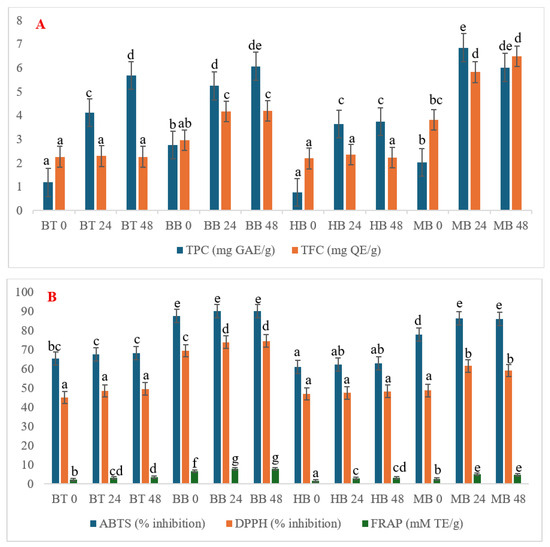
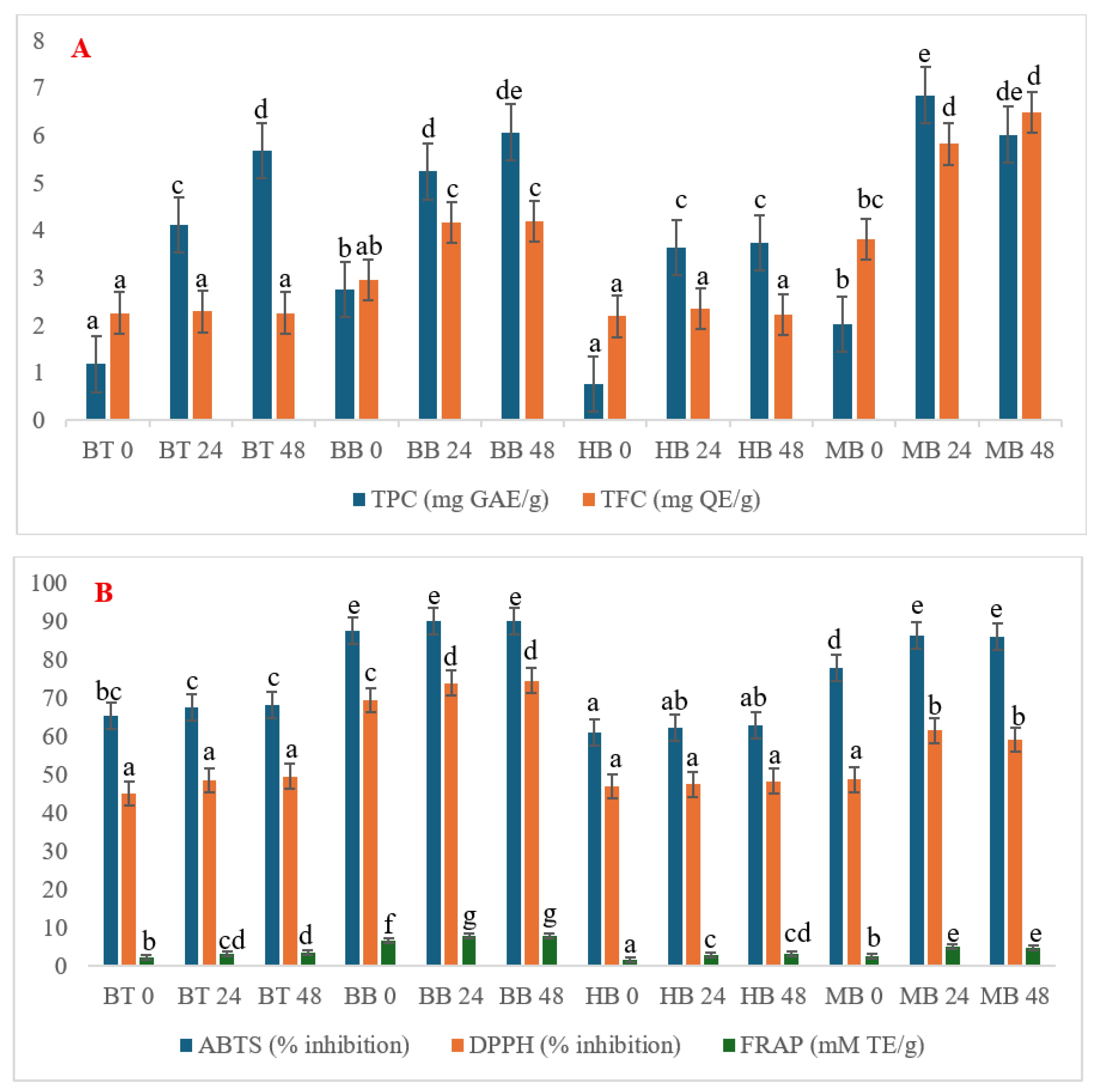
The total phenolic content (TPC), total flavonoid (TFC), and antioxidant properties such as ferric reducing antioxidant power (FRAP), 2,2-diphenyl-1-picrylhydrazyl (DPPH), and 2,2′-azino-bis(3-ethylbenzothiazoline-6-sulfonic acid) (ABTS) are presented in Figure 1A,B. The TPC showed an increase in all the fermented samples, with the most pronounced increase observed in MBs at 24 h (6.85 mg GAE/g), demonstrating an approximate 239% increment, from an initial value of 2.02 mg GAE/g. Similarly, BBs at 48 h showed a 121% increase after 48 h (6.07 mg GAE/g) of fermentation from an initial value of 2.75 mg GAE/g. The increase in TPC in fermented legumes can be attributed to the lactic acid bacteria (LAB) hydrolases, which may have converted polyphenolic compounds into other lower molecular weight compounds [42]. Legumes fermented with LABs have been reported to increase the TPC, and this value varies depending on the type of legume, the LAB, and the fermentation method [15]. A study has reported an increase in TPC values in four different legume flours fermented with Lactobacillus brevis, Lactobacillus rossiae, Lactiplantibacillus plantarum, Leuconostoc mesenteroides, and Pediococcus acidilactici [43]. The results further showed that the TPC values varied between different fermented legumes [43], which was the case in this present study.
Figure 1.
(A) Total phenolic and total flavonoid contents of unfermented and fermented selected bean flours. (B) Antioxidant properties of unfermented and fermented selected bean flours. BT 0—raw butter bean; BT 24—butter bean fermented at 24 h; BT 48—butter bean fermented at 48 h; BB—black bean; BB 24—black bean fermented at 24 h; BB 48—black bean fermented at 48 h; HB—haricot bean; HB 24—haricot bean fermented at 24 h; HB 48—haricot bean fermented at 48 h; MB 0—raw mung bean; MB 24—mung bean fermented at 24 h; MB 48—mung bean fermented at 48 h; TPC—total phenolic content; TFC—total flavonoid content; ABTS—2,2′-azino-bis(3-ethylbenzothiazoline-6-sulfonic acid); DPPH—2,2-diphenyl-1-picrylhydrazyl. Values are means ± standard deviation (n = 3). Bars with different letters indicate significant differences among samples according to Duncan’s multiple range test (p ≤ 0.05).
An increase in TPC during fermentation has been linked to polymeric phenolic compounds, which are hydrolyzed by microbial enzymes, resulting in the release of simpler and/or biologically more active phenolic compounds [44,45]. Likewise, the lignocellulosic matrix of legumes is degraded by fermentation, thereby releasing phenolic compounds from an inaccessible state [15]. The TFC showed an increase in the fermented samples except for the BT 48 h (2.26 mg QE/g) value, which remained constant as compared with the unfermented BT (2.26 mg QE/g). The value of BTs at 24 h, on the other hand, was 2.29 mg QE/g (Figure 1A). The HB values increased to 2.36 mg QE/g after 24 h of fermentation but decreased slightly to 2.23 mg QE/g after 48 h. This value was still, however, higher than the unfermented HB value of 2.19 mg QE/g. According to the study of ref. [46], fermentation of pulses was reported to cause a significant increase in TFC, but after a period of time (post fifth day). This effect started decreasing, attributed to nutrient depletion and lesser metabolic activity of fermenting microorganism. An increase in TFC values of fermented legumes may be a result of the earlier increase in TTA values, which releases bound flavonoid components to make them more bioavailable [47]. The TFC showed similar trends with TPC, with notable increases observed in MB and BB flours. The TFC value in MBs increased from 3.81 to 6.48 mg/g after 48 h of fermentation, representing a 70% increase.
The antioxidant activities of the legume flours demonstrated significant (p ≤ 0.05) increases following fermentation (Figure 1B). The ABTS radical scavenging activity in BB flour increased from 87.64% to 90.01% at 24 h and stabilized at 89.93% after 48 h of fermentation. Similarly, FRAP activity in BB flour increased from 6.64 to 8.03 mM TE/g at 24 h and stabilized at 8.00 mM TE/g after 48 h of fermentation. MBs showed a pronounced increment in DPPH radical scavenging (from 48.72% to 61.50% at 24 h and later stabilized to 59.12% at 48 h) and FRAP values (from 2.54 mM TE/g to 5.00 mM TE/g at 24 h and later stabilized to 4.87 mM TE/g at 48 h). The MB and BB flours had the highest antioxidant activity, which coincides with the highest TPC and TFC values reported earlier. The increase in phenolic, flavonoid, and polyphenol contents released during fermentation improves antioxidant activity [48,49]. Fermentation of legumes is an effective means to develop functional foods that are rich in antioxidants [35,50].
Fermentation can further increase the antioxidant activities of legumes by releasing phenolic compounds bound to the cell walls. The increase in acidity during fermentation can also impact the antioxidant activity of fermented foods positively through improving the bioactive compound extraction, stabilizing antioxidants and microbial hydrolysis, and increasing the solubility and bioavailability of antioxidants in the final product [51]. It has also been reported that lactic acid fermentation can degrade plant cell walls, enabling the release or synthesis of various antioxidant compounds, activation of endogenous enzymes, production of organic acids, and release of bioactive compounds [52]. Other factors can influence antioxidant properties further than phenolic compounds, while various analytical techniques for determining antioxidant capacity can lead to different results [40].
As presented in Table 4, Pearson’s correlation was used to evaluate the relationships between the phytochemical constituents (TPC and TFC) and antioxidant activities (FRAP, ABTS, and DPPH) of the investigated samples. A relatively high positive and significant (p ≤ 0.05) relationship between TPC and TFC was observed, suggesting a substantial contribution of flavonoids to the overall phenolic content. TPC also showed a positive and significant (p ≤ 0.05) correlation with FRAP, indicating a strong association between the TPC and FRAP. On the other hand, relatively high positive correlation coefficients were also found for TFC with ABTS radical scavenging activity (0.77), DPPH (0.54), and FRAP (0.50). These relationships were not statistically significant and thus indicates that flavonoids alone were not the sole contributors to the antioxidant activities measured by these assays. High positive correlations were identified between the antioxidant activity assays, particularly between ABTS and DPPH (0.91), ABTS and FRAP (0.87), and DPPH and FRAP (0.98). These values were, however, not statistically significant (p ≤ 0.05). While the magnitude of the correlation suggests a degree of agreement, the lack of statistical significance suggests that the observed associations might have been influenced by sample variability. As the assays appear to somewhat reflect related antioxidant responses, they could have possibly captured different aspects of antioxidant behaviour in legume flours.
Table 4.
Pearson correlation coefficients between phytochemical and antioxidant activities of unfermented and fermented legume flours.
3.4.2. Targeted Phenolic Compounds of Fermented Legume Flours Using Ultra-High Performance Liquid Chromatography–Photodiode Array
Phenolic compounds can be grouped in several ways due to their carbon chain and perhaps classify them into 16 classes [53]. The most important classes of phenolic compounds found in the human diet are flavonoids, phenolic acids, and tannins, while flavonoids are the major group of phenolic compounds found in plants, accounting for more than half of the eight thousand naturally occurring phenolic compounds [53,54]. The most common polyphenols found in legumes are anthocyanins, phenolic acids, tannins, and flavonoids, which widely vary and influence mostly the colour, pattern of the seedcoat, and legume type [5,55].
The targeted analysis of the seven phenolic compounds (chlorogenic acid, trans-ferulic acid, quercetin, apigenin, p-coumaric acid, luteolin, and sinapic acid) across the selected legume flours at different fermentation times (24 and 48 h) is presented in Table 5. The increase in antioxidant activities (DPPH, FRAP, and ABTS) in Figure 1B contributed to the increase in phenolic compounds. A study also reported that increased antioxidant activity in kiwifruit pulp fermented with Lactiplantibacillus plantarum contributed to polyphenolic compounds [30]. In BT and BB samples, concentrations of chlorogenic acid increased significantly (p ≤ 0.05) during the initial 24 h of fermentation (from 47.73 to 113.12 mg/kg in BTs and from 99.25 to 149.24 mg/kg in BBs). Furthermore, the concentration of chlorogenic acid increased in HBs during the initial 24 h of fermentation from 99.47 to 103.44 mg/kg, signifying the capacity of LABs to release or synthesize this hydroxycinnamic acid. However, towards the 48 h fermentation, chlorogenic acid decreased in the legume samples but still increased when compared to the unfermented legume samples. Interestingly, MBs exhibited the opposite trend, with non-detected chlorogenic acid in the unfermented sample but quantifiable after 24 h of fermentation (25.40 mg/kg); then at 48 h, the chlorogenic acid was not detected (Table 5). Higher chlorogenic acid might be due to the action of microbial enzymes that may have released the complexed phenolic compounds [56]. A study also linked chlorogenic acid to have potent antioxidant capacity [57]; thus, a higher level of chlorogenic acid may primarily account for the higher antioxidant activity.
Table 5.
Targeted phenolic compounds (mg/kg) of unfermented and fermented selected bean flours.
Trans-ferulic acid in MBs exhibited a biotransformation, starting at 145.28 mg/kg in unfermented samples and significantly (p ≤ 0.05) increasing to 555.51 mg/kg at 24 h and 624.81 mg/kg at 48 h, with a significant difference (p ≤ 0.05). The other legumes (BTs, BBs, and HBs) showed more modest increases in trans-ferulic acid concentrations during fermentation. Although BB 48 h and HB 48 h showed a slight decrease when compared to their 24 h counterparts, they were still higher than their unfermented counterpart. An increase in trans-ferulic acid following the fermentation of these legumes can be attributed to the microbial enzymes’ activity, particularly feruloyl esterases (FAEs), which were produced by the fermenting microorganisms.
The concentrations of p-coumaric acid increased across all fermented legume samples, with the most significant increase observed in MBs, where concentrations rose from 25.10 mg/kg in unfermented samples to 100.81 mg/kg at 24 h and 114.50 mg/kg at 48 h of fermentation. The high concentrations of p-coumaric acid observed in MBs is similar to that of trans-ferulic acid. The concentrations of sinapic acid increased across all fermented legume samples. The sinapic acid was more obvious in MBs, as its concentration increased from 42.14 mg/kg in unfermented samples to 161.43 and 181.95 mg/kg after 24 and 48 h fermentation, respectively. The increase in both p-coumaric and sinapic acids might be due to metabolism of LABs. According to ref. [5], the predominant phenolic acids identified in legumes are sinapic, gallic, caffeic, ferulic, p-hydroxybenzoic, and p-coumaric acids, which the most abundant in dry beans was ferulic acid. Ref. [58] reported similar findings in dark beans.
The three flavonoids (quercetin, apigenin, and luteolin) quantified in this study demonstrated variable accumulation patterns during fermentation. The concentrations of quercetin were undetected in unfermented BTs, HBs, and MBs, but an increase was detected in the legumes at 24 and 48 h. Quercetin were detected in the unfermented BBs and increased from 2.58 mg/kg in the unfermented BBs to 2.94 mg/kg at 24 h and 3.06 mg/kg at 48 h. Apigenin and luteolin concentrations increased during fermentation across all legume types, with the most pronounced increases detected in BBs. The concentrations of apigenin and luteolin were undetected in unfermented HBs and MBs. An increase in quercetin, apigenin, and luteolin during fermentation of the selected legumes can be due to the metabolic activity of LABs, which hydrolyses phenolic compounds and flavonoid glycosides into aglycones. This metabolism occurs through enzymatic hydrolysis and bioconversion, which liberate or increase the levels of free flavonoids such as quercetin, apigenin, and luteolin.
3.5. Pasting Properties of Unfermented and Fermented Selected Bean Flours
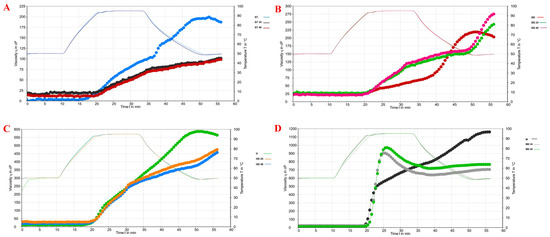
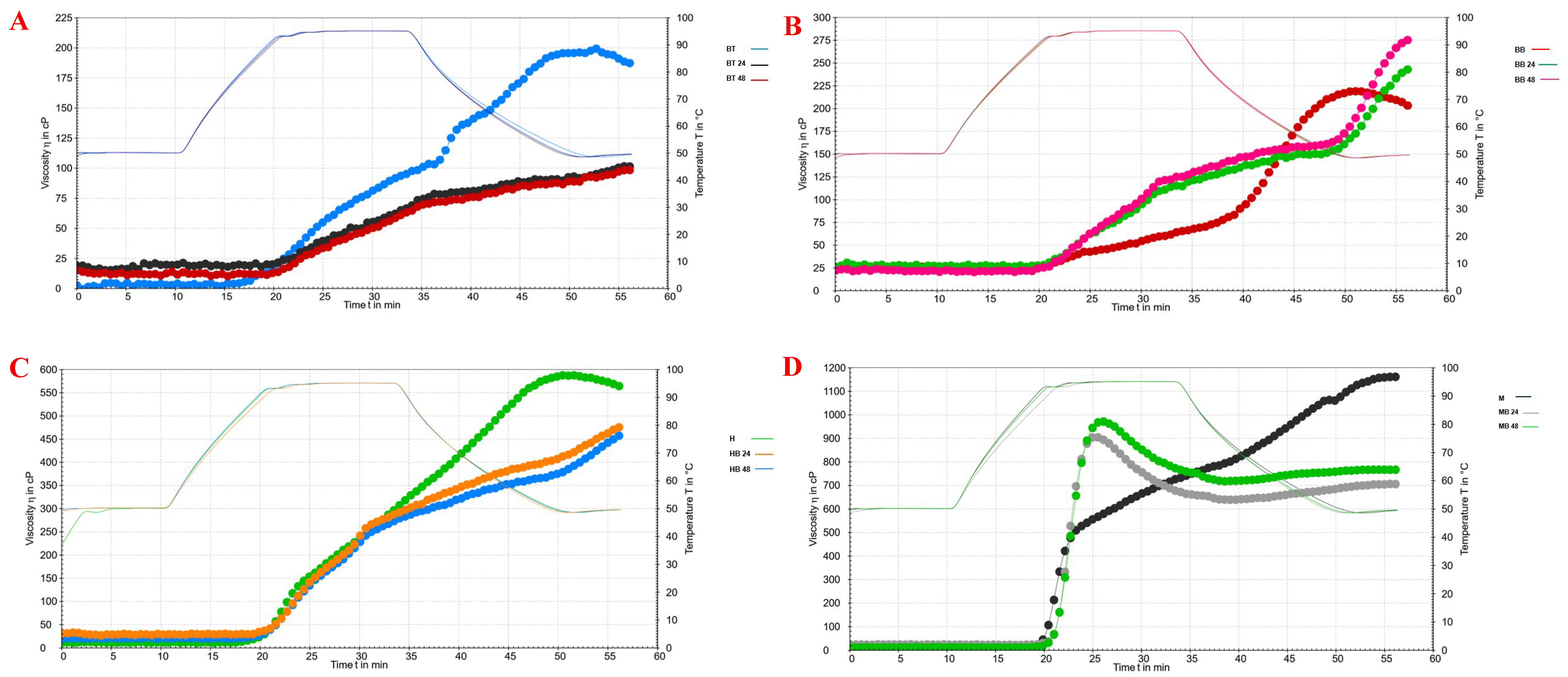
Figure 2A–D illustrates the rheometric pasting properties of unfermented and fermented legumes (butter bean, black bean, haricot bean, and mung bean) at different fermentation times (24 to 48 h). The peak time of unfermented BTs was 33.08 min and remained constant at 33.15 min after 24 and 48 h of fermentation. The peak time of unfermented BBs was 33.13 min, increasing to 33.15 min in BBs fermented at 24 h and 33.20 min in BBs fermented at 48 h. The peak time of unfermented and fermented HBs at 24 h remains the same at 33.15 min, while the peak time of HBs fermented at 48 h was 33.10 min. The MB samples fermented for 24 and 48 h showed significantly shorter peak times (25.05 and 25.30 min, respectively) as compared to the unfermented MBs (33.17 min). Peak time gives an indication of the time required for starch to gelatinize fully [6], while the similar pasting time suggests that fermentation has no effect on the time of raw and fermented legume samples, except for MB samples fermented at 24 and 48 h. The peak temperatures for unfermented legumes (BTs, BBs, and HBs) and their fermented 24 h and 48 h counterparts remain constant at 95.10 °C, with no significant (p ≤ 0.05) difference. Although the peak temperatures of unfermented MBs remain at 95.10 °C, at 24 h, it was 94.85 °C and 94.95 °C at 48 h. Pasting temperature gives an indication of the minimal temperature needed for sample cooking, associated energy cost, and stability of other components [59]. Hence, since the MB 24 h and 48 h have a slightly reduced pasting temperature, this gives an indication that the MB fermented samples will cook faster and would require less energy.
Figure 2.
Pasting profiles of unfermented and fermented selected bean flours. (A) BT: unfermented butter bean; BT 24: butter bean fermented at 24 h; BT 48: butter bean fermented at 48 h; (B) BB: unfermented black bean; BB 24: black bean fermented at 24 h; BB 48: black bean fermented at 48 h; (C) H: unfermented haricot bean, HB 24: haricot bean fermented at 24 h, HB 48: haricot bean fermented at 48 h; (D) M: unfermented mung bean, MB 24: mung bean fermented at 24 h, MB 48: mung bean fermented at 48 h.
The peak viscosity (PV) of MBs was significantly (p ≤ 0.05) higher, with 685.45 cP for the unfermented MBs compared to that reported after fermentation for 24 and 48 h, which increased to 888.90 and 922.30 cP, respectively. The PV of unfermented BBs was 117 cP, while it was 119 and 118.75 cP at 24 and 48 h, respectively. The increase in the PV may be attributed to improved water binding capacity and swelling of the starch granule during fermentation. High PV of the legume flours, especially in MBs, can be used in some products requiring high gel powers and elasticity. On the contrary, the PV of BTs dropped from 96.24 cP in unfermented BTs to 64.60 and 61.09 cP at 24 and 48 h, respectively, which indicates that due to fermentation, the swelling of starches in BTs decreased. According to ref. [60], a decrease in PV with fermentation time can be associated with starch degradation into simple molecules, and depolymerization occurs during fermentation. The HBs had a similar decrease in PV from 296.05 cP in the unfermented to 280.30 at 24 h and 276.75 at 48 h. A study reported an increase in PV in sorghum flour fermented with Lactiplantibacillus plantarum, ascribing this effect to the enhanced release of starch granules from the protein matrix due to fermentation [61]. Unfermented MBs showed the highest holding strength (HS) (684.85 cP), which decreased to 624.90 cP at 24 h but increased slightly to 664.45 cP at 48 h of fermentation. The HS of unfermented HBs (295.95 cP) decreased to 279.35 cP at 24 h and 275.60 cP at 48 h of fermentation, while that of the unfermented BTs (95.13 cP) decreased to 63.90 cP at 24 h and 60.27 cP at 48 h of fermentation. On the other hand, unfermented BBs (115.40 cP) increased slightly to 117.60 cP at 24 h and 117.25 cP at 48 h. A decrease in HS is linked to an increased presence of resistant starch [62]; hence, the presence of more resistant starch, which might be less soluble, may perhaps be present in these legumes, leading to a lower HS. An increase in HS may be due to hydrogen bond increasing, entanglement among starch chains, and recrystallization of amylose, which determine the starches’ retrogradation or gelling properties [63,64].
Fermentation significantly (p ≤ 0.05) reduced final viscosity (FV) in the legume samples. The FV in BTs was reduced from 163.85 to 84.15 cP at 24 h and 79.73 cP at 48 h; in BBs, it was reduced from 239.90 to 154.85 cP at 24 h and 150.35 cP at 48 h; and in HBs, it was reduced from 484.60 to 365.55 cP at 24 h and 353.20 cP at 48 h. However, the MBs exhibited a different pattern, with FV decreasing from 876.30 cP in unfermented MBs to 637.95 cP at 24 h and 679.65 cP at 48 h. The FV may be affected by the re-correlation of starch molecules in the samples and the effect of simple kinetics of cooling on viscosity [65]. Breakdown viscosity (BV) demonstrated the difference between PV and HS, while the BV remained minimal across most of the samples except for MB fermented samples, which displayed significantly (p ≤ 0.05) higher BV values (264.00 cP at 24 h and 257.90 cP at 48 h).
The BV of unfermented HBs also increased from 0.14 cP to 0.99 cP (24 h) and 1.19 cP (48 h), whereas that of BTs and BBs decreased. Reduction in BV signifies a higher level of resistance to breakdown induced by shear, which is likely caused by starch molecules’ partial hydrolysis leading to smaller and more stable granules [66]. Ref. [67] reported that the higher the BV, the lesser the sample’s ability during cooking to withstand heating and shear stress. The increased BV values during fermentation of HBs and MBs would facilitate easy cooking, but when processed into a solid form, it would be susceptible to stress. The differences in pasting properties of the selected legumes fermented with heterofermentative LABs may be due to various factors, such as variations in starch structure (amylose/amylopectin ratio, chain length distribution), enzymatic activity of the LAB, protein content/composition, and the formation of organic acids and metabolites during fermentation.
3.6. Thermal Properties of Unfermented and Fermented Selected Bean Flours
The thermal properties of unfermented and fermented selected legume flours were determined using differential scanning calorimetry (DSC) and are presented in Table 6. The parameters investigated include onset temperature (To), peak temperature (Tp), endset temperature (Te), and gelatinization enthalpy change (ΔHG). Ref. [6] indicated that thermal properties give detailed insights into the starch gelatinization behaviour and provide useful information for food processing applications.
Table 6.
Thermal properties of unfermented and fermented selected bean flours.
The To values of the unfermented legumes ranged from 95.21 °C to 96.71 °C. Following fermentation, some of the selected legume samples displayed slight variations. The HBs fermented at 24 h showed a significant increase of 103.73 °C, and this was the highest value recorded across all samples. The MBs showed a slight increase in the 24 h samples (96.28 °C) from 95.21 °C in the unfermented sample. A sharp decline to 81.63 °C at 48 h fermentation was observed. This might be linked to acid-induced gelatinization shifts or extensive starch degradation. However, BTs showed a slight decrease from 96.70 °C in the unfermented sample to 94.49 °C at 24 h and 94.79 °C at 48 h. Correspondingly, BBs demonstrated a decrease from 95.88 °C to 93.73 °C at 24 h and 94.30 °C at 48 h. The Tp was observed to decrease across all legume samples, with unfermented HBs having the highest value (114.36 °C), while Tp values of the fermented samples ranged from 103.24 to 110.98 °C. This decrease might be associated with the disruption of the crystal structure, resulting in a less ordered and thermally stable structure formation [22]. Reduction in gelatinization temperature may be due to the variations in granule shape after fermentation, the enzymatic hydrolysis, and the amylose content of each granule, which produces more shorter double helices during fermentation; hence, the heat resistance capacity was lessened, and gelatinization temperatures were lower [68]. Likewise, starch crystallinity and distribution of chain length can influence the gelatinization temperatures. Lactic acid fermentation mainly digests starch because of the hydrolytic actions of amylolytic enzymes [69].
Variations were observed in the Te values, with HBs fermented at 48 h showing the highest Te value (150.19 °C), and extended gelatinization, probably due to complex matrix interactions, might be responsible for this. The BB samples showed an increase in Te values in the fermented samples (140.33–141.36 °C), while moderate shifts were seen in the BT and MB samples (Table 6). The unfermented BTs had the lowest ΔHG (2771.75 J/g), while the BTs fermented at 24 h showed the highest (4964.60 J/g); the BTs fermented at 48 h showed a slight drop in ΔHG value (4246.75 J/g). A similar trend was observed in BB samples, while MB samples also increased throughout fermentation without a slight drop at the 48 h period. However, unfermented HBs had a value of 3649.48 J/g, which decreased at 24 h fermentation (3485.46 J/g) and increased slightly at 48 h fermentation (3651.87 J/g). An increase in ΔHG indicates that after fermentation, the structural integrity of the samples increased, and higher energy is needed to break it [70]. A study also reported a similar decrease in Tp and an increase in ΔHG during rice starch fermentation, ascribing this to amorphous region hydrolysis. This enlarged the relative crystalline region, thus needing more energy to break down and increasing the overall enthalpy of the system [71]. Several factors influence the detection of enthalpy changes during DSC, and these include botanical sources, moisture content, degree of starch hydration, physical properties of starch granules, etc. [72]. The variations in the thermal properties of the selected legumes can be associated with the overall structural organization of the starches, which varies quite a bit and thus is affected differently during fermentation.
4. Conclusions
This study demonstrated that fermentation of the selected legumes can serve many roles in food systems, such as its use as a natural source of phenolic compounds, which can be targeted for some health benefits. Thermal analysis in this study also revealed altered gelatinization parameters. The colour changes observed, especially the pronounced darkening in black beans, would provide the food manufacturers with an insight into the appearance and controllable product characteristics when incorporating fermented legume flours into products. From a functional perspective, the selected legumes have an advantage, especially in the development of sustainable, plant-based food products that meet current consumer demands for nutritious and functional foods. The improved nutritional and functional characteristics of the described fermented legume flours exhibit promise for industrial application to develop novel health-improving food products. On the basis of the obtained results, it can be concluded that the controlled fermentation with LABs is considered to be a promising approach for the legume valorization in the field of functional foods. This ensures a consumer trend for healthy, sustainable development of plant nutrition. However, future studies should focus on optimizing fermentation parameters using response surface methodology or machine learning approaches to identify optimal conditions for maximizing specific outcomes (e.g., phenolic content, antioxidant activity, or functional properties) for each legume type. Microbial validation, comparative studies with other LAB strains, or co-fermentation approaches could be explored, and lastly, the incorporation of these fermented legume flours into specific food matrices such as cookies, pasta, and breads should be developed.
Funding
This research received no external funding.
Institutional Review Board Statement
Not applicable.
Informed Consent Statement
Not applicable.
Data Availability Statement
The original contributions presented in this study are included in the article. Further inquiries can be directed to the corresponding author.
Conflicts of Interest
The author declares no conflicts of interest.
References
- Jarmul, S.; Dangour, A.D.; Green, R.; Liew, Z.; Haines, A.; Scheelbeek, P.F.D. Focus on Evidence Synthesis for Climate Solutions. Environ. Res. Lett. 2020, 15, 123014. [Google Scholar] [CrossRef] [Scilit]
- Kozicka, M.; Havlík, P.; Valin, H.; Wollenberg, E.; Deppermann, A.; Leclère, D.; Lauri, P.; Moses, R.; Boere, E.; Frank, S.; et al. Feeding climate and biodiversity goals with novel plant-based meat and milk alternatives. Nat. Commun. 2023, 14, 5316. [Google Scholar] [CrossRef] [Scilit] [PubMed]
- Yanni, A.E.; Iakovidi, S.; Vasilikopoulou, E.; Karathanos, V.T. Legumes: A Vehicle for Transition to Sustainability. Nutrients 2023, 16, 98. [Google Scholar] [CrossRef] [Scilit]
- Fils Pierre, J. Legumes: Cornerstones of Global Food Security and Sustainable Agriculture. In Legume Crop for Food Security-Cultivation and Benefits; Jose, C., Jimenez-Lopez, J.C., Escudero-Feliu, J., Eds.; IntechOpen: Rijeka, Coratia, 2024; pp. 1–11. [Google Scholar]
- Affrifah, N.S.; Uebersax, M.A.; Amin, S. Nutritional significance, value-added applications, and consumer perceptions of food legumes: A review. Legume Sci. 2023, 5, e123. [Google Scholar] [CrossRef] [Scilit]
- Adebo, J.A. Chemical composition, antioxidant activity, functional, pasting, and thermal properties of selected bean flours. Legume Sci. 2025, 7, e70053. [Google Scholar] [CrossRef] [Scilit]
- Sharma, K.; Zhang, W.; Rawdkuen, S. Dietary plant-based protein supplements: Sources, processing, nutritional value, and health benefits. Foods 2025, 14, 3259. [Google Scholar] [CrossRef] [Scilit]
- Lukus, P.K.; Doma, K.M.; Duncan, A.M. The role of pulses in cardiovascular disease risk for adults with diabetes. Am. J. Lifestyle Med. 2020, 14, 571–584. [Google Scholar] [CrossRef] [Scilit]
- Adebo, O.A.; Njobeh, P.B.; Adebiyi, J.A.; Gbashi, S.; Kayitesi, E. Food metabolomics: A new frontier in food analysis and its application to understanding fermented foods. In Functional Food-Improve Health Through Adequate Food; InTech: Rijeka, Croatia, 2017; pp. 211–234. [Google Scholar]
- Adebiyi, J.A.; Obadina, A.O.; Adebo, O.A.; Kayitesi, E. Fermented and malted millet products in Africa: Expedition from traditional/ethnic foods to industrial value-added products. Crit. Rev. Food Sci. Nutr. 2018, 58, 463–474. [Google Scholar] [CrossRef] [Scilit]
- Adebo, O.A.; Njobeh, P.B.; Adeboye, A.S.; Adebiyi, J.A.; Sobowale, S.S.; Ogundele, O.M.; Kayitesi, E. Advances in fermentation technology for novel food products. In Innovations in Technologies for Fermented Food and Beverage Industries; Food Microbiology and Food Safety; Panda, S., Shetty, P., Eds.; Springer: Cham, Switzerland, 2018. [Google Scholar]
- Anumudu, C.K.; Miri, T.; Onyeaka, H. Multifunctional Applications of Lactic Acid Bacteria: Enhancing Safety, Quality, and Nutritional Value in Foods and Fermented Beverages. Foods 2024, 13, 3714. [Google Scholar] [CrossRef] [Scilit]
- Carboni, A.D.; Martins, G.N.; Gómez-Zavaglia, A.; Castilho, P.C. Lactic acid bacteria in the production of traditional fermented foods and beverages of Latin America. Fermentation 2023, 9, 315. [Google Scholar] [CrossRef] [Scilit]
- Bartkiene, E.; Krungleviciute, V.; Juodeikiene, G.; Vidmantiene, D.; Maknickiene, Z. Solid state fermentation with lactic acid bacteria to improve the nutritional quality of lupin and soya bean. J. Sci. Food Agric. 2015, 95, 1336–1342. [Google Scholar] [CrossRef] [Scilit]
- Emkani, M.; Oliete, B.; Saurel, R. Effect of lactic acid fermentation on legume protein properties, a review. Fermentation 2022, 8, 244. [Google Scholar] [CrossRef] [Scilit]
- Gänzle, M.G.; Monnin, L.; Zheng, J.; Zhang, L.; Coton, M.; Sicard, D.; Walter, J. Starter Culture Development and Innovation for Novel Fermented Foods. Annu. Rev. Food Sci. Technol. 2024, 15, 211–239. [Google Scholar] [CrossRef] [Scilit]
- Kumar, A.; Saranyadevi, S.; Thirumalaisamy, S.K.; Dapana Durage, T.T.; Jaiswal, S.G.; Kavitake, D.; Wei, S. Phenolic Acids in Fermented Foods: Microbial Biotransformation, Antioxidant Mechanisms, and Functional Health Implications. Front. Mol. Biosci. 2025, 12, 1678673. [Google Scholar] [CrossRef] [Scilit]
- Mudau, M.; Adebo, O.A. Effect of Traditional and Novel Processing Technologies on the Thermo-Pasting, Microstructural, Nutritional, and Antioxidant Properties of Finger Millet and Bambara Groundnut Flours. Int. J. Food Sci. Technol. 2025, 60, vvae037. [Google Scholar] [CrossRef] [Scilit]
- Cheng, Y.; Yu, Q.; Xia, X.; Qian, J.; Xu, Q.; Yu, H.; Guo, Y.; Xie, Y.; Yao, W.; Qian, H. The Effect of Lactococcus lactis CICC 23610 Fermentation on the Physicochemical Properties and Flavor Formation of Oat Beverage. Cereal Chem. 2024, 101, 817–832. [Google Scholar] [CrossRef] [Scilit]
- Kewuyemi, Y.O.; Adebo, O.A. Complementary nutritional and health promoting constituents in germinated and probiotic fermented flours from cowpea, sorghum and orange fleshed sweet potato. Sci. Rep. 2024, 14, 1987. [Google Scholar] [CrossRef] [Scilit]
- Mudau, M.; Adebo, O.A. Impact of ultrasonication on the metabolite profile, nutritional quality, and antioxidant properties of Moringa oleifera Lam. leaf powder. Appl. Food Res. 2025, 5, 101299. [Google Scholar] [CrossRef] [Scilit]
- Adeyanju, A.A.; Emmanuel, P.O.; Adetunji, A.I.; Adebo, O.A. Nutritional, Pasting, Rheological, and Thermal Properties of Sorghum–Okara Composite Flours and Porridges. Int. J. Food Sci. Technol. 2025, 60, vvae021. [Google Scholar] [CrossRef] [Scilit]
- Emerald, F.M.E.; Pushpadass, H.A.; Manjunatha, M.; Manimala, K.; Dejey, D.; Salish, K.; Nath, B.S. Modelling approaches for predicting moisture transfer during baking of chhana podo (milk cake) incorporated with tikhur (Curcuma angustifolia) starch. J. Food Meas. Charact. 2020, 14, 2981–2997. [Google Scholar] [CrossRef] [Scilit]
- Arouna, N.; Gabriele, M.; Pucci, L. The impact of germination on sorghum nutraceutical properties. Foods 2020, 9, 1218. [Google Scholar] [CrossRef] [Scilit] [PubMed]
- Sadh, P.K.; Saharan, P.; Duhan, S.; Duhan, J.S. Bio-enrichment of phenolics and antioxidant activity of combination of Oryza sativa and Lablab purpureus fermented with GRAS filamentous fungi. Resour.-Effic. Technol. 2017, 3, 347–352. [Google Scholar] [CrossRef] [Scilit]
- Kewuyemi, Y.O.; Kesa, H.; Meijboom, R.; Alimi, O.Z. Comparison of nutritional quality, phenolic compounds, and antioxidant activity of conventional and 3D printed biscuits from wholegrain and multigrain flours. Innov. Food Sci. Emerg. Technol. 2023, 83, 103243. [Google Scholar] [CrossRef] [Scilit]
- Adebiyi, J.A.; Obadina, A.O.; Mulaba-Bafubiandi, A.F.; Adebo, O.A.; Kayitesi, E. Effect of fermentation and malting on the microstructure and selected physicochemical properties of pearl millet (Pennisetum glaucum) flour and biscuit. J. Cereal Sci. 2016, 70, 132–139. [Google Scholar] [CrossRef] [Scilit]
- Indasah, I.; Muhith, A. Local microorganism from “Tape” (fermented cassava) in composition and its effect on physical, chemical and biological quality in environmental. IOP Conf. Ser. Earth Environ. Sci. 2020, 519, 12003. [Google Scholar] [CrossRef] [Scilit]
- Atasoy, M.; Álvarez Ordóñez, A.; Cenian, A.; Djukić-Vuković, A.; Lund, P.A.; Ozogul, F.; Trček, J.; Ziv, C.; De Biase, D. Exploitation of microbial activities at low pH to enhance planetary health. FEMS Microbiol. Rev. 2024, 48, fuad062. [Google Scholar] [CrossRef] [Scilit]
- Zhou, Y.; Wang, R.; Zhang, Y.; Yang, Y.; Sun, X.; Zhang, Q.; Yang, N. Biotransformation of phenolics and metabolites and the change in antioxidant activity in kiwifruit induced by Lactobacillus plantarum fermentation. J. Sci. Food Agric. 2020, 100, 3283–3290. [Google Scholar] [CrossRef] [Scilit]
- Toor, B.S.; Kaur, A.; Kaur, J. Fermentation of legumes with Rhizopus oligosporus: Effect on physicochemical, functional and microstructural properties. Int. J. Food Sci. Technol. 2022, 57, 1763–1772. [Google Scholar] [CrossRef] [Scilit]
- Xiao, Y.; Xing, G.; Rui, X.; Li, W.; Chen, X.; Jiang, M.; Dong, M. Effect of solid-state fermentation with Cordyceps militaris SN-18 on physicochemical and functional properties of chickpea (Cicer arietinum L.) flour. LWT-Food Sci. Technol. 2015, 63, 1317–1324. [Google Scholar] [CrossRef] [Scilit]
- Xiao, Y.; Sun, M.; Zhang, Q.; Chen, Y.; Miao, J.; Rui, X.; Dong, M. Effects of Cordyceps militaris (L.) Fr. fermentation on the nutritional, physicochemical, functional properties and angiotensin I converting enzyme inhibitory activity of red bean (Phaseolus angularis [Willd.] W.F. Wight.) flour. J. Food Sci. Technol. 2018, 55, 1244–1255. [Google Scholar] [CrossRef] [Scilit]
- Mauro, R.R.; Vela, A.J.; Ronda, F. Impact of starch concentration on the pasting and rheological properties of gluten-free gels. Effects of amylose content and thermal and hydration properties. Foods 2023, 12, 2281. [Google Scholar] [CrossRef] [Scilit]
- Olukomaiya, O.O.; Adiamo, O.Q.; Fernando, W.C.; Mereddy, R.; Li, X.; Sultanbawa, Y. Effect of solid-state fermentation on proximate composition, anti-nutritional factor, microbiological and functional properties of lupin flour. Food Chem. 2020, 315, 126238. [Google Scholar] [CrossRef] [Scilit] [PubMed]
- Chinma, C.E.; Azeez, S.O.; Sulayman, H.T.; Alhassan, K.; Alozie, S.N.; Gbadamosi, H.D.; Danbaba, N.; Oboh, H.A.; Anuonye, J.C.; Adebo, O.A. Evaluation of fermented African yam bean flour composition and influence of substitution levels on properties of wheat bread. J. Food Sci. 2020, 85, 4281–4289. [Google Scholar] [CrossRef] [Scilit] [PubMed]
- Du, S.; Jiang, H.; Yu, X.; Jane, J. Physicochemical and functional properties of whole legume flour. LWT-Food Sci. Technol. 2014, 55, 308–313. [Google Scholar] [CrossRef] [Scilit]
- Ojo, M.O.; Oni, O.K.; Zubair, A.B.; Femi, F.A.; Audu, Y.; Etim, B.; Adeyeye, S. Influence of fermentation period on the chemical and functional properties, antinutritional factors, and in vitro digestibility of white lima beans flour. J. Food Sci. 2024, 89, 9047–9059. [Google Scholar] [CrossRef] [Scilit]
- Cairano, M.; Condelli, N.; Caruso, M.; Marti, A.; Cela, N.; Galgano, F. Functional properties and predicted glycemic index of gluten free cereal, pseudocereal and legume flours. LWT-Food Sci. Technol. 2020, 133, 109860. [Google Scholar] [CrossRef] [Scilit]
- Amanipour, A.; Samaei, Y.; Böök, O.; Granfeldt, Y.; Lazarte, C.E. Impact of dehulling, germination and fermentation on the bioactive and functional properties of grey pea flour. Front. Nutr. 2024, 11, 1478399. [Google Scholar] [CrossRef] [Scilit]
- Adejobi, T.H.; Olorunnusi, J.O.; Adegbanke, O.R.; Oguntoyinbo, O.O.; Enujiugha, V.N. Effect of ginger and garlic inclusion on the performance of Lactobacillus plantarum in Maize (Zea mays l.) fermentation into ogi. IPS J. Appl. Microbiol. Biotechnol. 2024, 3, 46–56. [Google Scholar] [CrossRef] [Scilit]
- Zhao, X.; Tang, F.; Cai, W.; Peng, B.; Zhang, P.; Shan, C. Effect of fermentation by lactic acid bacteria on the phenolic composition, antioxidant activity, and flavor substances of jujube–wolfberry composite juice. LWT-Food Sci. Technol. 2023, 184, 114884. [Google Scholar] [CrossRef]
- De Pasquale, I.; Pontonio, M.; Gobbetti, M.; Rizzello, C.G. Nutritional and functional effects of the lactic acid bacteria fermentation on gelatinized legume flours. Int. J. Food Microbiol. 2020, 316, 108426. [Google Scholar] [CrossRef] [Scilit]
- Dueñas, M.; Fernández, D.; Hernández, T.; Estrella, I.; Muñoz, R. Bioactive phenolic compounds of cowpeas (Vigna sinensis L.). Modifications by fermentation with natural microflora and with Lactobacillus plantarum ATCC 14917. J. Sci. Food Agric. 2005, 85, 297–304. [Google Scholar] [CrossRef] [Scilit]
- McCue, P.P.; Shetty, K. A model for the involvement of lignin degradation enzymes in phenolic antioxidant mobilization from whole soybean during solid-state bioprocessing by Lentinus edodes. Process Biochem. 2005, 40, 1143–1150. [Google Scholar] [CrossRef] [Scilit]
- Saharan, P.; Sadh, P.K.; Duhan, S.; Duhan, J.S. Bio-enrichment of phenolic, flavonoids content and antioxidant activity of commonly used pulses by solid-state fermentation. Food Meas. 2020, 14, 1497–1510. [Google Scholar] [CrossRef] [Scilit]
- Adetuyi, F.O.; Ibrahim, T.A. Effect of fermentation time on the phenolic, flavonoid and vitamin C contents and antioxidant activities of okra (Abelmoschus esculentus) seeds. Niger. Food J. 2014, 32, 128–137. [Google Scholar] [CrossRef] [Scilit]
- Adebo, O.A.; Medina-Meza, I.G. Impact of fermentation on the phenolic compounds and antioxidant activity of whole cereal grains: A mini review. Molecules 2020, 25, 927. [Google Scholar] [CrossRef] [Scilit]
- Bolat, E.; Sarıtaş, S.; Duman, H.; Eker, F.; Akdaşçi, E.; Karav, S.; Witkowska, A.M. Polyphenols: Secondary metabolites with a biological impression. Nutrients 2024, 16, 2550. [Google Scholar] [CrossRef] [Scilit]
- Chandra-Hioe, M.V.; Wong, C.H.; Arcot, J. The potential use of fermented chickpea and faba bean flour as food ingredients. Plant Foods Hum. Nutr. 2016, 71, 90–95. [Google Scholar] [CrossRef] [Scilit] [PubMed]
- Zhao, Y.S.; Eweys, A.S.; Zhang, J.Y.; Zhu, Y.; Bai, J.; Darwesh, O.M.; Zhang, H.B.; Xiao, X. Fermentation affects the antioxidant activity of plant-based food material through the release and production of bioactive components. Antioxidants 2021, 10, 2004. [Google Scholar] [CrossRef] [Scilit] [PubMed]
- de Figueiredo, S.M.; Binda, N.S.; Nogueira-Machado, J.A.; Vieira-Filho, S.A.; Caligiorne, R.B. The antioxidant properties of organosulfur compounds (sulforaphane). Recent Pat. Endocr. Metab. Immune Drug Discov. 2015, 9, 24–39. [Google Scholar] [CrossRef] [Scilit]
- Cosme, P.; Rodríguez, A.B.; Espino, J.; Garrido, M. Plant phenolics: Bioavailability as a key determinant of their potential health-promoting applications. Antioxidants 2020, 9, 1263. [Google Scholar] [CrossRef] [Scilit] [PubMed]
- Soleymani, A.; Shahrajabian, M.H.; Naranjani, L. Effect of planting dates and different levels of nitrogen on seed yield and yield components of nuts sunflower (Helianthus annuus L.). Afr. J. Agric. Res. 2013, 8, 5802–5805. [Google Scholar]
- Lin, L.Z.; Harnly, J.M.; Pastor-Corrales, M.S.; Luthria, D.L. The polyphenolic profiles of common beans (Phaseolus vulgaris L.). Food Chem. 2008, 107, 399–410. [Google Scholar] [CrossRef] [Scilit]
- Toor, B.S.; Kaur, A.; Sahota, P.P.; Kaur, J. Antioxidant potential, antinutrients, mineral composition and Ftir spectra of legumes fermented with Rhizopus oligosporus. Food Technol. Biotechnol. 2021, 59, 530–542. [Google Scholar] [CrossRef] [Scilit] [PubMed]
- Xiao, Y.; Xing, G.; Rui, X.; Li, W.; Chen, X.; Jiang, M.; Dong, M. Enhancement of the antioxidant capacity of chickpeas by solid state fermentation with Cordyceps militaris SN-18. J. Funct. Foods 2014, 10, 210–222. [Google Scholar] [CrossRef] [Scilit]
- López, A.; El-Naggar, T.; Dueñas, M.; Ortega, T.; Estrella, I.; Hernández, T.; Gómez-Serranillos, M.P.; Palomino, O.M.; Carretero, M.E. Effect of cooking and germination on phenolic composition and biological properties of dark beans (Phaseolus vulgaris L.). Food Chem. 2013, 138, 547–555. [Google Scholar] [CrossRef] [Scilit] [PubMed]
- Iwe, M.O.; Onyeukwu, U.; Agiriga, A.N. Proximate, functional and pasting properties of FARO 44 rice, African yam bean and brown cowpea seeds composite flour. Cogent Food Agric. 2016, 2, 1142409. [Google Scholar] [CrossRef] [Scilit]
- Singh, S.; Singh, N.; Ezekiel, R.; Kaur, A. Effects of gamma-irradiation on the morphological, structural, thermal and rheological properties of potato starches. Carbohydr. Polym. 2011, 83, 1521. [Google Scholar] [CrossRef] [Scilit]
- Pranoto, Y.; Anggrahini, S.; Efendi, Z. Effect of natural and Lactobacillus plantarum fermentation on in-vitro protein and starch digestibilities of sorghum flour. Food Biosci. 2013, 2, 46–52. [Google Scholar] [CrossRef] [Scilit]
- Xu, M.; Jin, Z.; Simsek, S.; Hall, C.; Rao, J.; Chen, B. Effect of germination on the chemical composition, thermal, pasting, and moisture sorption properties of flours from chickpea, lentil, and yellow pea. Food Chem. 2019, 295, 579–587. [Google Scholar] [CrossRef] [Scilit]
- Ragaee, S.; Abdel-Aal, E.-S.M. Pasting properties of starch and protein in selected cereals and quality of their food products. Food Chem. 2006, 95, 9–18. [Google Scholar] [CrossRef] [Scilit]
- Kumar, R.; Khatkar, B.S. Thermal, pasting and morphological properties of starch granules of wheat (Triticum aestivum L.) varieties. J. Food Sci. Technol. 2017, 54, 2403–2410. [Google Scholar] [CrossRef] [Scilit]
- Ikegwu, O.J.; Nwobasi, V.N.; Odoh, M.O.; Oledinma, N.U. Evaluation of the pasting and some functional properties of starch isolated from some improved cassava varieties in Nigeria. Afr. J. Biotechnol. 2009, 8, 2310–2315. [Google Scholar]
- Bamidele, O.P. Effects of natural fermentation time on chemical composition, antioxidant activities, and phenolic profile of cassava root flour. Appl. Sci. 2025, 15, 8494. [Google Scholar] [CrossRef] [Scilit]
- Adebowale, A.A.; Sanni, L.; Awonorin, S. Effect of texture modifiers on the physicochemical and sensory properties of direct fufu. Food Sci. Technol. Int. 2005, 11, 373–382. [Google Scholar] [CrossRef] [Scilit]
- Guo, L.; Li, H.; Lu, L.; Zou, F.; Tao, H.; Cui, B. The role of sequential enzyme treatments on structural and physicochemical properties of cassava starch granules. J. Food Sci. Technol. 2019, 71, 1800258. [Google Scholar] [CrossRef] [Scilit]
- Zhang, T.; Hong, S.; Zhang, J.R.; Liu, P.H.; Li, S.; Wen, Z.; Xiao, J.; Zhang, G.; Habimana, O.; Shah, N.P.; et al. The effect of lactic acid bacteria fermentation on physicochemical properties of starch from fermented proso millet flour. Food Chem. 2024, 437, 137764. [Google Scholar] [CrossRef] [Scilit] [PubMed]
- Gupta, R.; Gaur, S. Investigating the effect of natural fermentation in modifying the physico-functional, structural and thermal characteristics of pearl and finger millet starch. J. Sci. Food Agric. 2024, 104, 2440–2448. [Google Scholar] [CrossRef] [Scilit]
- Lu, Z.-H.; Li, L.-T.; Min, W.-H.; Wang, F.; Tatsumi, E. The effects of natural fermentation on the physical properties of rice flour and the rheological characteristics of rice noodles. J. Food Sci. 2005, 40, 985–992. [Google Scholar] [CrossRef] [Scilit]
- Alonso-Gomez, L.; Niño-López, A.M.; Romero-Garzón, A.M.; Pineda-Gomez, P.; del Real-Lopez, A.; Rodriguez-Garci, M.E. Physicochemical transformation of cassava starch during fermentation for production of sour starch in Colombia. Starch-Starke 2016, 68, 1139–1147. [Google Scholar] [CrossRef] [Scilit]

Disclaimer/Publisher’s Note: The statements, opinions and data contained in all publications are solely those of the individual author(s) and contributor(s) and not of MDPI and/or the editor(s). MDPI and/or the editor(s) disclaim responsibility for any injury to people or property resulting from any ideas, methods, instructions or products referred to in the content. |
© 2026 by the author. Licensee MDPI, Basel, Switzerland. This article is an open access article distributed under the terms and conditions of the Creative Commons Attribution (CC BY) license.