Article

Investigation of Nitrate Respiration in Cupriavidus necator for Application in Life Support System

1
Toulouse Biotechnology Institute (TBI), Université de Toulouse, The French National Centre for Scientific Research (CNRS), National Research Institute for Agriculture, Food and Environment (INRAe), National Institute of Applied Sciences (INSA), 31077 Toulouse, France
2
CNES-Exploration Vols Habités-Spaceship.Fr, 31400 Toulouse, France
*
Authors to whom correspondence should be addressed.
Fermentation 2026, 12(2), 81; https://doi.org/10.3390/fermentation12020081 (registering DOI)
Submission received: 1 December 2025 / Revised: 7 January 2026 / Accepted: 15 January 2026 / Published: 2 February 2026
(This article belongs to the Section Fermentation Process Design)

Abstract

Cupriavidus necator is a well-studied microorganism with potential application in bioregenerative life support systems for single-cell protein and bioplastic production. Most studies have been carried out in autotrophy or heterotrophy, requiring O2 as the final electron acceptor. In the context of inhabited missions, access to O2 will primarily be limited to the crew. In this study, we investigated the capacity of C. necator to carry out nitrate respiration as a strategy to limit oxygen supply to the cultures by providing nitrate from another compartment of the Bioregenerative Life Support System (BLSS). Batch bioreactor experiments were carried out to determine the best conditions for nitrate utilization in terms of pH and aeration. Continuous cultures were then performed under two carbon sources (glucose vs. acetic acid) and two substrate limitations (nitrate vs. carbon). The optimal conditions were found to be pH 7.5 under anaerobiosis. They were applied in chemostats, where three steady-states were obtained at a low dilution rate. In all cases, the biomass consisted of a mixture of protein (from 29 ± 1% Cell Dry Weight (CDW) to 39 ± 2% CDW) and polyhydroxybutyrate (from 45 ± 2% CDW to 57 ± 3% CDW), which was found to be a key component for nitrate respiration metabolism. Microaerobic conditions were also tested in batch culture, reporting for the first time aerobic nitrate respiration in C. necator. Under these conditions, growth parameters improved during the nitrate phase; however, the specific growth rate during the nitrite phase was lower than that observed under strictly anaerobic conditions.

1. Introduction

The renewed interest in human space exploration is accompanied by the need to develop new life support systems. These can be defined as complex systems of technologies that work in a network to maintain favourable conditions for human survival. Space agencies around the world are promoting research in this area to enable food production and resource recycling in space [1,2,3]. Therefore, the introduction of biological reactions is needed, and such systems are known as bioregenerative life support systems (BLSSs).
As early as the 1960s, ref. [4] investigated the potential use of Cupriavidus necator (C. necator), formerly known as Hydrogenomonas eutropha, Wautersia eutropha, Alcaligenes eutrophus, and, later, Ralstonia eutropha [5], for space applications, focusing on its ability to convert CO2, urea, and hydrogen into single-cell protein (SCP). More recently, its integration into a bioregenerative life support system (BLSS) has been further explored [6,7,8,9]. In the last two studies, urea from crew urine served as the nitrogen source, while volatile fatty acids (VFAs) generated during the first stage of anaerobic digestion of organic waste provided the carbon source, either as a mixture (mainly acetate, followed by propionate, valerate, butyrate, iso-valerate, and iso-butyrate) or individually. Laboratory-scale experiments reported protein productivities ranging from 0.046 to 0.132 g·g−1·h−1 (equivalent to 6.2–23 g·day−1) [7].
C. necator is also one of the most efficient and extensively studied bacteria for producing polyhydroxyalkanoates (PHAs) [10,11]. Using anaerobic digestion effluent as a carbon source provides a promising way to integrate waste management with biopolymer production [12,13]. For a space application, in situ production of PHA-derived materials could enable astronauts to manufacture tools or construction components using 3D printing. The incorporation of PHA production into a BLSS has been investigated using Rhodospirillum rubrum [14,15,16], where slow specific growth rates (µ) (h−1) (0.005–0.010 h−1) and relatively low PHA yields (averaging 10% of cell dry weight (CDW), and up to 35% of CDW under optimal conditions) were achieved, consisting of a mix of polyhydroxybutyrate (PHB) and polyhydroxyvalerate (PHV).
The metabolic shift between SCP production and PHA accumulation is generally driven by nutrient imbalance, particularly the carbon-to-nitrogen (C/N) ratio. Typically, C. necator favours SCP production at C/N < 10 and PHA accumulation at C/N > 20 [17]. Notably, significant amounts of PHA have been detected even under conditions optimized for SCP production and high growth rates [7,18].
Most of these process characterizations were performed aerobically. However, for a life support system application in space, access to O2 will be scarce and primarily limited to the crew. C. necator is a well-studied bacterium whose genome has been sequenced and annotated [19,20]. It is known to have the ability to grow anaerobically using nitrate and nitrite as electron acceptors. Nitrate respiration consists of the total reduction of nitrate to N2 by four enzymes: a nitrate reductase NADH-dependent (nar), a nitrite reductase (nir), a nitric oxide reductase (nor), and a nitrous oxide reductase (nos) [21]. Few data are available to describe C. necator fermentation using its anoxic metabolism. The authors of [22] were the first to test it in autotrophy and heterotrophy. Nitrate cultures were characterized by a diauxic growth, first with nitrate consumption and nitrite production, and then with nitrite consumption. Reference [23] determined the kinetic parameters of C. necator H16 in autotrophy and confirmed a drastic reduction in the µ, at best, µnitrate = 0.021 h−1 and µnitrite = 0.008 h−1, compared to aerobic conditions in autotrophy (µ = 0.24 h−1) [24]. These very low specific growth rates represent a major limitation for practical applications in autotrophy. However, studying heterotrophic anaerobic growth has been lacking in the literature. Therefore, the present study focuses on characterizing biomass production, physiology, and metabolic outcomes under nitrate-respiring conditions in order to assess the feasibility and constraints of using nitrate as an alternative electron acceptor.
Interestingly, nitrate and nitrite are key compounds in the natural nitrogen cycle. They are produced by nitrifying microorganisms and consumed by plants [25,26]. A BLSS attempts to reproduce the nitrogen cycle in artificial ecosystems. For example, BLSS designs typically include a compartment that allows ammonium (NH4+) to be converted to nitrate, which is then used for plant growth [2,27]. In this context, aerobic cultivation of C. necator could potentially be replaced by nitrate-respiring cultivation, thereby reducing the overall oxygen demand supplied by plants. It is thus necessary to determine the best conditions for nitrate respiration and then to test its effect on the biomass composition.
Therefore, the aim of this work was to investigate the potential of C. necator as a nitrate utilizer for biomass production. First, optimum pH and aeration conditions were determined for nitrate utilization. Finally, nitrate-limited or carbon-limited continuous culture experiments were performed to characterize the biomass production and composition at steady-state. Two carbon sources (glucose and acetate) were tested in continuous cultures. Acetate was selected because it is the main VFA present in anaerobic digestate.

2. Materials and Methods

2.1. Strain and Culture Media

2.1.1. Strains

Wild-type strains C. necator CECT 4623 (Spanish Type Culture Collection, Universitat de Valencia, Valencia, Spain) and DSM 541 (DSMZ-German Collection of Microorganisms and Cell cultures GmbH, Leibniz Institute, Braunschweig, Germany) were used in the present work. C. necator CECT 4623 is a H16-derived, glucose-utilizing mutant, while C. necator DSM 541 is also derived from the wild-type strain H16 but is not able to synthesize PHA [28,29]. This strain was used to allow for an indicative comparison of growth behaviour in the absence of PHB synthesis. Indeed, although this strain is derived from H16, it was not obtained from CECT 4623, thus preventing the complete exclusion of the influence of other mutations.

2.1.2. Media

Tryptone Soy Broth (TSB, Becton Dickinson, Sparks, MD, USA) was used as a rich medium for the first steps of preculture. To prepare TSB agar plates, 20 g·L−1 of agar was added to the TSB medium. Mineral medium 1 (MM1) was used for precultures and was previously described in [30]. Glucose (9.6 g·L−1) and urea (1.6 g·L−1) were used as carbon and nitrogen sources, respectively. Mineral medium 2 (MM2) was employed for bioreactor cultures and was prepared as described in [31]. For the batch experiments, 1800 mL of MM2 was prepared with glucose (9.6 g·L−1) or fructose (9.6 g·L−1), urea (1.6 g·L−1), and NO3- (3 g·L−1) as the carbon (C), nitrogen (N), and energy sources, respectively. Due to the large excess of glucose and urea quantified during Experiment C, their concentrations were then reduced to (4.9 g·L−1) for glucose and (1 g·L−1) for urea throughout all the remaining batch experiments (A, B, D, and E). For chemostat conditions, three independent 20 L tanks were prepared with MM2 containing urea (1 g·L−1) and NO3 (3 g·L−1). In addition, three 4 L tanks were prepared, one containing glucose (49 g·L−1) and the others containing acetic acid (57 g·L−1).

2.2. Inoculum Preparation

The inoculum was prepared according to [7].

2.3. Bioreactor Cultivation

The 2 L working-volume bioreactor set-up was composed as presented in [7], with some slight modifications. Nitrogen was used to flush the reactor and maintain a pO2 < 0.5% saturation. The gas analysis allowed the quantification of N2, CO2, and O2 in both the inlet and outlet of the reactor (MicroGC fusion, Inficon, Bad Ragaz, Switzerland). For the continuous-experiment set-up, fresh medium was added by peristaltic pumps (520Du, Watson Marlow, Spirax-Sarco Engineering plc, Cheltenham, UK) from sterile tanks and removed from the reactor with another pump to a waste tank.

2.4. Fermentation Strategy

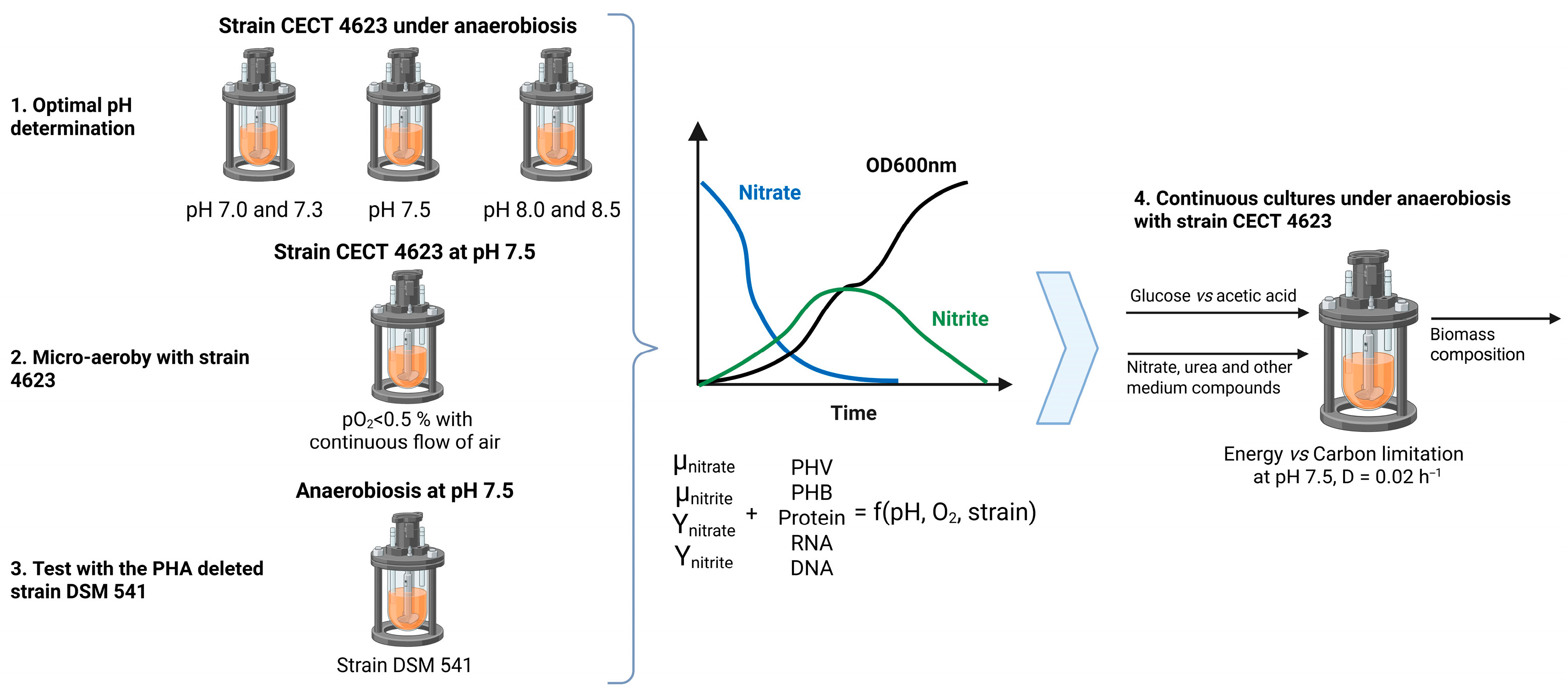
A series of four batch cultures were performed in a bioreactor to determine the optimal nitrate utilization conditions for C. necator. First, three separate culture runs tested five pH values (7.0, 7.3, 7.5, 8.0, and 8.5) under anaerobic conditions with strain CECT 4623 on MM2 medium with glucose. These five conditions were tested in three cultures because some of them showed no growth or very slow dynamics. Microaeration was then studied again at pH 7.5 with C. necator CECT 4623. Anaerobiosis was performed with a continuous flow of N2 in the liquid phase of the bioreactor, while microaerobiosis consisted of a continuous, limited flow of air, resulting in pO2 < 0.5% throughout the culture. Finally, a culture with the PHA-deleted strain DSM 541 was tested anaerobically at pH 7.5 on MM2 with fructose. Figure 1 summarizes the fermentation strategy in each batch.
Under the conditions defined above, two chemostats using the strain CECT 4623 at low dilution rates (0.02 h−1), with glucose or acetic acid as the sole C source and urea as the N source, were studied. After an approximately 50 h batch phase to consume all nitrate and nitrite, a 20 L tank of MM2 and a 4 L bottle containing the carbon source (glucose or acetic acid) were connected to the bioreactor. The flow rate of the 4 L tank pump containing the C-sources was set at 4 mL·h−1, which corresponds to 10% of the total flow rate (40 mL·h−1). This set-up allows the separate control of both nitrate and carbon flow. Therefore, multiple substrate limitations were attempted, specifically nitrate or carbon limitations. For each experimental condition, a steady-state was reached after at least a five-residence time, i.e., about 250 h at this dilution rate. The steady-states were then characterized by at least three samples. Finally, the next condition was set up by connecting new tanks to the bioreactor. Thus, each condition corresponded to a 20 L tank of culture medium 2 and a 4 L bottle of the carbon source, so they were all independent from each other. The experimental dilution rates were calculated by dividing the effluent flow rate by the volume of the liquid phase in the reactor at the end of the culture. Table 1 summarizes the conditions tested in this study for the batch and chemostat phases.

2.5. Analytical Procedure

2.5.1. Biomass Quantification and Characterization

The quantification of the biomass, protein, PHB, PHV, DNA, and RNA contents was performed according to [7]. The results are expressed in %CDW. In addition, flow cytometry was used to monitor cell viability with propidium iodide as described in [32].

2.5.2. Metabolite Quantification

The supernatant was used to quantify substrates and metabolites. Nitrate, nitrite, and acetic acid consumption and possible byproduct formation were quantified by high-pressure ionic chromatography (HPIC) using an ICS-3000 system (Dionex, Sunnyvale, CA, USA) equipped with a conductivity detector. IonPac AS11-HC analytical and AG11 guard columns equipped with an anion self-generating suppressor (ASRS® 300, 4 mm), a carbonate removal device (CRD 200, 4 mm), a continuously regenerated anion trap column (CR-ATC) and a conductivity detector were used for anion quantification (Thermo Fisher Scientific, Waltham, MA, USA). The mobile phase was KOH solution (EGC II KOH cartridge, Thermo Fisher Scientific, Waltham, MA, USA) at a flow rate of 1 mL·min−1. A concentration gradient was applied: 1 mM for 13 min, increasing to 60 mM over 32 min with two steps at 15 mM and 30 mM for times of 25 min and 35 min, respectively, then 60 mM for 5 min and finally decreasing to 1 mM over 15 min. Glucose was also quantified with HPIC using the ICS-3000 system (Dionex, USA) equipped with an amperometric detector. CarboPac PA1 analytical and CarboPac PA1 guard columns (4 × 250 mm) (4 × 50 mm) (Thermo Fisher Scientific, Waltham, MA, USA), followed by an amperometric detector composed of an electrochemical cell, a reference electrode, and a working electrode (pH–AgCl) (Dionex, USA), were used. The isocratic mobile phase was 200 mM NaOH, purchased concentrated (Fisher Chemical, Leicestershire, UK) and set at 1 mL·min−1. In addition, the ammonium concentration was determined as described in [33]. Chromatographic data were collected and analysed with Chromeleon (version 6.80 SP4 Build 2361) software. External standards (acetate, nitrate, nitrite, glucose, and ammonium) were used from 1.25 mg·L−1 to 20 mg·L−1, at the beginning and the end of the sequence, to ensure the stability throughout the analysis.
Finally, urea was quantified as presented in [7].

2.6. Data Treatment

For the batch experiments, specific growth rates (µmax) (h−1) were determined as being the slope of Ln(OD) = f(t). The error on the µmax was calculated as the standard deviation of the slope. Correlations between CDW and optical density measurements were determined for each batch experiment and were used to determine substrate (S) conversion yields to biomass. The state variables were plotted pairwise in a scatter plot within the considered period of time. A linear regression was applied; the conversion yields (Ynitrate), (Ynitrite), and (Yglucose) (gCDW·gS−1) correspond to its slope and the error to its standard deviation.
For the chemostat experiments, the CO2 production rate (rCO2) (Cmol·L−1·h−1) was calculated as described in [34]. Substrate consumption rates and carbon and nitrogen mass balances were determined by adaptation of the data treatment presented in [7]. Briefly, the dilution rate (D) (h−1) was defined by the following equation (Equation (1)):
D = Q o u t V l
where Qout is the flow rate at the outlet of the chemostat (L·h−1) and Vl is the volume of the liquid phase in the bioreactor tank (L).
At steady-state, the consumption rates of carbon (rC) and nitrogen (rN = rurea + rNH4+) or production rates of total biomass (rX), catalytic biomass (rXC) (biomass subtracted from PHAs), and PHA (rPHA) were determined according to the following equation (Equation (2)):
r E = Q o u t · [ E ] o u t Q i n · [ E ] i n V l
For transitional regimes the following equation (Equation (3)) was used:
r E = Q o u t · [ E ] o u t Q i n · [ E ] i n V l + d ( Q o u t · [ E ] o u t ) d t
where E represents any compound, [E]in its concentration at the chemostat inlet (mol·L−1), Qin its inlet flow rate (L·h−1), and [E]out its outlet concentration (mol·L−1). In this study, the double-feeding strategy used to separate the carbon source from the rest of the culture medium allowed for the distinction between Qin and Qout. The units Cmol and Nmol, which represent the amount containing one mole of carbon or nitrogen, were used to characterize the organic compounds (acetate, glucose, biomass, CO2, and PHB) and the nitrogen-containing compounds (urea, ammonium, and biomass) [35].
The elemental composition of the catalytic biomass was C H1.69 O0.45 N0.25, determined from the culture of C. necator under unlimited growth conditions [7]. The catalytic biomass yields (Ysxc) in (Cmolxc·CmolS−1) and the total biomass yields (Ysx) (gCDW·gS−1) were calculated with the equations below (Equations (4) and (5)); in the latter case, the rates were expressed in (g·L−1·h−1):
Y S X C = r X C r C
Y S X = r X r C
Finally, the specific rates (q) were determined, and the carbon and nitrogen mass balances were checked as presented in [7].

3. Results

3.1. Determination of the Nitrate Fermentation Conditions

3.1.1. Optimum pH

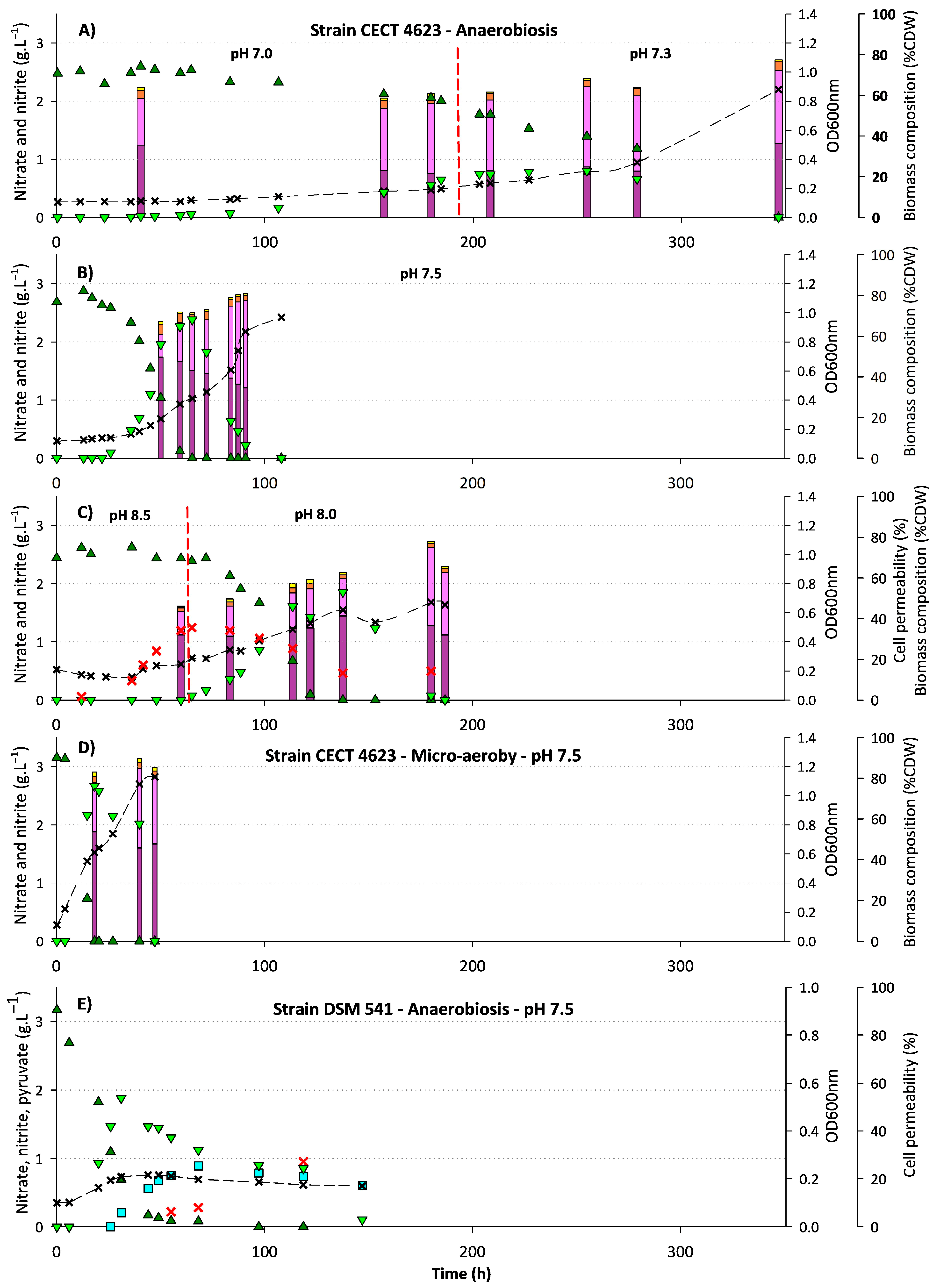
Three batch cultures (A, B, and C) (Table 1) were performed at different pHs to characterize the growth parameters: the maximum specific growth rate (µmax) and the conversion yields of nitrate, nitrite, and glucose into biomass (Ynitrate, Ynitrite, and Yglucose). Biomass composition was also quantified in terms of proteins, DNA, RNA, PHB, and PHV over time. Figure 2 shows the kinetic results of the experiments described below, and Table 2 summarizes the kinetic parameters and biomass composition results. Culture A consisted of two different periods (Figure 2A). The first, performed at pH 7.0 from 0 h to 180 h, showed very slow growth dynamics (µnitrate = 0.0044 ± 0.0002 h−1); the pH was then changed to 7.3 for the rest of the experiment. The specific growth rates increased at µnitrate = 0.0073 ± 0.0001 h−1 and µnitrite = 0.012 h−1 at pH 7.3.
The Ynitrate was found to be the highest in the study at 0.27 ± 0.04 gCDW·gnitrate−1 and 0.31 ± 0.04 gCDW·gnitrate−1 at pH 7.0 and 7.3, respectively. The average biomass composition for both pH conditions is shown in Table 2. Interestingly, the total biomass composition (protein + PHB + nucleic acids) was found to be low at the beginning of the cultivation and increased over time (from 56% CDW to 68% CDW). Similarly, PHB content tended to increase over time, while DNA and RNA contents decreased.
At pH 7.5, the growth dynamics were faster and showed a diauxic profile (Figure 2B). After around 20 h of lag phase, cell growth started on nitrate, which was converted into nitrite. Total nitrate consumption was achieved at 65 h, and a second growth phase powered by nitrite consumption was observed until 100 h. The specific growth rates were µnitrate = 0.036 ± 0.001 h−1 and µnitrite = 0.050 ± 0.003 h−1. In terms of biomass yields, Ynitrate = 0.11 ± 0.00 gCDW·gnitrate−1, Ynitrite = 0.26 ± 0.08 gCDW·gnitrite−1, and Yglucose = 0.29 ± 0.01 gCDW·gglucose−1 were obtained. At the end of the nitrate growth phase, the biomass was composed of 48% of CDW protein, 20% CDW PHB, and 5.1% CDW nucleic acids. At the end of the nitrite growth phase, the protein content decreased to 34% CDW, the PHB content increased to 43% CDW, and the nucleic acids dropped to 3.4% CDW. The average values obtained for all the samples of this experiment are shown in Table 2.
Culture C was also composed of two distinct periods (Figure 2C). The first, at pH 8.5 from 0 h to 60 h, was characterized by an absence of cell growth, an absence of nitrate and nitrite consumption, and by an increase in cell membrane permeability that reached 35% of the total population instead of less than 5% for the other cultures. Thus, the decision to decrease the pH to 8.0 was made. Then, from 60 h to 137 h, a first phase of cell growth with nitrate consumption and nitrite production was observed. This was followed by a second phase of cell growth on nitrite. The two µmax were calculated: µnitrate = 0.012 ± 0.001 h−1 and µnitrite = 0.009 h−1. The yields were determined and are presented in Table 2. Protein content increased during nitrate consumption and reached a maximum of 41% CDW, then decreased to 32% CDW at the end of the experiment. Nucleic acids accumulated during the nitrate phase to a maximum of 4.5% CDW before decreasing and stabilizing at 3% CDW for the entire nitrite phase. PHB content increased continuously, from 11% CDW to 31% CDW (Table 2).
In all cases, glucose, urea, and ammonium were quantified in excess, and no PHV was detected at any time. Interestingly, the urea and NH4+ concentrations remained stable over time, with ammonium concentrations not exceeding 11 Nmmol·L−1 regardless of pH. Under anaerobiosis, pH 7.5 clearly led to the highest µmax on both the nitrate and nitrite phases of diauxic growth, with µnitrate < µnitrite. This condition was repeated in a final batch culture and showed comparable results in terms of specific growth rates (µnitrate = 0.042 ± 0.003 h−1 and µnitrite = 0.050 ± 0.000 h−1) and biomass composition. It was therefore chosen as the condition for the next steps of the study.

3.1.2. Anaerobiosis vs. Microaerobiosis

Figure 2D presents the kinetic data for the batch experiment at pH 7.5 under microaerobiosis. The nitrate and nitrite phases were characterized with µnitrate = 0.104 ± 0.019 h−1 and µnitrite = 0.027 ± 0.001 h−1. Due to the high µnitrate, the overall culture time was significantly reduced compared to the same pH conditions under anaerobiosis, from 100 h to 45 h. Glucose, urea, and ammonium, i.e., carbon and nitrogen, were in excess as expected. Unlike previous cultures, NH4+ concentrations increased throughout the cultivation period, reaching 17 Nmmol·L−1 and 43 Nmmol·L−1 at the end of the nitrate and nitrite growth phases, respectively. The biomass yield on glucose (Yglucose) was 0.29 ± 0.02 gCDW·gglucose−1, which is similar to the value obtained under anaerobic conditions. However, the yields on nitrate and nitrite were approximately twice as high as in anaerobiosis. As before, the protein, DNA, and RNA contents decreased over time (from 54% CDW to 46% CDW and from 6% CDW to 4% CDW, respectively) while the PHB content increased (from 24% CDW to 33% CDW). Our results indicate that C. necator can simultaneously utilize oxygen and nitrate as terminal electron acceptors under the tested conditions. To our knowledge, such concurrent oxidative and nitrate respiration has not been explicitly described for C. necator in the literature. Although the underlying regulatory and enzymatic mechanisms were not investigated here, this observation suggests a degree of respiratory flexibility allowing partial substitution of oxygen by nitrate.
Microaerobiosis led to the highest µmax obtained in this study, for the nitrate growth phase at pH 7.5. Interestingly, microaerobiosis cled to µnitrate higher than µnitrite, which is the opposite of the anaerobic condition. Since the microaerobic condition had a lower µnitrite than the anaerobic condition, it was not retained for the following stages of the study.

3.1.3. PHA Synthetic Metabolism

Finally, the necessity of PHA synthetic metabolism for nitrate respiration was tested. One final batch experiment was conducted with C. necator DSM 541, a strain that cannot synthesize PHA, under anaerobic conditions at a pH of 7.5. The kinetic data are presented in Figure 2E. A growth phase occurred on nitrate with a yield of 0.05 ± 0.01 gCDW·gnitrate−1 and nitrite production. After reaching 2 g·L−1 of nitrites, cell growth did not resume. On the contrary, biomass slowly decreased with nitrite concentration. This was accompanied by pyruvate excretion up to 1 g·L−1 and an increase in cell permeability (27%). These results illustrate the necessity of PHA synthesis for the cell to ensure nitrite respiration.

3.2. Continuous Cultures

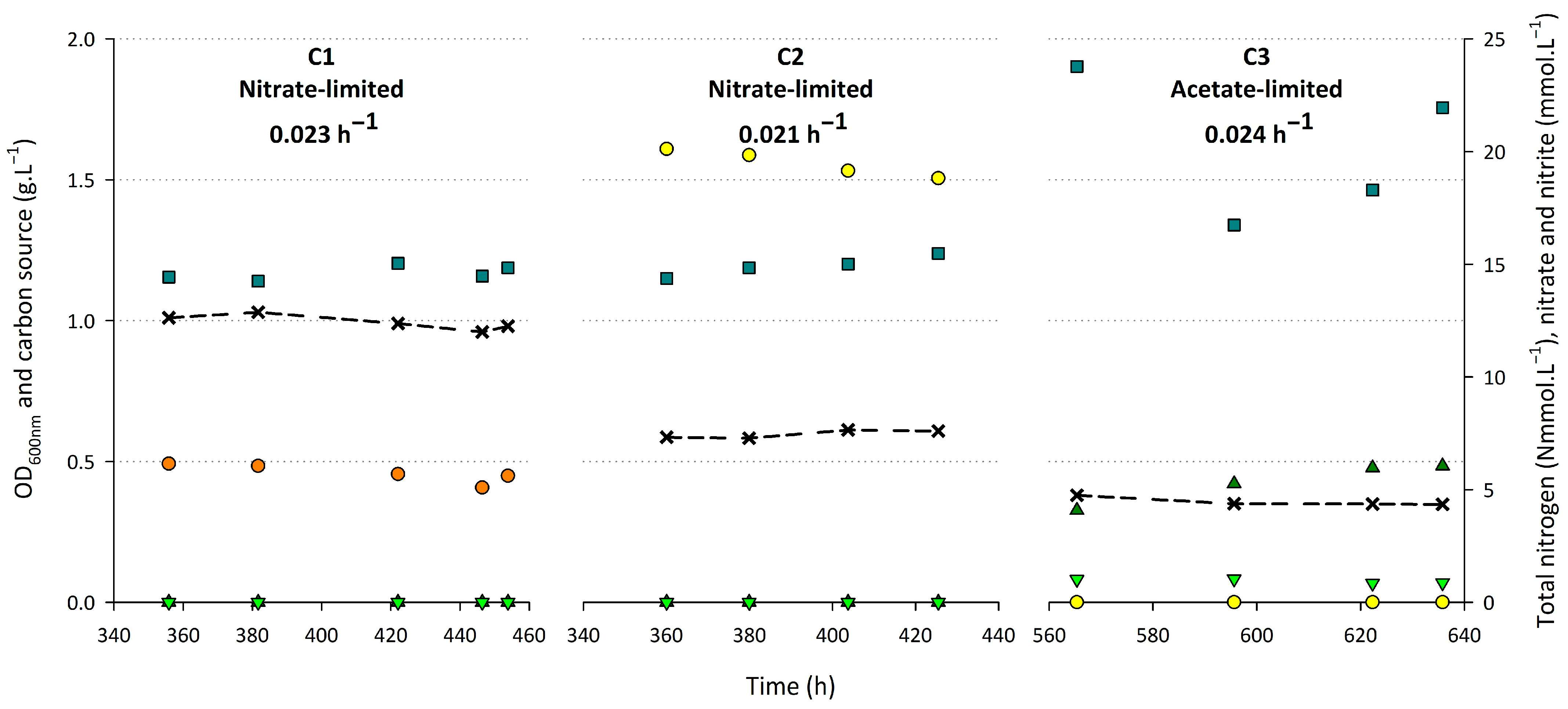
The conditions established above (pH 7.5 under anaerobiosis with strain CECT 4623) were applied to the chemostat experiments. Three steady-states were obtained: one on glucose and two on acetic acid as the carbon source. The objective was to study the effect of nitrate respiration on biomass composition under nutrient-unbalanced conditions. The dilution rates were 0.023 h−1, 0.021 h−1, and 0.024 h−1 for experiments C1, C2, and C3, respectively. The kinetic data are shown in Figure 3. The nitrogen source was in excess in the form of urea and ammonium during all steady-states (on glucose, the total nitrogen concentration in the culture broth was 14.7 ± 0.4 Nmmol·L−1, and on acetic acid it was 14.8 ± 0.3 Nmmol·L−1 and 20 ± 3 Nmmol·L−1). Urea accounted for the vast majority of excess nitrogen in the culture broth. Ammonium concentrations never exceeded 1 Nmmol·L−1. Similarly, high concentrations of residual carbon were quantified during the first two steady-states (glucose = 0.45 ± 0.03 g·L−1 for C1 and acetic acid = 1.6 ± 0.5 g·L−1 for C2), but neither nitrate nor nitrite was detected, meaning that the reducing power was the limiting substrate in these cases. In contrast, for the final steady-state (C3), nitrate and nitrite were quantified in excess with concentrations of 5.3 ± 0.9 mmol·L−1 and 1.0 ± 0.1 mmol·L−1, respectively. Acetic acid was not detected, indicating that carbon limitation was reached. However, it was difficult to achieve perfect stability even after 500 h, as shown by the evolution of the total nitrogen concentration. Thus, it was the only rate calculated with (Equation (4)).
In addition, the biomass composition in proteins, DNA, RNA, and PHB was determined. The results presented in Table 3 correspond to the mean values and their standard deviations for at least three samples collected at steady-state. In all cases, the biomass was composed of a mixture of proteins and PHB. Nitrate and nitrite being used as the limiting substrate resulted in a greater accumulation of PHB than that of the acetic acid-limited chemostat, with 57% CDW and 45% CDW, respectively. As expected with glucose and acetic acid, no PHV was detected. The total nucleic acid contents were found to be 4.5 ± 0.7% CDW for C1, 5.1 ± 1.2% CDW for C2, and 2.6 ± 0.4% CDW for C3.
Using both online and offline data, the following were determined: instantaneous qC/qN ratios; carbon-to-biomass yields (Ysx) and (Ysxc) (Table 3); carbon (qC)- and nitrogen (qN)-specific consumption rates; CO2 (qCO2)- and PHB (qPHB)-specific production rates; and carbon and nitrogen balances (Table 4). For all the steady states, the mass balances were satisfactory and closed within 21%, meaning that all substrates and products were accounted for. This gap could be explained by the low quantities of biomass, urea, ammonium, PHB, and CO2 that were measured.

4. Discussion

4.1. Effects of pH and Aeration on C. necator Anaerobic Growth

A series of five batch cultivations were carried out to determine the optimal kinetic parameters for nitrate utilization by C. necator. Firstly, the anaerobic-growth kinetics started with a consistent lag phase regardless of pH. This is probably explained by the use of aerobically grown precultures [22]. Cells needed time to transition from O2 to nitrate respiration. Subsequently, as expected under these conditions, diauxic growth was reported, confirming proteome adaptation to nitrite reduction after total nitrate consumption [36]. Under anaerobic conditions, the best µmax was found at pH = 7.5, with a sharp decrease in µmax values at higher and lower pHs. These results are consistent with the findings of [22], who determined an optimal pH range from 7.5 to 8.0 in heterotrophy. In terms of yields, the behaviour of C. necator varied. Ynitrate was found to be lower at pH 7.5. Due to the small number of sampling points during the nitrite growth phase, Ynitrite could only be calculated at pH 7.5 under anaerobiosis and microaerobiosis. The lower Ynitrate at pH 7.5 may be explained by increased carbon flux toward PHB (reaching 20%CDW), reducing biomass yields.
Microaerobic conditions yielded the best growth parameters in terms of µnitrate and yields, compared to anaerobiosis at the same pH. Only µnitrite was found to be lower than in anaerobiosis. According to [22], O2 represses the formation of the denitrifying system (nitrite reductase), which could explain why, in this case, µnitrate was higher than µnitrite. Similarly, Pfitzner and Schlegel [22] found that ammonium repressed the expression of nitrate reductase. Thus, the use of urea as a nitrogen source limited the effect of high NH4+ concentrations during nitrate growth. This is supported by the strong regulation of ammonium concentration by cells under anaerobic conditions reported in this study. To our knowledge, this is the first report of simultaneous oxidative and nitrate respiration in C. necator. However, this phenomenon, also called aerobic denitrification, has been well characterized in other denitrifiers [37,38]. A direct link between dissolved oxygen concentration, growth rate, and yields has been established for Pseudomonas stutzeri [39].

4.2. Effects of the pH and Aeration on C. necator Biomass Composition

In batch cultures, the composition of the quantified total biomass (sum of the protein, PHB, DNA, and RNA contents) was influenced by the culture conditions (Table 2). Furthermore, it increased over time during the kinetics, from 46% CDW (Figure 2C) to 81% CDW (Figure 2B). This means that the unquantified cell components, namely carbohydrates and lipids that form cell walls and membranes, reached 40–50% CDW instead of 10–20% CDW, as usually determined in C. necator [40]. One possible explanation for this phenomenon is an increase in cell size over time. An increase in forward-scatter width (FSC-W) and forward-scatter area (FSC-A), which are known to correlate with the size of the cells, was measured by flow cytometry over time for the kinetics (A, B, and C) (Supplementary Materials Figure S1). In the case of bacilli-shaped bacteria, it has been shown that the surface-to-volume ratio decreases with increasing width [41]. Thus, the surface-to-volume ratio decreased over time during our kinetics, which could have led to a decrease in the proportion of the cell surface constituents (lipids and carbohydrates) relative to the protein, PHB, DNA, and RNA present inside the cell. Harris and Theriot (2018) and R. H. Pritchard (1974) have already suggested this idea [41,42], and it has been quantitatively measured in Bacillus megaterium [43]. Cell size is known to be influenced by nutrient availability and cell cycle progression, although work is still needed to characterize all the physiological processes involved in cell size regulation and, notably, the repartition between lipid and carbohydrate accumulation [44,45,46]. In our case, non-optimal pH conditions may have triggered this phenomenon.
Furthermore, PHA synthesis is a key element of nitrate respiration metabolism, and several lines of evidence support this interpretation. First, the biomass composition evolved in the same way in batch culture, regardless of the condition. A decrease in protein and nucleic acid content was measured over time in favour of an increase in PHB. In the chemostat at steady-state, the biomass was also mainly composed of a mixture of protein and PHB. Proteomic analyses comparing aerobic and anaerobic conditions with C. necator H16 suggested a strong link between anaerobiosis and PHB synthesis [36]. Our experiment with the PHA-negative strain DSM 541 demonstrated the necessity of PHB to perform complete nitrate respiration. Because nitrate reduction showed comparable µmax between strains 4623 and 541 (Table 2), this step still worked even with a lower yield. However, the absence of PHB synthesis resulted in the absence of nitrite reduction and, therefore, no growth. To our knowledge, this is the first time that a direct correlation link between PHB synthesis and anaerobic respiration has been reported in C. necator. Nevertheless, the importance of PHB accumulation to perform nitrate respiration has been shown in anaerobic and aerobic conditions with other microorganisms. Interestingly, ref. [47] reported that electron flux coming from PHA production or consumption powered denitrification in Accumulibacter phosphatis. Similarly, detailed biochemical pathways of Pseudomonas stutzeri under aerobic and anaerobic denitrification were proposed by [39]. In this case, microbial stoichiometry and carbon flux analyses revealed that the carbon source and PHB stock played a critical role in electron balance in nitrate respiration [39,48].

4.3. Consideration for BLSS Integration

Finally, the interest of using anaerobic nitrate respiration with C. necator can be discussed for a spatial application in a life support system. To date, this is one of the few studies describing chemostat experiments under anaerobic nitrate respiration with C. necator. Three different steady-states were obtained, and their biomass compositions were characterized. Only two continuous culture experiments under these conditions have been reported. Both were performed with an ecological biotechnology approach to remove nitrate and nitrite pollutants from wastewater, one in autotrophy [49] and the other in heterotrophy using a complex medium in membrane bioreactors [50]. Therefore, it is difficult to compare those results. Moreover, the biomass consisted of a mixture of protein and PHB, regardless of nutrient limitation and carbon source. The C/N ratio of nutrients has been shown to be a key parameter influencing PHB production [17]. In this case, it was possible to reduce the PHB content from 57% CDW to 45% CDW in favour of protein accumulation by adjusting the C/N ratio in the culture medium (Table 4). Examination of the qC/qN, i.e., the ratio of the specific consumption rates of carbon and nitrogen, shows that only C3 showed a qC/qN below 10, known to favour SCP production. Further optimization of the C/N ratio toward SCP production seems difficult, as it would lead to a reduction in biomass quantity, which was already very low. Continuous experiments showed lower nucleic acid accumulation under anaerobiosis than aerobiosis, approaching the 2% target for food application [51]. This result was confirmed in our batch cultures, where DNA and RNA levels decreased over time, showing less nucleic acid accumulation than under aerobic conditions [40].
Anaerobic nitrate respiration also revealed some challenges compared to oxidative respiration. Reference [36] showed that all intermediate compounds were produced by C. necator, leading to the production of toxic gaseous oxides, but all these gases were consumed by the cells until total reduction into N2. However, only a genetically engineered strain, deleted for the nitrous oxide reductase (nor), showed N2O accumulation inside the gas phase of the bioreactor [50]. Furthermore, under anaerobic conditions on glucose, the total biomass yield (Ysx) in chemostat cultivation (0.43 gCDW·gglucose−1) was higher than in batch culture (0.29 gCDW·gglucose−1), which is encouraging. However, operating chemostats anaerobically rather than aerobically caused a substantial drop in catalytic biomass yields (Ysxc). This trend was further confirmed in chemostat experiments with C. necator, where total biomass yields were lower: under similar conditions of strain and nutrient limitation, the Ysxc were 0.46 ± 0.02 Cmolxc·Cmolglucose−1 and 0.43 ± 0.02 Cmolxc·Cmolacetic acid−1 on glucose and acetic acid, respectively [8]. In terms of biomass productivity, values ranging from 0.037 gCDW·L−1·h−1 (C1) to 0.020 gCDW·L−1·h−1 (C2) to 0.014 gCDW·L−1·h−1 (C3) were obtained. In aerobiosis at low dilution rate, biomass productivities of 0.19 gCDW·L−1·h−1 and 0.24 gCDW·L−1·h−1 were obtained on acetic acid and glucose, respectively [8]. In addition, the specific growth rates obtained remain very low compared to aerobic culture. Doubling times were significantly longer, with the best anaerobic growth rate observed in this study being approximately five times lower than published aerobic heterotrophic values (μ = 0.24 h−1) [40]. These results could be expected because anaerobic nitrate respiration yields around 35% to 40% less ATP compared to aerobic respiration [52], which is combined with the drastic inhibitory effect of nitrite accumulation on growth [23]. Nitrate respiration involves a trade-off between reduced oxygen demand and slower growth rates, which would require larger reactor volumes or longer cultivation times. While this limitation is critical for SCP production, where high biomass productivity is required, it may be more acceptable for PHB production, in which polymer accumulation rather than rapid growth is the primary objective. Due to the mix of SCP and PHB, it could be interesting to directly use this biomass as a 3D-printable material. This strategy was proven to reduce production costs by removing the PHB purification step, which would be very advantageous for an application in space [53]. An increase in the compostability and varying mechanical properties was determined with PHB-rich biomass material, depending on the blend ratio between PHA and biomass [54,55].
Given that anaerobic nitrate respiration would significantly reduce biomass production and require larger reactor capacities or longer culture times, the results obtained in this study represent a significant limitation for the practical applications of BLSS. One of our main findings was the identification of these constraints, highlighting the need for further research into different approaches to reducing oxygen demand while maintaining acceptable growth performance, such as aerobic nitrate respiration.

5. Conclusions

In conclusion, C. necator’s nitrate utilization conditions were found to be optimal at a pH of 7.5 under anaerobiosis. These results provide a proof of principle that nitrate can substitute for oxygen as a terminal electron acceptor in C. necator, with growth parameters substantially reduced compared to aerobic conditions. PHB was a key component of this metabolism, and the biomass always consisted of a mixture of protein and PHB. Urea proved to be an ideal nitrogen source under these conditions, allowing the cells to tightly regulate ammonium concentrations. For the first time, simultaneous oxidative and nitrate respiration, also known as aerobic denitrification, was characterized in C. necator and led to improved growth parameters. Further research is needed to optimize this approach, lowering oxygen demand while preserving acceptable growth performance. Future work should quantify N2 production directly and assess whether the reduced growth rates are offset by O2 conservation benefits.

Supplementary Materials

The following supporting information can be downloaded at: https://www.mdpi.com/article/10.3390/fermentation12020081/s1, Figure S1: (Kinetic A). Superposition of the kinetic results for culture A and the evolution of the FSC-A and FSC-W signals of this culture in boxplots; (Kinetic B). Superposition of the kinetic results for culture B and the evolution of the FSC-A and FSC-W signals of this culture in boxplots; (Kinetic C). Superposition of the kinetic results for culture C and the evolution of the FSC-A and FSC-W signals of this culture in boxplots.

Author Contributions

P.J.: Conceptualization, Methodology, Investigation, Validation, Formal analysis, Visualization, Writing—Original draft preparation, and Writing—Review and Editing. E.L.: Conceptualization, Methodology, and Resources. A.P.: Resources, Funding acquisition, and Project administration. G.N.: Resources and Project administration. S.E.G.: Conceptualization, Supervision, Project administration, Funding acquisition, and Writing—Review and Editing. N.G.: Conceptualization, Verification, Supervision, Project administration, and Writing—Review and Editing. All authors have read and agreed to the published version of the manuscript.

Funding

The research presented in this article was funded by the INSA-CNES grant 5700007777 in the frame of the Spaceship.FR project. This work benefited from a state grant managed by the Agence Nationale de la Recherche (ANR) under the Investissements d’Avenir programme with the reference ANR-18-EURE-0021.

Institutional Review Board Statement

Not applicable.

Informed Consent Statement

Not applicable.

Data Availability Statement

The data presented in this study are available on request from the corresponding author due to legal restriction.

Acknowledgments

The authors would like to thank Alexis Paillet, Gregory Navarro, and Sebastien Barde for the fruitful discussions on space applications. The authors would like to thank Emmanuel Desmartin and his team at TWB for technical support. During the preparation of this manuscript/study, the authors used DeepL Translate, Deepl SE: https://www.deepl.com/write (accessed on 24 November 2025) for the purpose of the reformulation of text passages. The authors have reviewed and edited the output and take full responsibility for the content of this publication.

Conflicts of Interest

The authors declare no conflicts of interest.

Abbreviations

The following abbreviations are used in this manuscript:
BLSSBioregenerative life support system
C. necatorCupriavidus necator
SCPSingle-cell protein
VFAsVolatile fatty acids
PHAsPolyhydroxyalcanoates
CDWCell dry weight
PHBPolyhydroxybutyrate
PHVPolyhydroxyvalerate
C/NCarbon-to-nitrogen ratio
narNitrate reductase
nirNitrite reductase
norNitric oxide reductase
nosNitrous oxide reductase
NH4+Ammonium
µSpecific growth rate (h−1)
CECTSpanish Type Culture Collection
DSMDSMZ-German Collection of Microorganisms and Cell cultures GmbH
TSBTryptone Soy Broth
MM1Mineral medium 1
MM2Mineral medium 2
CCarbon
NNitrogen
HPICHigh-pressure ionic chromatography
µmaxMaximal specific growth rate (h−1)
SSubstrate
YnitrateConversion yield of nitrate into biomass (batch) (gCDW·gS−1)
YnitriteConversion yield of nitrite into biomass (batch) (gCDW·gS−1)
YglucoseConversion yield of glucose into biomass (batch) (gCDW·gS−1)
XcCatalytic biomass
YsxcCatalytic biomass yields (chemostat) (Cmolxc·CmolS−1)
YsxTotal biomass yields (chemostat) (gCDW·gS−1)
qSpecific consumption or production rate (mol·gCDW−1·h−1)
FSC-WForward-scatter width
FSC-AForward-scatter area

References

  1. Hao, Z.; Zhu, Y.; Feng, S.; Meng, C.; Hu, D.; Liu, H.; Liu, H. Effects of Long Term Isolation on the Emotion Change of “Lunar Palace 365” Crewmembers. Sci. Bull. 2019, 64, 881–884. [Google Scholar] [CrossRef] [PubMed]
  2. Lasseur, C.; Brunet, J.; de Weever, H.; Dixon, M.; Dussap, G.; Godia, F.; Leys, N.; Mergeay, M. Melissa: The European Project of a Closed Life Support System. Gravit. Space Biol. 2008, 23, 11. [Google Scholar]
  3. Shevtsov, J.; Escobar, C.; Schuerger, A.; Trouillefou, C.; Tuominen, L.; Wheeler, R. Bioregenerative Life Support Systems: Coordinated Research into Organisms, Technology and Systems Integration; NASA: Washington, DC, USA, 2021. [Google Scholar]
  4. Foster, J.F.; Litchfield, J.H. A Continuous Culture Apparatus for the Microbial Utilization of Hydrogen Produced by Electrolysis of Water in Closed-Cycle Space Systems. Biotechnol. Bioeng. 1964, 6, 441–456. [Google Scholar] [CrossRef]
  5. Vandamme, P.; Coenye, T. Taxonomy of the Genus Cupriavidus: A Tale of Lost and Found. Int. J. Syst. Evol. Microbiol. 2004, 54, 2285–2289. [Google Scholar] [CrossRef]
  6. Cruvellier, N. Etude et Modélisation du Compartiment Nitrifacteur de la Boucle MELiSSA: Coculture Sur Ammonium et Triculture Sur Urée. Ph.D. Thesis, Université de Clermont Auvergne, Clermont-Ferrand, France, 2018. [Google Scholar]
  7. Joris, P.; Lombard, E.; Paillet, A.; Navarro, G.; Guillouet, S.E.; Gorret, N. Recycling Potential of Cupriavidus Necator for Life Support in Space: Production of SCPs from Volatile Fatty Acid and Urea Mixture. J. Biotechnol. 2024, 396, 18–27. [Google Scholar] [CrossRef]
  8. Joris, P.; Navarro, G.; Paillet, A.; Lombard, E.; Gorret, N.; Guillouet, S. Assessing the Recycling Potential of Cupriavidus Necator for Space Travel: Production of SCPs and PHAs from Organic Wastes; Texas Tech. Library: Calgary, AB, Canada, 2023. [Google Scholar]
  9. Joris, P. Étude de la Bactérie Cupriavidus Necator Pour une Application Spatiale en Support Vie: Recyclage des Déchets, Alimentation et Biopolymères. Ph.D. Thesis, Université de Toulouse, Toulouse, France, 2025. Available online: https://theses.hal.science/tel-05371320v1 (accessed on 13 June 2025).
  10. Chee, J.Y.; Lakshmanan, M.; Jeepery, I.F.; Mohamad Hairudin, N.H.; Sudesh, K. The Potential Application of Cupriavidus Necator as Polyhydroxyalkanoates Producer and Animal Feed. Appl. Food Biotechnol. 2019, 6, 19–34. [Google Scholar] [CrossRef]
  11. Tan, G.-Y.; Chen, C.-L.; Li, L.; Ge, L.; Wang, L.; Razaad, I.; Li, Y.; Zhao, L.; Mo, Y.; Wang, J.-Y. Start a Research on Biopolymer Polyhydroxyalkanoate (PHA): A Review. Polymers 2014, 6, 706–754. [Google Scholar] [CrossRef]
  12. Rajesh Banu, J.; Ginni, G.; Kavitha, S.; Yukesh Kannah, R.; Kumar, V.; Adish Kumar, S.; Gunasekaran, M.; Tyagi, V.K.; Kumar, G. Polyhydroxyalkanoates Synthesis Using Acidogenic Fermentative Effluents. Int. J. Biol. Macromol. 2021, 193, 2079–2092. [Google Scholar] [CrossRef]
  13. Saratale, R.G.; Cho, S.-K.; Saratale, G.D.; Kumar, M.; Bharagava, R.N.; Varjani, S.; Kadam, A.A.; Ghodake, G.S.; Palem, R.R.; Mulla, S.I.; et al. An Overview of Recent Advancements in Microbial Polyhydroxyalkanoates (PHA) Production from Dark Fermentation Acidogenic Effluents: A Path to an Integrated Bio-Refinery. Polymers 2021, 13, 4297. [Google Scholar] [CrossRef]
  14. Cabecas Segura, P.; Onderwater, R.; Deutschbauer, A.; Dewasme, L.; Wattiez, R.; Leroy, B. Study of the Production of Poly(hydroxybutyrate-co-hydroxyhexanoate) and Poly(hydroxybutyrate-co-hydroxyvalerate-co-hydroxyhexanoate) in Rhodospirillum rubrum. Appl. Environ. Microbiol. 2022, 88, e0158621. [Google Scholar] [CrossRef] [PubMed]
  15. Cabecas Segura, P.; Wattiez, R.; Vande Wouwer, A.; Leroy, B.; Dewasme, L. Dynamic Modeling of Rhodospirillum rubrum PHA Production Triggered by Redox Stress during VFA Photoheterotrophic Assimilations. J. Biotechnol. 2022, 360, 45–54. [Google Scholar] [CrossRef] [PubMed]
  16. Cabecas Segura, P.; De Meur, Q.; Tanghe, A.; Onderwater, R.; Dewasme, L.; Wattiez, R.; Leroy, B. Effects of Mixing Volatile Fatty Acids as Carbon Sources on Rhodospirillum rubrum Carbon Metabolism and Redox Balance Mechanisms. Microorganisms 2021, 9, 1996. [Google Scholar] [CrossRef]
  17. Bellini, S.; Tommasi, T.; Fino, D. Poly(3-hydroxybutyrate) Biosynthesis by Cupriavidus necator: A Review on Waste Substrates Utilization for a Circular Economy Approach. Bioresour. Technol. Rep. 2022, 17, 100985. [Google Scholar] [CrossRef]
  18. Sakarika, M.; Kerckhof, F.-M.; Van Peteghem, L.; Pereira, A.; Van Den Bossche, T.; Bouwmeester, R.; Gabriels, R.; Van Haver, D.; Ulčar, B.; Martens, L.; et al. The Nutritional Composition and Cell Size of Microbial Biomass for Food Applications Are Defined by the Growth Conditions. Microb. Cell Factories 2023, 22, 254. [Google Scholar] [CrossRef] [PubMed]
  19. Lykidis, A.; Pérez-Pantoja, D.; Ledger, T.; Mavromatis, K.; Anderson, I.J.; Ivanova, N.N.; Hooper, S.D.; Lapidus, A.; Lucas, S.; González, B.; et al. The Complete Multipartite Genome Sequence of Cupriavidus necator JMP134, a Versatile Pollutant Degrader. PLoS ONE 2010, 5, e9729. [Google Scholar] [CrossRef] [PubMed]
  20. Pohlmann, A.; Fricke, W.F.; Reinecke, F.; Kusian, B.; Liesegang, H.; Cramm, R.; Eitinger, T.; Ewering, C.; Pötter, M.; Schwartz, E.; et al. Genome Sequence of the Bioplastic-Producing “Knallgas” Bacterium Ralstonia eutropha H16. Nat. Biotechnol. 2006, 24, 1257–1262. [Google Scholar] [CrossRef]
  21. Cramm, R. Genomic View of Energy Metabolism in Ralstonia eutropha H16. Microb. Physiol. 2009, 16, 38–52. [Google Scholar] [CrossRef]
  22. Pfitzner, J.; Schlegel, H.G. Denitrifikation bei Hydrogenomonas eutropha Stamm H16. Archiv. Mikrobiol. 1973, 90, 199–211. [Google Scholar] [CrossRef]
  23. Tiemeyer, A.; Link, H.; Weuster-Botz, D. Kinetic Studies on Autohydrogenotrophic Growth of Ralstonia eutropha with Nitrate as Terminal Electron Acceptor. Appl. Microbiol. Biotechnol. 2007, 76, 75–81. [Google Scholar] [CrossRef]
  24. Repaske, R.; Ambrose, C.A.; Repaske, A.C.; De Lacy, M.L. Bicarbonate Requirement for Elimination of the Lag Period of Hydrogenomonas eutropha. J. Bacteriol. 1971, 107, 712–717. [Google Scholar] [CrossRef]
  25. Maiti, B.K.; Moura, I.; Moura, J.J.G. Nitrate-Nitrite Interplay in the Nitrogen Biocycle. Molecules 2025, 30, 3023. [Google Scholar] [CrossRef]
  26. Stein, L.Y.; Klotz, M.G. The Nitrogen Cycle. Curr. Biol. 2016, 26, R94–R98. [Google Scholar] [CrossRef]
  27. Verbeelen, T.; Leys, N.; Ganigué, R.; Mastroleo, F. Development of Nitrogen Recycling Strategies for Bioregenerative Life Support Systems in Space. Front. Microbiol. 2021, 12, 700810. [Google Scholar] [CrossRef] [PubMed]
  28. Orita, I.; Iwazawa, R.; Nakamura, S.; Fukui, T. Identification of Mutation Points in Cupriavidus necator NCIMB 11599 and Genetic Reconstitution of Glucose-Utilization Ability in Wild Strain H16 for Polyhydroxyalkanoate Production. J. Biosci. Bioeng. 2012, 113, 63–69. [Google Scholar] [CrossRef] [PubMed]
  29. Schlegel, H.G.; Lafferty, R.; Krauss, I. The Isolation of Mutants Not Accumulating Poly-β-Hydroxybutyric Acid. Archiv. Mikrobiol. 1970, 71, 283–294. [Google Scholar] [CrossRef]
  30. Lu, J.; Brigham, C.J.; Rha, C.; Sinskey, A.J. Characterization of an Extracellular Lipase and Its Chaperone from Ralstonia eutropha H16. Appl. Microbiol. Biotechnol. 2013, 97, 2443–2454. [Google Scholar] [CrossRef]
  31. Marc, J.; Grousseau, E.; Lombard, E.; Sinskey, A.J.; Gorret, N.; Guillouet, S.E. Over Expression of GroESL in Cupriavidus Necator for Heterotrophic and Autotrophic Isopropanol Production. Metab. Eng. 2017, 42, 74–84. [Google Scholar] [CrossRef]
  32. Boy, C.; Lesage, J.; Alfenore, S.; Gorret, N.; Guillouet, S.E. Plasmid Expression Level Heterogeneity Monitoring via Heterologous eGFP Production at the Single-Cell Level in Cupriavidus necator. Appl. Microbiol. Biotechnol. 2020, 104, 5899–5914. [Google Scholar] [CrossRef]
  33. Boy, C.; Lesage, J.; Alfenore, S.; Guillouet, S.E.; Gorret, N. Investigation of the Robustness of Cupriavidus necator Engineered Strains during Fed-Batch Cultures. AMB Expr. 2021, 11, 151. [Google Scholar] [CrossRef]
  34. Timoumi, A.; Cléret, M.; Bideaux, C.; Guillouet, S.E.; Allouche, Y.; Molina-Jouve, C.; Fillaudeau, L.; Gorret, N. Dynamic Behavior of Yarrowia lipolytica in Response to pH Perturbations: Dependence of the Stress Response on the Culture Mode. Appl. Microbiol. Biotechnol. 2017, 101, 351–366. [Google Scholar] [CrossRef]
  35. Roels, J.A. Energetics and Kinetics in Biotechnology; Elsevier Biomedical Press: Amsterdam, The Netherlands, 1983; ISBN 978-0-444-80437-2. [Google Scholar]
  36. Kohlmann, Y.; Pohlmann, A.; Schwartz, E.; Zühlke, D.; Otto, A.; Albrecht, D.; Grimmler, C.; Ehrenreich, A.; Voigt, B.; Becher, D.; et al. Coping with Anoxia: A Comprehensive Proteomic and Transcriptomic Survey of Denitrification. J. Proteome Res. 2014, 13, 4325–4338. [Google Scholar] [CrossRef]
  37. Robertson, L.A.; Kuenen, J.G. Aerobic Denitrification: A Controversy Revived. Arch. Microbiol. 1984, 139, 351–354. [Google Scholar] [CrossRef]
  38. Yang, J.; Feng, L.; Pi, S.; Cui, D.; Ma, F.; Zhao, H.; Li, A. A Critical Review of Aerobic Denitrification: Insights into the Intracellular Electron Transfer. Sci. Total Environ. 2020, 731, 139080. [Google Scholar] [CrossRef] [PubMed]
  39. Li, T.; Li, W.; Chai, X.; Dai, X.; Wu, B. PHA Stimulated Denitrification through Regulation of Preferential Cofactor Provision and Intracellular Carbon Metabolism at Different Dissolved Oxygen Levels by Pseudomonas stutzeri. Chemosphere 2022, 309, 136641. [Google Scholar] [CrossRef] [PubMed]
  40. Ismail, S.; Giacinti, G.; Raynaud, C.D.; Cameleyre, X.; Alfenore, S.; Guillouet, S.; Gorret, N. Impact of the Environmental Parameters on Single Cell Protein Production and Composition by Cupriavidus necator. J. Biotechnol. 2024, 388, 83–95. [Google Scholar] [CrossRef] [PubMed]
  41. Harris, L.K.; Theriot, J.A. Surface Area to Volume Ratio: A Natural Variable for Bacterial Morphogenesis. Trends Microbiol. 2018, 26, 815–832. [Google Scholar] [CrossRef]
  42. Pritchard, R.H. Review Lecture on the Growth and Form of a Bacterial Cell. Philos. Trans. R. Soc. Lond. 1974, 267, 303–336. [Google Scholar] [CrossRef]
  43. Sud, I.J.; Schaechter, M. Dependence of the content of cell envelopes on the growth rate of Bacillus megaterium. J. Bacteriol. 1964, 88, 1612–1617. [Google Scholar] [CrossRef]
  44. Levin, P.A.; Angert, E.R. Small but Mighty: Cell Size and Bacteria. Cold Spring Harb. Perspect. Biol. 2015, 7, a019216. [Google Scholar] [CrossRef]
  45. Vadia, S.; Tse, J.L.; Lucena, R.; Yang, Z.; Kellogg, D.R.; Wang, J.D.; Levin, P.A. Fatty Acid Availability Sets Cell Envelope Capacity and Dictates Microbial Cell Size. Curr. Biol. 2017, 27, 1757–1767.e5. [Google Scholar] [CrossRef]
  46. Vadia, S.; Levin, P.A. Growth Rate and Cell Size: A Re-Examination of the Growth Law. Curr. Opin. Microbiol. 2015, 24, 96–103. [Google Scholar] [CrossRef]
  47. Roy, S.; Nirakar, P.; Yong, N.G.H.; Stefan, W. Denitrification Kinetics Indicates Nitrous Oxide Uptake Is Unaffected by Electron Competition in Accumulibacter. Water Res. 2021, 189, 116557. [Google Scholar] [CrossRef] [PubMed]
  48. Yuan, H.; Dang, Z.; Li, C.; Zhou, Y.; Yang, B.; Huang, S. Simultaneous Oxygen and Nitrate Respiration for Nitrogen Removal Driven by Aeration: Carbon/Nitrogen Metabolism and Metagenome-Based Microbial Ecology. J. Water Process Eng. 2022, 50, 103196. [Google Scholar] [CrossRef]
  49. Ho, C.M.; Tseng, S.K.; Chang, Y.J. Autotrophic Denitrification via a Novel Membrane-Attached Biofilm Reactor. Lett. Appl. Microbiol. 2001, 33, 201–205. [Google Scholar] [CrossRef] [PubMed]
  50. Oshiki, M.; Ishimaru, M.; Hatamoto, M.; Yamaguchi, T.; Araki, N.; Okabe, S. N2O Production Using Native Nos-Deficient Denitrifying Bacterial Strains Screened by a Genome Mining Approach. Bioresour. Technol. Rep. 2020, 11, 100529. [Google Scholar] [CrossRef]
  51. Salazar-López, N.J.; Barco-Mendoza, G.A.; Zuñiga-Martínez, B.S.; Domínguez-Avila, J.A.; Robles-Sánchez, R.M.; Ochoa, M.A.V.; González-Aguilar, G.A. Single-Cell Protein Production as a Strategy to Reincorporate Food Waste and Agro By-Products Back into the Processing Chain. Bioengineering 2022, 9, 623. [Google Scholar] [CrossRef]
  52. Siegrist, H.; Brunner, I.; Koch, G.; Phan, L.C.; Le, V.C. Reduction of Biomass Decay Rate under Anoxic and Anaerobic Conditions. Water Sci. Technol. 1999, 39, 129–137. [Google Scholar] [CrossRef]
  53. Ivanov, V.; Stabnikov, V.; Ahmed, Z.; Dobrenko, S.; Saliuk, A. Production and Applications of Crude Polyhydroxyalkanoate-Containing Bioplastic from the Organic Fraction of Municipal Solid Waste. Int. J. Environ. Sci. Technol. 2015, 12, 725–738. [Google Scholar] [CrossRef]
  54. Coats, E.R.; Loge, F.J.; Wolcott, M.P.; Englund, K.; McDonald, A.G. Production of Natural Fiber Reinforced Thermoplastic Composites through the Use of Polyhydroxybutyrate-Rich Biomass. Bioresour. Technol. 2008, 99, 2680–2686. [Google Scholar] [CrossRef]
  55. Collet, C.; Vaidya, A.A.; Gaugler, M.; West, M.; Lloyd-Jones, G. Extrusion of PHA-Containing Bacterial Biomass and the Fate of Endotoxins: A Cost-Reducing Platform for Applications in Molding, Coating and 3D Printing. Mater. Today Commun. 2022, 33, 104162. [Google Scholar] [CrossRef]
Figure 1. Workflow diagram of the fermentation strategy performed in this study. Created in https://BioRender.com.
Fermentation 12 00081 g001
Figure 2. Kinetic results of the batch experiments in the bioreactor. With OD600nm (×), nitrate (), nitrite (), and () pyruvate concentrations in g·L−1, (×) the permeable cells in % of the total cell population, and the protein (), PHB (), DNA (), and RNA () contents in %CDW. (A) Strain CECT 4623—Anaerobiosis—pH 7.0/7.3; (B) Strain CECT 4623—Anaerobiosis—pH 7.5; (C) Strain CECT 4623—Anaerobiosis—pH 8.5/8.0; (D) Strain CECT 4623—Microaerobiosis—pH 7.5; (E) Strain DSM 541—Anaerobiosis—pH 7.5.
Fermentation 12 00081 g002
Figure 3. Kinetic results of the chemostat experiments at steady-state. With OD600nm (×), glucose (), and acetic acid () concentrations in g·L−1 and total nitrogen (), nitrate (), and nitrite () concentrations in mmol·L−1.
Fermentation 12 00081 g003
Table 1. Culture conditions tested in this study.
ModeBatch
ExperimentAB *CDE
StrainCECT 4623CECT 4623CECT 4623CECT 4623DSM 541
pH7.0/7.37.58.0/8.57.57.5
Carbon sourceGlucoseGlucoseGlucoseGlucoseFructose
Nitrogen sourceUreaUreaUreaUreaUrea
AerationAnaerobiosisAnaerobiosisAnaerobiosisMicroaerobiosisAnaerobiosis
ModeChemostat
D (h−1)0.020.020.02
ExperimentC1C2C3
Carbon sourceGlucoseAcetic acidAcetic acid
Nitrogen sourceUreaUreaUrea
Limiting substrateNitrate and nitriteNitrate and nitriteAcetic acid
Transient period duration (h)286359505
Steady-state duration (h)986671
* Experimental condition performed in duplicate.
Table 2. Growth parameters and average macromolecular composition of C. necator grown in batch cultures with two strains at different pH and aeration conditions.
StrainsAerationExperimentpHµnitrateµnitriteYnitrateYnitriteYglucoseProteinsPHBDNARNASum of the Biomass Components
(h−1)(h−1)(gCDW·gnitrate−1)(gCDW·gnitrite−1)(gCDW·gglucose−1)(%CDW)(%CDW)(%CDW)(%CDW)(%CDW)
CECT 4623AnaerobiosisA7.00.0044 ± 0.0002/0.27 ± 0.04//22 ± 129 ± 63.7 ± 0.31.4 ± 0.256 ± 6
7.30.0073 ± 0.00010.0120.31 ± 0.04/0.35 ± 0.0227 ± 137 ± 23.6 ± 0.30.8 ± 0.168 ± 7
B *7.50.036 ± 0.0010.050 ± 0.0030.11 ± 0.000.26 ± 0.080.29 ± 0.0142 ± 628 ± 123.7 ± 0.91.0 ± 0.275 ± 5
C8.00.012 ± 0.0010.0090.14 ± 0.01/0.30 ± 0.0435 ± 423 ± 92.1 ± 0.31.4 ± 0.562 ± 9
8.50/////////
MicroaerobiosisD7.50.104 ± 0.0130.0270.24 ± 0.020.52 ± 0.000.29 ± 0.0249 ± 532 ± 73.1 ± 0.72.0 ± 0.286 ± 3
DSM 541AnaerobiosisE7.50.033 ± 0.00100.05 ± 0.010//////
* Experimental condition performed in duplicate.
Table 3. Growth parameters and average macromolecular composition of C. necator grown in continuous cultures at steady-state with different limiting substrates.
ExperimentDCarbon SourceLimiting
Substrate
CDWYsxYsxcProteinPHADNARNA
(h−1)(g·L−1)(gCDW·gS−1)(Cmolxc·cmolS−1)(%CDW)(%CDW)(%CDW)(%CDW)
C10.023GlucoseNitrate and nitrite1.6 ± 0.10.38 ± 0.020.43 ± 0.0333 ± 257 ± 13.9 ± 0.41.4 ± 0.2
C20.021Acetic acid0.94 ± 0.080.29 ± 0.030.33 ± 0.0229 ± 157 ± 33.6 ± 0.30.80 ± 0.1
C30.024Acetic acid0.59 ± 0.020.21 ± 0.010.24 ± 0.0139 ± 245 ± 22.2 ± 0.40.40 ± 0.01
Table 4. Nutritional ratios, specific rates, and mass balances of the three steady-states.
ExperimentDC/NqC/qNqNqCqCO2qPHBCarbon BalanceNitrogen Balance
(h−1)(Nmmol·g−1·h−1)(Cmmol·g−1·h−1)(%)(%)
C10.0238.223 ± 5−0.20 ± 0.02−4.7 ± 0.61.9 ± 0.21.5 ± 0.188 ± 1108 ± 10
C20.0218.729 ± 4−0.20 ± 0.02−5.4 ± 0.52.7 ± 0.4 1.4 ± 0.293 ± 299 ± 9
C30.0242.86 ± 1−1.1 ± 0.2−6.8 ± 0.26.0 ± 0.10.91 ± 0.07114 ± 879 ± 4
Disclaimer/Publisher’s Note: The statements, opinions and data contained in all publications are solely those of the individual author(s) and contributor(s) and not of MDPI and/or the editor(s). MDPI and/or the editor(s) disclaim responsibility for any injury to people or property resulting from any ideas, methods, instructions or products referred to in the content.