Non-Toxic Increases in Nitrogen Availability Can Improve the Ability of the Soil Lichen Cladonia rangiferina to Cope with Environmental Changes



Abstract
1. Introduction
2. Materials and Methods
2.1. Lichen Sampling
2.2. Incubation
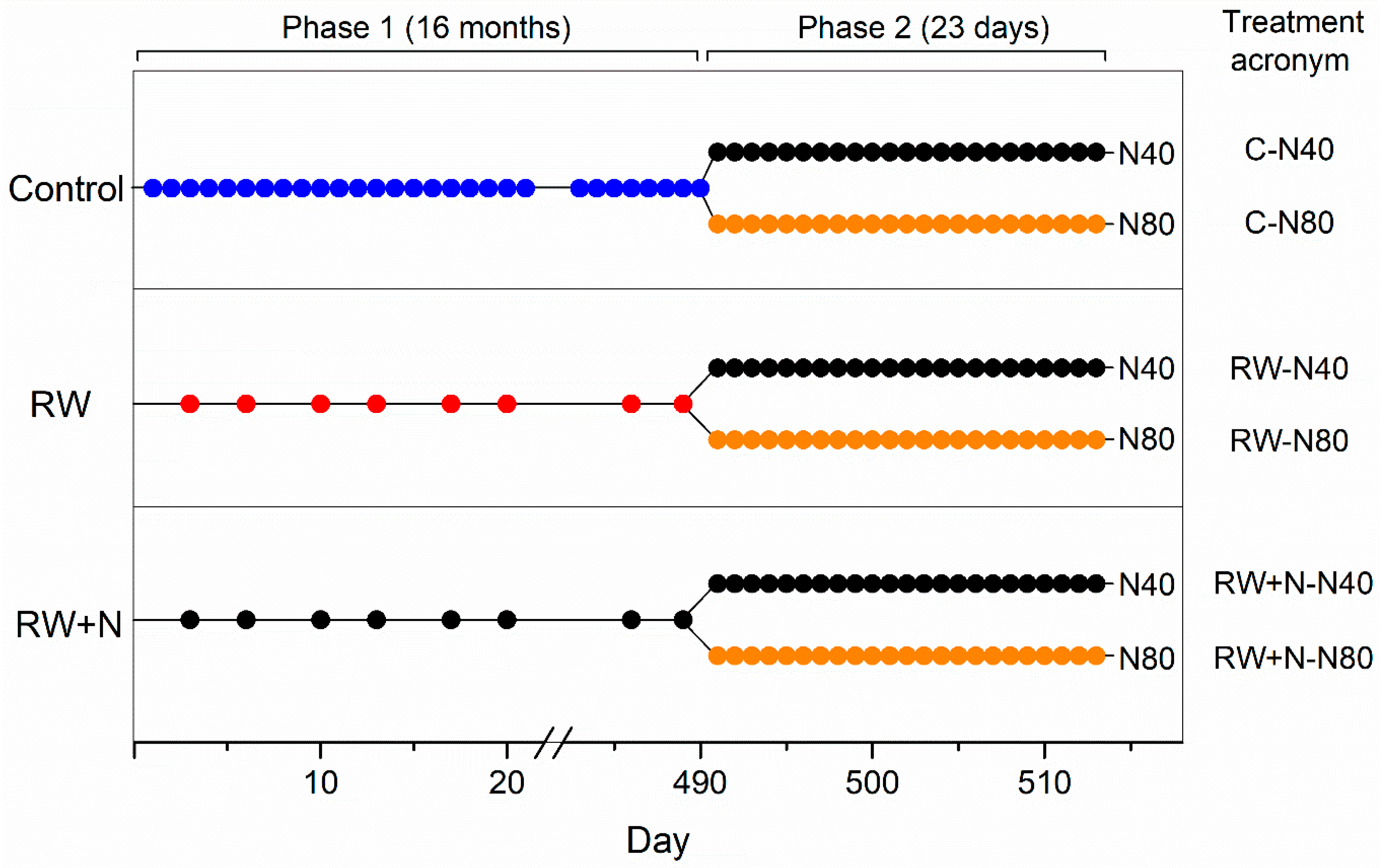
2.3. Treatments
2.4. Chlorophyll a Fluorescence
2.5. Statistical Analyses
3. Results
3.1. Effects of Different Long-Term Water Regimes and Their Interaction with N Pollution
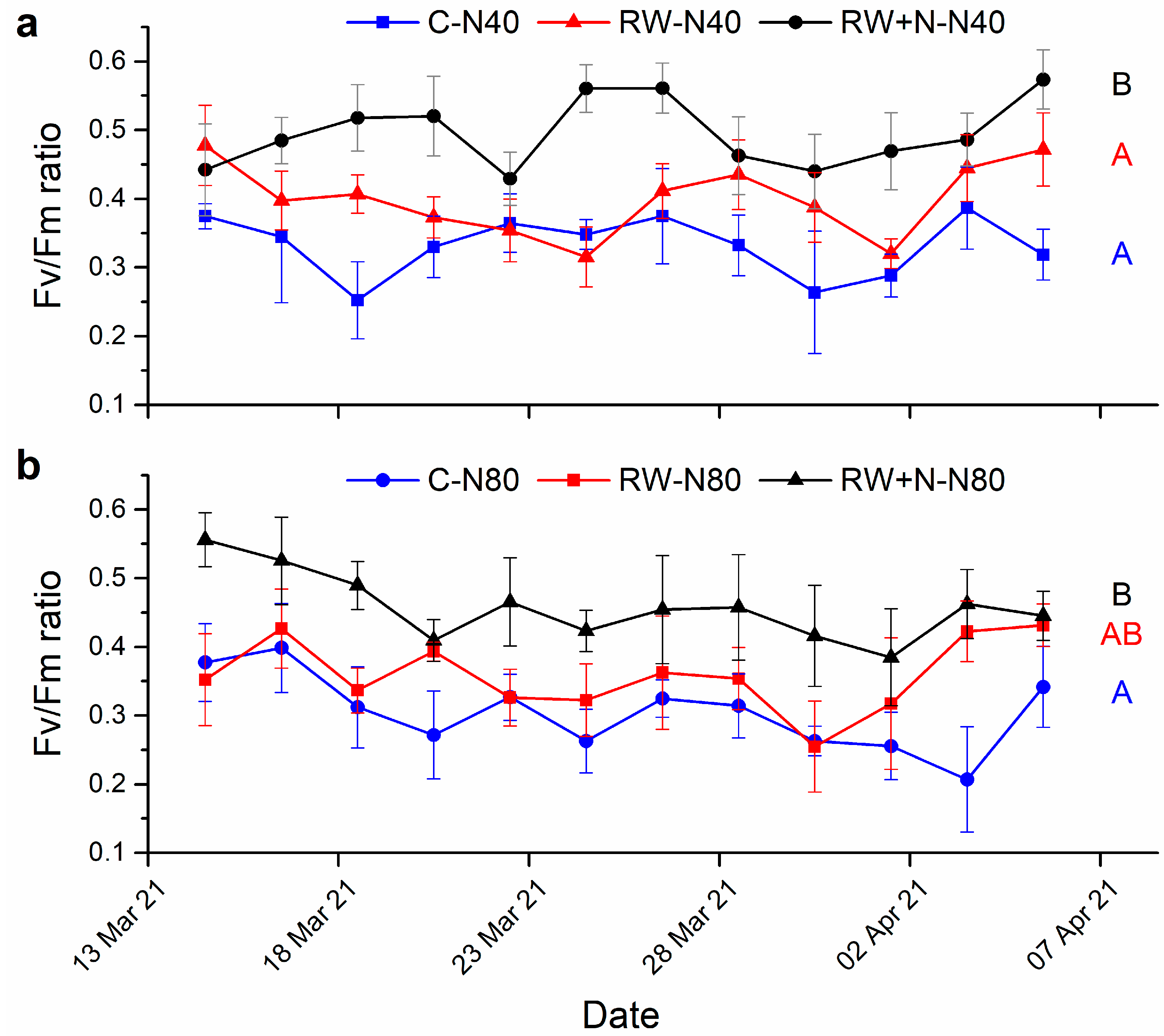
3.2. Effects of Prior N Exposure on the Ability of Cladonia to Deal with Increased N Availability
4. Discussion
5. Conclusions
Supplementary Materials
Author Contributions
Funding
Institutional Review Board Statement
Informed Consent Statement
Data Availability Statement
Acknowledgments
Conflicts of Interest
References
- Schimel, D.S. Drylands in the earth system. Science 2010, 327, 418–419. [Google Scholar] [CrossRef] [Scilit] [PubMed]
- Korner, C. Biosphere responses to CO2 enrichment. Ecol. Appl. 2000, 10, 1590–1619. [Google Scholar] [CrossRef] [Scilit]
- Reynolds, J.F.; Stafford Smith, D.M.; Lambin, E.F.; Turner, B.L., II; Mortimore, M.; Batterbury, S.P.J.; Downing, T.E.; Dowlatabadi, H.; Fernández, R.J.; Herrick, J.E.; et al. Ecology: Global desertification: Building a science for dryland development. Science 2007, 316, 847–851. [Google Scholar] [CrossRef] [Scilit] [PubMed]
- European Commission; Joint Research Centre. World Atlas of Desertification: Rethinking Land Degradation and Sustainable Land Management; Cherlet, M., Hutchinson, C., Reynolds, J., Hill, J., Sommer, S., von Maltitz, G., Eds.; Publications Office: Luxembourg, 2018. [Google Scholar]
- Maestre, F.T.; Salguero-Gómez, R.; Quero, J.L. It is getting hotter in here: Determining and projecting the impacts of global environmental change on drylands. Philos. Trans. R. Soc. B Biol. Sci. 2012, 367, 3062–3075. [Google Scholar] [CrossRef] [Scilit]
- Ferrenberg, S.; Reed, S.C.; Belnap, J.; Schlesinger, W.H. Climate change and physical disturbance cause similar community shifts in biological soil crusts. Proc. Natl. Acad. Sci. USA 2015, 112, 12116–12121. [Google Scholar] [CrossRef] [Scilit]
- Poulter, B.; Frank, D.; Ciais, P.; Myneni, R.B.; Andela, N.; Bi, J.; Broquet, G.; Canadell, J.G.; Chevallier, F.; Liu, Y.Y.; et al. Contribution of semi-arid ecosystems to interannual variability of the global carbon cycle. Nature 2014, 509, 600. [Google Scholar] [CrossRef] [Scilit]
- Ahlström, A.; Raupach, M.R.; Schurgers, G.; Smith, B.; Arneth, A.; Jung, M.; Reichstein, M.; Canadell, J.G.; Friedlingstein, P.; Jain, A.K.; et al. The dominant role of semi-arid ecosystems in the trend and variability of the land CO2 sink. Science 2015, 348, 895–899. [Google Scholar] [CrossRef] [Scilit]
- Whitford, W.G. Ecology of Desert Systems; Whitford, W.G., Ed.; Academic Press: New York, NY, USA, 2002. [Google Scholar]
- Intergovernmental Panel on Climate Change. Climate Change 2013—The Physical Science Basis: Working Group I Contribution to the Fifth Assessment Report of the Intergovernmental Panel on Climate Change; Cambridge University Press: Cambridge, UK, 2014; ISBN 9781107057999. [Google Scholar]
- Levin, S.A. The problem of pattern and scale in ecology. Ecology 1992, 73, 1943–1967. [Google Scholar] [CrossRef] [Scilit]
- Chave, J. The problem of pattern and scale in ecology: What have we learned in 20 years? Ecol. Lett. 2013, 16, 4–16. [Google Scholar] [CrossRef] [Scilit]
- Allen, C.D. Interactions across spatial scales among forest dieback, fire, and erosion in northern New Mexico landscapes. Ecosystems 2007, 10, 797–808. [Google Scholar] [CrossRef] [Scilit]
- Ochoa-Hueso, R.; Manrique, E. Effects of nitrogen deposition and soil fertility on cover and physiology of Cladonia foliacea (Huds.) Willd., a lichen of biological soil crusts from Mediterranean Spain. Environ. Pollut. 2011, 159, 449–457. [Google Scholar] [CrossRef] [Scilit]
- Phoenix, G.K.; Hicks, W.K.; Cinderby, S.; Kuylenstierna, J.C.I.; Stock, W.D.; Dentener, F.J.; Giller, K.E.; Austin, A.T.; Lefroy, R.D.B.; Gimeno, B.S.; et al. Atmospheric nitrogen deposition in world biodiversity hotspots: The need for a greater global perspective in assessing N deposition impacts. Glob. Chang. Biol. 2006, 12, 470–476. [Google Scholar] [CrossRef] [Scilit]
- Valentin, C.; D’Herbès, J.M.; Poesen, J. Soil and water components of banded vegetation patterns. Catena 1999, 37, 1–24. [Google Scholar] [CrossRef] [Scilit]
- Belnap, J.; Lange, O.L. Biological Soil Crusts: Structure, Function, and Management; Springer: Berlin/Heidelberg, Germany, 2001; ISBN 3-540-4107/5-9. [Google Scholar]
- Eldridge, D.J.; Greene, R.S.B. Microbiotic soil crusts: A review of their roles in soil and ecological processes in the rangelands of australia. Aust. J. Soil Res. 1994, 32, 389–415. [Google Scholar] [CrossRef] [Scilit]
- Munzi, S.; Cruz, C.; Branquinho, C.; Cai, G.; Faleri, C.; Parrotta, L.; Bini, L.; Gagliardi, A.; Leith, I.D.; Sheppard, L.J. More tolerant than expected: Taking into account the ability of Cladonia portentosa to cope with increased nitrogen availability in environmental policy. Ecol. Indic. 2020, 119, 106817. [Google Scholar] [CrossRef] [Scilit]
- Matos, P.; Pinho, P.; Aragón, G.; Martínez, I.; Nunes, A.; Soares, A.M.V.M.; Branquinho, C. Lichen traits responding to aridity. J. Ecol. 2015, 103, 451–458. [Google Scholar] [CrossRef] [Scilit]
- Tuba, Z.; Csintalan, Z.; Proctor, M.C.F. Photosynthetic responses of a moss, Tortula ruralis, ssp. ruralis, and the lichens Cladonia convoluta and C. furcata to water deficit and short periods of desiccation, and their ecophysiological significance: A baseline study at present-day CO2 concentrat. New Phytol. 1996, 133, 353–361. [Google Scholar] [CrossRef] [Scilit]
- Lange, O.L.; Green, T.G.A.; Ziegler, H. Water status related photosynthesis and carbon isotope discrimination in species of the lichen genus Pseudocyphellaria with green or blue-green photobionts and in photosymbiodemes. Oecologia 1988, 75, 494–501. [Google Scholar] [CrossRef] [Scilit]
- Scheidegger, C.; Frey, B.; Schroeter, B. Cellular water uptake, translocation and PSII activation during rehydration of desiccated. In Bibliotheca Lichenologica: Vol. 67. New Species and Novel Aspects in Ecology and Physiology of Lichens; Kappen, L., Ed.; Cramer: Stuttgart, Germany, 1997; pp. 105–117. [Google Scholar]
- Green, T.G.; Meyer, A.; Buedel, B.; Zellner, H.; Lange, O.L. Diel patterns of CO2-exchange for six lichens from a temperate rain forest in New Zealand. Symbiosis 1995, 18, 251–273. [Google Scholar]
- Jonsson, A.V.; Moen, J.; Palmqvist, K. Predicting lichen hydration using biophysical models. Oecologia 2008, 156, 259–273. [Google Scholar] [CrossRef] [Scilit]
- Grote, E.E.; Belnap, J.; Housman, D.C.; Sparks, J.P. Carbon exchange in biological soil crust communities under differential temperatures and soil water contents: Implications for global change. Glob. Chang. Biol. 2010, 16, 2763–2774. [Google Scholar] [CrossRef] [Scilit]
- Maestre, F.T.; Bowker, M.A.; Escolar, C.; Puche, M.D.; Soliveres, S.; Maltez-Mouro, S.; García-Palacios, P.; Castillo-Monroy, A.P.; Martínez, I.; Escudero, A. Do biotic interactions modulate ecosystem functioning along stress gradients? Insights from semi-arid plant and biological soil crust communities. Philos. Trans. R. Soc. Lond. Ser. B Biol. Sci. 2010, 365, 2057–2070. [Google Scholar] [CrossRef] [Scilit] [PubMed]
- Castillo-Monroy, A.P.; Bowker, M.A.; Maestre, F.T.; Rodríguez-Echeverría, S.; Martinez, I.; Barraza-Zepeda, C.E.; Escolar, C. Relationships between biological soil crusts, bacterial diversity and abundance, and ecosystem functioning: Insights from a semi-arid Mediterranean environment. J. Veg. Sci. 2011, 22, 165–174. [Google Scholar] [CrossRef] [Scilit]
- Munzi, S.; Pisani, T.; Loppi, S. The integrity of lichen cell membrane as a suitable parameter for monitoring biological effects of acute nitrogen pollution. Ecotoxicol. Environ. Saf. 2009, 72, 2009–2012. [Google Scholar] [CrossRef] [Scilit]
- Munzi, S.; Paoli, L.; Fiorini, E.; Loppi, S. Physiological response of the epiphytic lichen Evernia prunastri (L.) Ach. to ecologically relevant nitrogen concentrations. Environ. Pollut. 2012, 171, 25–29. [Google Scholar] [CrossRef] [Scilit]
- Pinho, P.; Dias, T.; Cruz, C.; Sim Tang, Y.; Sutton, M.A.; Martins-Loução, M.-A.; Máguas, C.; Branquinho, C. Using lichen functional diversity to assess the effects of atmospheric ammonia in Mediterranean woodlands. J. Appl. Ecol. 2011, 48, 1107–1116. [Google Scholar] [CrossRef] [Scilit]
- Morillas, L.; Roales, J.; Cruz, C.; Munzi, S. Resilience of epiphytic lichens to combined effects of increasing nitrogen and solar radiation. J. Fungi 2021, 7, 333. [Google Scholar] [CrossRef] [Scilit]
- Munzi, S.; Branquinho, C.; Cruz, C.; Loppi, S. Nitrogen tolerance in the lichen Xanthoria parietina: The sensitive side of a resistant species. Funct. Plant Biol. 2013, 40, 237–243. [Google Scholar] [CrossRef] [Scilit]
- Maslaňáková, I.; Biľová, I.; Goga, M.; Kuchár, M.; Bačkor, M. Differences between Sensitivity of Mycobiont and Photobiont of Cladonia sp. Lichens to Different Types of Nitrogen Exposure. Water Air Soil Pollut. 2015, 226, 243. [Google Scholar] [CrossRef] [Scilit]
- Veres, K.; Farkas, E.; Csintalan, Z. The bright and shaded side of duneland life: The photosynthetic response of lichens to seasonal changes is species-specific. Mycol. Prog. 2020, 19, 629–641. [Google Scholar] [CrossRef] [Scilit]
- Dias, T.; Malveiro, S.; Martins-Loução, M.A.; Sheppard, L.J.; Cruz, C. Linking N-driven biodiversity changes with soil N availability in a Mediterranean ecosystem. Plant Soil 2011, 341, 125–136. [Google Scholar] [CrossRef] [Scilit]
- EMEP. MSC-W—Co-Operative Programme for Monitoring and Evaluation of the Long-Range Transmission of Air Pollutants in Europe. Available online: https://www.emep.int/mscw/index.html (accessed on 3 December 2021).
- Fenn, M.E.; Baron, J.S.; Allen, E.B.; Rueth, H.M.; Nydick, K.R.; Geiser, L.; Bowman, W.D.; Sickman, J.O.; Meixner, T.; Johnson, D.W.; et al. Ecological effects of nitrogen deposition in the western United States. BioScience 2003, 53, 404–420. [Google Scholar] [CrossRef] [Scilit]
- Meixner, T.; Fenn, M. Biogeochemical budgets in a mediterranean catchment with high rates of atmospheric N deposition—Importance of scale and temporal asynchrony. Biogeochemistry 2004, 70, 331–356. [Google Scholar] [CrossRef] [Scilit]
- Raggio, J.; Green, T.G.A.; Sancho, L.G. In situ monitoring of microclimate and metabolic activity in lichens from Antarctic extremes: A comparison between South Shetland Islands and the McMurdo Dry Valleys. Polar Biol. 2016, 39, 113–122. [Google Scholar] [CrossRef] [Scilit]
- Paoli, L.; Pirintsos, S.A.; Kotzabasis, K.; Pisani, T.; Navakoudis, E.; Loppi, S. Effects of ammonia from livestock farming on lichen photosynthesis. Environ. Pollut. 2010, 158, 2258–2265. [Google Scholar] [CrossRef] [Scilit] [PubMed]
- Austin, A.T.; Yahdjian, L.; Stark, J.M.; Belnap, J.; Porporato, A.; Norton, U.; Ravetta, D.A.; Schaeffer, S.M. Water pulses and biogeochemical cycles in arid and semiarid ecosystems. Oecologia 2004, 141, 221–235. [Google Scholar] [CrossRef] [Scilit]
- Morillas, L.; Portillo-Estrada, M.; Gallardo, A. Wetting and drying events determine soil N pools in two Mediterranean ecosystems. Appl. Soil Ecol. 2013, 72, 161–170. [Google Scholar] [CrossRef] [Scilit]
- Hooper, D.U.; Johnson, L. Nitrogen limitation in dryland ecosystems: Responses to geographical and temporal variation in precipitation. Biogeochemistry 1999, 46, 247–293. [Google Scholar] [CrossRef] [Scilit]
- Nayaka, S.; Ranjan, S.; Saxena, P.; Pathre, U.V.; Upreti, D.K.; Singh, R. Assessing the vitality of Himalayan lichens by measuring their photosynthetic performances using chlorophyll fluorescence technique. Curr. Sci. 2009, 97, 538–545. [Google Scholar]
- Mishler, B.D.; Oliver, M.J. Putting Physcomitrella Patens on the Tree of Life: The Evolution and Ecology of Mosses. In Annual Plant Reviews; Wiley: Hoboken, NJ, USA, 2018; pp. 1–15. [Google Scholar]
- Coe, K.K.; Belnap, J.; Sparks, J.P. Precipitation-driven carbon balance controls survivorship of desert biocrust mosses. Ecology 2012, 93, 1626–1636. [Google Scholar] [CrossRef] [Scilit]
- Maphangwa, K.W.; Musil, C.F.; Raitt, L.; Zedda, L. Experimental climate warming decreases photosynthetic efficiency of lichens in an arid South African ecosystem. Oecologia 2012, 169, 257–268. [Google Scholar] [CrossRef] [Scilit] [PubMed]
- Lange, O.L.; Schulze, E.-D.; Koch, W. Experimentell-ökologische Untersuchungen an Flechten der Negev-Wüste: II. CO2-Gaswechsel und Wasserhaushalt von Ramalina maciformis (Del.) Bory am natürlichen Standort während der sommerlichen Trockenperiode. Flora 1970, 159, 38–62. [Google Scholar] [CrossRef] [Scilit]
- Kappen, L.; Smith, C.W. Heat tolerance of two Cladonia species and Campylopus praemorsus in a hot steam vent area of Hawaii. Oecologia 1980, 47, 184–189. [Google Scholar] [CrossRef] [Scilit] [PubMed]
- Oliver, M.J.; Velten, J.; Wood, A.J. Bryophytes as experimental models for the study of environmental stress tolerance: Tortula ruralis and desiccation-tolerance in mosses. Plant Ecol. 2000, 151, 73–84. [Google Scholar] [CrossRef] [Scilit]
- Schonbeck, M.; Bewley, J. Response of the moss Tortula ruralis to desiccation treatments. I. Effects of minimum water content and rates of dehydration and rehydration. Can. J. Bot. 2011, 59, 2698–2706. [Google Scholar] [CrossRef] [Scilit]
- Schonbeck, M.; Bewley, J. Responses of the moss Tortula ruralis to desiccation treatments. II. Variations in desiccation tolerance. Can. J. Bot. 2011, 59, 2707–2712. [Google Scholar] [CrossRef] [Scilit]
- Stark, L.R.; Nichols, L., II; Bonine, M.L. Do the Sexes of the Desert Moss Syntrichia caninervis Differ in Desiccation Tolerance? A Leaf Regeneration Assay. Int. J. Plant Sci. 2005, 166, 21–29. [Google Scholar] [CrossRef] [Scilit]
- Barker, D.H.; Stark, L.R.; Zimpfer, J.F.; Mcletchie, N.D.; Smith, S.D. Evidence of drought-induced stress on biotic crust moss in the Mojave Desert. Plant Cell Environ. 2005, 28, 939–947. [Google Scholar] [CrossRef] [Scilit]
- Kranner, I.; Beckett, R.; Hochman, A.; Nash, T.H., III. Desiccation-tolerance in lichens: A review. Bryologist 2008, 111, 576–593. [Google Scholar] [CrossRef] [Scilit]
- Weissman, L.; Garty, J.; Hochman, A. Rehydration of the lichen Ramalina lacera results in production of reactive oxygen species and nitric oxide and a decrease in antioxidants. Appl. Environ. Microbiol. 2005, 71, 2121–2129. [Google Scholar] [CrossRef] [Scilit]
- Mayaba, N.; Beckett, R.P. The effect of desiccation on the activities of antioxidant enzymes in lichens from habitats of contrasting water status. Symbiosis 2001, 31, 113–121. [Google Scholar]
- Lange, O.L.; Green, T.G.A. Diel and seasonal courses of ambient carbon dioxide concentration and their effect on productivity of the epilithic lichen Lecanora muralis in a temperate, suburban habitat. Lichenologist 2008, 40, 449–462. [Google Scholar] [CrossRef] [Scilit]
- Li, X.; Hui, R.; Zhang, P.; Song, N. Divergent responses of moss- and lichen-dominated biocrusts to warming and increased drought in arid desert regions. Agric. For. Meteorol. 2021, 303, 108387. [Google Scholar] [CrossRef] [Scilit]
- Tucker, C.L.; Ferrenberg, S.; Reed, S.C. Climatic Sensitivity of Dryland Soil CO2 Fluxes Differs Dramatically with Biological Soil Crust Successional State. Ecosystems 2019, 22, 15–32. [Google Scholar] [CrossRef] [Scilit]
- Larson, D.W. Environmental stress and Umbilicaria lichens: The effect of high temperature pretreatments. Oecologia 1982, 55, 102–107. [Google Scholar] [CrossRef] [Scilit]
- Belnap, J.; Phillips, S.L.; Flint, S.; Money, J.; Caldwell, M. Global change and biological soil crusts: Effects of ultraviolet augmentation under altered precipitation regimes and nitrogen additions. Glob. Chang. Biol. 2008, 14, 670–686. [Google Scholar] [CrossRef] [Scilit]
- Ladrón de Guevara, M.; Gozalo, B.; Raggio, J.; Lafuente, A.; Prieto, M.; Maestre, F.T. Warming reduces the cover, richness and evenness of lichen-dominated biocrusts but promotes moss growth: Insights from an 8 yr experiment. New Phytol. 2018, 220, 811–823. [Google Scholar] [CrossRef] [Scilit]
- Hyvärinen, M.; Crittenden, P.D. Relationships between atmospheric nitrogen inputs and the vertical nitrogen and phosphorus concentration gradients in the lichen Cladonia portentosa. New Phytol. 1998, 140, 519–530. [Google Scholar] [CrossRef] [Scilit]
- Palmqvist, K.; Dahlman, L.; Valladares, F.; Tehler, A.; Sancho, L.G.; Mattsson, J.-E. CO2 exchange and thallus nitrogen across 75 contrasting lichen associations from different climate zones. Oecologia 2002, 133, 295–306. [Google Scholar] [CrossRef] [Scilit]
- Chapin, F.S. The Mineral Nutrition of Wild Plants. Annu. Rev. Ecol. Syst. 1980, 11, 233–260. [Google Scholar] [CrossRef] [Scilit]
- Palmqvist, K.; Dahlman, L. Responses of the green algal foliose lichen Platismatia glauca to increased nitrogen supply. New Phytol. 2006, 171, 343–356. [Google Scholar] [CrossRef] [Scilit] [PubMed]
- Munzi, S.; Cruz, C.; Maia, R.; Máguas, C.; Perestrello-Ramos, M.M.; Branquinho, C. Intra- and inter-specific variations in chitin in lichens along a N-deposition gradient. Environ. Sci. Pollut. Res. 2017, 24, 28065–28071. [Google Scholar] [CrossRef] [Scilit] [PubMed]
- Dahlman, L.; Persson, J.; Näsholm, T.; Palmqvist, K. Carbon and nitrogen distribution in the green algal lichens Hypogymnia physodes and Platismatia glauca in relation to nutrient supply. Planta 2003, 217, 41–48. [Google Scholar] [CrossRef] [Scilit] [PubMed]
- Nimis, P. Urban lichen studies in Italy. I. The town of Trieste. Stud. Geobot. 1985, 5, 49–74. [Google Scholar]
- Nimis, P. Urban lichen studies in Italy. II. The town of Udine. Gortania 1986, 7, 147–172. [Google Scholar]
- Wirth, V. The influence of water relations on lichen SO2-resistance. Bibl. Lichenol. 1987, 25, 347–350. [Google Scholar]
- Giordani, P. Is the diversity of epiphytic lichens a reliable indicator of air pollution? A case study from Italy. Environ. Pollut. 2007, 146, 317–323. [Google Scholar] [CrossRef] [Scilit]
- Rydzak, J. Lichens as indicators of the ecological conditions of the habitat. Ann. Univ. Marie Curie-Sklodowska 1968, 23, 131–164. [Google Scholar]
- Munzi, S.; Correia, O.; Silva, P.; Lopes, N.; Freitas, C.; Branquinho, C.; Pinho, P. Lichens as ecological indicators in urban areas: Beyond the effects of pollutants. J. Appl. Ecol. 2014, 51, 1750–1757. [Google Scholar] [CrossRef] [Scilit]
- Tretiach, M.; Pavanetto, S.; Pittao, E.; di Toppi, L.S.; Piccotto, M. Water availability modifies tolerance to photo-oxidative pollutants in transplants of the lichen Flavoparmelia caperata. Oecologia 2012, 168, 589–599. [Google Scholar] [CrossRef] [Scilit]
- Dentener, F.; Kinne, S.; Bond, T.; Boucher, O.; Cofala, J.; Generoso, S.; Ginoux, P.; Gong, S.; Hoelzemann, J.J.; Ito, A.; et al. Emissions of primary aerosol and precursor gases in the years 2000 and 1750 prescribed data-sets for AeroCom. Atmos. Chem. Phys. 2006, 6, 4321–4344. [Google Scholar] [CrossRef] [Scilit]
- Ward, D. The Biology of Deserts; Oxford University Press: Oxford, UK, 2008; ISBN 9780199211470. [Google Scholar]
- Kleidon, A.; Fraedrich, K.; Heimann, M. A green planet versus a desert world: Estimating the maximum effect of vegetation on the land surface climate. Clim. Chang. 2000, 44, 471–493. [Google Scholar] [CrossRef] [Scilit]
- Weltzin, J.F.; Loik, M.E.; Schwinning, S.; Williams, D.G.; Fay, P.A.; Haddad, B.M.; Harte, J.; Huxman, T.E.; Knapp, A.K.; Lin, G.; et al. Assessing the Response of Terrestrial Ecosystems to Potential Changes in Precipitation. BioScience 2003, 53, 941–952. [Google Scholar] [CrossRef] [Scilit]
- Schwinning, S.; Sala, O.E.; Loik, M.E.; Ehleringer, J.R. Thresholds, memory, and seasonality: Understanding pulse dynamics in arid/semi-arid ecosystems. Oecologia 2004, 141, 191–193. [Google Scholar] [CrossRef] [Scilit]
- Potts, D.L.; Huxman, T.E.; Enquist, B.J.; Weltzin, J.F.; Williams, D.G. Resilience and resistance of ecosystem functional response to a precipitation pulse in a semi-arid grassland. J. Ecol. 2006, 94, 23–30. [Google Scholar] [CrossRef] [Scilit]
- Reed, S.C.; Coe, K.K.; Sparks, J.P.; Housman, D.C.; Zelikova, T.J.; Belnap, J. Changes to dryland rainfall result in rapid moss mortality and altered soil fertility. Nat. Clim. Chang. 2012, 2, 752–755. [Google Scholar] [CrossRef] [Scilit]
- Escolar, C.; Maestre, F.T.; Rey, A. Biocrusts modulate warming and rainfall exclusion effects on soil respiration in a semi-arid grassland. Soil Biol. Biochem. 2015, 80, 9–17. [Google Scholar] [CrossRef] [Scilit]
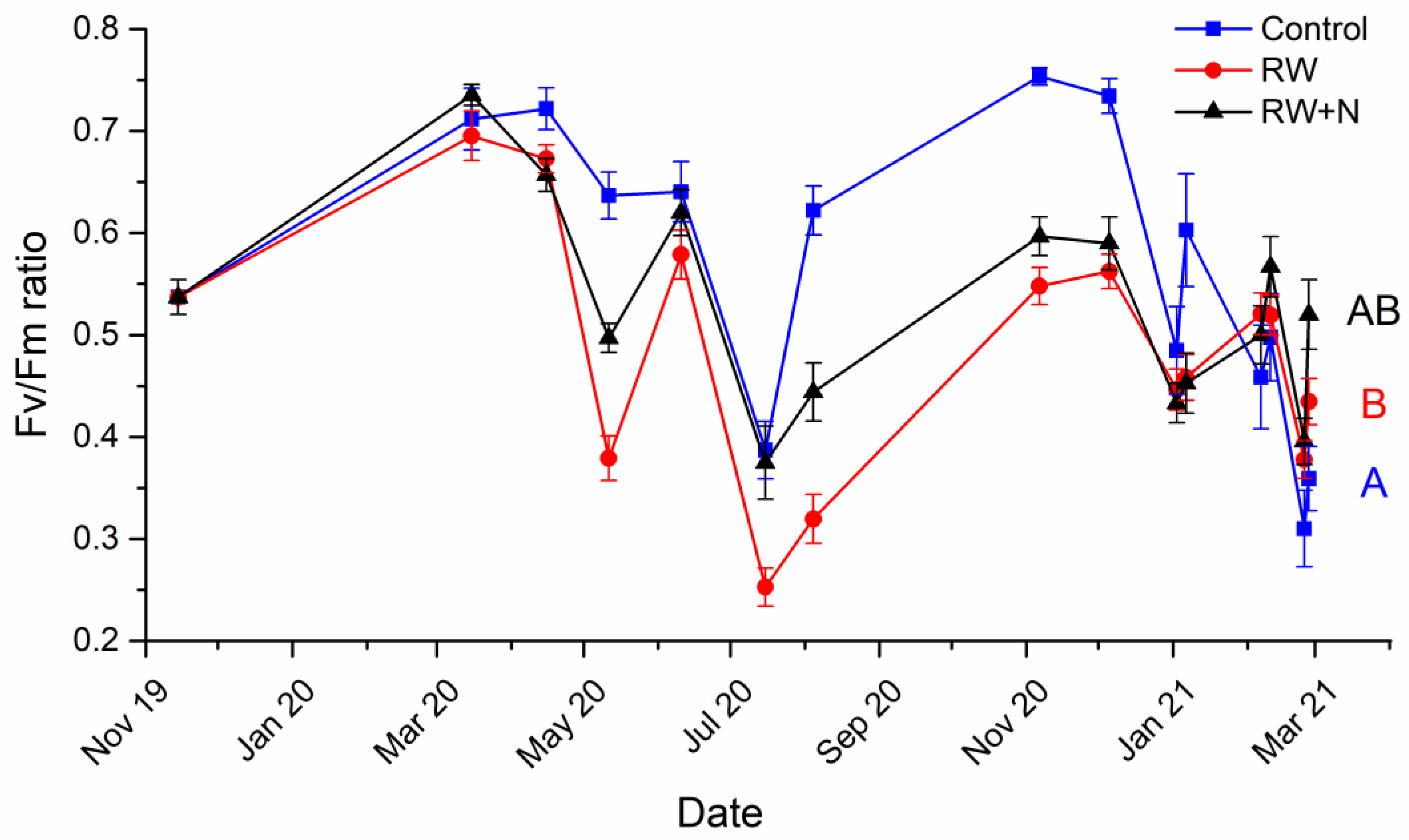


| Factor | df | F | p |
|---|---|---|---|
| Treatment | 2 | 11.810 | <0.0001 |
| Time | 7.622 | 39.155 | <0.0001 |
| Treatment × Time | 15.245 | 5.578 | <0.0001 |
| Interaction Control | 4.238 | 18.835 | <0.0001 |
| Interaction RW | 6.525 | 27.626 | <0.0001 |
| Interaction RW+N | 3.384 | 9.713 | <0.0001 |
| Factor | df | F | p |
|---|---|---|---|
| 40 kg N h−1year−1 (N-40) | |||
| Treatment | 2 | 12.293 | 0.001 |
| Time | 11 | 1.385 | 0.187 |
| Treatment × Time | 22 | 1.054 | 0.406 |
| 80 kg N h−1year−1 (N-80) | |||
| Treatment | 2 | 5.566 | 0.019 |
| Time | 11 | 2.309 | 0.013 |
| Treatment × Time | 22 | 0.703 | 0.830 |
| Scenario | Aridity | Nitrogen Deposition | Temperature | Lichen Vitality |
|---|---|---|---|---|
| 1 | ↑ | - | - | ↓ |
| 2 | ↑ | ↑ | - | ↓ |
| 3 | ↑ | ↑ | ↑ | ↓↓ |
| 4 | ↑ | - | ↑ | ↓↓↓ |
Publisher’s Note: MDPI stays neutral with regard to jurisdictional claims in published maps and institutional affiliations. |
© 2022 by the authors. Licensee MDPI, Basel, Switzerland. This article is an open access article distributed under the terms and conditions of the Creative Commons Attribution (CC BY) license (https://creativecommons.org/licenses/by/4.0/).
Share and Cite
Morillas, L.; Roales, J.; Cruz, C.; Munzi, S. Non-Toxic Increases in Nitrogen Availability Can Improve the Ability of the Soil Lichen Cladonia rangiferina to Cope with Environmental Changes. J. Fungi 2022, 8, 333. https://doi.org/10.3390/jof8040333
Morillas L, Roales J, Cruz C, Munzi S. Non-Toxic Increases in Nitrogen Availability Can Improve the Ability of the Soil Lichen Cladonia rangiferina to Cope with Environmental Changes. Journal of Fungi. 2022; 8(4):333. https://doi.org/10.3390/jof8040333
Chicago/Turabian StyleMorillas, Lourdes, Javier Roales, Cristina Cruz, and Silvana Munzi. 2022. "Non-Toxic Increases in Nitrogen Availability Can Improve the Ability of the Soil Lichen Cladonia rangiferina to Cope with Environmental Changes" Journal of Fungi 8, no. 4: 333. https://doi.org/10.3390/jof8040333
APA StyleMorillas, L., Roales, J., Cruz, C., & Munzi, S. (2022). Non-Toxic Increases in Nitrogen Availability Can Improve the Ability of the Soil Lichen Cladonia rangiferina to Cope with Environmental Changes. Journal of Fungi, 8(4), 333. https://doi.org/10.3390/jof8040333