
Descriptions of Four New Species in Cunninghamellaceae (Mucoromycota) from the Brazilian Savanna Through Integrative Taxonomy

 , , , , , , , , , and
Abstract
1. Introduction
2. Materials and Methods
2.1. Sampling Site and Soil Collection
2.2. Isolation, Purification and Deposit
2.3. Growth Experiments and Micromorphology

| Species | Country | Tmax (°C) | ||
|---|---|---|---|---|
| MEA | PDA | SMA | ||
| Absidia abundans [41] | China | 31 | - | - |
| Absidia ampullaceae [42] | China | 30 | - | - |
| Absidia arrhiza [43] | China | - | 33 | - |
| Absidia biappendiculata [42] | China | 35 | - | - |
| Absidia brunnea [42] | China | 35 | - | - |
| Absidia cheongyangensis [20] | Korea | 33 | 33 | 33 |
| Absidia chinensis [42] | China | 30 | - | - |
| Absidia cinerea [42] | China | 35 | - | - |
| Absidia collariata [44] | China | - | 29 | - |
| Absidia crystalloides [45] | China | - | 32 | - |
| Absidia digitula [42] | China | 32 | - | - |
| Absidia fluvii [20] | Korea | 32 | 32 | 32 |
| Absidia frigida [46] | China | 24 | - | - |
| Absidia gemella [46] | China | 29 | - | - |
| Absidia globospora [47] | China | 28 | 28 | - |
| Absidia hainanensis [44] | China | - | 34 | - |
| Absidia healeya [48] | Australia | - | 30 | - |
| Absidia jiangxiensis [42] | China | 31 | - | - |
| Absidia kunryangriensis [20] | Korea | 31 | 32 | - |
| Absidia lobata [41] | China | 26 | - | - |
| Absidia longissima [46] | China | 36 | - | - |
| Absidia medula [47] | China | 32 | 32 | - |
| Absidia menglianensis [49] | China | - | 36 | - |
| Absidia nigra [42] | China | 31 | - | - |
| Absidia oblongispora [42] | China | 32 | - | - |
| Absidia ovalispora [50] | China | - | - | 37 |
| Absidia pacifica [45] | China | - | 35 | - |
| Absidia paracylindrospora [20] | Korea | 31 | 32 | 31 |
| Absidia pararepens [20] | Korea | 32 | 32 | 32 |
| Absidia pateriformis [45] | China | - | 30 | - |
| Absidia purpurea [42] | China | 30 | - | - |
| Absidia pyriformis [44] | China | - | 33 | - |
| Absidia radiata [41] | China | 32 | - | - |
| Absidia rhizoidea | Brazil | 33 | 31 | - |
| Absidia sphaerica [43] | China | - | 33 | - |
| Absidia sichuanensis [41] | China | 28 | - | - |
| Absidia simplex [43] | China | - | 29 | - |
| Absidia sympodialis [42] | China | 33 | - | - |
| Absidia tarda [20] | Brazil | 36 | 36 | 36 |
| Absidia tardiva [44] | China | - | 27 | - |
| Absidia terrestris [51] | Mexico | 27 | - | - |
| Absidia thailandica [52] | Thailand | - | 27 | - |
| Absidia tibetensis [44] | China | - | 30 | - |
| Absidia turgida [47] | China | 32 | 32 | - |
| Absidia variabilis | Brazil | 31 | 32 | - |
| Absidia varians [20] | China | 29 | - | - |
| Absidia variiprojecta [20] | Brazil | 32 | 32 | 33 |
| Absidia variispora [20] | Brazil | 32 | 32 | 32 |
| Absidia virescens [42] | China | 33 | - | - |
| Absidia viridis [43] | China | - | 29 | - |
| Absidia yunnanensis [41] | China | 32 | - | - |
| Absidia zonata [47] | China | 37 | 37 | - |
| Gongronella longapophysata | Brazil | 32 | 33 | - |
| G. verticilatta | Brazil | 31 | 31 | - |
2.4. DNA Extraction, PCR Amplification and Sequencing
2.5. Phylogenetic Analysis
3. Results
3.1. Phylogenetic Analyses
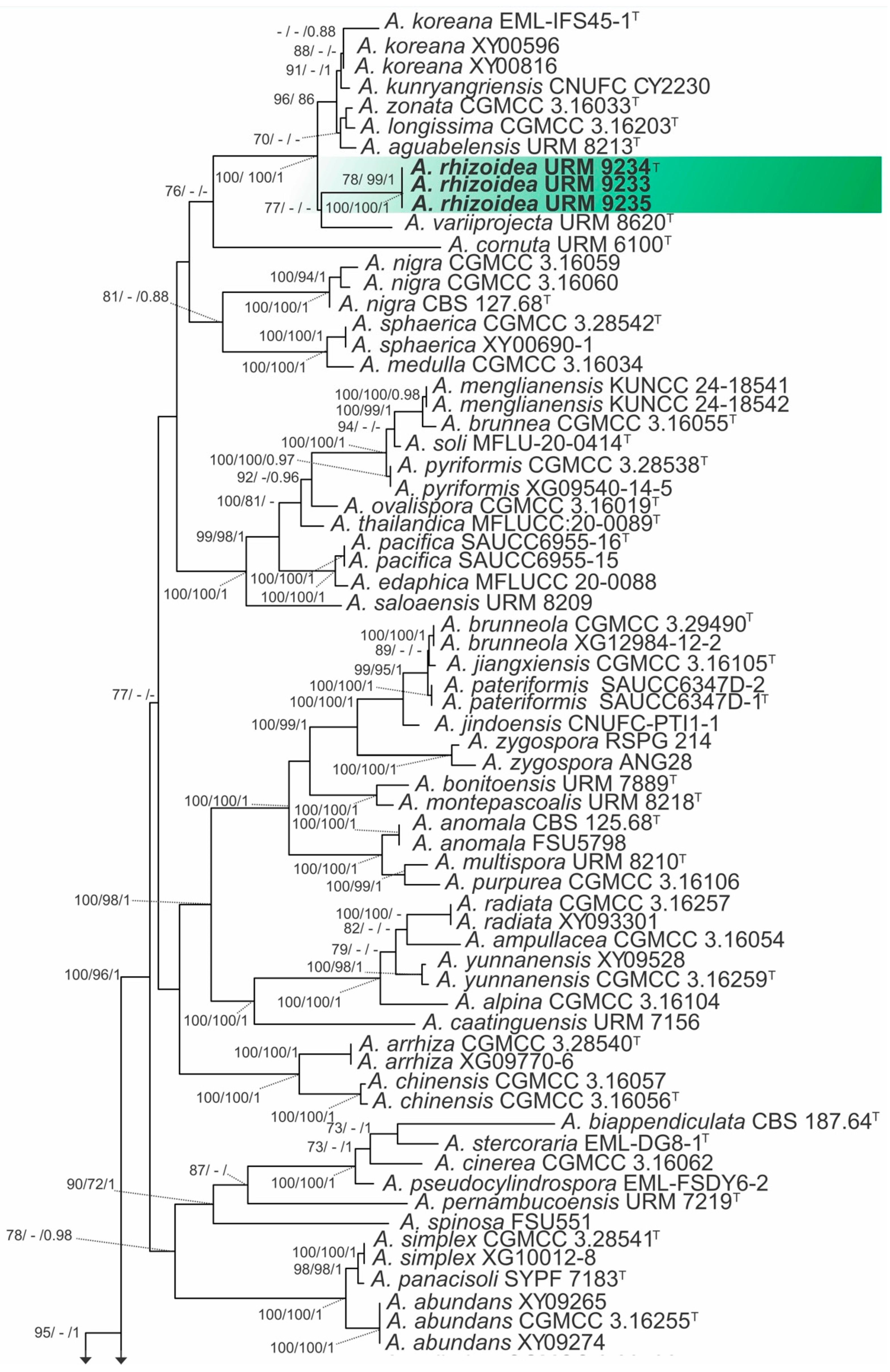
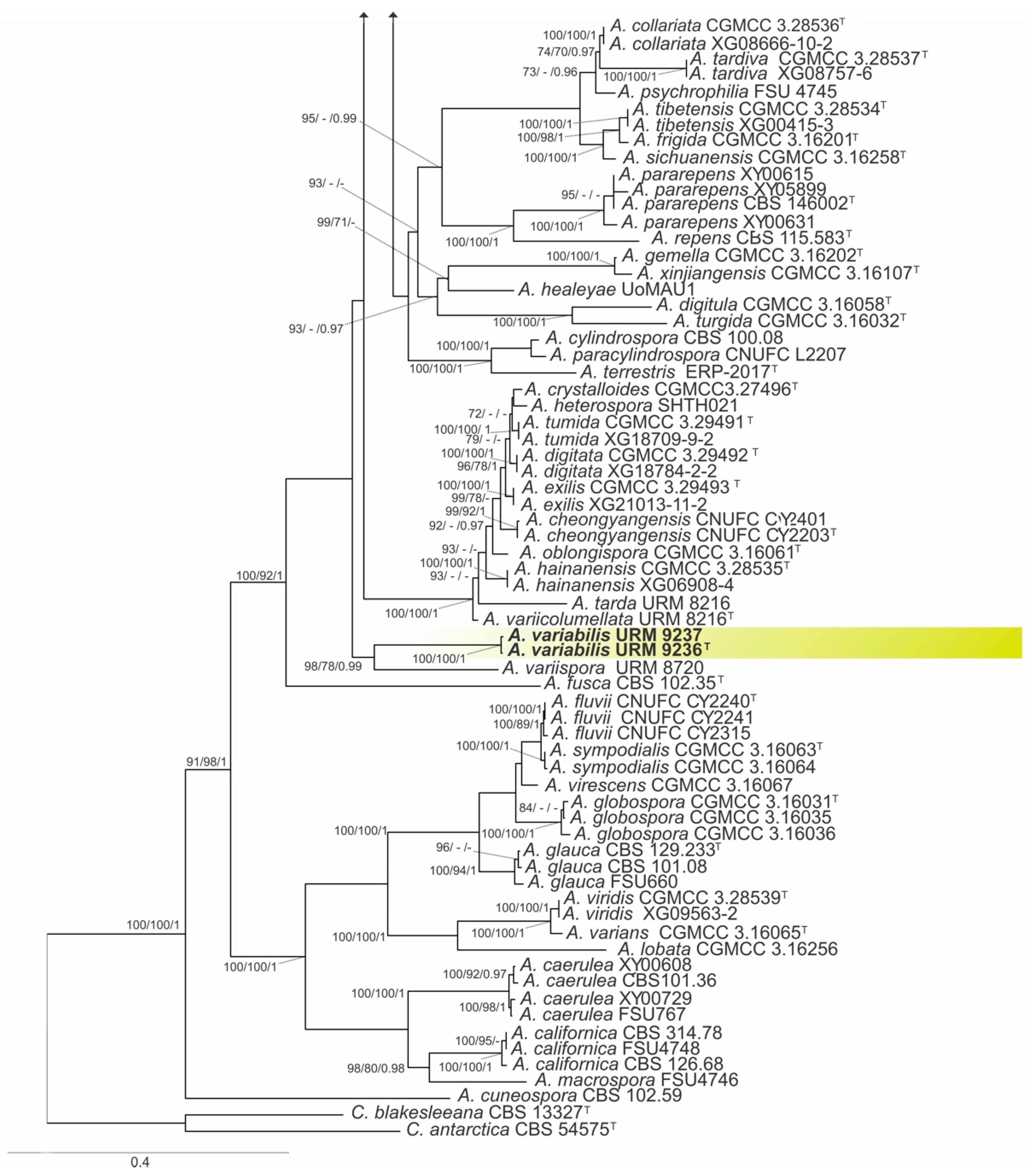
3.1.1. Absidia
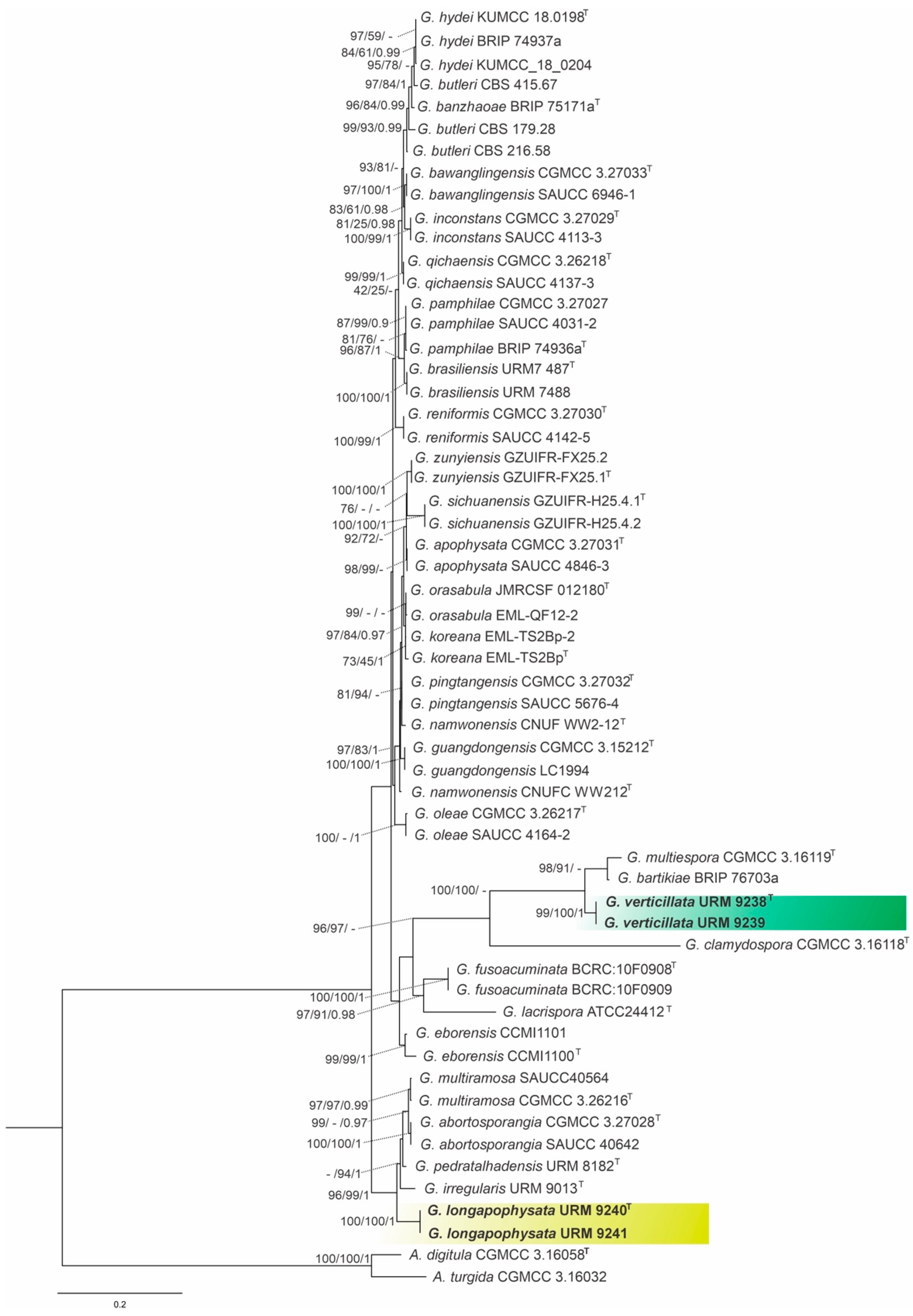
3.1.2. Gongronella
3.2. Taxonomy
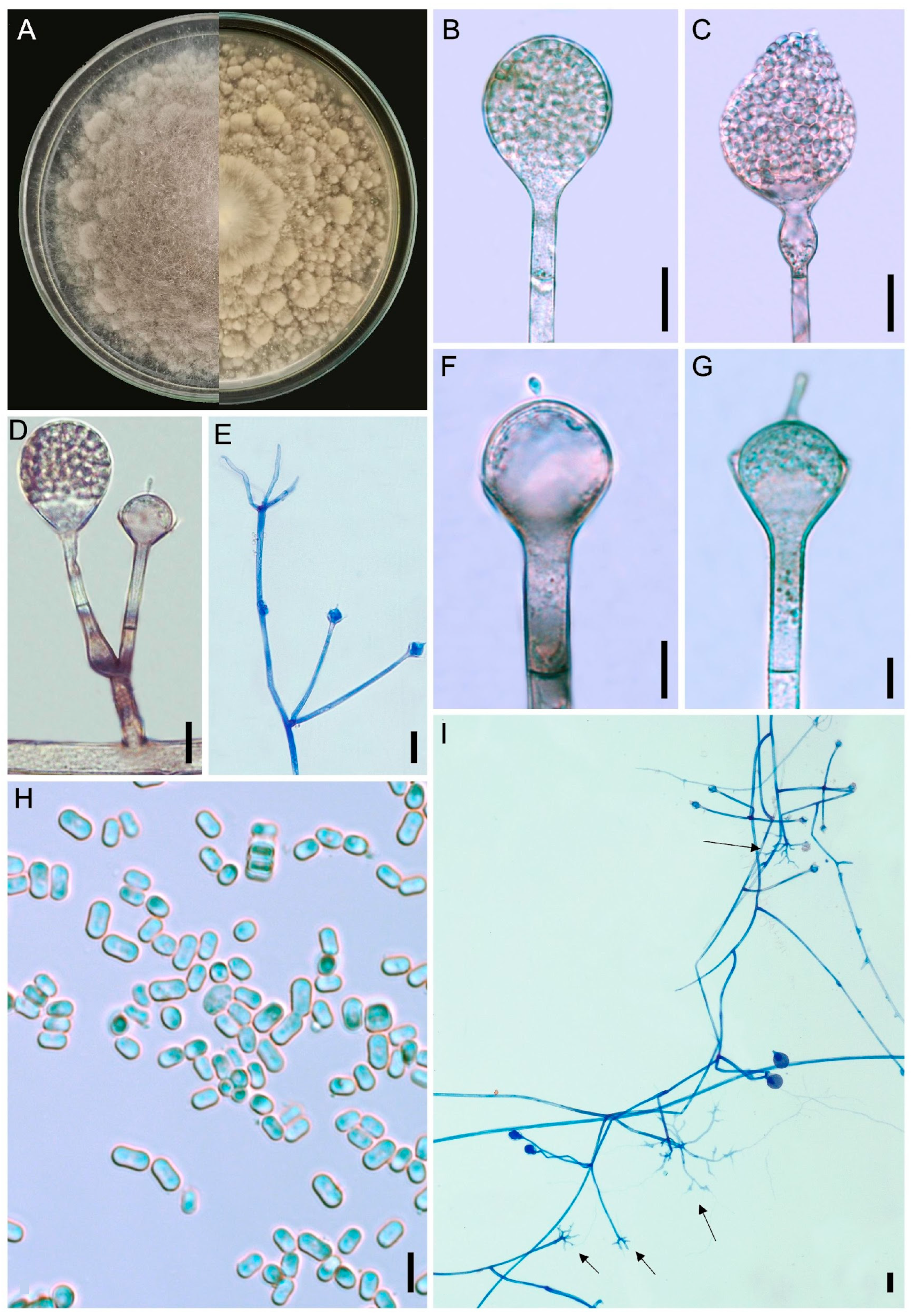
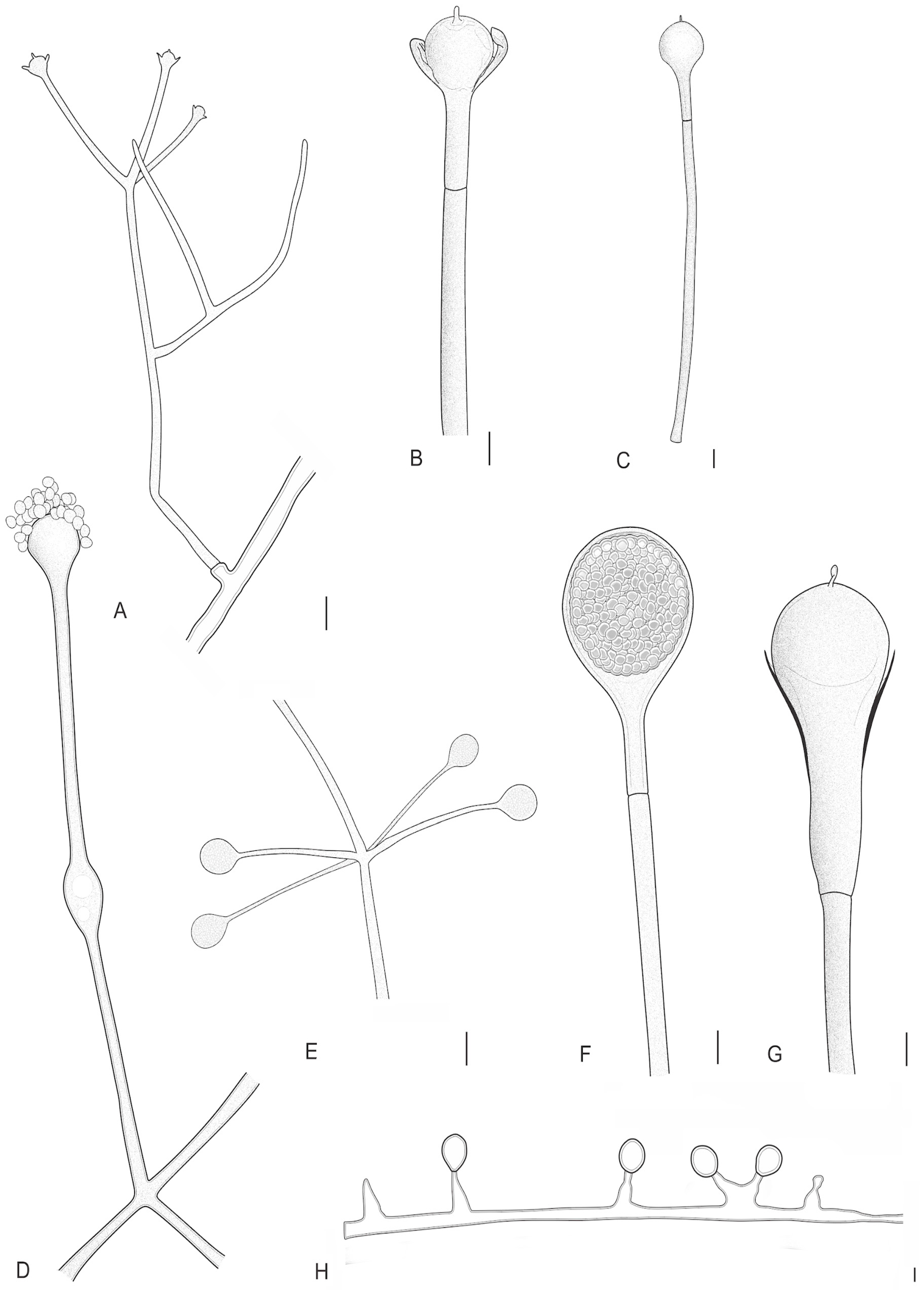
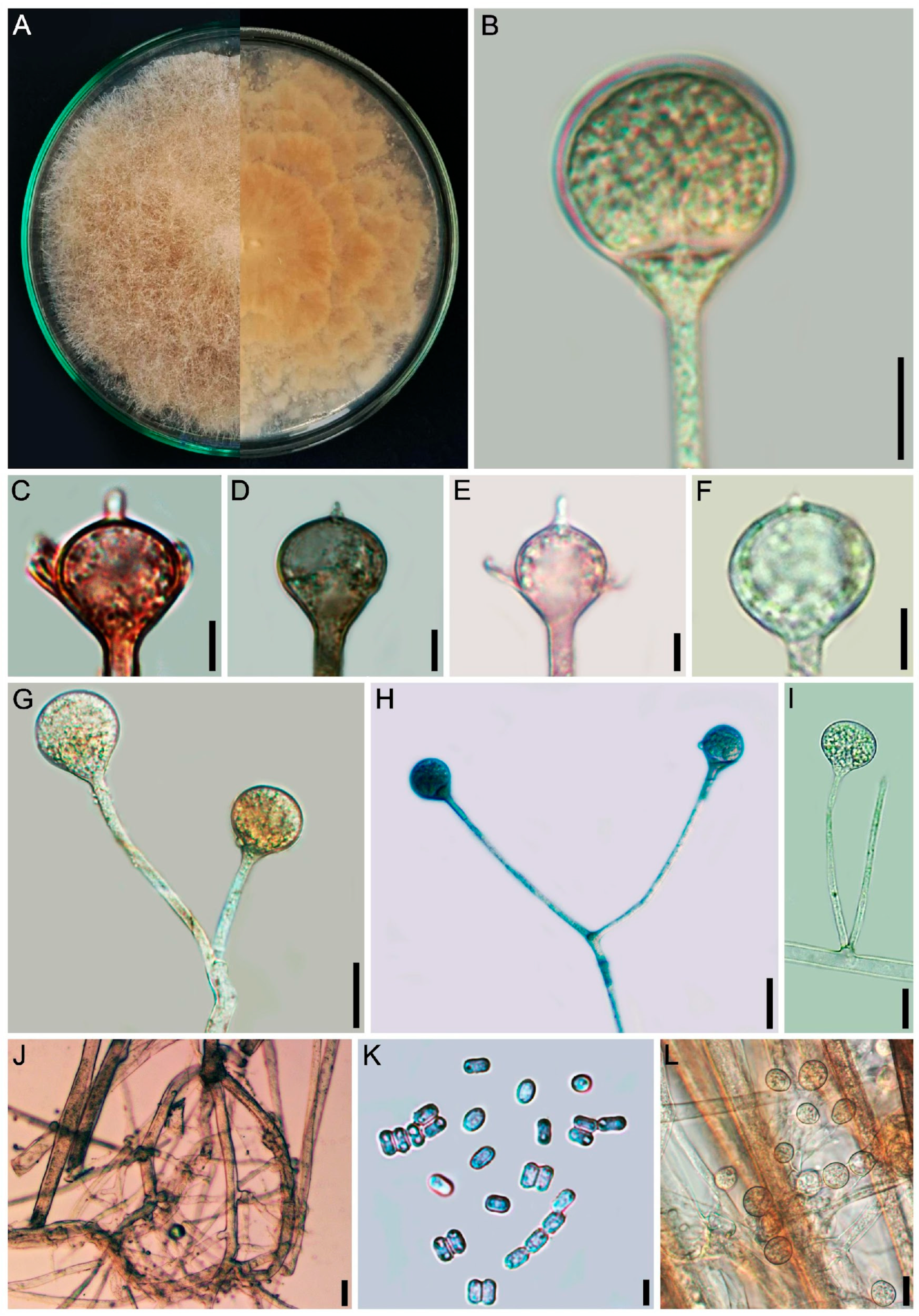
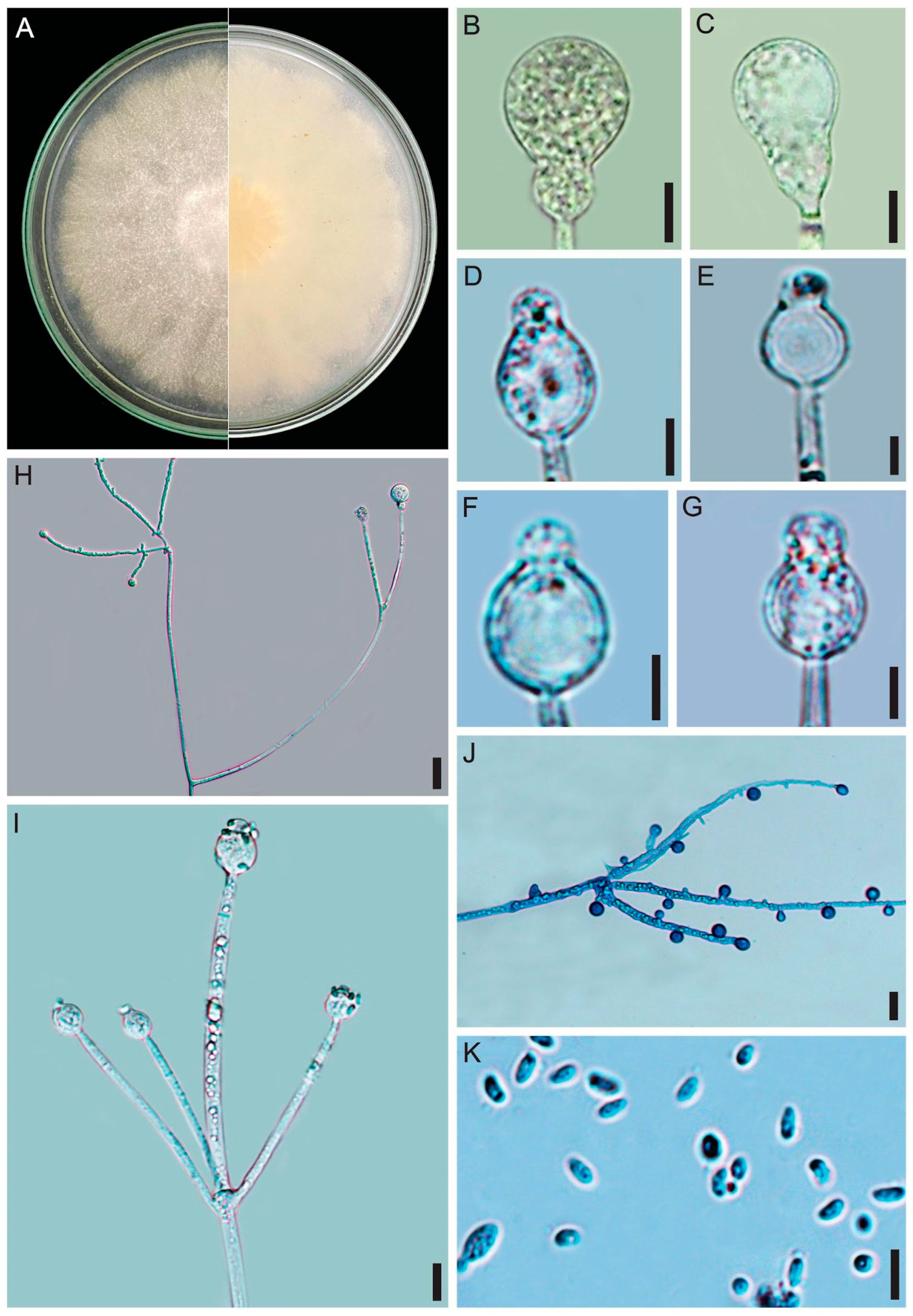
3.2.1. Absidia rhizoidea L.W.S. de Freitas & A.L. Santiago, sp. nov. (Figure 3 and Figure 4)


3.2.2. Absidia variabilis L.W.S. de Freitas & A.L. Santiago, sp. nov. (Figure 4 and Figure 5)

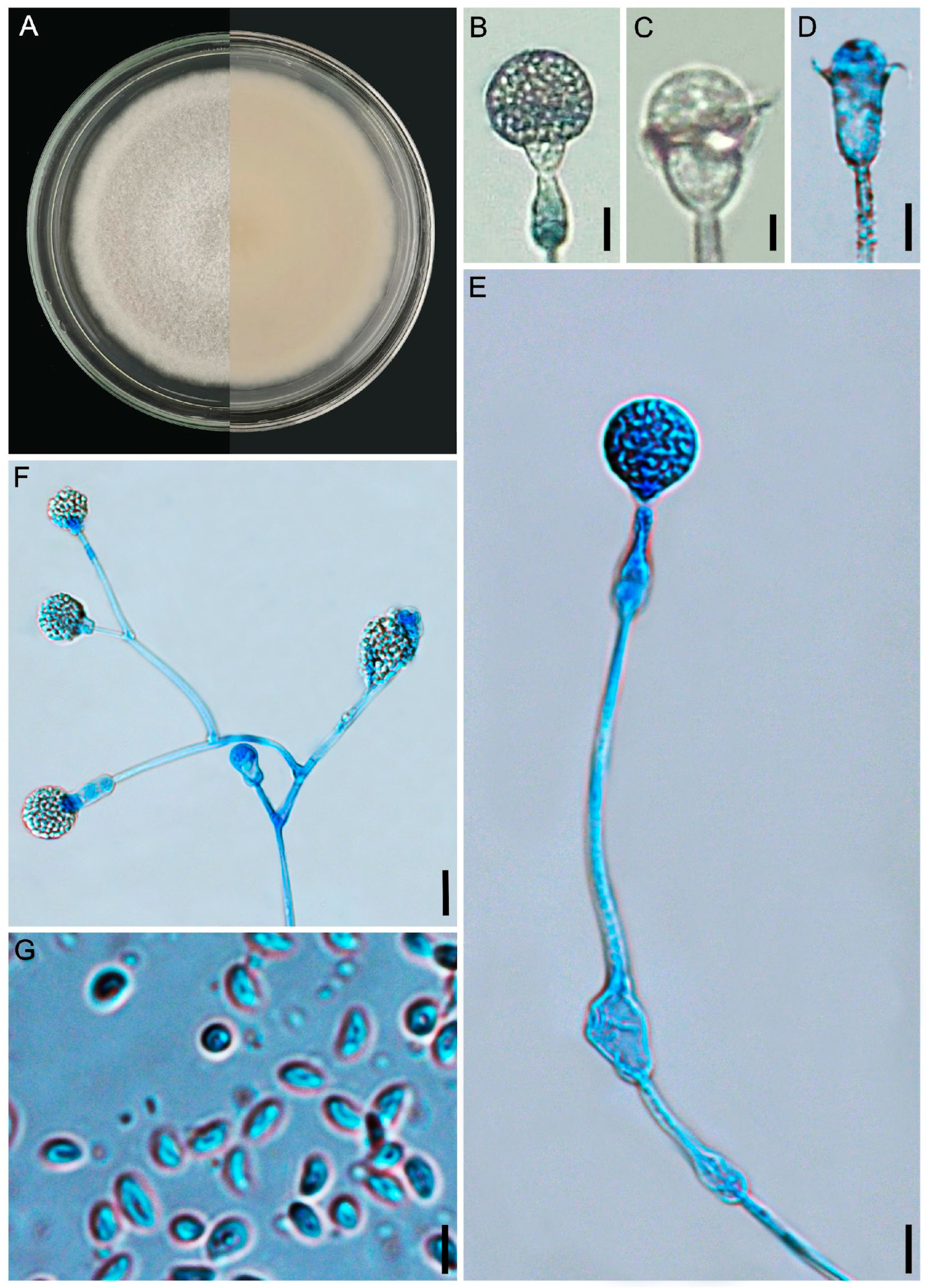
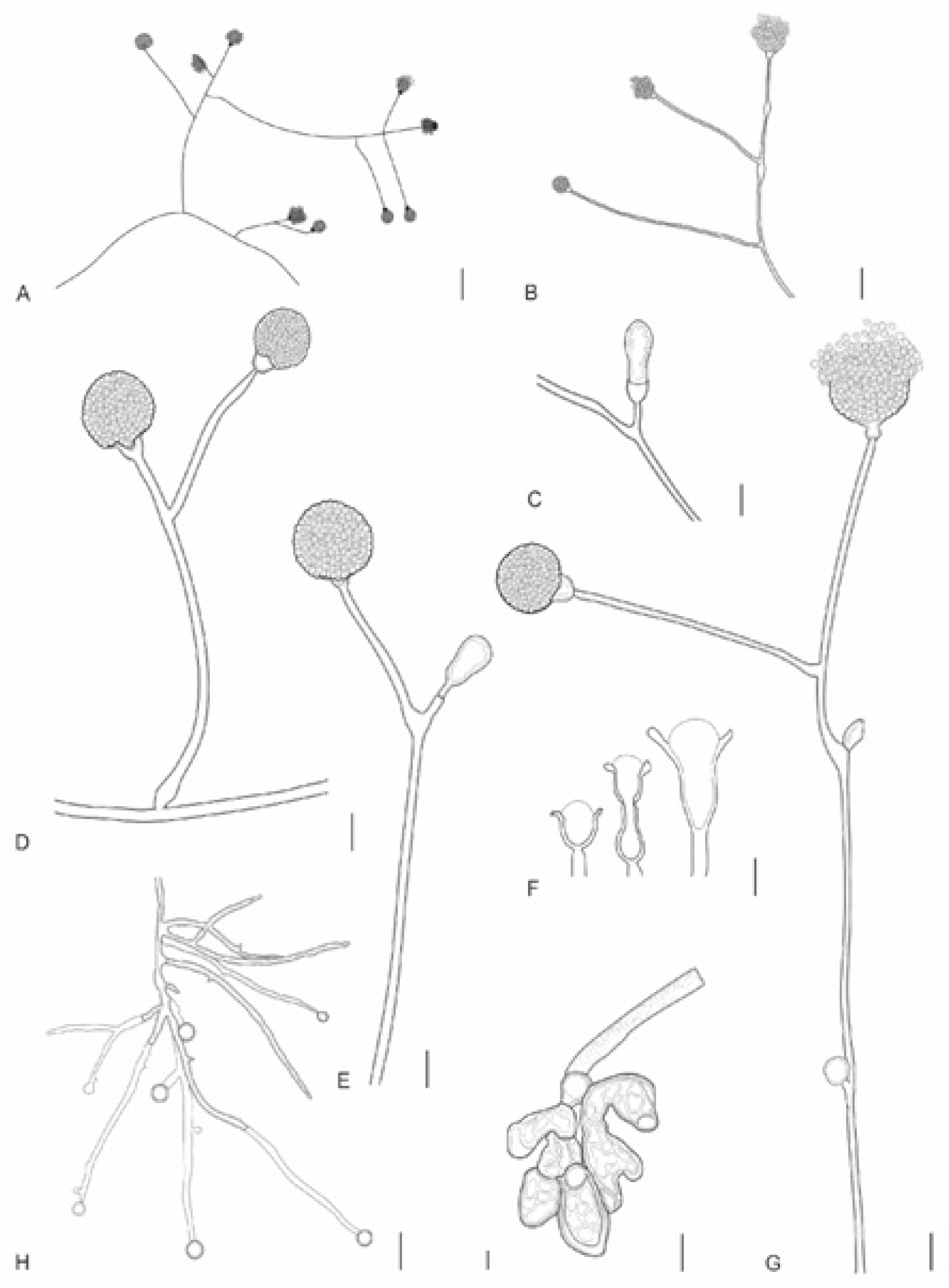
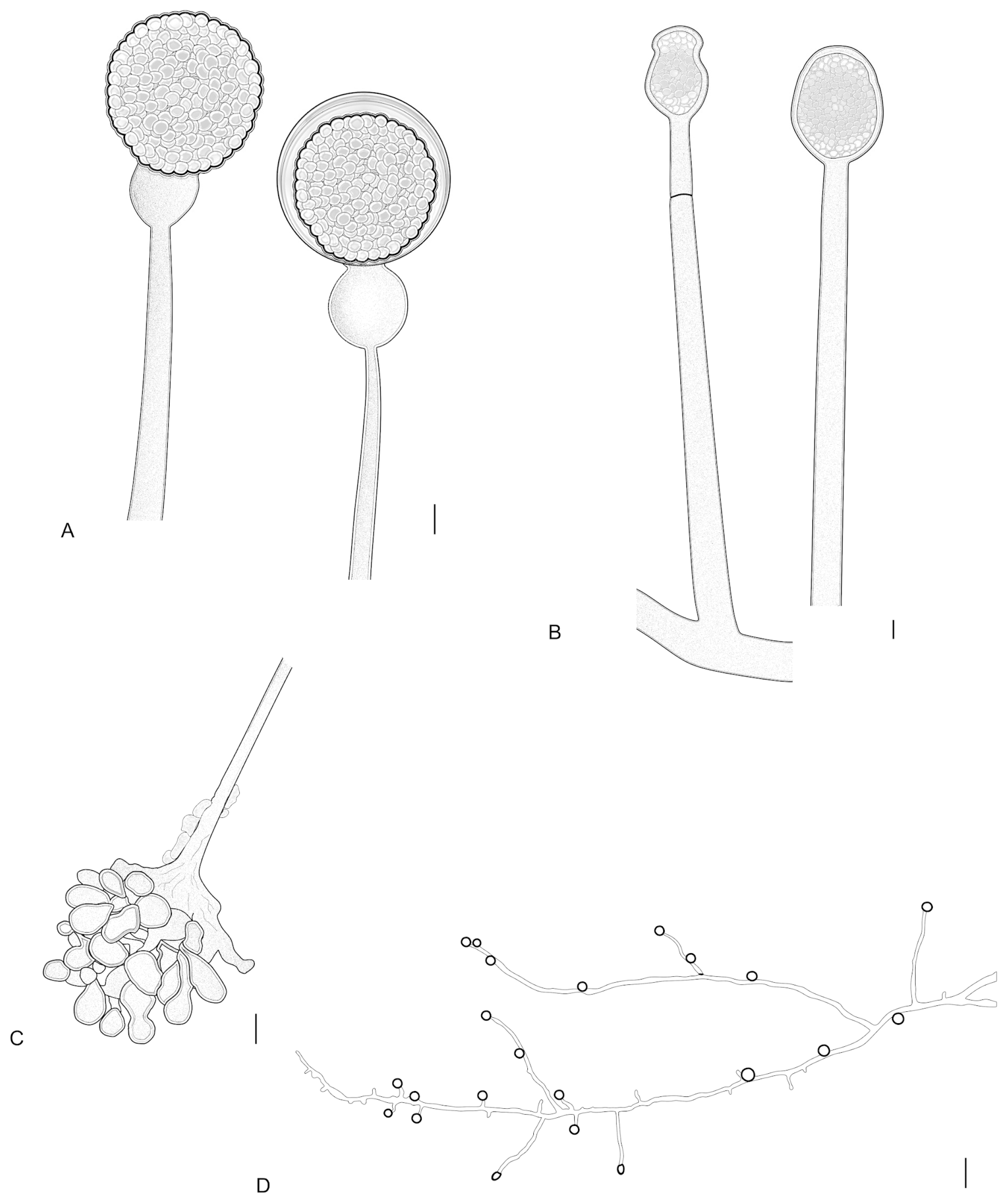
3.2.3. Gongronella longapophysata L.W.S de Freitas & A.L. Santiago, sp. nov. (Figure 6 and Figure 7)


3.2.4. Gongronella verticillata L.W.S. de Freitas & A.L. Santiago, sp. nov. (Figure 8 and Figure 9)


4. Discussion
Author Contributions
Funding
Institutional Review Board Statement
Informed Consent Statement
Data Availability Statement
Acknowledgments
Conflicts of Interest
References
- Ribeiro, J.F.; Walter, B.M.T. Fitofisionomias do bioma Cerrado. In Cerrado: Ambiente e Flora; Sano, S.M., Almeida, S.P., Eds.; Embrapa-CPAC: Planaltina, Brazil, 1998; pp. 89–166. [Google Scholar]
- Santos, F.J.M. Checklist of the herpetofauna in an area of the Cerrado Biome, Central Brazil, under strong mining pressure. J. Wildl. Biodivers. 2025, 9, 332–354. [Google Scholar] [CrossRef]
- De Jesus, D.L.V.; Aranda, R. Hydromorfological soils drives ant (Hymenoptera: Formicidae) communities in Brazilian wet savanna. Wetl. Ecol. Manag. 2025, 33, 4. [Google Scholar] [CrossRef]
- Wijayawardene, N.N.; Hyde, K.D.; Mikhailov, K.V.; Goto, B.T.; Santiago, A.L.C.M.A.; Tokarev, Y.S.; Elshahed, M.S.; Madrid, H.; Pires-Zottarelli, C.L.A.; Pawłowska, J.; et al. Families of non-Dikarya fungi. Mycosphere 2025, 16, 4063–4445. [Google Scholar] [CrossRef]
- Flora e Funga do Brasil. Jardim Botânico do Rio de Janeiro. Available online: http://floradobrasil.jbrj.gov.br/reflora/listaBrasil/PrincipalUC/PrincipalUC.do;jsessionid=D8E2833E5478AF52DD9209A15B77387F#CondicaoTaxonCP (accessed on 3 March 2026).
- De Souza, J.I.; Marano, A.V.; Pires-Zottarelli, C.L.A.; Chambergo, F.S.; Harakava, R. A new species of Backusella (Mucorales) from a Cerrado reserve in Southeast Brazil. Mycol. Prog. 2014, 13, 975–980. [Google Scholar] [CrossRef]
- De Souza, J.I.; Pires-Zottarelli, C.L.A.; Santos, J.F.; Costa, J.P.; Harakava, R. Isomucor (Mucoromycotina): A new genus from a Cerrado reserve in state of São Paulo, Brazil. Mycologia 2012, 104, 232–241. [Google Scholar] [CrossRef] [PubMed]
- Cabral, L.; Sauer, S.; Shankland, A. Introduction: Reclaiming the Cerrado—A Territorial Account of a Disputed Frontier. IDS Bull. 2025, 56, 103–117. [Google Scholar] [CrossRef]
- Benny, G.L. Zygomycetes. 2005. Available online: http://zygomycetes.org/index.php?id=27 (accessed on 27 February 2026).
- Voigt, K. Syllabus of Plant Families, 13th ed.; Borntraeger: Stuttgart, Germany, 2012; pp. 130–156. [Google Scholar]
- Naumov, N.A. Opredelitel Mukorovych (Mucorales), 2nd ed.; Botanical Institute Academy of Sciences USSR: Moscow, Russia; Leningrad, Russia, 1935; 140p. [Google Scholar]
- Pidoplichko, N.M.; Mil’ko, A.A. Atlas Mukoral’vykh Gribov; Naukova Dumka: Kiev, Ukraine, 1971; 115p. [Google Scholar]
- Mil’ko, A.A. Opredelitel’mukoral’nykh Gribov; Naukova Dumka: Kiev, Ukraine, 1974; 303p. [Google Scholar]
- Benjamin, R.K. The merosporangiferous Mucorales. Aliso 1959, 4, 321–433. [Google Scholar] [CrossRef]
- Hesseltine, C.W. Genera of Mucorales with notes on their synonymy. Mycologia 1955, 47, 344–363. [Google Scholar] [CrossRef]
- Hesseltine, C.W.; Ellis, J.J. Mucorales. In The Fungi: An Advanced Treatise. A Taxonomic Review with Keys: Basidiomycetes and Lower Fungi; Ainsworth, G.C., Sparrow, F.K., Sussman, A.S., Eds.; Academic Press: New York, NY, USA, 1973; pp. 187–217. [Google Scholar]
- Benny, G.L.; Humber, R.A.; Morton, J.B. Zygomycota: Zygomycetes. In The Mycota. Systematics and Evolution. Part A; McLaughlin, D.G., McLaughlin, E.G., Lemke, P.A., Eds.; Springer: Berlin, Germany, 2001; pp. 113–146. [Google Scholar]
- Voigt, K.; Wöstemeyer, J. Phylogeny and origin of 82 Zygomycetes from all 54 genera of the Mucorales and Mortierellales based on combined analysis of actin and translation elongation factor EF-1α genes. Gene 2001, 270, 113–120. [Google Scholar] [CrossRef]
- Cordeiro, T.R.L.; Nguyen, T.T.T.; Lima, D.X.; da Silva, S.B.G.; de Lima, C.L.F.; Leitão, J.D.A.; Gurgel, L.M.S.; Lee, H.B.; Santiago, A.L.C.M.d.A. Two new species of the industrially relevant genus Absidia (Mucorales) from soil of the Brazilian Atlantic Forest. Acta Bot. Bras. 2020, 34, 549–558. [Google Scholar] [CrossRef]
- Nguyen, T.T.T.; Santiago, A.L.C.M.d.A.; Hallsworth, J.E.; Cordeiro, T.R.L.; Voigt, K.; Crous, P.M.; Júnior, M.A.M.; Elsztein, C.; Lee, H.B. New Mucorales from opposite ends of the world. Stud. Mycol. 2024, 109, 273–321. [Google Scholar] [CrossRef]
- De Freitas, L.W.S.; de Oliveira, R.J.V.; Cordeiro, T.R.L.; Nguyen, T.T.T.; Lim, H.J.; Lee, H.B.; Santiago, A.L.C.M.d.A. Gongronella pedratalhadensis, a new species of Mucorales (Mucoromycota) isolated From the Brazilian. Sydowia 2021, 73, 61–68. [Google Scholar] [CrossRef]
- Hoffmann, K.; Discher, S.; Voigt, K. Revision of the genus Absidia (Mucorales, Zygomycetes) based on physiological, phylogenetic, and morphological characters; thermotolerant Absidia spp. form a coherent group, Mycocladiaceae fam. nov. Mycol. Res. 2007, 111, 1169–1183. [Google Scholar] [CrossRef]
- Stencel, B.M.; Zień, M.; Jaworska, M.M. The energy of activation of intracellular and extracellular chitin deacetylase. Prog. Chem. Appl. Chitin Its Deriv. 2025, 30, 283–289. [Google Scholar] [CrossRef]
- Krawczyk-Łebek, A.; Żarowska, B.; Janeczko, T.; Kostrzewa-Susłow, E. Antimicrobial activity of new glycoside derivatives of chloroflavones obtained by fungal biotransformation. Sci. Rep. 2025, 15, 25821. [Google Scholar] [CrossRef]
- Guiraud, P.; Villemain, D.; Kadri, M.; Bordjiba, O.; Steiman, R. Biodegradation capability of Absidia fusca Linnemann towards environmental pollutants. Chemosphere 2003, 52, 663–671. [Google Scholar] [CrossRef] [PubMed]
- Albert, Q.; Leleyter, L.; Lemoine, M.; Heutte, N.; Rioult, J.-P.; Sage, L.; Garon, D. Comparison of tolerance and biosorption of three trace metals (Cd, Cu, Pb) by the soil fungus Absidia cylindrospora. Chemosphere 2018, 196, 386–392. [Google Scholar] [CrossRef]
- Sepcies Fungorum. 2026. Available online: https://www.speciesfungorum.org/ (accessed on 3 March 2026).
- Crous, P.W.; Wingfield, M.J.; Chooi, Y.-H.; Gilchrist, C.L.M.; Lacey, E.; Pitt, J.I.; Roets, F.; Swart, W.J.; Cano-Lira, J.F.; Valenzuela-Lopez, N.; et al. Fungal Planet description sheets: 1042-1111. Persoonia 2020, 44, 201–459. [Google Scholar] [CrossRef] [PubMed]
- Wang, Y.-X.; Zhao, H.; Ding, Z.-Y.; Ji, X.-Y.; Zhang, Z.-X.; Wang, S.; Zhang, X.-G.; Liu, X.-Y. Three new species of Gongronella (Cunninghamellaceae, Mucorales) from soil in Hainan, China based on morphology and molecular phylogeny. J. Fungi 2023, 12, 1182. [Google Scholar] [CrossRef]
- Wang, Y.-X.; Zhao, H.; Jiang, Y.; Liu, X.-Y.; Tao, M.F.; Liu, X.-Y. Unveiling species diversity within early-diverging fungi from China III: Six new species and a new record of Gongronella (Cunninghamellaceae, Mucoromycota). MycoKeys 2024, 110, 287–317. [Google Scholar] [CrossRef] [PubMed]
- Braga, H.F.; Baffi, M.A.; Alves, P.H.F. Farinha do caroço de abacate como substrato alternativo para produção de pectinases por Gongronella butleri. J. Biotechnol. Biodivers. 2023, 11, 25–29. [Google Scholar] [CrossRef]
- Maw, T.; Tan, T.K.; Khor, E.; Wong, S.M. Complete cDNA sequence of chitin deacetylase from Gongronella butleri and its phylogenetic analysis revealed clusters corresponding to taxonomic classification of fungi. J. Biosci. Bioeng. 2002, 93, 376–381. [Google Scholar] [CrossRef]
- Cavalheiro, G.F.; Sanguine, I.S.; Santos, F.R.S.; Costa, A.C.; Fernandes, M.; Paz, M.F.; Fonseca, G.G.; Leite, R.S.R. Catalytic properties of amylolytic enzymes produced by Gongronella butleri using agroindustrial residues on solid-state fermentation. Biomed. Res. Int. 2017, 2017, 7507523. [Google Scholar] [CrossRef]
- Santos, F.; Garcia, N.F.L.; da Paz, M.F.; Fonseca, G.G.; Leite, R.S.R. Production and characterization of β-glucosidase from Gongronella butleri by solid-state fermentation. Afr. J. Biotechnol. 2016, 15, 633–641. [Google Scholar] [CrossRef]
- Peera, M.; Tayo-Ajimoko, A.; Liao, F. An alternative to conventional antibiotics—The antimicrobial properties of deacetylated chitin extracted from Gongronella butleri: A research protocol. URNCST J. 2024, 8, 1–5. [Google Scholar] [CrossRef]
- Veloso, H.P.; Rangel-Filho, A.L.R.; Lima, J.C.A. Classificação da Vegetação Brasileira, Adaptada a um Sistema Universal; IBGE: Rio de Janeiro, Brazil, 1991; pp. 1–124.
- Martins, L.P.; Junior, E.C.A.; Martins, A.R.P.; Colins, M.S.; Almeida, G.C.F.; Azevedo, G.G. Butterflies of Amazon and Cerrado remnants of Maranhão, Northeast Brazil. Biota Neotrop. 2017, 17, 1–11. [Google Scholar] [CrossRef]
- Benny, G.L. The methods used by Dr. R.K. Benjamin, and other Mycologists to isolate Zygomycetes. Aliso 2008, 26, 37–61. [Google Scholar] [CrossRef]
- Cordeiro, T.R.L.; Walther, G.; Lee, H.B.; Nguyen, T.T.T.; de Souza, C.A.F.; Lima, D.X.; de Oliveira, R.J.V.; Góes-Neto, A.; Tomé, L.M.R.; Kurzai, O.; et al. A polyphasic approach to the taxonomy of Backusella reveals two new species. Mycol. Prog. 2023, 22, 16. [Google Scholar] [CrossRef]
- Kornerup, A.; Wanscher, J.H. Methuen Handbook of Colour, 3rd ed.; Methuen: London, UK, 1978; pp. 5–252. [Google Scholar]
- Zhao, H.; Nie, Y.; Zong, T.K.; Wang, Y.J.; Wang, M.; Dai, Y.C.; Liu, X.Y. Species diversity and ecological habitat of Absidia (Cunninghamellaceae, Mucorales) with emphasis on five new species from forest and grassland soil in China. J. Fungi. 2022, 8, 471. [Google Scholar] [CrossRef]
- Zhao, H.; Nie, Y.; Zong, T.-K.; Wang, K.; Lv, M.-L.; Cui, Y.-J.; Tohtirjap, A.; Chen, J.-J.; Zhao, C.-L.; Wu, F.; et al. Species diversity, updated classification and divergence times of the phylum Mucoromycota. Fungal Divers. 2023, 123, 49–157. [Google Scholar] [CrossRef]
- Ding, Z.Y.; Ji, X.Y.; Tao, M.F.; Liu, W.X.; Jiang, Y.; Zhao, H.; Meng, Z.; Liu, X.Y. Unveiling species diversity within early-diverging fungi from China IV: Four new species of Absidia (Cunninghamellaceae, Mucoromycota). MycoKeys 2025, 199, 29–46. [Google Scholar] [CrossRef]
- Ji, X.-Y.; Ding, Z.-Y.; Nie, Y.; Zhao, H.; Wang, S.; Huang, B.; Liu, X.-Y. Unveiling species diversity within early-diverging fungi from China V: Five new species of Absidia (Cunninghamellaceae, Mucoromycota). MycoKeys 2025, 117, 267–288. [Google Scholar] [CrossRef]
- Tao, M.-F.; Ding, Z.-Y.; Wang, Y.-X.; Zhang, Z.-X.; Zhao, H.; Meng, Z.; Liu, X.-Y. Unveiling species diversity within early-diverging fungi from China II: Three new species of Absidia (Cunninghamellaceae, Mucoromycota) from Hainan Province. MycoKeys 2024, 110, 255–272. [Google Scholar] [CrossRef]
- Zhao, H.; Nie, Y.; Zong, T.; Dai, Y.; Liu, X. Three New Species of Absidia (Mucoromycota) from China Based on Phylogeny, Morphology and Physiology. Diversity 2022, 14, 132. [Google Scholar] [CrossRef]
- Zong, T.K.; Zhao, H.; Liu, X.L.; Ren, L.Y.; Zhao, C.L.; Liu, X.Y. Taxonomy and phylogeny of four new species in Absidia (Cunninghamellaceae, Mucorales) from China. Front. Microbiol. 2021, 12, 677836. [Google Scholar] [CrossRef]
- Urquhart, A.S.; Idnurm, A. Absidia healeyae: A new species of Absidia (Mucorales) isolated from Victoria, Australia. Mycoscience 2021, 62, 331–335. [Google Scholar] [CrossRef] [PubMed]
- Luo, C.; Chen, F.; Phookamsak, R.; Sun, J.; Jiang, H. Polyphasic taxonomic study of Absidia menglianensis sp. nov. (Cunninghamellaceae, Mucorales) isolated from an avocado plantation in Yunnan, China. Stud. Fungi 2024, 9, e018. [Google Scholar] [CrossRef]
- Zhao, H.; Zhu, J.; Zong, T.K.; Liu, X.L.; Ren, L.Y.; Lin, Q.; Qiao, M.; Nie, Y.; Zhang, Z.D.; Liu, X.Y. Two new species in the family Cunninghamellaceae from China. Mycobiology 2021, 49, 142–150. [Google Scholar] [CrossRef]
- Crous, P.W.; Luangsa-Ard, J.J.; Wingfield, M.J.; Carnegie, A.J.; Hernández-Restrepo, M.; Lombard, L.; Roux, J.; Barreto, R.W.; Baseia, I.G.; Cano-Lira, J.F.; et al. Fungal Planet description sheets: 785-867. Persoonia 2018, 41, 238–417. [Google Scholar] [CrossRef] [PubMed]
- Htet, Y.M.; Yasanthika, W.E.; Hurdeal, V.G.; de Farias, A.R.G. Absidia thailandica sp. nov., an addition to the diversity of soil fungi from Thailand. Phytotaxa 2024, 646, 157–168. [Google Scholar] [CrossRef]
- De Freitas, L.W.S.; Cruz, M.O.; Nguyen, T.T.T.; Lee, H.B.; Santos, F.R.S.; Santiago, A.L.C.M.A. Absidia variicolumellata, sp. nov., a new mucoralean fungus isolated from Atlantic Forest in Bahia state (Brazil). Sydowia 2023, 75, 75–86. [Google Scholar] [CrossRef]
- White, T.J.; Bruns, T.; Lee, S.; Taylor, J. Amplification and direct sequencing of fungal ribosomal RNA genes for phylogenetics. In PCR Protocols: A Guide to Methods and Applications; Innis, M.A., Gelfand, D.H., Sninsky, J.J., White, T.J., Eds.; Academic Press: New York, NY, USA, 1990; pp. 315–322. [Google Scholar] [CrossRef]
- Vilgalys, R.; Hester, M. Rapid genetic identification and mapping of enzymatically amplified ribosomal DNA from several Cryptococcus species. J. Bacteriol. 1990, 172, 4239–4246. [Google Scholar] [CrossRef]
- Rehner, S.A.; Samuels, G.J. Taxonomy and phylogeny of Gliocladium analysed from nuclear large subunit ribosomal DNA sequences. Mycol. Res. 1994, 98, 625–634. [Google Scholar] [CrossRef]
- Katoh, K.; Standley, D.M. MAFFT multiple sequence alignment software version 7: Improvements in performance and usability. Mol. Biol. Evol. 2013, 30, 772–780. [Google Scholar] [CrossRef] [PubMed]
- Kumar, S.; Stecher, G.; Tamura, K. MEGA7: Molecular evolutionary genetics analysis version 7.0 for bigger datasets. Mol. Biol. Evol. 2016, 33, 1870–1874. [Google Scholar] [CrossRef]
- Maddison, W.P.; Maddison, D.R. Mesquite: A Modular System for Evolutionary Analysis, Version 3.31. 2017. Available online: http://www.mesquiteproject.org (accessed on 3 March 2016).
- Trifinopoulos, J.; Nguyen, L.-T.; Von Haeseler, A.; Minh, B.Q. W-IQ-TREE: A fast online phylogenetic tool for maximum likelihood analysis. Nucleic Acids Res. 2016, 44, W232–W235. [Google Scholar] [CrossRef] [PubMed]
- Stamatakis, A. RAxML Version 8: A tool for phylogenetic analysis and post-analysis of large phylogenies. Bioinformatics 2014, 30, 1312–1313. [Google Scholar] [CrossRef]
- Miller, M.A.; Pfeiffer, W.; Schwartz, T. Creating the CIPRES science gateway for inference of large phylogenetic trees. In Proceedings of the 2010 Gateway Computing Environments Workshop (GCE), New Orleans, LA, USA, 14 November 2010. [Google Scholar] [CrossRef]
- Hoang, D.T.; Chernomor, O.; von Haeseler, A.; Minh, B.Q.; Vinh, L.S. UFBoot2: Improving the ultrafast bootstrap approximation. Mol. Biol. Evol. 2018, 35, 518–522. [Google Scholar] [CrossRef]
- Kalyaanamoorthy, S.; Minh, B.Q.; Wong, T.K.F.; von Haeseler, A.; Jermiin, L.S. ModelFinder: Fast model selection for accurate phylogenetic estimates. Nat. Methods 2017, 14, 587–589. [Google Scholar] [CrossRef]
- Ronquist, F.; Teslenko, M.; van der Mark, P.; Ayres, D.L.; Darling, A.; Hȯhna, S.; Larget, B.; Liu, L.; Suchard, M.A.; Huelsenbeck, J.P. MrBayes 3.2: Efficient bayesian phylogenetic inference and model choice across a large model space. Syst. Biol. 2012, 61, 539–542. [Google Scholar] [CrossRef]
- Rambaut, A. FigTree (Tree Figure Drawing Tool), version 1.4. 3 2006–2016; Institute of Evolutionary Biology, University of Edinburgh: Edinburgh, UK, 2016. [Google Scholar]
- Tan, Y.P.; Bishop-Hurley, S.L.; Conroy, J.R.; Shivas, R.G. Index of Australian Fungi No. 50. 2025. Available online: https://zenodo.org/records/14693768 (accessed on 3 March 2016).
- Paine, F.S. Studies on fungous flora of virgin soils. Mycologia 1927, 19, 248–267. [Google Scholar] [CrossRef]
- Hesseltine, C.W.; Ellis, J.J. An interesting species of Mucor, M. ramosissimus. Sabouraudia 1964, 3, 151–154. [Google Scholar] [CrossRef] [PubMed]
- Schipper, M.A.A. Notes on Mucorales—I. Observations on Absidia. Persoonia 1990, 14, 133–149. [Google Scholar]
- Kirk, P.M.; Cannon, P.; Stalpers, J.; Minter, D.W. Dictionary of the Fungi, 10th ed.; CAB International: Wallingford, UK, 2008; pp. 1–771. [Google Scholar] [CrossRef]
- Hoffmann, K.; Walther, G.; Voigt, K. Mycocladus vs. Lichtheimia: A correction (Lichtheimiaceae fam. nov., Mucorales, Mucoromycotina). Mycol. Res. 2009, 113, 275–278. [Google Scholar] [CrossRef]
- Hoffmann, K.; Voigt, K. Absidia parricida plays a dominant role in biotrophic fusion parasitism among mucoralean fungi (Zygomycetes): Lentamyces, a new genus for A. parricida and A. zychae. Plant Biol. 2009, 11, 537–554. [Google Scholar] [CrossRef]
- Lima, D.X.; Cordeiro, T.R.; De Souza, C.A.; de Oliveira, R.J.; Lee, H.B.; Souza-Motta, C.M.; Santiago, A.L.D.A. Morphological and molecular evidence for two new species of Absidia from Neotropic soil. Phytotaxa 2020, 446, 61–71. [Google Scholar] [CrossRef]
- Leitaão, J.D.; Cordeiro, T.R.; Nguyen, T.T.; Lee, H.B.; Gurgel, L.M.; Santiago, A.L.C.M.d.A. Absidia aguabelensis sp. nov.: A new mucoralean fungi isolated from a semiarid region in Brazil. Phytotaxa 2021, 516, 83–91. [Google Scholar] [CrossRef]
- Hesseltine, C.W.; Ellis, J.J. Notes on Mucorales, especially Absidia. Mycologia 1961, 53, 406–426. [Google Scholar] [CrossRef]
- Upadhyay, H.P. Soil fungi from north-east and north Brazil—VII. The genus Gongronella. Persoonia 1970, 6, 111–117. [Google Scholar]
- Zheng, R.-Y.; Chen, G.-Q. A monograph of Cunninghamella. Mycotaxon 2001, 80, 1–75. [Google Scholar] [CrossRef]
- De Lima, C.L.F.; Cordeiro, T.R.L.; dos Santos, M.A.B.; Leão, I.F.; dos Santos, F.R.S.; Muniz, A.W.; Yadav, L.S.; Lee, H.B.; Santiago, A.L.C.M. The third report of Cunninghamellaceae fungi in the Brazilian Amazon forest: Two new species of Cunninghamella isolated from soil. Mycologia 2026, 118, 1–15. [Google Scholar] [CrossRef]
- Alastruey-Izquierdo, A.; Hoffmann, K.; de Hoog, G.S.; Rodriguez-Tudela, J.L.; Voigt, K.; Bibashi, E.; Walther, G. Species recognition and clinical relevance of the zygomycetous genus Lichtheimia (syn. Absidia Pro Parte, Mycocladus). J. Clin. Microbiol. 2010, 48, 2154–2170. [Google Scholar] [CrossRef] [PubMed]
- Wagner, L.; Stielow, J.B.; de Hoog, G.S.; Bensch, K.; Schwartze, V.U.; Voigt, K.; Alastruey-Izquierdo, A.; Kurzai, O.; Walther, G. A new species concept for the clinically relevant Mucor circinelloides complex. Persoonia 2020, 44, 67–97. [Google Scholar] [CrossRef]
- Zheng, R.-Y.; Chen, G.-Q.; Huang, H.; Liu, X.-Y. A monograph of Rhizopus. Sydowia 2007, 59, 273–372. [Google Scholar]
- Ariyawansa, H.A.; Hyde, K.D.; Jayasiri, S.C.; Buyck, B.; Chethana, K.W.T.; Dai, D.Q.; Dai, Y.C.; Daranagama, D.A.; Jayawardena, R.S.; Lücking, R.; et al. Fungal diversity notes 111–252—Taxonomic and phylogenetic contributions to fungal taxa. Fungal Divers. 2015, 75, 27–274. [Google Scholar] [CrossRef]
- Crous, P.W.; Cowan, D.A.; Maggs-Kölling, G.; Yilmaz, N.; Thangavel, R.; Wingfield, M.J.; Noordeloos, M.E.; Dima, B.; Brandrud, T.E.; Jansen, G.M.; et al. Fungal Planet description sheets: 1182–1283. Persoonia 2021, 46, 313–528. [Google Scholar] [CrossRef]
- Tibpromma, S.; Hyde, K.D.; Jeewon, R.; Maharachchikumbura, S.S.N.; Liu, J.K.; Bhat, D.J.; Jones, E.B.G.; Mckenzie, E.H.C.; Camporesi, E.; Bulgakov, T.S.; et al. Fungal diversity notes 491–602: Taxonomic and phylogenetic contributions to fungal taxa. Fungal Divers. 2017, 83, 1–261. [Google Scholar] [CrossRef]
- Crous, P.W.; Wingfield, M.J.; Jurjević, Ž.; Balashov, S.; Osieck, E.R.; Marin-Felix, Y.; Luangsa-ard, J.J.; Mejía, L.C.; Cappelli, A.; Parra, L.A.; et al. Fungal Planet description sheets: 1697–1780. Fungal Syst. Evol. 2024, 14, 325–577. [Google Scholar] [CrossRef]


| Markers | PCR Primers | PCR Conditions * | References |
|---|---|---|---|
| ITS | ITS4/ITS5 | 95 °C, 5 min; (95 °C, 30 s; 55 °C, 45 s; 72 °C, 1:15 min) × 35 cycles; 72 °C, 10 min | White et al. [54] |
| LSU | LR5/LR0R | 95 °C, 5 min; (95 °C, 30 s; 55 °C, 45 s; 72 °C, 1:15 min) × 35 cycles; 72 °C, 10 min | Vilgalys and Hester [55]; Rehner and Samuels [56] |
| act | Act-1/Act-4R | 95 °C, 3 min; (95 °C, 60 s; 55 °C, 60 s; 72 °C, 60 s) × 30 cycles; 72 °C, 10 min | Voigt and Wöstemeyer [18] |
| Species | Strains | GenBank Accession Numbers | ||
|---|---|---|---|---|
| ITS | LSU | act | ||
| Absidia abundans | XY09265 | ON074697 | ON074681 | – |
| Absidia abundans | CGMCC 3.16255T | NR_182590 | ON074683 | – |
| Absidia abundans | XY09274 | ON074696 | ON074682 | – |
| Absidia aguabelensis | URM 8213T | NR_189383 | NG_241934 | – |
| Absidia alpina | CGMCC 3.16104 | OL678133 | – | – |
| Absidia ampullacea | CGMCC 3.16054 | MZ354138 | MZ350132 | – |
| Absidia anomala | CBS 125.68T | MH859085 | MH870799 | – |
| Absidia anomala | FSU5798 | EF030523 | – | EF030535 |
| Absidia arrhiza | CGMCC 3.28540T = XG09770-7 | PQ600860 | PQ600254 | PQ753533 |
| Absidia arrhiza | XG09770-6 | PQ600859 | PQ600253 | PQ753532 |
| Absidia biappendiculata | CBS 187.64 | MZ354153 | MZ350147 | MZ357438 |
| Absidia bonitoensis | URM 7889T | MN977786 | MN977805 | – |
| Absidia brunnea | CGMCC 3.16055T | MZ354139 | MZ350133 | MZ357421 |
| Absidia brunneola | CGMCC 3.29490T = XG12984-12-1 | NMDCN0009VE 6 | NMDCN000 9VEM | NMDCN0009 TVO |
| XG12984-12-2 | NMDCN0009VE 7 | NMDCN000 9VEN | NMDCN0009 TVP | |
| Absidia caatinguensis | URM 7156T | NR_154704 | NG_058582 | – |
| Absidia caerulea | XY00608 | OL620081 | – | – |
| Absidia caerulea | XY00729 | OL620082 | – | – |
| Absidia caerulea | CBS101.36 | MH855718 | MH867230 | – |
| Absidia caerulea | FSU767 | AY944870 | – | – |
| Absidia californica | CBS 314.78 | JN205816 | MH872902 | – |
| Absidia californica | FSU4748 | AY944873 | EU736301 | EU736224 |
| Absidia californica | CBS 126.68 = FSU4747T | AY944872 | EU736300 | AY944758 |
| Absidia cheongyangensis | CNUFC CY2203T | PP844904 | PP852788 | PP893196 |
| Absidia cheongyangensis | CNUFC CY2401 | – | PP852702 | PP893197 |
| Absidia chinensis | CGMCC 3.16057 | MZ354141 | MZ350135 | MZ357422 |
| Absidia chinensis | CGMCC 3.16056T | MZ354140 | MZ350134 | – |
| Absidia cinerea | CGMCC 3.16062 | MZ354146 | MZ350140 | MZ357427 |
| Absidia collariata | CGMCC 3.28536T = XG08666-10-1 | PQ610533 | PQ605104 | PQ613279 |
| Absidia collariata | XG08666-10-2 | PQ610534 | PQ605105 | PQ613280 |
| Absidia cornuta | URM 6100T | NR_172976 | MN625255 | – |
| Absidia crystalloides | CGMCC3.27496T = SAUCC6948-15 | PP377803 | PP373736 | PP790582 |
| Absidia crystalloides | SAUCC693201 | PP377804 | PP373736 | PP790581 |
| Absidia cuneospora | CBS 102.59 | JN205819 | – | – |
| Absidia cylindrospora | CBS 100.08 | JN205822 | JN206588 | – |
| Absidia digitata | CGMCC 3.29492T = XG18784-2-1 | NMDCN0009VE 2 | NMDCN000 9VEI | NMDCN0009 TVK |
| XG18784-2-2 | NMDCN0009VE 3 | NMDCN000 9VEJ | NMDCN0009 TVL | |
| Absidia digitula | CGMCC 3.16058T | MZ354142 | MZ350136 | MZ357423 |
| Absidia edaphica | MFLUCC 20-0088 | NR_172305 | NG_075367 | MT410739 |
| Absidia exilis | CGMCC 3.29493T = XG21013-11-1 | NMDCN0009VE 0 | NMDCN000 9VEG | NMDCN0009 TVI |
| XG21013-11-2 | NMDCN0009VE 1 | NMDCN000 9VEH | NMDCN0009 TVJ | |
| Absidia fluvi | CNUFC CY2240T | PP844891 | PP852703 | PP893201 |
| Absidia fluvi | CNUFC CY2241 | PP844892 | PP852704 | PP893202 |
| Absidia fluvi | CNUFC CY2315 | PP844893 | PP852705 | PP893203 |
| Absidia frigida | CGMCC 3.16201T | NR_182565 | OM030223 | – |
| Absidia fusca | CBS 102.35T | NR_103625 | NG_058552 | – |
| Absidia gemella | CGMCC 3.16202T | OM108488 | OM030224 | – |
| Absidia glauca | CBS 129233 | MH865253 | MH876693 | – |
| Absidia glauca | CBS 101.08T | MH854573 | MH866105 | – |
| Absidia glauca | FSU660 | AY944879 | EU736302 | EU736225 |
| Absidia globospora | CGMCC 3.16031T | NR_189829 | MW671544 | MZ357431 |
| Absidia globospora | CGMCC 3.16035 | MW671538 | MW671545 | MZ357432 |
| Absidia globospora | CGMCC 3.16036 | MW671539 | MW671546 | MZ357433 |
| Absidia healeyae | UoMAU1 | MT436028 | MT436027 | MW861731 |
| Absidia heterospora | SHTH021 | JN942683 | JN982936 | NA |
| Absidia hainanensis | CGMCC 3.28535T = XG06908-1 | PQ610537 | PQ605108 | PQ613283 |
| Absidia hainanensis | XG06908-4 | PQ610538 | PQ605109 | PQ613284 |
| Absidia jiangxiensis | CGMCC 3.16105T = Ab-216 | OL678134 | PP780377 | PP790577 |
| Absidia jindoensis | CNUFC-PTI1-1 | MF926622 | MF926616 | MF926510 |
| Absidia koreana | EML-IFS45-1T | KR030062 | KR030056 | KR030058 |
| Absidia koreana | XY00816 | OL620083 | ON123771 | – |
| Absidia koreana | XY00596 | OL620084 | – | – |
| Absidia kunryangriensis | CNUFC CY2230 | PP844905 | PP956882 | PP893198 |
| Absidia lobata | CGMCC 3.16256 | ON074690 | ON074679 | – |
| Absidia longissima | CGMCC 3.16203T | NR_182566 | OM030225 | – |
| Absidia macrospora | FSU4746 | AY944882 | EU736303 | AY944760 |
| Absidia medulla | CGMCC 3.16034 | NR_189832 | MW671549 | MZ357436 |
| Absidia menglianensis | KUNCC 24-18541 = root2-17 | PQ594927 | PQ594929 | – |
| Absidia menglianensis | KUNCC 24-18542 = MLAS011 | PQ594928 | PQ594930 | – |
| Absidia montepascoalis | URM 8218T | NR_172995 | – | – |
| Absidia multispora | URM 8210T | MN953780 | MN953782 | – |
| Absidia nigra | CBS 127.68T | NR_173068 | MZ350146 | MZ357437 |
| Absidia nigra | CGMCC 3.16059 | MZ354143 | MZ350137 | MZ357424 |
| Absidia nigra | CGMCC 3.16060 | MZ354144 | MZ350138 | MZ357425 |
| Absidia oblongispora | CGMCC 3.16061T | MZ354145 | MZ350139 | MZ357426 |
| Absidia ovalispora | CGMCC 3.16019T | NR_176748 | MW264131 | – |
| Absidia pacifica | SAUCC6955-16T = CGMCC 3.27497 | PP377802 | PP373735 | PP790579 |
| Absidia pacifica | SAUCC6955-15 = SAUCC 413601 | PP377801 | PP373734 | PP790580 |
| Absidia panacisoli | SYPF 7183T | MF522181 | MF522180 | – |
| Absidia paracylindrospora | CNUFC L2207 | PP844907 | PP956883 | PP893204 |
| Absidia pararepens | XY00631 | OL620085 | ON123774 | – |
| Absidia pararepens | XY00615 | OL620086 | – | – |
| Absidia pararepens | XY05899 | OL620087 | – | – |
| Absidia pararepens | CBS 146,002 = CCF 6352T | MT193669 | MT192308 | – |
| Absidia pateriformis | CGMCC 3.27495 = SAUCC6347D-1T | PP377805 | PP373738 | PP790583 |
| Absidia pateriformis | SAUCC6347D-2 = SAUCC 634702 | PP377806 | PP373739 | PP790584 |
| Absidia pernambucoensis | URM 7219T | MN635568 | MN635569 | – |
| Absidia pseudocylindrospora | EML-FSDY6-2 | KU923817 | KU923814 | KU923815 |
| Absidia psychrophilia | FSU 4745 | AY944874 | EU736306 | AY944762 |
| Absidia purpurea | CGMCC 3.16106 | OL678135 | – | – |
| Absidia pyriformis | CGMCC 3.28538T = XG09540-14-1 | PQ610531 | PQ605102 | PQ613277 |
| Absidia pyriformis | XG09540-14-5 | PQ610532 | PQ605103 | PQ613278 |
| Absidia radiata | CGMCC 3.16257 | ON074698 | ON074684 | – |
| Absidia radiata | XY09330-1 | ON074699 | ON074685 | – |
| Absidia repens | CBS 115583T | NR_103624 | NG_058551 | – |
| Absidia rhizoidea | URM 9234T | PZ234078 | PZ227107 | PZ227661 |
| Absidia rhizoidea | URM 9233 | PZ234079 | PZ227108 | PZ227662 |
| Absidia rhizoidea | URM 9235 | PZ234080 | PZ227109 | PZ227663 |
| Absidia saloaensis | URM 8209T | MN953781 | MN953783 | – |
| Absidia sichuanensis | CGMCC 3.16258T | NR_182589 | ON074688 | – |
| Absidia simplex | CGMCC 3.28541T = XG10012-9 | PQ600862 | PQ600256 | PQ686230 |
| Absidia simplex | XG10012-8 | PQ600861 | PQ600255 | PQ686229 |
| Absidia soli | MFLU-20-0414T | MT396373 | MT393988 | – |
| Absidia sphaerica | CGMCC 3.28542T = XY00690 | PQ600866 | PQ600260 | PQ777149 |
| Absidia sphaerica | XY00690-1 | PQ600865 | PQ600259 | PQ777148 |
| Absidia spinosa | FSU551 | AY944887 | EU736307 | EU736227 |
| Absidia stercoraria | EML-DG8-1T | KU168828 | KT921998 | KT922000 |
| Absidia sympodialis | CGMCC 3.16063T | MZ354147 | MZ350141 | – |
| Absidia sympodialis | CGMCC 3.16064 | MZ354148 | MZ350142 | – |
| Absidia tarda | URM 8412 | PP844911 | PP956884 | PP893199 |
| Absidia tardiva | CGMCC 3.28537T = XG08757-4 | PQ610529 | PQ605100 | PQ613275 |
| Absidia tardiva | XG08757-6 | PQ610530 | PQ605101 | PQ613276 |
| Absidia terrestris | ERP-2017T | LT795003 | LT795005 | – |
| Absidia tibetensis | CGMCC 3.28534T = XG00415-1 | PQ610535 | PQ605106 | PQ613281 |
| Absidia tibetensis | XG00415-3 | PQ610536 | PQ605107 | PQ613282 |
| Absidia thailandica | MFLUCC:20-0089 = MFLUCC:23-0073T | OR606547 | OR606546 | NA |
| Absidia tumida | CGMCC 3.29491T = XG18709-9-1 | NMDCN0009VE 4 | NMDCN000 9VEK | NMDCN0009 TVM |
| Absidia tumida | XG18709-9-2 | NMDCN0009VE 5 | NMDCN000 9VEL | NMDCN0009 TVN |
| Absidia turgida | CGMCC 3.16032T | NR_189830 | NG_241931 | MZ357434 |
| Absidia varians | CGMCC 3.16065T | MZ354149 | MZ350143 | MZ357428 |
| Absidia edaphica | MFLUCC 20-0088T | NR_172305 | NG_075367 | MT410739 |
| Absidia variabilis | URM 9236T | PZ234081 | PZ227110 | PZ227664 |
| Absidia variabilis | URM 9237 | PZ234082 | PZ227111 | PZ227665 |
| Absidia variiprojecta | URM 8620T | PP844913 | PP956885 | PP893200 |
| Absidia variispora | URM 8720 | PP844915 | PP956886 | PP893205 |
| Absidia variicolumellata | URM 8216T = DXL-2021b | MZ331545 | MZ331547 | – |
| Absidia virescens | CGMCC 3.16067 | MZ354151 | MZ350145 | MZ357430 |
| Absidia viridis | CGMCC 3.28539T = XG09563-3 | PQ600864 | PQ600258 | PQ753531 |
| Absidia viridis | XG09563-2 | PQ600863 | PQ600257 | PQ753530 |
| Absidia xinjiangensis | CGMCC 3.16107T | OL678136 | – | – |
| Absidia yunnanensis | XY09528 | ON074701 | ON074686 | – |
| Absidia yunnanensis | CGMCC 3.16259T | NR_182591 | NG_149054 | – |
| Absidia zonata | CGMCC 3.16033T | NR_189831 | MW671548 | MZ357435 |
| Absidia zygospora | RSPG 214 | KC478527 | – | – |
| Absidia zygospora | ANG28 | DQ914420 | – | – |
| Gongronella abortosporangia | CGMCC 3.27028T | PP195847 | PP195948 | PP933938 |
| Gongronella abortosporangia | CGMCC 3.27028T | PP195848 | PP195949 | PP933939 |
| Gongronella apophysata | SAUCC 4846-3 | PP195854 | PP195955 | PP933948 |
| Gongronella apophysata | CGMCC 3.27031T | PP195853 | PP195954 | PP933947 |
| Gongronella banzhaoae | BRIP 75171aT | OR271908 | OR259049 | – |
| Gongronella bartikiae | BRIP 76703a | PQ882522 | – | – |
| Gongronella bawanglingensis | CGMCC 3.27033T | PP195857 | PP195958 | PP933951 |
| Gongronella bawanglingensis | SAUCC 6946-1 | PP195858 | PP195959 | PP933952 |
| Gongronella brasiliensis | URM 7487T | NR_155148 | KY114932 | – |
| Gongronella brasiliensis | URM 7488 | KY114931 | KY114933 | – |
| Gongronella butleri | CBS 216.58 | JN206285 | MH869292 | – |
| Gongronella butleri | CBS 179.28 | JN206286 | – | – |
| Gongronella butleri | CBS 415.67 | MH859014 | MH870714 | – |
| Gongronella chlamydospora | CGMCC 3.16118T | OL678157 | – | – |
| Gongronella eborensis | CCMI 1100T | KT809408 | MN947301 | – |
| Gongronella eborensis | CCMI 1101 | GU244500 | MN947302 | – |
| Gongronella fusoacuminata | BCRC 10F0908T | NR_199105 | NG_244365 | – |
| Gongronella fusoacuminata | BCRC:10F0918 | PQ496504 | PQ496507 | – |
| Gongronella fusoacuminata | BCRC:10F0909 | PQ496503 | PQ496506 | – |
| Gongronella guangdongensis | CGMCC 3.15212T | NR_158464 | MN947303 | – |
| Gongronella guangdongensis | LC1994 | KC462740 | MN947304 | – |
| Gongronella hydei | KUMCC 18.0198T | NR_171964 | MT907273 | – |
| Gongronella hydei | BRIP 74937a | OR272184 | OR272185 | – |
| Gongronella hydei | KUMCC_18_0204 | MT152335 | MT907274 | – |
| Gongronella inconstans | CGMCC 3.27029T | PP195849 | PP195950 | PP933941 |
| Gongronella inconstans | SAUCC 4113-3 | PP195850 | PP195951 | PP933942 |
| Gongronella irregularis | URM9013T | PP923717 | PP923718 | – |
| Gongronella koreana | EML-TS2BpT | KP636529 | KP636530 | KP636527 |
| Gongronella koreana | EML-TS2Bp-2 | KP835545 | KP835542 | KP835543 |
| Gongronella lacrispora | ATCC 24412T | GU244498 | JN206609 | – |
| Gongronella longapophysata | URM 9240T | PZ234083 | PZ227112 | PZ227666 |
| Gongronella longapophysata | URM 9241 | PZ234084 | PZ227113 | PZ227667 |
| Gongronella multiramosa | CGMCC 3.26216T | OR733546 | OR733611 | PP933937 |
| Gongronella multiramosa | SAUCC 4056-4 | OR733545 | OR733610 | – |
| Gongronella multispora | CGMCC 3.16119T | OL678158 | – | – |
| Gongronella namwonensis | CNUFC WW2-12T | NR_175640 | MN658482 | – |
| Gongronella namwonensis | XY08131 | OL620098 | – | – |
| Gongronella oleae | CGMCC 3.26217T | OR742078 | OR733608 | PP933945 |
| Gongronella oleae | SAUCC 4164-2 | OR742079 | OR733609 | PP933946 |
| Gongronella orasabula | JMRC SF 012180T | NR_148087 | KT936263 | KT936265 |
| Gongronella orasabula | EML-QF12-2 | KT936270 | KT936264 | – |
| Gongronella pamphilae | BRIP 74936aT | OR271909 | OR259050 | – |
| Gongronella pamphilae | CGMCC 3.27027 | PP195845 | PP195946 | PP933935 |
| Gongronella pamphilae | SAUCC 4031-2 | PP195846 | PP195947 | PP933936 |
| Gongronella pedratalhadensis | URM 8182T | MN912512 | MN912508 | – |
| Gongronella pingtangensis | CGMCC 3.27032T | PP195855 | PP195956 | PP933949 |
| Gongronella pingtangensis | SAUCC 5676-4 | PP195856 | PP195957 | PP933950 |
| Gongronella qichaensis | CGMCC 3.26218T | OR733544 | OR733607 | – |
| Gongronella qichaensis | SAUCC 4137-3 | OR733543 | OR733606 | – |
| Gongronella reniformis | CGMCC 3.27030T | PP195851 | PP195952 | PP933943 |
| Gongronella reniformis | SAUCC 4142-5 | PP195852 | PP195953 | PP933944 |
| Gongronella sichuanensis | GZUIFR-H25.4.1T | MK813373 | MK813855 | MK820625 |
| Gongronella sichuanensis | GZUIFR-H25.4.2 | MK813374 | MK813856 | MK820626 |
| Gongronella verticillata | URM 9238T | PZ234085 | PZ227114 | – |
| Gongronella verticillata | URM 9239 | PZ234086 | PZ227115 | – |
| Gongronella zunyiensis | GZUIFR-FX25.1T | MN453856 | MN453853 | – |
| Gongronella zunyiensis | GZUIFR-FX25.2 | MN453857 | MN453854 | – |
| Cunninghamella blakesleeana | CBS 133.27 T | NR_119974 | MH866397 | KJ156479 |
| Cunninghamella antarctica | CBS 545.75T | JN205893 | JN206597 | KJ156492 |
Disclaimer/Publisher’s Note: The statements, opinions and data contained in all publications are solely those of the individual author(s) and contributor(s) and not of MDPI and/or the editor(s). MDPI and/or the editor(s) disclaim responsibility for any injury to people or property resulting from any ideas, methods, instructions or products referred to in the content. |
© 2026 by the authors. Licensee MDPI, Basel, Switzerland. This article is an open access article distributed under the terms and conditions of the Creative Commons Attribution (CC BY) license.
Share and Cite
Freitas, L.W.S.d.; Ferro, L.d.O.; Rodrigues, A.; Oliveira, C.S.d.; Cruz, M.O.d.; Bezerra, J.D.P.; Lee, H.B.; de Souza-Motta, C.M.; dos Santos, M.A.B.; Melo, R.F.R.; et al. Descriptions of Four New Species in Cunninghamellaceae (Mucoromycota) from the Brazilian Savanna Through Integrative Taxonomy. J. Fungi 2026, 12, 329. https://doi.org/10.3390/jof12050329
Freitas LWSd, Ferro LdO, Rodrigues A, Oliveira CSd, Cruz MOd, Bezerra JDP, Lee HB, de Souza-Motta CM, dos Santos MAB, Melo RFR, et al. Descriptions of Four New Species in Cunninghamellaceae (Mucoromycota) from the Brazilian Savanna Through Integrative Taxonomy. Journal of Fungi. 2026; 12(5):329. https://doi.org/10.3390/jof12050329
Chicago/Turabian StyleFreitas, Leslie Waren Silva de, Layanne de Oliveira Ferro, Andre Rodrigues, Camila Santana de Oliveira, Mateus Oliveira da Cruz, Jadson Diogo Pereira Bezerra, Hyang Burm Lee, Cristina Maria de Souza-Motta, Maria Alice Barbosa dos Santos, Roger Fagner Ribeiro Melo, and et al. 2026. "Descriptions of Four New Species in Cunninghamellaceae (Mucoromycota) from the Brazilian Savanna Through Integrative Taxonomy" Journal of Fungi 12, no. 5: 329. https://doi.org/10.3390/jof12050329
APA StyleFreitas, L. W. S. d., Ferro, L. d. O., Rodrigues, A., Oliveira, C. S. d., Cruz, M. O. d., Bezerra, J. D. P., Lee, H. B., de Souza-Motta, C. M., dos Santos, M. A. B., Melo, R. F. R., & Santiago, A. L. C. M. d. A. (2026). Descriptions of Four New Species in Cunninghamellaceae (Mucoromycota) from the Brazilian Savanna Through Integrative Taxonomy. Journal of Fungi, 12(5), 329. https://doi.org/10.3390/jof12050329