
Morphological and Phylogenetic Analyses Reveal Four New Species of Hydnellum from China
 , ,
, ,
Abstract
1. Introduction
2. Materials and Methods
2.1. Morphological Studies
2.2. DNA Extraction, PCR, and Sequencing
2.3. Phylogenetic Inference
3. Results
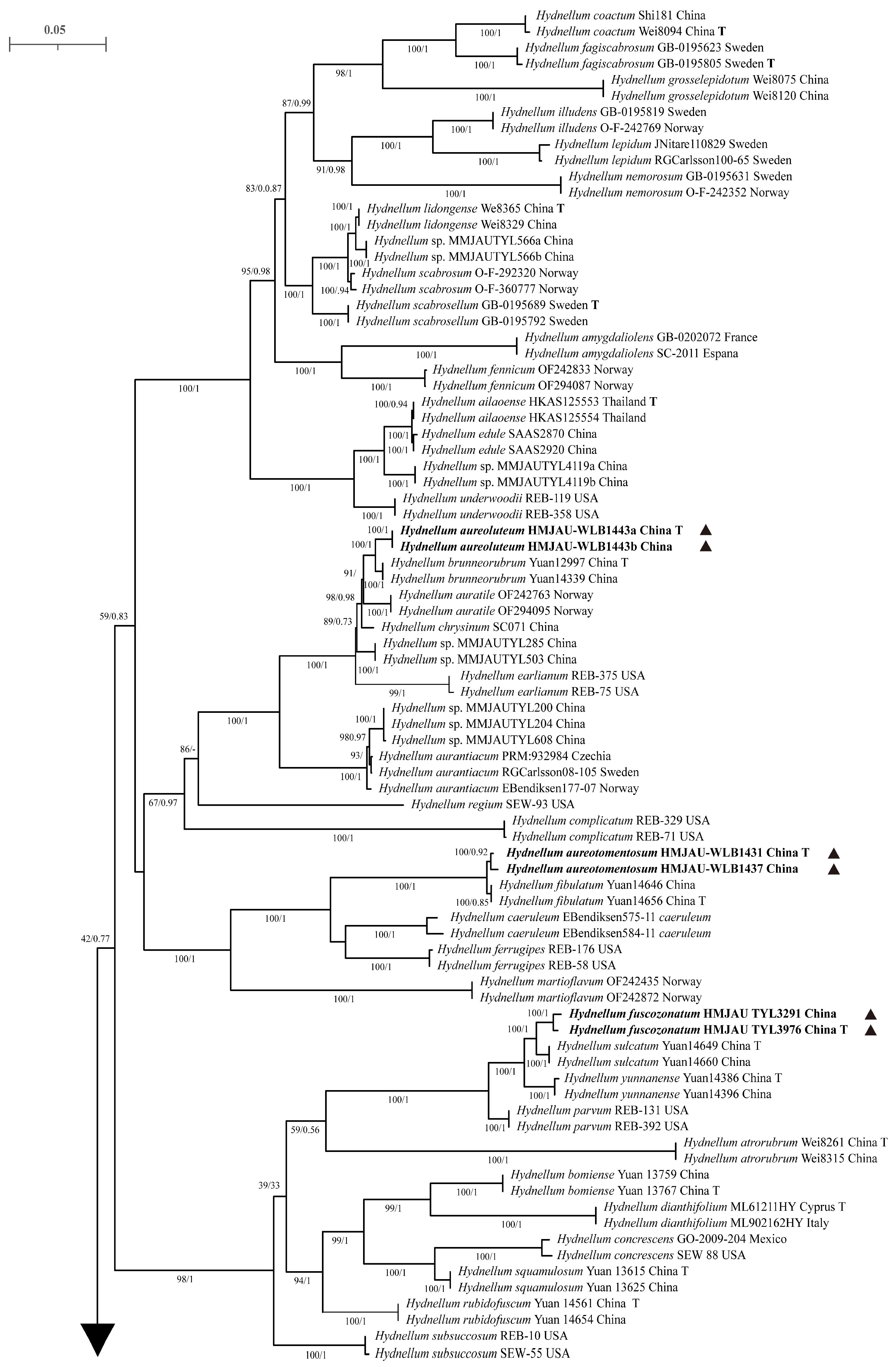
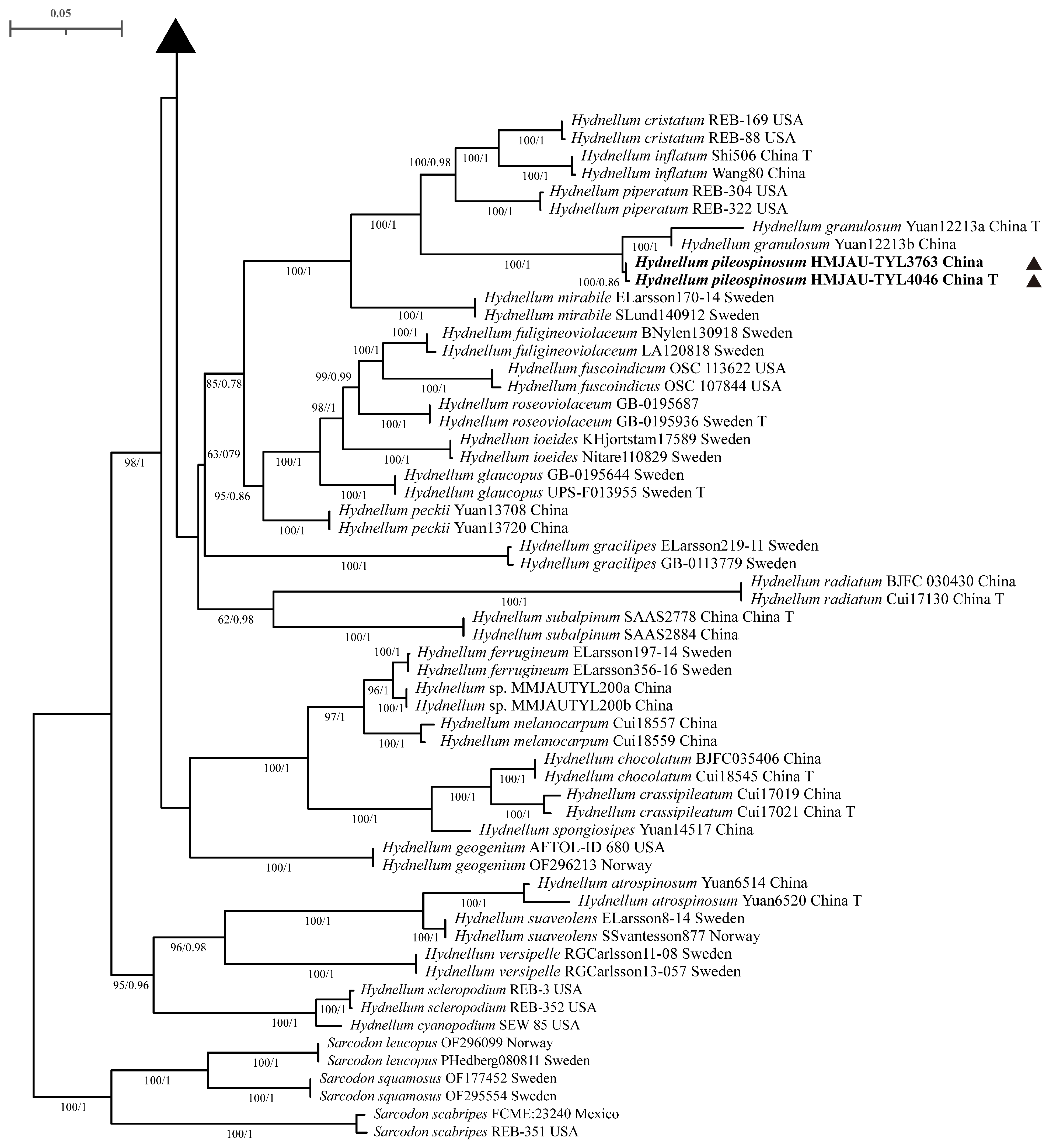
3.1. Phylogenetic Analyses
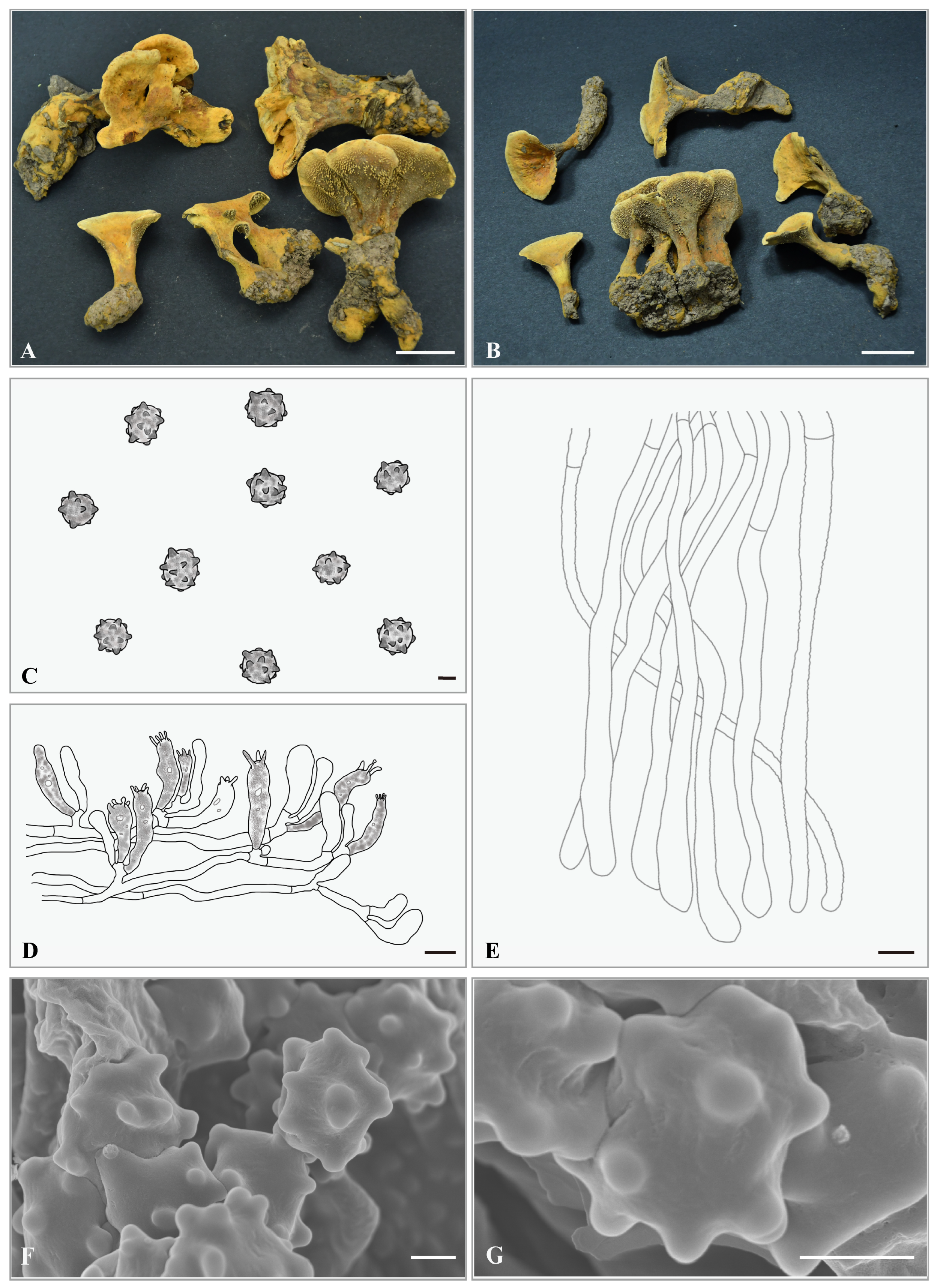
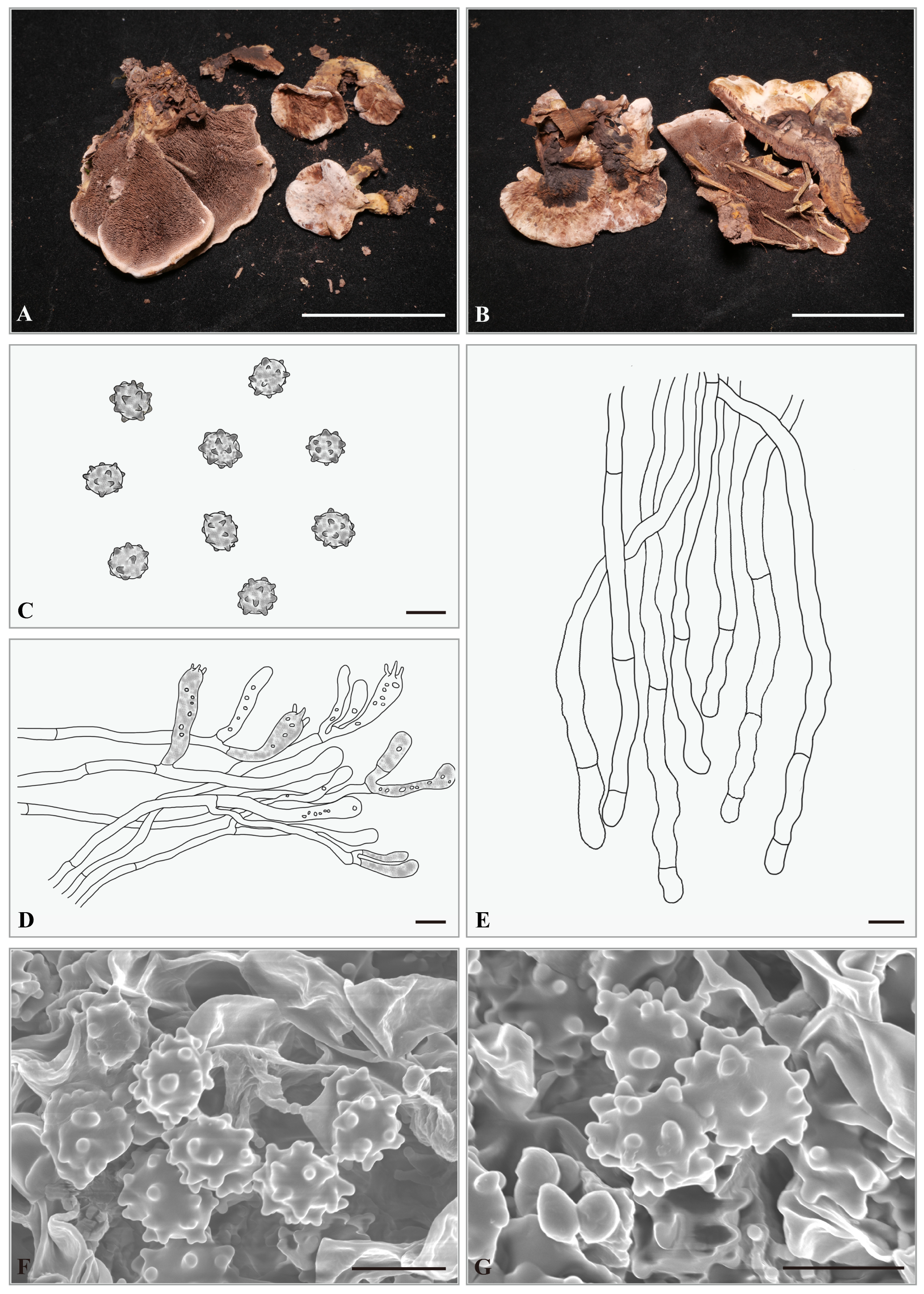
3.2. Taxonomy
4. Discussion

| 1. Pileus yellow to orange | 2 |
| 1. Pileus brown | 29 |
| 2. Pileus yellow | 3 |
| 2. Pileus orange | 14 |
| 3. Spines more or less white | 4 |
| 3. Spines more or less brown | 11 |
| 4. Pileus < 30 mm wide | H. bomiense |
| 4. Pileus > 30 mm wide | 5 |
| 5. Pileus ≥ 80 mm wide | 6 |
| 5. Pileus < 80 mm wide | 8 |
| 6. Pileus ≥ 100 mm wide | Hydnellum sp. 1 |
| 6. Pileus 80–100 mm wide | 7 |
| 7. Habitat in Abies and Pinus mixed forest | H. martioflavum |
| 7. Habitat in Pinus and Quercus mixed forest | H. edule |
| 8. Habitat in August | 9 |
| 8. Habitat in October | 10 |
| 9. Habitat in Picea forest | H. caeruleum |
| 9. Habitat in Pinus and Abies forest | H. subscabrosellum |
| 10. Basidiospores < 5.0 μm long on average | H. pileospinosum |
| 10. Basidiospores > 5.0 μm long on average | Hydnellum sp. 2 |
| 11. Spines > 5.0 μm long on average | H. subalpinum |
| 11. Spines < 5.0 μm long on average | 12 |
| 12. Basidiospores > 5.0 μm long on average | H. cinnamomea |
| 12. Basidiospores < 5.0 μm long on average | 13 |
| 13. Pileus > 40 mm wide | H. granulosum |
| 13. Pileus < 40 mm wide | H. aureoluteum |
| 14. Pileus light orange to deep orange | 15 |
| 14. Pileus orange to brown | 19 |
| 15. Spines dark | 16 |
| 15. Spines orange | 17 |
| 16. Spines > 3.0 μm long on average | H. complicatum |
| 16. Spines < 3.0 μm long on average | H. atrospinosum |
| 17. Spines < 3.0 μm long on average | H. chrysinum |
| 17. Spines ≥ 3.0 μm long on average | 18 |
| 18. Basidiospores ≥ 5.0 μm long on average | H. earlianum |
| 18. Basidiospores < 5.0 μm long on average | H. peckii |
| 19. Pileus ≥ 70 mm wide | 20 |
| 19. Pileus < 70 mm wide | 25 |
| 20. Spines brown | 21 |
| 20. Spines white | 22 |
| 21. Habitat in Picea forest | H. ferrugineum |
| 21. Habitat in Q. mongolica forest | Hydnellum sp. 4 |
| 22. Pileus > 100 mm wide | H. versipelle |
| 22. Pileus 70–100 mm wide | 23 |
| 23. Basidiospores > 5.0 μm long on average | 24 |
| 23. Basidiospores < 5.0 μm long on average | H. inflatum |
| 24. Basidiospores > 7.0 μm long on average | H. aurantiacum |
| 24. Basidiospores < 7.0 μm long on average | H. grosselepidotum |
| 25. Spines > 3.0 μm long on average | 26 |
| 25. Spines < 3.0 μm long on average | 27 |
| 26. Pileus pale orange to dark brown | H. spongiosipes |
| 26. Pileus golden yellow to light brown | H. brunneorubrum |
| 27. Basidiospores > 5.5 μm long on average | Hydnellum sp. 5 |
| 27. Basidiospores < 5.5 μm long on average | 28 |
| 28. Habitat in Q. mongolica forest | Hydnellum sp. 3 |
| 28. Habitat in angiosperm forest | H. xanthopus |
| 29. Pileus grayish brown to dark brown | 30 |
| 29. Pileus light brown to reddish brown | 37 |
| 30. Pileus grayish brown | 31 |
| 30. Pileus dark brown | 34 |
| 31. Basidiospores > 6.0 μm long on average | H. subailaoensis |
| 31. Basidiospores < 6.0 μm long on average | 32 |
| 32. Spines white to brown | H. fuscozonatum |
| 32. Spines brown to grayish brown | 33 |
| 33. Habitat in Q. acutissima forest | H. aureotomentosum |
| 33. Habitat in mixed forest | H. chocolatum |
| 34. Pileus > 60 mm wide | 35 |
| 34. Pileus < 60 mm wide | 36 |
| 35. Basidiospores > 5.0 μm long on average | H. nitidum |
| 35. Basidiospores < 5.0 μm long on average | H. sulcatum |
| 36. Spines brown | H. melanocarpum |
| 36. Spines black | H. radiatum |
| 37. Pileus light brown | 38 |
| 37. Pileus reddish brown | 44 |
| 38. Pileus ≥ 50 mm wide | 39 |
| 38. Pileus < 50 mm wide | 41 |
| 39. Basidiospores > 5.0 μm long on average | H. ailaoense |
| 39. Basidiospores ≤ 5.0 μm long on average | 40 |
| 40. Pileus > 100 mm wide | H. suaveolens |
| 40. Pileus < 100 mm wide | H. succulentus |
| 41. Spines white to brown | 42 |
| 41. Spines orange brown to reddish brown | 43 |
| 42. Habitat in Quercus forest | H. fibulatum |
| 42. Habitat in Fagaceae forest | H. atrorubrum |
| 43. Basidiospores > 5.0 μm long on average | H. lidongense |
| 43. Basidiospores < 5.0 μm long on average | H. concentricum |
| 44. Pileus 50–200 mm wide | 45 |
| 44. Pileus 15–45 mm wide | 49 |
| 45. Pileus ≥ 90 mm wide | 46 |
| 45. Pileus < 90 mm wide | 47 |
| 46. Spines whitish | H. illudens |
| 46. Spines grayish brown | H. fagiscabrosum |
| 47. Basidiospores > 5.0 μm long on average | 48 |
| 47. Basidiospores < 5.0 μm long on average | H. rubidofuscum |
| 48. Habitat in Picea forest | H. subcaeruleum |
| 48. Habitat in Pinus and Quercus mixed forest | H. crassipileatum |
| 49. Basidiospores > 5.0 μm long on average | 50 |
| 49. Basidiospores < 5.0 μm long on average | 51 |
| 50. Spines white to yellowish white | H. coactum |
| 50. Spines layer brown to reddish brown | H. tardum |
| 51. Habitat in September | 52 |
| 51. Habitat in July | H. squamulosum |
| 52. Spines white to grayish red | H. yunnanense |
| 52. Spines reddish brown | H. qinghaiense |
Author Contributions
Funding
Institutional Review Board Statement
Informed Consent Statement
Data Availability Statement
Acknowledgments
Conflicts of Interest
Appendix A
| Species | Pileus | Spines | Spores | Habitat | Time | Distribution | References | ||||
|---|---|---|---|---|---|---|---|---|---|---|---|
| Color | Size (mm) | Color | Length (mm) | Size (µm) | av. L × W (µm) | Q | |||||
| H. ailaoense | light brown to brown | 40–75 mm | brown | 1.5 mm | 5.5–7.0 × 4.5–6.0 μm | 6.3 × 5.2 μm | Q = 1.09–1.33 | Fagaceae and Pinaceae mixed forests | August | Yunnan, China | [39] |
| H. atrorubrum | light brown to dark ruby | 48 mm | white to dark brown | 3.5 mm | 4.5–6.0 × 3.9–5.1 μm | 5.0 × 4.4 μm | Q = 1.14–1.21 | Fagaceae forest | July | Yunnan, China | [31] |
| H. atrospinosum | light orange to yellowish brown | 75 mm | dark violet | 2.5 mm | 4.1–5.1 × 3.1–3.9 μm | 4.6 × 3.2 μm | Q = 1.34–1.44 | Picea forest | September | Qinghai, China | [31] |
| H. aurantiacum | orange to deep orange | 100 mm | white | 4.0 mm | 5.5–8.0 × 5.5–6.5 μm | 8.2 × 6.2 μm | hardwood forests | July to November | China, USA | [20] | |
| H. aureoluteum | golden yellow | 16.5–30.5 mm | grayish orange to light brown | 0.5–1.5 mm | 4.0–5.0 × 4.0–4.5 μm | 4.57 × 4.03 μm | Q = 1.00–1.25 | Q. acutissima forest | July | Sichuan, China | This study |
| H. aureotomentosum | gray to brown | 19.5–75.5 mm | brown | 2.0–4.5 mm | 5.5–6.0 × 5.0–5.5 μm | 5.91 × 5.04 μm | Q = 1.00–1.20 | Q. acutissima forest | July | Sichuan, China | This study |
| H. bomiense | yellow brown to dark brown | 26 mm | white to brown | 1.1 mm | 4.1–5.1 × 3.3–4.5 μm | 4.7 × 4.0 μm | Q = 1.18–1.21 | Fagaceae forest | July to September | Xizang, China | [31] |
| H. brunneorubrum | brownish orange to brownish red | 40 mm | golden yellow to light brown | 4.0 mm | 4.1–5.1 × 3.2–4.6 μm | 4.9 × 3.9 μm | Q = 1.23–1.26 | Fagaceae forest | August | Liaoning, China | [31] |
| H. caeruleum | pastel yellow to dark blonde | – | orange white to dark brown | 6.0 mm | 5.0–6.0 × 4.1–4.9 μm | – | – | Picea forest | August | China, North Europe, and temperate Asia | [31] |
| H. chocolatum | chocolate to fuscous | 74 mm | brown to grayish brown | 5.0 mm | 5.0–6.0 × 4.0–5.0 μm | 5.2 × 4.7 μm | Q = 1.00–1.25 | mixed forest | September | Sichuan, China | [32] |
| H. chrysinum | light orange to mars orange | 70 mm | light orange to salmon orange | 2.0 mm | 4.0–6.0 × 3.2–5.0 μm | – | – | – | – | – | [34] |
| H. cinnamomea | yellowish brown to brown | 62 mm | brown to grayish brown | 3.0 mm | 4.5–6.0 × 4.0–5.0 μm | 5.2 × 4.5 μm | Q = 1.14–1.16 | Quercus forest | September | Sichuan, China | [34] |
| H. coactum | reddish brown to dark brown | 35 mm | white to yellowish white | 2.1 mm | 5.7–7.0 × 4.7–5.9 μm | 6.2 × 5.3 μm | Q = 1.17–1.18 | Fagaceae forest | July/August | Yunnan, China | [38] |
| H. complicatum | white, orange white to light orange | 60 mm | carrot red to brusing black | 4.0 mm | 4.0–5.0 × 3.0–5.0 μm | 4.0 × 3.0 μm | – | – | June to September | China, USA | [34] |
| H. concentricum | light brown to grayish brown | 32 mm | reddish brown | 3.0 mm | 4.0–5.0 × 3.5–5.0 μm | 4.6 × 3.9 μm | Q = 1.04–1.37 | Pinus and Quercus mixed forest | September | Yunnan, China | [32] |
| H. crassipileatum | reddish brown to grayish brown | 55 mm | grayish brown | 5.0 mm | 4.0–6.0 × 4.0–5.5 μm | 5.6 × 4.5 μm | Q = 1.00–1.38 | Pinus and Quercus mixed forest | September | Yunnan, China | [32] |
| H. earlianum | light orange to deep orange | 70–90 mm | cream to brownish orange | 4.0 mm | 5.0–6.0 × 4.0–5.0 μm | 4.7 × 5.0 μm | – | riparian broadleaf mixed forest | June/August | China, USA | [34] |
| H. edule | brownish yellow to reddish brown | 50–90 mm | whitish | 8.0 mm | 5.5–7.0 × 4.5–5.5 μm | – | – | Pinus and Quercus mixed forest | July/August | Sichuan, China | [33] |
| H. fagiscabrosum | red brown to black brown | 50–140 mm | grayish brown | – | 4.5–6.3 × 3.8–5.3 μm | 5.4 × 4.7 μm | Q = 0.90–1.50 | Fagaceae forest | July to Octomber | China, Norway, Sweden, the UK, Italy and USA | [34] |
| H. ferrugineum | pale orange to brown | 80 mm | brownish gray to burnt umber | 6.0 mm | 5.0–6.0 × 5.0–6.0 μm | 6.0 × 5.0 μm | – | Picea forest | August | China, USA | [34] |
| H. fibulatum | light brown to dark brown | 45 mm | pinkish white to brown | 1.5 mm | 4.4–5.8 × 4.1–4.9 μm | 5.2 × 4.3 μm | Q = 1.12–1.21 | Quercus forest | August | Liaoning, China | [31] |
| H. fuscozonatum | gray to brownsh gray | 12.5–65.4 mm | white to brown | 0.5–2.5 mm | 5.5–6.0 × 5.0–5.5 μm | 5.94 × 5.02 μm | Q = 1.09–1.20 | Q. glauca forest | September/October | Anhui, China | This study |
| H. granulosum | light yellow to grayish brown | 50 mm | grayish orange to dark brown | 2.0 mm | 4.1–5.1 × 3.4–4.7 μm | 4.6 × 4.1 μm | Q = 1.12–1.13 | Acer and Cryptomeria mixed forest | August | Sichuan, China | [31] |
| H. grosselepidotum | pale orange to dark ruby | 75 mm | white to pale yellow | 1.4 mm | 5.1–6.4 × 4.1–5.9 μm | 5.5 × 4.9 μm | Q = 1.13–1.19 | Fagaceae forest | July/August | Yunnan, China | [38] |
| H. illudens | ochraceous to fulvous brown | 60–100 mm | whitish | 5.0 mm | 5.0–6.5 × 4.5–6.0 μm | – | – | Quercus forest | August | Sichuan, China; France | [33] |
| H. inflatum | grayish orange to brown | 75 mm | white to golden brown | 4.0 mm | 4.2–5.0 × 3.8–4.3 μm | 4.8 × 4.0 μm | Q = 1.18–1.20 | Fagaceae forest | October | Yunnan, China | [31] |
| H. lidongense | light brown to brown | 35 mm | grayish orange to brown | 1.0 mm | 4.1–6.0 × 4.0–5.0 μm | 5.5 × 4.9 μm | Q = 1.15–1.20 | Fagaceae forest | July | Yunnan, China | [38] |
| H. martioflavum | yellow brown to light brown | 90 mm | gray whitish to gray | 5.0 mm | 5.0–6.5 × 4.0–5.5 μm | – | – | Abies and Pinus mixed forest | September | Sichuan, China; Canada | [33,38] |
| H. melanocarpum | brown to black | 48 mm | brown | 4.0 mm | 4.5–5.5 × 3.8–5.1 μm | 5.0 × 4.6 μm | Q = 1.00–1.25 | mixed forest | September | Sichuan, China | [32] |
| H. nitidum | grayish brown to dark brown | 110 mm | reddish brown to grayish brown | 4.0 mm | 4.8–6.0 × 4.0–5.0 μm | 5.2 × 4.7 μm | Q = 1.08–1.20 | mixed forest | September | Sichuan, China | [34] |
| H. peckii | white to light orange | – | brownish orange | 3.0 mm | 4.2–5.1 × 3.9–4.4 μm | – | – | Pinus mixed forest | July | China, North Europe, Iran, and Korea | [31] |
| H. pileospinosum | grayish yellow to yellowish brown | 26.2–60.3 mm | white | 1.0–6.7 mm | 4.0–5.0 × 4.0–4.5 μm | 4.41 × 4.02 μm | Q = 1.00–1.13 | Q. Glauca forest | October | Anhui, China | This study |
| H. qinghaiense | reddish brown | 40 mm | grayish blue to brown | 4.0 mm | 4.0–5.0 × 3.0–4.0 μm | 4.4 × 3.8 μm | Q = 1.1–1.24 | Picea crassifolia forest | September | Qinghai, China | [34] |
| H. radiatum | dark brown to black | 29 mm | black | 3.0 mm | 4.0–5.0 × 3.0–4.5 μm | 4.5 × 3.8 μm | Q = 1.00–1.35 | – | September | Yunnan, China | [32] |
| H. rubidofuscum | reddish brown | 70 mm | grayish brown to reddish brown | 3.0 mm | 4.1–5.0 × 3.9–4.6 μm | 4.6 × 4.1 μm | Q = 1.11–1.12 | Quercus forest | August | Liaoning, China | [31] |
| Hydnellum sp. 1 | brownish yellow to dark brown | 62.5–140.5 mm | white to yellowish white | 4.8–8.5 mm | 6.0–6.5 × 5.0–5.5 μm | 6.2 × 5.1 μm | Q = 1.12–1.16 | P. koraiensis forest | September | Jilin, China | This study |
| Hydnellum sp. 2 | brownish yellow | 63.6–80.5 mm | white to yellowish white | 2.0–6.2 mm | 5.0–6.0 × 5.0–6.0 μm | 5.3 × 5.2 μm | Q = 1.00–1.10 | Q. serrata forest | October | Anhui, China | This study |
| Hydnellum sp. 3 | brownish orange to dark brown | 17.6–42.3 mm | light orange to light brown | 0.5–2.5 mm | 5.0–5.5 × 4.0–5.0 μm | 5.0 × 4.7 μm | Q = 1.00–1.25 | Q. mongolica forest | August/September | Jilin, China | This study |
| Hydnellum sp. 4 | brownish orange to dark brown | 32.5–100.6 mm | light orange to light brown | 0.5–2.5 mm | 6.0–7.0 × 6.0–6.5 μm | 6.7 × 6.2 μm | Q = 1.00–1.16 | Q. mongolica forest | September | Jilin, China | This study |
| Hydnellum sp. 5 | orange to brownish yellow | 8–15 mm | brownish yellow | 0.5–1.0 mm | 5.5–6.0 × 5.0–6.0 μm | 5.9 × 5.1 μm | Q = 1.00–1.25 | Q. variabilis forest | July | Jilin, China | This study |
| H. spongiosipes | pale orange to dark brown | – | pale orange to dark brown | 6.0 mm | 5.1–6.1 × 4.5–5.3 μm | – | – | Quercus forest | August | China, USA, and Europe | [31] |
| H. squamulosum | pastel red to dark magenta | 35 mm | pale red to reddish brown | 2.0 mm | 4.1–5.0 × 3.3–4.1 μm | 4.4 × 3.8 μm | Q = 1.14–1.16 | Picea mixed forest | July | Xizang, China | [31] |
| H. suaveolens | light brown to brownish | 160 mm | light brown to dark brown | 5.0 mm | 4.0–6.0 × 3.0–5.0 μm | 5.0 × 4.0 μm | – | Picea forest | August | China, USA | [34] |
| H. subailaoensis | brown to grayish brown | 62 mm | light vinaceous gray | 3.0 mm | 6.0–7.5 × 5.0–6.5 μm | 6.4 × 5.6 μm | Q = 1.12 | – | October | Yunnan, China | [34] |
| H. subalpinum | brownish yellow to brown | 50–200 mm | concolorous | 8.0 mm | 3.5–4.5 × 4.0–5.5 μm | – | – | Abies forest | September | Sichuan, China | [33] |
| H. subcaeruleum | reddish brown to dark brown | 50 mm | olivaceous buff to clay buff | 4.0 mm | 4.5–6.0 × 4.0–5.0 μm | 5.2 × 4.5 μm | Q = 1.13–1.19 | Picea forest | September | Gansu, China | [34] |
| H. subscabrosellum | brownish yellow to reddish brown | 30–70 mm | whitish to yellowish | 5.0 mm | 5.0–7.0 × 4.5–6.0 μm | – | – | Pinus and Abies mixed forest | August | Sichuan, China | [33] |
| H. succulentus | light brown to brown | 50 mm | pale reddish brown | 4.0 mm | 4.0–5.0 × 4.0–5.5 μm | 4.9 × 4.4 μm | Q = 1.10–1.19 | angiosperm forest | June/August | Yunnan, China | [34] |
| H. sulcatum | dark brown | 65 mm | brown | 1.5 mm | 4.1–5.8 × 4.0–4.6 μm | 4.8 × 4.3 μm | Q = 1.14–1.19 | Quercus forest | August | Liaoning, China | [31] |
| H. tarda | dark reddish brown | 35 mm | layer brown to reddish brown | 3.0 mm | 4.5–6.0 × 4.0–5.0 μm | 5.2 × 4.4 μm | Q = 1.17–1.20 | Fagaceae forest | June | Yunnan, China | [34] |
| H. versipelle | brownish orange to reddish brown | 200 mm | whitish | 9.0 mm | 4.0–5.5 × 3.0–4.0 μm | – | – | Abies forest | September | Sichuan, China; Europe | [33,38] |
| H. xanthopus | dawn to orange brown | 24 mm | clay buff | 2.0 mm | 3.5–4.8 × 4.0–5.5 μm | 4.9 × 4.3 μm | Q = 1.14 | angiosperm forest | August | Sichuan, China | [34] |
| H. yunnanense | grayish red to dark brown | 21 mm | white to grayish red | 1.5 mm | 4.2–5.1 × 3.5–4.5 μm | 4.7 × 4.0 μm | Q = 1.17–1.18 | Pinus forest | September | Yunnan, China | [31] |
References
- Karsten, P.A. Symbolae ad mycologiam Fennicam 8. Medd. Soc. Fauna Flora Fenn. 1881, 6, 7–13. [Google Scholar]
- Agerer, R. Ectomycorrhizae of Hydnellum peckii on Norway spruce and their chlamydospores. Mycologia 1993, 85, 74–83. [Google Scholar] [CrossRef]
- Arnolds, E. The fate of hydnoid fungi in The Netherlands and Northwestern Europe. Fungal Ecol. 2010, 3, 81–88. [Google Scholar] [CrossRef]
- Bergelson, J.; Crawley, M. Mycorrhizal infection and plant species diversity. Nature 1988, 334, 202. [Google Scholar] [CrossRef]
- Van Der Heijden, M.G.; Klironomos, J.N.; Ursic, M.; Moutoglis, P.; Streitwolf-Engel, R.; Boller, T.; Wiemken, A.; Sanders, I.R. Mycorrhizal fungal diversity determines plant biodiversity, ecosystem variability and productivity. Nature 1998, 396, 69–72. [Google Scholar] [CrossRef]
- Sevindik, M.; Bal, C.; Eraslan, E.C.; Uysal, I.; Mohammed, F.S. Medicinal mushrooms: A comprehensive study on their antiviral potential. Prospect. Pharm. Sci. 2023, 21, 42–56. [Google Scholar] [CrossRef]
- Smith, A.; Javed, S.; Barad, A.; Myhre, V.; Li, W.M.; Reimer, K.; Massicotte, H.B.; Tackaberry, L.E.; Payne, G.W.; Egger, K.N. Growth-inhibitory and immunomodulatory activities of wild mushrooms from North-Central British Columbia (Canada). Int. J. Med. Mushrooms 2017, 19, 485–497. [Google Scholar] [CrossRef] [PubMed]
- Zeb, M.; Lee, C.H. Medicinal properties and bioactive compounds from wild mushrooms native to North America. Molecules 2021, 26, 251. [Google Scholar] [CrossRef]
- Wang, S.M.; Han, J.J.; Ma, K.; Jin, T.; Bao, L.; Pei, Y.F.; Liu, H.W. New α-glucosidase inhibitors with p-terphenyl skeleton from the mushroom Hydnellum concrescens. Fitoterapia 2014, 98, 149–155. [Google Scholar] [CrossRef] [PubMed]
- Farzaneh, V.; Carvalho, I.S. A review of the health benefit potentials of herbal plant infusions and their mechanism of actions. Ind. Crops Prod. 2015, 65, 247–258. [Google Scholar] [CrossRef]
- Jansen, E.; van Dobben, H.F. Is Decline of Cantharellus cibarius in the Netherlands Due to Air Pollution? Ambio 1987, 16, 211–213. [Google Scholar]
- Arnolds, E. Decline of ectomycorrhizal fungi in Europe. Agric. Ecosyst. Environ. 1991, 35, 209–244. [Google Scholar] [CrossRef]
- Termorshuizen, A.J.; Schaffers, A.P. The decline of sporocarps of ectomycorrhizal fungi in stands of Pinus sylvestris L. in The Netherlands: Possible causes. Nova Hedwig. 1991, 53, 267–289. [Google Scholar]
- Lizon, P. Decline of macrofungi in Europe: An overview. Trans. Mycol. Soc. Repub. China 1993, 8, 21–48. [Google Scholar] [CrossRef]
- Newton, A.; Holden, E.; Davy, L.; Ward, S.; Fleming, L.; Watling, R. Status and distribution of stipitate hydnoid fungi in Scottish coniferous forests. Biol. Conserv. 2002, 107, 181–192. [Google Scholar] [CrossRef]
- Arnolds, E. A preliminary red data list of macrofungi in the Netherlands. Persoonia-Mol. Phylogeny Evol. Fungi 1989, 14, 77–125. [Google Scholar]
- Smith, J.H.; Suz, L.M.; Ainsworth, A.M. Red List of Fungi for Great Britain: Bankeraceae, Cantharellaceae, Geastraceae, Hericiaceae and selected genera of Agaricaceae (Battarrea, Bovista, Lycoperdon & Tulostoma) and Fomitopsidaceae (Piptoporus); Jodrell Laboratory, Royal Botanic Gardens: Kew, UK, 2016; p. 90. [Google Scholar]
- Baird, R.; Wallace, L.E.; Baker, G.; Scruggs, M. Stipitate hydnoid fungi of the temperate southeastern United States. Fungal Divers. 2013, 62, 41–114. [Google Scholar] [CrossRef]
- Banker, H.J. A contribution to a revision of the North American Hydnaceae. Mem. Torrey Bot. Club 1906, 12, 99–194. [Google Scholar] [CrossRef][Green Version]
- Baird, R.E.; Khan, S.R. The stipitate hydnums (Thelephoraceae) of Florida. Brittonia 1986, 38, 171–184. [Google Scholar] [CrossRef]
- Harrison, K.A. New or little known North American stipitate hydnums. Can. J. Bot. 1964, 42, 1205–1233. [Google Scholar] [CrossRef]
- Larsson, K.H.; Svantesson, S.; Miscevic, D.; Kõljalg, U.; Larsson, E. Reassessment of the generic limits for Hydnellum and Sarcodon (Thelephorales, Basidiomycota). MycoKeys 2019, 54, 31. [Google Scholar] [CrossRef]
- Schoch, C.L.; Seifert, K.A.; Huhndorf, S.; Robert, V.; Spouge, J.L.; Levesque, C.A.; Chen, W.; Consortium, F.B.; List, F.B.C.A.; Bolchacova, E. Nuclear ribosomal internal transcribed spacer (ITS) region as a universal DNA barcode marker for Fungi. Proc. Natl. Acad. Sci. USA 2012, 109, 6241–6246. [Google Scholar] [CrossRef] [PubMed]
- Nilsson, R.H.; Kristiansson, E.; Ryberg, M.; Hallenberg, N.; Larsson, K.H. Intraspecific ITS variability in the kingdom Fungi as expressed in the international sequence databases and its implications for molecular species identification. Evol. Bioinform. 2008, 4, 193–201. [Google Scholar] [CrossRef]
- Yang, Z.; Rannala, B. Unguided species delimitation using DNA sequence data from multiple loci. Mol. Biol. Evol. 2014, 31, 3125–3135. [Google Scholar] [CrossRef]
- Hibbett, D.S.; Taylor, J.W. Fungal systematics: Is a new age of enlightenment at hand? Nat. Rev. Microbiol. 2013, 11, 129–133. [Google Scholar] [CrossRef]
- Zamora, J.; Calonge, F.D.; Martín, M.P. Integrative taxonomy reveals an unexpected diversity in Geastrum section Geastrum (Geastrales, Basidiomycota). Persoonia-Mol. Phylogeny Evol. Fungi 2015, 34, 130–165. [Google Scholar] [CrossRef]
- Tekpinar, A.D.; Kalmer, A. Utility of various molecular markers in fungal identification and phylogeny. Nova Hedwig. 2019, 109, 187–224. [Google Scholar] [CrossRef]
- Cho, Y.; Kim, D.; Lee, Y.; Jeong, J.; Hussain, S.; Lim, Y.W. Validation of Fuscoporia (Hymenochaetales, Basidiomycota) ITS sequences and five new species based on multi-marker phylogenetic and morphological analyses. IMA Fungus 2023, 14, 12. [Google Scholar] [CrossRef]
- Cao, B.; Haelewaters, D.; Schoutteten, N.; Begerow, D.; Boekhout, T.; Giachini, A.J.; Gorjón, S.P.; Gunde-Cimerman, N.; Hyde, K.D.; Kemler, M.; et al. Delimiting species in Basidiomycota: A review. Fungal Divers. 2021, 109, 181–237. [Google Scholar] [CrossRef]
- Mu, Y.H.; Yu, J.R.; Cao, T.; Wang, X.H.; Yuan, H.S. Multi-gene phylogeny and taxonomy of Hydnellum (Bankeraceae, Basidiomycota) from China. J. Fungi 2021, 7, 818. [Google Scholar] [CrossRef] [PubMed]
- Song, C.G.; Sun, Y.F.; Wu, D.M.; Gao, N.; Liu, S.; Xu, T.M.; Cui, B.K. Morphology and molecular phylogeny reveal five new species of Hydnellum (Bankeraceae, Thelephorales) from China. Front. Microbiol. 2022, 13, 1049007. [Google Scholar] [CrossRef] [PubMed]
- Wang, D.; Feng, H.; Zhou, J.; Liu, T.H.; Zhang, Z.Y.; Xu, Y.Y.; Tang, J.; Peng, W.H.; He, X.L. New insights into the stipitate hydnoid fungi Sarcodon, Hydnellum, and the formerly informally defined Neosarcodon, with emphasis on the edible species marketed in Southwest China. IMA Fungus 2024, 15, 8. [Google Scholar] [CrossRef] [PubMed]
- Song, C.; Xu, T.; Xu, Y.; Wang, D.; Zeng, L.; Fan, X.; Sun, Y.; Cui, B. Systematic revision, molecular phylogeny and divergence times of Thelephorales (Basidiomycota). Mycosphere 2025, 16, 296–422. [Google Scholar] [CrossRef]
- Maas Geesteranus, R.A. Die terrestrischen Stachelpilze Europas. In Verhandelingen der Koninklijke Nederlandse Akademie van Wetenschappen, Afdeling Natuurkunde, Tweede Reeks; North-Holland Publishing Company: Amsterdam, The Netherland, 1975; Volume 65, pp. 1–127. [Google Scholar]
- Kõljalg, U.; Renvall, P. Hydnellum gracilipes: A link between stipitate and resupinate Hymenomycetes. Karstenia 2000, 40, 71–77. [Google Scholar] [CrossRef][Green Version]
- Loizides, M.; Alvarado, P.; Assyov, B.; Arnolds, E.; Moreau, P.A. Hydnellum dianthifolium sp. nov. (Basidiomycota, Thelephorales), a new tooth-fungus from southern Europe with notes on H. concrescens and H. scrobiculatum. Phytotaxa 2016, 280, 23. [Google Scholar] [CrossRef]
- Mu, Y.H.; Hu, Y.P.; Wei, Y.L.; Yuan, H.S. Hydnaceous fungi of China 8. Morphological and molecular identification of three new species of Sarcodon and a new record from southwest China. MycoKeys 2020, 66, 83. [Google Scholar] [CrossRef]
- Lei, L.; Luangharn, T.; Yu, F.M.; Li, W.J.; Li, W.C.; Zhao, Q. A novel hydnoid species of Hydnellum (Bankeraceae, Thelephorales) from southwest China. Phytotaxa 2023, 600, 291–300. [Google Scholar] [CrossRef]
- Hu, J.J.; Tuo, Y.L.; Qi, Z.X.; Li, X.F.; Jiang, D.H.; Zhang, B.; Li, Y. The combination of morphological and phylogenetic evidence reveals four new Gymnopus species and new distribution. J. Fungi 2024, 10, 672. [Google Scholar] [CrossRef]
- Kornerup, A.; Wanscher, J.H. Methuen Handbook of Colour, 3rd ed.; Eyre Methuen: London, UK, 1978. [Google Scholar]
- Nitare, J.; Ainsworth, A.; Larsson, E.; Parfitt, D.; Suz, L.; Svantesson, S.; Larsson, K.H. Four new species of Hydnellum (Thelephorales, Basidiomycota) with a note on Sarcodon illudens. Fungal Syst. Evol. 2021, 7, 233–254. [Google Scholar] [CrossRef]
- Xiang, C.; Gao, F.; Jakovlić, I.; Lei, H.P.; Hu, Y.; Zhang, H.; Zou, H.; Wang, G.; Zhang, D. Using PhyloSuite for molecular phylogeny and tree-based analyses. Imeta 2023, 2, e87. [Google Scholar] [CrossRef]
- Matheny, P.B.; Wang, Z.; Binder, M.; Curtis, J.M.; Lim, Y.W.; Nilsson, R.H.; Hughes, K.W.; Hofstetter, V.; Ammirati, J.F.; Schoch, C.L. Contributions of rpb2 and tef1 to the phylogeny of mushrooms and allies (Basidiomycota, Fungi). Mol. Phylogenetics Evol. 2007, 43, 430–451. [Google Scholar] [CrossRef] [PubMed]
- Hrouda, P. Hydnaceous fungi of the Czech Republic and Slovakia. Czech Mycol. 1999, 51, 99–155. [Google Scholar] [CrossRef]
- Baird, R.E. Study of the stipitate hydnums from the southern Appalachian Mountains—Genera: Bankera, Hydnellum, Phellodon, Sarcodon. Bibl. Mycol. 1986, 104, 1–156. [Google Scholar]
- Maas Geesteranus, R. Hyphal structures in Hydnums. Persoonia-Mol. Phylogeny Evol. Fungi 1962, 2, 377–405. [Google Scholar]
- Parfitt, D.; Ainsworth, A.M.; Simpson, D.; Rogers, H.J.; Boddy, L. Molecular and morphological discrimination of stipitate hydnoids in the genera Hydnellum and Phellodon. Mycol. Res. 2007, 111, 761–777. [Google Scholar] [CrossRef]
- Ainsworth, A.M.; Parfitt, D.; Rogers, H.J.; Boddy, L. Cryptic taxa within European species of Hydnellum and Phellodon revealed by combined molecular and morphological analysis. Fungal Ecol. 2010, 3, 65–80. [Google Scholar] [CrossRef]
- Nilsson, R.H.; Hallenberg, N.; Nordén, B.; Maekawa, N.; Wu, S.H. Phylogeography of Hyphoderma setigerum (Basidiomycota) in the northern hemisphere. Mycol. Res. 2003, 107, 645–652. [Google Scholar] [CrossRef] [PubMed]
- Setlow, P. Spore germination. Curr. Opin. Microbiol. 2003, 6, 550–556. [Google Scholar] [CrossRef] [PubMed]
- Jarvis, S.G.; Holden, E.M.; Taylor, A.F. Rainfall and temperature effects on fruit body production by stipitate hydnoid fungi in Inverey Wood, Scotland. Fungal Ecol. 2017, 27, 137–140. [Google Scholar] [CrossRef]
- Ayerst, G. The effects of moisture and temperature on growth and spore germination in some fungi. J. Stored Prod. Res. 1969, 5, 127–141. [Google Scholar] [CrossRef]
- Dix, N.J. Fungal Ecology; Springer Science: Berlin/Heidelberg, Germany, 2012. [Google Scholar]
- Martinez-Burgos, W.J.; Montes Montes, E.; Pozzan, R.; Serra, J.L.; Torres, D.O.; Manzoki, M.C.; Vieira, R.L.; dos Reis, G.A.; Rodrigues, C.; Karp, S.G. Bioactive compounds produced by macromycetes for application in the pharmaceutical sector: Patents and products. Fermentation 2024, 10, 275. [Google Scholar] [CrossRef]
- Elkhateeb, W.A.; Daba, G.M.; Elnahas, M.O.; Thomas, P.W. Anticoagulant capacities of some medicinal mushrooms. ARC J. Pharma Sci. 2019, 5, 12–16. [Google Scholar] [CrossRef]
- Smolskaitė, L.; Venskutonis, P.R.; Talou, T. Comprehensive evaluation of antioxidant and antimicrobial properties of different mushroom species. LWT-Food Sci. Technol. 2015, 60, 462–471. [Google Scholar] [CrossRef]
- Elkhateeb, W.A. What medicinal mushroom can do. Chem. Res. J. 2020, 5, 106–118. [Google Scholar]


| Species | Locality | Voucher | ITS | nrLSU | References |
|---|---|---|---|---|---|
| H. ailaoense | Thailand | HKAS125553 T | OP605523 | OP602211 | [39] |
| H. ailaoense | Thailand | HKAS125554 | OP605520 | OP602212 | [39] |
| H. amygdaliolens | Spain | SC-2011 | JN376763 | – | [32] |
| H. amygdaliolens | France | GB-0202072 | MW144290 | MW144290 | [32] |
| H. atrorubrum | China | Wei8315 | MW579937 | – | [31] |
| H. atrorubrum | China | Wei8261 T | MW579936 | MW579884 | [31] |
| H. atrospinosum | China | Yuan6514 | MW579940 | MW579886 | [31] |
| H. atrospinosum | China | Yuan6520 T | MW579939 | – | [31] |
| H. aurantiacum | Norway | EBendiksen177-07 | MK602712 | MK602712 | [22] |
| H. aurantiacum | Sweden | RGCarlsson08-105 | MK602711 | MK602711 | [22] |
| H. aurantiacum | Czechia | PRM:932984 | PV643846 | PV682263 | [22] |
| H. auratile | Norway | OF242763 | MK602715 | MK602715 | [22] |
| H. auratile | Norway | OF294095 | MK602714 | MK602714 | [22] |
| H. aureoluteum | China | HMJAU-WLB1443a T | PX856753 | PX855234 | This study |
| H. aureoluteum | China | HMJAU-WLB1443b | PX856754 | PX855235 | This study |
| H. aureotomentosum | China | HMJAU-WLB1431 T | PX856755 | PX855236 | This study |
| H. aureotomentosum | China | HMJAU-WLB1437 | PX856756 | PX855237 | This study |
| H. bomiense | China | Yuan 13759 | MW579941 | MW579887 | [31] |
| H. bomiense | China | Yuan 13767 T | MW579942 | – | [31] |
| H. brunneorubrum | China | Yuan12997 T | MW579944 | MW579889 | [31] |
| H. brunneorubrum | China | Yuan14339 | MW579943 | MW579888 | [31] |
| H. caeruleum | Norway | EBendiksen584-11 | MK602719 | MK602719 | [22] |
| H. caeruleum | Norway | EBendiksen575-11 | MK602718 | MK602718 | [22] |
| H. chocolatum | China | Cui18545 T | ON603657 | – | [32] |
| H. chocolatum | China | BJFC 035406 | NR185730 | – | [32] |
| H. chrysinum | China | SC071 | KJ534291 | – | [31] |
| H. coactum | China | Wei8094 T | MN846278 | MN846287 | [38] |
| H. coactum | China | Shi181 | MN846279 | MN846288 | [38] |
| H. complicatum | USA | REB-71 | KC571711 | – | [18] |
| H. complicatum | USA | REB-329 | KC571712 | – | [18] |
| H. concrescens | USA | SEW 88 | AY569025 | – | [31] |
| H. concrescens | Mexico | GO-2009-204 | KC152116 | – | [31] |
| H. crassipileatum | China | Cui17019 | ON603659 | ON603642 | [32] |
| H. crassipileatum | China | Cui17021 T | ON603660 | ON603641 | [32] |
| H. cristatum | USA | REB-169 | JN135174 | – | [18] |
| H. cristatum | USA | REB-88 | KC571718 | – | [18] |
| H. cyanopodium | USA | SEW 85 | AY569027 | – | [31] |
| H. dianthifolium | Cyprus | ML61211HY T | KX619419 | – | [37] |
| H. dianthifolium | Italy | ML902162HY | KX619420 | – | [37] |
| H. earlianum | USA | REB-75 | KC571724 | – | [18] |
| H. earlianum | USA | REB-375 | JN135179 | JN135179 | [18] |
| H. edule | China | SAAS2870 | OK636094 | OP407675 | [33] |
| H. edule | China | SAAS2920 | OK636092 | OP407677 | [33] |
| H. fagiscabrosum | Sweden | GB-0195805 T | MW144294 | MW144294 | [42] |
| H. fagiscabrosum | Sweden | GB-0195623 | MW144295 | MW144295 | [42] |
| H. fennicum | Norway | OF242833 | MK602738 | MK602738 | [22] |
| H. fennicum | Norway | OF294087 | MK602737 | MK602737 | [22] |
| H. ferrugineum | Sweden | ELarsson197-14 | MK602722 | MK602722 | [22] |
| H. ferrugineum | Sweden | ELarsson 356-16 | MK602721 | MK602721 | [22] |
| H. ferrugipes | USA | REB-176 | KC571727 | – | [18] |
| H. ferrugipes | USA | REB-58 | JN135176 | – | [18] |
| H. fibulatum | China | Yuan14656 T | MW579958 | – | [31] |
| H. fibulatum | China | Yuan14646 | MW579957 | MW579926 | [31] |
| H. fuligineoviolaceum | Sweden | BNylen130918 | MK602741 | MK602741 | [22] |
| H. fuligineoviolaceum | Sweden | LA120818 | MK602740 | MK602740 | [22] |
| H. fuscoindicum | USA | OSC 107844 | EU669229 | EU669279 | [22] |
| H. fuscoindicum | USA | OSC 113622 | EU669228 | EU669278 | [22] |
| H. fuscozonatum | China | HMJAU-TYL3291 | PX856757 | PX855238 | This study |
| H. fuscozonatum | China | HMJAU-TYL3976 T | PX856758 | PX855239 | This study |
| H. geogenium | USA | AFTOL-ID 680 | DQ218304 | AY631900 | [44] |
| H. geogenium | Norway | OF296213 | MK602724 | MK602724 | [22] |
| H. glaucopus | Sweden | UPS-F013955 T | MW144330 | MW144330 | [42] |
| H. glaucopus | Sweden | GB-0195644 | MW144319 | MW144319 | [42] |
| H. gracilipes | Sweden | ELarsson219-11 | MK602726 | MK602726 | [22] |
| H. gracilipes | Sweden | GB-0113779 | MK602727 | MK602727 | [22] |
| H. granulosum | China | Yuan12213b T | MW579947 | MW579892 | [31] |
| H. granulosum | China | Yuan12213a | MW579948 | MW579893 | [31] |
| H. grosselepidotum | China | Wei8120 | MN846274 | MN846283 | [38] |
| H. grosselepidotum | China | Wei8075 | MN846276 | MN846285 | [38] |
| H. illudens | Sweden | GB-0195819 | MW144341 | MW144341 | [42] |
| H. illudens | Norway | O-F-242769 | MW144335 | MW144335 | [42] |
| H. inflatum | China | Wang80 | MW579949 | MW579894 | [31] |
| H. inflatum | China | Shi506 T | MW579950 | MW579895 | [31] |
| H. ioeides | Sweden | KHjortstam17589 | MK602750 | MK602750 | [22] |
| H. ioeides | Sweden | Nitare110829 | MK602751 | MK602751 | [22] |
| H. lepidum | Sweden | JNitare110829 | MK602754 | MK602754 | [22] |
| H. lepidum | Sweden | RGCarlsson10-065 | MK602752 | MK602752 | [22] |
| H. lidongense | China | We8365 T | MN846280 | MN846289 | [38] |
| H. lidongense | China | Wei8329 | MN846281 | MN846290 | [38] |
| H. martioflavum | Norway | OF242435 | MK602754 | MK602754 | [22] |
| H. martioflavum | Norway | OF242872 | MK602752 | MK602752 | [22] |
| H. melanocarpum | China | Cui18557 | ON603662 | ON603643 | [32] |
| H. melanocarpum | China | Cui18559 | ON603663 | ON603644 | [32] |
| H. mirabile | Sweden | SLund140912 | MK602730 | MK602730 | [22] |
| H. mirabile | Sweden | ELarsson170-14 | MK602729 | MK602729 | [22] |
| H. nemorosum | Norway | O-F-242352 | MW144372 | MW144372 | [42] |
| H. nemorosum | Sweden | GB-0195631 | MW144373 | MW144373 | [42] |
| H. parvum | USA | REB-131 | JN135187 | – | [18] |
| H. parvum | USA | REB-392 | KC571717 | – | [18] |
| H. peckii | China | Yuan13708 | MW579966 | MW579905 | [31] |
| H. peckii | China | Yuan13720 | MW579967 | MW579906 | [31] |
| H. pileospinosum | China | HMJAU-TYL3763 | PX856759 | PX855240 | This study |
| H. pileospinosum | China | HMJAU-TYL4046 T | PX856760 | PX855241 | This study |
| H. piperatum | USA | REB-322 | JN135173 | – | [18] |
| H. piperatum | USA | REB-304 | KC571723 | – | [18] |
| H. radiatum | China | Cui17130 T | ON603664 | ON603645 | [32] |
| H. radiatum | China | BJFC 030430 | NR185733 | – | [32] |
| H. regium | USA | SEW-93 | AY569031 | – | [31] |
| H. roseoviolaceum | Sweden | GB-0195936 T | NR185593 | MW144374 | [42] |
| H. roseoviolaceum | Sweden | GB-0195687 | MW144375 | MW144375 | [42] |
| H. rubidofuscum | China | Yuan14561 T | MW579951 | MW579896 | [31] |
| H. rubidofuscum | China | Yuan14654 | MW579953 | MW579898 | [31] |
| H. scabrosellum | Sweden | GB-0195792 | MW144380 | MW144380 | [42] |
| H. scabrosellum | Sweden | GB-0195689 T | MW144379 | MW144379 | [42] |
| H. scabrosum | Norway | O-F-360777 | MK602765 | MK602765 | [22] |
| H. scabrosum | Norway | O-F-292320 | MK602766 | MK602766 | [22] |
| H. scleropodium | USA | REB-3 | JN135186 | – | [18] |
| H. scleropodium | USA | REB-352 | KC571740 | – | [18] |
| Hydnellum sp. 1a | China | HMJAU-TYL566a | PX626422 | PX623214 | This study |
| Hydnellum sp. 1b | China | HMJAU-TYL566b | PX626423 | PX623215 | This study |
| Hydnellum sp. 2a | China | HMJAU-TYL4119a | PX626425 | PX623218 | This study |
| Hydnellum sp. 2b | China | HMJAU-TYL4119b | PX626426 | PX623219 | This study |
| Hydnellum sp. 3a | China | HMJAU-TYL285 | PX626420 | PX623212 | This study |
| Hydnellum sp. 3b | China | HMJAU-TYL503 | PX626421 | PX623213 | This study |
| Hydnellum sp. 4a | China | HMJAU-TYL200 | PX626416 | PX623209 | This study |
| Hydnellum sp. 4b | China | HMJAU-TYL204 | PX626419 | PX623210 | This study |
| Hydnellum sp. 4c | China | HMJAU-TYL608 | PX626424 | PX623211 | This study |
| Hydnellum sp. 5a | China | HMJAU-TYL200a | PX626417 | PX623216 | This study |
| Hydnellum sp. 5b | China | HMJAU-TYL200b | PX626418 | PX623217 | This study |
| H. spongiosipes | China | Yuan 14517 | MW579968 | MW579907 | [31] |
| H. squamulosum | China | Yuan 13615 T | MW579954 | – | [31] |
| H. squamulosum | China | Yuan 13625 | MW579956 | MW579899 | [31] |
| H. suaveolens | Sweden | ELarsson8-14 | MK602735 | MK602735 | [22] |
| H. suaveolens | Norway | SSvantesson877 | MK602736 | MK602736 | [22] |
| H. subalpinum | China | SAAS2778 T | OP437919 | OP407685 | [33] |
| H. subalpinum | China | SAAS2884 | OP437920 | OP407686 | [33] |
| H. subsuccosum | USA | SEW-55 | AY569033 | – | [31] |
| H. subsuccosum | USA | REB-10 | JN135178 | – | [18] |
| H. sulcatum | China | Yuan14649 T | MW579960 | MW579901 | [31] |
| H. sulcatum | China | Yuan14660 | MW579959 | MW579900 | [31] |
| H. underwoodii | USA | REB-358 | JN135189 | – | [18] |
| H. underwoodii | USA | REB-119 | KC571782 | – | [18] |
| H. versipelle | Sweden | RGCarlsson13-057 | MK602771 | MK602771 | [22] |
| H. versipelle | Sweden | RGCarlsson11-08 | MK602772 | MK602772 | [22] |
| H. yunnanense | China | Yuan14386 T | MW579962 | MW579903 | [31] |
| H. yunnanense | China | Yuan14396 | MW579963 | MW579904 | [31] |
| Sarcodon leucopus | Norway | OF296099 | MK602755 | MK602755 | [31] |
| S. leucopus | Sweden | PHedberg080811 | MK602757 | MK602757 | [22] |
| S. scabripes | Mexico | FCME:23240 | EU293829 | – | [31] |
| S. scabripes | USA | REB-351 | JN135191 | – | [18] |
| S. squamosus | Norway | OF177452 | MK602768 | MK602768 | [22] |
| S. squamosus | Norway | OF295554 | MK602769 | MK602769 | [22] |
Disclaimer/Publisher’s Note: The statements, opinions and data contained in all publications are solely those of the individual author(s) and contributor(s) and not of MDPI and/or the editor(s). MDPI and/or the editor(s) disclaim responsibility for any injury to people or property resulting from any ideas, methods, instructions or products referred to in the content. |
© 2026 by the authors. Licensee MDPI, Basel, Switzerland. This article is an open access article distributed under the terms and conditions of the Creative Commons Attribution (CC BY) license.
Share and Cite
Tuo, Y.; Li, Y.; Wang, L.; Chu, H.; Qi, Z.; Hu, J.; Li, X.; Zhang, B.; Li, Y. Morphological and Phylogenetic Analyses Reveal Four New Species of Hydnellum from China. J. Fungi 2026, 12, 267. https://doi.org/10.3390/jof12040267
Tuo Y, Li Y, Wang L, Chu H, Qi Z, Hu J, Li X, Zhang B, Li Y. Morphological and Phylogenetic Analyses Reveal Four New Species of Hydnellum from China. Journal of Fungi. 2026; 12(4):267. https://doi.org/10.3390/jof12040267
Chicago/Turabian StyleTuo, Yonglan, Yiming Li, Libo Wang, Hang Chu, Zhengxiang Qi, Jiajun Hu, Xiao Li, Bo Zhang, and Yu Li. 2026. "Morphological and Phylogenetic Analyses Reveal Four New Species of Hydnellum from China" Journal of Fungi 12, no. 4: 267. https://doi.org/10.3390/jof12040267
APA StyleTuo, Y., Li, Y., Wang, L., Chu, H., Qi, Z., Hu, J., Li, X., Zhang, B., & Li, Y. (2026). Morphological and Phylogenetic Analyses Reveal Four New Species of Hydnellum from China. Journal of Fungi, 12(4), 267. https://doi.org/10.3390/jof12040267