

Predicting Veterinary Career Intentions Using Motivational Characteristics: A Survey Study Among Hungarian Students


Simple Summary
Abstract
1. Introduction
2. Materials and Methods
2.1. Study Design
2.2. Data Collection and Processing
2.3. Statistical Analysis
3. Results
3.1. Demographics and Education
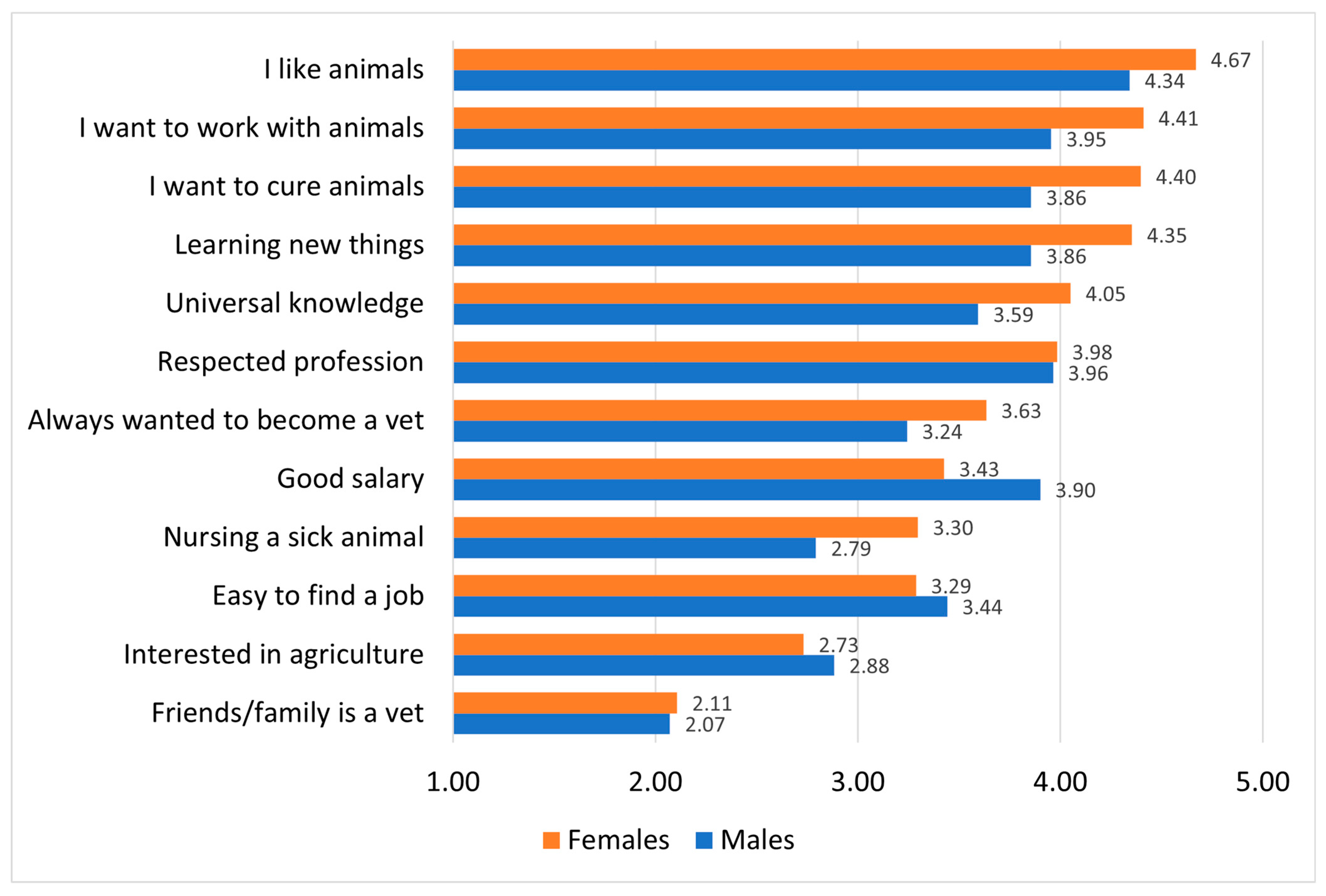
3.2. Motivational Characteristics
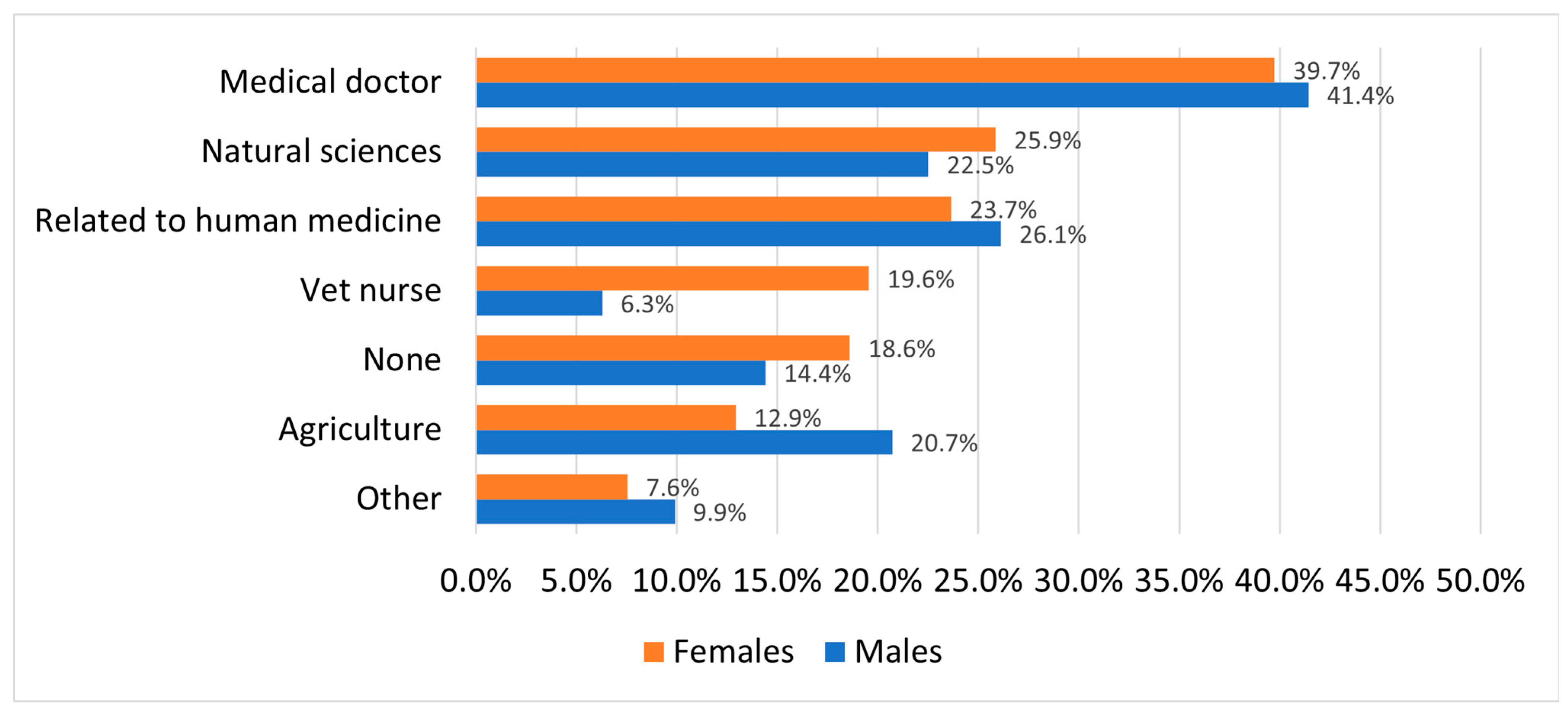
3.3. Common Alternative Career Choices
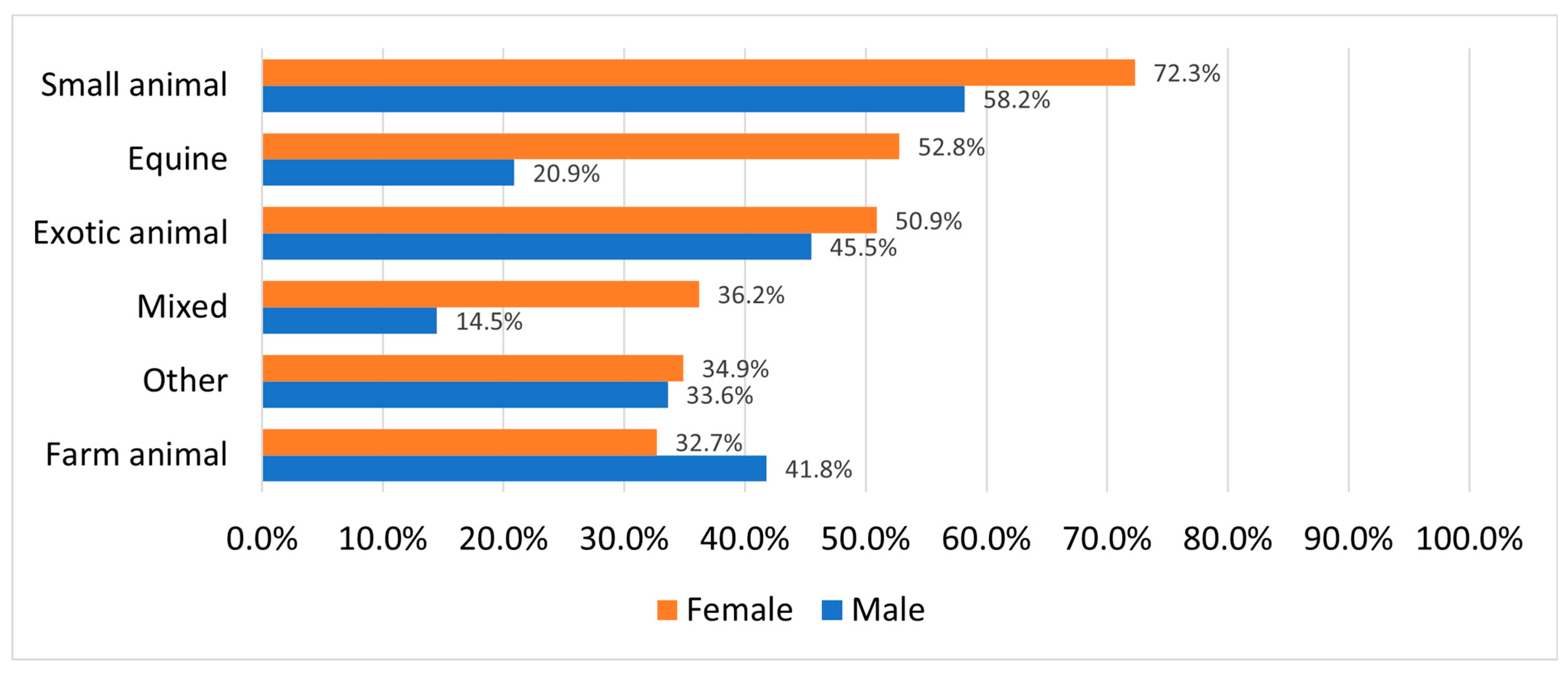
3.4. Veterinary Field Preferences
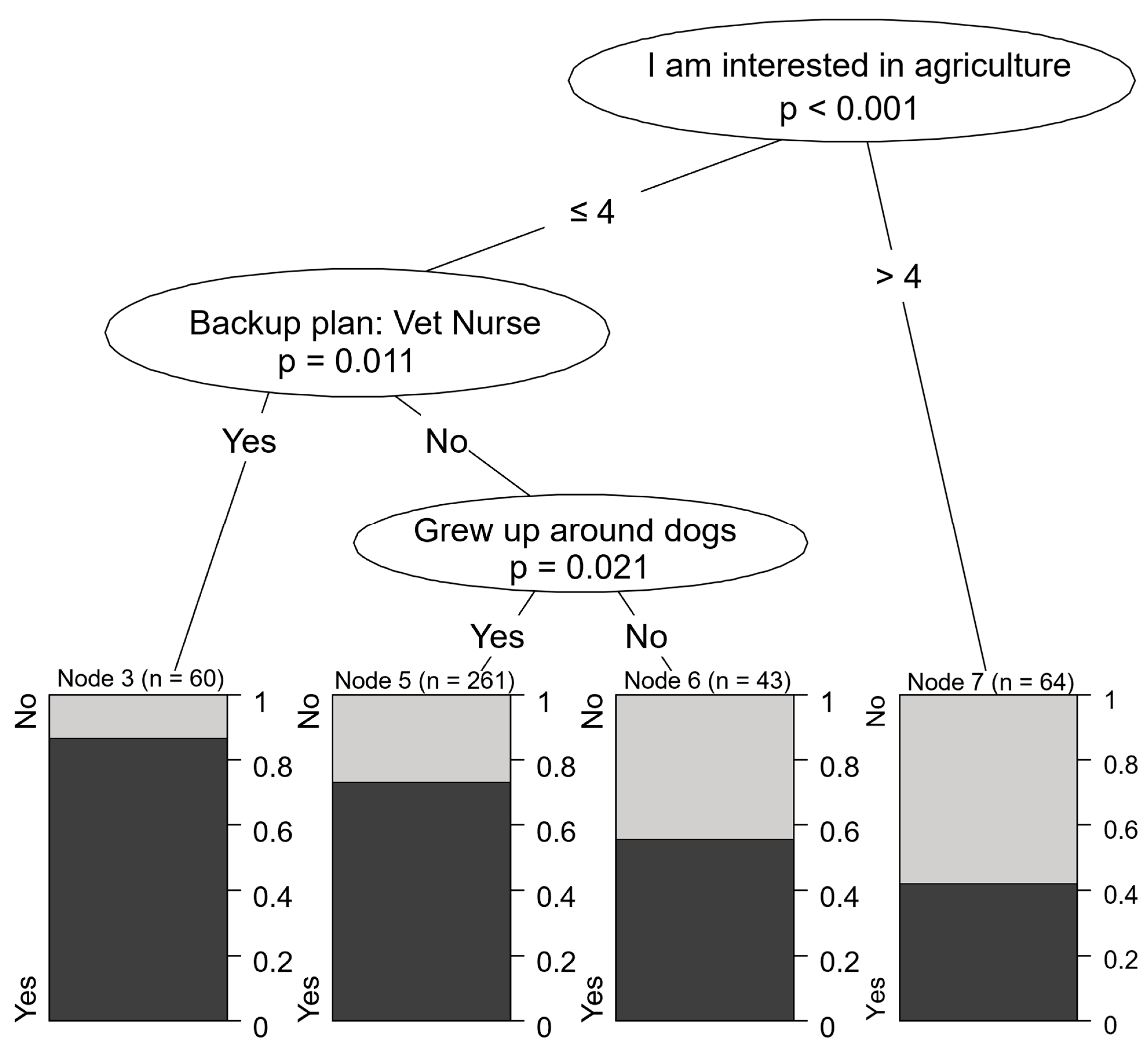
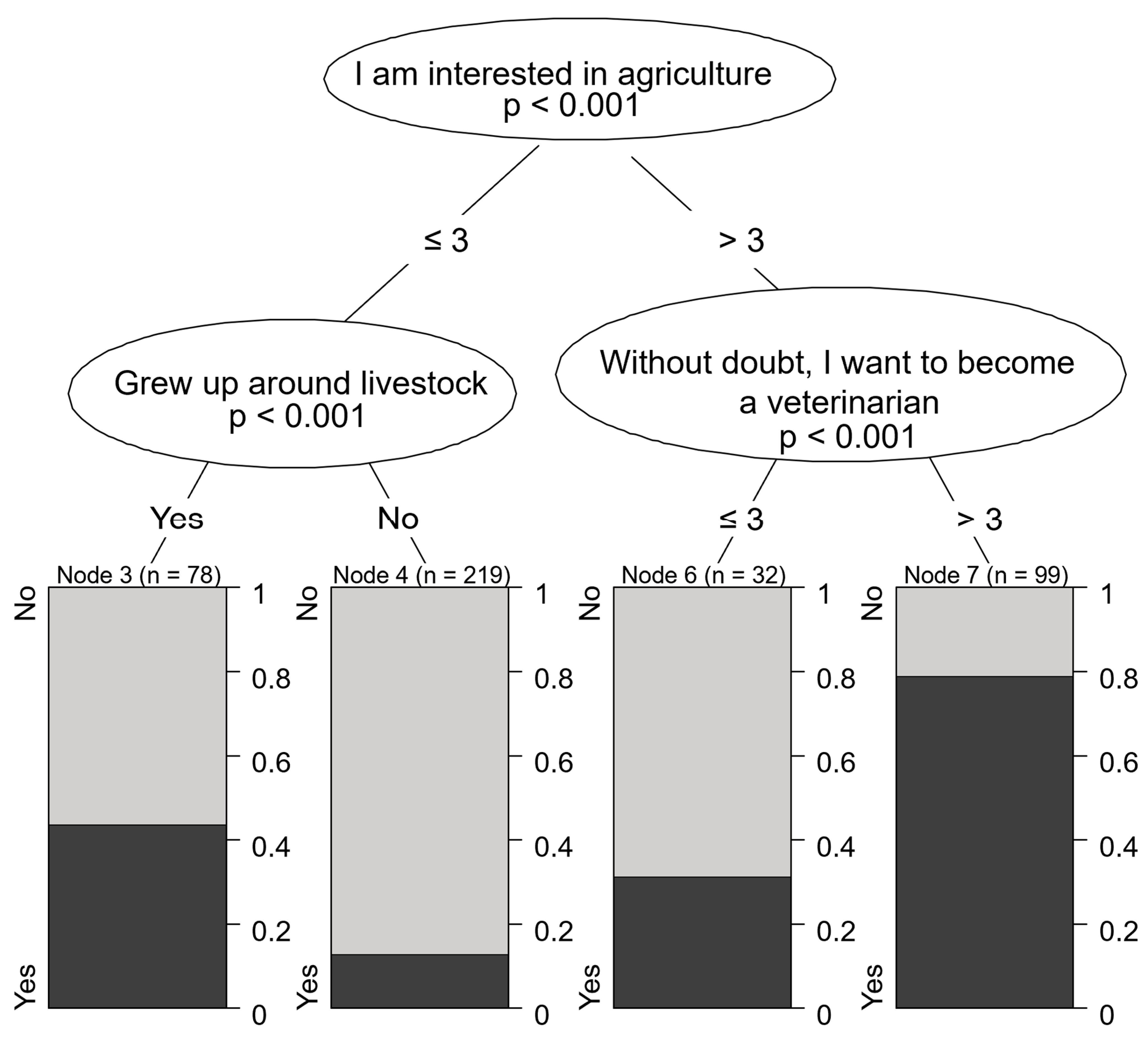
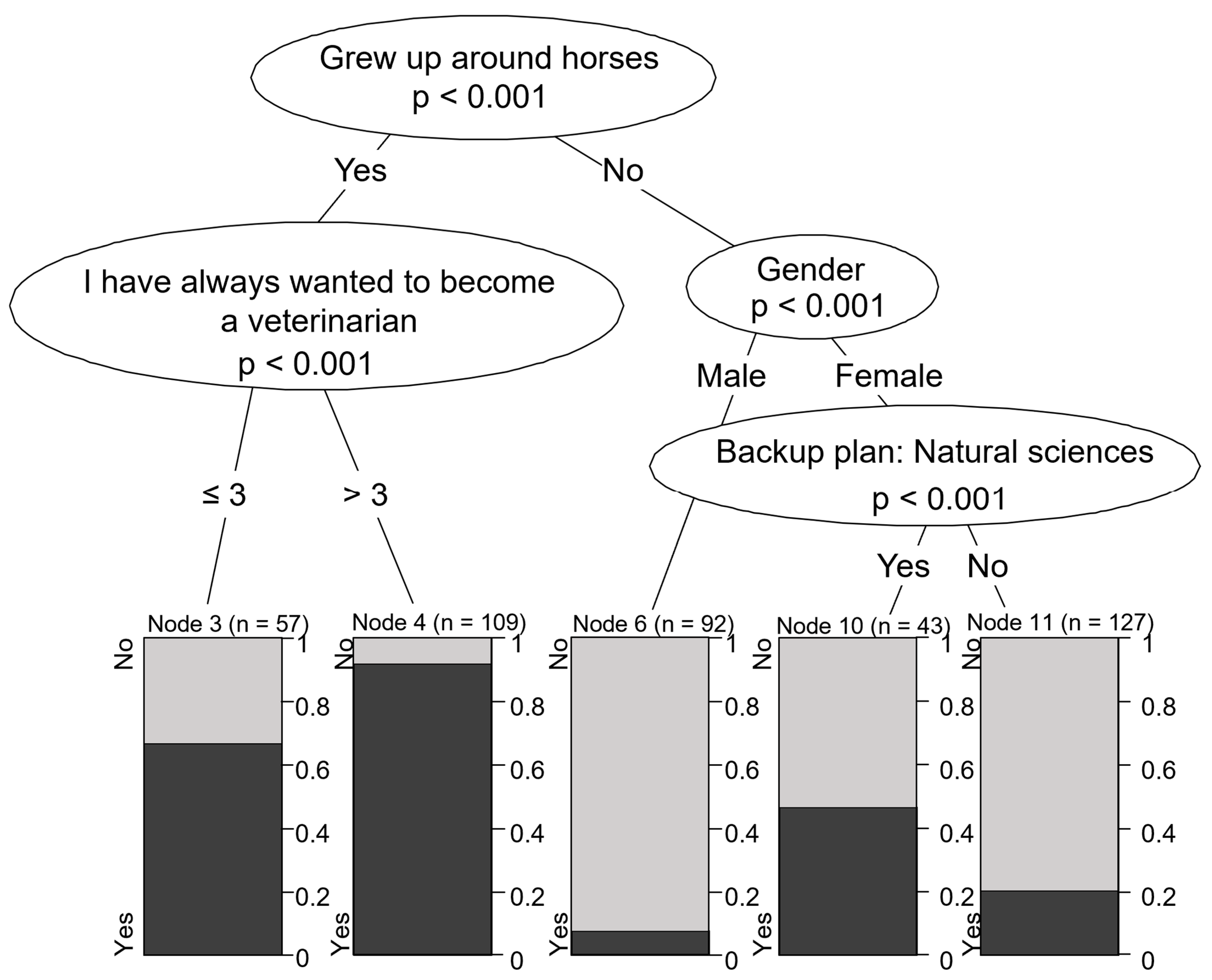
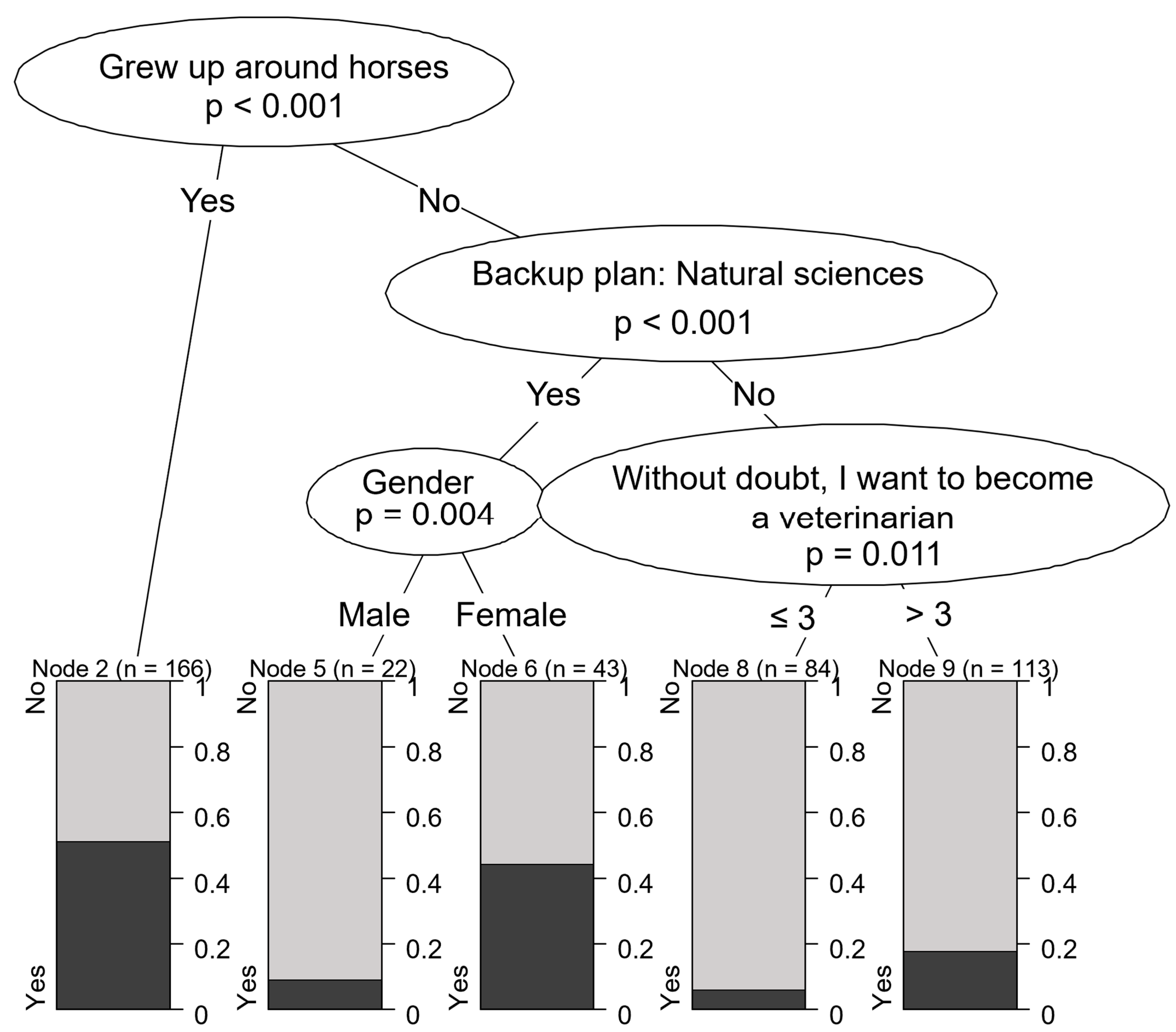
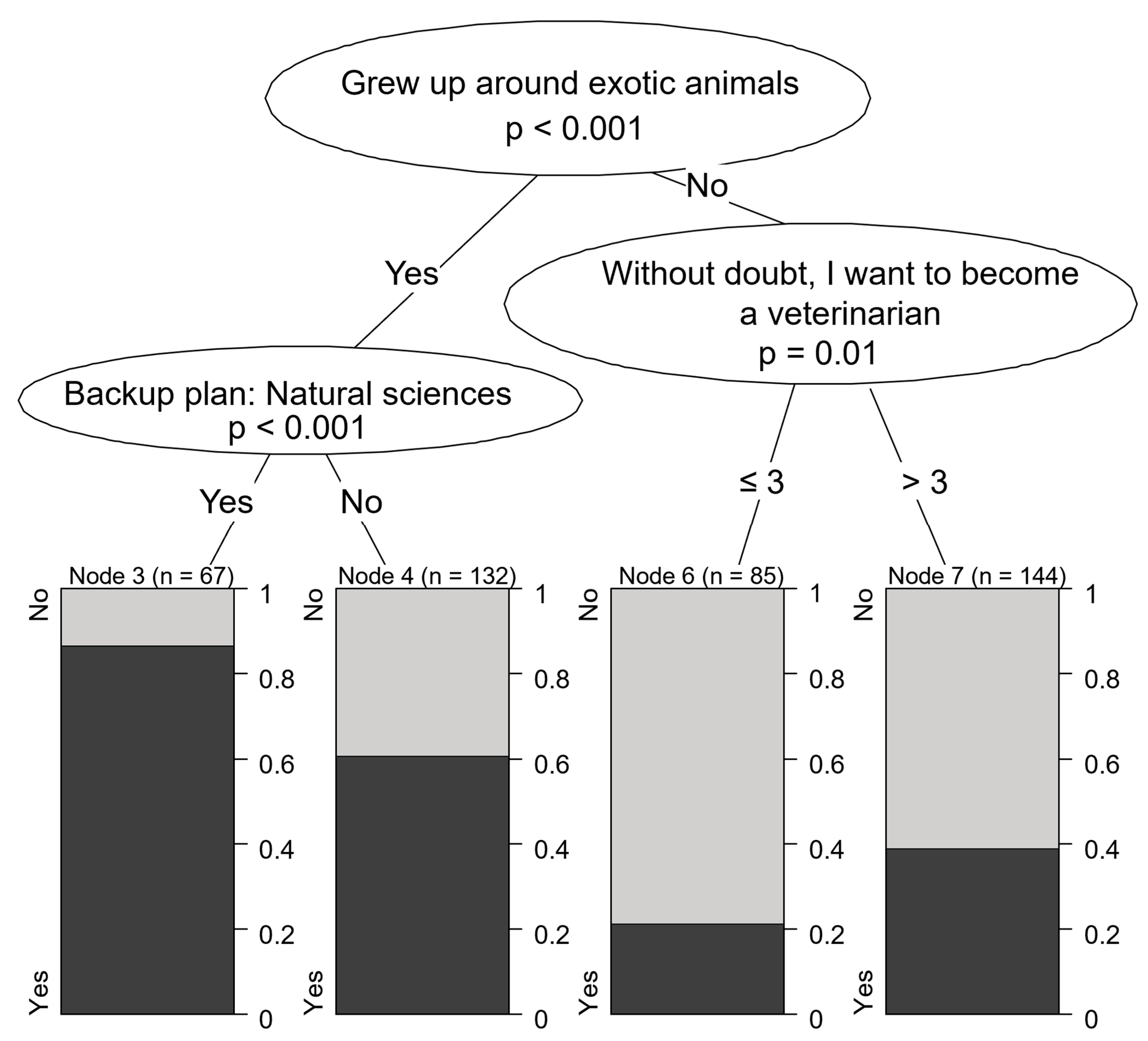
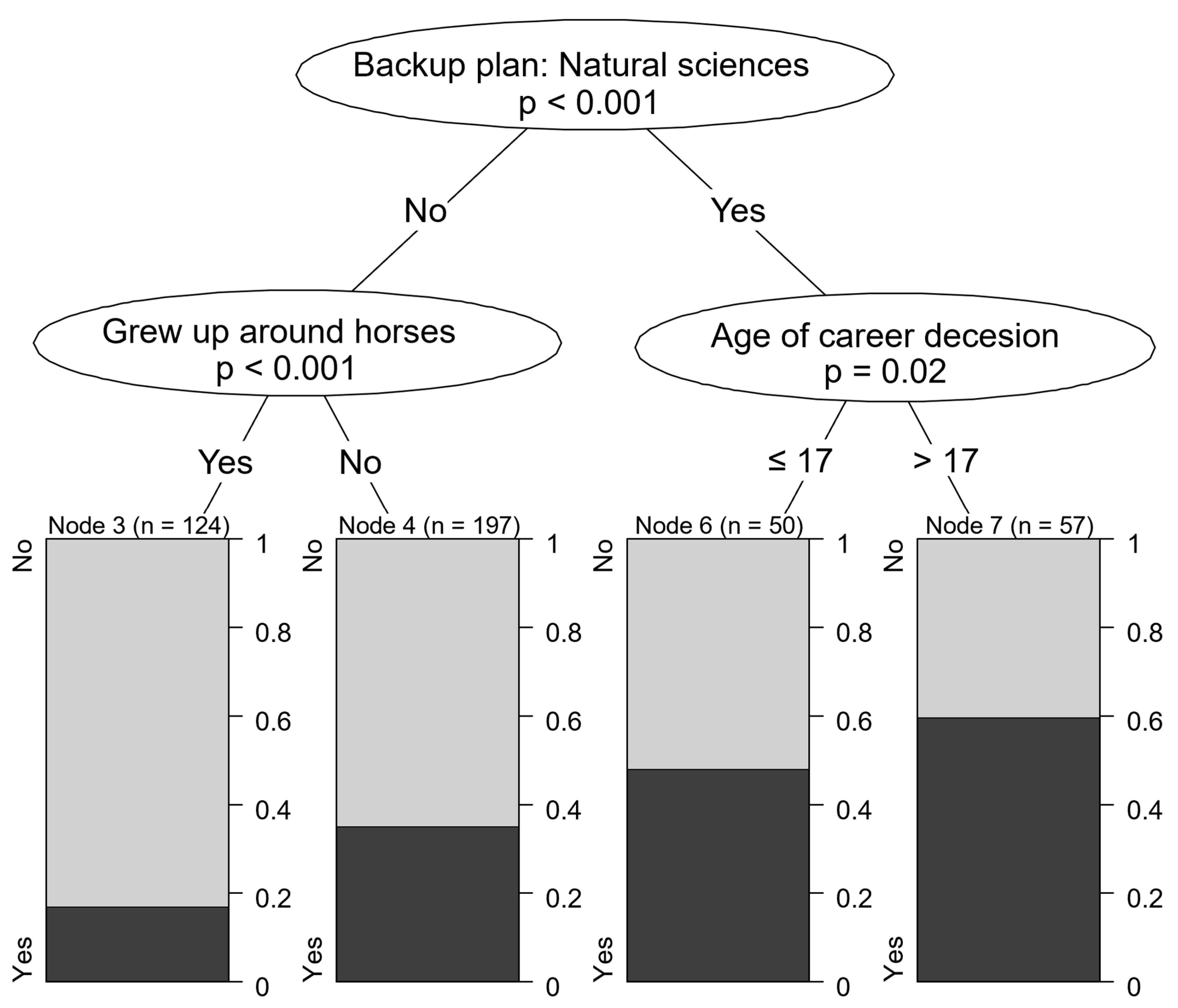
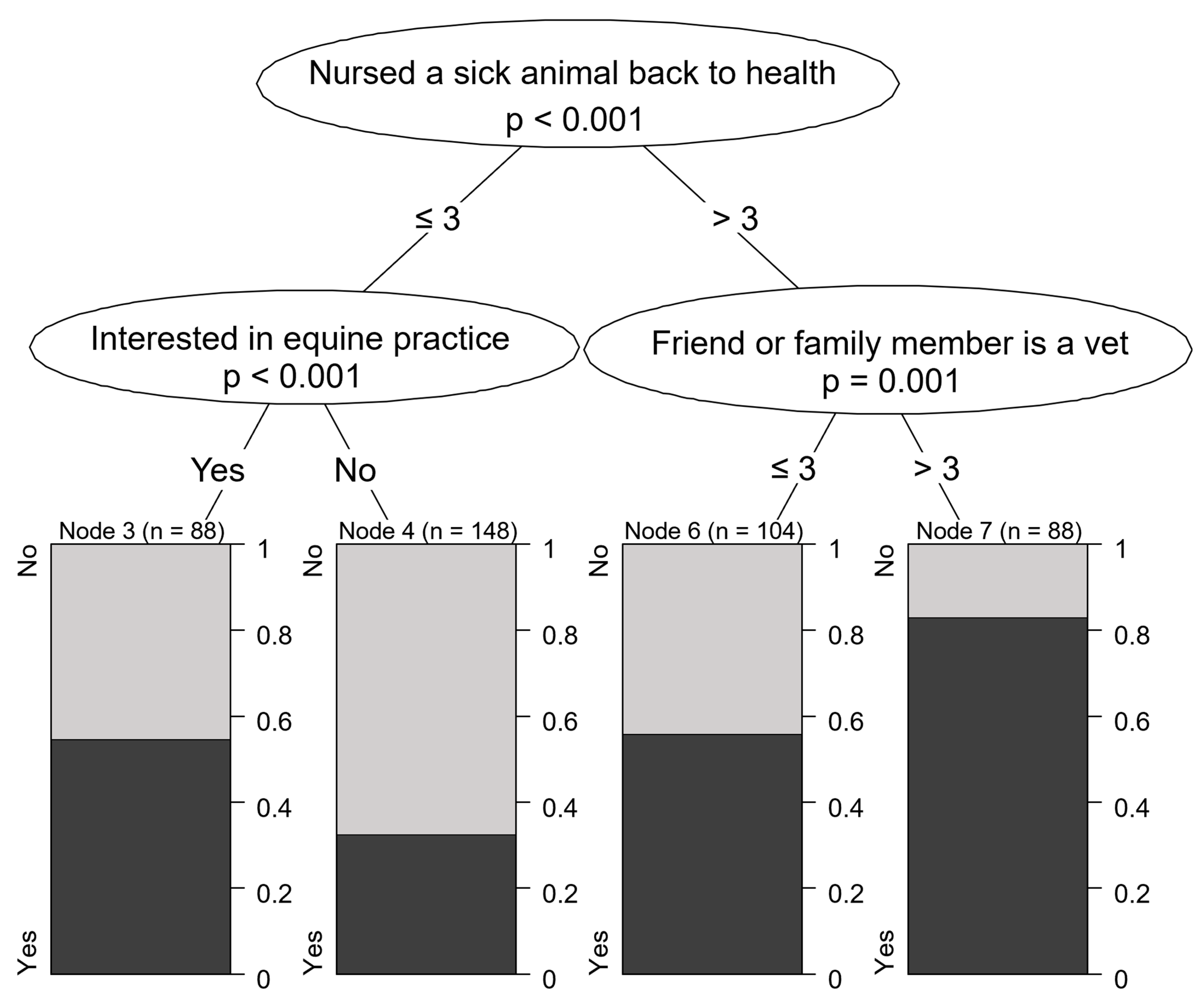
3.5. Motivational Characteristics of Veterinary Field Preferences (CART)
4. Discussion
4.1. Socio-Demographic Characteristics of Hungarian Veterinary Entrants and UVMB Admissions
4.2. Motivational Determinants of High School Students’ Career Choices
4.3. Associations Between Age, Gender, Educational Background and Career Choices
4.4. Intrinsic Motivational Characteristics
4.5. Extrinsic Motivational Characteristics
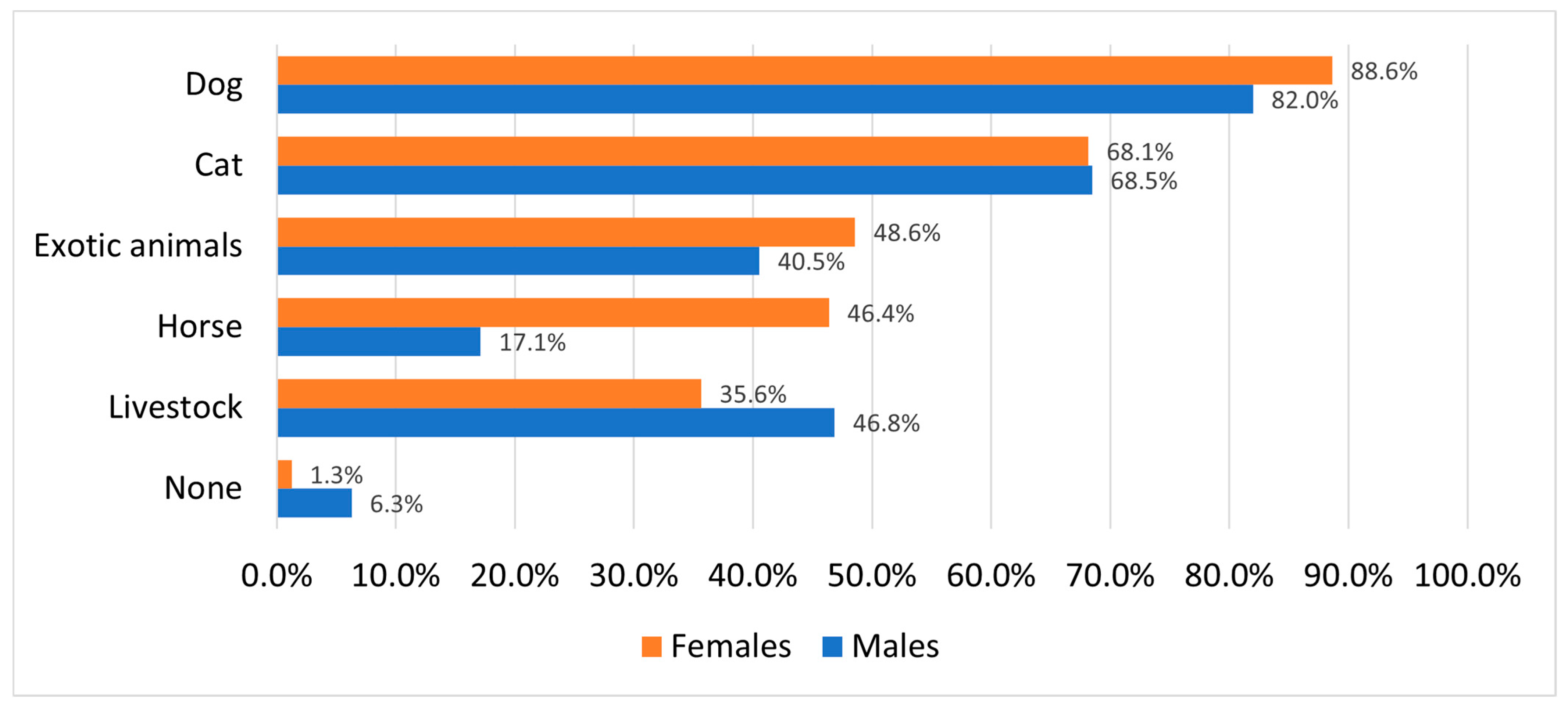
4.6. Motivation Related to Animal Exposure
4.7. Childhood Animal Exposure and Veterinary Field Choices
4.8. Consideration of Alternative Career Paths
4.9. Experiential Learning and Veterinary Career Aspirations
4.10. Limitations
5. Conclusions
Supplementary Materials
Author Contributions
Funding
Institutional Review Board Statement
Informed Consent Statement
Data Availability Statement
Acknowledgments
Conflicts of Interest
References
- Andrews, F.M. Veterinary schools admission in the United Kingdom: Attracting students to veterinary careers to meet the expanding needs of the profession and of global society. Rev. Sci. Tech. OIE 2009, 28, 699–707. [Google Scholar] [CrossRef] [Scilit]
- Bonnaud, L.; Fortané, N. Being a vet: The veterinary profession in social science research. Rev. Agric. Food Environ. Stud. 2021, 102, 125–149. [Google Scholar] [CrossRef] [Scilit]
- Kostelnik, K.; Lotz, F.; Sötje, L.; Heuwieser, W. Feminization of the veterinary profession and the shortage of food supply veterinarians. Stuttg. Tierärztliche Prax. Ausg. G Grosstiere Nutztiere 2010, 38, 156–164. [Google Scholar] [CrossRef] [Scilit]
- Fontanini, C. What are the motivations that steer women and men towards a career in veterinary medicine? In UNESCO Chair in Gender Equality and Women’s Empowerment; Université de Chypre: Nicosie, Cyprus, 2010. [Google Scholar]
- Horváth, L.; Bendzsel, D.; Ózsvári, L. The gender shift in veterinary medicine and its impact on veterinary profession in Hungary. Magy. Állatorvosok Lapja 2021, 143, 479–496. (In Hungarian) [Google Scholar]
- Dicks, M.R. A short history of veterinary workforce analyses. J. Am. Vet. Med. Assoc. 2013, 242, 1051–1060. [Google Scholar] [CrossRef] [Scilit]
- Payne, R. Encouraging student diversity: A new gateway to veterinary medicine. In Pract. 2007, 29, 356–359. [Google Scholar] [CrossRef] [Scilit]
- Robinson, D.; Munro, M.; Baldwin, S.; Pollard, E. Gateways to the Veterinary Profession: Perceptions of Veterinary Careers, 1st ed.; Institute for Employment Studies (IES): Brighton, UK, 2007; pp. 10–38. [Google Scholar]
- Gwinner, K.P.; Prince, J.B.; Andrus, D.M. Attracting students into careers in food supply veterinary medicine. J. Am. Vet. Med. Assoc. 2006, 228, 1693–1704. [Google Scholar] [CrossRef] [Scilit]
- Sprecher, D.J. Insights into the future generation of veterinarians: Perspectives gained from the 13- and 14-year-olds who attended Michigan State University’s veterinary camp, and conclusions about our obligations. J. Vet. Med. Educ. 2004, 31, 199–202. [Google Scholar] [CrossRef] [Scilit] [PubMed]
- Tomlin, J.L.; Brodbelt, D.C.; May, S.A. Influences on the decision to study veterinary medicine: Variation with sex and background. Vet. Rec. 2010, 166, 744–748. [Google Scholar] [CrossRef] [Scilit] [PubMed]
- Cake, M.A.; Mansfield, C.F.; McArthur, M.L.; Zaki, S.; Matthew, S.M. An exploration of the career motivations stated by early-career veterinarians in Australia. J. Vet. Med. Educ. 2019, 46, 545–554. [Google Scholar] [CrossRef] [Scilit] [PubMed]
- Serpell, J.A. Factors influencing veterinary students’ career choices and attitudes to animals. J. Vet. Med. Educ. 2005, 32, 491–496. [Google Scholar] [CrossRef] [Scilit]
- Fizer, D. Factors Affecting Career Choices of College Students Enrolled in Agriculture. Master’s Thesis, The University of Tennessee, Martin, TN, USA, 2013. [Google Scholar]
- Vansteenkiste, M.; Lens, W.; Deci, E.L. Intrinsic versus extrinsic goal contents in self-determination theory: Another look at the quality of academic motivation. Educ. Psychol. 2006, 41, 19–31. [Google Scholar] [CrossRef] [Scilit]
- Cook, D.A.; Artino, A.R., Jr. Motivation to learn: An overview of contemporary theories. Med. Educ. 2016, 50, 997–1014. [Google Scholar] [CrossRef] [Scilit]
- Meglino, B.M.; Korsgaard, M.A. Considering situational and dispositional approaches to rational self-interest: An extension and response to De Dreu (2006). J. Appl. Psychol. 2006, 91, 1253–1259. [Google Scholar] [CrossRef] [Scilit] [PubMed]
- Feakes, A.; Lindsay, N.; Palmer, E.; Steffens, P. Altruism or self-interest in tomorrow’s veterinarians? A metric conjoint experiment and cluster analysis. Front. Vet. Sci. 2023, 10, 1044463. [Google Scholar] [CrossRef] [Scilit] [PubMed]
- McGaghie, W.C.; Mytko, J.J.; Brown, W.N.; Cameron, J.R. Altruism and compassion in the health professions: A search for clarity and precision. Med. Teach. 2002, 24, 374–378. [Google Scholar] [CrossRef] [Scilit]
- Cake, M.; McArthur, M.L.; Mansfield, C.F.; Zaki, S.; Carbonneau, K.; Matthew, S.M. Challenging identity: Development of a measure of veterinary career motivations. Vet. Rec. 2020, 186, 386. [Google Scholar] [CrossRef] [Scilit] [PubMed]
- Szücs, L.; Bárdos, K.; Máté, M.; Ózsvári, L. Motivation factors for the Hungarian veterinary students’ carrier choice between 2016 and 2020. Magy. Állatorvosok Lapja 2023, 145, 455–469. (In Hungarian) [Google Scholar] [CrossRef] [Scilit]
- Langlands, A. The Gateways to the Professions Report, 1st ed.; Department for Education and Skills: London, UK, 2005; pp. 73–75. [Google Scholar]
- Krishna, B.; Sharma, G.; Harilal, R.; Suresh, J. Relationship between achievement motivation and risk preference with career preferences of veterinary students in Andhra Pradesh. Int. J. Sci. Environ. Technol. 2017, 6, 1985–1988. [Google Scholar]
- Mughal, H.; O’Neill, T.A.; Le Huray, L.; Bergman, M.; Remnant, J.; Galezowski, A.M.; Hecker, K.G.; McCorkell, R. Understanding the motivations, deterrents, and incentives for rural Albertan veterinary practice. Front. Vet. Sci. 2025, 12, 1633149. [Google Scholar] [CrossRef] [Scilit]
- Windsor, P. Can curriculum innovations create incentives for young veterinarians to practise in remote rural areas? Rev. Sci. Tech. 2009, 28, 689–697. [Google Scholar] [CrossRef] [Scilit]
- Holzer, B.M.; Ramuz, O.; Minder, C.E.; Zimmerli, L. Motivation and personality factors of Generation Z high school students aspiring to study human medicine. BMC Med. Educ. 2022, 22, 31. [Google Scholar] [CrossRef] [Scilit]
- Haase, H.; Lautenschläger, A. Career choice motivations of university students. Int. J. Bus. Adm. 2011, 2, 2. [Google Scholar] [CrossRef] [Scilit]
- Aeschlimann, B.; Herzog, W.; Makarova, E. How to foster students’ motivation in mathematics and science classes and promote students’ STEM career choice: A study in Swiss high schools. Int. J. Educ. Res. 2016, 79, 31–41. [Google Scholar] [CrossRef] [Scilit]
- Aschbacher, P.R.; Li, E.; Roth, E.J. Is science me? High school students’ identities, participation and aspirations in science, engineering, and medicine. J. Res. Sci. Teach. 2009, 47, 564–582. [Google Scholar] [CrossRef] [Scilit]
- Böckler, A.; Tusche, A.; Singer, T. The structure of human prosociality: Differentiating altruistically motivated, norm motivated, strategically motivated, and self-reported prosocial behavior. Soc. Psychol. Personal. Sci. 2016, 7, 530–541. [Google Scholar] [CrossRef] [Scilit]
- R Core Team. R: A Language and Environment for Statistical Computing; R Foundation for Statistical Computing: Vienna, Austria, 2021. Available online: https://www.R-project.org/ (accessed on 25 March 2025).
- Federation of Veterinarians of Europe (FVE). Third Survey of the Veterinary Profession in Europe 2023, 1st ed.; FVE: Brussels, Belgium, 2023; 171p. [Google Scholar]
- Villarroel, A.; McDonald, S.R.; Walker, W.L.; Kaiser, L.; Dewell, R.D.; Dewell, G.A. A survey of reasons why veterinarians enter rural veterinary practice in the United States. J. Am. Vet. Med. Assoc. 2010, 236, 849–857. [Google Scholar] [CrossRef] [Scilit]
- Makarova, E.; Aeschlimann, B.; Herzog, W. The gender gap in STEM fields: The impact of the gender stereotype of math and science on secondary students’ career aspirations. Front. Educ. 2019, 4, 60. [Google Scholar] [CrossRef] [Scilit]
- Eccles, J.S.; Wigfield, A. Motivational beliefs, values, and goals. Annu. Rev. Psychol. 2002, 53, 109–132. [Google Scholar] [CrossRef] [Scilit]
- Kogan, L.R.; McConnell, S.L.; Schoenfeld-Tacher, R. Veterinary students and non-academic stressors. J. Vet. Med. Educ. 2005, 32, 193–200. [Google Scholar] [CrossRef] [Scilit]
- Burks, D.J.; Kobus, A.M. The legacy of altruism in health care: The promotion of empathy, prosociality and humanism. Med. Educ. 2012, 46, 317–325. [Google Scholar] [CrossRef] [Scilit] [PubMed]
- Byrne, N. Differences in types and levels of altruism based on gender and program. J. Allied Health 2008, 37, 22–29. [Google Scholar]
- Sans, P.; Mounier, L.; Bénet, J.J.; Lijour, B. The motivations and practice-area interests of first-year French veterinary students (2005–2008). J. Vet. Med. Educ. 2011, 38, 199–207. [Google Scholar] [CrossRef] [Scilit]
- Edemeka, D.; Ajagbonna, O. Career motivation and specialty choice of veterinary medical students at Usmanu Danfodiyo University, Sokoto, Nigeria. Glob. J. Pure Appl. Sci. 2004, 10, 43–45. [Google Scholar] [CrossRef] [Scilit]
- Bae, Y.; Smith, T.M. Issues in Focus: Women in Mathematics and Science, 1st ed.; U.S. Department of Education: Washington, DC, USA, 1997.
- Jelinski, M.D.; Campbell, J.R.; Naylor, J.M.; Lawson, K.L.; Derkzen, D. Factors affecting the career path choices of graduates at the Western College of Veterinary Medicine. Can. Vet. J. 2008, 49, 161–166. [Google Scholar]
- Payne, E.; Cobb, K.; Oldham, J.; Remnant, J. Attitudes of UK veterinary students towards careers in the production animal sector: A mixed methods approach. Vet. Rec. 2021, 189, e455. [Google Scholar] [CrossRef] [Scilit] [PubMed]
- Feakes, A.M.; Palmer, E.J.; Petrovski, K.R.; Thomsen, D.A.; Hyams, J.H.; Cake, M.A.; Webster, B.; Barber, S.R. Predicting career sector intent and the theory of planned behaviour: Survey findings from Australian veterinary science students. BMC Vet. Res. 2019, 15, 27. [Google Scholar] [CrossRef] [Scilit]
- Ajzen, I. The theory of planned behavior. Organ. Behav. Hum. Decis. Process. 1991, 50, 179–211. [Google Scholar] [CrossRef] [Scilit]
- Haarhuis, J.C.M.; Muijtjens, A.M.M.; Scherpbier, A.J.J.A.; van Beukelen, P. An admissions system to select veterinary medical students with an interest in food animals and veterinary public health. J. Vet. Med. Educ. 2009, 36, 2–6. [Google Scholar] [CrossRef] [Scilit]
- Girasek, E. Orvosok Pályaválasztása. Master’s Thesis, Eötvös Loránd Tudományegyetem, Társadalomtudományi Kar, Budapest, Hungary, 2006. [Google Scholar]
- Alexopoulos, A.N.; Paolucci, P.; Sotiriou, S.A.; Bogner, F.X.; Dorigo, T.; Fedi, M.; Menasce, D.; Michelotto, M.; Paoletti, S.; Scianitti, F. The colours of the Higgs boson: A study in creativity and science motivation among high-school students in Italy. Smart Learn. Environ. 2021, 8, 23. [Google Scholar] [CrossRef] [Scilit]
- Hiller, S.E.; Kitsantas, A. The effect of a horseshoe crab citizen science program on middle school student science performance and STEM career motivation: Citizen science career motivation. Sch. Sci. Math. 2014, 114, 302–311. [Google Scholar] [CrossRef] [Scilit]



| Socio-Demographic Characteristics | Females | Males | Capital | County Seat | City | Township/Village |
|---|---|---|---|---|---|---|
| N | 317 | 111 | 88 | 82 | 157 | 101 |
| Gender | ||||||
| Females | - | - | 80.7% | 72.0% | 74.5% | 69.3% |
| Males | - | - | 19.3% | 28.0% | 25.5% | 30.7% |
| Age | ||||||
| Mean | 17.6 | 18.2 | 17.5 | 18.1 | 17.7 | 17.8 |
| SD | ±2.5 | ±5.3 | ±3.1 | ±3.4 | ±3.7 | ±3.5 |
| Age of career decision (years) | 10.9 | 12.8 | 12.0 | 11.6 | 11.3 | 10.8 |
| Secondary education | ||||||
| Specialized high school | 22.7% | 19.8% | 31.8% | 26.8% | 17.8% | 15.8% |
| General high school | 72.2% | 70.3% | 64.8% | 68.3% | 79.6% | 68.3% |
| Technical school | 3.8% | 9.9% | 2.3% | 1.2% | 2.5% | 15.8% |
| Motivational Characteristics | Females | Males | ||||
|---|---|---|---|---|---|---|
| Mean | SD | IQR | Mean | SD | IQR | |
| Friends/family is a vet | 2.11 | 1.38 | 2 | 2.07 | 1.15 | 2 |
| Interested in agriculture | 2.73 | 1.33 | 2 | 2.88 | 1.43 | 2 |
| Nursing a sick animal | 3.30 | 1.43 | 3 | 2.79 | 1.27 | 2 |
| Easy to find a job | 3.29 | 1.22 | 2 | 3.44 | 1.35 | 3 |
| Good salary | 3.43 | 1.17 | 1 | 3.90 | 1.18 | 2 |
| Respected profession | 3.98 | 1.17 | 1 | 3.96 | 1.23 | 2 |
| Always wanted to become a vet | 3.63 | 1.32 | 2 | 3.24 | 1.23 | 2 |
| Universal knowledge | 4.05 | 1.18 | 2 | 3.59 | 1.32 | 2 |
| Learning new things | 4.35 | 0.98 | 1 | 3.86 | 1.17 | 2 |
| I want to work with animals | 4.41 | 1.02 | 1 | 3.95 | 1.21 | 2 |
| I want to cure animals | 4.40 | 0.95 | 1 | 3.86 | 1.04 | 2 |
| I like animals | 4.67 | 0.85 | 0 | 4.34 | 1.03 | 1 |
| Preferred Professional Fields | Gender | Childhood Animal Exposure (Species Present in the Household or Experienced) | ||||
|---|---|---|---|---|---|---|
| Females | Males | Dogs/Cats | Horses | Livestock | Exotic Animals | |
| Small animal practice | 72.6% | 57.7% | 78.9% | 63.3% | 63.0% | 74.1% |
| Equine practice | 53.0% | 20.7% | 9.9% | 83.1% | 53.3% | 46.3% |
| Exotic animal practice | 34.4% | 28.8% | 29.6% | 24.1% | 23.0% | 50.2% |
| Laboratory work | 23.7% | 23.4% | 22.5% | 14.5% | 21.8% | 28.9% |
| Farm animal practice | 32.8% | 41.4% | 1.4% | 39.8% | 63.6% | 39.3% |
| Academic career | 12.6% | 13.5% | 21.1% | 7.2% | 8.5% | 15.4% |
| Veterinary public health | 8.2% | 8.1% | 2.8% | 8.4% | 13.3% | 9.5% |
Disclaimer/Publisher’s Note: The statements, opinions and data contained in all publications are solely those of the individual author(s) and contributor(s) and not of MDPI and/or the editor(s). MDPI and/or the editor(s) disclaim responsibility for any injury to people or property resulting from any ideas, methods, instructions or products referred to in the content. |
© 2025 by the authors. Licensee MDPI, Basel, Switzerland. This article is an open access article distributed under the terms and conditions of the Creative Commons Attribution (CC BY) license (https://creativecommons.org/licenses/by/4.0/).
Share and Cite
Szücs, L.; Fehérvári, P.; Ózsvári, L. Predicting Veterinary Career Intentions Using Motivational Characteristics: A Survey Study Among Hungarian Students. Vet. Sci. 2025, 12, 1189. https://doi.org/10.3390/vetsci12121189
Szücs L, Fehérvári P, Ózsvári L. Predicting Veterinary Career Intentions Using Motivational Characteristics: A Survey Study Among Hungarian Students. Veterinary Sciences. 2025; 12(12):1189. https://doi.org/10.3390/vetsci12121189
Chicago/Turabian StyleSzücs, Laura, Péter Fehérvári, and László Ózsvári. 2025. "Predicting Veterinary Career Intentions Using Motivational Characteristics: A Survey Study Among Hungarian Students" Veterinary Sciences 12, no. 12: 1189. https://doi.org/10.3390/vetsci12121189
APA StyleSzücs, L., Fehérvári, P., & Ózsvári, L. (2025). Predicting Veterinary Career Intentions Using Motivational Characteristics: A Survey Study Among Hungarian Students. Veterinary Sciences, 12(12), 1189. https://doi.org/10.3390/vetsci12121189